
A complete issue · 36 pages · 1924
Judge — January 12, 1924
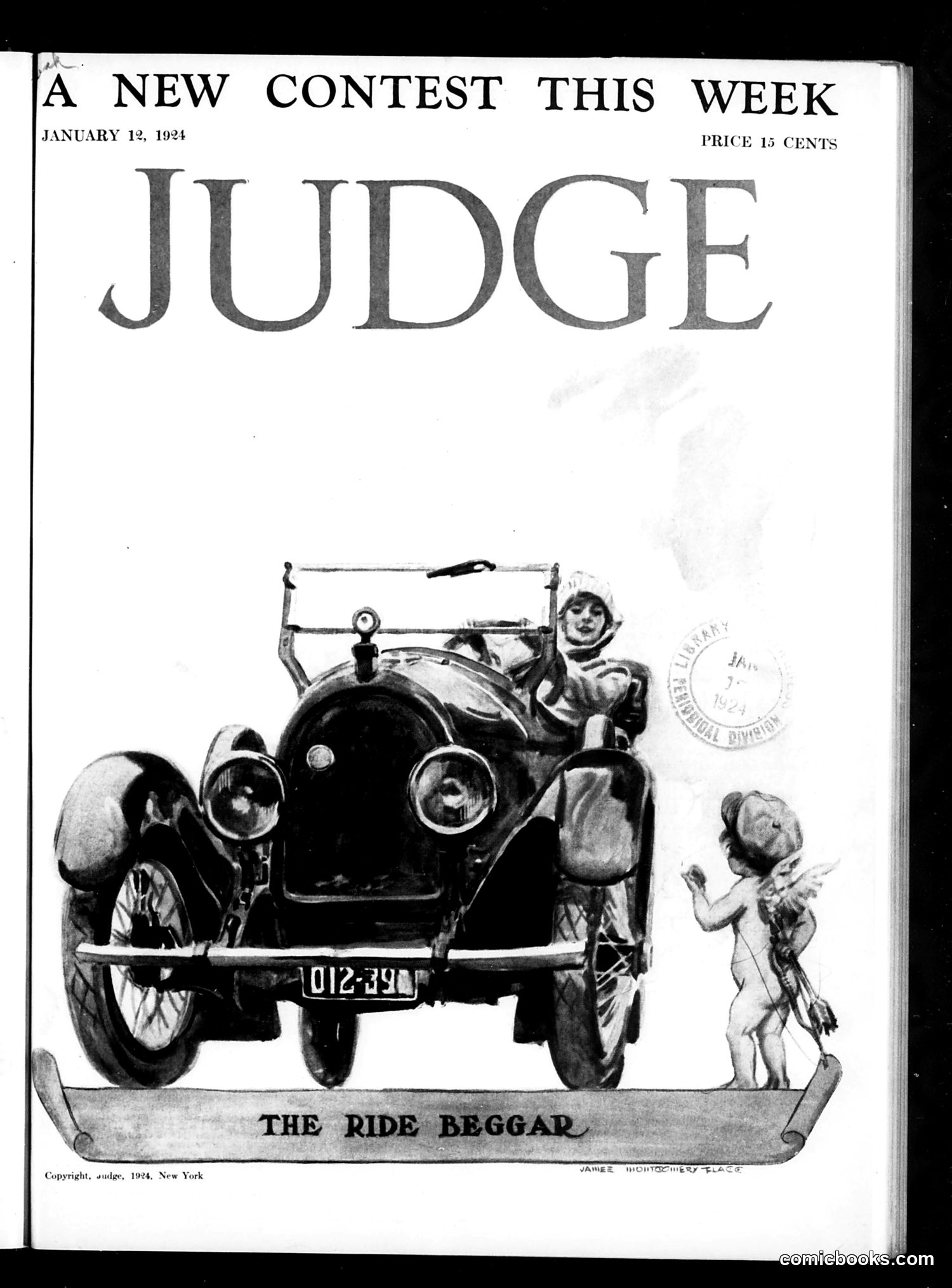
This cartoon satirizes hitchhiking or panhandling for automobile rides, a social phenomenon of the 1920s. A cherub or cupid figure stands beside a fancy touring car, apparently soliciting a ride from the well-dressed occupants. The title "The Ride Beggar" suggests this was a recognizable social type—people who stood on roadsides asking for lifts, similar to modern hitchhiking. The satire likely comments on either the proliferation of such panhandlers or the absurdity of asking strangers for automotive passage during an era when private cars were becoming increasingly common status symbols. The heavenly cherub adds a humorous, whimsical touch to the mundane social problem being mocked.
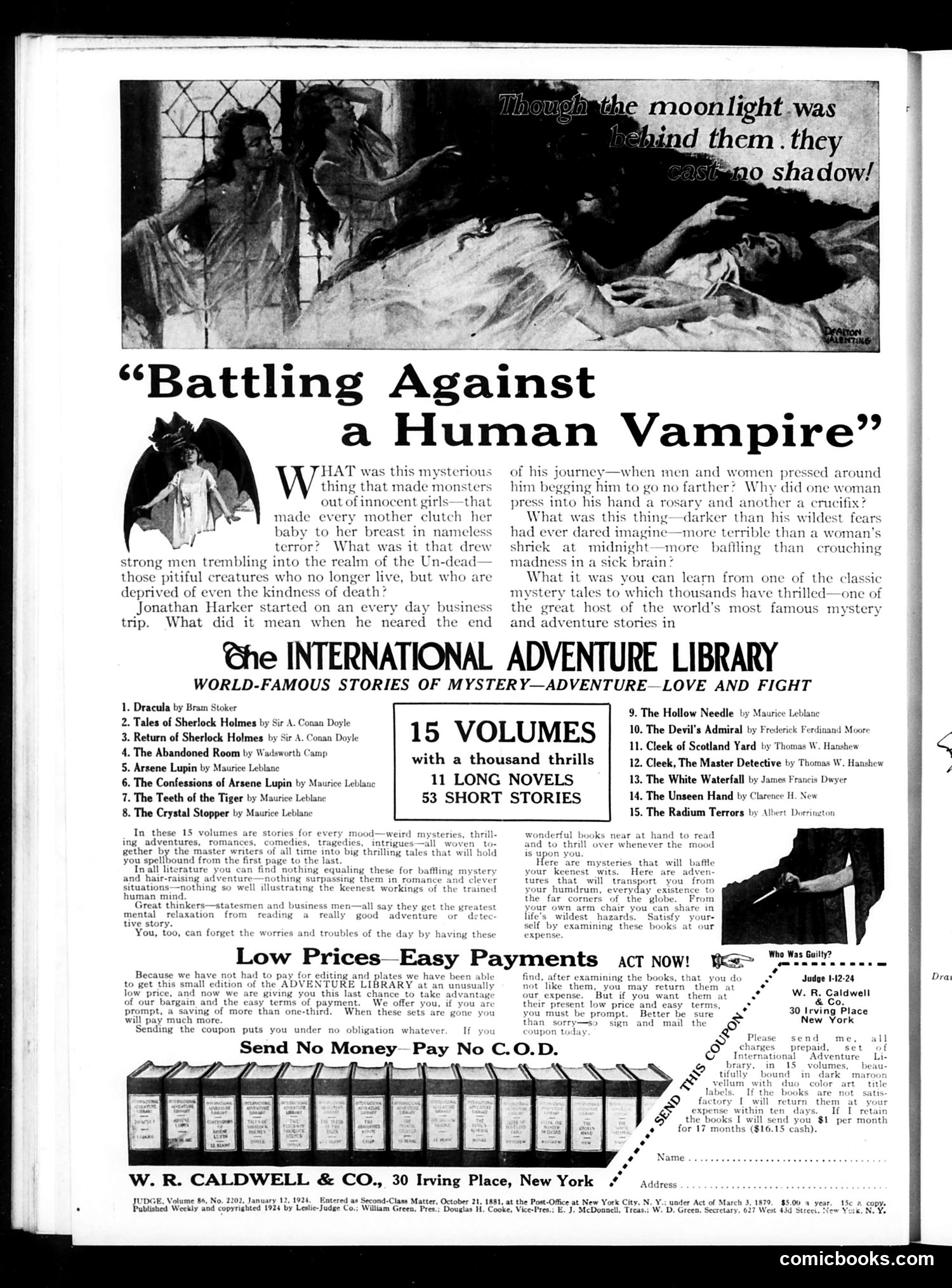
This page is primarily **advertising**, not political satire. The dominant content is a promotional spread for the "International Adventure Library"—a 15-volume book collection marketed by W. R. Caldwell & Co. The advertisement uses a melodramatic illustration titled "Battling Against a Human Vampire" depicting a nighttime scene with figures in apparent distress. This imagery is designed to entice readers with promises of thrilling mystery and adventure stories. The copy emphasizes classic tales like Dracula and Sherlock Holmes stories, appealing to readers' desire for "mystery—adventure—love and fight." The marketing strategy emphasizes low prices and easy payment terms ("Send No Money—Pay No C.O.D."). The page contains no clear political commentary or social satire—it's a straightforward product advertisement using sensationalized imagery and Gothic themes to sell books.
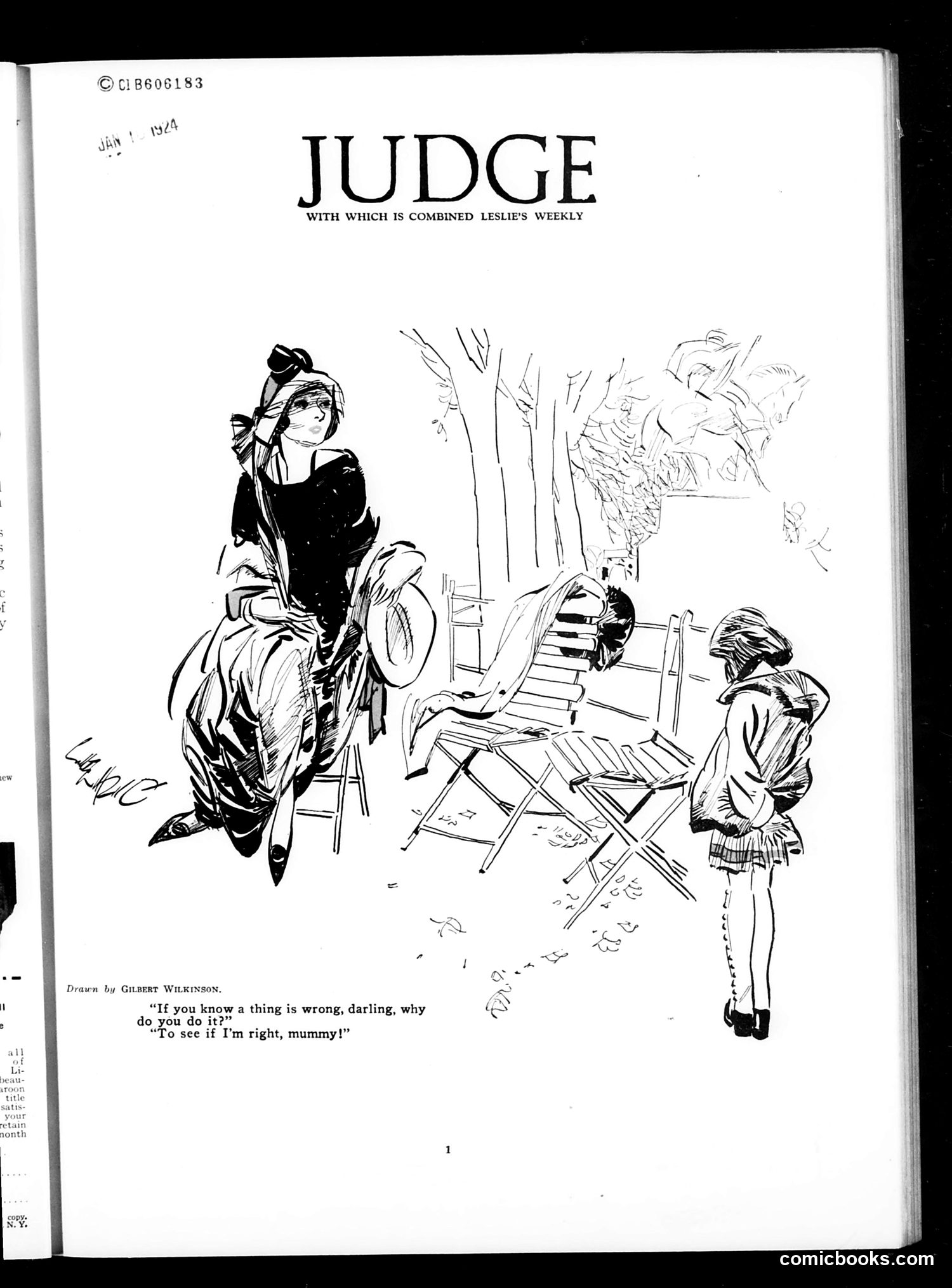
This cartoon by Gilbert Wilkinson depicts a domestic scene where a woman (likely the mother) is correcting a child's behavior. The child protests the correction with "If you know a thing is wrong, darling, why do you do it?" followed by "To see if I'm right, mummy!" The satire targets parental hypocrisy—the adult's contradictory behavior and reasoning. The child's logical retort exposes the absurdity of the mother's position: she claims to know something is wrong yet does it anyway, then expects the child to obey different standards. This reflects early 20th-century social commentary on inconsistent parenting and the gap between adult moral instruction and actual behavior. The humor derives from the child's precocious logic turning the tables on parental authority.
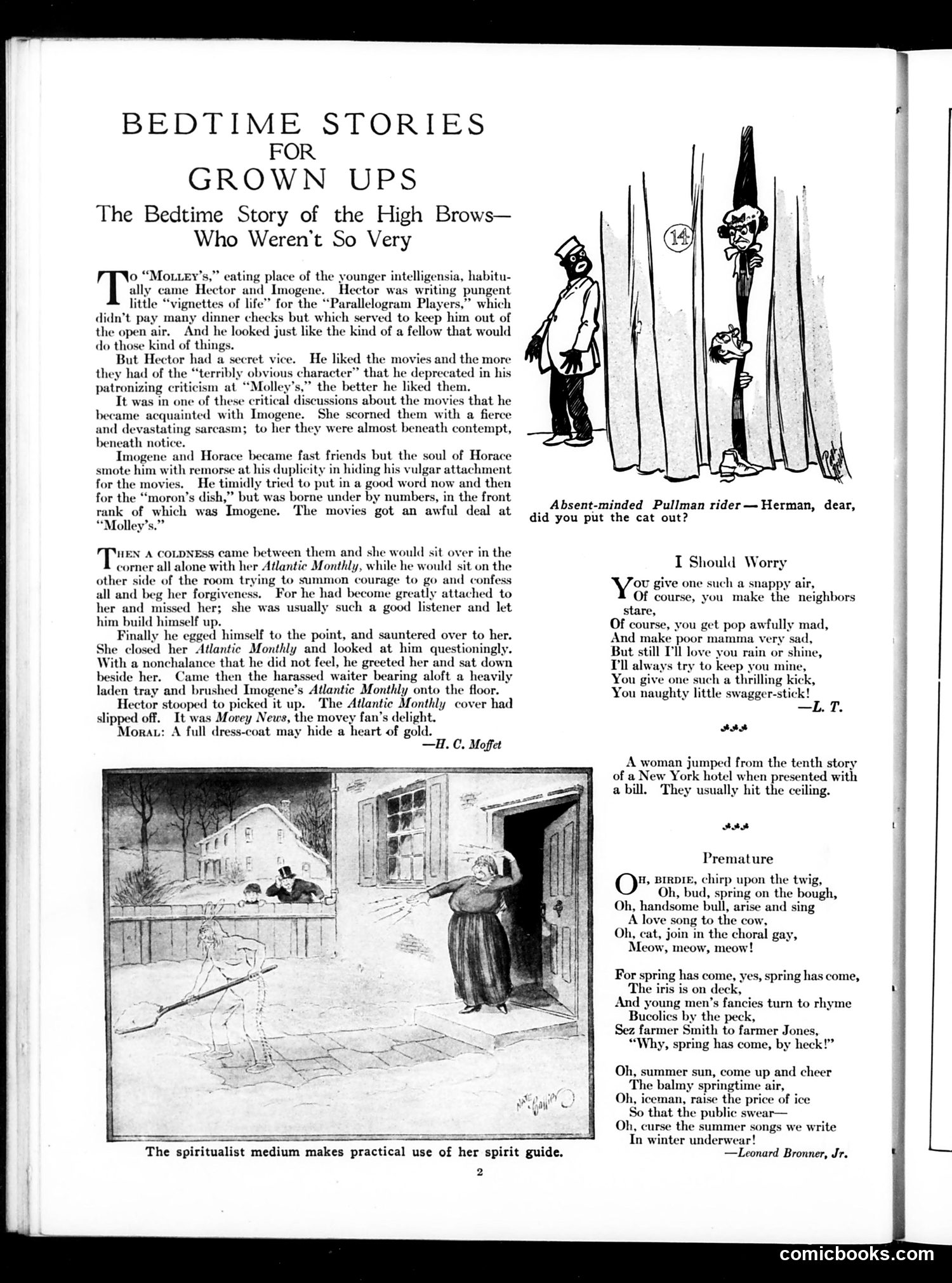
This page contains a bedtime story satirizing highbrow literary critics. The narrative mocks Hector, a pretentious writer for "Parallelepiped Players" who disparages movies, and Imogene, who loves them. Their friendship fractures over cinematic taste—Hector considers films culturally beneath him while Imogene champions them. The satire targets intellectual snobbery about popular entertainment. The moral ("A full dress-coat may hide a heart of gold") suggests that refined appearance masks narrow-mindedness. The accompanying cartoon depicts a spiritualist medium, likely ridiculing pseudoscientific practices. Below are poems ("I Should Worry," "Premature") unrelated to the story—typical Judge filler content mixing humor, satire, and verse on varied topics.
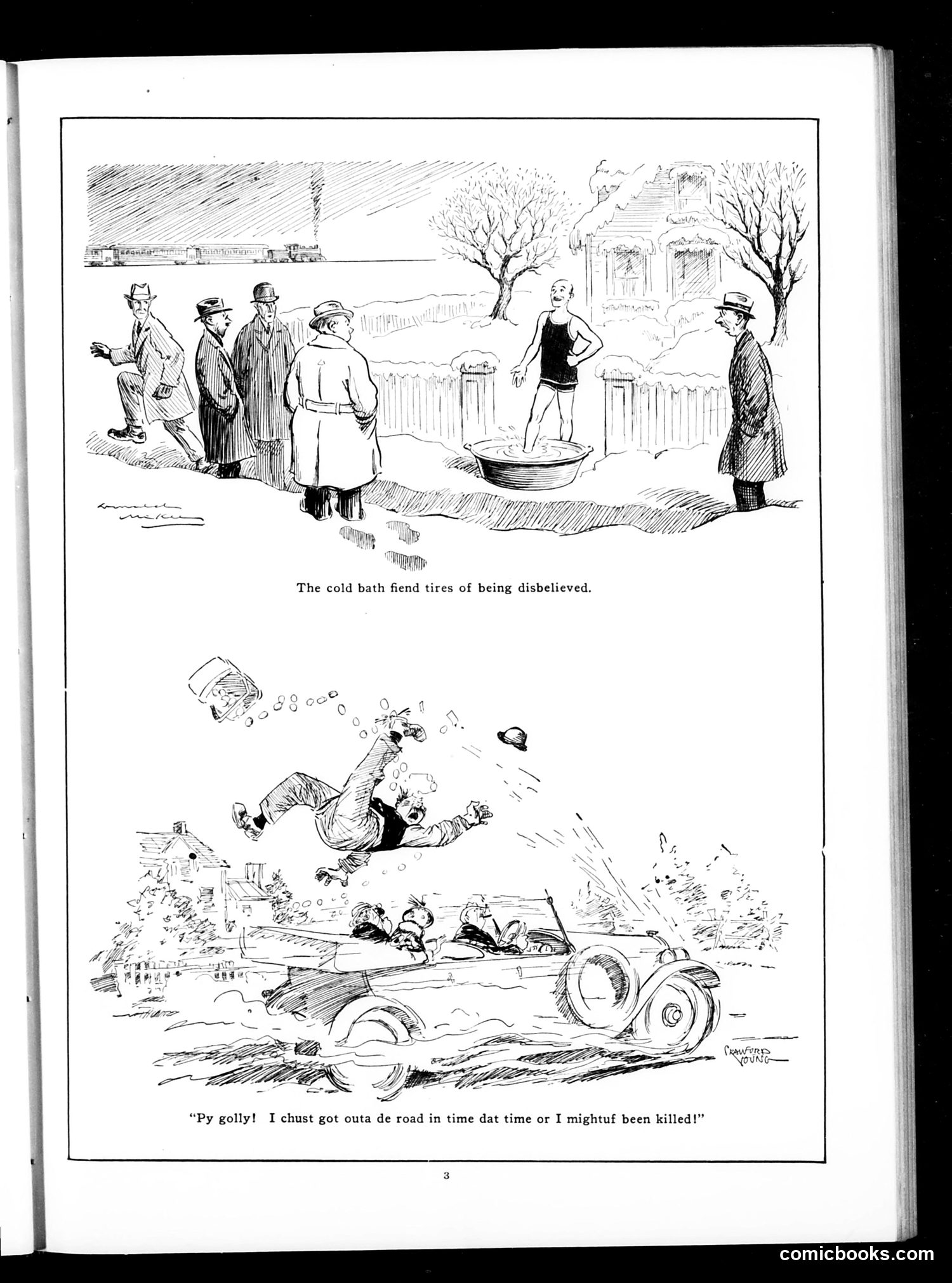
This page contains two satirical cartoons about early automobiles and public safety. The **top cartoon** titled "The cold bath fiend tires of being disbelieved" depicts skeptics witnessing a person in a bathing suit standing in a large basin—likely illustrating claims about cold-water bathing's health benefits that observers doubt. The **bottom cartoon** shows a dramatic automobile accident where a car has crashed, ejecting its occupants. The caption reads: "Py golly! I chust got outa de road in time dat time or I mighta been killed!"—using exaggerated dialect humor. The satire mocks both the danger of early motorcar travel and drivers' narrow escapes from accidents. Together, these cartoons reflect early 1900s anxieties about new technologies and dubious health fads.
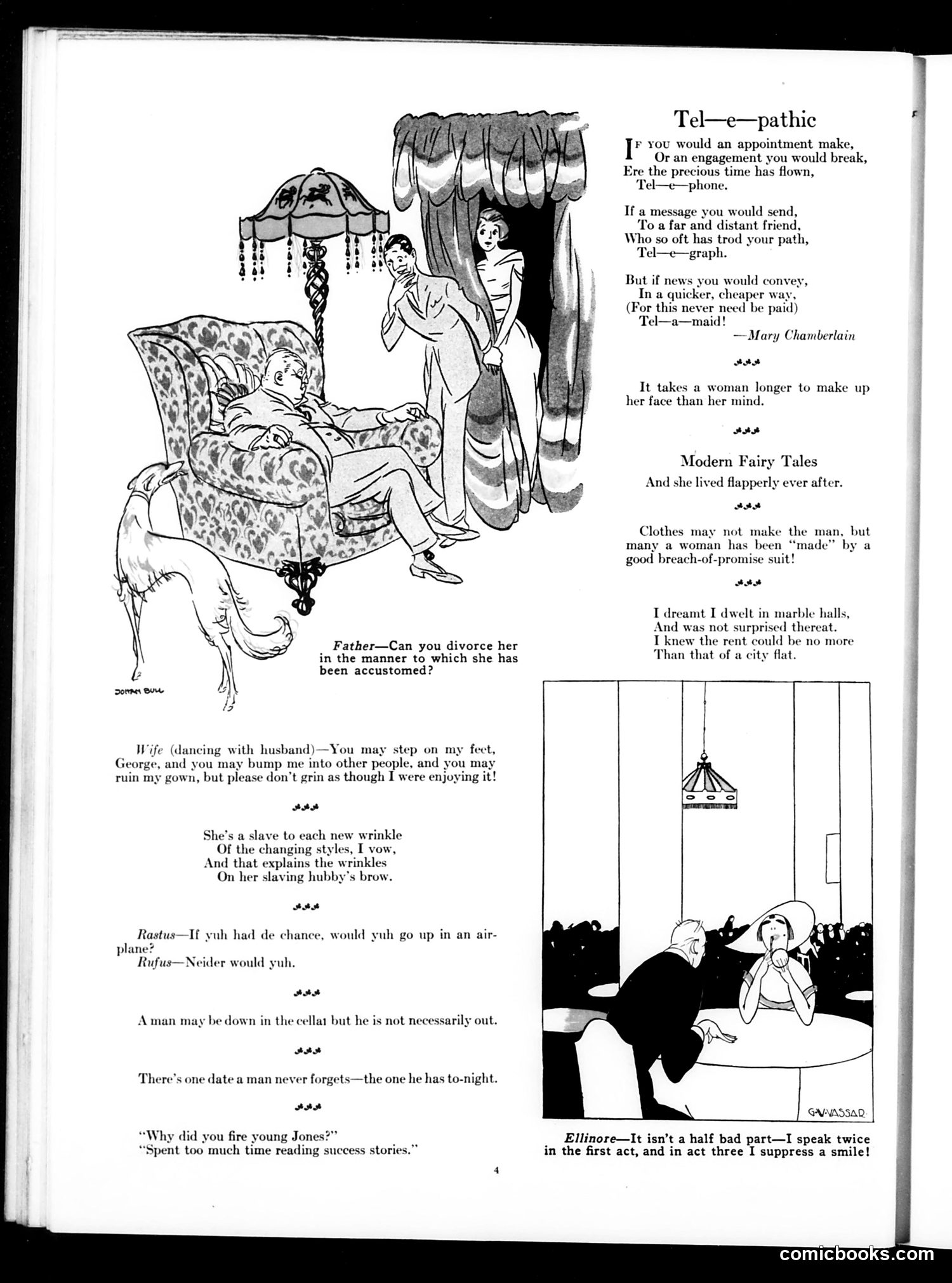
This page contains social humor from an era when telephone and telegraph technology was still novel. The "Tel-e-pathic" poem by Mary Chamberlain jokes about communication methods—telephone, telegraph, and "tel-a-maid" (likely gossip)—suggesting women used domestic servants to spread news quickly. The left cartoon shows a couple dancing while the husband steps on his wife's feet. The wife's witty response satirizes marital dynamics and her tolerance of his clumsiness. The lower right cartoon depicts a theater scene where an actress (Ellinore) complains about her minor role, with only two brief appearances. The humor targets theatrical vanity and actors' complaints about limited stage time. Throughout, the page mocks gender relations, domestic life, and entertainment culture of the early 20th century.
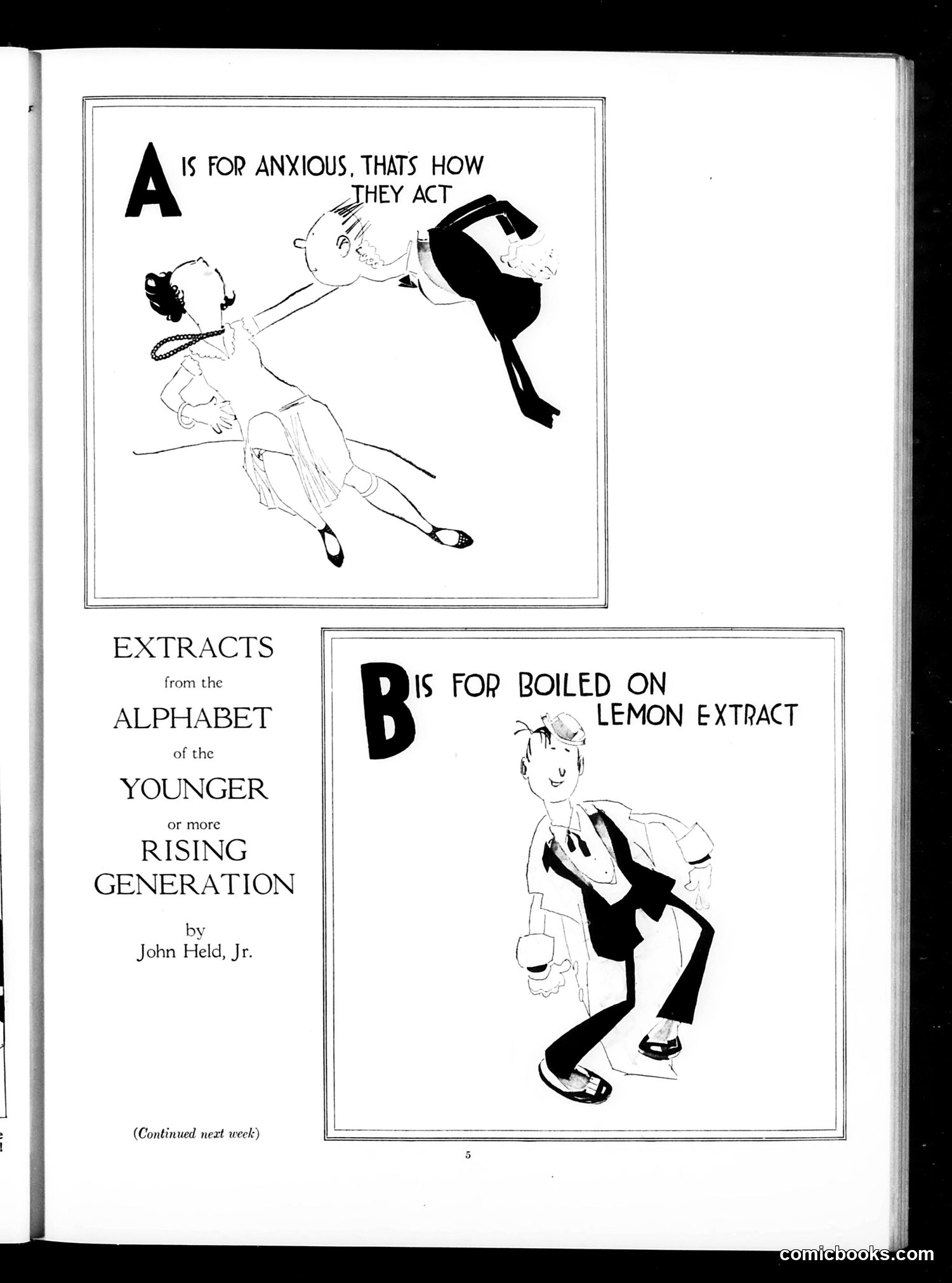
This page presents two satirical vignettes by cartoonist John Held Jr., mocking young people's behavior and mannerisms of the 1920s Jazz Age. **Panel A ("Anxious")**: A woman flails dramatically while a man kicks his legs in exaggerated panic—satirizing anxious youth as histrionic and prone to theatrical overreaction. **Panel B ("Boiled on Lemon Extract")**: A woman staggers drunkenly, presumably intoxicated from lemon extract—referencing Prohibition-era youth illegally consuming household products as alcohol substitutes, a common social problem of the 1920s. Held's humor targets the "younger generation" as reckless, neurotic, and destructive. The series appears designed as a satirical alphabet primer exposing generational vices to adult readers.
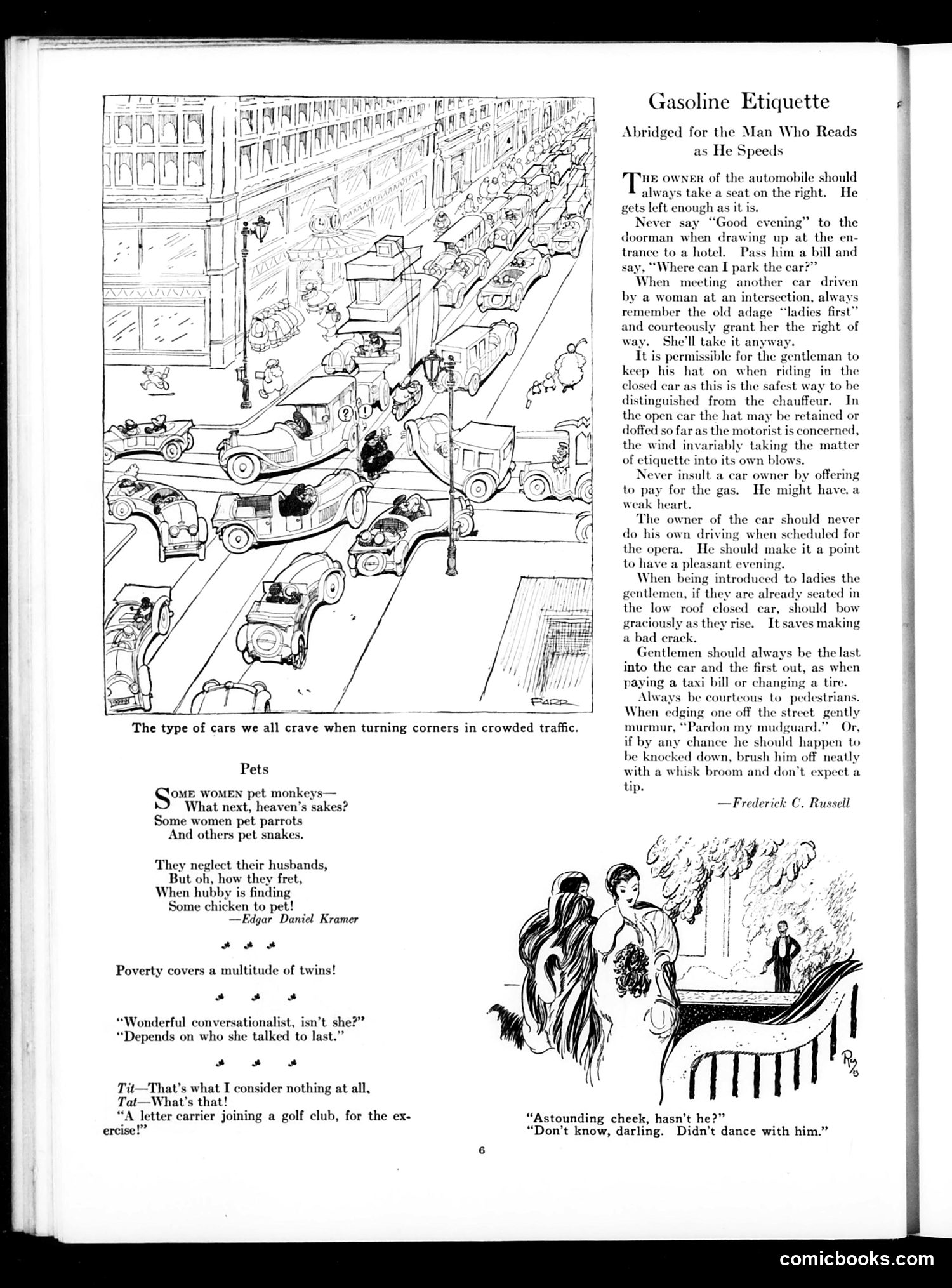
This satirical piece mocks the emerging automobile culture and nouveau riche car owners of the early 20th century. The main cartoon depicts crowded urban traffic with the caption ironically praising "the type of cars we all crave"—a jab at automotive congestion. The accompanying text humorously outlines "rules" for car owners that expose their actual behavior through faux-etiquette advice. Key targets include: - **Class pretension**: Suggesting owners treat doormen dismissively rather than courteously, implying wealthy drivers are rude - **Gender dynamics**: The patronizing "ladies first" rule that women ignore anyway, reflecting period attitudes - **Conspicuous consumption**: The concern about distinguishing oneself from chauffeurs reveals status anxiety - **Pedestrian danger**: Jokes about hitting pedestrians ("edging one off the street") reflect genuine hazards and driver callousness The accompanying "Pets" and humor sections shift focus but maintain the satirical tone about social absurdities. Overall, Judge critiques automobile-age pretension, carelessness, and the disruption cars brought to urban life.
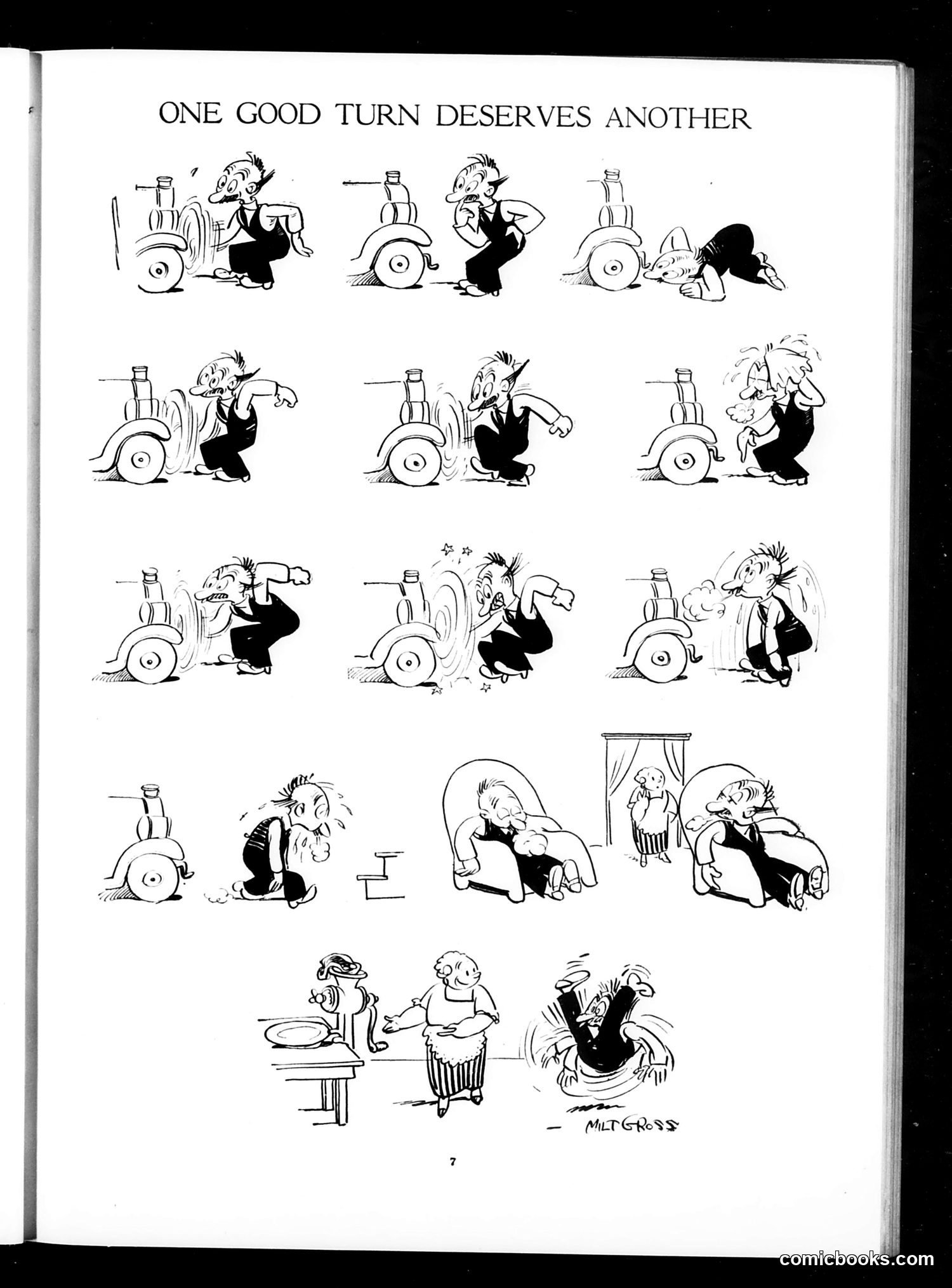
This is a sequential comic strip by Milt Gross (signed lower right) illustrating the proverb "One good turn deserves another." The narrative follows a man operating what appears to be a hand-cranked device or pump. Through successive panels, he performs favors for others—helping people with the contraption, assisting individuals in various predicaments. The sequence culminates in scenes showing reciprocal help: the man receives aid from those he previously helped, ultimately appearing in comfortable domestic situations. The comic uses physical comedy and slapstick humor typical of 1920s-30s Judge magazine style to demonstrate how kindness circulates through social interactions. There are no apparent political references—it's a straightforward moral lesson about reciprocity presented through visual gags and exaggerated character expressions.
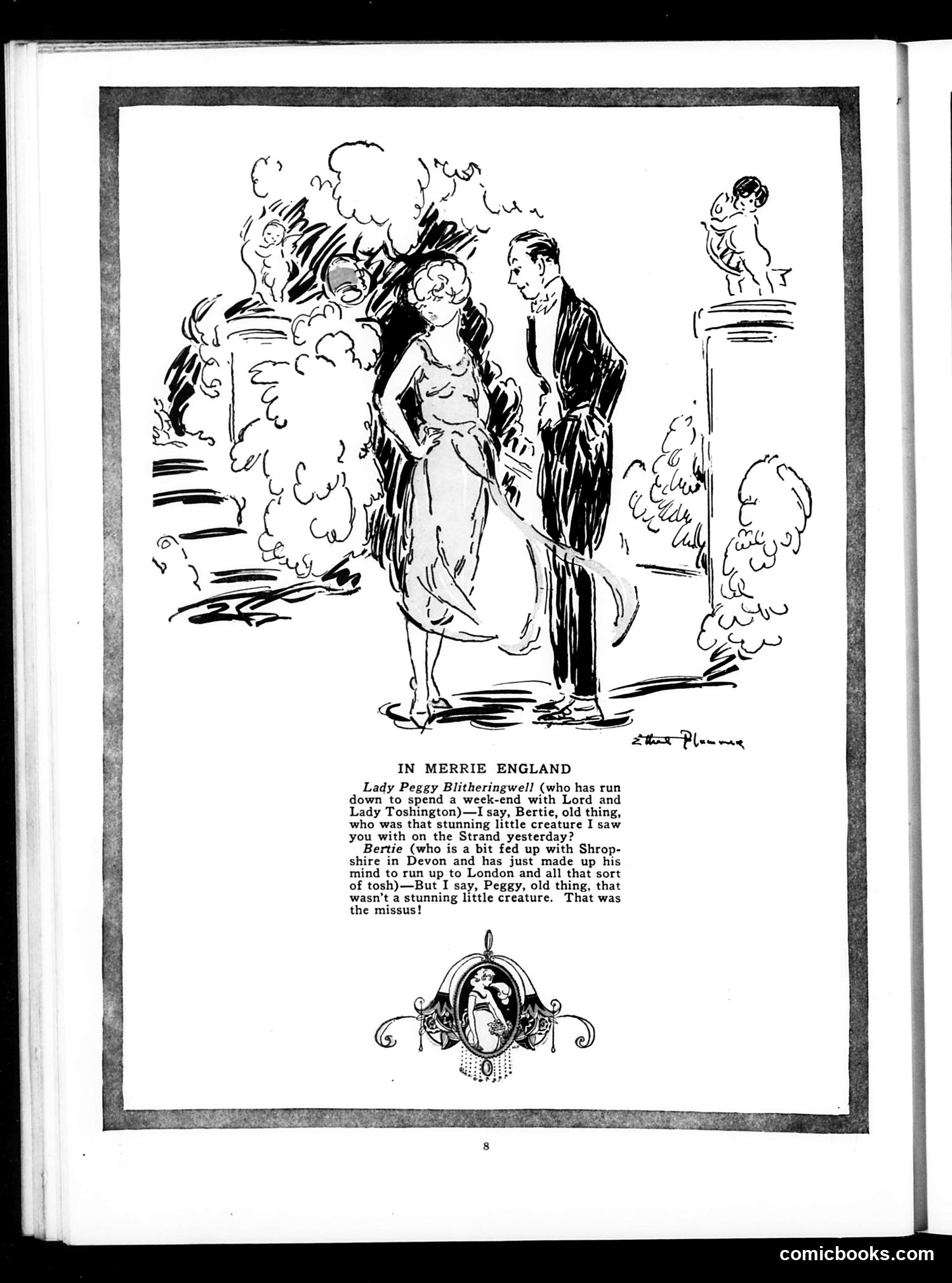
This is a single-panel joke cartoon satirizing British upper-class society and marriage dynamics. The setup involves Lady Peggy Blitheringwell visiting Lord and Lady Toshington's country estate, where she asks Bertie (likely a young aristocratic visitor) about a woman she saw him with in London. The punchline hinges on a class-based insult: Bertie's wife is so unfashionable, dowdy, or generally unimpressive that Lady Peggy didn't recognize her as a "stunning little creature"—she assumed she was someone of lower social standing. Bertie's deadpan response ("That was the missus!") delivers the joke's sting. The satire mocks shallow aristocratic values, snobbery about appearances, and the disconnect between romantic idealization and marital reality among the leisure class. The exaggerated social dialect ("old thing," "I say") emphasizes the affected pretentiousness being ridiculed.
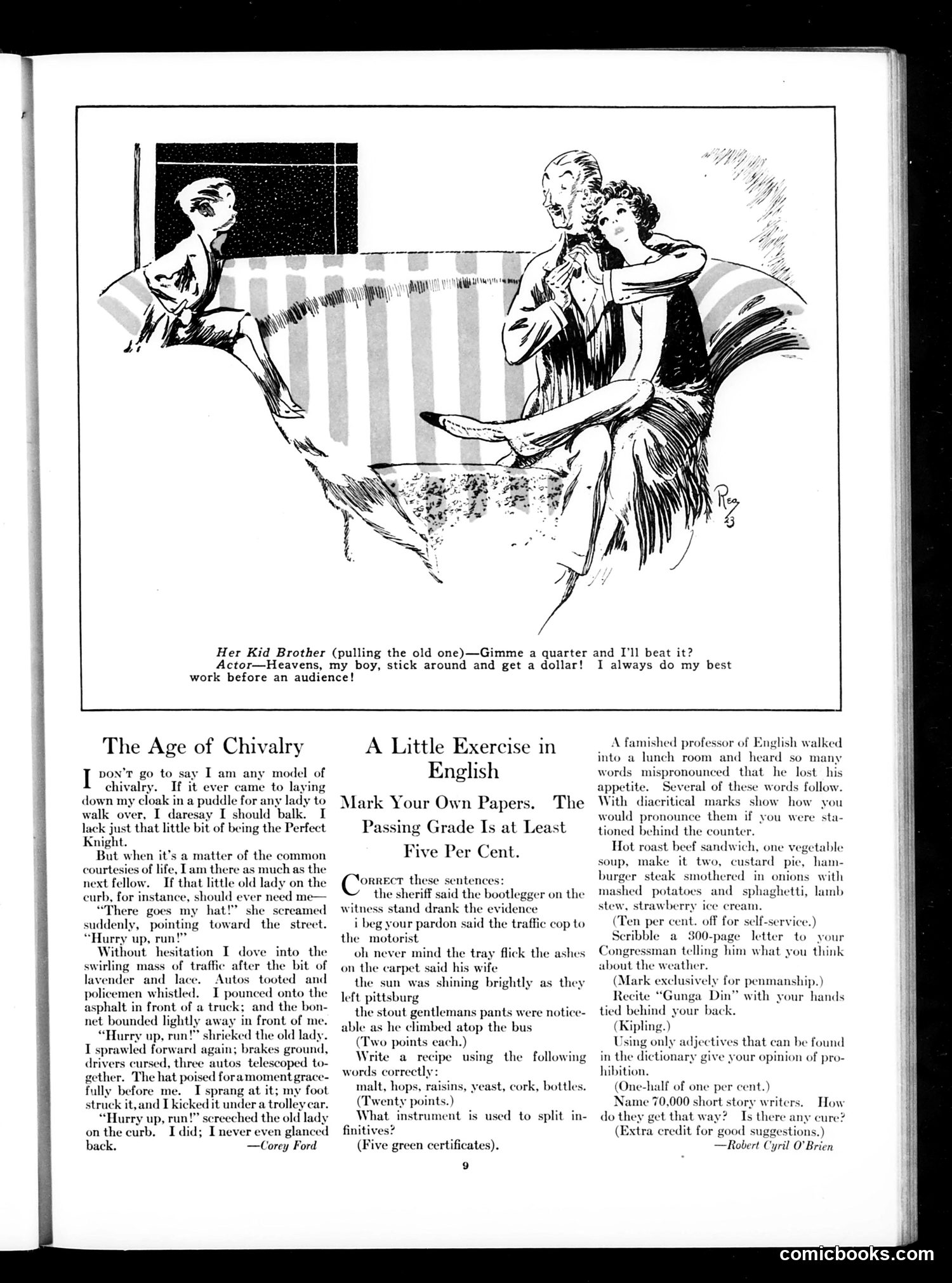
The top cartoon satirizes theatrical child labor and exploitation. An actor confronts a young boy (his "kid brother") who's demanding a quarter while threatening to expose the actor's act. The actor offers a dollar to keep the boy quiet, revealing how child performers were used as props and blackmailed for silence—a practice considered exploitative even then. The accompanying essay, "The Age of Chivalry," humorously subverts the concept of gentlemanly honor. The narrator claims to embody courteous values but then describes comically botching a simple act of helping an elderly woman retrieve her hat, causing a traffic disaster while she screams encouragement. The irony critiques performative masculinity—men claiming virtue while bungling real decency. The remaining sections are educational humor: "A Little Exercise in English" mocks poor grammar, misspellings, and mispronunciations common in everyday speech, presented as exam questions students must "correct."
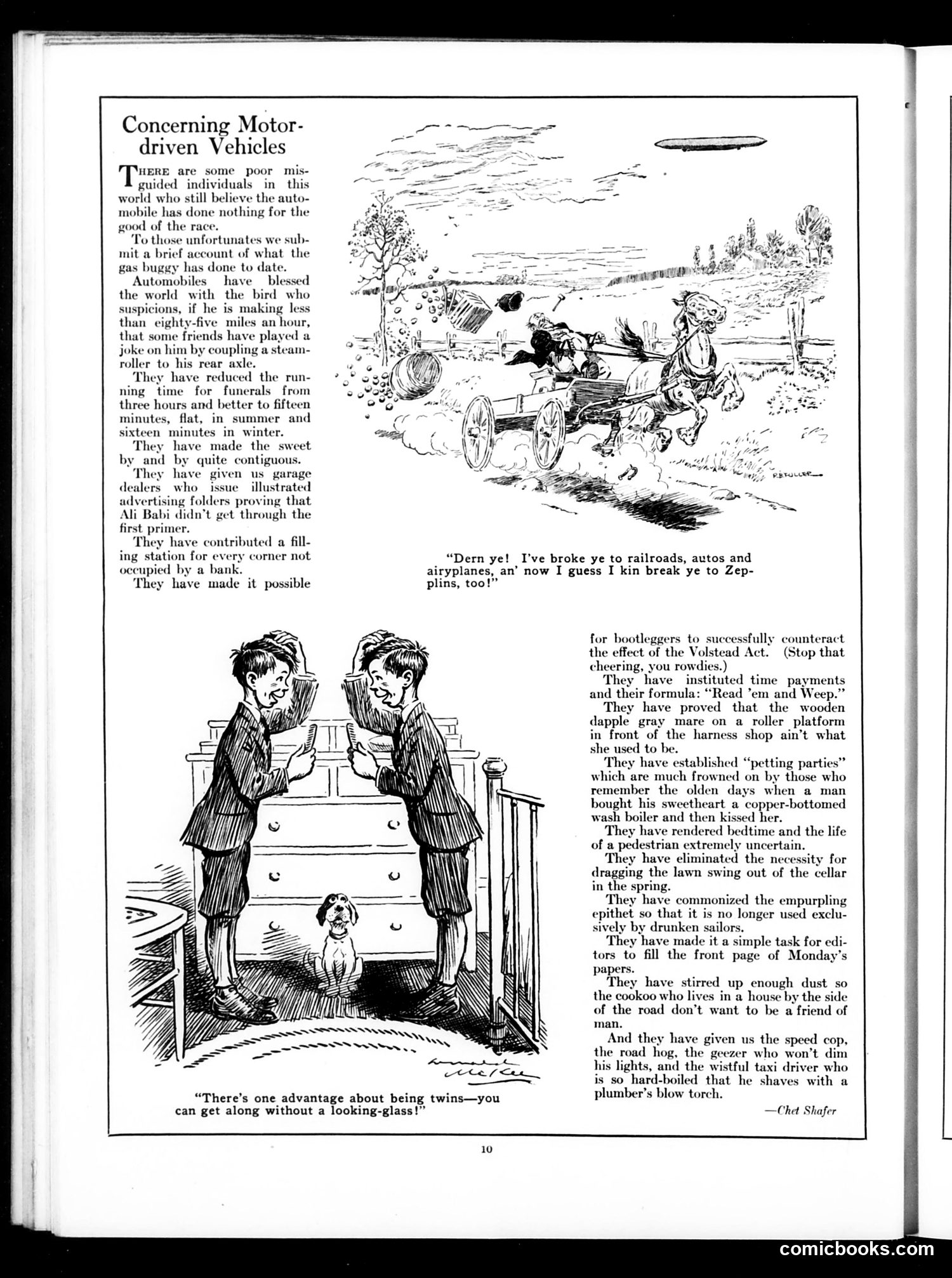
This piece satirizes automobiles' impact on American society, presented as a mock-serious list of "accomplishments." The humor inverts praise into criticism. The top cartoon shows a rural figure with a horse-drawn vehicle amid modern transportation (cars, airplanes, dirigibles), captioning his bewilderment at progress: "I've broke ye to railroads, autos and airplanes, an' now I guess I kin break ye to Zeppelins too!" The main text catalogs automobiles' actual social consequences: they've accelerated funerals, enabled bootleggers to evade Prohibition ("Volstead Act"), created "petting parties" (sexual activity), endangered pedestrians, and produced new traffic hazards (speed cops, reckless drivers). The bottom cartoon shows twins with the caption "one advantage about being twins—you can get along without a looking-glass," a non-sequitur joke unrelated to vehicles. Written by Chad Shafer, this pre-1930s satire captures early automobile-age anxieties: moral decay, Prohibition evasion, youth behavior changes, and road safety—concerns that remain surprisingly contemporary.
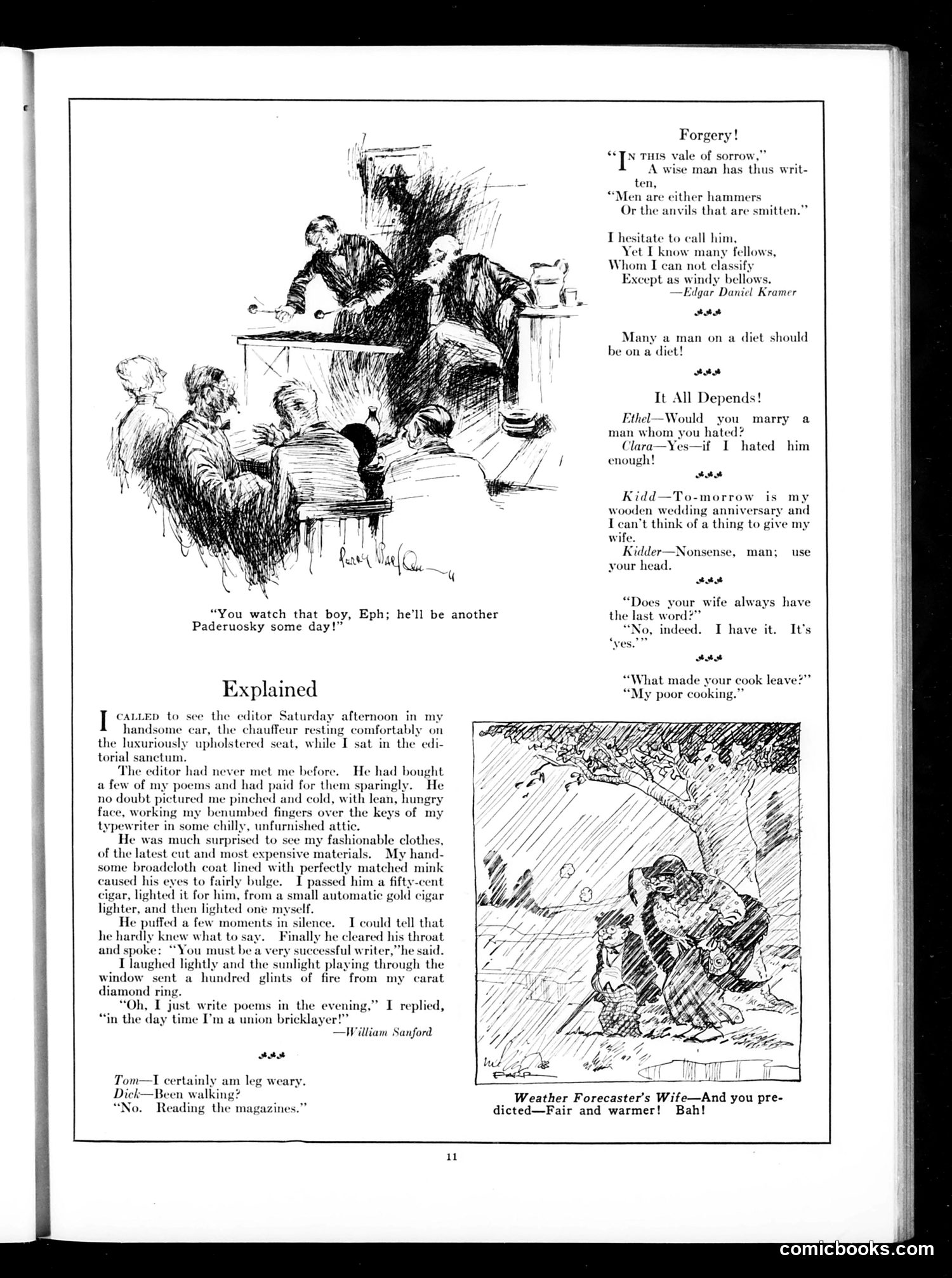
This page contains several distinct humor pieces typical of early 20th-century satirical magazines: **"Explained"** is the main story: A successful-seeming poet visits a magazine editor in a luxury car with chauffeur, wearing expensive mink-lined coat and diamond ring. The editor assumes he's a wealthy, accomplished writer—but the narrator reveals he's actually a union bricklayer who writes poetry in evenings. The joke satirizes class assumptions and the disconnect between material success and artistic merit; the editor's shock reveals snobbery about what "successful" should look like. **The cartoon above** shows a music teacher or parent observing a boy, predicting he'll become another "Paderewski" (famous pianist)—satirizing overoptimistic parental projections of their children's futures. **The remaining jokes** are brief quips about marriage, dieting, and a weather forecaster's wife mocking his inaccurate forecast—standard magazine filler humor of the era, requiring minimal context. The overall tone reflects Judge's characteristic mockery of American social pretension and domestic life.
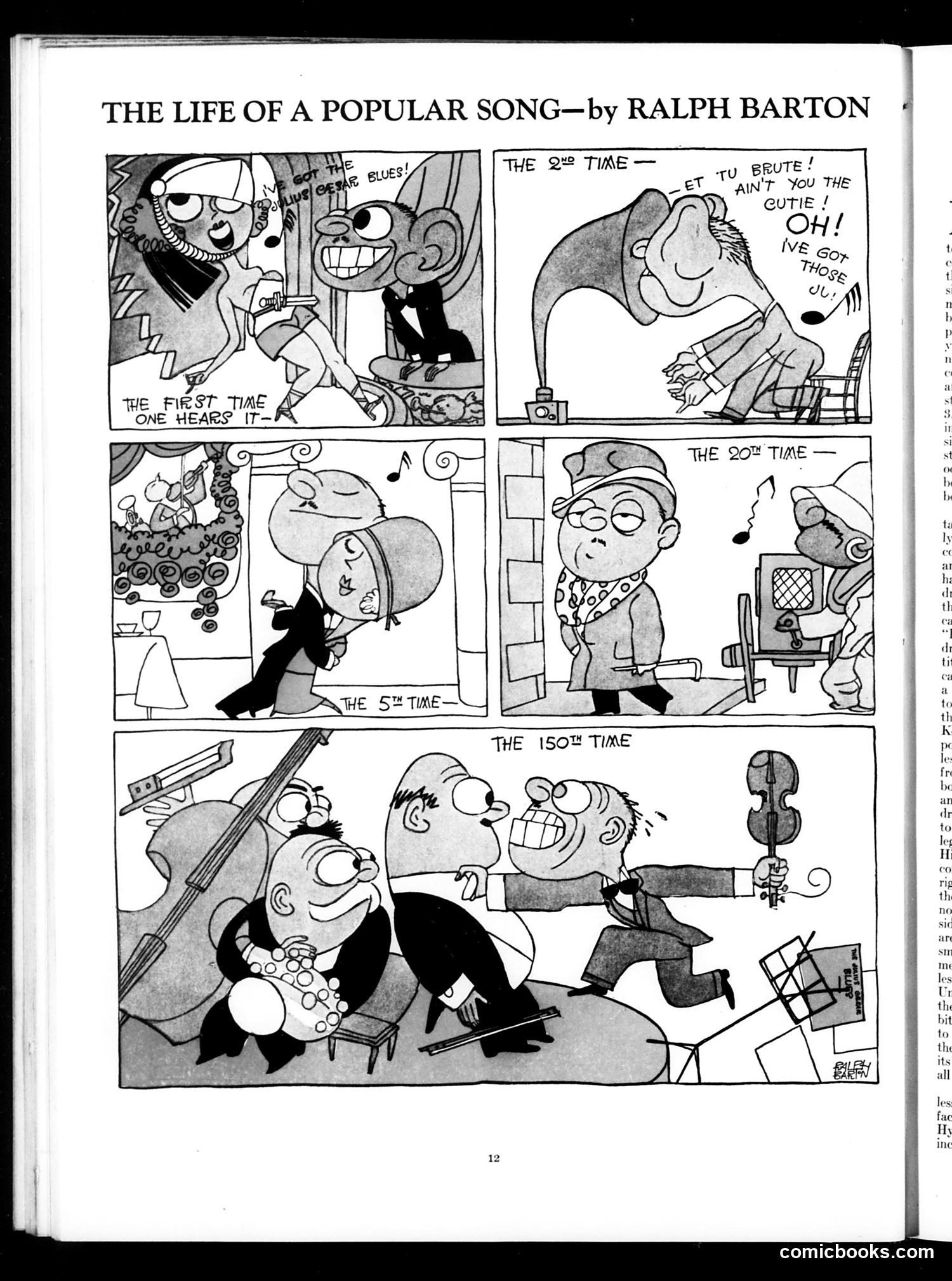
This satirical comic by cartoonist Ralph Barton tracks how a song's reception changes with repeated exposure. The progression shows: **First hearing**: Listeners enjoy it ("Got the blues") **Second time**: Still charming ("Ain't you the cutie") **Fifth time**: Fatigue sets in **20th time**: Annoyed indifference **150th time**: Complete exasperation—the song has become unbearable, with listeners actively hostile The joke satirizes how popular songs were constantly replayed on radio and in public spaces during this era, wearing out their appeal through overexposure. What begins as an entertaining tune becomes torture through repetition. Barton captures the period's frustration with inescapable commercial music, a recognizable complaint even to modern audiences familiar with "earworm" phenomena and streaming saturation.
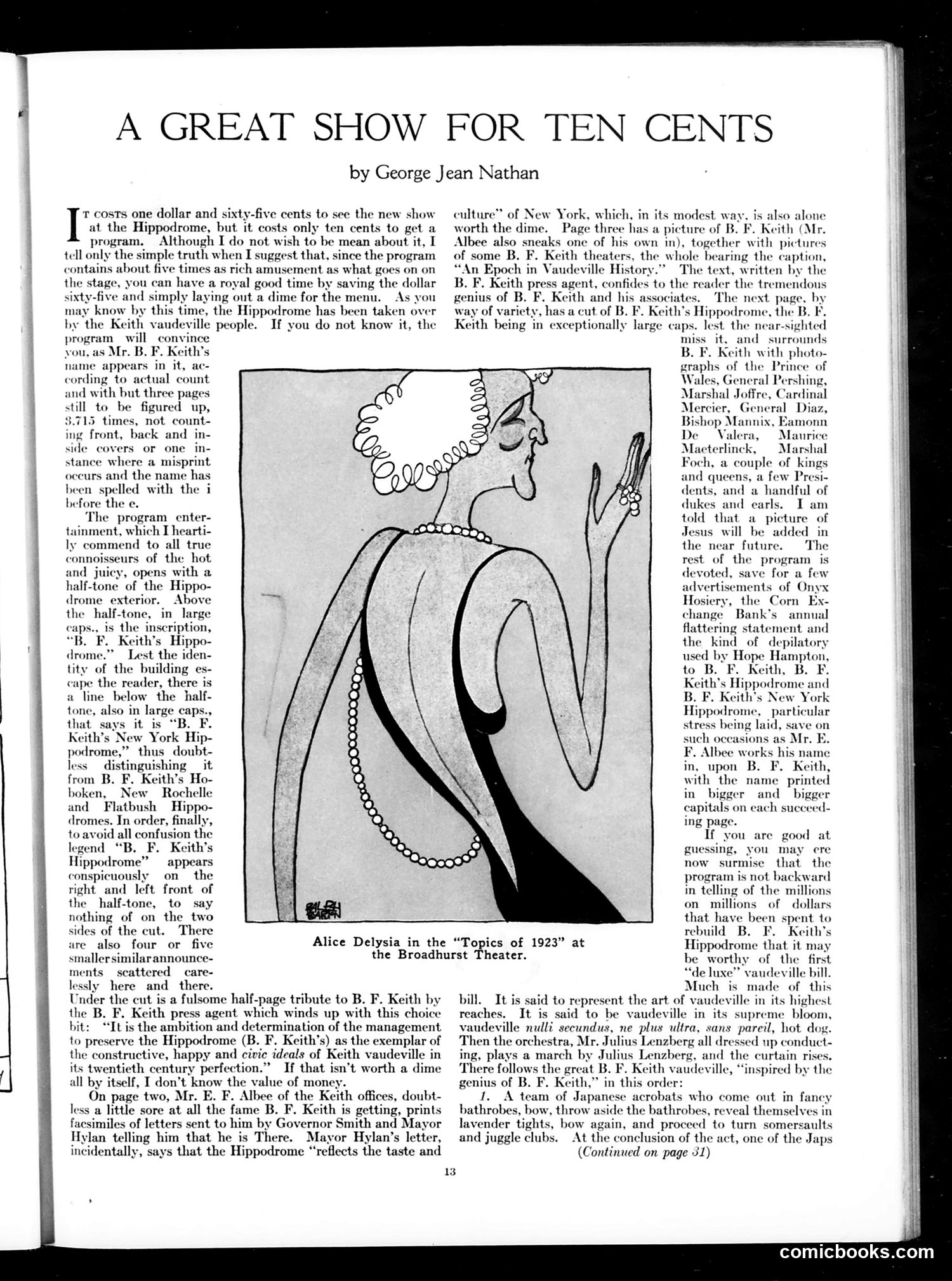
This is critic George Jean Nathan's satirical review of the Keith vaudeville circuit's takeover of New York's Hippodrome theater. The humor centers on **B. F. Keith's shameless self-promotion** in the show program. Nathan's joke: the program itself (costing 10 cents) is more entertaining than the actual show (costing $1.65), because the program is essentially one long advertisement for B. F. Keith. Nathan catalogs the absurd repetition—Keith's name appearing 8,715 times across pages, his name in multiple sizes and locations, fulsome tributes from politicians, photographs of Keith alongside famous figures (generals, cardinals, royalty—even a promised picture of Jesus). The accompanying caricature of **Alice Delysia** (an actress in the "Topics of 1923" show) appears decorative; the real subject is mocking corporate vanity and excessive self-aggrandizement through advertising disguised as entertainment content. This satirizes early 20th-century vaudeville moguls' brazen self-promotion tactics.
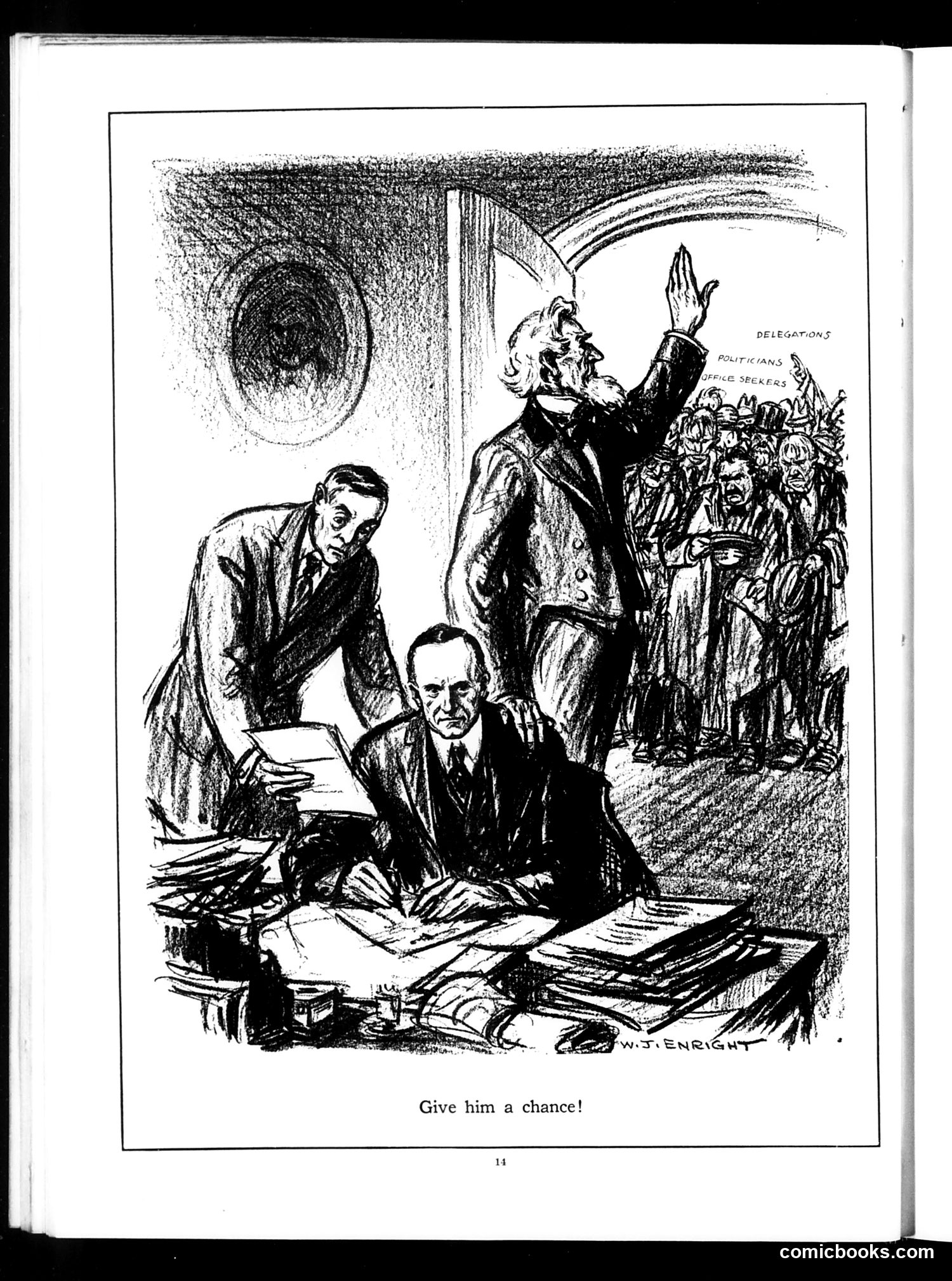
This political cartoon depicts a seated official (likely a government administrator or politician) overwhelmed by paperwork at his desk, while behind him stands an older, gesturing figure addressing a crowd labeled "DELEGATIONS" and "OFFICE SEEKERS." The cartoon satirizes the pressure placed on newly appointed officials by job-seekers and special interest groups demanding appointments and favors. The phrase "Give him a chance!" suggests the cartoon argues for patience with new administrators before they're besieged by patronage demands. The artist is W.T. Enright. The cartoon critiques the persistent American political practice of filling government positions through patronage rather than merit—a common satirical target in Judge magazine during the early-to-mid 20th century.
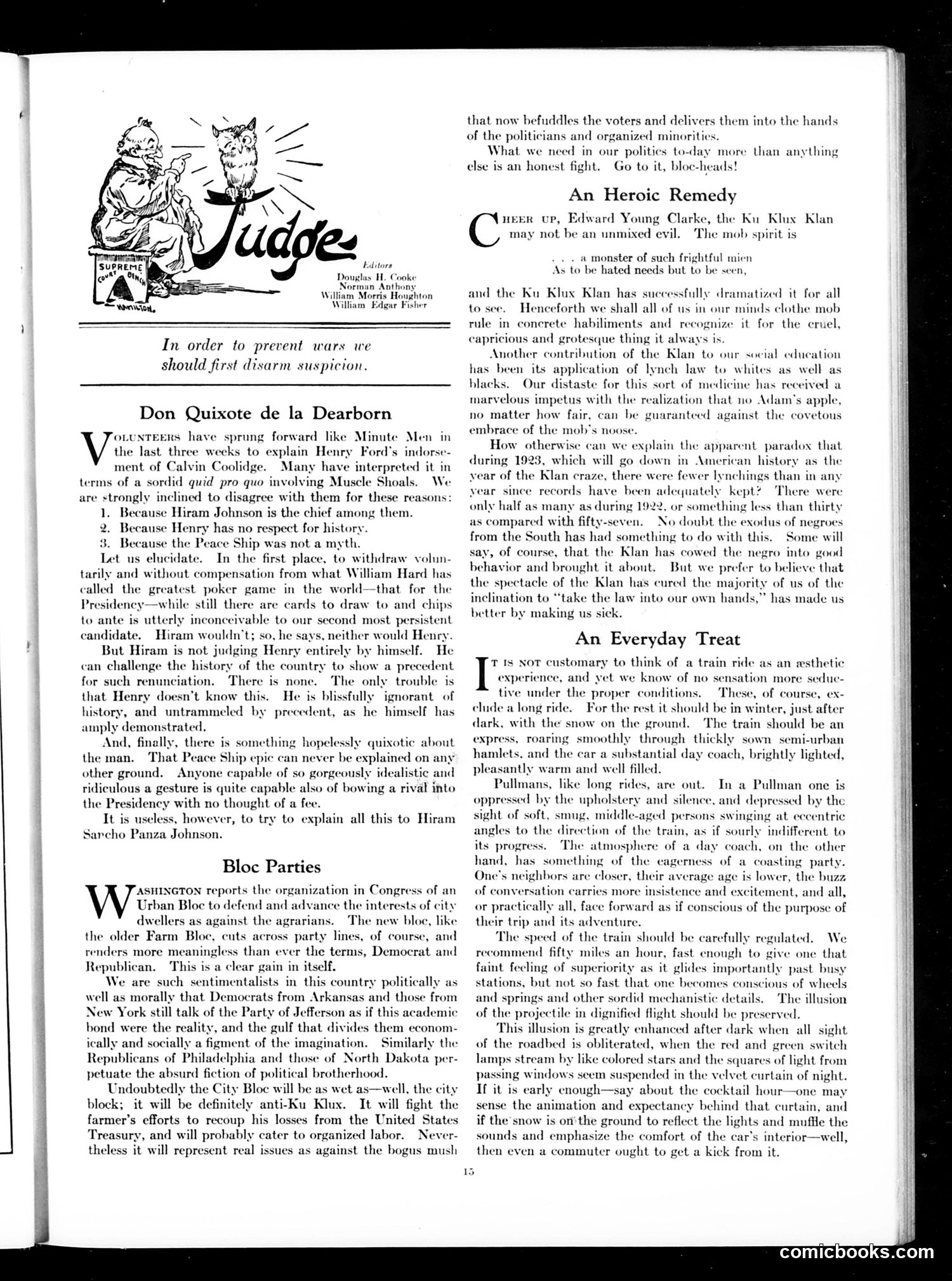
## Main Cartoon: "Don Quixote de la Dearborn" This satirizes **Henry Ford's endorsement of Calvin Coolidge** for president. The piece argues Ford won't withdraw from politics (unlike what some claimed) because: (1) rival candidate Hiram Johnson wouldn't, (2) Ford ignores history anyway, and (3) Ford's "Peace Ship" fiasco proved he's quixotically idealistic enough to do anything. The "Don Quixote" reference suggests Ford is a deluded dreamer tilting at windmills. "Sancho Panza Johnson" implies Johnson is Ford's foolish sidekick in this political fantasy. ## Secondary Articles **"Bloc Parties"** discusses emerging urban political blocs in Congress that cross traditional party lines—city dwellers vs. farmers—making old Democrat/Republican distinctions meaningless. **"An Heroic Remedy"** sarcastically praises the Ku Klux Klan for exposing "the mob spirit" through its violence. By making lynching visible and applying it to whites, the Klan inadvertently educates the public against mob rule itself.
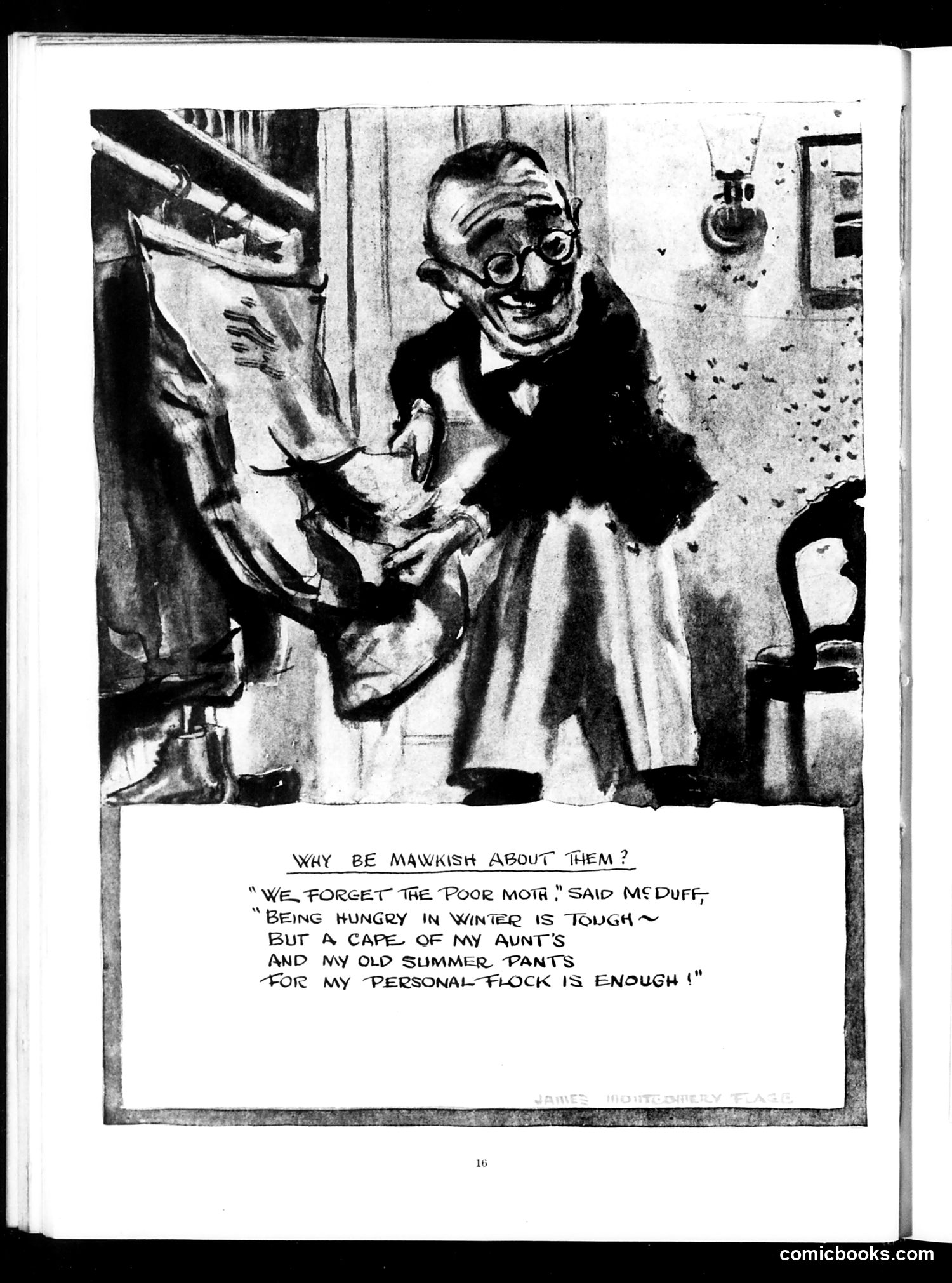
This cartoon satirizes wealthy indifference to poverty. A caricatured wealthy woman (Ms. Duff) dismisses concern for hungry poor people ("the poor moth") as sentimental. She boasts that her own wardrobe—castoff clothing from relatives ("aunt's cape," "old summer pants")—suffices for her "personal flock" (likely her children or dependents). The satire lies in the contrast: she considers hand-me-downs adequate for her own family while dismissing sympathy for the genuinely destitute facing winter hunger. The grotesque exaggeration of her features emphasizes the moral ugliness of such callousness. The "mawkish" (overly sentimental) framing in the title suggests Judge is mocking both excessive sentimentality about poverty *and* the wealthy person's self-satisfied rationalization for ignoring it—a sharp critique of class indifference.
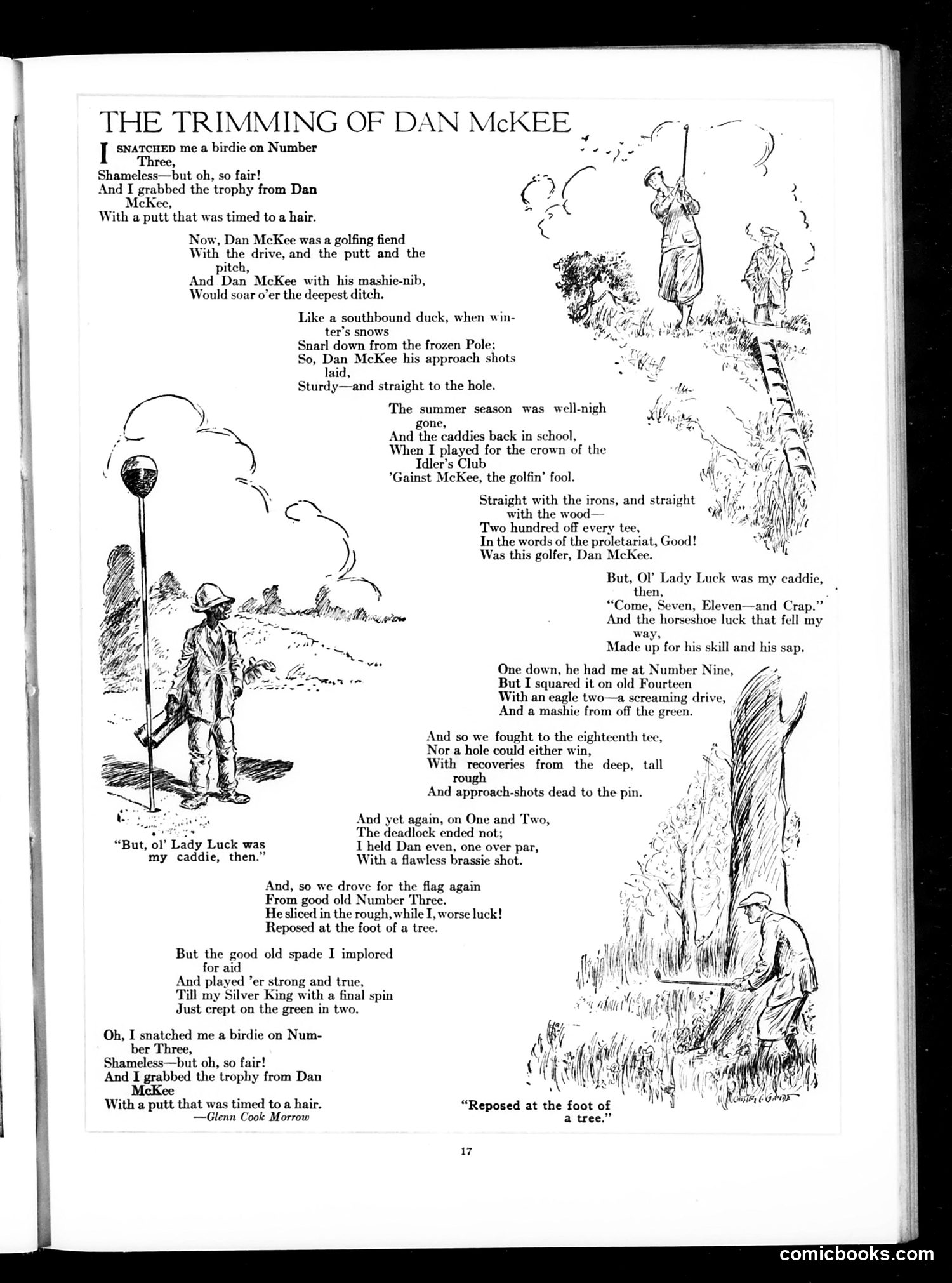
This is a humorous poem by Glenn Cook Morrow about a golf match, not political satire. The narrator defeats Dan McKee, a skilled golfer ("golfing fiend"), in a championship match at the Idler's Club through a combination of luck and skill. The joke centers on ironic reversal: McKee is the superior golfer with excellent technique ("Straight with the irons...Two hundred off every tee"), but the narrator wins because "Ol' Lady Luck was my caddie." The poem emphasizes that McKee's superior golfing ability couldn't overcome bad luck—slicing into the rough on the final hole—while the narrator benefited from fortunate circumstances. The accompanying pen-and-ink illustrations show golfers in period dress on the course. This is lighthearted sporting humor typical of Judge magazine, with no apparent political or social commentary—simply entertainment celebrating a lucky underdog victory.
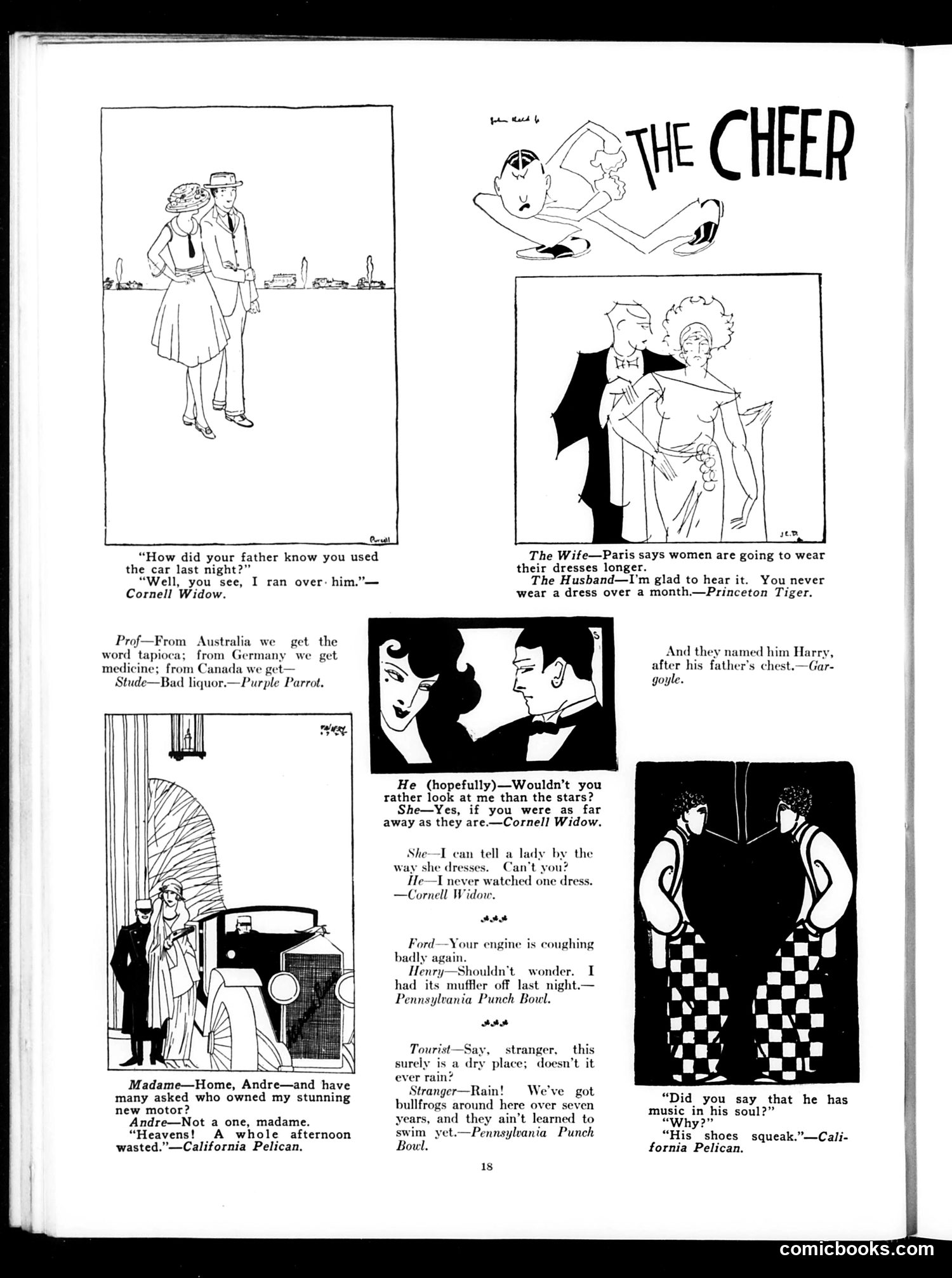
This page collects brief humorous anecdotes from various college and satirical publications of the early 20th century, arranged around cartoon illustrations. The jokes target common social situations: a wife's infidelity (running over her father with a car), marital discord over fashion and fidelity, flirtation and romantic disappointment, automotive troubles (referencing Ford engines), and rural ignorance (bullfrogs that can't swim after seven years). The cartoons illustrate domestic scenes—a woman with a car, couples in conversation, men examining women's clothing. One silhouette shows a couple in formal wear; another depicts two figures in matching patterned dresses (likely mocking fashion or gender presentation). The recurring publication credits (Cornell Widow, California Pelican, Pennsylvania Punch Bowl, Princeton Tiger) indicate these are college humor magazines—venues for student-produced satire focused on courtship, gender relations, and social pretension. The humor is chiefly observational rather than overtly political.
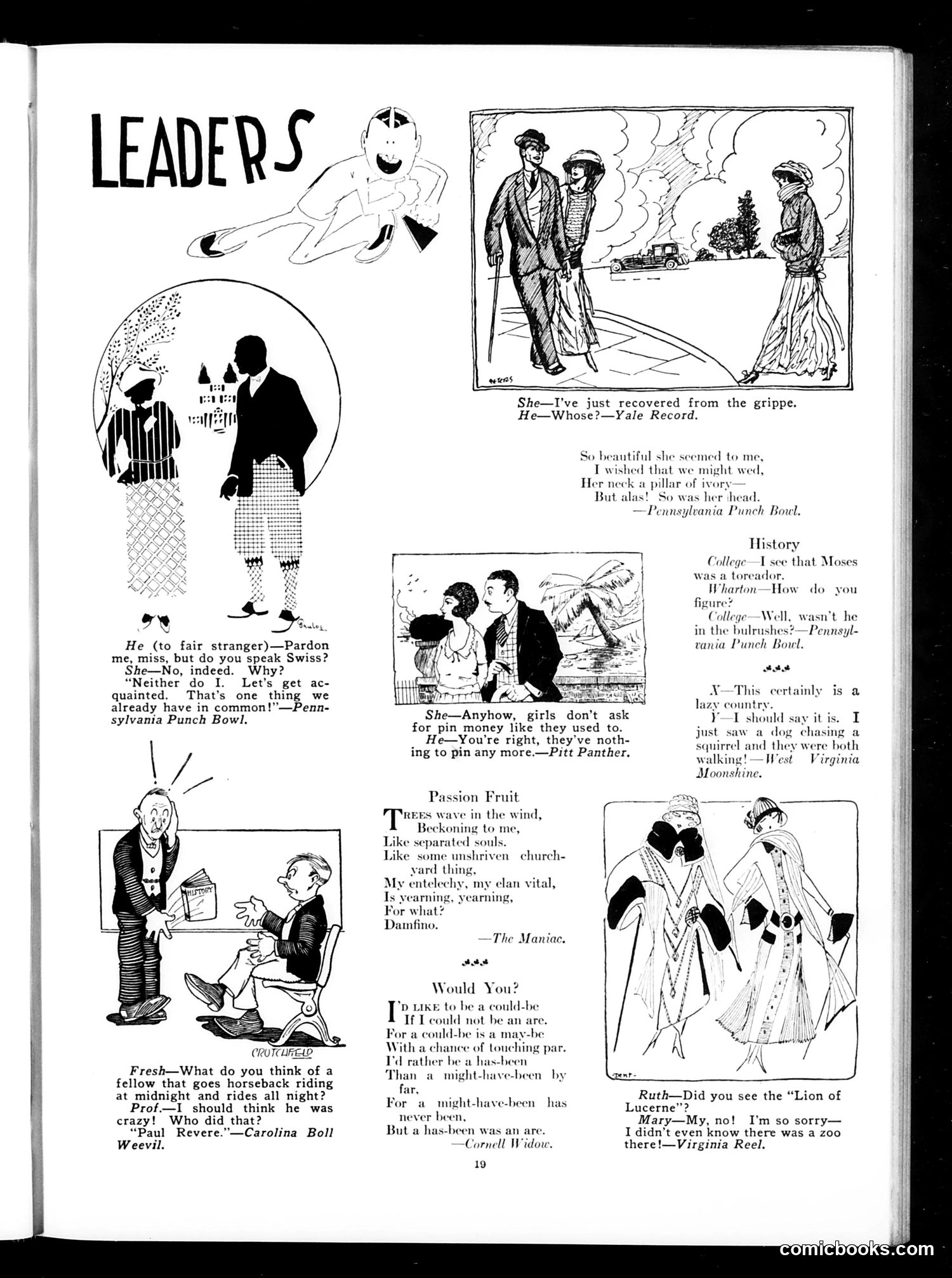
This page collects humor from various college publications (Yale Record, Pennsylvania Punch Bowl, Pitt Panther, etc.), featuring light satirical jokes typical of 1920s campus wit. **Key content:** The cartoons and jokes mock college life and dating customs. One cartoon shows a man asking a woman if she speaks Swiss—a nonsensical pickup line playing on the absurdity of flirtation. Another depicts an elderly woman lecturing a young man, suggesting generational friction. **Social references:** - "Grippe" (flu) jokes reflect post-WWI concerns - "Pin money" references outdated female dating customs - Biblical puns (Moses and bulrushes) show period wordplay - References to "the Lion of Lucerne" (likely a zoo attraction) and period slang **The satire's point:** These are gentle ribbs of college romance, gender roles, and generational attitudes. The humor relies on campus-specific references and collegiate audiences recognizing their own social dynamics reflected back at them.
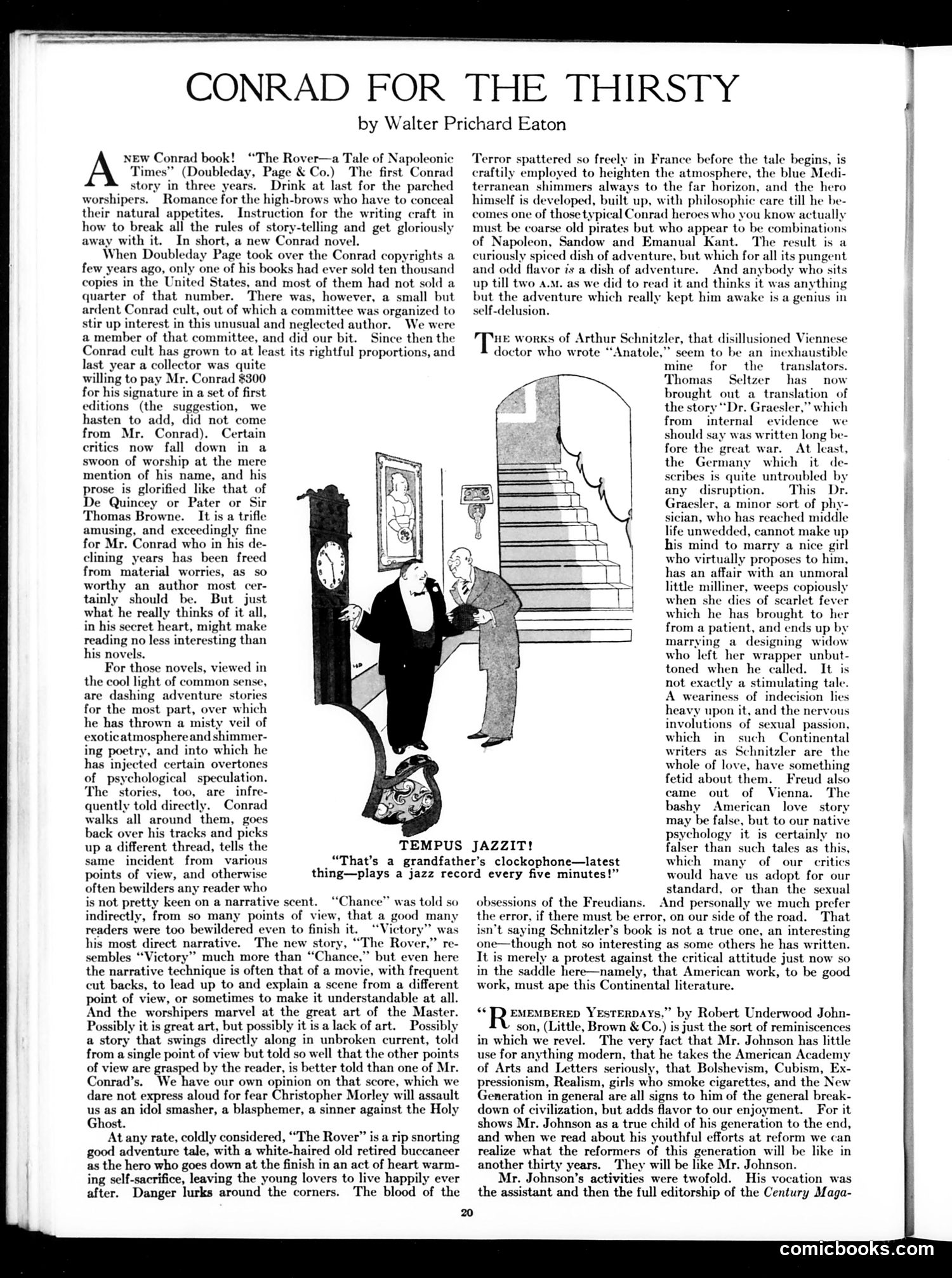
This review-essay by Walter Prichard Eaton discusses Joseph Conrad's novel *The Rover*, sarcastically framing Conrad's devoted readers as intellectually thirsty "worshipers" desperate for serious literature. The accompanying cartoon titled "Tempus Jazzit!" satirizes modern consumer culture and generational clash. It depicts two figures (likely representing an older and younger generation) examining a clock that plays jazz records every five minutes—a absurdist invention mocking how contemporary life has become fragmented and entertainment-obsessed. The "clockophone" represents the intrusion of vulgar popular culture (jazz) into what should be refined domestic spaces. Eaton's essay acknowledges Conrad's growing cult following and commercial success while maintaining skeptical distance from critics who treat his baroque narrative technique as great art rather than potential obfuscation. The satire targets both Conrad's pretentious admirers and the literary establishment's reverence for complexity over clarity.
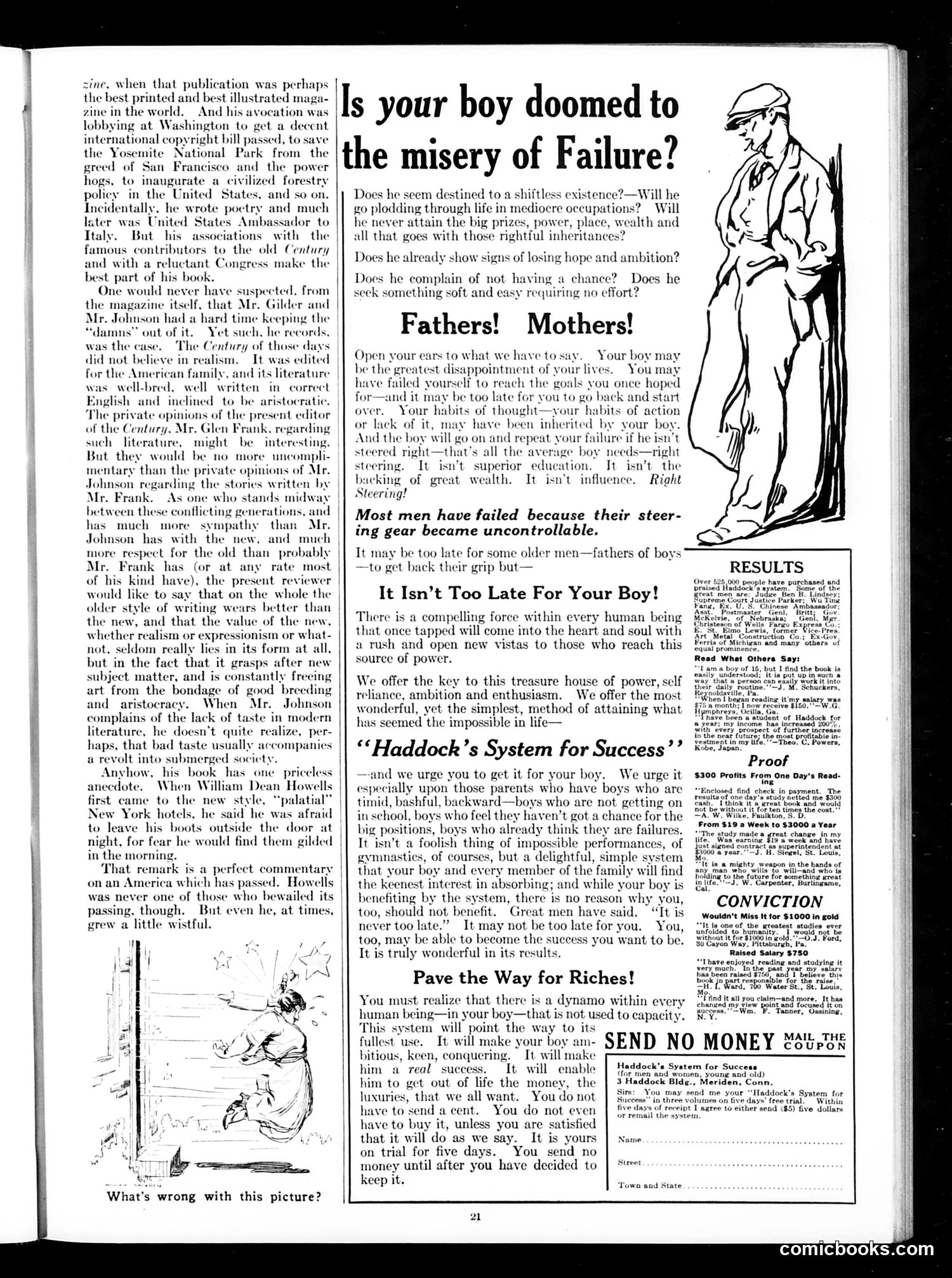
This page primarily features a **self-help advertisement** disguised as motivational editorial content, typical of early 20th-century Judge magazine's satirical approach to American culture. The main cartoon shows a dejected man in worn clothing—representing failure and poverty. The text above it uses fear-based marketing language targeting parents: "Is your boy doomed to the misery of Failure?" The satire lies in the contrast between the earnest, patronizing rhetoric ("Fathers! Mothers! Open your ears") and the obvious commercial manipulation. The ad promises success through "Haddock's System for Success" via a mysterious formula involving "will" and "steering" (self-direction), yet reveals almost nothing concrete about what this system actually teaches. The page mocks both the American obsession with self-improvement and the exploitative advertising that preys on parental anxieties about their children's futures. By publishing this alongside legitimate editorial content, Judge highlights how such dubious schemes infiltrated mainstream publications of the era.
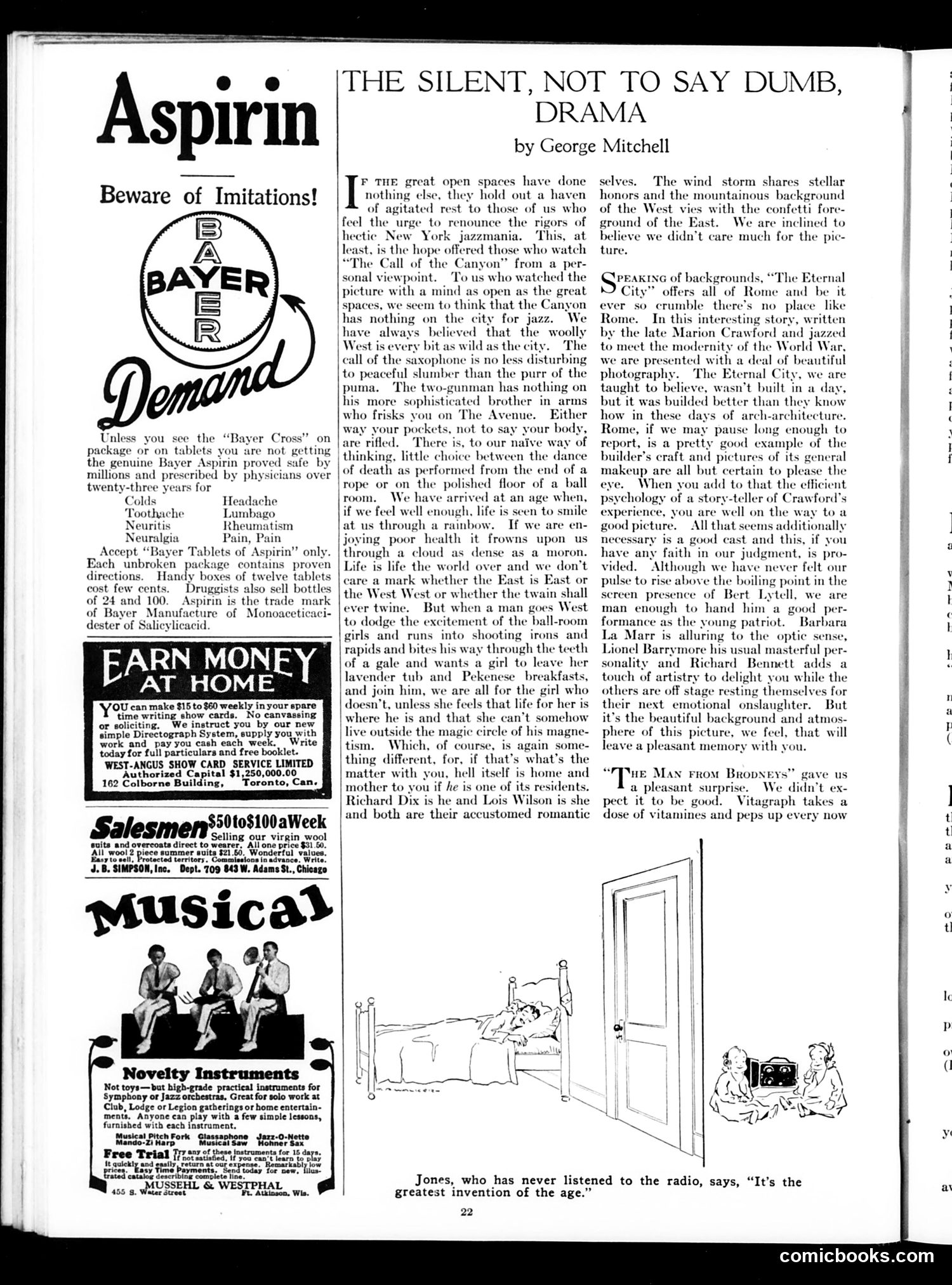
This page is primarily **advertising-heavy**, with one substantive article: George Mitchell's film review of "The Call of the Canyon." ## The Main Content Mitchell reviews this silent film (starring Richard Dix and Lois Wilson) with satirical detachment. His point: the movie romanticizes escaping to the American West to avoid urban jazz-age chaos, but he argues life's fundamental struggles exist everywhere—whether in New York's hectic nightlife or the Arizona wilderness. The review is cynical about the film's appeal, suggesting audiences want escapism but that geography changes nothing about human nature. ## The Cartoons/Illustrations The page includes a small cartoon showing a man in bed saying radio is "the greatest invention of the age"—a light joke about radio's novelty and appeal as home entertainment, contrasting with the film's outdoor adventure narrative. ## Advertisements The bulk consists of period product ads: Bayer Aspirin (emphasizing the genuine brand), mail-order sales jobs, musical instruments, and show-card services—typical 1920s direct-response marketing targeting working-class readers.
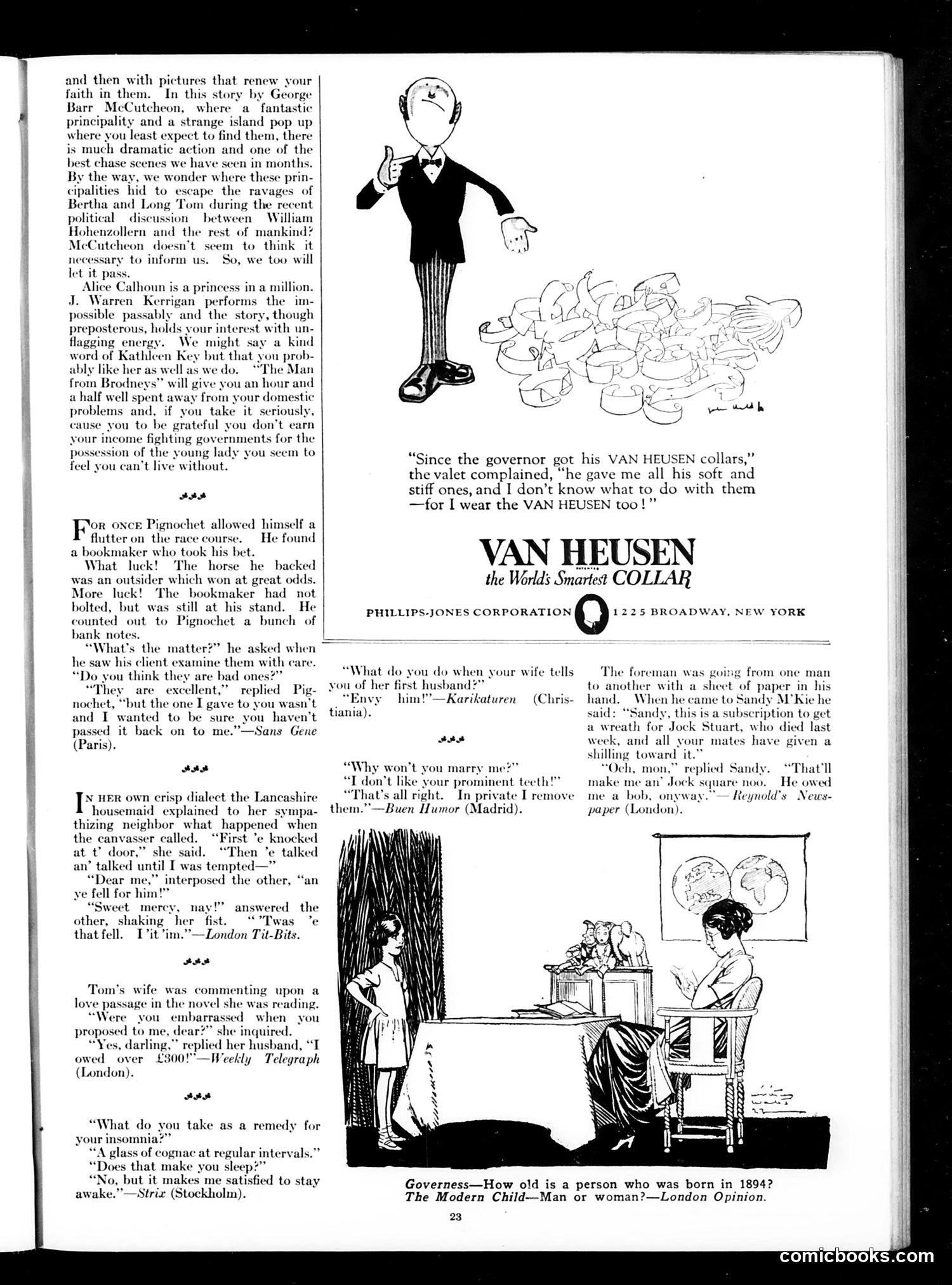
This page combines several short humorous anecdotes with advertising. The dominant content is a **Van Heusen collar advertisement** featuring a cartoon of a well-dressed man and a joke about a valet who received his employer's discarded collars after the governor switched to Van Heusen brand. The surrounding text presents brief jokes sourced from international publications (Paris, London, Madrid, Stockholm). These include: - A story about a man named Pignochet who worries a banknote he received from a bookmaker might be counterfeit - A Lancashire housemaid who physically attacks a door-to-door canvasser - Domestic humor about marriage proposals and insomnia remedies - A Scottish dialect joke about a man reluctant to contribute to a coworker's funeral wreath The final cartoon shows a governess and modern child, illustrating the era's humor about changing social attitudes—the child asks whether someone born in 1894 is a "man or woman," suggesting ambiguity about aging or gender roles. The page reflects early 20th-century light satirical humor with international flavor typical of Judge magazine's style.
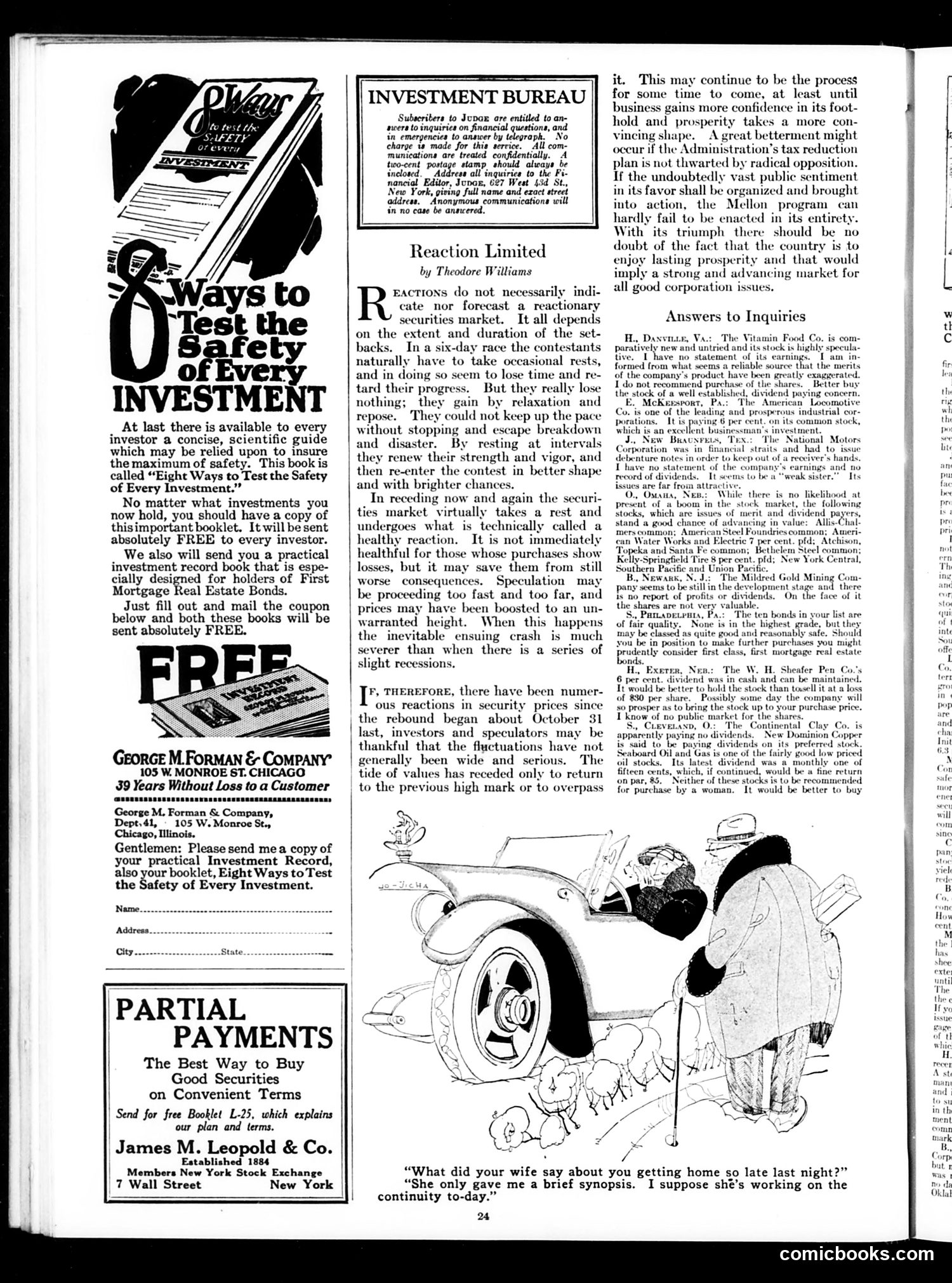
This page is primarily **advertising and financial commentary**, not satire or political cartooning in the traditional sense. The main content includes: 1. **Investment advertisements** from brokerage firms (George M. Forman & Company, James M. Leopold & Co.) offering free guides to safe investing—typical early 20th-century financial marketing. 2. **"Reaction Limited"** - a financial column by Theodore Williams discussing stock market "reactions" (downturns). The author argues that market pullbacks are healthy, preventing worse crashes. He optimistically references the "Mellon program" (Treasury Secretary Andrew Mellon's tax reduction plan under the Coolidge Administration), suggesting lower taxes will boost prosperity. 3. **Bottom cartoon**: A humorous domestic scene showing a man arriving home late, with his wife's quip about "continuity." This is unrelated satire about marital life, not political commentary. The page reflects **1920s optimism about markets and Republican fiscal policy**, with investment safety positioned as scientifically achievable through proper guidance.
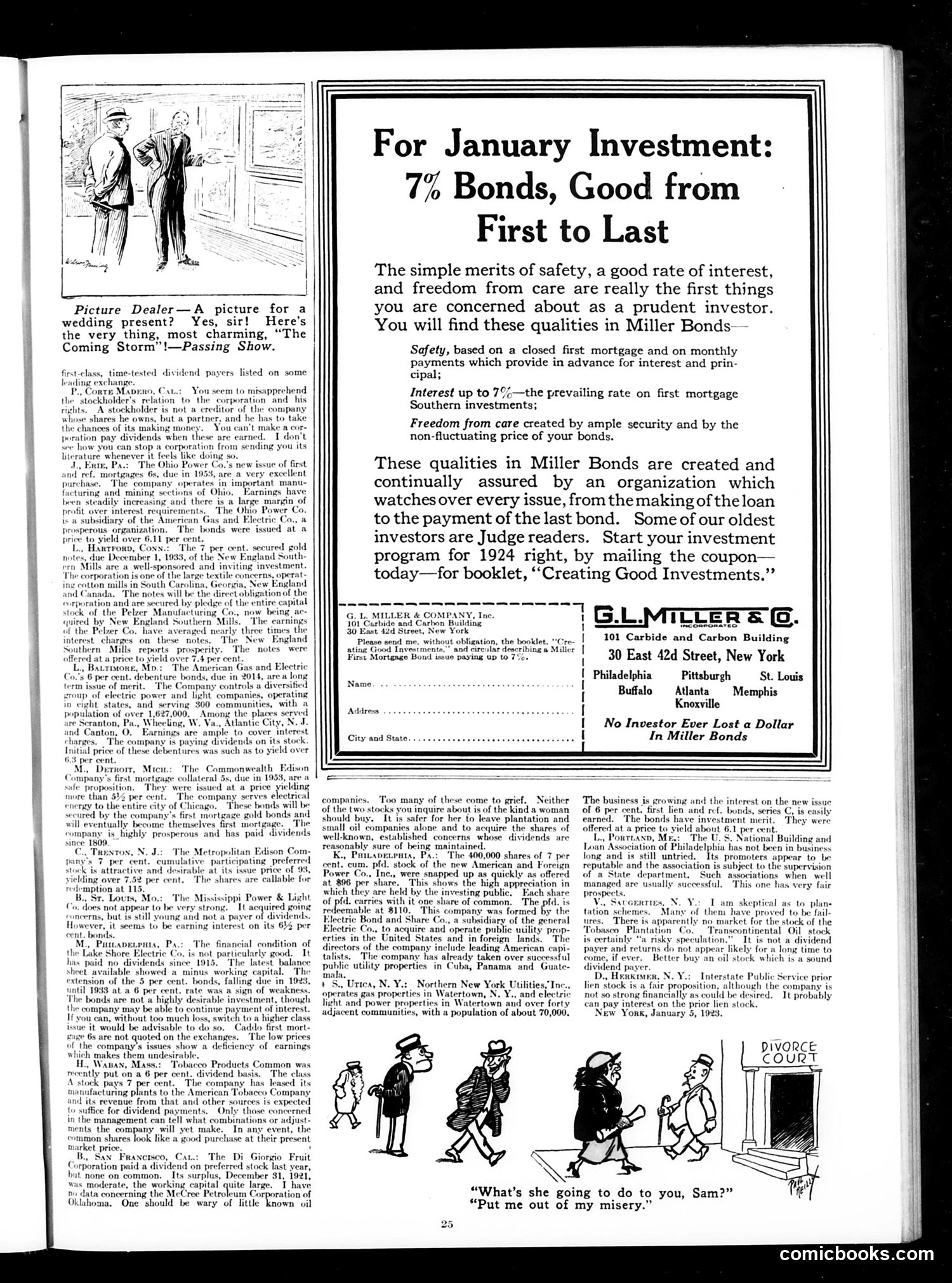
This page is primarily **financial advertising** for G.L. Miller & Company bonds, with two small cartoon elements. **The "Picture Dealer" cartoon** (top left): A shopkeeper offers a picture titled "The Coming Storm" as a wedding gift. The joke is the inappropriateness—giving a dark, ominous painting as a present for a happy occasion. This is satirizing poor taste in gift-giving. **The "Divorce Court" cartoon** (bottom): Shows a woman entering divorce court while a man says "What's she going to do to you, Sam?" and Sam replies "Put me out of my misery." The humor relies on the assumption that divorce will ruin him financially or emotionally—reflecting early 20th-century attitudes treating divorce as primarily a man's burden. **The main content** is a 1924 investment advertisement promoting Miller Bonds (7% interest) as safe, reliable investments. The letter column below discusses various stocks and bonds—period financial advice for middle-class investors seeking stable returns.
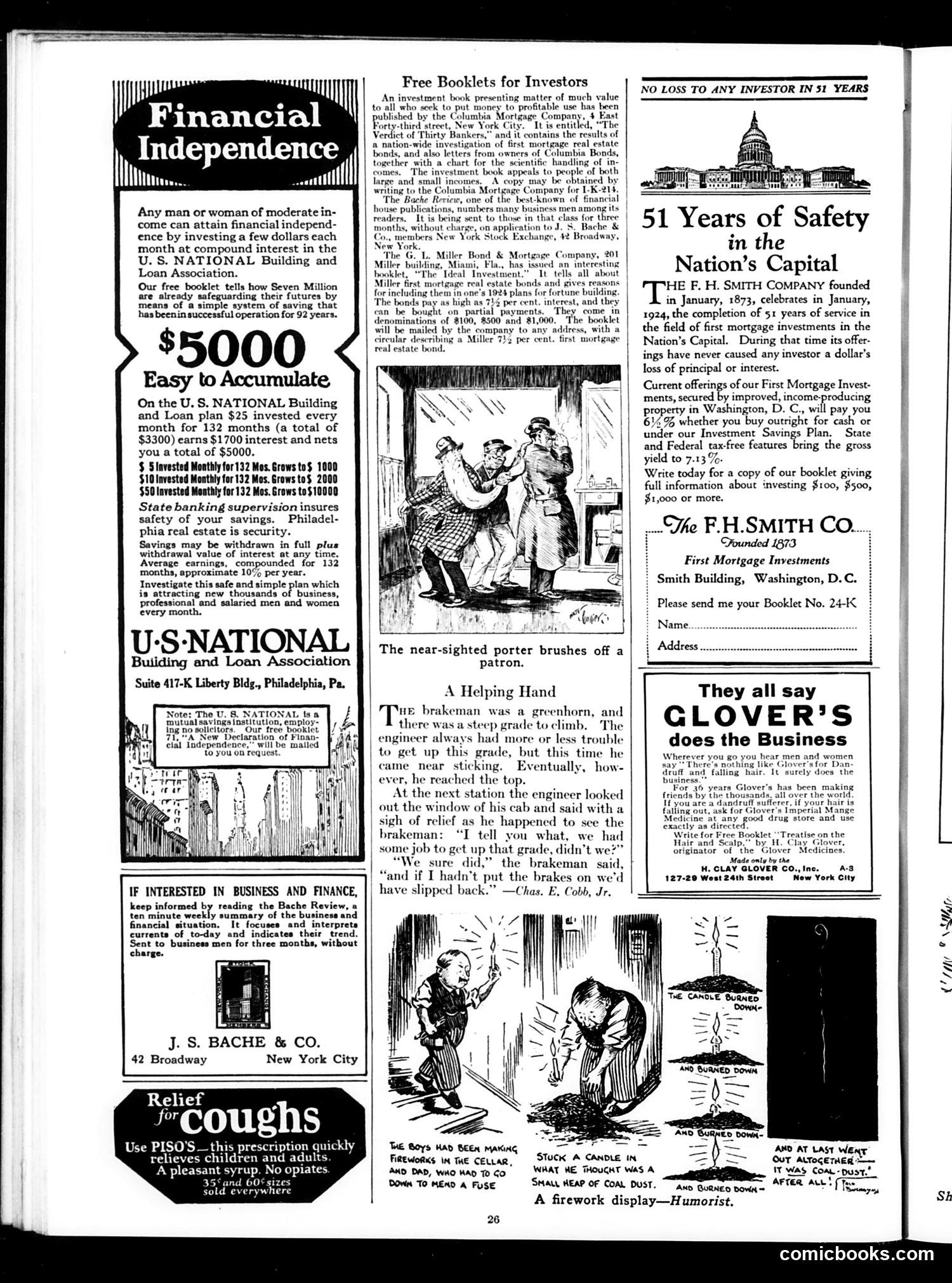
This page is primarily **advertising**, not political satire. It contains multiple financial investment pitches typical of the 1920s era. The main advertisements promote: 1. **U.S. National Building and Loan Association** — promising $5,000 accumulation through modest monthly savings with compound interest 2. **F.H. Smith Company** — boasting "51 Years of Safety" in mortgage investments with "NO LOSS TO ANY INVESTOR" 3. **Glover's** — a hair/scalp product company 4. **Piso's** — a cough syrup The small illustrative cartoons (a porter brushing off a patron; a fireworks display mishap) are generic humorous filler, not political commentary. The page reflects 1920s optimism about accessible wealth-building through savings and real estate investment—pitched to "moderate income" workers. The repeated emphasis on safety and "no losses" likely resonates with post-WWI economic uncertainty, though the promises would prove devastatingly false after the 1929 stock market crash.
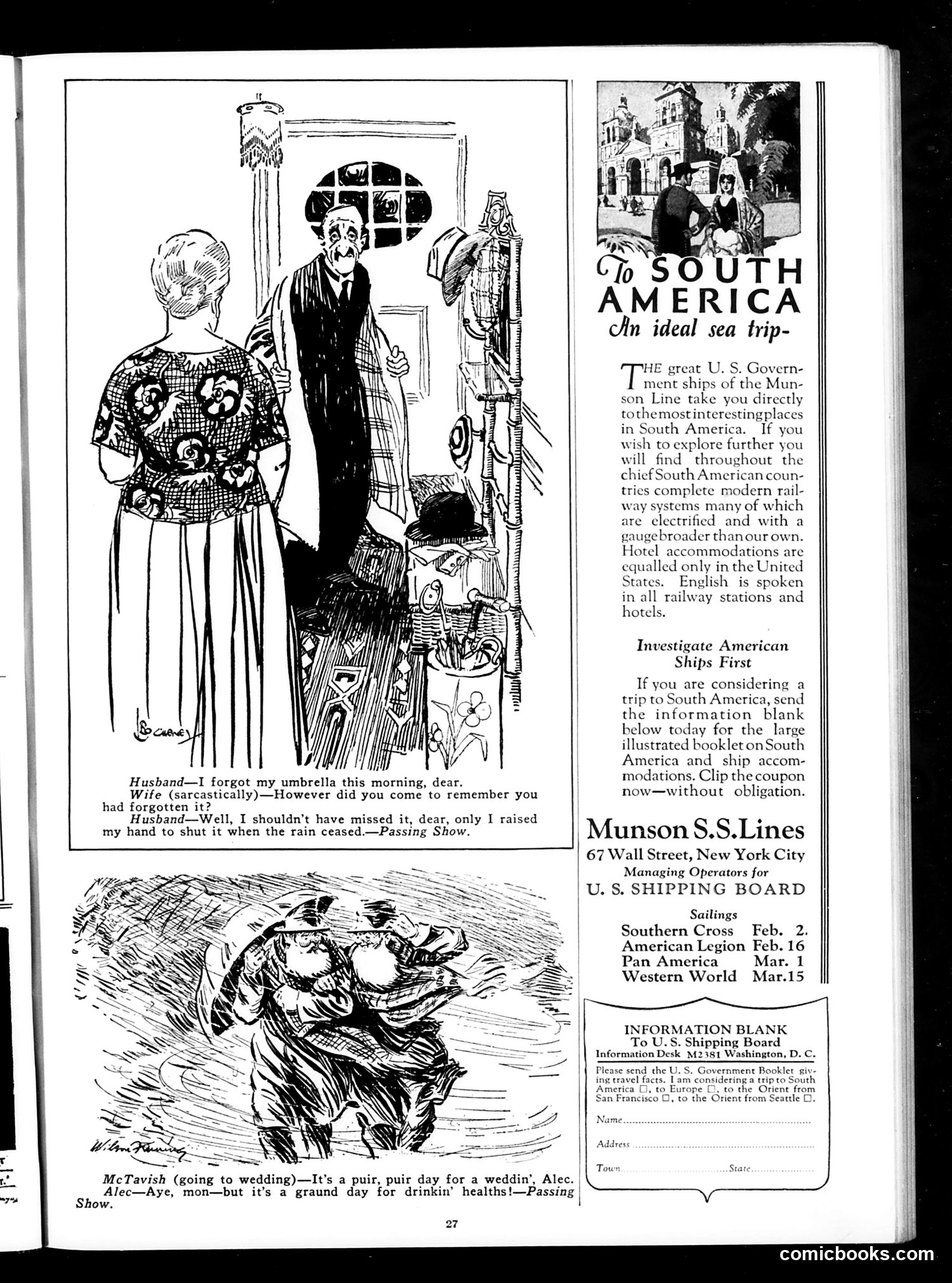
This page combines two humor cartoons with a substantial advertisement for Munson S.S. Lines shipping to South America. **Top cartoon**: A domestic scene where a husband claims he remembered his forgotten umbrella only when raising his hand to close it as rain stopped—a nonsensical excuse. The wife's sarcastic response suggests husbands are forgetful and make illogical excuses. **Bottom cartoon**: Two Scottish men (indicated by dialect spelling: "puir," "Alec," "mon") attend a wedding in poor weather. One notes it's a bad day for the ceremony but good for "drinkin' healths"—Scottish stereotyping portraying them as heavy drinkers who find any occasion an excuse for alcohol. **Advertisement**: The bulk of the page promotes U.S. Government ships operated by Munson Line for South American travel, emphasizing modern infrastructure, English availability, and comfortable hotels—marketing leisure travel to affluent readers during the post-WWI shipping boom. All content reflects early 20th-century humor sensibilities and period advertising conventions.
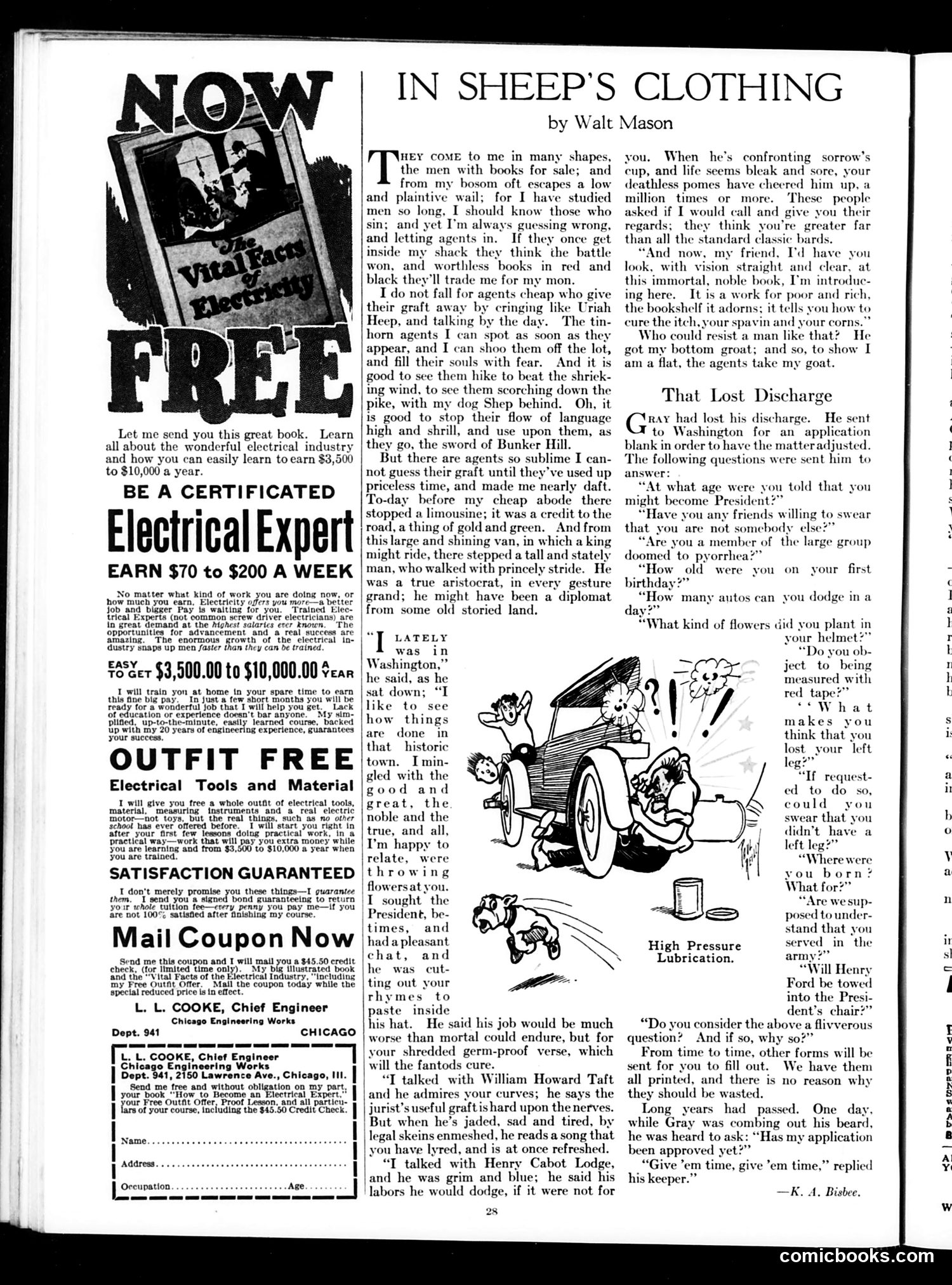
This page combines advertisements with Walt Mason's satirical verse poem of the same name. **The Poem's Message:** Mason's narrator describes being targeted repeatedly by deceptive traveling salesmen ("agents") who appear respectable but peddle worthless goods. The title metaphor—wolves in sheep's clothing—refers to these con artists disguising themselves as legitimate businesspeople. The poem celebrates his ability to spot obvious frauds and chase them away, but concludes with his vulnerability: even this suspicious man cannot identify the most sophisticated con when a genuinely aristocratic-seeming stranger (arriving by limousine) wins him over, leading to potential financial loss. **The Irony:** The satire is sharpened by the page's heavy presence of genuine-looking advertisements (electrical training, engineering courses), which employ identical persuasion tactics: prestigious claims, promises of wealth, official-looking credentials, and mail-in offers. The reader who ridicules the poem's narrator for falling for slick sales pitches confronts the same appeals throughout the page.
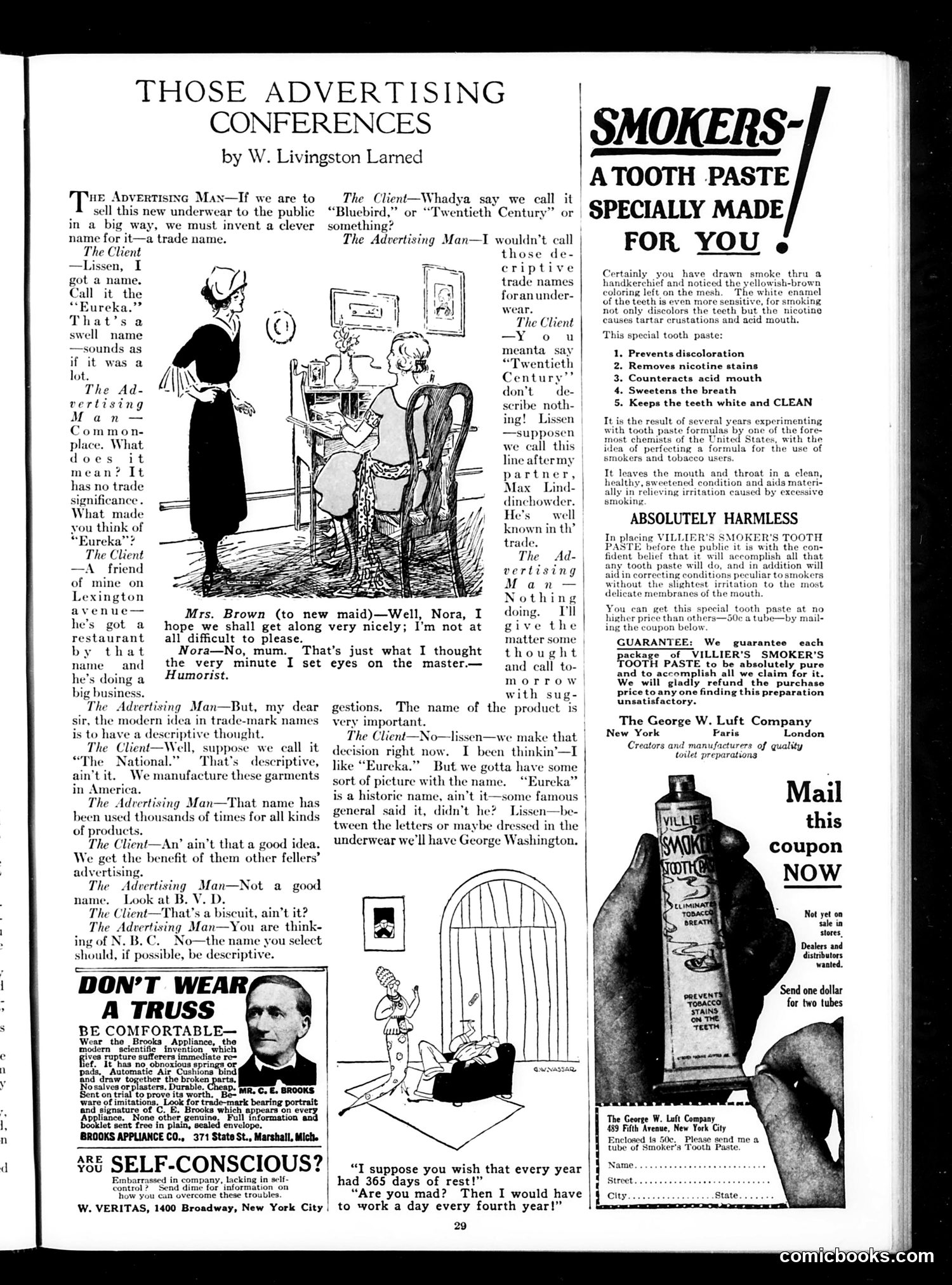
This page satirizes early 20th-century advertising practices through a dialogue between an Advertising Man and a Client discussing how to name a new underwear product. **The Satire's Point:** The Client represents a naive businessman who suggests terrible trade names based on irrelevant associations—his restaurant-owning friend's success with "Eureka," or copying established brands like "National" or "B.V.D." He even proposes naming underwear after his partner "Max Linddinchowder." The Advertising Man repeatedly insists modern marketing requires descriptive, meaningful brand names that convey the product's actual purpose. **The Joke:** The Client's logic—that piggy-backing on others' advertising success or using historic names (ultimately proposing "George Washington" on the underwear) is smart—directly contradicts the advertising professional's expertise. The satire mocks businessmen who don't understand modern marketing principles and try to cut corners. The page also contains period advertisements for a truss, "Smokers' Tooth Paste," and other products typical of the era.
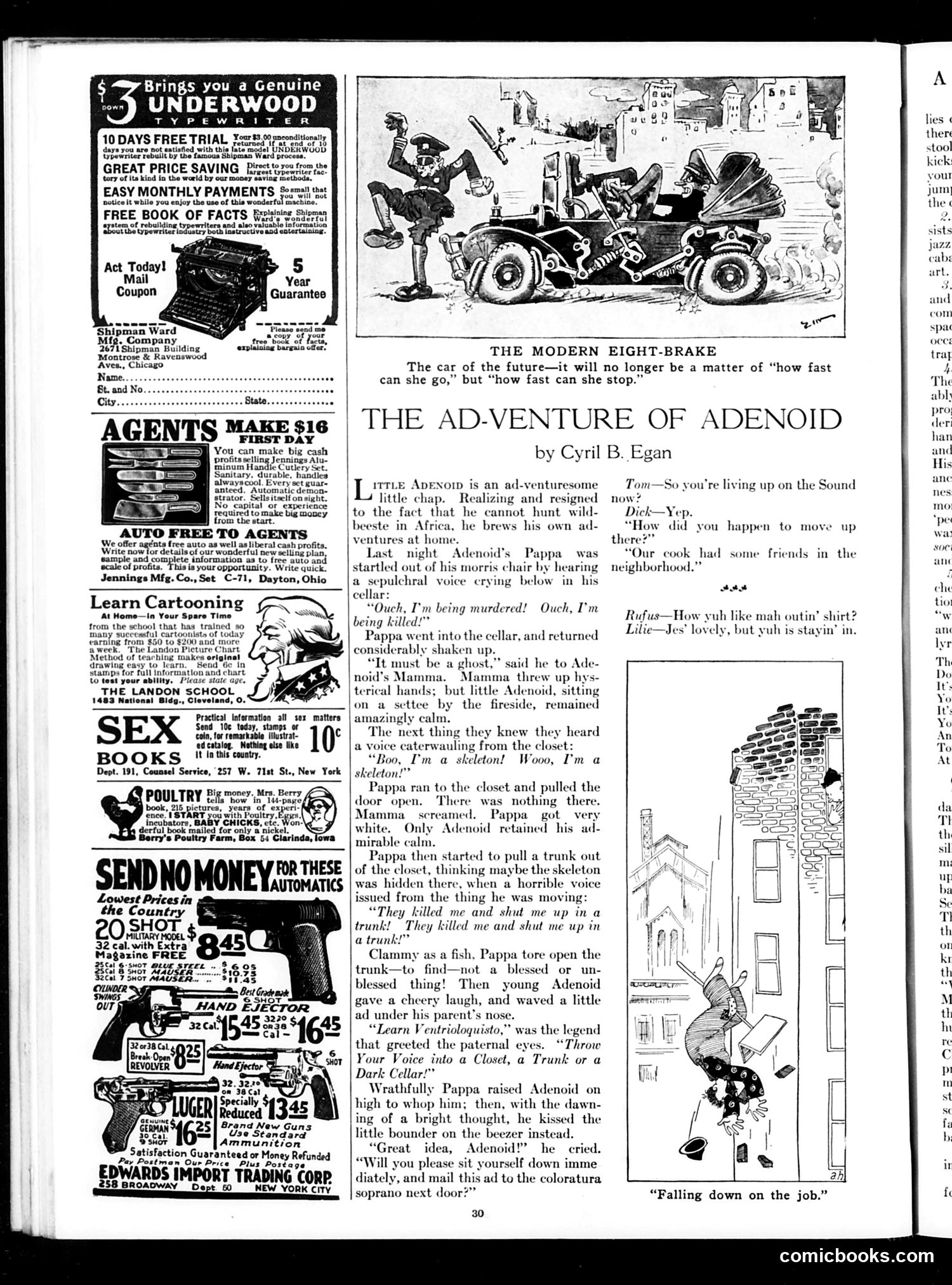
This page from *Judge* magazine contains a humorous short story illustrated with cartoon panels. "The Ad-Venture of Adenoid" satirizes mail-order advertisements prevalent in early 20th-century magazines. The plot: A mischievous boy named Adenoid uses a ventriloquism correspondence course to prank his parents, creating the illusion of ghosts and murder victims in their home. His father initially panics, but ultimately approves when he realizes his son is just advertising the mail-order lesson. **The satire's point**: The story gently mocks the proliferation of "learn-at-home" ads filling magazines—exactly like those surrounding this story on the same page (typewriter lessons, cartooning courses, poultry farming guides, etc.). By showing a child using such an ad to fool gullible adults, *Judge* suggests these mail-order schemes are somewhat absurd and exploit people's credulity. The parents' eventual approval implies complicity with this dubious advertising culture.
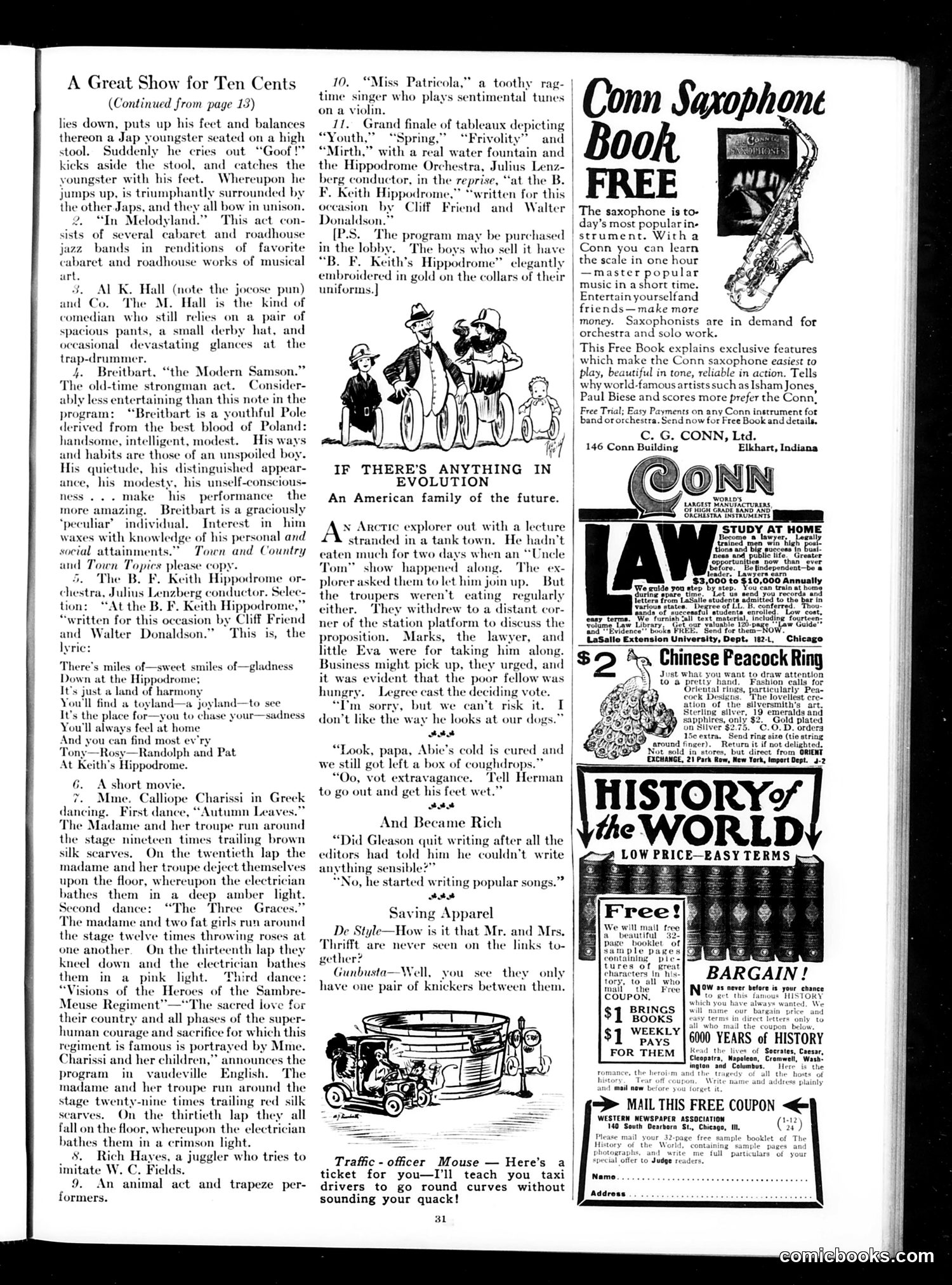
This page contains two main sections: a theater review and satirical content. **The Theater Review** describes vaudeville acts at the B.F. Keith Hippodrome. It catalogs various performers—acrobats, comedians, dancers, singers—with particular mockery of Mme. Charissi's Greek dancing act, where repetitive "running around the stage" with props (scarves, roses, silk) culminates in theatrical lighting effects. The satire pokes fun at vaudeville's reliance on spectacle over substance. **"If There's Anything in Evolution"** presents a joke about American materialism. An Arctic explorer, stranded and starving for two days, is tempted by a family discussing how they "never go on the links together" because they only own one pair of knickers (underwear/pants). The implication: American greed and class-consciousness persist even in dire circumstances—the family prioritizes possessions over shared experience, embodying what Judge saw as social decay. The page also contains advertisements for a free saxophone instruction book and history texts, typical of 1920s-era magazine filler.
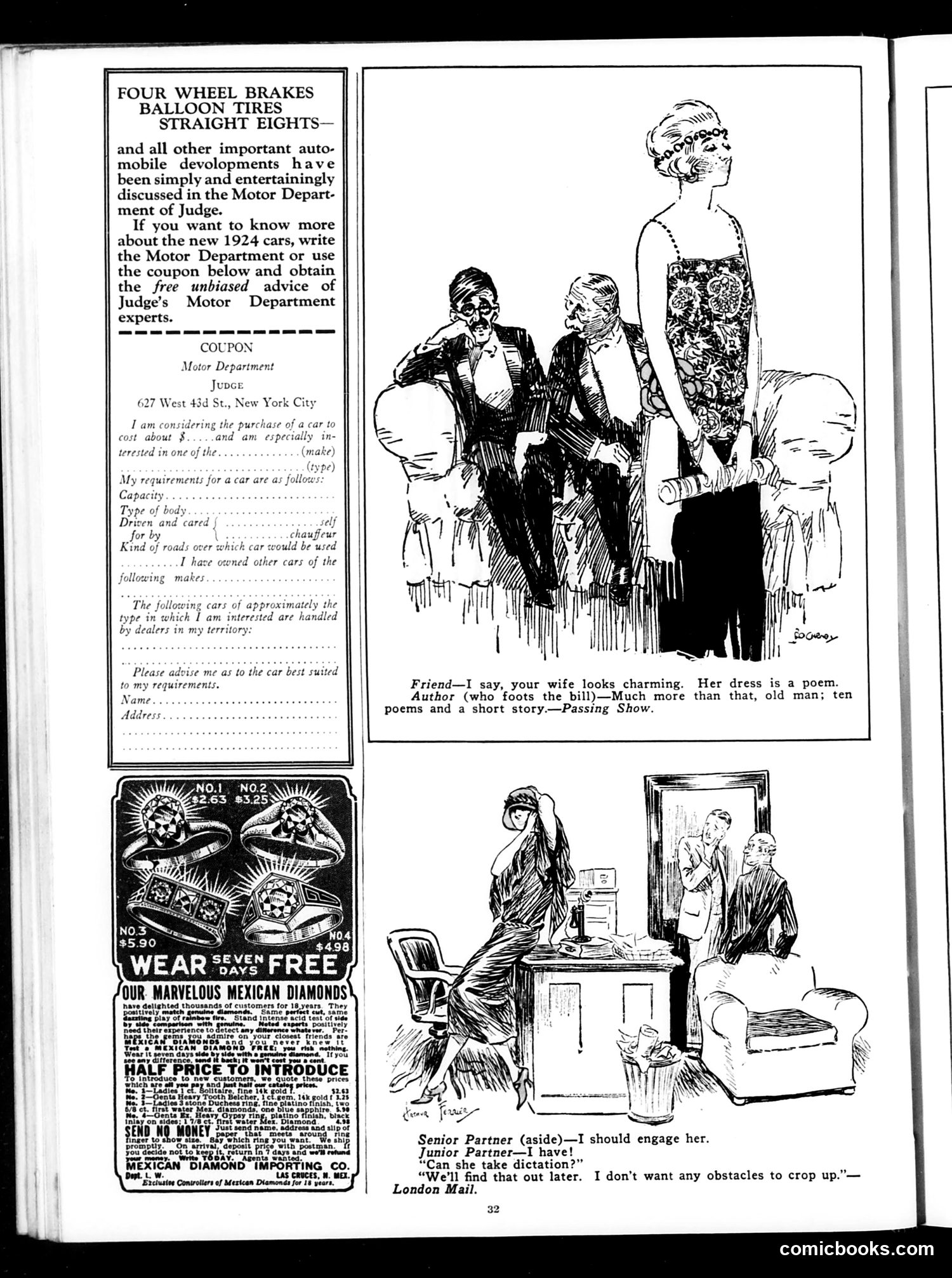
This page from Judge (circa 1924) contains three distinct elements: **Top cartoon**: Social satire about conspicuous consumption. A well-dressed couple receives compliments on the wife's fashionable dress. The husband reveals it cost him more than the dress itself—ten poems and a short story—suggesting the wife is a published author. The joke mocks wealthy men who fund their wives' artistic pursuits as vanity projects while taking credit for supporting "culture." **Middle advertisement**: Promotes "Mexican Diamonds" at half-price, a common mail-order scam promising gemstones that were likely glass or inferior stones. **Bottom cartoon**: Office humor about workplace dynamics. Partners discuss hiring a female secretary, planning to "find out" her dictation skills later while avoiding "obstacles"—a euphemistic reference to potential romantic complications. This reflects 1920s attitudes toward women in the workplace as both assets and complications. The page primarily serves as advertising and filler rather than significant political satire, typical of Judge's mixed commercial-editorial format.
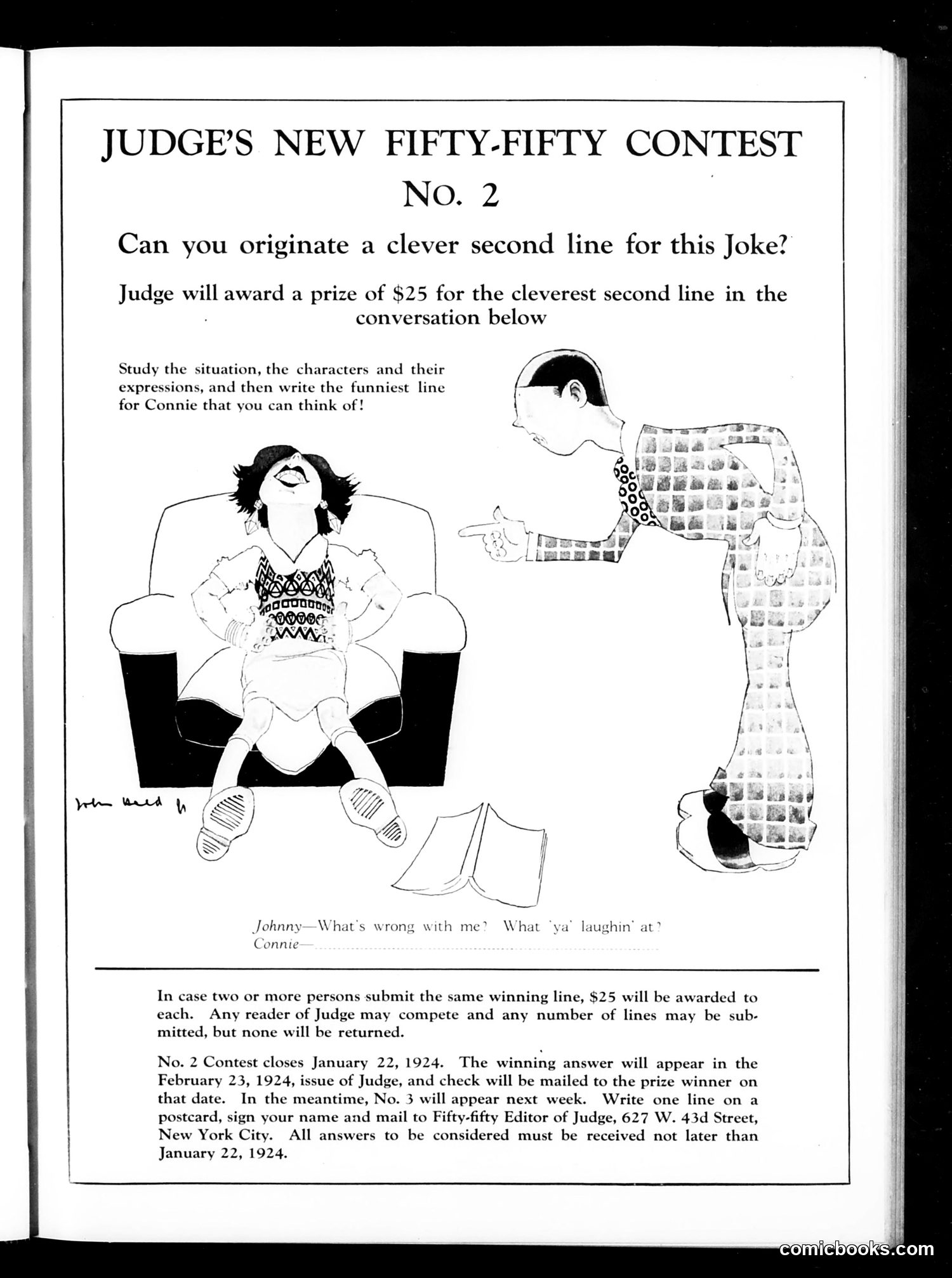
This page presents a reader-participation humor contest from *Judge*, a satirical magazine. The setup shows two characters: Johnny (seated, disheveled) asks Connie (standing, fashionably dressed) "What's wrong with me? What 'ya' laughin' at?" Readers are invited to submit Connie's witty reply for a $25 prize. The joke likely relies on visual contrast—Johnny's shabby appearance versus Connie's stylish outfit suggests he's the butt of the humor. The contest format was typical of 1920s magazine engagement, encouraging reader participation and community humor. The specific satirical target is unclear without additional context, though the disparity in their appearances and social presentation hints at class or fashion commentary common to the era. The contest closes January 22, 1924, with results appearing in February.
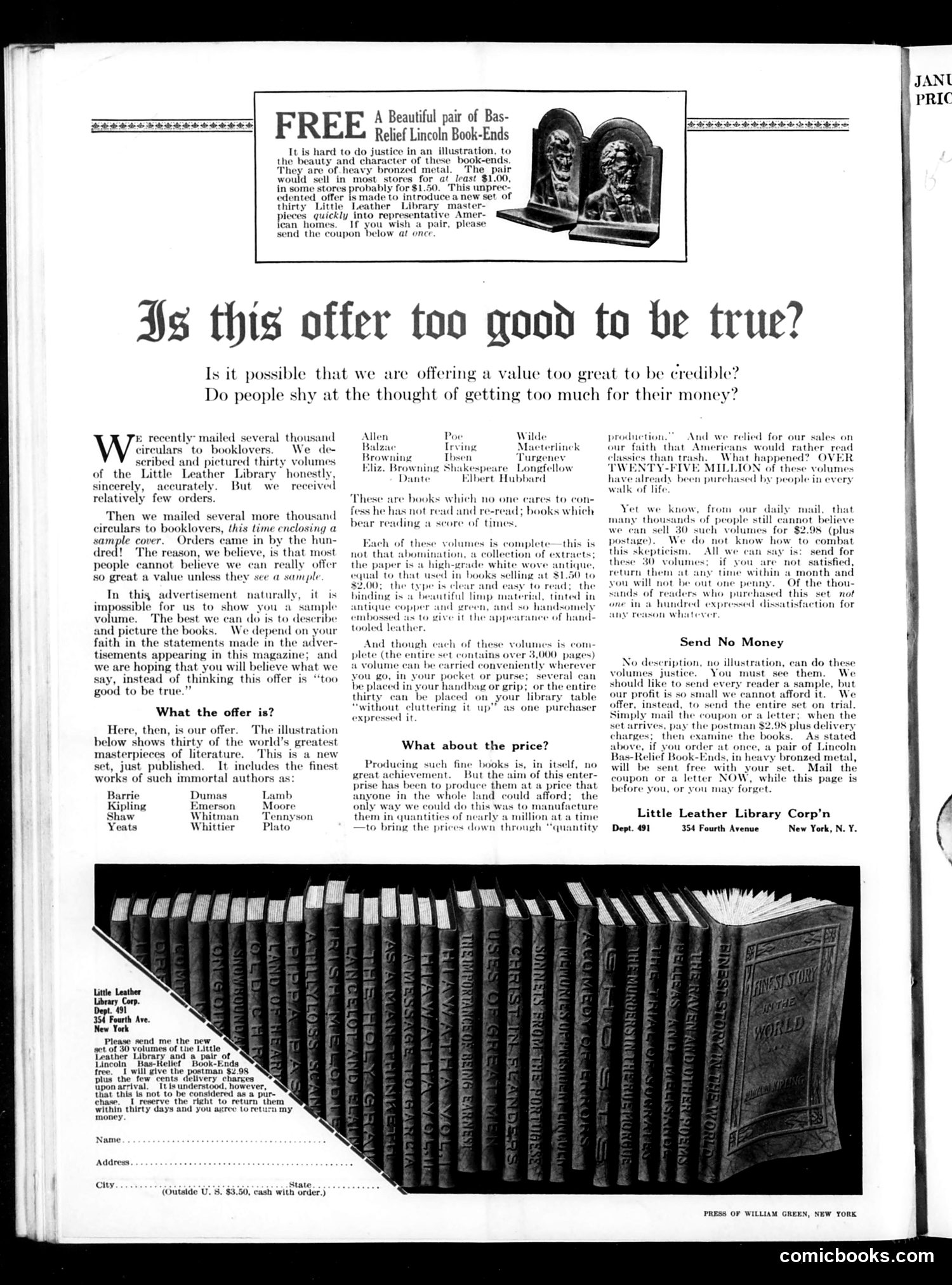
This page is primarily **advertising**, not political satire. It's a 1920s-era advertisement for the "Little Leather Library," a mail-order book set offering 30 classic literary works (by authors like Shakespeare, Dante, Poe, and Ibsen) plus free decorative Lincoln bookends. The ad's "joke" addresses consumer skepticism about seemingly too-good-to-be-true offers. The headline "Is this offer too good to be true?" directly acknowledges that people doubt the value proposition. The company explains they had poor response to initial circulars until they sent physical samples—proving people needed tangible evidence before believing the deal was genuine. The ad presents this as a mass-production achievement: producing quality books in "nearly a million" quantities allowed price reduction. It's essentially a Depression-era marketing pitch emphasizing affordability and accessibility to classical literature for ordinary Americans. There is **no political cartoon** on this page—only commercial advertising using consumer psychology.