
Judge, 1924-01-12 · page 22 of 36
Judge — January 12, 1924 — page 22: what you’re looking at
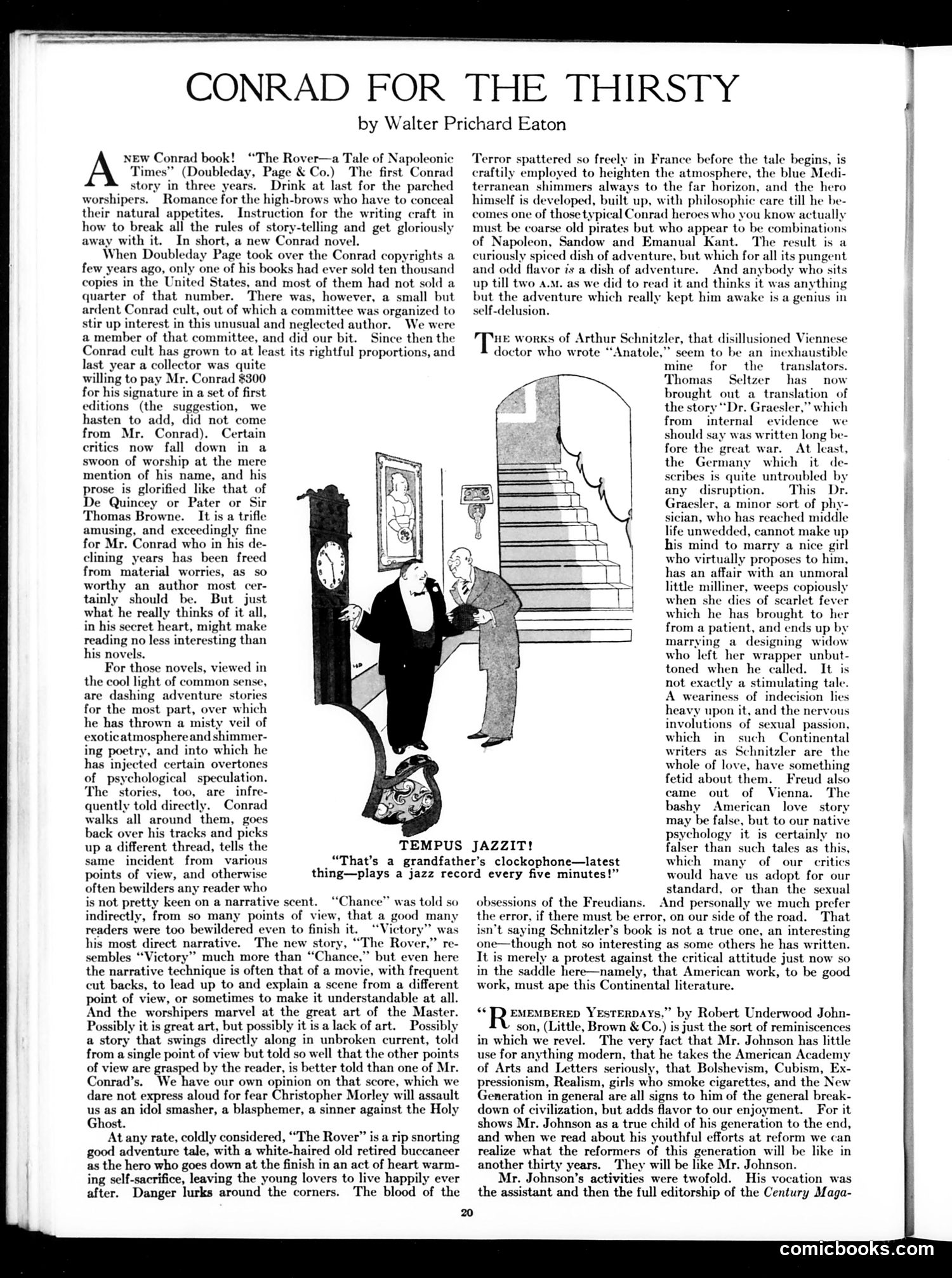
What you’re looking at
This review-essay by Walter Prichard Eaton discusses Joseph Conrad's novel *The Rover*, sarcastically framing Conrad's devoted readers as intellectually thirsty "worshipers" desperate for serious literature. The accompanying cartoon titled "Tempus Jazzit!" satirizes modern consumer culture and generational clash. It depicts two figures (likely representing an older and younger generation) examining a clock that plays jazz records every five minutes—a absurdist invention mocking how contemporary life has become fragmented and entertainment-obsessed. The "clockophone" represents the intrusion of vulgar popular culture (jazz) into what should be refined domestic spaces. Eaton's essay acknowledges Conrad's growing cult following and commercial success while maintaining skeptical distance from critics who treat his baroque narrative technique as great art rather than potential obfuscation. The satire targets both Conrad's pretentious admirers and the literary establishment's reverence for complexity over clarity.
📄 Transcribed text from this page (OCR, searchable)
Machine-transcribed from the original scan — historical spelling and the odd misread are preserved.
CONRAD FOR THE THIRSTY by Walter Prichard Eaton Conrad book! “The Rover—a Tale of Napoleonic imes” (Doubleday, Page & Co.) The first Conrad story in three years. Drink at last for the parched worshipers. Romance for the high-brows who have to conceal their natural appetites. Instruction for the writing craft in how to break all the rules of story-telling and get gloriously away with it. In short, a new Conrad novel. When Doubleday Page took over the Conrad copyrights a few years ago, only one of his books had ever sold ten thousand copies in the United States, and most of them had not sold a quarter of that number. There was, however, a small but ardent Conrad cult, out of which a committee was organized to stir up interest in this unusual and neglected author. We were a member of that committee, and did our bit. Since then the Conrad cult has grown to at least its rightful proportions, and last year a collector was quite willing to pay Mr. Conrad $300 for his signature in a set of first editions (the suggestion, we hasten to add, did not come from Mr. Conrad). Certain critics now fall down in a swoon of worship at the mere mention of his name, and his prose is glorified like that of De Quincey or Pater or Sir Thomas Browne. It is a trifle amusing, and exceedingly fine for Mr. Conrad who in his de- clining years has been freed from material worries, as so worthy an author most cer- tainly should be. But just what he really thinks of it all, in his secret heart, might make reading no less interesting than his novels. For those novels, viewed in the cool light of common sense, are dashing adventure stories for the most part, over which he has thrown a misty veil of exoticatmosphereand shimmer- ing poetry, and into which he has injected certain overtones of psychological speculation. The stories, too, are infre- quently told directly. Conrad walks all around them, goes back over his tracks and picks up a different thread, tells the same incident from various points of view, and otherwise often bewilders any reader who is not pretty keen on a narrative scent. “Chance” was told so indirectly, from so many points of view, that a good many readers were too bewildered even to finish it. “Victory” was his most direct narrative. The new story, “The Rover,” re- sembles “Victory” much more than “Chance,” but even here the narrative technique is often that of a movie, with frequent cut backs, to lead up to and explain a scene from a different point of view, or sometimes to make it understandable at all. And the worshipers marvel at the great art of the Master. Possibly it is great art, but possibly it is a lack of art. Possibly a story that swings directly along in unbroken current, told from a single point of view but told so well that the other points of view are grasped by the reader, is better told than one of Mr. Conrad’s. We have our own opinion on that score, which we dare not express aloud for fear Christopher Morley will assault us as an idol smasher, a blasphemer, a sinner against the Holy Ghost. Atany rate, coldly considered, “The Rover” is a rip snorting good adventure tale, with a white-haired old retired buccaneer as the hero who goes down at the finish in an act of heart warm- ing self-sacrifice, leaving the young lovers to live happily ever after. Danger lurks around the corners. The blood of the TEMPUS JAZZIT! “That’s a grandfather’s clockophone—latest thing—plays a jazz record every five minutes!” Terror spattered so freely in France before the tale begins, is craftily employed to heighten the atmosphere, the blue Medi- terranean shimmers always to the far horizon, and the hero himself is developed, built up, with philosophic care till he be- comes one of those typical Conrad heroes who you know actually must be coarse old pirates but who appear to be combinations of Napoleon, Sandow and Emanual Kant. The result is a curiously spiced dish of adventure, but which for all its pungent and odd flavor is a dish of adventure. And anybody who sits up till two a.m we did to read it and thinks anything but the adventure which really kept him awake is a genius in self-delusion. Te works of Arthur Schnitzler, that disillusioned Viennese doctor who wrote “Anatole,” seem to be an inexhaustible mine for the Thomas Seltzer translators. now brought out a tra ion of the story “Dr. Grae * which from internal evidence we should say was written long be- fore the great war. At least, the Germany which it de- scribes is quite untroubled by any disruption. This Dr. Graesler, a minor sort of phy- in, who has reached middle life unwedded, cannot make up his mind to marry a nice girl who virtually proposes to him, has an affair with an unmoral little milliner, weeps copiously when she dies of scarlet fever which he has brought to her from a patient, and ends up by marrying a designing widow who left her wrapper unbut- toned when he called. It is not exactly a stimulating tale. A weariness of indecision lies heavy upon it, and the nervous involutions of sexual passion, which in such Continental writers as Schnitzler are the whole of love, have something fetid about them. Freud also came out of Vienna. The bashy American love story may be false, but to our native psychology it is certainly no falser than such tales as this, which many of our critics would have us adopt for our standard, or than the sexual obsessions of the Freudians. And personally we much prefer the error, if there must be error, on our side of the road. That isn’t saying Schnitzler’s book is not a true one, an interesting one—though not so interesting as some others he has written. It is merely a protest against the critical attitude just now so in the saddle here—namely, that American work, to be good work, must ape this Continental literature. EMEMBERED YEsTERDAYS,” by Robert Underwood John- son, (Little, Brown & Co.) is just the sort of reminiscences in which we revel. The very fact that Mr. Johnson has little use for anything modern, that he takes the American Academy of Arts and Letters seriously, that Bolshevism, Cubism, Ex- pressionism, Realism, girls who smoke cigarettes, and the New Generation in general are all signs to him of the general break- down of civilization, but adds flavor to our enjoyment. For it shows Mr. Johnson as a true child of his generation to the end, and when we read about his youthful efforts at reform we can realize what the reformers of this generation will be like in another thirty years. They will be like Mr. Johnson. Mr. Johnson’s activities were twofold. His vocation was the assistant and then the full editorship of the Century Maga- comicbooks.com