
A complete issue · 36 pages · 1924
Judge — January 5, 1924
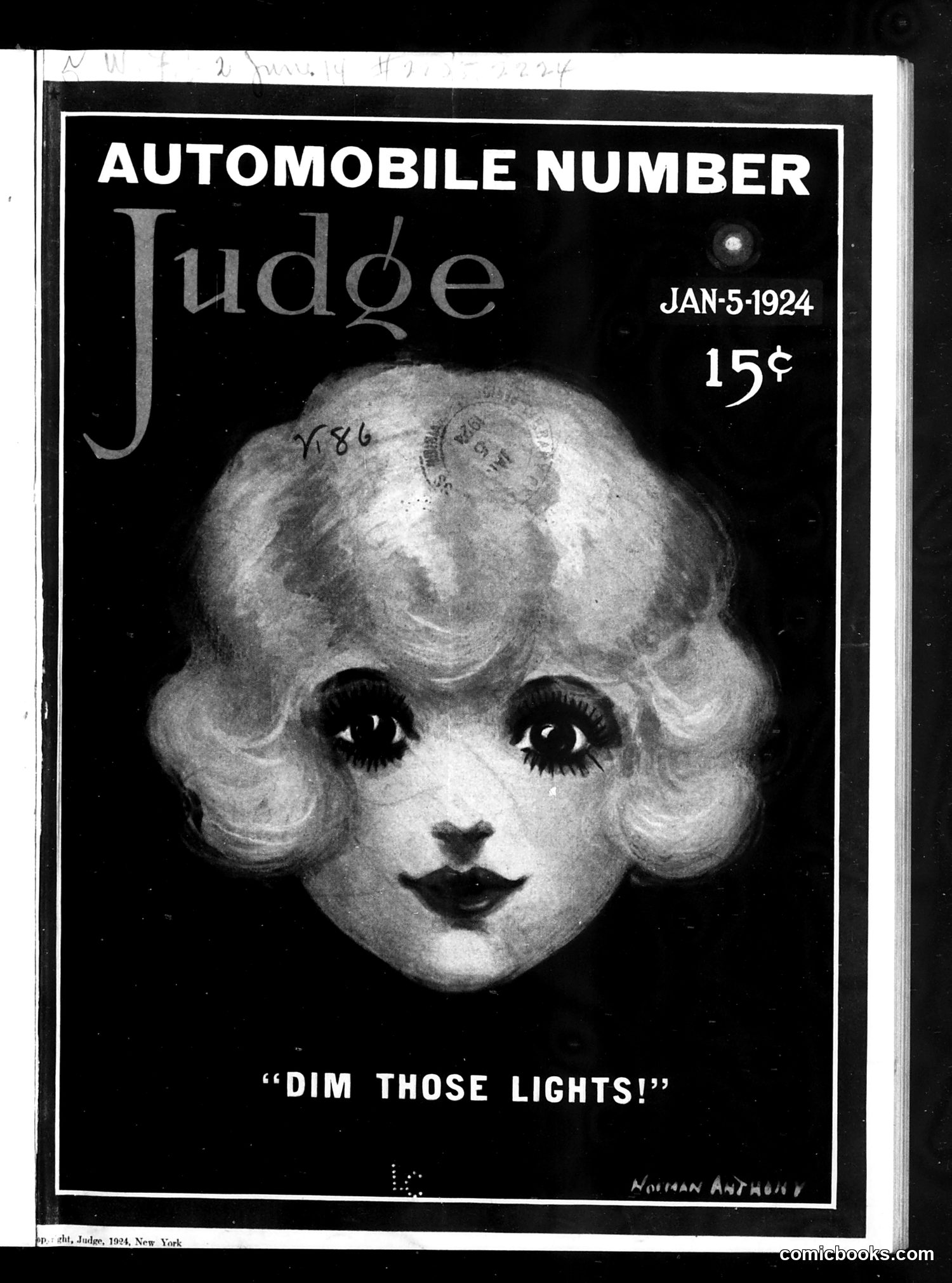
This is a satirical advertisement for automobiles, using a stylized feminine face with exaggerated features—large eyes with heavy lashes, wavy blonde hair, and bold lips. The caption "DIM THOSE LIGHTS!" is the joke's core. The satire plays on the then-common complaint about automobiles' increasingly bright headlights, which dazzled oncoming drivers. Rather than directly criticizing car manufacturers or drivers, Judge uses visual humor: the feminine face represents how blinded drivers appear—with wide, shocked eyes confronted by automobile headlights. This reflects 1920s anxieties about automobile safety and the technology's rapid adoption. The "Automobile Number" issue suggests Judge was examining the car industry's social impact, using this cover to mock the headlight problem through absurdist imagery.
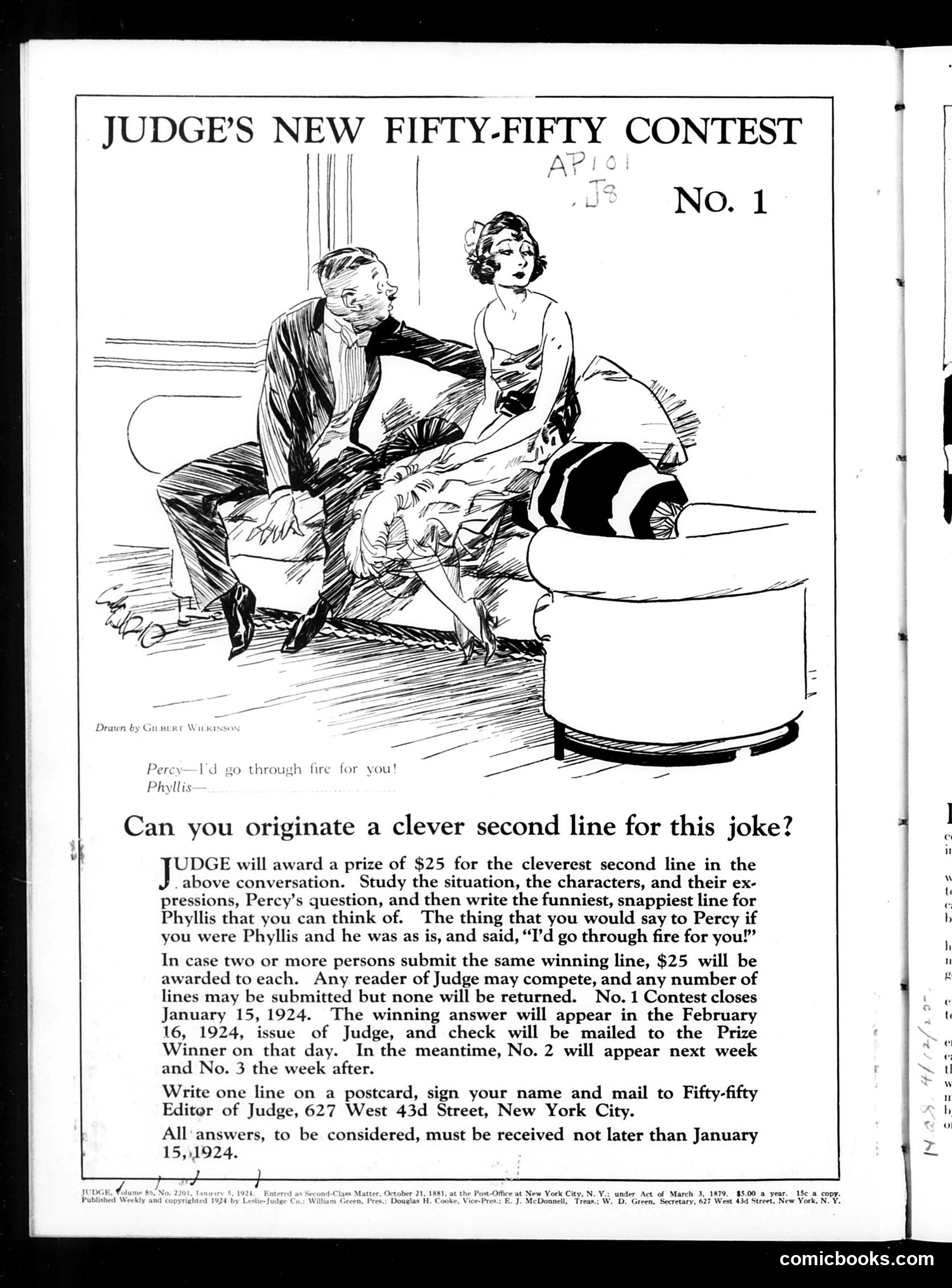
This is a humor contest page, not political satire. The cartoon depicts a domestic scene where a man (Percy) sits with a woman (Phyllis), declaring "I'd go through fire for you!" The contest invites readers to supply a clever "second line"—Phyllis's witty response to Percy's romantic declaration. The humor hinges on subverting romantic sentiment with a snappy comeback. Judge offered $25 for the cleverest response, with entries due by January 15, 1924. This was a common reader-participation feature in magazines of this era, encouraging audience engagement and filling pages with humorous content. The drawing is credited to Gilbert Wilkinson.
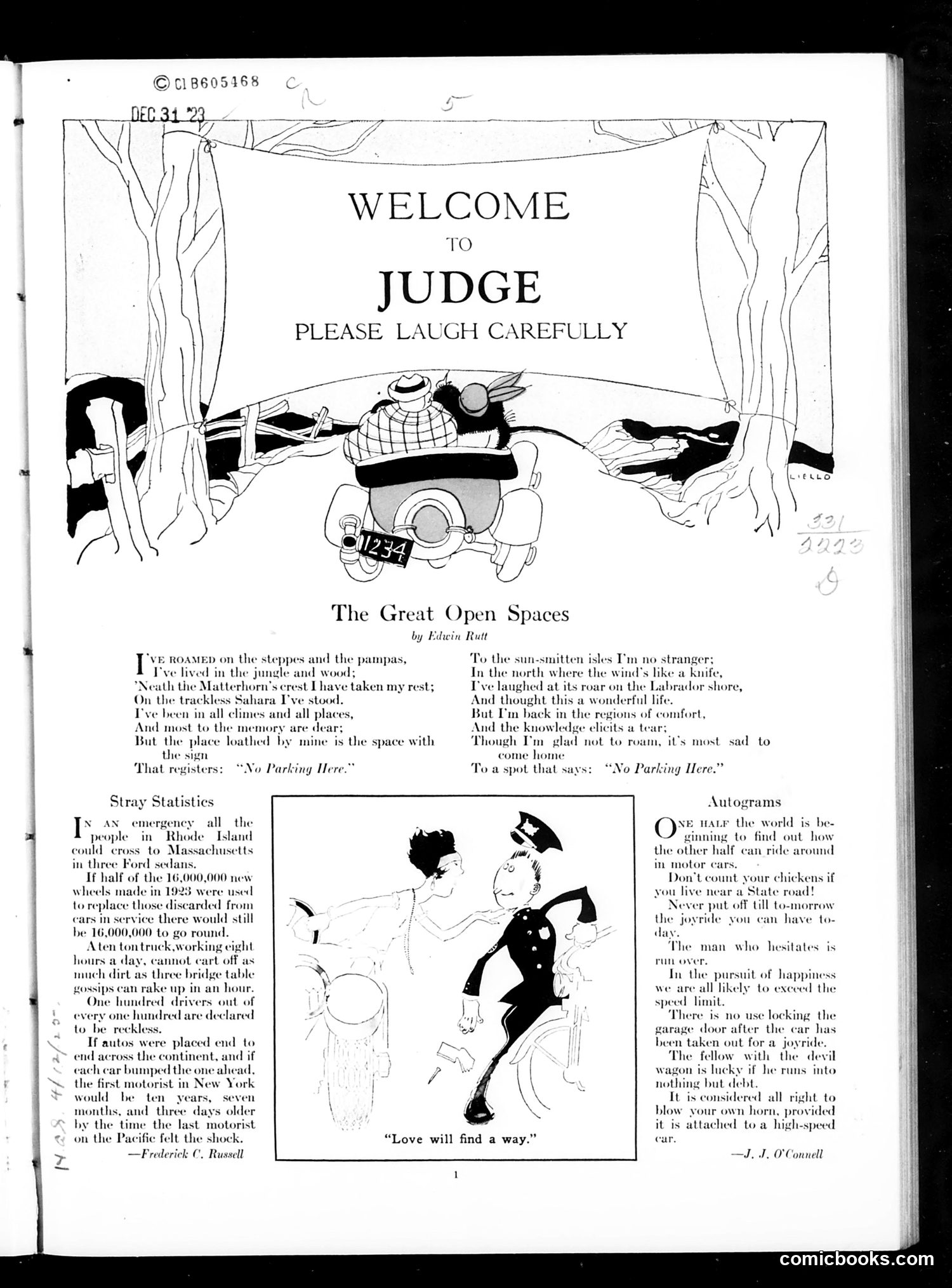
This page welcomes a judge with the instruction to "laugh carefully," introducing three humor pieces about modern automotive culture. The central cartoon depicts a couple in a car with the caption "Love will find a way," satirizing romantic persistence despite practical obstacles—likely referencing how courting couples used automobiles for privacy, a social concern of the 1920s-30s era. The surrounding text includes: - **"Stray Statistics"**: Absurdist humor about traffic and automotive casualties, mocking the explosion of motor vehicles and resulting chaos - **"Autograms"**: Witty observations about car ownership and driving behavior The overall theme mocks the automobile's rapid integration into American life, its associated dangers, and its transformation of social practices—particularly dating and courtship rituals.
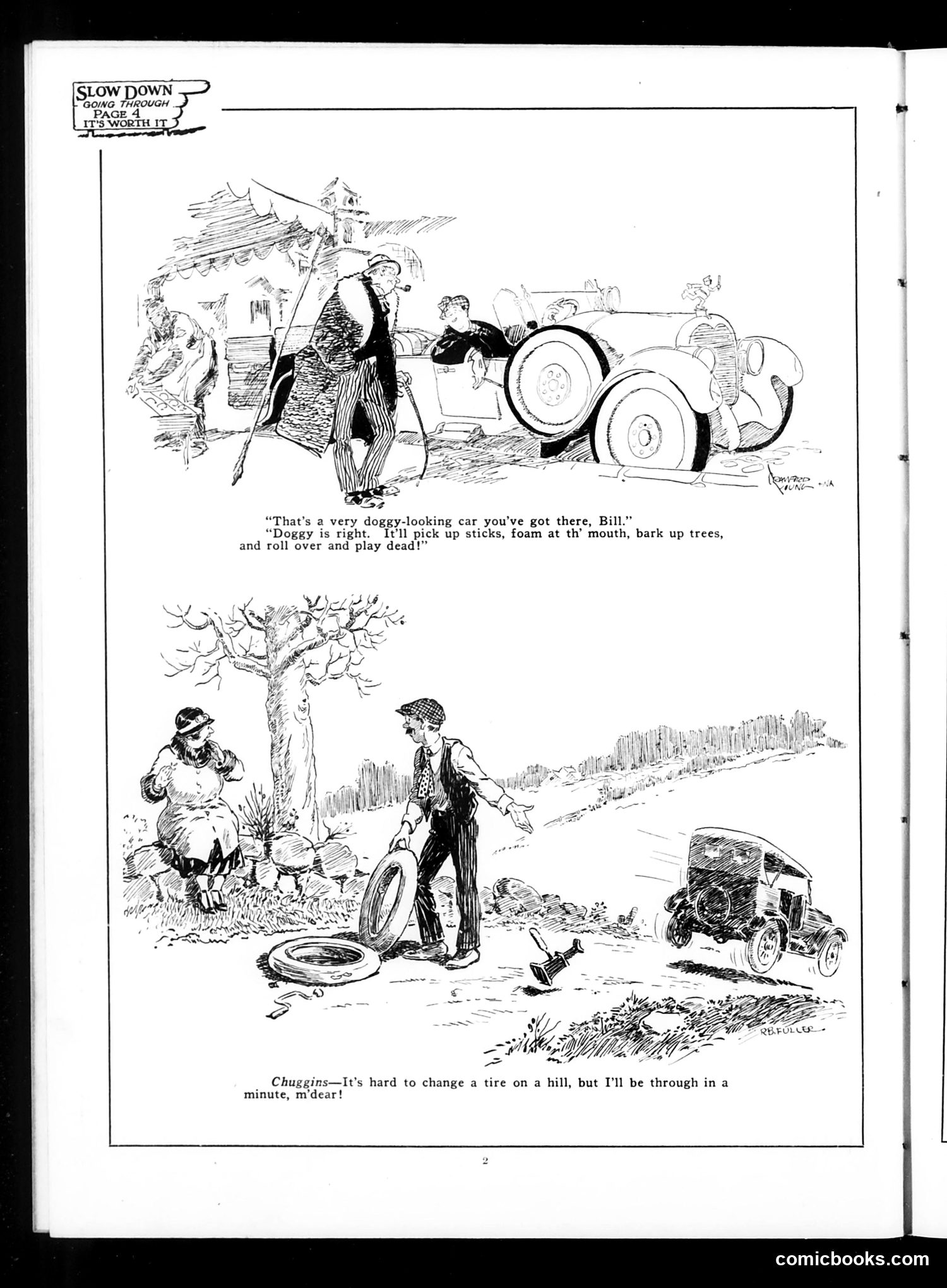
This page contains two unrelated cartoons satirizing automobiles and automotive culture in the early 20th century. The **top cartoon** mocks a poorly-constructed or ramshackle car, with one character describing it as "doggy-looking." The joke plays on the vehicle's shabby appearance—it will "pick up sticks, foam at th' mouth, bark up trees, and roll over and play dead," treating the bad car like an undisciplined dog. The **bottom cartoon** shows a couple attempting roadside tire repair on a hill, with the man (Chuggins) assuring his female companion he'll finish quickly. The humor derives from the common frustration of early motorists facing mechanical breakdowns and tire changes—frequent, difficult occurrences that made automobile travel unreliable and inconvenient compared to horse-drawn transport. Both cartoons reflect contemporary anxieties about automobile reliability and the novelty of car ownership.
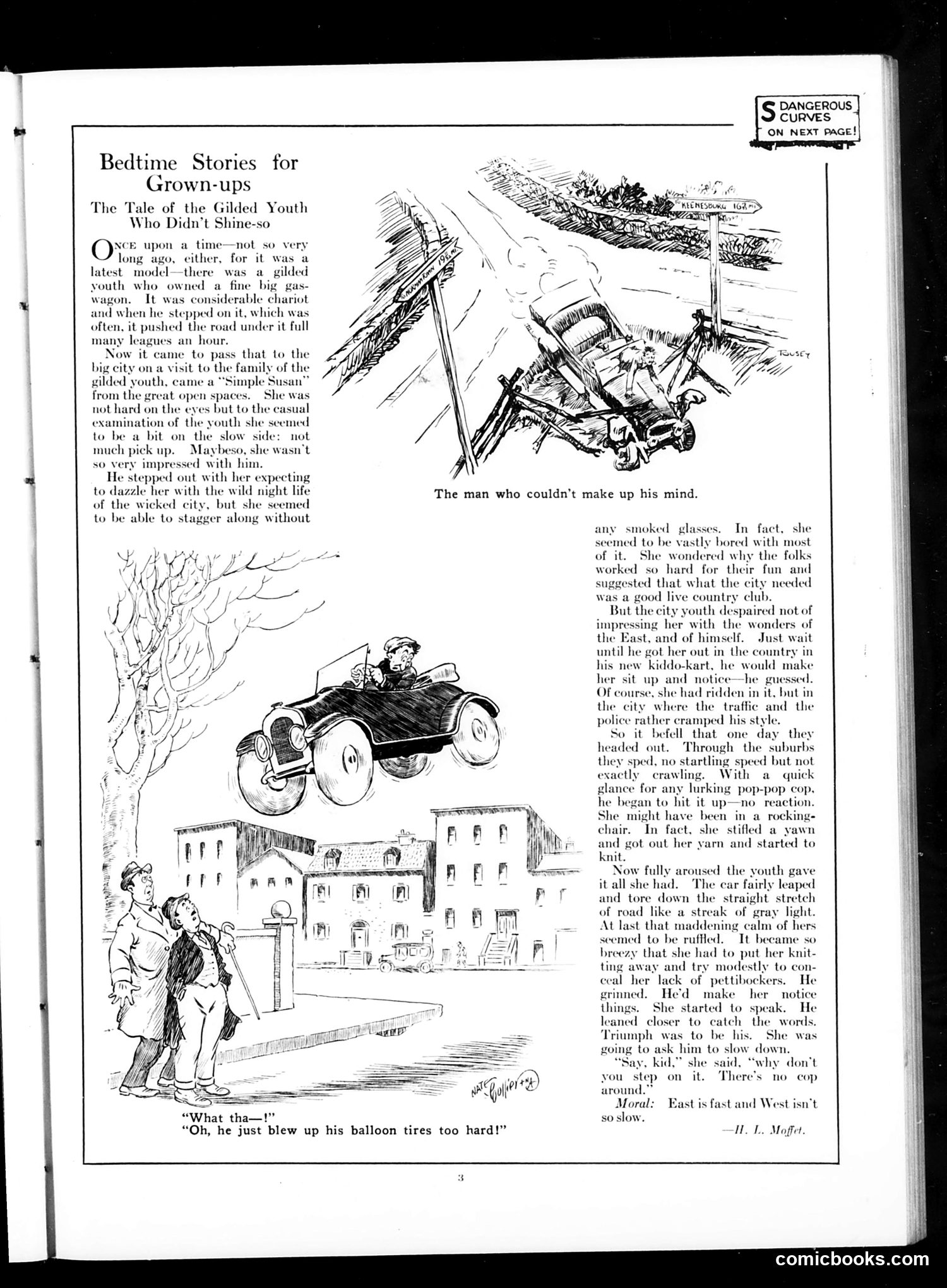
This is a satirical story about a wealthy young man with a fancy gas-powered vehicle who attempts to impress a woman ("Simple Susan") with displays of urban sophistication and reckless driving. The humor operates on several levels: **The satire:** The gilded youth fails to impress despite his wealth and the "wonders of the East." His new automobile—a status symbol of modern technology—becomes the vehicle for his comeuppance when he drives recklessly through suburbs. **The moral:** The story's conclusion suggests that flashy materialism and speed don't guarantee success; restraint and modesty are preferable. The caption "East is fast and West isn't so slow" implies criticism of both excessive haste and pretentious urban values. The illustrations mock early automobile culture and the foolishness of young wealthy men.
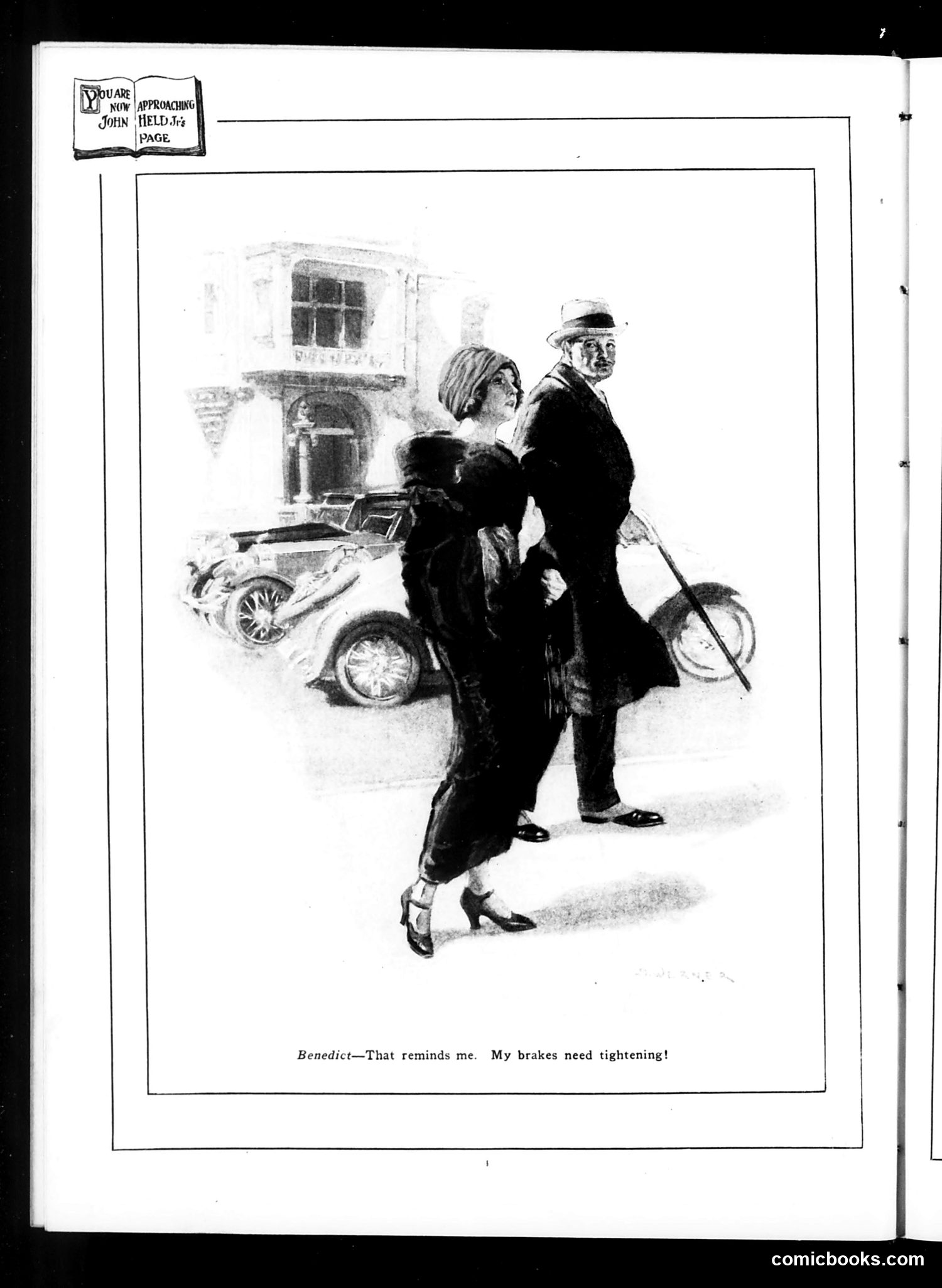
This cartoon depicts a traffic accident scenario from the early automobile era. A man and woman stand near a damaged car outside a building, with the woman appearing to have struck something or someone with her bicycle. The caption reads: "Benedict!—That reminds me. My brakes need tightening!" The satire targets **early 1900s gender dynamics and automobile safety**. The joke plays on the woman's apparent lack of concern—she's caused a collision but immediately shifts blame to her bicycle's brakes rather than acknowledging her responsibility. This reflects period stereotypes about women drivers and pedestrians as careless or distracted. The cartoon also satirizes the era's chaotic traffic conditions, where cars, bicycles, and pedestrians competed for space without modern safety standards or regulations.
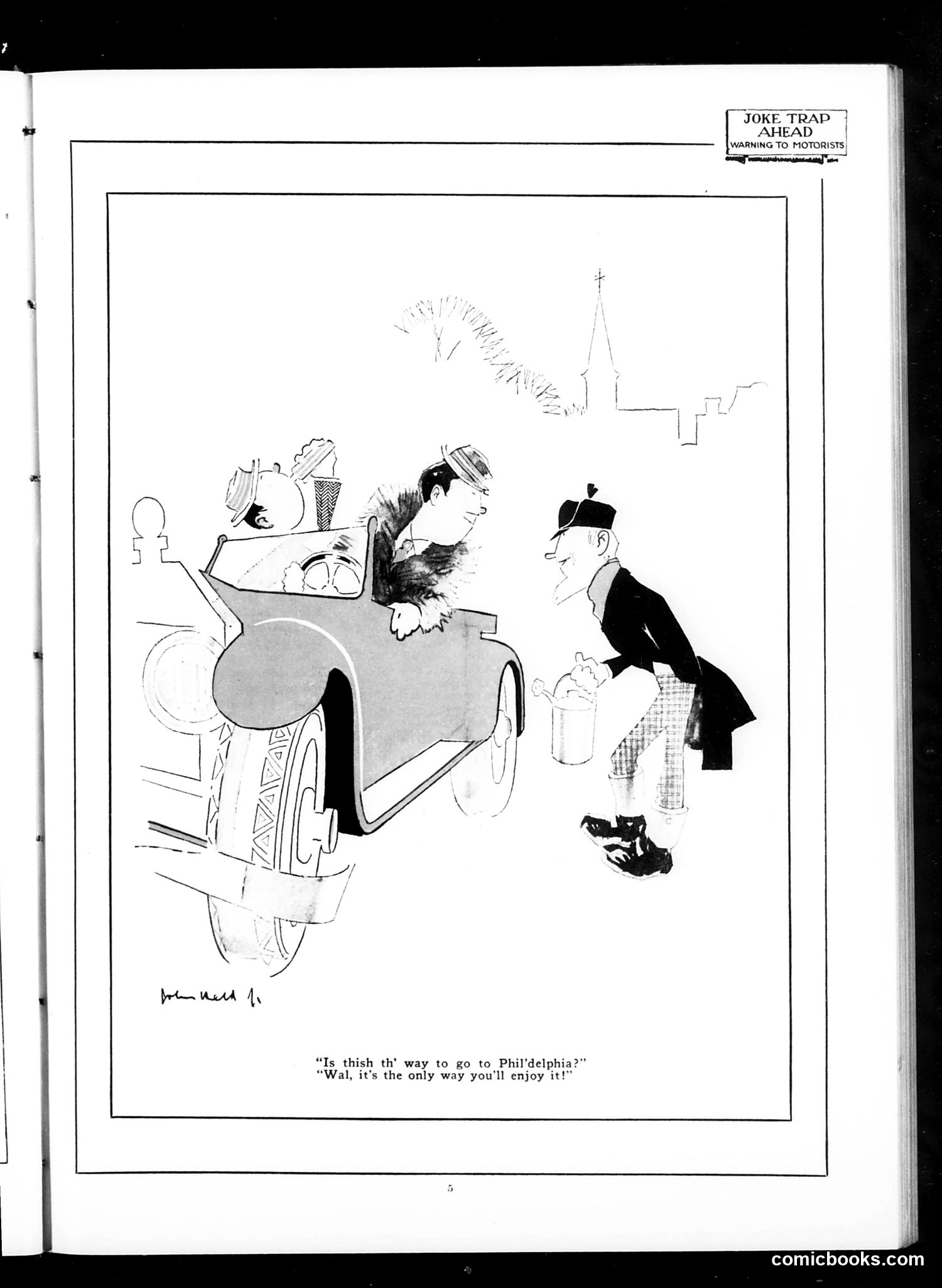
This is a humor cartoon titled "Joke Trap Ahead—Warning to Motorists." A drunk driver in an overloaded car asks a pedestrian for directions to Philadelphia, slurring his speech ("Is thish th' way"). The pedestrian's reply—that this is "the only way you'll enjoy it"—is a dark joke: the implication is that driving while intoxicated is the only way someone in that condition would find pleasure in the journey. The satire targets both drunk driving (presenting it as foolish and dangerous) and Prohibition-era drinking culture. The overloaded vehicle filled with contraband suggests bootlegging. The cartoon warns motorists about reckless driving while mocking those who drink and drive, reflecting early 20th-century concerns about automobile safety and alcohol abuse.
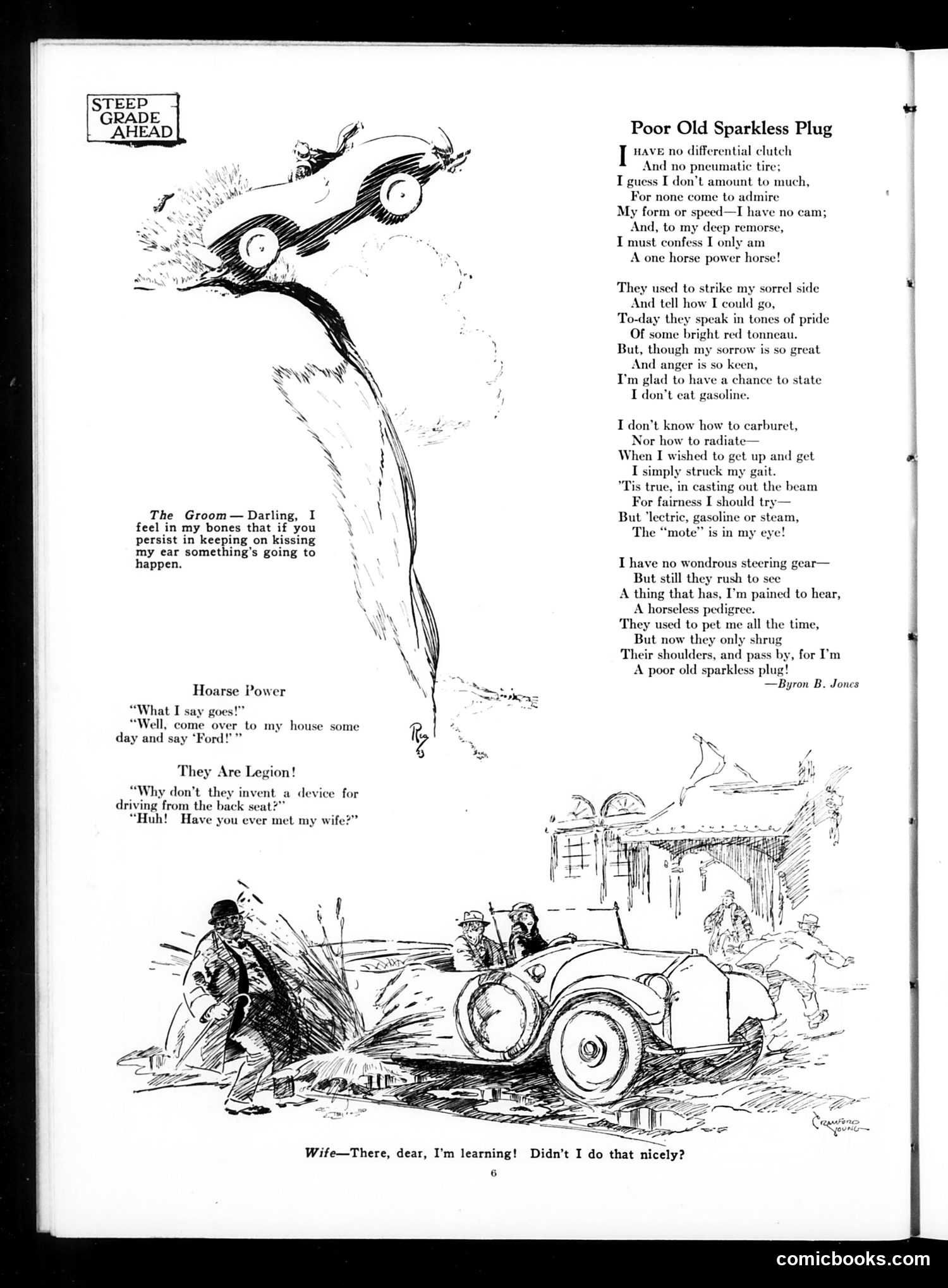
This 1910s-era Judge magazine page satirizes the rapid displacement of horses by automobiles. The main poem, "Poor Old Sparkless Plug," is a lament from a horse's perspective—it's been replaced by motorized vehicles ("bright red tonneau," "horseless pedigree") and mourns its lost status. The horse's one advantage is that it doesn't require gasoline, which appears to be the satire's real target: the newfangled, temperamental automobile technology. The lower cartoons mock early cars: "Hoarse Power" jokes about Ford's dominance ("say 'Ford!'"), while "They Are Legion!" depicts a car breaking down with a frustrated driver and wife. The humor mocks both automobile unreliability and wives as backseat drivers—typical period stereotypes. The overall satire critiques the hype around automobiles despite their mechanical problems, while nostalgically sympathizing with horses becoming obsolete.
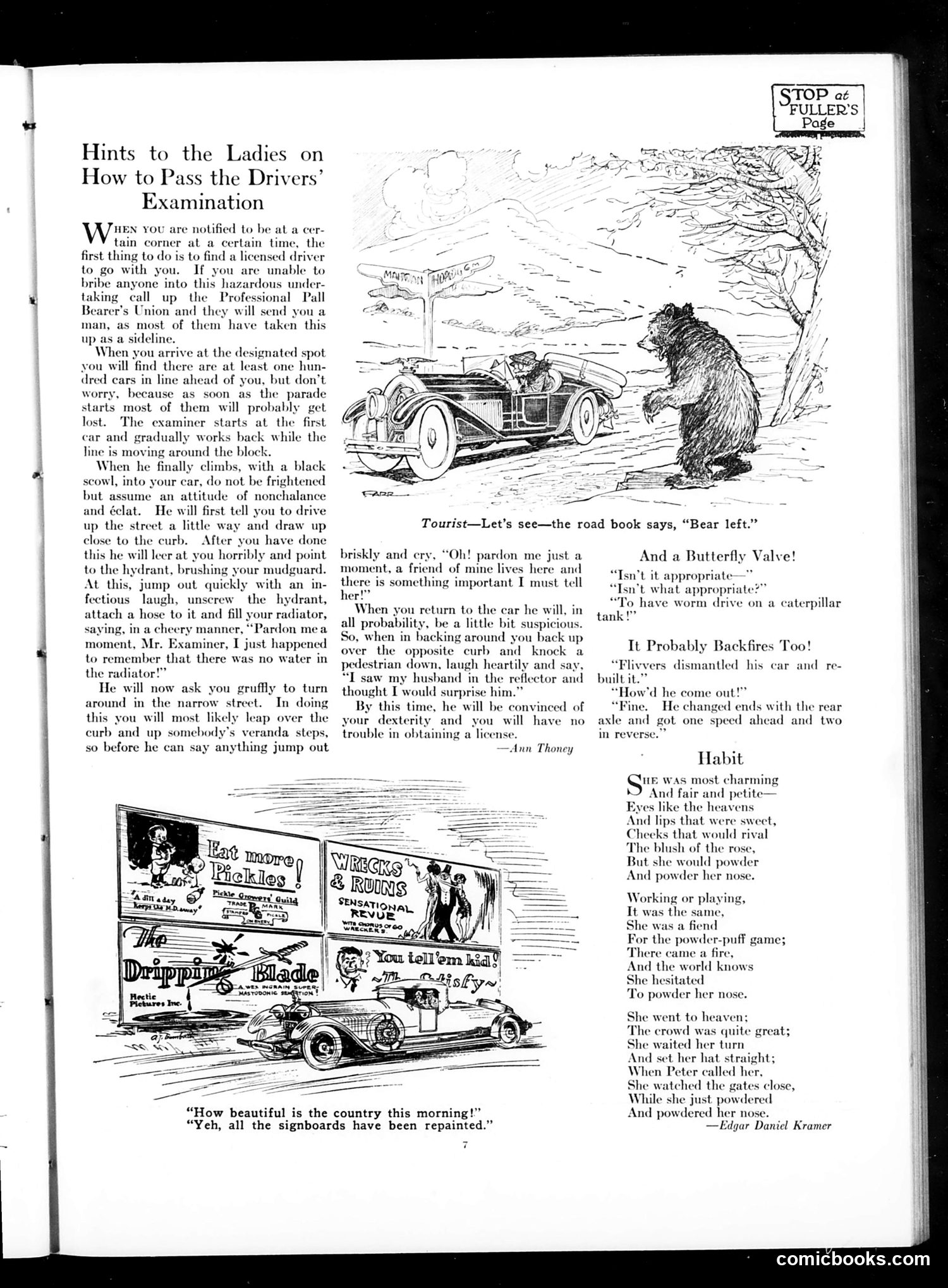
This page satirizes women drivers taking newly-required driving examinations—a relatively recent phenomenon in the 1920s when women's access to driving was novel and contentious. **Main Article**: "Hints to the Ladies" mockingly advises female test-takers to hire a male driver to take the exam with them, bribe examiners, and use elaborate excuses (disconnecting hydrants, visiting friends) to distract from obvious incompetence. The satire assumes women are naturally terrible drivers who cannot pass legitimately. **Cartoons Below**: Two automotive jokes about cars breaking down or malfunctioning, playing on the period's mechanical unreliability. **Poem "Habit"**: A lighthearted verse about a vain woman so obsessed with powdering her nose that she does it constantly—even while heaven's gates close. This reinforces a common era stereotype of women's shallow vanity. The page reflects contemporary anxiety about women's independence and competence, particularly regarding new technologies and public roles.
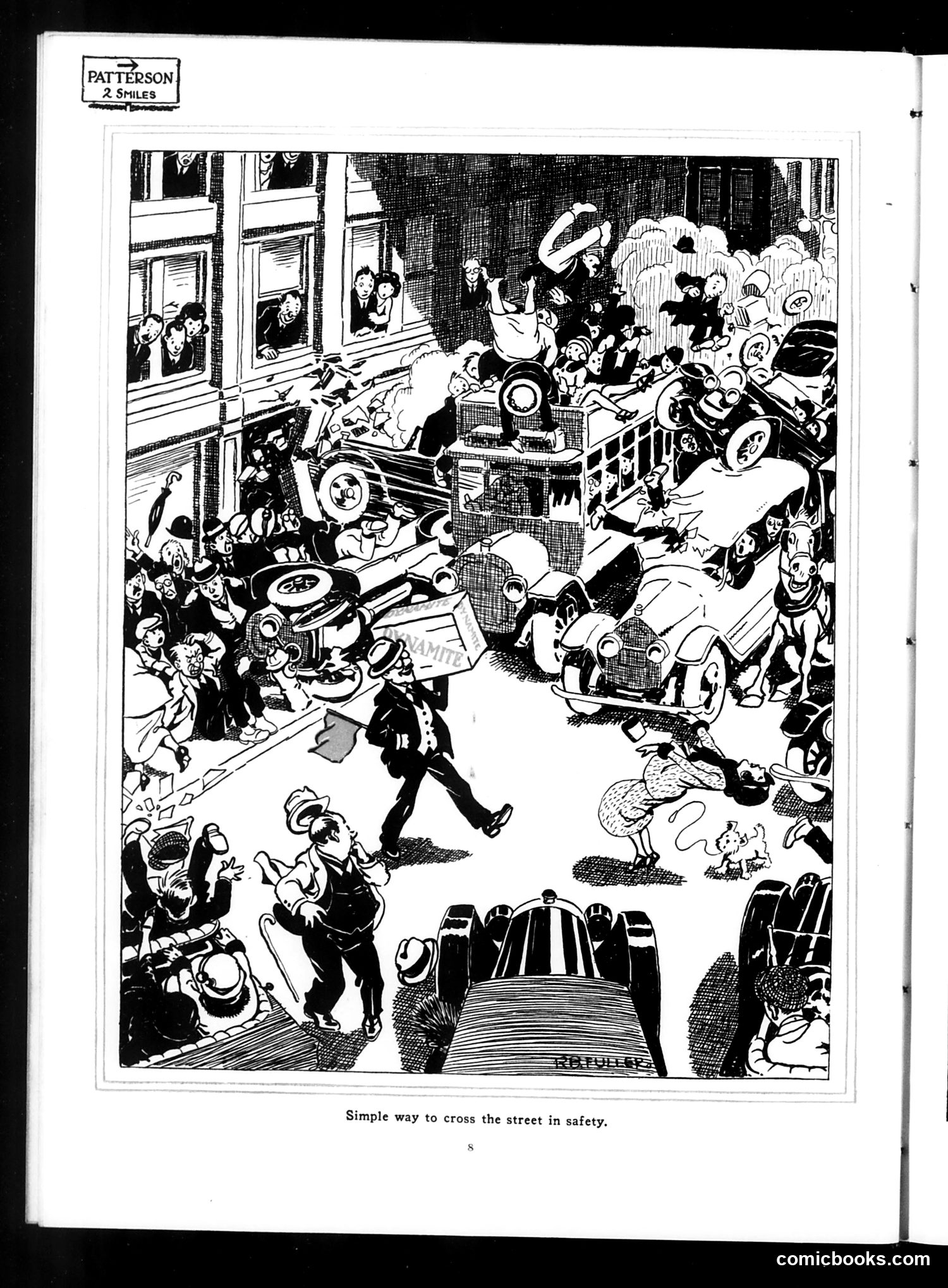
This is a satirical safety cartoon about urban traffic dangers during the early automobile era. The illustration depicts a chaotic street scene in Patterson (apparently a 2-mile area) where a pedestrian safely crosses by riding atop a large race car or vehicle, elevated above the dangerous street-level traffic jam below. The joke critiques the hazardous conditions created by rapid motorization: streets are clogged with automobiles, and crossing safely on foot has become nearly impossible. The absurd "solution"—traveling by car above the chaos—satirizes how automobiles, meant to improve transportation, have paradoxically made streets more dangerous for pedestrians. This reflects real early-20th-century concerns about automobile safety and urban congestion, topics Judge magazine frequently mocked through exaggeration and dark humor.
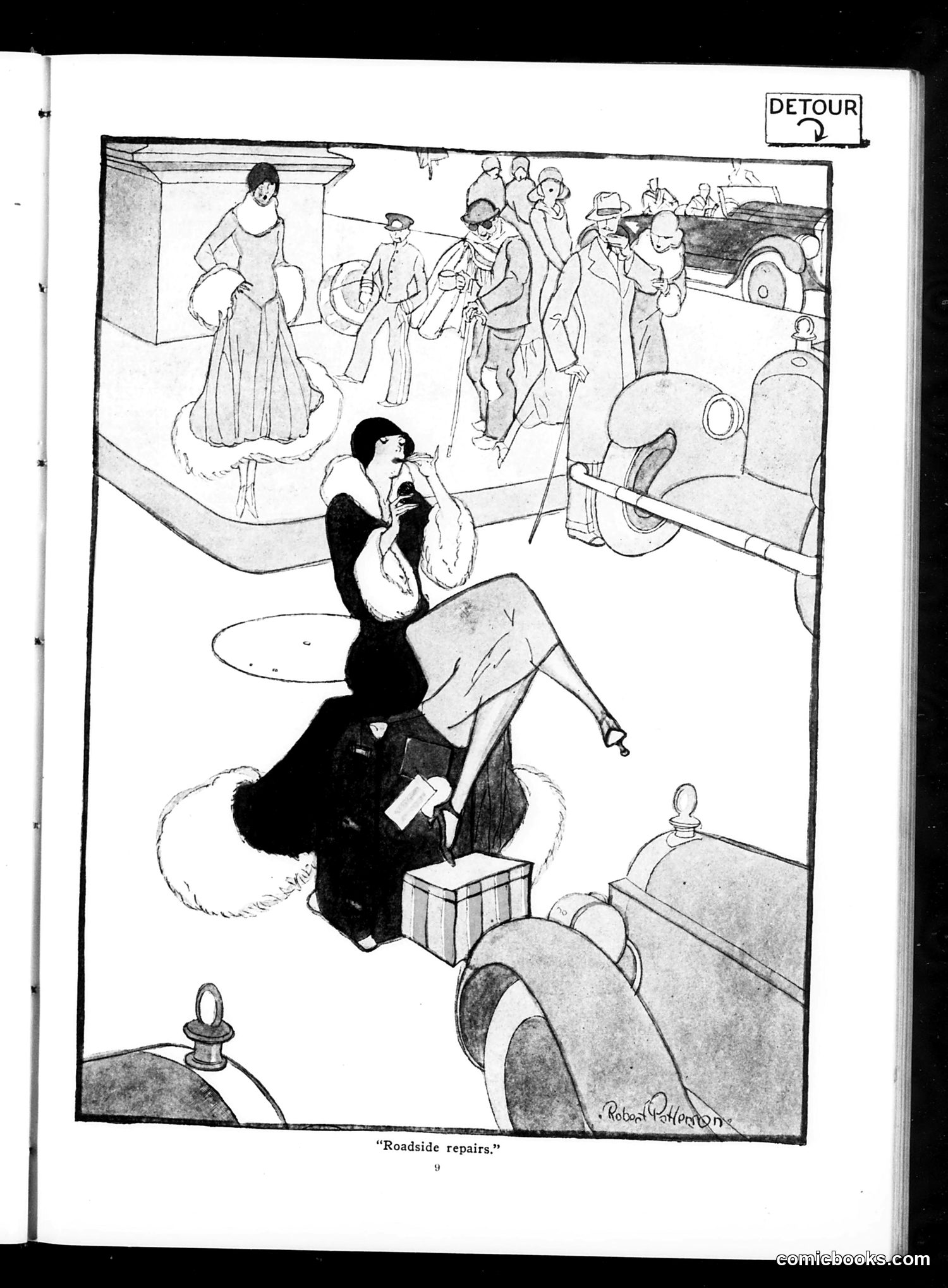
This cartoon satirizes the contrast between wealthy motorists and working-class road conditions. The central figure—a fashionably dressed woman in fur coat and heels—sits primly on luggage beside her broken-down automobile, apparently unconcerned about the mechanical failure. In the background, numerous working-class men perform actual repairs on the vehicle and road infrastructure. The satire likely critiques early 20th-century automobile culture: wealthy car owners enjoyed the prestige of motoring while remaining divorced from the labor, mess, and practical realities of vehicle maintenance. The "detour" sign emphasizes how automobiles disrupted existing infrastructure, requiring constant repairs—a burden borne by workers rather than the leisure-class drivers who benefited.
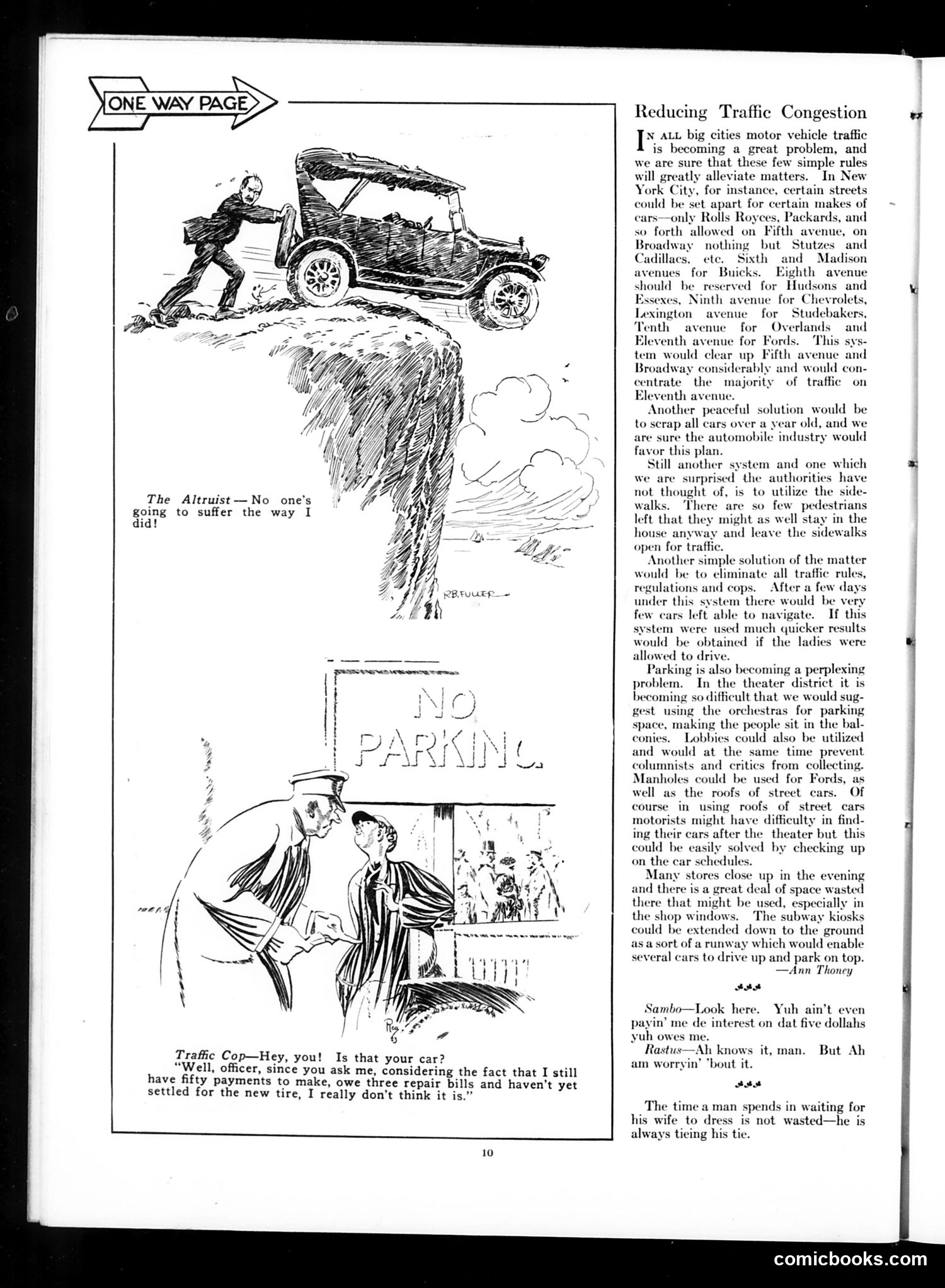
This page contains two distinct satirical pieces: **"The Altruist"** (top cartoon): Shows a man pushing a car off a cliff, claiming "No one's going to suffer the way I did!" The joke satirizes someone so bitter about their own automotive misfortunes that they'd harm others rather than endure suffering alone—dark humor about selfish altruism. **Traffic Congestion Article**: A lengthy satirical essay proposing absurd "solutions" to urban traffic problems, including: segregating streets by expensive car brands (Rolls-Royce on Fifth Avenue, Fords on Eleventh), scrapping cars over a year old, using sidewalks for traffic, eliminating traffic laws entirely, and converting theater orchestras and subway kiosks into parking spaces. The satire mocks both traffic congestion's severity and the impracticality of proposed solutions. **"No Parking" (middle cartoon)**: A traffic cop confronts a driver claiming he doesn't truly own his car due to outstanding payments and repair bills—humor about automobiles as financial burdens during the early auto era. The page reflects 1920s urban anxieties about automobile proliferation and city congestion.
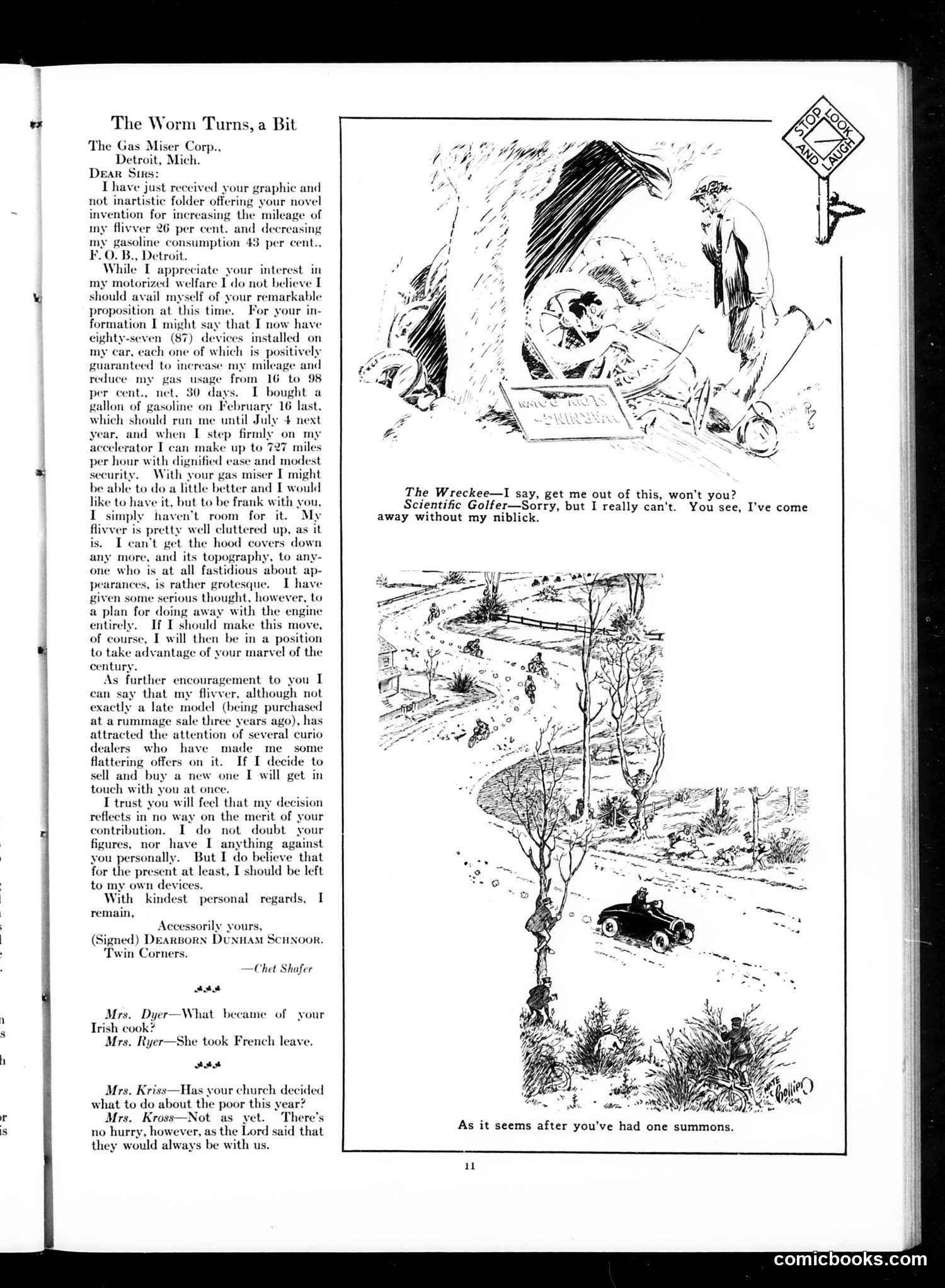
This page satirizes the automotive accessory craze of the early automobile era. The main letter mockingly describes a car owner who has installed 87 different gadgets—each claiming to improve mileage and reduce gas consumption by implausibly high percentages—yet paradoxically gets such poor fuel economy he bought only one gallon in February expecting it to last until July. The joke is that these miracle devices are worthless; he has no room for another one anyway because his engine compartment is already so cluttered with useless attachments. The cartoon below shows a golfer stuck in a water hazard, unable to extricate himself because he left his niblick (golf club) behind. The three brief joke exchanges at bottom ("Irish cook," "church and the poor") are unrelated filler typical of period magazines. The satire targets consumer gullibility regarding automotive "improvements"—common in the 1920s-30s when such schemes flourished.
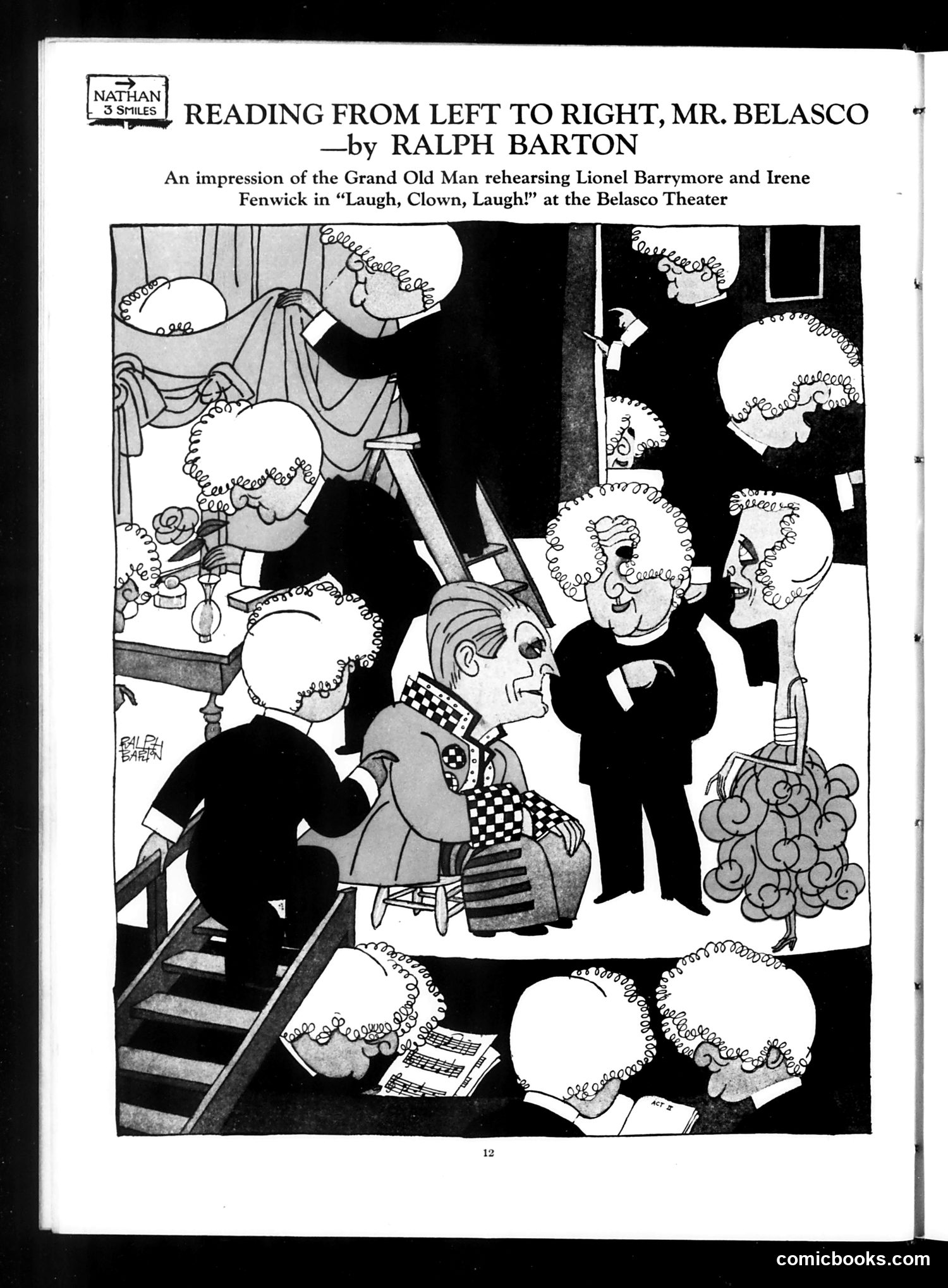
This is a satirical theatrical illustration by Ralph Barton depicting **David Belasco**, a famous Broadway producer and director (the "Grand Old Man" referenced), rehearsing actors **Lionel Barrymore** and **Irene Fenwick** for the play "Laugh, Clown, Laugh!" The cartoon's humor derives from Belasco's theatrical reputation—he was known for meticulous, demanding direction and elaborate stagecraft. The illustration shows him gesturing dramatically among his actors, capturing his characteristic directorial intensity. The exaggerated caricatures and the phrase "reading from left to right" suggests the cartoon is parodying theatrical conventions and Belasco's reputation for controlling every detail of production, including how actors should physically position and perform themselves on stage. The satire gently mocks theatrical pretension and the autocratic director archetype.
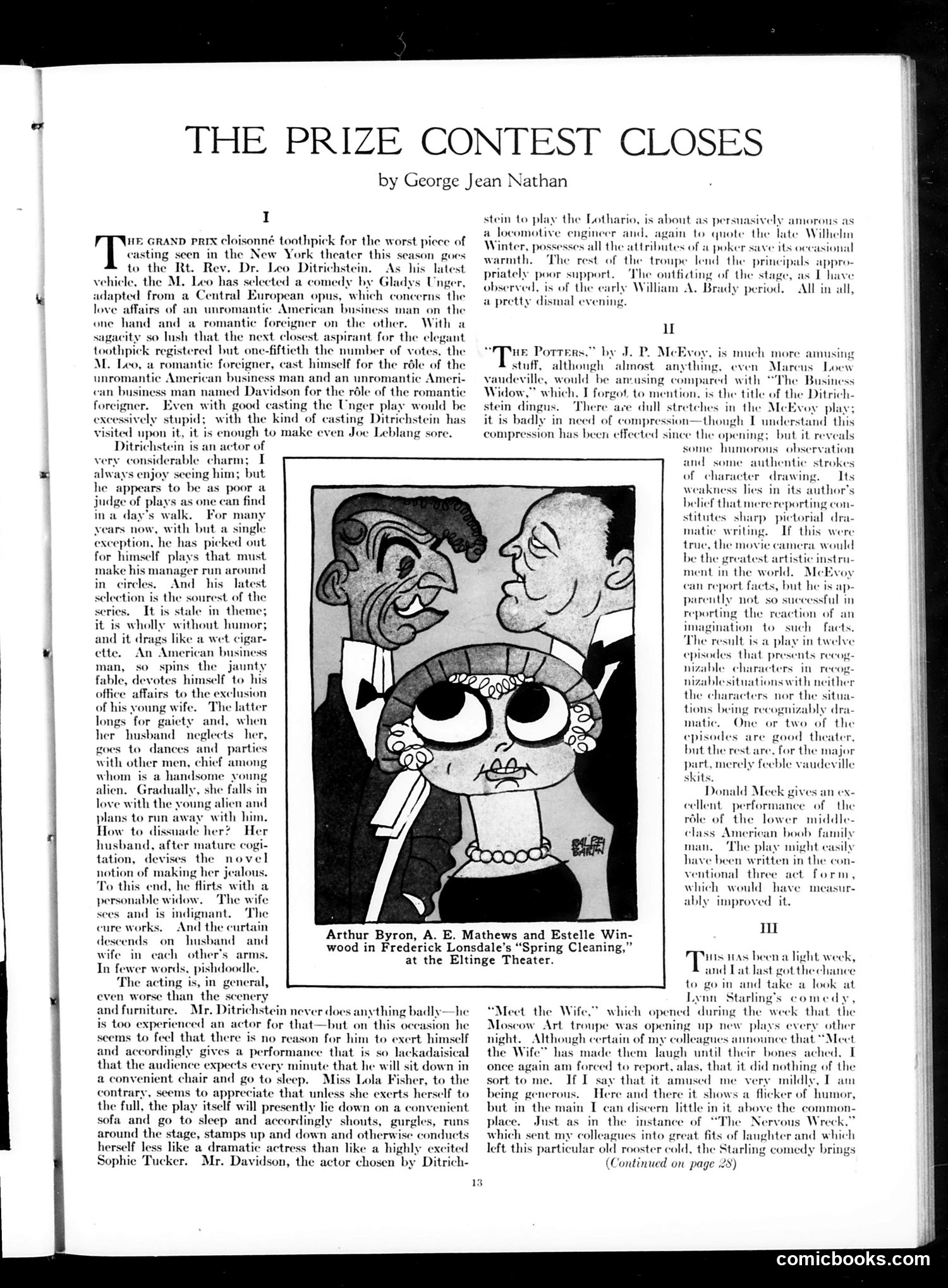
This theater review awards a satirical "grand prix" to actor-director M. Leo Ditrichstein for the worst casting of the season in his production of "The Business Widow" (a Central European comedy adapted by Gladys Unger). Nathan's critique: Ditrichstein miscast himself as an unromantic American businessman while casting Davidson (a romantic foreigner type) oppositely—the reverse of what the play requires. The plot concerns a neglected wife tempted by a charming foreigner; she's nearly seduced until her jealous husband's ploy succeeds. Nathan attacks not just casting but the entire production: the play itself is "stale," "wholly without humor," and "drags"; the acting is worse than scenery; Ditrichstein overcompensates by "shouting, gurgling, running around" like "Sophie Tucker" (suggesting undignified mugging); Davidson lacks romantic persuasiveness. The review contrasts this with J.P. McEvoy's "The Potters," deemed "much more amusing," though also imperfect. This represents early 20th-century Broadway criticism's acerbic style and insider references.
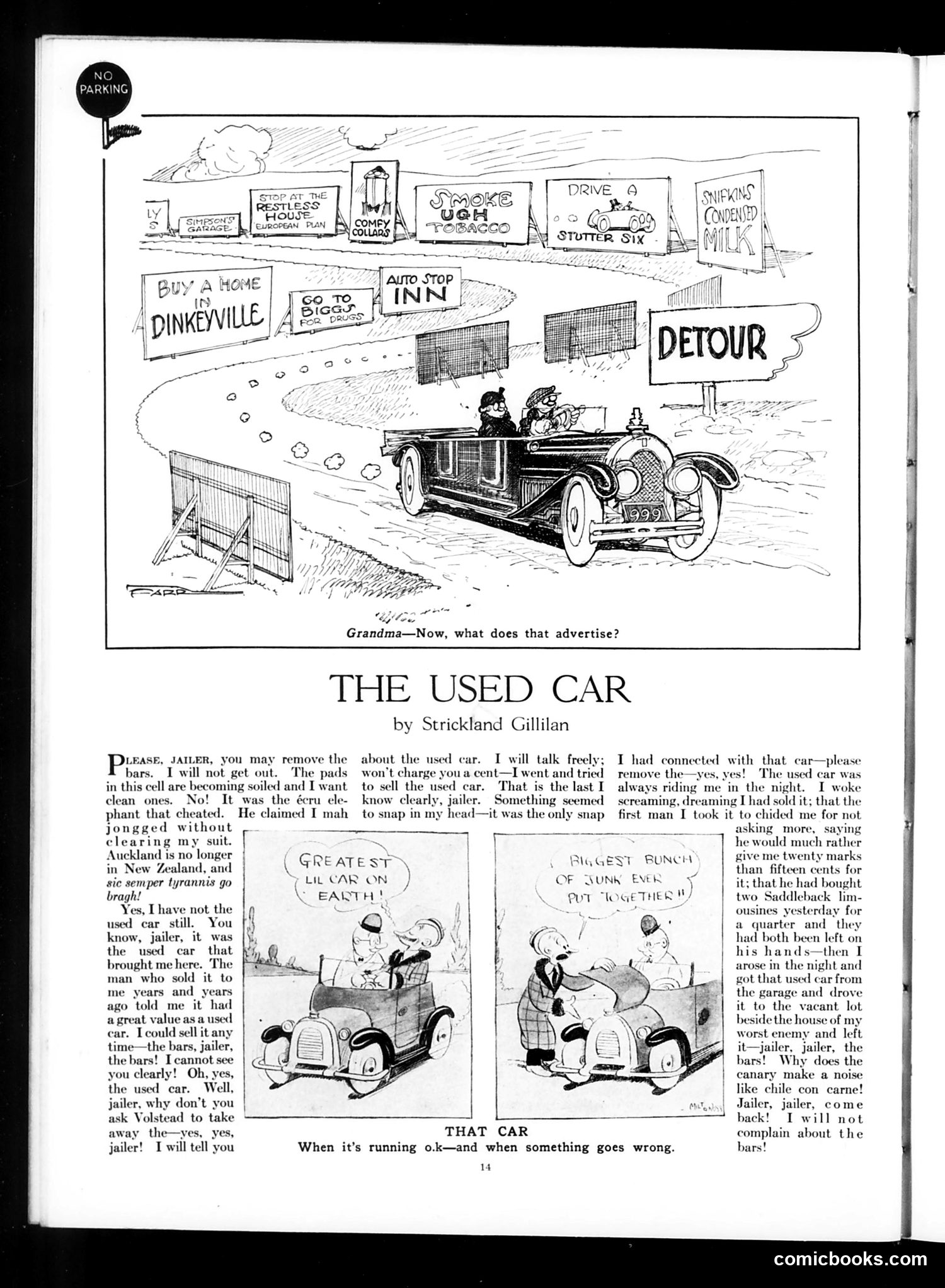
This satirical story mocks the used car market through a prisoner's complaint to his jailer. The narrator claims he's imprisoned because of a defective used car he purchased years ago—the "greatest lil car on earth," as the salesman claimed. The cartoons show the car's worthlessness: when running, it's unreliable; when broken, it's a disaster. The prisoner sarcastically describes attempting to sell it forward (as the original salesman had promised he easily could), eventually abandoning it at an enemy's house out of desperation. The satire targets deceptive used car salesmen who oversell worthless vehicles to unsuspecting buyers with exaggerated claims. The "greatest lil car on earth" slogan appears ironically in both cartoons, highlighting the gap between sales pitch and reality. The prisoner's imprisonment serves as comic exaggeration of how badly the purchase ruined his life—a pointed critique of early automotive commerce's dishonest practices.
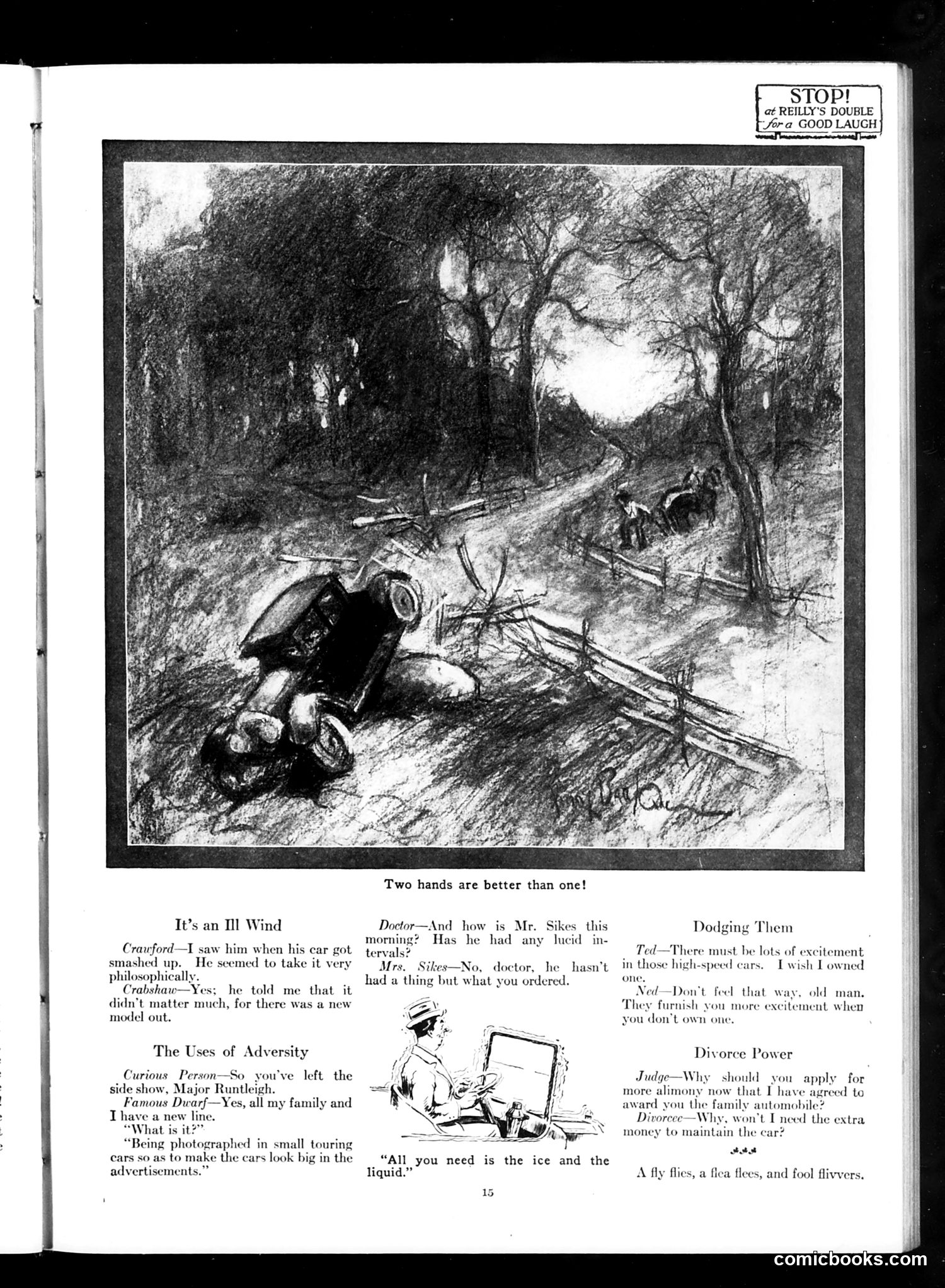
This page contains four separate humorous anecdotes satirizing early automotive culture and social absurdities: **"It's an Ill Wind"**: A man's damaged car is philosophically dismissed because a newer model exists—mocking both consumerism and the rapid obsolescence of automobiles. **"The Uses of Adversity"**: A former circus dwarf now profits by being photographed in small touring cars to create optical illusions making vehicles appear larger in advertisements—satirizing deceptive advertising practices. **"Dodging Them"**: A joke about used cars providing more "excitement" (likely breakdowns/problems) than owned ones. **"Divorce Power"**: A woman seeks increased alimony to maintain an automobile awarded in divorce settlement—satirizing both frivolous spending and the newfound independence cars granted women, presenting cars as expensive luxury items. The central cartoon depicts a car accident on a rural road. The overall theme: automobiles as status symbols, consumer obsessions, and sources of unexpected financial/social complications in modern life.
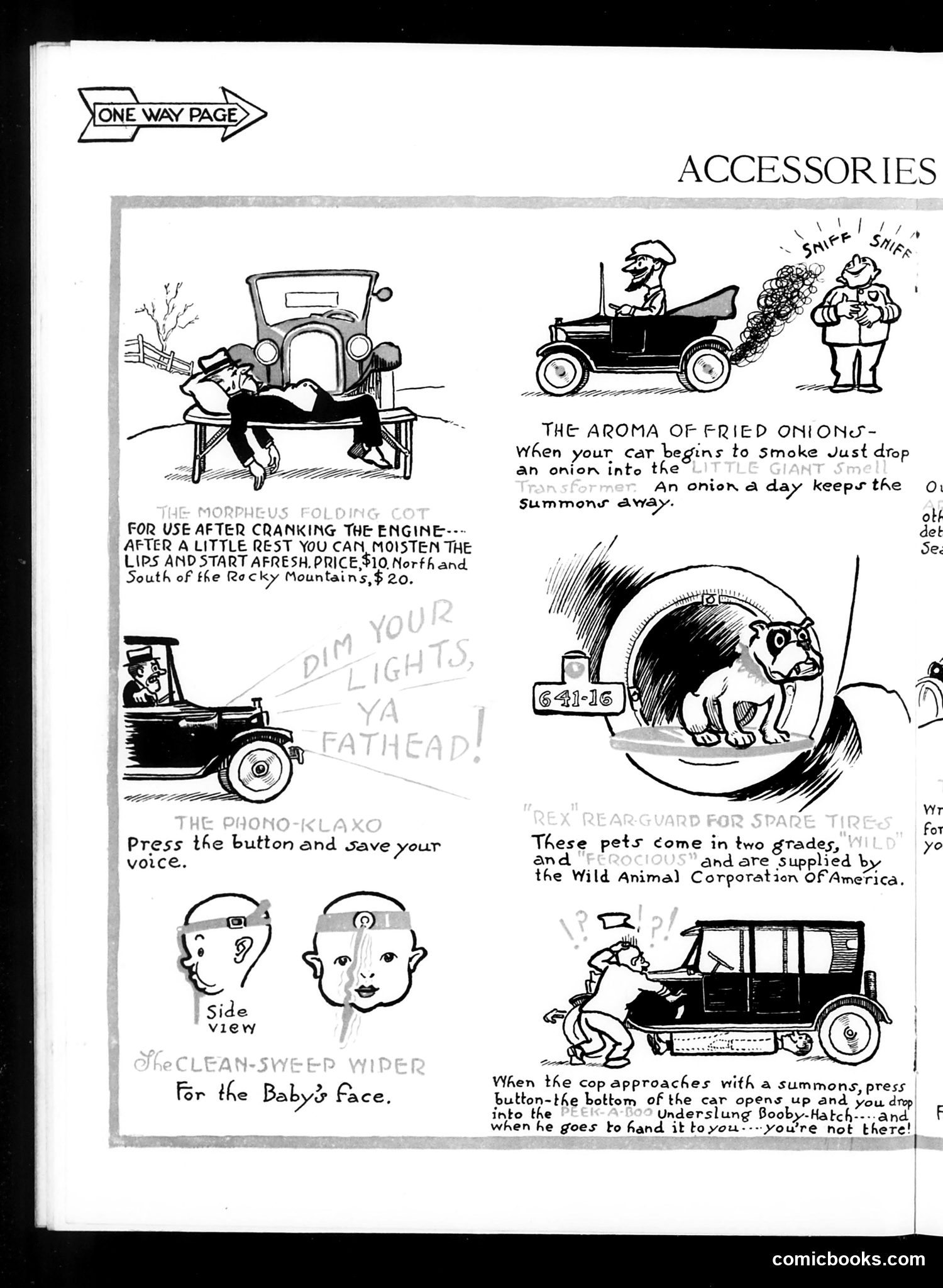
This Judge magazine page satirizes early automobile culture and the hassles of car ownership circa 1910s-1920s. Each absurd "accessory" mocks real driving problems: **The Morpheus Folding Cot**: Jabs at hand-cranking engines—exhausting work requiring rest breaks. **Phono-Klaxo**: Ridicules weak car horns by offering a button to amplify your voice instead. **Clean-Sweep Wiper**: Mocks baby-faced drivers (or perhaps their incompetence). **Fried Onions Aroma**: Dark humor about evading police—drop an onion when your engine smokes to fool cops into thinking you're cooking, not breaking down. **Rex Rearguard**: A pet mascot to distract officers during traffic stops. **Underslung Booby-Hatch**: The ultimate escape—a hidden trap door to literally disappear when cops approach with citations. The satire targets both car manufacturers' inadequate designs and drivers' desperation to avoid tickets and breakdowns—reflecting genuine frustrations with unreliable, difficult-to-operate early automobiles.
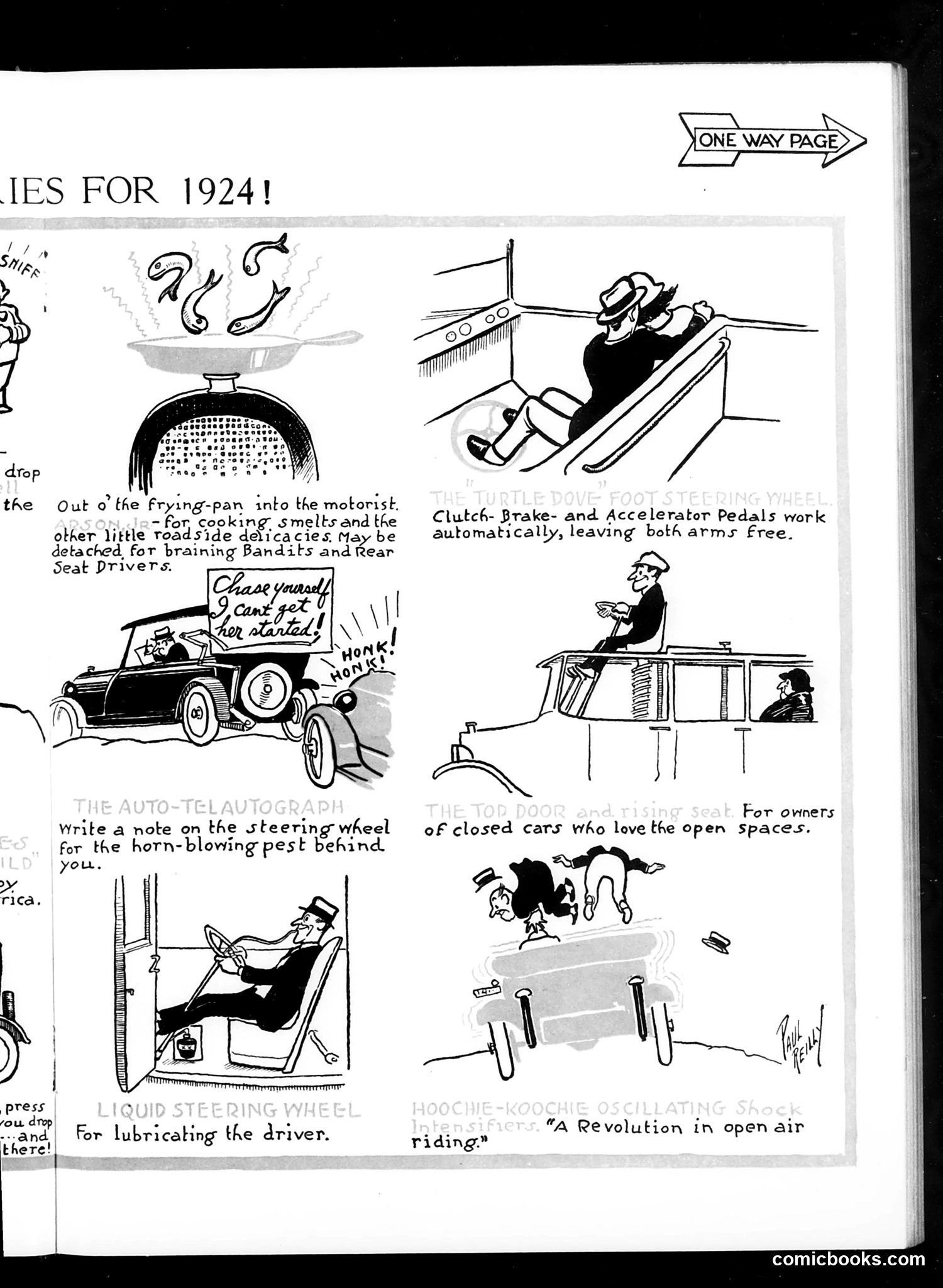
This Judge magazine page presents humorous "inventions for 1924," satirizing contemporary car culture and driving frustrations. The cartoons mock both vehicle design and motorist behavior: **"Turtle Dove Foot-Steering Wheel"** ridicules hands-free pedal operation, suggesting drivers need free arms for unspecified purposes. **"Auto-Autograph"** jokes about aggressive horn-honking, suggesting angry notes be written to pest drivers behind you. **"Liquid Steering Wheel"** puns on "lubricating the driver"—implying alcohol consumption while driving. **"Hoochie-Koochie Oscillating Shock"** references "hooch" (Prohibition-era slang for illegal liquor) and "revolution in open air riding," mocking convertible owners who loved open cars. The satire targets 1920s driving annoyances (horn-blowing, reckless behavior), Prohibition's cultural impact, and the novelty/dangers of early automobile technology. The tone is lighthearted mockery of both cars and driver behavior.
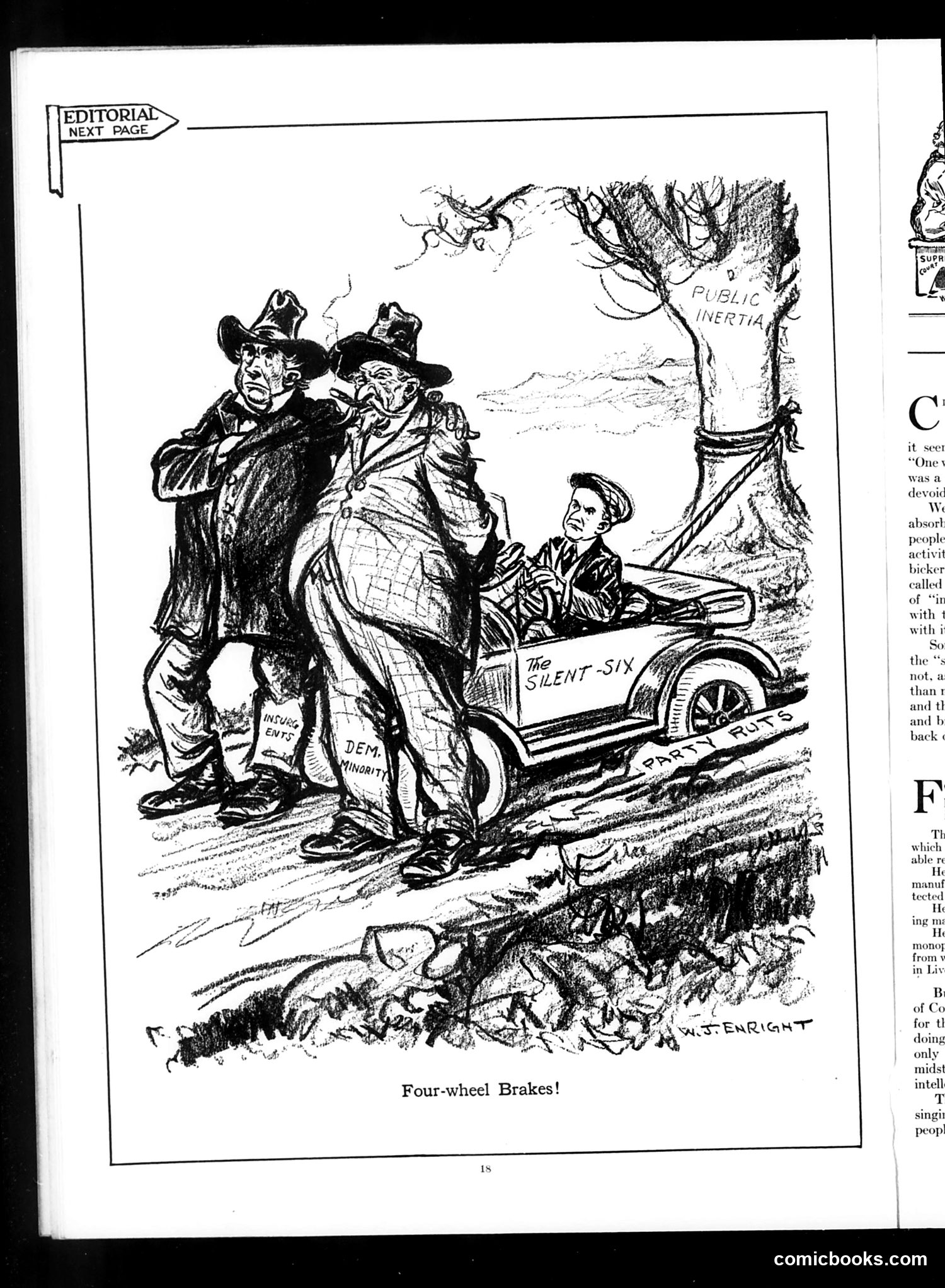
This editorial cartoon depicts two caricatured figures (appearing to represent political or business opponents) frantically grasping at a car labeled "The Silent Six" as it speeds away. The vehicle's occupant appears unmoved by their desperation. The cartoon's title "Four-wheel Brakes!" suggests the satire concerns stopping power or control—likely commentary on attempts to restrain or obstruct some political or business initiative. The tree labeled "Public Inertia" and the figures' exaggerated panic suggest the cartoonist is mocking these opponents' ineffectual efforts to halt progress. Without clearer context or visible names, the specific identities and historical moment remain uncertain, though this appears to critique failed opposition to some contemporary (to Judge magazine) technological or political advancement.
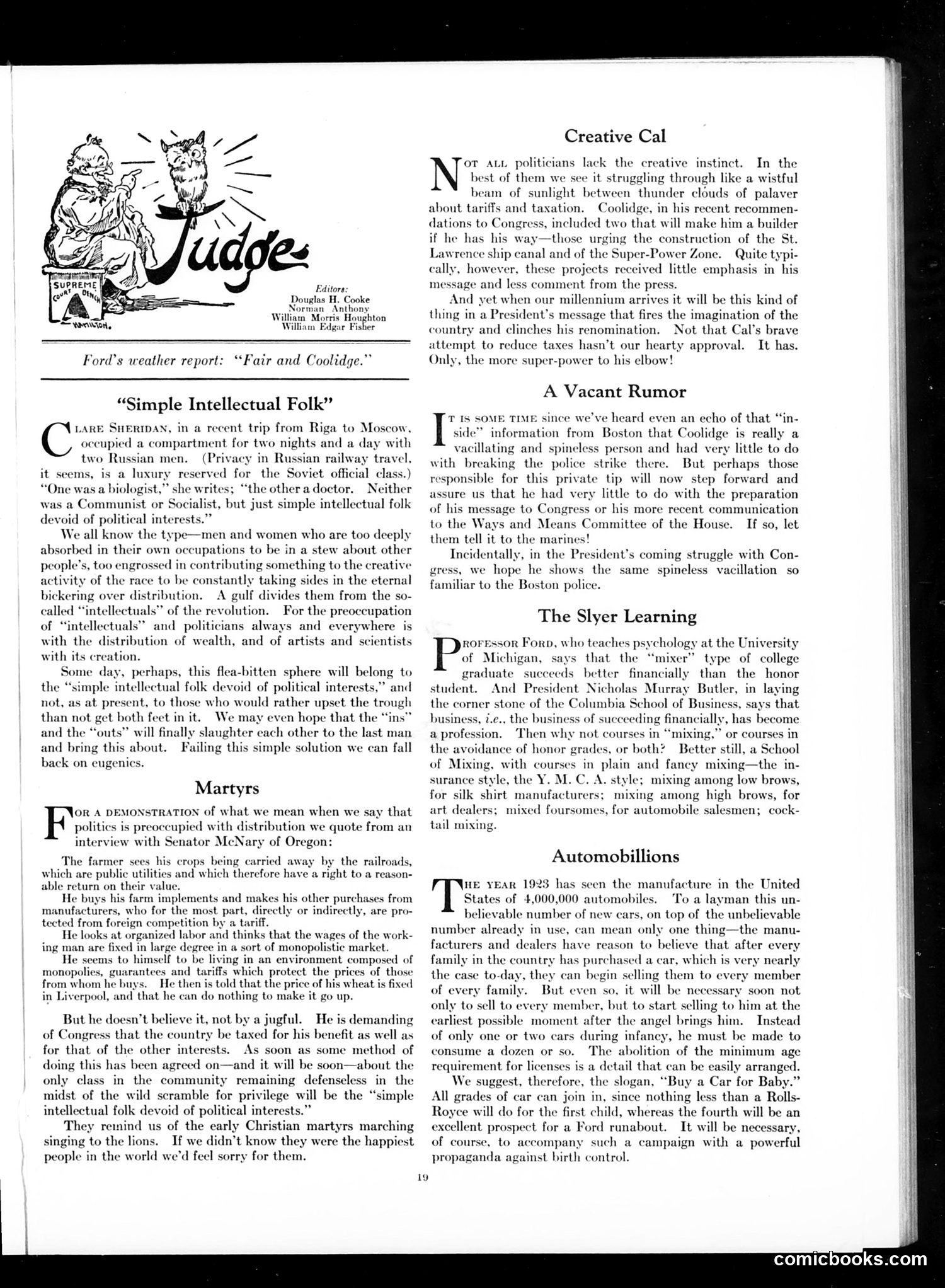
This page satirizes American political discourse circa the 1920s (likely early Coolidge era, based on references). **Main Cartoon**: The masthead shows "Judge" with an owl, the magazine's trademark. **Key Articles**: 1. **"Simple Intellectual Folk"** mocks apolitical academics and professionals who avoid economic disputes. The satire suggests these "creative" types will inevitably become sacrificial "martyrs" when competing interest groups (labor, farmers, manufacturers) scramble for government protection through tariffs and monopolies. 2. **"Martyrs"** uses Senator McNary's complaint about farmers facing rigged markets—protected manufacturers, organized labor, railroad monopolies—to illustrate how everyone demands government intervention for their benefit, leaving only unpolitical intellectuals defenseless. 3. **"Creative Cal"** (President Coolidge) praises his infrastructure proposals (St. Lawrence canal, Super-Power Zone) as visionary, while criticizing that Congress and press gave them little emphasis. The overall theme: American politics reduces to competing groups fighting over distribution of wealth and protection, leaving idealistic, creative individuals powerless.
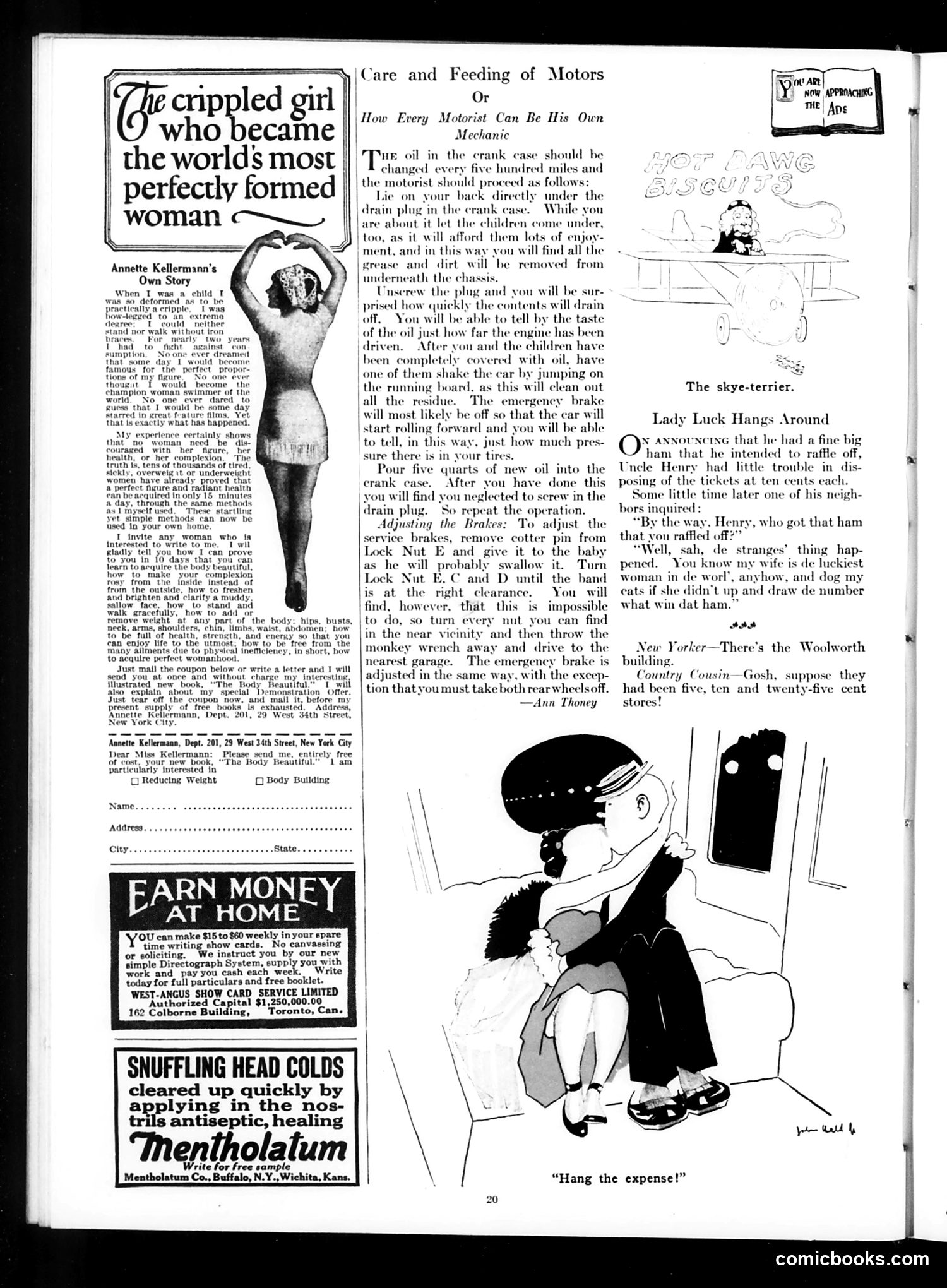
This page contains a humorous parody article mocking early automobilist incompetence. The satirical "instructions" for DIY motor maintenance deliberately advise absurd, dangerous, and wasteful procedures—lying under the car while children play underneath, tasting the oil to gauge engine wear, letting the car roll forward uncontrollably, and randomly adjusting brake components. The joke targets two 1920s anxieties: the newfound complexity of automobile ownership (most owners knew nothing about mechanics) and the era's obsession with self-improvement manuals offering dubious expert advice. By presenting obviously ridiculous steps in deadpan technical language, the cartoonist satirizes both clueless motorists and the overconfident "expert" guides proliferating in magazines. The humor assumes readers recognize how wrong these instructions are. The page also includes unrelated period advertisements and a humorous dialogue about raffling a dog.
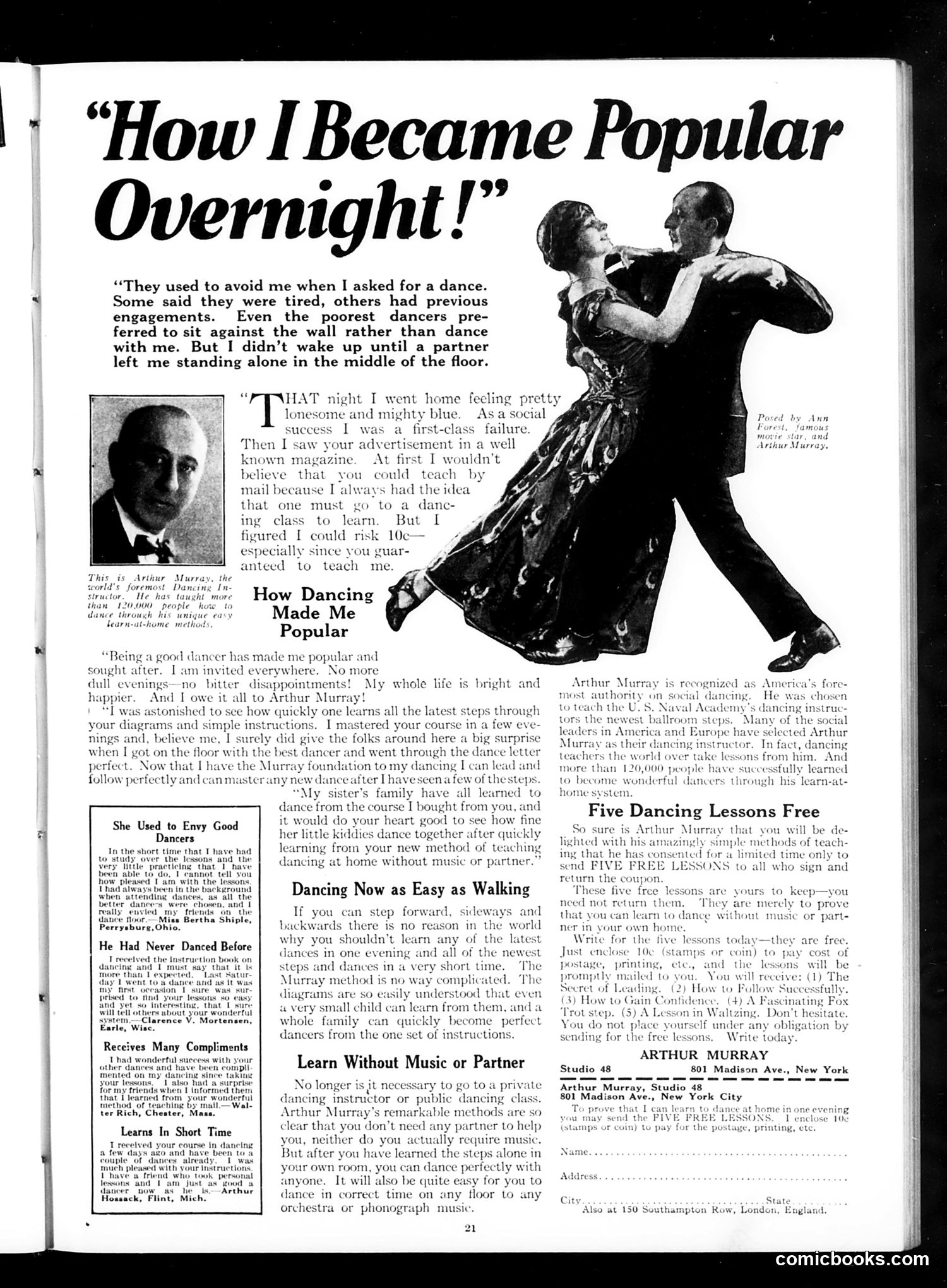
This page is primarily **advertising**, not political satire. It features testimonials promoting Arthur Murray's mail-order dance instruction method. The content presents **before-and-after narratives**: people who were socially rejected as poor dancers transformed into popular, confident dancers by following Murray's home study course. The imagery shows a couple demonstrating proper dancing form. The satire here is **genteel and commercial rather than political** — it gently mocks the social anxiety of awkward dancers while selling a solution. The testimonials (from named individuals in various cities) create false authenticity. Key selling points emphasized: learning "without music or partner," lessons arriving by mail, minimal cost (10 cents), and guaranteed results. The "Five Dancing Lessons Free" offer appears designed to lower barriers to purchase. This reflects early-20th-century American consumer culture, when mail-order instruction courses proliferated, and when dancing ability was genuinely valued as a marker of social acceptability and romantic prospects.
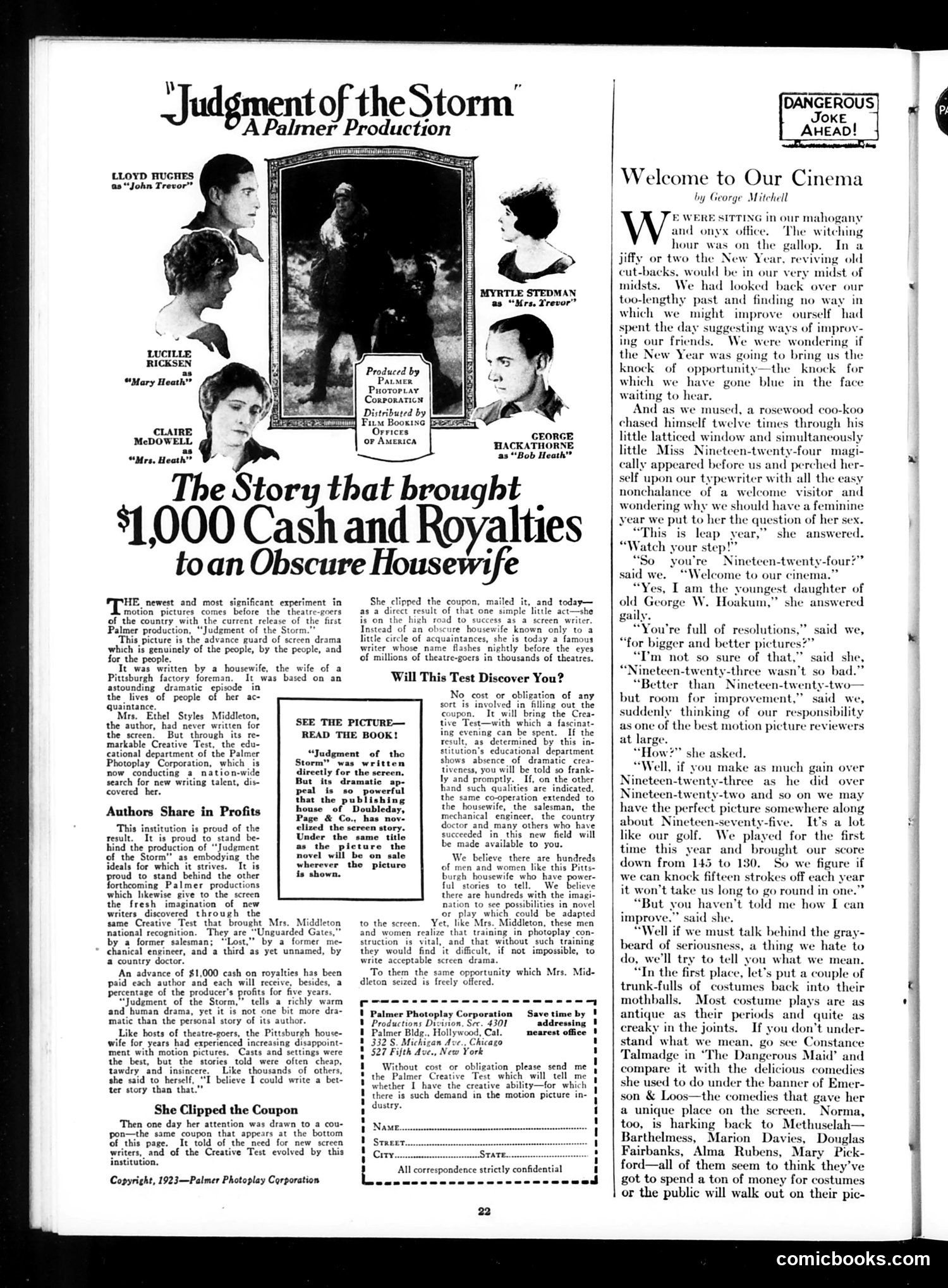
This 1922 magazine page advertises a Palmer Photoplay Corporation film and promotes their "Creative Test"—a nationwide talent search claiming to discover new screenwriting talent from ordinary people. The key story: **Mrs. Ethel Styles Middleton**, a Pittsburgh factory foreman's housewife with no prior screen experience, submitted a story through the Creative Test coupon and received $1,000 cash plus five-year profit participation—a remarkable sum for the era. Her story became "Judgment of the Storm," now being released theatrically. **The satire's appeal**: This represents 1920s optimism about democratic opportunity and meritocracy—the idea that talent could emerge from anywhere, not just established literary circles. The institution positioned itself as championing "the people" discovering fresh, authentic stories from ordinary lives rather than formulaic studio productions. The accompanying article promoting "Welcome to Our Cinema" suggests some contemporary skepticism about Hollywood's increasingly formulaic content, making Middleton's "housewife discovers success" narrative particularly marketable as proof that authentic storytelling still mattered.
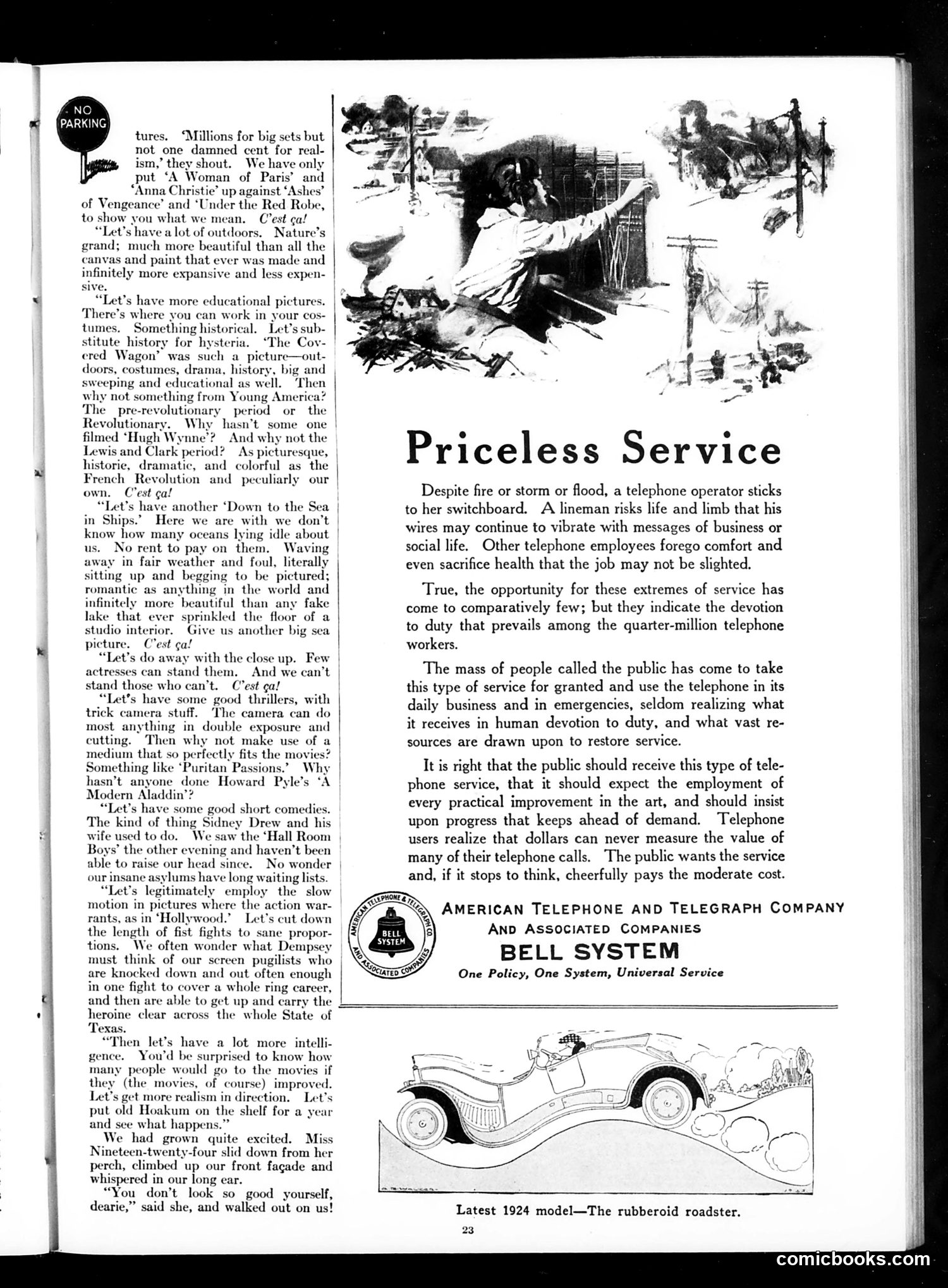
This page contains **two distinct pieces**: a satirical editorial about filmmaking and a Bell System advertisement. The **editorial** (left side) mocks early 1920s film directors' priorities. A character—likely representing a film producer or critic—complains that studios waste millions on elaborate sets while neglecting realism, outdoor filming, historical accuracy, and proper use of camera techniques. The satire targets excessive production values and melodramatic conventions. The punchline arrives when "Miss Nineteen-twenty-four" (personifying modernity) climbs down and insults the speaker for his own poor judgment, deflating his sanctimonious complaints. The **advertisement** (right) is a straightforward Bell System promotion celebrating telephone workers' heroic dedication to duty during emergencies—operators staying at switchboards during disasters, linemen risking lives. It emphasizes service reliability and argues the public underappreciates this devotion, which justifies the "moderate cost" of telephone service. The juxtaposition is ironic: the editorial criticizes artistic pretension while the ad celebrates corporate virtue.
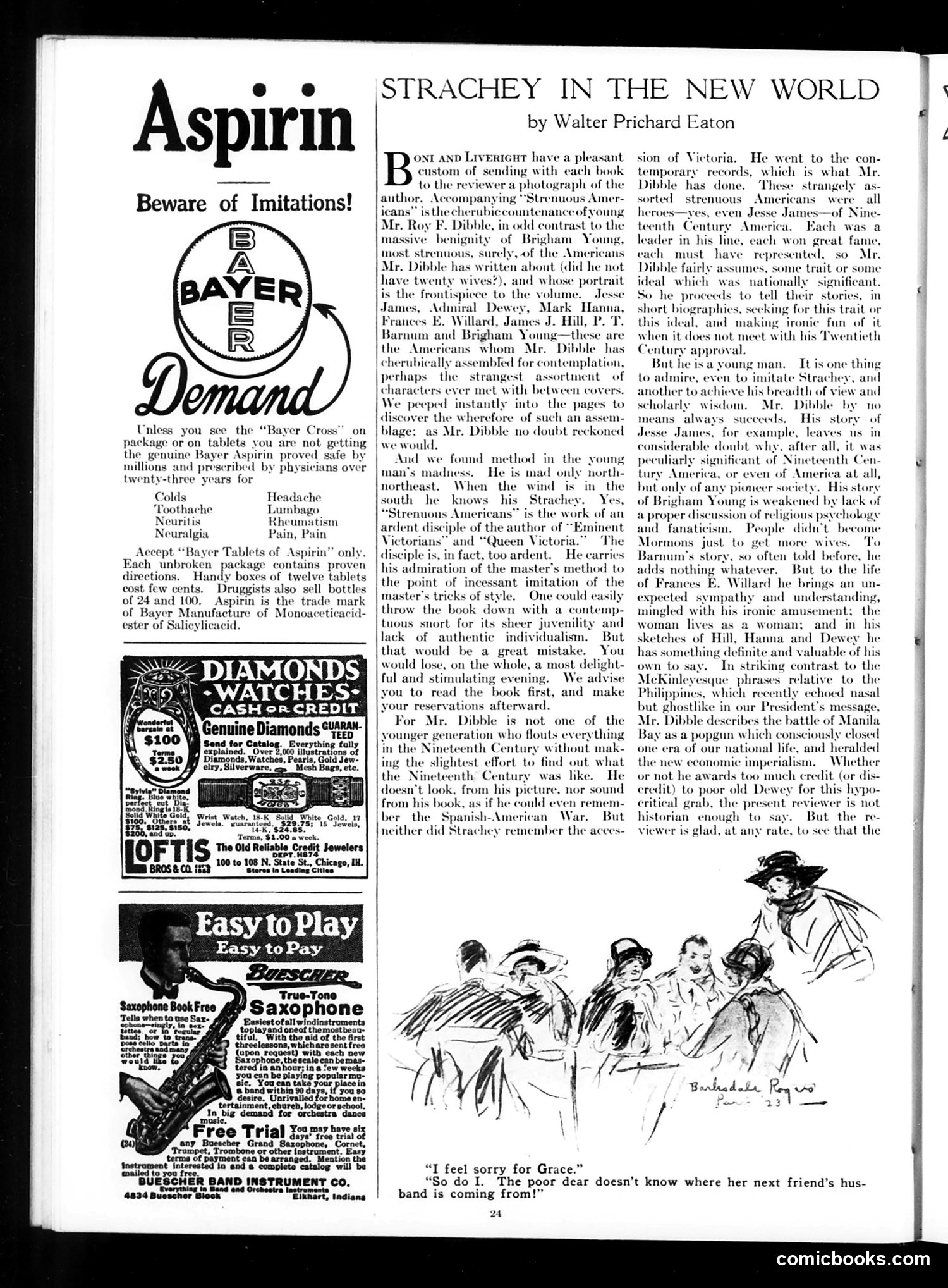
This page is primarily **advertising**, with a substantial book review article by Walter Prichard Eaton occupying the right column. **The Review Content:** Eaton critiques a book called "Strenuous Americans" by Roy Dibble, which profiles historical figures including Brigham Young, Admiral Dewey, Mark Hanna, Jesse James, and P.T. Barnum. Eaton notes Dibble imitates the biographical style of Lytton Strachey (author of "Eminent Victorians") too closely, showing "sheer juvenility and lack of authentic individualism." However, he praises Dibble for consulting primary sources rather than relying on contemporary assumptions—comparing this favorably to Strachey's own method with Queen Victoria's era. **The Cartoon:** The small sketch shows a woman discussing Grace, whose husband "is coming from" elsewhere—implying infidelity. This appears unrelated to the review. **Advertisements** dominate the left side: Bayer Aspirin (warning against imitations), Otis diamonds, and Buescher saxophones.
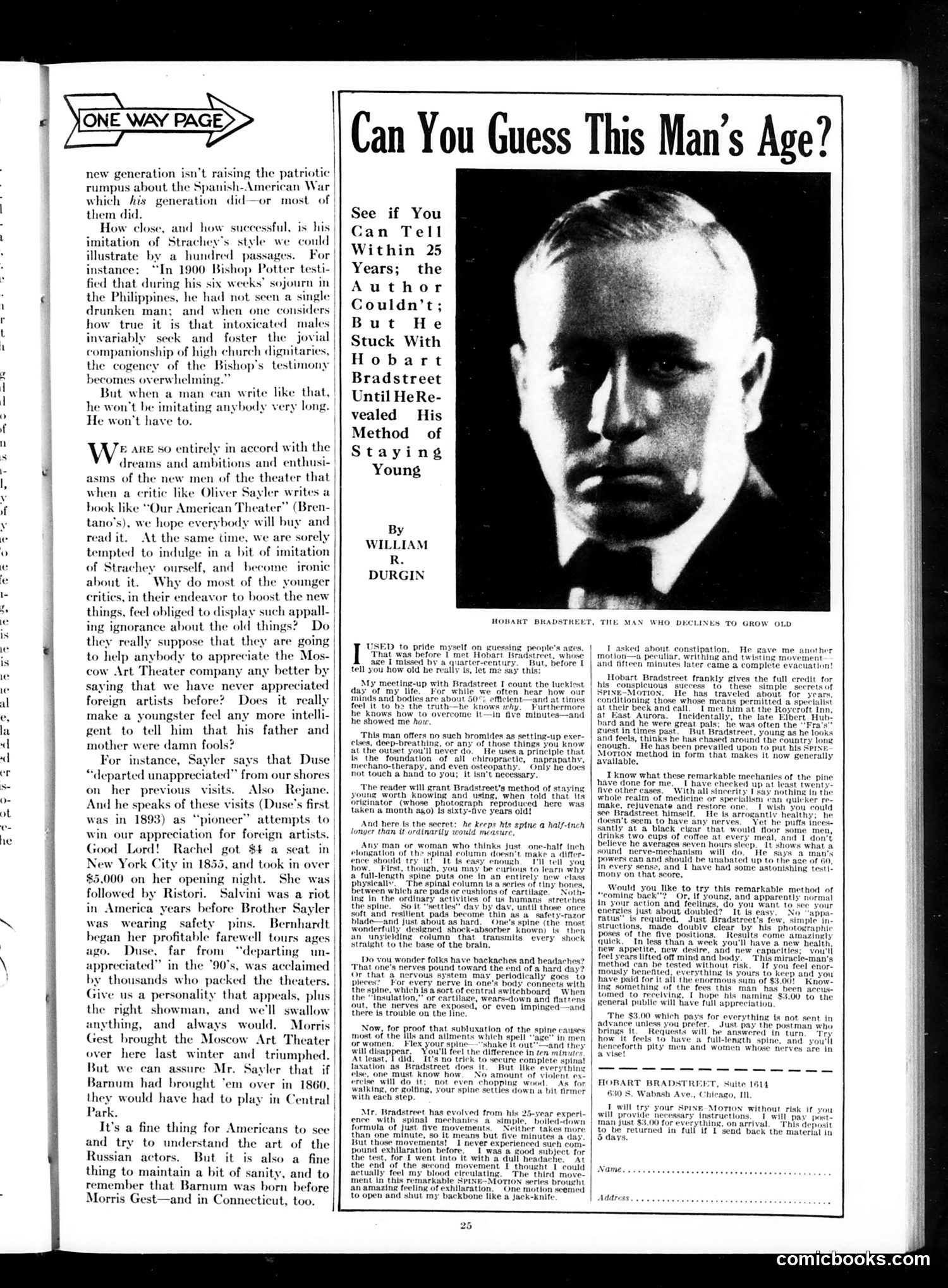
This page features a guessing game about **Hobart Bradstreet's age**, accompanied by text by William R. Durgin explaining Bradstreet's purported method for "staying young." The left column contains editorial commentary critiquing younger theater critics (particularly Oliver Sayler) for dismissing appreciation of foreign performers as unprecedented. The author argues this ignores history—noting that Rachel, Ristori, Salvini, and Duse were already celebrated in America decades earlier (1850s-1890s), long before the Moscow Art Theater's recent success. The main feature promotes Bradstreet's "spine-motion" technique as the secret to his youthful appearance. The photograph shows a middle-aged man with distinctive facial hair. This appears to be **health/fitness advertising disguised as editorial content**—a common Judge practice—promoting Bradstreet's physical wellness method through the guessing-game format to intrigue readers. The satirical edge targets both credulous health-fad consumers and critics who mistake novelty for progress.
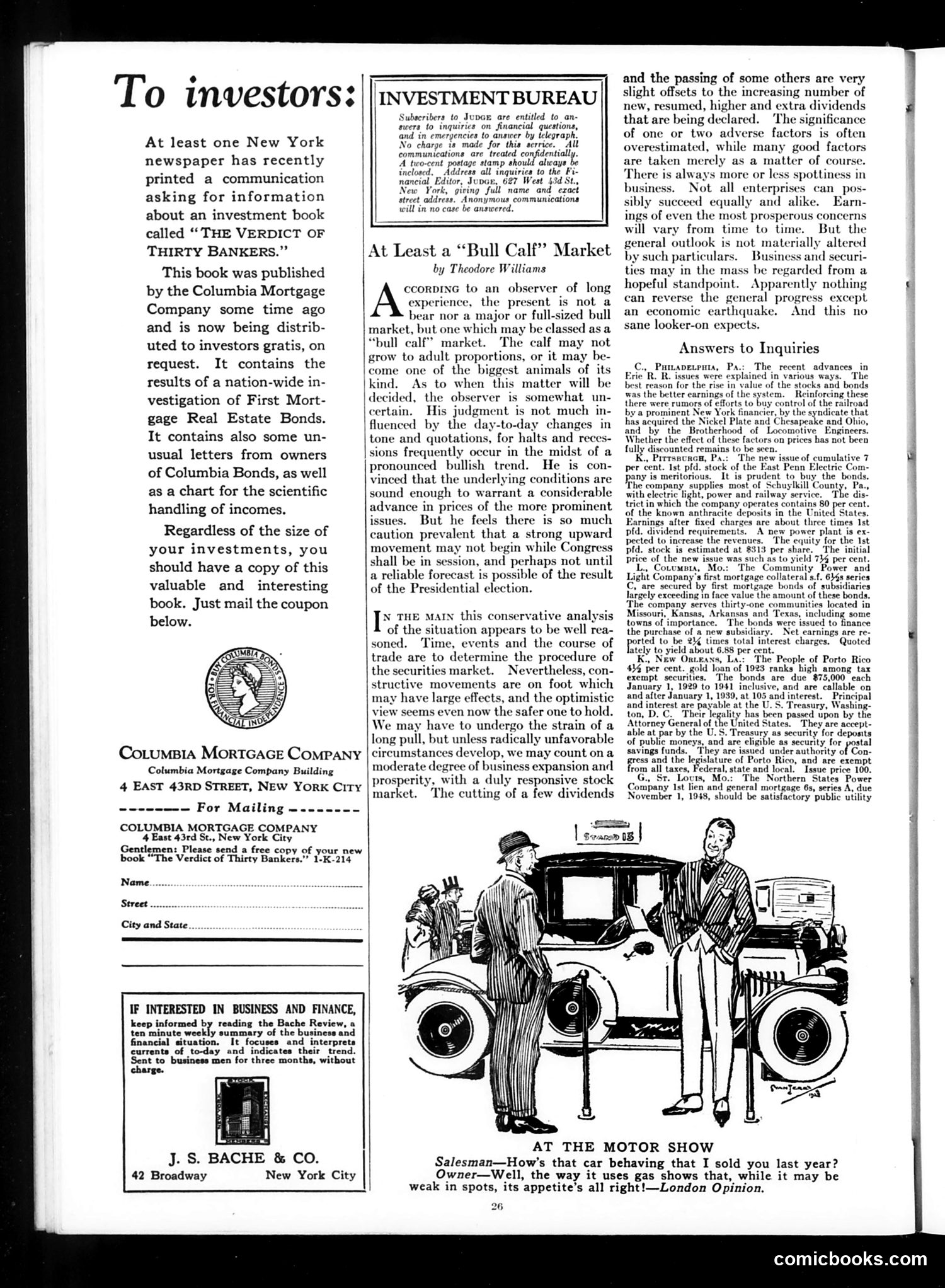
This page contains **investment advertisements and financial commentary**, not political satire in the traditional sense. The main content includes: 1. **Columbia Mortgage Company advertisement** promoting a free investment guide ("The Verdict of Thirty Bankers") about First Mortgage Real Estate Bonds—a pitch to individual investors seeking financial information. 2. **"At Least a 'Bull Calf' Market"** by Theodore Williams—an economics column using livestock metaphor to describe stock market conditions. A "bull calf" market is neither bearish nor fully bullish; it's a modest upward market whose growth depends on future conditions (Congressional session, Presidential election results). 3. **"At the Motor Show" cartoon**—a brief joke about a car's poor fuel efficiency, unrelated to the investment content. The page reflects 1920s-era financial publishing aimed at middle-class investors, with cautiously optimistic market analysis and frank admission of uncertainty about economic conditions.
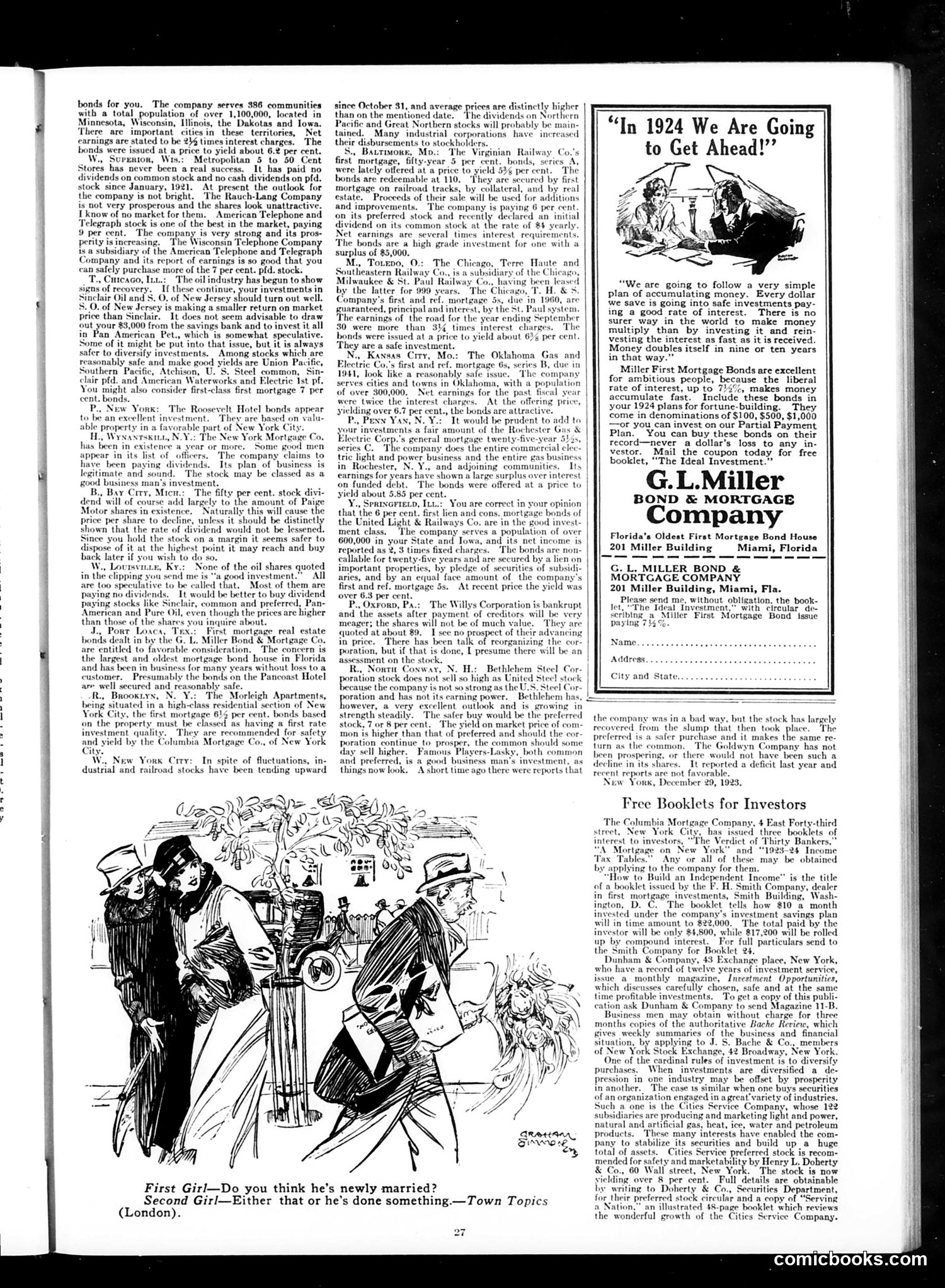
This page from Judge (dated December 29, 1923) combines financial advice columns with satirical cartoons about post-WWI American prosperity. **The Main Cartoon** (lower half): depicts a flapper-era couple, with a woman in fashionable 1920s dress and a man, apparently sharing gossip. The caption jokes that one girl asks another if a man is "newly married" or has "done something," suggesting financial irresponsibility—likely referencing the era's anxiety about young people's spending habits during the Jazz Age economic boom. **The Context**: The page is dominated by G.L. Miller Bond & Mortgage Company advertisements promoting "safe" investments and mortgage bonds yielding 6-7% returns. This sits ironically alongside the magazine's satirical tone, which typically mocked both financial speculation and the nouveau-riche eager to "get ahead" through investments. **The Satire's Point**: The juxtaposition suggests Judge was poking fun at Americans' newfound obsession with investment schemes and "getting rich quick" during the Roaring Twenties—while simultaneously advertising such investments themselves.
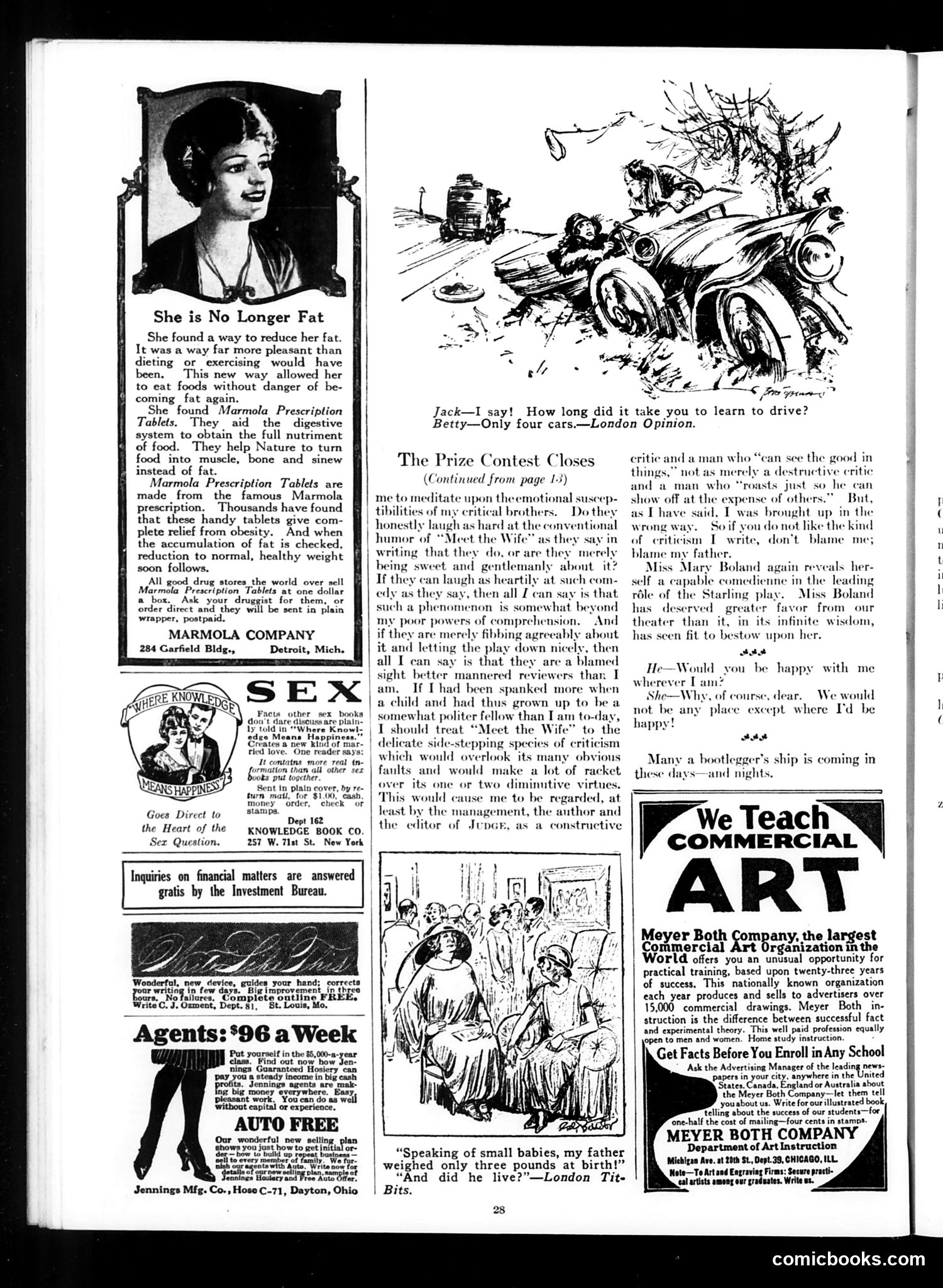
This page is primarily **advertising**, typical of early-20th-century magazines. The main editorial content is a theater review discussing the play "Meet the Wife" and its critics. **Key advertisements:** - **Marmola Tablets**: A weight-loss product promising fat reduction without dieting—reflecting contemporary anxiety about obesity and the era's unregulated patent medicine industry - **Commercial Art School**: Training in commercial design - **Auto/Agent positions**: Work-from-home sales schemes **The humor:** A small cartoon shows a driving mishap with the caption "Only four cars"—meaning the woman has destroyed four cars while learning to drive, satirizing women drivers (a common early-20th-century joke reflecting anxieties about women's independence and automobile access). **Theater review content**: Discusses reviewer "Miss Mary Boland" and the conventional comedy "Meet the Wife," with the critic lamenting that fellow reviewers are too polite and agreeable, while he prefers harsher criticism. The page captures period attitudes toward weight, gender roles, and consumer culture typical of Judge magazine's satirical approach.
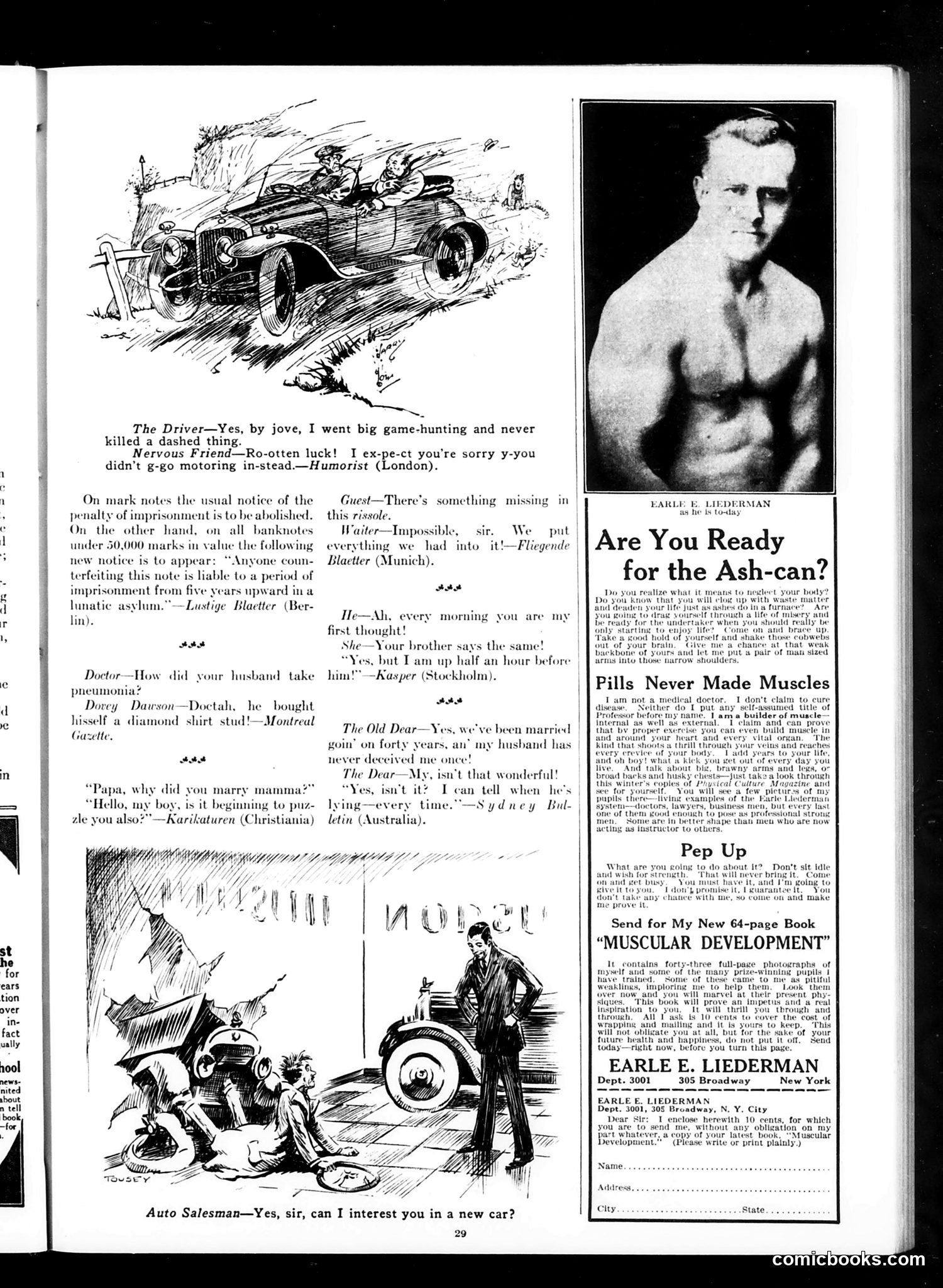
This page contains multiple jokes and advertisements typical of early 20th-century Judge magazine. **The Cartoons/Jokes:** The verbal humor satirizes various social situations—a hunter boasting about game hunting versus motoring, marital misunderstandings, and restaurant absurdities (a waiter claiming everything edible went into a rissole). The bottom cartoon depicts an auto salesman pitching to a customer, a common commercial interaction of the era. **The Advertisement:** The dominant right-side content is an advertisement for Earle E. Liederman's bodybuilding course ("Muscular Development"), featuring a shirtless photograph. The ad promises physical transformation and challenges readers: "Are You Ready for the Ash-can?"—implying weakness or obsolescence without his training. This reflects 1920s-era fitness marketing, where physical vigor was marketed as essential to male success and respectability. **Context:** The page mixes satirical commentary on everyday life with commercial appeals to male insecurity about physical capability.
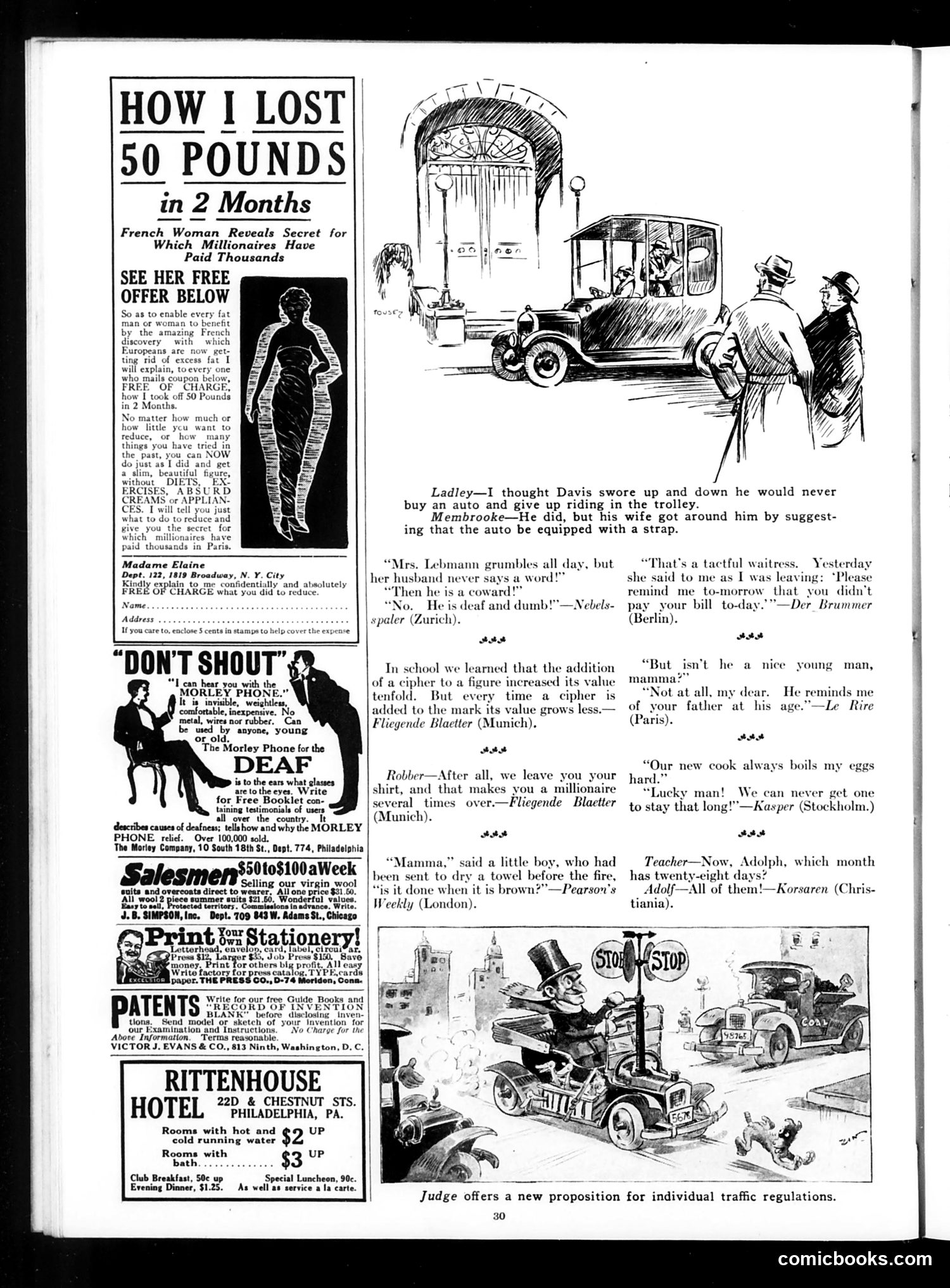
This page consists primarily of **advertisements and reprinted jokes** rather than original political cartoons. The main content includes: **Weight-loss ad** (top left): A dubious "French woman" pitch promising 50-pound weight loss in 2 months—typical early 20th-century quack medicine advertising targeting body-conscious readers. **Multiple translated jokes** (center and right): Brief humorous anecdotes reprinted from European publications (Zurich, Munich, London, Paris, Stockholm, Christianity). These touch on domestic life (nagging wives, deaf husbands), school absurdities, robbery, cooking, and wordplay—standard light humor of the era. **Bottom cartoon**: Shows a traffic accident with a judge suggesting "individual traffic regulations"—likely satirizing early automobile chaos and judicial bewilderment at new traffic problems. **Supporting ads**: Deafness devices, wool suits, stationery, patent services, hotel rooms—typical period advertising. The page reflects Judge's mix of satire, advertising revenue, and reprinted international humor typical of early 1900s American magazines.
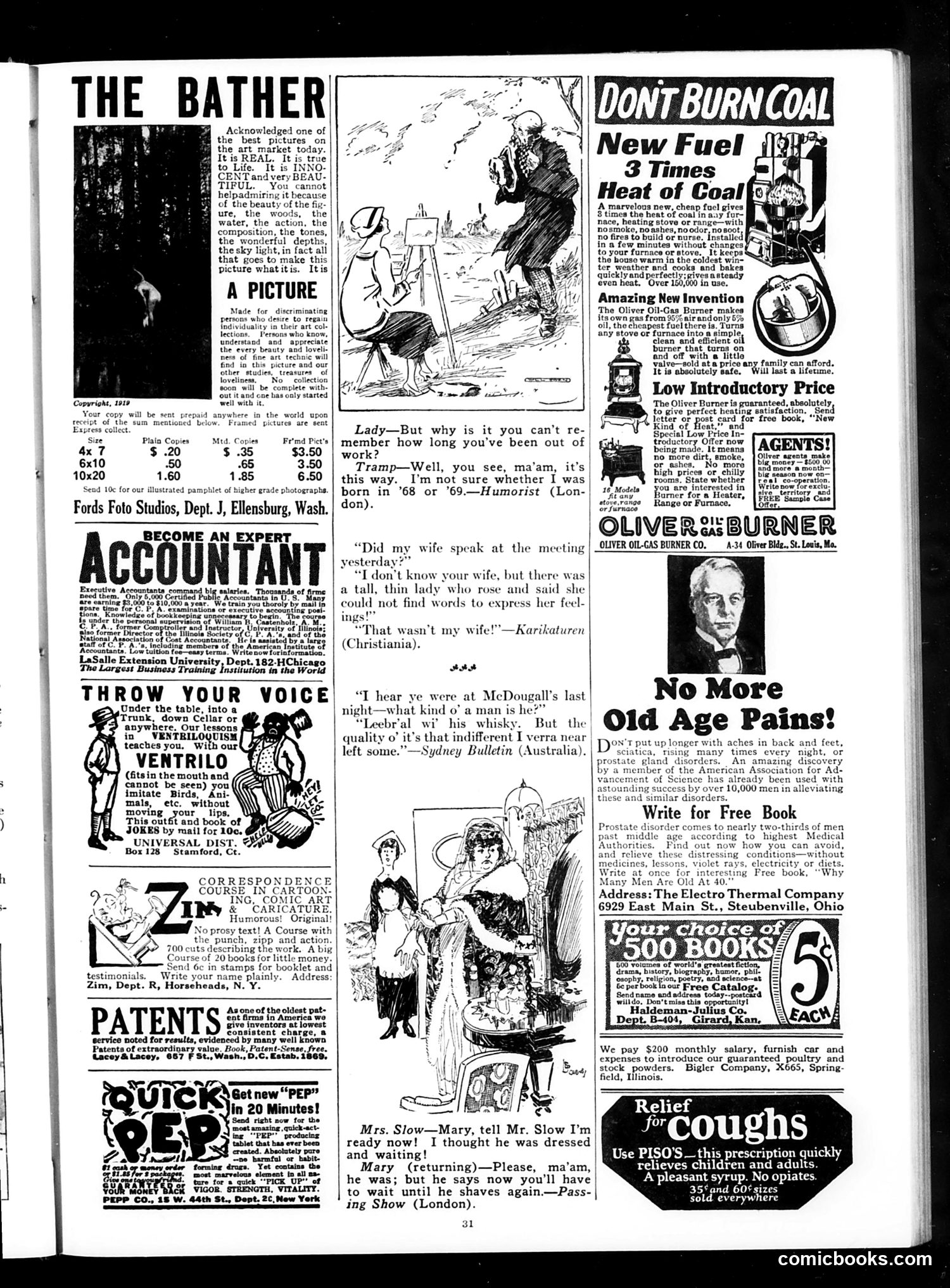
This page is primarily **advertising with humor interludes**, typical of Judge magazine's format. **"The Bather"** (top left) is an art print advertisement featuring a classical nude figure—likely a woman bathing—rendered in idealized academic style. The ad emphasizes the picture's artistic merit: composition, tone, and "beauty of the figure." It's marketed to discriminating collectors seeking "individuality" in home art collections. This reflects early 20th-century middle-class aspirations toward cultural refinement through owning fine art reproductions. The **humor pieces** scattered throughout are brief jokes about everyday life: a tramp's uncertain birth year, a wife's verbose speaking, and a man's grooming habits. These are mild, domesticated observations rather than political satire. The remaining content consists of **mail-order advertisements**—accountancy courses, ventriloquism lessons, comic art instruction, patent services, and patent medicines (including "PEP" tablets and cough syrup)—targeting readers seeking self-improvement or quick solutions to life's problems. This advertising mix reveals the magazine's working-to-middle-class readership circa 1919.
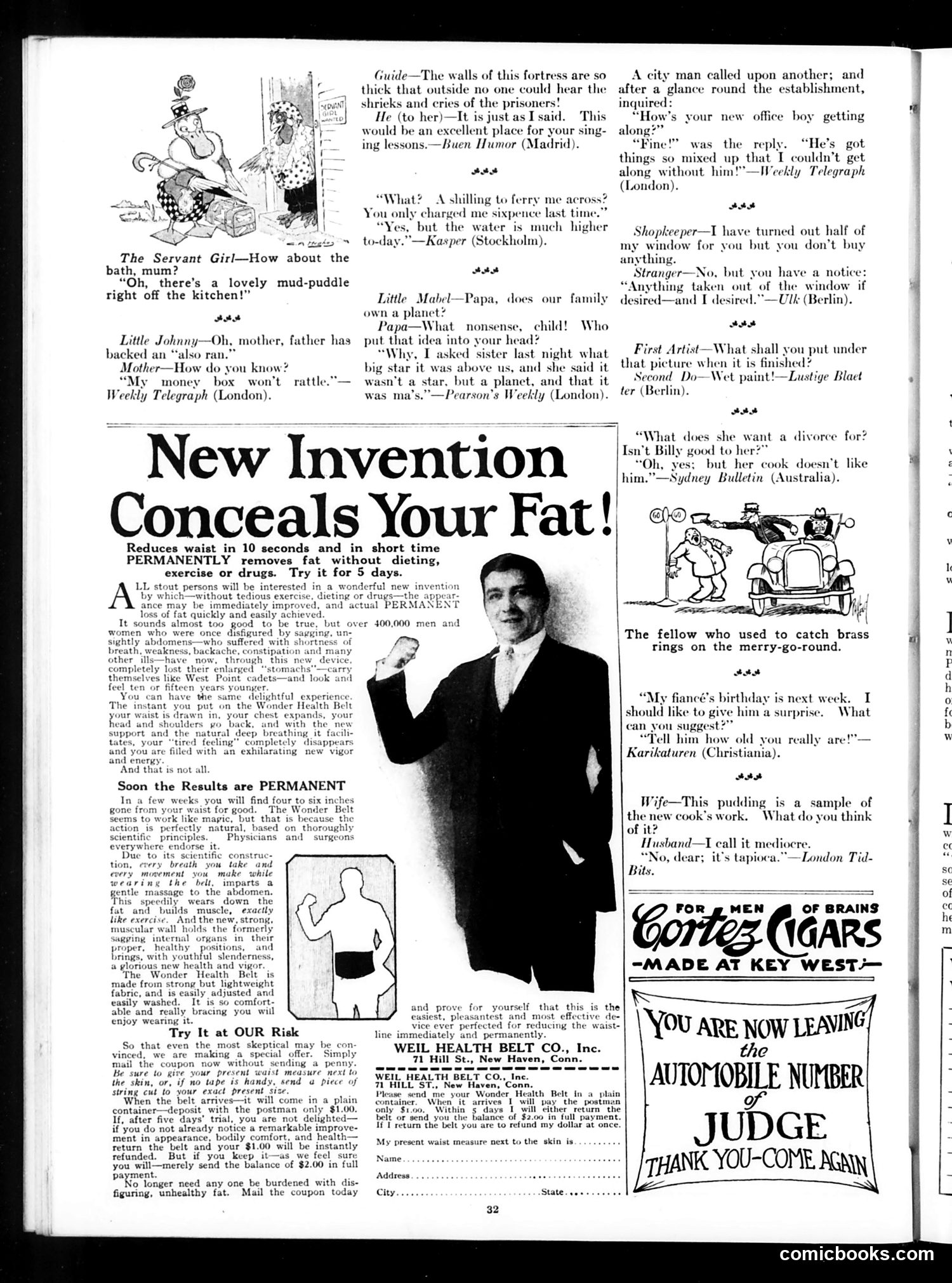
This page combines humorous short quips with period advertising. **The Humor Sections** feature brief, observational jokes sourced from international publications—a common Judge format. Topics include: a fortress's thick walls (ideal for singing lessons), ferry price increases due to water levels, a servant girl suggesting a mud puddle as a bath, and children's innocent misunderstandings (confusing stars with planets, betting on horses). **The Main Advertisement** promotes the "Wonder Health Belt"—a Victorian-era weight-reduction device claiming to permanently reduce waist size through passive means (no dieting or exercise required). The ad features a man in the belt, scientific-sounding language about deep breathing and muscular support, and a money-back guarantee. This reflects early 20th-century consumer culture's embrace of dubious health gadgets marketed to appearance-conscious buyers. The satire is implicit: Judge's audience would recognize the belt's exaggerated claims as emblematic of the era's snake-oil advertising, while the international humor selections mock human nature universally.
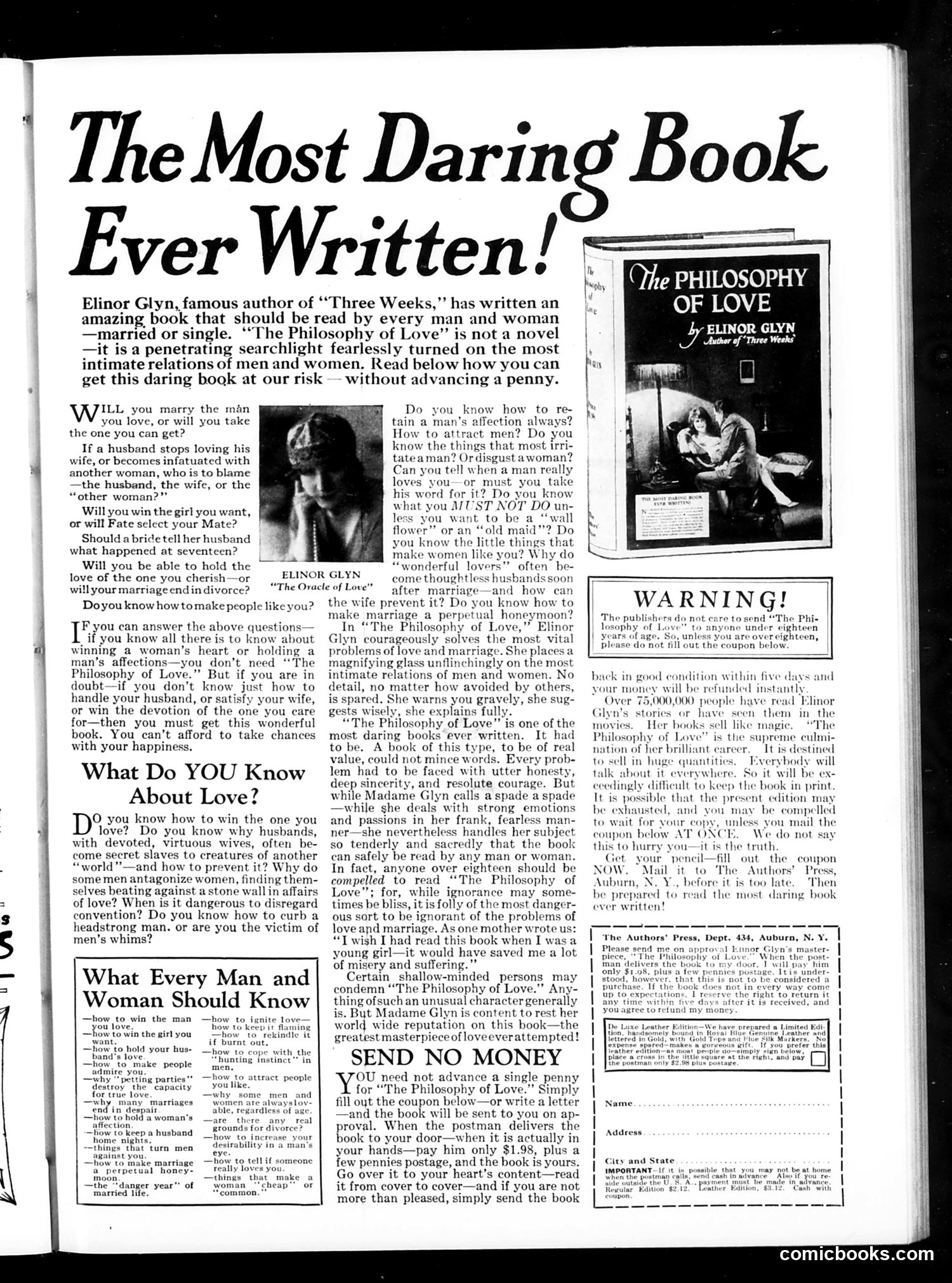
This page is primarily **advertising copy**, not satire. It promotes Elinor Glyn's book "The Philosophy of Love" as a scandalous bestseller addressing relationship and marriage advice—presented as daring because it frankly discusses intimate relations between men and women. The "WARNING!" box is a sales tactic: it claims the book is in such high demand that copies may sell out, urging immediate purchase. This creates artificial scarcity. Elinor Glyn was a real, famous author known for her 1907 novel "Three Weeks" (mentioned here), which was considered sexually provocative for its era. The ad plays on contemporary anxiety about changing gender relations and marital expectations in the early 20th century. The rhetorical questions ("Will you marry the man you love...?") appeal to readers' insecurities about romance and marriage success—timeless marketing tactics, though the specific concerns reflect period attitudes about courtship and divorce.
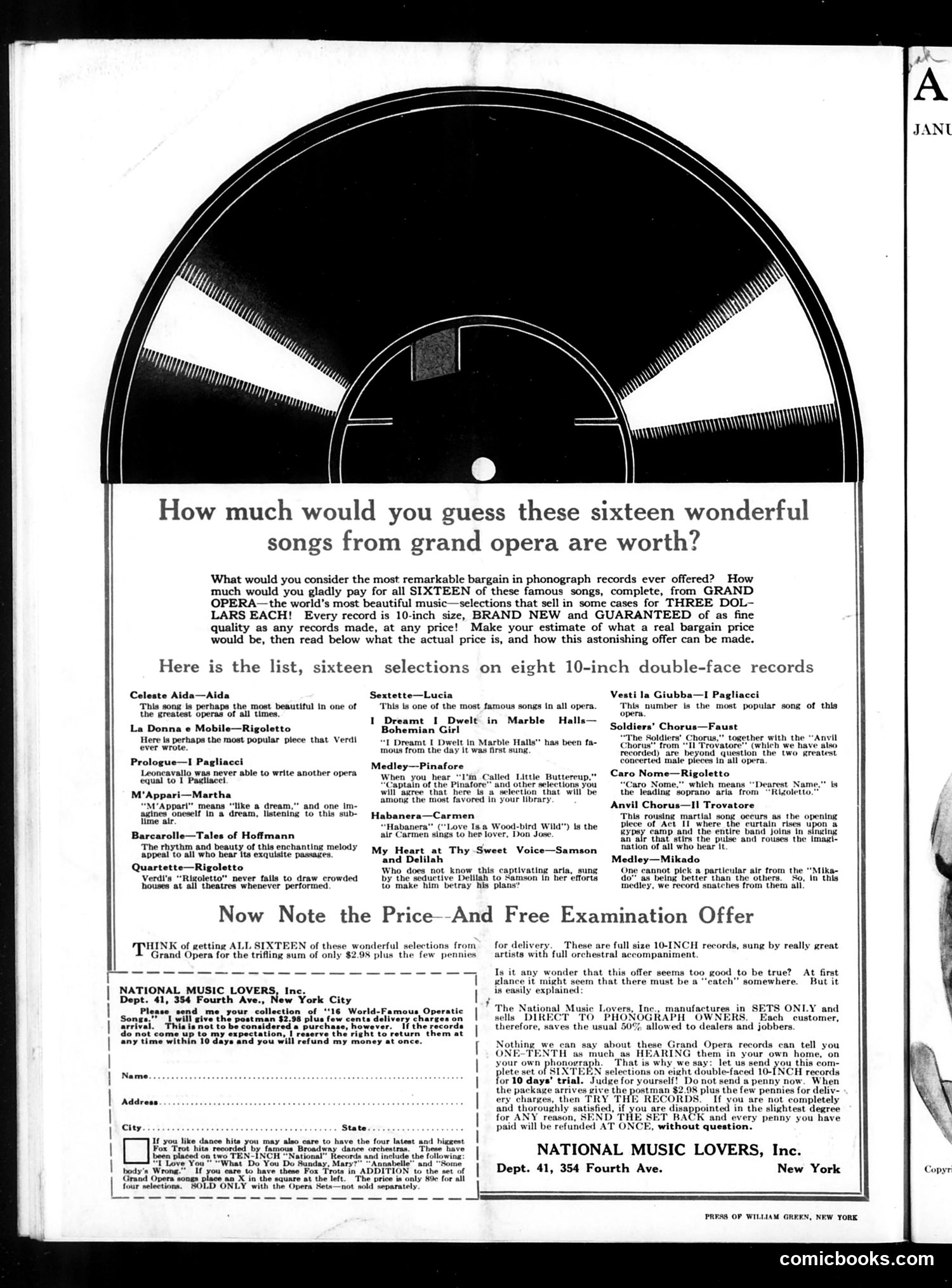
This is primarily a **mail-order advertisement**, not political satire. National Music Lovers, Inc. promotes a phonograph record collection of 16 famous grand opera selections (arias and choruses from works by Verdi, Puccini, and others) for $2.98 plus postage. The page lists beloved operatic moments—"La Donna e Mobile," "Habanera," "Anvil Chorus"—with brief descriptions of their musical merit. The marketing angle emphasizes an extraordinary bargain: individual records typically sold for $3 each, yet these sixteen 10-inch records sell for under $3 total because the manufacturer sells directly to consumers, eliminating middleman markups. The "free examination offer" was a common early-20th-century sales tactic: customers paid nothing upfront, could audition the records for 10 days, and received full refunds if unsatisfied. **No political content or satire is present.** This reflects Judge magazine's commercial advertising pages, which subsidized the publication's editorial content.