
Judge, 1924-01-05 · page 21 of 36
Judge — January 5, 1924 — page 21: what you’re looking at
What you’re looking at
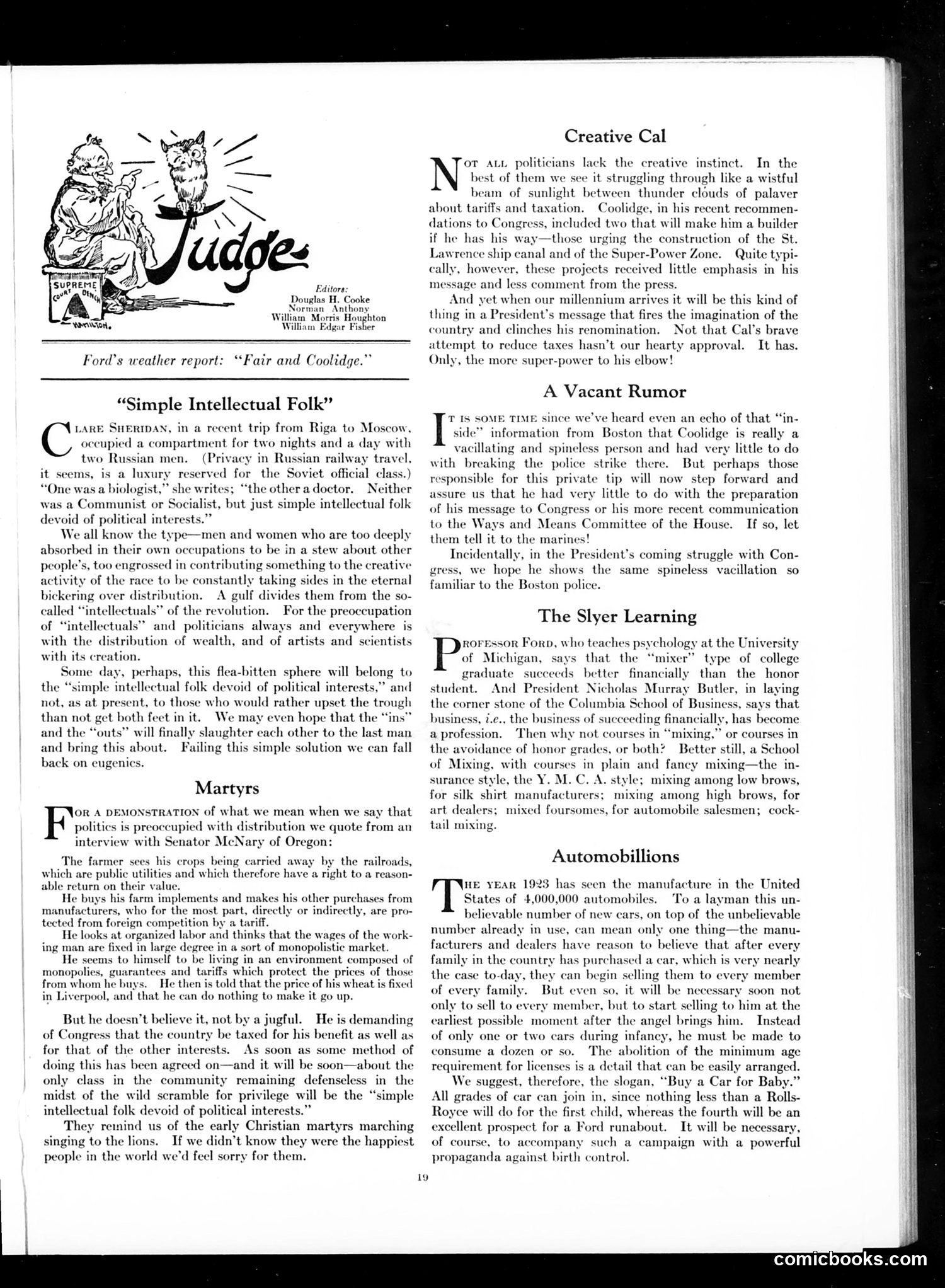
This page satirizes American political discourse circa the 1920s (likely early Coolidge era, based on references). **Main Cartoon**: The masthead shows "Judge" with an owl, the magazine's trademark. **Key Articles**: 1. **"Simple Intellectual Folk"** mocks apolitical academics and professionals who avoid economic disputes. The satire suggests these "creative" types will inevitably become sacrificial "martyrs" when competing interest groups (labor, farmers, manufacturers) scramble for government protection through tariffs and monopolies. 2. **"Martyrs"** uses Senator McNary's complaint about farmers facing rigged markets—protected manufacturers, organized labor, railroad monopolies—to illustrate how everyone demands government intervention for their benefit, leaving only unpolitical intellectuals defenseless. 3. **"Creative Cal"** (President Coolidge) praises his infrastructure proposals (St. Lawrence canal, Super-Power Zone) as visionary, while criticizing that Congress and press gave them little emphasis. The overall theme: American politics reduces to competing groups fighting over distribution of wealth and protection, leaving idealistic, creative individuals powerless.
📄 Transcribed text from this page (OCR, searchable)
Machine-transcribed from the original scan — historical spelling and the odd misread are preserved.
Anthony rtis Houghton igar Fisher “Simple Intellectual Folk” LARE SHERIDAN, in a recent trip from Riga to Moscow, C occupied a compartment for two nights and a day with two Russian men. (Privacy in Russian railway travel, rved for the Soviet official class.) “One was a biologist,” she writes; “the other a doctor. Neither was a Communist or Socialist, but just simple intellectual folk devoid of political interests.” We all know the type—men and women who are too deeply absorbed in their own occupations to be in a stew about other people’s, too engrossed in contributing something to the creative activity of the race to be constantly taking sides in the eternal bickering over distribution. A gulf divides them from the so- called “intellectuals” of the revolution. For the preoccupation of “intellectuals” and politicians always and everywhere is with the distribution of wealth, and of artists and scientists it seems, is a luxury res with its creation. Some day, perhaps, this flea-bitten sphere will belong to the “simple intellectual folk devoid of political interests,” and not, as at present, to those who would rather upset the trough than not get both feet init. We r en hope that the “ins” and the “outs” will finally slaughter each other to the last man and bring this about. Failing this simple solution we can fall back on eugenics. Martyrs OR A DEMONSTRATION of what we mean when we say that polities is preoccupied with distribution we quote from an interview with Senator McNary of Oregon: The farmer sees his crops being carried away by the rail which are public utilities and which therefore have a right to a re able return on their value. He buys his farm implements and makes his other purchases from manufacturers, who for the most part, directly or indirectly, are pro- tected from foreign competition by a tariff. He looks at organized labor and thinks that the wages of the work- ing man are fixed in large degree in a sort of monopolistic market. He seems to himself to be living in an environment composed of monopolies, guarantees and tariffs which protect the prices of those from whom he buys. He then is told that the price of his wheat is fixed in Liverpool, and that he can do nothing to make it go up. ason= But he doesn’t believe it, not by a jugful. He is demanding of Congress that the country be taxed for his benefit as well as for that of the other interests. As soon as some method of doing this has been agreed on—and it will be soon—about the only class in the community remaining defenseless in the midst of the wild scramble for privilege will be the “simple intellectual folk devoid of political intere They remind us of the early Christian martyrs marching singing to the lions. If we didn’t know they were the happiest. people in the world we'd feel sorry for them. Creative Cal In the best of them we see it struggling through like a wistful beam of sunlight between thunder clouds of palaver or att politicians lack the creative instinct. about tariffs and taxation. Coolidge, in his recent recommen- dations to Congress, included two that will make him a builder if he has his way—those urging the construction of the St Lawrence ship canal and of the Super-Power Zone. Quite ty cally, however, these projects received little emphasis in his message and less comment from the press. And yet when our millennium arrives it will be this kind of thing in a President's message that fires the imagination of the country and clinches his renomination. Not that Cal’s brave attempt to reduce taxes hasn’t our hearty approval. It has. Only, the more super-power to his elbow! A Vacant Rumor T IS SOME TIME since we've heard even an echo of that “in- side” information from Boston that Coolidge is really a vacillating and spineless person and had very little to do with breaking the police strike there. But perhaps. those responsible for this private tip will now step forward and assure us that he had very little to do with the preparation of his message to Congress or his more recent communication to the Ways and Means Committee of the House. If so, let them tell it to the marines! Incidentally, in the President’s coming struggle with Con- gress, we hope he shows the same spineless vacillation so familiar to the Boston police. The Slyer Learning ROFESSOR Forp, who teaches psychology at the University of Michigan, says that the “m type of college graduate succ ter financially than the honor student. And Pre: cholas Murray Butler, in laying stone of the Columbia School of Business, says that the corne! busine s become Then why not courses in “mixing,” or courses in Better still, a School of Mixing, with courses in plain and fancy mixing—the in- surance style, the Y. M. C. A. style; mixing among low brows, for silk shirt manufacturers; mixing among high brows, for art dealers; mixed foursomes, for automobile salesmen; cock- tail mixing. . the business of succeeding financially, h a profession. the avoidance of honor grades, or both? Automobillions HE YEAR 1923 has seen the manufacture in the United States of 4,000,000 automobiles. To a layman this un- believable number of new cars, on top of the unbelievable number already in use, can mean only one thing—the manu- facturers and dealers have reason to believe that after every family in the country has purchased a car, which is very nearly the case to-day, they can begin selling them to every member of every famil But even so, it will be necessary soon not only to sell to every member, but to start selling to him at the earliest possible moment after the angel brings him. Instead of only one or two cars during infancy, he must be made to consume a dozen or so. The abolition of the minimum age requirement for licenses is a detail that can be easily arranged. We suggest, therefore, the slogan, “Buy a Car for Baby.” All grades of car can join in, since nothing less than a Rolls- Royce will do for the first child, whereas the fourth will be an excellent prospect for a Ford runabout. It will be necessary, of course, to accompany such a campaign with a powerful propaganda against birth control. comicbooks.com