
Judge, 1924-01-05 · page 26 of 36
Judge — January 5, 1924 — page 26: what you’re looking at
What you’re looking at
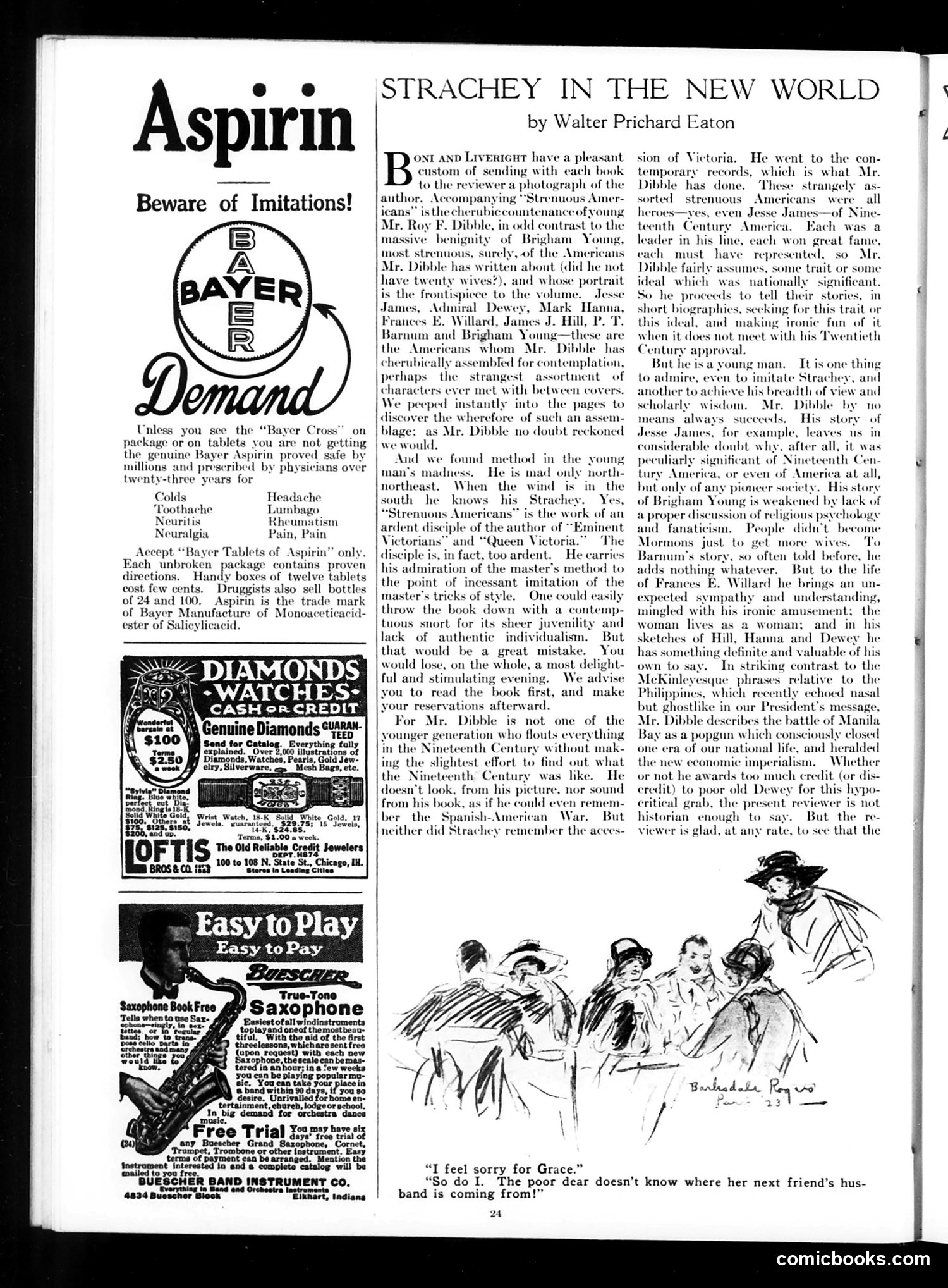
This page is primarily **advertising**, with a substantial book review article by Walter Prichard Eaton occupying the right column. **The Review Content:** Eaton critiques a book called "Strenuous Americans" by Roy Dibble, which profiles historical figures including Brigham Young, Admiral Dewey, Mark Hanna, Jesse James, and P.T. Barnum. Eaton notes Dibble imitates the biographical style of Lytton Strachey (author of "Eminent Victorians") too closely, showing "sheer juvenility and lack of authentic individualism." However, he praises Dibble for consulting primary sources rather than relying on contemporary assumptions—comparing this favorably to Strachey's own method with Queen Victoria's era. **The Cartoon:** The small sketch shows a woman discussing Grace, whose husband "is coming from" elsewhere—implying infidelity. This appears unrelated to the review. **Advertisements** dominate the left side: Bayer Aspirin (warning against imitations), Otis diamonds, and Buescher saxophones.
📄 Transcribed text from this page (OCR, searchable)
Machine-transcribed from the original scan — historical spelling and the odd misread are preserved.
Aspirin Beware of Imitations! Unless you see the “Bayer Cross” on package or on tablets you are not getting the genuine Bayer Aspirin proved safe by millions and preseribed by physicians over twenty-three years for Colds Headache ‘Toothache Lumbago Neur' Rheumatism Pain, Pain Accept “Bayer Tablets of Aspirin” only. Each unbroken package contain directions. Handy boxes of tw Druggists Aspirin is the’ tr ure of Monoaceticacid- cost few cents. of 24 and 100. -~WATCHES- CASH or CREDIT Everything fall Tnostrations of Easy to Play Easy to Pay True-Tone ‘ophone attestrements masibecee Witte eser oe ry of the first ) Saxo ; ceemetelions Pricing three Free Trial H Sore Ticeo eal ot ag rand Saxophone, terms ‘of pay! be Sastrement, interested ed 1a and «completa catalog’ will mailed to BUESCHER, BAND, INSTRUMENT. co. 4834 Busscher Block Elkhart, tndiang STRACHEY IN THE NEW WORLD ONT AND Livertcut have a pleasant custom of sending with each book to the reviewer a photograph of the author. Accompanying “Strenuous Amer- icans” is the cherubiccountenanceofyoung Mr. Re Dibble, in odd contrast to the ive benignity of Brigham Young, st strenuous, surely, of the Americans Mr. Dibble has written about (did he not have twenty wives?), and whose portrait is the frontispiece to the volume. Jesse Admiral Dewey, Mark Hanna, Willard, James J. Hill, P. ‘T. Barnum and Brigham Young—these are the Americans whom Mr. Dibble has | cherubically assembled for contemplation, ber ys the strangest assortment of ters ever met with between covers. We peeped instantly into. the pages to discover the wherefore of such an assem- blage: as Mr. Dibble no doubt reckoned | we would. And we found method in the young man’s madness. He is mad only north- northeast. When the wind is in the south he knows his Strachey. Yes, “Strenuous Americans” is the work of an ardent disciple of the author of “Eminent storians”” and “Queen Victori he disciple is, in fact, too ardent. He cz his admiration of the master’s method to the point of incessant imitation of the master’s tricks of style. One could easily throw the book down with a contemp- tuous snort for its sheer juvenility and lack of authentic individualism. But that would be a great mistake. You would lose, on the whole, a most delight- ful and stimulating evening. We advise you to read the book first, and make your reservations afterward. For Mr. Dibble is not one of the younger generation who flouts everything in the Nineteenth Century without mak ing the slightest effort to find out what the Nineteenth Century was like. He doesn’t look, from his picture, nor sound from his book, as if he could even remem- {ber the Spanish-American War. But neither did Strachey remember the acces- “I feel sorry for Grace.” “So do I. band is coming from!” 24 by Walter Prichard Eaton sion of Victoria. He went to the con- temporary records, which is what’ Mr. Dibble has done. ‘These strangel. sorted strenuous Americans were all heroes— of Nine- ves, even Jesse James: teenth Century y leader in his line, nerica, Each was a ch won great fame, each must have represented, so | Mr. Dibble fairly assumes, some trait ¢ ideal which was nationally signif So he proceeds to tell their stories, in short biographies, secking for this trait or this ideal, and making ironie fun of it when it does not meet with his Twentieth Century approval. But he is a young man. It is one thing to admire, even to imitate Strachey, and another to achieve his breadth of view and rly Mr. Dibble by no is always Is. His story of mes. for example, leaves usin le doubt why, after all, it was peculiarly significant of Nineteenth Cen- tury America, or even of America at all, but only of any pioncer society. His story of Brigham Young is weakened by lack of a proper discussion of religious psychology: and fanaticism. People didn’t) become Mormons just to get more wives. ‘To Barnum’s story ften told before, he adds nothing w! But to the life of Frances E. Willard he brings an un- xpected sympathy and understanding, mingled with his ironic amusement; the woman lives as a woman; and in his sketches of Hill, Hanna and Dewey he has something definite and valuable of his -. In striking contrast to the ssque_ phrase: ive to the Philippines, which rece hoed nasal but ghostlike in our President's message, Mr. Dibble describes the battle of Manila as a popgun which consciously closed era of our national life, and heralded the new economic imperialism. | Whether or not he awards too much credit (or dis- credit) to poor old Dewey for this hypo- critical grab, the present reviewer is not historian enough to say. But the re- viewer is glad, at any rate, to see that the dom, suc The poor dear doesn’t know where her next friend's hus- Si comicbooks.com