
Judge, 1924-01-05 · page 12 of 36
Judge — January 5, 1924 — page 12: what you’re looking at
What you’re looking at
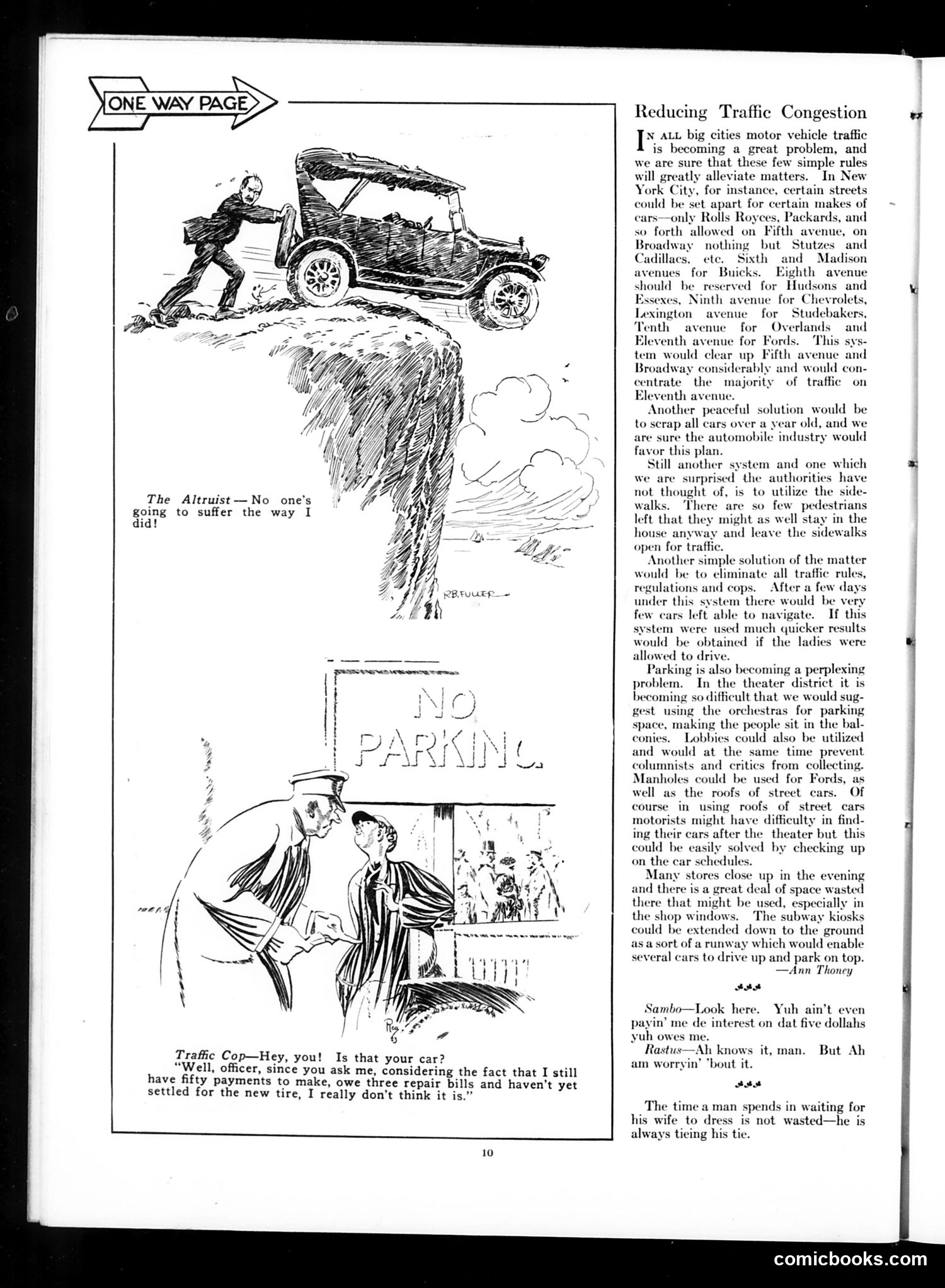
This page contains two distinct satirical pieces: **"The Altruist"** (top cartoon): Shows a man pushing a car off a cliff, claiming "No one's going to suffer the way I did!" The joke satirizes someone so bitter about their own automotive misfortunes that they'd harm others rather than endure suffering alone—dark humor about selfish altruism. **Traffic Congestion Article**: A lengthy satirical essay proposing absurd "solutions" to urban traffic problems, including: segregating streets by expensive car brands (Rolls-Royce on Fifth Avenue, Fords on Eleventh), scrapping cars over a year old, using sidewalks for traffic, eliminating traffic laws entirely, and converting theater orchestras and subway kiosks into parking spaces. The satire mocks both traffic congestion's severity and the impracticality of proposed solutions. **"No Parking" (middle cartoon)**: A traffic cop confronts a driver claiming he doesn't truly own his car due to outstanding payments and repair bills—humor about automobiles as financial burdens during the early auto era. The page reflects 1920s urban anxieties about automobile proliferation and city congestion.
📄 Transcribed text from this page (OCR, searchable)
Machine-transcribed from the original scan — historical spelling and the odd misread are preserved.
WAY PAGE The Altruist—No one’s going to suffer the way I Traffic Cop—Hey, you! “Well, officer, have fifty payment settled for the ne € Is that your car? since you ask me, considering the fact that I still Ss to make, owe three repair bills and haven't yet w tire, I really don’t think it is.” Reducing Traffic Congestion | ALL big cities motor vehicle traffic is becoming a great problem, and we are sure that these few simple rules will greatly alleviate matte In New York City, for instance, certain streets could be set apart for certain makes of cars—only Rolls Royces, Packards, and so forth allowed on Fifth avenue, on Broadway nothing but Stutzes ‘and Cadillacs, ete. Sixth and Madison avenues for Buicks. Eighth avenue should be reserved for Hudsons and issexes, Ninth avenue for Chevrolets, Lexington avenue for Studebakers, ‘Tenth avenue for Overlands and Eleventh avenue for Fords. This sys- tem would clear up Fifth avenue Broadway considerably and would con- centrate the majority of traffic on Eleventh avenue. Another peaceful solution would be to scrap all cars over a year old, and we are sure the automobile industry would favor this plan. Still another system and one which we are surprised the authorities have not thought of, is to utilize the side- walks. There are so few pedestrians left that th ight as well stay in the house any and leave the sidewalks open for traffic. Another simple solution of the matter would be to eliminate all traffic rule: regulations and cops. After a few d under this system there would be very few cars left able to navig: If this system were used much quicker results would be obtained if the ladies were allowed to drive. Parking is also becoming a perplexing problem. In the theater district it is becoming so difficult that we would sug- gest using the orchestras for parking space, making the people sit in the bal- conies. Lobbies could also be utilized and would at the same time prevent columnists and critics from collecting. Manholes could be used for Fords, as well as the roofs of street c¢ Of course in using roofs of street motorists might have difficulty in find- ing their cars after the theater but this could be easily solved by checking up on the car schedules. stores close up in the evening s a great deal of space wasted there that might be used, especial the shop windows. The subway kiosks could be extended down to the ground sort of a runway which would enable pral cars to drive up and park on top. —Ann Thoney se cy Sambo—Look here. Yuh ain’t even payin’ me de interest on dat five dollahs yuh owes me. Rastus—Ah knows it, man. But Ah am worryin’ ‘bout it. ey The time a man spends in waiting for his wife to dress is not wasted—he is always tieing his tie. comicbooks.com