
Judge, 1924-01-05 · page 15 of 36
Judge — January 5, 1924 — page 15: what you’re looking at
What you’re looking at
This theater review awards a satirical "grand prix" to actor-director M. Leo Ditrichstein for the worst casting of the season in his production of "The Business Widow" (a Central European comedy adapted by Gladys Unger). Nathan's critique: Ditrichstein miscast himself as an unromantic American businessman while casting Davidson (a romantic foreigner type) oppositely—the reverse of what the play requires. The plot concerns a neglected wife tempted by a charming foreigner; she's nearly seduced until her jealous husband's ploy succeeds. Nathan attacks not just casting but the entire production: the play itself is "stale," "wholly without humor," and "drags"; the acting is worse than scenery; Ditrichstein overcompensates by "shouting, gurgling, running around" like "Sophie Tucker" (suggesting undignified mugging); Davidson lacks romantic persuasiveness. The review contrasts this with J.P. McEvoy's "The Potters," deemed "much more amusing," though also imperfect. This represents early 20th-century Broadway criticism's acerbic style and insider references.
📄 Transcribed text from this page (OCR, searchable)
Machine-transcribed from the original scan — historical spelling and the odd misread are preserved.
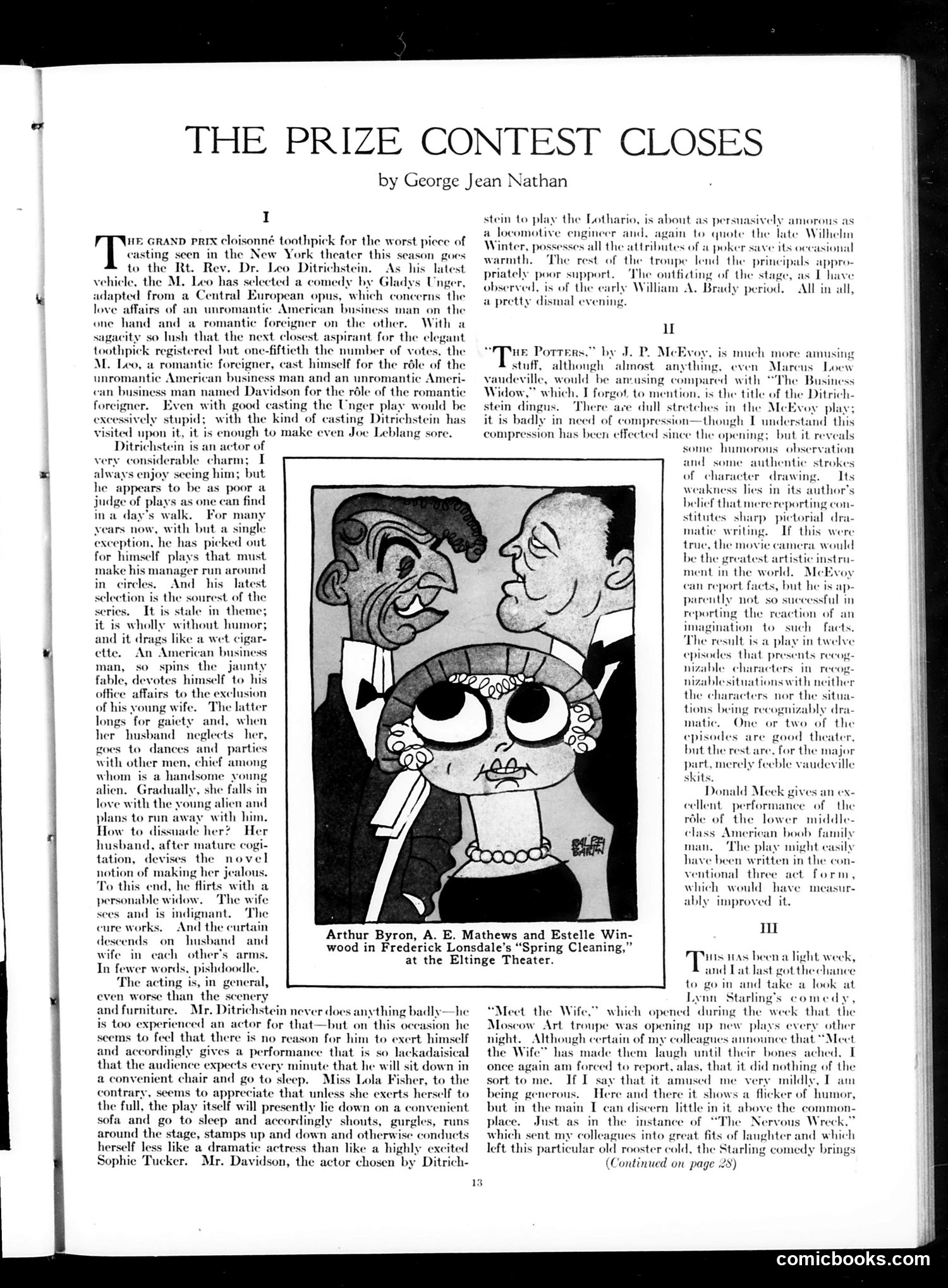
eve Oe. SnD THE PRIZE CONTEST CLOSES by George Jean Nathan I T= GRAND PRIX cloisonné toothpick for the worst piece of casting seen in the New York theater this season goes to the Rt. Rev. Dr. Leo Ditrichstein. s his latest vehicle, the M. Leo has selected a comedy by Gladys Unger, adapted from a Central European opus, which concerns the love affairs of an unromantic American business 1 on the one hand and a romantic foreigner on the other. With a so lush that the next closest aspirant for the elegant registered but one-fiftieth the number of votes, the M. Leo, a romantic foreigner, cast himself for the réle of the unromantic American business man and an unromantic Ameri- can business man named Davidson for the réle of the romantic foreigner. Even with good casting the Unger play would be ly stupid: with the kind of casting Ditrichstein has visited upon it, it is enough to make even Joe Leblang sore. Ditrichstein is an actor of very considerable charm; I alway's enjoy seeing him; but he appears to be as poor a judge of plays as one can find ina day's For many years now, with but a single exception, he has picked out for himself plays that must make his manager run around in circles. And his latest selection is the sourest of the series. It is stale in theme; it is wholly without humor; and it drags like a wet cigar- ette. An American business man, so spins the jaunty fable, devo’ himself to his office affairs to the exclusion of his young wife. The latter longs for gaiety and, when her husband neglects her, goes to dances and_ parties with other men, chief among whom is a handsome young alien. Gradually, she falls in love with the young alien and plans to run away with him. How to dissuade her? Her husband, after mature cogi- tation, devises the novel notion of making her jealous. To this end, he flirts with a personable widow. The wife sees and is indignant. The cure works. And the curtain descends on husband and wife in each other's arms. In fewer words, pishdoodle. The acting is, in general, even worse than the scenery and furniture. Mr. Ditrichstein never does anything badly—he is too experienced an actor for that—but on this occasion he spects every minute that he will sit down in and go to s Fisher, to the appreciate that unless she exerts herself to the full, the play itself will presently lie down on a convenient sofa and go to sleep and accordingly shouts, gurgles, runs around the stage, stamps up and down and otherwise conducts herself less like a_dramatic actress than like a highly excited Sophie Tucker. Mr. Davidson, the actor chosen by Ditrich- stein to play the Lothario, is about as persuasively amorous as a locomotive enginecr and, again to quote the late Wilhelm Winter, possesses all the attributes of a poker save its occasional warmth, ie rest of the troupe lend the princi priately poor support. The outficing of the stage observed, is of the early William A. Brady period. a pretty dismal evening. Ss appro- yas T have All in all, iu “TTur Porters,” by J. P. McEvoy, is much more amusing stuff, although almost anything, even Mareus Loew vaudeville, would be amusing compared with “The Business Widow,” which, I forgot, to mention, is the title of the Ditrich- stein dingus. There ave dull stretches in the McEvoy play; it is badly in need of compression—though [understand this compression has been effected since the opening; but it reveals some humorous observation and some authentic strokes of « ster drawing. — Its weakness lies in its author's belief that mere reporting con- stitutes sharp. pictorial dra- matic writing. If this were true, the movie camera would be the greatest artistic instru- ment in the world. McEvoy can report facts, but he parently not so successful in reporting the reaction of an tion to such facts. The result is a play in twelve episodes that presents recog- nizable characters in recog- nizablesituations with neithe: the characters nor the situa- tions being recognizably dra- matic. One or two of the but the rest a part, merely f skits. Donald Meek gives an ex- lent. performance of the f the lower middle- class Amer family man. ‘The play might easily have been written in the con- ventional three act form, which would have measur- ably improved it. sble vaudeville n boob Arthur Byron, A. E. Mathews and Estelle Win- mil wood in Frederick Lonsdale’s “Spring Cleaning,” at the Eltinge Theater. TT HAs been a light w and Lat last gotthecl to go it id take a look at Lynn Starling’s comedy, “Meet the Wife.” which opened during the week that the Moscow Art troupe was opening up new plays every other night. Although certain of my colleagues announce that “Meet the Wife” has made them laugh until their bon: hed. I once again am forced to report, alas, that it did nothing of the sort tome. If I say that it amused me very mildly, I am being generous. Here and there it shows a flicker of humor, but in the main T can discern little in it. above the common ve. Just as in the instance of “The Nervous Wrec! h sent my colleagues into great fits of laughter and which left this particular old rooster cold, the Starling comedy brings (Continued on page 28) comicbooks.com