
A complete issue · 37 pages · 1923
Judge — December 29, 1923
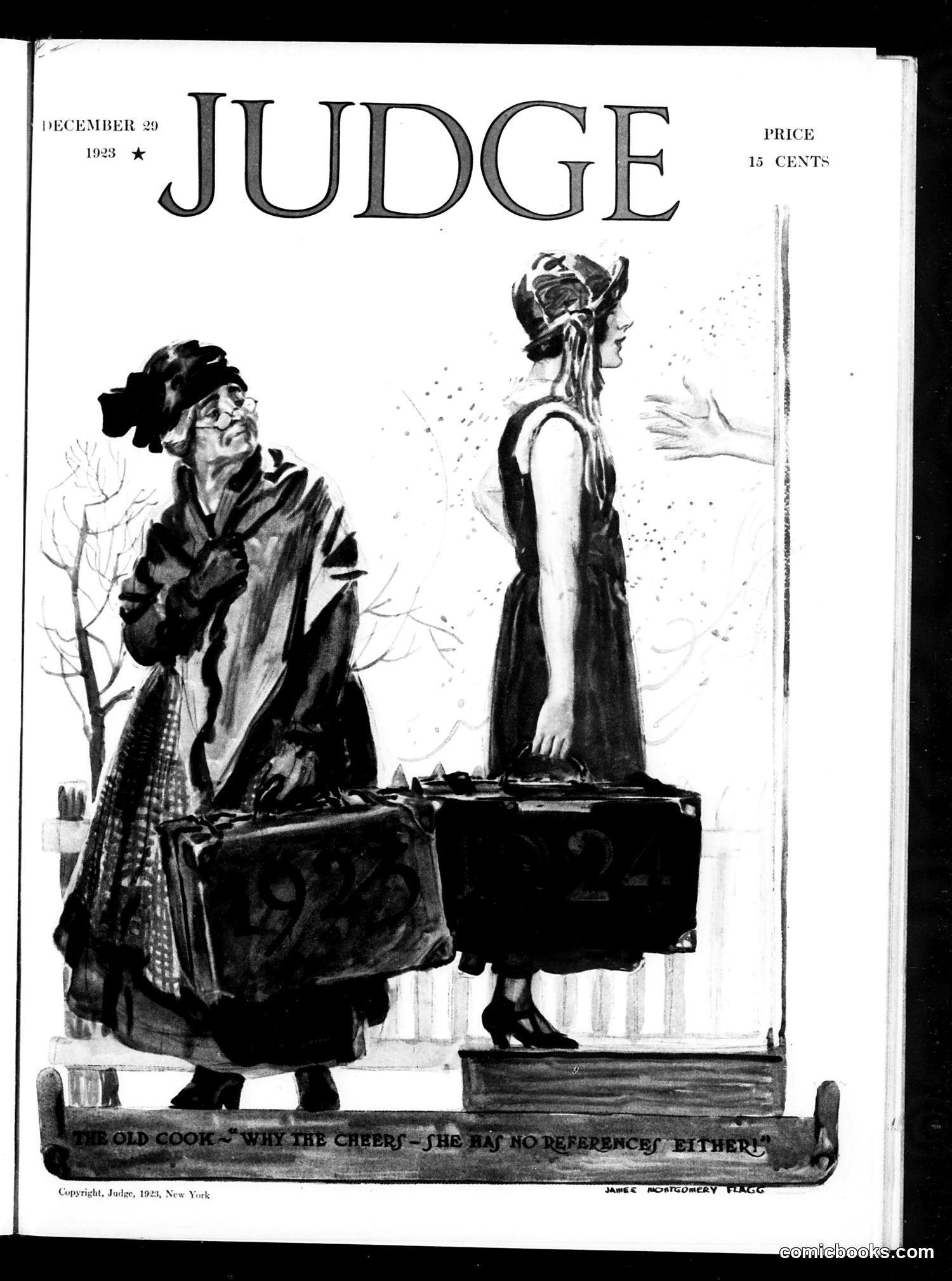
This cover illustration by James Montgomery Flagg depicts two women with luggage, accompanied by a caption referencing "The Old Cook," "Why The Cheese," "The Hat," and "No Deference Either." The cartoon likely comments on domestic service and class relations in 1920s America. The figures appear to represent a departing household servant (left, older, wearing a head covering) and possibly an employer or new hire (right, standing at attention with luggage). The cryptic caption suggests commentary on workplace friction—perhaps complaints about a cook's work quality, disputes over provisions, fashion choices, or lack of respect. Without additional context identifying specific contemporary figures or events, the precise satirical target remains unclear, though it reflects period anxieties about household labor and employer-employee dynamics.
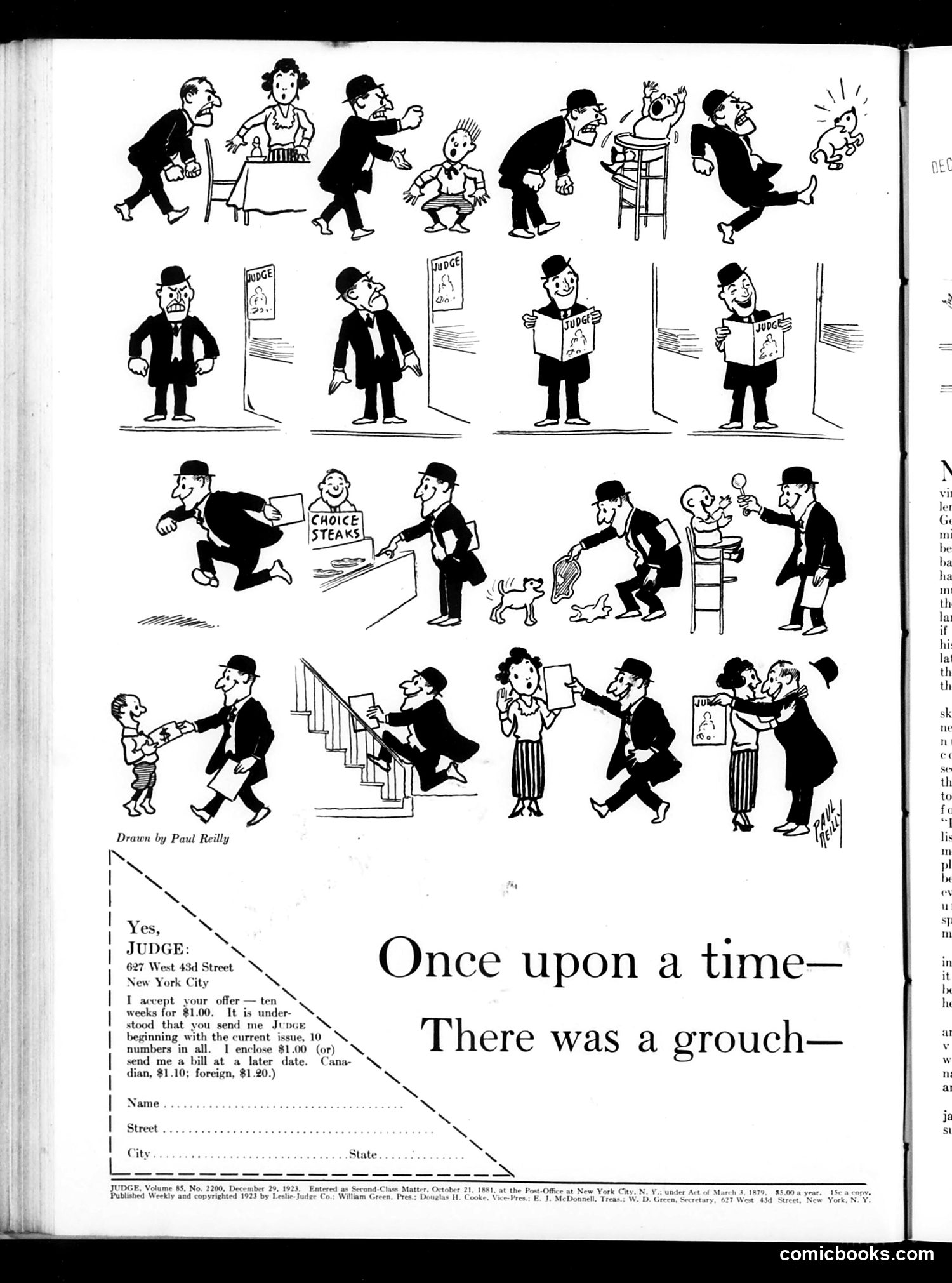
This page presents a visual narrative titled "Once upon a time—There was a grouch" by cartoonist Paul Reilly. The sequential illustrations depict a man in formal attire (bowler hat, suit) experiencing escalating frustrations throughout his day: arguing with companions, confronting authority figures (suggested by "JUDGE" signs), dealing with domestic chaos, and encountering various annoyances involving children, animals, and stairs. The humor derives from depicting everyman's mounting exasperations—a relatable theme for early 20th-century readers. The "grouch" character embodies the irritable urban professional confronting daily indignities, from domestic discord to public inconveniences. The subscription offer below suggests this type of humorous, relatable content appealed to Judge's middle-class readership seeking satirical commentary on ordinary life's frustrations.
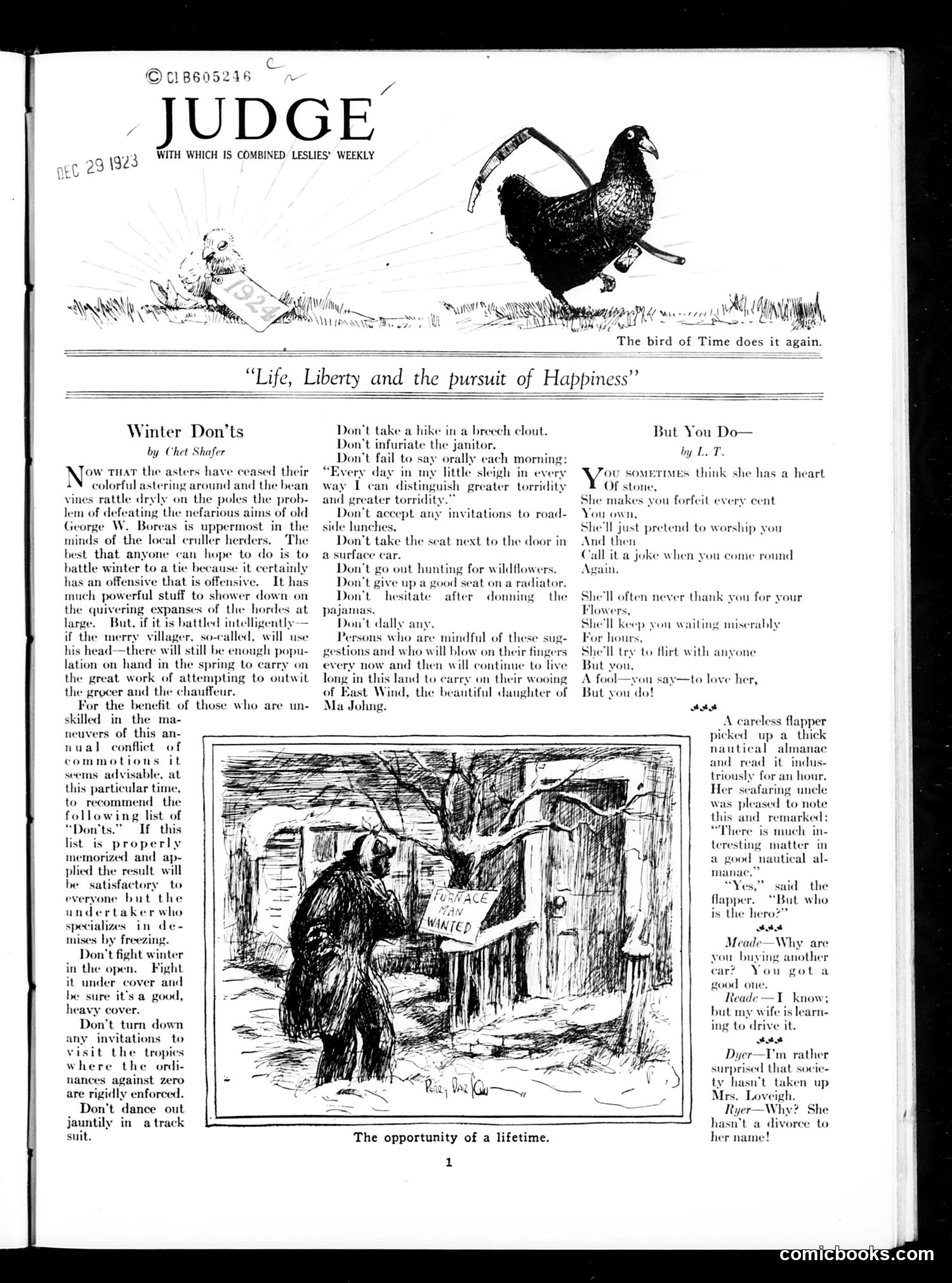
The main cartoon, titled "The opportunity of a lifetime," depicts a figure at a doorway marked "FORECLOSURE" and "WANTED," apparently representing a desperate housing situation. The accompanying "Winter Don'ts" column by Chet Shafer offers practical advice for economical winter living—avoiding costly habits like hiking in breech clouts, taking radiator seats, and hunting wildfowl. The joke "But You Do—" satirizes women who claim not to appreciate flowers, jewelry, and attention, yet clearly expect and enjoy such treatment from suitors. The cartoon likely reflects post-World War I economic hardship and housing crisis, while the advice columns humorously address Depression-era thrift. The rooster illustration references the passage of time and seasonal change.
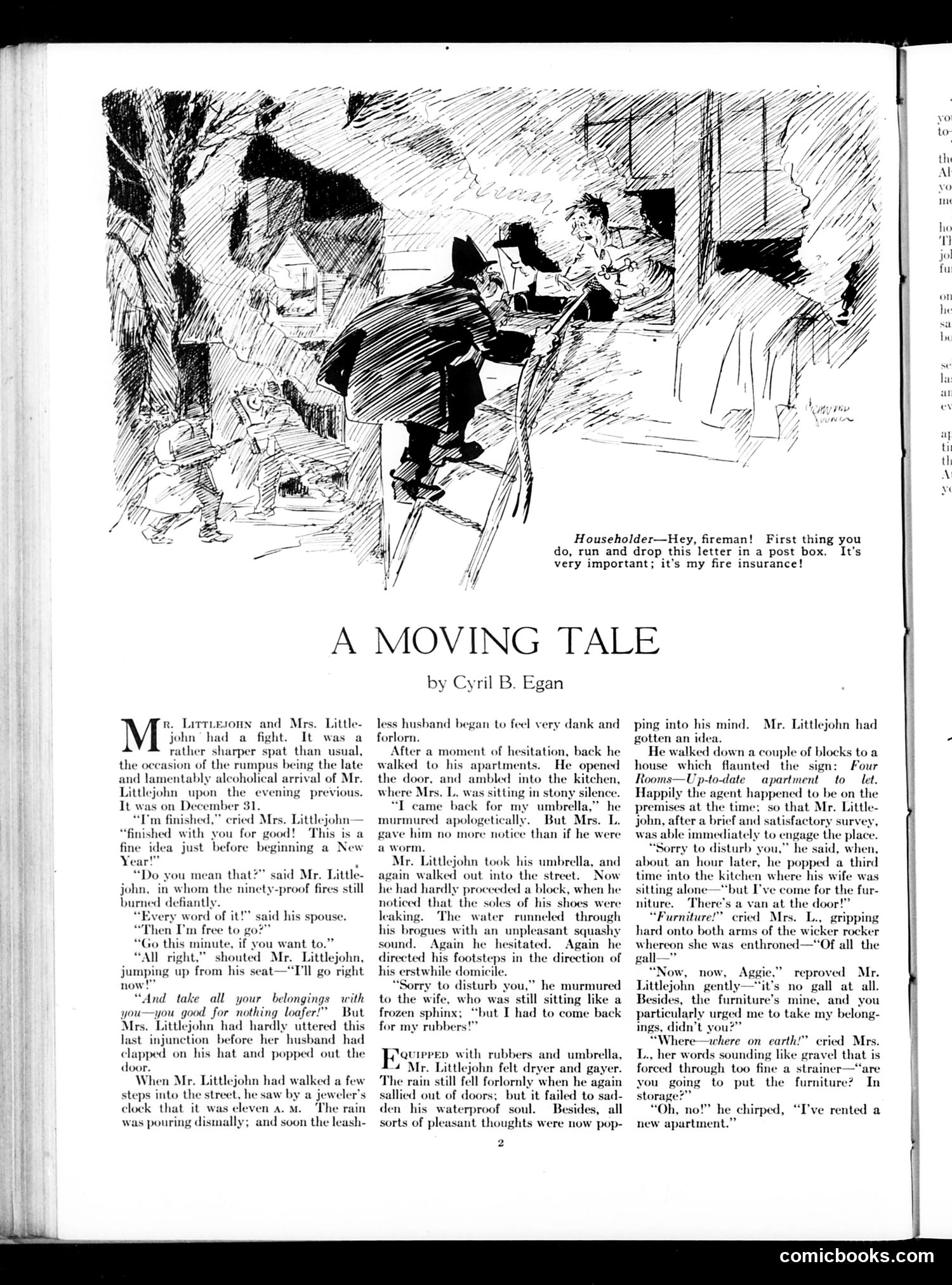
This page contains a humorous short story rather than a political cartoon. The illustration depicts a domestic dispute: Mr. and Mrs. Littlejohn are moving apartments after arguing about household finances. The satire centers on marital comedy—the wife scolds the husband for his poor financial management ("finished with you for good!"), while the husband frantically instructs a fireman to mail his fire insurance letter, realizing he's forgotten it during their chaotic moving day. The humor derives from the absurdity of prioritizing insurance documentation amid domestic turmoil and the physical comedy of moving day disruptions. This represents typical early 20th-century Judge magazine content: light domestic satire aimed at middle-class readers, poking gentle fun at marriage dynamics and household management rather than political commentary.
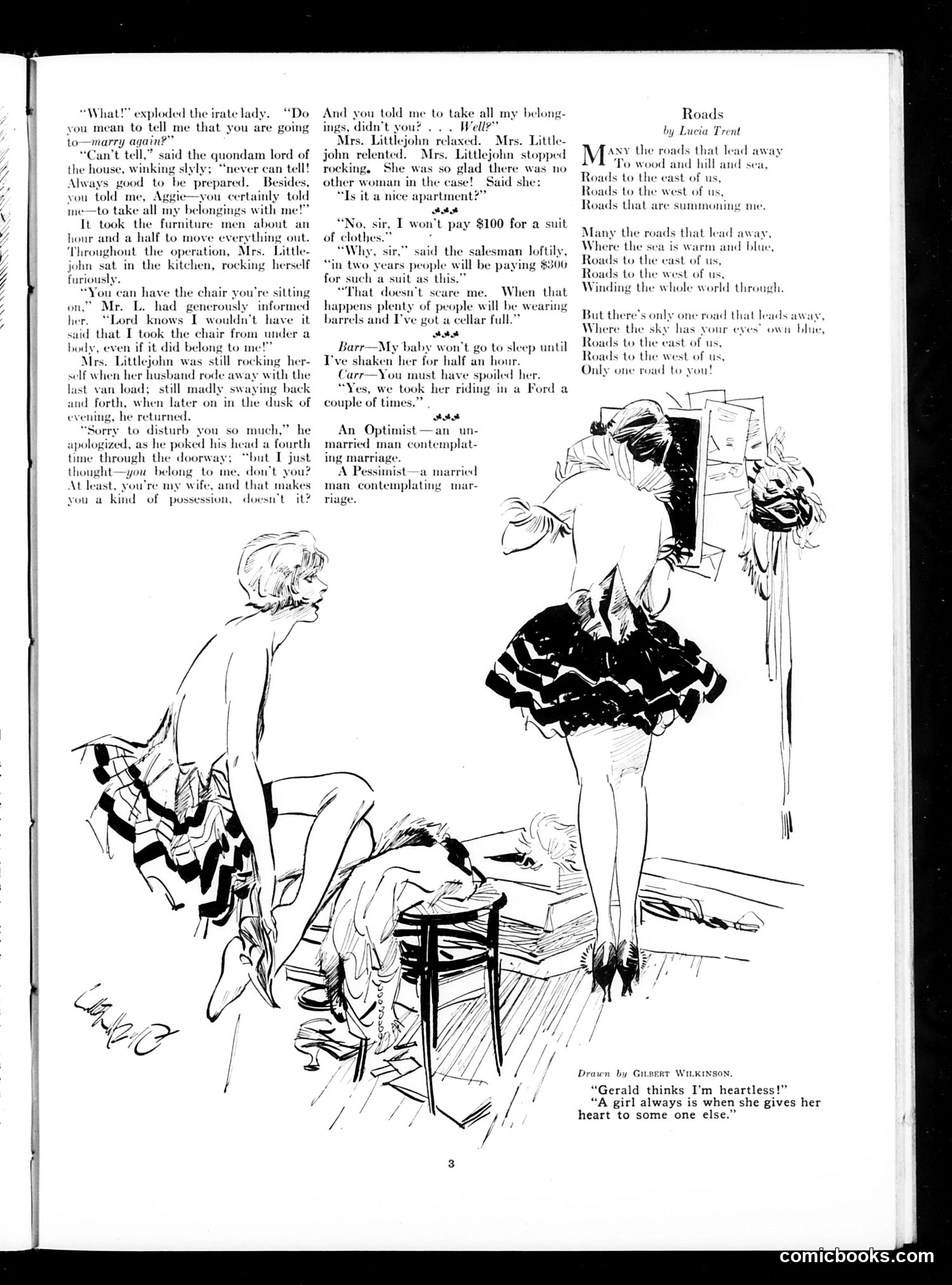
This page contains two distinct pieces: a dialogue-based comic about marital disputes over furniture and clothing expenses, and a poem titled "Roads" by Louis E'arl. The main cartoon, illustrated by Gilbert Wilkinson, depicts a domestic argument between a husband and wife. The husband complains about his wife's spending on home furnishings and a new suit of clothes, while she defends her purchases. The satire targets typical early-20th-century marital conflicts over household finances and consumer spending—particularly women's expenditures on clothing and home decoration, which husbands often viewed as extravagant. The closing quote ("A girl always is when she gives her heart to some one else") suggests commentary on marriage's financial and emotional complexities. The humor relies on relatable domestic tensions rather than specific political references.
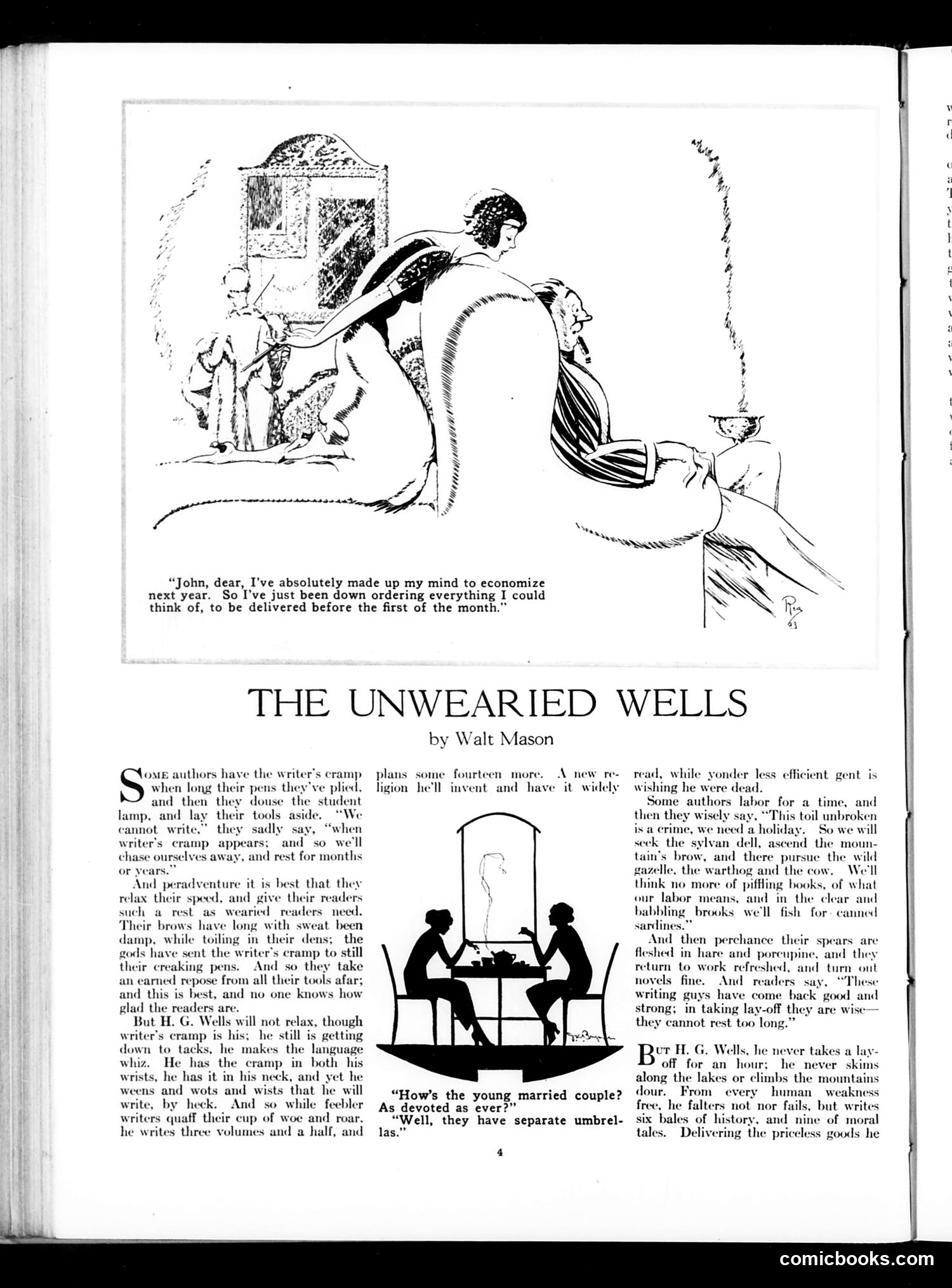
This page satirizes prolific author H. G. Wells through a humorous comparison of writing styles. The cartoon shows a couple at a table discussing "separate umbrellas"—a reference to Wells' theme about marital independence. The article contrasts two types of writers: those who suffer from "writer's cramp" and take breaks, versus Wells, who never rests. It suggests Wells writes prolifically despite physical strain—"cramp in both wrists," "wrists and wots and wists"—yet somehow produces "three volumes and a half" continuously. The satire mocks Wells' relentless output and his particular obsession with writing about marriage, separate lives, and social arrangements. The joke critiques both his productivity and his fixation on marital themes as subject matter.
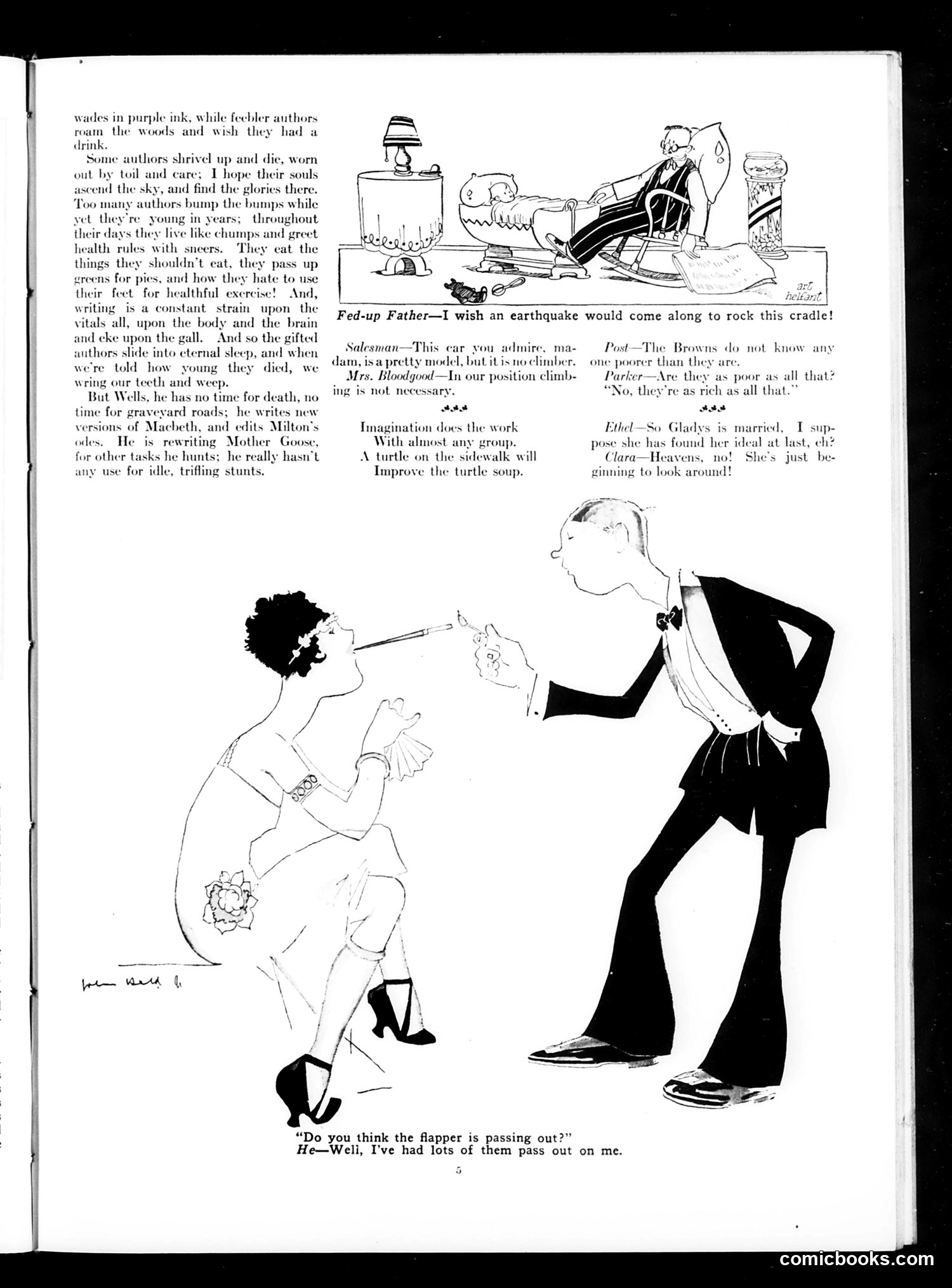
This page contains multiple unrelated satirical vignettes typical of Judge's format: **Top cartoon:** "Fed-up Father" depicts a exhausted parent wishing for an earthquake to disturb a baby's cradle—satirizing the sleep deprivation of new parenthood. **Middle section:** Brief comedic dialogues mock social pretension and materialism. A salesman tries selling a car to a woman concerned with status ("our position"), while another couple insists they're wealthy despite being poor. The humor relies on class consciousness and social climbing anxieties common to 1920s urban readers. **Bottom cartoon:** A "flapper" (young woman of the Jazz Age, recognizable by her short hair, revealing dress, and heeled shoes) appears intoxicated or fainting. The man's response—that many flappers have "passed out" on him—makes a crude joke about women's alcohol consumption during Prohibition, reflecting anxieties about changing female behavior and liberation. The page reflects 1920s social commentary: parenting struggles, class anxiety, and moral concern about women's newfound social freedoms.
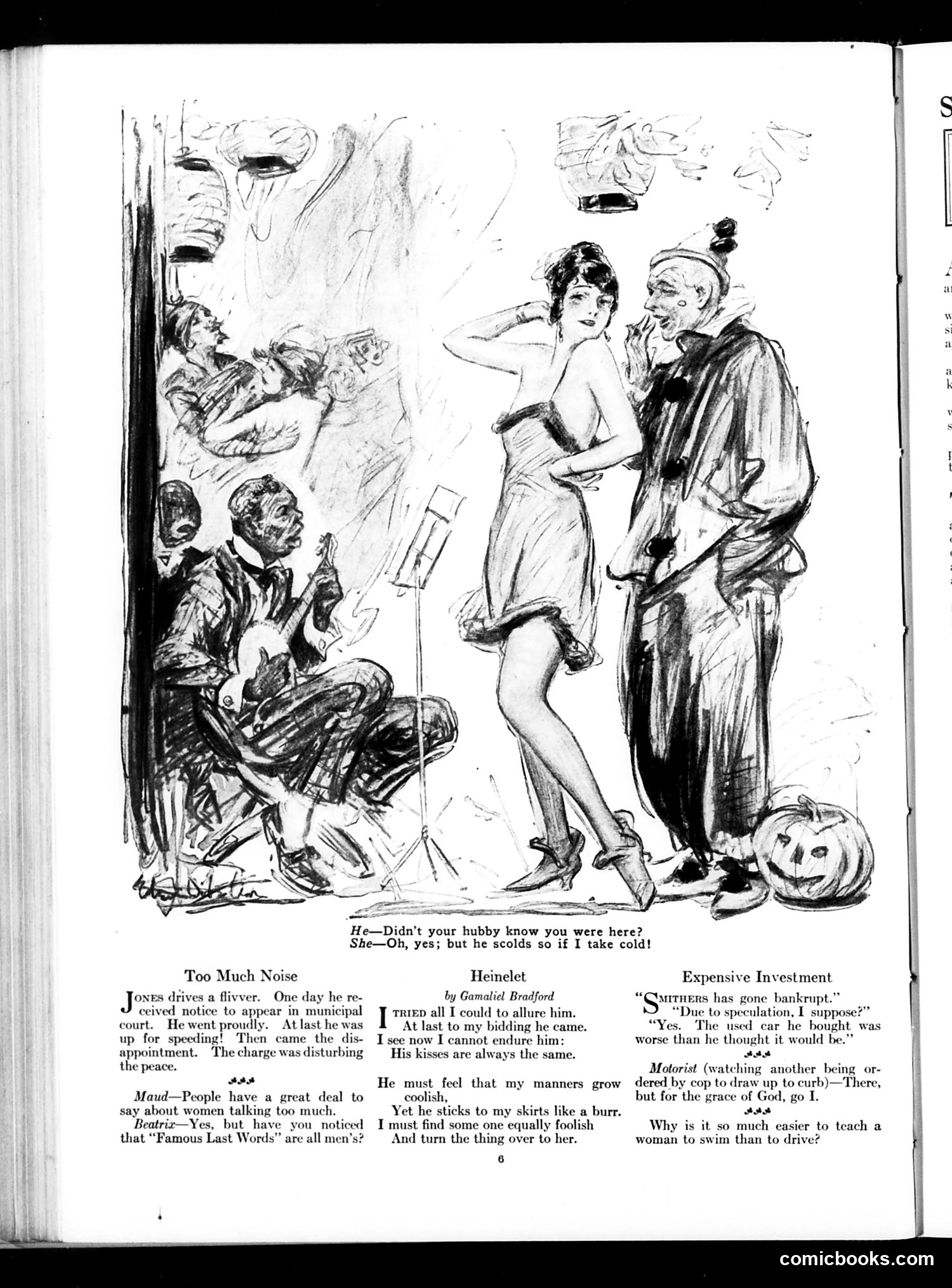
This page contains three separate satirical pieces mocking early 20th-century social and domestic attitudes: **"Too Much Noise"** jokes about a man arrested for disturbing the peace while driving a "flivver" (cheap car), presented as ironically more shameful than speeding. **"Heinelet"** is a poem by Gamaliel Bradford depicting a woman who successfully seduced a man, only to find him tedious—she now plans to manipulate him into pursuing another woman instead. It satirizes both feminine manipulation and male predictability. **"Expensive Investment"** mocks the unreliability of used cars as risky financial ventures. The cartoons also include gender-based humor: women's talkativeness versus men's "famous last words," and a gendered dig suggesting women are naturally worse drivers than swimmers. The overall tone reflects period attitudes about gender relations, automobiles as novelty luxuries, and marital discord presented as light entertainment for Judge's readers.
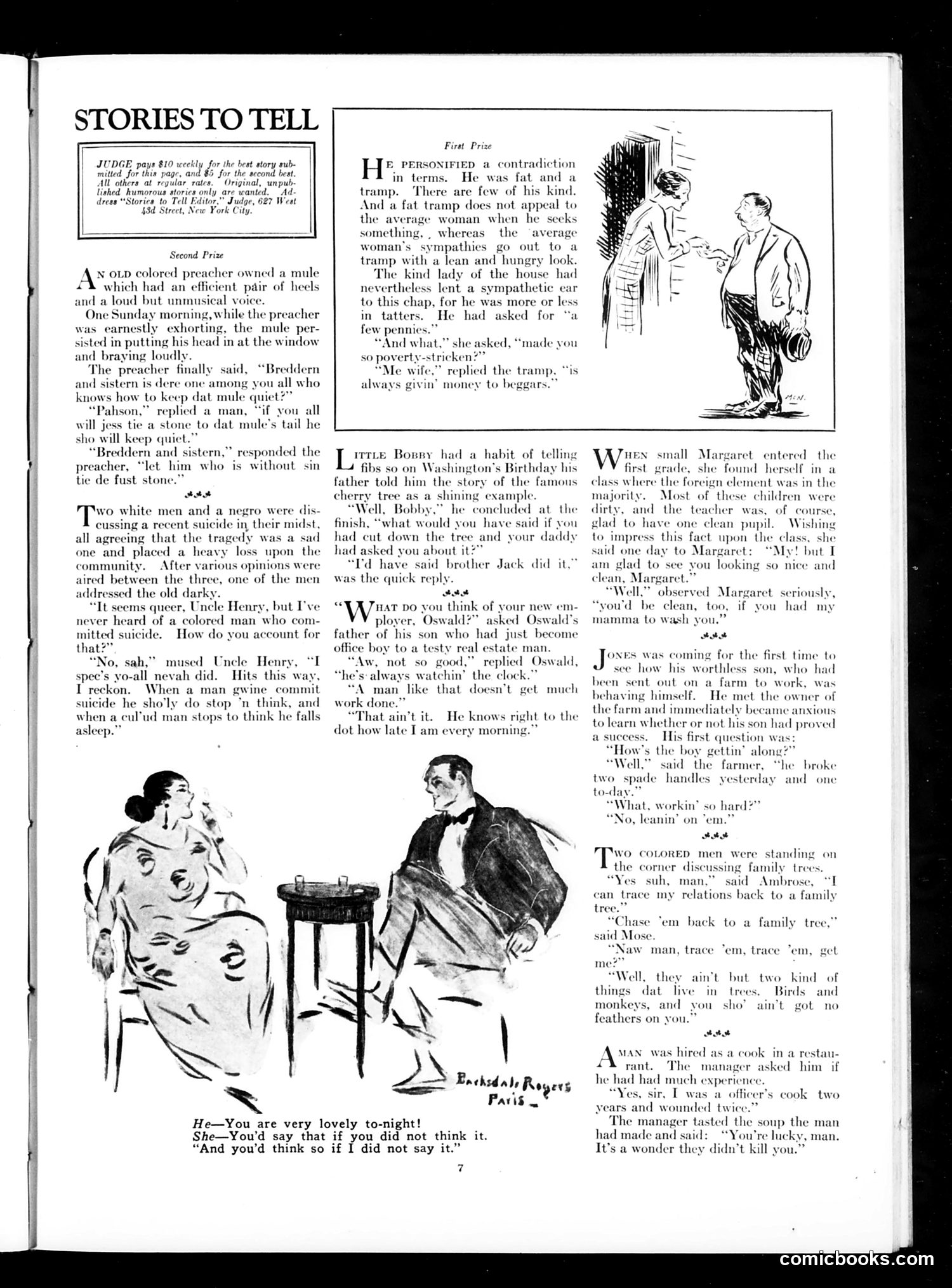
This page from *Judge* magazine presents a collection of humorous short stories with racial and ethnic stereotypes typical of early 20th-century American humor. **Key content:** The stories employ dialect humor and minstrelsy conventions. One features an "old colored preacher" with a braying mule—a setup for comedic resolution through folksy wisdom. Another presents "Uncle Henry," a Black man rendered in heavy dialect, discussing suicide in racially stereotyped terms. A separate story depicts an Irish immigrant ("tramp") and his wife in poverty, playing on period prejudices about Irish immigrants and their perceived financial irresponsibility. Additional vignettes include workplace comedy (a boy watches the clock) and a scene featuring a "foreign element" schoolchild, suggesting anxiety about non-native-born students. **The satire:** Rather than critiquing these groups, the magazine *celebrates* their caricatures as entertainment, with prize money offered for such stories. The humor relies entirely on readers accepting ethnic and racial stereotypes as inherently amusing. This reflects *Judge*'s audience: affluent white Americans entertained by exaggerated portrayals of people they considered social inferiors.
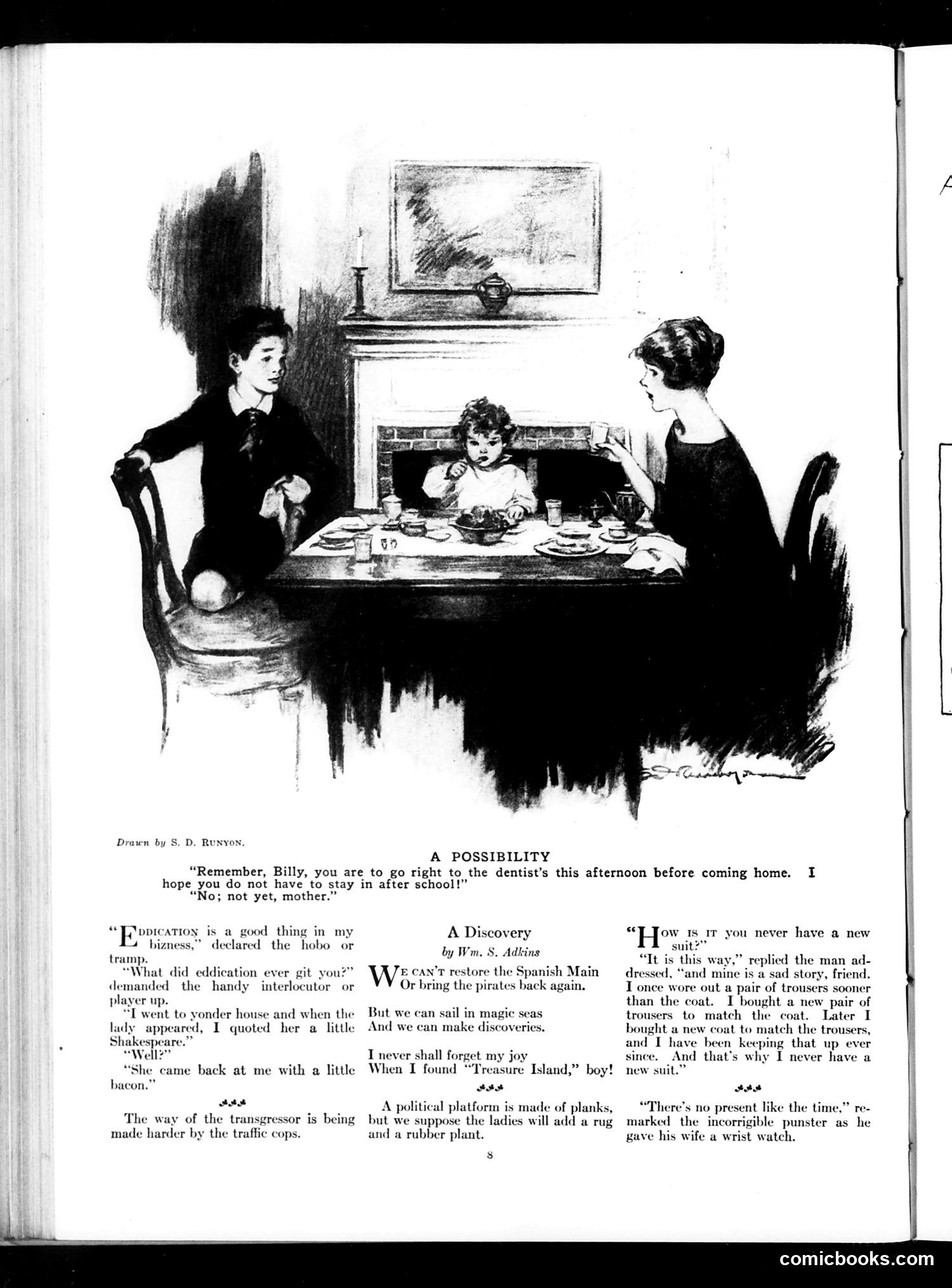
**Main Cartoon ("A Possibility"):** Drawn by S.D. Runyon, this depicts a domestic scene where a mother reminds her son Billy to visit the dentist after school. The humor plays on parental anxiety about children's obedience—the mother hopes he won't "have to stay in after school" (implying detention), suggesting the boy might skip the dentist appointment. The satire gently mocks the tension between parental instructions and children's reliability. **Text Sections:** The page contains four separate humorous anecdotes and witticisms: - An exchange about education's value - A poem about discovering literary classics (likely nostalgic commentary on reading) - A joke about political platforms and women's domestic tastes - A pun about a man perpetually buying matching suit pieces, never completing a full new suit These represent typical Judge magazine fare: light domestic humor, gentle social observation, and wordplay targeting middle-class American life and pretensions.
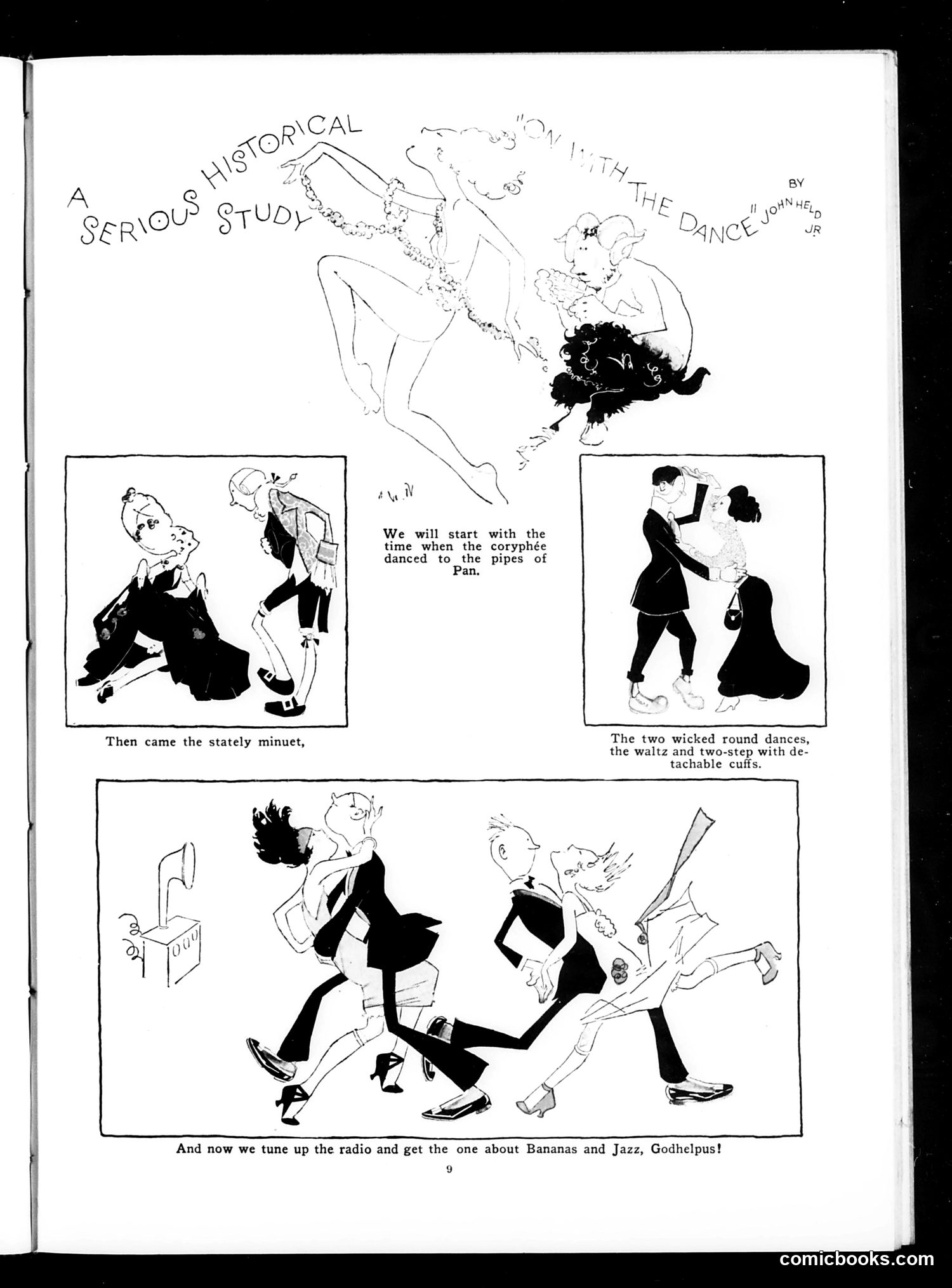
This is a satirical piece titled "A Serious Historical Study On the Dance" by John Held Jr., tracing dance evolution. It contrasts historical dance forms—starting with classical Pan pipes and the minuet, progressing through the "wicked round dances" (waltz and two-step)—with modern 1920s jazz. The final panel shows figures wildly dancing to radio-broadcast jazz music about "Bananas and Jazz," depicted as chaotic and ungainly compared to earlier, more dignified forms. The satire mocks contemporary concerns about jazz as culturally degrading, capturing generational anxiety about modernism. "Detachable cuffs" appears to be a joke about the physical chaos of these new dances. Held's exaggerated illustrations emphasize the perceived vulgarity of jazz-age culture versus traditional dancing.
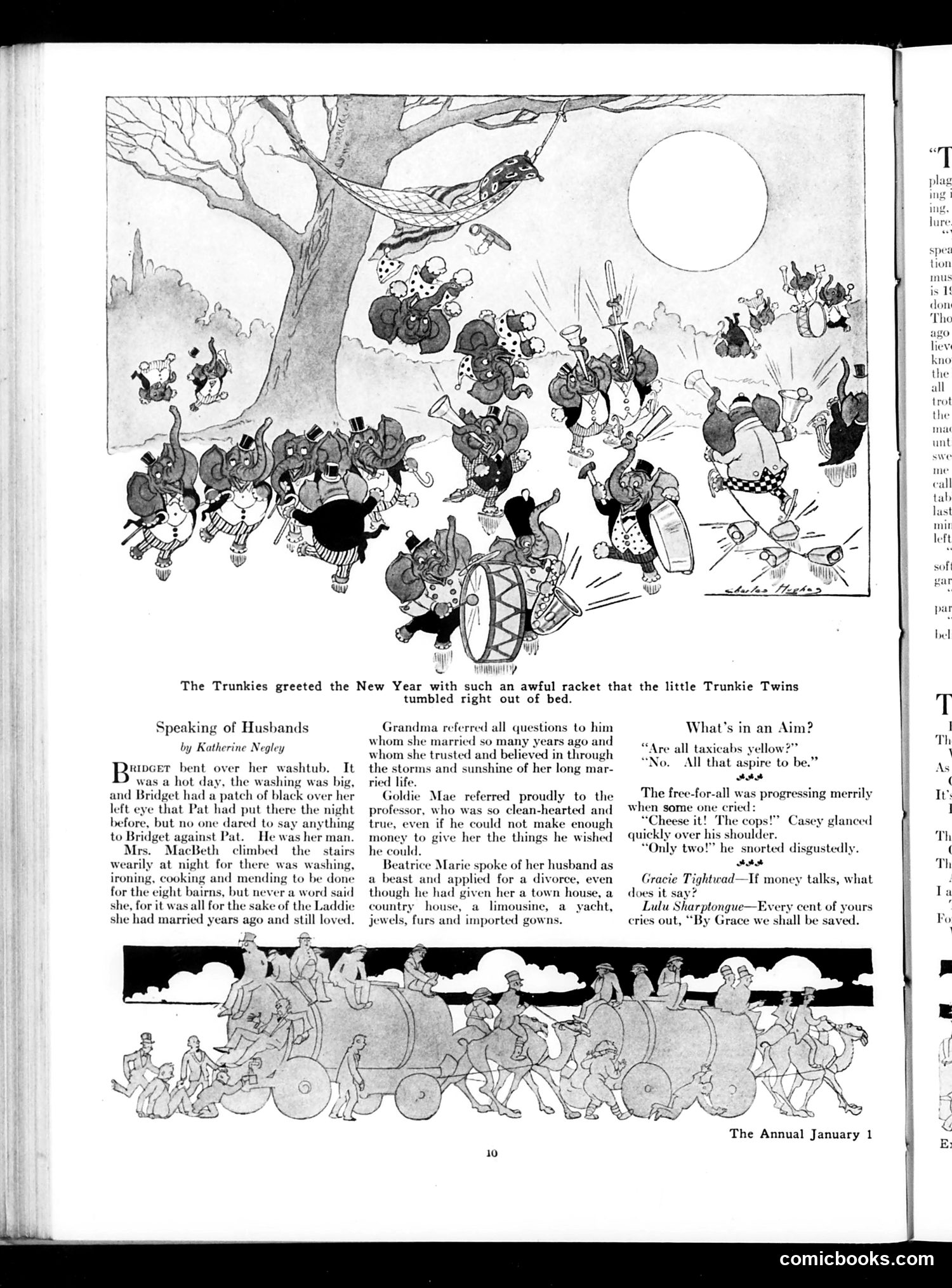
This page contains multiple satirical pieces about marriage and gender roles in early 20th-century America. The main feature, "Speaking of Husbands" by Katherine Negley, contrasts different wives' attitudes toward marriage through four vignettes. Bridget tolerates spousal abuse ("a patch of black over her left eye"), Mrs. Beth works herself to exhaustion for her family without complaint, Grandma and Goldie Mae defer to their husbands' judgment—yet Beatrice Marie, despite receiving luxury goods (limousine, yacht, jewels), complains and divorces her husband anyway. The satire targets women who supposedly have everything materially but remain ungrateful, implying that wives should accept their lot without complaint. It reinforces period ideals of feminine self-sacrifice while mocking women's independence. The cartoon illustrations above show chaotic New Year's celebrations by "Trunkies" (unclear reference—possibly a fictional group). Additional brief jokes about taxicabs and money further populate the page with typical Judge magazine humor.
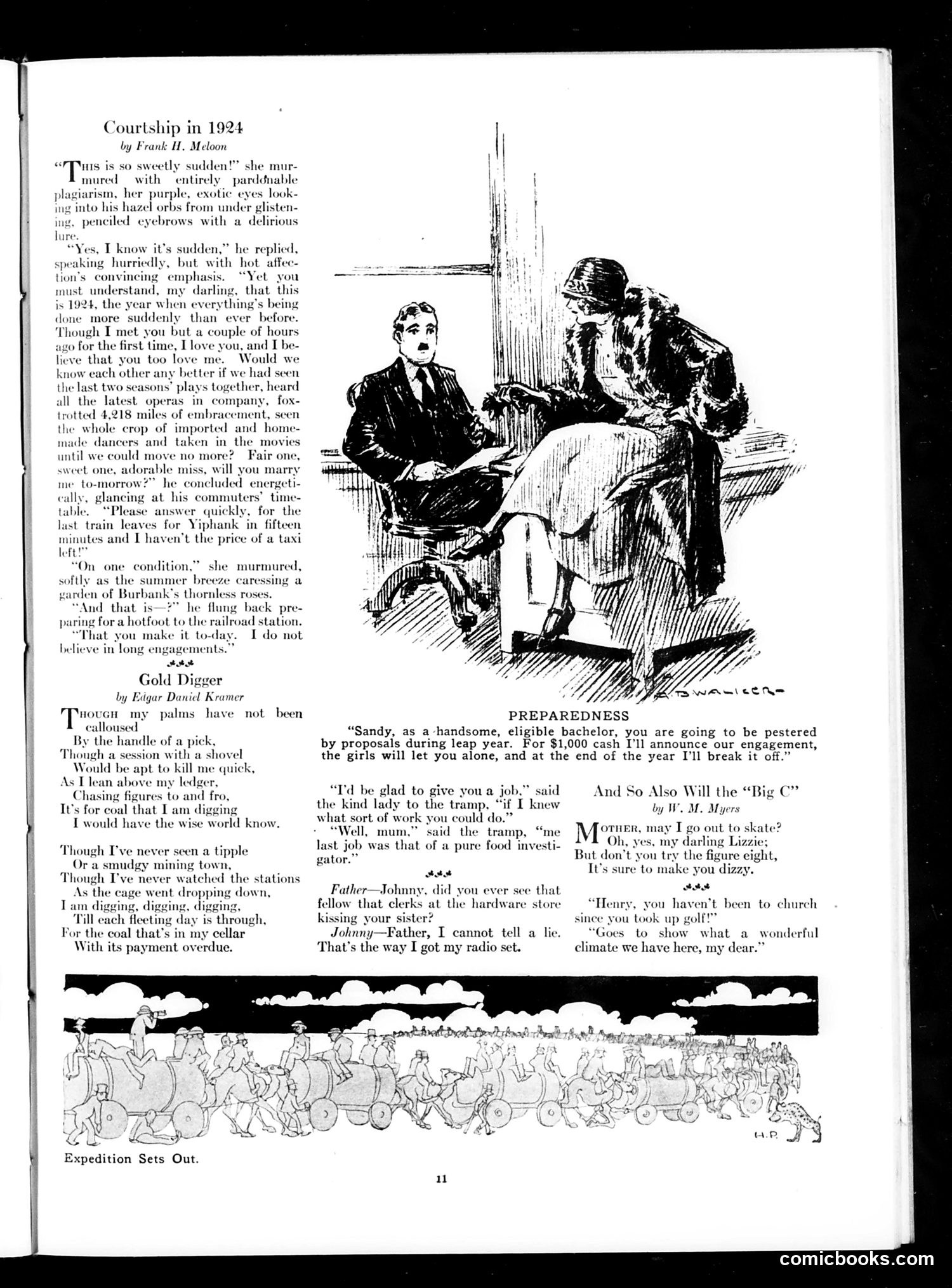
This 1924 *Judge* magazine page satirizes rapid social change and modern courtship customs. The main cartoon "Preparedness" mocks the "leap year proposal" tradition (when women could propose to men) by depicting a cynical scheme: a man offers a woman $1,000 to announce a fake engagement, supposedly to deter other marriage-minded women during leap year, then break it off after twelve months. The accompanying text and vignettes joke about 1920s hustle culture and materialism. "Courtship in 1924" satirizes how quickly people make life decisions in the modern era—a man proposes after just hours of meeting. "Gold Digger" mocks both miners and office workers obsessed with money. Other brief jokes target social mobility and shifting gender roles (the "pure food investigator" tramp, the father worried about his daughter skating). The satire captures anxiety about how rapidly traditional customs—courtship, gender roles, economic relationships—were changing in the post-WWI, Jazz Age 1920s.
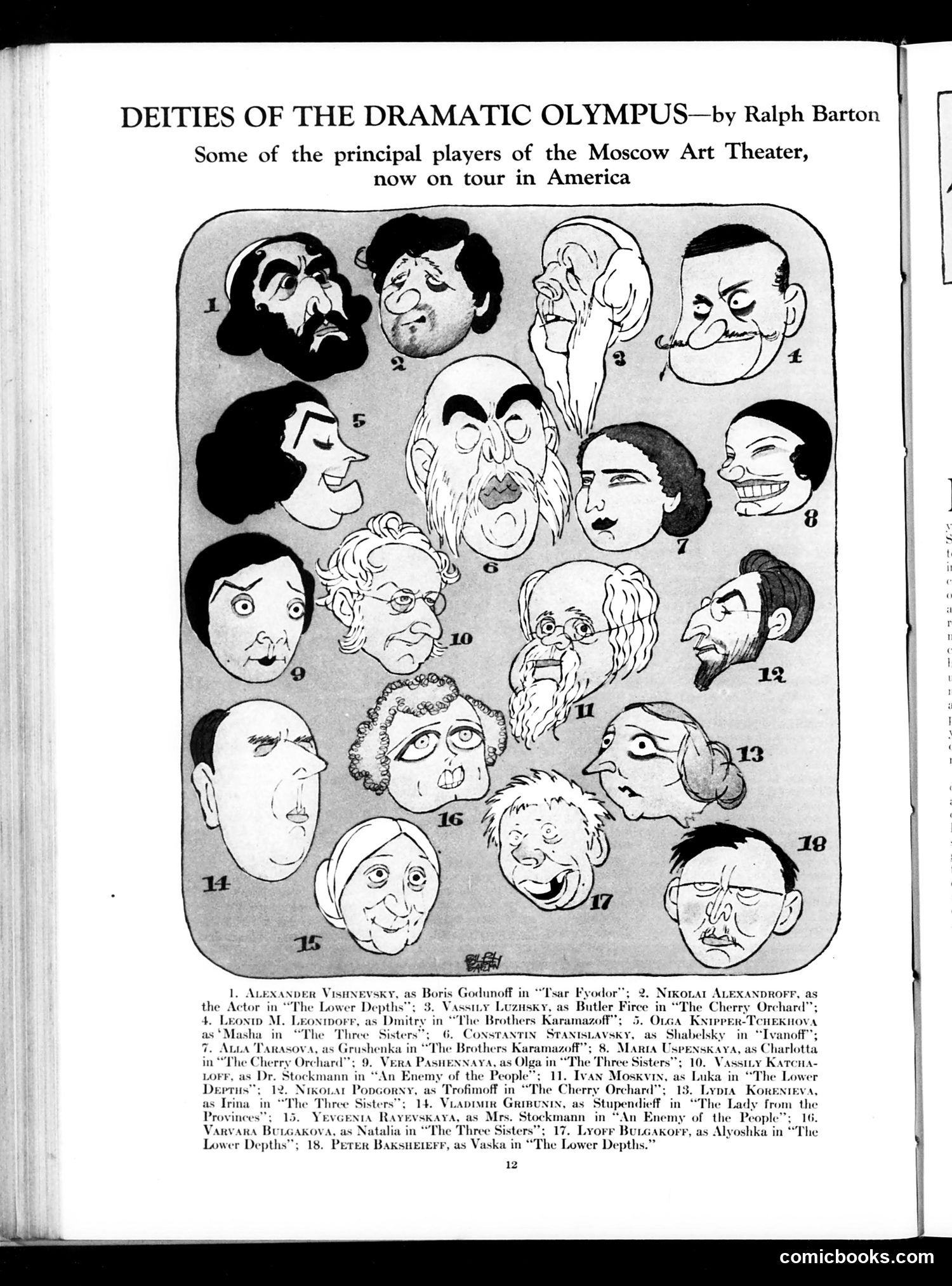
This is a caricature page celebrating the Moscow Art Theater company during their American tour. Rather than satirical commentary, it's a humorous tribute: Barton draws 18 principal actors in exaggerated caricature style, emphasizing distinctive facial features—prominent noses, heavy brows, characteristic expressions—to create instantly recognizable portraits. The "Olympus" title playfully elevates these theatrical performers to godlike status, reflecting their celebrity status during this tour. The caricatures accompany each actor's name and their roles in major plays like *The Three Sisters*, *The Cherry Orchard*, and *The Brothers Karamazov*—all by Chekhov and Dostoevsky, canonical works that established the Moscow Art Theater's international reputation. For a modern reader: this represents how foreign theatrical companies were celebrated attractions in early 20th-century America, with prominent magazines like *Judge* featuring visual homages to distinguished visiting performers.
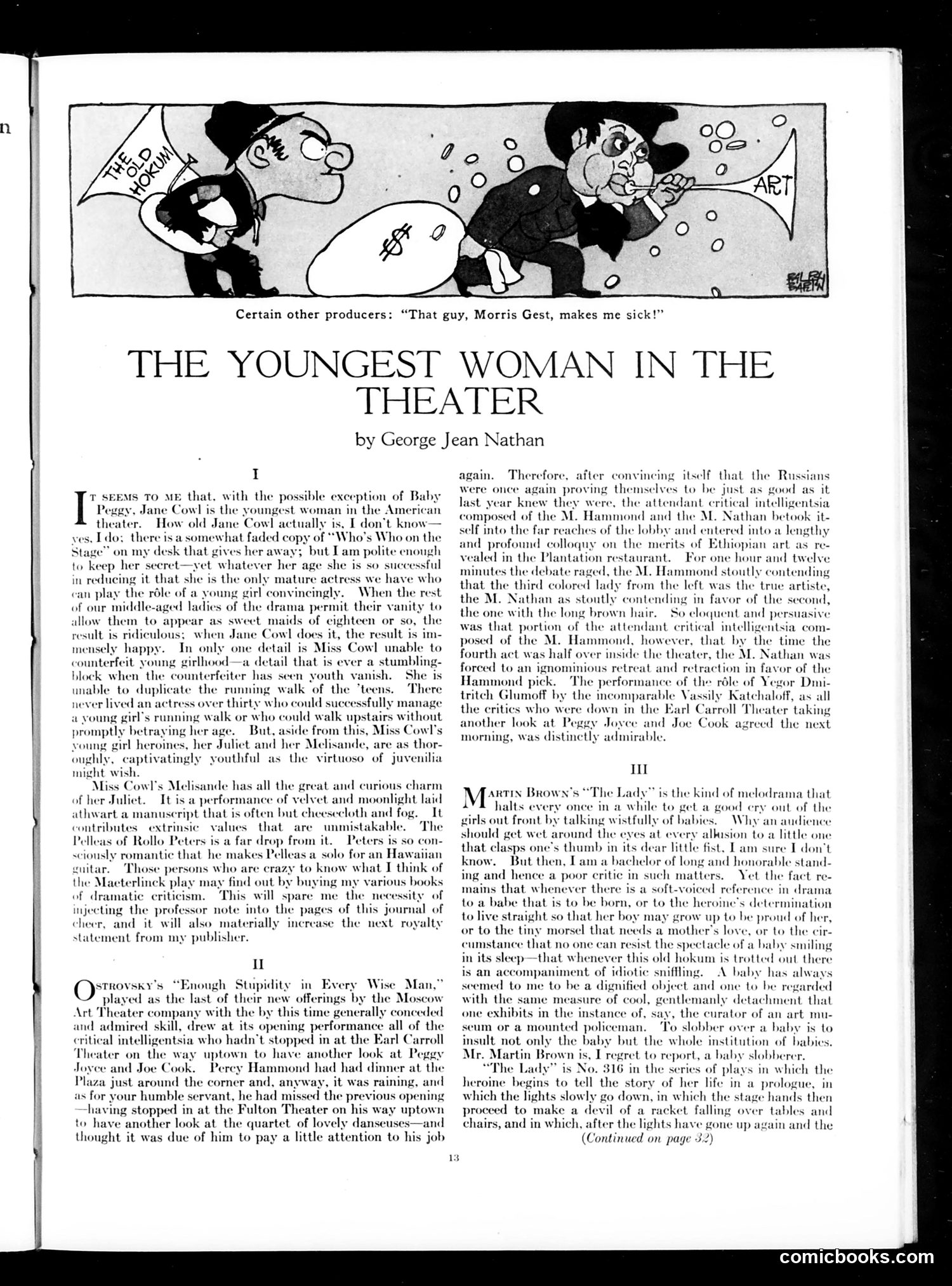
## The Cartoon The top cartoon mocks producer **Morris Gest** (identified in the caption). Two figures in formal dress appear to be vomiting or spitting out money (indicated by the "$" symbol and "ART" label), suggesting Gest's productions are financially successful but artistically worthless. Other theater producers express disgust at his work, implying he prioritizes profit over artistic merit—a common satirical jab at commercially-minded impresarios. ## The Article The page's main content discusses actress **Jane Cowl**, praised for convincingly playing young women despite her actual age. The author (theater critic **George Jean Nathan**, evident from byline and references to his "various books") contrasts her success with other actresses who fail at youthful roles. The article also critiques a Moscow Art Theater production and humorously describes critics debating Ethiopian art in a restaurant lobby rather than focusing on the actual performance. **Context:** This reflects 1920s theatrical criticism and the tension between commercial theater (Gest) and artistic merit (Cowl, Moscow Art Theater).
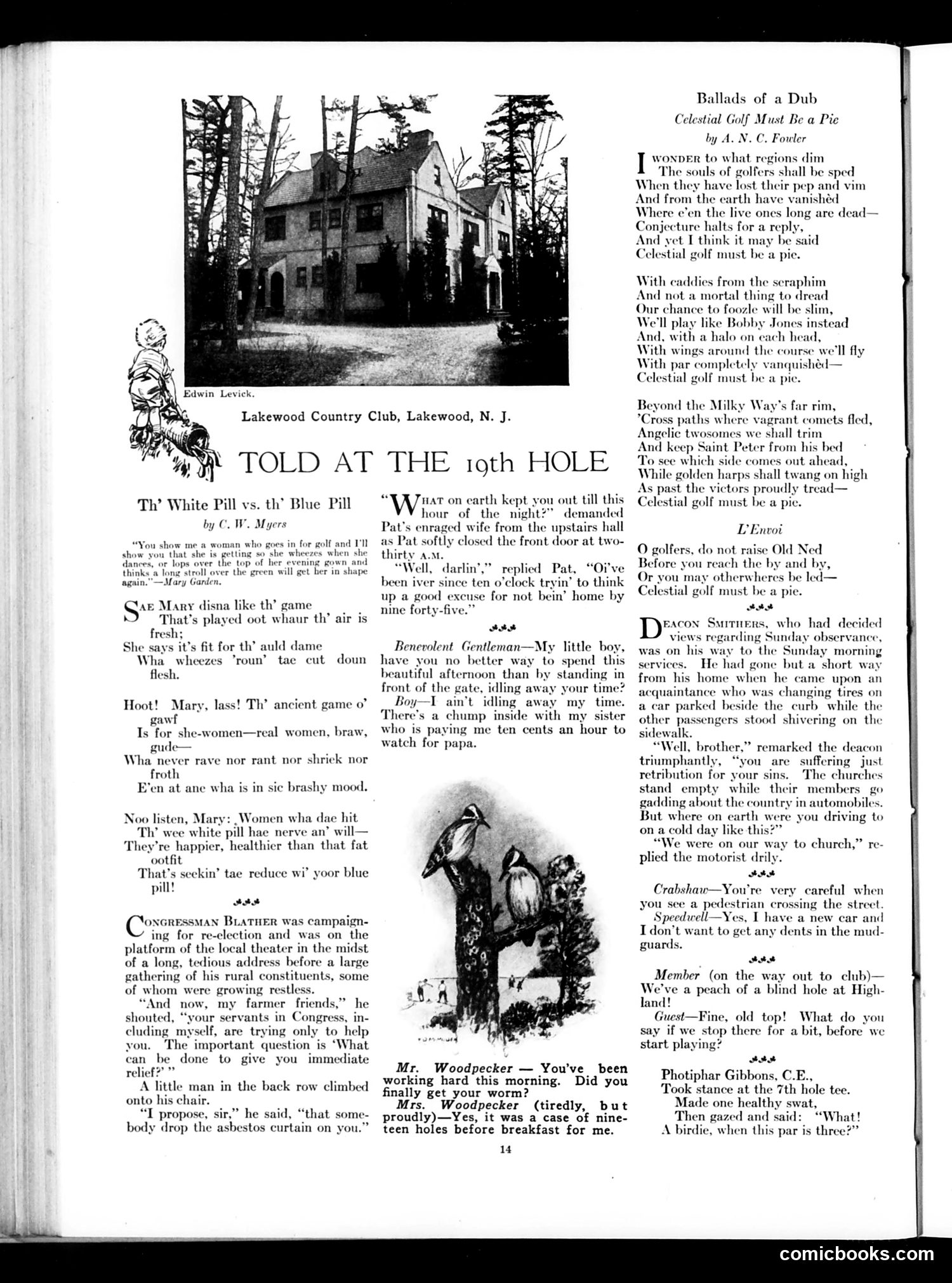
This page from *Judge* magazine contains several humorous pieces satirizing early 20th-century American life: **"Th' White Pill vs. th' Blue Pill"** mocks gender debates about women's health and recreation. The Scottish dialect piece contrasts a woman who dislikes golf with praise for athletic women, sarcastically suggesting women golfers are healthier than those taking "blue pills" (likely patent medicines for weight loss or female ailments). **The Congressman anecdote** satirizes political platitudes. A rural constituent interrupts a re-election speech offering to "drop the asbestos curtain"—a theater reference suggesting the politician's boring speech should be shut down. **"Told at the Tenth Hole"** presents golf-themed jokes, including one where a husband blames his late arrival on inventing an excuse, and another where Mrs. Woodpecker describes exhausting work finding food as "nineteen holes before breakfast"—a golfing pun. **"Celestial Golf Must Be a Pie"** is a humorous poem imagining golfers' afterlife, suggesting golf obsession is so consuming that even heaven would involve eternal golf. The page satirizes class pretensions, women's changing roles, political hypocrisy, and the era's golf mania among the wealthy.
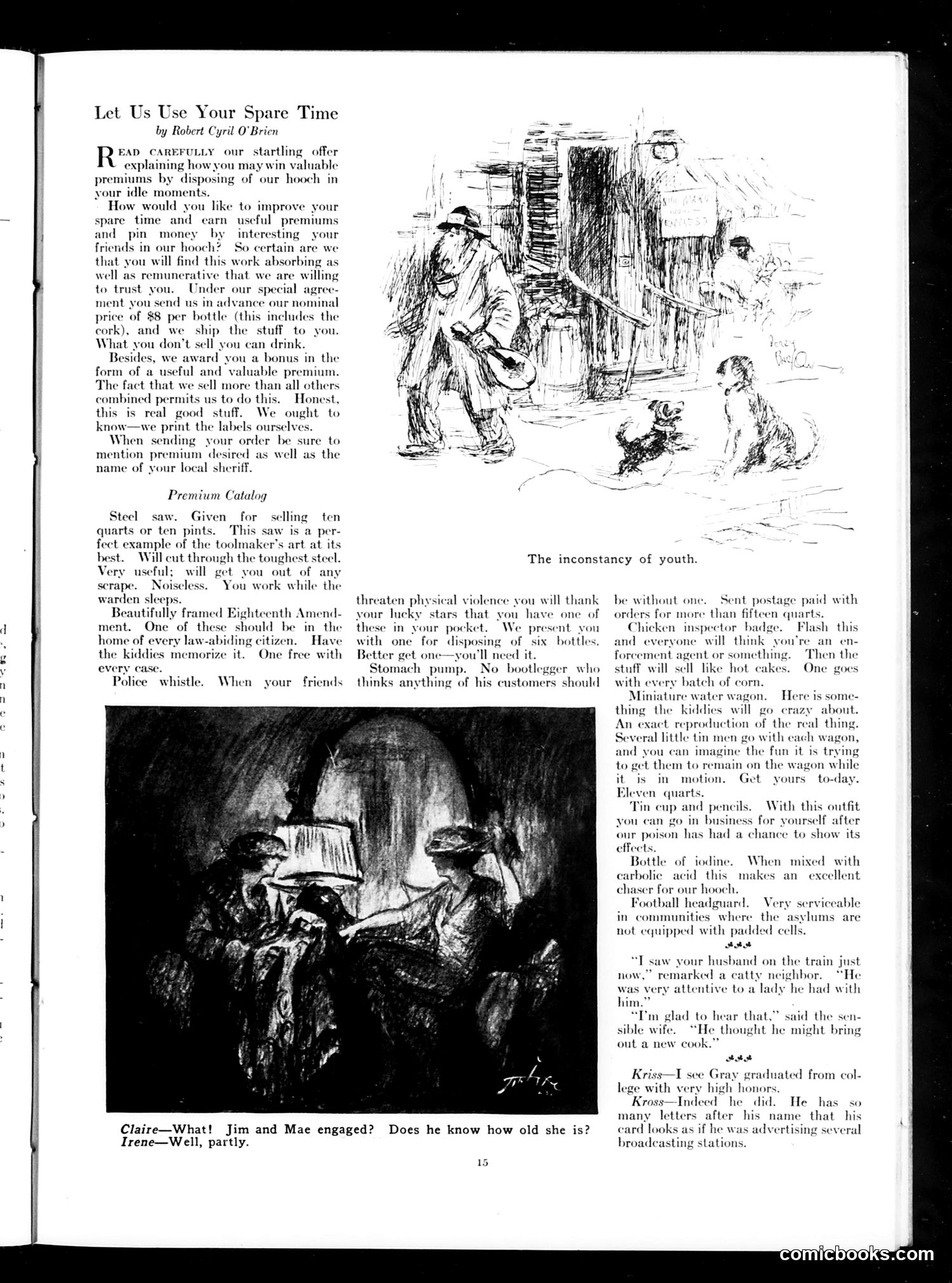
This article mocks illegal liquor sales during Prohibition (1920-1933) by presenting a fake mail-order scheme that treats bootlegging as a legitimate business. The "premium catalog" offers absurd gifts for selling "hooch" (illegal alcohol): a steel saw (for cutting through jail bars), a framed 18th Amendment (the law they're breaking), a police whistle (for warning of raids), and a stomach pump (implying the liquor is poisonous). The humor targets multiple angles: the hypocrisy of printing prohibition laws on bottles while selling contraband; the obvious dangers ("our poison"); and the criminal infrastructure required (mentioning "the warden," "enforcement agents," and asylums). The final jokes about Gray's college letters and a wife's indifferent response to her husband's infidelity are unrelated filler. This represents Judge magazine's satirical attack on Prohibition's failures and the thriving illegal trade it spawned.
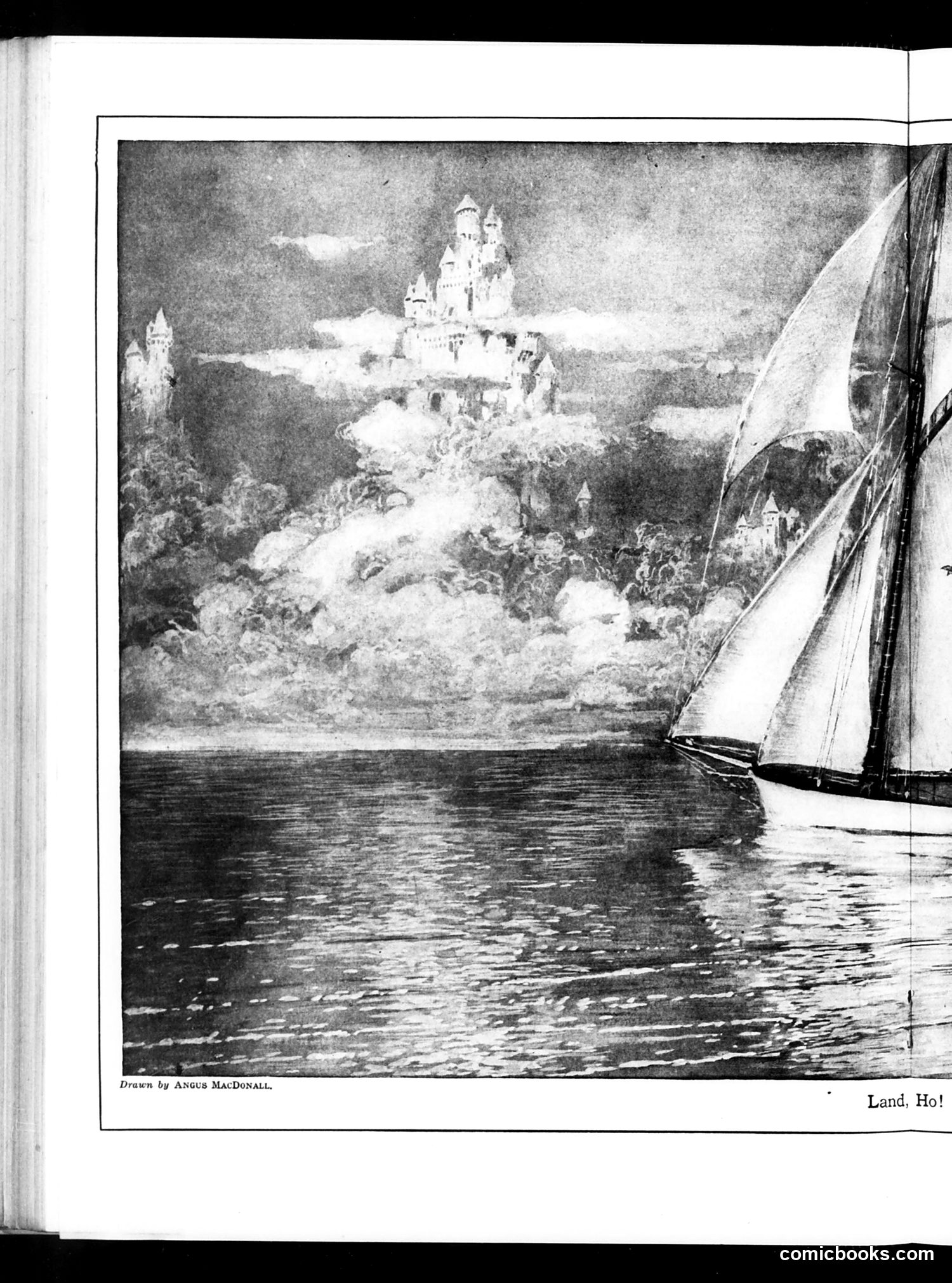
This illustration by Angus MacDonall depicts a sailboat approaching a fantastical castle perched on clouds over water. The caption "Land, Ho!" suggests discovery or arrival at a destination. The image appears to be a romantic or whimsical illustration rather than political satire. It likely references literary or fairy-tale imagery popular in Judge's era—the castle in the clouds evokes fantasy narratives or utopian ideals. The sailboat's crew spotting this impossible landscape may satirize optimistic exploration, naive ambition, or the pursuit of unattainable goals. Without additional context about the magazine's issue date or surrounding content, the specific political or social critique remains unclear, though the dreamlike quality suggests commentary on idealism versus reality.
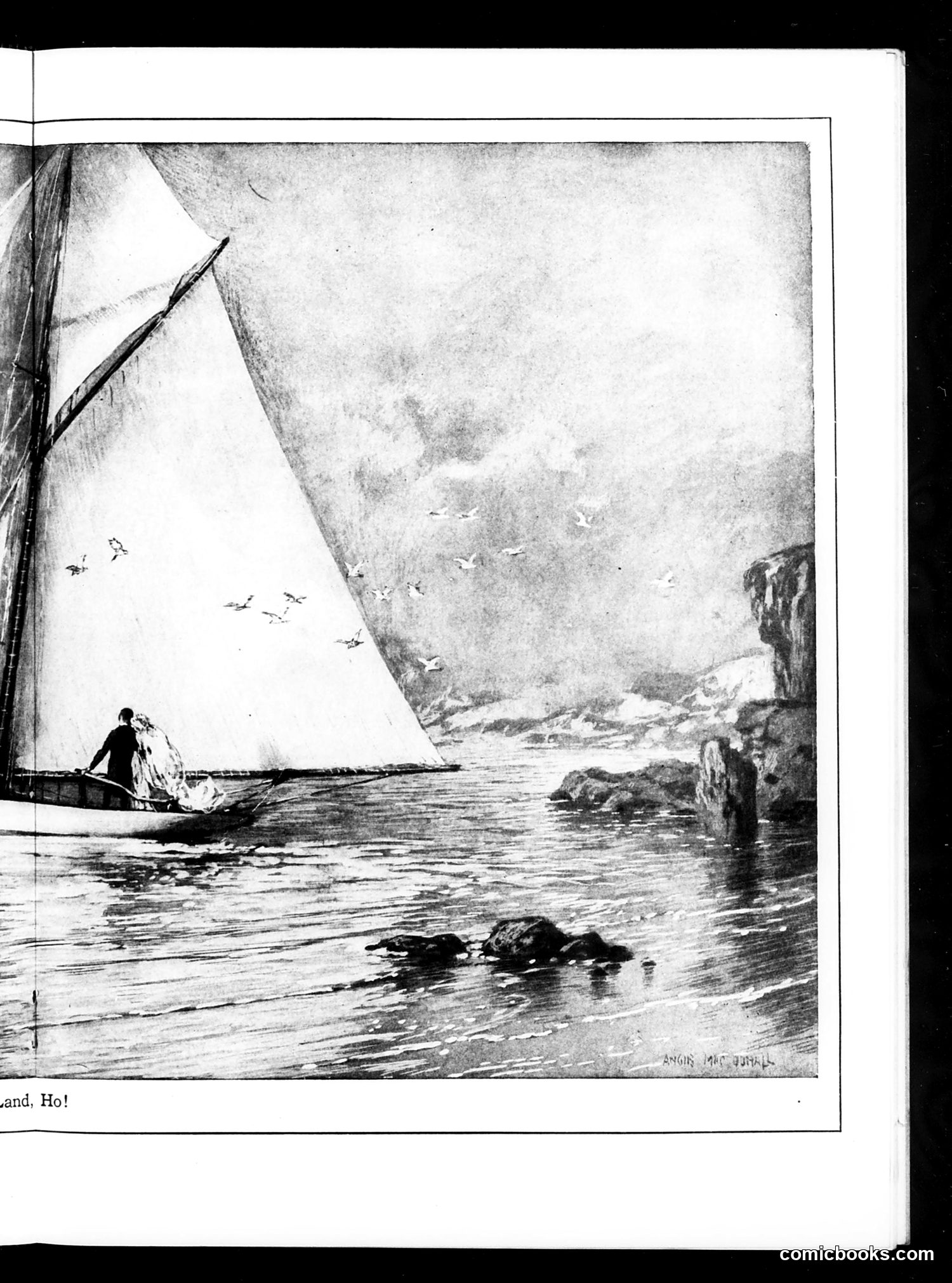
This appears to be an illustration from *Judge* magazine showing a dramatic maritime scene. A lone figure in a small sailboat is visible in turbulent waters near rocky shores and steep cliffs. Birds fly overhead, and the sky appears stormy or overcast. The partial caption reads "land, Ho!" suggesting arrival or discovery after difficult passage. Without the complete text or additional context visible on this page, I cannot definitively identify the specific political or social satire intended. The image could reference maritime exploration, emigration, or a contemporary news event, but the full caption and any surrounding commentary that would clarify the cartoon's satirical point are not legible in this reproduction.
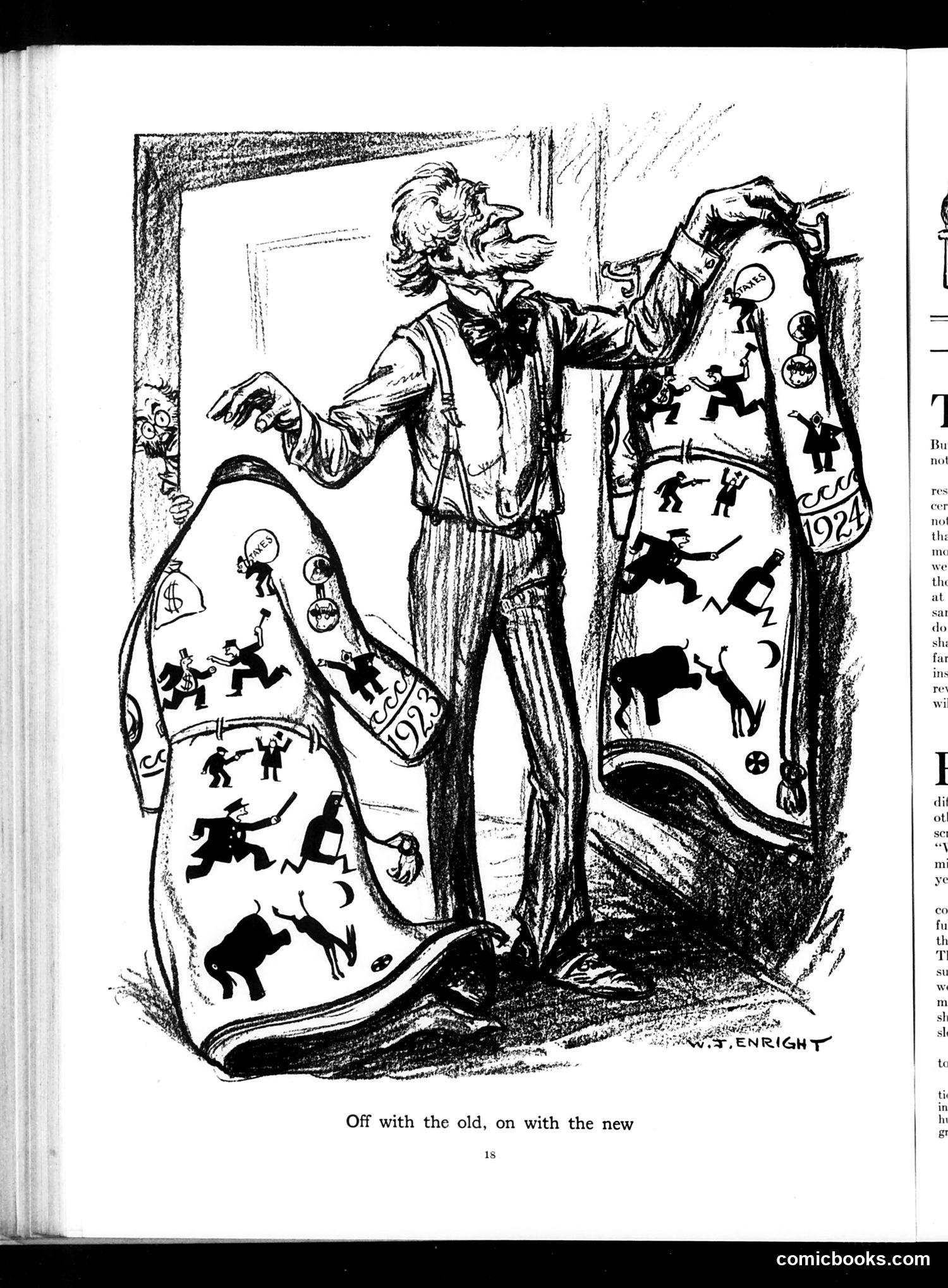
This political cartoon depicts a tailor or clothier presenting two large coats to a well-dressed gentleman. The coats are decorated with small figures engaged in various activities—people, animals, and symbols including dollar signs, suggesting representations of different social elements or economic conditions. The satire appears to comment on **transitional change**, likely referencing a shift in political administration or economic policy (given the "1924" visible on one coat). The tailor is literally offering to replace an old garment with a new one, metaphorically suggesting discarding old policies or social arrangements in favor of new ones. The cartoon's message suggests skepticism about whether merely switching external appearances ("clothes") actually addresses underlying systemic issues, as the coat's contents remain substantially similar.
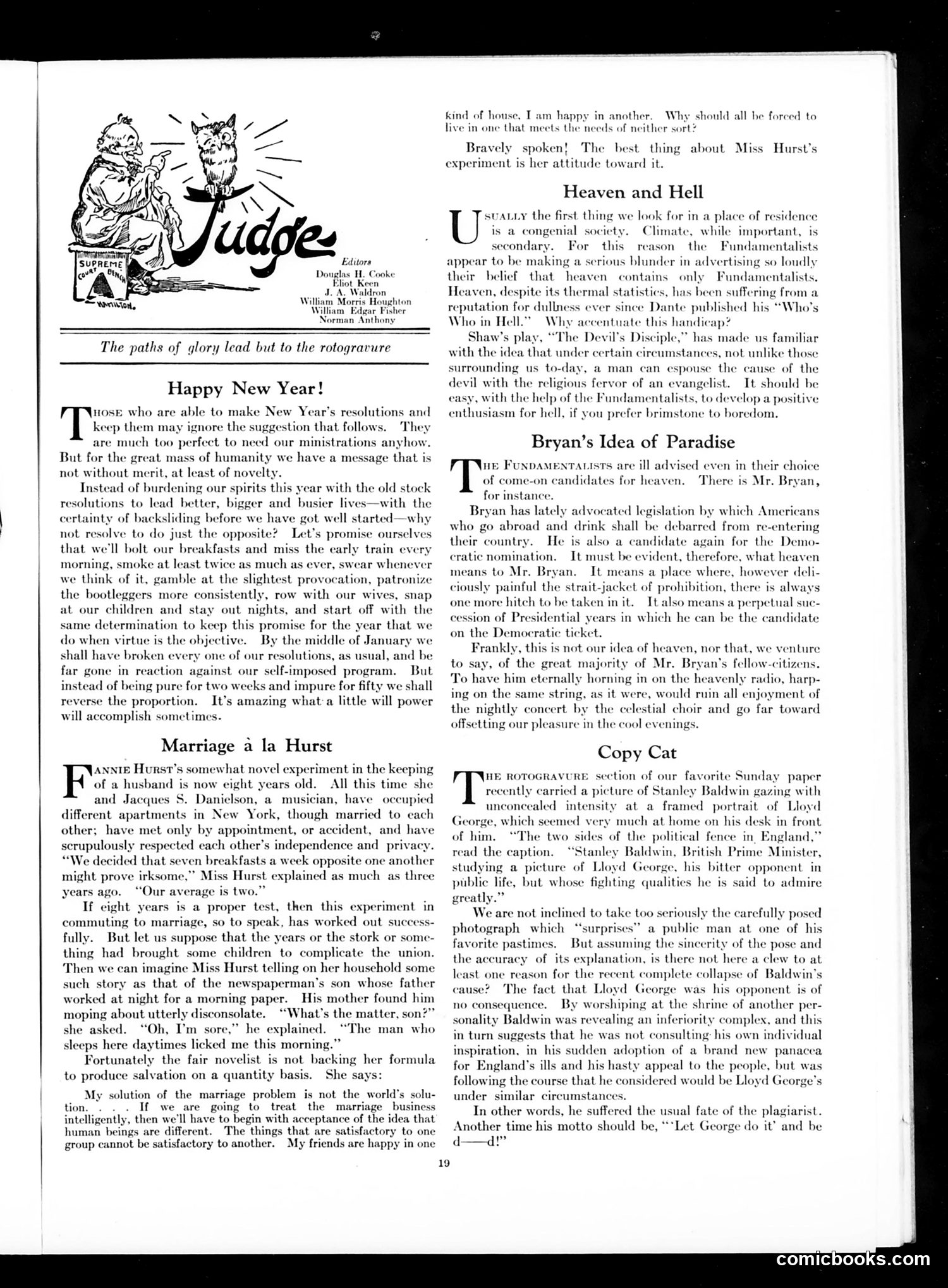
This page from Judge contains three satirical pieces: **"Happy New Year!"** mocks New Year's resolutions by suggesting readers resolve to do the *opposite* of self-improvement—drink, gamble, neglect family—then break those resolutions. The satire targets humanity's predictable failure at moral improvement. **"Marriage à la Hurst"** discusses Fannie Hurst's eight-year experiment maintaining separate apartments from her musician husband. The piece presents this as evidence that independence sustains marriage, using an anecdote about a newspaperman's son whose father works nights. Judge treats this unconventional arrangement as humorously impractical yet surprisingly successful. **"Heaven and Hell"** critiques Fundamentalists for damaging heaven's reputation through Dante's unflattering medieval depiction ("Who's Who in Hell"). The satire suggests religious zealots inadvertently make their promised afterlife sound unappealing by emphasizing only theological purity over pleasantness. The "Judge" masthead cartoon appears to show the magazine's mascot character. Overall, the page employs gentle mockery of contemporary social trends and religious attitudes.
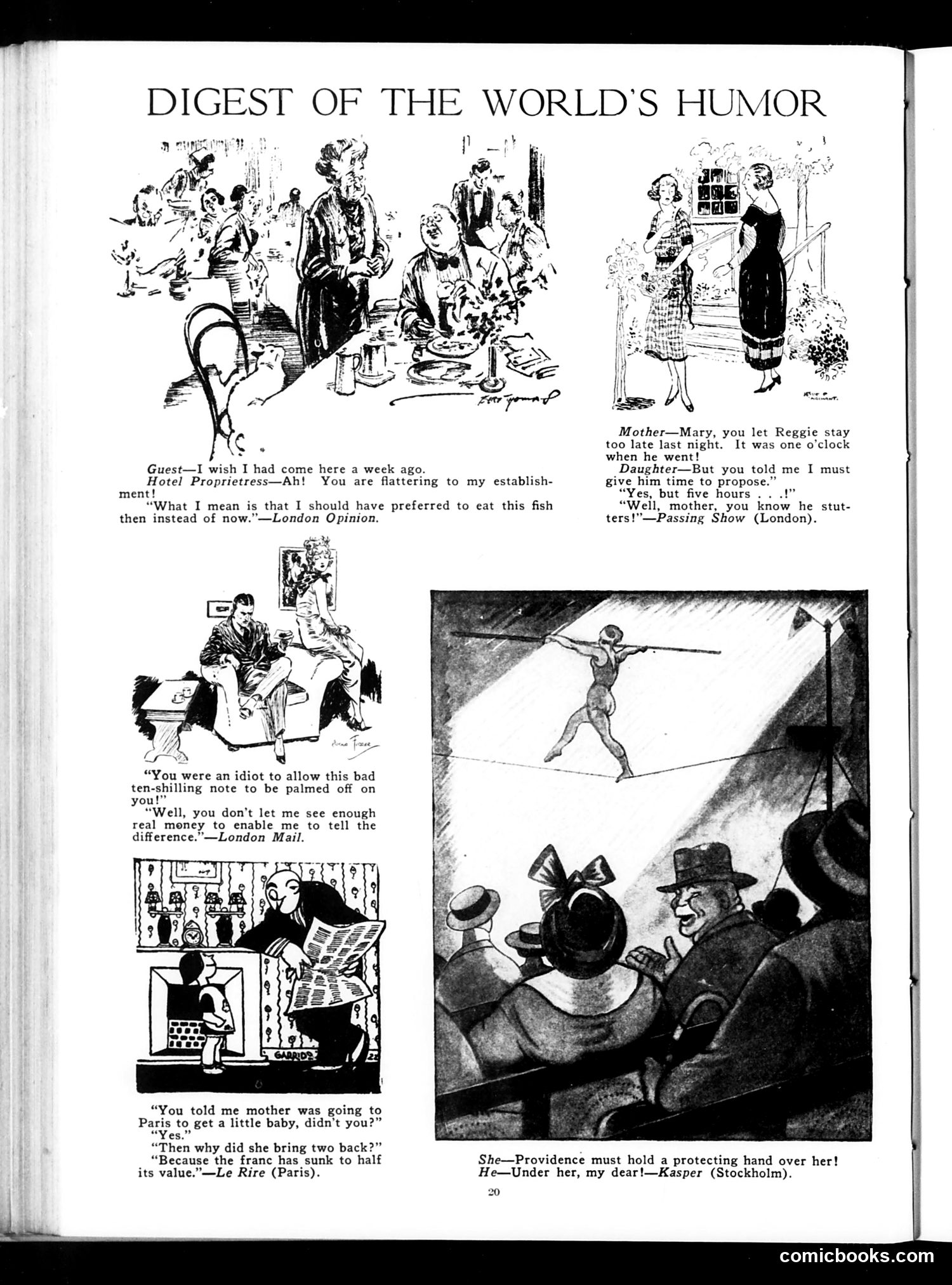
This page collects brief jokes from various international publications, showcasing early 20th-century humor across different cultures. The jokes reflect period concerns: a hotel guest complains about poor fish quality; a daughter excuses her suitor's late visit by noting he has a stutter (implying his proposal took time); parents debate allowing a young man to court their daughter. Most notably, one French joke references the franc's devaluation—a mother supposedly returns from Paris with two babies instead of one because "the franc has sunk to half its value," a dark economic joke playing on currency collapse. The tightwad money joke suggests post-war economic hardship affected common people's ability to distinguish real from counterfeit currency. The page's final large illustration depicts a tightrope walker, with observers expressing concern for the performer's safety—appears unrelated to the text jokes above it, possibly a caption mix-up or separate item.
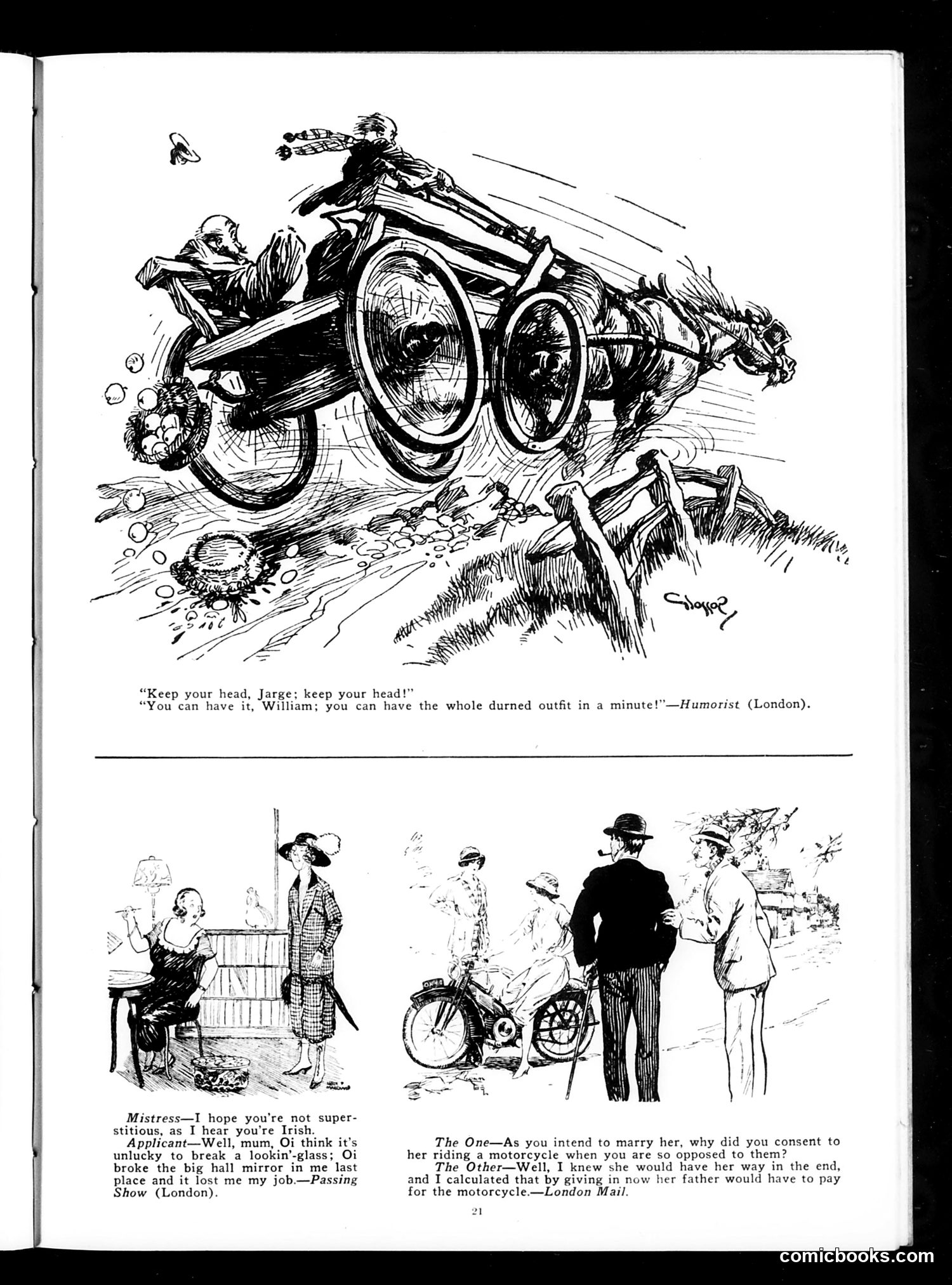
This page contains three separate satirical cartoons from British sources (reprinted in the American Judge magazine), all mocking early automotive and motorcycle culture. The top cartoon depicts a horse-drawn vehicle losing control, with passengers urging each other to "keep your head"—joking about the chaos of early transportation. The middle cartoon features an Irish domestic servant applicant who admits breaking a mirror caused her job loss, playing on period Irish stereotypes about superstition. The bottom cartoon satirizes gender dynamics and parental authority: a man agrees to let his fiancée ride a motorcycle (which he opposes) specifically because he knows her father will ultimately pay for it—suggesting calculated manipulation disguised as compromise. All three jokes rely on contemporary anxieties: dangerous new vehicles, class-based servant stereotypes, and shifting social norms around women's independence. The humor is gentle, domestic, and reflects early-20th-century concerns about modernity and social change.
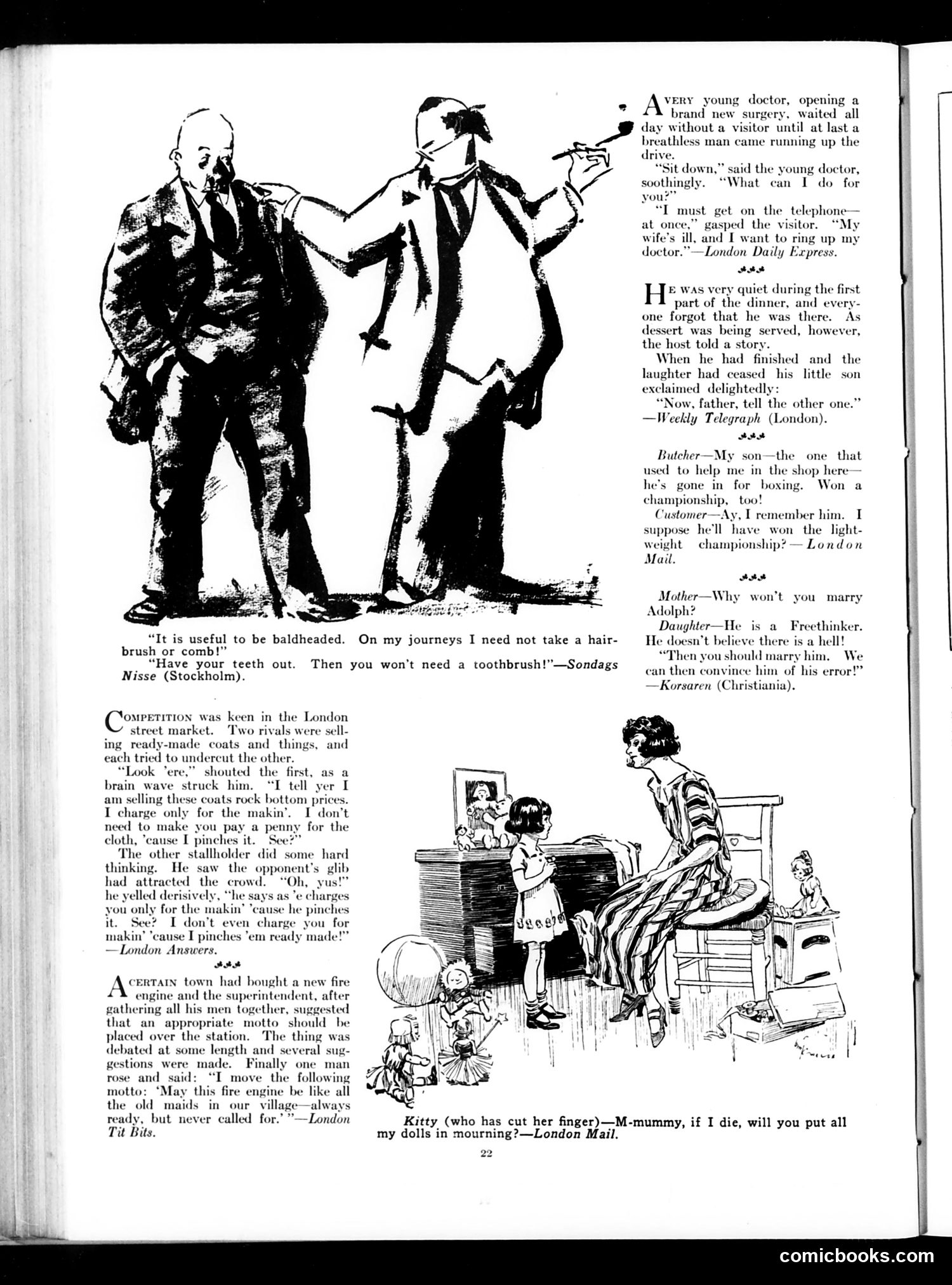
This page from Judge contains multiple short humorous anecdotes typical of early 20th-century satirical magazines. **Top cartoon**: Shows two men in suits—one bald, one with disheveled hair—illustrating a Swedish joke about baldness eliminating the need for grooming supplies. The humor is absurdist. **Street market anecdote**: Two London coat vendors engage in competitive undercutting. The first claims rock-bottom prices because he steals fabric; the second one-ups him by claiming he steals ready-made coats entirely. This satirizes cutthroat market competition and brazen dishonesty. **Fire engine motto**: A town superintendent's meeting turns absurd when someone suggests the new fire engine should be "like all the old maids in our village—always ready, but never called for." This jokes about unmarried women's perceived uselessness. **Bottom illustration**: Shows a domestic scene, accompanying a joke about a child's morbid question regarding dolls and mourning. The page reflects period attitudes—casual sexism, working-class stereotypes, and dark humor—standard for early 20th-century Judge magazine's audience.
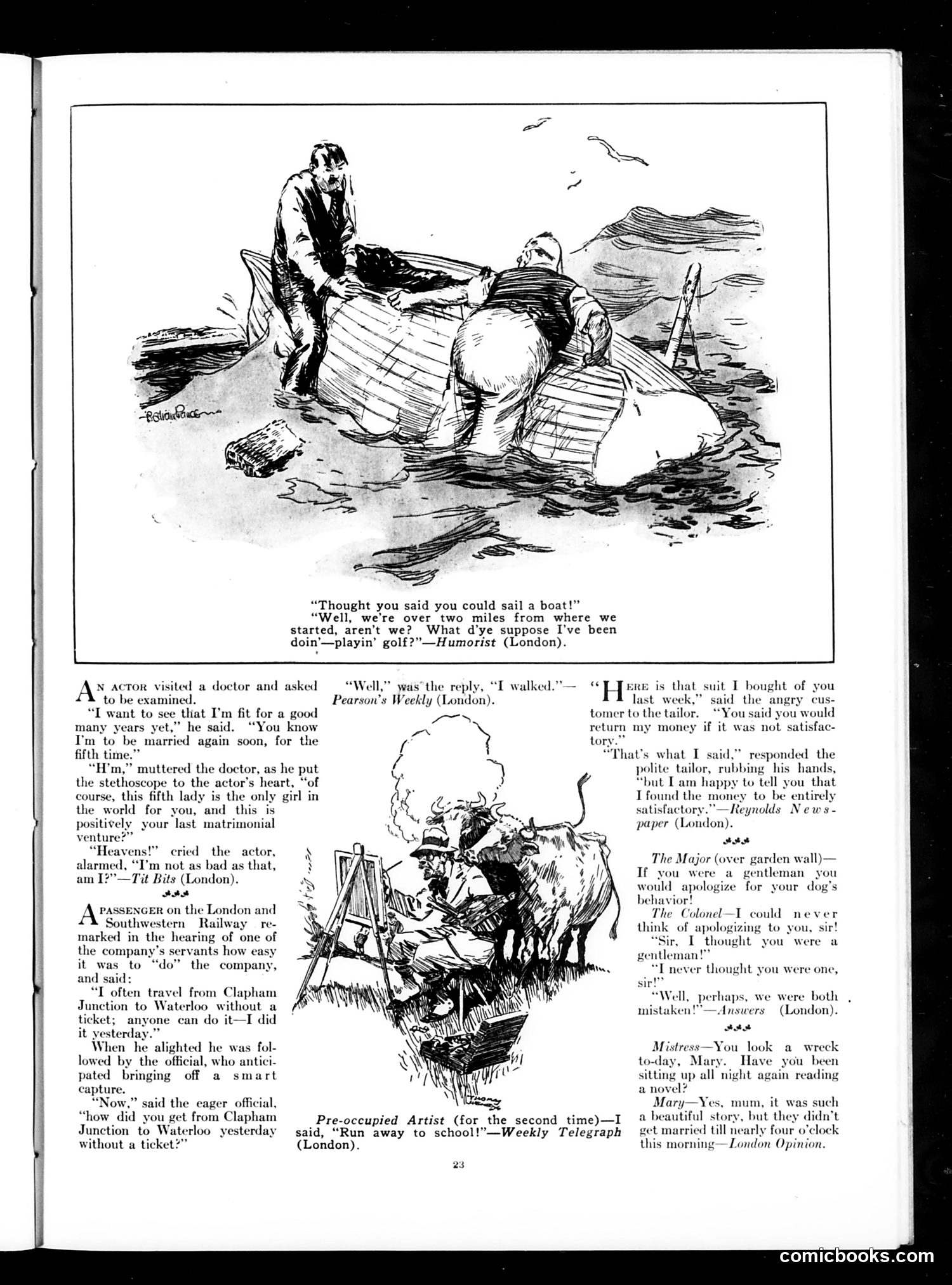
This page collects humorous anecdotes rather than political cartoons. The humor relies on Victorian-era social conventions and class dynamics: **Key jokes:** - An actor seeking a fifth marriage is medically advised he's unfit—satirizing marital frivolity among the wealthy - A railway passenger boasts of fare-dodging; when caught, claims he "ran away to school"—mocking dishonesty - A tailor reframes a customer's complaint by claiming he personally verified the suit's quality—satirizing smooth-talking salesmanship - Two neighbors quarrel over a dog incident; both insult each other's gentlemanliness before accepting mutual error—poking fun at class-conscious propriety - A servant reads romance novels all night, caring only that characters eventually marry—gentle mockery of sentimental fiction's appeal to working-class readers The satire targets human folly: marital excess, petty crime, commercial deception, and class pretension. These represent common targets of *Judge*'s British and American humor in this era.
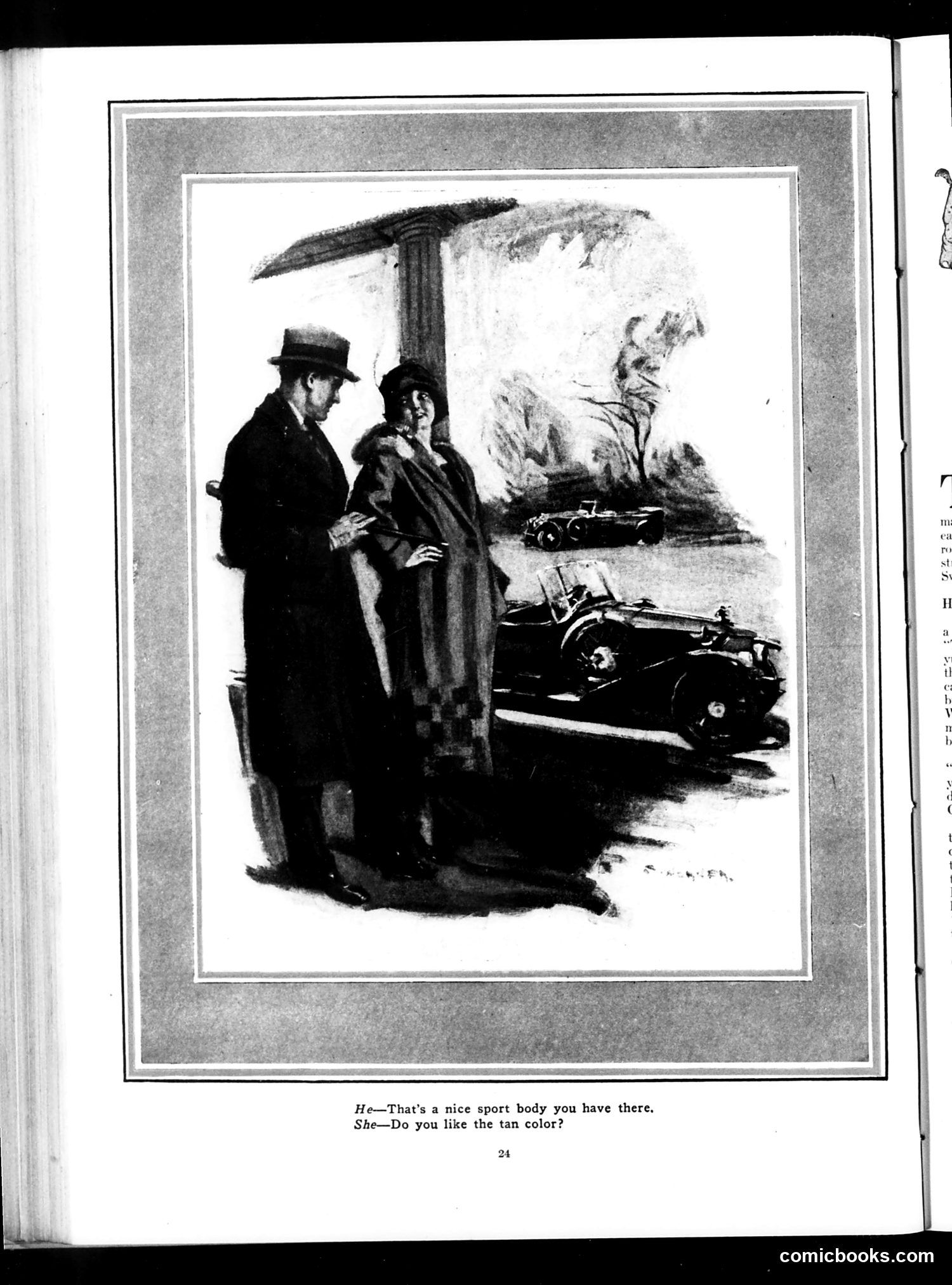
This is a flirtation cartoon from Judge magazine, page 24. Two well-dressed figures stand beneath an umbrella near parked automobiles. The man compliments the woman's "sport body," and she responds by asking if he likes her "tan color." The joke plays on double meaning: "tan" refers both to her skin tone and to the tan-colored automobile visible behind them. The woman deflects the man's forward compliment by redirecting his attention to her car rather than her appearance—a clever riposte that was risqué for the era. The cartoon satirizes modern courtship rituals and the growing prominence of automobiles in American social life during the 1920s-30s. The elegant clothing and cars suggest upper-class leisure culture.
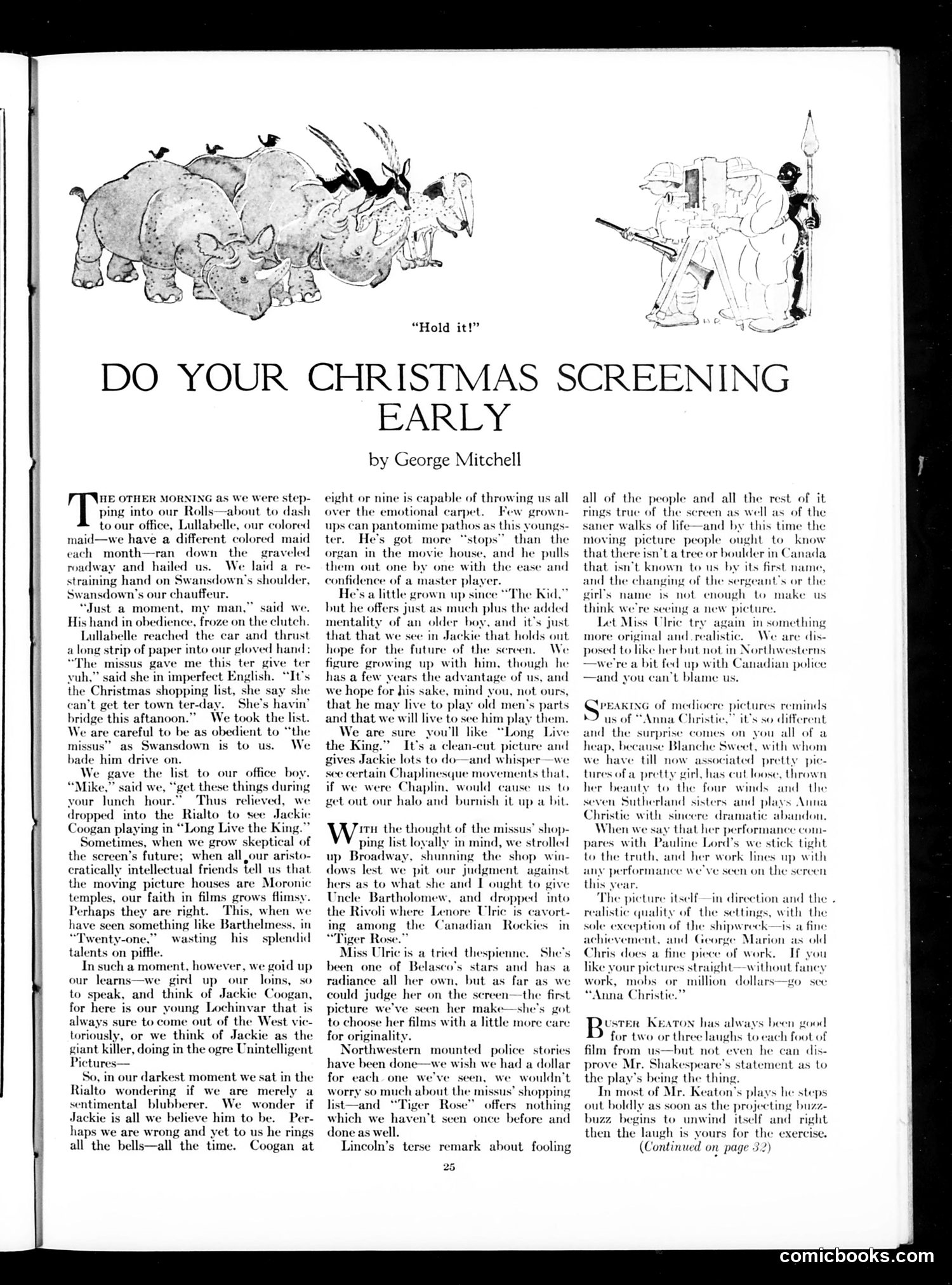
This article by George Mitchell is a film critic's column disguised as holiday advice. The cartoon header shows elephants (representing "the missus"—a wife) being restrained by a hunter, captioned "Hold it!"—a visual pun on postponing Christmas shopping. Mitchell reviews current cinema while recounting his morning: receiving his wife's shopping list, delegating it to an office boy, then spending his lunch hour at movies instead. He praises child actor Jackie Coogan in "Long Live the King" as genuinely talented, contrasting him with Richard Barthelmess, whom he considers a waste of talent. He criticizes Lenore Ulric's "Tiger Rose" as derivative—another predictable Northwest Mounted Police story. The satire is genteel and self-aware: Mitchell admits he's a "sentimental blubberer" about cinema while simultaneously shirking domestic duties. The article encourages readers to "screen" films early (preview them) rather than waste Christmas holiday time on mediocre pictures—practical advice wrapped in film criticism.
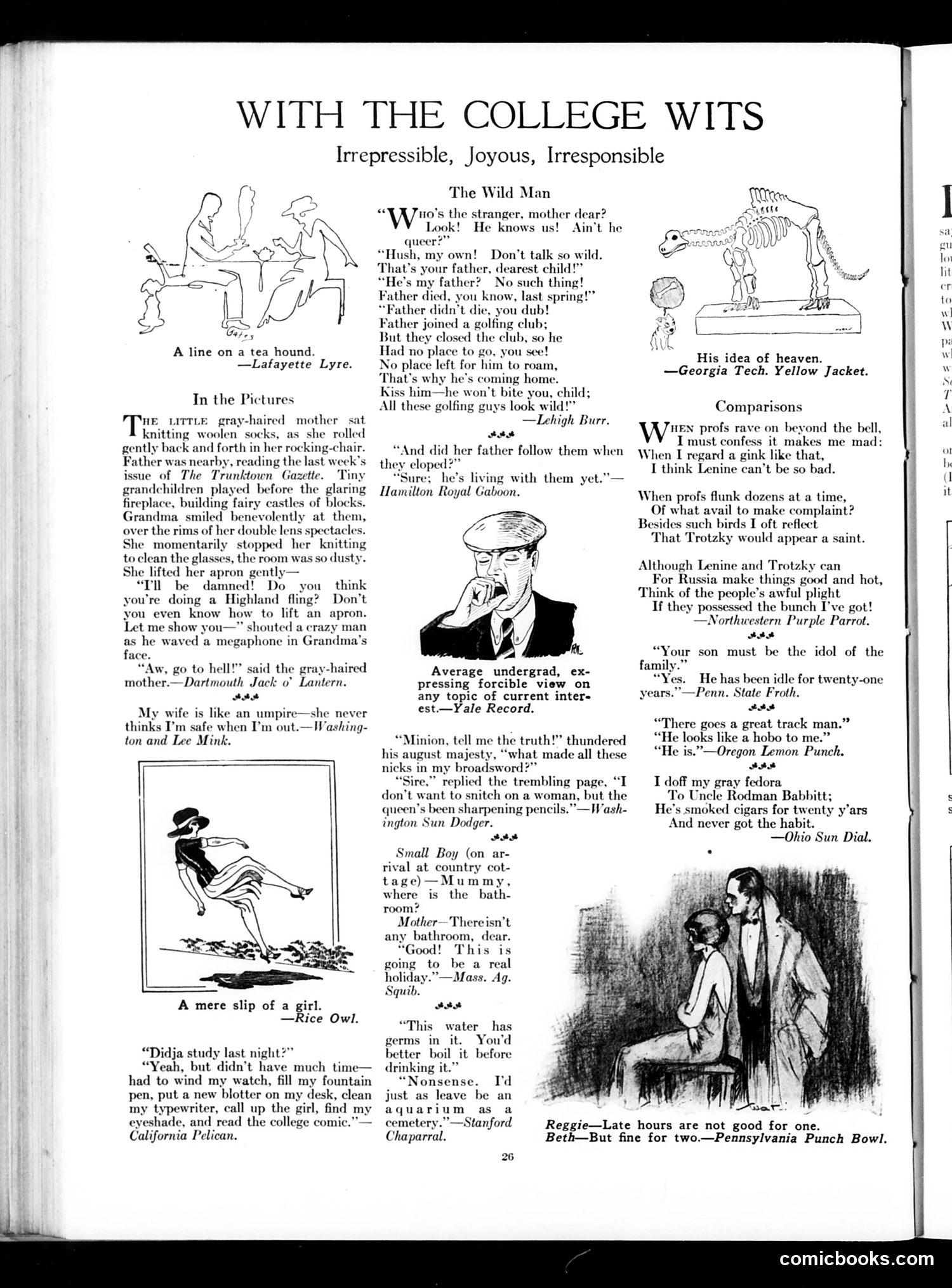
This page collects humorous quips and cartoons from various college humor magazines circa the 1920s-30s. The content satirizes college life and domestic situations through brief jokes attributed to publications like Yale Record, Lehigh Burr, and Rice Owl. Key themes include: **College student behavior**: Students procrastinating (winding watches, calling girls instead of studying), professors flunking students en masse, and youthful irresponsibility treated as charming. **Domestic life**: Wives criticizing husbands' safety; fathers abandoning families for golf clubs; the absurdity of family dynamics. **Social references**: One joke mentions Lenin and Trotsky (Russian Revolution figures), implying even bad American college students are preferable to Soviet leadership—a pointed political jab reflecting post-WWI American anti-communist sentiment. **Gender humor**: Dismissive jokes about women (the queen sharpening pencils on the king's sword; wives nagging). The cartoons are simple line drawings accompanying the jokes. This appears to be a compilation celebrating collegial irreverence as wholesome American humor.
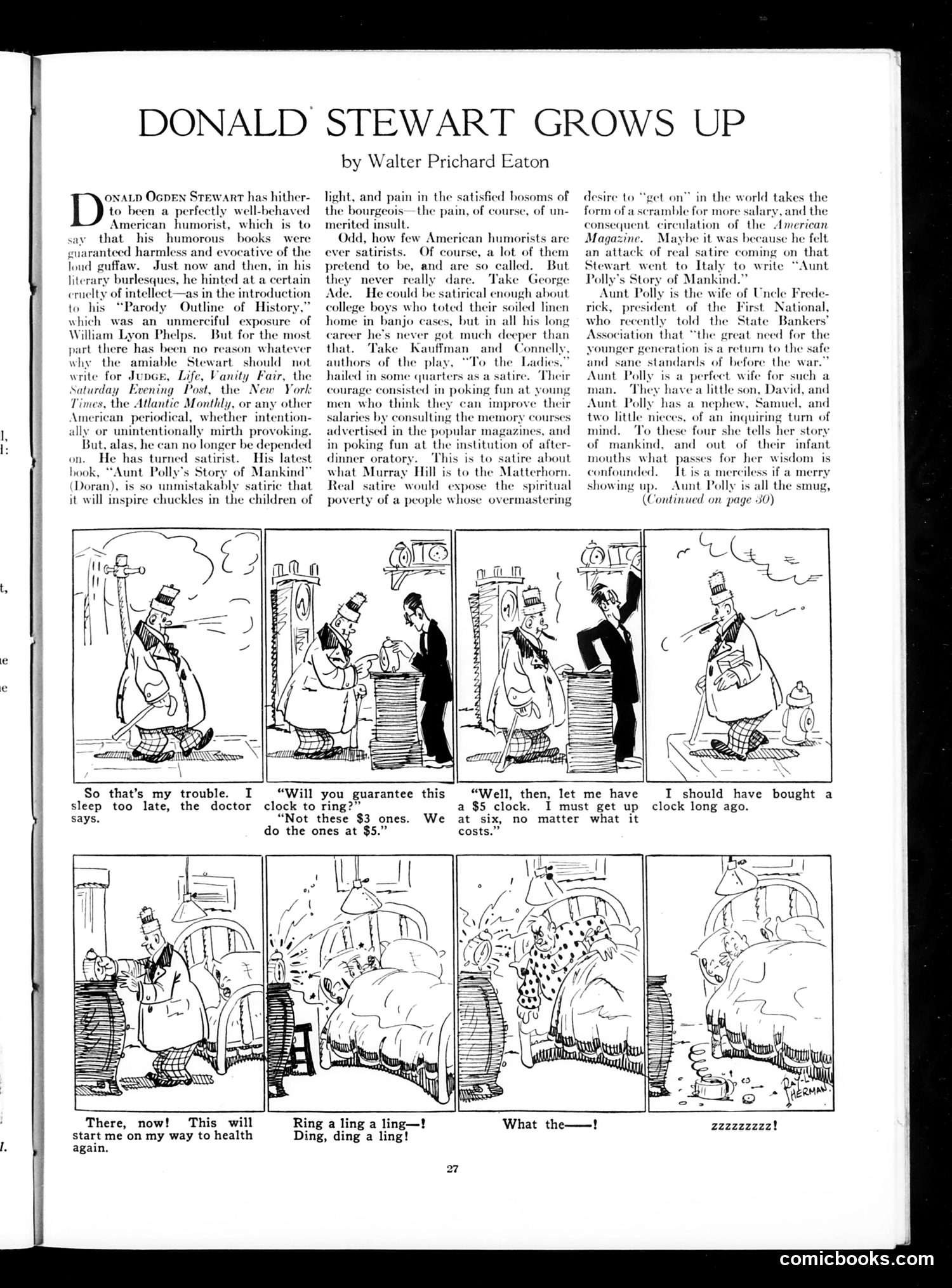
This page introduces Walter Prichard Eaton's essay praising humorist Donald Stewart for finally becoming a "real" satirist with his book *Aunt Polly's Story of Mankind*. **The satirical point:** Eaton distinguishes between safe, commercially acceptable humor (which Stewart previously wrote) and genuine satire that critiques society's spiritual emptiness. He argues most American humorists avoid real satire because it threatens the comfortable bourgeoisie. **The cartoons below** illustrate the essay's opening anecdote: a man visits a doctor complaining of oversleeping, then buys a cheap alarm clock that malfunctions catastrophically in the bedroom below—a slapstick joke about inadequate solutions to real problems, likely echoing the essay's theme that surface-level humor masks deeper social issues. **Key reference:** Uncle Frederick represents complacent capitalism—a banker advocating pre-war "safe and sane standards," embodying the spiritual poverty Eaton claims real satire should expose.
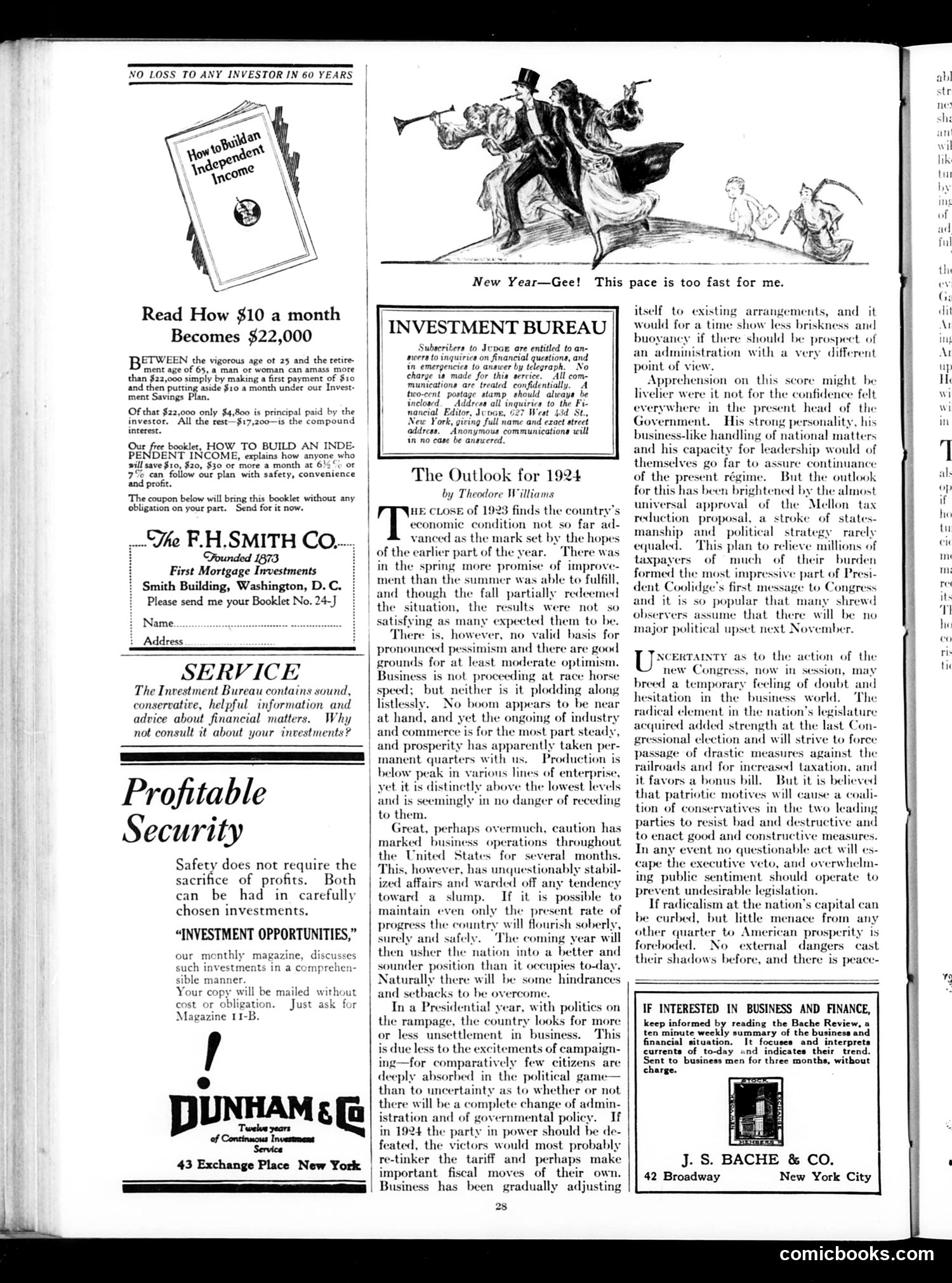
**The Cartoon:** The top illustration depicts revelers—a man in top hat and woman in fancy dress—celebrating New Year's Eve with champagne and a trumpet, while a small figure labeled "This space is too fast for me" struggles to keep pace. This satirizes the frenetic pace of post-war prosperity and the "Roaring Twenties" lifestyle, suggesting some Americans felt left behind by rapid economic and social change. **The Articles:** The page is dominated by financial advertising and Theodore Williams's "The Outlook for 1924"—an optimistic economic forecast written after the 1923 economic slowdown. Williams argues for "moderate optimism," cautioning against excessive caution while predicting steady (not explosive) growth. He warns that an election year could cause business "unsettlement." **Historical Context:** This reflects genuine 1924 anxieties: post-WWI economic volatility, election uncertainty, and wealth inequality—some Americans thriving while others struggled to adapt.
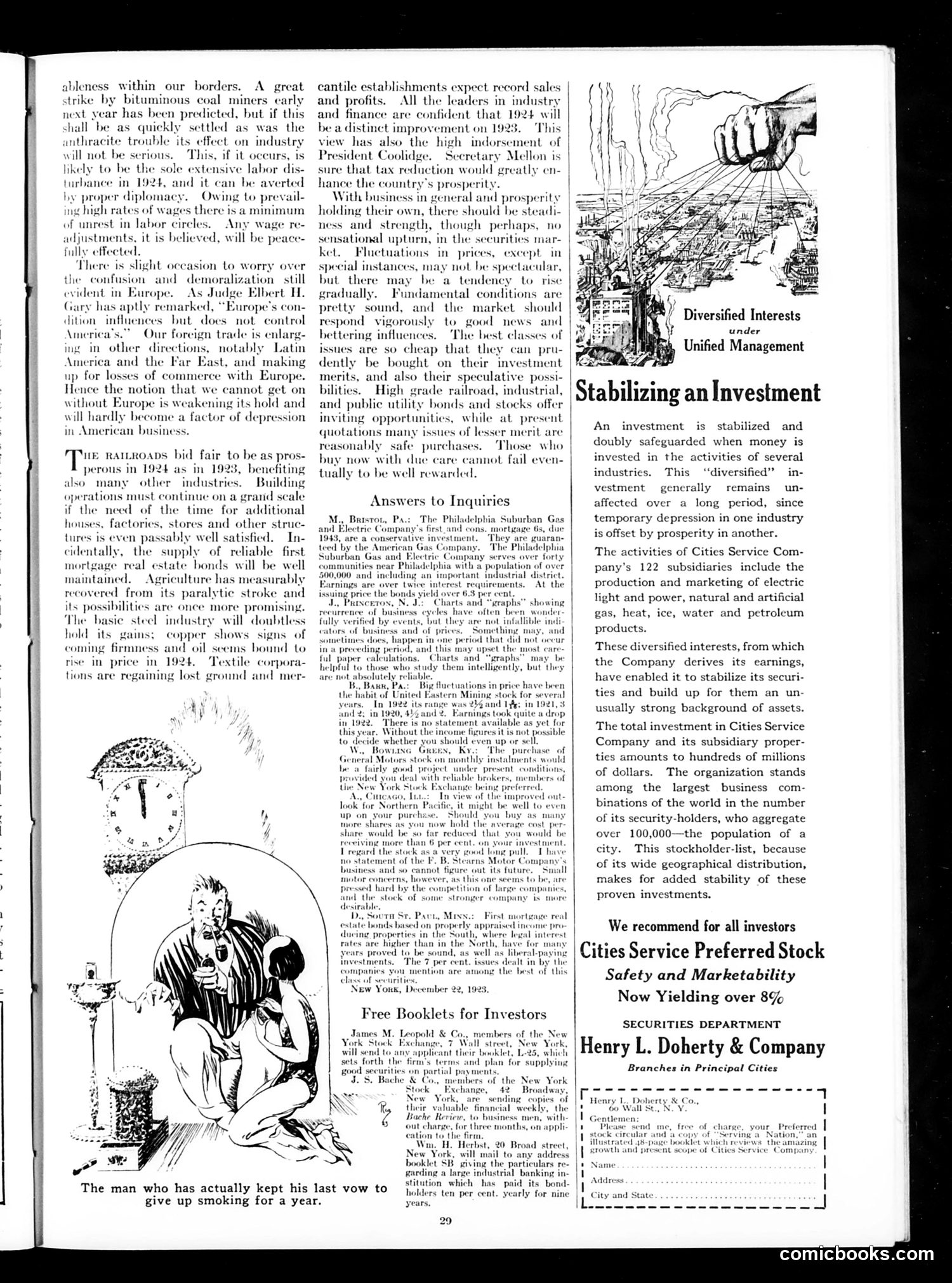
This cartoon satirizes Americans' notoriously broken New Year's resolutions, specifically the common pledge to quit smoking. The image depicts a thin, worn figure—suggesting deprivation through self-denial—who has supposedly maintained a smoking cessation vow for a full year. The joke's point is cynical: achieving such a resolution is so extraordinarily rare that it's noteworthy enough to merit cartoon commentary. The exaggerated, almost skeletal appearance of the figure suggests the difficulty and toll of maintaining such discipline. This reflects 1920s social attitudes where New Year's resolutions were widely made but chronically abandoned, making actual success laughable or nearly impossible. The surrounding text discusses economic optimism for 1924, creating ironic contrast: while businessmen predict prosperity and self-improvement, ordinary people can't even quit smoking—a commentary on American willpower and self-control.
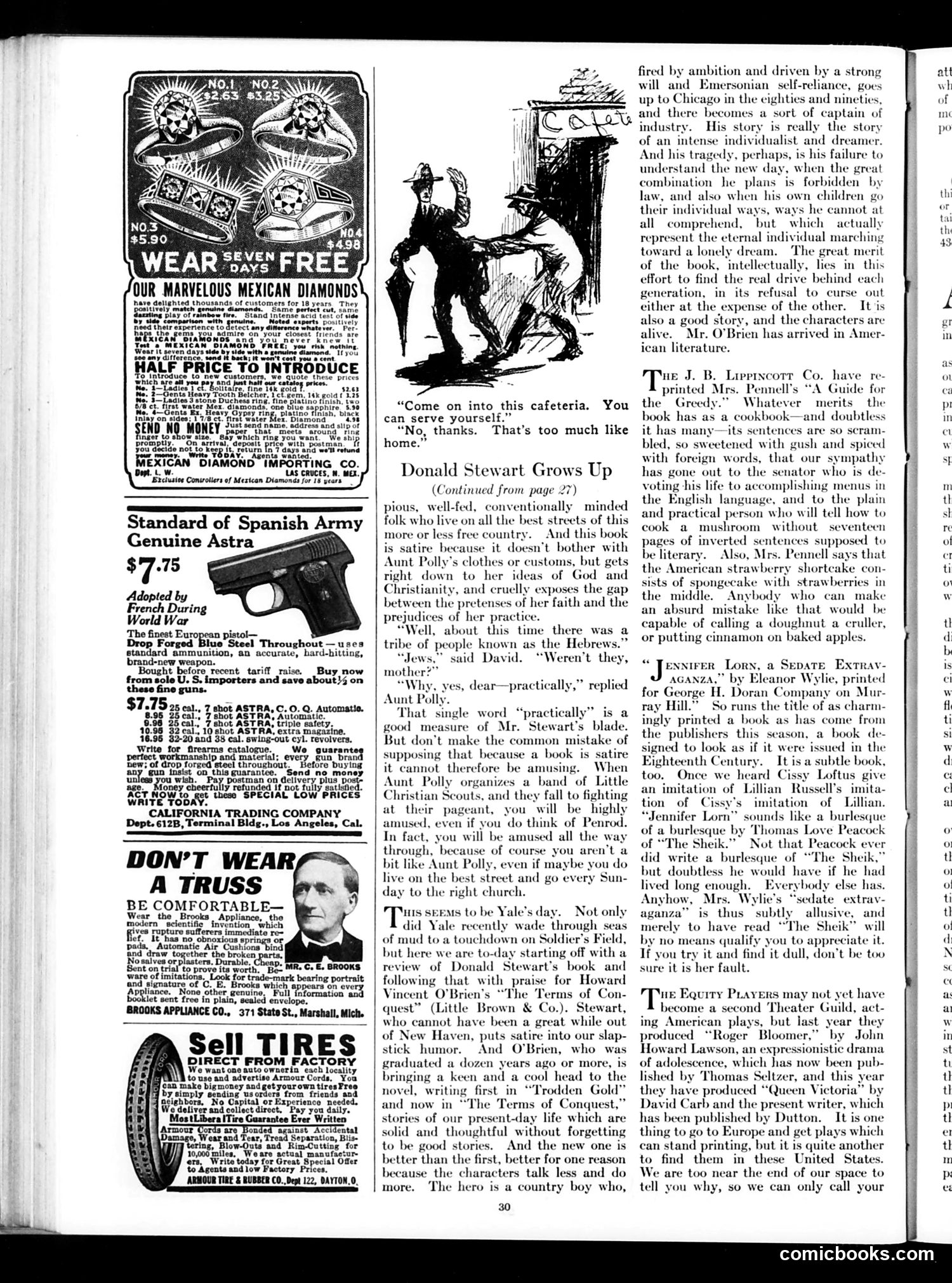
This page is primarily **advertising**, with a small cartoon and literary review mixed in. The cartoon shows a man refusing cafeteria self-service, saying it's "too much like home"—a joke about domestic drudgery, suggesting home life involves unpleasant chores. The main text reviews **"Donald Stewart Grows Up,"** a satirical novel about small-town hypocrisy. The reviewer praises Stewart's satire targeting conventionally pious middle-class people (like "Aunt Polly") whose Christian faith conflicts with their actual prejudiced behavior. The review notes the book is both amusing and biting social criticism—using a single word ("practically") as an example of Stewart's sharp satirical blade. The surrounding ads peddle dubious products: "Mexican diamonds," Spanish pistols, trusses, and tire-selling schemes—typical early-20th-century mail-order schemes Judge's readers would recognize as scams or quackery.
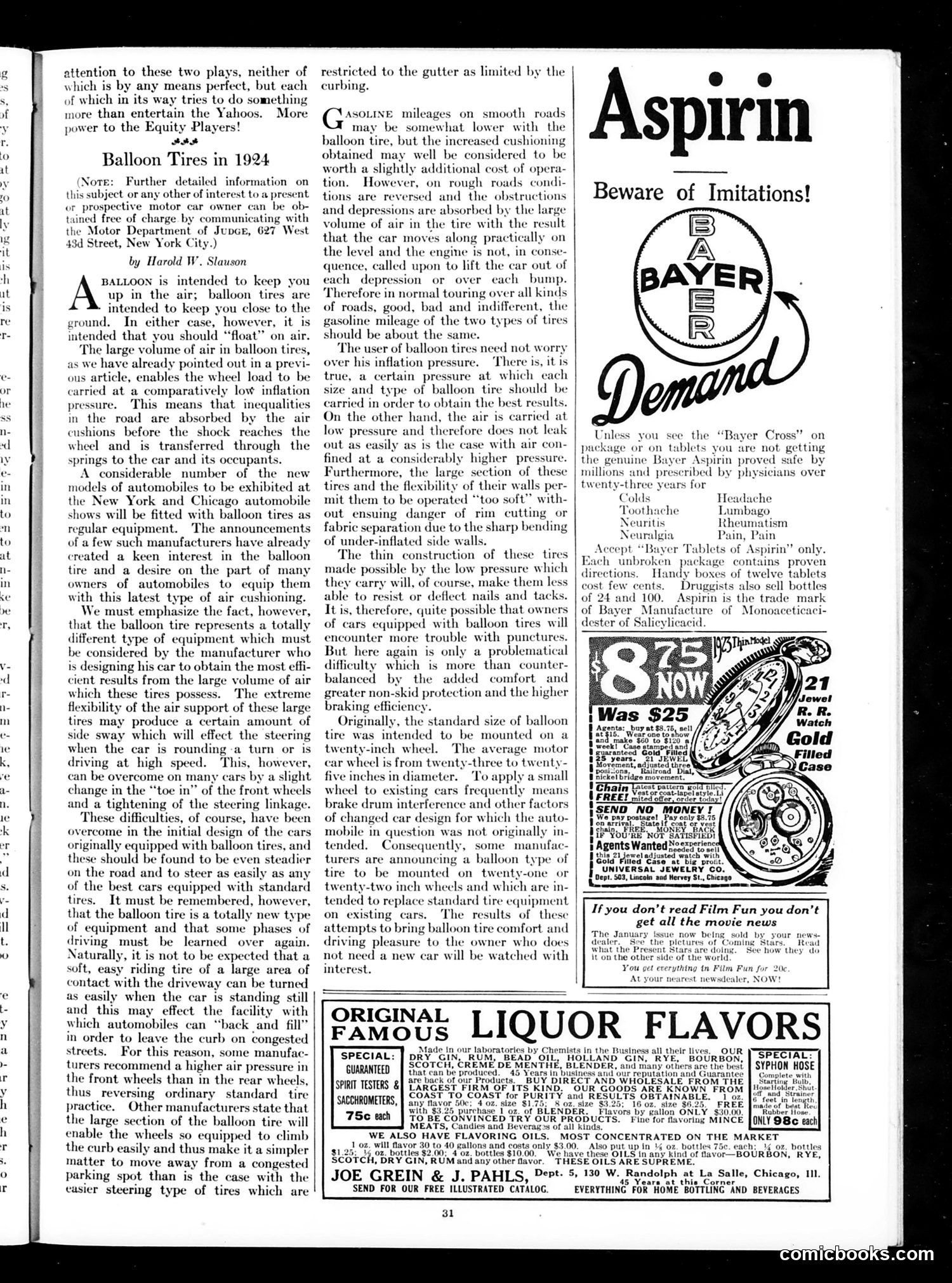
This page is primarily **technical/instructional content**, not satire. It's an article by Harold W. Slauson explaining balloon tires—a new 1924 automotive innovation—to Judge magazine's readers. **The Context:** Balloon tires were large, low-pressure tires designed to cushion rides by absorbing road shocks through air volume rather than rigid construction. This was novel technology. **The Point:** The article educates readers on this emerging car equipment while acknowledging trade-offs: improved comfort and road absorption versus potential steering difficulties and slightly lower fuel efficiency. The author notes manufacturers were already adapting car designs to work optimally with balloon tires. **The Advertising:** The page also features ads for Aspirin (warning of imitations), a jewelry catalog, and liquor flavoring products—typical period Judge content. This represents Judge functioning as a consumer-education magazine alongside its satirical content, helping middle-class readers understand modern automotive developments.
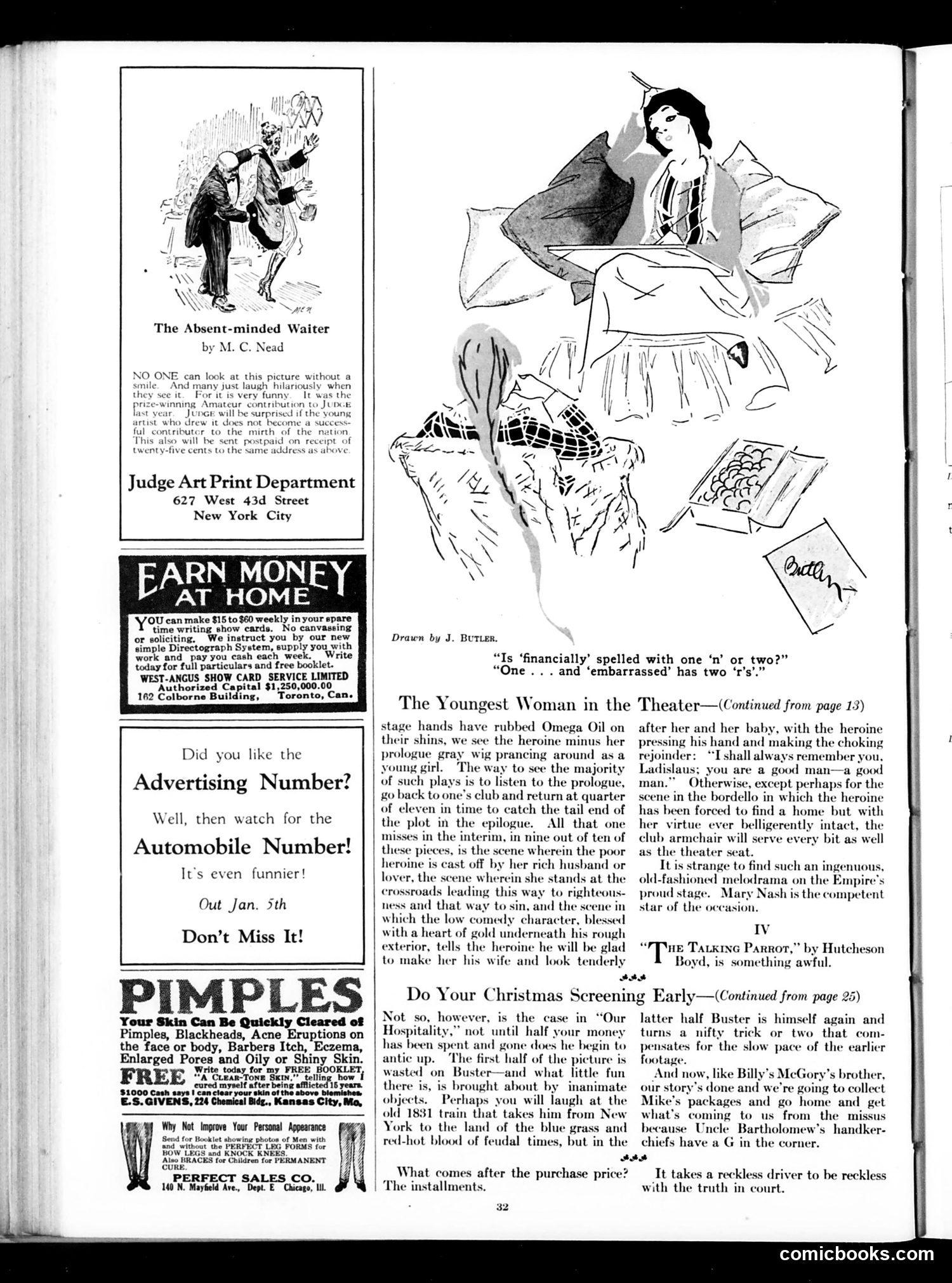
This *Judge* magazine page features a prize-winning cartoon by M.C. Nead titled "The Absent-Minded Waiter"—showing a server hilariously confused while serving, likely mixing up orders or spilling things. The joke relies on physical comedy common to early 20th-century humor. The page is primarily **advertising**, promoting various mail-order schemes: art prints, show-card writing jobs, acne treatments, and corrective devices for bow legs. These represent typical Depression-era "earn money at home" pitches targeting readers desperate for income or self-improvement. The editorial content reviews theatrical productions, particularly critiquing *"Our Hospitality"* (a Buster Keaton film) for wasting time on slapstick rather than plot. The magazine positions itself as sophisticated entertainment commentary while surrounding readers with get-rich-quick advertisements—a stark contradiction reflecting *Judge*'s dual identity as satirical publication and commercial enterprise.
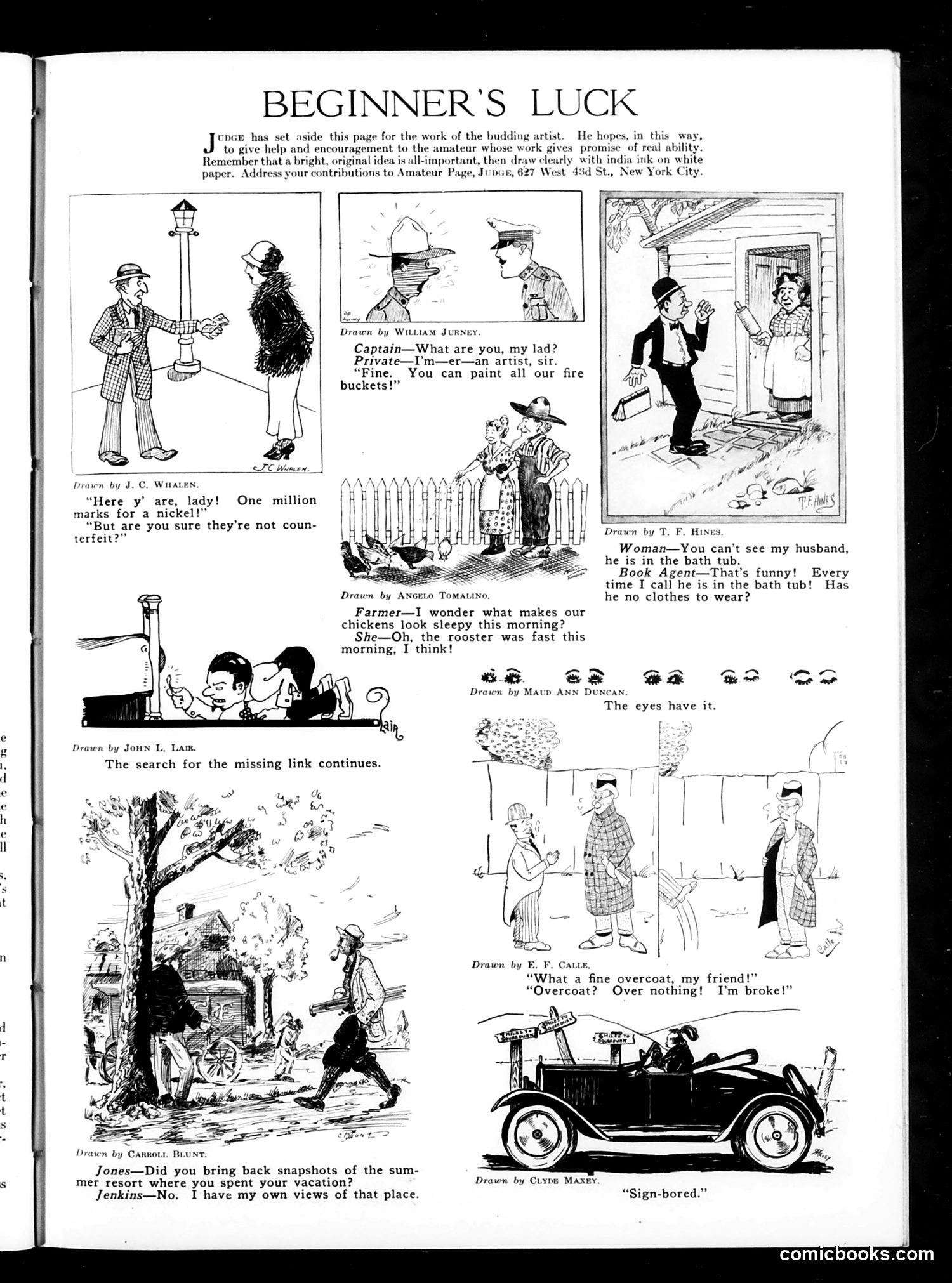
This page showcases amateur cartoonists' work, featuring gag comics typical of early 20th-century humor: **Key cartoons:** 1. **Military artist**: A soldier claims to be an artist; the captain assigns him to paint fire buckets—mocking both artistic pretension and military grunt work. 2. **Hyperinflation joke**: A vendor sells "one million marks for a nickel," with a woman questioning authenticity—likely referencing post-WWI German inflation when currency became nearly worthless. 3. **Bath tub evasion**: A book agent repeatedly finds a husband always bathing—implying he's avoiding the salesman (or has no clothes, suggesting poverty). 4. **The "missing link"**: A crude drawing labeled this evolutionary reference, apparently showing primitive figures. 5. **"Sign-bored"**: A man in an overstuffed car, visually exhausted by vacation travel—playing on "sign" and "bored." These are gentle, domestic humor and topical satire typical of Judge's period, relying on wordplay and visual gags rather than sharp political commentary.
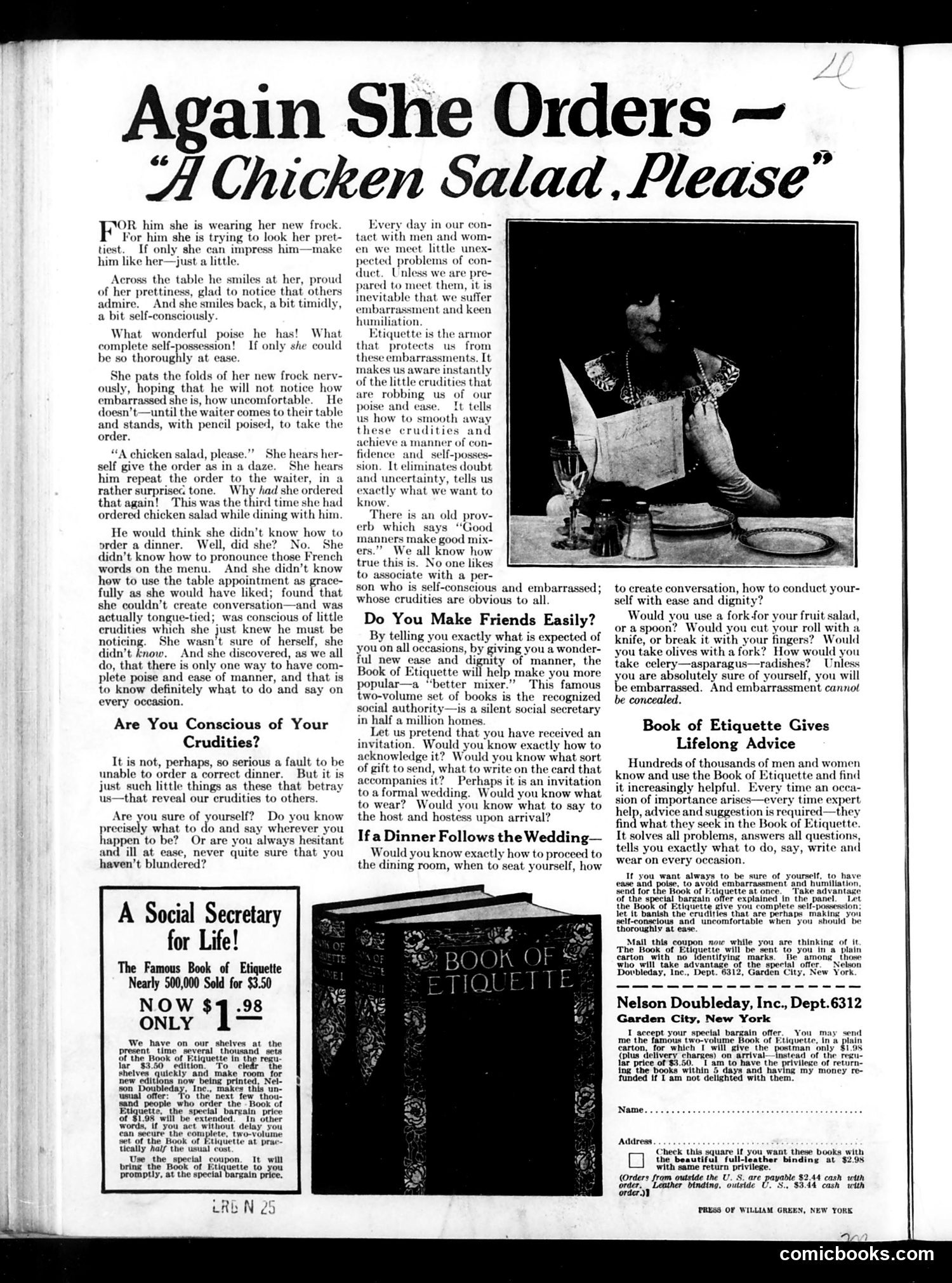
This page satirizes **social anxiety and self-consciousness**, particularly among women in courtship situations. The narrative follows a woman on a dinner date who repeatedly orders chicken salad—the only menu item she can confidently pronounce—revealing her insecurity about her education, manners, and sophistication. The satire targets how **etiquette anxiety** undermines social confidence. Her embarrassment over not knowing French menu terms, proper table manners, and dinner conversation exposes the gap between her actual knowledge and her desire to appear refined. The man notices nothing amiss, yet she suffers acute humiliation. The page then pivots to **selling a solution**: the "Book of Etiquette" as a "Social Secretary for Life," discounted from $3.50 to $1.98. The implied message is that proper etiquette knowledge guarantees social success and eliminates embarrassment—a common early-20th-century advertising trope that positioned etiquette books as essential self-improvement tools for socially aspiring readers, particularly women seeking marriageability and social acceptance.

I can see this is a blank or nearly blank page from Judge magazine with only "comicbooks.com" visible at the bottom. There are no discernible cartoons, illustrations, text content, or satirical commentary visible on this page to analyze. This appears to be either a blank page, a title page, an advertisement page, or a scanning artifact. Without visible cartoon content, political figures, captions, or satirical commentary, I cannot identify any references, jokes, or historical context for a modern reader. To provide meaningful analysis of Judge magazine's political satire and historical significance, I would need a page with actual cartoon artwork or readable text content.