
Judge, 1923-12-29 · page 15 of 37
Judge — December 29, 1923 — page 15: what you’re looking at
What you’re looking at
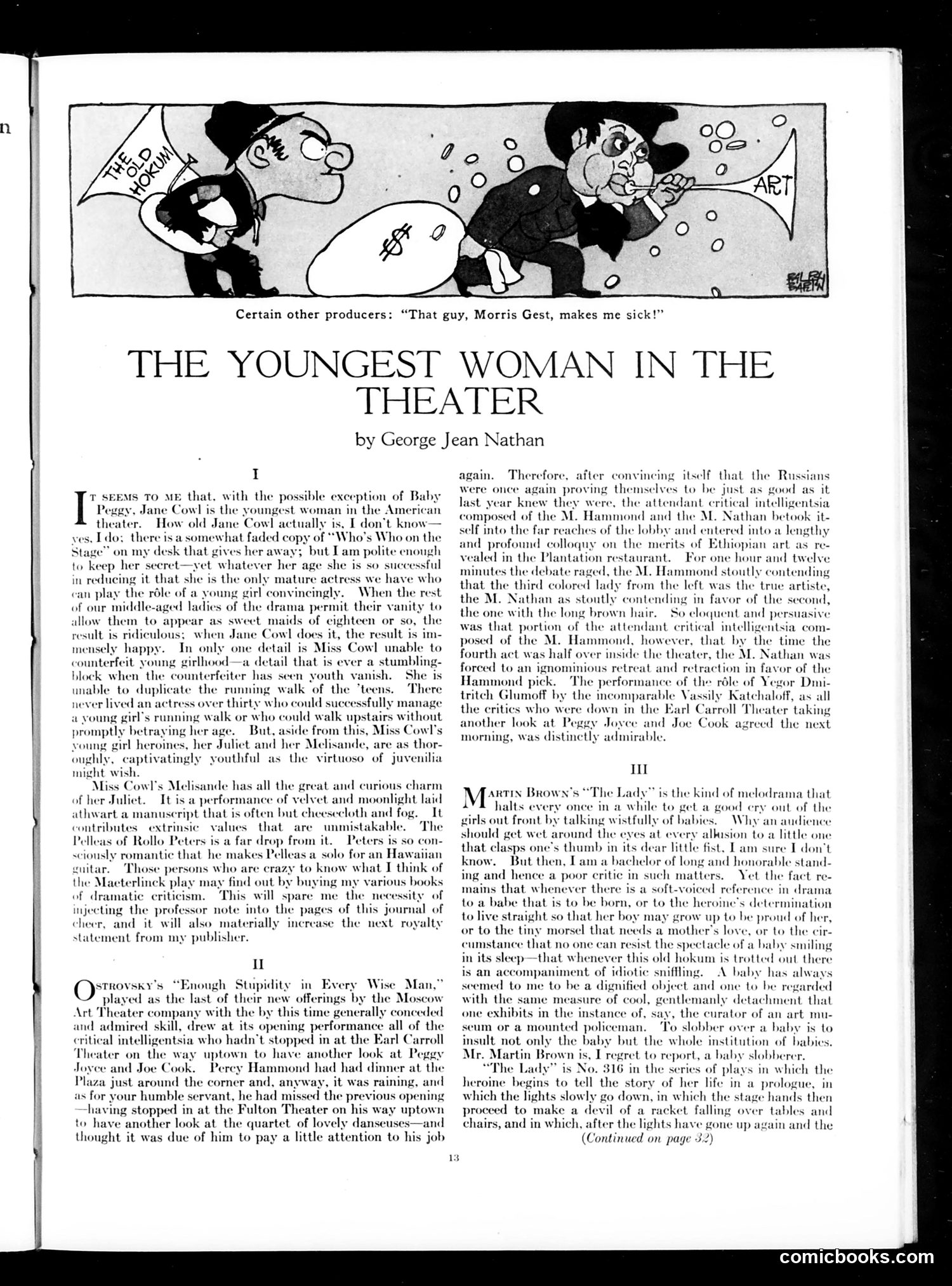
## The Cartoon The top cartoon mocks producer **Morris Gest** (identified in the caption). Two figures in formal dress appear to be vomiting or spitting out money (indicated by the "$" symbol and "ART" label), suggesting Gest's productions are financially successful but artistically worthless. Other theater producers express disgust at his work, implying he prioritizes profit over artistic merit—a common satirical jab at commercially-minded impresarios. ## The Article The page's main content discusses actress **Jane Cowl**, praised for convincingly playing young women despite her actual age. The author (theater critic **George Jean Nathan**, evident from byline and references to his "various books") contrasts her success with other actresses who fail at youthful roles. The article also critiques a Moscow Art Theater production and humorously describes critics debating Ethiopian art in a restaurant lobby rather than focusing on the actual performance. **Context:** This reflects 1920s theatrical criticism and the tension between commercial theater (Gest) and artistic merit (Cowl, Moscow Art Theater).
📄 Transcribed text from this page (OCR, searchable)
Machine-transcribed from the original scan — historical spelling and the odd misread are preserved.
THE YOUNGEST Certain other producers: “That guy, Morris Gest, makes me sick!” WOMAN IN THE THEATER I To Me that. with the possible exception of Baby Jane Cowl is the youngest woman in the American How old Jane Cowl actually is, I don’t know— there is a somewhat faded copy of “Who's Who on the on my desk that gives her away; but Iam polite enough cep her secret—yet whatever her age she is so successful in reducing it that she is the only mature actress we have who can play the role of a young girl convincingly. When the rest of our middle-aged ladies of the drama permit their vanity to allow them to appear as sweet maids of cighteen or so, the result is ridiculous; when Jane Cowl does it, the result is im- mensely happy. In only one detail is Miss Cowl unable to counterfeit: young girlhood—a detail that is ever a stumbling- block when the counterfeiter has seen youth vanish. She is: unable to duplicate the running walk of the ‘teens. There never lived an actress over thirty who could successfully manage a young girl's running walk or who could walk upstairs without promptly betraying her age. But, aside from this, Miss Cowl’s young girl heroines, her Juliet and her Melisande, are as thor- aptivatingly youthful as the virtuoso of juvenilia might wish. Miss Cowl’s Melisande has all the gre and curious charm of her Juliet. It is a performance of velvet and moonlight le athwart a manuscript that is often but cheesecloth and fog. — It contributes extrinsic values that are unmistakable. The Pelleas of Rollo Peters is a far drop from it. Peters is so con- sciously romantic that he makes Pelleas a solo for an Ha n guitar. ‘Those persons who are erazy to know what I think of the Maeterlinck play may find out by buying my various books of dramatic crit m. This will spare me the necessity of injecting the professor note into the pages of this journal of cheer, and it will also materially increase the next royalty statement from my publisher. ves, Ido: Il Ortrorsey’s “Enough Stupidity in E played as the last of their new offerin Art Theater company with the by this time generally conceded and admired skill, drew at its opening performance all of the critical intelligentsia who hadn't stopped in at the Earl Carroll Theater on the way uptown to have another look at Peggy Joyce and Joe Cook. Perey Hammond had had dinner at the Plaza just around the corner and, anyway, it was raining, and as for your humble servant, he had missed the previous opening having stopped in at the Fulton Theater on his way uptown to have another look at the quartet of lovely danseuses—and thought it was due of him to pay a little attention to his job ry Wise Man,” by the Moscow by George Jean Nathan again. Therefore, aif r convincing itself that the Russians were once again proving themselves to be just as good as it last year knew they were, the attendant critical intelligentsia composed of the M. Hammond and the M. Nathan betook it- self into the far reaches of the lobby and entered into a lengthy and profound colloquy on the merits of Ethiopian art as re vealed in the Plantation restaurant. For one hour and twelve minutes the debate raged, the M. Hammond stoutly contending that the third colored lady from the left was the true artiste, the M. Nathan as stoutly contending in favor of the second, the one with the long brown hair. » eloquent and persuasive was that portion of the attendant critical intelligentsia com- posed of the M. Hammond, however, that by the time the fourth act was half over inside the theater, the M. Nathan was forced to an ignominious retreat and retraction in favor of the Hammond pick. The performance of the role of Yegor Dini- tritch Glumoff by the incomparable Vassily Katchaloff, as all the critics who were down in the Earl Carroll Theater taking another look at Peggy Joyce and Joe Cook agreed the next morning, Was distinctly admirable. Il ARTIN Brown's “The Lady” is the kind of melodrama that 4 halts every once in a while to get a good ery out of the girls out front by talking wistfully of babies. Why an audience should get wet around the eyes at every alkision to a little one that clasps one’s thumb in its dear little fist. Lam sure I don't know. But then, Lam a bachelor of long and honorable stand- ing and hence a poor critic in such matters. Yet the fact re- mains that whenever there is a soft-voiced reference in drama to a babe that is to be born, or to the heroine's determination to live straight so that her boy may grow up to be proud of or to the tiny morsel that needs a mother’s love, or to the cir- cumstance that no one ean resist the spectacle of a baby smiling in its sleep—that whenever this old hokum is trotted out there is an accompaniment of idiotic sniffing. A baby has always seemed to me to be a dignified object and one to be urded with the same measure of cool, gentlemanly detachment that one exhibits in the instance of, say, the curator of an art mu- scum or a mounted policeman. ‘To slobber over a baby is to insult not only the baby but the whole institution of babies. Mr. Martin Brown is, I regret to report, a baby slobberer. “The Lady” is No. 316 in the series of plays in which the heroine begins to tell the story of her life in a prologue, in which the lights slowly go down, in which the stage hands then proceed to make a devil of a racket falling over tables and chairs, and in which, after the lights have gone up again and the (Continued on page 32) comicbooks.com