
Judge, 1923-12-29 · page 9 of 37
Judge — December 29, 1923 — page 9: what you’re looking at
What you’re looking at
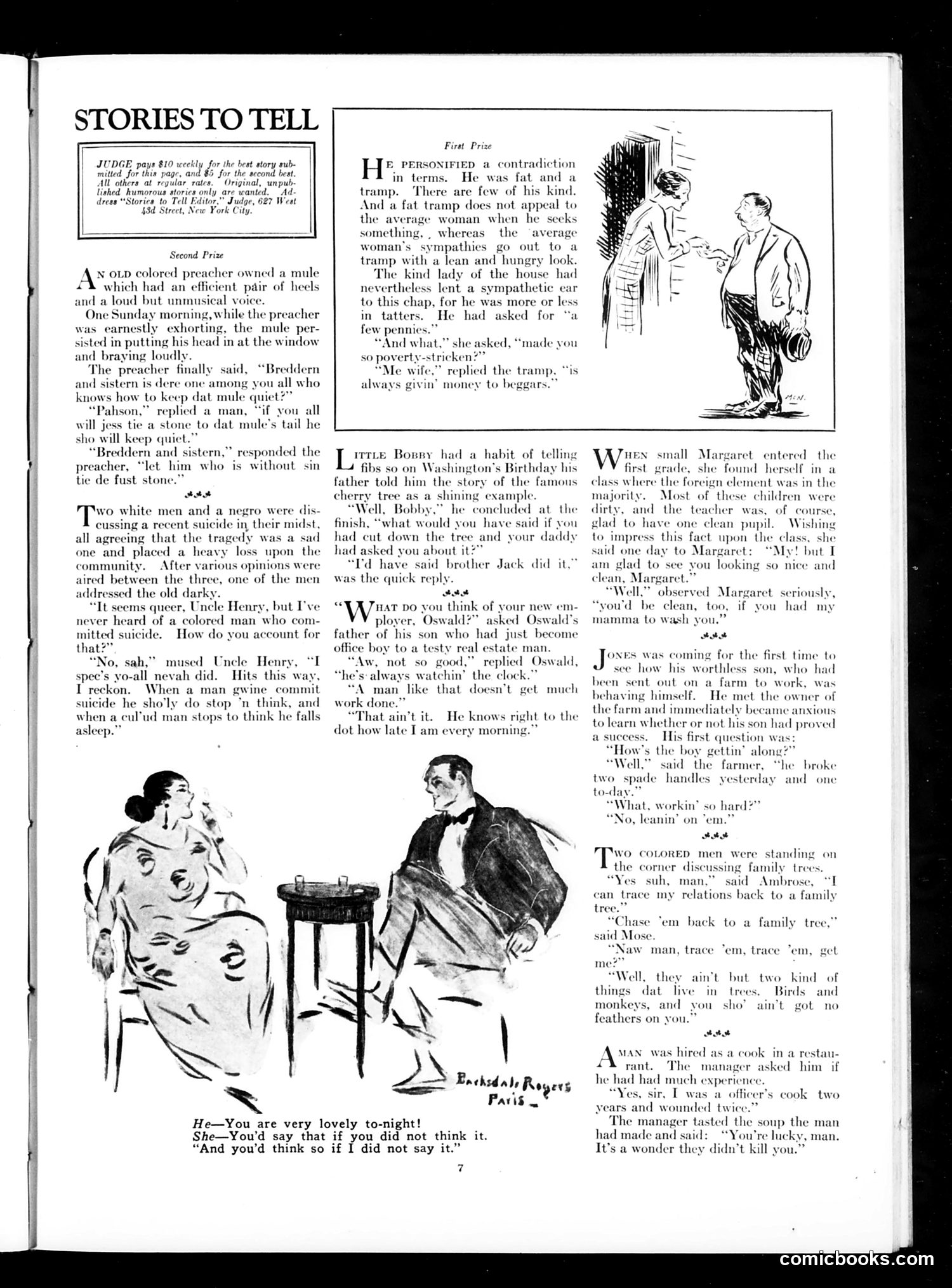
This page from *Judge* magazine presents a collection of humorous short stories with racial and ethnic stereotypes typical of early 20th-century American humor. **Key content:** The stories employ dialect humor and minstrelsy conventions. One features an "old colored preacher" with a braying mule—a setup for comedic resolution through folksy wisdom. Another presents "Uncle Henry," a Black man rendered in heavy dialect, discussing suicide in racially stereotyped terms. A separate story depicts an Irish immigrant ("tramp") and his wife in poverty, playing on period prejudices about Irish immigrants and their perceived financial irresponsibility. Additional vignettes include workplace comedy (a boy watches the clock) and a scene featuring a "foreign element" schoolchild, suggesting anxiety about non-native-born students. **The satire:** Rather than critiquing these groups, the magazine *celebrates* their caricatures as entertainment, with prize money offered for such stories. The humor relies entirely on readers accepting ethnic and racial stereotypes as inherently amusing. This reflects *Judge*'s audience: affluent white Americans entertained by exaggerated portrayals of people they considered social inferiors.
📄 Transcribed text from this page (OCR, searchable)
Machine-transcribed from the original scan — historical spelling and the odd misread are preserved.
STORIES TO TELL JUDGE pays $10 weekly for the beat story sub- mitted for this page, and 85 for the second best Al others at regular rates Original, unpub: lished humorous atorics only are wanted. Ad. dress “Stories to Tell Editor,” Judge, 687 West 43d Street, New York City. Second Prize 1 er owned a mule ent pair of heels 1 voic ; oLp colored pr which had an eff and a loud but unmusicd i One Sunday morning,while the preacher was earnestly exhorting, the mule per- sisted in putting his head in at the window and braying loudly The preacher finally said, “Breddern and sistern is dere one among you all who knows how to keep dat mule quiet?” ’ahson,” replied a man, “if you all will jess tie a stone to dat mule’s tail he sho will keep quict.” “Breddern and sistern,” responded the preacher, “let him who is without sin tie de fust stone.” ett Te white men and a negro were dis- cussing a recent suicide in their midst, all agreeing that the tragedy was a sad one and placed a heavy loss upon the community. After aired between the three, addressed the old darky “It seems queer, Uncle Henry, but I've never heard of a colored man who com- mitted suicide. How do you account for ious opinions were one of the men . sah,” mused Uncle Henry, “I spee’s yo-all nevah did. Hits this Treckon. When a man gwine commit suicide he sho'ly do stop ’n think, and cul'ud man stops to think he falls ice Bosry had father told him the story of the cherry tree as a shining example. “Well, finish, “ had cut down the tree and your daddy had asked you about it?” I'd ha was the quick reply. offi Firat Prize H® PERSONIFIED a contradiction in term He was fat and a tramp. There are few of his kind. And a fat tramp does not appeal to the average woman when he seeks something, , whereas the ‘average woman's sympathies go out to a tramp with a lean and hungry look. The kind lady of the house | nevertheless lent a sympathetic to this chap, for he was more or less in tatters. He had asked for “a few pennies.” “And what,” she asked, “ so poverty-stricken?” "Me wife,” replied the tramp, “is always givin’ money to beggars. made you a habit of telling fibs so on Washington's Birthday his famous Bobby.” he concluded at the what would you have said if you » said brother Jack did it.” ott “Wier po you think of your new em- ployer, Oswald?” asked Oswald’s father of his son who had just become ve boy to a testy re: ‘Aw, not so good, “he’s: always watchin’ the clock “A] mar work done. “That ain’t it. dot how late I estate man. replied Oswald, like that doesn’t get much He knows right to the am every morning.” He—You are very lovely to-night! She—You'd say that if you did not think it. “And you'd think so if I did not say it.” HEN small first class wher Margaret entered the ade, she found herself in a the foreign clement was in the Most of these children were the ther was, of course, dto have one clean pupil. Wishing to impress this fact upon the class, she said one day to Margaret: ! but I am glad to see you looking so hice and observed Margaret. seriously, “you'd be clean, too, if you had my mamma to wash you.” tot jo" s was coming for the first time to Y see how his worthless son, who had been sent out on a farm to work, was behaving himself. He met the owner of the farm and immediately became anxious to learn whether or not his son had proved a success. His first question was: “How’s the boy gettin’ along?” “Well,” said the farmer, “he broke two spade handles yesterday and one to-day.” “What, workin’ so hard?” “No, leanin’ on “em.” Rd Ts COLORED men were standing on the corner discussing family tree “Yes suh, man,” said Ambros 1 trace my relations back to a f amily “hase said Mose Naw man, trace “em, trace “em, get ‘em back to a family tree,” Vell, they ain't but two kind of things dat live in Birds and monkeys, and you sho’ ain't got no feathers on you.” ttt A man was hired as a cook in a restau- rant. The mar asked him if he had had much experience. “Yes, sir, Twas a offic years and wounded twice. The manager tasted the soup the man had made and said: “You're lucky, man, It’s a wonder they didn’t kill you.” rs cook two comicbooks.com