
Judge, 1923-12-29 · page 21 of 37
Judge — December 29, 1923 — page 21: what you’re looking at
What you’re looking at
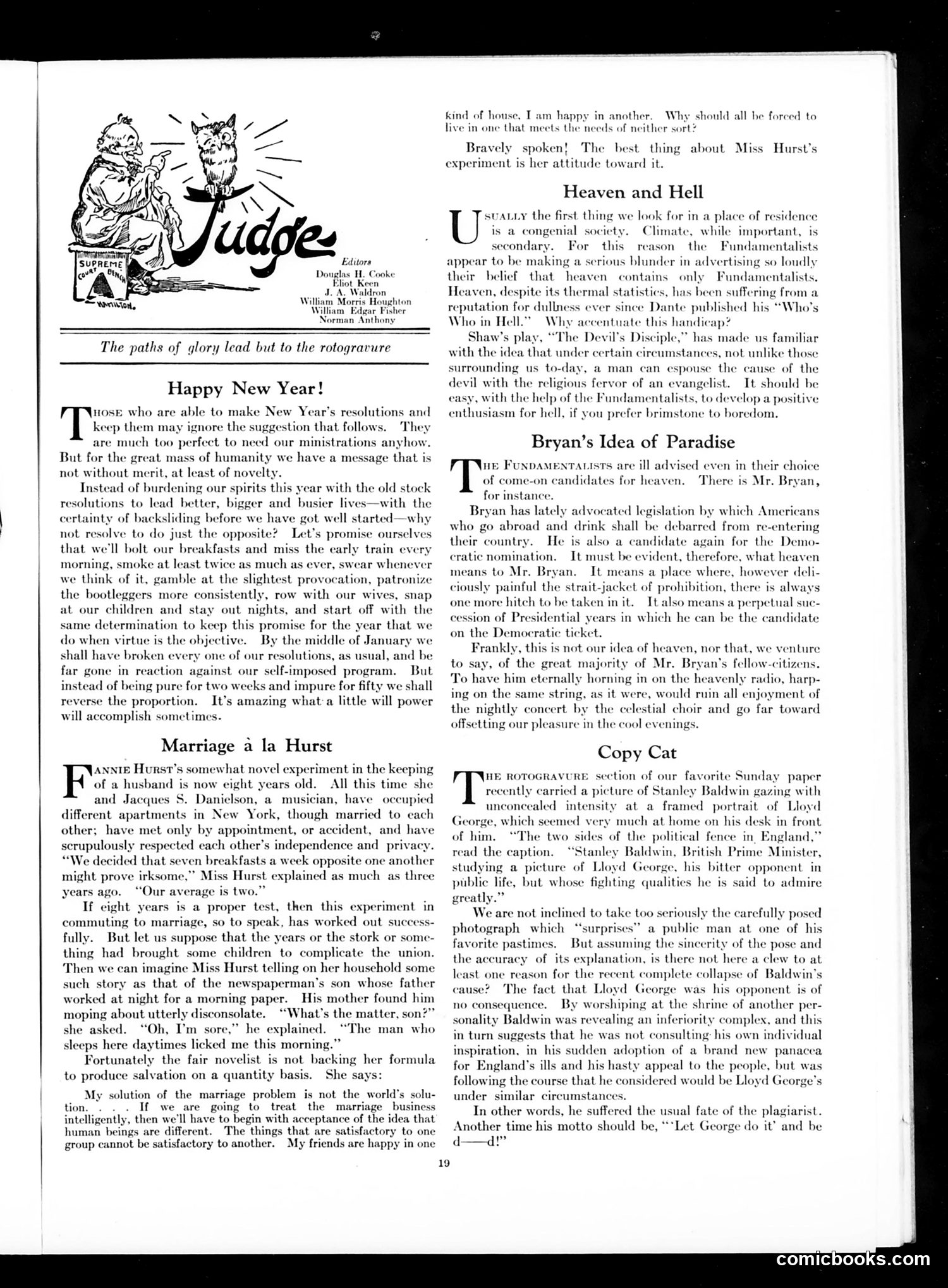
This page from Judge contains three satirical pieces: **"Happy New Year!"** mocks New Year's resolutions by suggesting readers resolve to do the *opposite* of self-improvement—drink, gamble, neglect family—then break those resolutions. The satire targets humanity's predictable failure at moral improvement. **"Marriage à la Hurst"** discusses Fannie Hurst's eight-year experiment maintaining separate apartments from her musician husband. The piece presents this as evidence that independence sustains marriage, using an anecdote about a newspaperman's son whose father works nights. Judge treats this unconventional arrangement as humorously impractical yet surprisingly successful. **"Heaven and Hell"** critiques Fundamentalists for damaging heaven's reputation through Dante's unflattering medieval depiction ("Who's Who in Hell"). The satire suggests religious zealots inadvertently make their promised afterlife sound unappealing by emphasizing only theological purity over pleasantness. The "Judge" masthead cartoon appears to show the magazine's mascot character. Overall, the page employs gentle mockery of contemporary social trends and religious attitudes.
📄 Transcribed text from this page (OCR, searchable)
Machine-transcribed from the original scan — historical spelling and the odd misread are preserved.
D Editors iglas H, Cooke jot Keen J. A, Waldron Morris Houghton am Edgar Fisher Norman Anthony The paths of glory lead but to the rotogravure Happy New Year! nose who are able to make New Year's resolutions and cep them may ignore the suggestion that follows. They are much too perfect to need our ministrations anyhow. But for the great mass of humanity we have a message that is not without merit, at least of novelty. Instead of burdening our spirits this year with the old stock resolutions to lead better, bigger and busier lives—with the certainty of backsliding before we have got well started—why not resolve to do just the opposite? Let's promise ourselves that we'll bolt our breakfasts and miss the carly train every morning, smoke at least twice as much as ever, swear whenever we think of it, gamble at the slightest provocation, patronize the bootleggers more consistently, row with our wives, snap at our children and stay out nights, and start off with the ition to keep this promise for the ye do when virtue is the objective. same determi ar that we By the middle of January we -e broken every one of our resolutions, as usual, and be far gone in reaction against our self-imposed program. But i of being pure for two weeks and impure for fifty we shall » the proportion. It’s amazing what:a little will power Marriage a la Hurst will accomplish sometimes. ANNIE Hurst’s somewhat novel experiment in the keeping EF“: a husband is now eight years old. All this time she and Jacques S. Danielson, musician, have occupied different apartments in New York, though married to each other; have met only by appointment, or accident, and have scrupulously respected each other’s independence and privacy. “We decided that seven breakfasts a week opposite one another might prove irksome,” Miss Hurst explained as much as three years ago. “Our average is two.” If eight years is a proper test, then this experiment in commuting to marriage, so to speak, has worked out success- fully. But let us suppose that the years or the stork or some- thing had brought some children to complicate the union. ‘Then we can imagine Miss Hurst telling on her household some such story as that of the newspaperman’s son whose father worked at night for a morning paper. moping about utterly disconsolate. she asked. His mother found him “What's the matter, son?” Dh, I'm sore,” he explained. sleeps here daytimes licked me this morning, Fortunately the fair novelist is not backing her formula to produce salvation on a quantity basis. She says: “The man who My solution of the marriage problem is not the world’s solu- tion. ‘ we are going to treat the marriage business intelligently, then we'll have to begin with eptance of the idea that human beings are different. The things t are satisfactory to one group cannot be satisfactory to another. My friends are happy in one 19 kind of house, Iam happy in another. Why should all be forced to live in one that meets the needs of neither sort? Bravely spoken! The best thing about experiment is her attitude toward it. Heaven and Hell SUALLY the first thing we look for in a place of residence is a congenial society. Climate, while important, is For this re the Fundamentalists appear to be making a serious blunder in advertising so loudly their belief that heaven only Fundamentalists, Heaven, despite its thermal statistics, has been suffering from a reputation for dullness ever since Dante published his “Who's Who in Hell.” Why ituate this handicap? Shaw’s play, “The Devil's Disciple,” has made us familiar with the idea that under certain circumstances, not unlike those surrounding us to-day, a man can espouse the cause of the It should be undamentalists, to develop a positive enthusiasm for hell, if you prefer brimstone to boredom. Miss Hurst’s ason, contains devil with the religious fervor of an evangelist. casy, with the help of the Bryan’s Idea of Paradise HE FUNDAMENTALISTS are ill advised even in their choice of come-on candidates for heaven. for instance. Bryan has lately advocated legi: who go abroad and drink shall be debarred from re-entering their country. He is also a candidate again for the Demo- cratic nomination. It must be evident, therefore, what heaven means to Mr. Bryan. It means a place where, however deli- ciously painful the strait-jacket of prohibition, there is alway one more hitch to be taken in it. It also means a perpetual suc- cession of Presidential years in which he can be the candidate on the Democratic ticket. Frankly, this is not our idea of } to s There is Mr. Bryan, ion by which Americans ven, nor that, we venture y, of the great majority of Mr. Bryan’s fellow-citizens. ‘To have him eternally horning in on the heavenly radio, harp- ing on the same string, as it were, would ruin all enjoyment of the nightly concert by the celestial choir and go far toward offsetting our pleasure in the cool evenings. Copy Cat HE ROTOGRAVURE section of our favorite Sunday paper recently carried a picture of Stanley Baldwin gazing with unconcealed intensity at a framed portrait of Lloyd George, which seemed very much at home on his desk in front of him. “The two sides of the political fence in, Eng read the caption. and,” “Stanley Baldwin, British Prime Minister, studying a picture of Lloyd George. his bitter opponent. in public life, but whose fighting qualities he is said to admire greatl We are not inclined to take too seriously the carefully posed photograph which “surprises” a publie man at one of his favorite pastimes. the accur But assuming the sincerity of the pose and y of its explanation, is there not here a clew to at ason for the recent complete collapse of Baldwin's The fact that Lloyd George was his opponent is of cause. no consequence. By worshiping at the shrine of another per- sonality Baldwin was revealing an inferiority complex, and this in turn suggests that he was not consulting: his own individual inspiration, in his sudden adoption of a brand new panacea for England’s ills and his hasty appeal to the people, but was following the course that he considered would be Lloyd George's under similar circumstan In other words, he suffered the usual fate of the plagiarist. Another time his motto should be, “*Let d—d!” ieorge do it’ and be comicbooks.com