
A complete issue · 36 pages · 1923
Judge — October 27, 1923
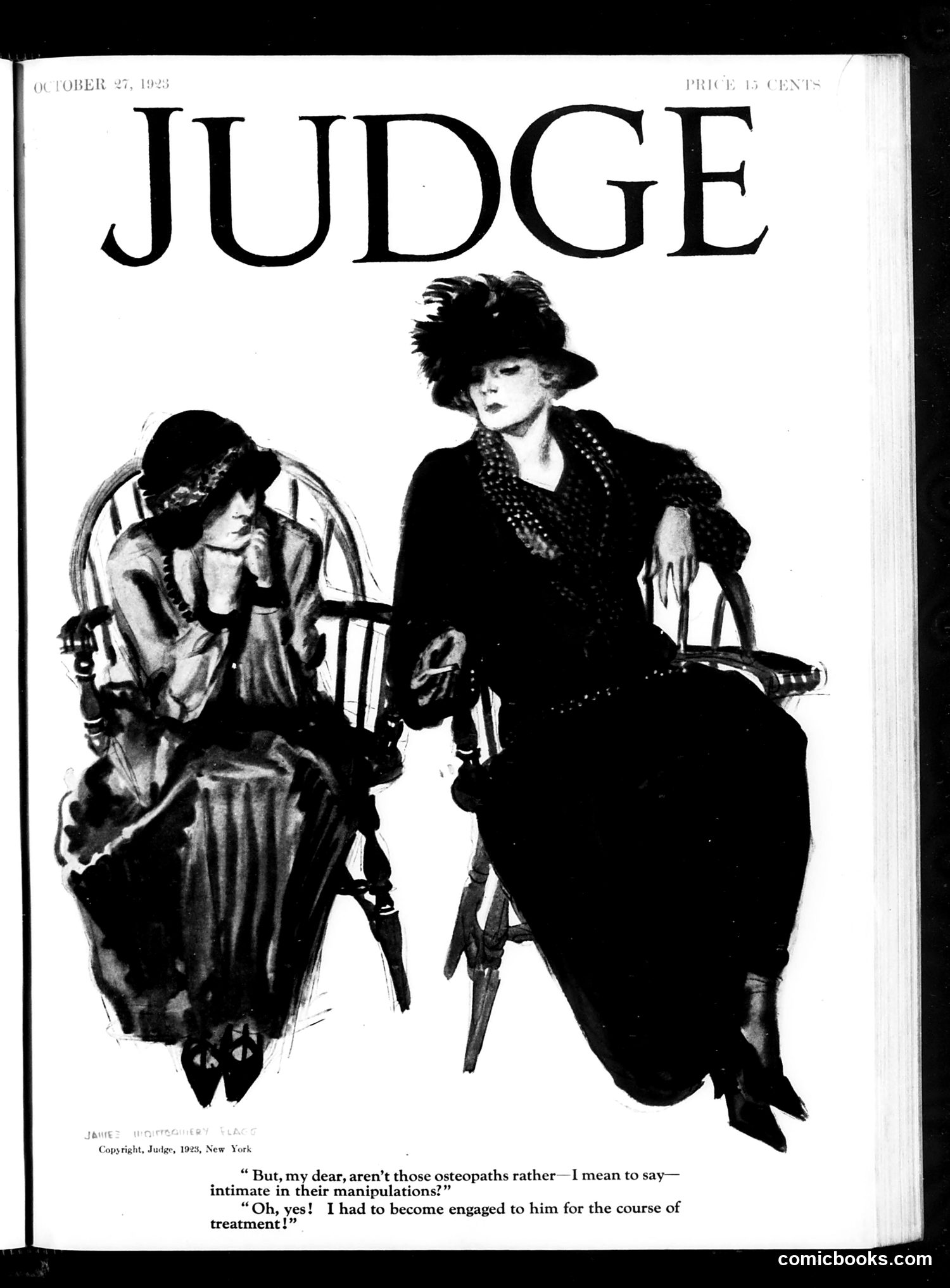
This satirical cartoon depicts two fashionably dressed women in 1920s attire sitting together. The dialogue references osteopaths—practitioners of osteopathy, a medical field that was controversial and often mocked during this era. The joke hinges on one woman's admission that she became engaged to an osteopath specifically to receive his "treatments" for her ailments. The satire mocks both the questionable medical practices of osteopathy and the romantic entanglements that might result from seeking such care. The 1920s saw widespread skepticism about osteopathic medicine, which was sometimes viewed as quackery. The cartoon appears to ridicule the desperation of women seeking health remedies and the dubious professional relationships that could develop, reflecting period anxieties about medical fraud and courtship propriety.
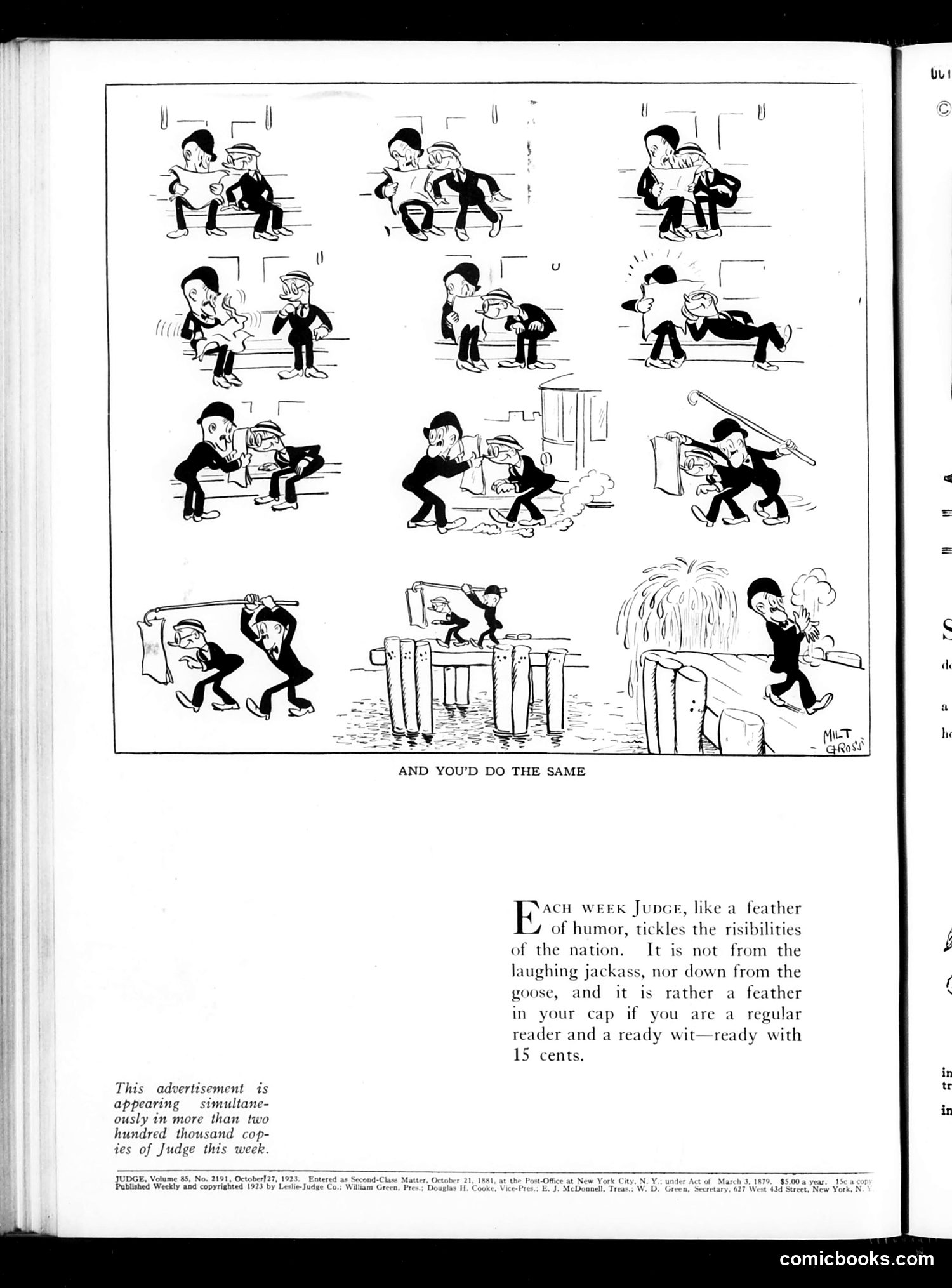
This is a humorous comic strip showing a sequence of escalating physical confrontations between two men in formal attire. The progression depicts increasingly violent responses to minor provocations—starting with simple gestures and escalating to property destruction, fighting with implements, and ultimately a dramatic waterfall scene. The caption "And You'd Do the Same" suggests the cartoon satirizes how ordinary people justify violent reactions to small slights or annoyances. It's social commentary on human nature—the idea that anyone, given sufficient irritation, would resort to similar behavior. The repetitive scenario emphasizes the universality of this supposedly justified escalation, using physical comedy to mock how people rationalize disproportionate responses to minor offenses.
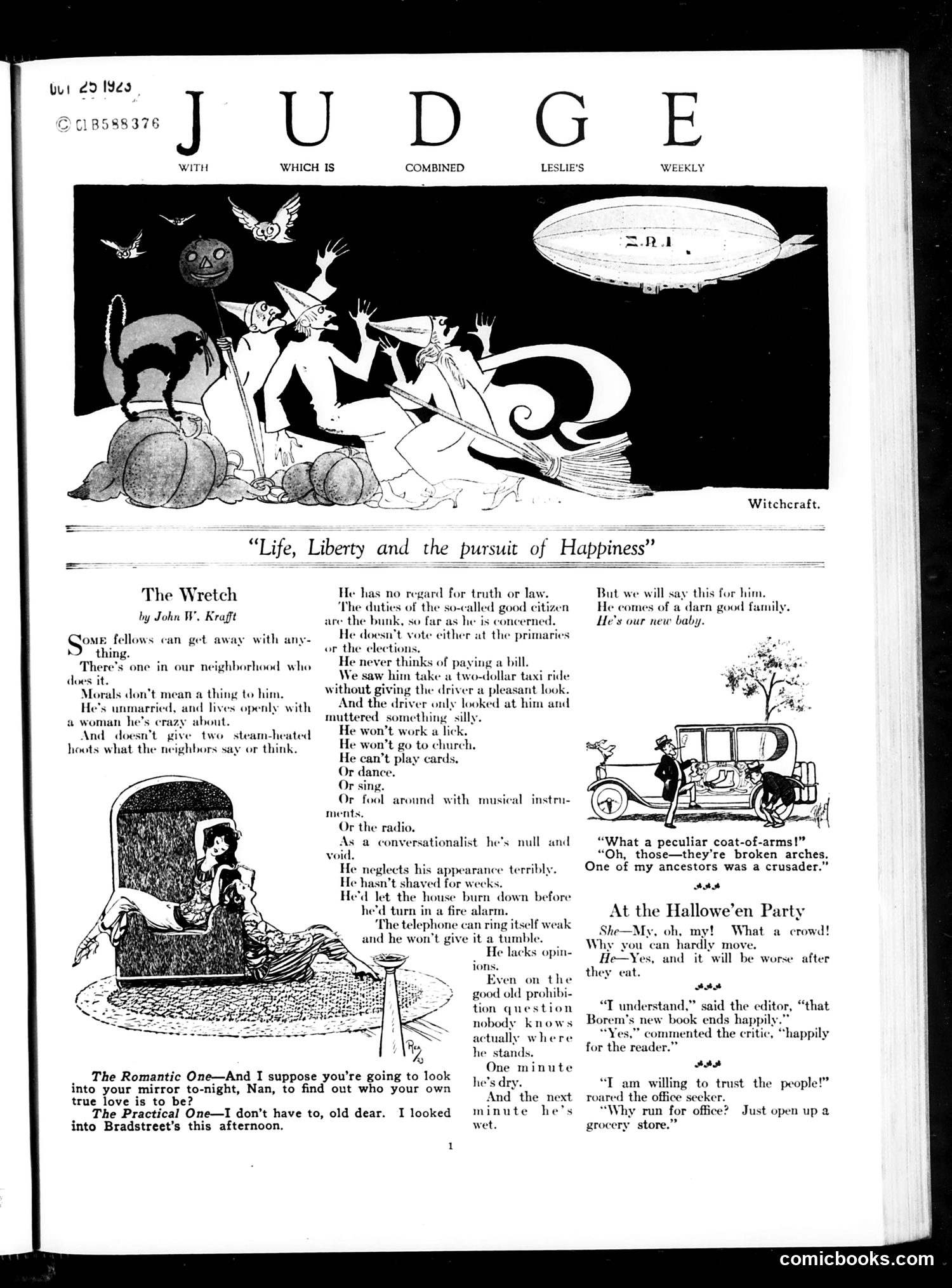
This page contains satirical commentary and humorous fiction rather than political cartoons. "The Wretch" by John W. Kraft depicts a disreputable man who ignores social conventions, refuses employment, avoids church, and neglects his appearance. The satire targets moral laxity and social irresponsibility—likely reflecting early 20th-century anxieties about citizenship and civic duty. "At the Hallowe'en Party" appears to be light social humor about a crowded celebration. The illustrated vignettes mock social pretension: one couple discusses ancestry ("one of my ancestors was a crusader"), while an office seeker desperately seeks employment at a grocery store. Overall, this reflects Judge's typical approach: satirizing American social behavior, class attitudes, and individual character flaws through humor rather than explicit political commentary.
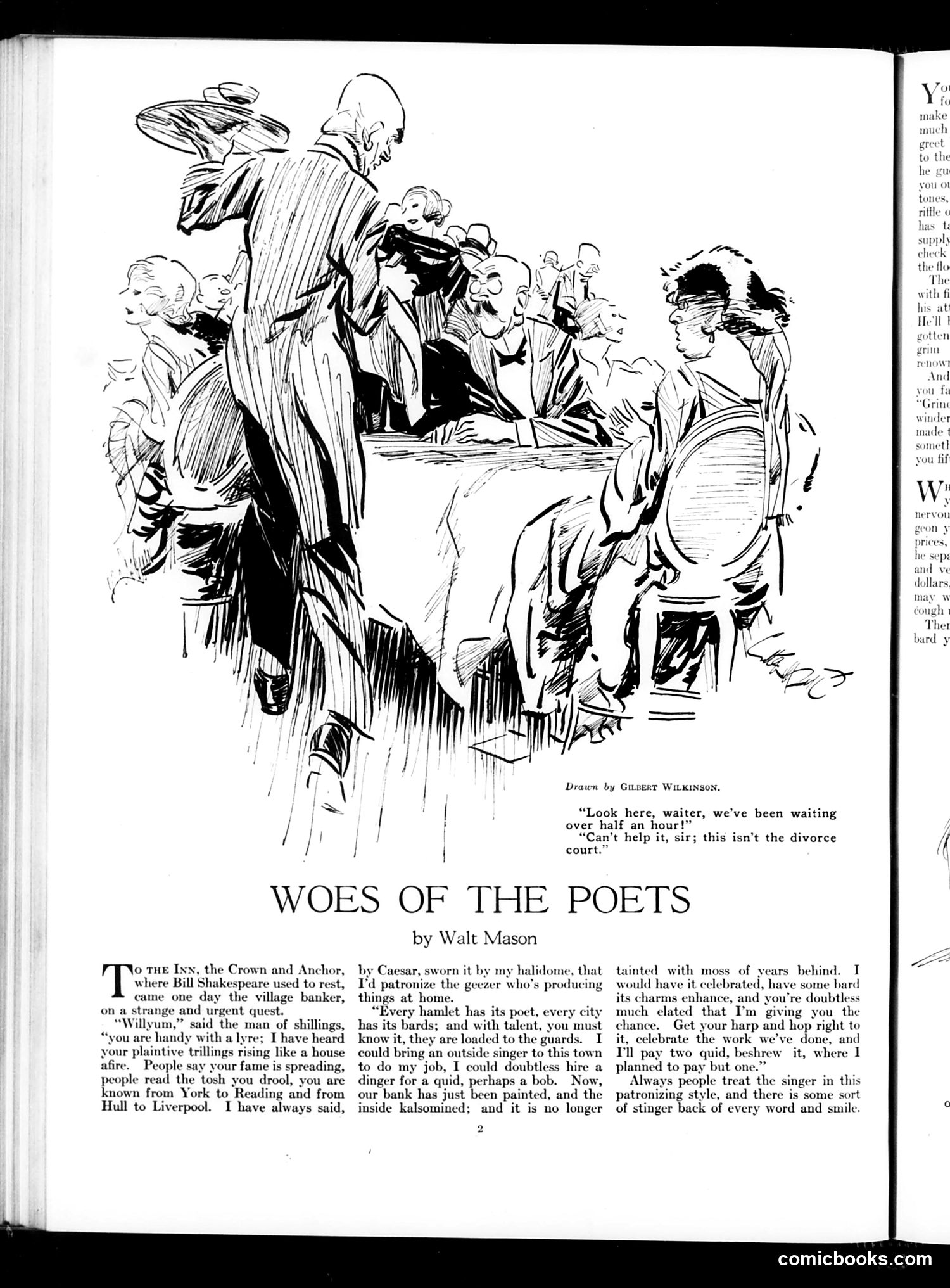
This satirical piece critiques the economic struggles of poets and artists. The cartoon depicts a tall, thin poet being confronted by an impatient waiter at what appears to be a restaurant or inn. The waiter complains they've been "waiting over half an hour" for payment, sarcastically noting "this isn't the divorce court." Mason's accompanying text humorously describes how poets are celebrated for their talent but economically undervalued. He references famous literary patrons (the Crown and Anchor inn, Shakespeare) while noting that modern banks won't finance poets' work. The joke centers on the irony that society prizes poets' artistry yet leaves them perpetually broke—unable even to pay restaurant bills.
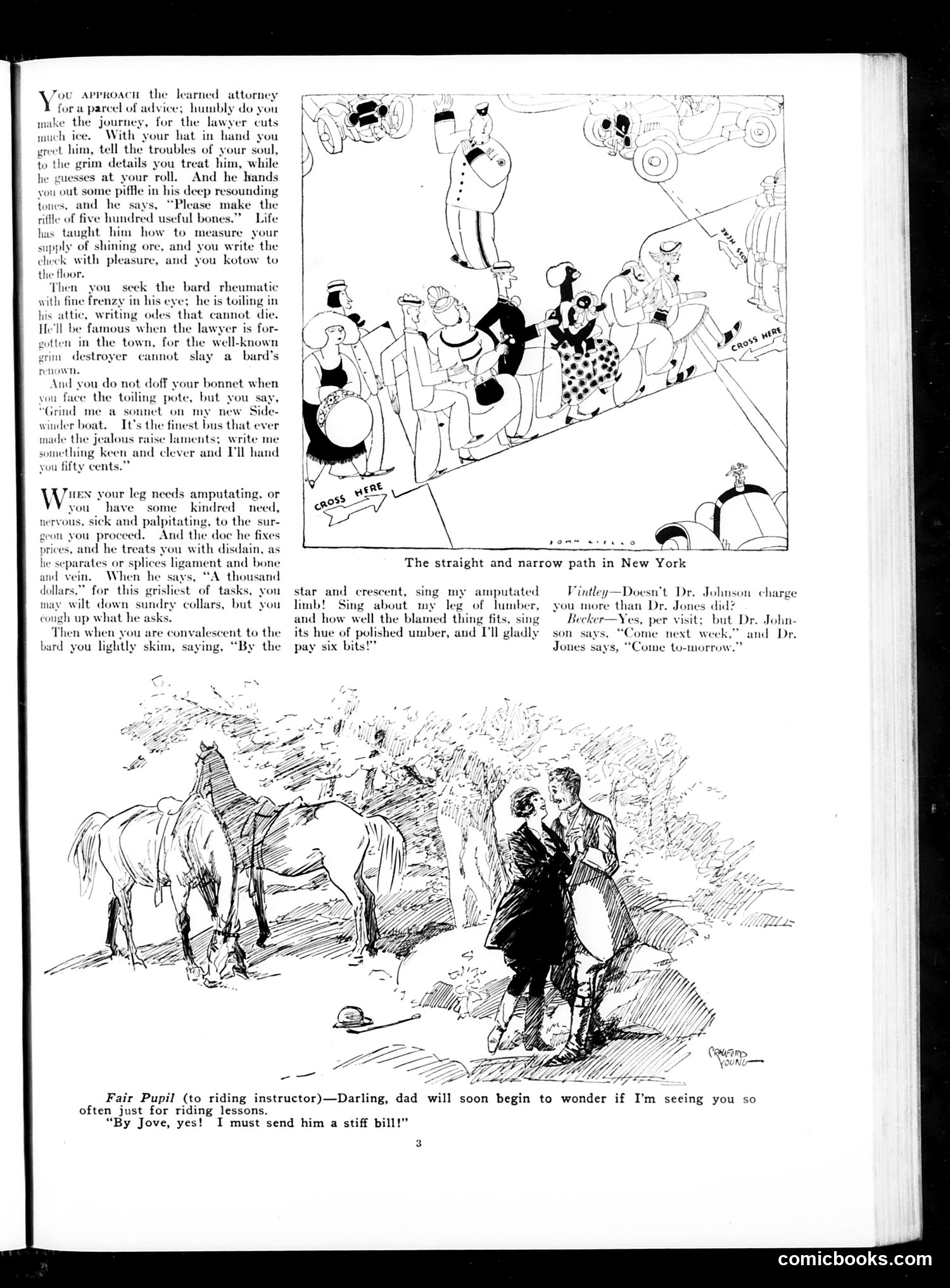
This page contains two distinct pieces of satirical content: **Top cartoon** ("The straight and narrow path in New York"): A crowded street scene depicting New York life with various urban characters and situations. The satire appears to target the chaotic, morally questionable nature of city living—the "narrow path" being difficult to navigate amid temptation and vice. **Bottom cartoon**: Features a young woman on horseback with an instructor, captioned with dialogue about frequent riding lessons. The humor plays on the double entendre—the "fair pupil" is seeing the riding instructor suspiciously often, prompting the joke about sending "a stiff bill" to her father, implying either excessive lesson costs or improper behavior. Both pieces employ typical early 20th-century satirical humor about urban morality and social propriety.
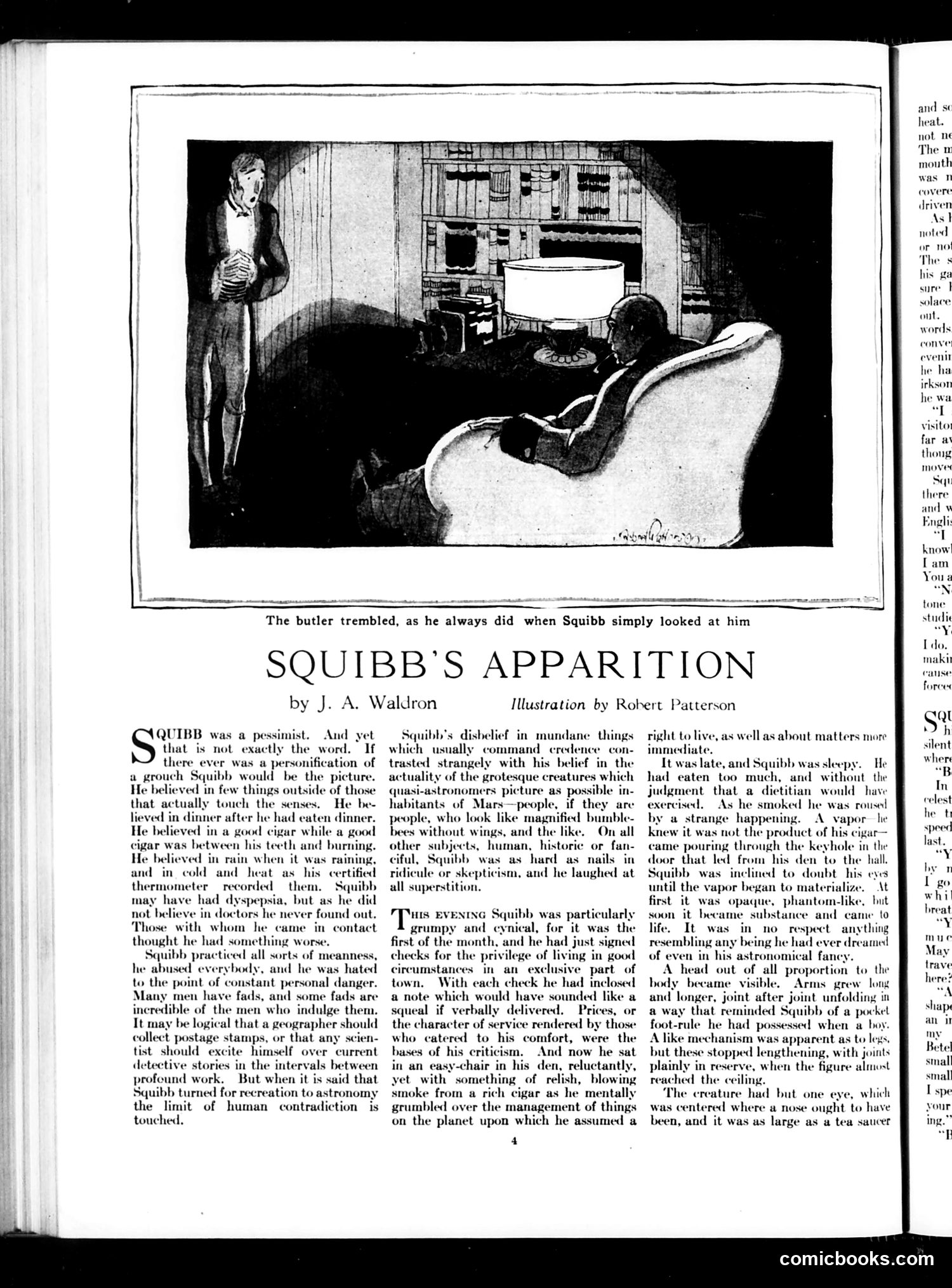
This is a fictional story illustration, not political satire. The image shows a butler trembling before a ghostly figure of "Squibb"—apparently a deceased employer or authority figure—materializing in what appears to be a well-appointed bedroom or study. The accompanying text describes Squibb as a pessimistic, demanding man obsessed with detecting fraud and imposing strict personal discipline. The story plays on classic ghost-story conventions: Squibb's apparition visits to continue harassing those he once controlled, even from beyond death. This appears to be humorous social commentary about overbearing authority figures and their lasting psychological impact, rather than political satire. The joke relies on Victorian-era ghost-story tropes familiar to Judge's contemporary readers.
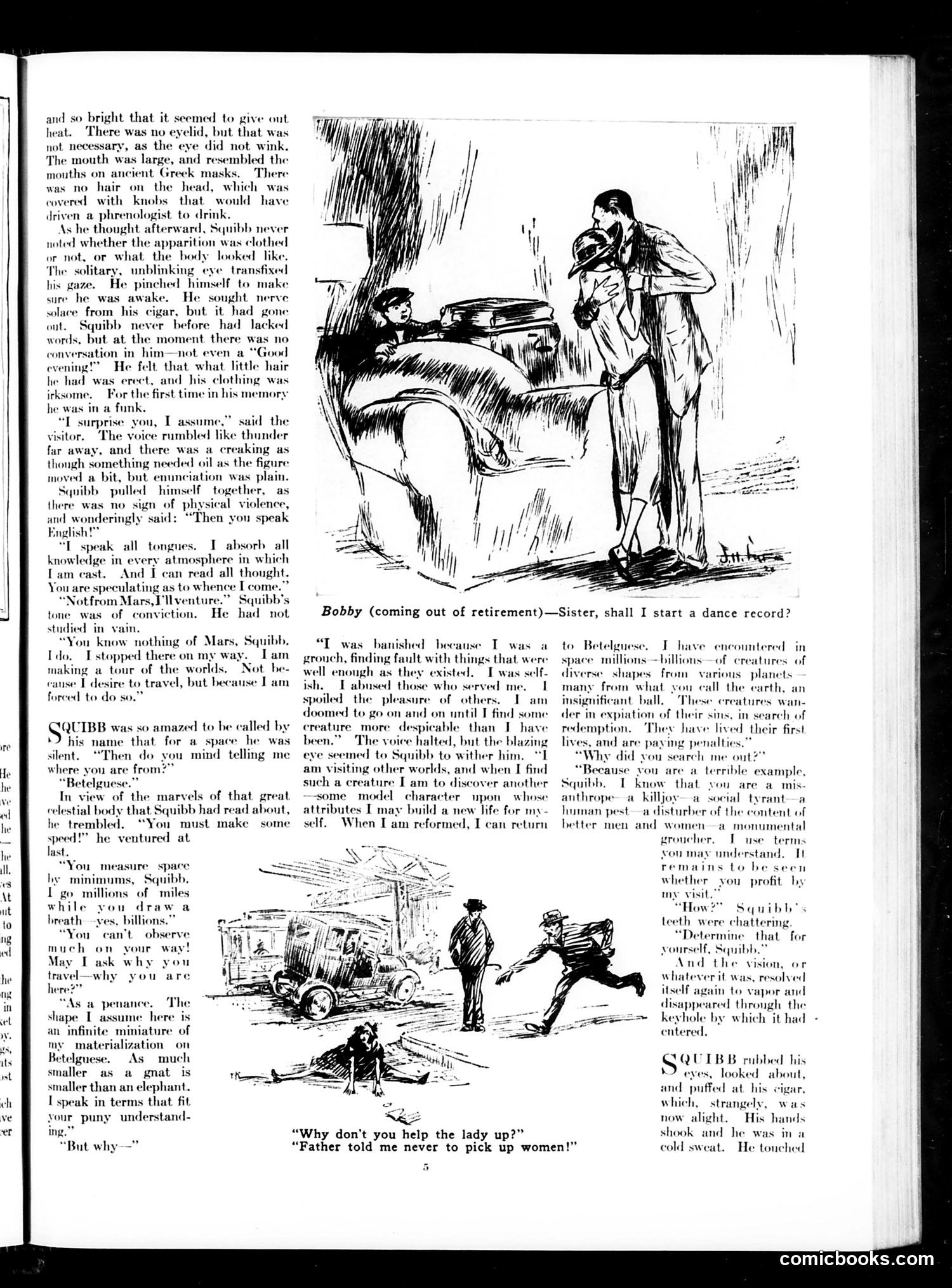
This page contains two distinct pieces of satirical fiction from *Judge* magazine: **Main Story: "The Visitor"** A fantastical tale where an alien being from Betelgeuse visits Earth character "Squibb," a misanthropic grouch. The alien—itself a reformed grouch banished to wander the cosmos—confronts Squibb about his negative character. The satire critiques social types: the perpetual complainer, the man who spoils others' pleasure, the fault-finder. The alien's mission to find someone "more despicable" than itself offers satirical commentary on human moral failings. Squibb represents the self-absorbed cynic common in Gilded Age satire. **Caption Cartoon: "Bobby Coming Out of Retirement"** Shows a young boy refusing to help a fallen woman, claiming "Father told me never to pick up women!" This satirizes both overly literal-minded obedience to parental advice and societal attitudes toward women—the "impropriety" of male-female contact taken to absurd extremes. It mocks Victorian prudishness through the boy's innocent misunderstanding. Both pieces use exaggeration to ridicule contemporary character flaws and social conventions.
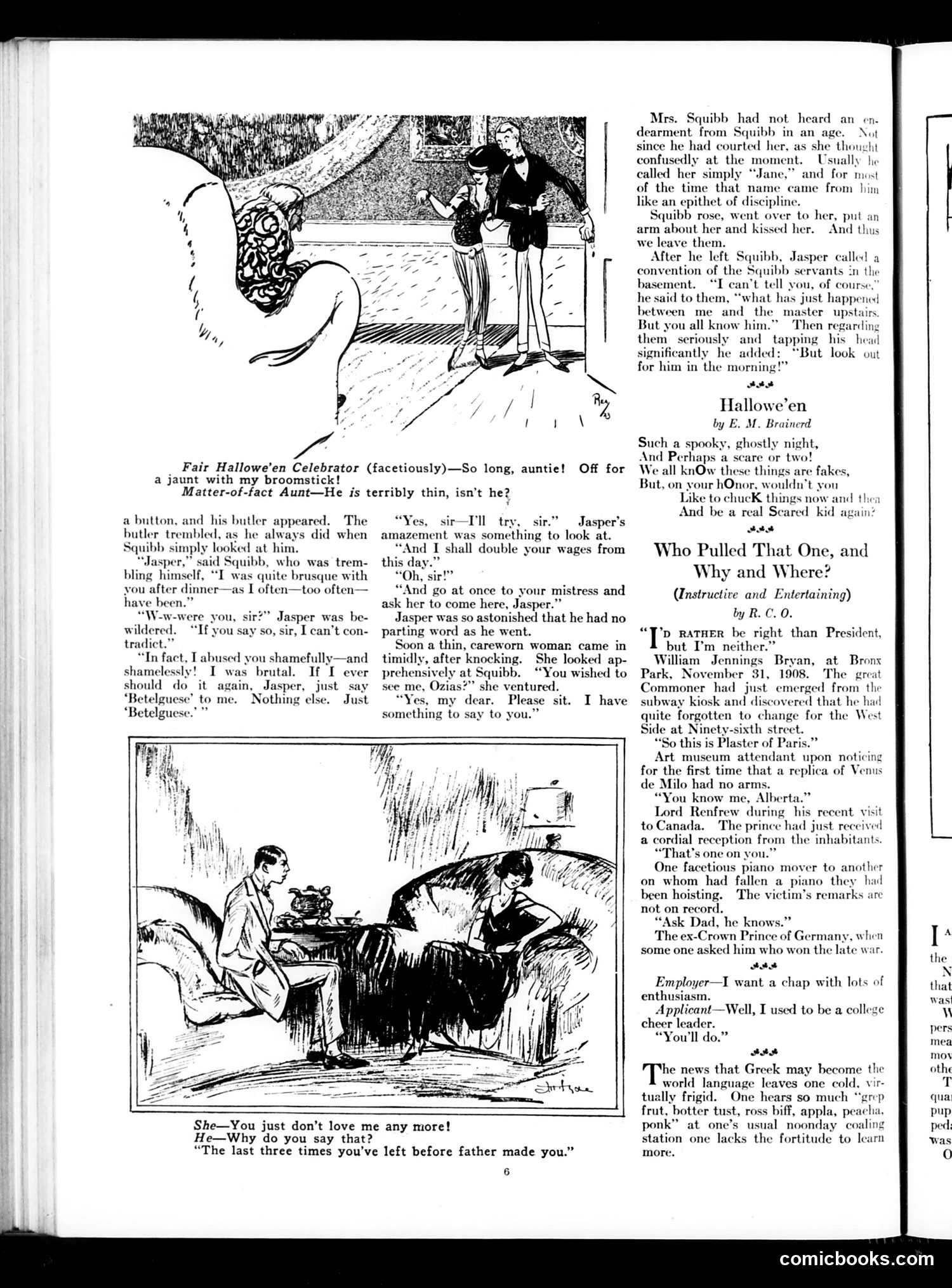
This page contains multiple humorous pieces typical of early 20th-century satirical journalism. **Top cartoons:** A "Fair Hallowe'en Celebrator" joke playing on Halloween witch imagery, and a domestic scene where a man apologizes to his wife and butler, prompting the butler to warn other servants "look out for him in the morning!"—suggesting the man's uncharacteristic kindness signals mental instability. **"Who Pulled That One, and Why and Where?":** A recurring humor column collecting attributed witticisms. Quotes attributed to William Jennings Bryan (1908), museum attendants, Lord Renfrew, piano movers, and the ex-Crown Prince of Germany reference contemporary public figures and recent events (the war, likely WWI). **Bottom section:** Brief jokes mocking Greek becoming a world language, using exaggerated phonetic slang ("grep frut, botter tust") to satirize how Americans would sound speaking Greek—ethnic humor typical of the era. The overall tone is genteel, observational humor targeting educated readers aware of current events and prominent personalities.
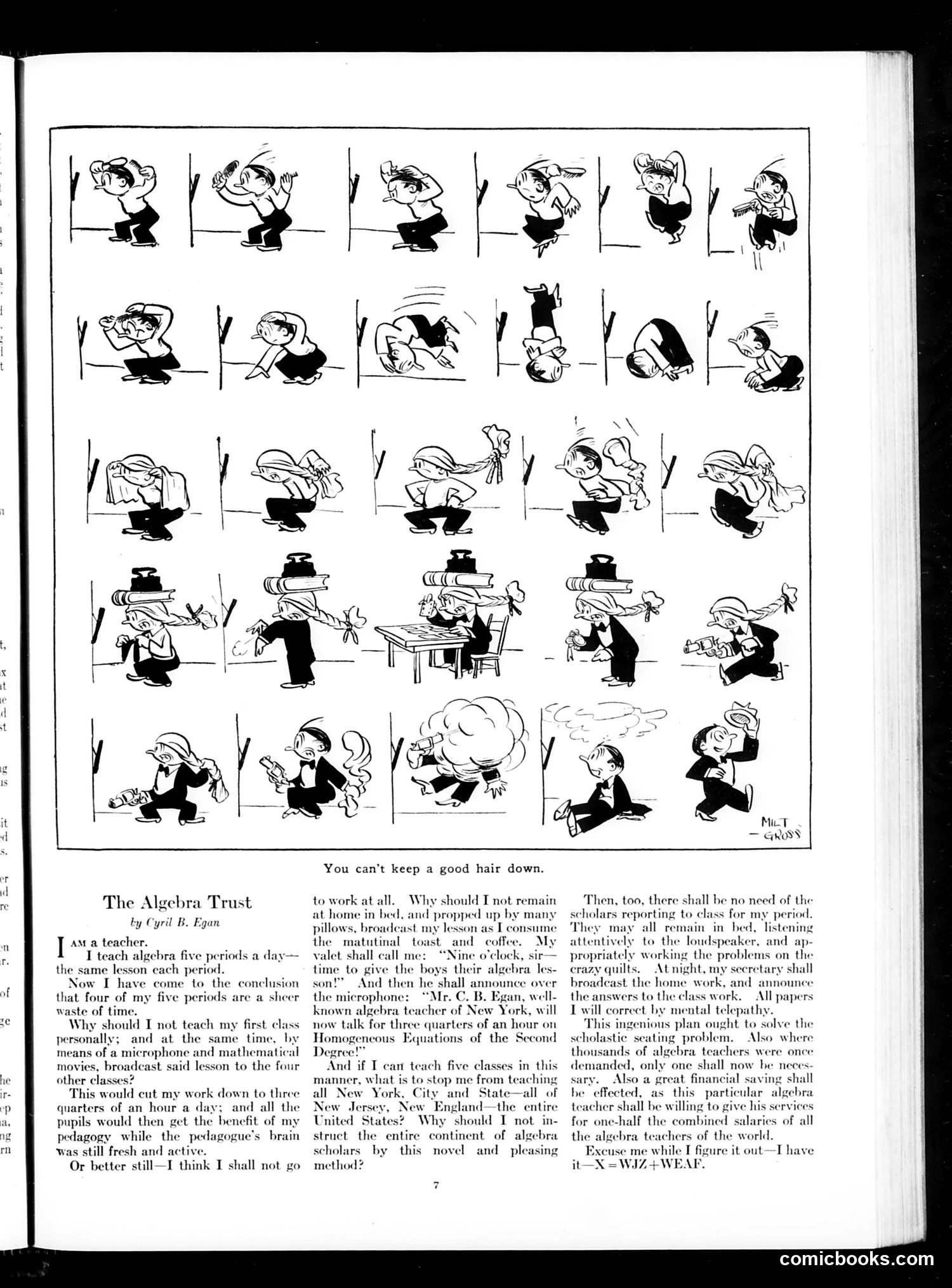
This page satirizes inefficient educational bureaucracy and the fantasy of consolidating teaching labor. **The Setup:** A teacher proposes using microphones to broadcast his algebra lesson to multiple classes simultaneously, then imagines the logical extreme: teaching all students across New York, the entire Northeast, and eventually the continent from his bed, with a valet announcing his lesson and a secretary broadcasting homework answers. **The Satire:** The cartoon mocks: 1. **Educational "trusts"** (monopolistic consolidation) — similar to contemporary corporate trusts being debated 2. **Teacher laziness and self-interest** — the instructor's fantasy of maximum pay for minimal work 3. **Technology utopianism** — naive faith that broadcasting could replace in-person education 4. **Labor displacement** — replacing thousands of teachers with one, a capitalist efficiency scheme presented absurdly **The Joke:** The final equation "X=WJZ+WEAP" is nonsensical algebra, mocking both the scheme's logic and the subject itself. The "You can't keep a good hair down" caption references the hair-raising absurdity of the proposal.
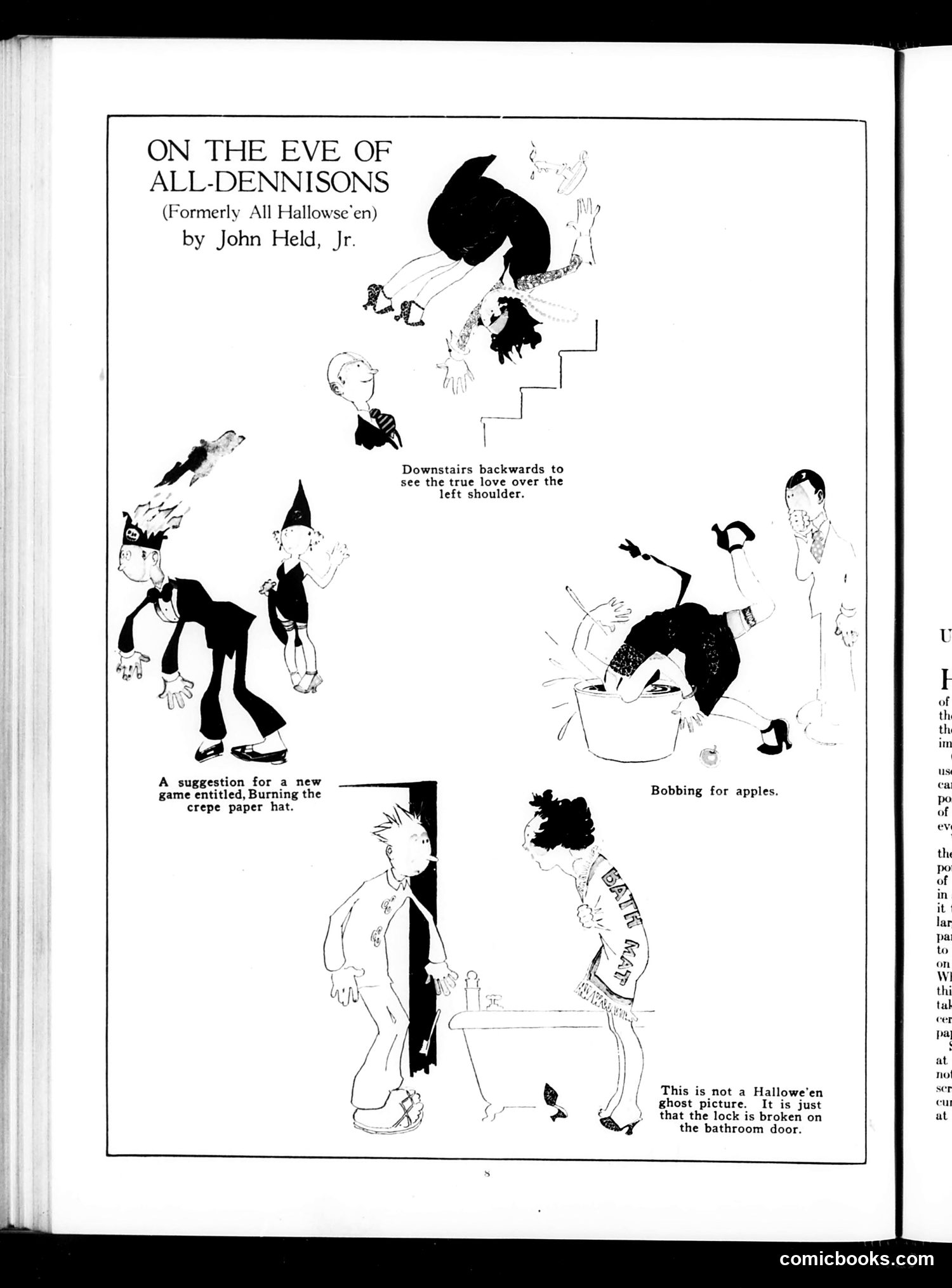
This page satirizes Halloween traditions while punning on "Dennisons," likely a popular manufacturer of Halloween decorations and party supplies of that era. Held presents six comic vignettes depicting typical All Hallows' Eve activities with humorous twists: The illustrations show children engaged in recognizable Halloween games—bobbing for apples, burning crepe paper hats—alongside folk traditions like walking backwards downstairs to glimpse one's "true love" over the left shoulder. The final panel's joke subverts expectations by explaining an apparently ghostly figure is actually someone locked out of a broken bathroom door. The humor derives from the contrast between anticipated supernatural thrills and mundane domestic reality, characteristic of Held's satirical approach to American social customs.
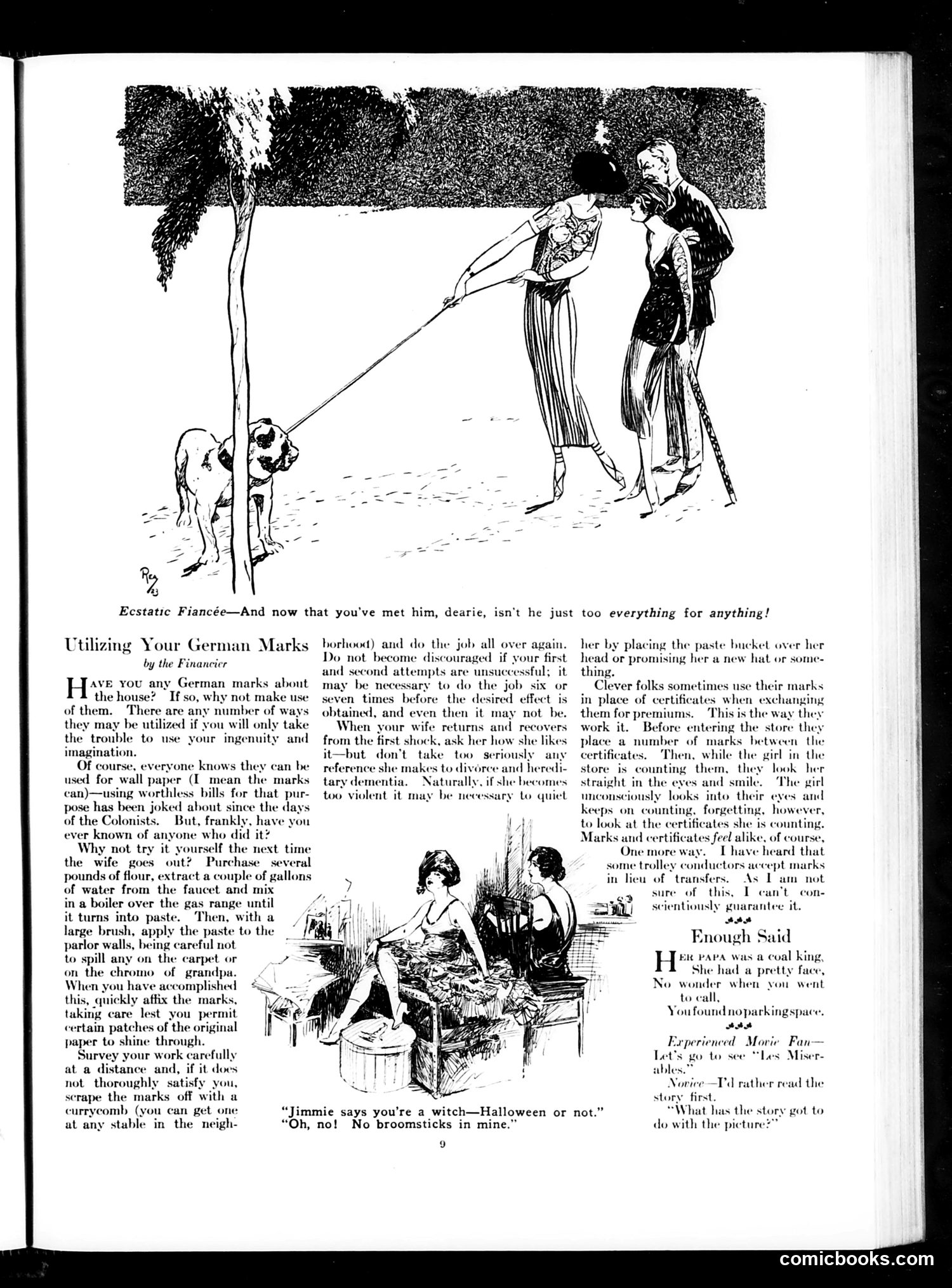
This page contains two unrelated pieces of early 20th-century satire: **"Utilizing Your German Marks"** mocks the hyperinflation of German currency after World War I, when German marks became so worthless they were literally used as wallpaper or paste. The "advice" column sarcastically suggests humorous uses—including passing them off as certificates or to transit conductors—satirizing both the currency collapse and petty fraud schemes that exploited it. **The cartoons** show domestic humor: the top depicts a woman presenting her fiancé to a friend; the middle shows two women with cleaning supplies, with one joking about being called a witch (likely a Halloween reference); the bottom features a brief exchange about parking scarcity at a coal magnate's house, and moviegoers debating whether to read story descriptions or just look at pictures. The satire targets post-WWI economic chaos, everyday marital dynamics, and emerging consumer culture around automobiles and cinema.
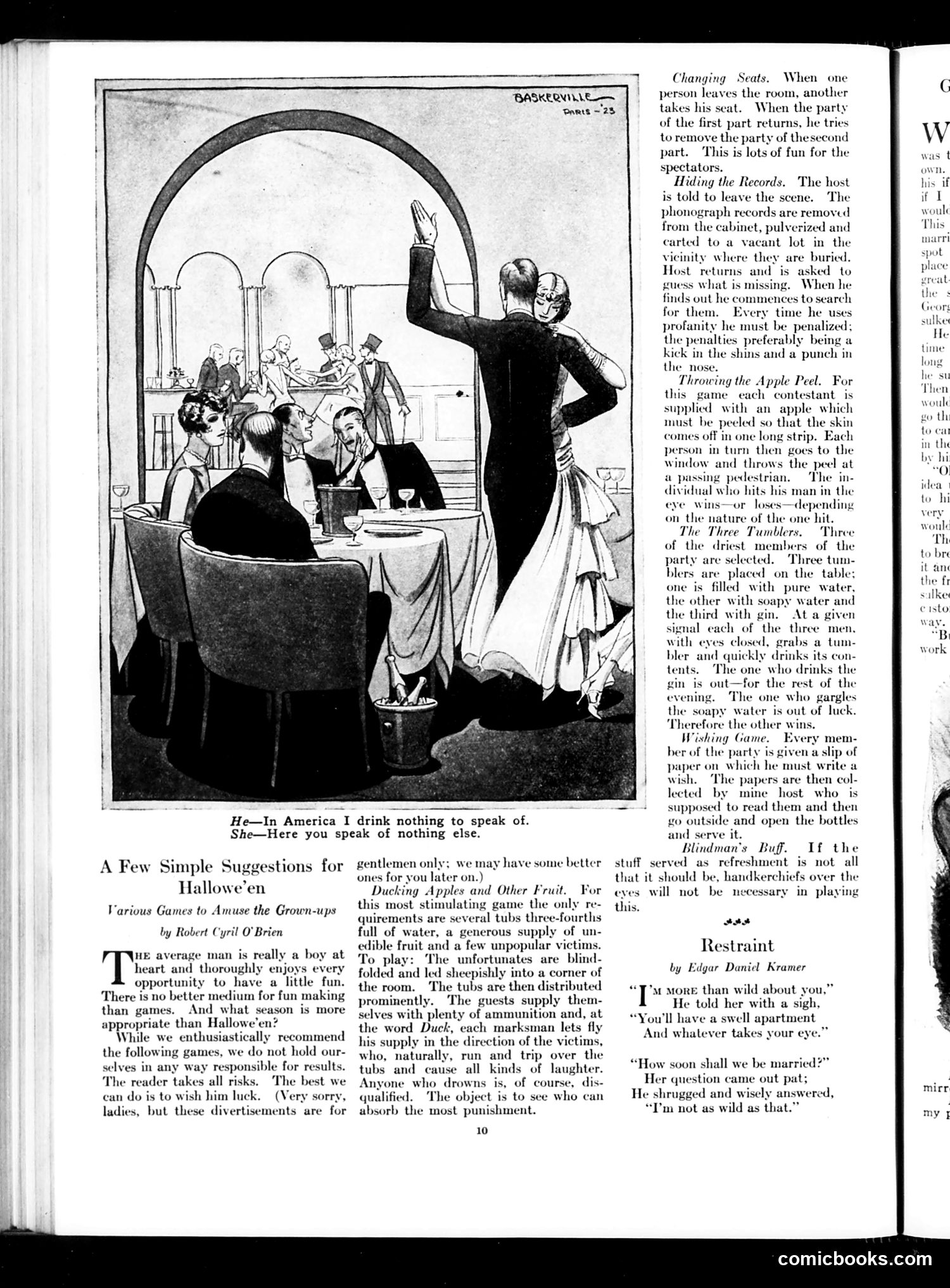
This page contains two distinct pieces from Judge magazine: **The Cartoon ("Baskerville"):** A man outside a window watches a dinner party inside, making a quip about American drinking habits—the joke being that Americans claim to "drink nothing to speak of" but then talk constantly about it. This appears to be post-Prohibition satire (note "Pants '23"), mocking the contradiction between official temperance and actual behavior during or after alcohol restrictions. **"A Few Simple Suggestions for Hallowe'en":** A humorous article describing absurdly cruel party games disguised as entertainment—dunking people in water, throwing fruit at blindfolded victims, burying phonograph records. The satirical point is that these "games" are actually forms of mild torture presented as fun. The accompanying poem "Restraint" jokes about a man's courtship cooling when marriage becomes real. The overall tone is sophisticated mockery of upper-class social pretense and behavior, typical of Judge's satirical approach to American manners and hypocrisy.
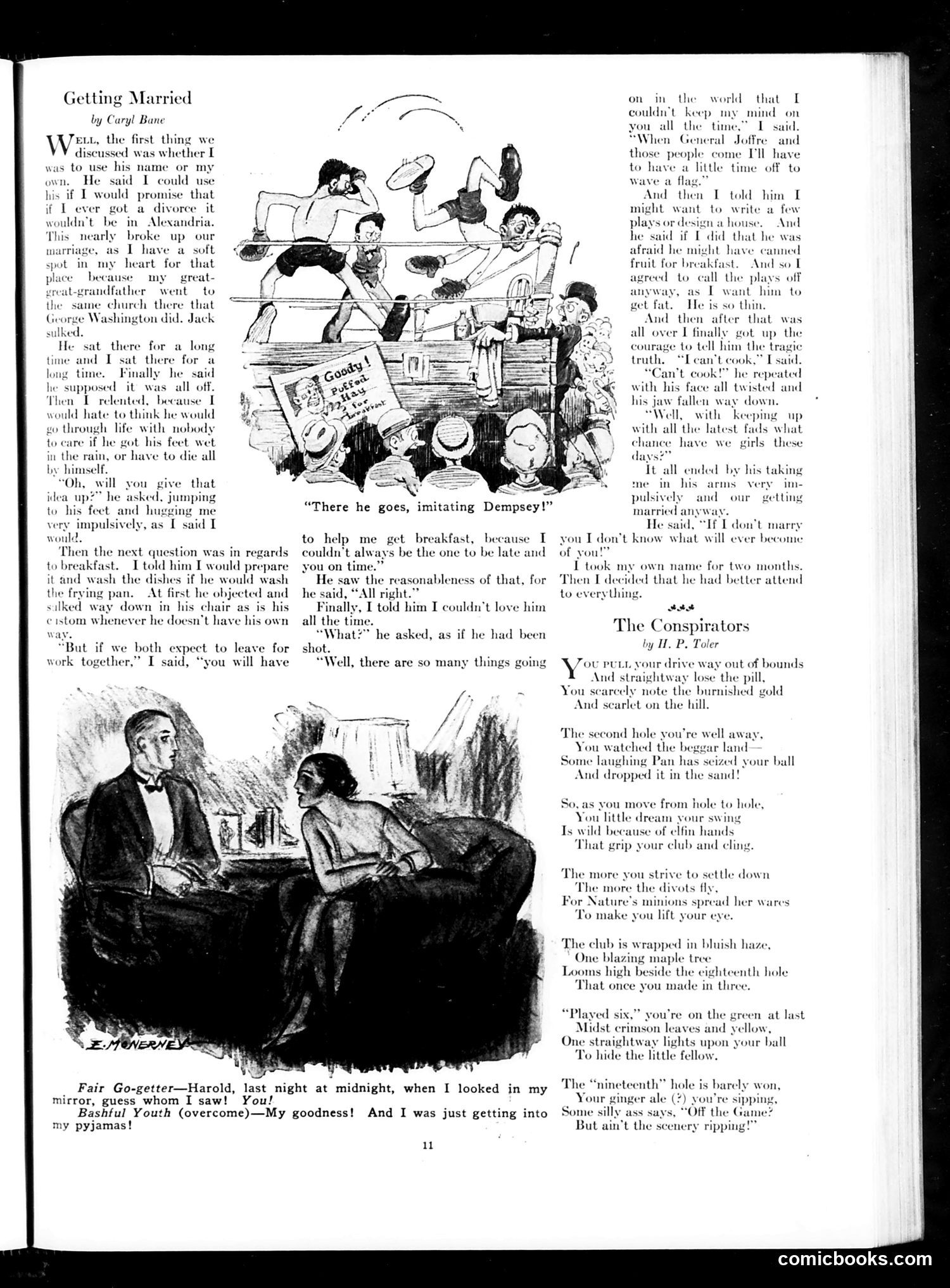
**"Getting Married"** by Caryl Bane is a humorous domestic-relations piece about a couple negotiating marriage terms. The bride-to-be insists on keeping her own name, refuses to promise eternal devotion, and admits she can't cook—each revelation nearly derails the engagement. The joke satirizes modern women's independence (circa 1920s Judge era) and the friction between traditional masculine expectations and female autonomy. The husband ultimately accepts her terms, resigned that single life is worse. **"The Conspirators"** by H.P. Toler is a golf poem describing "elfin hands" and "Nature's minions" sabotaging a golfer's game—losing balls, creating distractions, ruining his swing. It's whimsical nature-poetry framed as mischievous spirits interfering with sport, culminating in the ironic observation that scenery matters more than actual golfing ability.
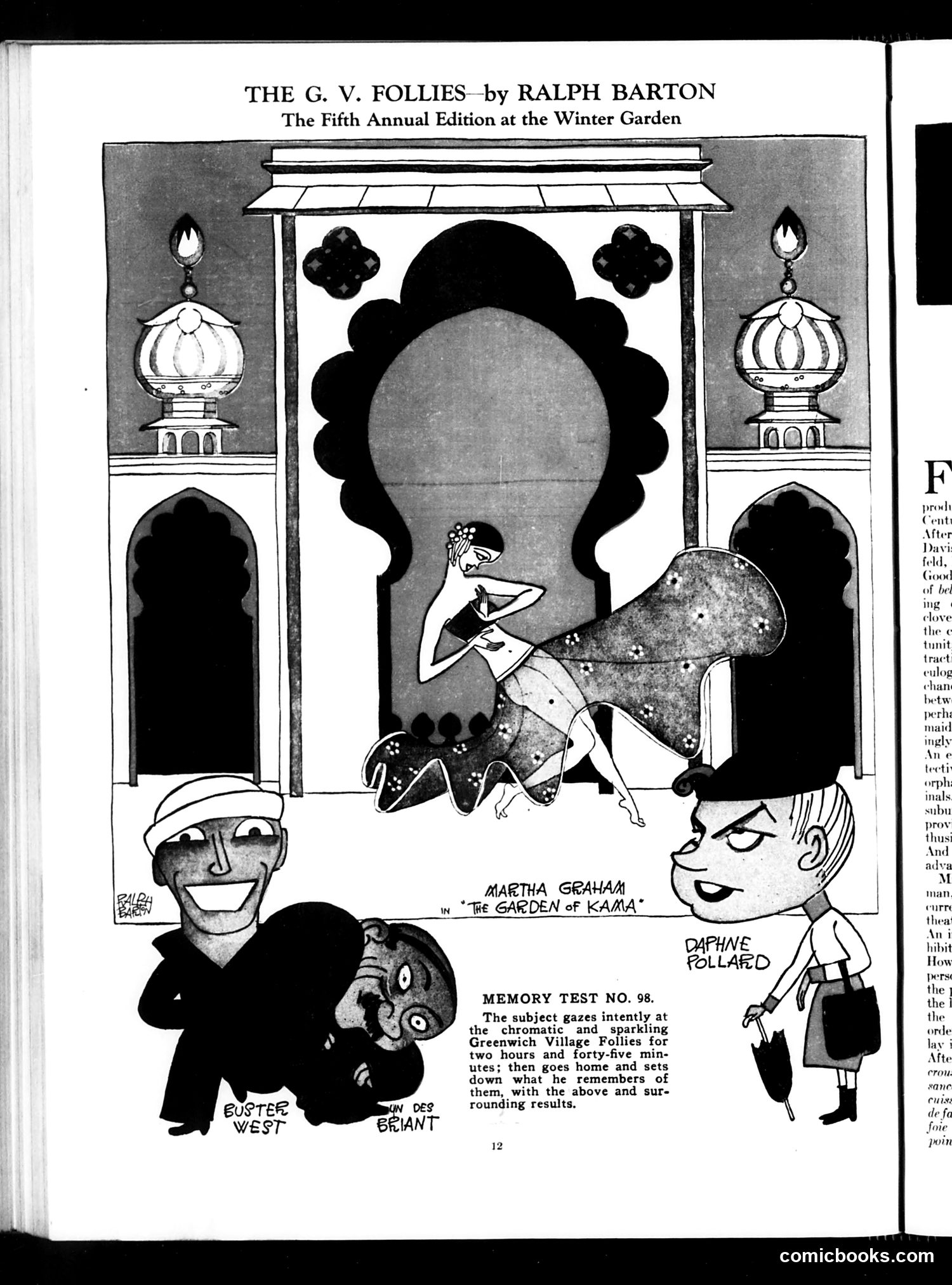
This is a theatrical satire from Judge magazine featuring Ralph Barton's commentary on the Greenwich Village Follies—a real Broadway revue of the 1920s. The main illustration shows a stylized female dancer performing in an exotic, ornate setting, with performers identified as Martha Graham (in "The Garden of Kama") and Daphne Pollard. The "Memory Test No. 98" is the satirical joke: viewers attend the show for 2 hours and 45 minutes, then attempt to recall what they've seen. The caricatured faces at bottom (Buster West and "In Des Briant") represent audience members whose actual memories differ wildly from the reality. This mocks both the visual spectacle of 1920s theatrical productions and audiences' unreliable recollections—suggesting the Follies rely more on dazzle than substance.
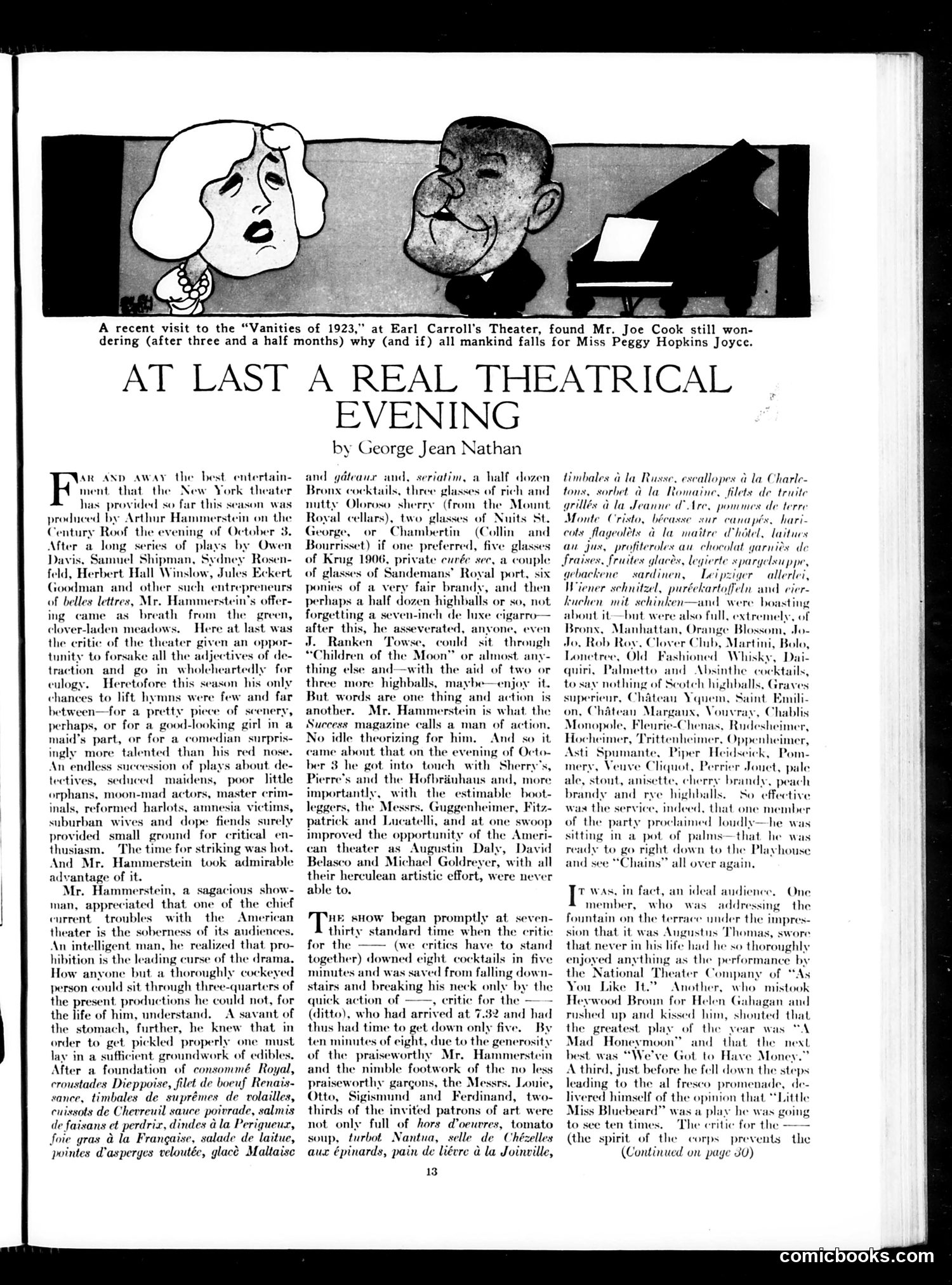
The cartoon at the top satirizes Joe Cook's bewilderment over the popularity of actress Peggy Hopkins Joyce, who appeared in the "Vanities of 1923" at Earl Carroll's Theater. The exaggerated caricatures—a glamorous woman (Joyce) and a confused man (Cook)—mock the inexplicable appeal of Joyce, a famous "It girl" of the 1920s known more for her beauty and romantic scandals than theatrical talent. The article below, by critic George Jean Nathan, reviews a production by Arthur Hammerstein. Nathan sarcastically argues that American theater's real problem isn't bad plays but Prohibition—audiences can't enjoy mediocre theater without alcohol. He humorously describes an elaborate pre-show meal and drinks designed to get the critic sufficiently intoxicated to enjoy the performance. The satire critiques both Prohibition's impact on entertainment culture and the desperation of producers trying to compensate for poor theatrical quality.
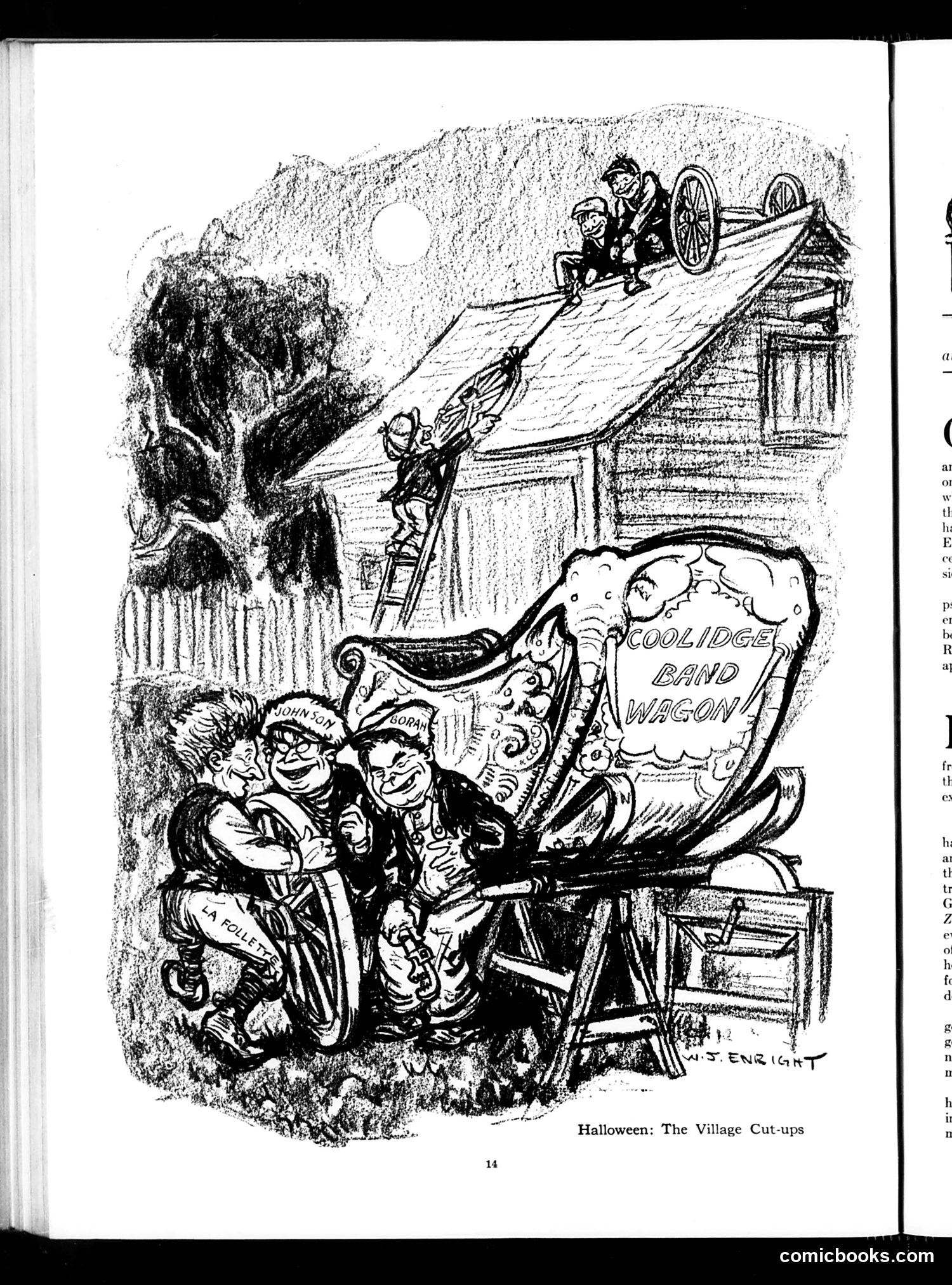
This is a Halloween-themed illustration from *Judge* magazine depicting a humorous scene of village pranksters. The cartoon shows three caricatured men in the foreground operating a "Coolidge Band Wagon" pulled by an elephant—a clear political reference to President Calvin Coolidge and Republican politics of the 1920s. Above them, other figures engage in classic Halloween mischief: two boys on a rooftop with a cart, another figure on a ladder, and general chaos around a rural house. The satire appears to mock both the villagers' pranks and, through the elephant wagon, Republican political machinations of the era. The "cut-ups" are simultaneously literal Halloween troublemakers and political operatives, suggesting satirical commentary on contemporary politics disguised as innocent holiday fun.
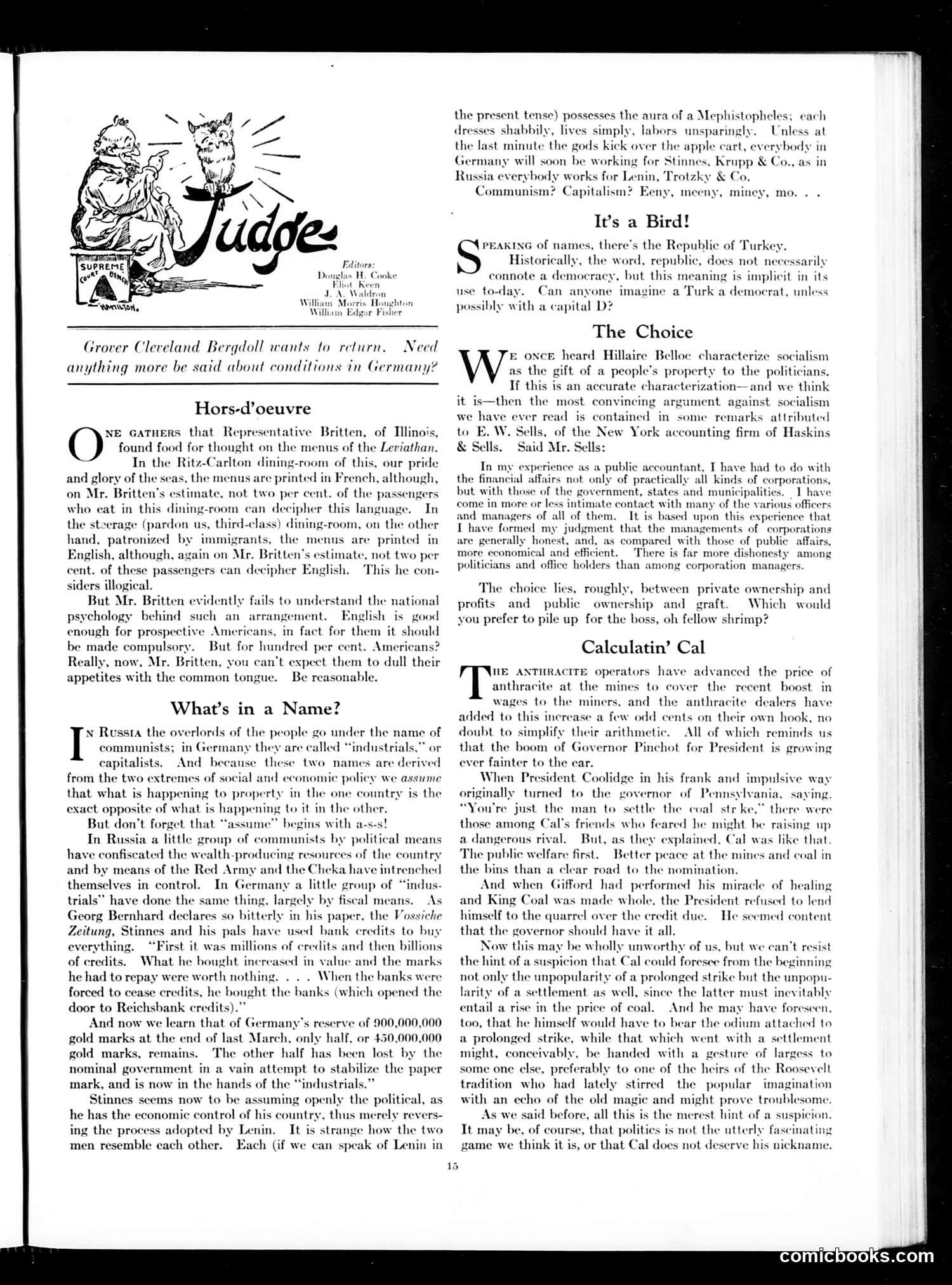
The page contains four distinct political commentaries: **"Hors-d'oeuvre"** mocks Representative Britten of Illinois for criticizing that first-class ship dining menus are in French while steerage menus are in English. The satire suggests wealthy Americans deliberately use French to distinguish themselves from immigrants, who are given English menus they supposedly can't read either—exposing class pretension. **"What's in a Name?"** compares post-WWI Germany and Soviet Russia, arguing both are controlled by small elite groups (industrialists vs. communists) despite opposite ideologies. It references Hugo Stinnes, a German industrialist who accumulated vast wealth and power through bank credits during hyperinflation, paralleling Lenin's political control. **"It's a Bird!"** ridicules Turkey's adoption of "Republic" as a name while remaining an autocracy under presumably non-democratic leadership. **"The Choice"** begins discussing socialism, attributing to Hilaire Belloc a definition of socialism as transferring people's property to politicians. The overall theme: post-war governments—whether communist or capitalist—concentrate power in few hands while using ideological labels to mask oligarchic control.
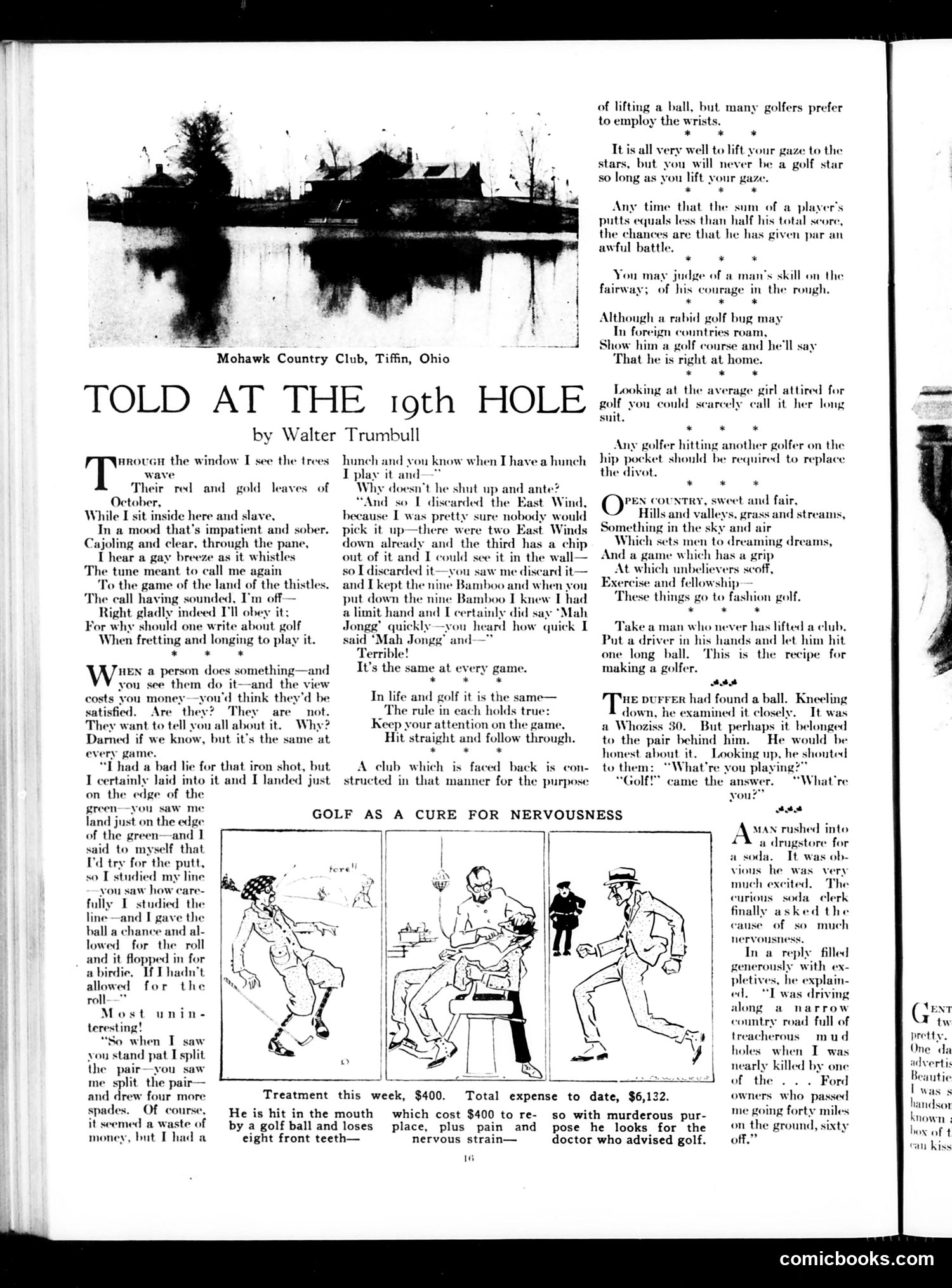
This page from *Judge* magazine presents satirical golf content targeting early 1900s leisure culture. The main story by Walter Trumbull mocks a common social irritant: the bore who won't stop recounting every detail of their golf game. The repeated refrain—"you saw me"—satirizes the tedious, ego-driven golf anecdote. The accompanying cartoons and "Golf as a Cure for Nervousness" section continue the theme, showing golf's prominence in upper-middle-class American life as both recreation and supposed therapeutic treatment. The final anecdote about the "duffer" finding a golf ball and confusing its owner emphasizes the era's pretension around golf as a marker of sophistication and honesty among gentlemen. The humor targets both golf obsession and the social performance surrounding it—familiar themes that remain recognizable today, though the specific cultural context (golf as exclusive gentleman's pursuit) has changed substantially.
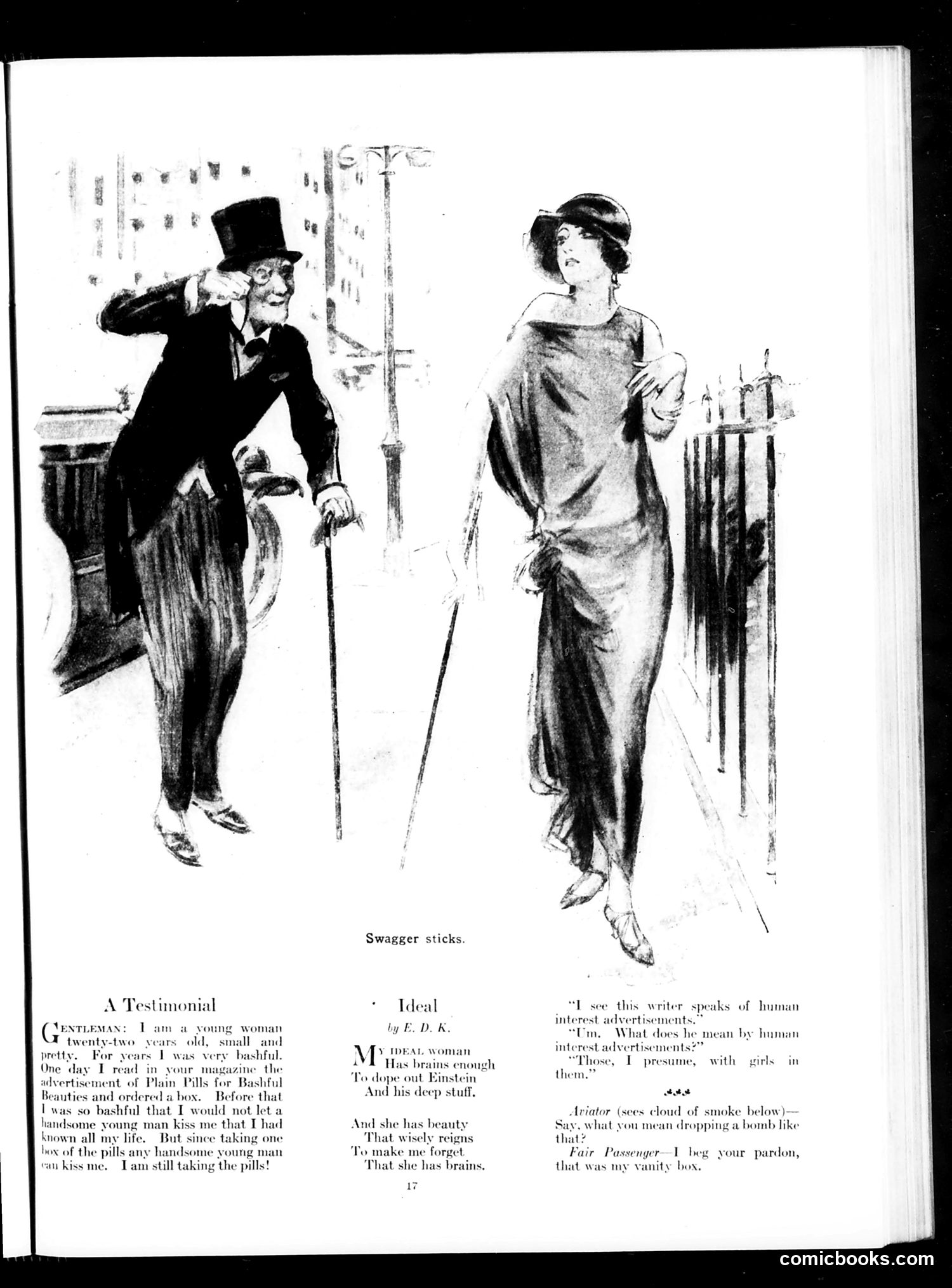
This page contains three satirical pieces mocking early 20th-century advertising and gender attitudes: **"A Testimonial"** (left): A fake endorsement for "Plain Pills for Bashful Beauties"—satirizing dubious patent medicine ads that made absurd claims. The humor lies in the woman's confession that pills transformed her from refusing kisses to accepting them from any handsome man, implying the product's actual effect is moral corruption, not confidence. **"Ideal"** (center): A poem mocking the "modern woman" who has enough brains to understand Einstein's physics but ironically lacks actual intelligence—satirizing how contemporary culture celebrated women's intellectual aspirations while still viewing them as fundamentally shallow. **The cartoon and dialogue** (right): A military aviator and female passenger exchange witty banter. She drops her "vanity box" (cosmetics case), which explodes like a bomb. The joke critiques women's vanity and excess concern with appearance, presented as literally destructive. Overall, the page satirizes both fraudulent advertising targeting women and misogynistic attitudes about female intelligence and vanity.
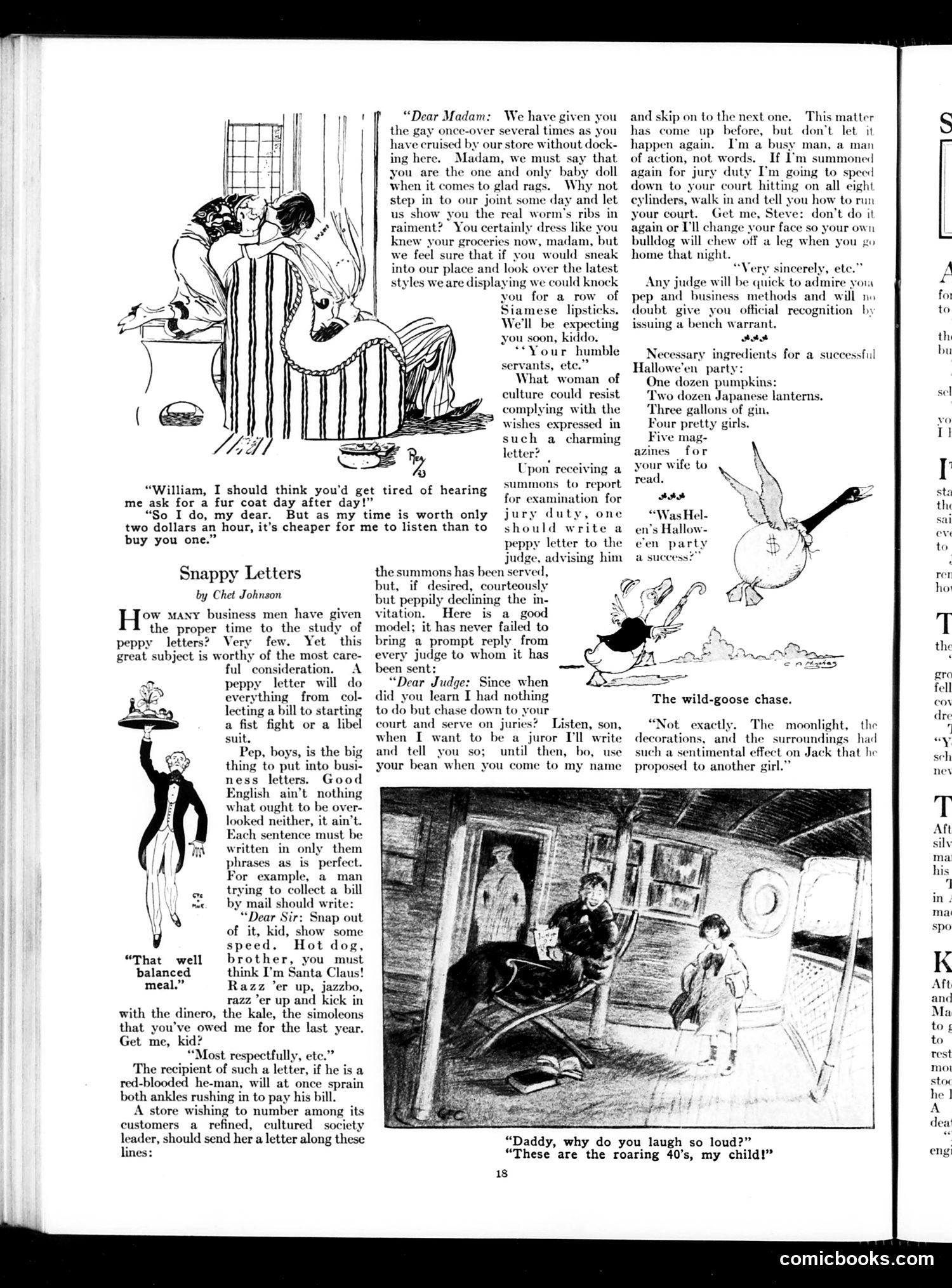
This page satirizes business correspondence and social etiquette through mock "peppy" letters. The humor relies on deliberately crude, disrespectful tone presented as advice for formal situations—the opposite of what's actually appropriate. The examples include: a bill collector using slang ("Hot dog," "dinero," "razz 'er up"), a store soliciting a refined customer with patronizing familiarity ("doll," "glad rags"), and most pointedly, a jury summons response that insults the judge while refusing to serve. Each letter is framed as "model" correspondence that supposedly succeeds, when in reality it would horrify recipients. The joke targets both oblivious business writers who mistake bombast for effectiveness, and broader 1920s-30s anxieties about declining manners and formality. The accompanying illustrations (a woman in modern dress, comedic figures) reinforce the satirical tone. The page mocks the false confidence of men mistaking rudeness for "pep" or business acumen.
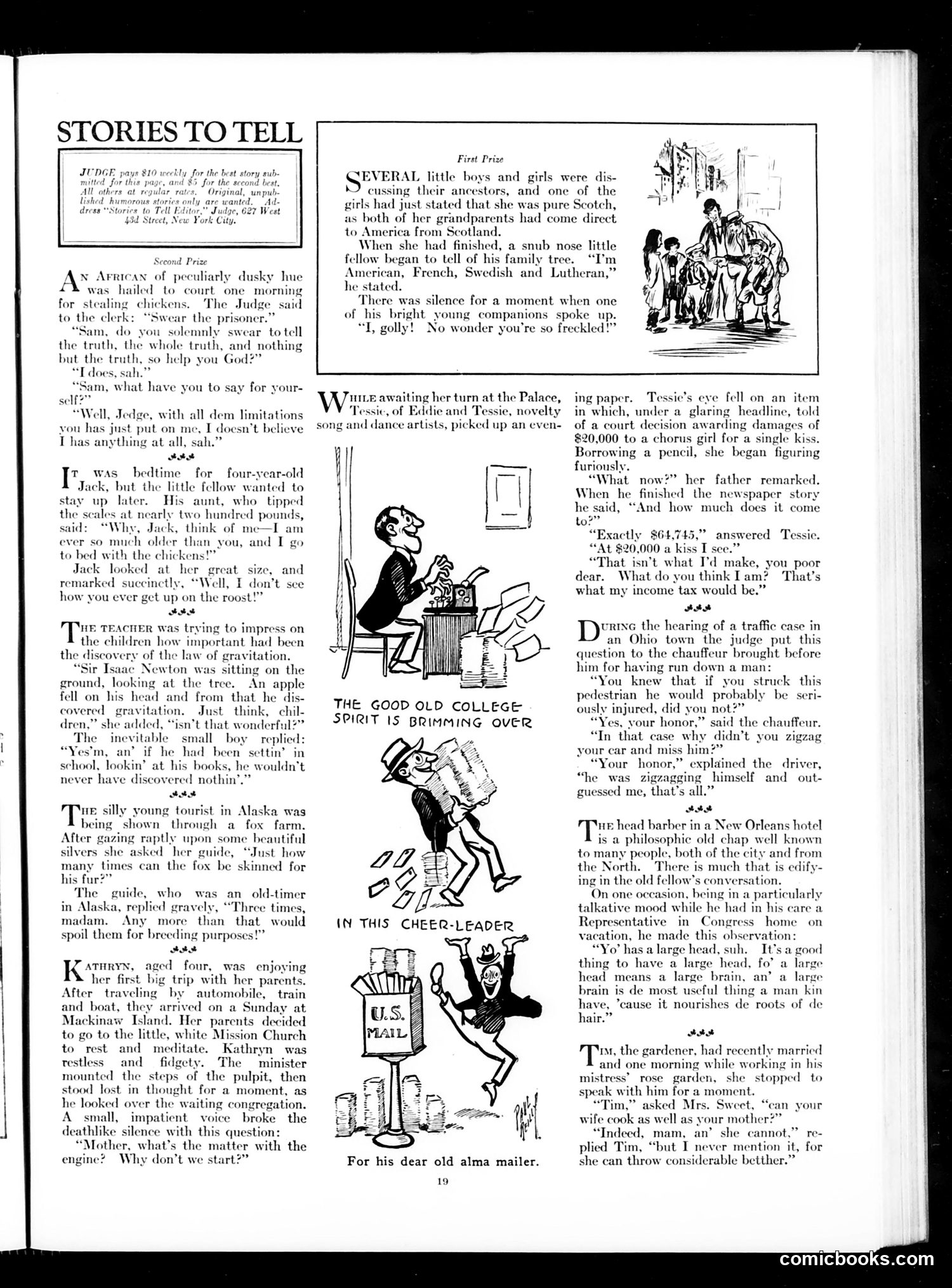
This *Judge* magazine page contains humorous short stories reflecting early 20th-century American attitudes. Key satirical points: **"Sam's Defense"**: Mocks African American dialect and court testimony, using racist stereotypes common to the era's "humor." **"Jack and His Aunt"**: A child's blunt observation about an overweight woman—typical period comedy centered on body-shaming. **"The Apple and Gravitation"**: Gentle satire of schoolchildren's literalism versus scientific insight. **"Tessie's Calculation"**: A chorus girl calculates her "worth" based on a lawsuit awarding $20,000 for a kiss, then computes her potential income tax—satire on both female performers' economics and taxation. **"The Traffic Case"**: Dark humor about a pedestrian being struck by a car, reflecting early automobile-era anxieties. The overall tone reflects *Judge*'s satirical focus on contemporary social situations, human nature, and period-specific concerns, though many jokes rely on stereotypes now considered offensive.
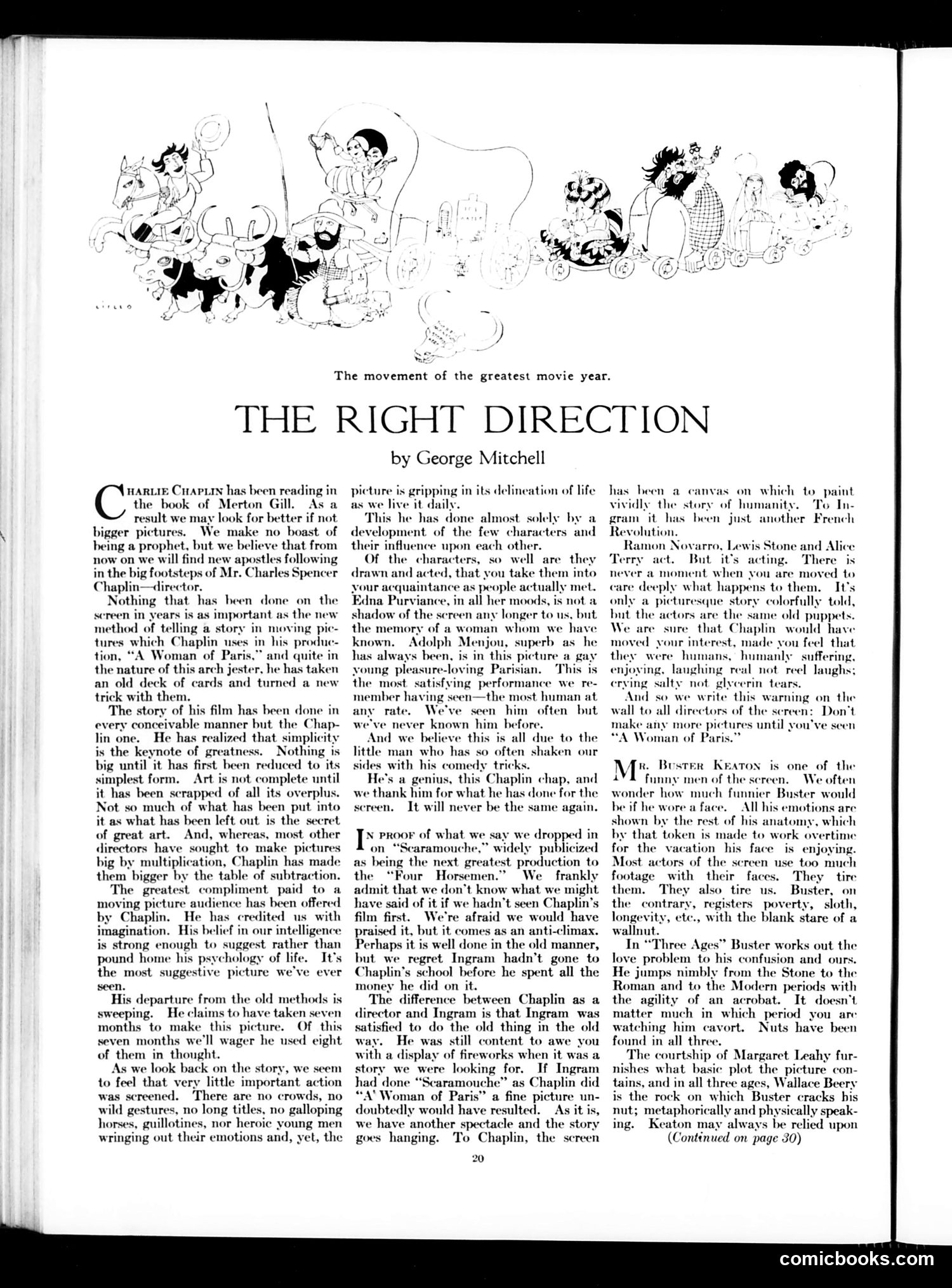
This is a film review (not primarily satirical cartoon) praising Charlie Chaplin's directorial debut, "A Woman of Paris" (1923). The illustrated header shows Chaplin and other figures in a celebratory parade or procession. **Key figures discussed:** - **Charlie Chaplin** - transitioning from actor to director - **Edna Purviance** - actress in the film - **Adolphe Menjou** - playing a "gay young pleasure-loving Parisian" **The point:** The critic argues Chaplin revolutionized filmmaking by using *subtraction* rather than multiplication—minimal crowds, sets, and dramatic gestures, relying instead on character development and audience imagination. This contrasts favorably with director Rex Ingram's "Scaramouche," criticized for following old-fashioned spectacle-driven methods. The satire is implicit: other directors waste money on elaborate production values while Chaplin achieves superior artistry through restraint and psychology.
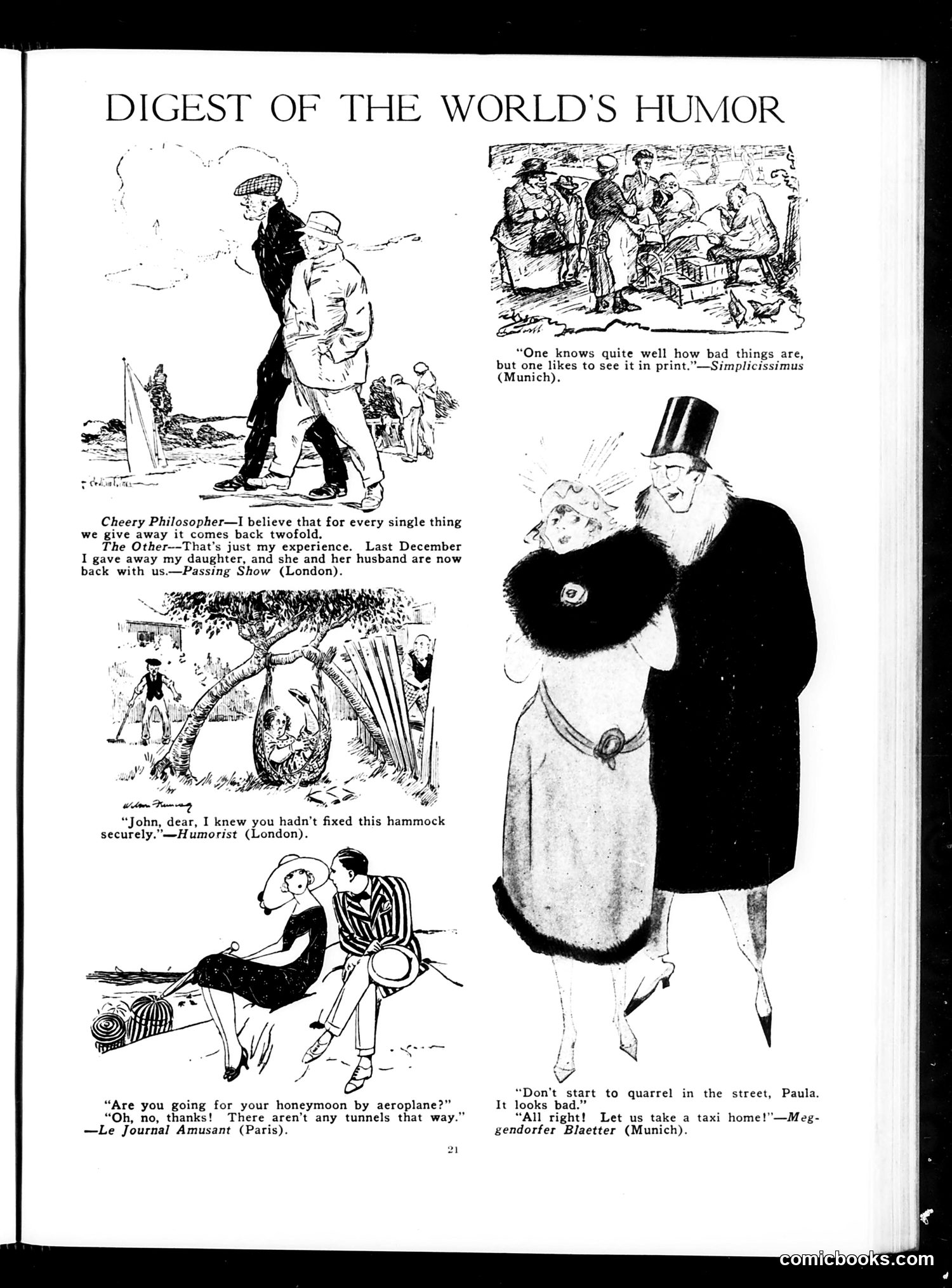
This is a "Digest of the World's Humor" page collecting international jokes and cartoons from various European publications (Munich, London, Paris). The humor reflects early 20th-century concerns: 1. **The "Cheery Philosopher"** joke plays on unwanted family obligations—giving away one's daughter in marriage was meant to be permanent, but the newlyweds returning home suggests both marriage difficulties and economic hardship forcing dependency. 2. **The hammock cartoon** depicts a domestic accident, poking fun at husbands' incompetence at household repairs. 3. **The honeymoon/aeroplane joke** references the novelty and danger of early aviation—avoiding airplane travel because there were "no tunnels" is absurdist humor about fear of flying. 4. **The street quarrel cartoon** shows concern about public propriety and appearance, satirizing how couples hide marital discord in public. The page demonstrates how international satirical magazines shared similar comedic sensibilities about marriage, domesticity, and modern anxieties.
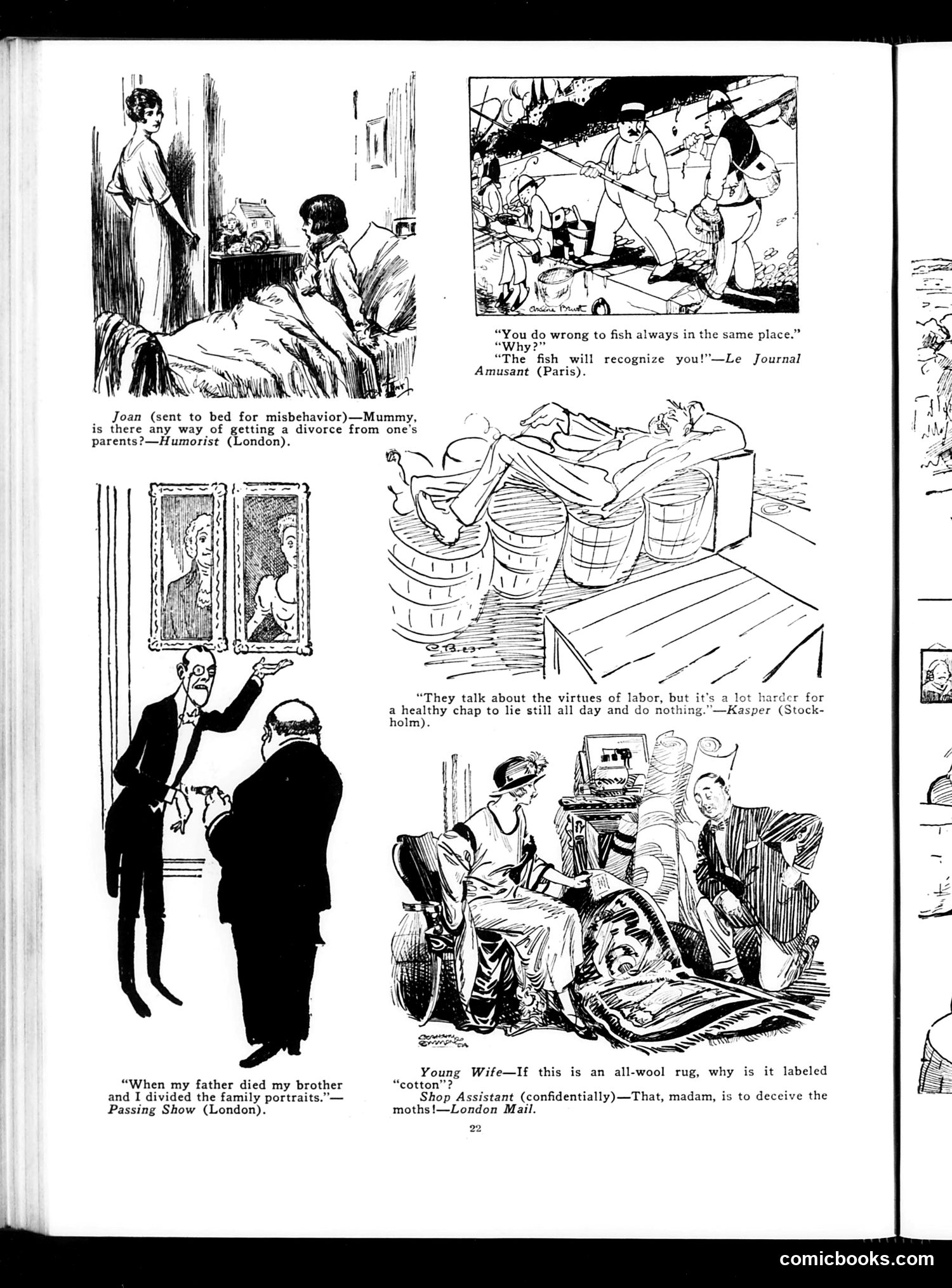
This page collects international satirical humor from various publications, presented as amusing quotes and cartoons. **The jokes satirize:** 1. **Fishing/Repetition**: A French joke about overfishing the same spot—fish will recognize you, implying diminishing returns from predictable behavior. 2. **Childhood rebellion**: A British joke where a child asks about divorcing their parents, mocking both parental authority and children's frustrations. 3. **Idleness vs. labor**: A Swedish comment mocking moralists who praise hard work while lazily lounging all day—hypocrisy about virtue. 4. **Consumer deception**: A London joke where a shop assistant admits labeling all-wool rugs as "cotton" to fool moths, satirizing merchant dishonesty and absurd business logic. 5. **Inheritance**: A British quip about dividing family portraits after a father's death, poking fun at materialism and sibling disputes. The page functions as a cultural digest of contemporary satire from multiple European sources, appealing to Judge's sophisticated, internationally-aware readership.
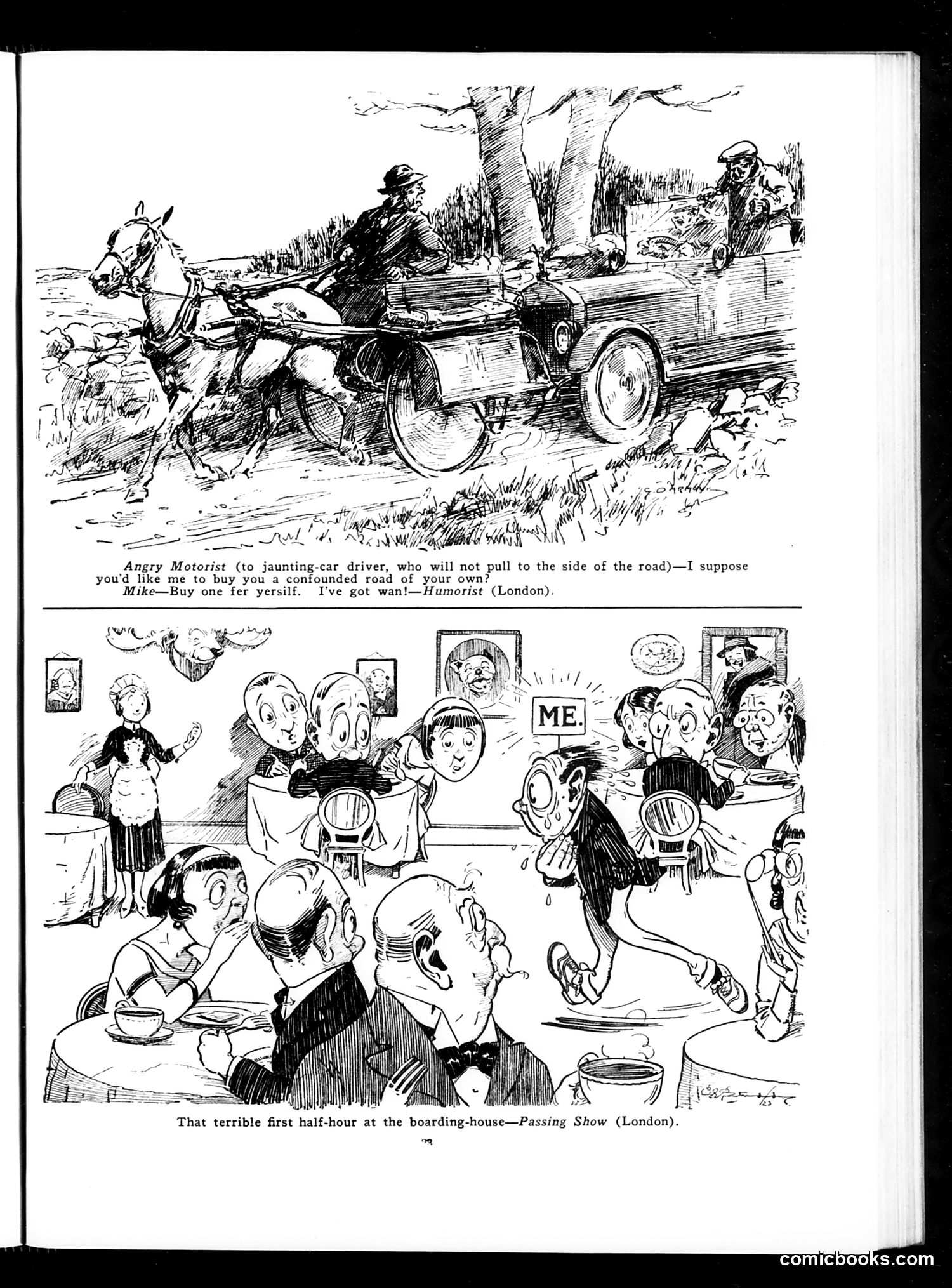
**Top Cartoon:** Depicts a conflict between an early motorist and a horse-drawn jaunting car (Irish carriage) driver who refuses to yield the road. The motorist sarcastically suggests buying the driver his own road; the driver retorts he already has one. This satirizes the clash between new automobile traffic and traditional horse transport—a common tension in early 20th-century streets. The joke mocks both the motorist's entitlement and the driver's stubborn refusal to adapt to changing conditions. **Bottom Cartoon:** Shows the awkward social chaos of a boarding-house dining room's first meal. Residents peer at each other with exaggerated curiosity, one holds a sign reading "ME" (identifying himself), while others eat and stare. The satire captures the universal discomfort of meeting strangers at a boarding-house table—the forced introductions, competitive sizing-up, and social anxiety of communal dining. It's an observational humor piece about uncomfortable first impressions in shared lodging.
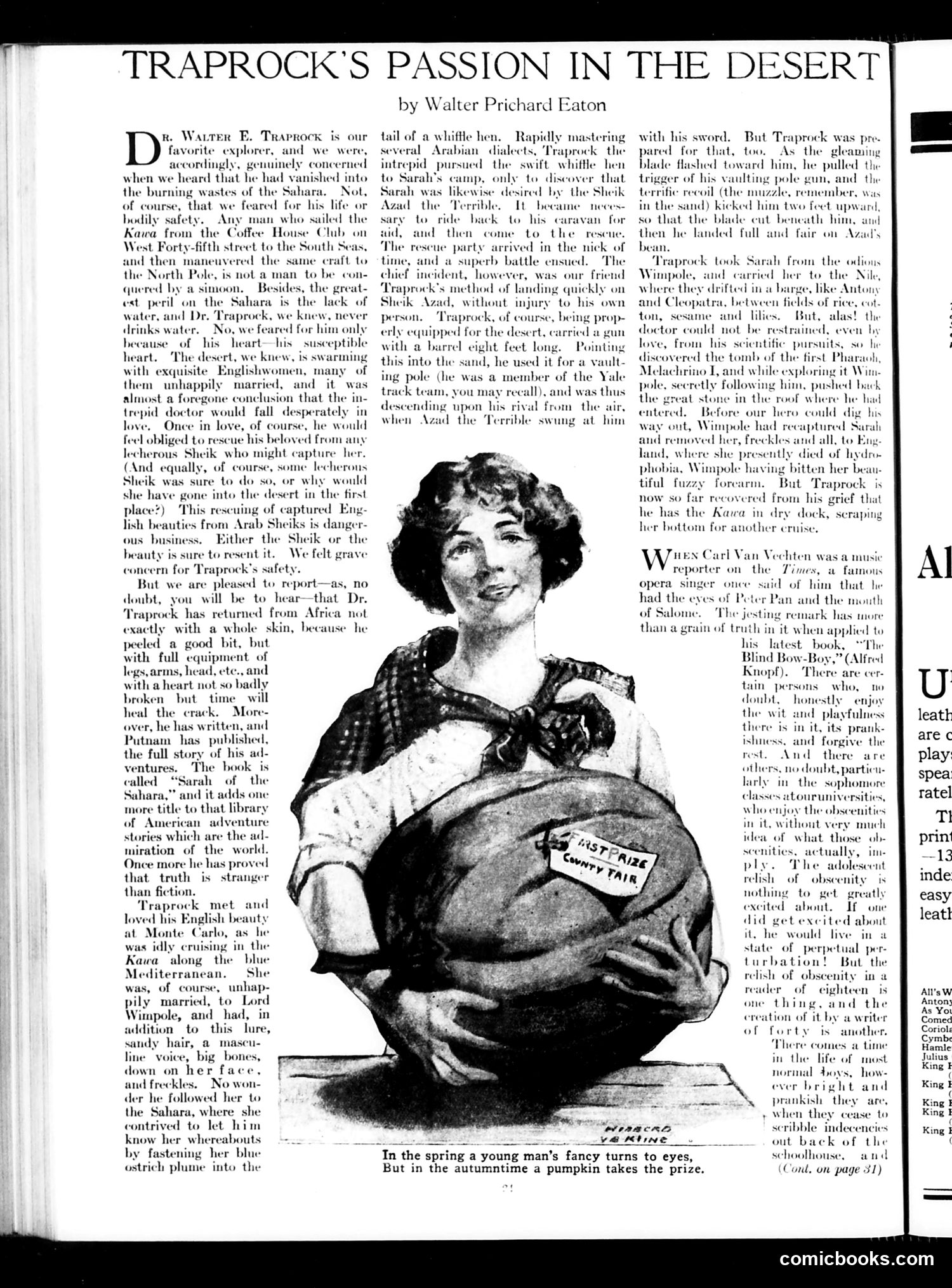
This is a humorous article about "Dr. Traprock," Judge magazine's fictional adventurer character. The piece satirizes popular adventure fiction tropes of the era. **The Setup:** Traprock, an intrepid explorer, falls in love with an unhappily married English woman (Lady Wimple) he meets in the Mediterranean and pursues her to the Sahara Desert, where she's being held by "Azad the Terrible," a stereotypical villainous Arab sheik. **The Joke:** The article mocks overwrought adventure narratives by describing absurdly implausible heroics—Traprock uses an 8-foot-barreled gun as a vaulting pole (referencing his Yale track team days) to literally pole-vault over the sheik's sword strike and land a punch. **The Satire:** This exaggerates the ridiculous conventions of early-20th-century adventure stories: exotic desert settings, damsels in distress, racial stereotypes, and physically impossible feats of derring-do presented as serious drama. The accompanying photo of a smiling woman holding a pumpkin reinforces the tongue-in-cheek tone. The caption's pun ("young man's fancy...pumpkin takes the prize") completes the mockery.
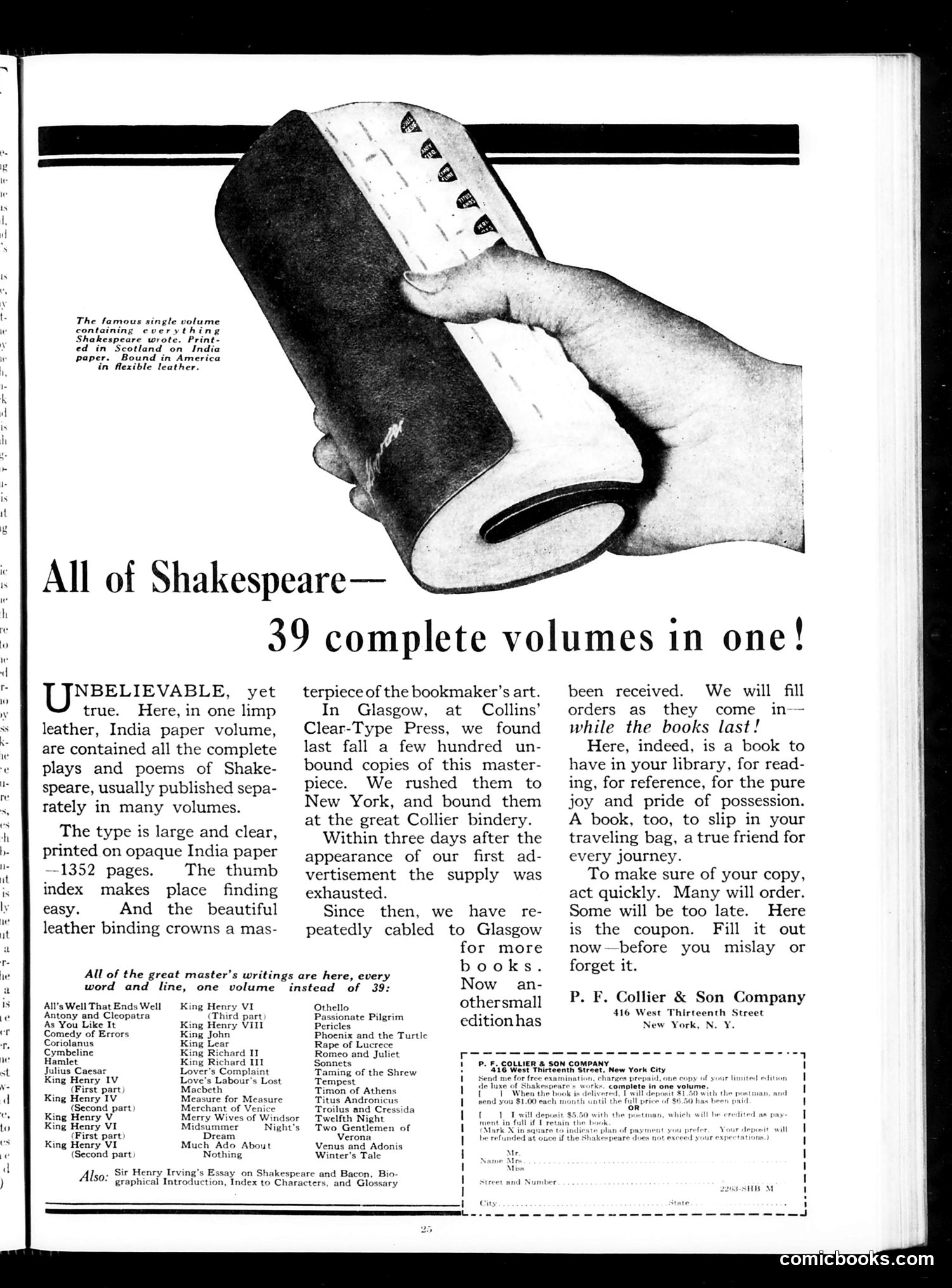
This page is primarily a **product advertisement**, not political satire. It promotes a one-volume complete Shakespeare edition published by P.F. Collier & Son Company, printed in Scotland and bound in New York. The image shows a hand holding the compact leather-bound book to demonstrate its portability and elegant design. The advertisement emphasizes the remarkable achievement: 1,352 pages of all 39 Shakespeare plays and poems, printed on India paper in large, clear type, with a thumb index for easy navigation. The pitch targets educated readers seeking convenience and prestige—a "true friend for every journey" and source of "joy and pride of possession." The marketing urgency ("while the books last!") and repeated cable orders to Glasgow suggest genuine commercial success. This reflects early 20th-century consumer culture celebrating technological and manufacturing innovations that made prestigious literature accessible and portable for the middle and upper-middle classes.
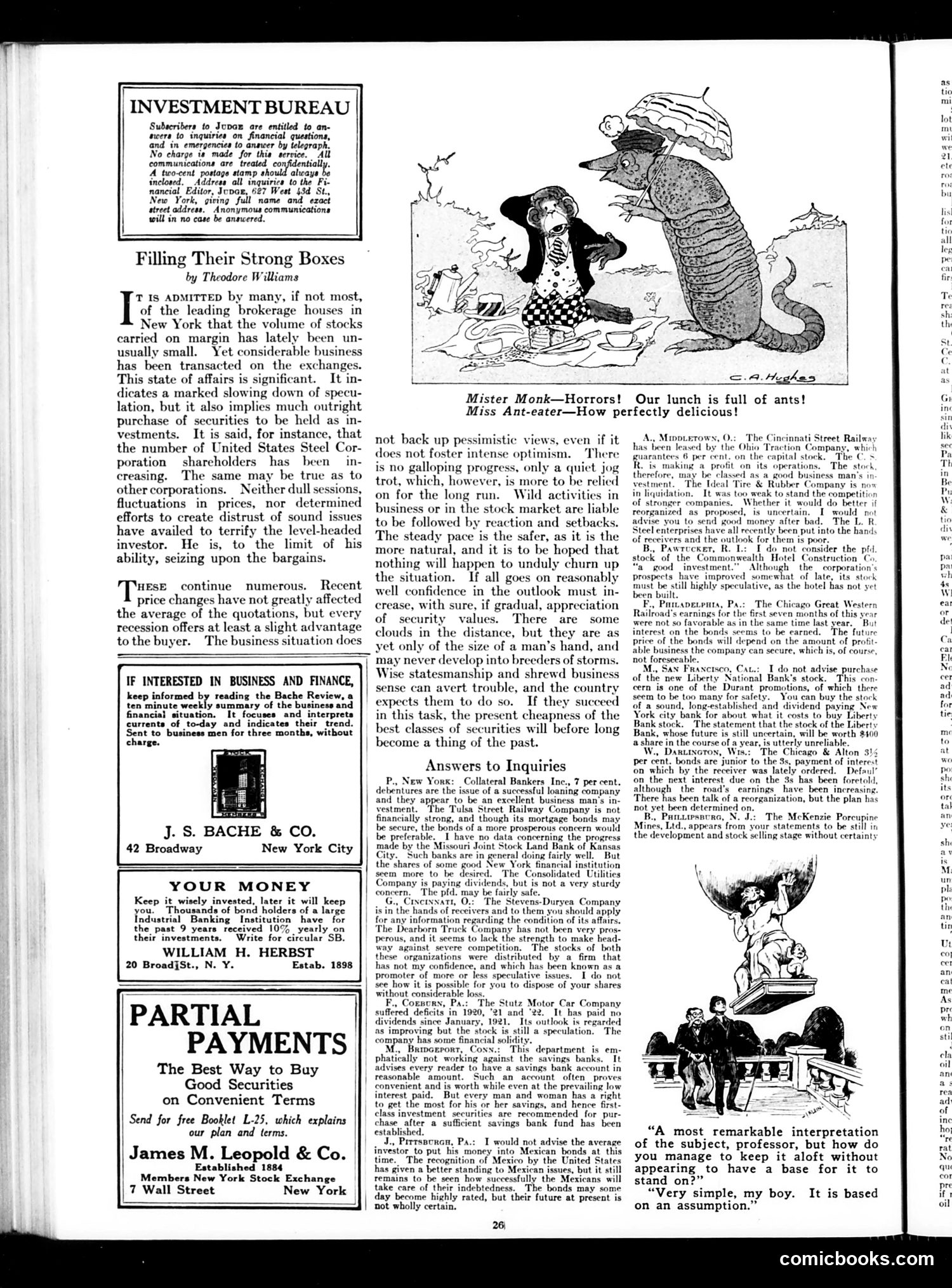
This page contains a satirical cartoon titled "Mister Monk—Horrors! Our lunch is full of ants! Miss Ant-eater—How perfectly delicious!" The cartoon depicts a character identified as "Mister Monk" (appearing distressed) discovering ants in his lunch, while "Miss Ant-eater" (a female ant-eater character) expresses delight at the same problem. The humor relies on a simple visual pun: what's horrifying to the monk is exactly what the ant-eater desires—her natural food. The accompanying article by Theodore Williams discusses stock market investment strategy, arguing that steady, conservative investment in securities is safer than speculative trading. The cartoon likely functions as light relief amid the page's dense financial commentary, offering readers a humorous break from earnest discussion of market conditions and investment advice.
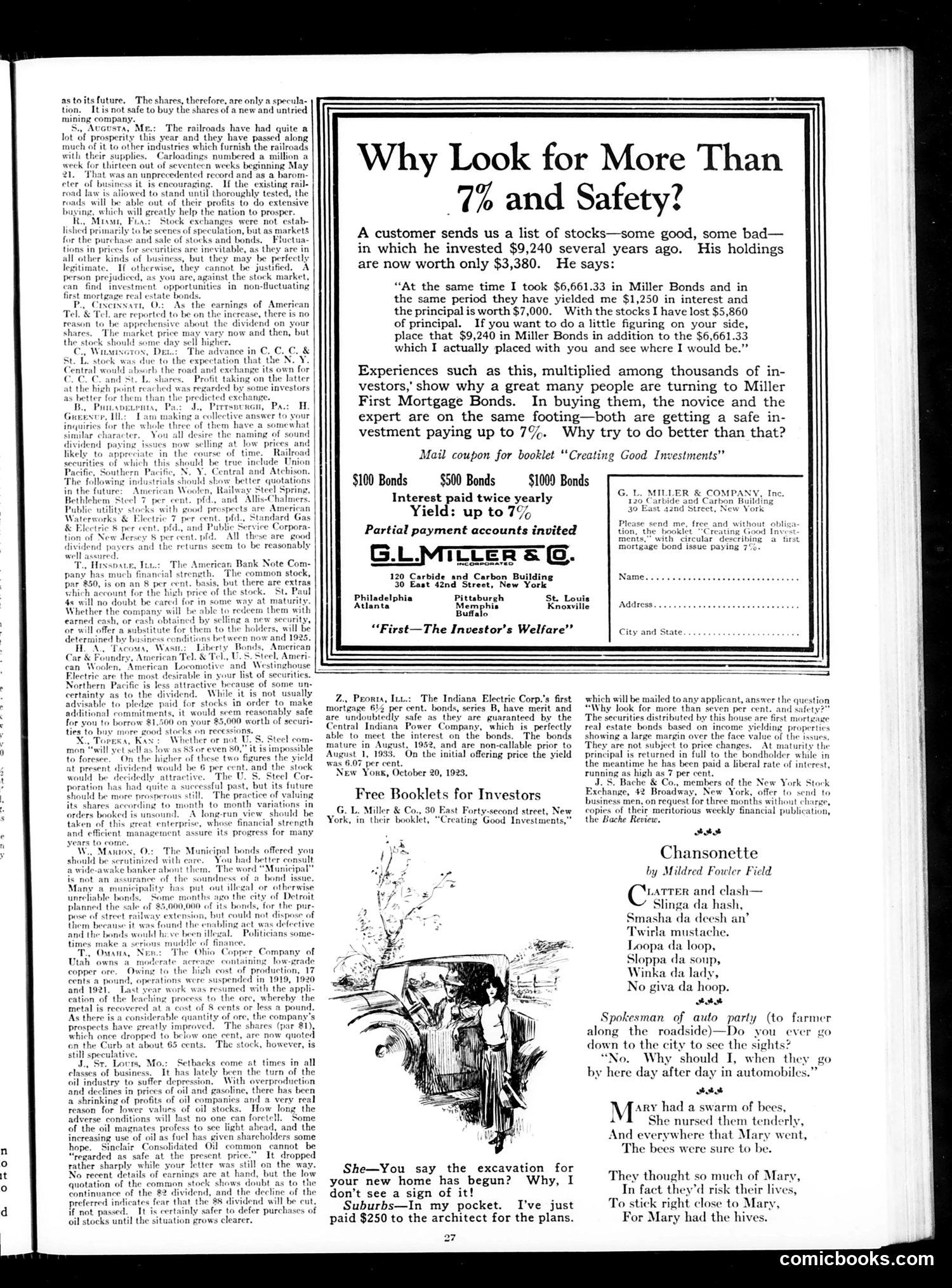
This page is primarily **financial advertising**, not political satire. The main content is a G.L. Miller & Company advertisement promoting **First Mortgage Bonds** as safer investments than stocks. The advertisement presents a customer testimonial: a man invested $9,240 in stocks years ago but they're now worth only $3,380—a significant loss. Meanwhile, his $6,661.33 in Miller Bonds yielded $1,250 in interest with principal worth $7,000. **The satirical point**: The ad argues that amateur investors should abandon risky stock speculation and instead purchase safe bonds offering 7% returns. The message reflects **1920s skepticism about stock market volatility** following the speculative boom. The contrast between stock losses and bond stability demonstrates why "a great many people are turning to Miller First Mortgage Bonds." The page also contains a humorous poem "Chansonette" and dialogue about home construction (unrelated to the main advertisement). This reflects real **post-WWI investment anxiety**—the market boom of the 1920s had volatility concerns, and conservative bonds were marketed as the prudent alternative for ordinary investors.
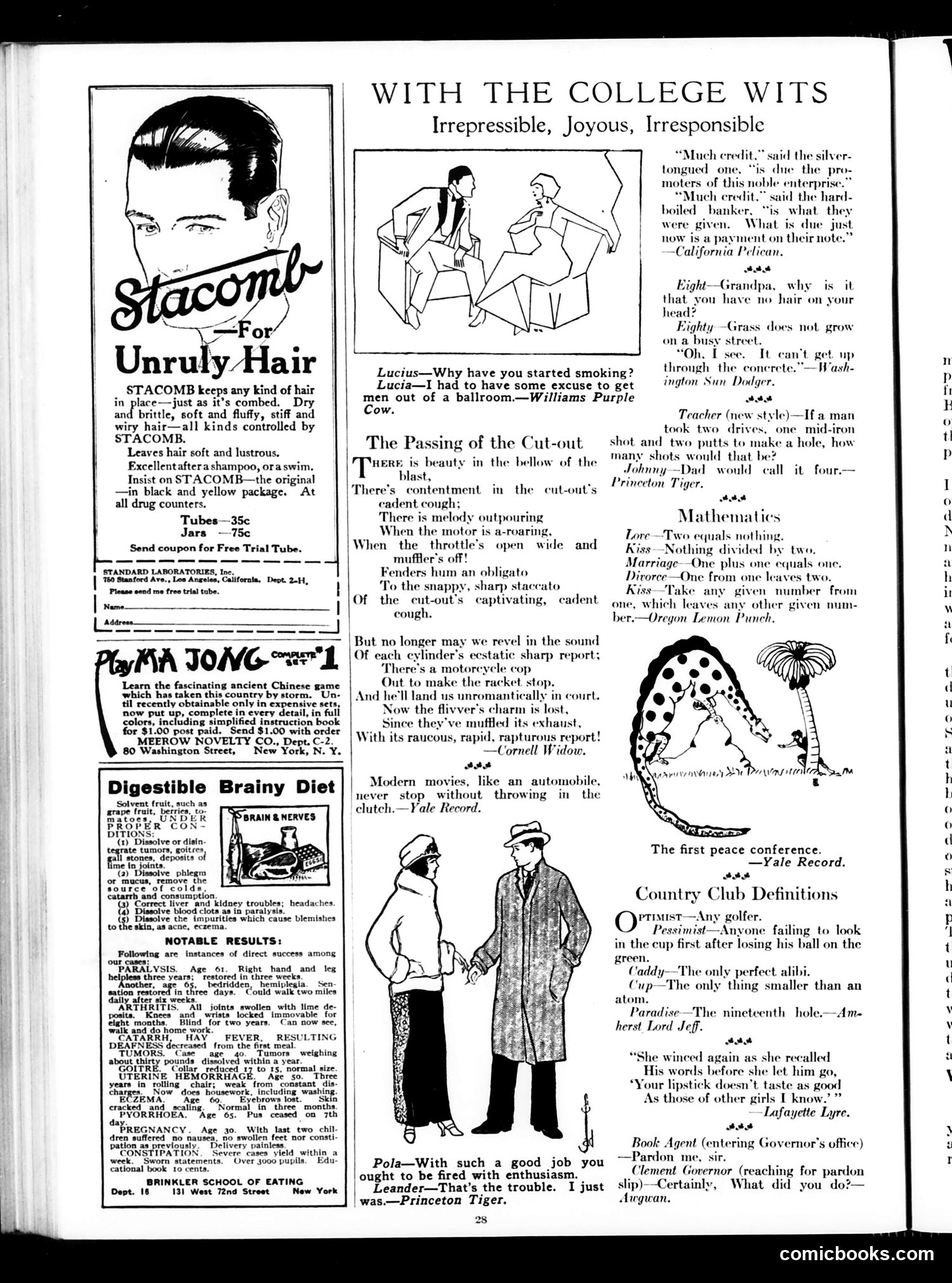
This page from *Judge* magazine presents miscellaneous college humor and advertisements typical of early 20th-century satirical publications. **Main Content:** The "College Wits" section collects brief jokes and witticisms attributed to college students and publications (California Pelican, Williams Purple Cow, Washington Sun Dodger, Princeton Tiger, Yale Record). The humor is gentle, contemporary satire: jokes about smoking etiquette, baldness as result of busy living, modern dating styles, and golf terminology. **Advertisements:** The page is dominated by period product ads (Stacomb hair product, Mah-Jong game, "Digestible Brainy Diet" health supplement) promising various remedies—typical of an era before FDA regulations when patent medicines made expansive health claims. **Context for Modern Readers:** These jokes assume familiarity with college life, automobiles, and golf—markers of educated, upper-middle-class leisure. The humor is light rather than biting satire; the "irrepressible, joyous" college students represent aspirational youth culture of the era.
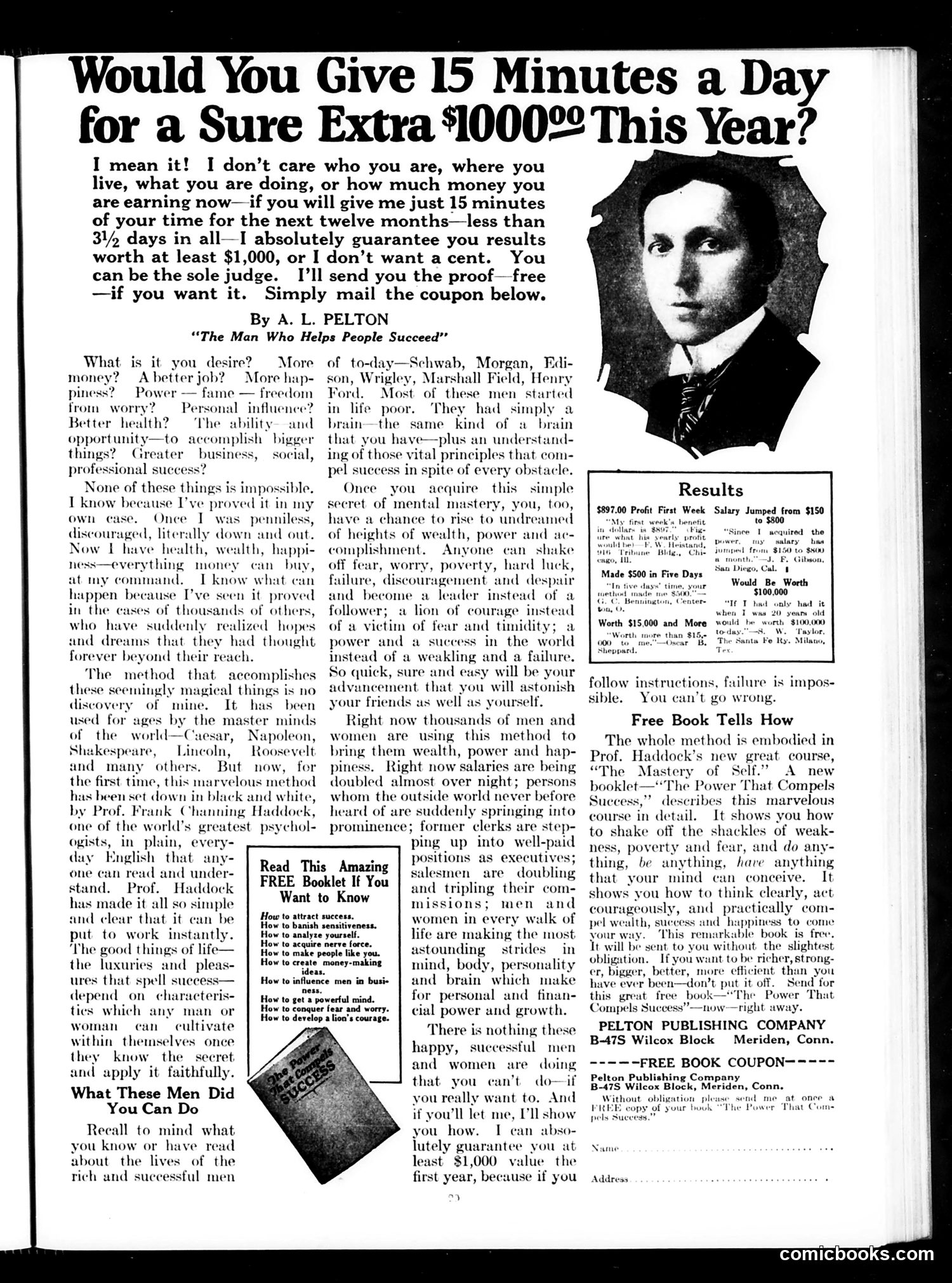
This page is primarily **advertising disguised as editorial content**—a common early 20th-century practice. A.L. Pelton (byline: "The Man Who Helps People Succeed") pitches a self-help course promising $1,000 guaranteed income for just 15 minutes daily of effort. The satire lies in the **extravagant promises typical of mail-order schemes**: mentions of wealthy industrialists (Schwab, Morgan, Edison, Ford, Wrigley) supposedly proving anyone can rise from poverty through mysterious "mental mastery." The language is deliberately vague—"vital principles," "secret of mental mastery"—characteristic of pseudoscientific self-help scams. The "Results" box showcases fabricated testimonials with suspiciously round numbers ($897.60 profit, salaries "jumped from $150 to $900"). For *Judge* magazine's satirical audience, this represented the **proliferation of dubious success schemes** targeting working-class Americans during the early 1900s. The exaggerated confidence and scientistic jargon ("Prof. Frank Channing Haddock") would have been instantly recognizable as hucksterism to contemporary readers.
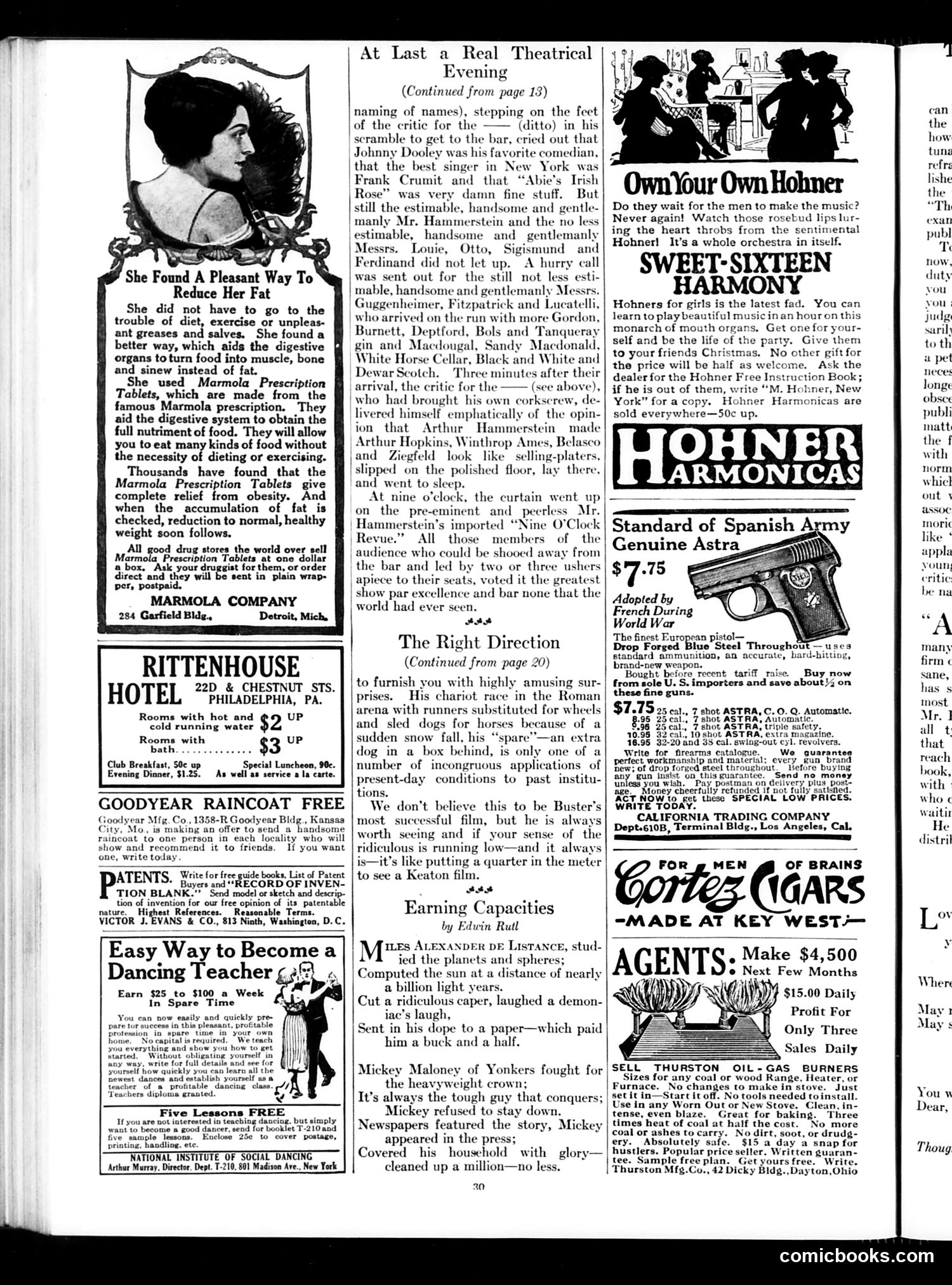
This page is primarily **advertisements** with a small theater review excerpt at the top. The main content mocks the opening night of a theatrical production (likely the "Nine O'Clock Revue"). The satire targets the pretentious theater world: prominent producers and theater owners—named Hammerstein, Hopkins, Ames, Belasco, and Ziegfeld—are satirized as self-important figures whose opinions about entertainment superiority prove hollow. The joke culminates when one critic, after delivering pompous judgments about singers and shows, gets drunk and literally falls asleep during the performance itself—undermining his entire pronouncement that it's "the greatest show...the world had ever seen." The satire targets **theatrical pomposity and critic intoxication** during the Jazz Age/Prohibition era, when speakeasies and heavy drinking accompanied high-society entertainment venues. The remainder is typical period advertisements for weight-loss tablets, hotels, dance instruction, and firearms.
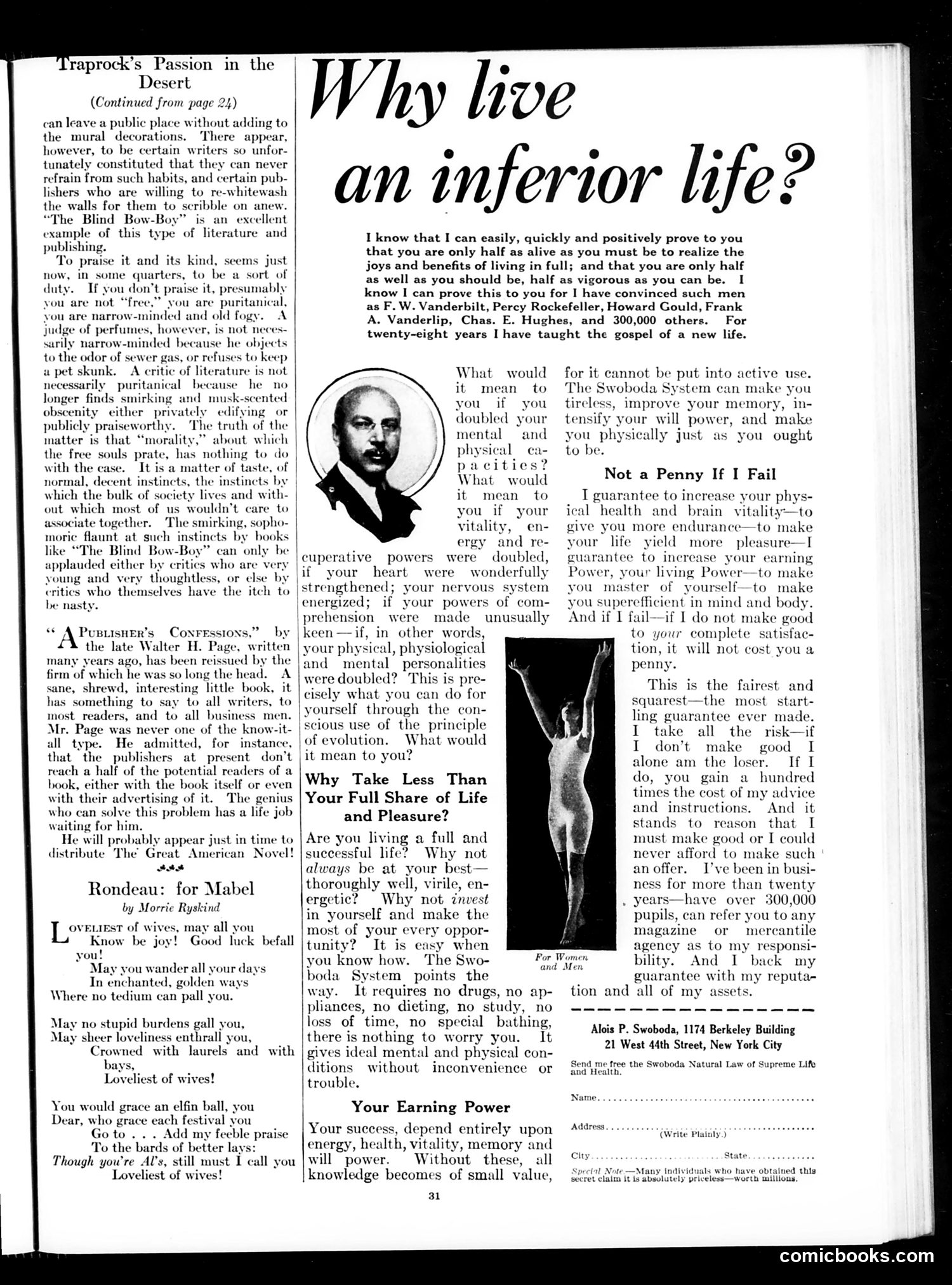
This page mixes literary criticism with self-help advertising. The main article criticizes "The Blind Bow-Boy" (a 1923 novel by Ronald Firbank), condemning it as obscene while defending the critic's right to disapprove without being labeled prudish or "not free." The author argues that rejecting vulgar literature reflects normal taste, not narrow-mindedness. The right side features a large advertisement by someone named Swoboda (appears to be a "vitality" or wellness guru), claiming he can prove readers are only "half alive" and promising to increase health and earning power—typical early 20th-century snake-oil self-help marketing. He names wealthy clients (Vanderbilt, Rockefeller, Hughes) for credibility. The page also includes a light poem ("Rondeau for Mabel") and continued book reviews. It's primarily a magazine page mixing editorial content with period advertising.
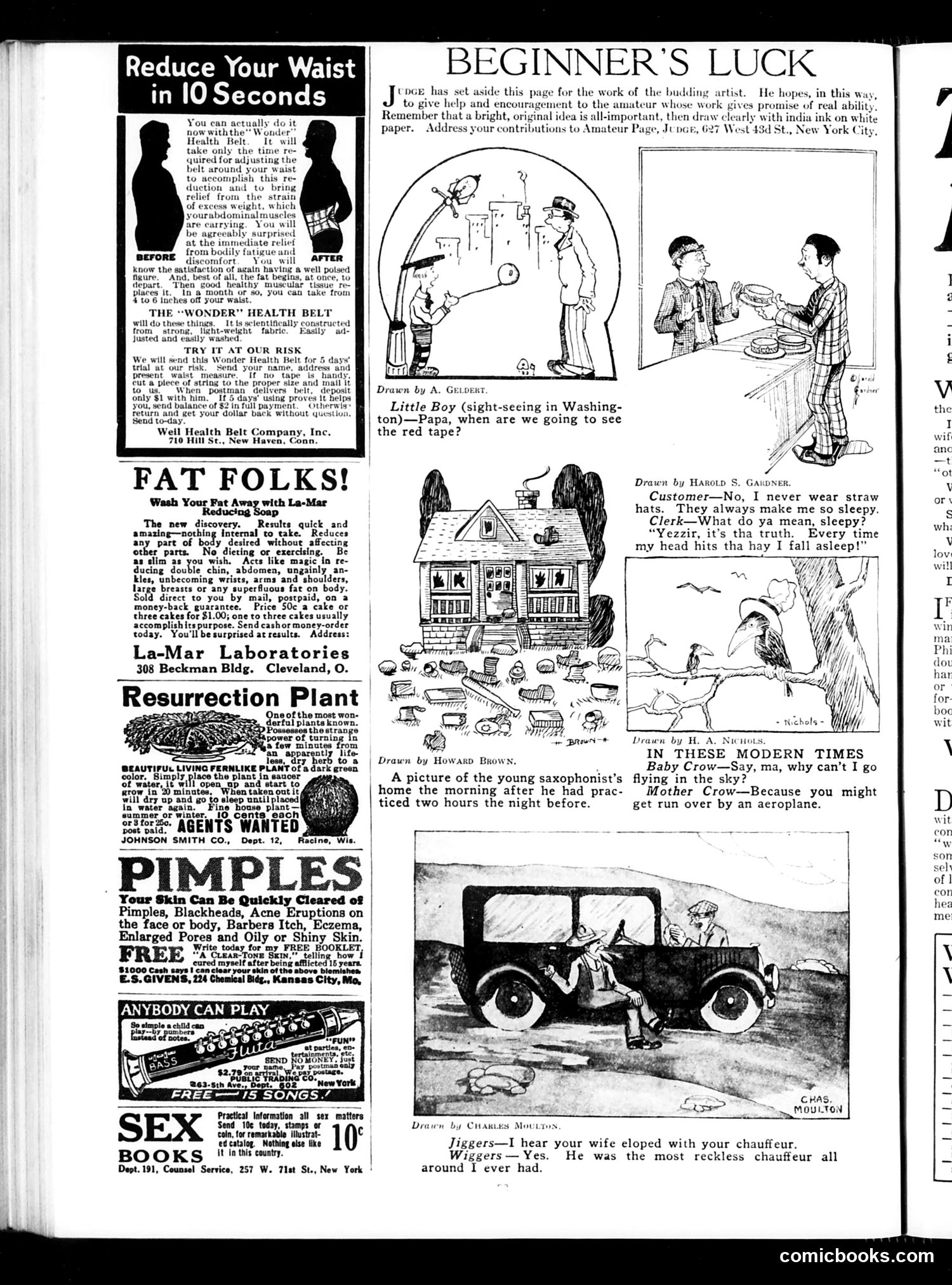
This page from *Judge* magazine contains humor and advertising reflecting 1920s American anxieties about body image and propriety. **The Cartoons:** The central comic strips satirize specific concerns: - A child touring Washington asks about "red tape"—bureaucratic obstruction—a common political complaint - A store clerk jokes about straw hats causing drowsiness (pun-based humor) - A crow mother warns her son about airplanes—reflecting anxiety about this new technology - A man confesses his wife eloped with their chauffeur, a common scandal scenario implying class transgression and infidelity **The Advertisements:** The page is dominated by dubious medical/cosmetic products: waist-reducing belts, soap claiming to reduce fat, and acne treatments. These reflect contemporary obsessions with appearance and the prevalence of unregulated patent medicines making outlandish claims. The humor is genteel and family-oriented, while the ads exploit insecurities about body image, reflecting Jazz Age anxieties about modernity and social change.
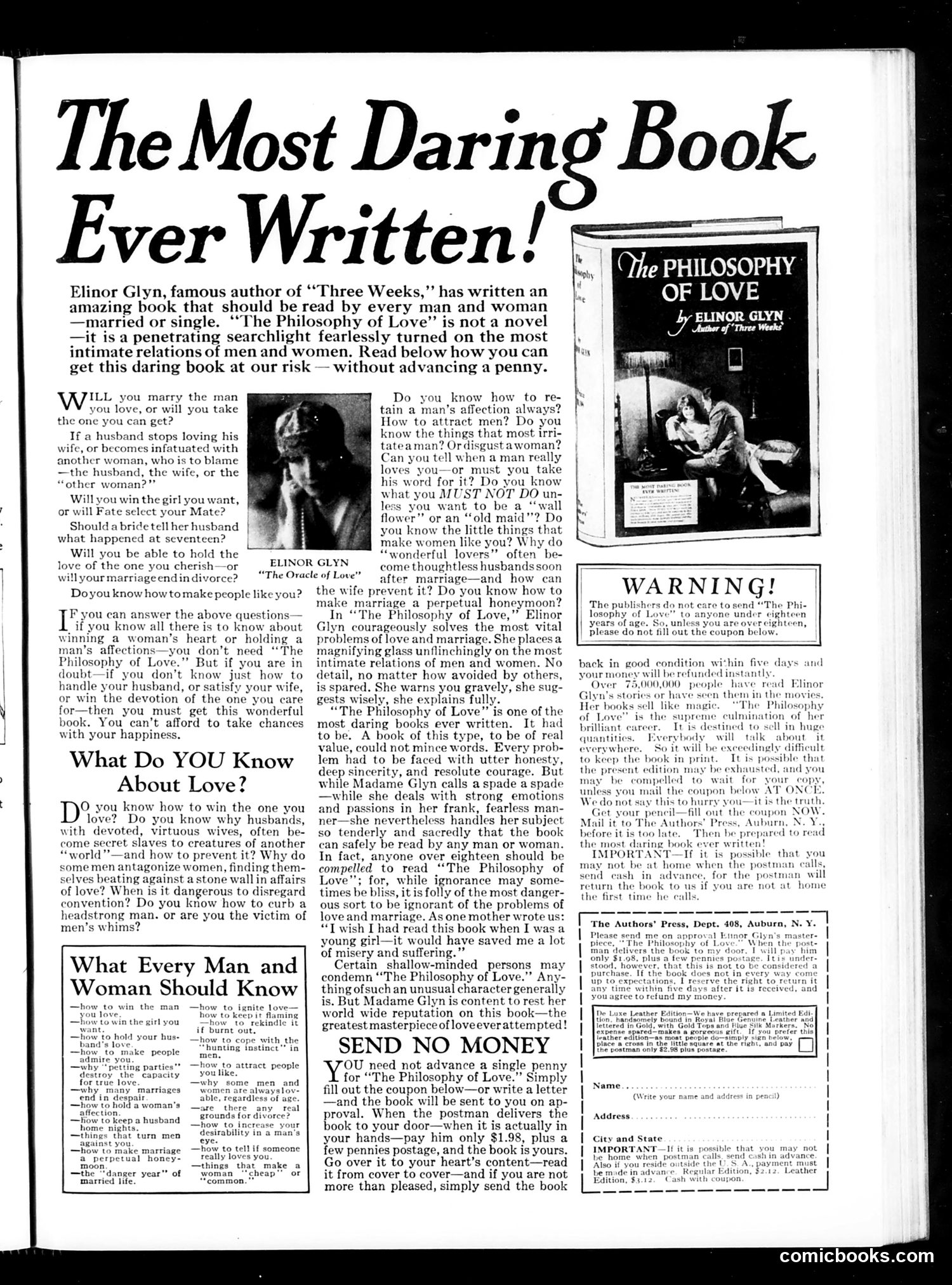
This is primarily a **full-page advertisement** for Elinor Glyn's book "The Philosophy of Love," positioned as scandalously frank advice about relationships and marriage. **The appeal to modern readers:** The ad exploits early 20th-century anxiety about courtship, marriage, and gender relations. It promises to answer forbidden questions: Should women reveal premarital experiences? How do you prevent infidelity? What causes divorce? **The satire/humor**: Judge magazine likely ran this to mock sensationalist book marketing. The hyperbolic language ("most daring," "fearlessly," "without advancing a penny") mimics genuine period advertisements that sold self-help books by implying they contained shocking intimate knowledge. The long list of relationship anxieties reflects genuine contemporary concerns about changing gender roles and companionate marriage. **Elinor Glyn** (1864-1943) was an actual British novelist famous for scandalous works; this advertisement leverages her real reputation for sexual frankness to market relationship advice as daring and essential reading for "every man and woman."
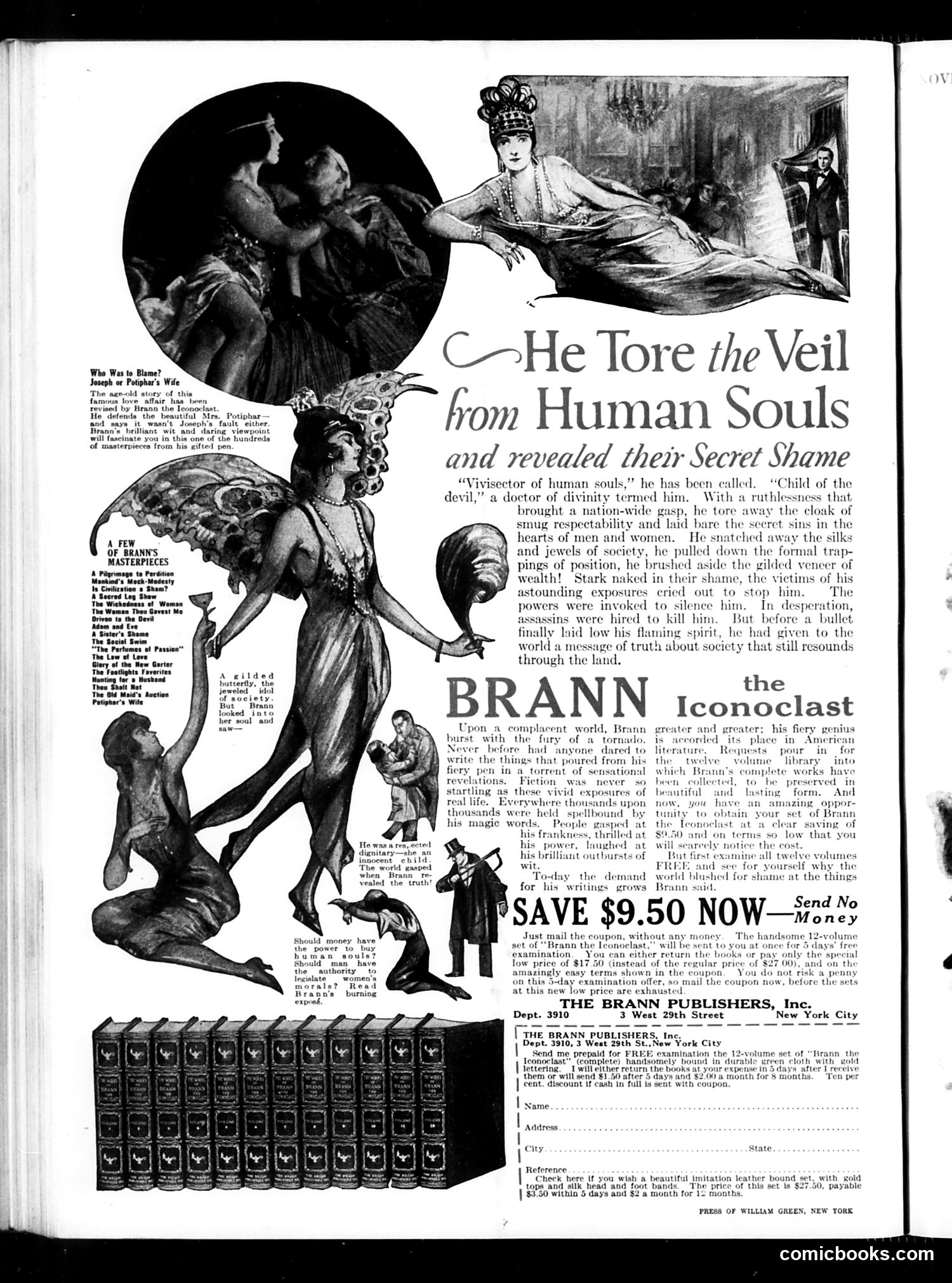
This page is primarily a book advertisement disguised as editorial content. It promotes a 12-volume collection of writings by **William Cowper Brann**, a late-19th-century Texas iconoclast and editor. The satirical framing presents Brann as a fearless social crusader who exposed society's hidden hypocrisy and moral corruption. The dramatic language—describing him as a "vivisector of human souls" and "child of the devil"—treats his controversial journalism as noble truth-telling that threatened powerful institutions enough to provoke assassination attempts. The references to "Joseph or Potiphar's Wife" and comparisons to biblical figures reinforce Brann's self-image as a righteous troublemaker. The accompanying illustrations depict him dramatically unmasking respectable society figures. However, the actual purpose is commercial: **Judge magazine** (known for satire) is selling Brann's complete works at a "special" discounted price of $17.50 with a 5-day free trial offer. The entire narrative about his dangerous fearlessness serves as persuasive marketing copy.