
Judge, 1923-10-27 · page 22 of 36
Judge — October 27, 1923 — page 22: what you’re looking at
What you’re looking at
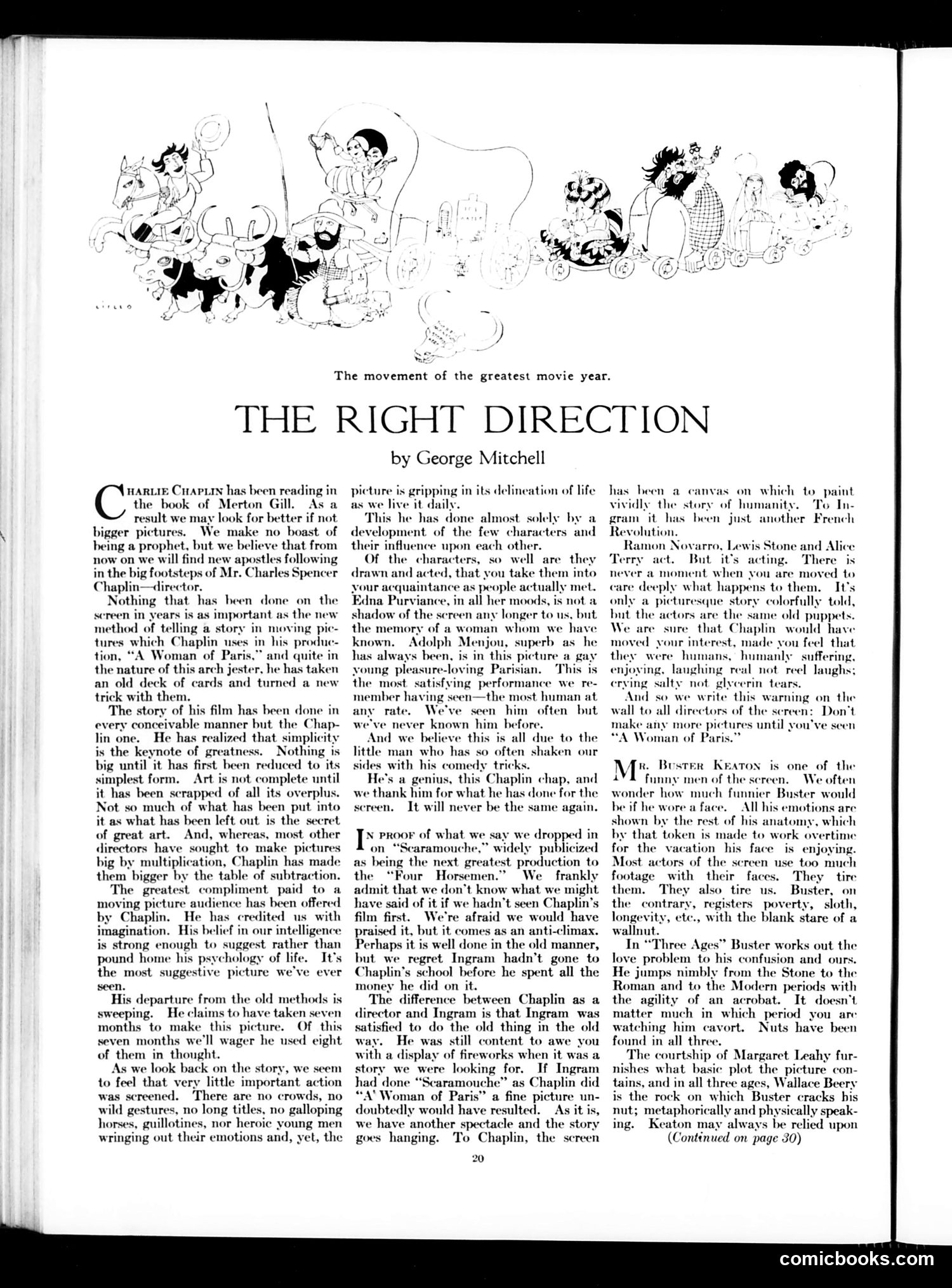
This is a film review (not primarily satirical cartoon) praising Charlie Chaplin's directorial debut, "A Woman of Paris" (1923). The illustrated header shows Chaplin and other figures in a celebratory parade or procession. **Key figures discussed:** - **Charlie Chaplin** - transitioning from actor to director - **Edna Purviance** - actress in the film - **Adolphe Menjou** - playing a "gay young pleasure-loving Parisian" **The point:** The critic argues Chaplin revolutionized filmmaking by using *subtraction* rather than multiplication—minimal crowds, sets, and dramatic gestures, relying instead on character development and audience imagination. This contrasts favorably with director Rex Ingram's "Scaramouche," criticized for following old-fashioned spectacle-driven methods. The satire is implicit: other directors waste money on elaborate production values while Chaplin achieves superior artistry through restraint and psychology.
📄 Transcribed text from this page (OCR, searchable)
Machine-transcribed from the original scan — historical spelling and the odd misread are preserved.
The movement of the greatest movie year. THE RIGHT DIRECTION HARLIE CHapLtn has been reading ir in the book of Merton Gill. result we may look for better if m bigger pictures. We make no boast of being a prophet, but we believe that from now on we will find new apostles following in the big footsteps of Mr. Charles Spencer Chaplin—director. Nothing that has been done on the screen in years is as important as the new method of telling a story in moving pic- in his produe- “A Woman of Paris.” and quite in the nature of this arch jester, he has taken an old deck of cards and turned a new trick with them. The story of his film has been done in every conceivable manner but the Chap- lin one. He has realized that simplicity is the keynote of greatness. Nothing is big until it has first been reduced to its simplest form, Art is not complete until it has been scrapped of all its overplus. Not so much of what has been put into it as what has been left out is the secret of great art. And, whereas, most other directors have sought to make pictures big by multiplication, Chaplin has made them bigger by the table of subtraction. The greatest compliment. paid to a moving picture audience has been offered by Chaplin. He has credited us with imagination. His belief in our intelligence is strong enough to suggest rather than pound home his psychology of life. It’s the most suggestive picture we've ever seen. His departure from the old methods is sweeping. He claims to have taken seven months to make this picture. Of t seven months we'll wager he used eight of them in thought. ‘As we look back on the story, we seem to feel that very little important action was screened. There are no crowds, no wild gestures, no long titles, no galloping horses, guillotines, nor heroic young men wringing out their emotions and, yet, the by George Mitchell picture is gripping in its delineation of life it daily. This he has done almost solely by a development of the few characters and their influence upon each other. so well are they drawn and acted, that you take them into your acquaintance as people actually met. Edna Purviance, in all her moods, is not a shadow of the screen any longer to us, but the memory of a woman whom we ha known. Jolph Menjou, superb as he has al been, is in this picture a gay young pleasure-loving Parisian. This is the most satisfying performance we re- member hav een—the most human at any rate. We've seen him often but we've never known him before. And we believe this is all due to the little man who has ften shaken our sides with his comedy tricks. He's a genius, this Chaplin chap, and we thank him for what he has done for the screen. It will never be the same again. I PROOF of what we say we dropped in on “Scaramouche,” widely publicized as being the next greatest production to the “Four Horsen We frankly admit that we don’t know what we might have said of it if we hadn't seen Chaplin's film first. We're afraid we would have praised it, but it comes as an anti-climax. Perhaps it is well done in the old manner, but we regret Ingram hadn't gone to Chaplin’s school before he spent all the money he did on it. The difference between Chaplin as a director and Ingram is that Ingram was tisfied to do the old thing in the old He was still content to awe you lay of fireworks when it was a story we were looking for. If Ingram had done “Scaramouche” as Chaplin did “A’ Woman of Paris” a fine picture un- doubtedly would have resulted. A: we have another spectacle and the story goes hanging. To Chaplin, the screen 20 has been a canvas on which to paint vividly the story of humanity. To In- gram it has been just another French Revolution. Ramon Novarro, Lewis Stone and Alice But cting. There is moment when you are moved to © deeply what happens to them. It's only a picturesque story colorfully told, but the actors are the same old puppets. We are sure that Chaplin would have moved your interest, made you feel that they were humans, humanly. suffering, enjoying, laughing real not reel laughs: crying salty not glycerin tears. And so we write this warning on the wall to all directors of the screen: Don't make any more pictures until you've seen “A Woman of Paris.” N Rk. Buster Keaton is one of the 4 funny men of the screen. We often wonder how much funnier Buster would be if he wore a face. All his emotic shown by the rest of his anatomy hy that token is made to work ¢ for the vacation his face is enjoying. Most actors of the screen use too much footage with their faces. They tire them. They also tire us. the contrary, registers povert longev ete., with the blank stare of a wallnut. In “Three Ages” Buster works out the love problem to his confusion and ours. He jumps nimbly from the Stone to the Roman and to the Modern periods with the agility of an acrobat. It doesn't matter much in which period you are watching him cavort. Nuts have been found in all three. The courtship of Margaret Leahy fur- nishes what basic plot the picture con- tains, and in all three ages, Wallace Beery is the rock on which Buster cracks bis nut; metaphorically and physically speak- ing. Keaton may always be relied upon (Continued on page 30) comicbooks.com