
Judge, 1923-10-27 · page 6 of 36
Judge — October 27, 1923 — page 6: what you’re looking at
What you’re looking at
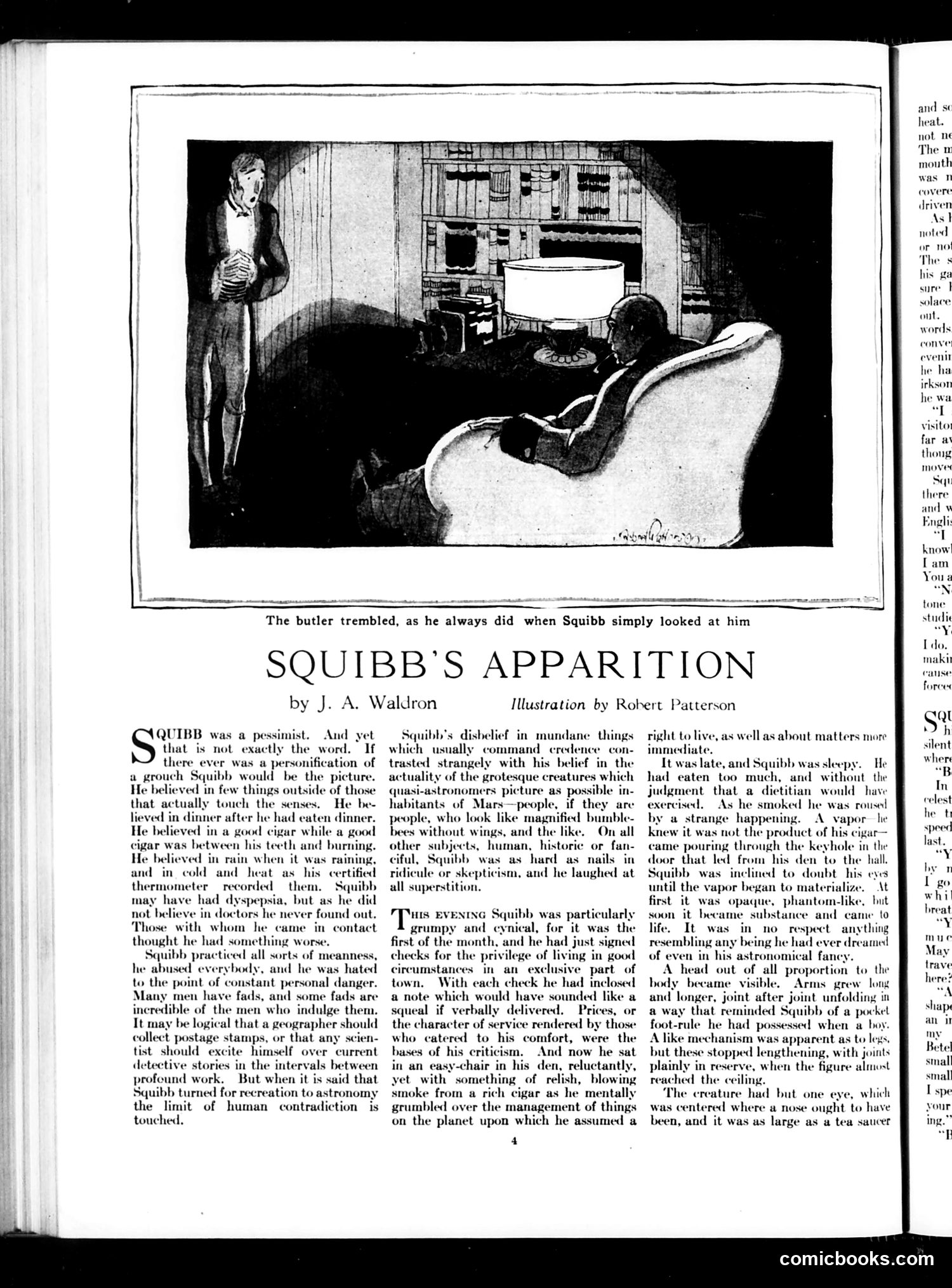
This is a fictional story illustration, not political satire. The image shows a butler trembling before a ghostly figure of "Squibb"—apparently a deceased employer or authority figure—materializing in what appears to be a well-appointed bedroom or study. The accompanying text describes Squibb as a pessimistic, demanding man obsessed with detecting fraud and imposing strict personal discipline. The story plays on classic ghost-story conventions: Squibb's apparition visits to continue harassing those he once controlled, even from beyond death. This appears to be humorous social commentary about overbearing authority figures and their lasting psychological impact, rather than political satire. The joke relies on Victorian-era ghost-story tropes familiar to Judge's contemporary readers.
📄 Transcribed text from this page (OCR, searchable)
Machine-transcribed from the original scan — historical spelling and the odd misread are preserved.
The butler trembled, as he always did when Squibb simply looked at him SQUIBB’S APPARITION by J. A. Waldron QUIBB was a pessimist. And yet that is not exactly the word. If there ever was a personification of grouch Squibb would be the picture. He believed in few things outside of those that actually touch the senses. He be- lieved in dinner after he had eaten dinner. He believed in a good cigar while a good cigar was between his teeth and burning. He believed in rain when it was ri and in cold and heat as his. c+ thermometer recorded — them. may have had dyspepsia, but as he did not believe in doctors he never found out. Those with whom he came in contact thought he had something worse. Squibb practiced all sorts of meanness, he abused eve and he was hated to the point of constant personal danger. Many men have fads, and some fads are incredible of the men who indulge them. Tt may be logical that a geographer should collect postage stamps, or that any tist te himself over current detective stories in the intervals between profound work. But when it is said that Squibb turned for recreation to astronomy the limit of human contradiction is touched. bod and s¢ heat. not ne The a mouth was 0 covere driven As] noted or no! The s his ga sure | solace out. words conve evenil he ha irkson he wa visitor far ay thong moves Sau there and ¥ Engli: “T know! [am Youd tone Squibb’s disbelief in mundane things which usually command credence con- trasted strangely with his belief in_ the actuality of the grotesque creatures w quasi-astronomers picture as possible habitants of Mars—peopl people, who look like magnified bumble- bees without wings, and the like. On all other subjects, human, historic or fan- ciful, Squibb was as hard as nails in ridicule or skepticism, and he laughed at all superstition. in- if they are Squibb was particularly nical, for it was the nd he had just signed checks for the privilege of living in good circumstances in an exclusive part. of town, With each check he had inclosed a note which would have sounded like a squeal if verbally delivered. Prices, or the character of service rendered by those who catered to his comfort, were the bases of his criticism, And now he sat in an easy-chair in his den, reluctantly, yet with something of relish, blowing smoke from a rich cigar as he mentally grumbled over the management of things on the planet upon which he assumed a 4 Illustration by Robert Patterson stud Ido. makin cause forces right to live, as well as about matters more immediate. silent It was late, and Squibb was sleepy. He wher had eaten too much, and without the B judgment that a dietitian would have In exercised. As he smoked he was roused celest by a strange happening. A. vapor le he t knew it was not the product of his cigar— ees came pouring through the keyhole in the door that led from his den to the hall. lee Squibb was inclined to doubt his eyes ion until the vapor began to materi . At I go first it was opaque, phantom-like, but whil soon it became substance and came to fp breat life. It was in no. respect anything Y re: any being he had ever dreamed mue of € May A head out of all proportion to the body became visible. Arms grew: long and longer, joint after joint unfolding in A a way that reminded Squibb of a pocket shape foot-rule he had possessed when a boy. an it A like mechanism was apparent as to legs, my but these stopped lengthening, with joints ete plainly in reserve, when the figure almost smal ed the ceiling. small «creature had but one eye, which was centered where a nose ought to have been, and it was as large as a tea saucer comicbooks.com