
Judge, 1923-10-27 · page 3 of 36
Judge — October 27, 1923 — page 3: what you’re looking at
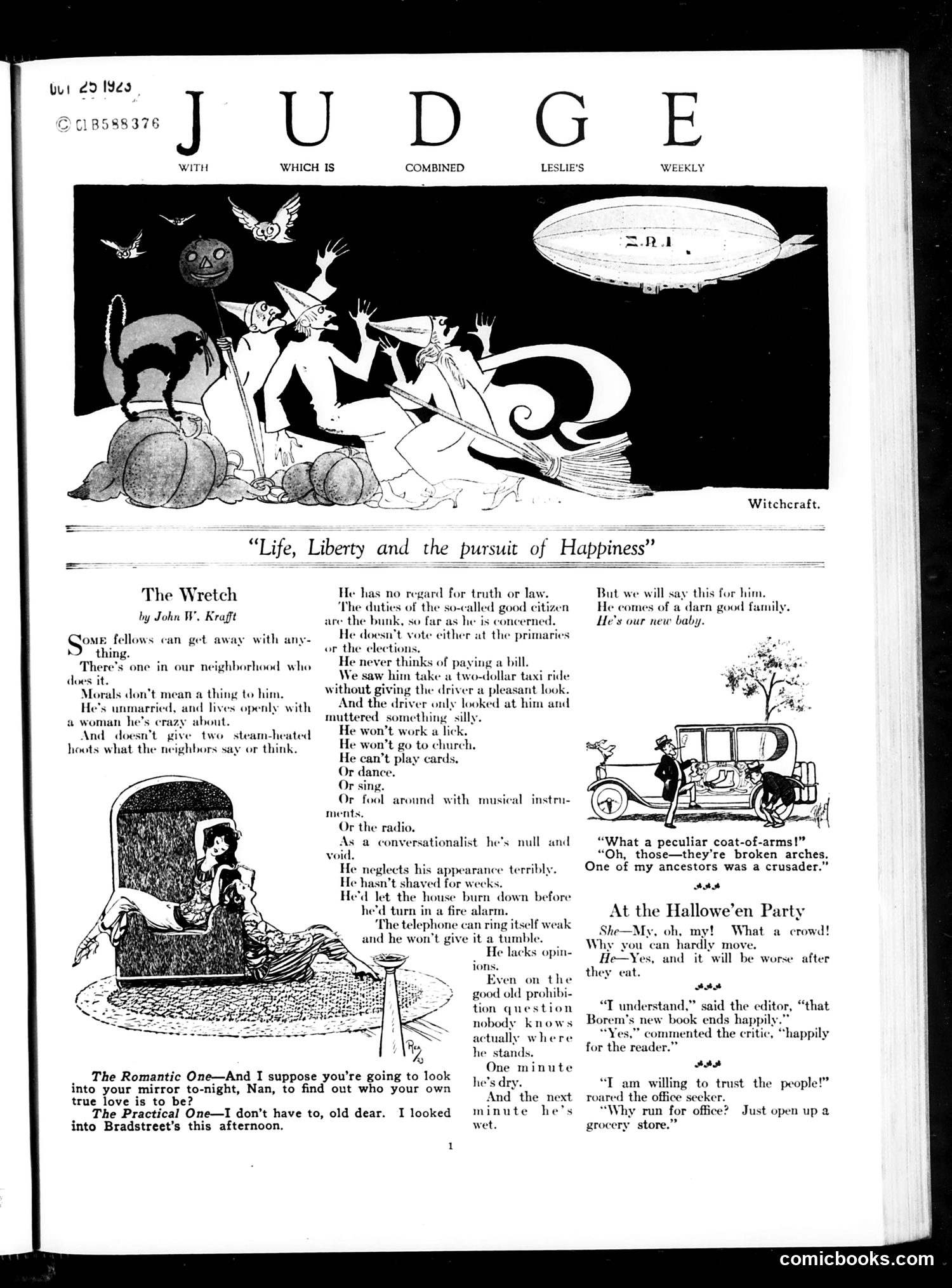
What you’re looking at
This page contains satirical commentary and humorous fiction rather than political cartoons. "The Wretch" by John W. Kraft depicts a disreputable man who ignores social conventions, refuses employment, avoids church, and neglects his appearance. The satire targets moral laxity and social irresponsibility—likely reflecting early 20th-century anxieties about citizenship and civic duty. "At the Hallowe'en Party" appears to be light social humor about a crowded celebration. The illustrated vignettes mock social pretension: one couple discusses ancestry ("one of my ancestors was a crusader"), while an office seeker desperately seeks employment at a grocery store. Overall, this reflects Judge's typical approach: satirizing American social behavior, class attitudes, and individual character flaws through humor rather than explicit political commentary.
📄 Transcribed text from this page (OCR, searchable)
Machine-transcribed from the original scan — historical spelling and the odd misread are preserved.
bur 29 192o © (1 B588376 The Wretch by John W’. Krafft Soe fellows can get away with any- J thin The: does it. Morals don’t mean a thing to him. He's unmarri d lives openly with a woman he’s ¢ about. And doesn’t give two steam-heated hoots what the neighbors say or think. one in our neighborhood who The Romantic One—And I suppose you're going to look into your mirror to-night, Nan, to find out who your own true love is to be? The Practical One—I don’t have to, old dear. into Bradstreet’s this afternoon. J U WHICH IS COMBINED Happiness” LESLIE'S DGeE WEEKLY Witchcraft. He has no regard for truth or la ‘The duti the so-called good ci are the bunk, so far as he is concerned. He doesn’t vote either at the primaries or the tions. He never thinks of paying a bill. We saw him take a two-dollar taxi ride without giving the driver a pleasant look. And the driver only looked at him and muttered something. silly. He won’t work a lick. He won’t go to church, He can’t play cards. Or dance. Or sing. Or fool around with musical instru- ments. Or the radio. As a conversationalist he’s null: and void. He neglects his appearance terribly. He hasn’t shaved for weeks. He'd let the house burn down before he'd turn in a fire d ‘The telepho 1. 1 ring itself weak and he won't gi it a tumble. He lacks opin- ions. Even on the good old prohibi- tion question nobody knows actually where he stands. One minute he’s dry. And the next minute he’s wet. I looked But we will say this for him. He comes of a darn good family. He's our new baby. “What a peculiar coat-of-arms!” “Oh, those—they’re broken arches. One of my ancestors was a crusader.” Sas At the Hallowe’en Party She—My, oh, my! What a crowd! Why you can hardly move. He—Yes, and it will be worse after they eat. ott “T understand,” said the editor, “that Borem’s new book ends happi x commented the cri for the reader.” Ral “T am willing to trust the people!” roared the office se “Why run for office? fc Just open up a grocery store. comicbooks.com