
A complete issue · 36 pages · 1923
Judge — September 1, 1923
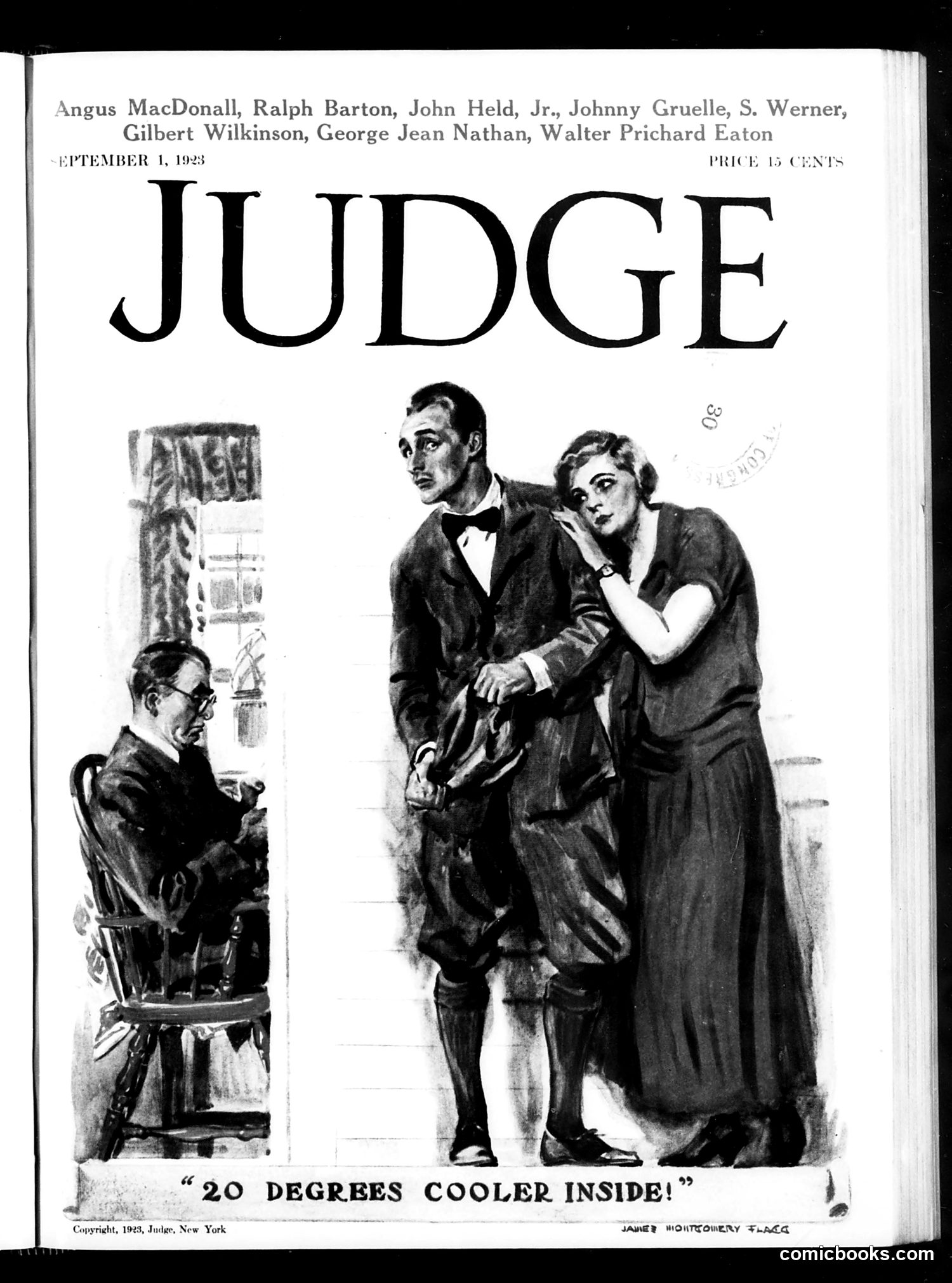
This satirical cover depicts a domestic scene with the caption "20 Degrees Cooler Inside!" A man in formal attire (bow tie, jacket) stands with a woman, while another man sits separately, appearing to observe them. The humor likely references the contrast between outdoor summer heat and indoor comfort—a practical domestic joke rather than political satire. However, without clearer identification of the specific figures or context, the exact satirical target remains unclear. The formal dress and interior setting suggest this may comment on social manners, domestic life, or possibly a contemporary cultural reference specific to 1923 readers. The named contributors listed at the top (MacDonall, Barton, Held, etc.) were prominent Judge illustrators and writers of the era.
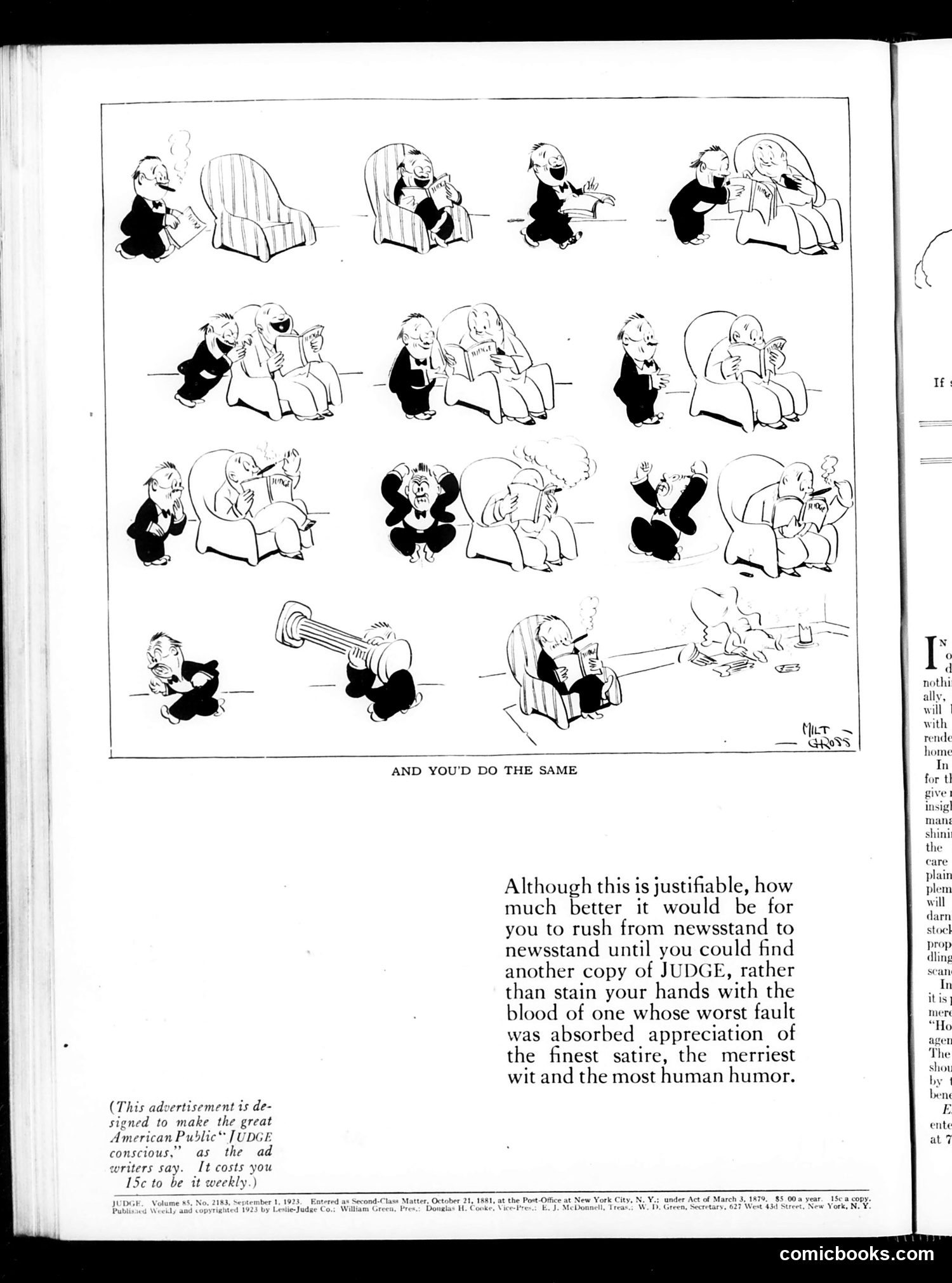
This page is primarily an **advertisement for Judge magazine itself**, not political commentary. The cartoon strip titled "AND YOU'D DO THE SAME" depicts a series of scenes showing a man in formal attire repeatedly encountering a woman in a chair, with escalating physical comedy—ultimately involving what appears to be a large mallet or club. The advertisement below argues readers should buy Judge rather than commit violence against those who appreciate satire and humor. It's a self-promotional pitch emphasizing that Judge offers "the finest satire, the merriest wit and the most human humor"—suggesting readers find entertainment in the magazine instead of resorting to aggression. The ad cost 15¢ weekly and positioned Judge as essential American public reading.
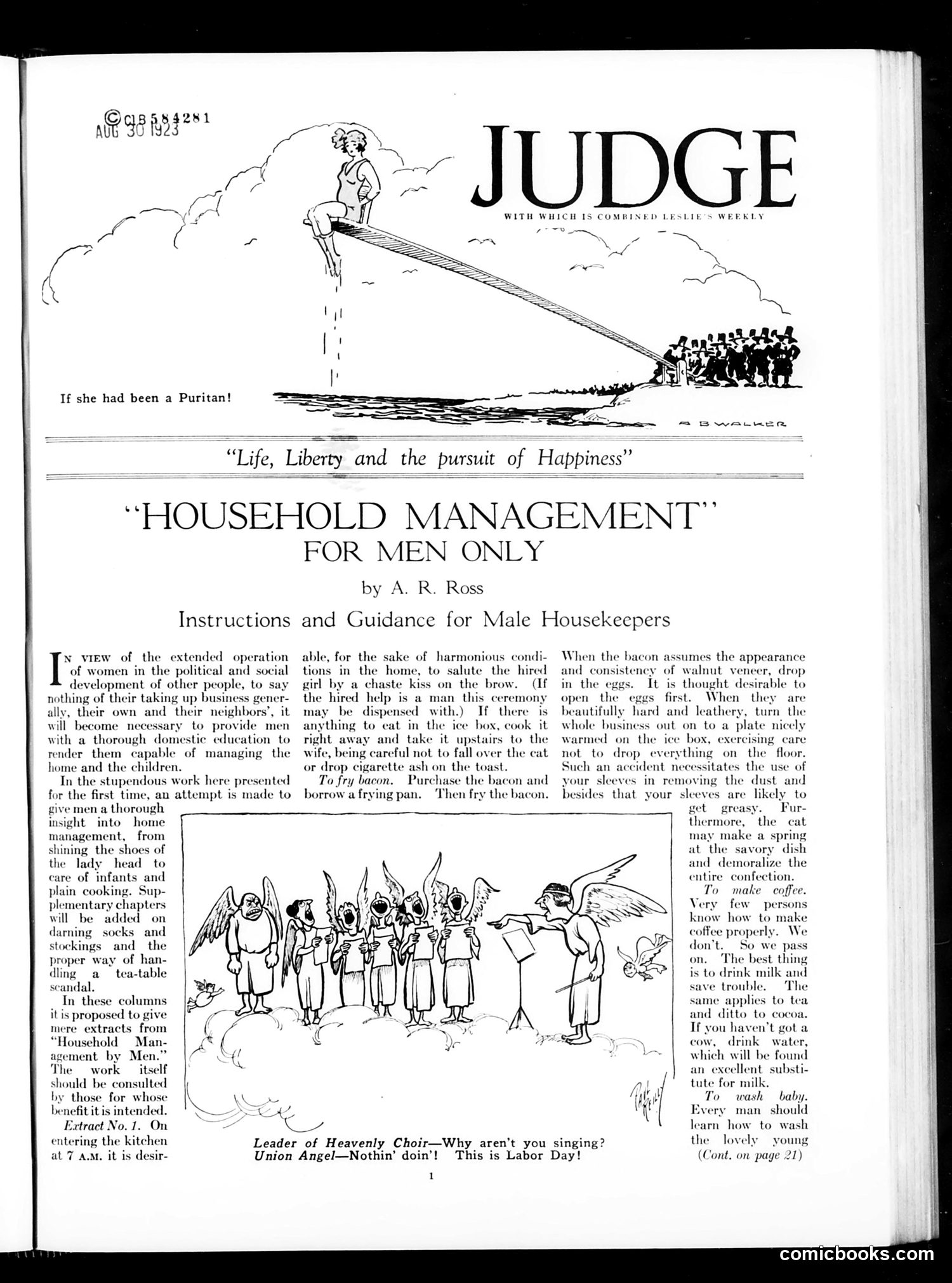
This Judge magazine page satirizes gender roles through two main elements: **Top cartoon**: A woman on a plank balanced on a seesaw with a crowd below. The caption "If she had been a Puritan!" suggests commentary on women's rights and social expectations—likely referencing contemporary debates about women's suffrage or independence. **Main article**: "Household Management for Men Only" by A.R. Ross ironically presents instructions for male housekeepers. The accompanying cartoon shows angels rejecting a male cook, with the caption mocking his cooking failure on Labor Day. The satire targets gender inversion—the joke being that men performing domestic work is absurd and laughable. This reflects early 20th-century attitudes treating housekeeping as exclusively female work, and mocking any deviation from these norms as ridiculous.
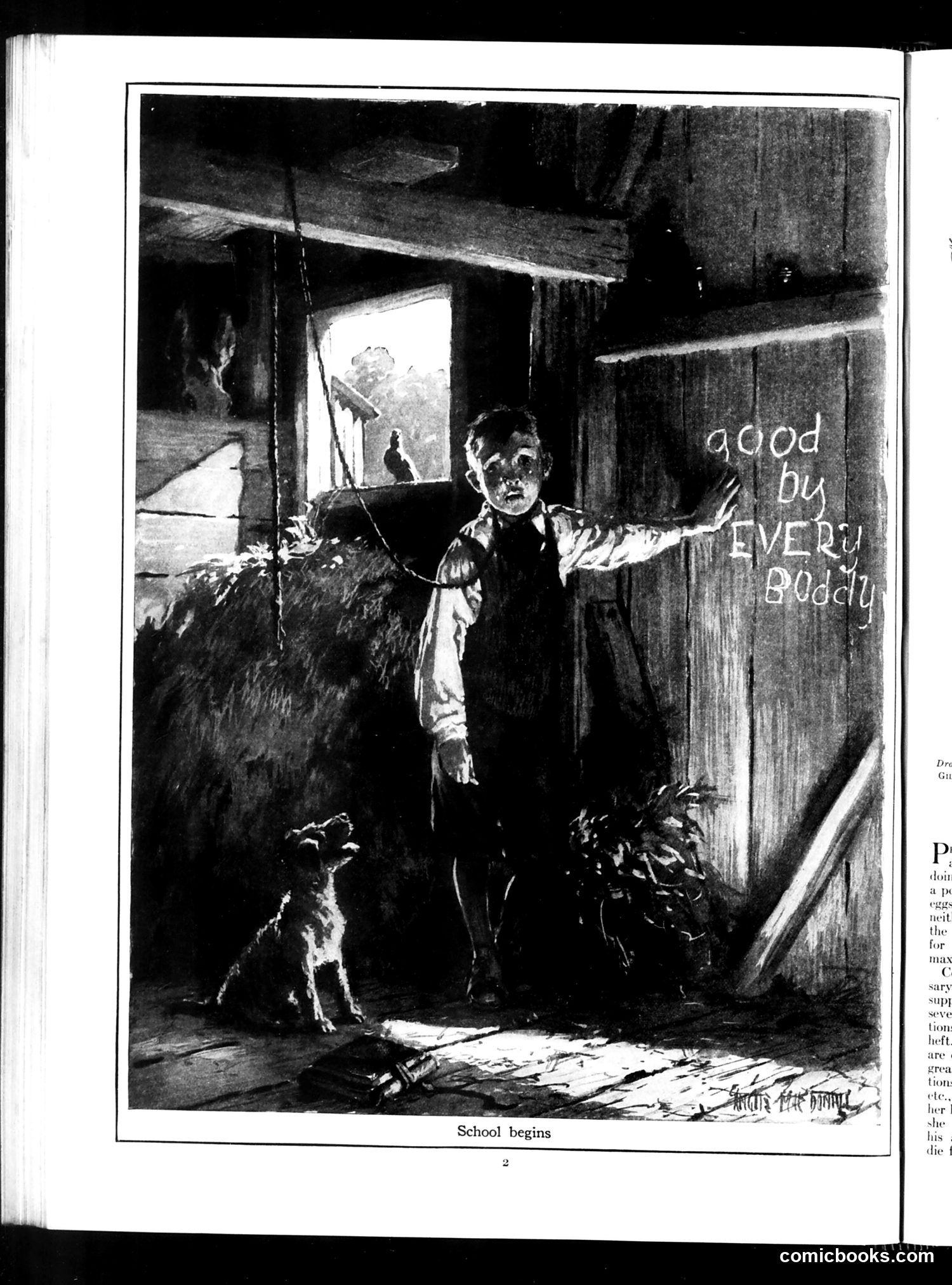
This illustration depicts a schoolmaster or authority figure saying goodbye to various animals—likely representing different nations or groups—as they depart for "school." The text "good by EVERybody" suggests the beginning of a collective educational or disciplinary experience. The cartoon appears to satirize international relations, possibly referencing a period when multiple nations were entering into conflict or a shared political situation. The animals likely represent different countries being sent to learn lessons through warfare or political struggle—a common metaphor in Judge magazine's satirical tradition. Without additional context about the specific publication date, the exact historical reference remains unclear, though the style suggests early-to-mid 20th century. The overall tone mocks the inevitability or resignation with which nations enter into serious conflicts.
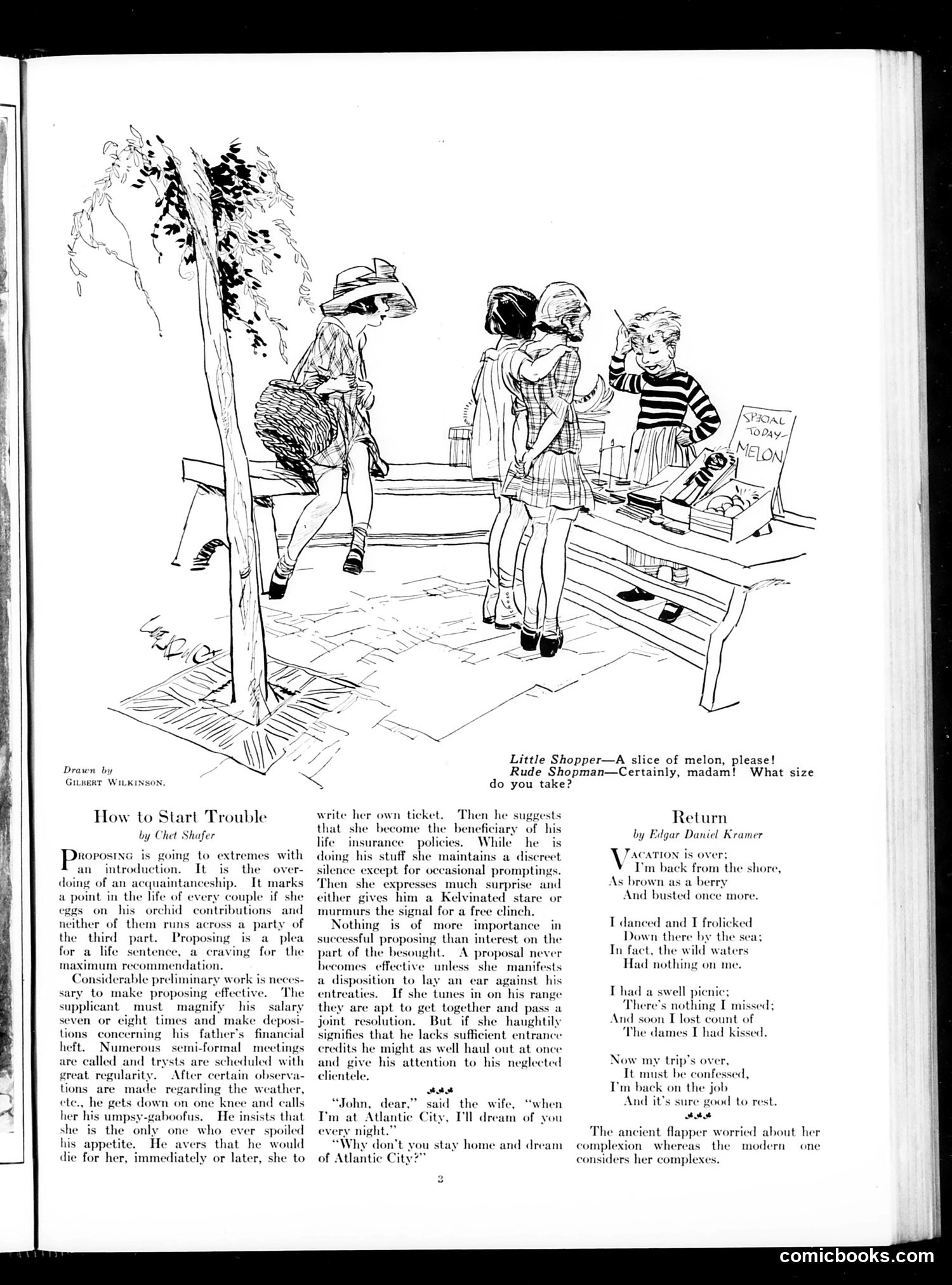
This page contains two satirical pieces from Judge magazine: **"How to Start Trouble"** (left) by Gilbert Wilkinson mocks the elaborate preliminaries couples undertake before proposing marriage. The satire targets how men magnify their salaries and financial status, carefully orchestrate introductions, and employ psychological manipulation (Kelvinated stares, free clinches) to secure a woman's acceptance. The piece sarcastically suggests men treat proposals like business negotiations rather than genuine romantic commitments. **"Little Shopper" and "Return"** (right) present humorous dialogue about retail transactions and vacation experiences. The cartoon shows a vendor interaction, while accompanying verses describe a seaside vacation's pleasures and the speaker's relief at returning home. These pieces reflect early 20th-century social commentary on courtship rituals and domestic life.
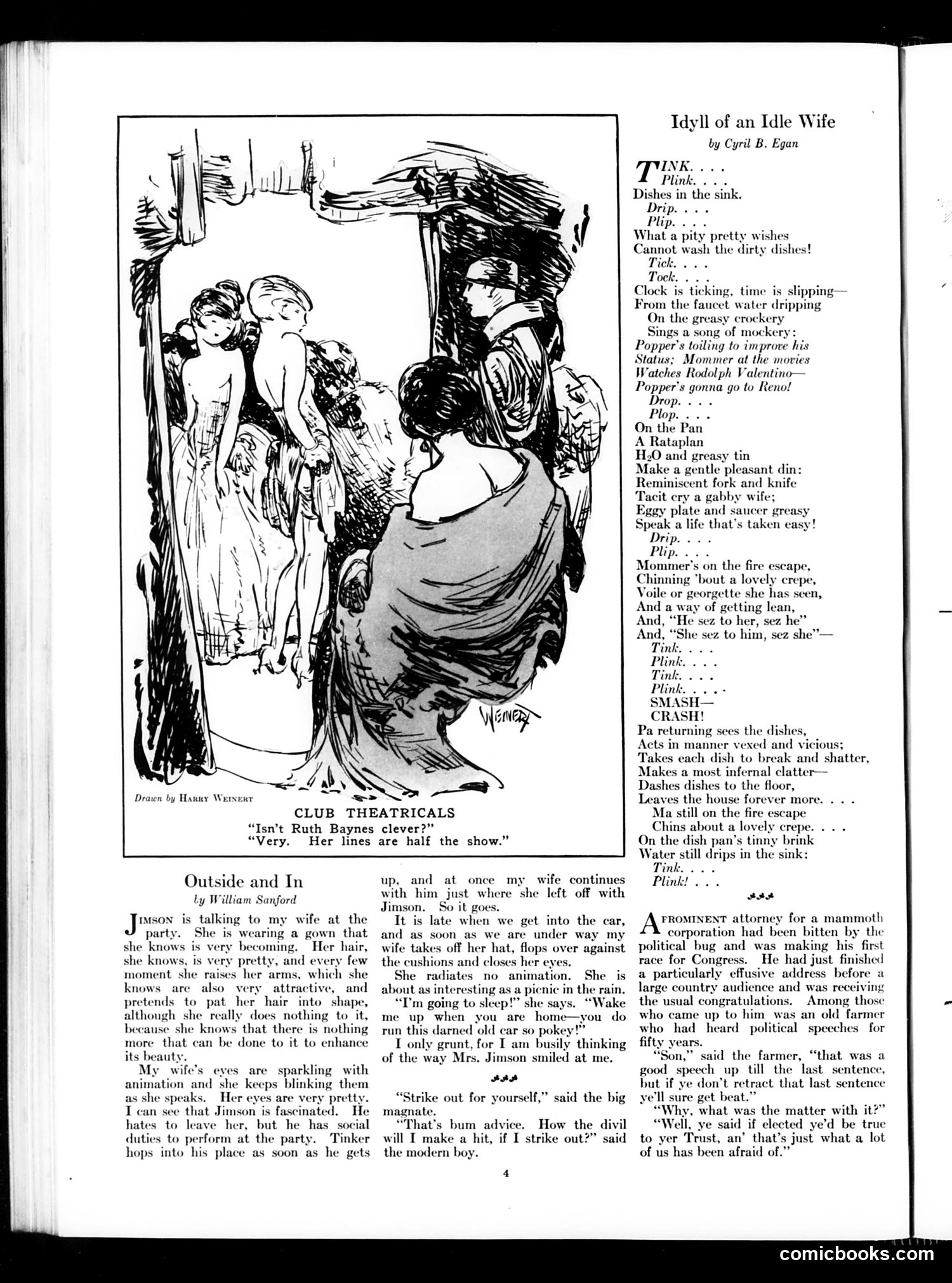
The page contains two distinct pieces: **"Idyll of an Idle Wife"** (top right): A satirical poem by Cyril B. Egan mocking a housewife's day of domestic complaints—dirty dishes, clock-watching, daydreaming about movies (mentioning Rudolph Valentino), and gossip. When her husband returns, she deliberately breaks dishes in anger. The satire targets both women's perceived idleness and domestic discontent in the early 20th century. **"Outside and In"** (bottom): A dialogue by William Sanford depicting a husband attending a party while his wife stays home. She wears an attractive gown; he finds her "very pretty" but notes she "hates to leave her, but he has social duties." The satire critiques the social double standard: women confined domestically while men enjoy public social life, and wives' resentment of this inequality. Both pieces satirize marriage dynamics and gender roles of the 1920s-era.
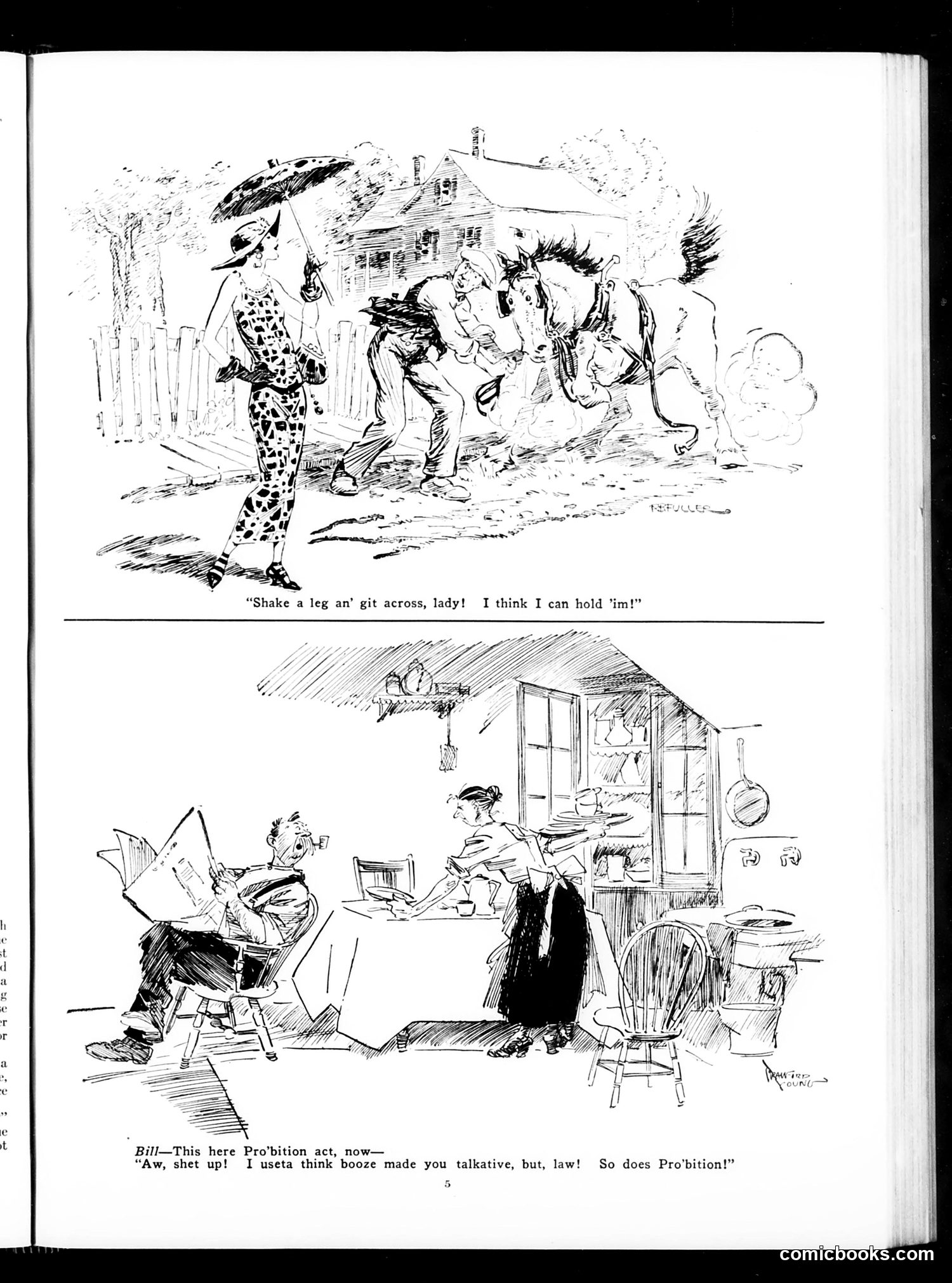
This Judge magazine page satirizes Prohibition through two scenes: **Top cartoon**: A woman in spotted dress attempts to cross while a man restrains a wild horse, suggesting chaos and difficulty under Prohibition's restrictions. **Bottom cartoon**: "Bill" complains that Prohibition—meant to reduce drinking and its social problems—has instead made people *more* talkative and disruptive. The joke inverts Prohibition's promised benefits: rather than creating order, it's created new social problems (excessive talking/disruption). The satire criticizes Prohibition as ineffective or counterproductive, suggesting it didn't solve the drinking-related issues supporters claimed it would. This reflects common anti-Prohibition sentiment during the 1920s-early 1930s period, when the policy faced growing public criticism for failing to eliminate alcohol consumption and associated social problems.
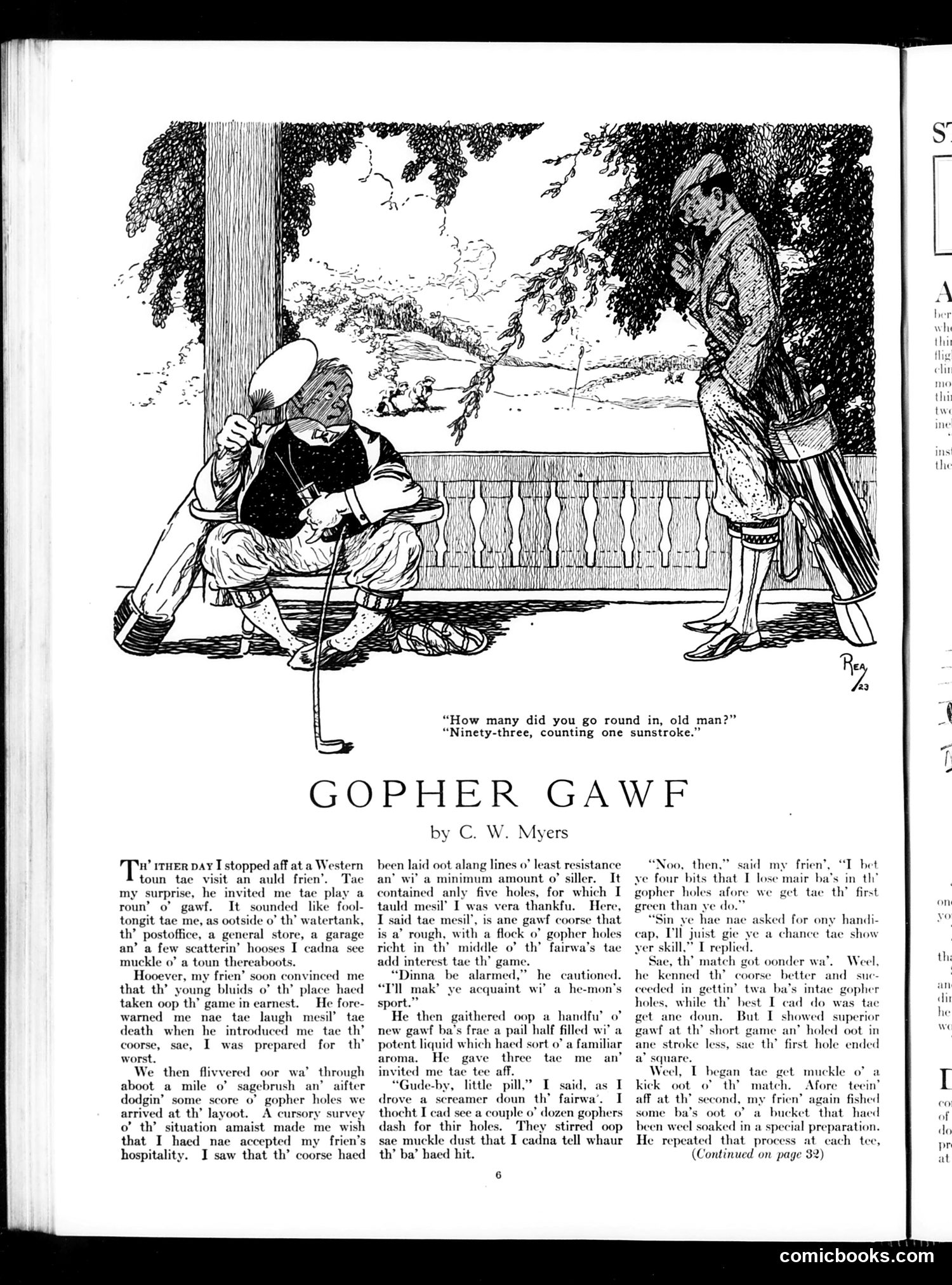
This is a humorous short story illustrated with a single cartoon panel, not a political cartoon. The story, written in Scottish dialect, satirizes golf's popularity spreading to remote American frontier towns. The cartoon shows two men on a makeshift golf course near a small Western town. The joke (shown in the caption) plays on the absurdity of the setting: when asked his score, an old golfer answers "Ninety-three, counting one sunstroke"—implying the harsh desert heat nearly killed him. The narrative mocks how golf has reached even isolated areas with minimal infrastructure, where the course is plagued by gopher holes. The protagonist is gradually won over despite the rough conditions and his friend's use of mysterious "potent liquid" to soak the golf balls (likely suggesting alcohol or some golf-enhancing preparation). The humor derives from applying an elite sport to primitive frontier circumstances.
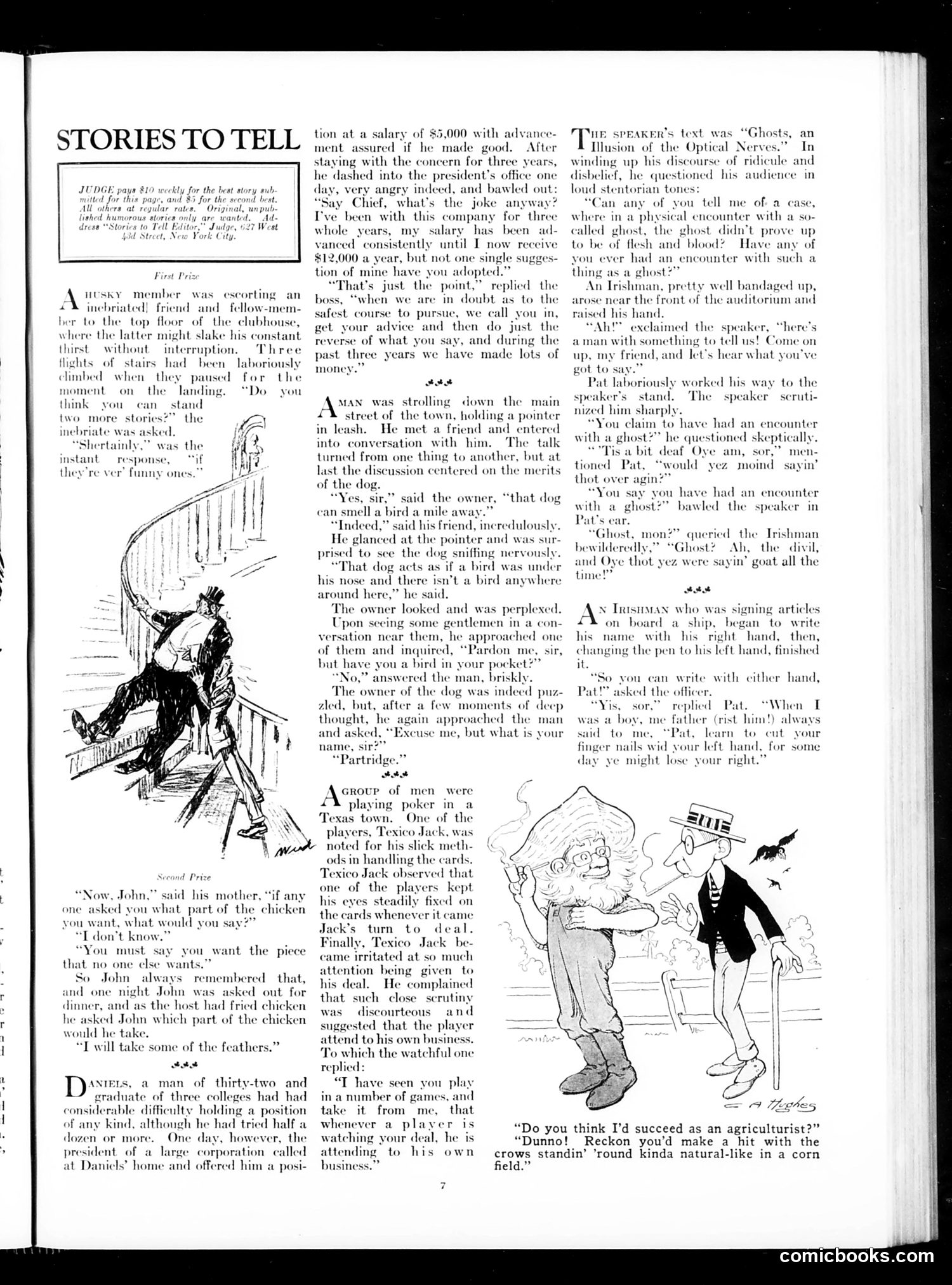
This page from *Judge* contains several humorous stories illustrating character flaws and absurdities in human behavior, typical of the magazine's satirical approach. **"The Chicken Story"**: Mocks a boy who takes his mother's advice literally—always leaving the best part for others. When asked what he wants at dinner, he absurdly requests "feathers," exposing the impracticality of rigid courtesy. **"The Boss's Reversal"**: Satirizes corporate management. A frustrated employee earning $12,000 annually learns his raises came *because* the company ignored his suggestions and did the opposite—a cutting joke about corporate incompetence and how sometimes bad advice accidentally leads to profit. **"The Dog and Partridge"**: A man boasts his pointer can smell birds miles away, but the dog acts nervous with no bird present. When the owner discovers a nearby man is named "Partridge," the joke exposes how assumptions and hearsay can mislead us. **"The Poker Player"**: Critiques cheating. A watchful observer confronts a dealer about his suspicious methods, implying constant scrutiny reveals criminal behavior. These stories lampoon human pretension, stupidity, and dishonesty through exaggerated scenarios common to *Judge's* humor tradition.
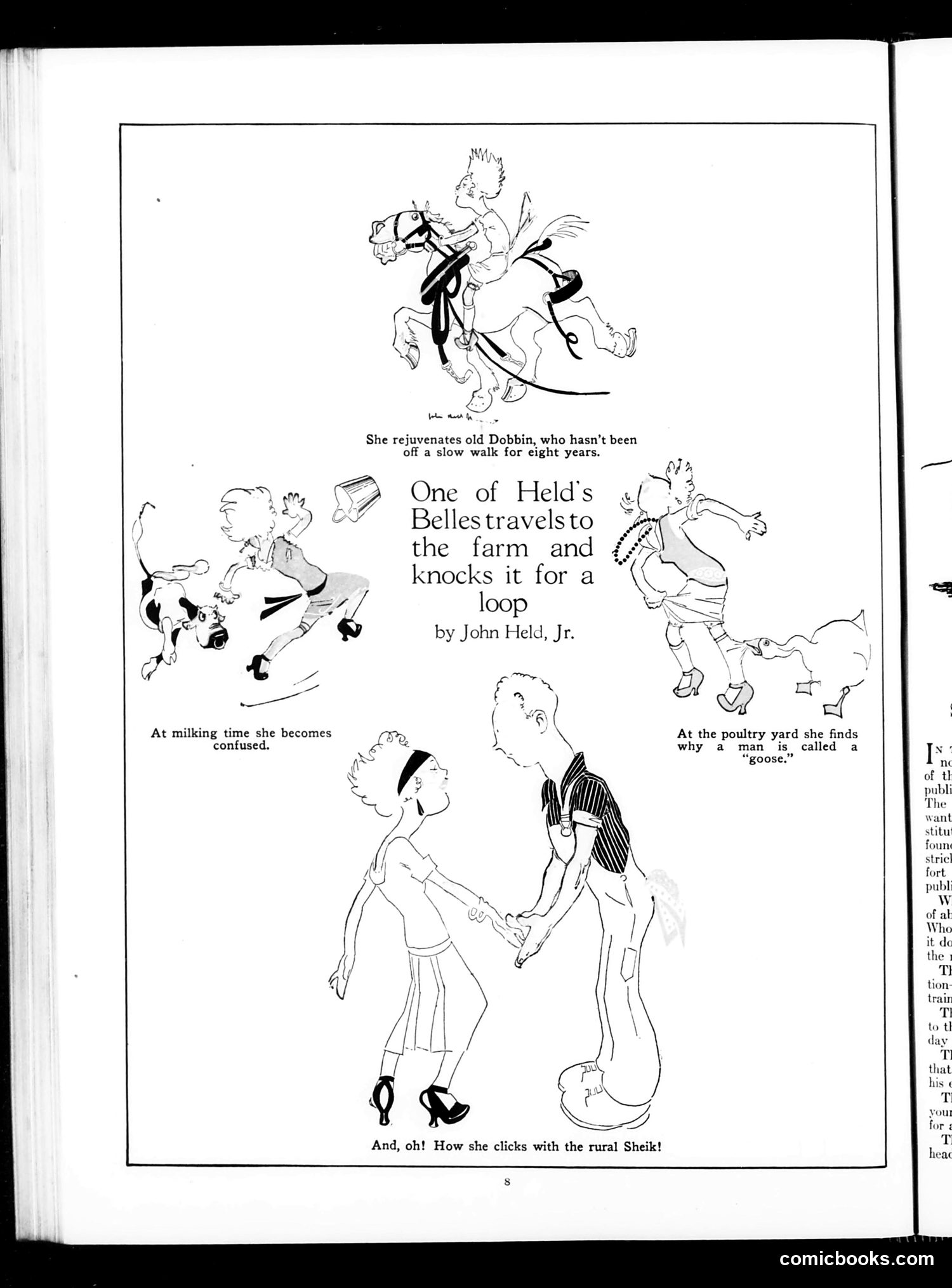
This is a humorous comic strip by John Held Jr. about a fashionable urban woman ("one of Held's Belles") visiting a farm. The joke plays on her unfamiliarity with rural life and double entendres: She exhausts an old horse ("Dobbin"), becomes confused during milking, and makes a crude pun at the poultry yard about why men are called "geese." The final panel shows her flirting with a rural man ("the rural Sheik"), suggesting she's more interested in romance than farm work. The satire mocks both urban sophistication and rural naïveté. "Sheik" references the 1920s exotic romantic fantasy. The strip's humor depends on readers understanding farming references and appreciating Held's satirical take on the clash between city and country cultures during the Jazz Age.
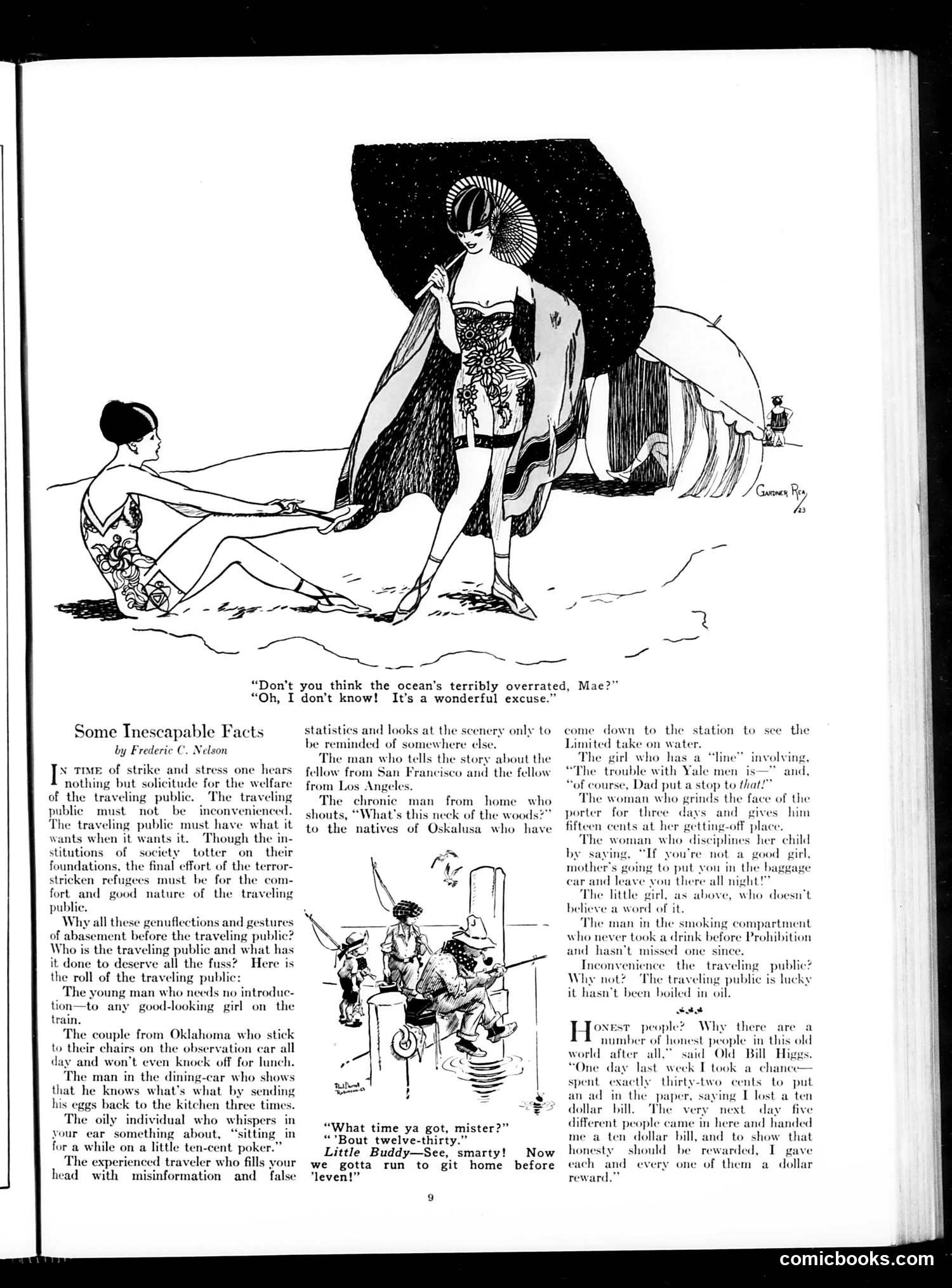
**Main Cartoon (top):** A fashionably dressed woman at the beach pulls a reluctant, scantily-clad man into the ocean. The caption satirizes superficial beach conversation—she complains the ocean is "overrated," he responds it's "a wonderful excuse." The joke suggests the ocean serves merely as a pretext for flirtation and display rather than genuine enjoyment. **Article: "Some Inescapable Facts"** by Frederic C. Nelson satirizes the traveling public during what appears to be labor unrest or strikes (referenced in opening). Nelson catalogs types of annoying train passengers—the show-off, the bores, the demanding woman who underpays porters, the Prohibition-era drinker. The piece mocks society's exaggerated deference to travelers while these passengers themselves are often insufferable and inconsiderate. The final anecdote about "Old Bill Higgs" and his lost ten-dollar bill appears to mock false claims of widespread honesty. The satire targets both the entitled traveling public and society's fawning service toward them.
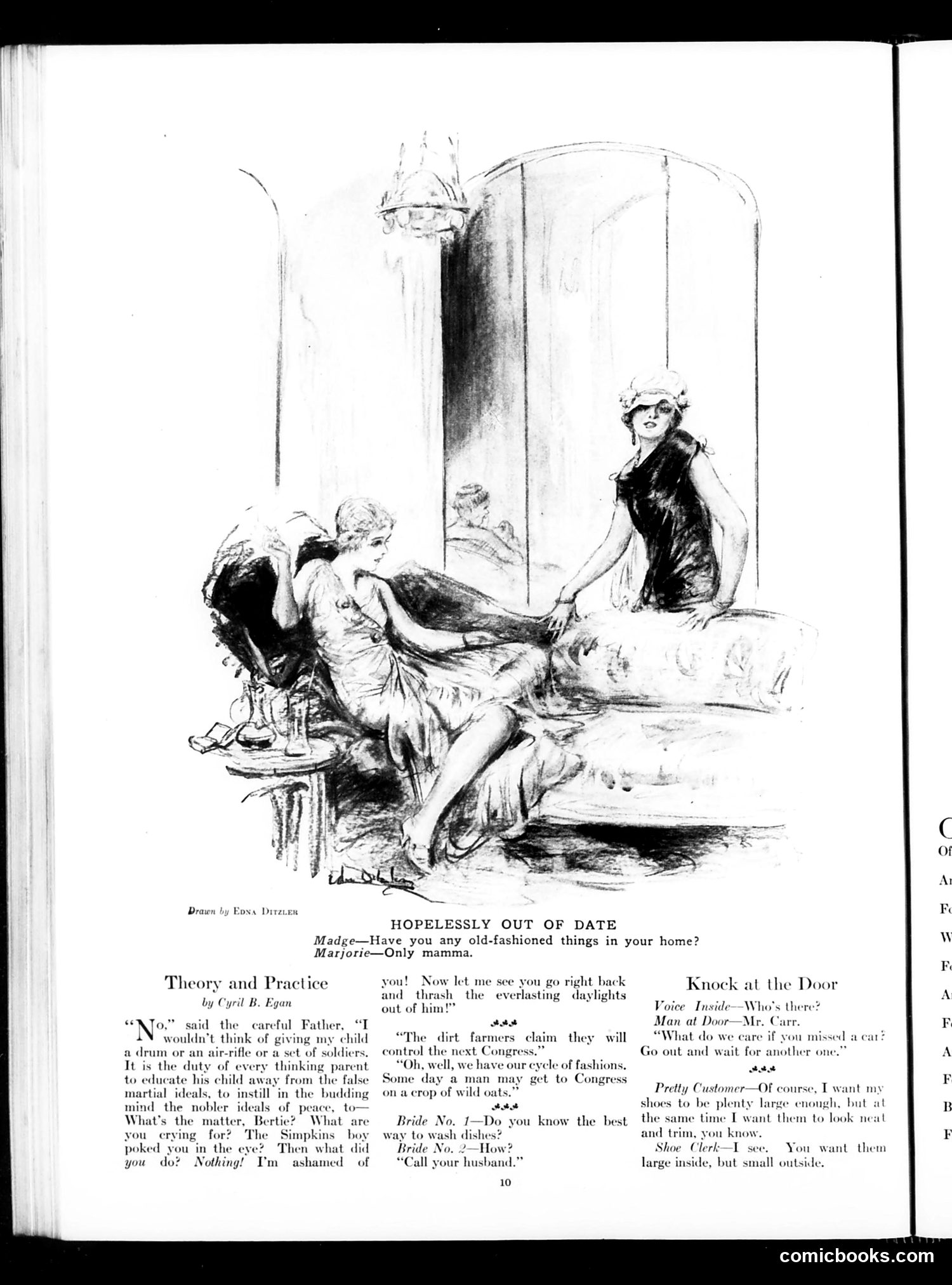
This page contains three separate satirical pieces from *Judge* magazine: **Main Cartoon**: A woman asks another if she has old-fashioned things at home; the reply "Only mamma" ridicules outdated mothers—likely commenting on generational conflict and rapidly changing social norms in early 20th-century America. **"Theory and Practice"**: A father lectures against giving children toy weapons to promote peace, then immediately tells his son to fight back violently against a bully. The satire exposes hypocrisy in parenting philosophy—the gap between idealistic principles and actual behavior. **Remaining Shorts**: Brief jokes about wives and husbands, shoe-fitting contradictions, and politics reference Congress elections and fashion cycles—all mocking domestic life, consumer culture, and political vacuity common to the era. The overall theme: the disconnect between what people *say* they believe and what they actually *do*—a recurring *Judge* satirical motif about American society's pretensions and contradictions.
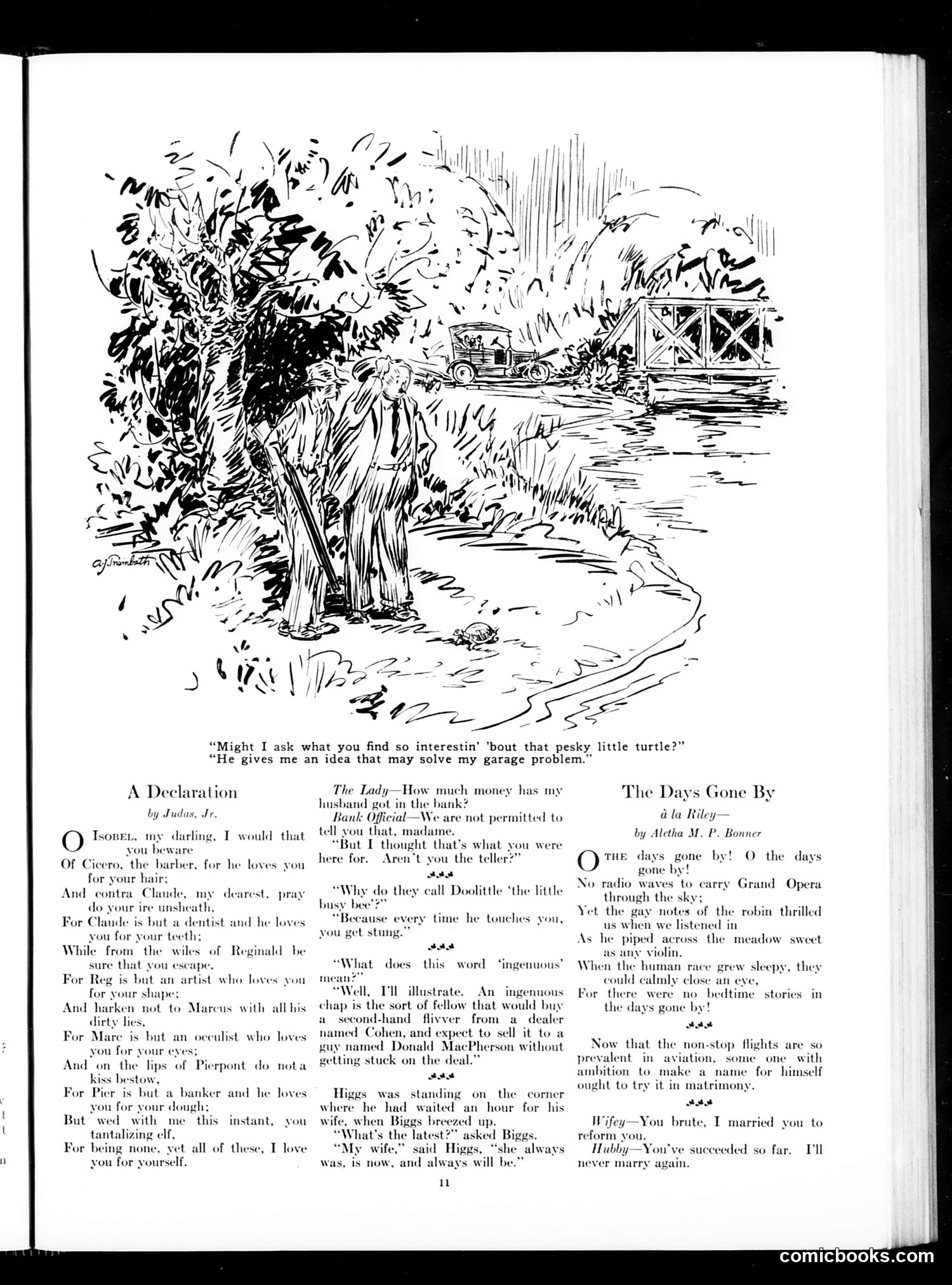
This page contains **three separate humorous pieces**, typical of Judge's satirical format: 1. **Top cartoon**: A man observing a turtle suggests it could "solve my garage problem"—likely a joke about the turtle's slow speed as a solution to speeding/traffic issues, or possibly a visual pun about the turtle's shell resembling a car. 2. **"A Declaration" (left)**: A comic poem warning a woman to beware suitors—a barber, dentist, artist, oculist, and banker—each who "love you for" specific body parts or money. Only the speaker "loves you for yourself." This gently mocks professional men's mercenary interests and flattery. 3. **Right side pieces**: Brief humorous sketches about: - A banker refusing to disclose account information, despite being a "teller" - A definition of "ingenuous" involving a secondhand car scam (antisemitic joke referencing "Cohen") - A wife always being late - A poem lamenting loss of pre-radio/pre-flight era simplicity The content reflects 1920s-30s social satire about modern conveniences, gender relations, and professional types.
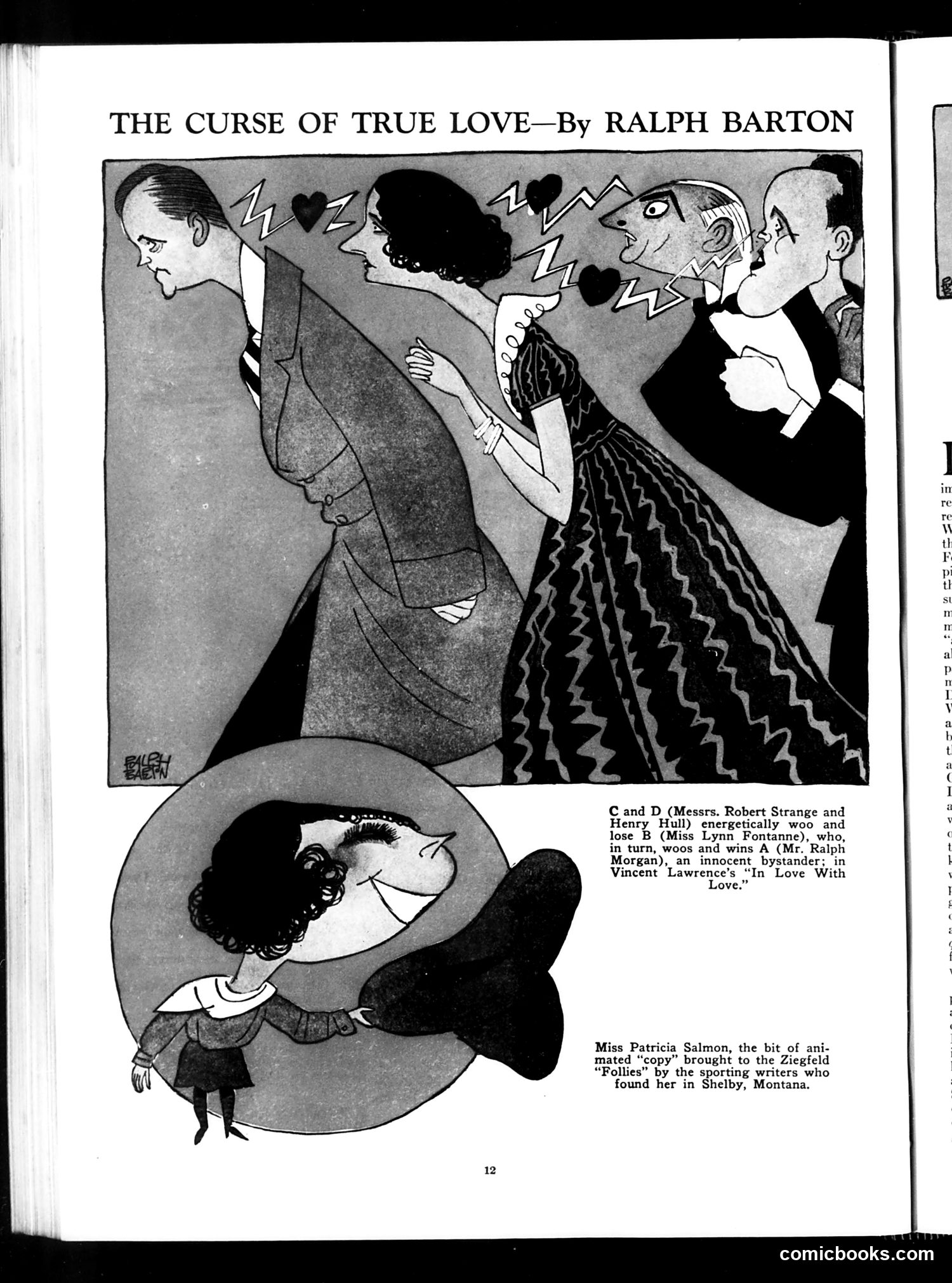
This is a satirical cartoon about the Broadway play "In Love With Love" by Vincent Lawrence. The upper panel shows a love-triangle farce: two men (C and D) pursue a woman (B), who ignores them to pursue an innocent bystander (A) — depicting the circular, frustrating nature of romantic entanglement that the play's title ironically emphasizes. The lower panel advertises Miss Patricia Salmon, presented as a novelty act in the Ziegfeld "Follies" — notably described as "animated copy" discovered by sportswriters in Montana, suggesting she was promoted more as a curiosity or gimmick than as a serious performer. Barton's satire mocks both theatrical absurdity and the era's tendency to package women as exotic commodities for entertainment.
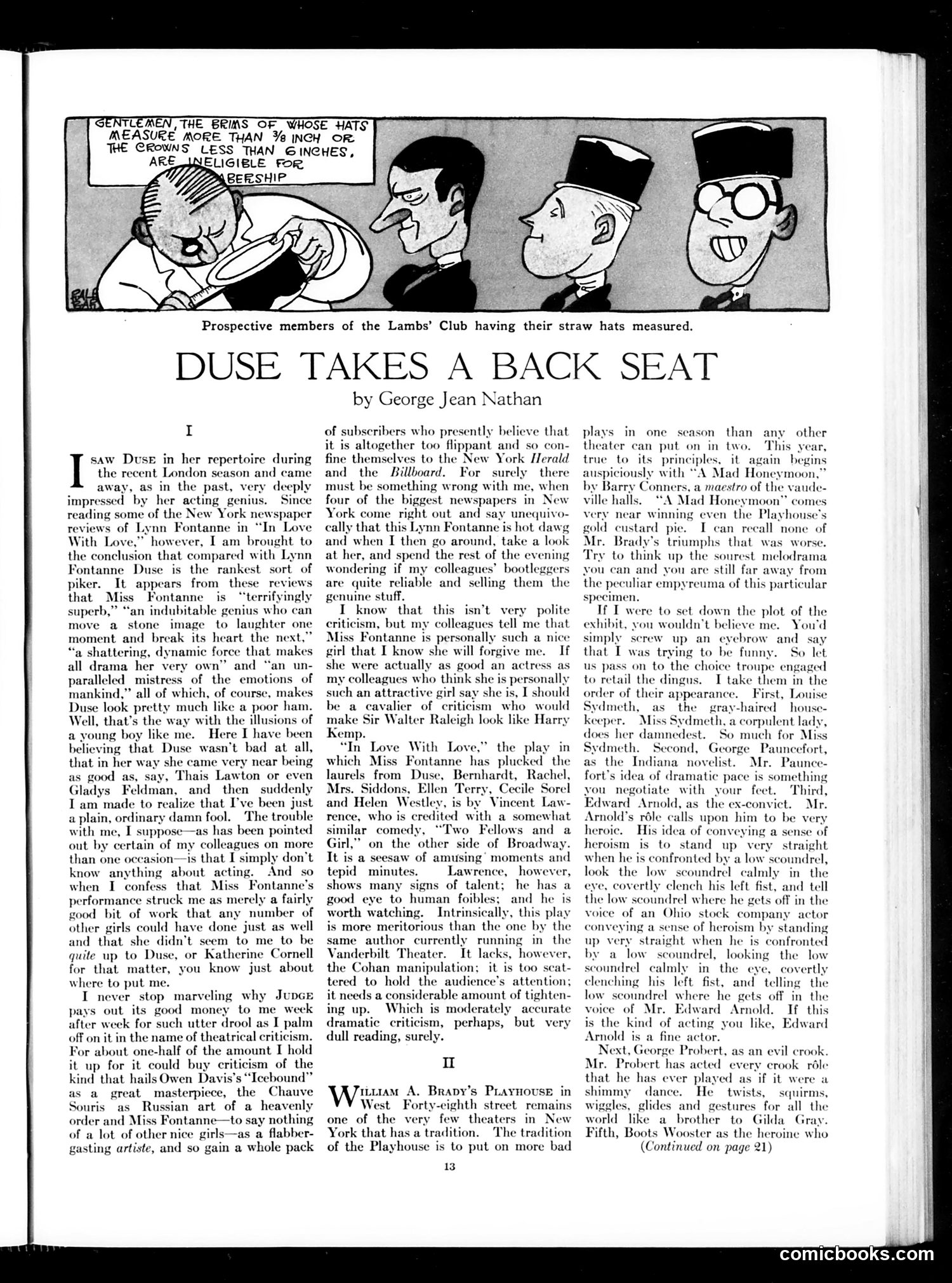
**The Cartoon:** The top panel satirizes the Lambs' Club (a theatrical social club) by showing men's straw hats being measured against absurdly specific eligibility criteria—brims over 9/16 inch or crowns under 6 inches—to mock the club's exclusionary or arbitrary membership standards. **The Article:** Theater critic George Jean Nathan mocks his fellow New York newspaper critics for gushing over actress Lynn Fontanne in the play "In Love With Love," calling her a genius while he found her merely competent. He sarcastically compares her favorably to the legendary Eleonora Duse (a celebrated Italian actress) and other theatrical greats, suggesting his colleagues are either incompetent critics or swayed by Fontanne's personal charm rather than actual talent. Nathan questions why *Judge* magazine pays him to write honest criticism when readers apparently prefer the inflated praise other papers provide. The satire targets both theatrical hype and critical dishonesty in 1920s newspapers.
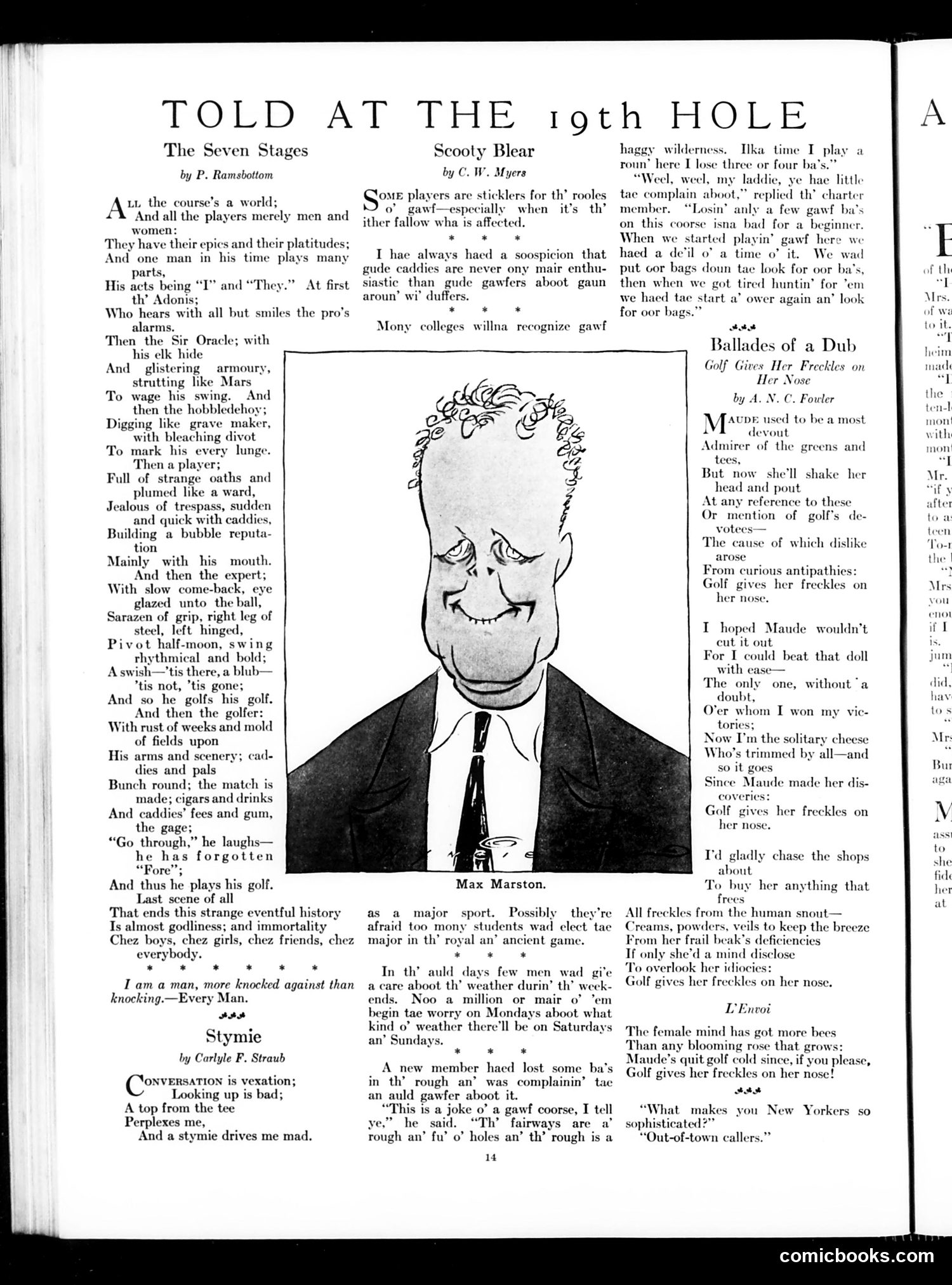
This page collects golf-themed humor pieces typical of early 20th-century Judge magazine. The central portrait is of **Max Marston**, likely a prominent golfer of the era, though the text doesn't explicitly identify him. The pieces satirize golf culture through multiple lenses: **"The Seven Stages"** parodies Shakespeare's "seven ages of man," tracing a golfer's lifecycle from cocky novice ("Adonis") through various incompetent phases to the finally enlightened player who's forgotten competitive ambition. **"Scooty Blear"** and other dialect pieces mock Scottish golf culture and the pretensions surrounding the "royal and ancient game," while critiquing colleges that overemphasize golf. **"Ballades of a Dub"** humorously suggests that golfing caused a woman (Maude) to develop freckles—implying excessive sun exposure—making her less desirable to the narrator, who ironically now beats her at golf without her former competition. The overall satire targets golf's obsessive popularity, its social pretensions, and the eccentric behaviors it inspires in players.
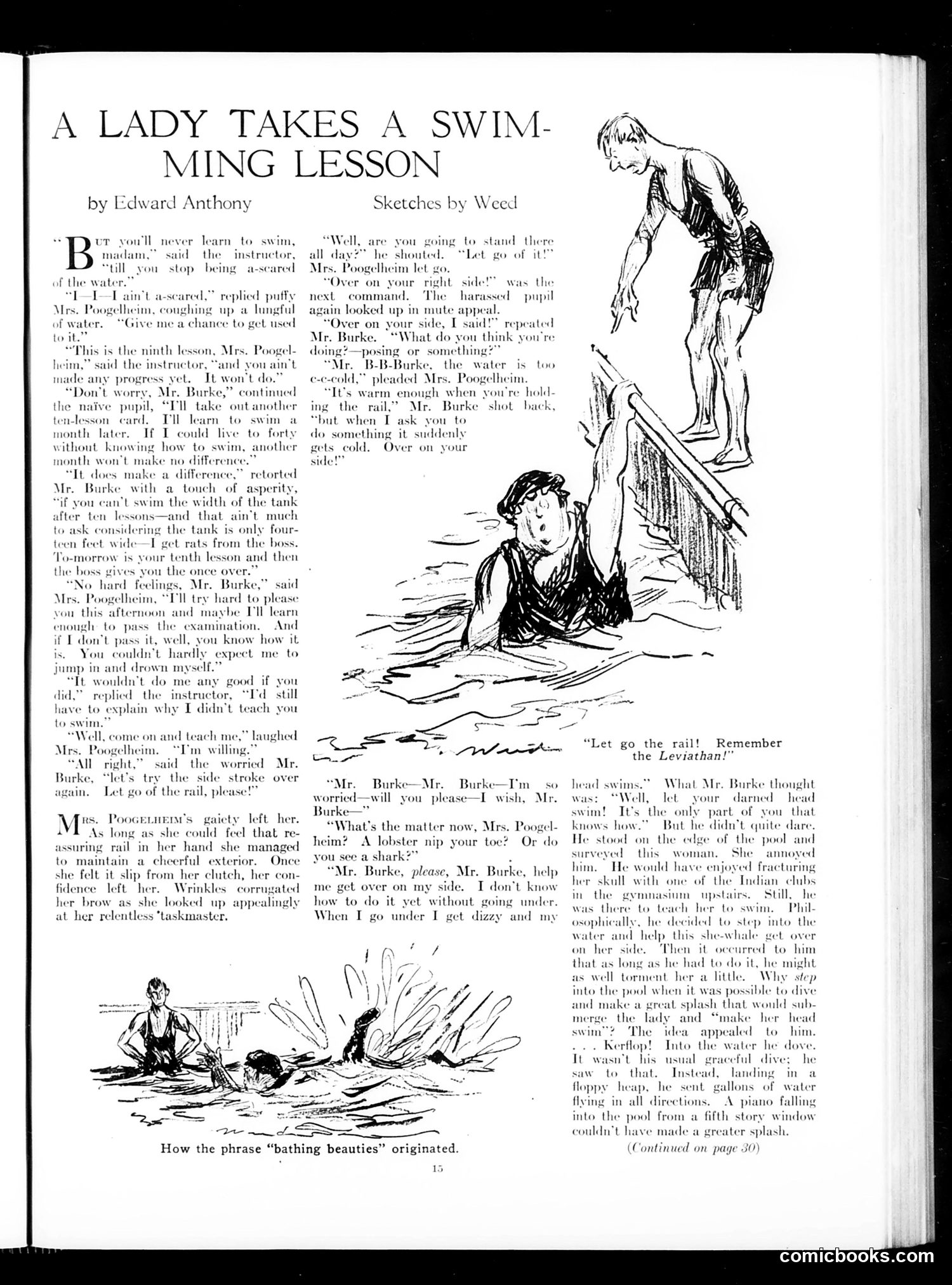
This is a humorous story illustrated with sketches about Mrs. Poogelheim's swimming instruction with an exasperated instructor, Mr. Burke. The satire targets turn-of-the-century attitudes about women's timidity and physical weakness. Mrs. Poogelheim, a portly, anxious woman, repeatedly fails at basic swimming tasks—she clings to the rail, complains the water is cold, and refuses to let go despite nine previous lessons. Mr. Burke's frustration escalates as she makes excuses and displays paralyzing fear. The joke culminates in the caption "How the phrase 'bathing beauties' originated"—suggesting that women in water look ridiculous rather than beautiful. Burke's final act of diving into the pool and creating a massive splash appears designed to humiliate or shock her into action. The piece mocks both women's perceived physical inadequacy and the absurdity of expecting timid women to master swimming, while portraying the male instructor as increasingly contemptuous of his pupil.
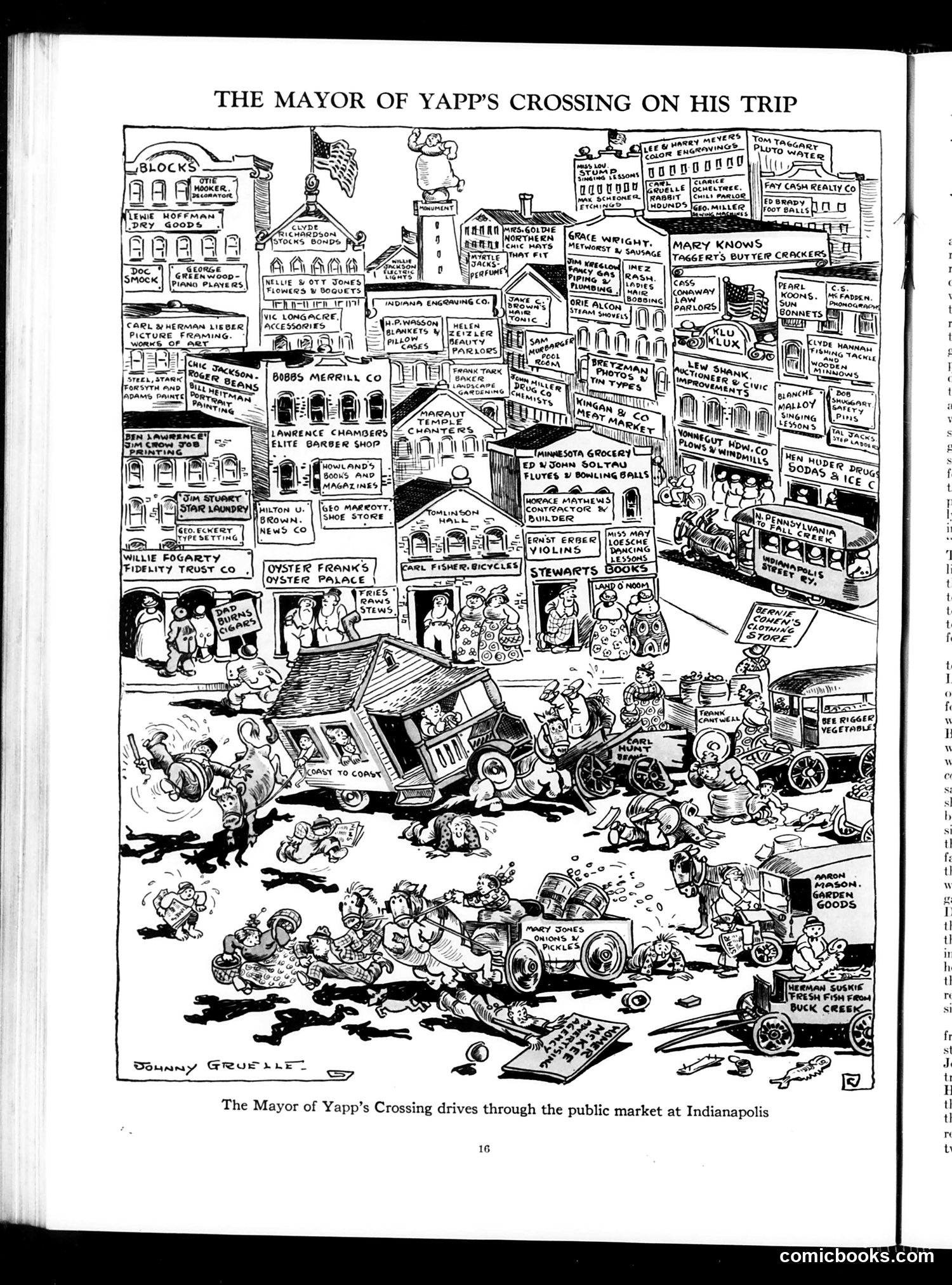
This is a satirical cartoon depicting a small-town mayor's chaotic journey through Indianapolis's public market. The humor relies on contrasting rural simplicity with urban chaos: the mayor's vehicle (appears to be an early automobile) careens through the marketplace amid pedestrians, vendors, and merchandise, creating mayhem. The cartoon is essentially a "fish out of water" joke—a country figure overwhelmed by city life. The labels throughout identify real Indianapolis businesses (storefronts, shops, services), suggesting this mocks an actual local dignitary's visit or plays on stereotypes about unsophisticated small-town leaders navigating modern urban environments. The artist is credited as "Dohanny Gruelle" (likely Johnny Gruelle). This appears designed for Judge magazine's Indianapolis readership as local humor, poking fun at provincial pretension meeting metropolitan reality.
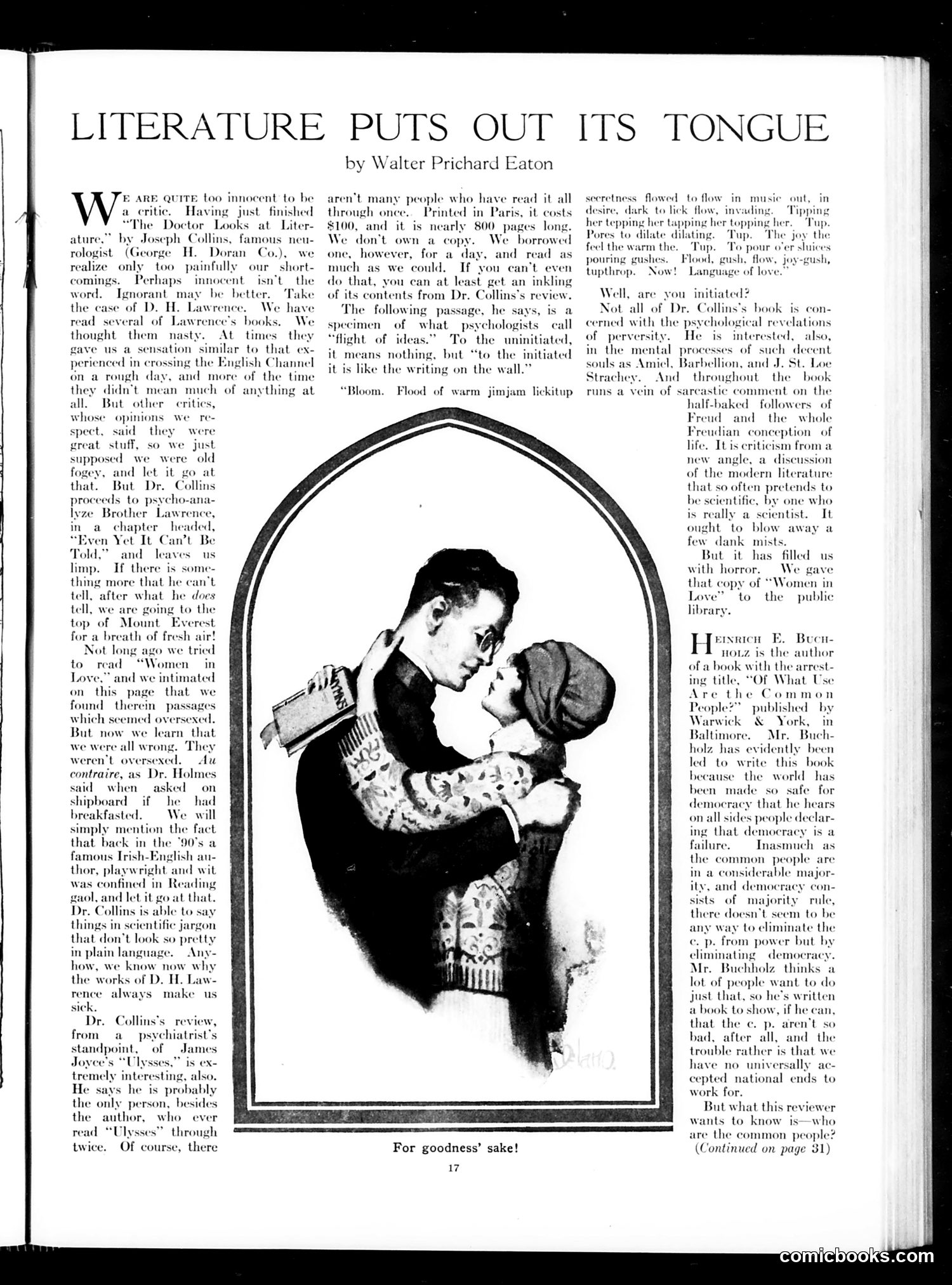
This article critiques Dr. Joseph Collins's psychoanalytic approach to literary criticism in his book *The Doctor Looks at Literature*. The satirical point: Collins applies Freudian analysis to works by D.H. Lawrence and James Joyce, "explaining" their deliberately obscure or sexually charged writing through psychological jargon that makes nonsensical passages seem profound. The cartoon (captioned "For goodness' sake!") illustrates this absurdity—a romantic embrace reduced to pseudo-scientific terminology. Author Eaton mocks how Collins justifies Lawrence and Joyce's work by pathologizing them rather than engaging genuine literary merit. The excerpt from *Ulysses* ("Bloom. Flood of warm jimjam...") exemplifies Joyce's stream-of-consciousness style, which Collins claims is scientifically explicable but which Eaton suggests is simply incomprehensible gibberish dressed up in psychiatric language. The satire targets 1920s literary modernism and the trendy application of Freudian psychology to culture—suggesting that pseudo-intellectual analysis creates false legitimacy for works that may simply be bad or obscene.
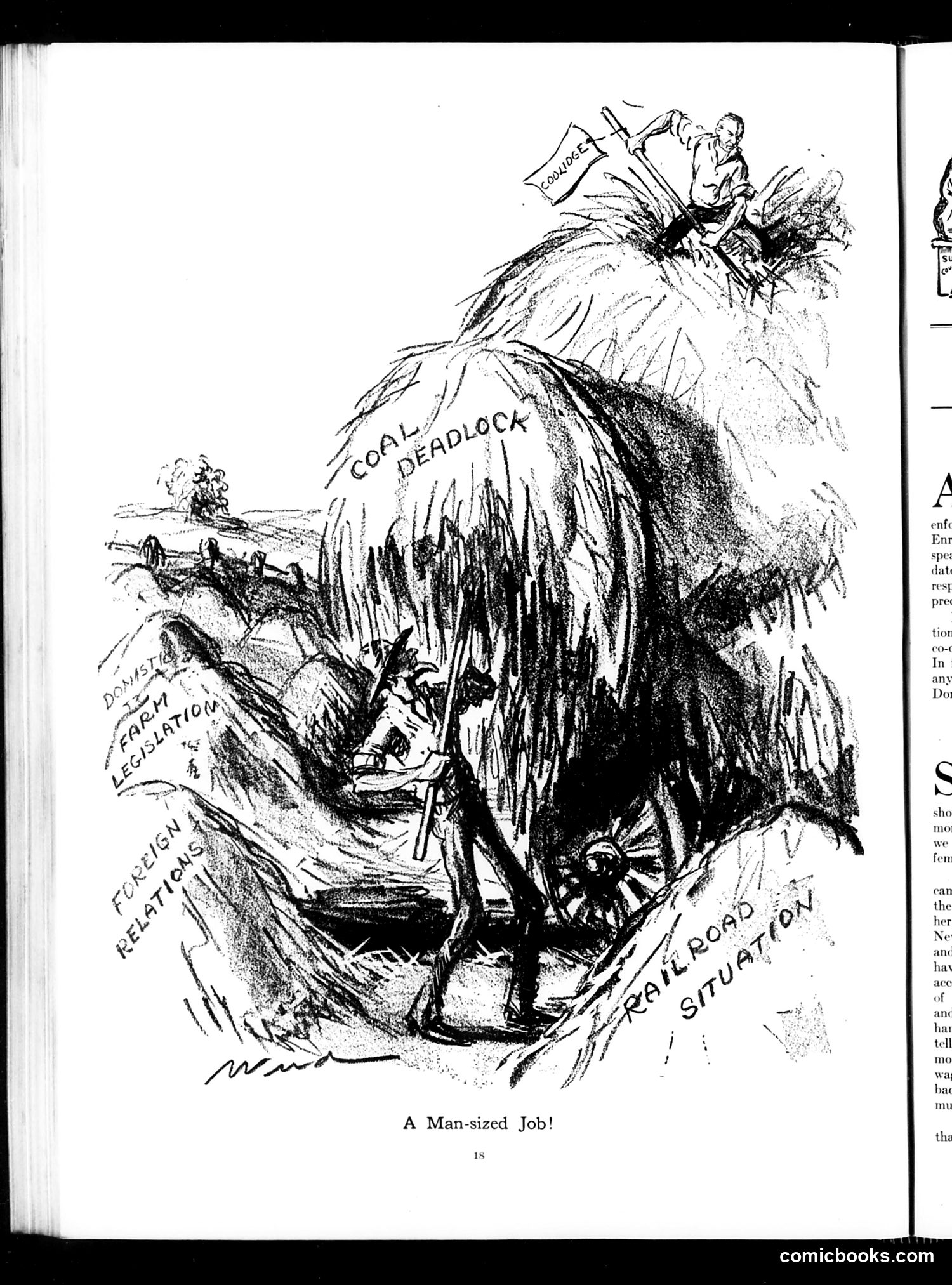
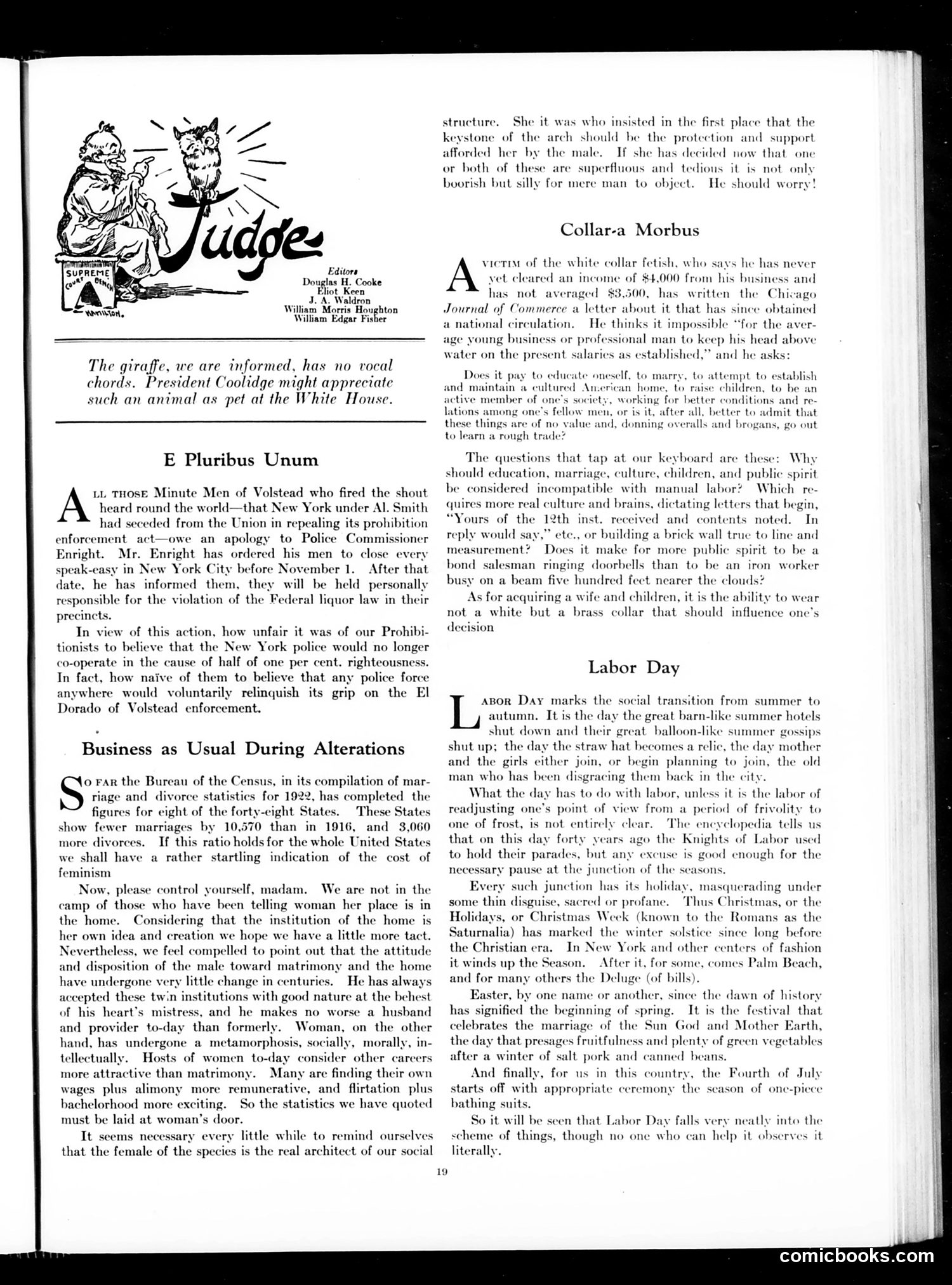
## The Cartoons and Articles: **Top Cartoon ("Judge")**: A visual gag mocking President Calvin Coolidge's famously taciturn personality. The caption notes giraffes have no vocal cords, suggesting Coolidge would appreciate such a pet for the White House—a jab at his reputation for rarely speaking publicly. **"E Pluribus Unum"**: Satire on Prohibition enforcement in New York. When Al Smith (anti-Prohibition politician) was elected, prohibitionists feared police would stop enforcing the Volstead Act. Judge mocks this naïveté, noting Police Commissioner Enright ordered officers to close speakeasies before November 1, proving cops would continue profiting from liquor law enforcement regardless of political winds. **"Business as Usual During Alterations"**: Commentary on rising divorce rates. Judge sarcastically blames women's changing attitudes toward marriage, noting some now prefer wages and independence to matrimony—reflecting 1920s feminism concerns among conservative commentators. **"Collar-a Morbus" and "Labor Day"**: Articles about white-collar workers struggling on inadequate salaries and Labor Day's cultural significance. The page reflects Judge's satirical conservative perspective on 1920s social change.
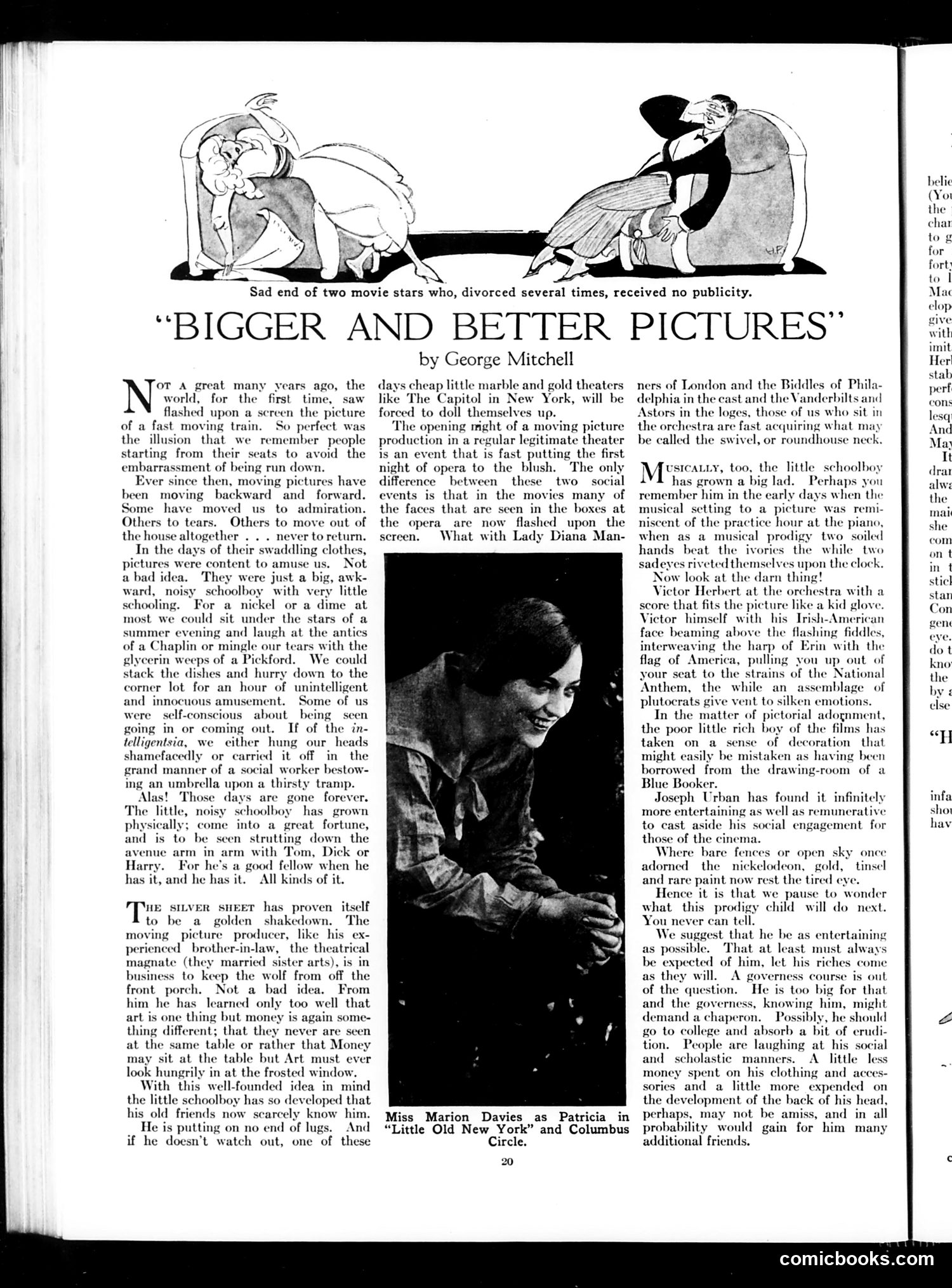
This article critiques the film industry's transformation from humble entertainment into pretentious high art. Mitchell contrasts cinema's early days—nickel theaters showing Chaplin and Pickford films for working-class audiences—with the current trend of lavish premiere screenings in legitimate theaters. The satire targets how movies have become status symbols for the wealthy elite (the Vanderbilts, Astors, Biddles mentioned). Mitchell mocks both the industry's newfound gravitas (hiring composer Victor Herbert) and the social climbing it encourages. The cartoon's opening image shows two figures being pulled apart, illustrating the tension between cinema's original innocence and its newfound pretensions. The piece argues that while movies have gained artistic legitimacy, they've lost their charm as simple, accessible entertainment—ironically, by becoming "bigger and better."
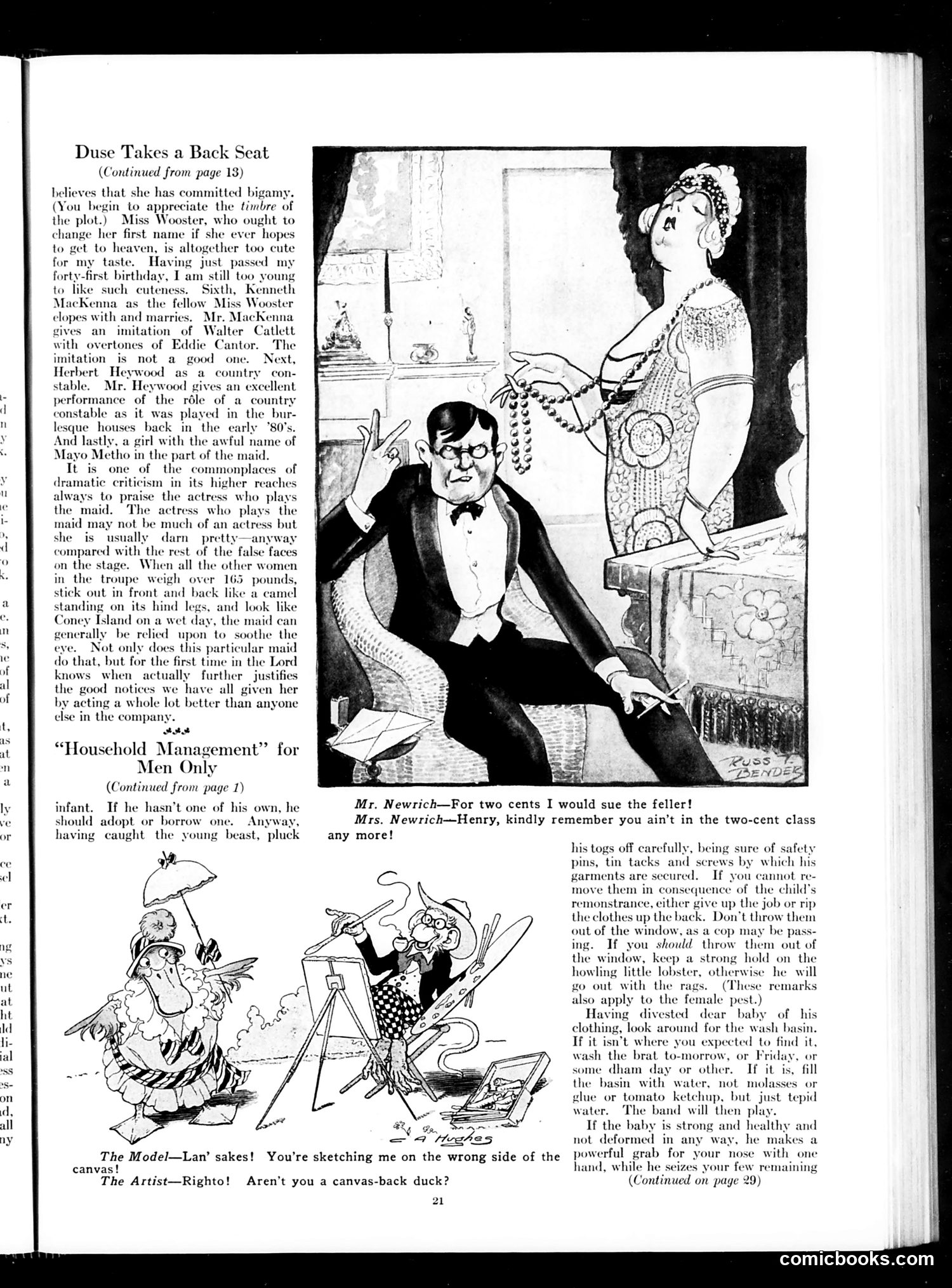
This page contains three distinct pieces of early-20th-century satirical content: **"Duse Takes a Back Seat"** is a theater review criticizing a stage production. The critic dismisses most performers as mediocre, with particular scorn for Kenneth MacKenna's imitation of vaudeville performers Walter Catlett and Eddie Cantor. The title sarcastically suggests the famous Italian actress Eleonora Duse would be overshadowed by this amateur cast. The review's tone is elitist and dismissive. **"Household Management for Men Only"** is absurdist satire about bathing an infant, offering deliberately impractical "advice" (don't throw wet clothes out windows because cops might see; use only tepid water, not molasses). This mocks the era's condescension toward men handling domestic tasks. **The cartoon dialogue** between Mr. and Mrs. Newrich satirizes the newly wealthy—his threat to sue over cost and her correcting him for still acting "two-cent class" humor shows social climbing anxiety among the rich. All pieces employ humor punching downward at performers, working-class people, and the socially ambitious.
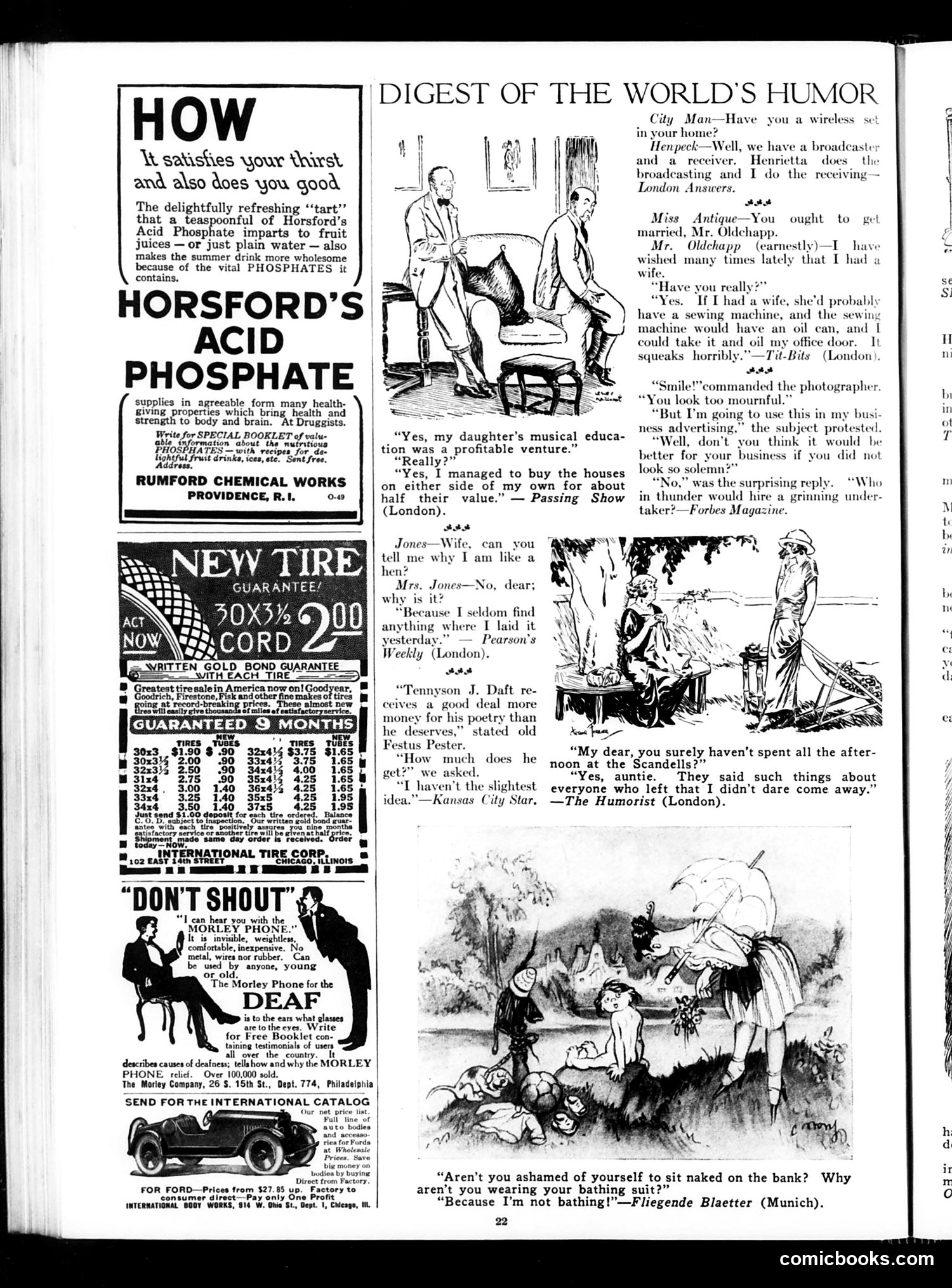
This is primarily a **humor digest page** collecting jokes from various publications rather than original satirical content. The cartoons and quips mock everyday domestic and social situations. The main cartoon depicts a man confronting a naked person at a riverbank—the humor relies on the victim's excuse that he's "not bathing," implying he's simply lounging nude. It's mild social satire about propriety. The text jokes target recognizable types: henpecked husbands (a husband forced to listen to his wife's "broadcasting"), wives with sewing machines creating household chaos, undertakers who look too sad, and the nouveau riche showing off newly-purchased neighboring properties. One recurring theme is **marital complaint**—men expressing regret about wives, their expenses, and dominance. The "wireless set" joke plays on wives as intrusive broadcasters in the home. The page is framed by **period advertisements** (Horsford's Acid Phosphate, tire guarantees, hearing aids for the deaf, and automobiles), typical of Judge's commercial content. The humor is genteel, mainstream, and aimed at middle-class readers concerned with domestic manners and social climbing.
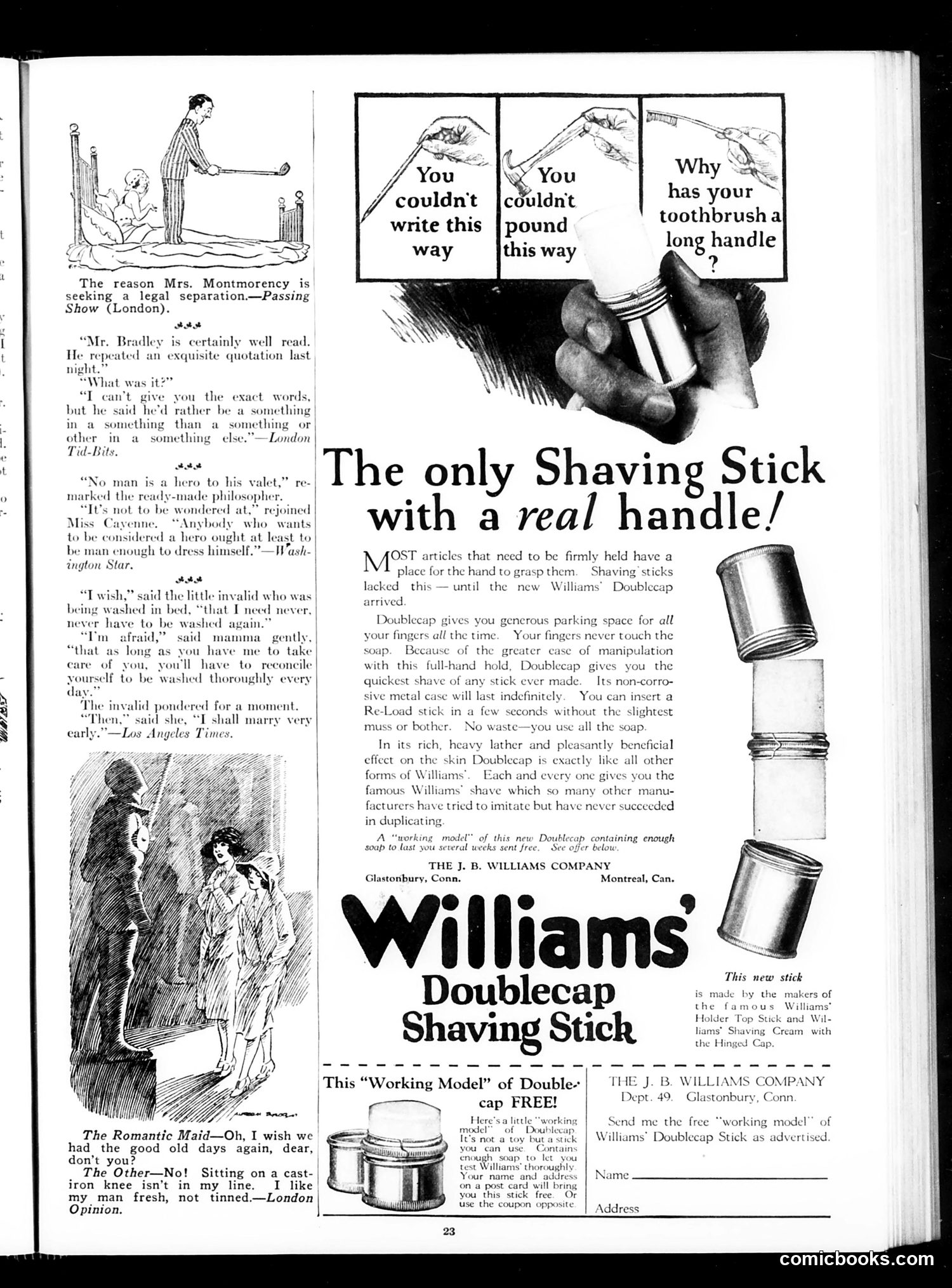
This page combines satirical cartoons with advertising. The top cartoons mock domestic life and intellectual pretension: one depicts a wife seeking legal separation because her husband won't hold a toothbrush properly, another ridicules a man who repeats quotations inaccurately, and a third features an invalid complaining about being washed—all reflecting early 20th-century attitudes about gender roles and domesticity. The dominant content is a **Williams' Doublecap Shaving Stick advertisement** disguised as editorial praise. It addresses a genuine product problem: traditional shaving sticks lacked handles, requiring users to grip soap directly. The ad emphasizes the new handle's practical benefits—ease of grip, no wasted soap, quick application—and offers a free sample. The lower cartoon, "The Romantic Maid," jokes about preferring modern convenience (fresh men) over nostalgic idealization of "the good old days," possibly alluding to preserved or tinned goods. The entire page reflects period humor and consumer culture circa 1910s-1920s.
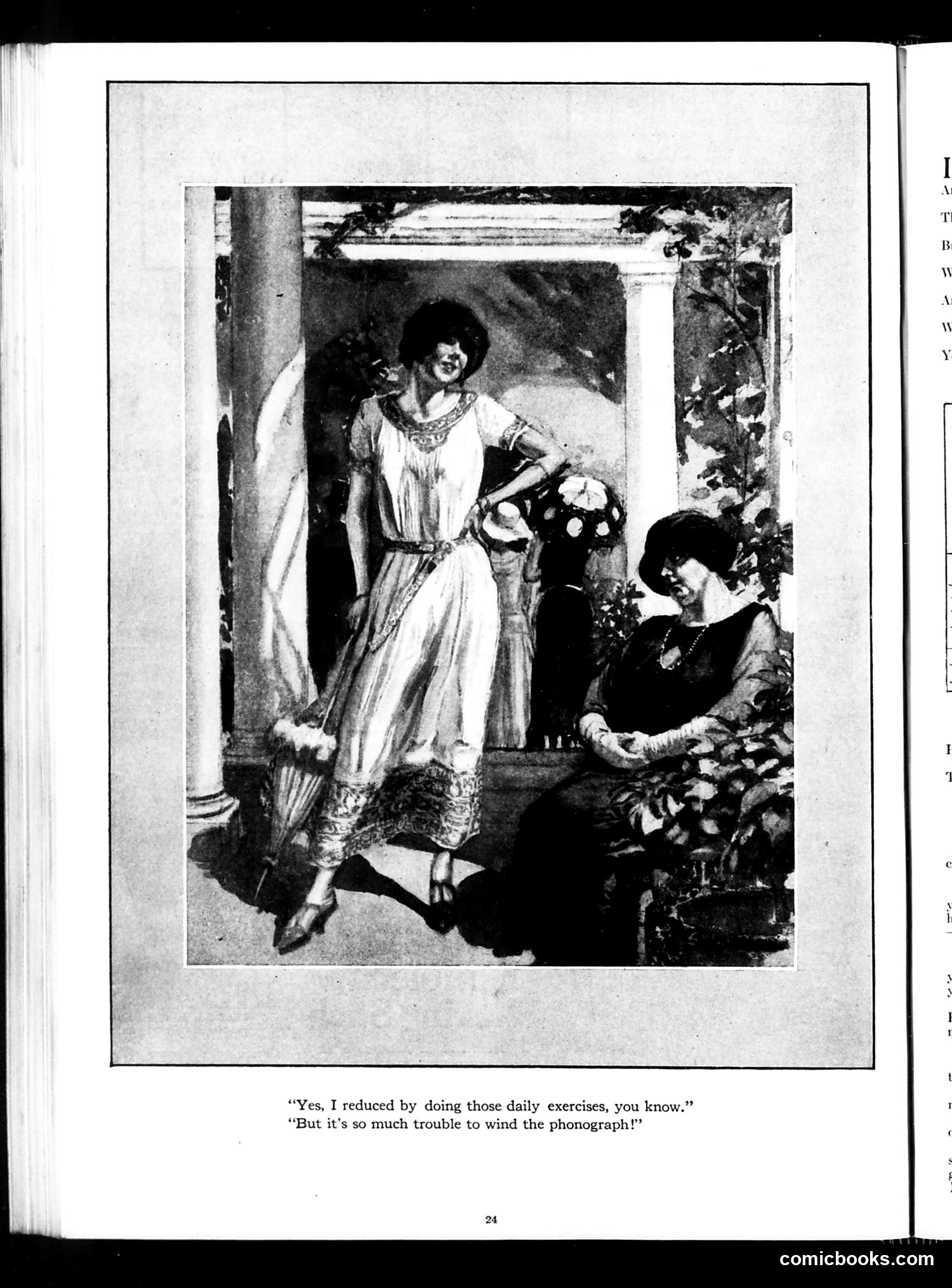
This cartoon satirizes the early 20th-century fad of using phonographs to accompany exercise routines. A woman in elegant dress claims she reduced her weight through "daily exercises," while her companion points out the practical absurdity: winding the phonograph (which required manual cranking) is so tedious that it defeats the purpose. The joke targets both the exercise trend itself and the inconvenient technology of early phonographs. It mocks upper-class women who adopted fashionable but impractical health regimens—the real effort goes into managing the machine rather than exercising. The satire reflects early 1900s skepticism toward both mechanical conveniences and modern wellness fads, suggesting they often create more problems than they solve.
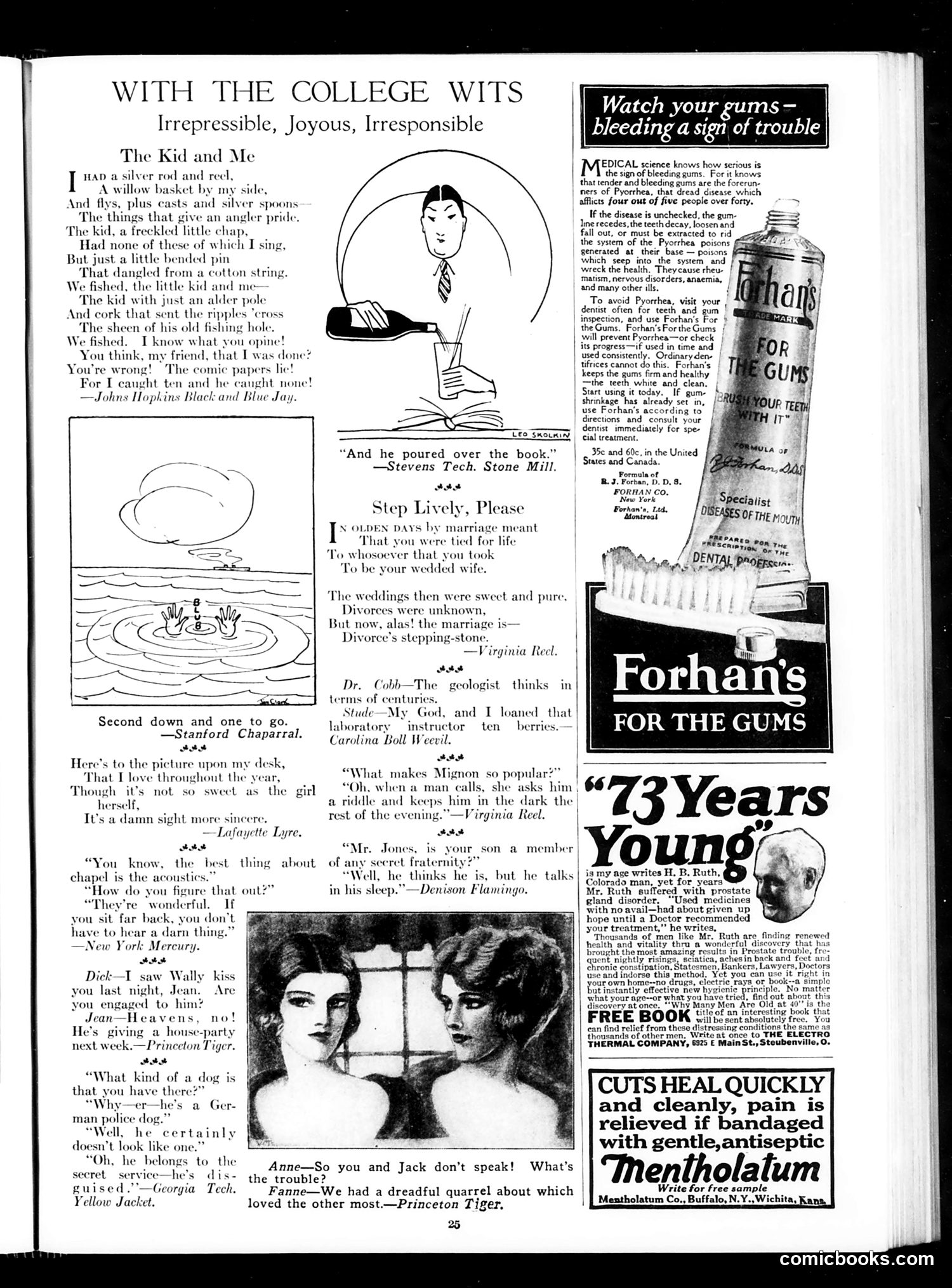
This page from *Judge* presents college humor and period advertisements typical of early 20th-century American satirical magazines. **College Humor Section ("With the College Wits"):** Multiple short, anonymous jokes and poems from various college publications mock undergraduate social life. They include mild ribaldry about romance ("You're wrong! The comic papers lie!"), marital instability ("Divorce's stepping-stone"), and romantic entanglements. The humor is gentle and relies on wordplay and situational comedy rather than political content. References to "Wally kiss," "Jack," and similar characters are generic romantic scenarios without identifiable historical figures. **Advertisements:** The page prominently features two period medical product ads: Forhan's toothpaste (emphasizing gum disease prevention, a genuine health concern of the era) and Mentholatum salve. These reflect contemporary consumer medicine marketing that would seem quaint today. **Overall Context:** This appears to be a typical humor magazine page prioritizing collegiate entertainment over political satire, targeting educated middle-class readers interested in light social commentary.
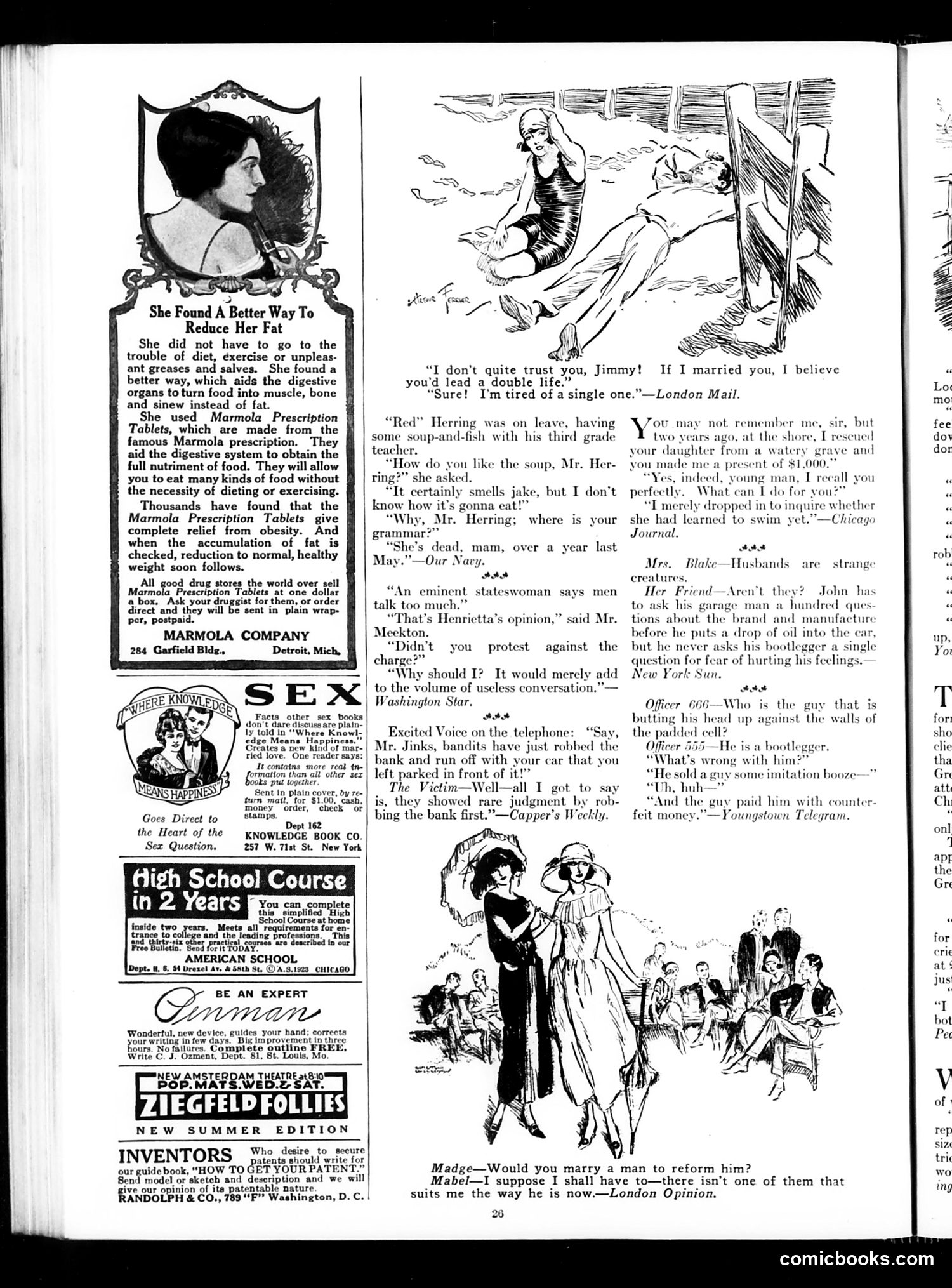
This page primarily consists of **advertisements** for weight-loss pills (Marmola), self-improvement courses, and patent services, mixed with brief **humorous anecdotes** rather than political cartoons. The jokes reflect 1920s social attitudes: one mocks men who claim they'd "lead a double life" in marriage; another satirizes a third-grade teacher socializing with a naval officer; several joke about wives' complaints regarding husbands' behavior (particularly around Prohibition-era bootleggers). One anecdote jokes about a man feigning gratitude to a woman years after she gave him money. The recurring theme is **gender relations and marital skepticism**—common satirical territory in this era. The bootlegger reference dates this to the Prohibition period (1920-1933). The "Red Herring" naval joke appears unrelated to politics, simply playing on the character's name. Overall, this is a **commercial advertising page with filler humor** rather than serious political satire.
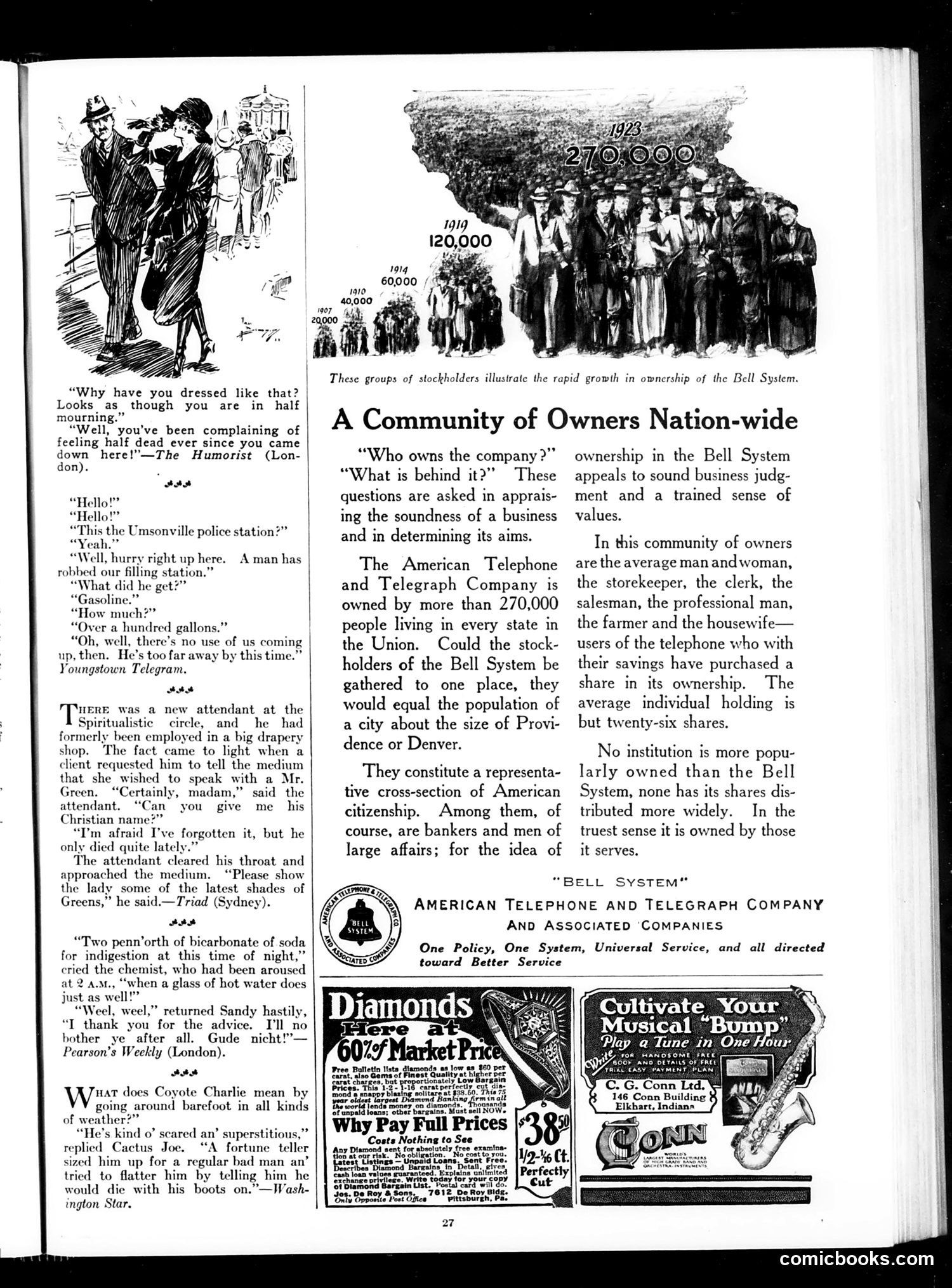
This page mixes humor with corporate advertising. The top section contains several short jokes from various publications—typical of Judge magazine's format. These include mild workplace humor (a spiritualist medium confused about fabric colors) and absurdist comedy (a gas station robber stealing "over a hundred gallons," so police don't bother pursuing). The main content is a substantial advertisement for American Telephone and Telegraph (AT&T), promoting the "Bell System." Using a visual showing stockholder growth from 1910-1923, AT&T argues it's "a community of owners nation-wide"—claiming over 270,000 people own shares. The pitch emphasizes broad ownership across ordinary citizens (farmers, clerks, housewives), not just wealthy financiers, to counter anti-monopoly sentiment and suggest democratic legitimacy. The bottom third contains period advertisements for diamonds and musical instruments—standard magazine filler. The satire, if any exists, is subtle: this is essentially propaganda disguised as journalism, positioning a major corporation as a people's company during an era of growing monopoly concerns.
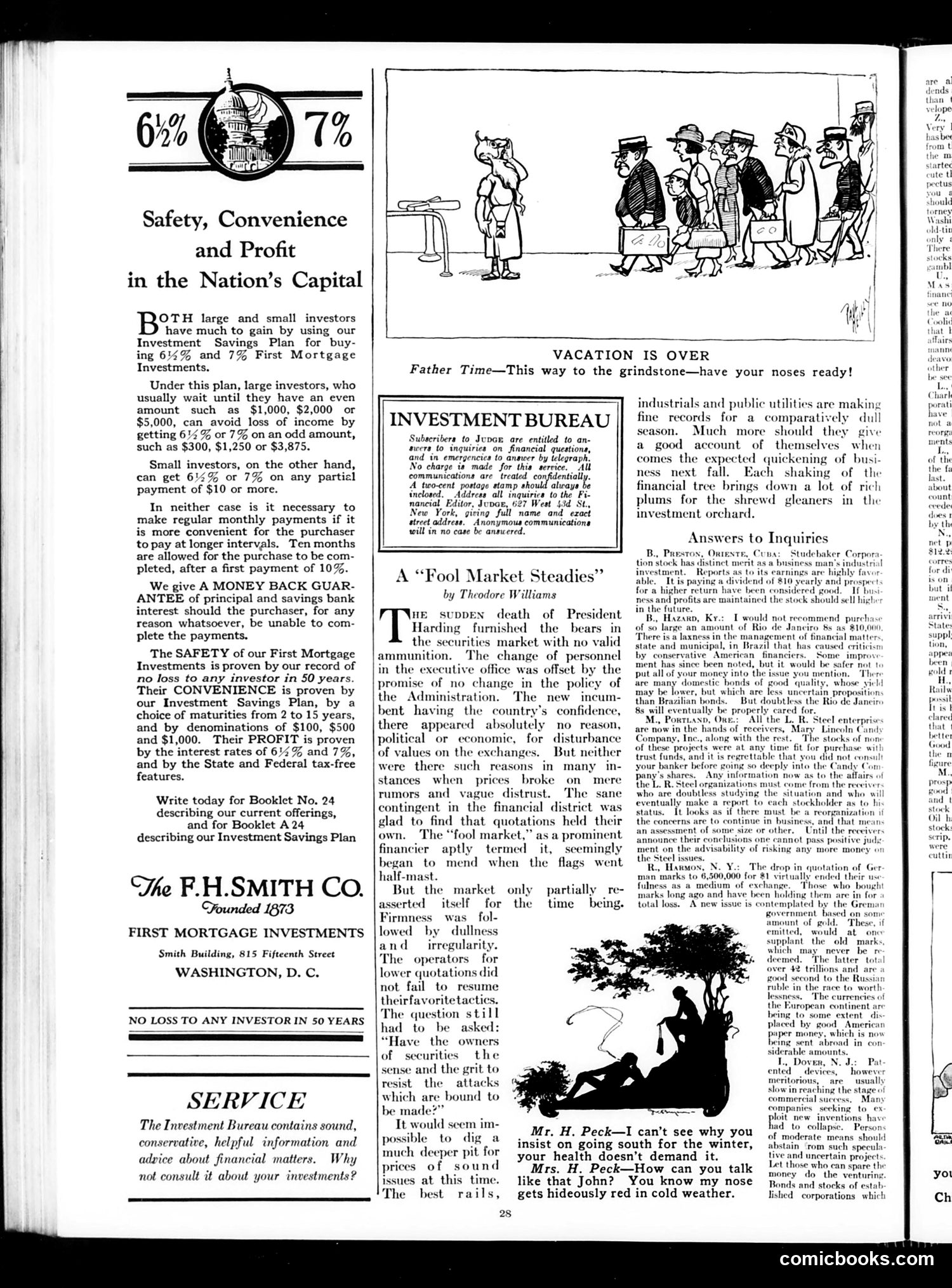
This page combines financial advertising with satirical commentary on post-Harding economic conditions (appears to reference mid-1920s, following President Harding's death in 1923). **The Main Cartoon:** "Vacation Is Over" depicts Father Time herding reluctant workers back to labor ("the grindstone"), satirizing the end of summer vacation and return to economic drudgery. **The Financial Content:** The F.H. Smith Company advertises investment plans offering 6.5%-7% returns on first mortgage investments, emphasizing safety and convenience for both large and small investors in Washington, D.C. **The Article:** Theodore Williams discusses stock market instability following Harding's death. He notes the "fool market" initially steadied but remains prone to manipulation by bears (short-sellers) exploiting investor fear and uncertainty. The piece criticizes the lack of nerve among securities owners to resist speculative attacks. **Context:** This reflects post-war economic volatility and widespread anxiety about financial markets among ordinary Americans—a theme that would intensify before the 1929 crash.
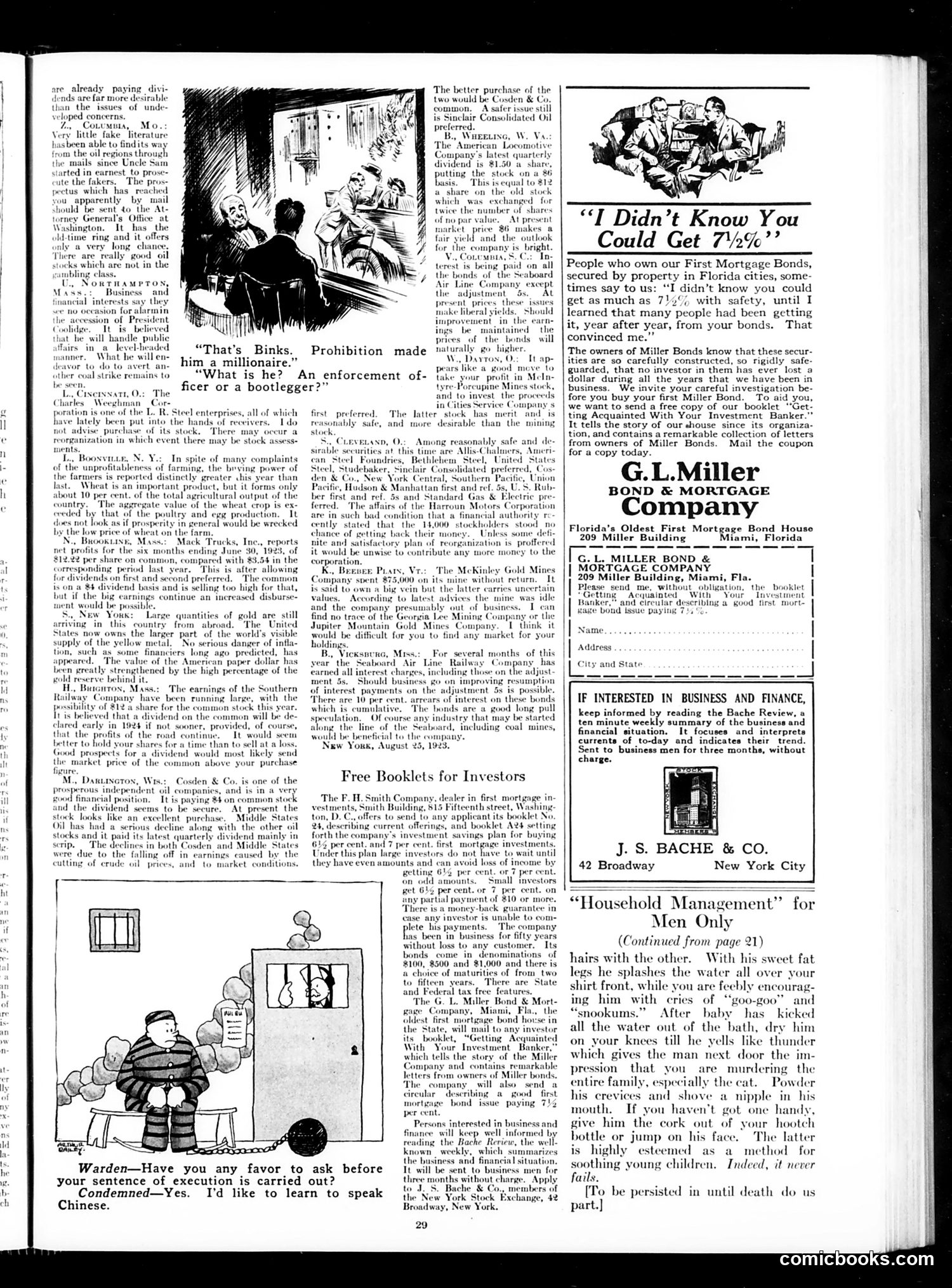
This page is primarily **financial advice columns** rather than political satire. It contains readers' questions about investments (stocks, bonds, mining companies) answered by the magazine's financial columnist. The one cartoon visible shows "Binks," apparently a wealthy man, with the joke being: someone asks "What is he? An enforcement officer or a bootlegger?"—suggesting that during Prohibition (in effect 1920-1933), one couldn't tell the difference between law enforcement and criminals, since both were profiting from illegal alcohol. This reflects contemporary cynicism about Prohibition's corruption and the parallel economies it created. The rest of the page discusses investment opportunities in railroads, steel, oil, and mining companies—typical 1920s financial content for middle-class readers. There's also an advertisement for G.L. Miller Bond & Mortgage Company offering First Mortgage Bonds in Florida.
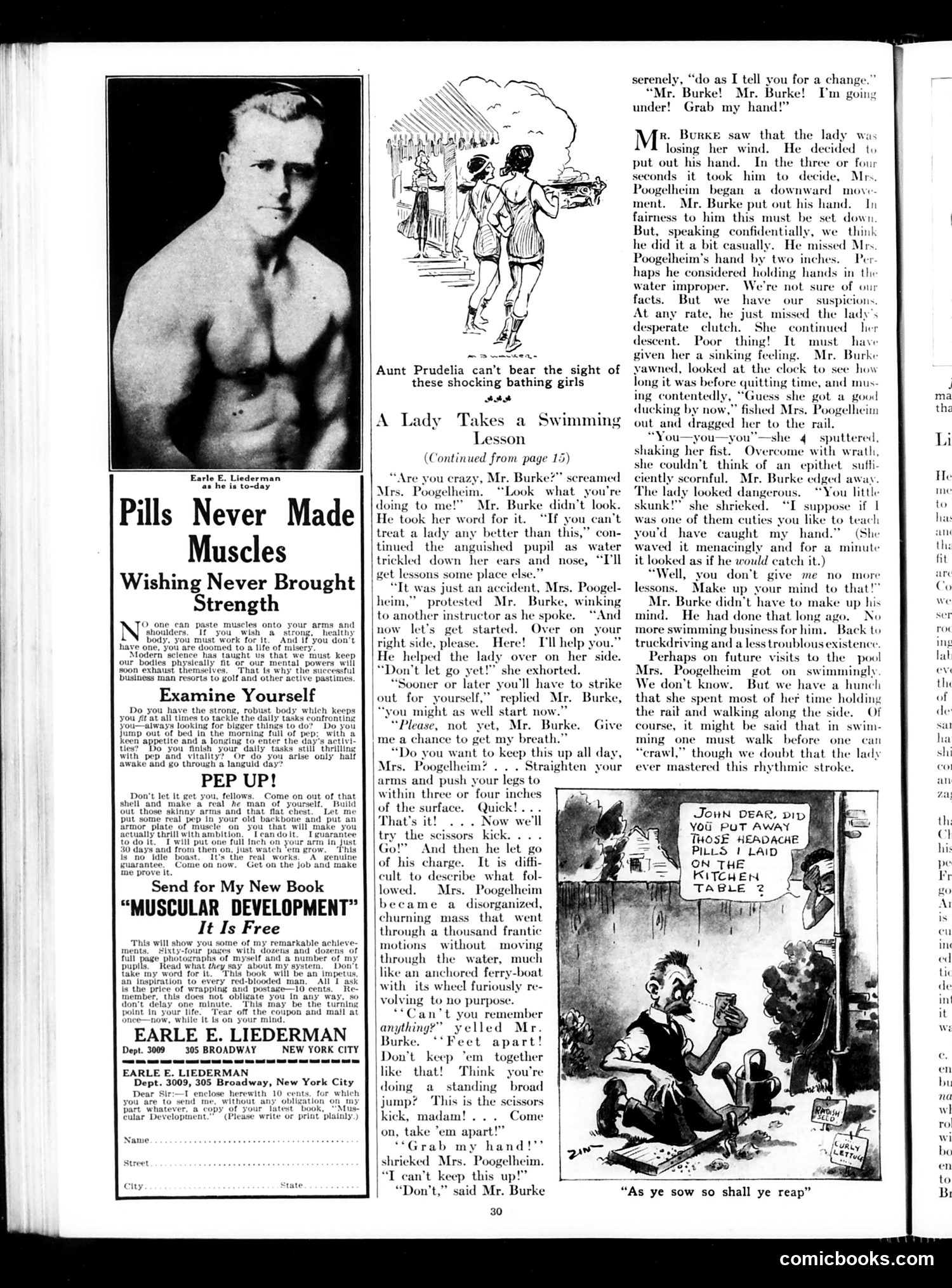
This page contains two satirical elements: **Top Left: "Pills Never Made Muscles" Advertisement** A genuine period advertisement (not satire) by Earle E. Liederman promoting a free bodybuilding book. It mocks the false promise of pills and wishes, insisting real physical strength requires actual exercise—typical early 1900s fitness marketing. **Main Story: "A Lady Takes a Swimming Lesson"** A satirical narrative about Mrs. Poogelheim's disastrous swimming instruction. The humor targets incompetent or negligent swimming instructors (Mr. Burke) and anxious, hapless female swimmers. When Mrs. Poogelheim panics underwater, the instructor delays helping her—missing her hand by inches, allegedly due to propriety concerns about "holding hands in the water." The satire mocks both the stuffy social conventions restricting physical contact between men and women, and the instructor's indifference masked by false morality. The accompanying cartoon illustrates the chaos of her frantic, anchored struggle in the water.
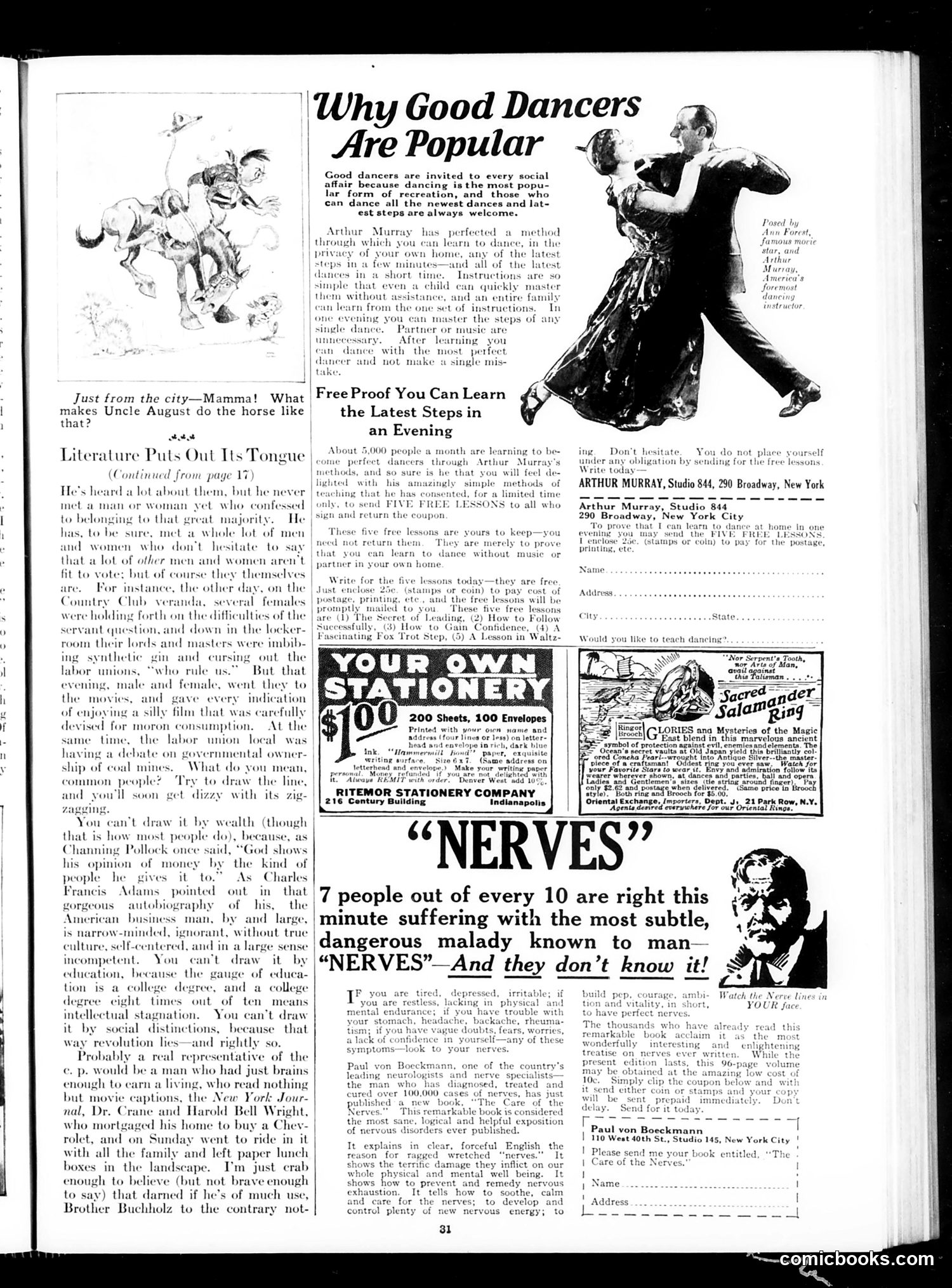
This page from *Judge* magazine contains mostly **advertising and promotional content** rather than political satire. The main cartoon (top left) shows a humorous domestic scene: a child asks his mother why "Uncle August" is doing strange movements with a horse. This is a visual gag about awkward dancing—the uncle appears to be attempting fashionable dance steps, and the child doesn't understand the behavior. The page primarily promotes **Arthur Murray's dance instruction method**, a real commercial service that taught people to dance at home using simple techniques. The ads emphasize that anyone—even children—could quickly learn "the latest dances" without a partner or music. The sidebar text about "Literature Puts Out Its Tongue" discusses class distinctions and social hierarchies, unrelated to the dancing content. The other advertisements include stationery sales and a book about "nerves" (anxiety/nervous disorders), typical of 1920s-30s magazine advertising. **No significant political satire is present on this page**—it's primarily commercial promotion of consumer products and services aimed at middle-class readers.
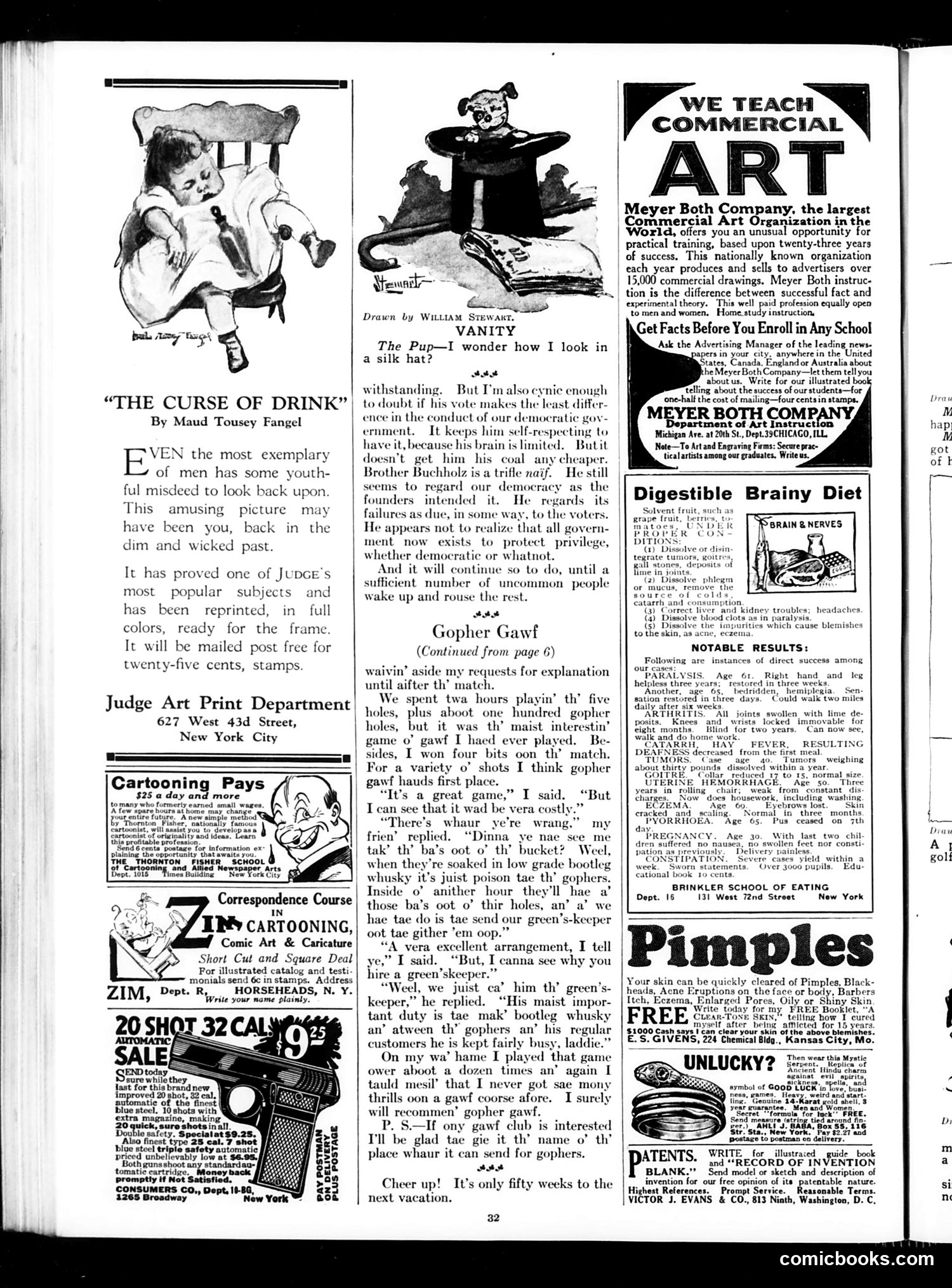
**Main Cartoon:** "The Curse of Drink" by Maud Tousey Fangel depicts a cherubic baby holding liquor bottles, illustrating the moral warning that even exemplary men have "youthful misdeeds." Judge offered this as a popular, frameable print for twenty-five cents—typical early 20th-century moralistic commentary on alcohol consumption. **"Vanity":** A brief cartoon showing a dog in a silk hat, likely satirizing vanity and pretension. **"Gopher Gawf":** A humorous Scottish-dialect piece about using poisoned bootleg whisky to kill gophers on a golf course during Prohibition, suggesting the poor quality and abundance of illegal alcohol. The page is primarily **advertising for correspondence courses** (cartooning, commercial art instruction) interspersed with editorial content. This reflects Judge's business model targeting aspiring artists and illustrators alongside satirical commentary on contemporary issues like drinking and democratic governance.
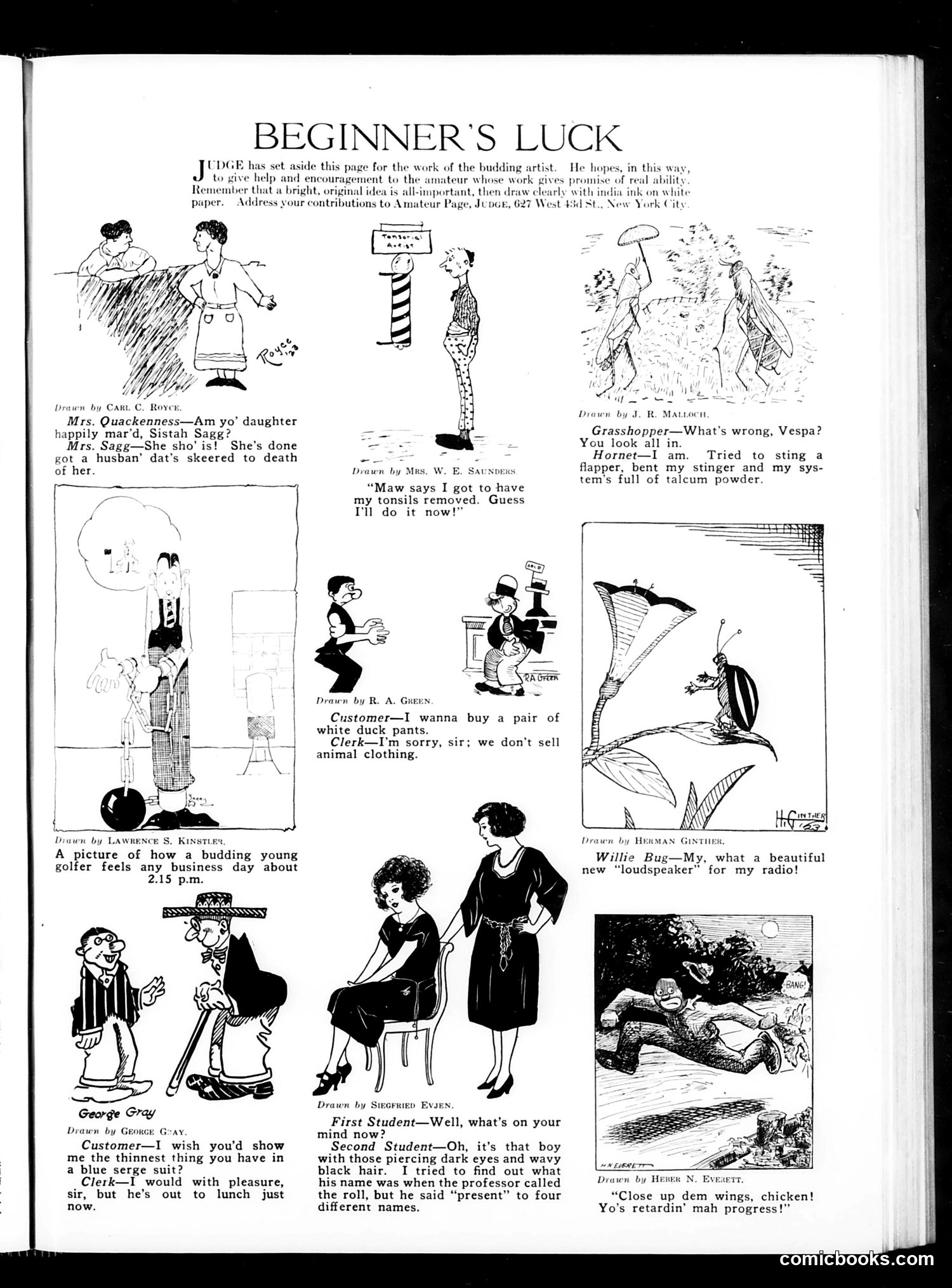
This is Judge's amateur submission page, featuring short gag cartoons and jokes by budding cartoonists. The humor reflects 1920s-30s sensibilities: **Social/racial humor**: The "Mrs. Quackenness" and "Sistah Sagg" dialogue uses exaggerated dialect comedy, common but offensive by today's standards, depicting African American women discussing marriage. **Modern life jokes**: A golfer anxiously checking time, a clerk's lunch break excuse, and confusion over "white duck pants" (playing on the phrase as though ducks were clothing). **Youth culture**: A flapper-obsessed college student, a child deciding to remove his tonsils, and a hornet stung while attacking a powder-wearing flapper—reflecting 1920s "modern girl" anxieties. **Nature anthropomorphism**: Insects as characters with human concerns (radio "loudspeakers"). The page's purpose was encouraging amateur artists while providing light satirical commentary on contemporary society, workplace absurdities, and generational change.
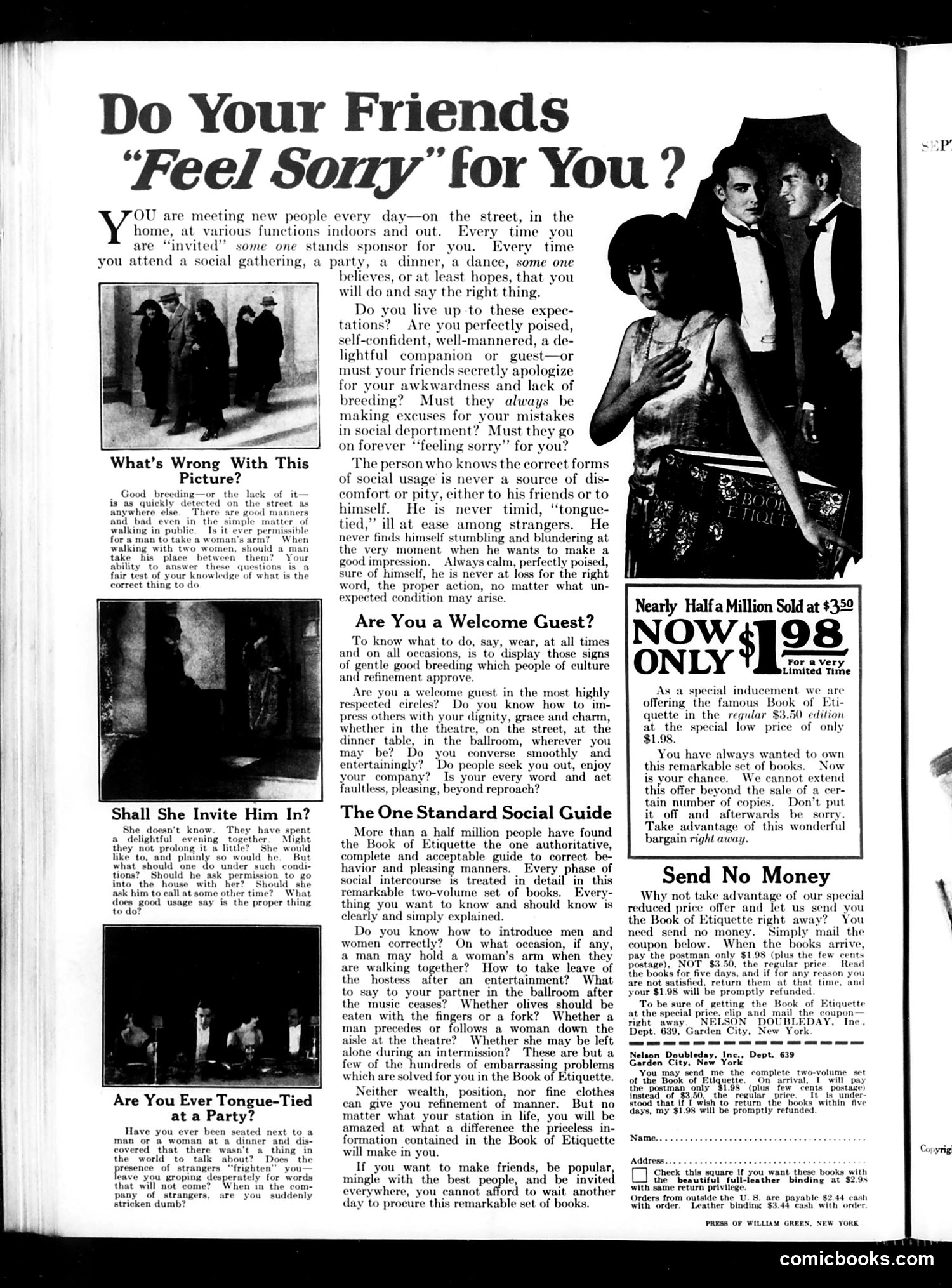
This is not political satire but rather **social satire and self-help advertising**. Judge magazine here mocks Americans' anxiety about proper social behavior and good manners—a major concern in the early 20th century. The page presents several scenarios where people fear social embarrassment: being tongue-tied at dinner, not knowing whether to invite a guest inside, appearing awkward in public. The underlying joke: Americans are obsessed with appearing "well-bred" and fear their friends pity their lack of refinement. The main advertisement dominates the right side, selling the "Book of Etiquette" as the solution to these anxieties—promising that knowing correct social forms will make one confident, poised, and never a source of embarrassment. The satire is gentle: Judge mocks middle-class social climbing and etiquette-obsession by taking it seriously while merchandising the very solution to the problem it describes.