
Judge, 1923-09-01 · page 19 of 36
Judge — September 1, 1923 — page 19: what you’re looking at
What you’re looking at
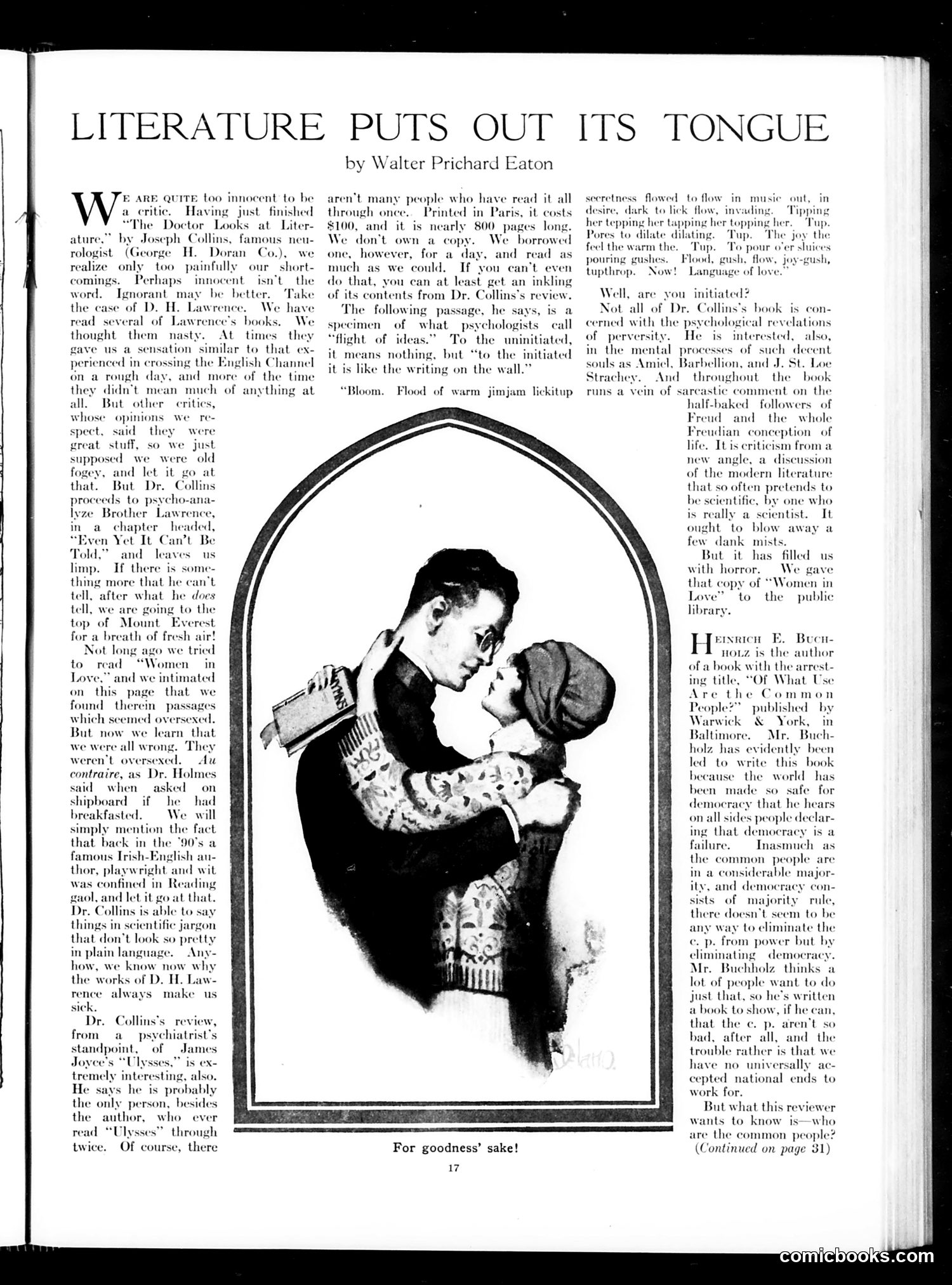
This article critiques Dr. Joseph Collins's psychoanalytic approach to literary criticism in his book *The Doctor Looks at Literature*. The satirical point: Collins applies Freudian analysis to works by D.H. Lawrence and James Joyce, "explaining" their deliberately obscure or sexually charged writing through psychological jargon that makes nonsensical passages seem profound. The cartoon (captioned "For goodness' sake!") illustrates this absurdity—a romantic embrace reduced to pseudo-scientific terminology. Author Eaton mocks how Collins justifies Lawrence and Joyce's work by pathologizing them rather than engaging genuine literary merit. The excerpt from *Ulysses* ("Bloom. Flood of warm jimjam...") exemplifies Joyce's stream-of-consciousness style, which Collins claims is scientifically explicable but which Eaton suggests is simply incomprehensible gibberish dressed up in psychiatric language. The satire targets 1920s literary modernism and the trendy application of Freudian psychology to culture—suggesting that pseudo-intellectual analysis creates false legitimacy for works that may simply be bad or obscene.
📄 Transcribed text from this page (OCR, searchable)
Machine-transcribed from the original scan — historical spelling and the odd misread are preserved.
LITERATURE PUTS OUT ITS TONGUE by Walter Prichard Eaton 2 ARE QUITE too innocent to be critic. Having just finished Phe Doctor Looks at Liter- by Joseph Collins, famous neu- (George H. Doran Co.), only too painfully our short- mmings. Perhaps innocent isn’t. the word. Ignorant may be better. ‘Take the case of D. H. We have read several of Lawrence's books. We thought them nasty. At times they gave us a sensation similar to that ex- perienced in crossing the English Channel on a rough day, and more of the time they didn’t mean much of anything at all. But other critics, whose opinions we r spect, said they were great stuff, so we just supposed we were old fogey, and let it go at that. But Dr. Collins proceeds to psycho-ana- lyze Brother Lawrence, in a chapter headed, “Even Yet It Can’t Be Told.” and leaves us limp. If there is some- thing more that he can't after what he does Il, we are going to the top of Mount Evere breath of fresh air! t long ago we tried read “Women — in and we intimated on this page that we found therein passages which seemed oversexed. But now we learn that we were all wrong. They weren't oversexed. — Au contraire, as Dr. Holmes said when asked — on shipboard if he had breakfasted. We will simply mention the fact that back in the ‘90°s a famous Irish-English au- thor, playwright and wit was confined in Reading gaol, and let it go at that. Dr. Collins is able to say things in scientific jargon that don’t look so pretty in plain langua Any- how, we know now why the works of D. H. Law- rence always make us sick. Dr. Collins’s review, from a psychiatrist's standpoint, of ature, rologist realize we Lawrence. ys he is probably the only person, besides the author, who ever read “Ulysses” through twice. Of course, there aren't many people who have read it all through once. Printed in Paris, it costs $100, and it is nearly 800 pages long. We don't own a copy. We borrowed one, however, for a day, and read as much as we could. If you can’t even do that, you can at least get an inkling of its contents from Dr. Collins's review. The following passage, he says, is a specimen of what psychologists — call “flight: of ideas.” To the uninitiated, it means nothing, but “to the initiated it is like the writing on the wall.” “Bloom. Flood of warm jimjam lickitup For goodness’ sake! seeretness flowed to flow. in musi¢ desire, dark to lick flow, invading her tepping her tapping Pores to dilate dilating. Tup. The joy the fecl the warm the. ‘Tup. ‘To pour o'er sluices pouring gushes. Flood, gush, flow, tupthrop. Now! Language of love out, in Tipping r topping her. Tup. gush, Well, are you initiated? Not all of Dr. Collins’s book is con- cerned with the psychological revelations of perversity. He is interested, in the mental processes of such decent souls as Amiel, Barbellion, and J. St. Loe Strachey. And throughout the book runs a vein of sarcastic comment on the half-baked followers of Freund and the whole Freudian conception of life. It is criticism from a new angle, a discussion of the modern literature that so often pretends to he scientific, by one who is really a scientist. It ought ‘to blow away a few dank mists. But it has filled us with horror. We gave that copy of “Women in Love” to the public library. I [' Inricn FE. How is the author of a book with the arrest- ing title, “Of What Use Are the C Bucu- ommon published by Warwick & York, in Baltimore. Mr. Buch- holz has evidently been led to write this book because the world has been made so. safe for democracy that he hears onall sides people declar- ing that democracy is a failure. Inasmuch as the common. people are in a considerable major- ity, and democracy « sists of majority rule, there doesn’t seem to be any way to climinate the p. from power but by eliminating democracy. Mr. Buchholz thinks a lot of people it to do just that, so he’s written a book to show, if he can, that the e. p. aren't so bad, after all, and the trouble rather is that we have no universally ac- cepted national ends to work for. But what this reviewer wants to know is—who re the common people? (Continued on page 31)