
Judge, 1923-09-01 · page 15 of 36
Judge — September 1, 1923 — page 15: what you’re looking at
What you’re looking at
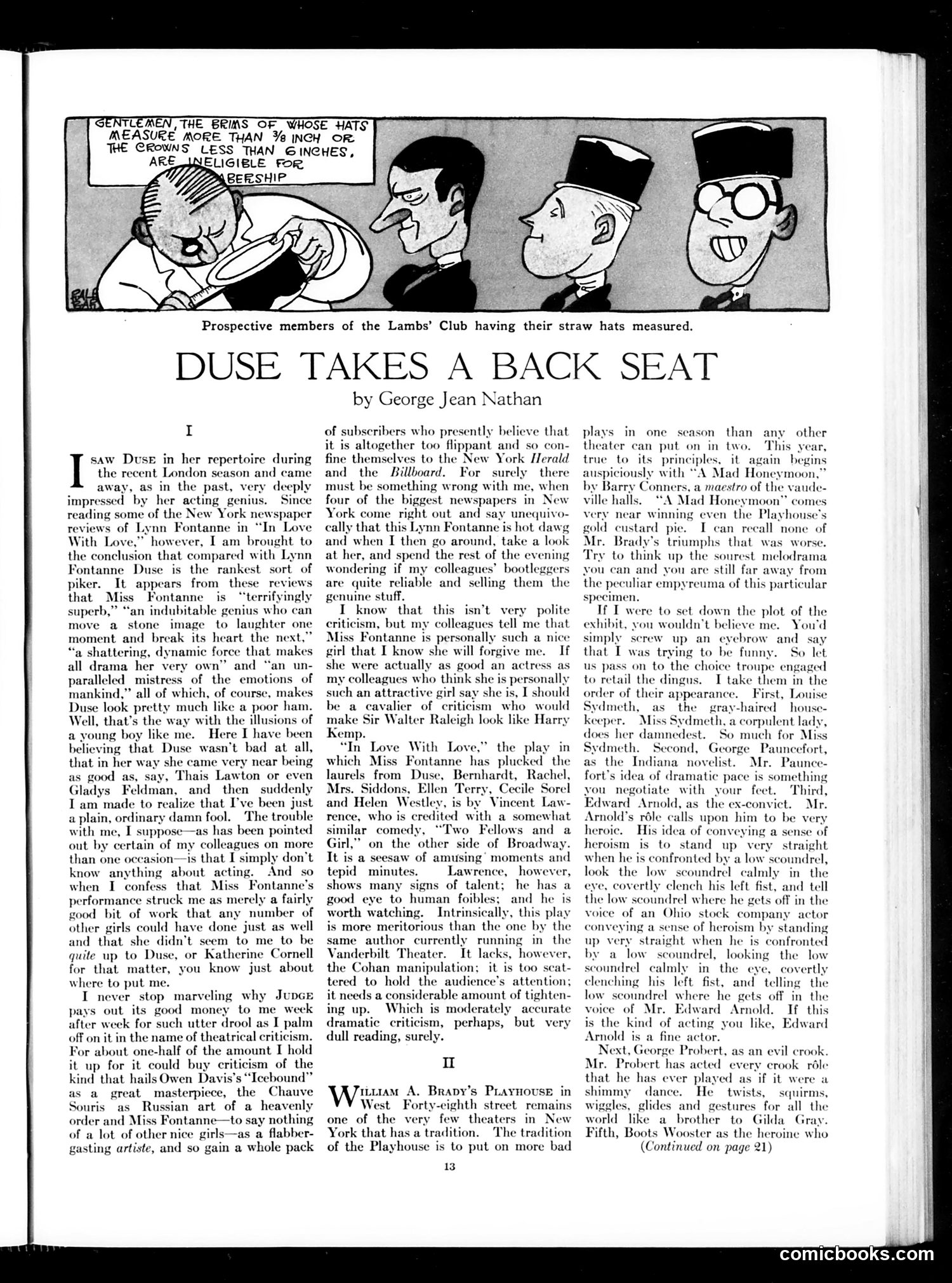
**The Cartoon:** The top panel satirizes the Lambs' Club (a theatrical social club) by showing men's straw hats being measured against absurdly specific eligibility criteria—brims over 9/16 inch or crowns under 6 inches—to mock the club's exclusionary or arbitrary membership standards. **The Article:** Theater critic George Jean Nathan mocks his fellow New York newspaper critics for gushing over actress Lynn Fontanne in the play "In Love With Love," calling her a genius while he found her merely competent. He sarcastically compares her favorably to the legendary Eleonora Duse (a celebrated Italian actress) and other theatrical greats, suggesting his colleagues are either incompetent critics or swayed by Fontanne's personal charm rather than actual talent. Nathan questions why *Judge* magazine pays him to write honest criticism when readers apparently prefer the inflated praise other papers provide. The satire targets both theatrical hype and critical dishonesty in 1920s newspapers.
📄 Transcribed text from this page (OCR, searchable)
Machine-transcribed from the original scan — historical spelling and the odd misread are preserved.
MEN, THE BRIMS OF WHOSE HATS MEASURE MORE THAN Ye INCH OR THE CROWNS LESS THAN GINCHES, DELIGIBLE FoR UP ARE Prospective members of the Lambs’ Club having their straw hats measured. DUSE TAKES A BACK SEAT I saw Duse in her repertoire during I the recent London season and came awa: in the past, very deeply impressed by her acting genius. Since reading some of the New York newspaper reviews of Lynn Fontanne in “In Love With Love,” however, I am brought to the conclusion that compared with Lynn Fontanne Duse is the rankest sort of pi It rs from e reviews Miss Fontanne is “terrifyingly superb,” “an indubitable genius who can move a stone image to laughter one moment and break its heart the next,” “a shattering, dynamic force that makes all drama her very own” and “an un- paralleled mistress of the emotions of mankind,” all of which, of course, makes Duse look pretty much like a poor ham. Well, that’s the way with the illusions of a young boy like me. Here I have been believing that Duse wasn’t bad at all, that in her w ame very near be as good as, say, Thais Lawton or even Gladys Feldman, and then suddenly I am made to realize that I’ve been just a plain, ordinary damn fool. The trouble with me, I suppose—as has been pointed out by certain of my colleagues on more than one occasion—is that I simply don’t know anything about acting. And so when I confess that Miss Fontanne’s performance struck me as merely a fairly good bit of work that any number of other girls could have done just as well and that she didn’t seem to me to be quite up to Duse, or Katherine Cornell for that matter, you know just about where to put me. I never stop marveling why Jur pays out its good money to me weel after week for such utter drool as I palm off on it in the name of theatrical criticism. For about one-half of the amount I hold it up for it could buy criticism of the kind that hails Owen Davis's “Icebound” great masterpiece, the Chauve Souris as Russian art of a heavenly order and Miss Fontanne—to say nothing of a lot of other nice girls—as a flabber- gasting artiste, and so gain a whole pack as a by George Jean Nathan of subscribers who presently believe tha it is altogether too flippant and so con- fine themselves to the New York Herald and the Billboard. For surely there must be something wrong with me, when four of the biggest newspapers in New York come right out and say unequivo- cally that this Lynn Fontanne is hot dawg and when I then go around, take a look at her, and spend the rest of the evening wondering if my colleagues’ bootleggers are quite reliable and selling them the genuine stuff. I know that this isn’t very polite criticism, but my colleagues tell me that Miss Fontanne is personally such a nice girl that I know she will forgive me. If she were actually as good an actress as my colleagues who think she is personally such an attractive girl say she is, I should be a cavalier of criticism who would make Sir Walter Raleigh look like Harry Kemp. “In Love With Love,” the play in which Miss Fontanne has plucked the laurels from Duse, Bernhardt, Rachel, Mrs. Siddons, Ellen Terry, Cecile Sorel and Helen Westley, is by Vincent Law- rence, who is credited with a somewhat similar come “Two Fellows and Girl,” on the other side of Broadw It is a seesaw of amusing’ moments and tepid minutes. — Lawrence, however, shows many signs of talent; he has a good eye to human foibles; and he is worth watching. Intrinsically, this play is more meritorious than the one by the ame author currently running in the Vanderbilt Theater. It lacks, however, the Cohan manipulation; it is too scat- tered to hold the audience's attention; it needs a considerable amount of tighten- ing up. Which is moderately accurate dramatic criticism, perhaps, but very dull reading, surely. I 111AM A. Brapy’s Piaynouse in West Forty-eighth street remains one of the very few theaters in New York that has a tradition. The tradition of the Playhouse is to put on more bad 13 in one season than any other ter can put on in two. This year, true to its principles, it again begins auspiciously with “A Mad Honeymoon,” by Barry Conners, a maestro of the vaude- ville halls. ‘tA Mad Honeymoon” comes very near winning even the Playhouse’s gold custard pie. I can recall none of Mr. Brady’s triumphs that was worse. Try to think up the sourest- melodrama you can and you are still far away from the peculiar empyreuma of this particular specimen, If I were to set down the plot of the exhibit, you wouldn’t believe me. You'd simply screw up an eyebrow and say that I was trying to be funny. So let us pass on to the choice troupe engaged to retail the dingt I take them in the order of their appearance. First, Louise Sydmeth, as the gray-haired house- keeper. Miss Sydmeth, a corpulent lady. does her damnedest. So much for Miss Sydmeth. Second, George Pauncefort, as the Indiana novelist. Mr. Paunce- fort's idea of dramatic pace is something you negotiate with your feet. rird, Edward Arnold, as the ex-convict. Mr. Arnold's réle calls upon him to be very heroic. His idea of conveying a sense of heroism is to stand up’ very. straight when he is confronted by a low scoundrel, look the low scoundrel calmly in the eye, covertly clench his left fist, and tell the low scoundrel where he gets off in the voice of an Ohio stock company actor conveying a sense of heroism by standing up very straight when he is confronted by a low scoundrel, looking the low scoundrel calmly in the eye, covertly clenching his left fist, and telling the low scoundrel where he gets off in the voice of Mr. Edward Arnold. If this is the kind of acting you like, Edward Arnold is a fine acto Next, George Probert, as an evil crook. Mr. Probert has acted ¢ crook réle that he has ever played as if it were a shimmy dance. He twists, squirms, wiggles, glides and gestu for all the world like a brother to Gilda Gray. Fifth, Boots Wooster as the heroine who (Continued on page 21) comicbooks.com