
A complete issue · 36 pages · 1923
Judge — July 14, 1923
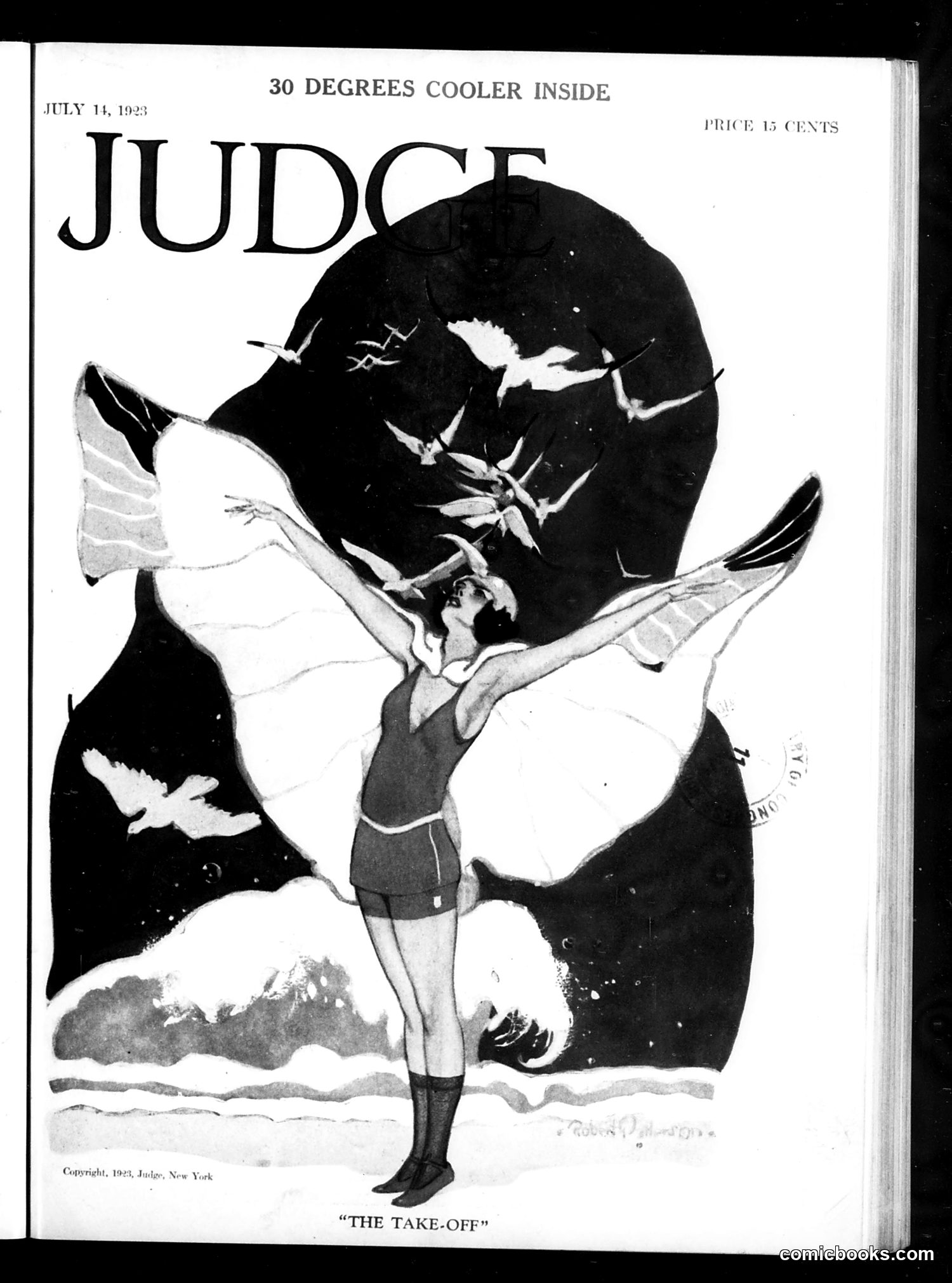
This cover illustration depicts a woman in a bathing suit performing an exaggerated diving or flying pose, with her legs and arms spread wide. Large black shapes resembling wings or fabric billow around her against a mountainous landscape. The title "The Take-Off" appears to reference aviation, which was a novelty and cultural sensation in the early 1920s. The cartoon likely satirizes either the growing participation of women in aviation (still shocking to conservative audiences) or perhaps mocks the exaggerated fashion and physical freedoms women were claiming during the Jazz Age—the "flapper" era. The specific reference or event remains unclear without additional context, but the cartoon appears to celebrate women's liberation and modern athleticism with humorous exaggeration.
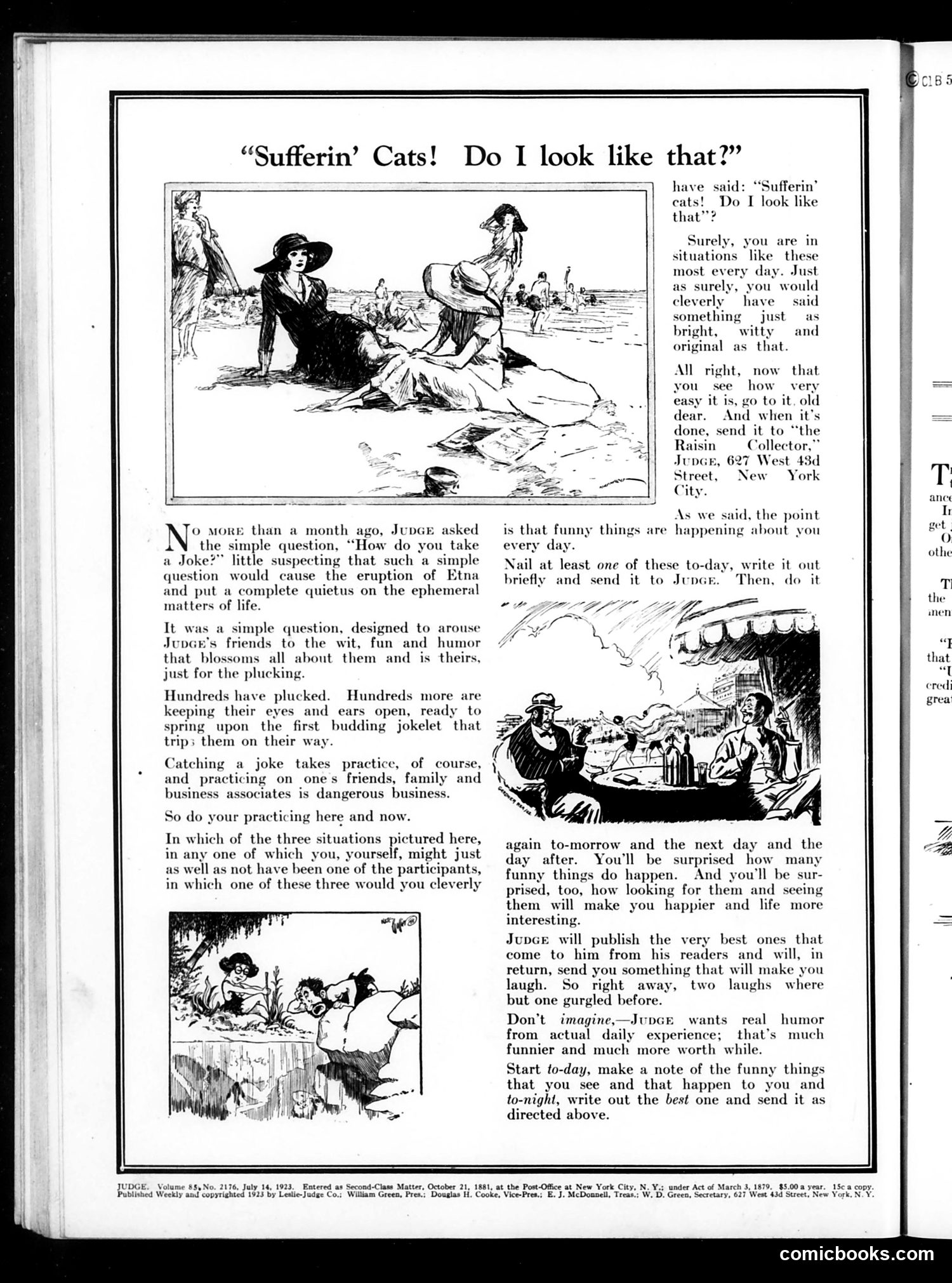
This page from Judge magazine (July 14, 1922) invites readers to submit humorous observations from daily life. The title's phrase "Sufferin' cats" is a mild exclamation common to the era—not a political reference. The three illustrations show everyday situations: people at a beach, someone dining outdoors, and figures by water. These are generic scenes meant to prompt readers' wit. The editorial framework encourages readers to observe funny moments and submit them to "The Raisin Collector" for publication. Judge promises to publish the best submissions and reward contributors with laughs. This is essentially a humor-solicitation feature, not political satire. It reflects the magazine's participatory approach to comedy and 1920s casual entertainment culture.
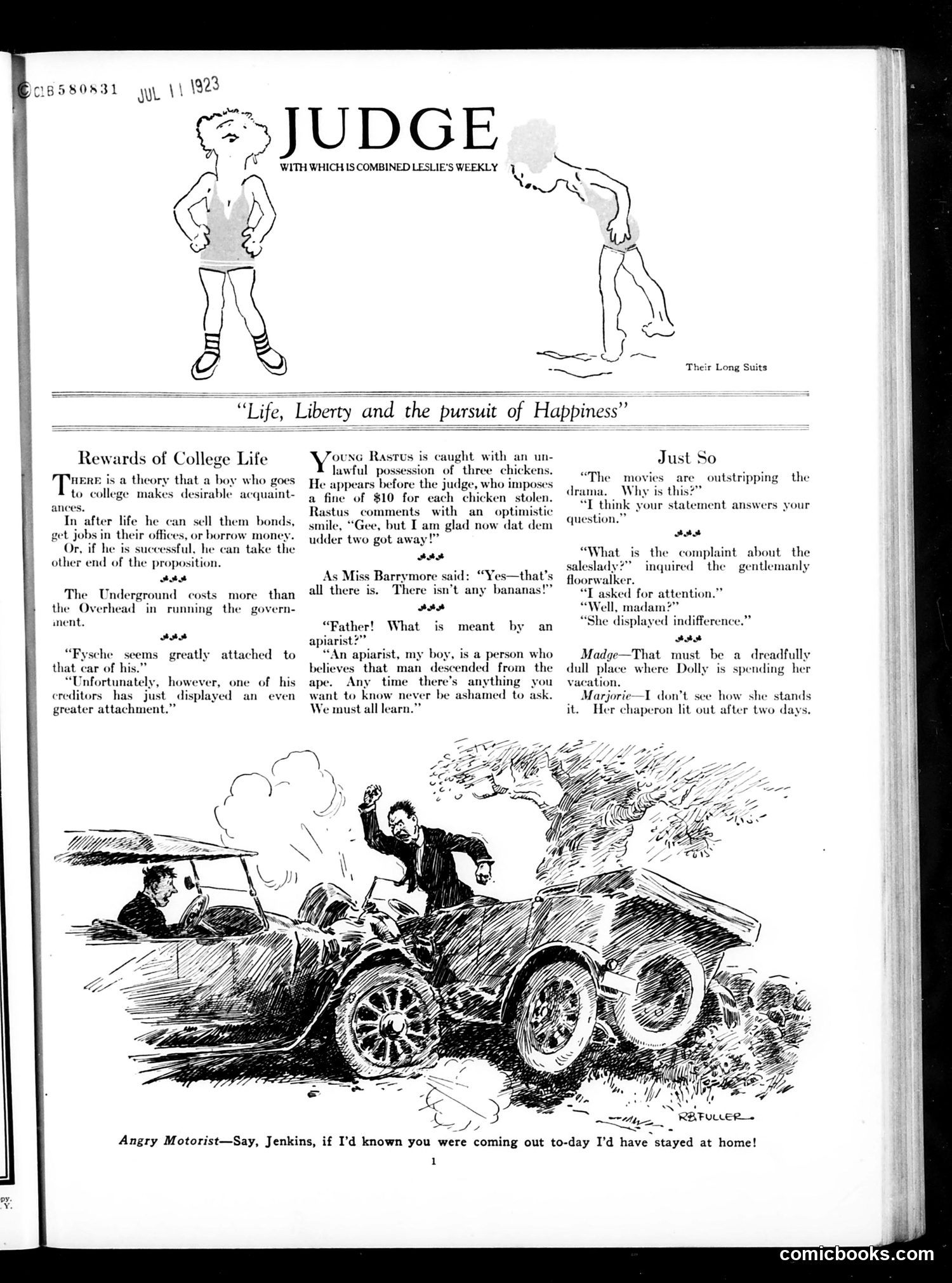
This page contains three separate satirical pieces rather than a unified cartoon. **"Rewards of College Life"** mocks the idea that college education guarantees success, suggesting instead that graduates end up unemployed or dependent on family. **"Just So"** presents a brief dialogue about cinema, with the joke apparently turning on differing perspectives about movie quality or attendance. **The main cartoon** depicts an angry motorist (named Jenkins) confronting someone about a car accident or reckless driving. The caption's humor relies on the motorist's ironic complaint that he wouldn't have gone out if he'd known Jenkins was driving—implying Jenkins is a dangerously bad driver whose mere presence on the road should keep others home. The page reflects 1920s concerns about automobile safety and reckless drivers, presented through typical Judge-style satirical humor.
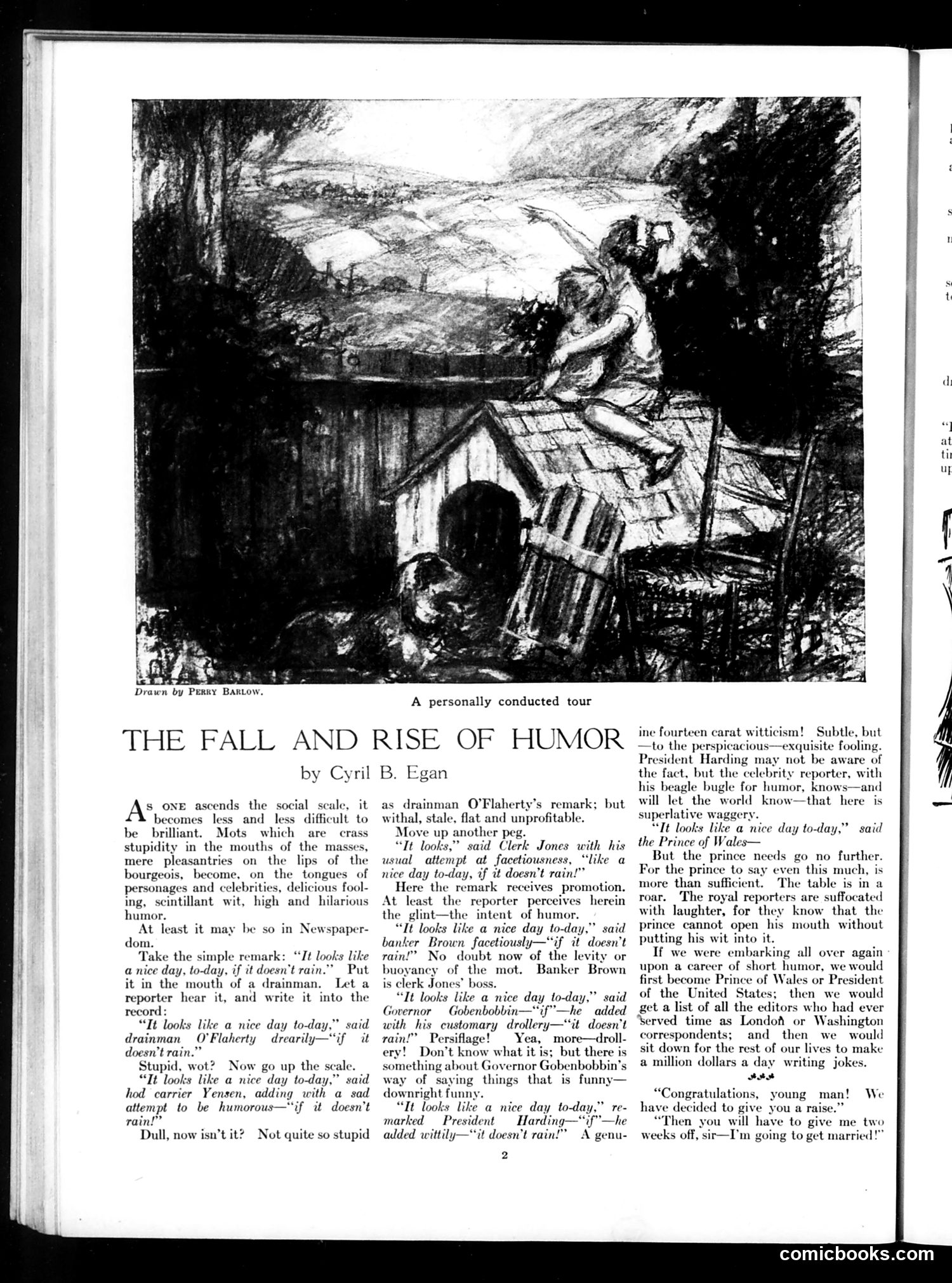
This satirical article examines how humor becomes "less and less difficult to withal" as one ascends the social scale. The piece uses a running gag—the phrase "It looks like a nice day to-day"—repeated across various figures of authority (a drainman, Clerk Jones, Banker Brown, Governor Gobendobbin, and President Harding). The satire's point: even powerful leaders resort to the same banal small talk as ordinary citizens. The humor depends on readers recognizing these named officials as contemporary political figures (Harding was president 1921-1923). By showing everyone—from working-class to presidential—using identical platitudes, Egan mocks how humor and wit deteriorate across all social strata, suggesting genuine wit is actually rare among the powerful.
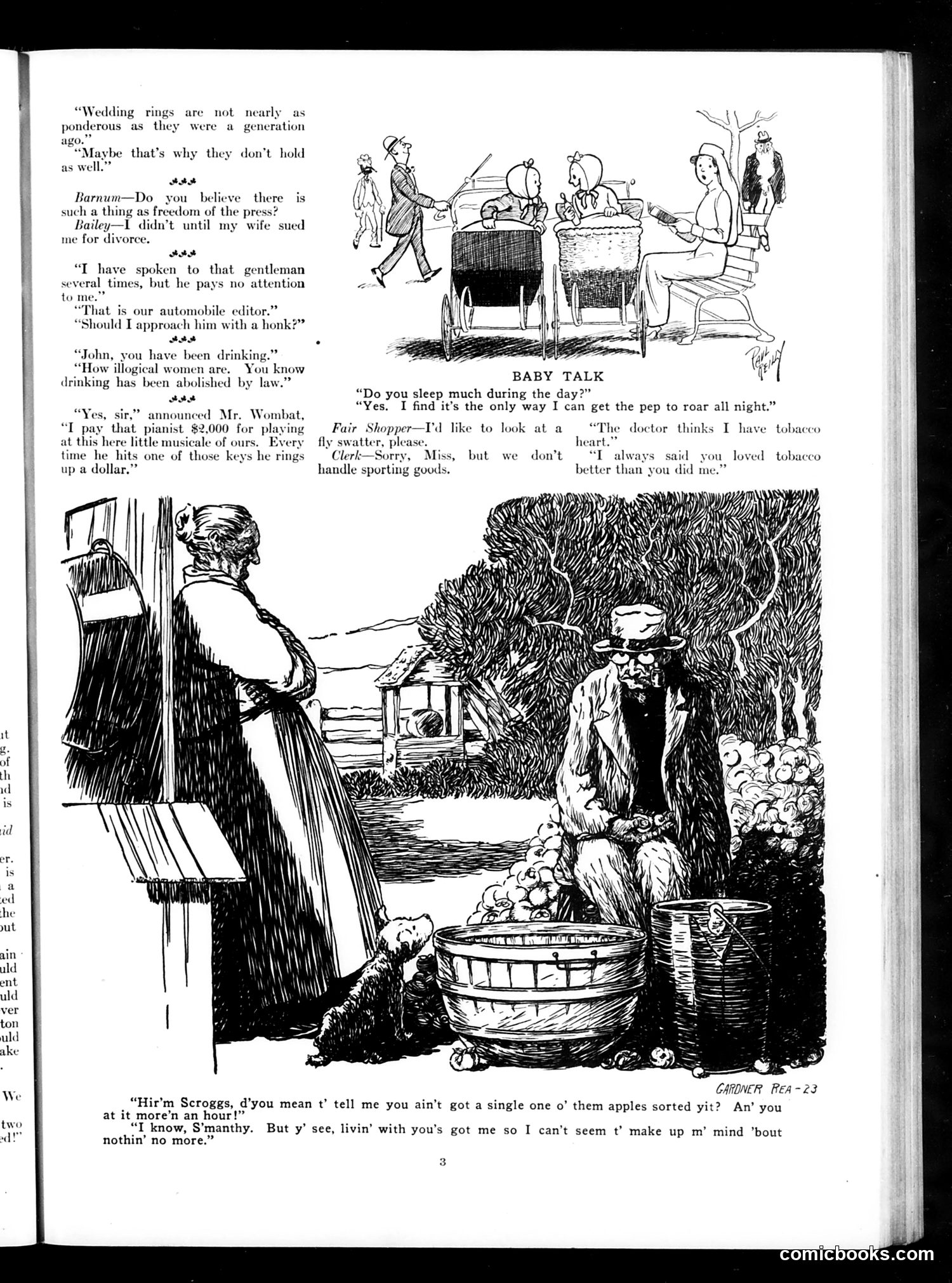
This page contains three distinct humor pieces typical of early 20th-century satirical journalism: **Top dialogue section**: Jokes about marriage, divorce law, and wedding rings—standard domestic humor of the era mocking both women's legal gains and men's complaints about costs. **"Baby Talk" cartoon**: Two panels satirizing new parents. The upper cartoon jokes about sleep deprivation with babies. The lower cartoon depicts rural/working-class life, showing a woman at a window and a man sorting apples, with dialect humor about poverty and domestic arrangements. The cartoons rely on class-based stereotypes (rural/poor characters speak in exaggerated dialect) and gender stereotypes (complaining wives, exhausted husbands). The satire targets ordinary domestic life rather than political figures, reflecting Judge's focus on social observation and class-based humor rather than partisan politics.
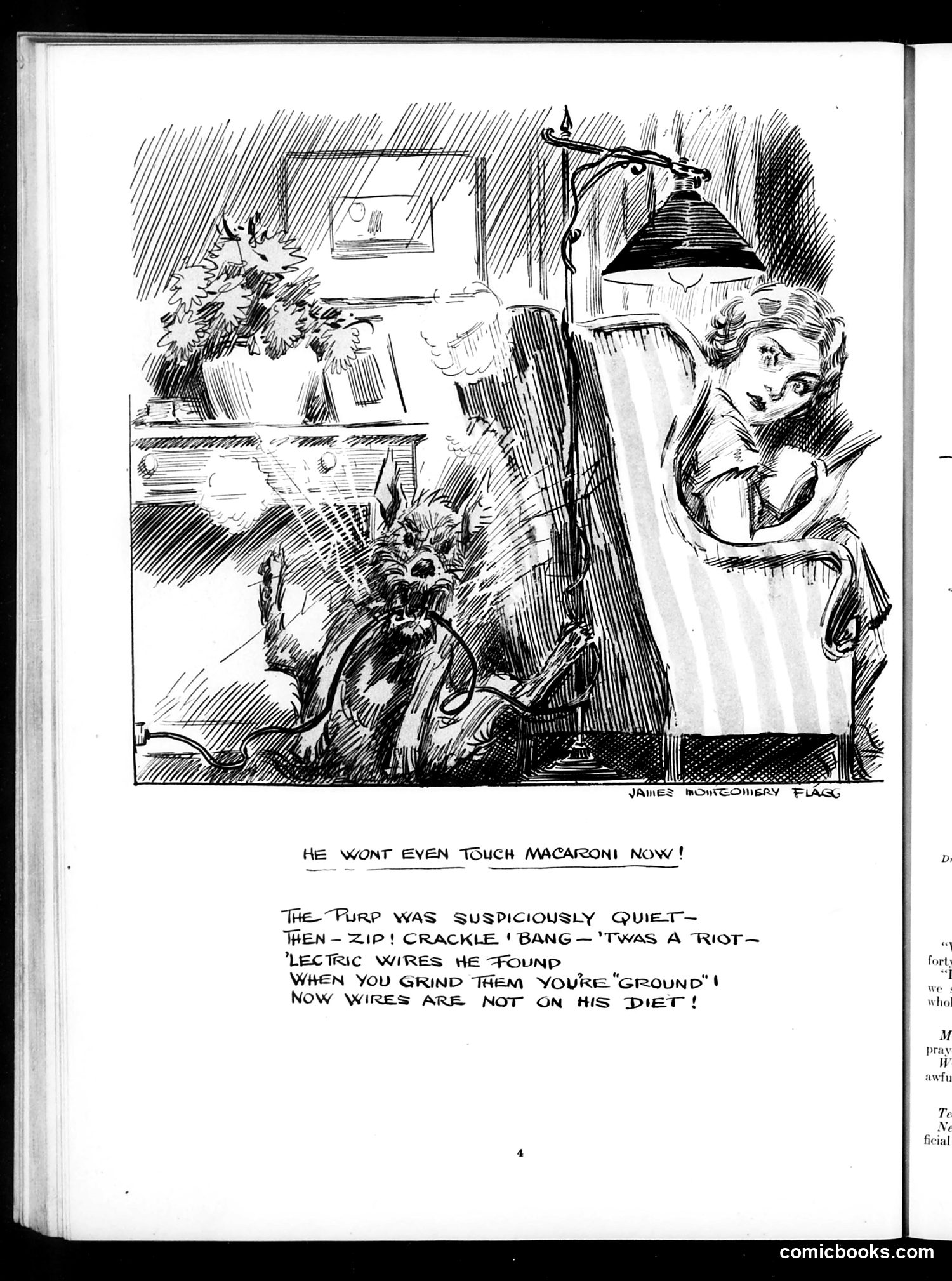
This cartoon by James Montgomery Flagg satirizes a dog that has chewed through electrical wires, creating household chaos. The humor plays on the dog's indiscriminate appetite—the caption "HE WONT EVEN TOUCH MACARONI NOW!" suggests the pet has become so accustomed to dangerous materials that ordinary food seems unpalatable by comparison. The detailed narrative below explains the incident: the dog's quiet behavior preceded electrical sparks and noise, and the owner discovers the dog has consumed live wires, which are now "not on his diet." This is domestic humor rather than political satire, typical of Judge magazine's varied content. It mocks both pet misbehavior and the owner's exasperation, using dark comedy about the electrical hazard for comedic effect.
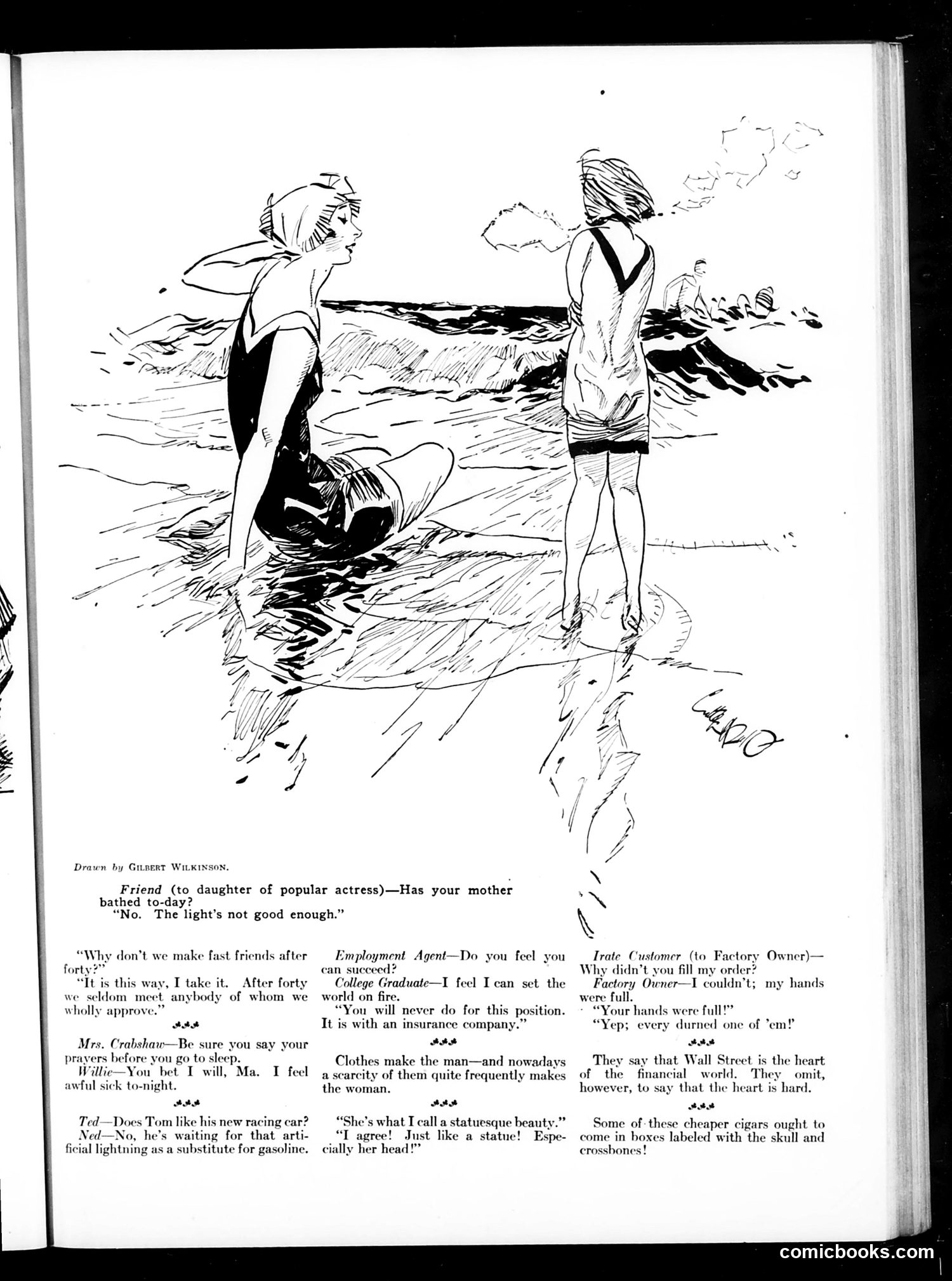
This page collects brief satirical jokes typical of early 20th-century American humor. The main illustration shows two women in bathing suits at a beach; the accompanying joke suggests that women (specifically actresses) stop bathing after age forty—a dig at vanity and aging. The text jokes target various social anxieties: a college graduate's overconfidence versus an insurance company's pragmatism; the notion that poverty ("scarcity of clothes") affects women's respectability; a factory owner's hands being "full" of idle workers (likely referencing labor/unemployment concerns); and Wall Street's heartlessness. Other quips mock parental religiosity, obsolete automobiles, and poor-quality cigars. The humor relies on wordplay, double meanings, and gentle mockery of middle-class pretensions—characteristic of Judge's satirical approach to contemporary American life and social conventions of the era.
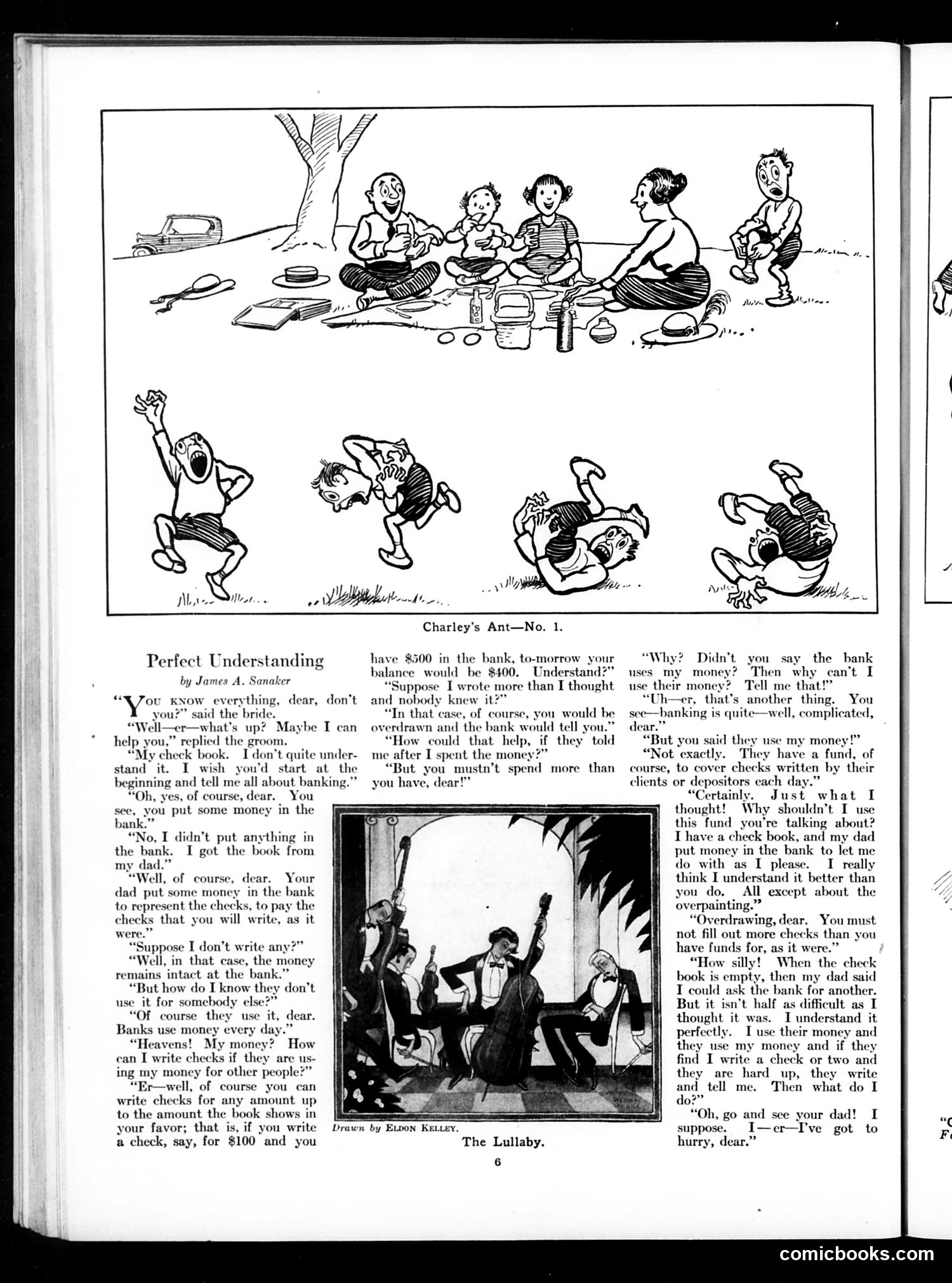
This is a humorous dialogue between a new bride and groom about basic banking. The wife, unfamiliar with how checking accounts work, asks innocent questions that expose the logical absurdities her husband tries to explain. The satire targets **banking confusion among ordinary people**, particularly women excluded from financial management. The wife's questions—"Why can't I use the bank's money if they use mine?"—are logically sound but reveal how poorly banking practices were understood or explained to the average citizen. The cartoon at the top shows a family picnic scene; the panels below ("Charley's Ant") depict slapstick physical comedy, likely unrelated. The joke's humor lies in the groom's inability to explain banking clearly and his eventual surrender ("go see your dad"), suggesting that even he doesn't fully understand the system he's defending. It's satire of financial institutions' mystifying operations and the era's gender-based exclusion from economic literacy.
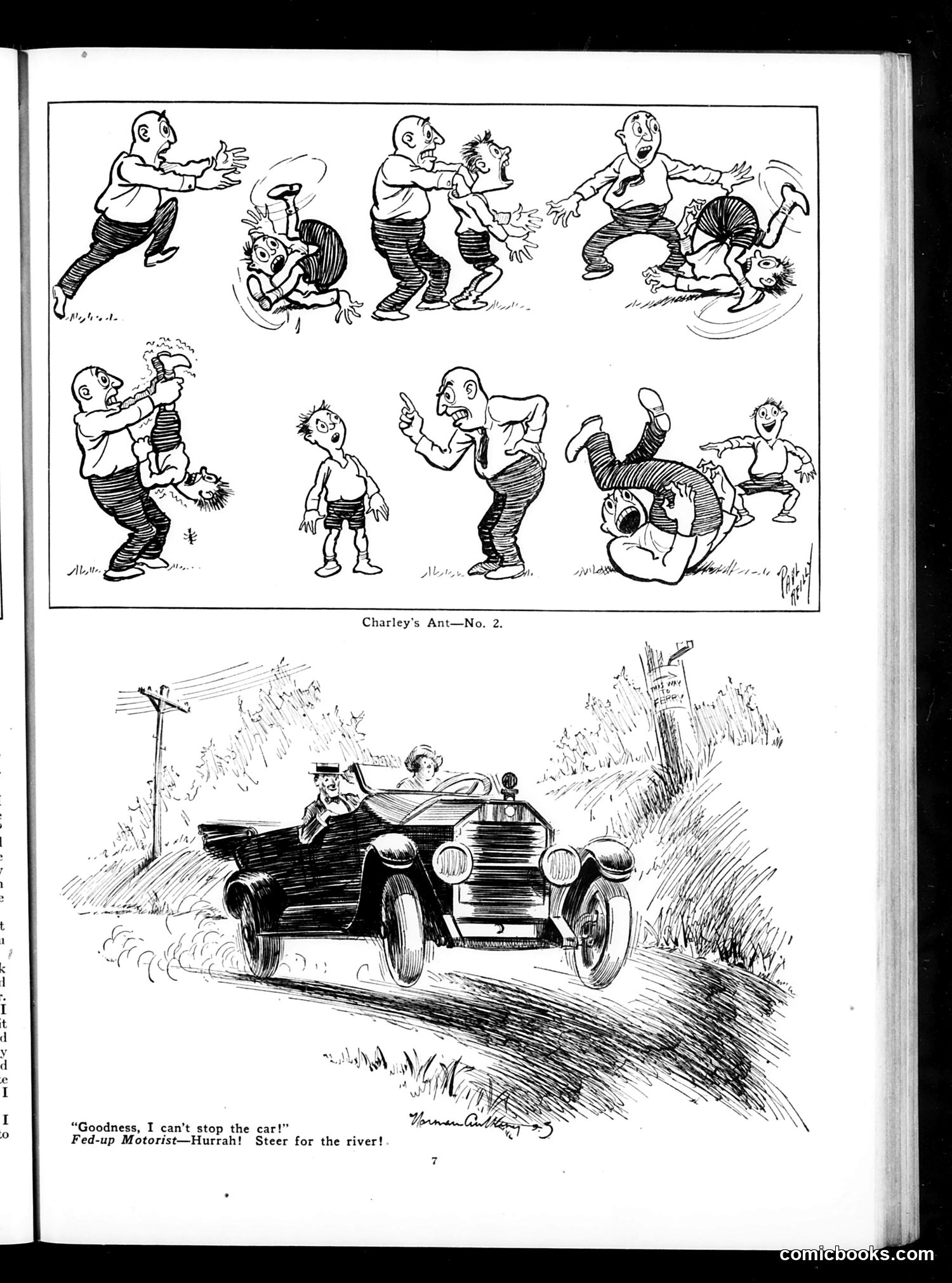
This Judge magazine page contains two separate cartoons satirizing early automobile culture. The top panel, "Charley's Ant—No. 2," shows slapstick humor involving adults being chased or tormented by a small child (depicted with spiky hair), playing on the chaos of childcare. The bottom cartoon mocks motorists of the era. It depicts a fed-up driver unable to control his car, heading toward a river. A passenger ironically cheers "Hurrah! Steer for the river!"—joking that crashing into the water would be preferable to the car's unreliability. This reflects early automobiles' notorious mechanical problems and poor handling. The satire targets both the vehicles' dangerous inadequacy and drivers' frustration with newfangled technology, presenting deliberate crash-into-a-river as a darkly humorous "solution" to mechanical failure.
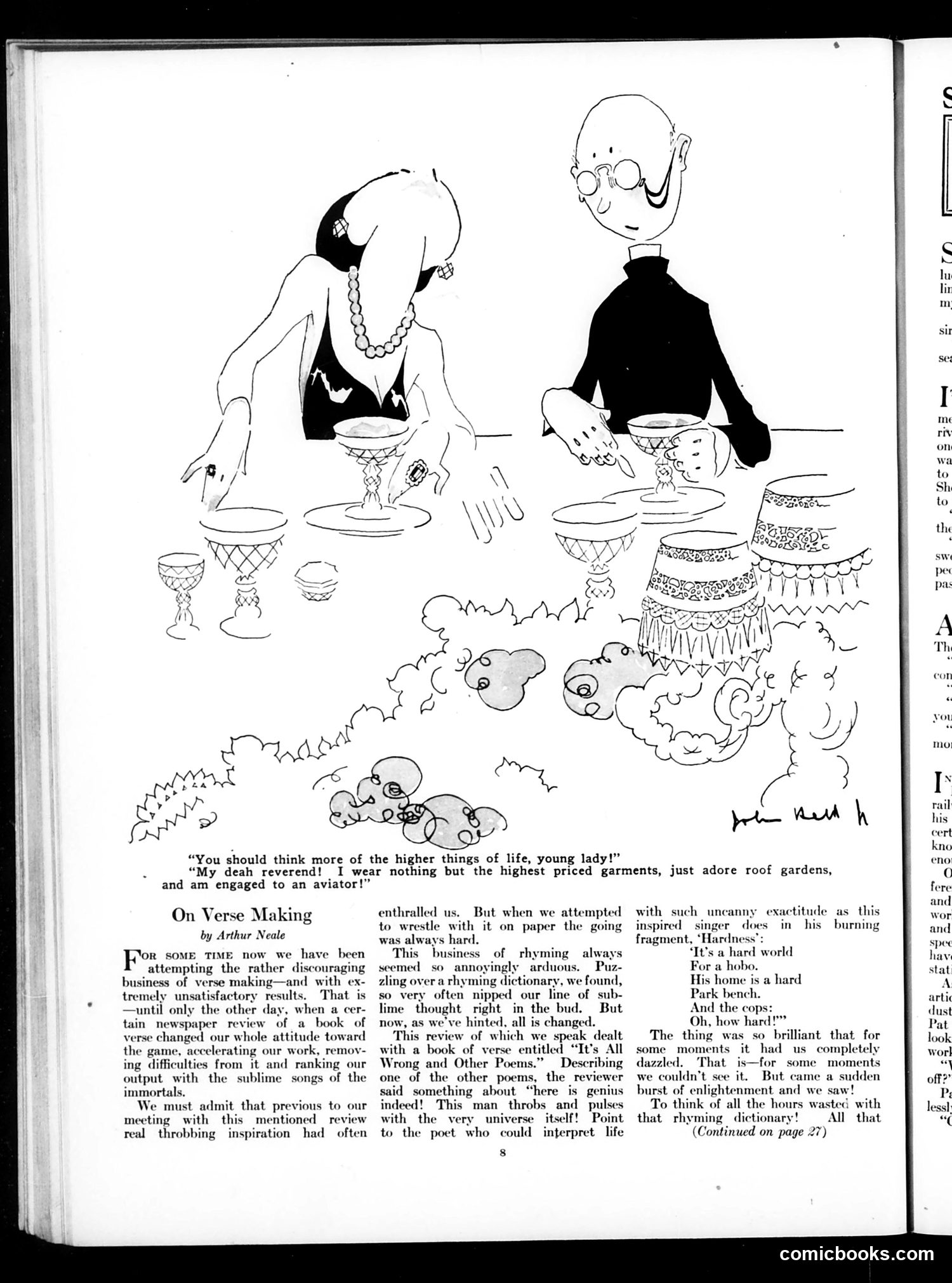
The top cartoon satirizes materialism and shallow values among the wealthy. A clergyman lectures a young woman about "higher things of life," but she dismisses his moral concerns, responding that she wears only expensive garments, loves roof gardens, and is engaged to an aviator—implying she measures worth by luxury and status rather than spirituality or character. The elaborate tableware and decorative objects surrounding them emphasize conspicuous consumption. The joke targets both the hypocritical reverend (preaching virtue while dining lavishly) and the flighty society woman who conflates moral elevation with material acquisition and fashionable pursuits (aviation being a trendy novelty at the time). The accompanying article "On Verse Making" by Arthur Neale is a humorous essay mocking amateur poets and overly-earnest literary criticism, ultimately suggesting that uninspired verse ("It's a hard world / Park bench") receives absurdly effusive praise from pretentious reviewers.
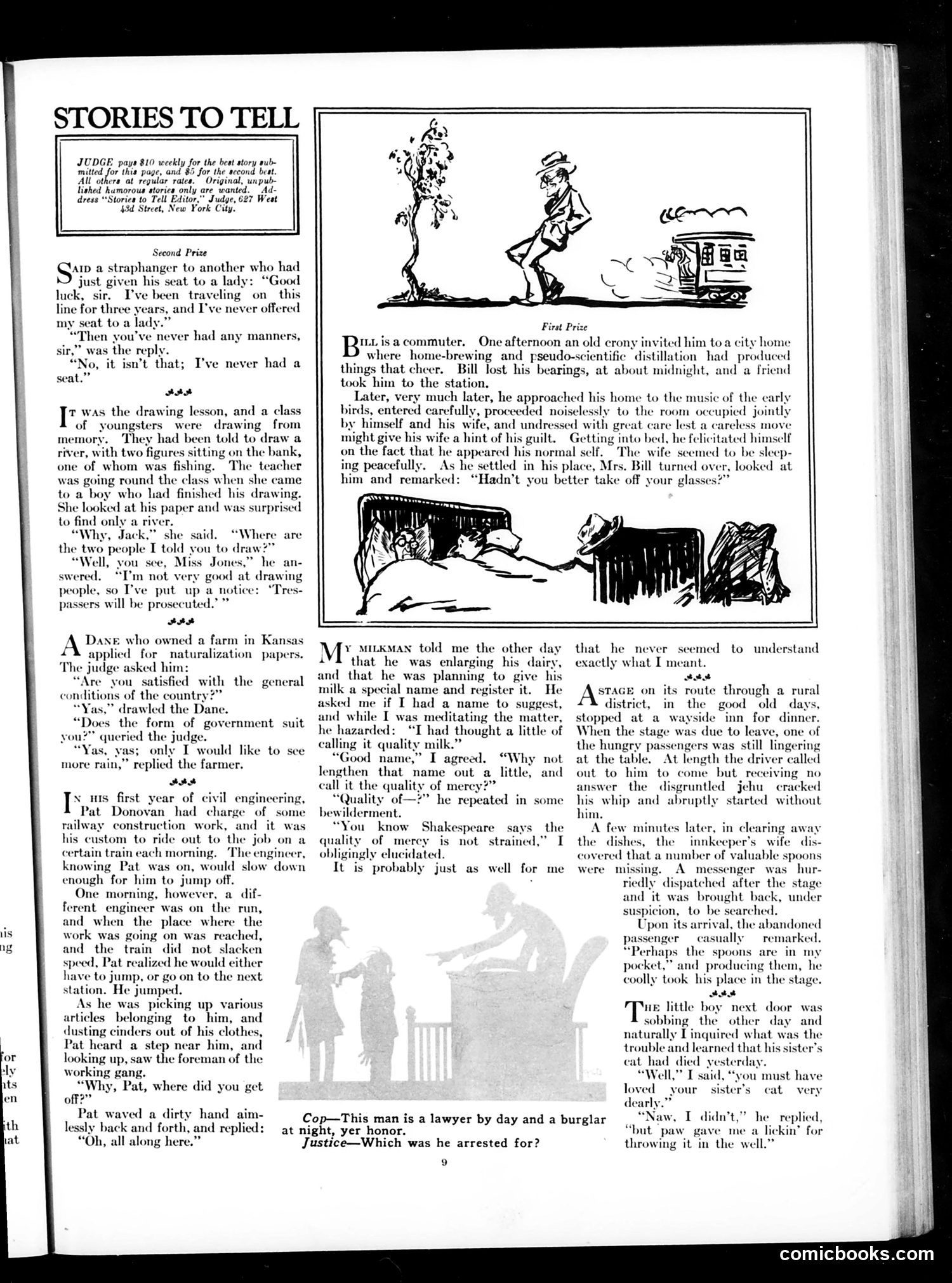
This page contains humorous short anecdotes typical of Judge's satirical humor. Key pieces include: **The Commuter Story (First Prize)**: A man named Bill sneaks home drunk at dawn after an illicit drinking party. He undresses carefully to avoid waking his wife, but she immediately notices he's still wearing his eyeglasses—exposing his deception. The joke targets both Prohibition-era home-brewing and marital infidelity. **The Straphanger Joke**: A man who's never given up his seat on public transit explains he's never *had* a seat to give—dark humor about crowded urban transit conditions. **Other brief jokes** include a drawing class mishap, a Dane's immigration interview, and a railway worker's mishap. **The Final Riddle**: A lawyer arrested—unclear whether for practicing law or burglary—satirizes potentially corrupt legal practitioners. The page reflects early 20th-century American urban life: public transit congestion, Prohibition enforcement, and class anxieties. The humor is gentle, domestic, and middle-class focused—typical of Judge's audience.
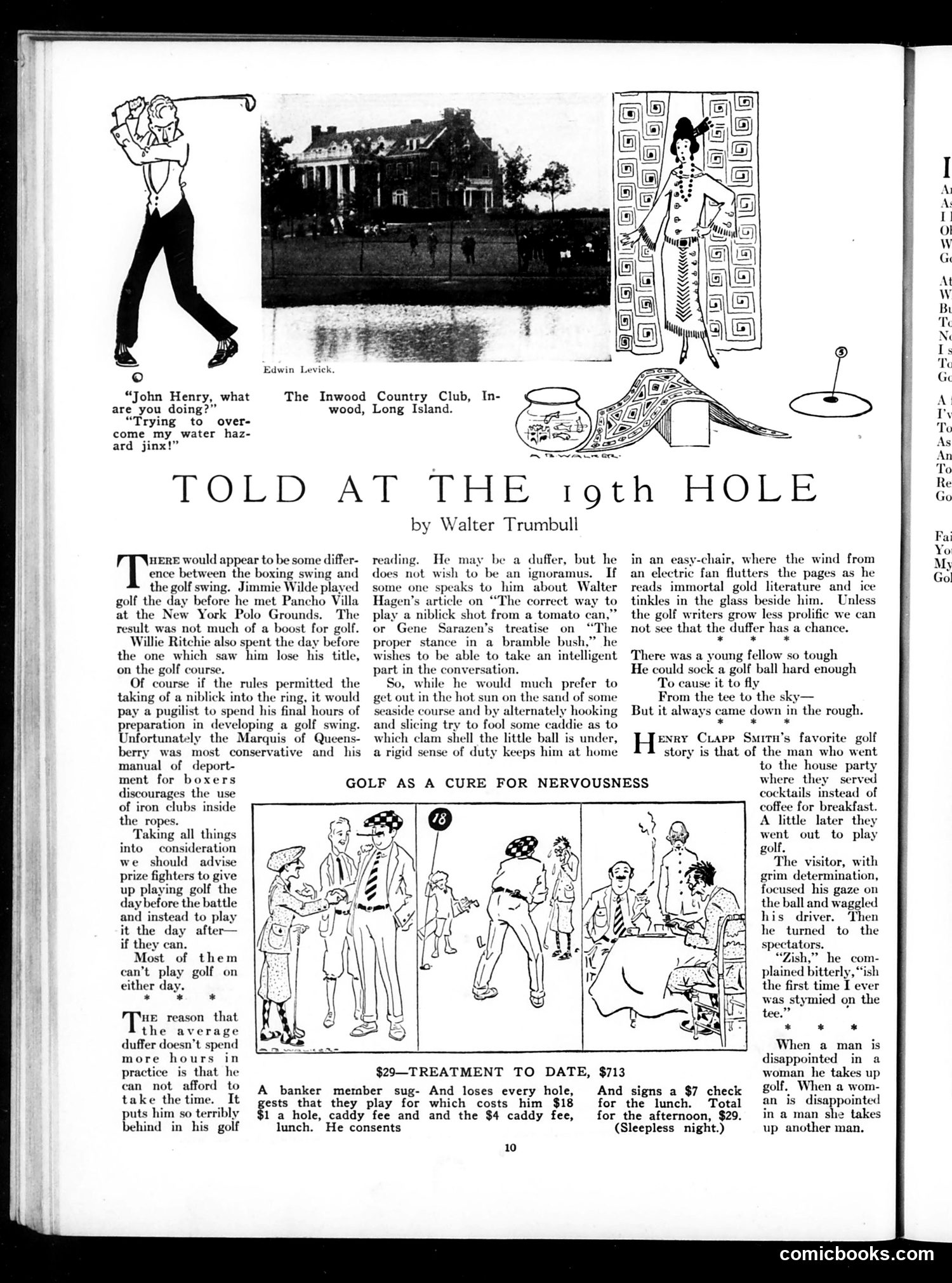
This is a humorous article about golf culture by Walter Trumbull, published in *Judge* magazine. The main satire targets golf enthusiasts' obsession with the sport and the financial drain it causes. The central cartoon illustrates "Golf as a Cure for Nervousness," showing that a golfer's treatment costs $713 but yields no results—he's still sleepless. The banker anecdote reveals the joke: players gamble $1 per hole plus caddy fees ($18) and lunch ($4), losing constantly. The page mocks golfers' contradictions: duffers spend hours reading golf instruction articles by professionals like Walter Hagen and Gene Sarazen (famous contemporary golfers) rather than practicing, yet they can't afford practice time anyway. The final quips suggest golf is an expensive escape—men take it up when disappointed in women, while women simply find another man instead. The photographs of the Inwood Country Club and a fashionable woman reference wealthy leisure culture where golf was primarily a pastime for the affluent.
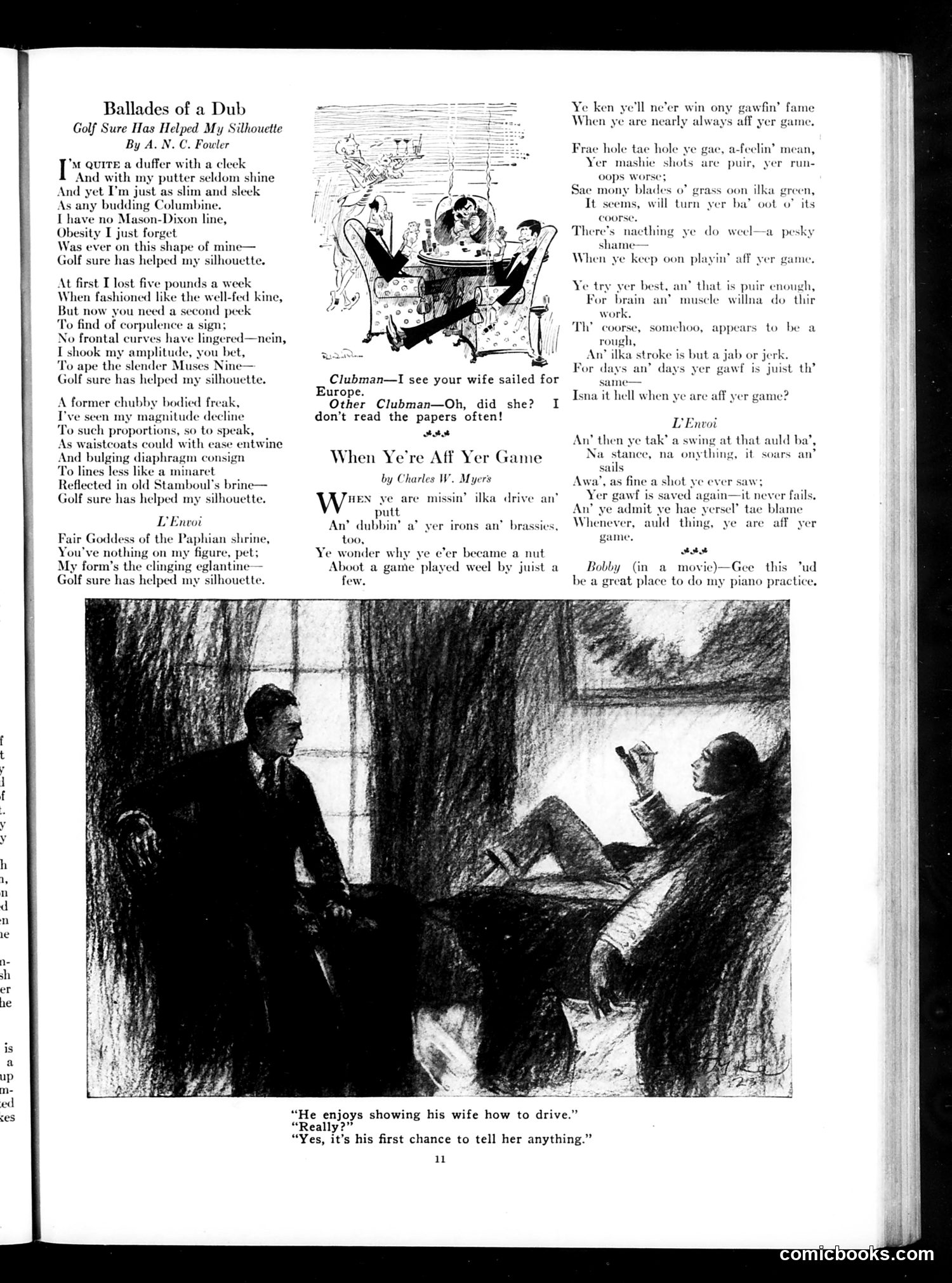
This page contains three golf-related humor pieces from early 20th-century Judge magazine, reflecting golf's popularity among American leisure classes. **"Ballades of a Dub"** satirizes the weight-loss claims of golf enthusiasts. The speaker boasts that golf transformed him from "chubby bodied freak" to slim figure—a humorous exaggeration of golf's supposed health benefits. **The clubman exchange** jokes about marital indifference: one man hasn't noticed his wife left for Europe because he "don't read the papers often"—implying husbands paid no attention to their wives' activities. **"When Ye're Aff Yer Game"** (in Scottish dialect) sympathizes with golfers playing poorly, capturing frustration until one miraculous shot redeems the round—suggesting golf's addictive emotional rollercoaster. **The bottom cartoon** satirizes male authority: a man finally gets to "tell her anything" while teaching his wife to drive—implying husbands rarely had platforms to lecture wives otherwise. The humor targets both marital dynamics and men's desire for dominance.
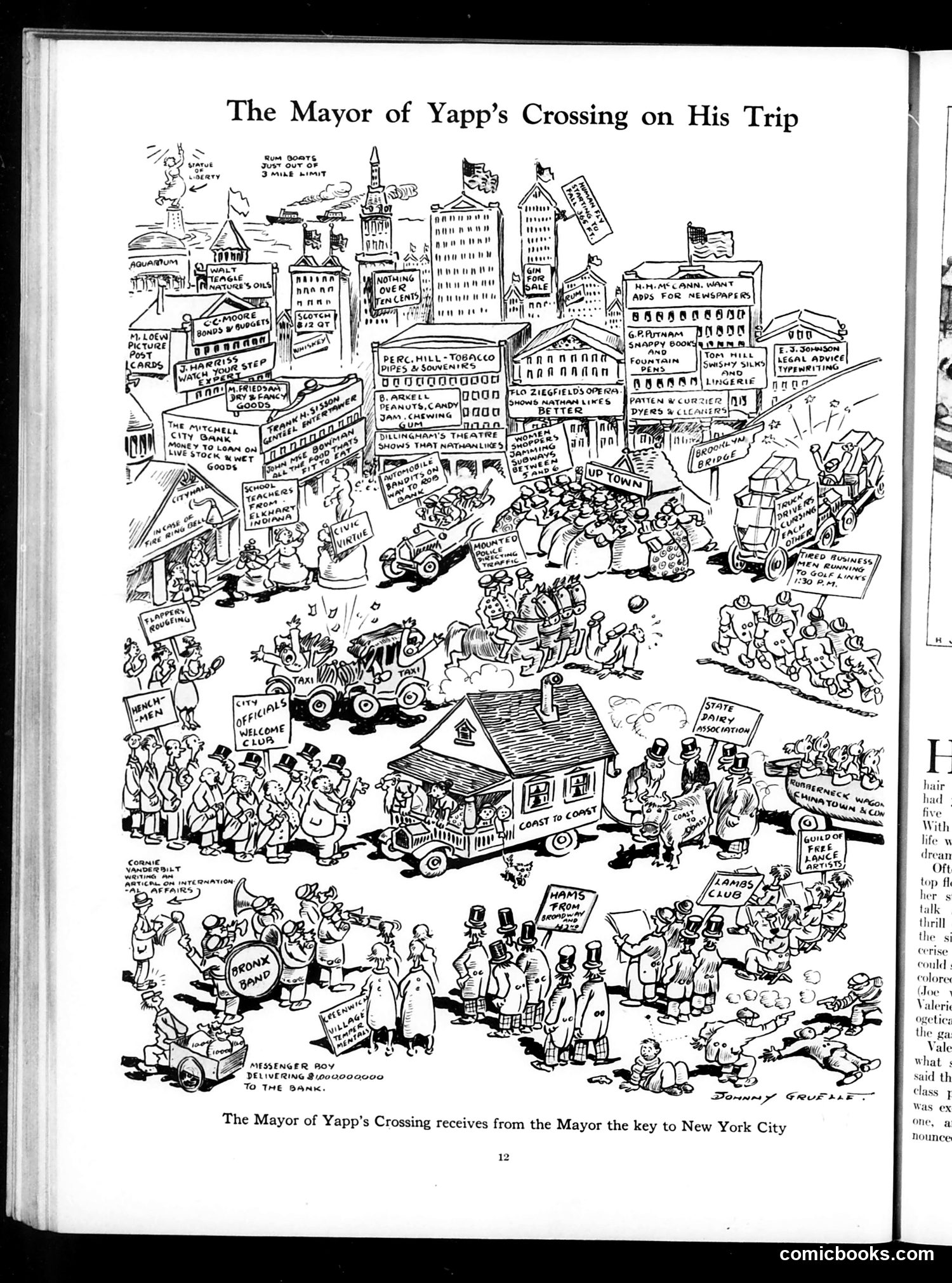
This is a bustling satirical map-illustration of New York City circa the early 1900s, showing the Mayor of a fictional small town ("Yapp's Crossing") receiving the key to New York City. The cartoon mocks NYC's commercial excess and cultural pretensions through labeled vignettes. Visible references include: - **Vanderbilt** (upper left)—representing wealthy industrial families - **Ziegfeld's Opera House**—theatrical glamour - **Messenger boy delivering billions to the bank**—financial speculation/wealth obsession - Various shops: tobacco, candy, newspapers - Street crowds, performers, and merchants The satire likely targets the contrast between small-town simplicity and NYC's overwhelming commercialism, materialism, and bustling greed. The cartoonist (signed "Johnny Gruelle") uses dense, chaotic illustration to capture the city as a frenetic, money-obsessed spectacle—a common Progressive-era critique of urban excess. The caption's formal tone ironically contrasts the actual mayhem depicted.
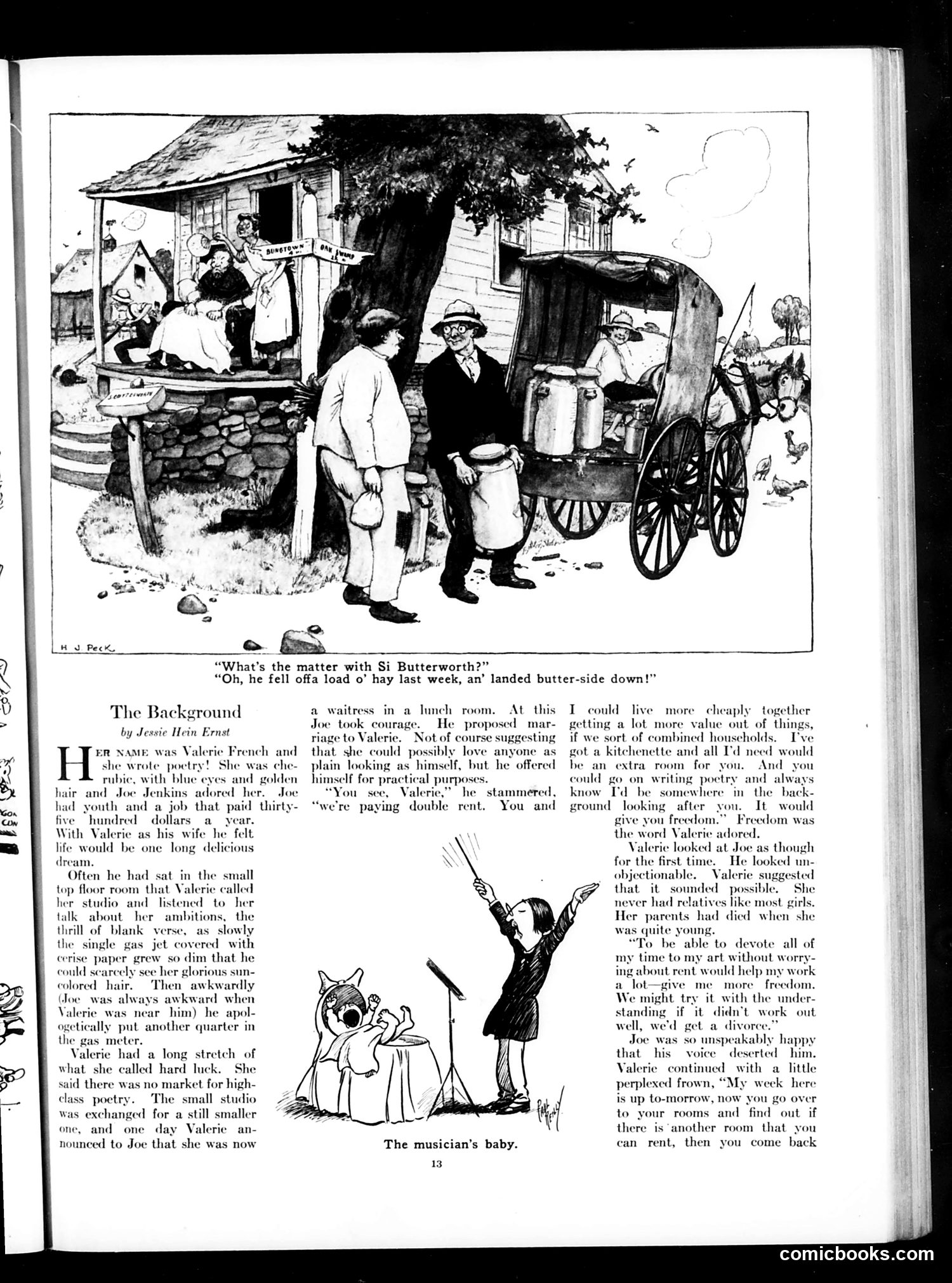
The page contains two distinct pieces: **Top Cartoon:** A simple visual pun captioned "What's the matter with Si Butterworth?" The joke relies on wordplay: Si fell off a hay wagon and landed "butter-side down"—a play on the expression "butter-side down" (referring to Murphy's Law, where buttered bread always lands buttered-side down). The humor is purely comedic, not political. **Main Story:** "The Background" by Jessie Hein Ernst begins a serialized romance about Valerie French, an aspiring poet, and Joe Jenkins, a working man who loves her. The story satirizes bohemian artistic life and working-class courtship in early 20th-century America. It depicts Valerie's struggle as a poet, her eventual work as a waitress, and Joe's awkward marriage proposal based on practical economics rather than romance. The social commentary concerns the difficulty of sustaining artistic ambitions on limited income and the clash between romantic idealism and financial necessity.
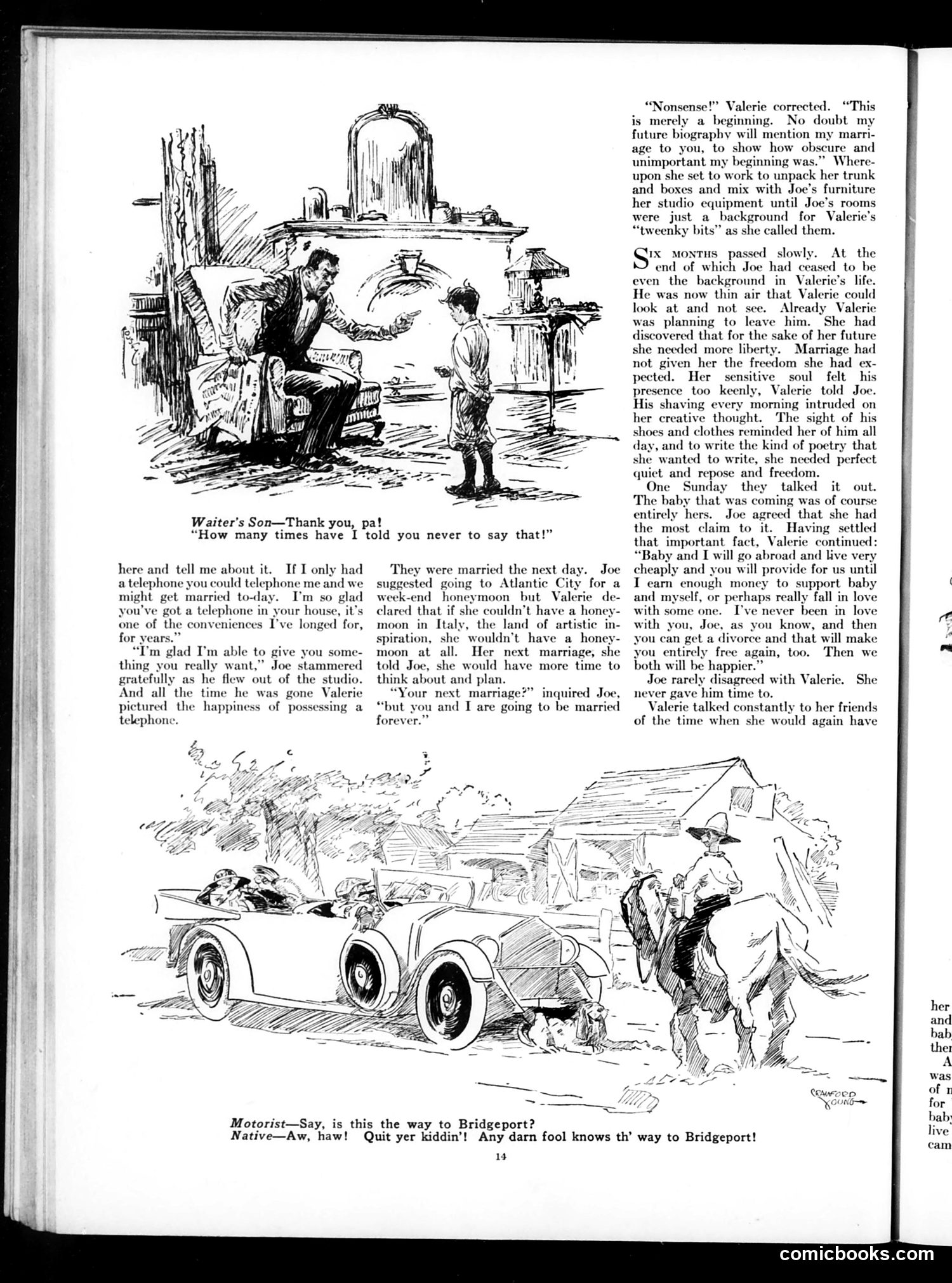
This page contains two satirical pieces mocking early 20th-century attitudes about marriage, ambition, and gender roles. **Top story:** "Waiter's Son" satirizes a self-absorbed woman named Valerie who marries Joe for access to his telephone and middle-class comforts. She immediately treats marriage as temporary, planning her "next marriage" and eventually abandoning Joe and their baby to pursue artistic dreams in Italy—while expecting him to provide financial support indefinitely. The satire targets women who view marriage as a stepping stone rather than commitment, and their entitlement to male financial support. **Bottom cartoon:** Two rural figures discuss directions to Bridgeport. The joke relies on a "rube" stereotype—the Native character uses exaggerated rural dialect ("Aw, haw! Quit yer kiddin'!"), suggesting country people are foolish and defensive about their knowledge. This reflects common period stereotypes mocking rural Americans as unsophisticated. Both pieces reflect Jazz Age anxieties about changing social norms, women's independence, and class tensions in 1920s America.
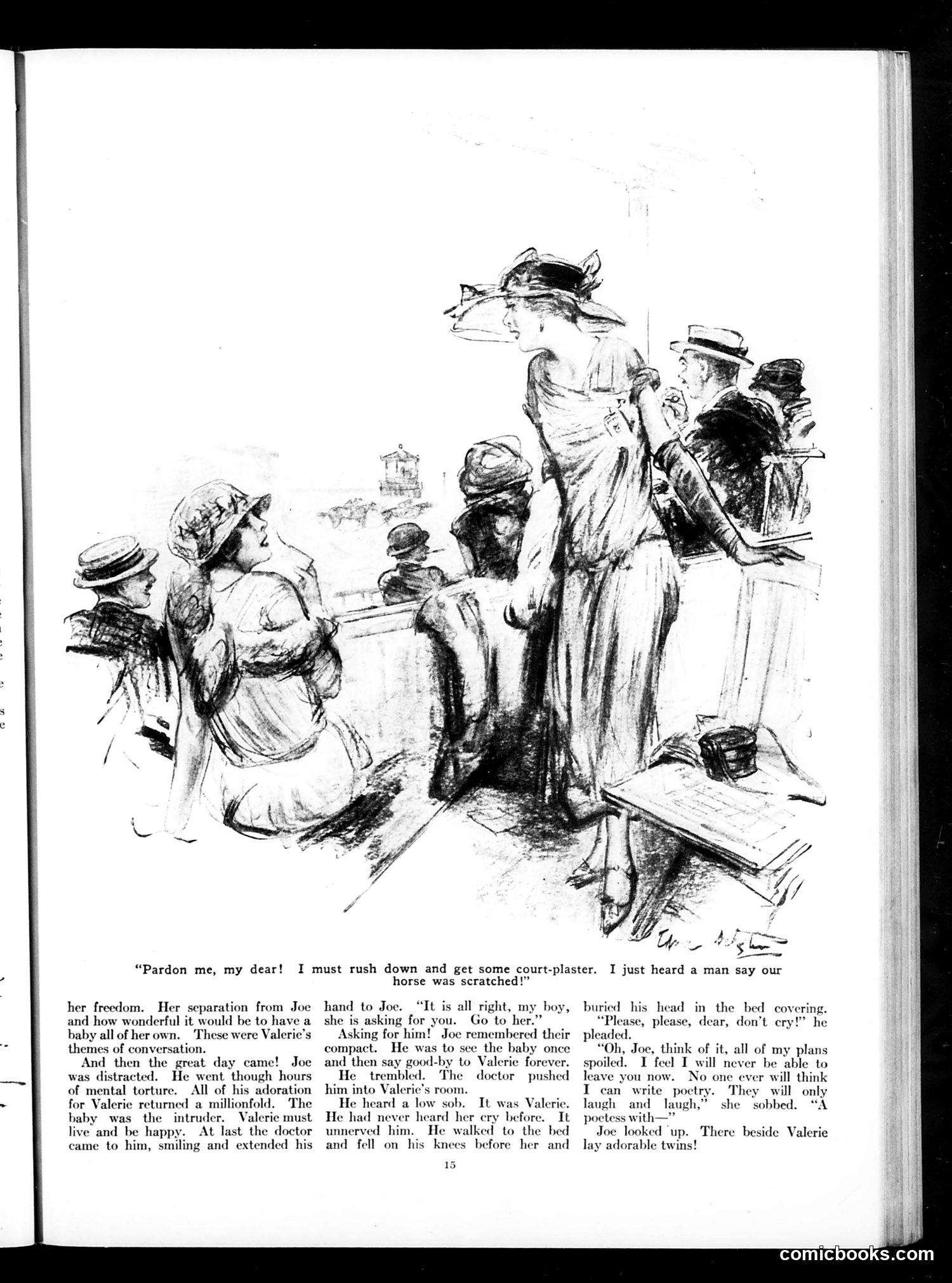
This page depicts a domestic melodrama rather than political satire. The narrative follows Joe and Valerie, a couple who apparently had an agreement: Joe would see their newborn baby once, then separate from Valerie forever to grant her freedom. The cartoon's humor relies on ironic contrast: while Joe agonizes over their impending separation and Valerie despairs that motherhood will ruin her aspirations as a poet, the punchline arrives when Joe discovers not one baby but twins—complicating their entire arrangement. The opening caption about "court-plaster" for a scratched horse serves as a comedic non-sequitur, establishing the lighthearted tone before the sentimental plot unfolds. This appears to be serialized fiction illustrated with sketches—typical Judge content mixing social commentary on marriage, women's ambitions, and family with sentimental drama and gentle humor.
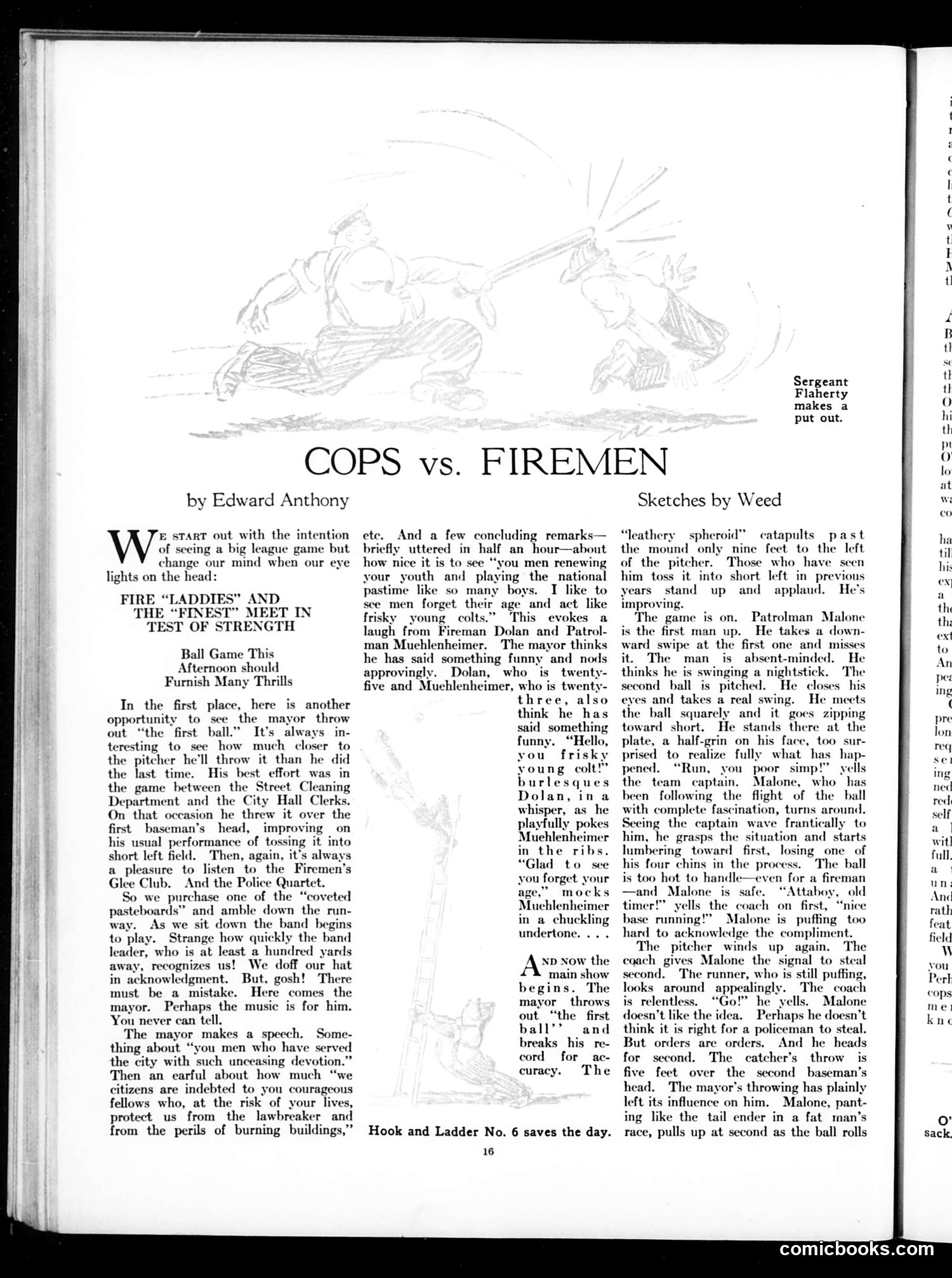
This is a humorous sports article describing a baseball game between New York City police and fire departments. The satire targets municipal bureaucracy and the self-importance of city officials. The joke centers on the **mayor's ceremonial first pitch**, which the author mockingly notes he throws poorly but claims as "improvement." The mayor delivers a patronizing speech praising both departments as "courageous" and "frisky young colts"—language the officers find ridiculous given they're grown men. The game itself satirizes the players: Patrolman Malone absent-mindedly swings like he's holding a nightstick rather than a bat, then appears shocked his hit actually works. The firefighters save the day athletically, suggesting their superiority. This reflects early 20th-century American civic pride in municipal departments while gently mocking both the pomposity of local politicians and the working-class dignity of police and firefighters forced to endure such ceremonies.
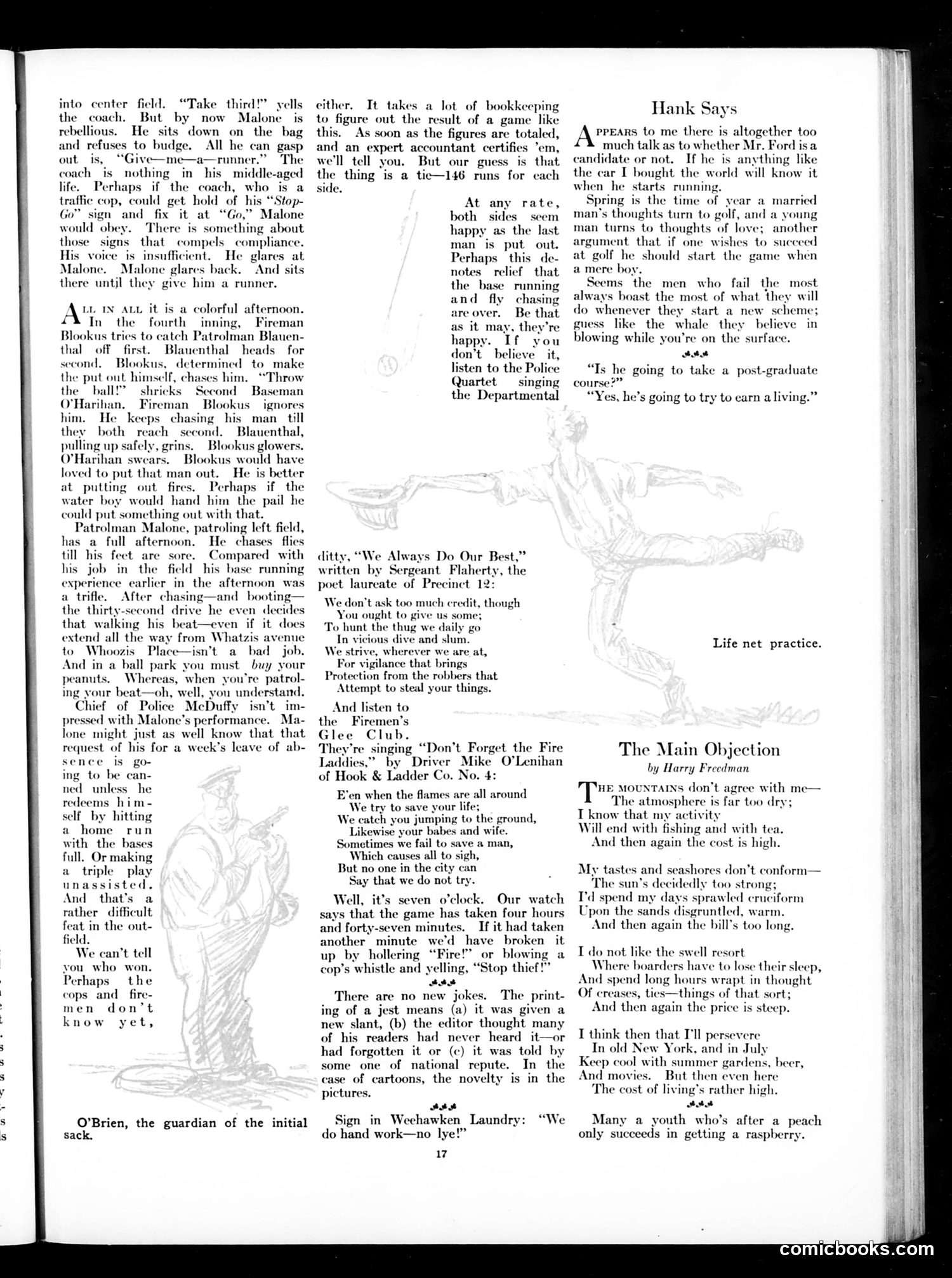
This page satirizes a baseball game between New York City police and firemen—rival municipal departments that clearly had genuine competitive tension. The humor centers on how each group brings their job habits to the field: Patrolman Malone demands "a runner" like issuing orders; officers use traffic-control signs as metaphors for compliance; Fireman Blookus chases down opponents with the same determination he'd use fighting fires; and the game supposedly ends in a 146-146 tie because "it takes a lot of bookkeeping." The cartoon mocks both institutional rivalry and occupational identity. Officers and firefighters are portrayed as so defined by their professional roles that they can't simply play baseball—they must police, fight fires, and assert authority even during recreation. The concluding song parodies glorify each department's public service, adding gentle mockery of institutional self-importance. It's fundamentally humor about institutional cultures and the difficulty of separating professional identity from leisure activities.
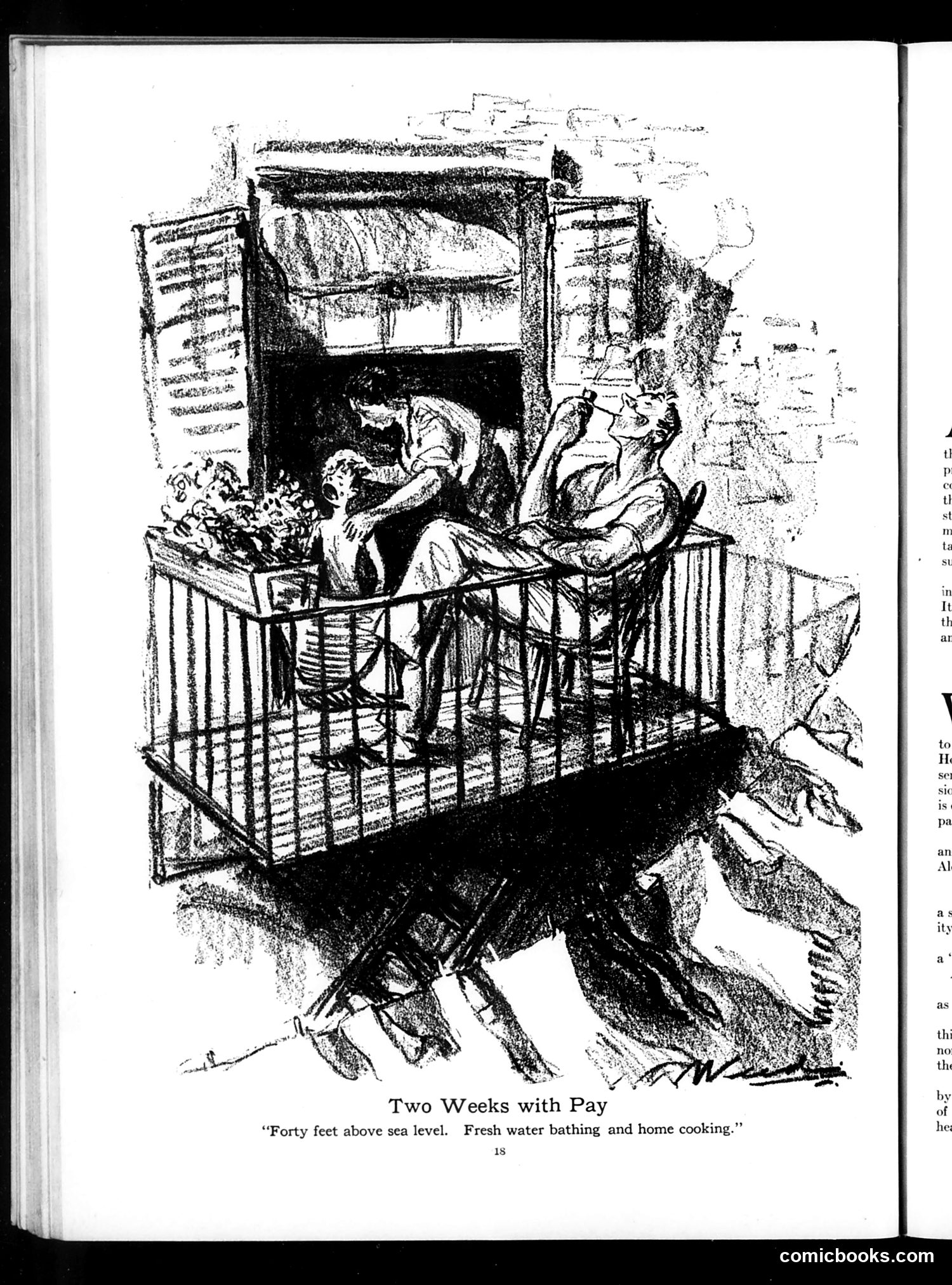
This illustration satirizes vacation advertisements promising luxury retreats. The cartoon shows people cramped on a tiny balcony forty feet above sea level, appearing to enjoy themselves despite obviously uncomfortable conditions. The caption's promises of "fresh water bathing and home cooking" are undercut by the visual reality: crowded quarters, minimal space, and a makeshift setup suggesting false advertising. The satire mocks early 20th-century travel industry marketing that overpromised modest accommodations to working-class vacationers. The irony—that employees' two-week paid vacation is spent in such tight, unglamorous conditions—critiques both exploitative employers and misleading tourism promotions. It's humor rooted in class anxiety and consumer skepticism about advertised leisure experiences.
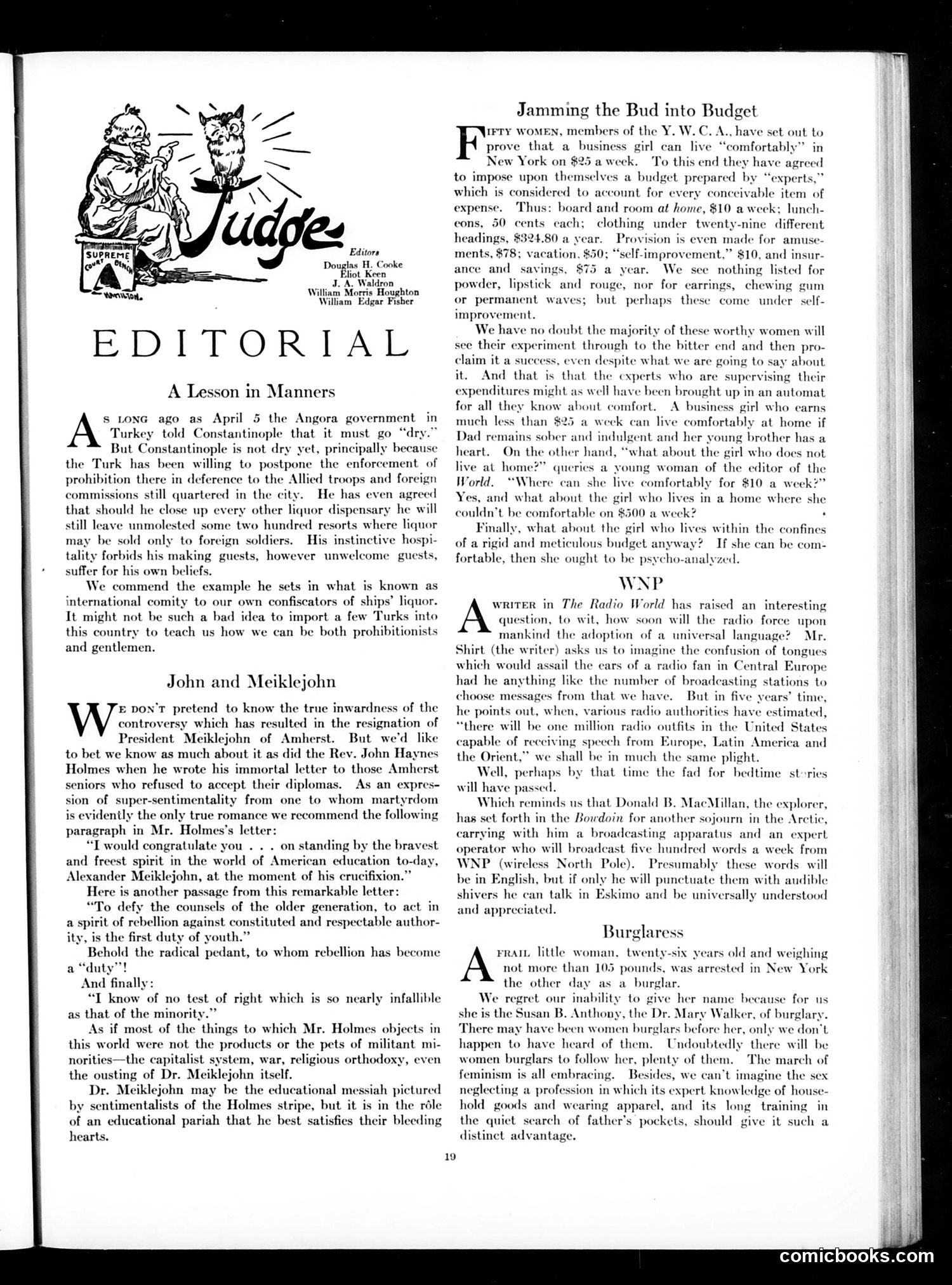
The page contains three editorial pieces satirizing contemporary issues: **The Turkish Liquor Dispensary**: Judge praises Turkey's government for maintaining hospitality to foreign soldiers by keeping liquor available despite Prohibition—contrasting this with American prohibition enforcement's lack of diplomatic courtesy. **Meiklejohn Controversy**: This attacks educator Alexander Meiklejohn's resignation from Amherst College and defends college authorities. Judge mocks Rev. John Haynes Holmes's letter romanticizing Meiklejohn's "martyrdom" and "crucifixion," ridiculing Holmes's claim that defying authority is youth's "first duty." The piece argues that minorities often support bad things, undermining Holmes's logic. **YWCA Budget Experiment**: Fifty women attempt to live on $25/week following an "expert" budget. Judge satirizes the unrealistic nature of such strict budgeting, noting it omits cosmetics and personal grooming—suggesting the experts lack practical understanding of comfort or real life expenses. The "Judge" masthead cartoon appears decorative rather than directly related to these pieces.
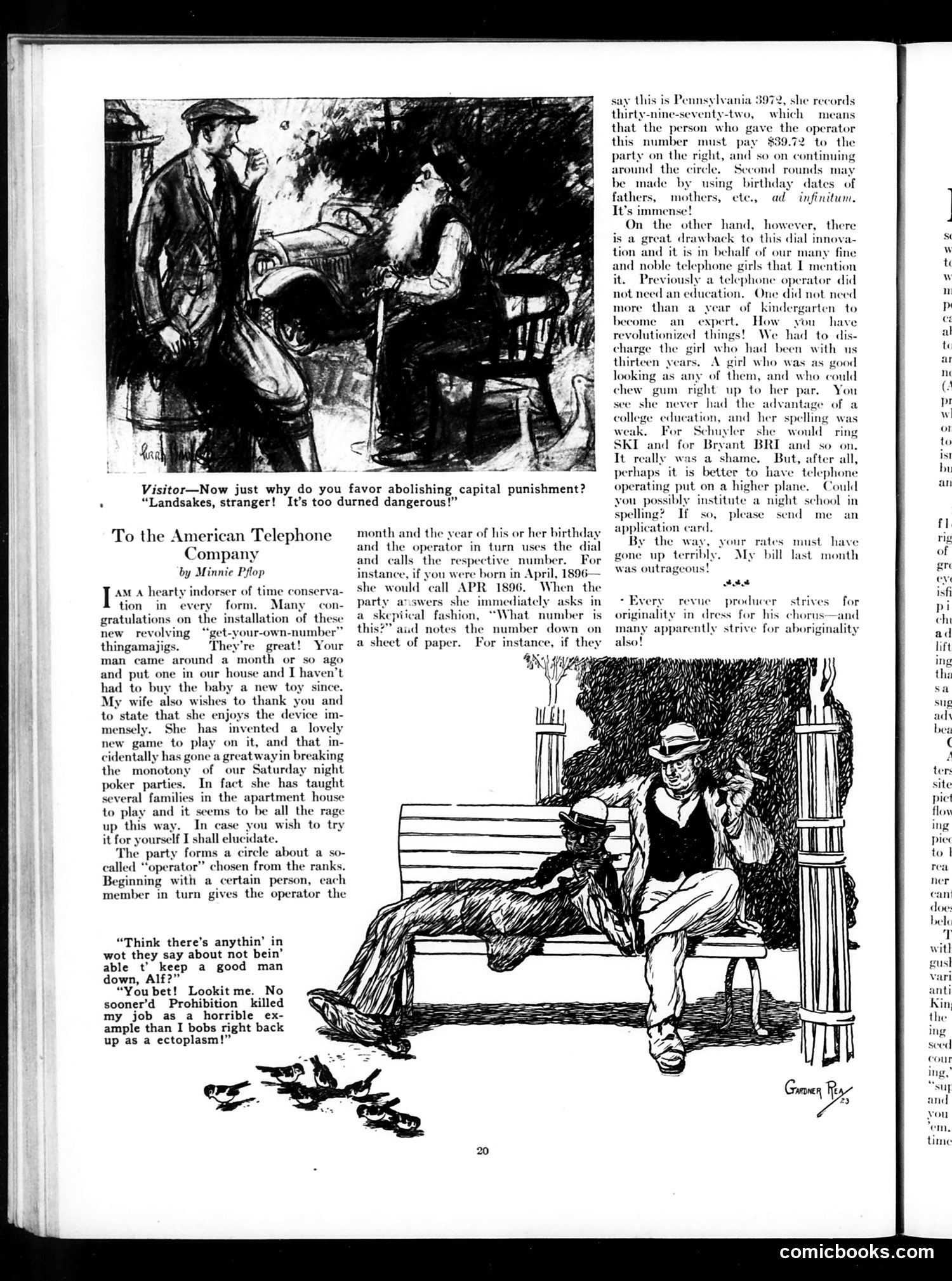
This page contains three distinct satirical pieces from Judge magazine (likely early 1900s): **Top Cartoon**: A visitor questions someone about opposing capital punishment. The absurd response—"It's too durned dangerous!"—satirizes hypocritical arguments, suggesting the questioner fears *being executed* rather than holding principled anti-death-penalty views. **Main Article ("To the American Telephone Company")**: This mock-endorsement by Minnie Pflop sarcastically praises the new rotary dial phone system. The joke: families use it as a gambling game, betting money based on phone numbers and birthdate dials. The letter then shifts to genuine complaint—the old telephone operator (who needed no education) has been replaced by one expected to spell correctly and possess literacy. The author laments this "progress" forces out longtime uneducated workers. **Bottom Cartoon**: Two working-class men discuss unemployment during Prohibition. One claims he's returned as a "ectoplasm" (ghost)—dark humor suggesting Prohibition's job losses were so devastating, the unemployed are literally undead. All three pieces mock social change: technological progress, labor displacement, and Prohibition's unintended consequences.
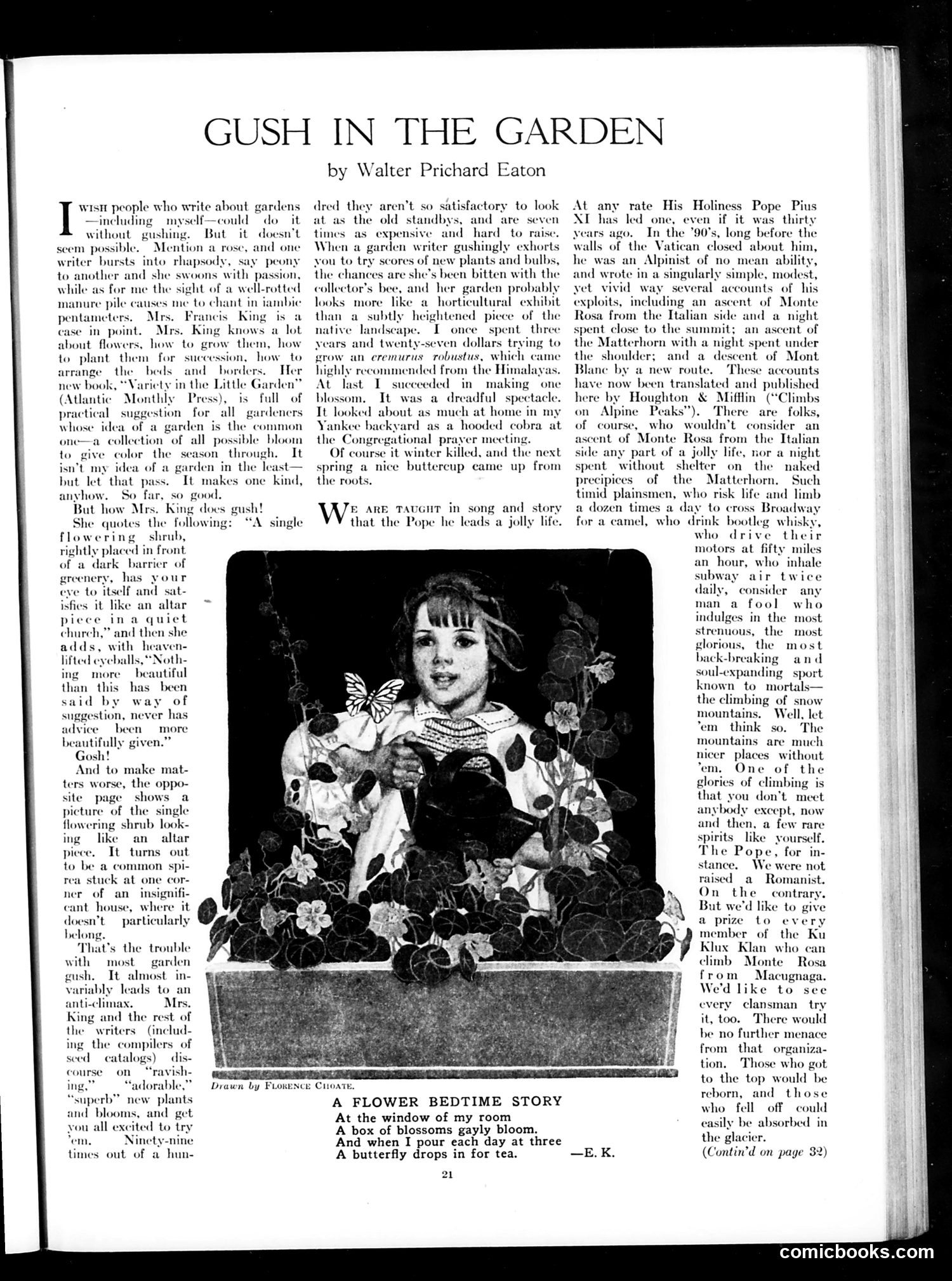
This is a literary essay by Walter Prichard Eaton critiquing garden writers' tendency toward excessive enthusiasm. The main point: gardening writers (like Mrs. Francis King, whose book is reviewed) use flowery language ("ravishing," "adorable," "superb") to promote plants that often disappoint in practice. Eaton's satire targets the gap between romantic prose and reality. He mocks the common practice of recommending expensive, difficult new varieties while overselling their beauty. His example: spending 27 dollars and three years growing an eremurus from the Himalayas, only to produce "a dreadful spectacle" unsuited to his yard. The accompanying illustration shows a young girl in a flower-filled window box—a whimsical "bedtime story" poem about blossoms and visiting butterflies, likely exemplifying the sentimental, romanticized language Eaton criticizes. The sidebar about Pope Pius XI climbing mountains appears unrelated to the main article.
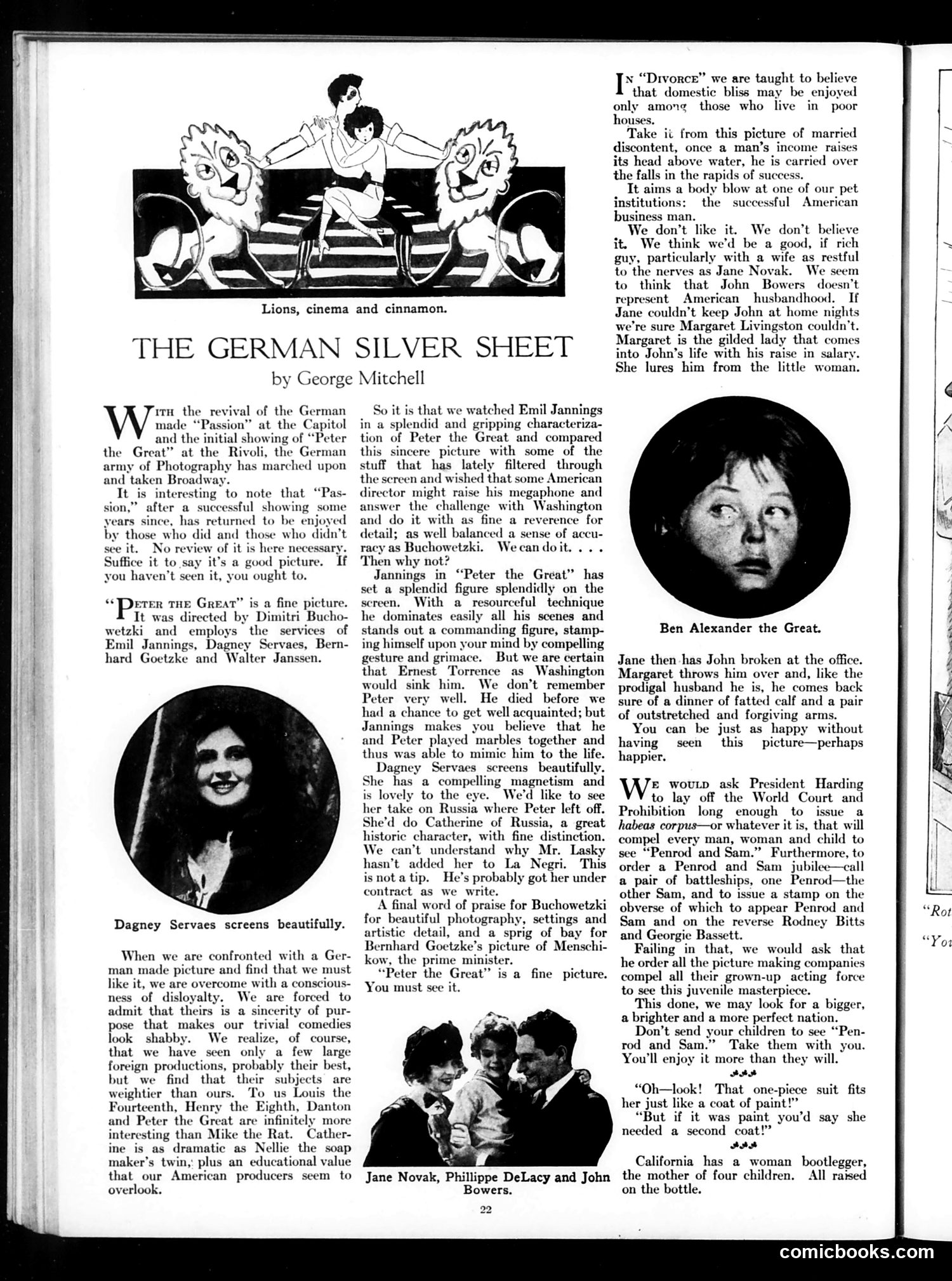
This page reviews German film imports, specifically *Peter the Great* (directed by Dimitri Buchowetzki, starring Emil Jannings) and the revival of *Passion*. The critic George Mitchell expresses grudging admiration for German cinema's artistic seriousness and "weightier" historical subjects compared to American comedies like "Mike the Rat." The opening cartoon satirizes American prosperity anxiety: it depicts a wealthy couple in a fancy car pulled by lions (representing luxury and success), with the caption suggesting that domestic happiness disappears once a man's income rises—he falls into the "rapids of success." The satire mocks the notion that wealth destroys marriage, while the photo captions identify actors in *Divorce* (Jane Novak, John Bowers). The deeper point: Judge's editors critique how American films and audiences dismiss success and wealth as inherently corrupting, while praising foreign productions for their dramatic substance.
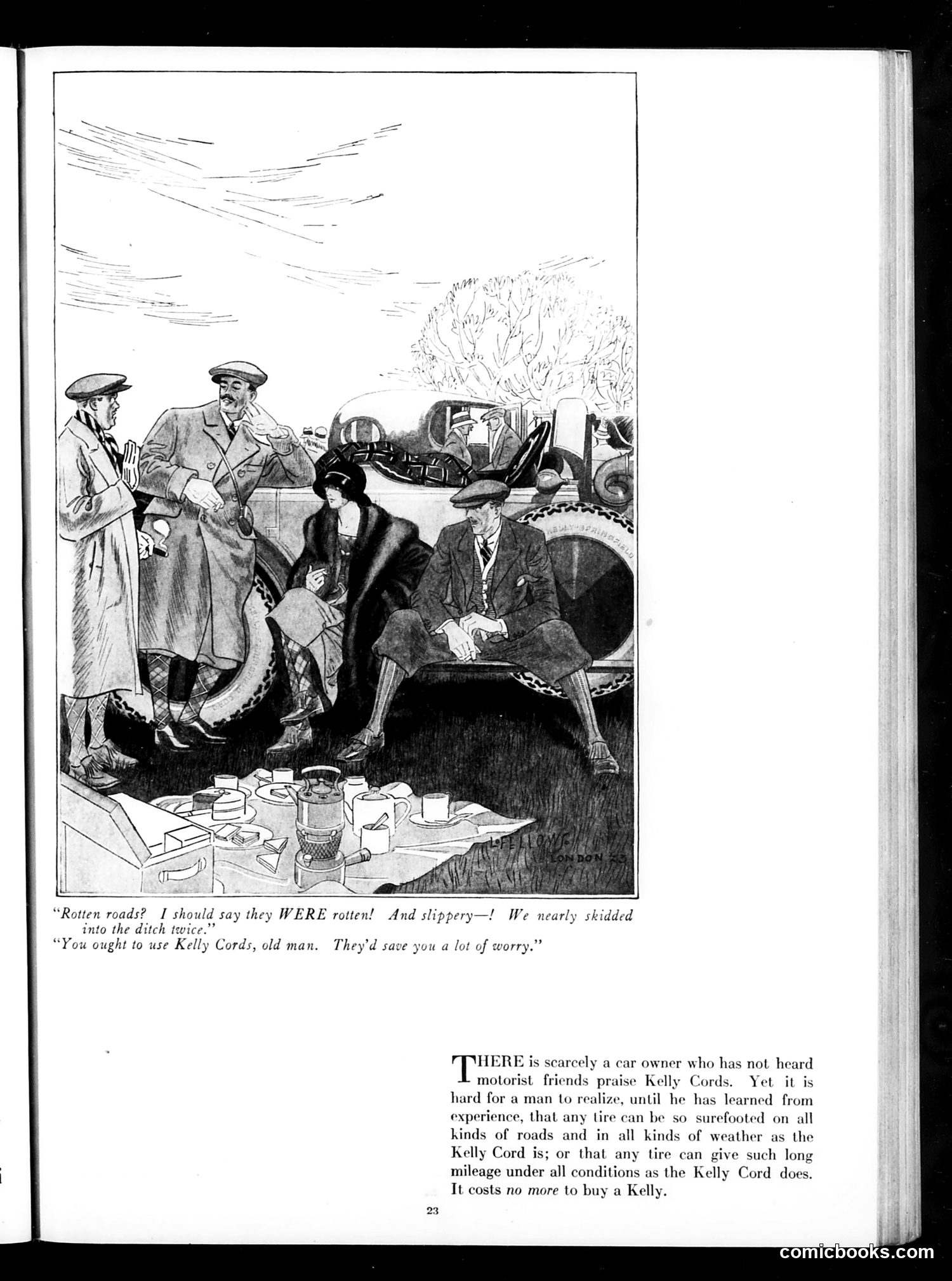
This is a **Kelly Cords tire advertisement**, not political satire. The cartoon depicts two motorists having a conversation at what appears to be a roadside picnic. One man complains about dangerous driving conditions on poor roads—rotten surfaces and slipperiness causing near-accidents. His companion recommends Kelly Cord tires as the solution. The advertisement below emphasizes Kelly Cords' superiority: they perform reliably on all road types and weather conditions while offering exceptional mileage, and cost no more than competitors. This was a common early automotive advertising strategy—presenting product benefits through relatable scenarios and testimonials from satisfied users. The casual, gentlemanly tone and outdoor setting reflect 1920s-era marketing approaches targeting car owners.
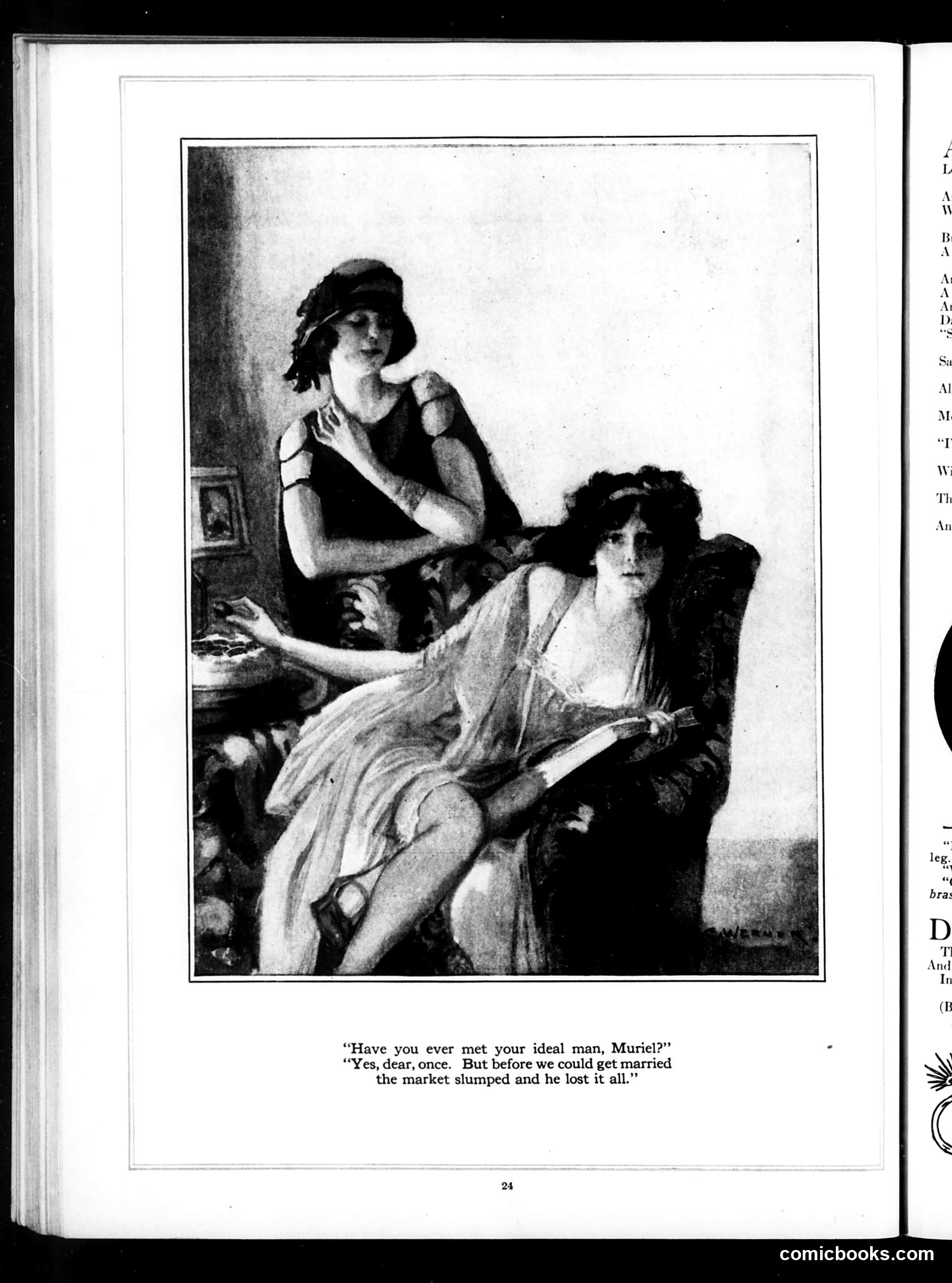
This is a satirical illustration about financial loss during what appears to be a market crash. Two women are depicted—one standing, one seated—in an intimate domestic scene. The dialogue reveals the joke: Muriel admits she once met her "ideal man," but he lost all his wealth when "the market slumped," making marriage impossible. The satire targets the financial precariousness of courtship and marriage among the upper classes, where a man's marriageability depends entirely on maintaining wealth. The illustration suggests that romantic ideals are subordinated to economic reality—a man ceases to be "ideal" once he becomes poor. This reflects early 20th-century anxieties about stock market volatility and its impact on social stability and courtship rituals.
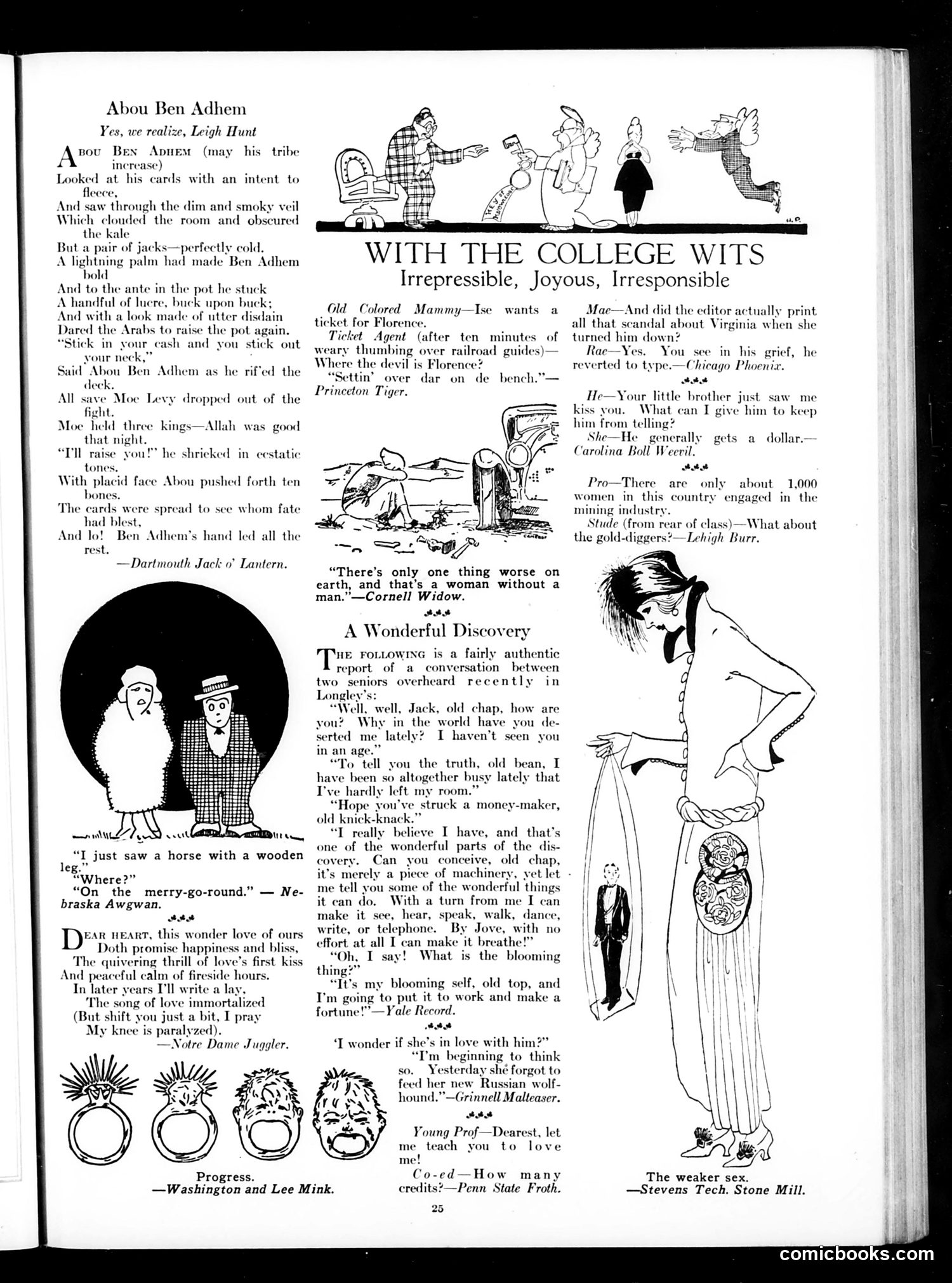
This page collects humor from college publications circa 1920s. The content consists primarily of **reprinted college jokes** rather than political cartoons—a common Judge practice. **Key Content:** - **"Abou Ben Adhem"**: A parody poem (referencing Leigh Hunt's famous work) reimagining the title character as a card player winning at poker. The humor lies in the incongruity of treating a classic literary figure as a gambler. - **"College Wits" section**: Jokes submitted by various college newspapers, mostly involving flirtation, academic life, and dating—representative of 1920s college humor. References include stereotypes (African American dialect in the Florence ticket agent joke) common to that era's casual racism. - **"A Wonderful Discovery"**: A dialogue where a senior describes his "self" as a machine he can operate—social commentary on self-improvement or self-objectification dressed as whimsy. The cartoons are minimal line drawings accompanying jokes. **The satire targets college life itself**: romantic entanglement, academic indifference, and youthful absurdity, all delivered with the irreverent tone Judge's subtitle promises: "Irrepressible, Joyous, Irresponsible."
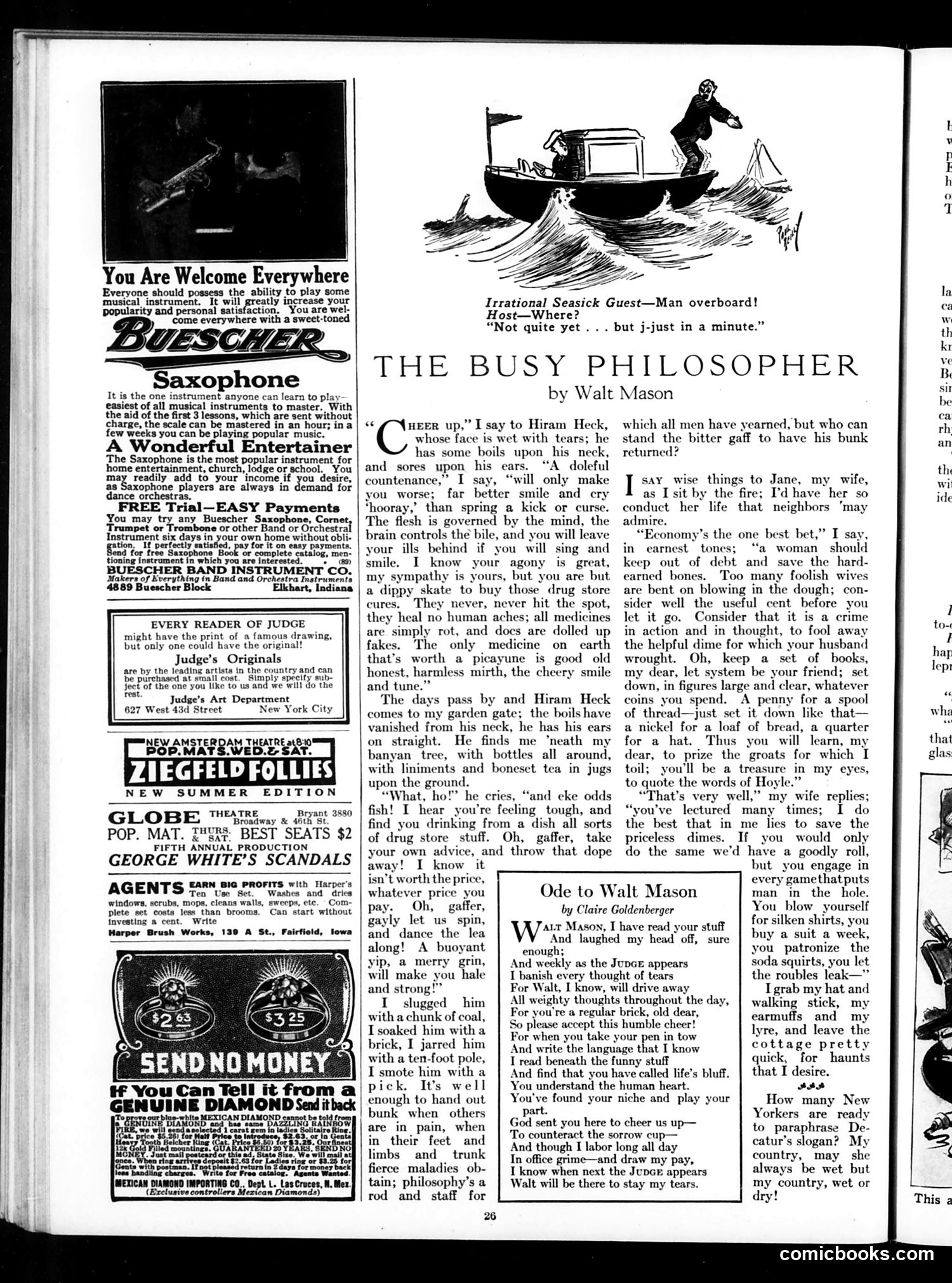
This page features a satirical comic strip by Walt Mason about a smug philosopher named Hiram Heck. The joke mocks self-help platitudes and their blind advocates. **The Setup:** Heck preaches that positive thinking and cheerfulness cure all ailments—boils, sores, everything. He dismisses medicine as "rot" and doctors as "dolled up fakes," insisting only "honest, harmless mirth" heals. **The Twist:** When Heck's boils mysteriously vanish, he becomes Heck's own convert, parroting the philosophy back at him. But then the narrator discovers Heck himself is secretly using the very drug-store remedies he condemned—liniments and boneset tea. **The Satire:** Mason skewers the hypocrisy of wellness gurus who preach one thing while practicing another, and who take credit for results their own advice didn't produce. The narrator's violent response (hitting him with coal, brick, and pole) is exaggerated slapstick humor expressing justified frustration at being duped. The page is otherwise filled with period advertisements (saxophones, theater, diamonds).
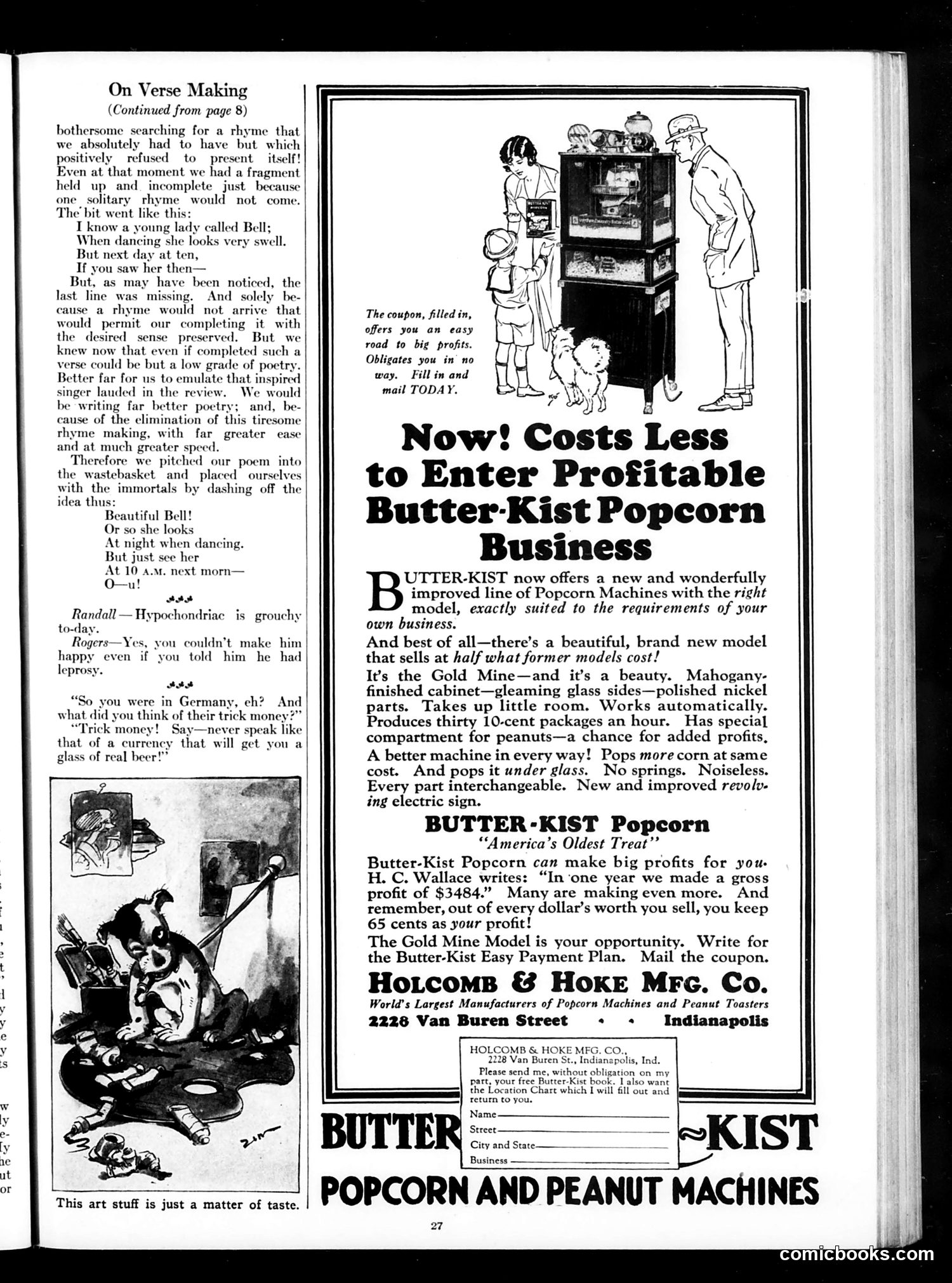
This page contains **primarily advertising with minimal editorial content**. The left column features "On Verse Making," a lighthearted discussion of poetry composition that includes brief humorous anecdotes (about a character named Bell, a hypochondriac named Randall, and a joke about German currency). The **dominant content** is a full-page advertisement for **Butter-Kist Popcorn Machines**, manufactured by Holcomb & Hoke in Indianapolis. The ad targets small business entrepreneurs, promoting their new "Gold Mine" model as an affordable entry into the popcorn vending business. It emphasizes profitability (claiming 65-cent margins per dollar sold, citing one operator's $3,484 annual profit) and automatic operation. The illustration shows a family examining the machine, positioning it as an accessible business opportunity for ordinary Americans. **Historical context**: This reflects early-20th-century American entrepreneurship and the expansion of automated vending machines into popular entertainment and snack distribution.
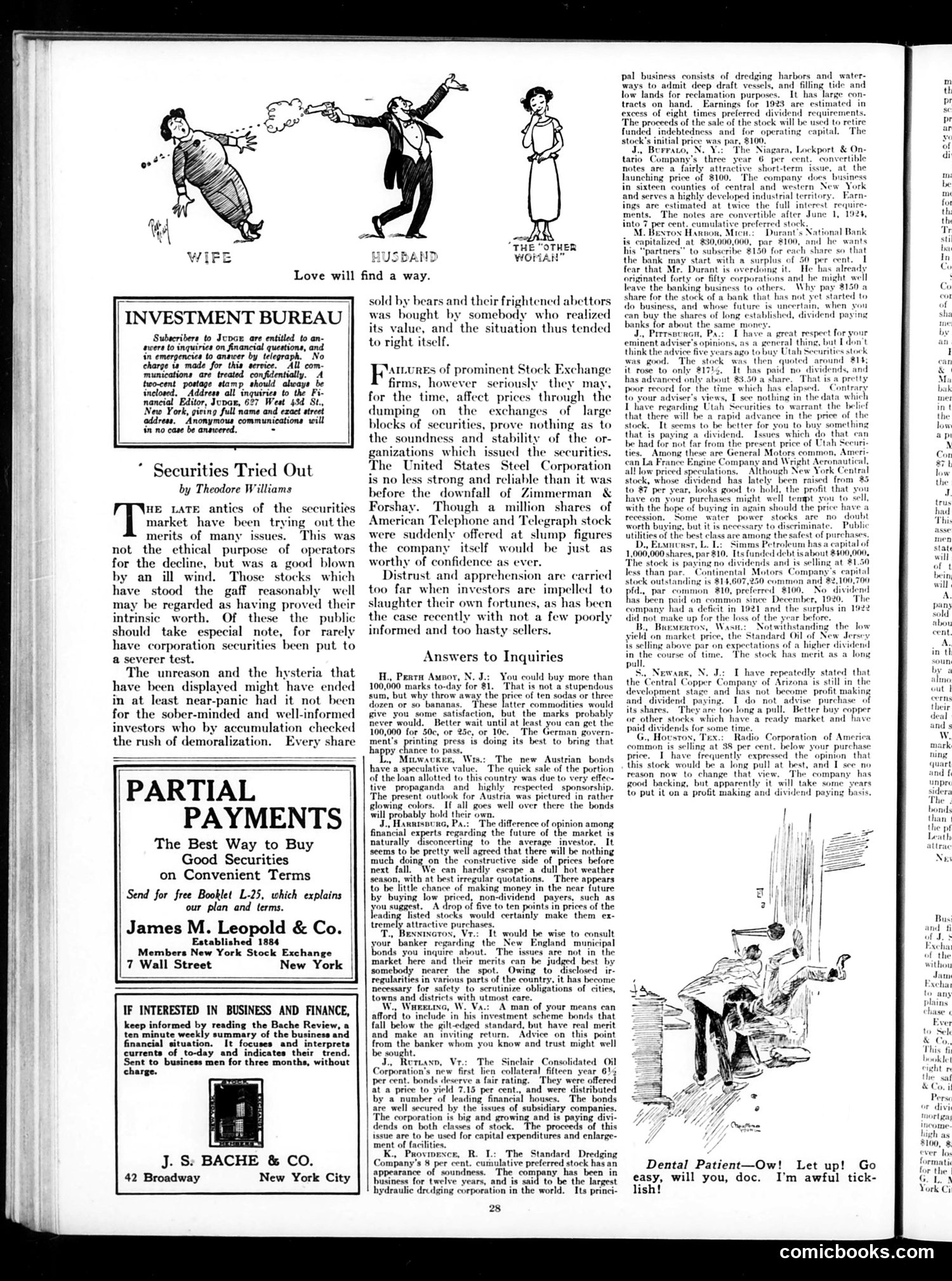
## The Cartoons The three illustrated figures represent a domestic triangle: a disheveled "Wife," an exuberant "Husband," and "The Other Woman." The caption "Love will find a way" is ironic commentary on infidelity, suggesting that despite marital complications, romantic entanglements persist—a common Judge theme mocking middle-class moral hypocrisy. ## The Financial Content The page comprises advertisements and advice columns for stock investment services (Leopold & Co., J.S. Bache & Co.). The article "Securities Tried Out" by Theodore Williams discusses the recent stock market volatility and the behavior of investors during downturns. Williams argues that panic-selling by uninformed investors actually validates the soundness of major corporations like U.S. Steel and American Telephone & Telegraph, since shrewd investors buy during downturns, "righting" the market. The "Answers to Inquiries" section addresses readers' financial questions about securities and currency speculation. **Context**: This reflects early 20th-century investment culture and market volatility, likely post-1907 Panic.
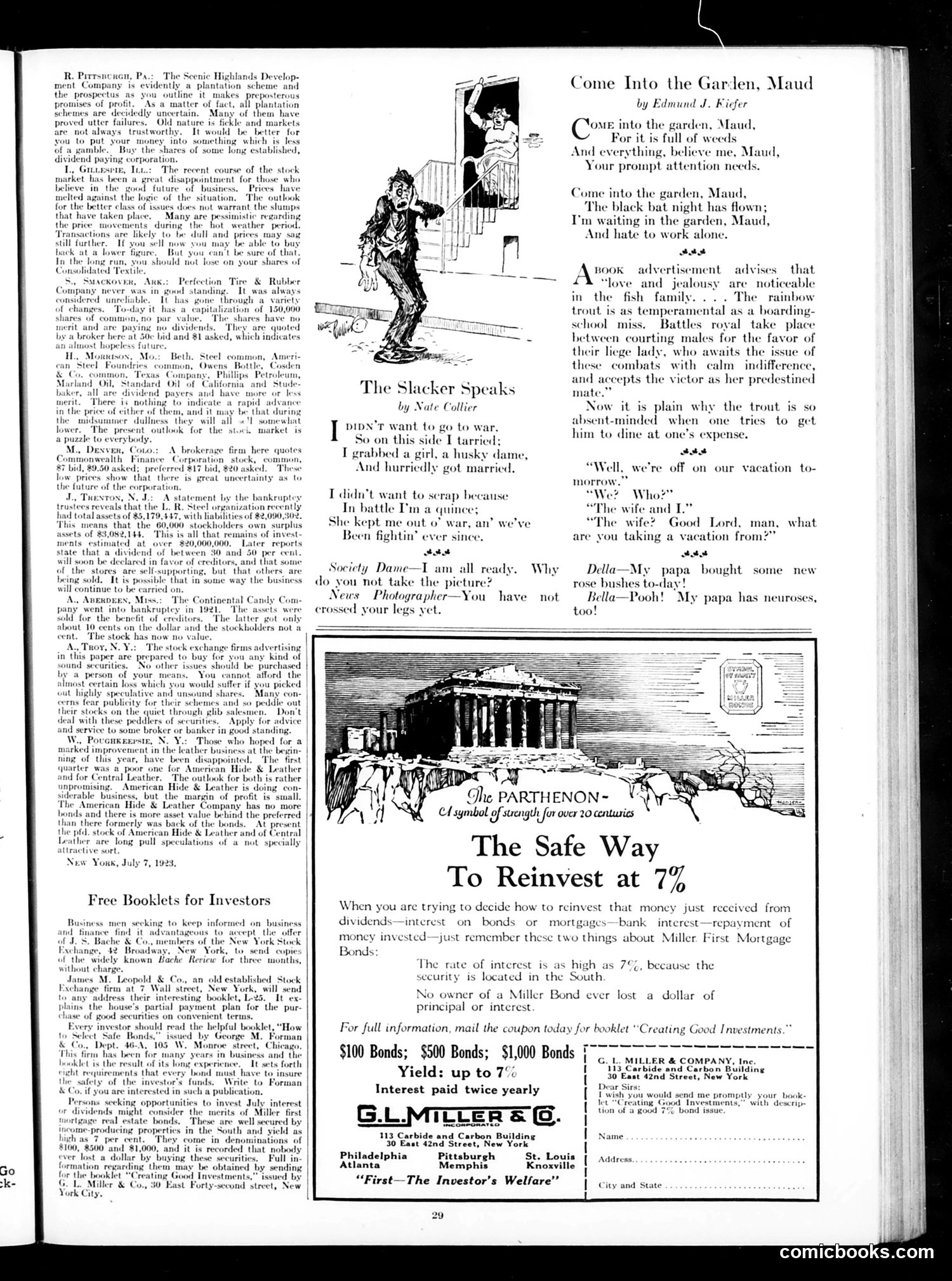
This page from Judge magazine (dated July 7, 1923) contains satirical poetry and humor targeting post-WWI social attitudes. **"Come Into the Garden, Maud"** is a parody of Tennyson's famous poem, but instead of romantic invitation, the speaker urges a woman to attend to garden weeds—a domestic joke about women's household duties. **"The Slacker Speaks"** by Nate Collier directly satirizes men who avoided WWI military service. The speaker boasts of dodging the draft by marrying hastily ("grabbed a girl...and hurriedly got married"), claiming he's been "fightin' ever since" domestically. The satire mocks draft-dodgers and suggests marriage is punishment equivalent to war—a commentary on postwar masculine anxiety and antimilitarism. The page also contains the typical Judge content: financial advice columns warning against unreliable investments, and society humor about mundane domestic matters (husbands taking vacations, fathers buying rose bushes). The overall tone reflects 1920s cynicism about recent war experience and contemporary gender roles.
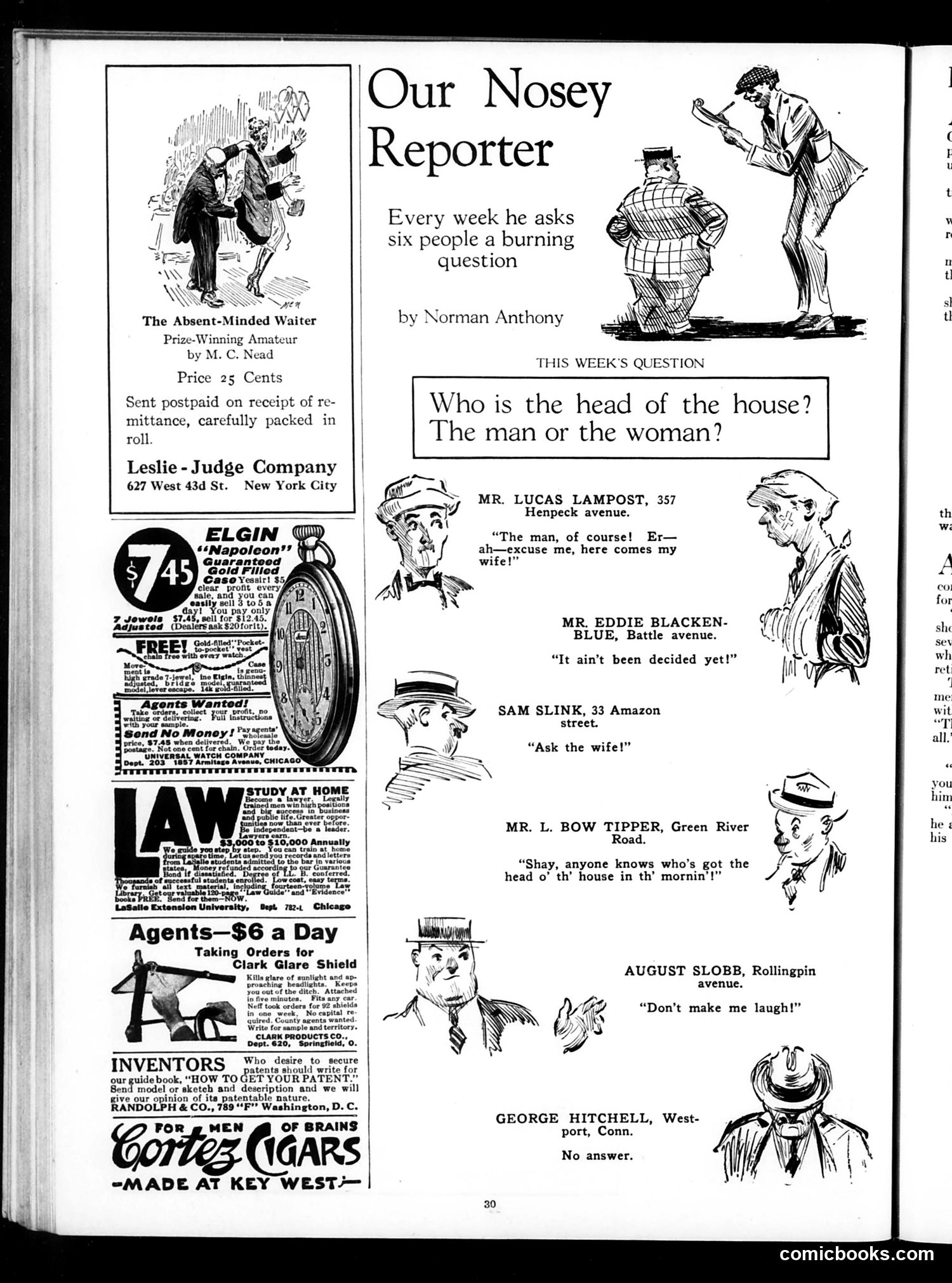
This is a humor column where a reporter asks ordinary people the same weekly question. This week's topic—"Who is the head of the house? The man or the woman?"—reflects early 20th-century domestic gender dynamics. The responses reveal comedic commentary on household power structures: - **Mr. Lampost** insists "the man," then immediately retreats when his wife appears—suggesting men lack actual authority despite claiming it - **Mr. Blackenblue** says it's "not been decided yet"—implying marital negotiation - **Mr. Slink** deflects to "ask the wife" - **Mr. Tipper** jokes that women control mornings (domestic time) - **Mr. Slobb** refuses to answer, fearing his wife's reaction - **Mr. Hitchell** gives "no answer" at all The satire mocks the pretense of male household authority while suggesting women actually wield domestic power. This reflects period anxieties about shifting gender roles, particularly relevant given women's suffrage movements of the era.
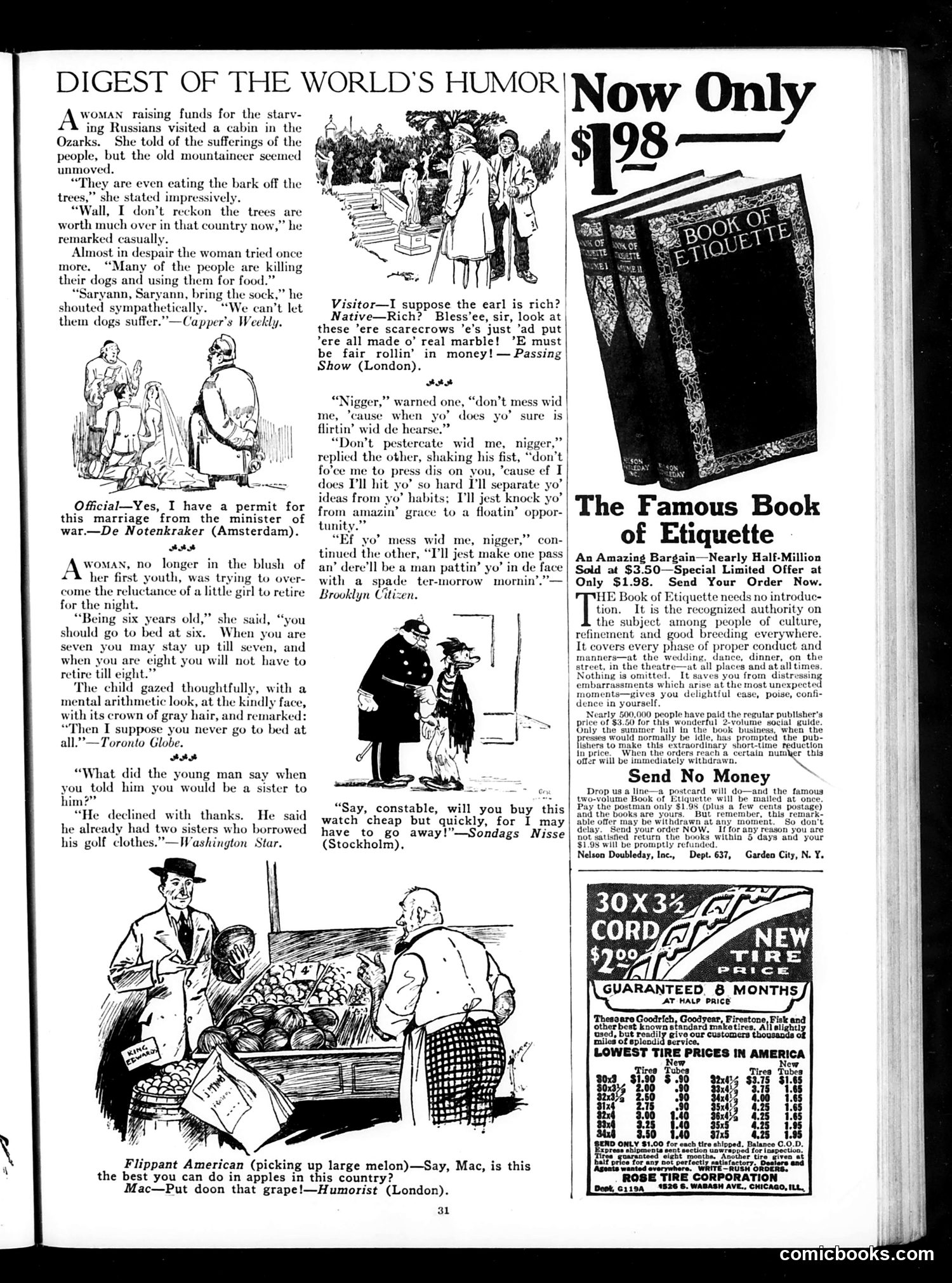
This page collects brief humorous anecdotes from international sources, reflecting early 20th-century satirical sensibilities. **Key content includes:** - **Russian famine relief joke**: A woman fundraising for starving Russians encounters an Ozark mountaineer unmoved by tales of suffering—until she mentions dogs being killed, when he suddenly becomes sympathetic. The satire targets perceived American indifference to foreign humanitarian crises. - **"Nigger" dialect jokes**: Multiple anecdotes using racist stereotypes and eye-dialect, depicting African Americans in confrontational or comedic situations. These reflect the deeply racist humor conventions of the era. - **Gender/class humor**: Stories about women's age, children's logic, and romantic rejection—typical period comedy targeting domestic situations. - **International sourcing**: Credits to Amsterdam, Stockholm, London papers emphasize Judge's cosmopolitan reach. The page's advertising (Book of Etiquette, tire sales) occupies substantial space, typical for magazines of this era. The humor is broadly observational rather than topical-political.
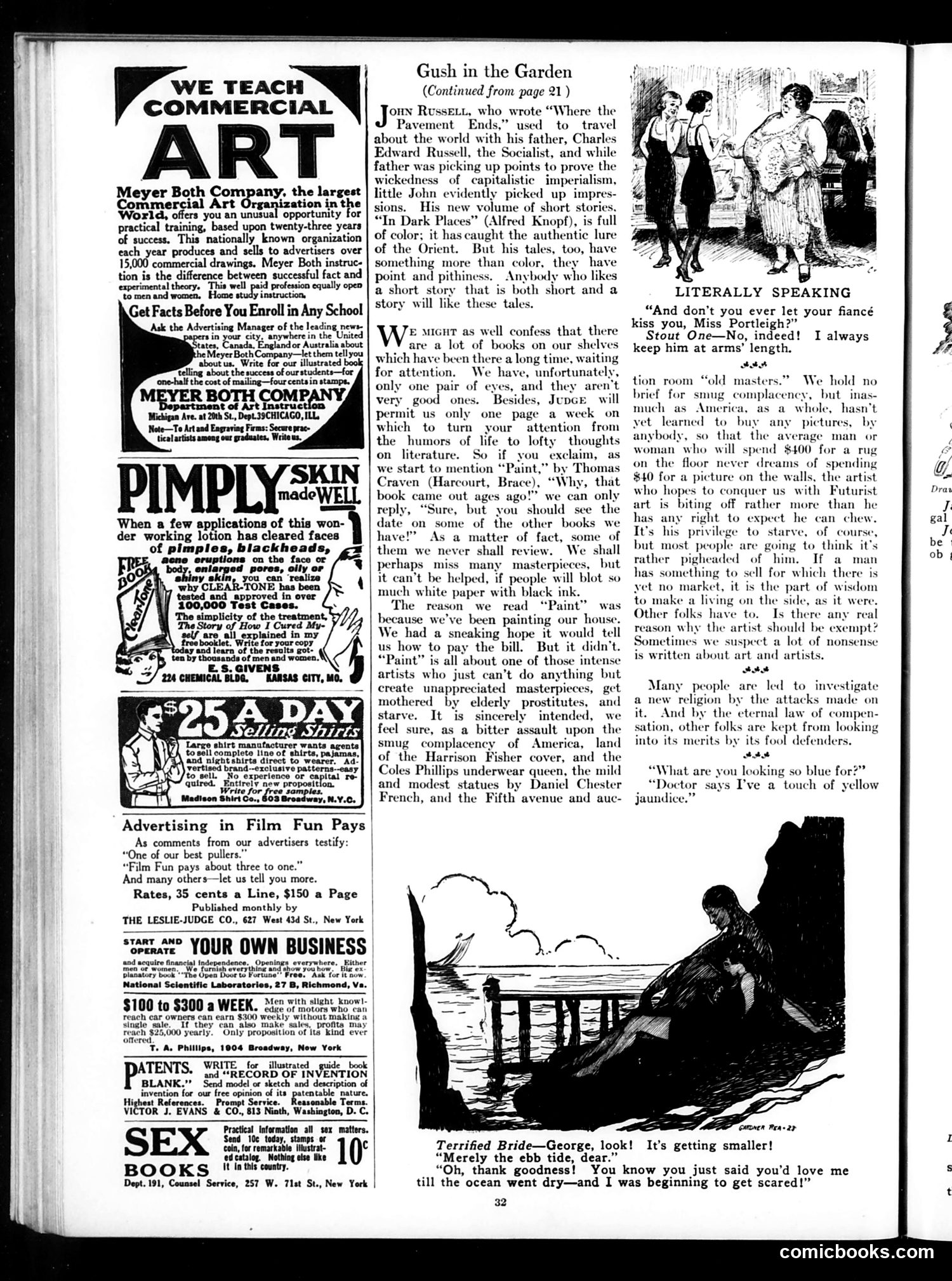
This page is primarily **advertising**, not political satire. It showcases commercial ads typical of early 20th-century magazines: art instruction schools, skin treatments, job opportunities, and patent services. The one literary content—"Gush in the Garden" (continued from page 21)—is a **book review column** discussing John Russell's short story collection "In Dark Places." The reviewer humorously acknowledges that Judge receives many books for review but lacks space to cover them all, given only one page weekly for literature among the magazine's humor content. The cartoon at page bottom shows a man and woman at a dock, with dialogue about the tide receding—a sentimental/romantic scene unrelated to the reviews above it. **No clear political satire or caricature appears on this page.** It represents typical magazine filler material combining advertisements with light literary commentary.
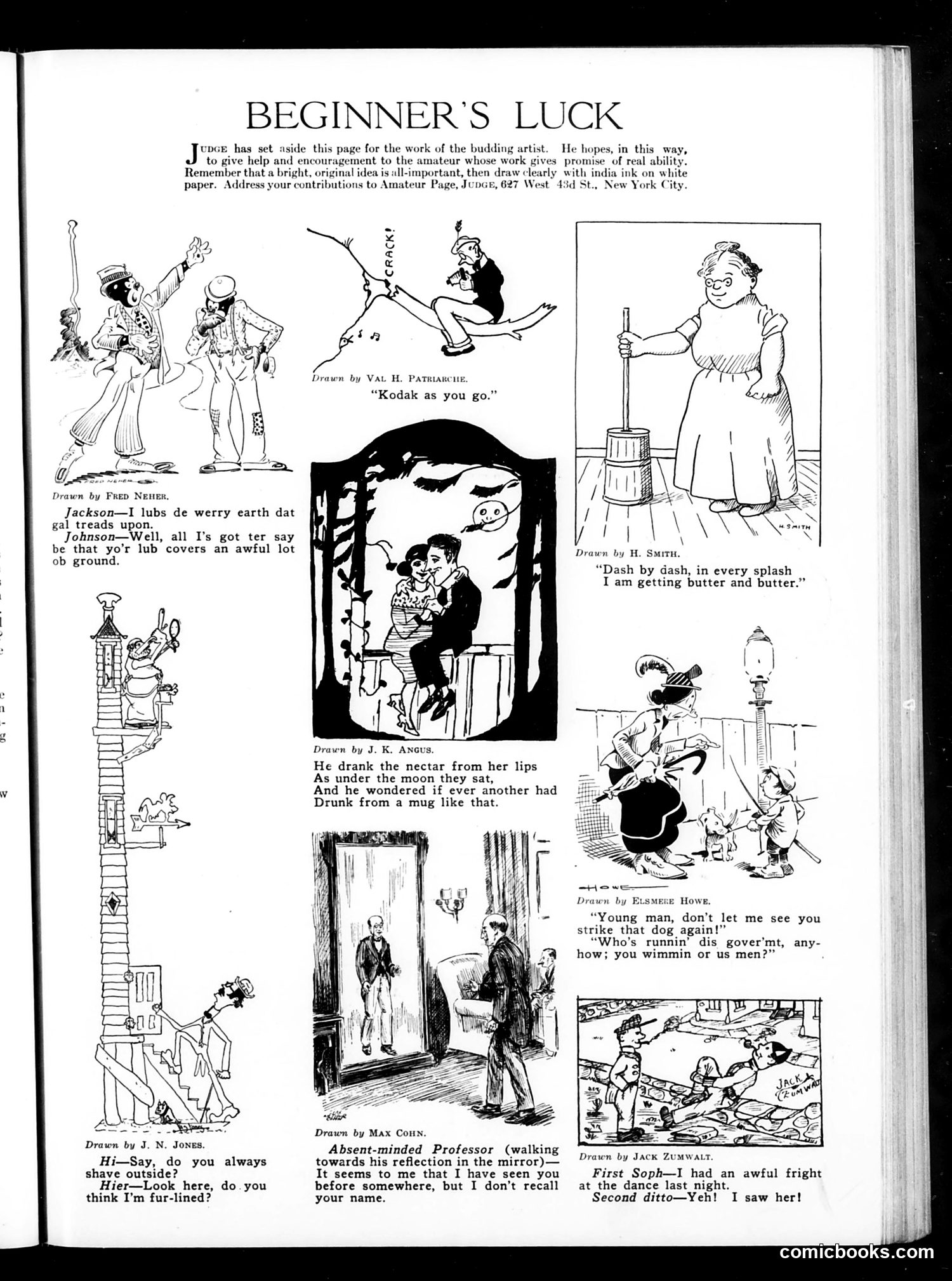
This is a submissions page for amateur cartoonists, featuring six short humorous comics drawn by different artists. The cartoons reflect early 20th-century social attitudes: 1. **Jackson/Johnson joke**: Uses racist dialect humor common to the era, making a pun about expansive romantic affection. 2. **"Kodak as you go"**: Depicts leisure photography as a modern, carefree activity. 3. **The romantic couple**: A sentimental scene about drinking from a lover's lips, playing on Victorian romance tropes. 4. **Woman with broom**: Depicts gender role conflict—a woman disciplining a man over a dog, prompting his complaint about "wimmin" running government. 5. **Absent-minded Professor**: Plays on the stock character of a forgetful intellectual who mistakes his mirror reflection for a stranger. 6. **Dance hall scene**: Brief joke about a young couple's romantic encounter. The overall tone is lighthearted, domestic humor reflecting period social norms and anxieties about modernity, gender roles, and courtship.
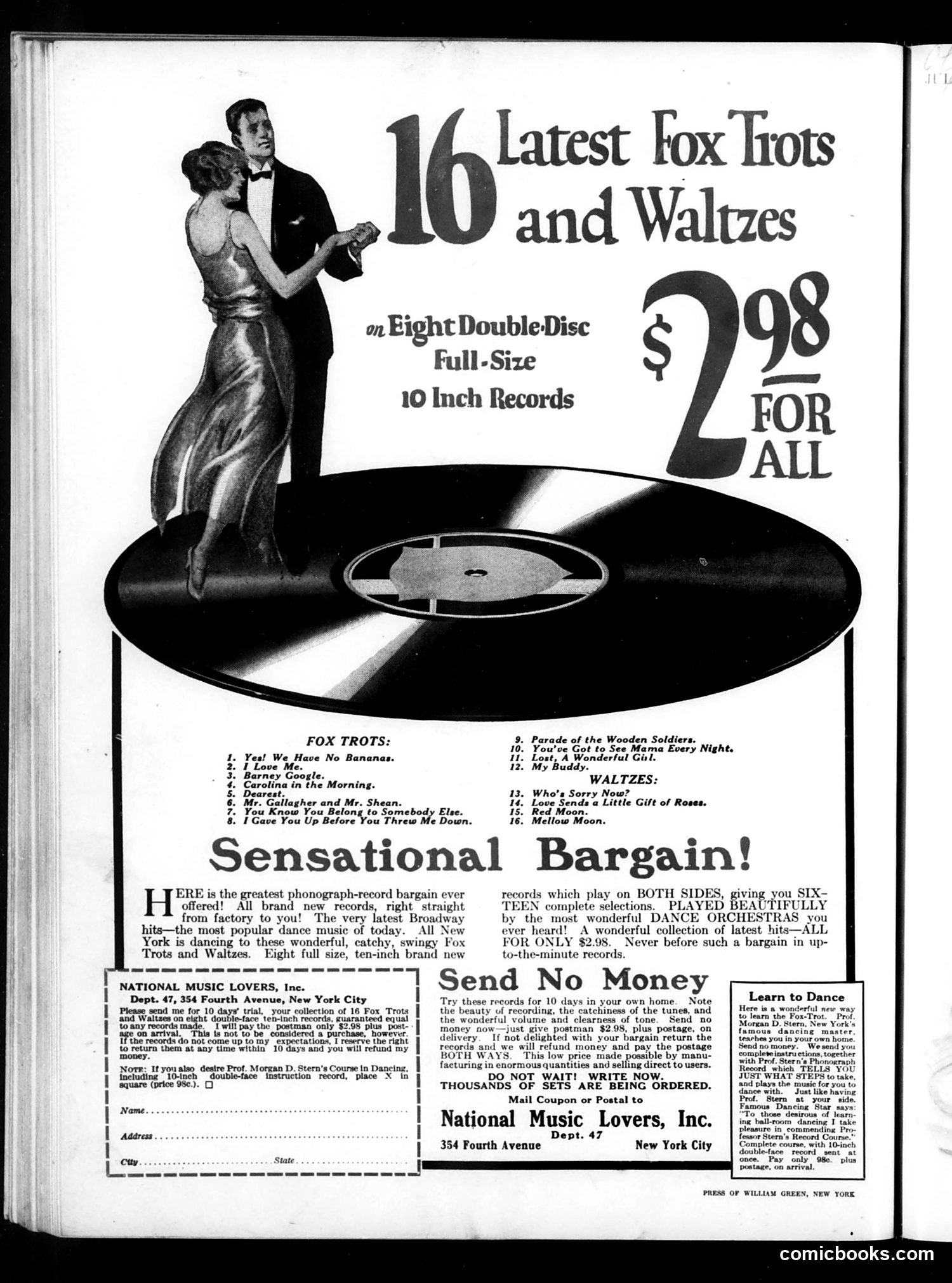
This page is **primarily a mail-order advertisement**, not political satire. It promotes a phonograph record collection from National Music Lovers, Inc. **The Content:** The ad offers 16 dance recordings (fox trots and waltzes) on eight double-sided 10-inch records for $2.98—marketed as a "sensational bargain." Song titles like "Yes! We Have No Bananas" and "Carolina in the Morning" reflect early 1920s popular hits. The illustration shows a dancing couple in formal wear, typical of period advertising imagery. **Social Context:** This reflects the Jazz Age's dance craze. Fox trots and waltzes were the dominant ballroom dances. The ad emphasizes that "all New York is dancing" to these hits, positioning the product as fashionable and up-to-date. **The Pitch:** A 10-day trial offer with no upfront payment (pay the postman on delivery) was common direct-mail marketing. An optional dancing instruction course by "Prof. Morgan D. Stern" is also promoted. This is essentially a period document showing 1920s consumer culture and music distribution.