
Judge, 1923-07-14 · page 8 of 36
Judge — July 14, 1923 — page 8: what you’re looking at
What you’re looking at
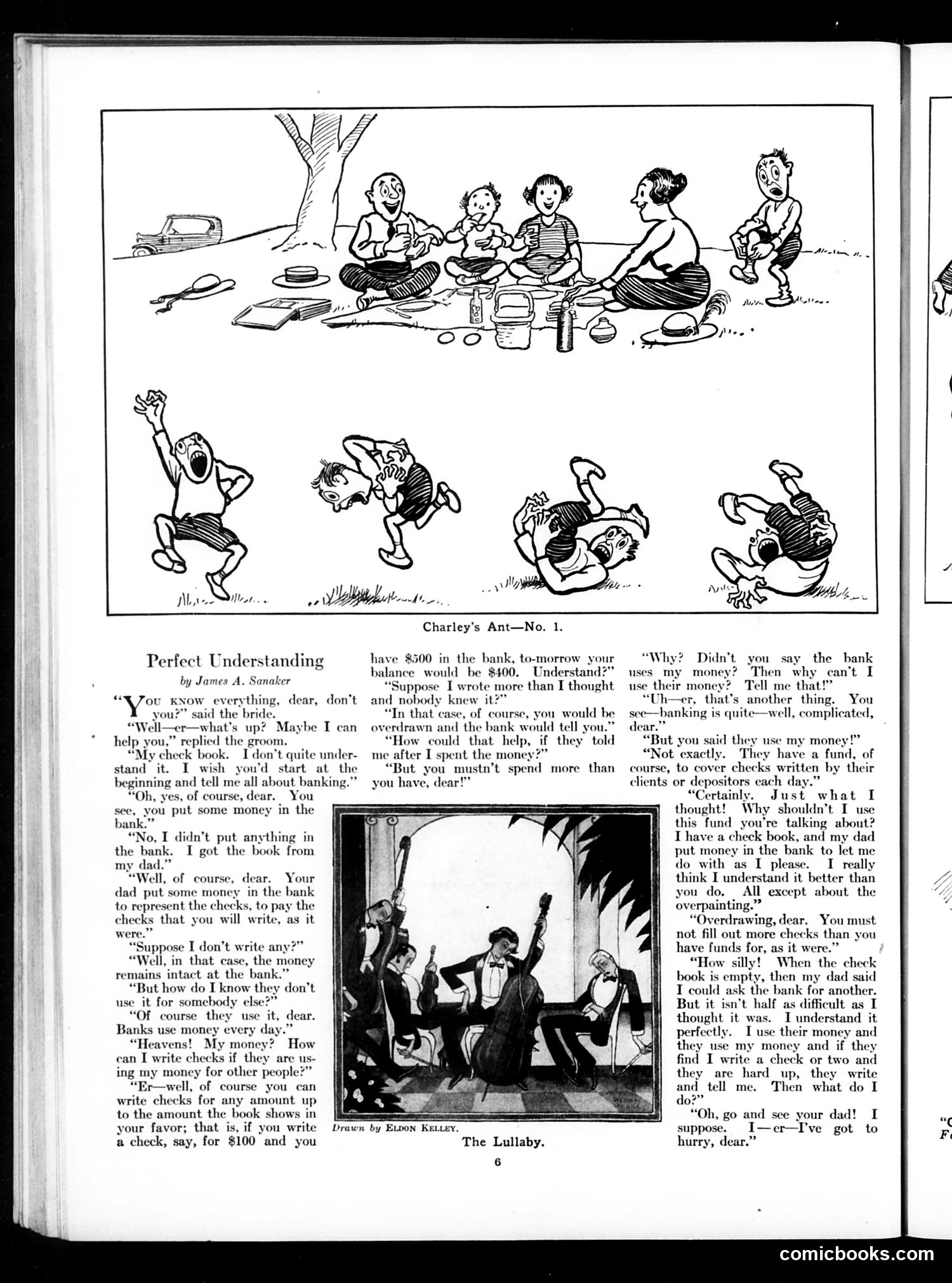
This is a humorous dialogue between a new bride and groom about basic banking. The wife, unfamiliar with how checking accounts work, asks innocent questions that expose the logical absurdities her husband tries to explain. The satire targets **banking confusion among ordinary people**, particularly women excluded from financial management. The wife's questions—"Why can't I use the bank's money if they use mine?"—are logically sound but reveal how poorly banking practices were understood or explained to the average citizen. The cartoon at the top shows a family picnic scene; the panels below ("Charley's Ant") depict slapstick physical comedy, likely unrelated. The joke's humor lies in the groom's inability to explain banking clearly and his eventual surrender ("go see your dad"), suggesting that even he doesn't fully understand the system he's defending. It's satire of financial institutions' mystifying operations and the era's gender-based exclusion from economic literacy.
📄 Transcribed text from this page (OCR, searchable)
Machine-transcribed from the original scan — historical spelling and the odd misread are preserved.
Perfect Understanding by James A. Sanaker *e ‘ou KNow everything, dear, don’t you?” said the bric “Well—er—what's up? help you,” replied the groom. “My check book. stand it. I wish you'd start at Maybe I can Tdon't quite under- the beginning and tell me all about. banking.” “Oh, yes, of course, dear. You you put some money in the ‘No, I didn’t put anything in the bank. I got the book from my dad “Well, of course, dear. dad put some monc nt the ch Your ippose I don’t write any?” “Well, in that case, the money ins intact at the bank.” But how do I know th use it for somebody el: “Of course th can I write che ing my money for other people?” “Er—well, of course you can write checks for any amount up to the amount the book shows in your favor; that is, if you write a check, say, for $100 and you Charley’s Ant—No. 1. 00 in the bank, to-morrow y > would be $400. Understan “Suppose I wrote more than I thought and nobody knew it?” “In that case, of course, you would be overdrawn and the bank would tell you.” “How could that help, if they told me after I spent the mone “But you mustn’t spend more than you have, dear!” Drawn by ELDON “The Lullaby. 6 “Why? Didn’t you sa uses. my money? “Then w use their mone; Tell me that! “Uh—er, that’s another thing. You see—banking is quite—well, complicated, dear.” “But you said they use my money!” “Not exactly. They have a fund, of course, to cover checks written by their clients or depositors each day.” “Certainly. Just what I thought! Why shouldn’t I use this fund you're talking about? IT have a check book, and my dad put money in the bank to let me do with as I please. I really think I understand it better than you do. All except about the overpainting.” “Overdrawing, dear. You must not fill out more checks than you have funds for, as it were.” “How silly! When the check book is empty, then my dad said I could ask the bank for another. But it isn’t half as difficult as I thought it was. I understand it perfectly. I use their money and they use my money and if they find I write a check or two and they are hard up, they write and tell me. Then what do I do?” the bank can't I “Oh, go and see your dad! I suppose. I—er—I’ve got to hurry, dear.” comicbooks.com