
Judge, 1923-07-14 · page 11 of 36
Judge — July 14, 1923 — page 11: what you’re looking at
What you’re looking at
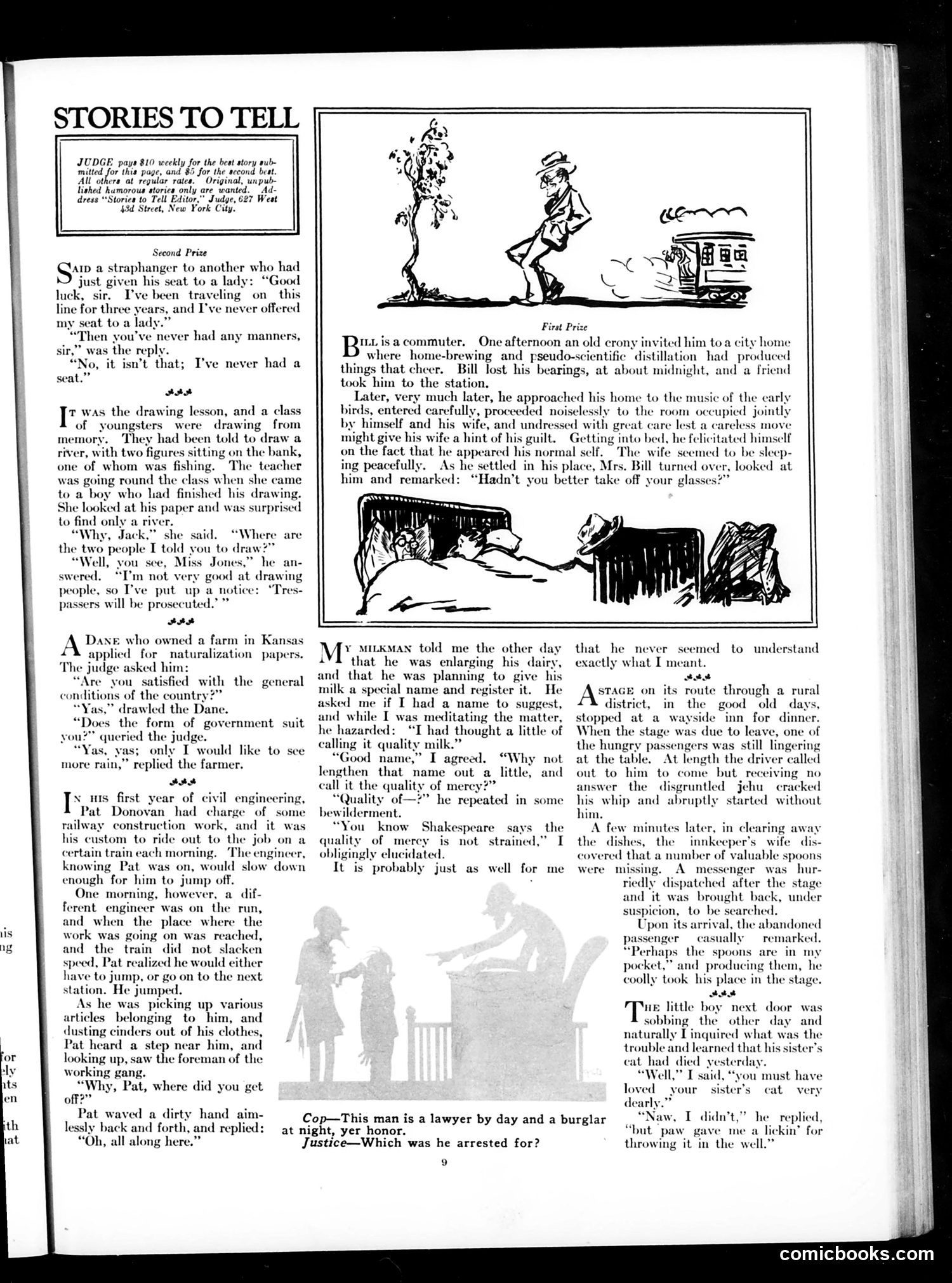
This page contains humorous short anecdotes typical of Judge's satirical humor. Key pieces include: **The Commuter Story (First Prize)**: A man named Bill sneaks home drunk at dawn after an illicit drinking party. He undresses carefully to avoid waking his wife, but she immediately notices he's still wearing his eyeglasses—exposing his deception. The joke targets both Prohibition-era home-brewing and marital infidelity. **The Straphanger Joke**: A man who's never given up his seat on public transit explains he's never *had* a seat to give—dark humor about crowded urban transit conditions. **Other brief jokes** include a drawing class mishap, a Dane's immigration interview, and a railway worker's mishap. **The Final Riddle**: A lawyer arrested—unclear whether for practicing law or burglary—satirizes potentially corrupt legal practitioners. The page reflects early 20th-century American urban life: public transit congestion, Prohibition enforcement, and class anxieties. The humor is gentle, domestic, and middle-class focused—typical of Judge's audience.
📄 Transcribed text from this page (OCR, searchable)
Machine-transcribed from the original scan — historical spelling and the odd misread are preserved.
JUDGE pays 810 weekly for the beat story sub- mitted for this page, and 85 for the accond beat. All thera at regular rates.” Original, unpub- dress “Stories to Tell E 43d Street, New York City. Second Prize S 1D a straphanger to another who had just given his seat to a lady: “Good luck, sir. I've been traveling on_ this line for three years, and I've never offered my seat to a lady.” ‘Then you've never ha sir,” was the reply. No, it isn’t that; seat. 1 any manners, T’ve never had a R Ralnad I" was the drawing lesson, and a class of youngsters were drawing from memory. They had been told to draw a river, with two figures sitting on the bank, one of whom was fishing. ‘The teacher was going round the class when she came to a boy who had finished his drawing. She looked s aper and was surprised to find only 2 as “Why, Js she said. “Where are the two people I told you to dri “Well, you see, Miss Jones, swered. “I’m not very good at drawing people, so I’ve put up a notice: passers will be prosecuted.’ ” ead Dane who owned a farm in Ka applied for naturalization The judge asked him: “Are you. satisfied with the general conditions of the country “Yas,” drawled the Dane. “Does the form of government suit Y que cried the judge. yas, yi only T would like to sce more rain,” replied the farmer. Rd I urs first year of civil engineering, Donovan had charge of some railway construction work, and it was his custom to ride out to the job on a each morning. ‘The engineer, at_ was on, would slow down enough for him to jump off. One morning, however, a dif- ferent engineer was on the run, and when the place where the work was going on was reached, and the train did not slacken speed, Pat realized he would either have to jump, or go on to the next station. He jumped. As he was picking up various articles belonging to him, and dusting cinders out of his clothes, Pat heard a step near him, and looking up, saw the foreman of the working gang. “Why, Pat, where did you get off?” Pat waved a dirty hand aim- lessly back and forth, and replied: “Oh, all along here.” Sas es papers. STORIES TO TELL ILL is a commuter. things that cheer. took him to the station. by hims might give his wife a hint of his guilt. ing peacefully. As he him and remarked: MILKMAN told me the other day that he was enlarging his dairy, and that he was planning to give his milk a special name and register it. He asked me if I had a name to suggest, and while I was meditating the matter, he hazarded: “I had thought a little of calling it quality, milk.” Good name,” I agreed. “Why not lengthen that name out a little, and call it the quality of me “Quality of—?” he repeated in some bewilderment. “You know Shakespeare quality of merey is not obligingly elucidated. It is probably just as well for me says strained,” I Cop—This man is a lawyer by day and a burglar at night, yer honor. Justice—Which was he arrested for? 9 Firat Prize One afternoon an old crony invited him toa city home where home-brewing and pseudo-scientific distillation had produced Bill lost his bearings, at about midnight, and a friend Later, very much later, he approached his home to the music of the early birds, entered carefully, proceeded noiselessly to the room occupied jointly If and his wife, and undressed with great care lest on the fact that he appeared his normal self. sttled in his place, Mrs. Bill turned o Hadn't you better take off your glasse areless move Getting into bed, he felicitated himself The wife seemed to be sle that he never seemed to exactly what I meant. ceed A s TAGE on its route through a rural district, in the good old days, stopped at a wayside inn for dinner. When the stage was due to leave, one of the hungry passengers was still lingering at the table. At length the driver called out to him to come but receivi answer the disgruntled jehu his whip and abruptly started without him. A few minutes later, in clearing away the dishes, the innkeeper’s wife dis- covered that a number of valuable spoons were missing. A messenger was hur- riedly dispatched after the stage and it was brought back, under suspicion, to be searched, Upon its arrival, the abandoned passenger — casually ethaps the spoons are in my pocket,” and producing them, he coolly took his place in the stage. Rad TT little boy next door was obbing the other « naturally [inquired what trouble and learned that his sister’s cat had died yesterday. understand “Well,” I said, “you must have loved your sister's cat very dear uw, I didn’t,” he replied, “but paw. gave me a lickin’ for throwing it in the well.” comicbooks.com