
Judge, 1923-07-14 · page 19 of 36
Judge — July 14, 1923 — page 19: what you’re looking at
What you’re looking at
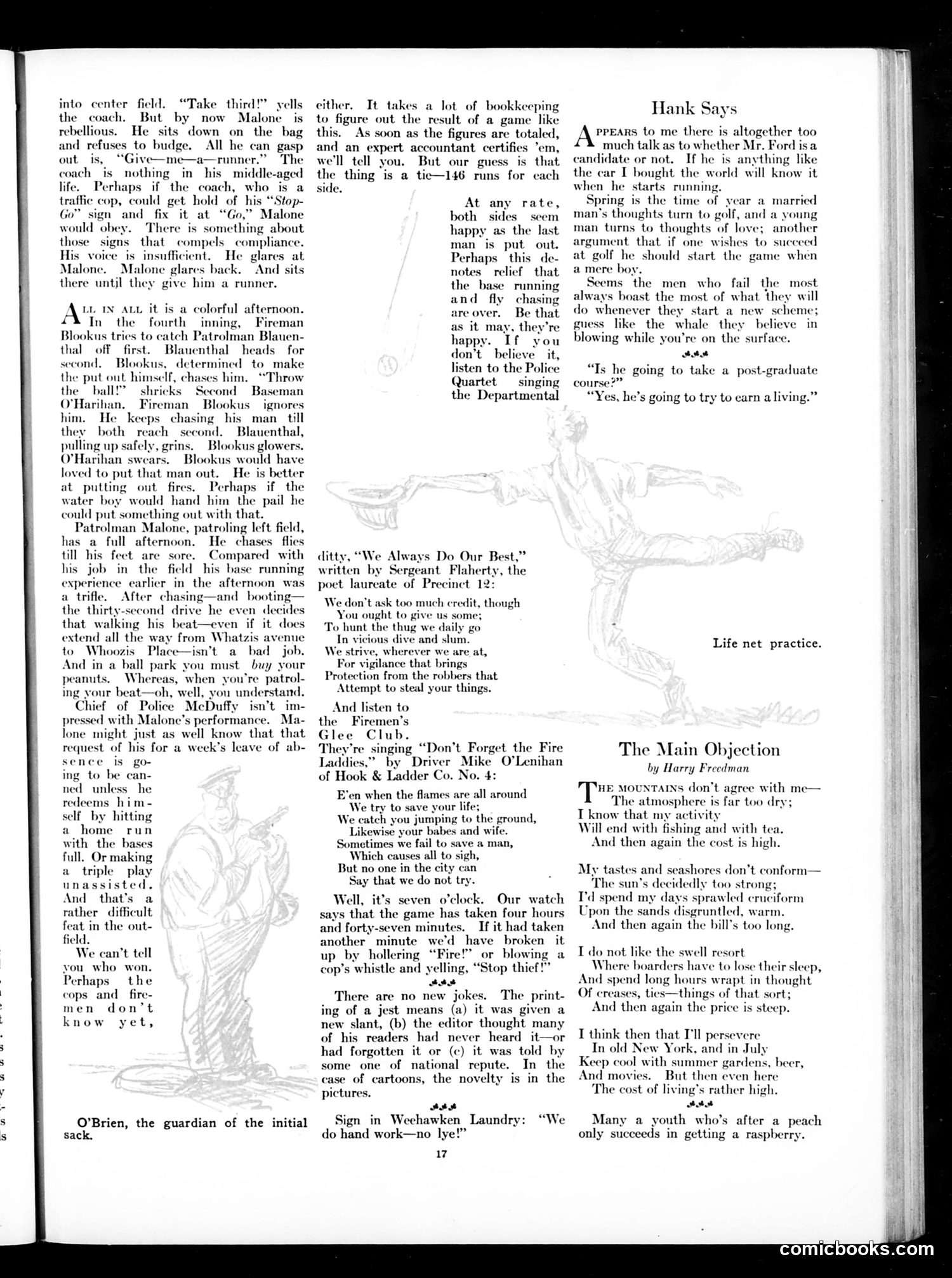
This page satirizes a baseball game between New York City police and firemen—rival municipal departments that clearly had genuine competitive tension. The humor centers on how each group brings their job habits to the field: Patrolman Malone demands "a runner" like issuing orders; officers use traffic-control signs as metaphors for compliance; Fireman Blookus chases down opponents with the same determination he'd use fighting fires; and the game supposedly ends in a 146-146 tie because "it takes a lot of bookkeeping." The cartoon mocks both institutional rivalry and occupational identity. Officers and firefighters are portrayed as so defined by their professional roles that they can't simply play baseball—they must police, fight fires, and assert authority even during recreation. The concluding song parodies glorify each department's public service, adding gentle mockery of institutional self-importance. It's fundamentally humor about institutional cultures and the difficulty of separating professional identity from leisure activities.
📄 Transcribed text from this page (OCR, searchable)
Machine-transcribed from the original scan — historical spelling and the odd misread are preserved.
into center field. “Take third!” the coach. But by now Malone is rebellious. He sits down on the bag and refuses to budge. All he can gasp out is, “Give—me—a—runner.” ‘The coach is nothing in his middle-aged Perhaps if the coach, who affic cop, could get hold of his “Stop- Go” sign ‘and fix. it at “Go,” Malone would obey. There is something about yells those signs that compels compliance. His voice is insufficient. He glares at Malone. Malone glares back. And sits there until they give him a runner. LL IN ALL it is a colorful afternoon. In the fourth inning, Fireman Blookus tries to catch Patrolman Blauen- thal off first. Blaucnthal heads for second. Blookus, determined to. make the put out himself, chi “Throw the. ball!” shricks Baseman O'Harihan. Fireman Blookus ignores him. He keeps chasing his. man_ till they both reach second. Blauenthal, pulling up safely, grins. Blookus glowers. YE rihan swears. Blookus would have esr to put that man out. He is better at putting out fires. Perhaps if the water boy would hand him the pail he could put something out with that. Patrolman Malone, patroling left field, has a full afternoon. He chases flies till his fect are sore. Compared with his job in the field his base running experience earlier in the afternoon was a trifle. After chasing—and booting— the thirty-second drive he even decides that walking his beat—even if it does extend all the way from Whatzis avenue to Whoozis Place—isn’t a bad job. And in a ball park you must buy your peanuts. Whereas, when you're patrol- ing your beat—oh, well, you understand. Chief of Police MeDuffy isn’t im- pressed with Malone’s performance. Ma- lone might just as well know that t request of his for a week’s leave of ab- sence is go- ing to be can- ned unless he redeems him - self by hitting a home run with the full. Or making a triple play unassisted, And that’s a rather difficult feat in the out- field. We can’t tell you who won. Perhaps the cops and _ fire- men don’t know yet, O’Brien, the guardian of the initial sack. either. It takes a lot of bookkeeping to figure out the result of a game like this. As soon as the figures are totaled, and an expert accountant ce: em, we'll tell you. But our guess is that the thing is a tie—146 runs for each side. At any rate, both sides seem happy as the last man is put out. Perhaps this de- notes relief that the > running and fly chasing are over. Be that as it may, the: happy. If you don’t believe it, listen to the Poli Quartet singing the Departmental re ditty, “We Always Do Our Best,” written by Sergeant Flaherty, the poet laureate of Precinct We don’t ask too much credit, though You ought to give us some; To hunt the thug we daily go In vicious dive and slum. We strive, wherever we are at, For vigilance that bri Protection from the robbers that Attempt to steal your things. And listen to the Firemen’s Glee Club. . They're singing “Don’t Forget the Fire Laddies,” by Driver Mike O’Lenihan of Hook & Ladder Co. No. 4: E’en when the flames are all around We try to sa ur life We you jumping to the ground, ise your babes and wife. Sometimes we fail to save a man, Which causes all to sigh, But no one in the city can ay that we do not try. Well, it’s seven o'clock. Our watch says that the game has taken four hours and forty-seven minutes. If it had taken another minute we'd have broken it up by hollering “Fire!” cop’s whistle and yelling, “Stop thief There are no new jo The print- ing of a jest. means it was given a new slant, (b) the editor thought many of his readers had never heard it—or had forgotten it or (c) it was told by some one of national repute. In the « of cartoons, the novelty is in the pictures. fas Sign in Weehawken Laundry: do hand work—no lye!” “We 7 Hank Says APPEARS to me there is altogether too much talk as to whether Mr. Ford is a candidate or not. If he is anything like the car I bought the world will know it when he starts running. Spring is the time of year a married man’s thoughts turn to golf, and a young man turns to thoughts of love; another argument that if one wishes to succeed at golf he should start the game when a mere boy. Seems the men who fail the most always boast the most of what they will do whenever they start a new scheme; guess like the whale they believe in blowing while you're on the surface. se “Is he going to take a post-graduate course?” “Yes, he’s going to try to carn a living.” Life net practice. The Main Objection by Harry Freedman Na MOUNTAINS don’t agree with me— The atmosphere is far too dry; Will end with fishing and with tea. And then again the cost is high. My tastes and seashores don’t conform— The sun’s decidedly too strong: T’d spend my days sprawled cruciform Upon the sands disgruntled, warm. And then again the bill's too long. I do not like the swell resort Where boarders have to lose their sleep, And spend long hours wrapt in thought Of creases, ties—things of that sort; And then again the price is steep. I think then that I'll persevere In old New York, and in July Keep cool with summer gardens, beer, And movies. But then even here The cost of living’s rather high, Perl Many a youth who’s after a peach only succeeds in getting a raspberry. comicbooks.com