
A complete issue · 36 pages · 1923
Judge — April 28, 1923
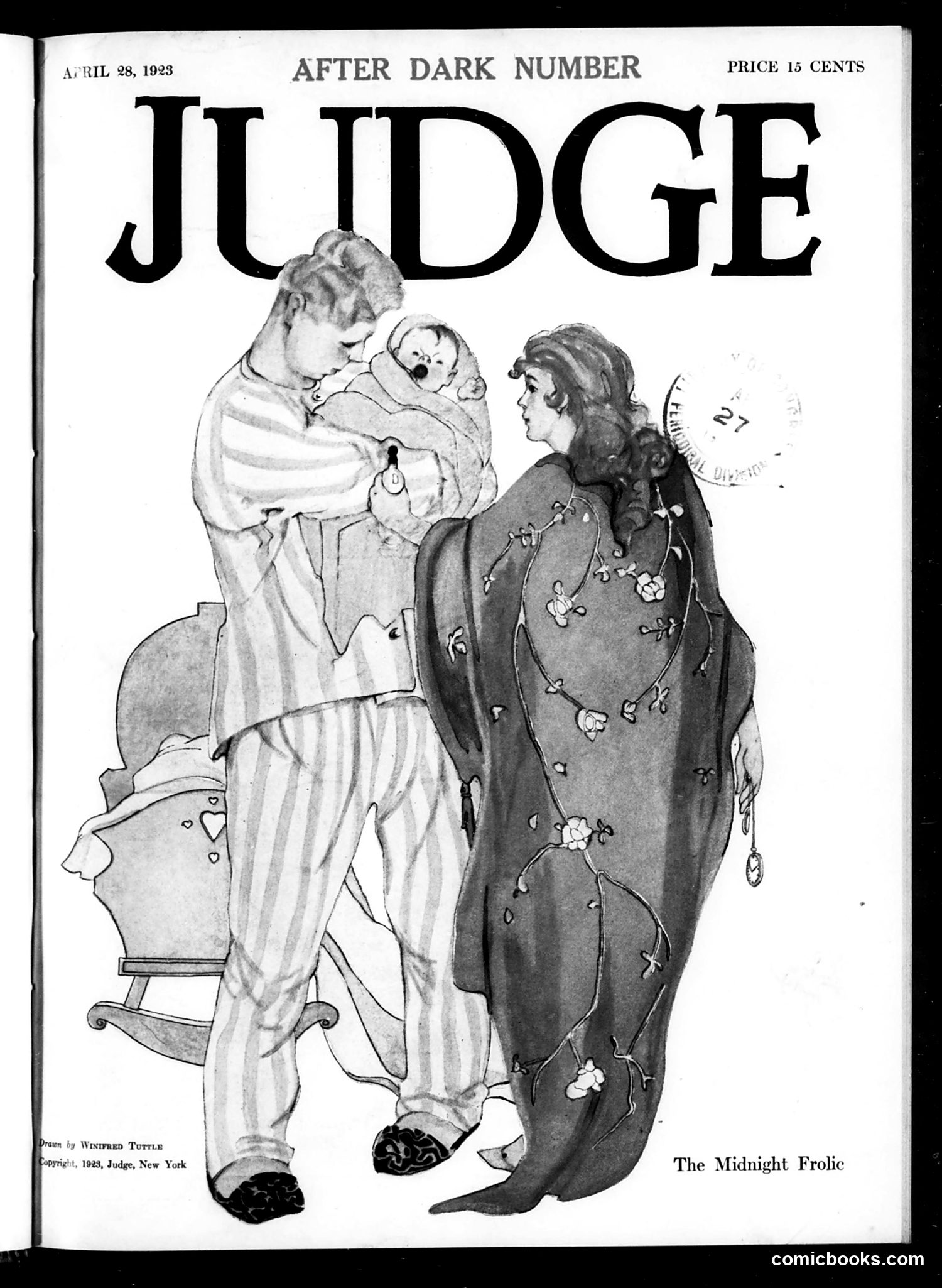
This cover illustration by Winslow Tettle depicts a domestic scene titled "The Midnight Frolic." A man in striped pajamas holds an infant while a woman in an ornate, flower-decorated robe stands nearby. The drawing appears to satirize the disruptions of nighttime childcare—a common domestic comedy subject of the 1920s. The joke likely plays on the contrast between the woman's elaborate, decorative nightwear and the unglamorous reality of midnight baby care. The man's bewildered expression suggests he's been summoned to help with an infant at an inconvenient hour. This reflects 1920s gender dynamics and domestic humor, where parenting duties interrupting leisure or sleep provided standard material for magazine satire.
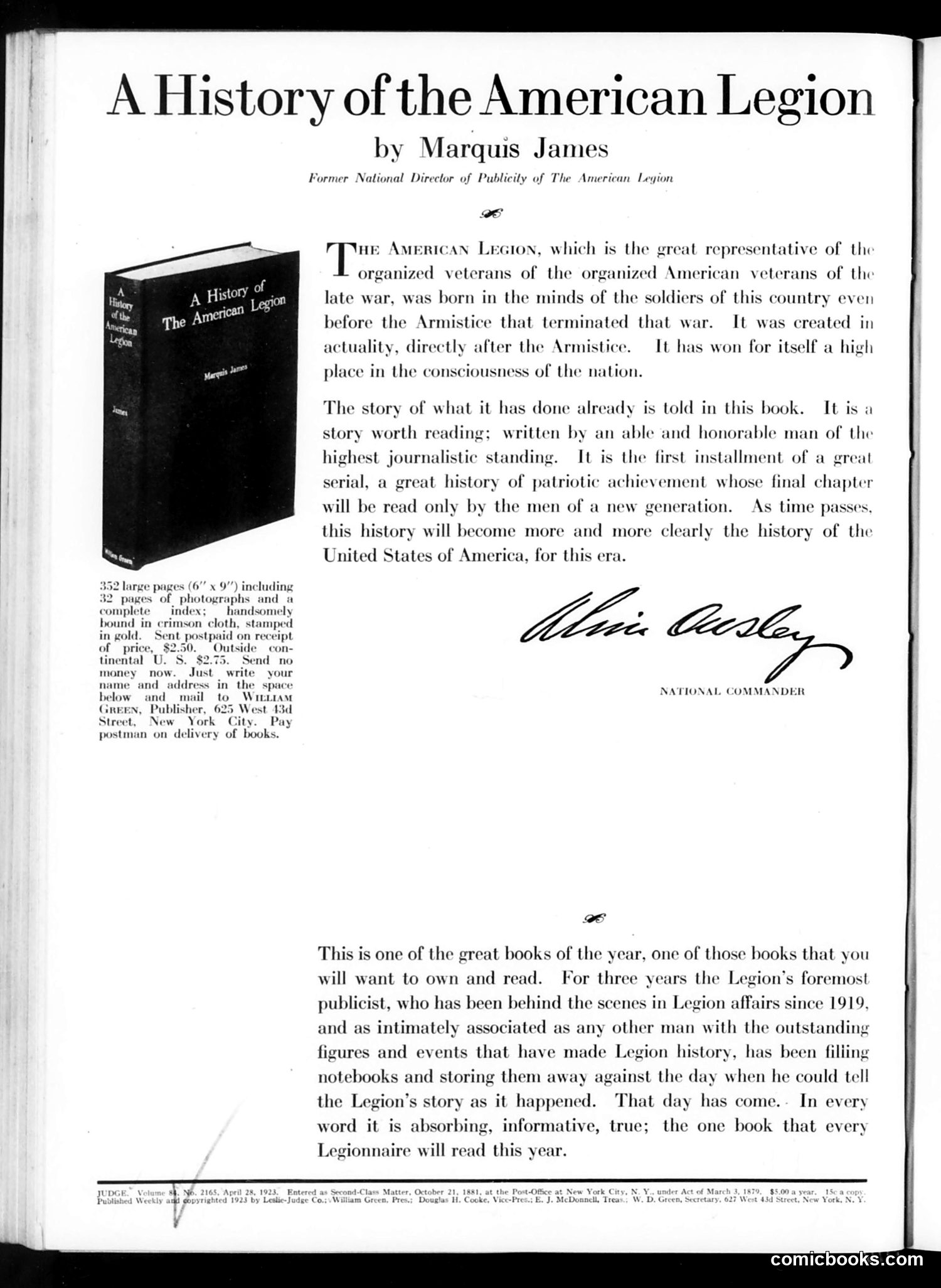
This page is primarily **advertising and promotional content**, not a political cartoon. It advertises "A History of the American Legion" by Marquis James, the former National Director of Publicity for The American Legion. The text describes the book as a comprehensive history of the Legion's formation after WWI and its activities since then. A signature appears to be from the National Commander endorsing the work. The promotional copy emphasizes this is "one of the great books of the year" and notes that James, as the Legion's publicist for three years, has been collecting material "since 1919" to document the organization's history. There is no political satire or cartoon content visible on this page—it functions as a straightforward book advertisement within the Judge magazine.
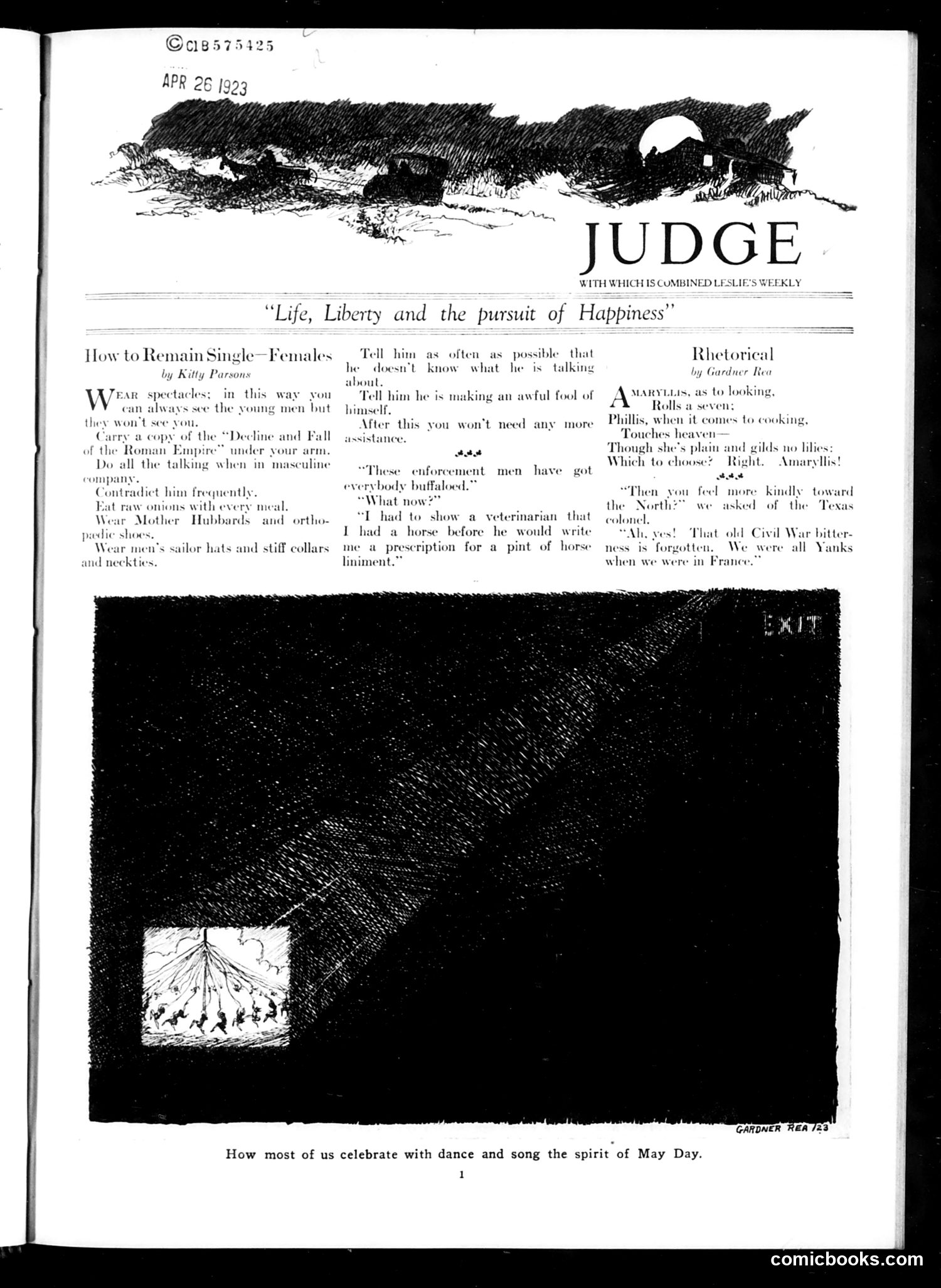
This page contains three distinct pieces: 1. **"How to Remain Single—Females"** by Kitty Parsons: Advice column satirizing dating and courtship, suggesting women wear spectacles, carry books, eat onions frequently, and adopt masculine mannerisms to discourage suitors. 2. **"Rhetorical"** by Gardner Rea: A brief humorous exchange mocking Southern nostalgia, where a Texas colonel romanticizes the Civil War as "Yanks in France," suggesting outdated thinking about regional conflict. 3. **Large illustration**: Depicts a dark interior space (marked "EXIT") with a May Day pole-dancing celebration visible through a small window—likely satirizing the contrast between traditional holiday celebrations and modern urban life or socialism-related May Day observances gaining attention in 1920s America.
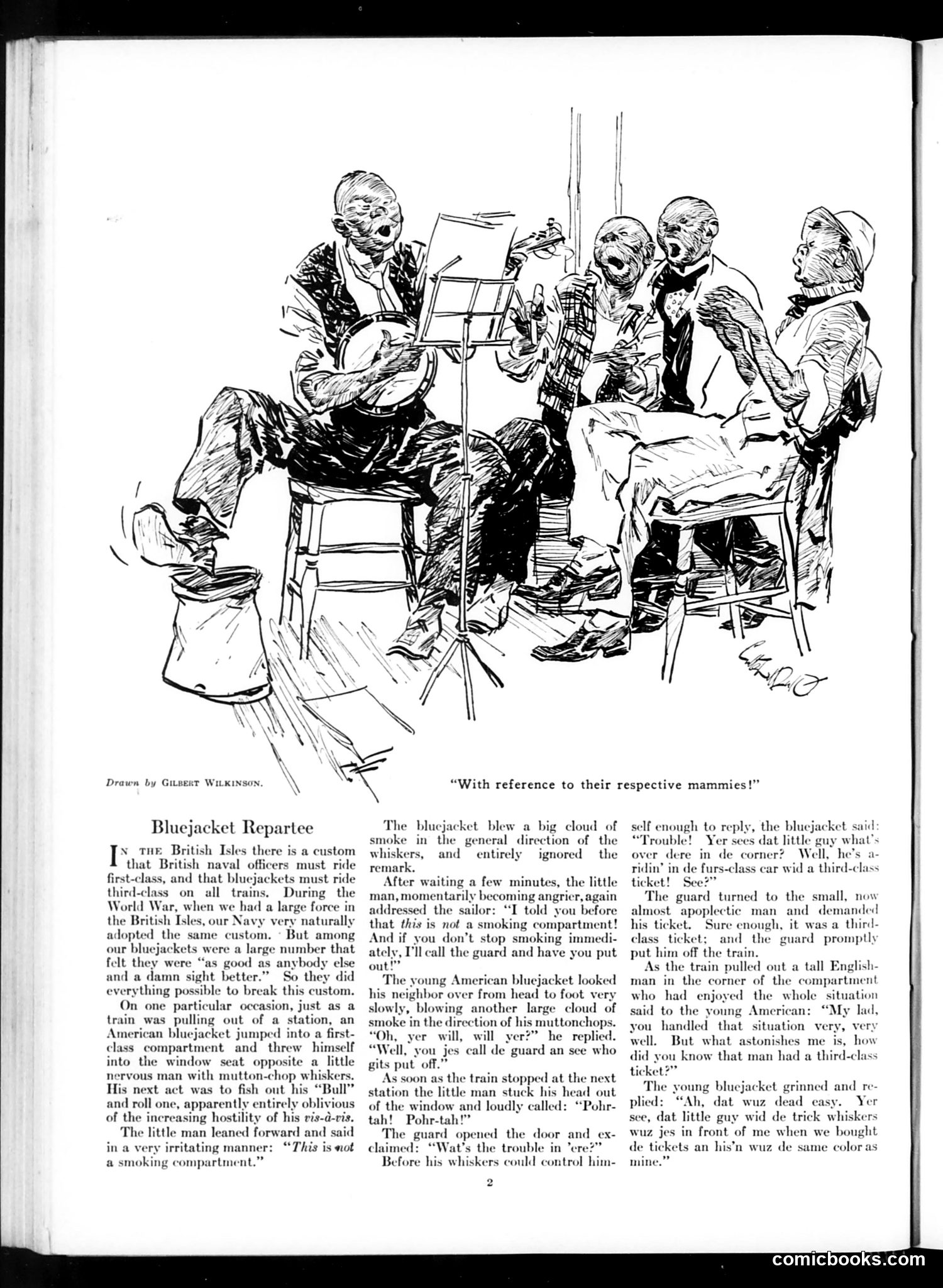
This illustrated story depicts a confrontation between American and British naval officers (bluejackets) in a first-class train compartment. The satire centers on a conflict over smoking: an American sailor smokes despite British objections, citing his first-class ticket as justification. When a British guard attempts enforcement, the American responds with quick wit, ultimately suggesting the guard's ticket is counterfeit. The humor relies on period tensions between American and British naval culture. The "bluejacket" custom referenced—that British sailors consider themselves superior—is mocked through the American's irreverent confidence and linguistic play. The story plays on national stereotypes: stuffy British formality versus brash American egalitarianism, suggesting Americans would not defer to arbitrary class hierarchies even during the World War era referenced in the text.
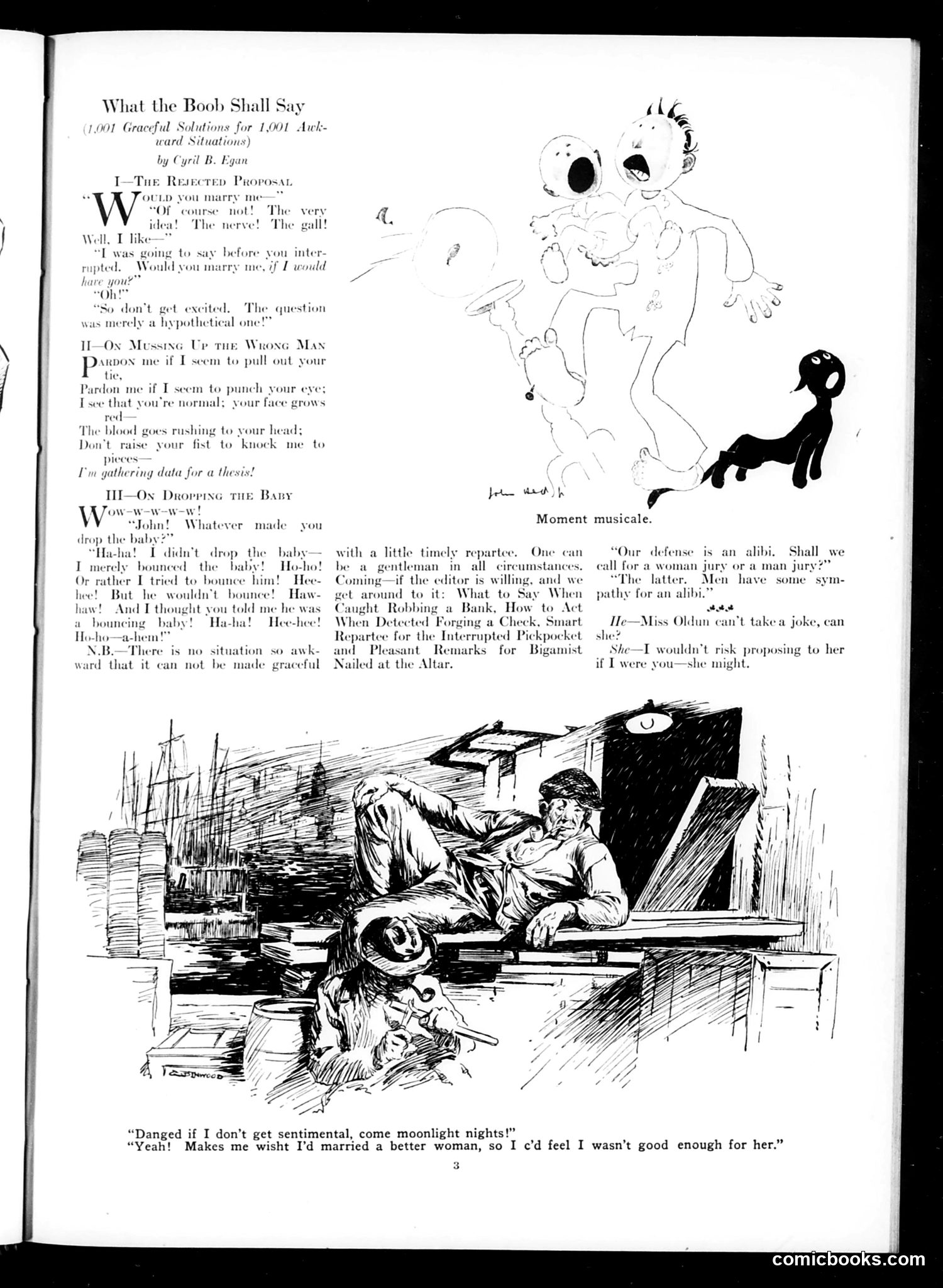
This page from *Judge* magazine presents humorous advice columns written by Carol B. Egan, offering comedic responses to awkward social situations. The sketches illustrate three scenarios: 1. **The Rejected Proposal** - A woman responds gracefully to an unwanted marriage proposal 2. **On Messing Up the Wrong Man** - Advice about accidentally insulting someone 3. **On Dropping the Baby** - Humorous guidance on recovering from accidentally dropping an infant The illustrations use exaggerated cartoon style typical of early 20th-century satire. The bottom sketch shows a domestic scene with two figures, accompanying the final exchange about sentimentality in relationships. The humor targets social awkwardness and etiquette violations common to the era, offering tongue-in-cheek advice on maintaining composure in embarrassing situations. The overall tone is lighthearted social commentary on genteel behavior.
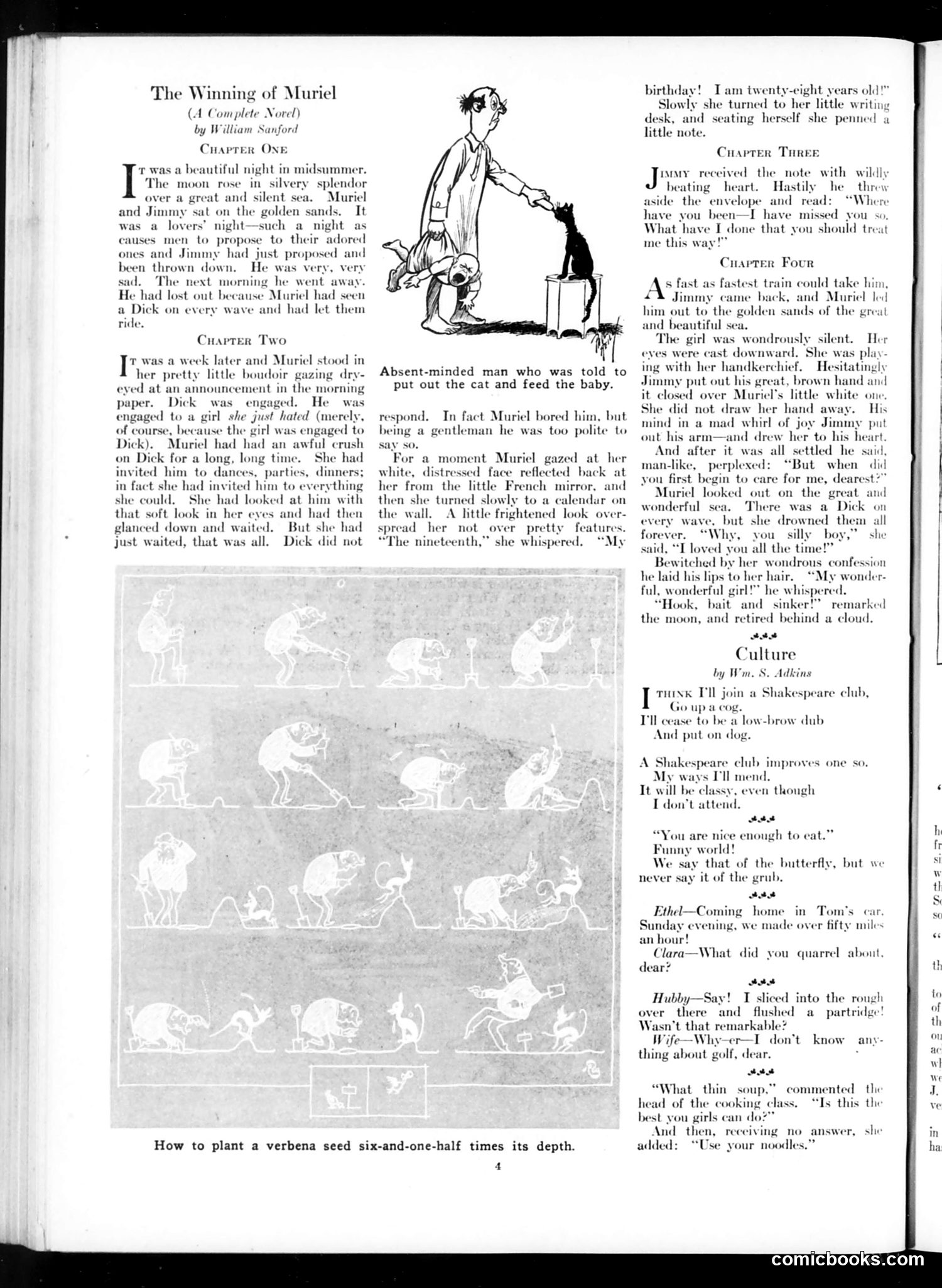
This page contains a serialized short story, "The Winning of Muriel" by William Sanford, rather than political cartoons. The narrative spans Chapters One through Four and describes a romantic encounter between two young people—Jimmy and Muriel—on a beach at midsummer. The right column features a section titled "Culture" by W.M. Adkins, offering light satirical commentary on social pretensions. It mocks people who claim to join Shakespeare clubs ("Go up a cog") while admitting they won't actually attend, and includes humorous anecdotes about dining and golf etiquette. The large central illustration shows sequential drawings of what appears to be gardening instruction—specifically "How to plant a verbena seed six-and-one-half times its depth"—likely satirizing overly detailed instructional diagrams. This is primarily entertainment and lifestyle content rather than political satire.
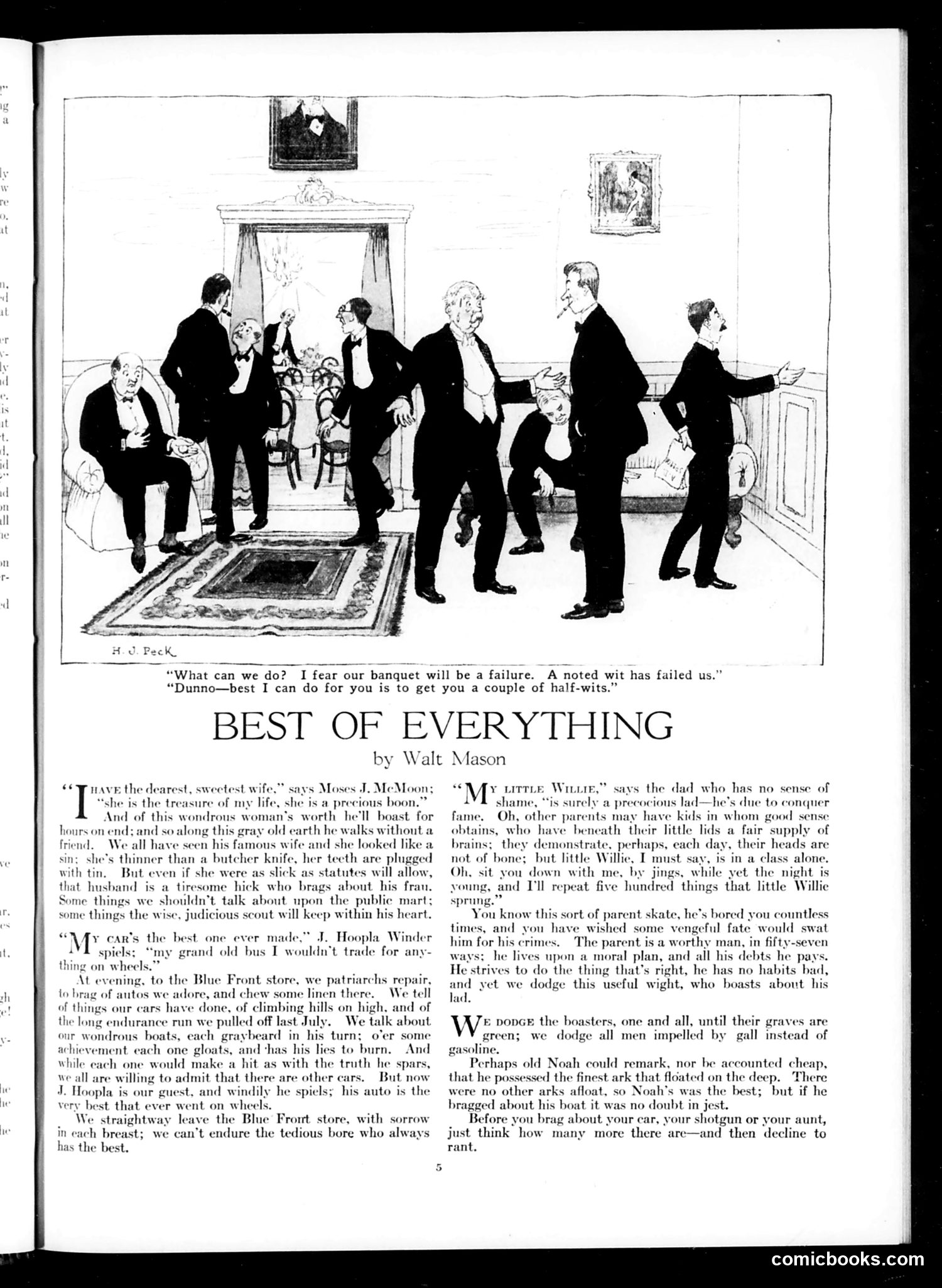
This Judge magazine page contains two separate satirical pieces: **The Cartoon:** A host frets that his banquet will fail because "a noted wit has failed us." A guest offers to find "a couple of half-wits" instead—a joke about substituting mediocre speakers for one absent wit. **"Best of Everything" Essay by Walt Mason:** This satirizes chronic boasters—men who endlessly brag about their possessions (wives, cars, boats, children). Mason catalogs these types: the husband praising his homely wife, the car owner "J. Hoopla Winder" who won't stop talking about his automobile, the father boasting about his "precocious" son. The satire's point: these men are tedious and insufferable, yet society cannot escape them. Mason concludes by invoking Noah's Ark—even that unique achievement wouldn't warrant bragging. The moral: before boasting about your car, gun, or relative, remember countless others possess similar things, so "decline to rant." The humor targets early-1900s consumer culture and the nouveaux riches displaying newfound possessions (especially automobiles).
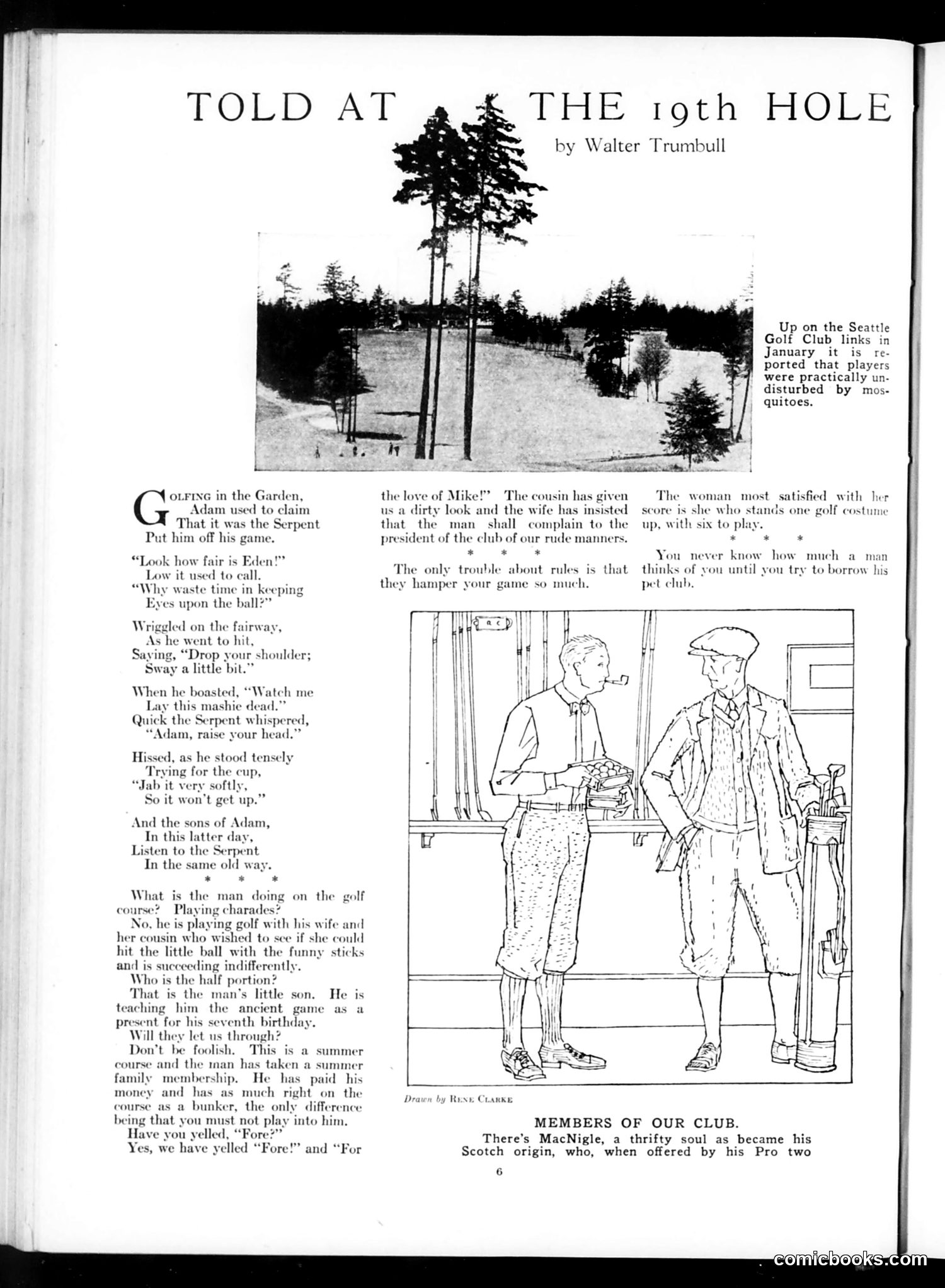
This is a humorous piece by Walter Trumbull about golf club social dynamics and etiquette. The page combines poetry and prose commentary on golfing behavior. **The main content:** The poem humorously parallels Adam and Eve's temptation in Eden with golfers being distracted during play—the "Serpent" representing distracting voices (wives, cousins, bystanders) offering unsolicited swing advice, just as they tempt modern golfers. **The cartoon** (drawn by René Clarke) depicts a man trying to teach his young son golf while the boy's mother and a female cousin watch. The accompanying text explains the social awkwardness: the man has paid for a summer family membership, giving them legitimate course access, but the wife and cousin are novices and disrupt other players' games. **The satire targets** the tension between inclusive club membership policies and traditional golf etiquette—specifically how amateur family members, particularly women, were viewed as intrusive outsiders on the golf course during this era. The closing note about "MacNigle" appears to introduce a character series about club members.
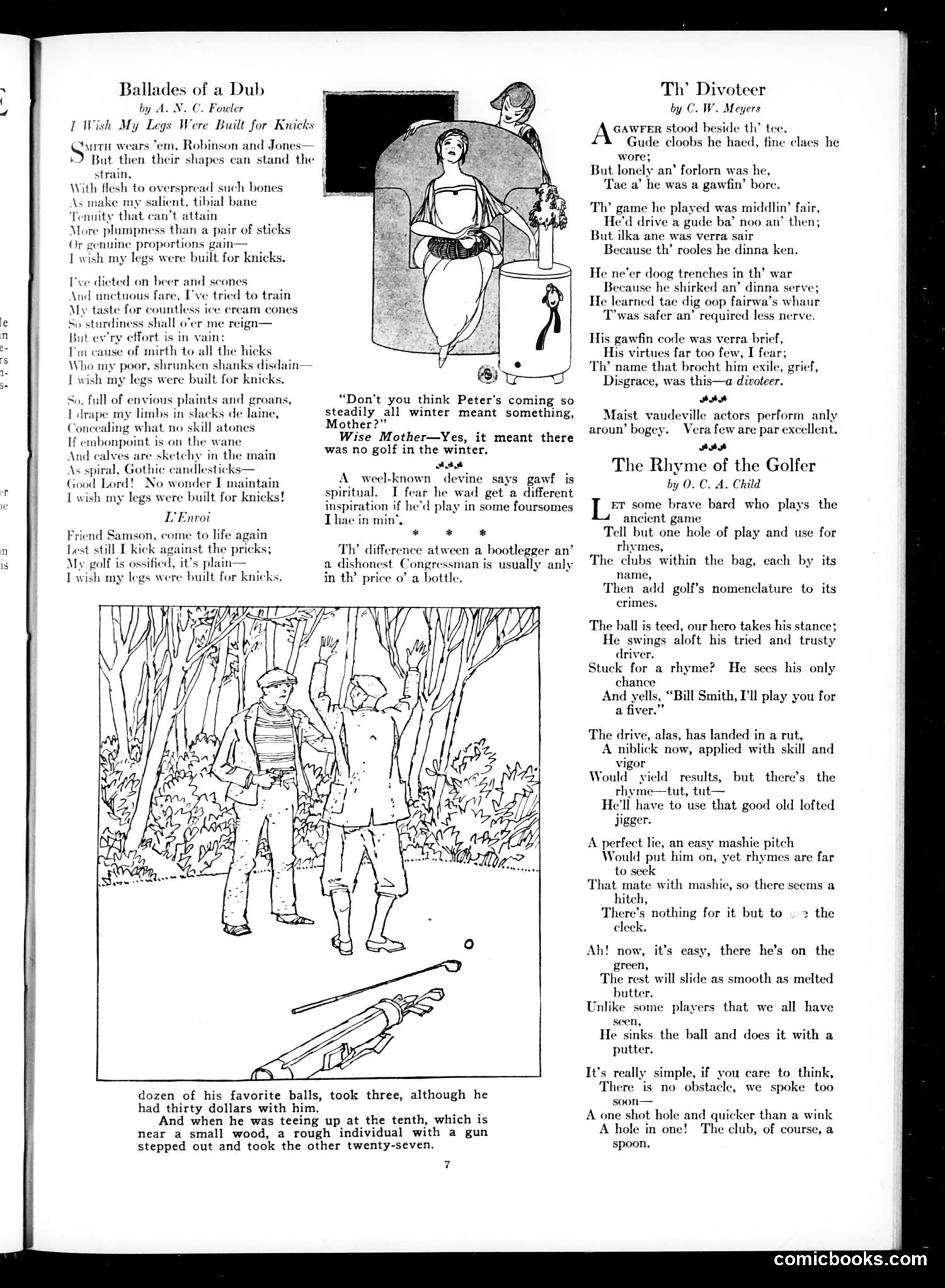
This page from *Judge* magazine contains **no political cartoons or satire**. Instead, it features three pieces of **light, humorous verse about golf and fashion**, popular leisure topics for the magazine's upper-middle-class audience. **"Ballades of a Dub"** mocks a thin man embarrassed by his scrawny legs in fashionable knickers (knee-length pants), a style that required decent leg shape. The humor targets personal vanity and fashion consciousness. **"Th' Divoteer"** uses Scottish dialect to ridicule a golfer who damages fairways (creates divots) and breaks golf etiquette—implying he avoided military service during WWI and learned to dig only in safe places. It's gentle social mockery of an inconsiderate golfer. **"The Rhyme of the Golfer"** is a lighthearted technical joke: a poet struggles to find rhymes while describing each golf club and hole, ultimately succeeding with contrived rhymes. The overall tone is **recreational satire aimed at affluent readers**, poking fun at their pastimes rather than addressing serious political issues.
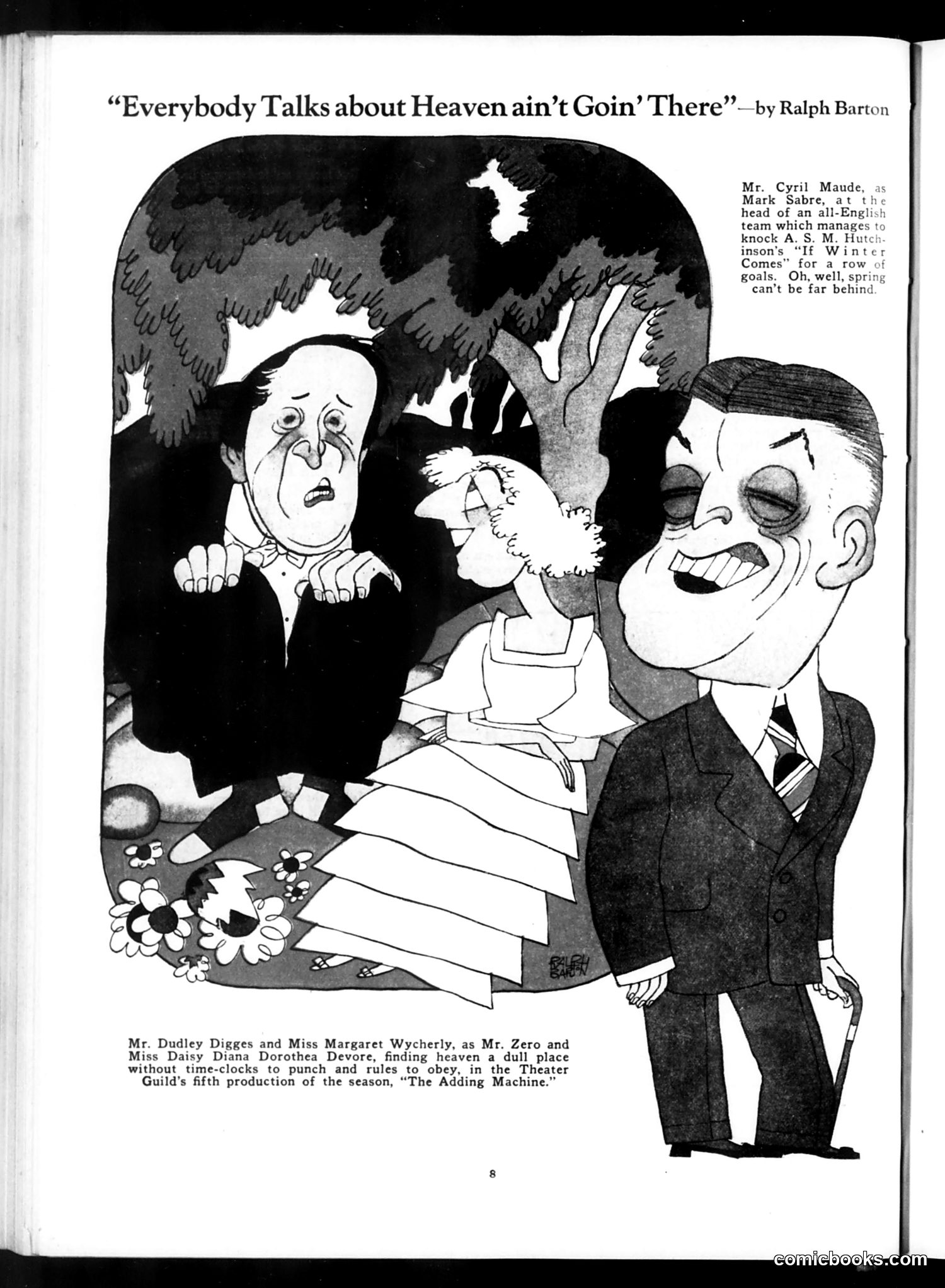
This is Ralph Barton's theatrical satire from *Judge* magazine. The cartoon depicts two separate theater productions: 1. **Top figure**: Cyril Maude in "If Winter Comes," an adaptation of A.S.M. Hutchinson's novel. The caricature suggests the production is "knocking" or defeating the source material. 2. **Bottom figures**: Dudley Digges and Margaret Wycherly in the Theater Guild's "The Adding Machine," where their characters (Mr. Zero and Miss Daisy Diana Dorothea Devore) find heaven boring without workplace rules and time-clocks to punch—a satirical commentary on the play's themes about mechanized modern life. The title's ironic reference to a spiritual hymn contrasts with both plays' earthly, material preoccupations. Barton satirizes contemporary theater by suggesting these productions focus on mundane concerns rather than transcendent or meaningful drama.
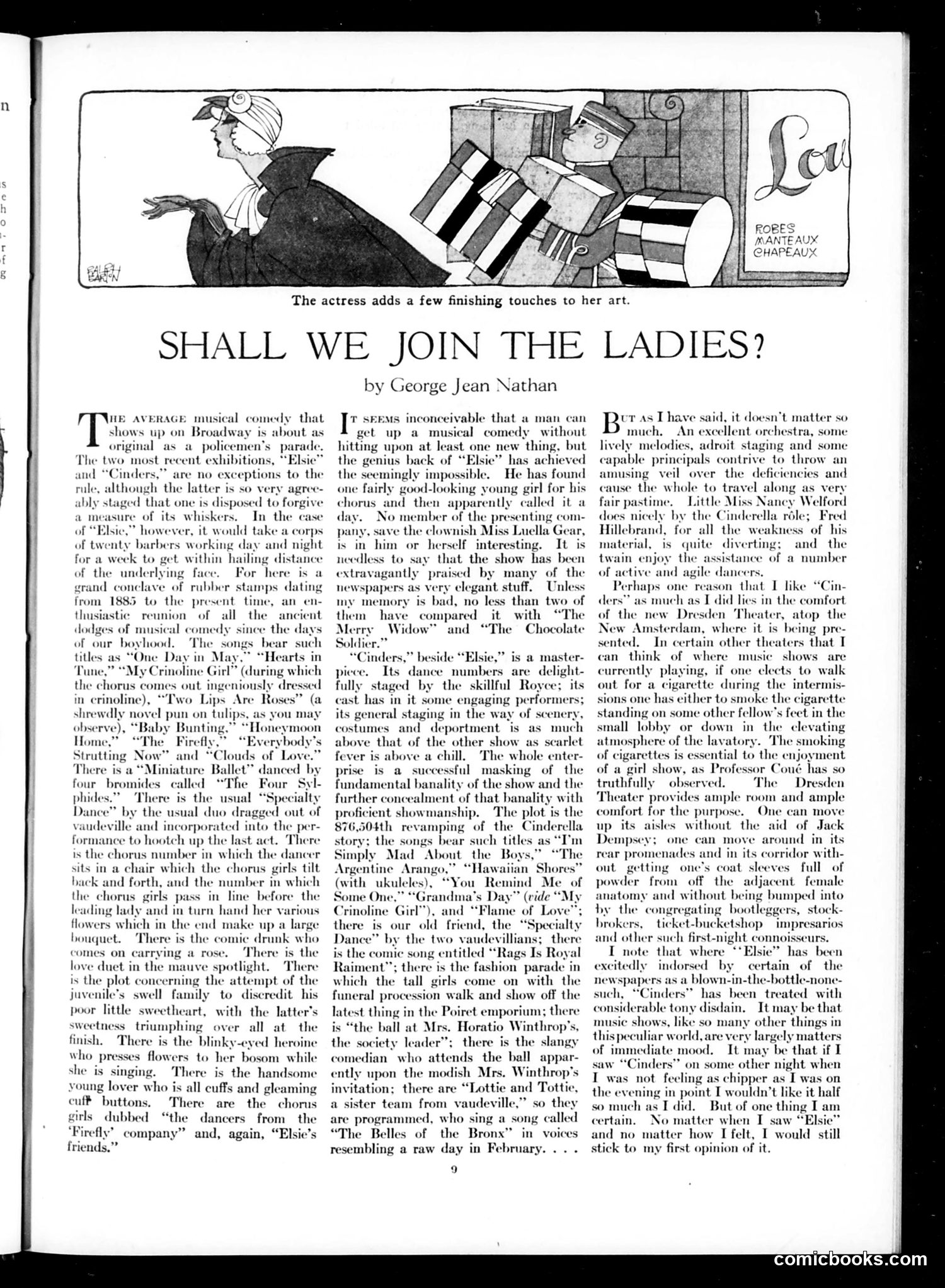
This is a theater review of the Broadway musical comedy "Elsie," not a political cartoon. The illustration at top shows an actress adding costume details—referencing the review's central critique. Nathan's satire targets the creative bankruptcy of contemporary musical comedy. He catalogs the show's relentless recycling of tired theatrical conventions: stale plot devices (the "876,504th revamping" of Cinderella), hackneyed song titles, obligatory dance numbers, and stock character types. His point: "Elsie" succeeds only through superficial spectacle—elaborate costumes, skilled staging, and attractive performers—masking fundamental creative exhaustion. While Nathan acknowledges the show's professional execution and praises the dancing of "the skillful Royce," he dismisses it as skillful packaging of inherent mediocrity. The review exemplifies early 20th-century theatrical criticism's tension between entertainment's technical sophistication and its artistic substance.
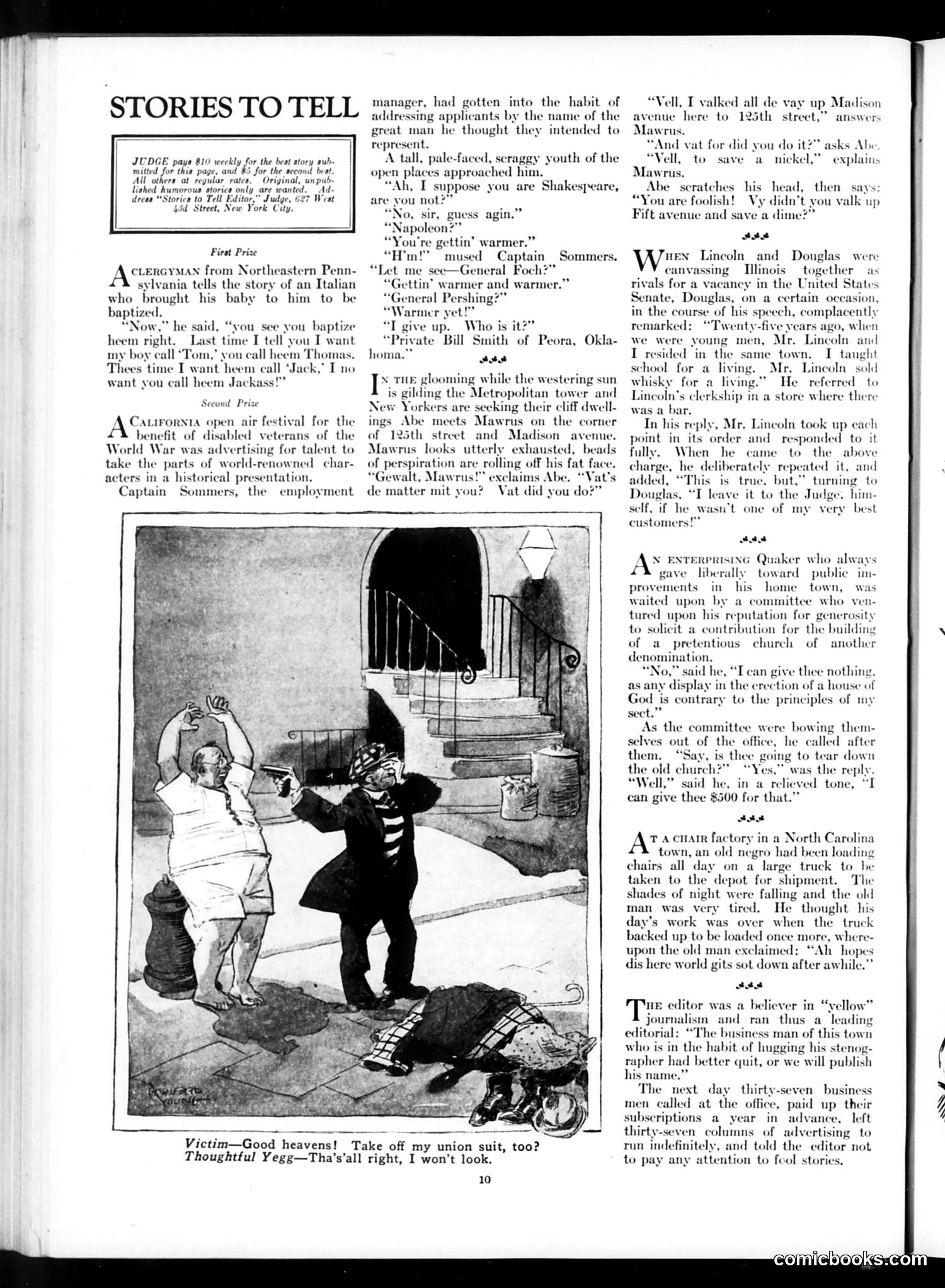
The main cartoon depicts a mugging or robbery scene. A victim (labeled "Victim") is being accosted by two figures—one appears to be a police officer or authority figure and another man. The victim exclaims, "Good heavens! Take off my union suit, too?"—suggesting he's being stripped of his clothing and belongings. The joke satirizes labor unions and their aggressive tactics. The caption "Thoughtful Yegg" (yegg being slang for a criminal) references the victim's reluctant acceptance. The satire suggests unions were seen as predatory, extracting everything from workers—literally taking the clothes off their backs. This reflects early 20th-century anti-union sentiment, when Judge magazine frequently mocked organized labor as corrupt and exploitative. The surrounding "Stories to Tell" section contains various humorous anecdotes, unrelated to the main cartoon's political commentary on labor disputes.
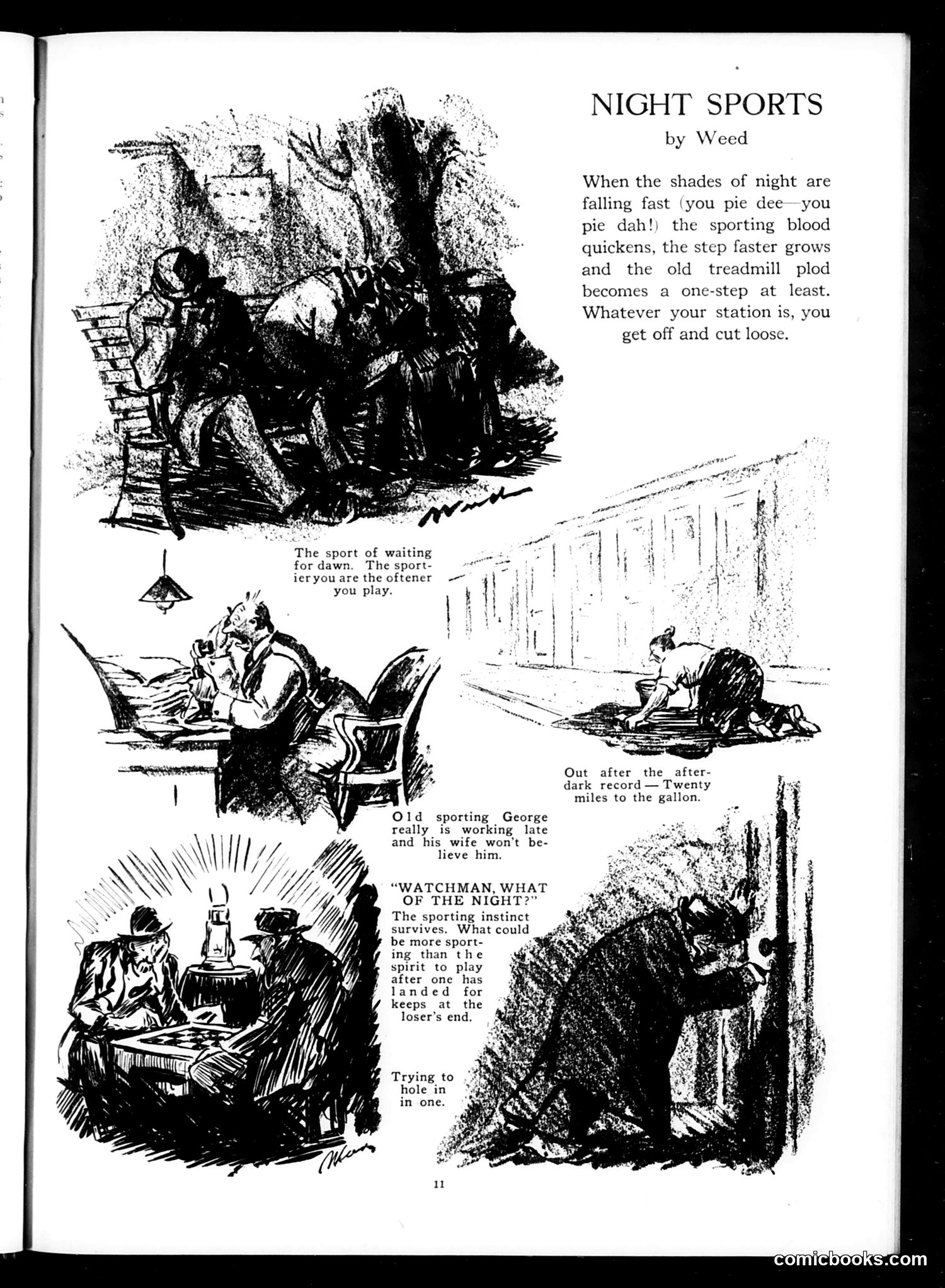
This satirical piece mocks upper-class nighttime leisure activities and moral hypocrisy. The cartoon presents several "sports": 1. **"Waiting for dawn"** — appears to reference late-night carousing, suggesting people stay out all night and must wait for morning. 2. **"Old sporting George"** — a husband claiming to work late while his skeptical wife doubts him, satirizing infidelity excuses. 3. **"After-dark record — Twenty miles to the gallon"** — likely references reckless nighttime driving, possibly to secret rendezvous. 4. **"Watchman, what of the night?"** — quotes scripture while depicting gambling ("trying to hole in one"), contrasting religious morality with actual behavior. 5. **Late-night activities generally** — the piece satirizes how wealthy individuals shed social constraints after dark, engaging in drinking, gambling, and affairs they'd hide in daylight. The humor targets class hypocrisy: respectable daytime citizens become different people at night, treating questionable behavior as thrilling "sports."
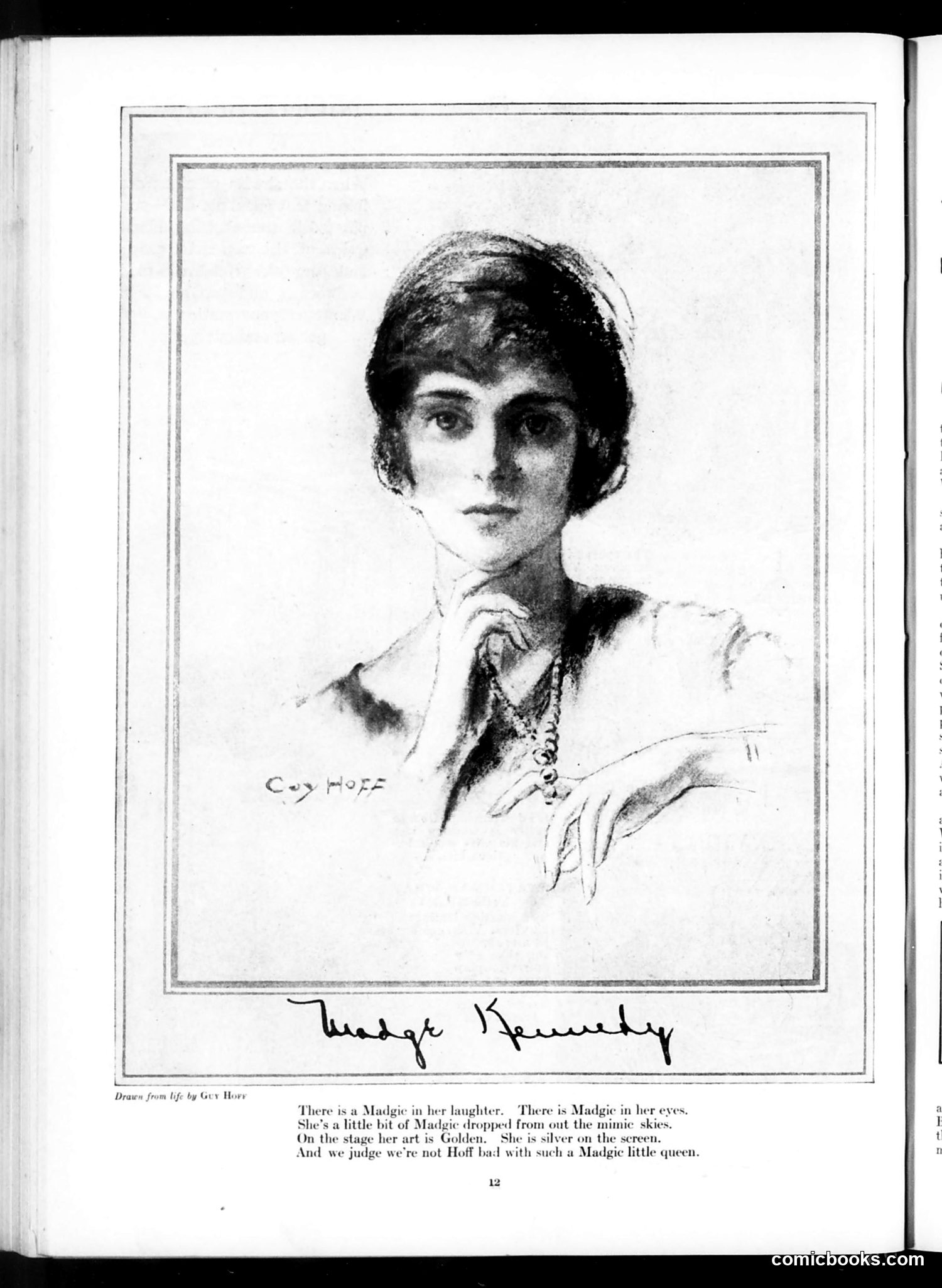
This page features a portrait sketch labeled "Madge Kennedy," drawn by Guy Hoff. The accompanying verse praises Kennedy as an entertainer with "Magic" in her laughter and eyes, noting her success both on stage ("Golden") and in film ("silver on the screen"). Kennedy was a popular American actress of the early 20th century, known for theatrical and silent film work. The playful poem uses "Magic/Madgic" as a pun on her first name, celebrating her charm and talent. This appears to be a fan appreciation piece rather than satire—*Judge* magazine occasionally featured admiring portraits of popular entertainers alongside light, complimentary verse.
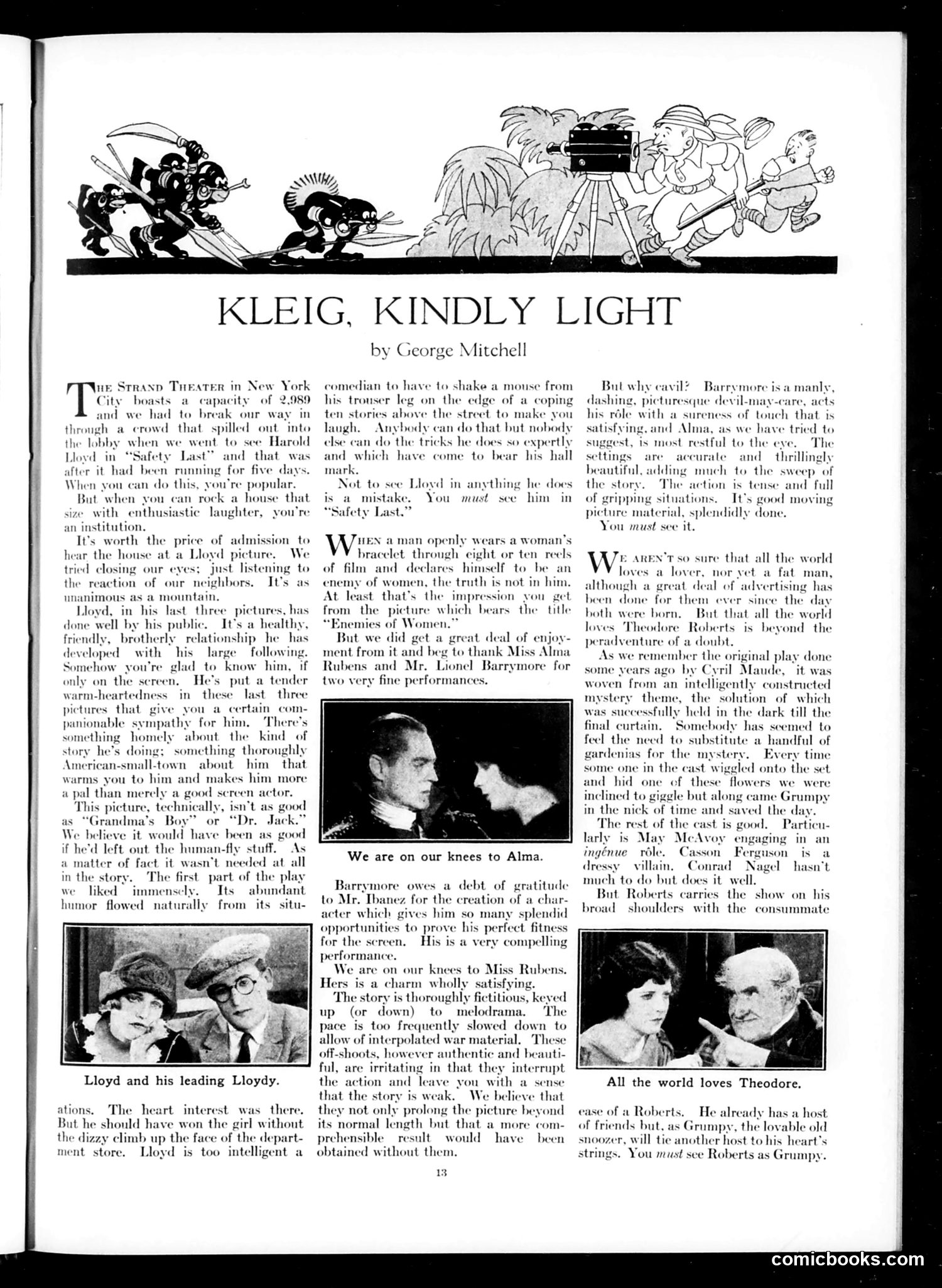
This page reviews three silent films for a modern reader unfamiliar with early cinema: **Harold Lloyd's "Safety Last"** receives praise for Lloyd's appeal as an everyman comedian whose stunts (famously climbing a building facade) draw massive audiences. The reviewer admires Lloyd's "tender warm-heartedness" and small-town American relatability, though criticizes the climactic stunt as unnecessary. **"Enemies of Women"** stars Lionel Barrymore and Alma Rubens. The plot involves a man declaring himself an enemy of women while wearing a woman's bracelet—a contradiction the reviewer finds implausible. He praises Barrymore's "manly, dashing" performance and Rubens' charm, but faults the film's pacing, complaining interpolated war material interrupts the narrative. The cartoons at top appear to depict film production—showing cameramen and actors, illustrating the review's focus on cinema and celebrity. The tone is typical 1920s film criticism: technically analytical while emphasizing star appeal and emotional resonance over plot logic.
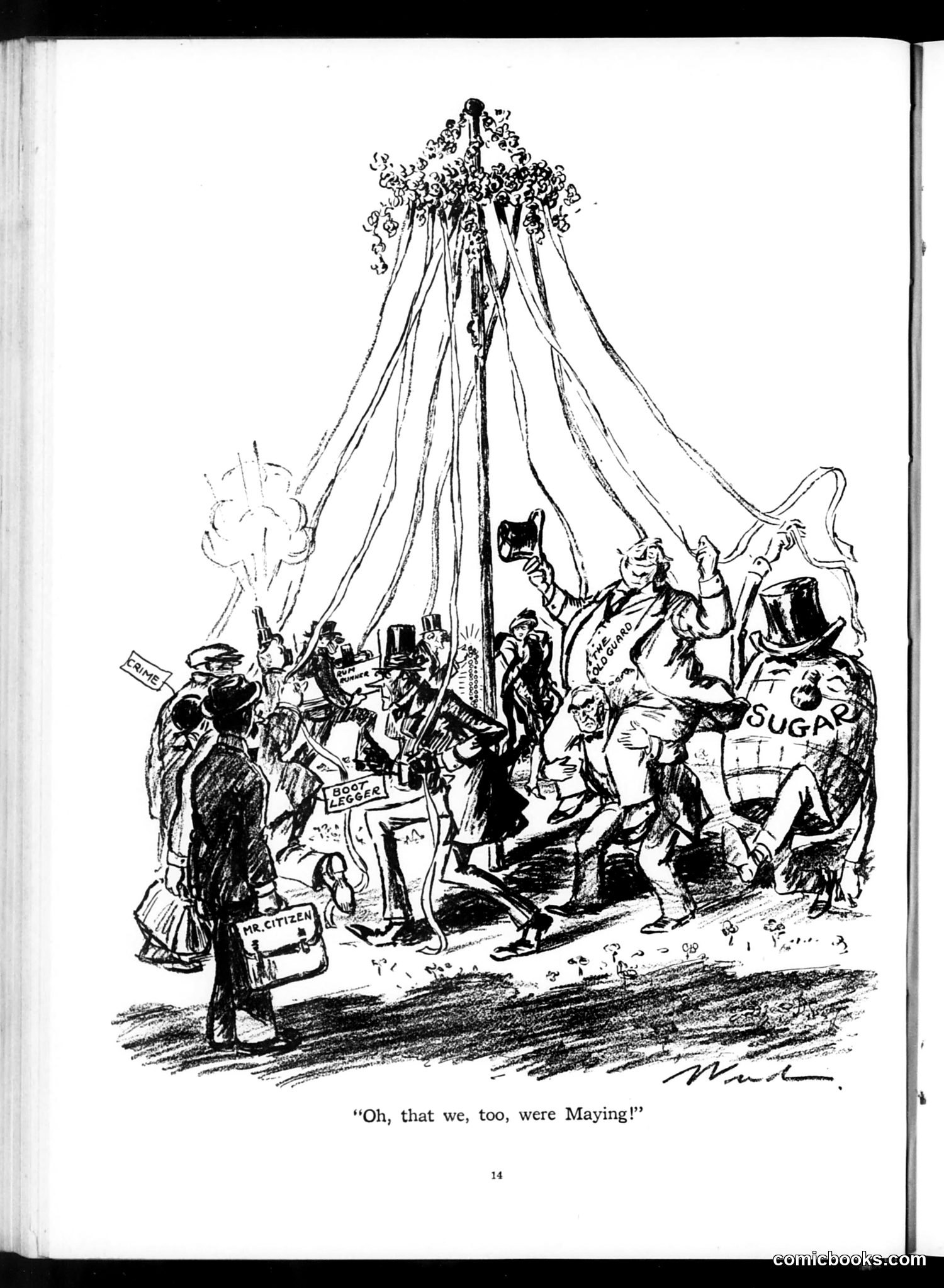
This cartoon depicts a "Maypole" scene where various figures dance around a central pole topped with flowers. The visible labels include "MR. CITIZEN," "SUGAR," and "GOD BLESS," suggesting this satirizes American citizens and commodities during a period of economic concern. The caption—"Oh, that we, too, were Maying!"—expresses nostalgia or longing, implying the figures wish they could participate in carefree celebration like traditional May Day festivities. The cartoon likely critiques either wartime rationing, economic hardship, or inflation affecting ordinary Americans who cannot freely enjoy commodities or leisure. The formal dress and animated postures suggest ironic commentary on citizens' aspirations versus harsh economic reality. The specific historical moment remains unclear without publication date context.
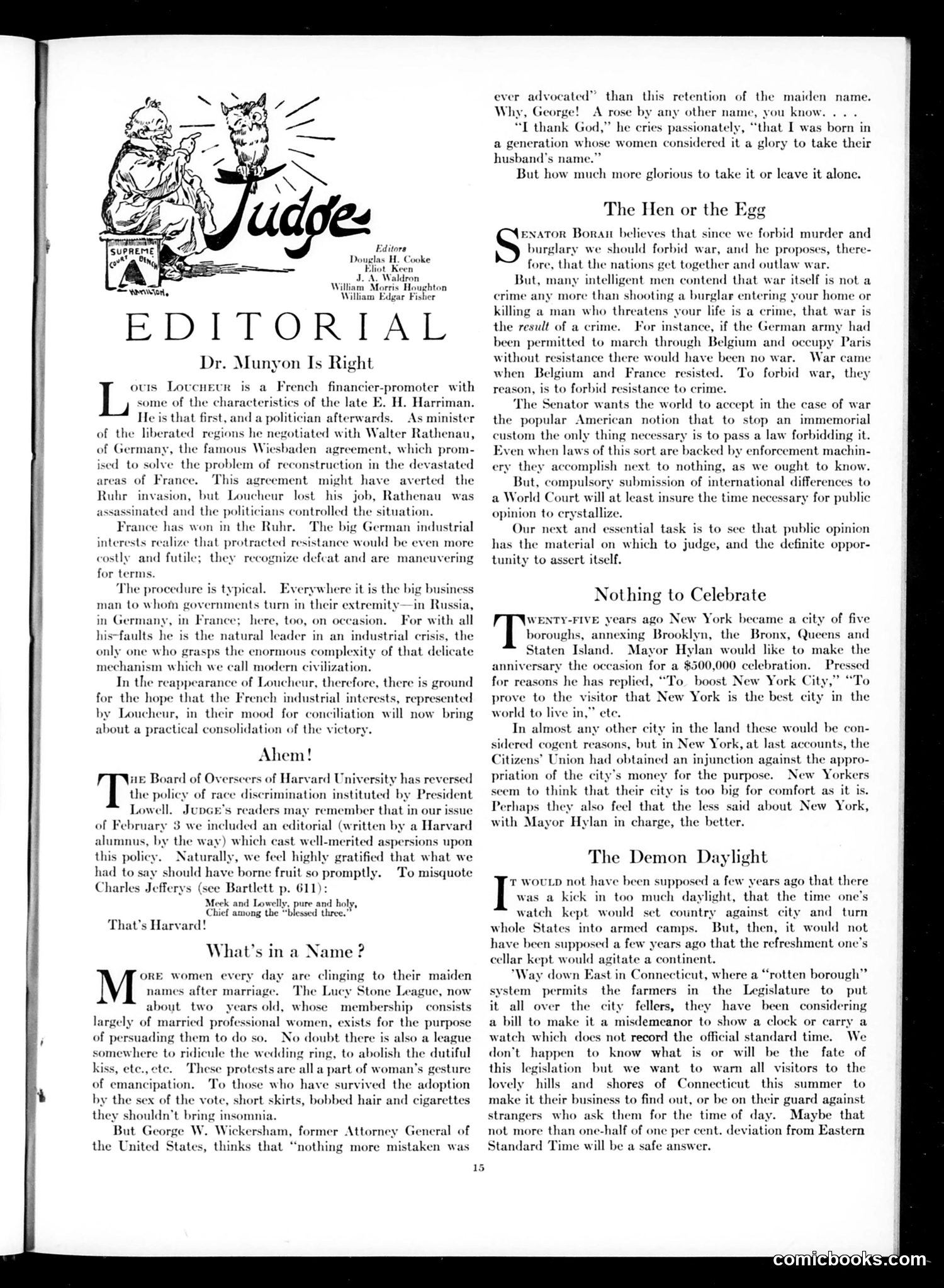
This editorial page from Judge magazine (likely early 1920s) contains four opinion pieces on contemporary political and social issues: **"Dr. Munyon Is Right"** discusses French financier-promoter Loucheur's return to negotiate the Ruhr crisis, arguing that in industrial crises, governments wisely turn to pragmatic businessmen rather than politicians. **"Ahem!"** applauds Harvard University's Board of Overseers for reversing President Lowell's race discrimination policy, noting Judge had previously criticized this discrimination. **"What's in a Name?"** satirizes conservative opposition to women retaining maiden names after marriage. It mocks former Attorney General George Wickersham's claim that women taking husbands' names is glorious, suggesting it should be optional. **"The Hen or the Egg"** debates Senator Borah's proposal to outlaw war internationally, arguing war is a defensive response to crime (invasion) rather than a crime itself, so outlawing war alone won't prevent conflict. The small cartoon shows a judge figure, relating to the magazine's "Judge" branding.
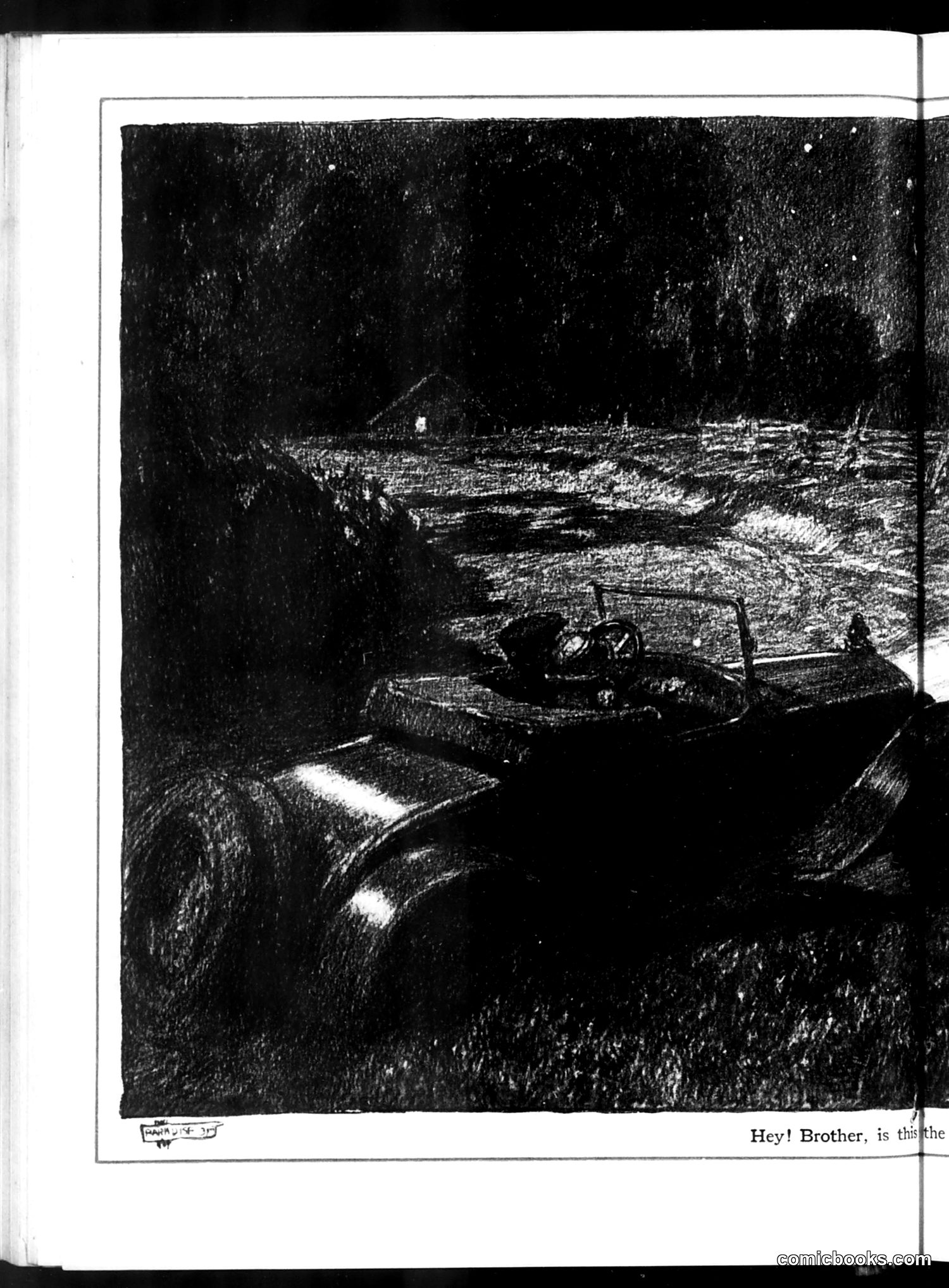
This appears to be a black and white photograph or illustration rather than a political cartoon. The image shows a nighttime forest or wooded scene with a small illuminated cabin or structure visible in the distance. In the foreground, there's what appears to be abandoned or wrecked machinery or equipment, possibly an old vehicle or farm equipment. The caption reads: "Hey! Brother, is this the..." but the text cuts off, leaving the complete meaning unclear. Without the full caption or identifying information about the publication date and context, I cannot definitively explain the specific political or social satire intended. The image's meaning likely depends on contemporary events or references that aren't fully legible here. The abandoned machinery in a remote setting might suggest themes of rural decay, abandonment, or industrial decline, but this remains speculative without additional context.
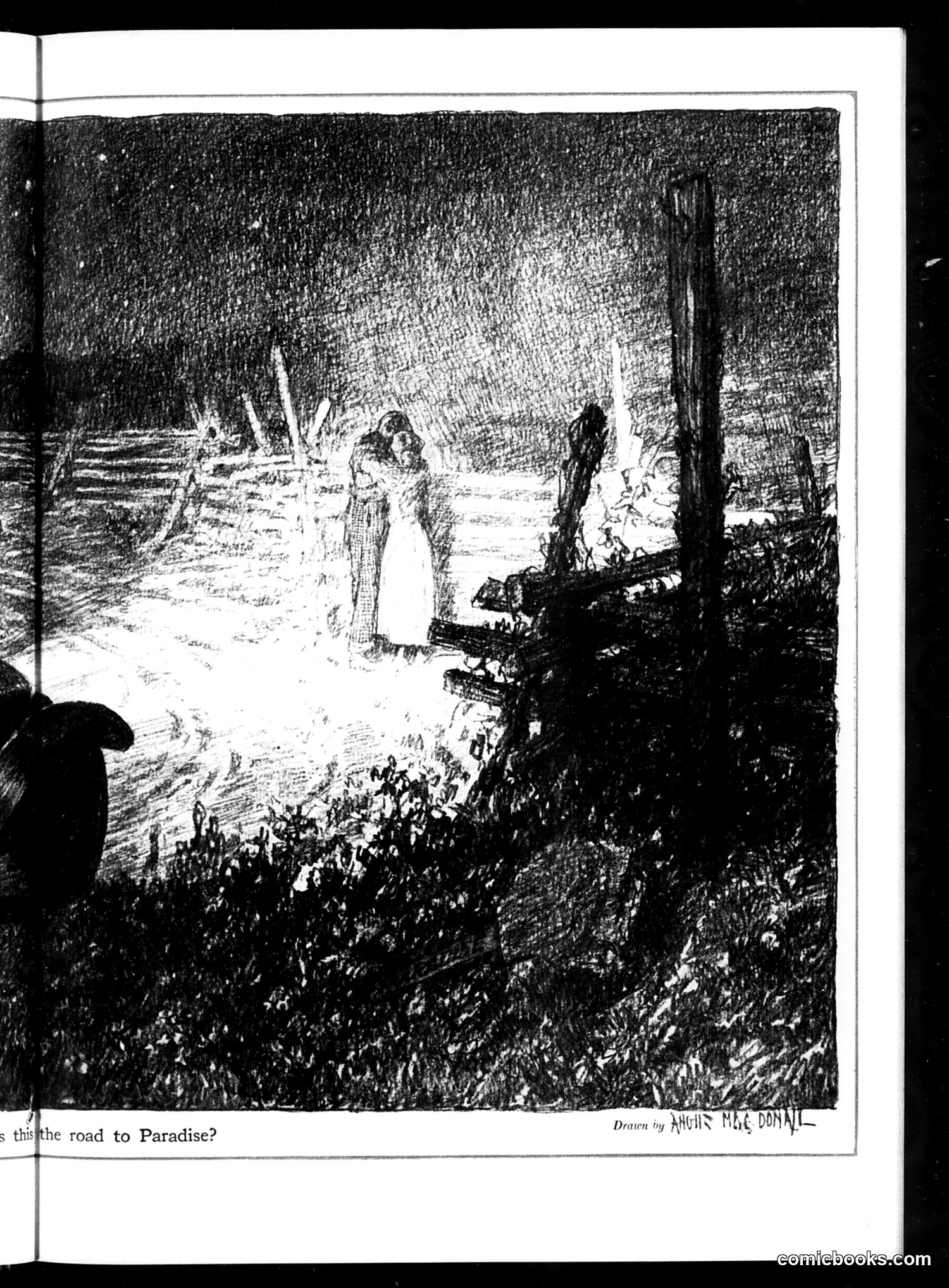
This illustration, credited to artist Angus MacDonald, depicts a nighttime rural scene with figures on a path. The caption reads "Is this the road to Paradise?" The sketch shows what appears to be travelers or wanderers encountering figures on a dark country road, rendered in MacDonald's characteristic crosshatching technique. The romantic or mysterious tone—combined with the Paradise reference—suggests social satire about aspiration and disillusionment. Without additional context from Judge's publication date or surrounding articles, the specific political or social commentary remains unclear. The image could satirize 1920s idealism, rural versus urban life, or spiritual/material seeking during America's post-WWI period. The ambiguous figures and moody atmosphere support a commentary on unfulfilled promises or misguided journeys, but the precise target requires additional documentation.
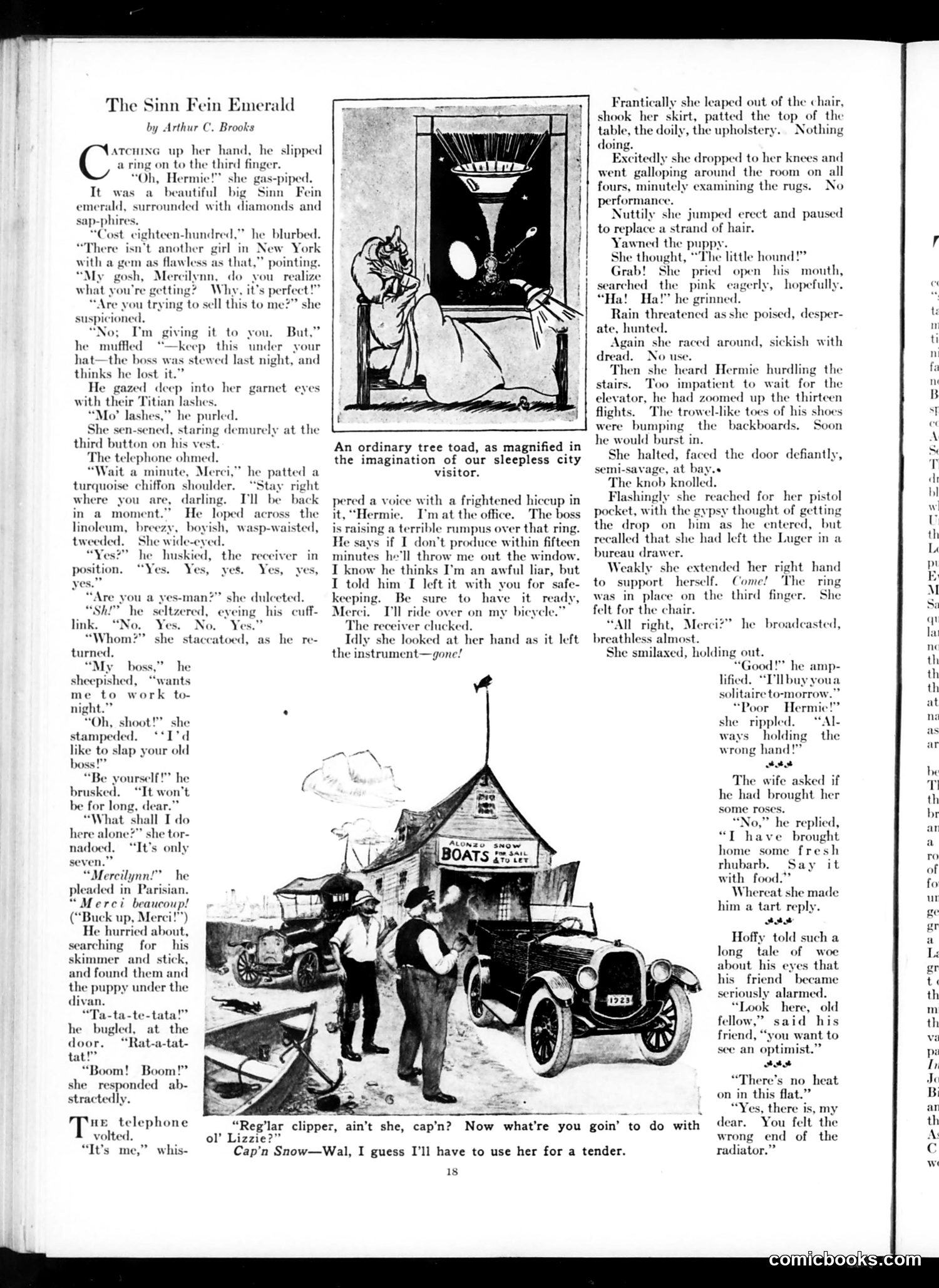
This is a humorous short story, not a political cartoon, though the title references contemporary Irish politics. The "Sinn Féin Emerald" appears to be a fictional jewel—the story plays on the emerald's Irish associations while being primarily a romantic comedy. The plot concerns a man giving his girlfriend (Merceilynn) an expensive emerald ring he's actually stolen from his drunken boss. When the boss demands its return within fifteen minutes, the woman loses the ring while searching frantically. Just as her boyfriend arrives, she miraculously finds it back on her finger, saving the situation. The humor derives from the absurd situations, overwrought romantic dialogue ("sen-sened," "smilaxed"), and slapstick physical comedy. There's no substantive political content—"Sinn Féin" appears chosen simply for the poetic association with emeralds rather than engaging with actual Irish independence politics of the era.
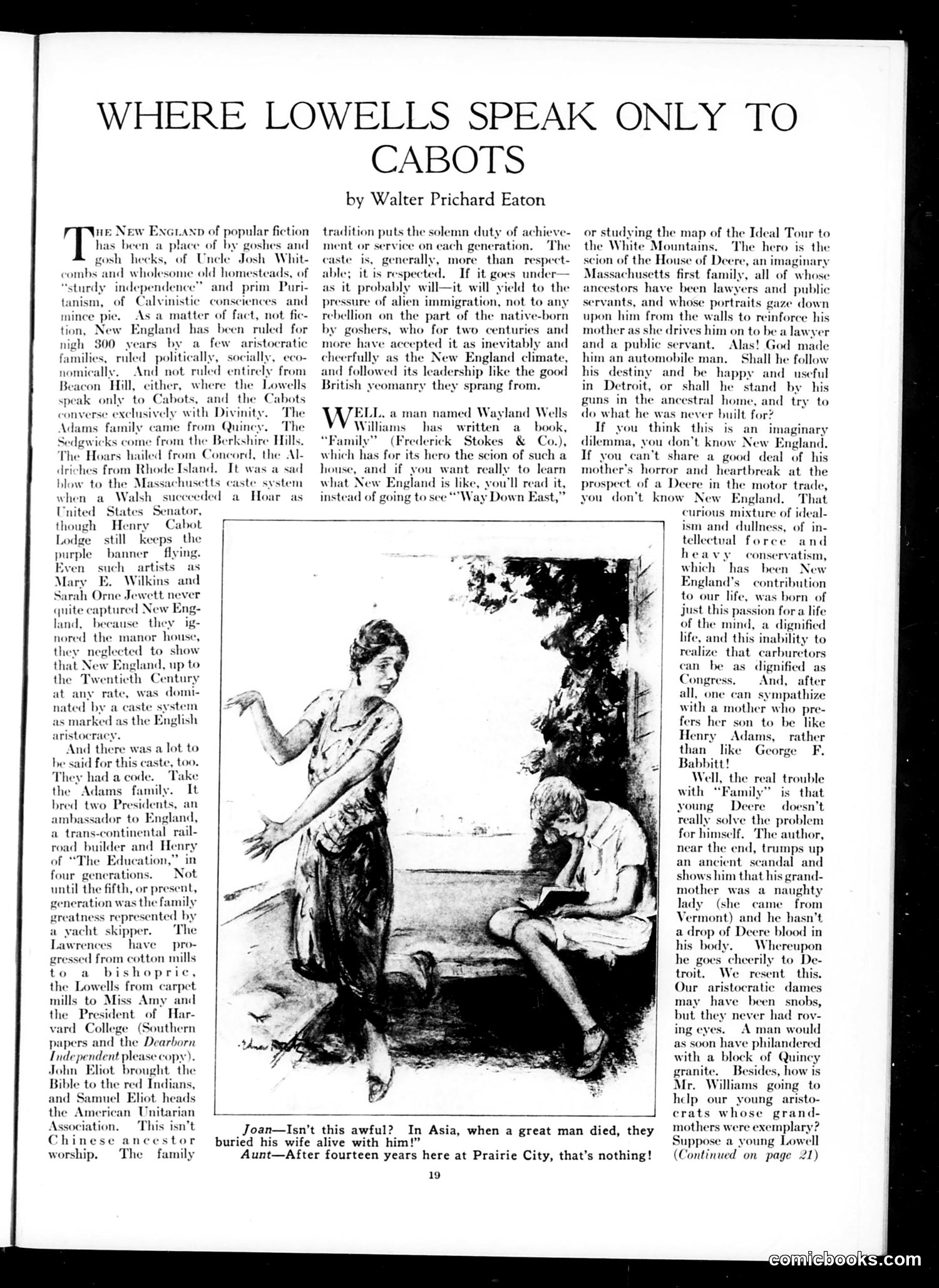
This article satirizes New England's rigid aristocratic class system, particularly Boston's Brahmin families (Lowells, Cabots, Adamses, Sedgwicks). The famous phrase "Lowells speak only to Cabots, and Cabots converse exclusively with Divinity" encapsulates the exclusivity of these old-money families who dominated Massachusetts politically and socially for three centuries. The accompanying illustration depicts a woman (representing old New England tradition) instructing children in proper aristocratic behavior. The text criticizes how this inherited caste system pressures descendants—like the fictional Deere family protagonist—to follow predetermined paths (law, public service) rather than pursue personal ambitions (automobile manufacturing). The satire's target: the suffocating rigidity of hereditary privilege and its inability to adapt to modern American social mobility. The author suggests this rigid class structure, though historically significant, is ultimately doomed by immigration and changing values.
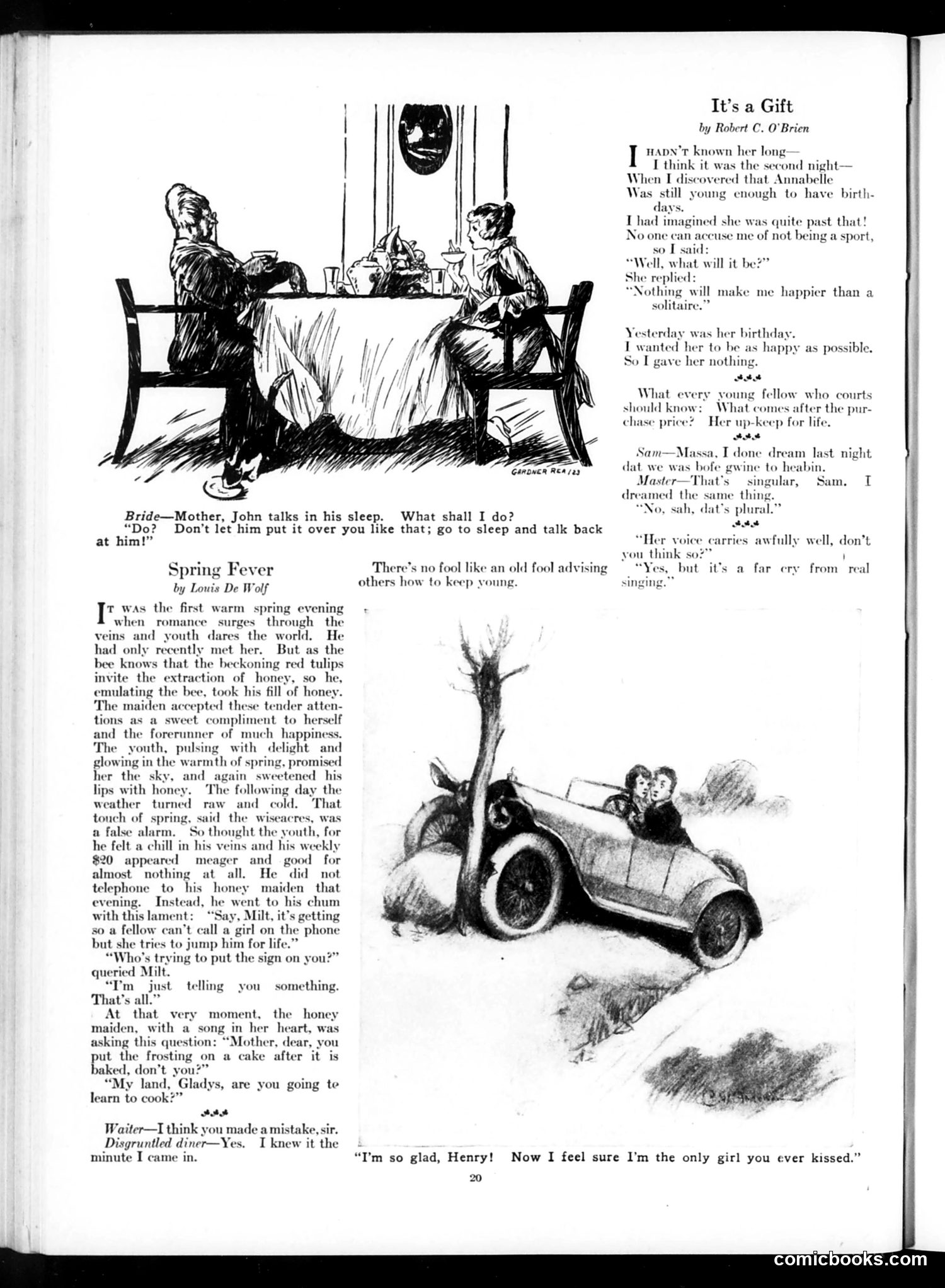
This page contains three distinct satirical pieces about courtship and marriage: **"It's a Gift"** (top right) mocks the financial burden of dating. A man gives his girlfriend nothing for her birthday after she requested a solitaire diamond ring, reasoning that her "up-keep for life" following marriage makes expensive gifts foolish. The satire targets male stinginess disguised as practical wisdom. **"Spring Fever"** (left) depicts a young man's romantic ardor cooling when warm weather passes and his finances feel tight ($20 weekly salary). He avoids calling his girlfriend, complaining to a friend that she "tries to jump him for life"—suggesting women exploit men for financial support. The piece satirizes male fickleness and financial anxiety during courtship. **The cartoon at top** shows a wife advising her friend not to let her husband "put it over" her regarding his sleep-talking; she should "talk back." This mocks marital power dynamics. Overall, the page satirizes early-20th-century dating economics: men resent women's expectations for gifts and financial security, while women strategically pursue material security through romance. The humor targets both genders' mercenary approaches to marriage.
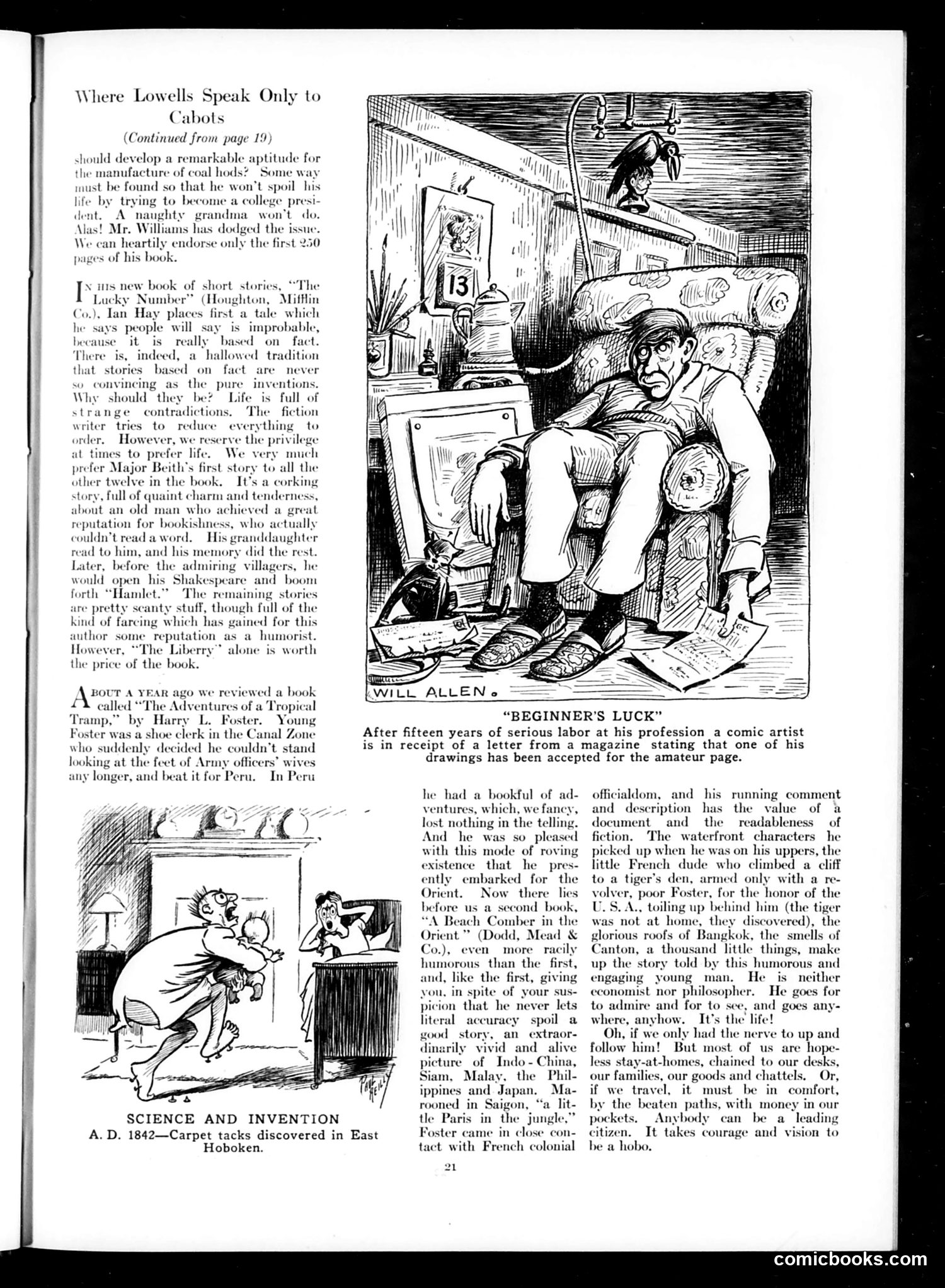
This page contains book reviews and commentary on contemporary literature, not political cartoons. The main content discusses: **"Where Lowells Speak Only to Cabots"** — A critique of a novel by Mr. Williams about class mobility. The reviewer objects that the protagonist implausibly becomes a college president; they endorse only the first 250 pages. **Ian Hay's "The Lucky Number"** — Praised for its first story about an old man with a false reputation for literacy whose granddaughter actually does his reading. The reviewer prefers this to Hay's other humorous tales. **Harry L. Foster's "A Beach Comber in the Orient"** — A travel narrative praised for vividly depicting Indo-China, Siam, and the Philippines through encounters with colorful colonial characters and scenes, despite potentially exaggerating details. **"Beginner's Luck"** (cartoon by Will Allen) shows a struggling cartoonist finally receiving acceptance from a magazine's amateur page after 15 years of professional work—a commentary on artistic struggle and rejection. The page reflects early 20th-century literary tastes and publishing standards.
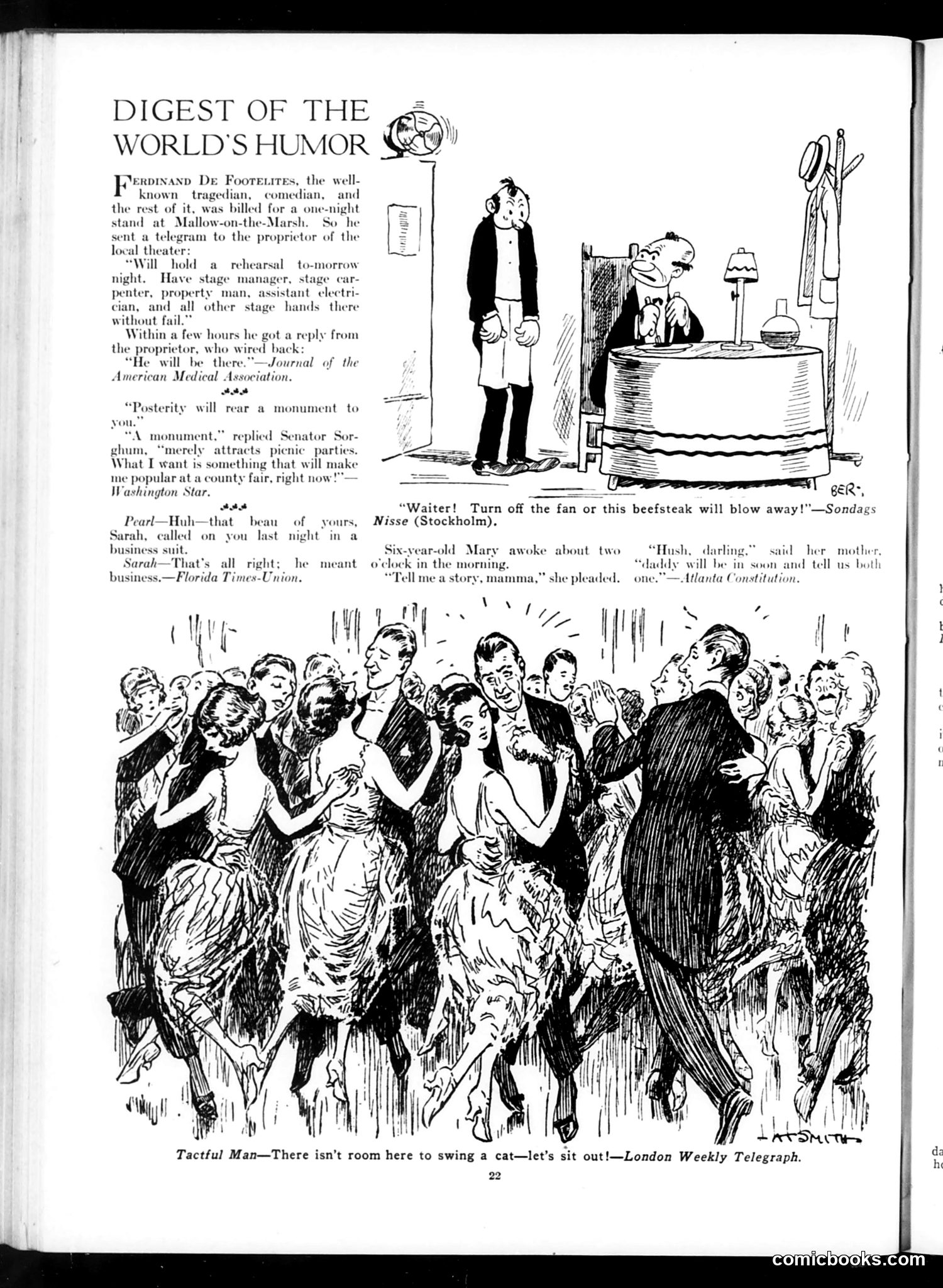
This page collects brief humorous anecdotes from various international publications, arranged around two cartoons. **Top cartoon**: A waiter at a dining establishment, where the fan is so powerful it threatens to blow away a patron's beefsteak—satirizing either excessively enthusiastic service or absurdly powerful ventilation. **Bottom cartoon** (credited to a signature): A crowded ballroom scene where people are packed so tightly the caption reads "Tactual Man—There isn't room here to swing a cat—let's sit out!" This mocks overcrowded social events where dancing becomes physically impossible due to the crush of attendees. The textual humor includes medical/professional ironies (a theater owner assuring a visiting actor that all staff will materialize) and domestic jokes about children and courtship conventions. The page represents *Judge*'s format of reprinting witticisms from American and European sources, emphasizing physical comedy and social observation typical of early 20th-century humor magazines.
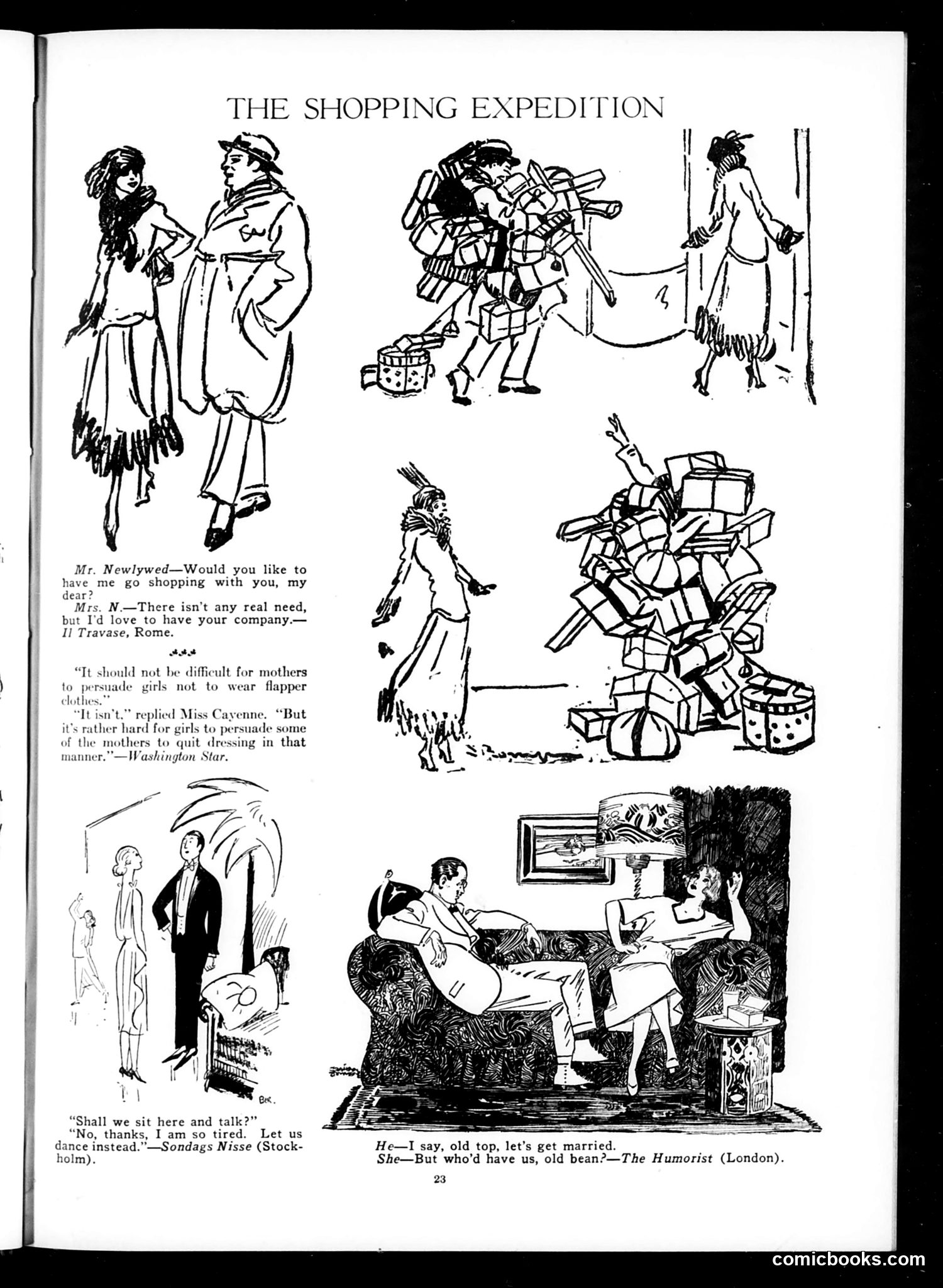
This page collects humorous international cartoons mocking modern courtship and marriage customs, circa the 1920s flapper era. **Central theme:** The absurdity of young women's newfound independence and changing social roles. A newlywed husband offers to accompany his wife shopping—a reversal of traditional male authority. The wife accepts out of politeness rather than necessity, satirizing how modern couples navigate unfamiliar domestic dynamics. **Running commentary** from various international sources critiques: - **Fashion rebellion**: Girls resisting mothers' pressure to abandon "flapper clothes" (short, loose dresses) - **Dating behavior**: Women preferring dancing to conversation—mocking younger generations' restlessness - **Marriage prospects**: A couple so undesirable that neither believes anyone would accept them The cartoons collectively satirize post-WWI social upheaval: women's increased autonomy, changing fashion, and evolving courtship rituals puzzled traditional society. The international sourcing (Rome, Stockholm, Washington, London) suggests this generational anxiety was widespread.
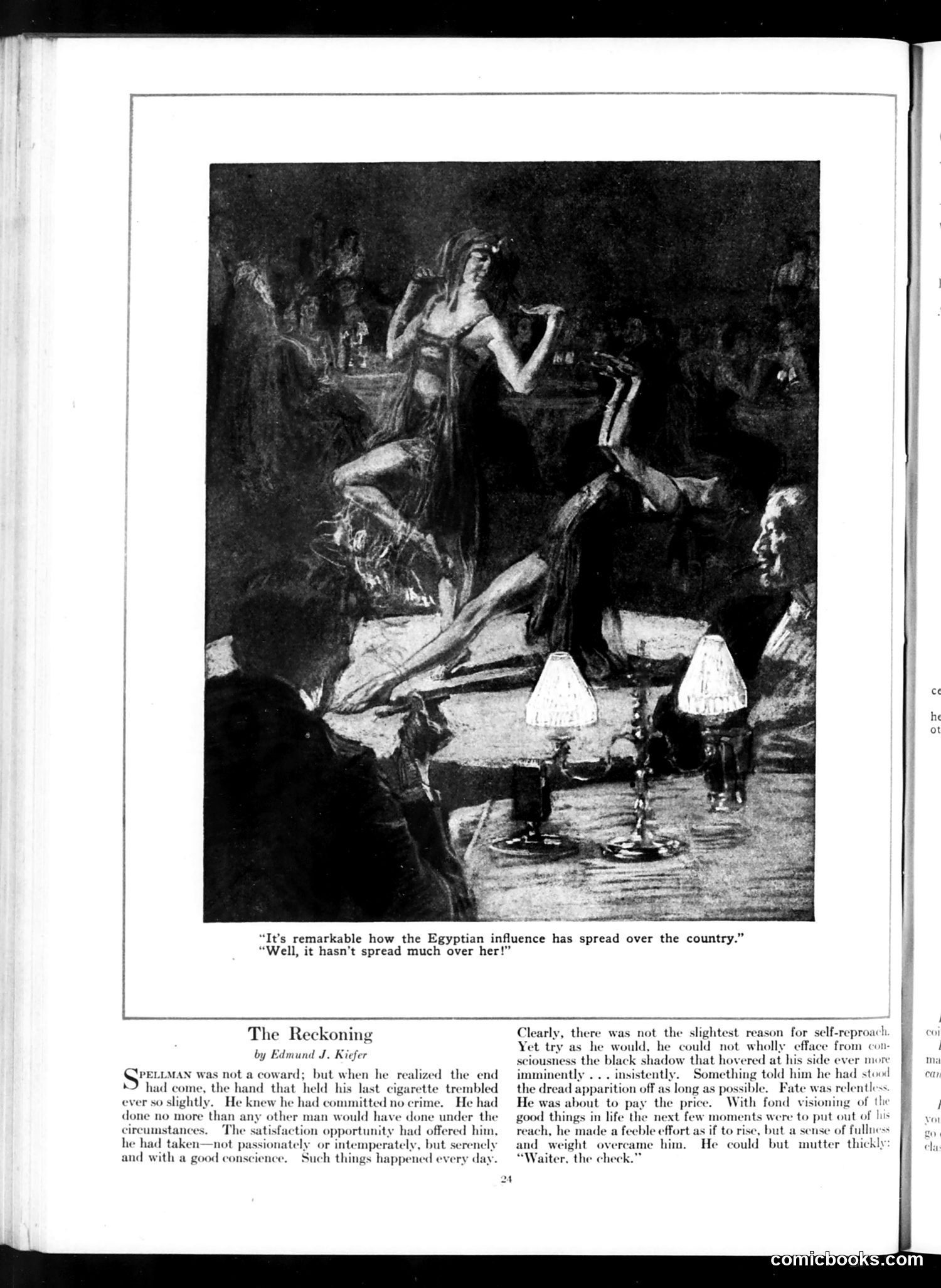
This page contains two separate pieces from Judge magazine: **Top cartoon:** A joke about "Egyptian influence" in fashion/culture. A woman in Egyptian-style dress is shown dancing or posing at what appears to be a social gathering. The humor plays on the 1920s Egyptian revival trend (likely sparked by King Tutankhamun's tomb discovery in 1922), with the punchline suggesting this particular woman hasn't adopted the fashion herself—implying she's either too old, too plain, or otherwise unsuitable for the trend. **Bottom story:** "The Reckoning" by Edmund J. Kiefer is a short fiction piece about a man named Spellman facing consequences for past actions. Despite claiming he committed no crime and acted with good conscience, he experiences mounting dread and guilt. The story ends darkly: his final words to a waiter are "the check"—suggesting either death or financial ruin arrives as his day of judgment.
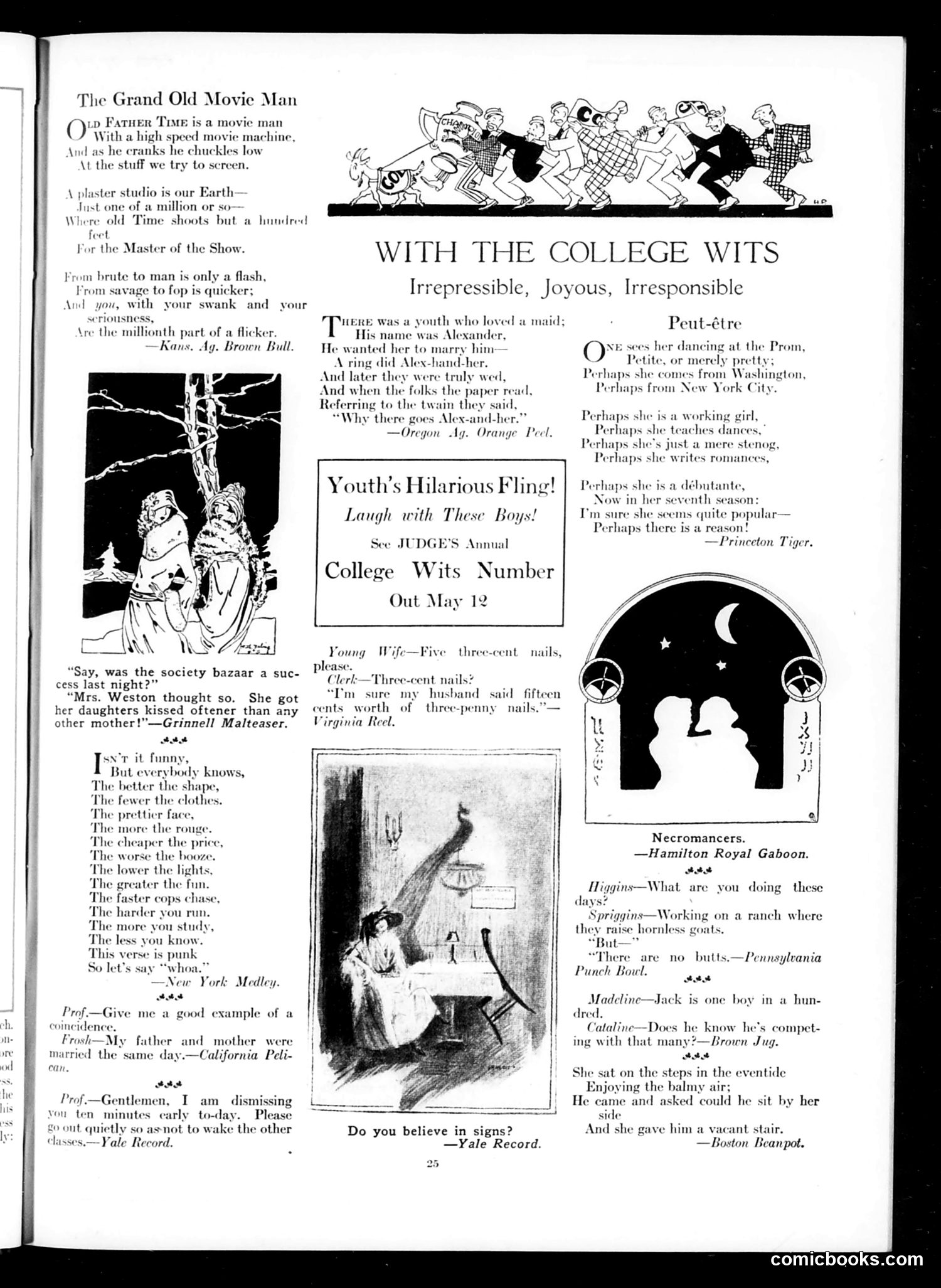
This page combines film commentary with college humor typical of early 20th-century Judge magazine. **"The Grand Old Movie Man"** (top left) uses "Father Time" as a metaphor for cinema itself—personifying time as a projectionist cranking film stock. The satire suggests that human existence, from "brute to man," unfolds as rapidly as movie footage. The poem mocks human pretension: our "swank and seriousness" amount to merely "the millionth part of a flicker"—a philosophical jab at mortality and humanity's insignificance. **The college humor section** ("With the College Wits") showcases typical campus jokes from various universities (Princeton Tiger, Yale Record, etc.). These include mild wordplay (the "Alexander/Alex-and-her" marriage pun), flirtation commentary, and domestic humor about working girls and debutantes—reflecting 1920s social attitudes about women's roles. **"Youth's Hilarious Fling!"** advertises Judge's upcoming College Wits annual issue, capitalizing on the era's college humor magazine trend. The overall tone: satirical commentary on modernity mixed with lighthearted collegiate banter—standard Judge fare for educated, urban readers.
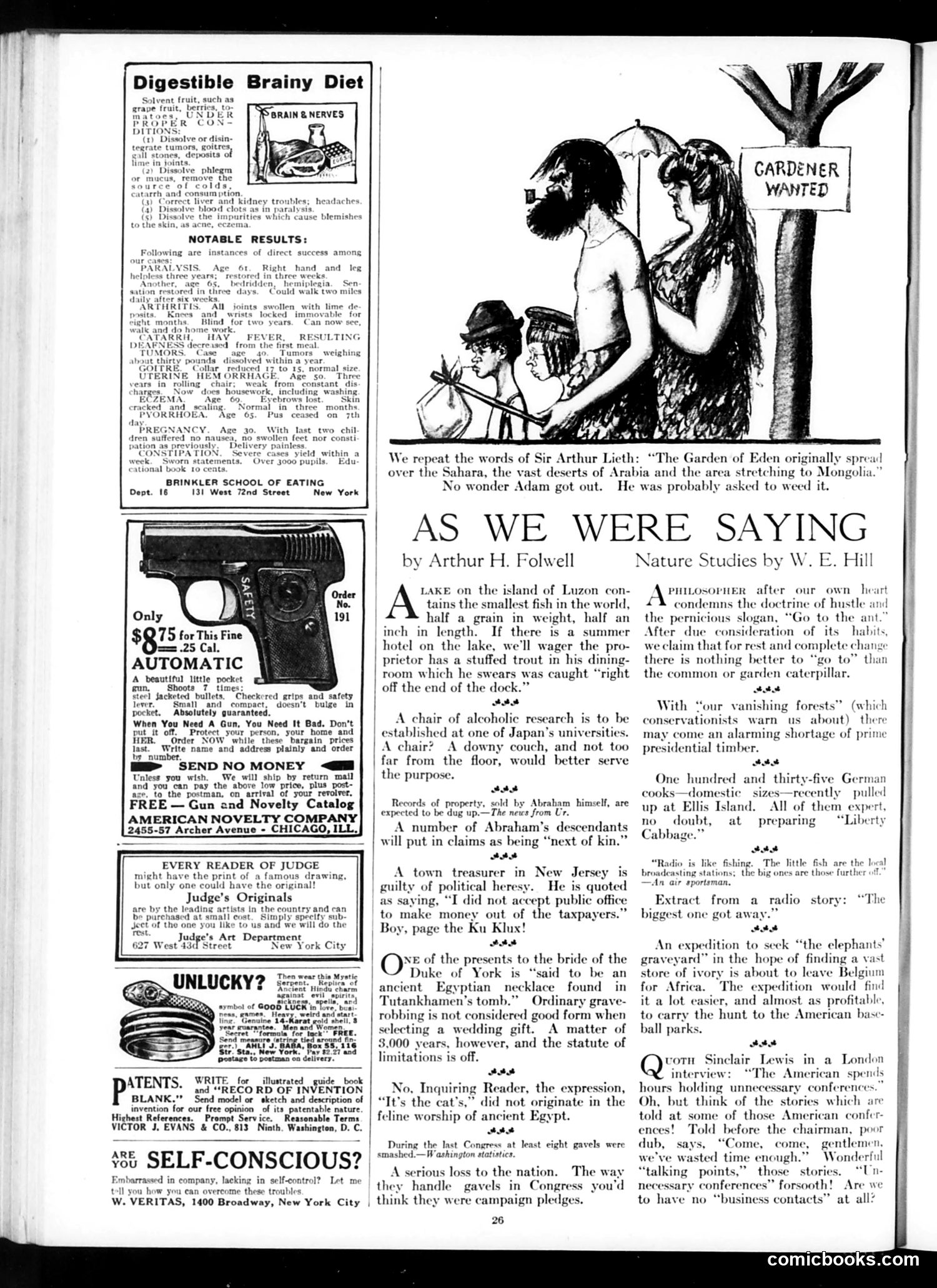
This page from the satirical magazine *Judge* contains mostly **advertisements and miscellaneous content** rather than coherent political cartoons. The main visual element shows a tree with a "Gardener Wanted" sign and figures beneath it, accompanying an article titled "As We Were Saying" by Arthur H. Folwell. The accompanying text humorously references the Garden of Eden, sarcastically suggesting Adam was asked to weed it—implying the task was so unpleasant he left. The article itself consists of **brief, disconnected satirical observations** about contemporary life: the smallest fish in Luzon, an alcoholic research chair at a Japanese university, a New Jersey treasurer who claims not to profit from office (mocked as heresy), ancient Egyptian necklaces as wedding gifts, and Congressional gavel-smashing. The page is primarily filled with **period advertisements** for self-help books, firearms, patents, and medical treatments—typical Judge magazine filler content. There is **no identifiable political cartoon with specific caricatured figures** on this page.
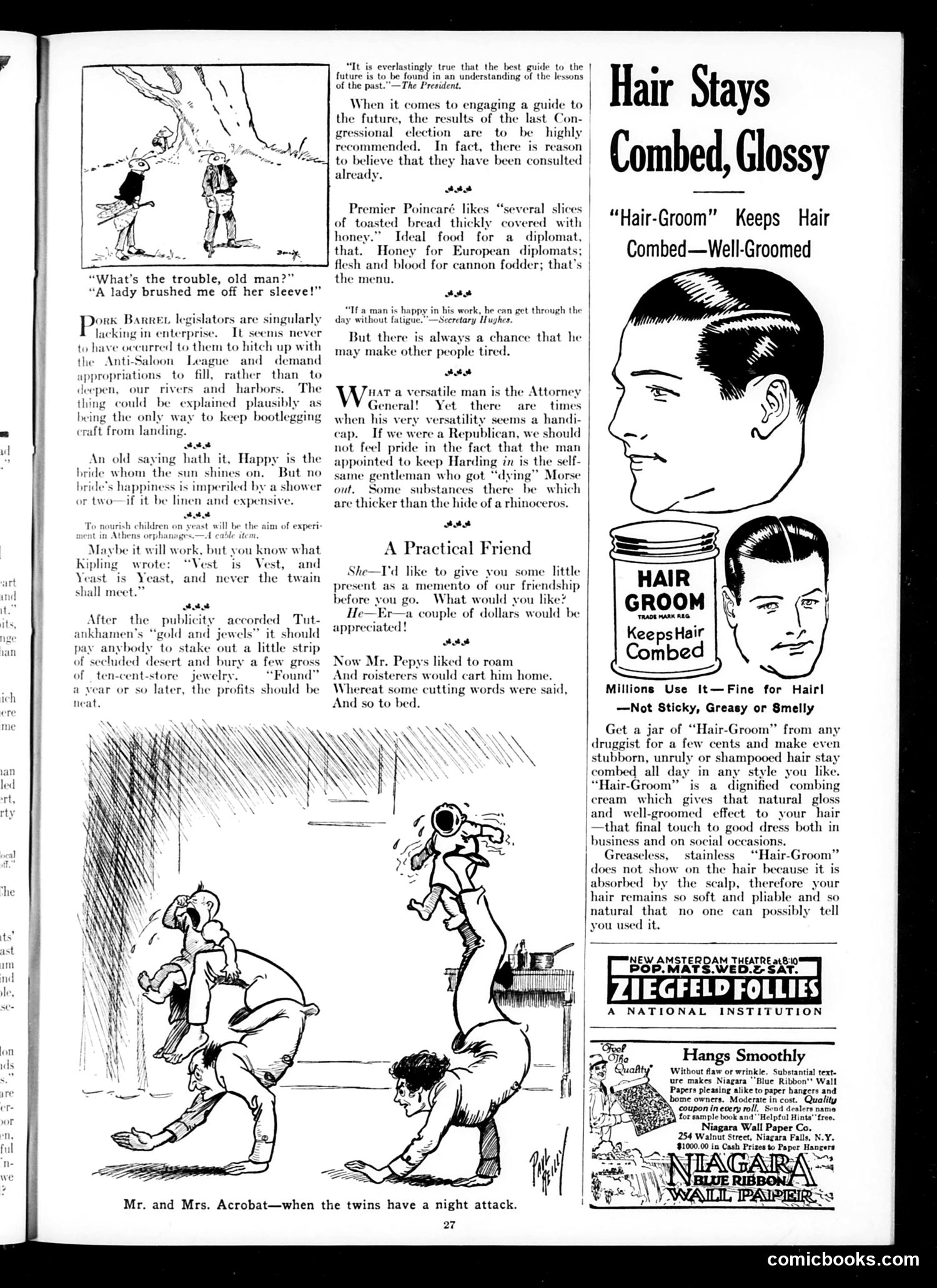
This page combines political commentary with period advertisements. The main satirical content addresses **recent Congressional election results** as a guide to understanding the future—likely referencing the 1920 elections that brought Republican Warren G. Harding to power after Woodrow Wilson's presidency. The short political quips mock various figures: **Premier Poincaré** (French leader) for his dining preferences, **Attorney General** (likely Harry Daugherty under Harding) for his questionable versatility in protecting the administration, and implicit criticism of the Harding administration's competence. The cartoon "Mr. and Mrs. Acrobat" depicts children doing acrobatic flips during a nighttime tantrum—a humorous domestic scene unrelated to politics. The page is primarily filled with **period product advertisements** for Hair-Groom (hair styling cream), Ziegfeld Follies theater, and Niagara wallpaper—typical Judge magazine content mixing satire with commercial revenue.
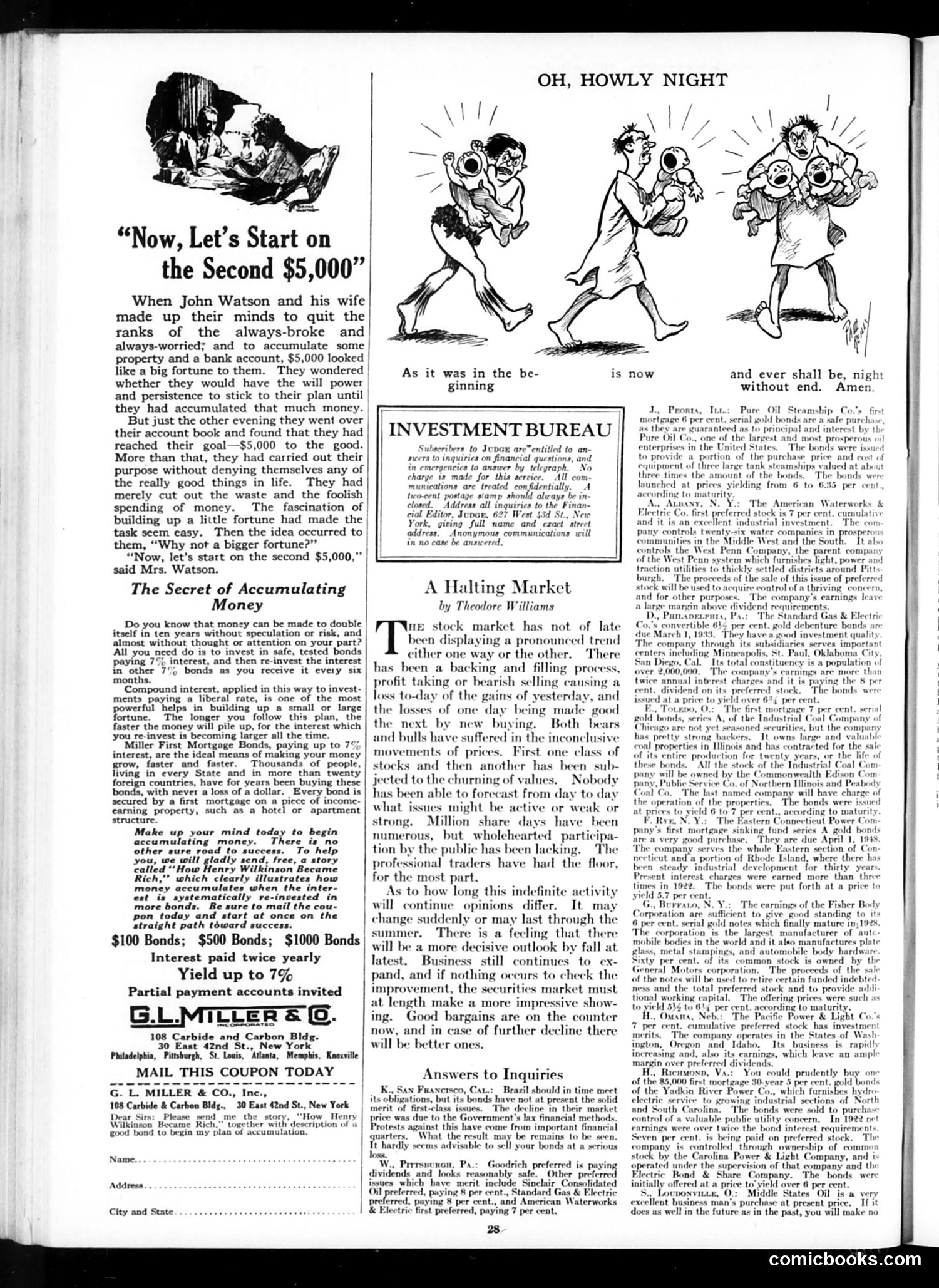
This Judge magazine page contains two satirical narratives about money and finance: **"Now, Let's Start on the Second $5,000"** mocks the get-rich-quick mentality. A couple achieves their $5,000 savings goal through discipline, then immediately wants more—suggesting Americans' endless desire for wealth despite their difficulty accumulating it initially. **"The Secret of Accumulating Money"** is actually an advertisement disguised as financial advice, promoting G.L. Miller & Co.'s bonds. It uses the "compound interest" concept to lure readers, offering bonds paying 7% interest. The ad exemplifies how financial companies marketed investment products to ordinary people seeking wealth-building solutions. **"Oh, Howly Night"** (top right) appears to be a separate cartoon showing figures juggling or struggling with multiple babies or objects—likely satirizing the burden of supporting large families or financial obligations. The page satirizes both consumer aspiration and financial industry marketing tactics of the era, showing how Americans were sold investment dreams.
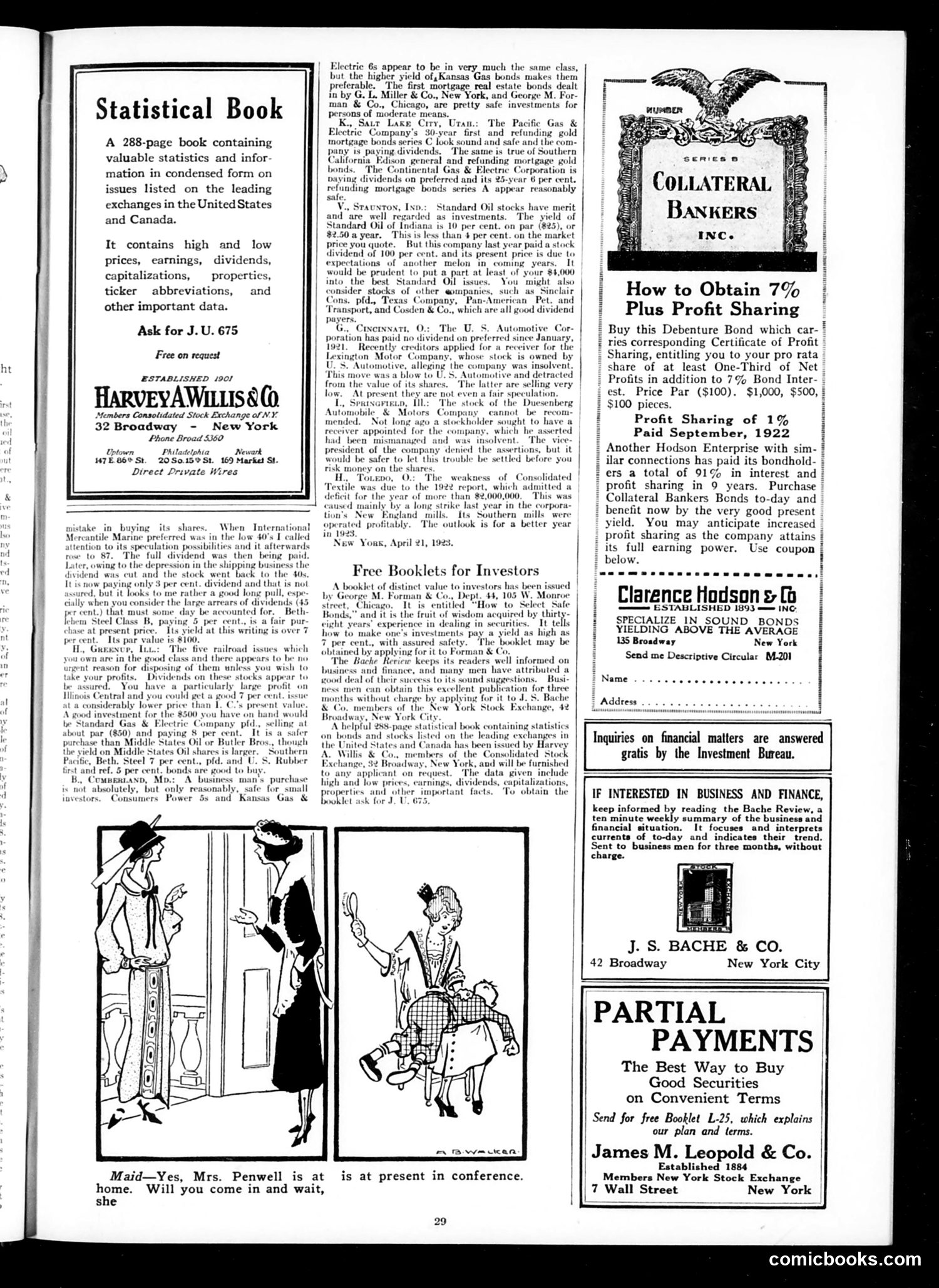
This page is primarily **financial advertising** rather than satire or political commentary. It consists of investment firm advertisements and a statistical book promotion. The only cartoon appears at bottom-left: a three-panel domestic scene showing a maid informing her employer "Mrs. Penwell is at home. Will you come in and wait, she is at present in conference." The joke is a simple social comedy about domestic hierarchy—the wealthy Mrs. Penwell is occupied with visitors while her guest waits, illustrating class dynamics and the formality of 1920s social etiquette. It's not political satire but rather gentle humor about upper-class social rituals. The advertisements feature financial services (Harvey A. Willis & Co., Collateral Bankers Inc., J.S. Bache & Co., James M. Leopold & Co.) promoting bonds, debentures, and stock investments—typical of Judge's revenue model and reflecting 1923's pre-Depression investment culture.
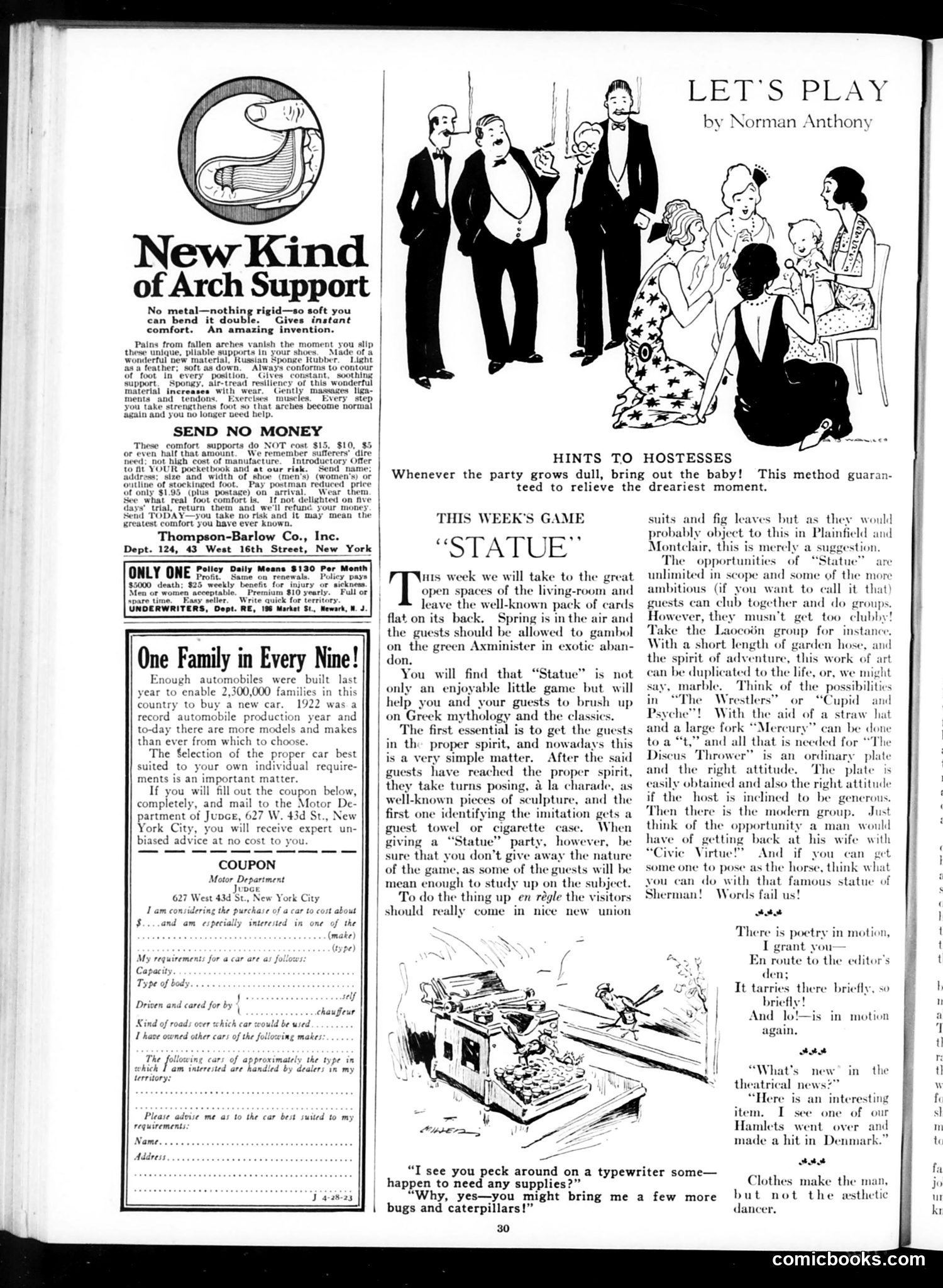
This is primarily an **advertising and entertainment page** from Judge magazine, mixing ads with party game content. The left side contains two product advertisements: arch support insoles (mail-order, no payment required upfront) and automobiles (promoting the booming 1920s car market—"One Family in Every Nine"). The right side features **"Let's Play" by Norman Anthony**, a party game column. The main feature is "Statue," a parlor game where guests pose as classical sculptures for others to identify. The humor relies on 1920s sophistication: sophisticated guests understood Greek mythology and classical art, so the game offers both intellectual exercise and physical comedy (guests awkwardly mimicking famous statues in living rooms). The cartoon illustrates well-dressed adults and women in a social setting, typical of upper-middle-class entertainment. A small joke at bottom depicts typewriter humor—someone asking if the writer needs supplies, offering "bugs and caterpillars," a sarcastic reference to typewriter malfunctions. The content reflects prosperous 1920s leisure culture and genteel parlor entertainment.
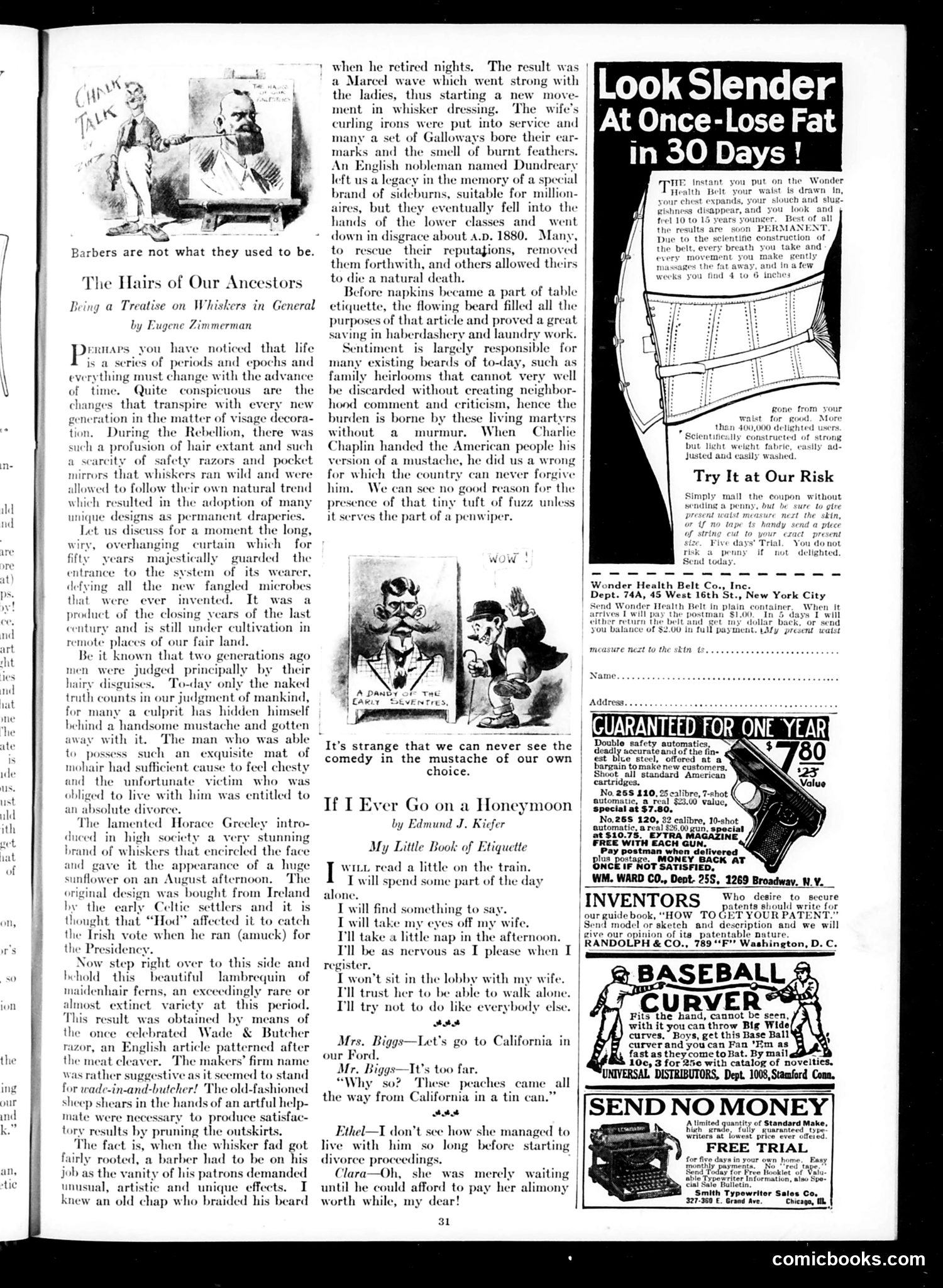
This is a humorous historical essay by Eugene Zimmerman mocking changing facial hair fashions across generations. The text contrasts the elaborate beards and mustaches of the Civil War era with modern (early 20th century) clean-shaven styles. The satire targets: 1. **Vanity and masculine pride**: Men judged themselves by facial hair complexity; one man allegedly braided his beard nightly, creating fashionable waves to impress women. 2. **Obsolete grooming technology**: References to "Wade & Butcher" razors and sheep shears joke about primitive barbering tools. 3. **Class pretension**: Elaborate sideburns ("Galloways") filtered downward from millionaires to "lower classes," suggesting fashion's arbitrary social markers. 4. **Sentiment over sense**: Modern men maintain old-fashioned beards purely from habit or nostalgia. The piece concludes by criticizing Charlie Chaplin's famous mustache, suggesting even celebrities perpetuate dated facial hair trends. The cartoons show exaggerated whisker styles from different eras, emphasizing how absurd these once-serious fashion statements appear in retrospect.
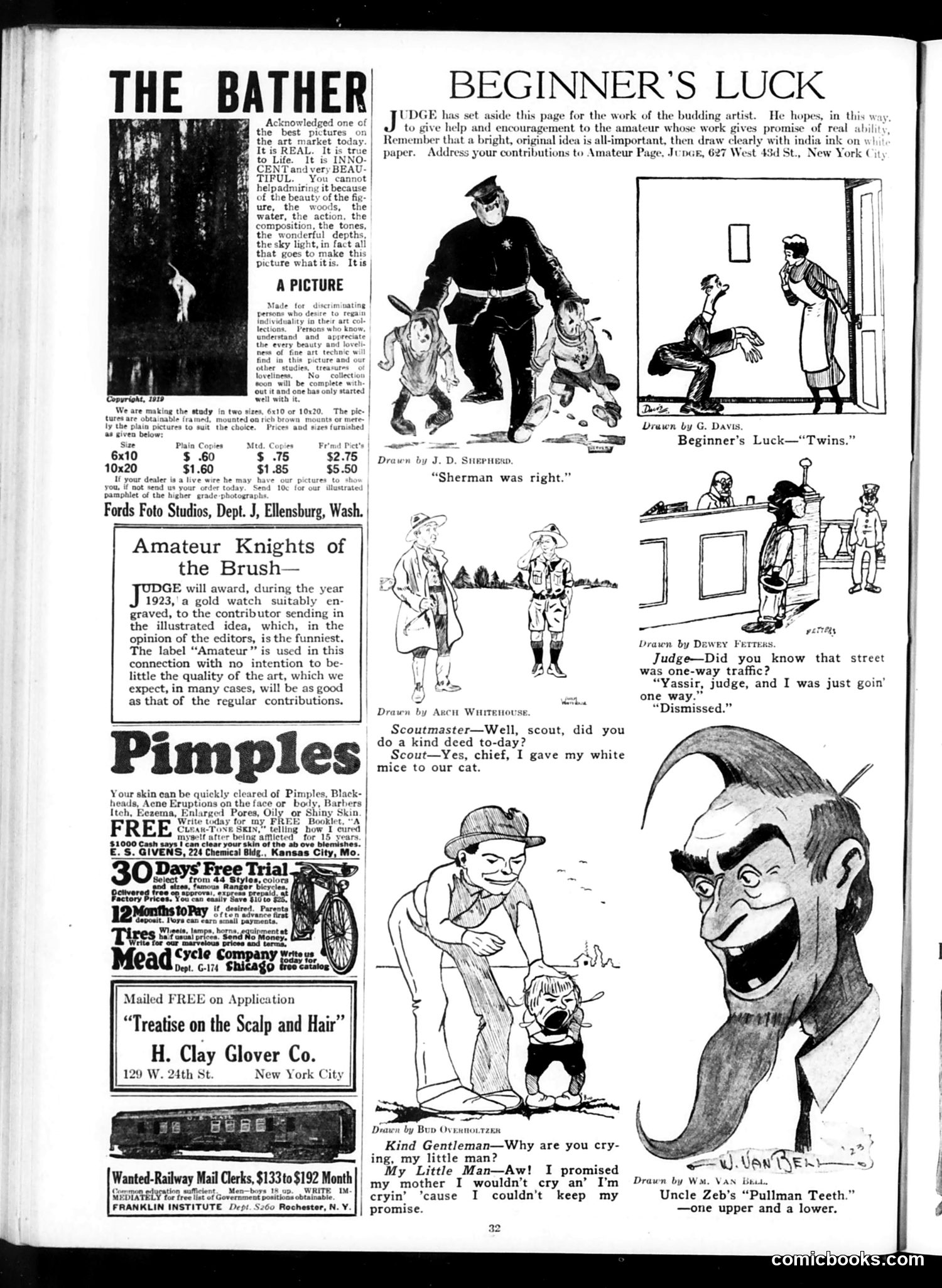
This page from Judge magazine (circa 1923) showcases humor cartoons and advertisements typical of the era. **"Beginner's Luck" section:** Features amateur cartoonists' submissions. The jokes are simple, visual gags: "Twins" shows a policeman struggling with two mischievous children; "Sherman was right" depicts traffic confusion (likely referencing General Sherman's Civil War march—a dated historical reference); the street-traffic cartoon involves a Black man (depicted with period-typical racist caricature) claiming innocence about one-way traffic; the Scout joke plays on literal interpretation (giving white mice to a cat as a "kind deed"). **Advertisements:** The page is heavily padded with ads for pimple treatments, hair products, bicycles, and railroad clerk training—typical commercial content of 1920s magazines. **Context:** Judge was a satirical publication aimed at educated, urban audiences. The "Amateur Knights of the Brush" section encouraged reader submissions, democratizing cartooning while maintaining editorial standards.
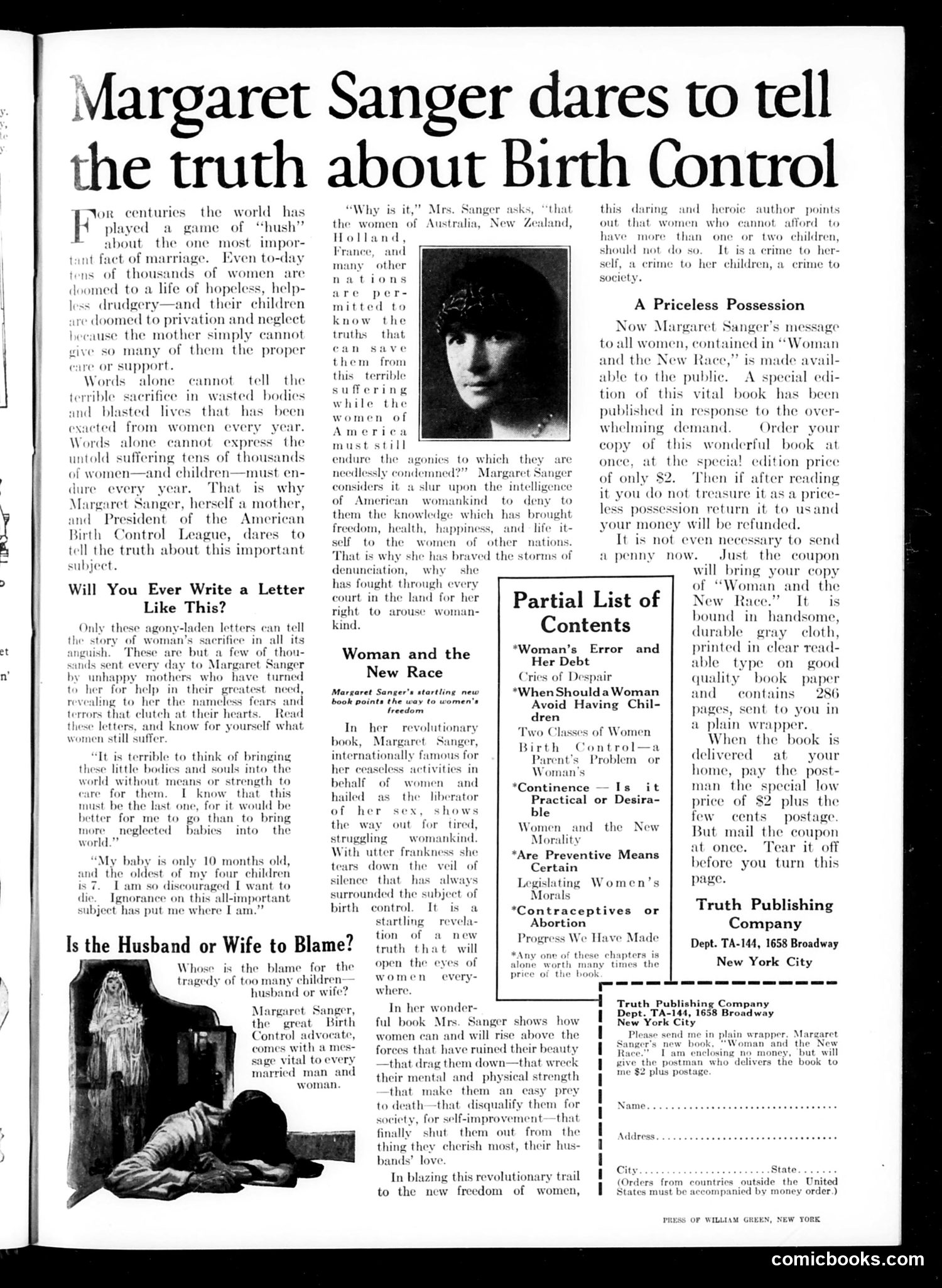
This page promotes Margaret Sanger's birth control advocacy book, "Woman and the New Race." The satire criticizes society's silence around contraception and its consequences. **The figures:** Margaret Sanger (photographed) is the Birth Control League president advocating for women's reproductive freedom. The illustration below shows a suffering mother with children, representing women trapped in poverty by unwanted pregnancies. **The social references:** The page contrasts women in prosperous nations (Australia, New Zealand, France) who have access to family planning with American women denied this knowledge. It frames birth control as a moral issue—a "crime" against children and society to bear more offspring than families can support. **The satire's point:** Judge magazine here supports Sanger's radical claim that women deserve contraceptive information. The "hush" about marriage's realities and the untold suffering of overburdened mothers represent societal hypocrisy. By publishing readers' heartbreaking letters, the magazine shames America's prudish silence on reproductive rights.
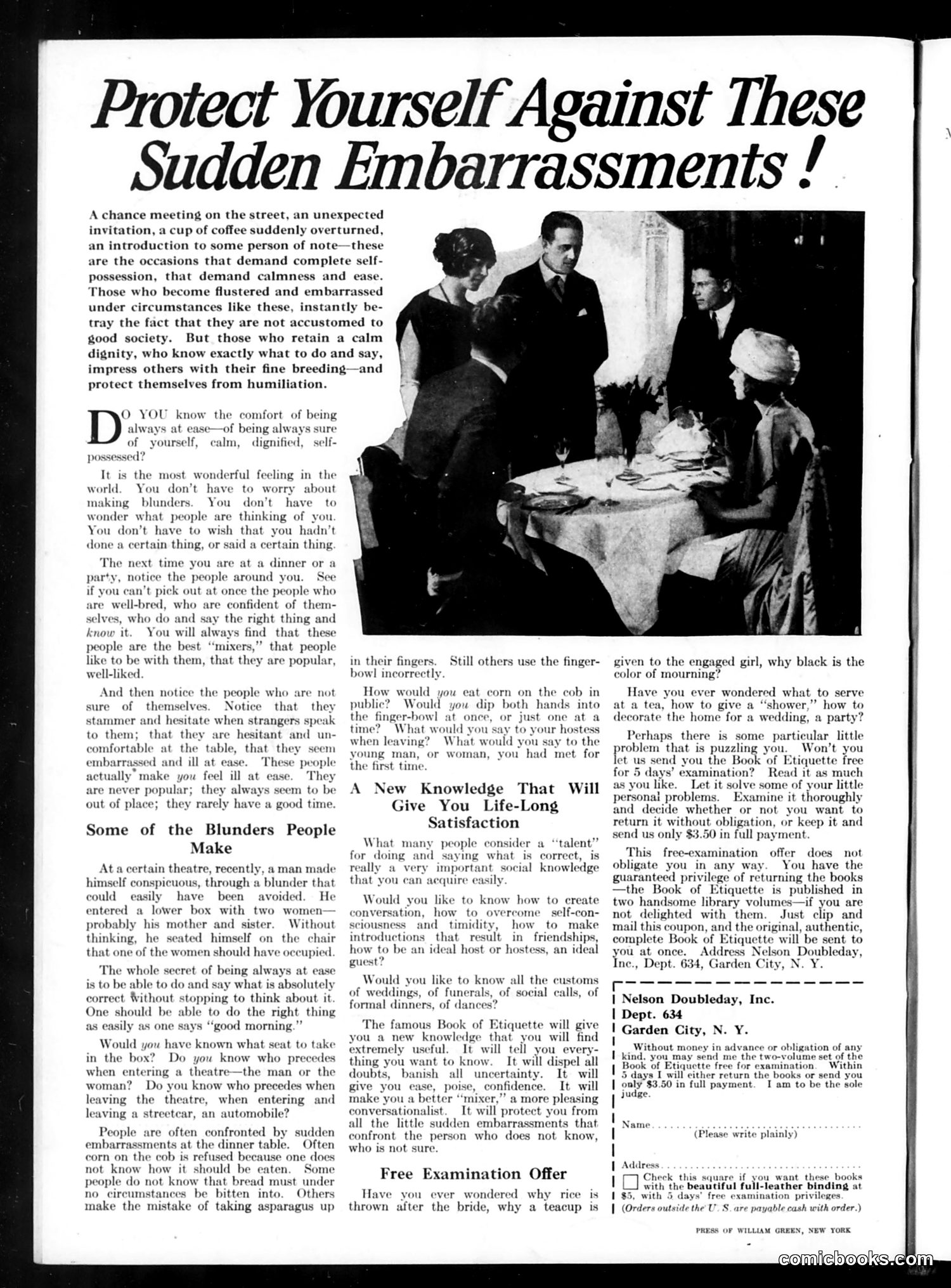
This is primarily an **advertisement disguised as editorial advice**, not a political cartoon. The page promotes "The Book of Etiquette" by Nelson Doubleday, Inc., framed as a self-help guide for social anxiety. The accompanying photograph shows a dinner party scene illustrating social embarrassment—likely depicting someone committing a breach of etiquette while others observe with disapproval. **The pitch**: The text argues that "well-bred" people maintain composure in awkward situations (spilled coffee, theater seating, eating corn on the cob), while "poorly bred" people become flustered and unpopular. This anxiety-based marketing exploits early 20th-century class anxieties about proper behavior. **The satire/irony**: Judge magazine, known for social commentary, appears here to be selling the very conformity and class-consciousness it often mocked—promoting etiquette as the path to social acceptance and self-worth, a commentary on American anxieties about respectability and "breeding."