
Judge, 1923-04-28 · page 4 of 36
Judge — April 28, 1923 — page 4: what you’re looking at
What you’re looking at
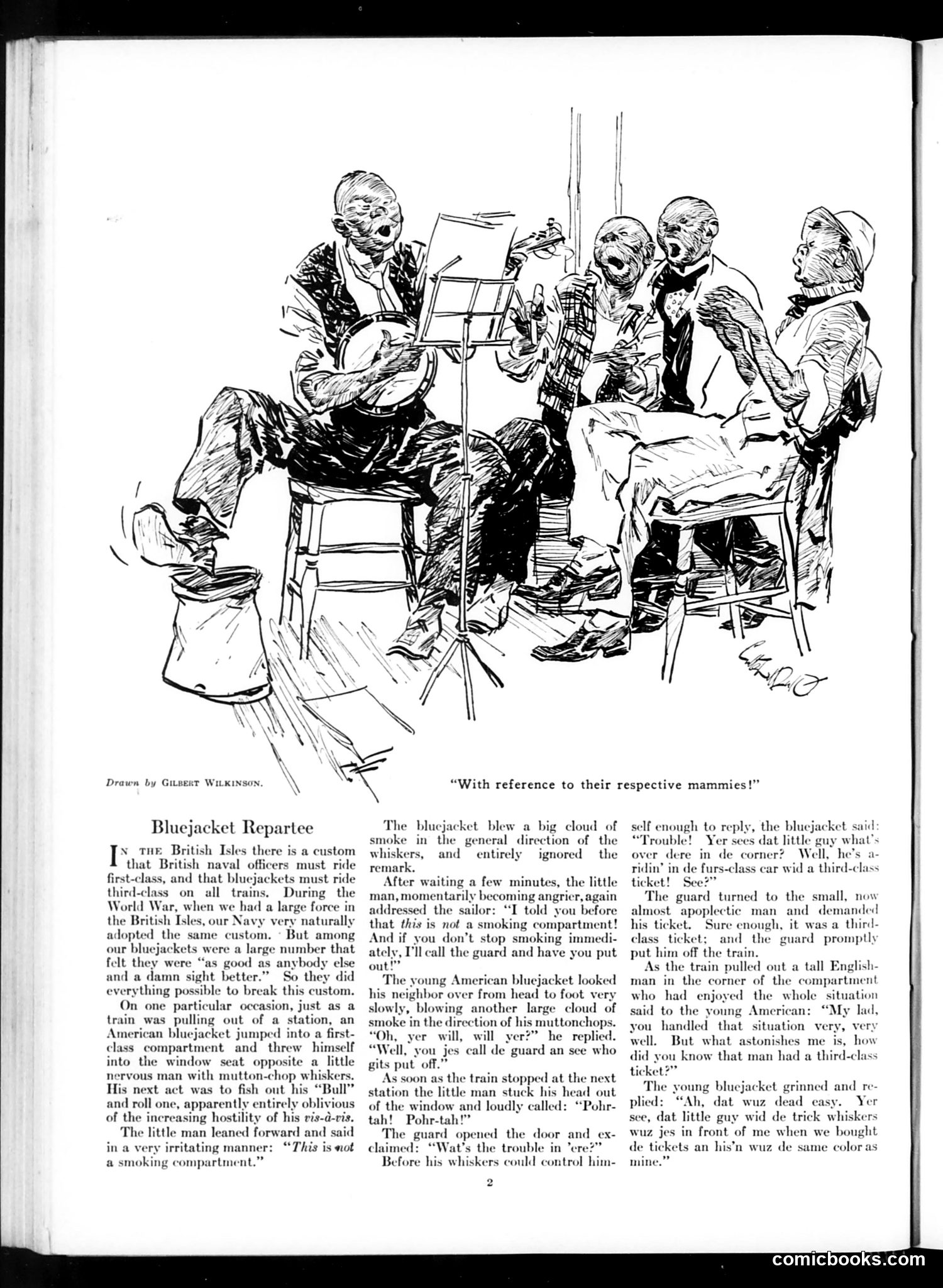
This illustrated story depicts a confrontation between American and British naval officers (bluejackets) in a first-class train compartment. The satire centers on a conflict over smoking: an American sailor smokes despite British objections, citing his first-class ticket as justification. When a British guard attempts enforcement, the American responds with quick wit, ultimately suggesting the guard's ticket is counterfeit. The humor relies on period tensions between American and British naval culture. The "bluejacket" custom referenced—that British sailors consider themselves superior—is mocked through the American's irreverent confidence and linguistic play. The story plays on national stereotypes: stuffy British formality versus brash American egalitarianism, suggesting Americans would not defer to arbitrary class hierarchies even during the World War era referenced in the text.
📄 Transcribed text from this page (OCR, searchable)
Machine-transcribed from the original scan — historical spelling and the odd misread are preserved.
Drawn by Gitpert WILKINSON. Bluejacket Repartee tHE British Isles there is a custom Ss must ride sts must ride During the large force in s, and that bluejac lass on all trains. World War, when we the British Isles, our N ry naturally adopted the same cust But among jackets were a large number that felt they were “as good as anybody else and a damn sight better.” So they did everything possible to break this custom. On one particular occasion, just as a train was pulling out of a station, an American bluejacket jumped into a first- class compartment and threw himself into the window seat opposite a little nervous man with mutton-chop whiskers. and roll one, apparently entirely of the increasing hostility of his vis-d-vis. The little man leaned forward and said in a very irritating manner: “This is not a smoking compartment.” “With reference to their respective mammies!” The bluejacket blew a big cloud of smoke in the general direction of the whiskers, and entirely ignored — the remark, After waiting a few minutes, the little man, momentarily becoming angrier, again addressed the sailor: “I told you before that this is not a smoking cc And if you don’t stop smoking immedi- ately, I'll call the guard and have you put out!” The young American bluejacket looked his neighbor over from head to foot very plowing another large cloud of in the direction of his muttonchops. yer will, will yer?” he replied. “Well, you jes call de guard an see who gits put off.” As soon as the train stopped at the next station the little man stuck his of the window and loudly called: tah! Pohr-tah! The guard opened the door and ex- claimed: “Wat's the trouble in ’ere?” Before his whiskers could control him- f enough to reply, the bluejacket said ‘rouble! Yer sees dat little 5 over dere in de corner? Well ridin’ in de furs-class car wid a third-« ticket! See?” The guard turned to the small, now almost apoplectic man and demanded his ticket. Sure enough, it was a third- class ticket; and the guard promptly put him off the train. As the train pulled out a tall English- man in the corner of the compartment who had enjoyed the whole situation said to the young America Ty lad, you handled that situation very, very well. But what astonishes me is, how did you know that man had a third-class ticket?” The young bluejacket grinned and re- plied: “Ah, dat wu: y. Ye see, dat little guy wid de trick whiskers wuz jes in front of me when we bought de tickets an his’n wuz de same color as mine.” dead ¢ comicbooks.com