
Judge, 1923-04-28 · page 21 of 36
Judge — April 28, 1923 — page 21: what you’re looking at
What you’re looking at
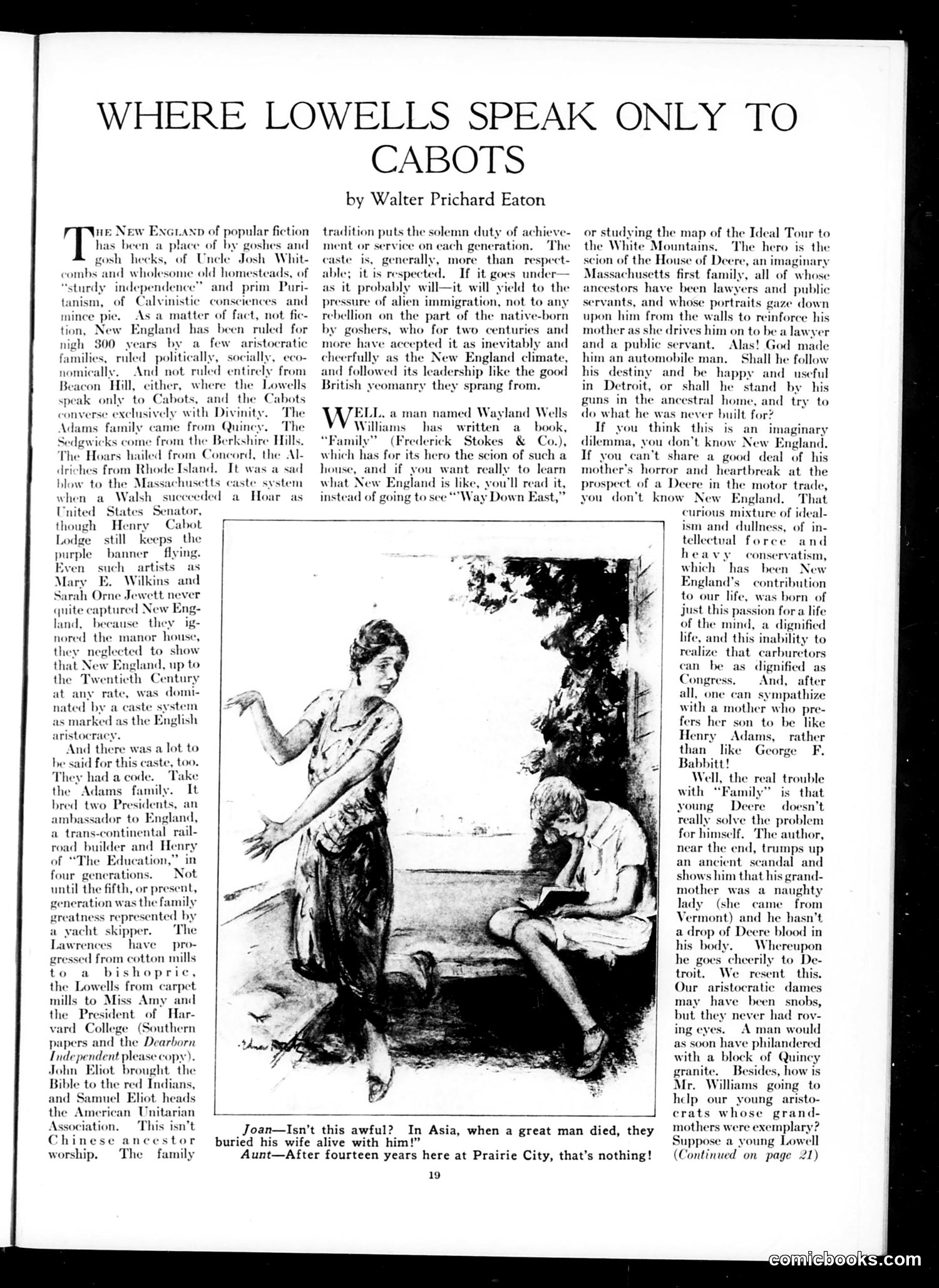
This article satirizes New England's rigid aristocratic class system, particularly Boston's Brahmin families (Lowells, Cabots, Adamses, Sedgwicks). The famous phrase "Lowells speak only to Cabots, and Cabots converse exclusively with Divinity" encapsulates the exclusivity of these old-money families who dominated Massachusetts politically and socially for three centuries. The accompanying illustration depicts a woman (representing old New England tradition) instructing children in proper aristocratic behavior. The text criticizes how this inherited caste system pressures descendants—like the fictional Deere family protagonist—to follow predetermined paths (law, public service) rather than pursue personal ambitions (automobile manufacturing). The satire's target: the suffocating rigidity of hereditary privilege and its inability to adapt to modern American social mobility. The author suggests this rigid class structure, though historically significant, is ultimately doomed by immigration and changing values.
📄 Transcribed text from this page (OCR, searchable)
Machine-transcribed from the original scan — historical spelling and the odd misread are preserved.
WHERE LOWELLS SPEAK ONLY TO ne New ENGtanp of popular fiction | has been a place of by goshes and s, of Unele’ Josh Whit- some old homesteads, of “sturdy independence” and prim) Puri- tanism, of Calvinistic consciences and mince pie. As a matter of fact, not fic- tion, New England has been ruled for nigh 300 years by a few aristocratic families, ruled politically, socially, eco- nomically. And not ruled entirely from Beacon Hill, either, where the Lowells speak only to Cabots, and the Cabots converse exclusively with Divinity. The Adams family came from Quincy. The Sedgwicks come from the Berkshire Hills. The Hoars hailed from Concord, the Al- driches from Rhode Island. It was a sad blow to the Massachusetts caste system when a Walsh Hoar United States Senator, gosh h combs and whe suceceded a CABOTS by Walter Prichard Eaton tradition puts the solemn duty of achieve- ach generation, ‘The caste is, gene + more than respect- able; it is respected. If it goes under— as it probably will—it will yield to the pressure of alien immigration, not to any rebellion on the part of the native-born by goshers, who for two centuries and more | necepted it as inevitably and cheerfully as the New England climate, and followed its leadership like the good British yeomanry they sprang from. a man named Wayland Wells ns has written a book, (Frederick Stokes & Co.), n of such a ally to learn -ou'll read it, y Down East,” ment or service on “Family” which has for its hero the and if you want what New England is lik instead of going to sce“ W house, or studying the map of the Ideal Tour to the White Mountains. The hero is the scion of the House of Deere, an imaginary Massachusetts first family, all of whose cestors have been law: id public servants, and whose portraits gaze down upon him from the walls to reinforce his mother as she drives him on to be a lawyer and a public servant. Alas! God made him an automobile man. Shall he follow his destiny and be happy and_ useful in Detroit, or shall he stand by his guns in the ancestral home, and try to do what he was never built for? If you think this is an imaginary dilemr you don’t know New England. If you can’t share a good deal of his mother’s horror and heartbreak at the prospect of a Deere in the motor trade, you don’t know New England. That curious mixture of ideal- though Henry Cabot — [ Lodge still keeps the purple banner _ flying. Even such artists as \ E. Wilkins and Sarah Orne Jewett never quite captured New Eng- land, because they ig- nored the manor house, they neglected to show that New England, up to the Twentieth Century was domi- at any ri nated by a caste system as mark the English aristocrac And there was a lot to be said for this caste, too, They had a code. Take the Adams family. It bred two Presidents, an ambassador to England, a trans-continental road builder and Henry of “The Education,” in four generations. Not until the fifth, or present, generation was the family tness represented by gre a yacht skipper. The Lawrences have — pro- gressed from cotton mills to a bishopric, the Lowells from carpet mills to Miss Amy and the President of Har- vard College (Southern papers and the Dearborn Independent please copy). John Eliot brought the Bible to the red Indians, and Samuel Eliot heads ] ism and dullness, of in- tellectual force and heavy conservatism, which has been N. England’s contribution to our life, was born of just this passion for a life of the mind, a dignified life, and this inability to realize that carburetors can be as dignified as Congress. And, after all, one can sympathize with a mother who pre- fers her son to be like Henry Adams, rather than like George F. Babbitt! Well trouble with “Fa is that young Deere doesn’t really solve the problem for himself. The author, near the end, trumps up an ancient scandal and shows him that his grand- mother was a naughty lady (she came from Vermont) and he hasn’t a drop of Deere blood in his body. Whereupon he goes cheerily to De- troit. We resent this. Our aristocratic dames may have been snobs, but they never had roy- ing eyes. A man would as soon have philandered with a block of Quinc granite. Besides, how is Mr. Williams going to hdlp our young aristo- crats whose grand- the American Unitarian L Association. — This isn’t Chi neestor worship. The family se Joan—Isn’t this awful? buried his wife alive with him!” Aunt—After fourteen years here at Prairie City, that’s nothing! 19 In Asia, when a great man died, they mothers were exemplary? Suppose a young Lowell (Continued on page 21)