
Judge, 1923-04-28 · page 12 of 36
Judge — April 28, 1923 — page 12: what you’re looking at
What you’re looking at
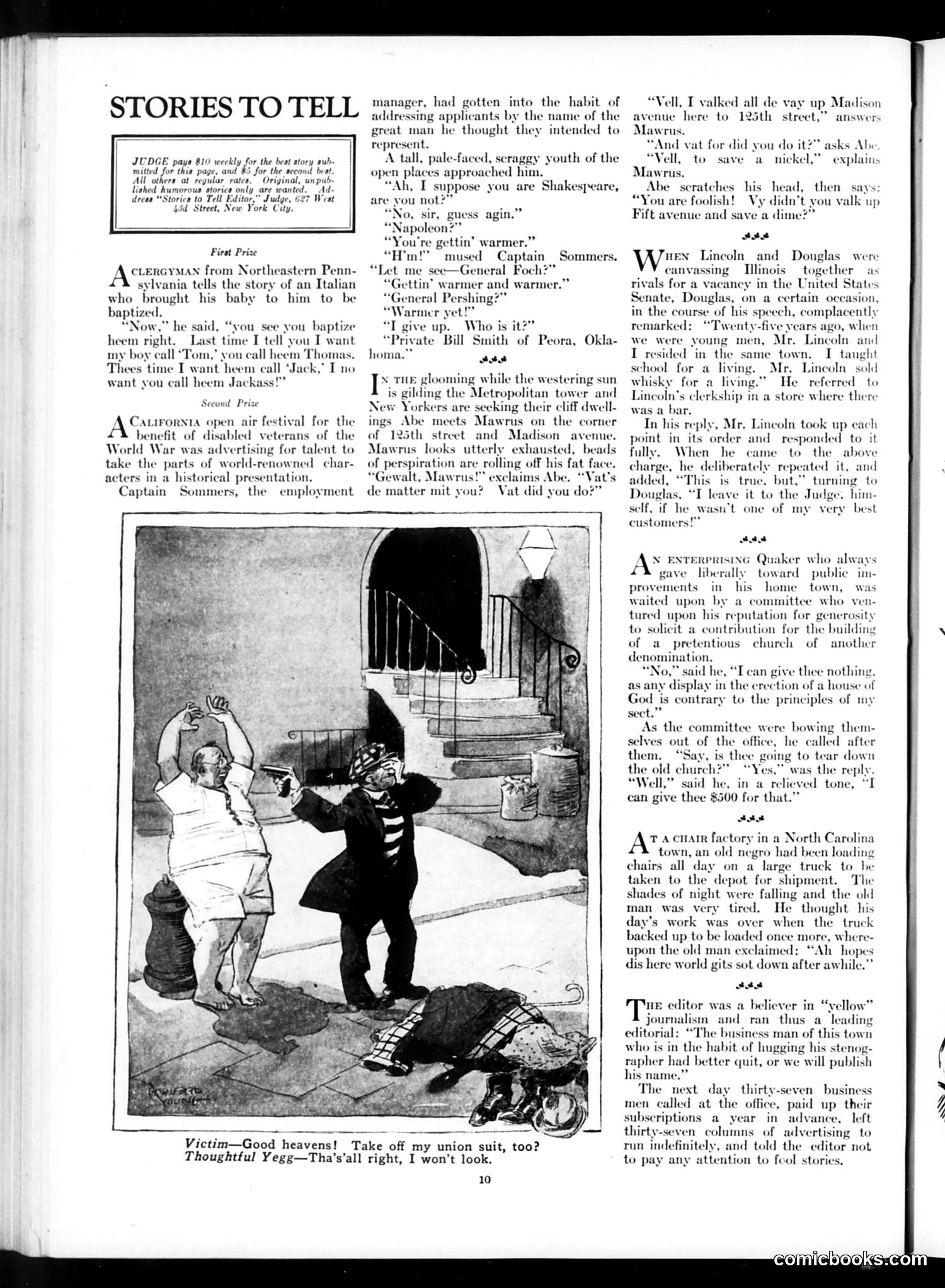
The main cartoon depicts a mugging or robbery scene. A victim (labeled "Victim") is being accosted by two figures—one appears to be a police officer or authority figure and another man. The victim exclaims, "Good heavens! Take off my union suit, too?"—suggesting he's being stripped of his clothing and belongings. The joke satirizes labor unions and their aggressive tactics. The caption "Thoughtful Yegg" (yegg being slang for a criminal) references the victim's reluctant acceptance. The satire suggests unions were seen as predatory, extracting everything from workers—literally taking the clothes off their backs. This reflects early 20th-century anti-union sentiment, when Judge magazine frequently mocked organized labor as corrupt and exploitative. The surrounding "Stories to Tell" section contains various humorous anecdotes, unrelated to the main cartoon's political commentary on labor disputes.
📄 Transcribed text from this page (OCR, searchable)
Machine-transcribed from the original scan — historical spelling and the odd misread are preserved.
STORIES TO TELL JUDGE pays $10 weekly for the best story aub- mitted for this pay All others at regul d 85 for the second brat lished humorous sto dreas “Stories to Tell Firat Prize Acnaruan from Northeastern Penn- sylvania tells the story of an Italian who brought his baby to him to be baptized. " he said, “you see you baptize heem right. Last time I tell’ you I want my boy call ‘Tom,’ you call heem Thomas. Thees time I want’heem call ‘Jack,’ I no want you call heem Jackass!” Second Prize A Garona open air festival for the benefit of disabled veterans of the World War was advertising for talent to take the parts of world-renowned: char- acters in a historical presentation. Captain Sommers, the employment Victim—Good heavens! Take off my union suit, too? manager, had gotten into the habit of addressing applicants by the name of the great man he thought they intended to represent. A tall, pale-faced, scraggy youth of the open places approached him. “Ah, I suppose you are Shakespeare, are you not?” ou're gettin’ warmer.” “Hm!” mused Captain Sommers. “Let me see—General Foch? ttin’ warmer and warmer.” neral Pershing?” ‘armer yet!” “I give up. Who is it?” “Private Bill Smith of Peora, Okla- Dalal I tne glooming while the westering sun is gilding the Metropolitan tower and rkers are seeking their cliff dwell- ings Abe meets Mawrus on the corner of 125th street and Madison avenue. Mawrus looks utterly exhausted, beads f perspiration are rolling off his fe “Gewalt, Mawrus!”’ exclaims Abe. de matter mit you? Vat did you do’ Thoughtful Yegg—Tha’s’all right, I won't look. 10 “Vell, I valked all de vay up Madison avenue here to 125th street,” answers Mawrus. “And vat for did you do it?” asks Alx cll, to. save “a nickel,” explains Mawrus. Abe scratches his head, then says: “You are foolish! Vy didn’t you valk up Fift avenue and save a dime?” sae HEN Lincoln and Douglas wer canvassing Illinois together as Is for a vacancy in the United St c, Douglas, on a certain occasion, in the course of his speech, complacently remarked: “Twenty-five when we were young men, Mr. Lincoln and I resided in the same town. I taught school for a liv Mr. Lincoln sold whisky for a. livi He referred to Lincoln's clerkship in a store where there was a bar. In his reply, Mr. Lincoln took up each point in its order and responded to it fully. When he came to the above charge, he deliberately repeated it, and added, “This is true, but,” turning to Douglas, “I leave it to the Judge, him- self, if he wasn’t one of my very best customer: sae AS ExTenpnrsiNG Quaker who always LY gave liberally toward public im- provements in his home town, was waited upon by a committee who ven- tured upon his’ reputation for generosity to solicit a contribution for the building of a pretentious church of another denominati in the erection of a house of God js contrary to the principles of my sect.” As the committee were bowing them- selves out of the office, he called after them. “Say, is thee going to tear down the old church?” * was the reply. “Well,” said he, in a relieved tone, “I can give thee $500 for that.” ery T aciatr factory in a North Carolina town, an old negro had been loading chairs all'day on a large truck to be taken to the depot for shipment. The shades of night were falling and the old an was very tired. He thought his s work over when the truck 1 up to be loaded once more, where- upon the old man exc ‘Ah hopes dis here world gits sot down after awhile.” ery HE editor w: believer in “yellow” journalism and ran thus a leading editori The business man of this town who is in the habit of hug; his stenog- rapher had better quit, or we will publish his name.” The next day thirty-seven business me led at the office, paid up their subscriptions a year in advance, left thirty-seven columns of advertising to run indefinitely, and told the editor not to pay any attention to fool stories. CS) a