
Judge, 1923-04-28 · page 11 of 36
Judge — April 28, 1923 — page 11: what you’re looking at
What you’re looking at
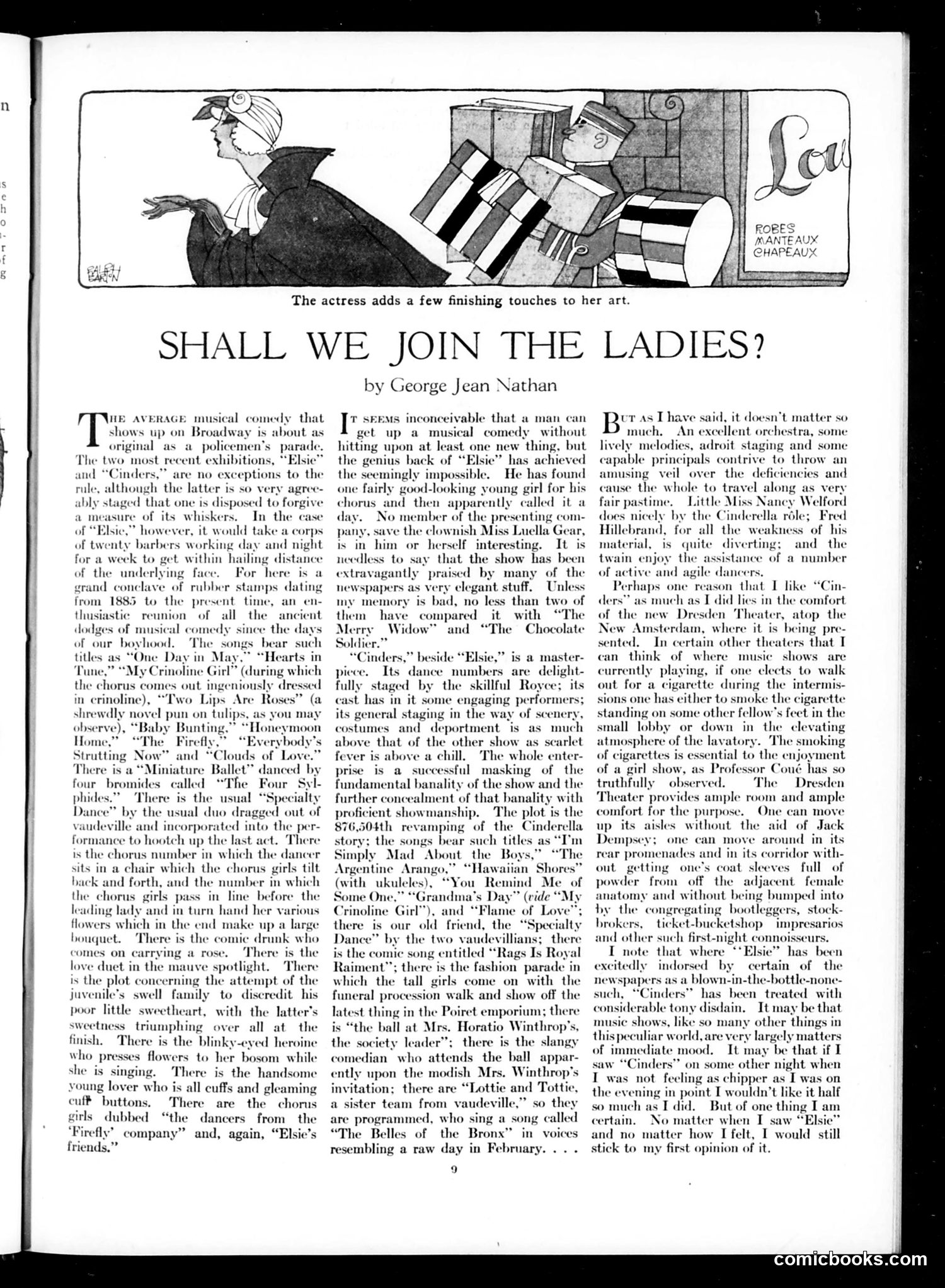
This is a theater review of the Broadway musical comedy "Elsie," not a political cartoon. The illustration at top shows an actress adding costume details—referencing the review's central critique. Nathan's satire targets the creative bankruptcy of contemporary musical comedy. He catalogs the show's relentless recycling of tired theatrical conventions: stale plot devices (the "876,504th revamping" of Cinderella), hackneyed song titles, obligatory dance numbers, and stock character types. His point: "Elsie" succeeds only through superficial spectacle—elaborate costumes, skilled staging, and attractive performers—masking fundamental creative exhaustion. While Nathan acknowledges the show's professional execution and praises the dancing of "the skillful Royce," he dismisses it as skillful packaging of inherent mediocrity. The review exemplifies early 20th-century theatrical criticism's tension between entertainment's technical sophistication and its artistic substance.
📄 Transcribed text from this page (OCR, searchable)
Machine-transcribed from the original scan — historical spelling and the odd misread are preserved.
ROBES MANTEAUX CHAPEAUX The actress adds a few finishing touches to her art. SHALL WE JOIN THE LADIES? 2 AVERAGE musical comedy that wes up on Broadway is - two en . Elsi “Cinders,” are no mre to the although the latter is so very agree- -d that one is disposed to forgive a measure of its whiskers. In the case of “Elsie,” however, it would take a corps of twenty barbers working day and night for a week to get within hailing distance of the underlying face. For here is a grand conclave of rubber stamps dating from 1885 to the an cn- thusiastie reunion ancient dodges of mus of our boyhoc songs bear such titles “One Day in ry * “Hearts in Tune,” “My Ci : (during which the chorus comes out ingeniously dressed in crinoline), “Pwo Lips Are Roses” (a shrewdly novel pun on tulips, as you may vy Bunting, and rule, ably s present time, all the y since the Struttin, and “Clouds of’ Love.” There is a ture Ballet” danced by four bromides called “The Four Syl- phides.” There is the usual * Dance” by the usual duo dri vaudeville and incorporated into the per- formance to hootch up the last act. There is the chorus number in which the dancer sits in a chair which the chorus girls tilt back and forth, and the number in which the chorus girls pass in line before the leading lady and in turn hand her various flowers which in the end make up a large bouquet. There is the comic drunk who comes on carry rose. ‘There is the love duet in the mauve spotlight. There is the plot concerning the attempt of the juvenile’s swell family to discredit his poor little sweetheart, with the latter's sweetness triumphing over all at the finish. There is the blinky-eyed heroine who presses flowers to her bosom while she There is the handsome young lover who is all cuffs and gleaming cuff buttons, There are the chorus girls dubbed “the dancers from the ‘Firefly’ company” and, again, “Elsie’s friends.” Now is singing. by George Jean Nathan A can without SEEMS inconceivable that a up a musical comedy hitting upon the ge the sec least one new thing, but as ieved igly impossible. He has found ing young girl for his d then apparently called it a member of the presenting com- ve the clownish Miss Luella Gear, is in him or herself interesting. It is needless to say that the show has been antly praised) by y of the Unless 0 less than two of compared it) with “The and “The Chocolate “Cinders,” beside “Elsie,” is a master- piece. Its dance numbers are delight- fully staged by the ful Royce; its t has in it some engaging performers; its general staging in the way of scenery, costumes and deportment is as much above that of the other show as scarlet fever is above a chill, The whole enter- prise a successful masking of the fundamental banality of the show and the further concealment of that banality with proficient showmanship. ‘The plot is the 876,504th revamping of the Cindere! story; the songs bear such title Simply Mad About the Bc Argent 3 (with ukul Some On ndma’s Da Crinoline Girl”), and ‘Fla there is our old friend, the “Specialty Dance” by the two vaudevillians; there is the song entitled “Rags Is Royal Raiment”; there is the fashion parade in which the tall girls come on with the funeral procession walk and show off the latest thing in the Poiret emporium; there is “the b: Horatio Winthrop’s, the s there is the slangy who attends the ball appar- ently upon the modish Mrs. Winthrop’s invitation; there are “Lottie and Tottie, sister team from vaudeville,” so they are programmed, who sing a song called “The Belles of the Bronx” in voices resembling a raw day in February. . . . 9 B tv As I have said, it doesn’t matter so much, — An exc nt orchestra, some lively melodies, adroit staging and some capable | principals contrive to throw an amusing veil over the deficiencies and cause the whole to travel along as very fair pastime. Little Miss Naney Welford does nicely by the Cinderella réle; Fred Hillebrand, for all the weakness of his material, is quite div and the twain enjoy the assistance of a number of active and a dancers. Perhaps one reason that I like ‘ ders” as much as I did lies in the com| of the new Dresden Theater, atop the New Amsterdam, where it is being pre- sented, In certain other theaters t can think of where music currently playing, if one clects to walk out for a cigarette during the intermis- sions one has either to smoke the cigarette standing on some other fellow’s feet i in the small lobby or down in the clevating atmosphere of the lavatory. The of cigarettes is essential to the of a girl show, as Professor Coué has s truthfully observed. The Dresden Theater provides ample room and ample comfort for the purpose. One can move up its aisles without the aid of Jack Dempsey; one can move around in its rear promenades and in its corridor with- out getting one’s coat sleeves full of powder from off the adjacent female anatomy and without being bumped into by the congregating bootleggers, stock- brokers, ticket-bucketshop — impresarios and other such first-night connoisseurs. I note that where **Elsie” has been excitedly indorsed by certain of the news rs as a blown-in-the-bottle-none- such, nders” has been trea considerable tony disdain music shows, like so m: this peculiar world, are very ly matters of immediate mood. It may be that if I saw “Cinders” on some other night wh s not feeling as chipper as I was on ening in point I wouldn’t like it half so much as I did. But of one thing certain. No matter when I saw “Els and no matter how I felt, I would still stick to my first opinion of it. comicbooks.com