
Judge, 1923-04-28 · page 23 of 36
Judge — April 28, 1923 — page 23: what you’re looking at
What you’re looking at
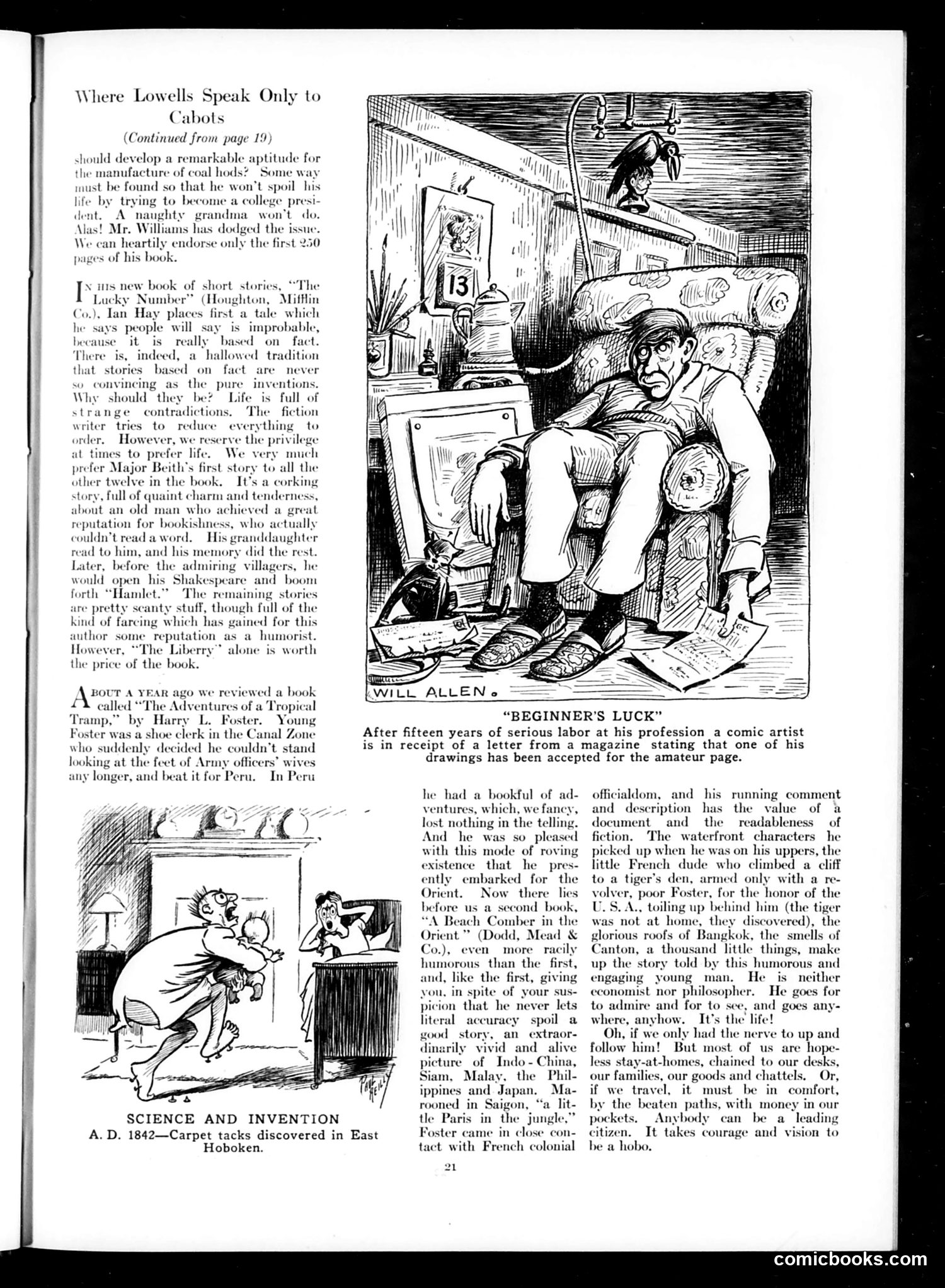
This page contains book reviews and commentary on contemporary literature, not political cartoons. The main content discusses: **"Where Lowells Speak Only to Cabots"** — A critique of a novel by Mr. Williams about class mobility. The reviewer objects that the protagonist implausibly becomes a college president; they endorse only the first 250 pages. **Ian Hay's "The Lucky Number"** — Praised for its first story about an old man with a false reputation for literacy whose granddaughter actually does his reading. The reviewer prefers this to Hay's other humorous tales. **Harry L. Foster's "A Beach Comber in the Orient"** — A travel narrative praised for vividly depicting Indo-China, Siam, and the Philippines through encounters with colorful colonial characters and scenes, despite potentially exaggerating details. **"Beginner's Luck"** (cartoon by Will Allen) shows a struggling cartoonist finally receiving acceptance from a magazine's amateur page after 15 years of professional work—a commentary on artistic struggle and rejection. The page reflects early 20th-century literary tastes and publishing standards.
📄 Transcribed text from this page (OCR, searchable)
Machine-transcribed from the original scan — historical spelling and the odd misread are preserved.
Where Lowells Speak Only to Cabots (Continued from page 19) should develop a remarkable aptitude for the manufacture of coal hods? Some way must be found so that he won't spoil his by trying to become a college presi- A naughty grandma won't do. Mr. Williams has dodged the issue. We can heartily endorse only the first 250 pages of his book. hy is new book of short. stories, “The Lucky Number” (Houghton, Mifflin Co.), Ian > which he says people will say is improbable, heeause it. is really based on fact. is, i ‘d tradition are never » convincing as the pure inventions. Why should they be? Life is full of strange contradictions. The fiction writer tries to reduce everything to order. How we reserve the privilege at times to prefer life. We very much prefer Major Beith’s first story to all the other twelve in the book. It’s a corking story, full of quaint charm and tenderness, about an old man who achieved a great reputation for bookishness, who actually couldn’t read a word. His granddaughter read to him, and his memory did the rest. Later, before the admiring villagers, he would open his Shakespeare and boom forth “Hamlet.” The remaining stories are pretty scanty stuff, though full of the kind of farcing which has gained for this author some reputation as a humorist. However, “The Liberry” alone is worth the price of the book. A Pour A YEAR ago we reviewed a book £2 called “The Adventures of a Tropical Tramp,” by Harry L. Foster. Young Foster was a shoe clerk in the Ca Zone who suddenly decided he couldn't stand looking at the feet of Army officers’ wives any longer, and beat it for Peru. In Peru cy SCIENCE AND INVENTION A. D. 1842—Carpet tacks discovered in East Hoboken. “BEGINNER'S LUCK” After fifteen years of serious labor at his profession a comic artist is in receipt of a letter from a magazine stating that one of his drawings has been accepted for the amateur page. he had a bookful of ad- ventures, which, we fancy, lost nothing in the telling. And he was so pleased with this mode of roving existence that he pres- ently embarked for the Orient. Now there lies before us a second book, “A Beach Comber in the Orient ” (Dodd, Me Co.), even more humorous than the first, and, like the first, giving you, in spite of your sus- picion that he never lets literal accuracy spoil a good story, an extraor- dinarily vivid and alive picture of Indo - China, Siam, Malay, the Phil- ippi nd J Ma- igon, “z tle Paris in the jungl Foster came in close con- tact with French colonial 21 officialdom, and his running comment and description has the value of 2 document and the readableness — of fiction. The waterfront characters he picked up when he was on his uppers, the little French dude who climbed a cliff to a tiger’s den, armed only with a re- r, poor Foster, for the honor of the A., toiling up behind him (the tiger was not at home, they discovered), the glorious roofs of Bangkok, the smells of Canton, a thousand little things, m up the story told by this humorous anc engaging young man. He is_ neither economist nor philosopher. He goes for to admire and for to see, and goes any- where, anyhow. It’s the life! Oh, if we only had the nerve to up and follow him! But most of us are hope- Or, if we travel, it must be in comfort, by the beaten paths, with money i ‘kets. © Anybody can be a ding ci n. It takes courage and vision to be a hobo. comicbooks.com