
A complete issue · 36 pages · 1923
Judge — February 3, 1923
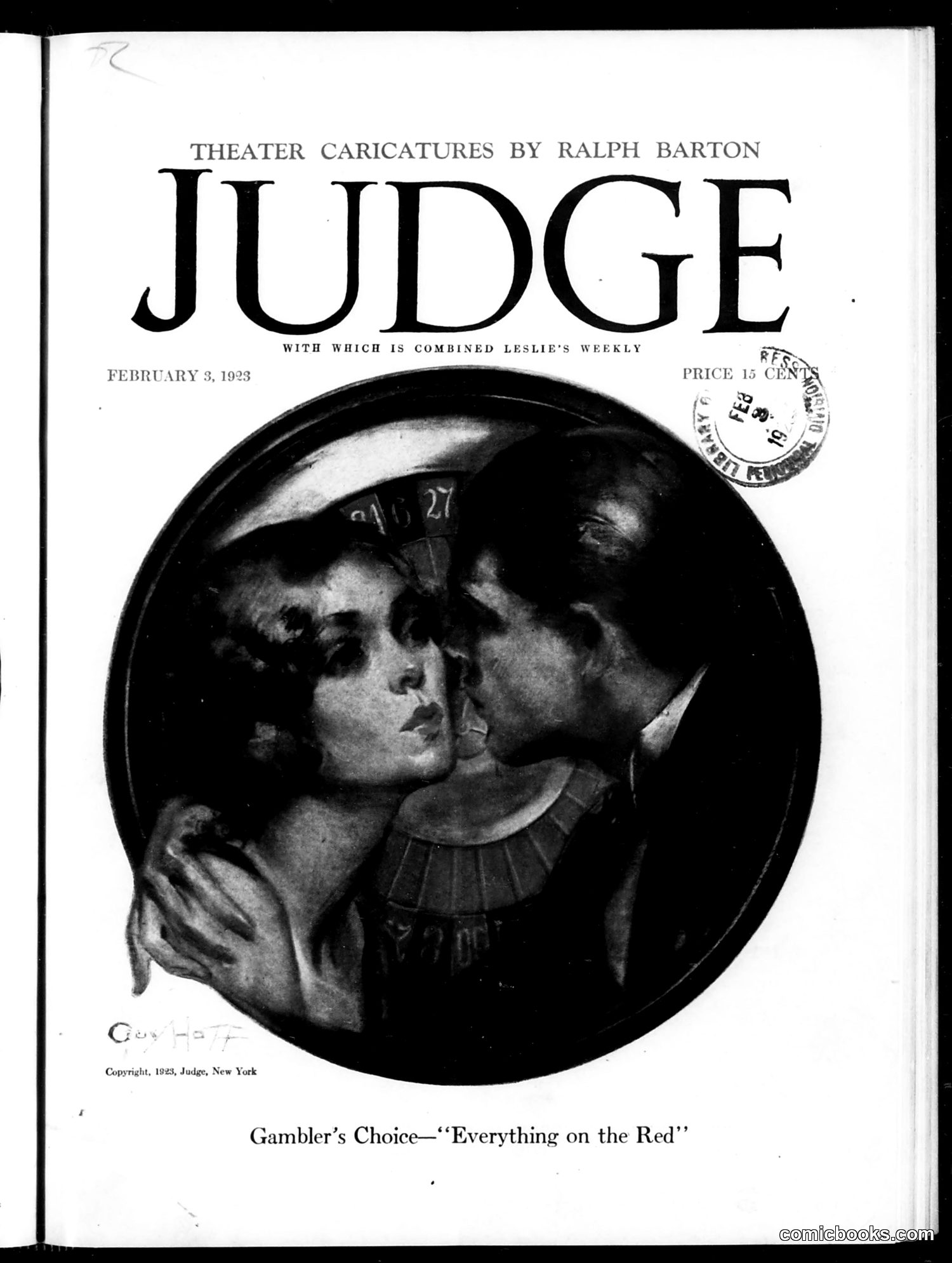
This is a theater caricature by Ralph Barton illustrating "Gambler's Choice—'Everything on the Red.'" The circular vignette shows two figures in an intimate embrace, with one wearing what appears to be military or formal attire with decorative collar details. The title references a gambling bet ("everything on the red"), likely suggesting romantic or dramatic stakes in a theatrical production. Without identifying the specific play or performers, the caricature captures a theatrical moment of romantic tension typical of early 1920s stage drama. The price of 15 cents and copyright date of 1923 confirm this as a contemporary entertainment publication. Barton was a noted illustrator known for theatrical commentary.
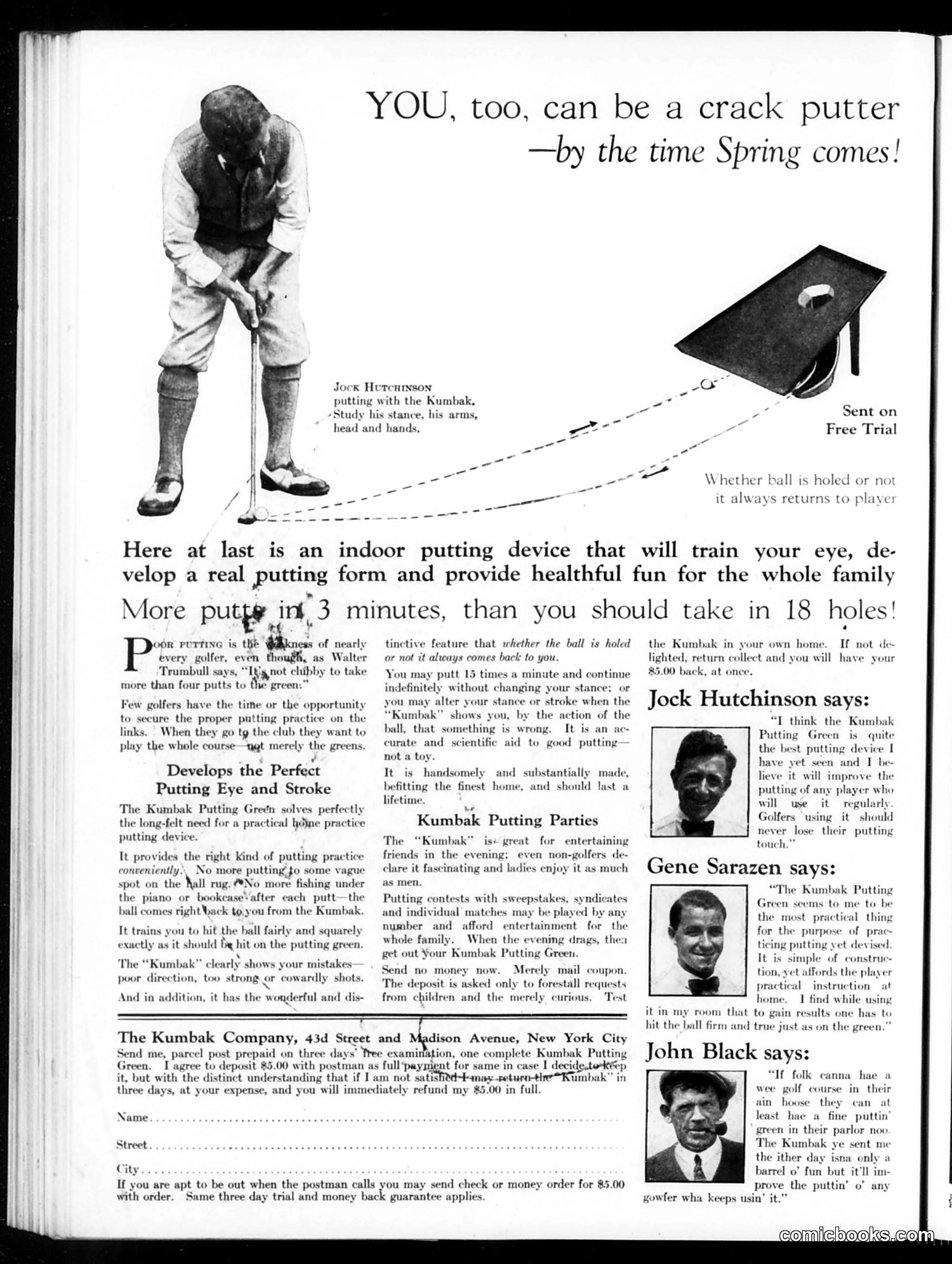
This page is primarily **advertising, not satire or political commentary**. It promotes the "Kumbak Putting Green," an indoor putting practice device for home use. The product costs $3.00 on free trial. The page features testimonials from what appear to be **professional golfers** of the era—Jock Hutchinson, Gene Sarazen, and John Black—endorsing the device's effectiveness for improving putting form and accuracy. The humor is gentle and self-promotional rather than satirical: the tagline "YOU, too, can be a crack putter—by the time Spring comes!" uses aspirational language typical of vintage advertising. There's **no apparent political satire or social commentary**—this is straightforward commercial promotion using celebrity endorsements, a standard advertising technique then and now.
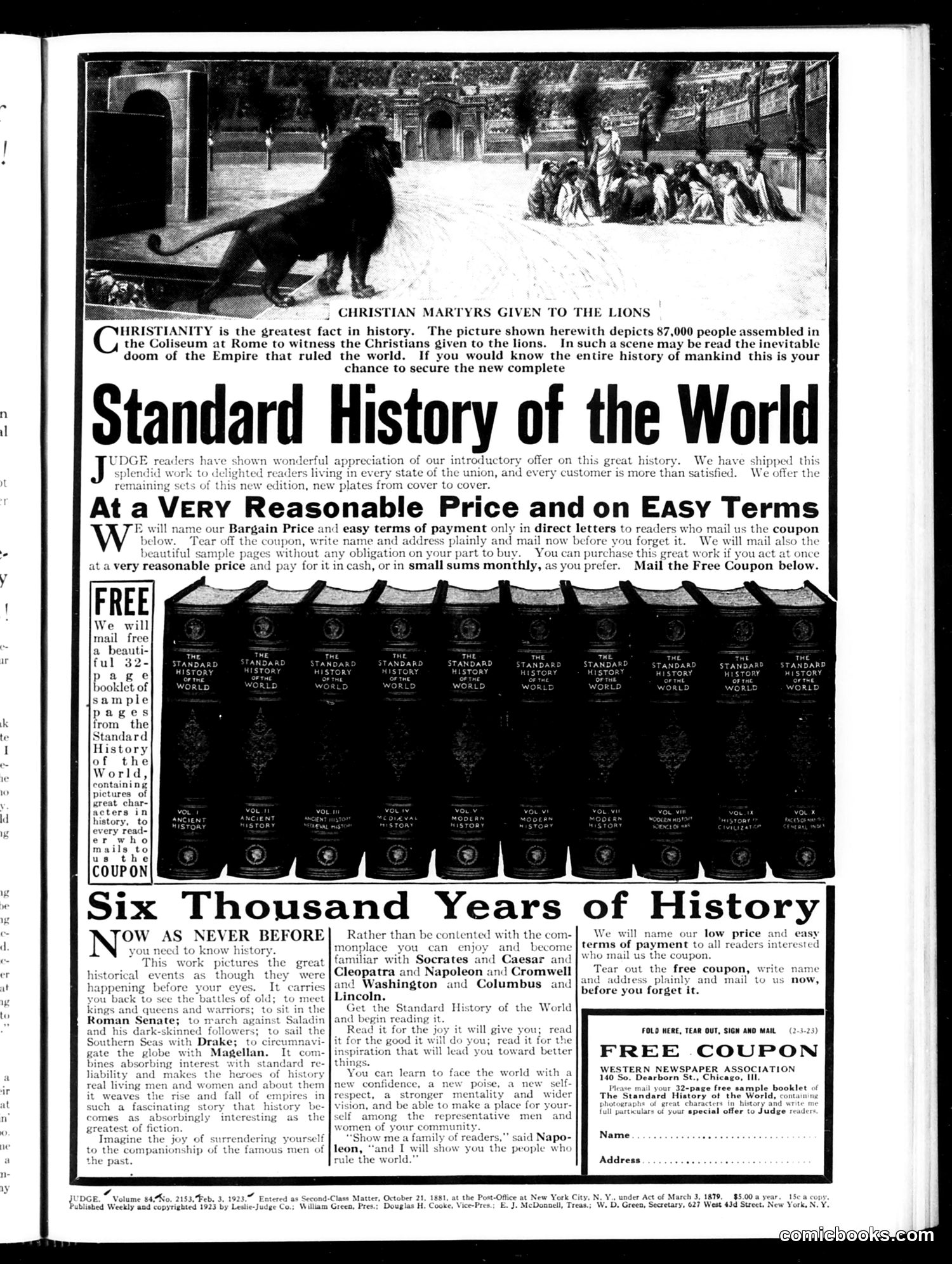
This page is primarily **advertising**, not satire or political commentary. The top image depicts "Christian Martyrs Given to the Lions" in Rome's Colosseum, used as promotional imagery for the *Standard History of the World* book series. The advertisement emphasizes this 10-volume encyclopedia covers "six thousand years of history" and mentions famous historical figures: Socrates, Caesar, Cleopatra, Napoleon, Washington, and Columbus. The sales pitch promises readers can "learn to face the world with a new confidence" through historical knowledge. The coupon at bottom is a typical mail-in offer from the Western Newspaper Association, allowing customers to purchase the expensive set on installment payments at "very reasonable price." **Bottom line:** This is commercial promotion, not editorial satire.
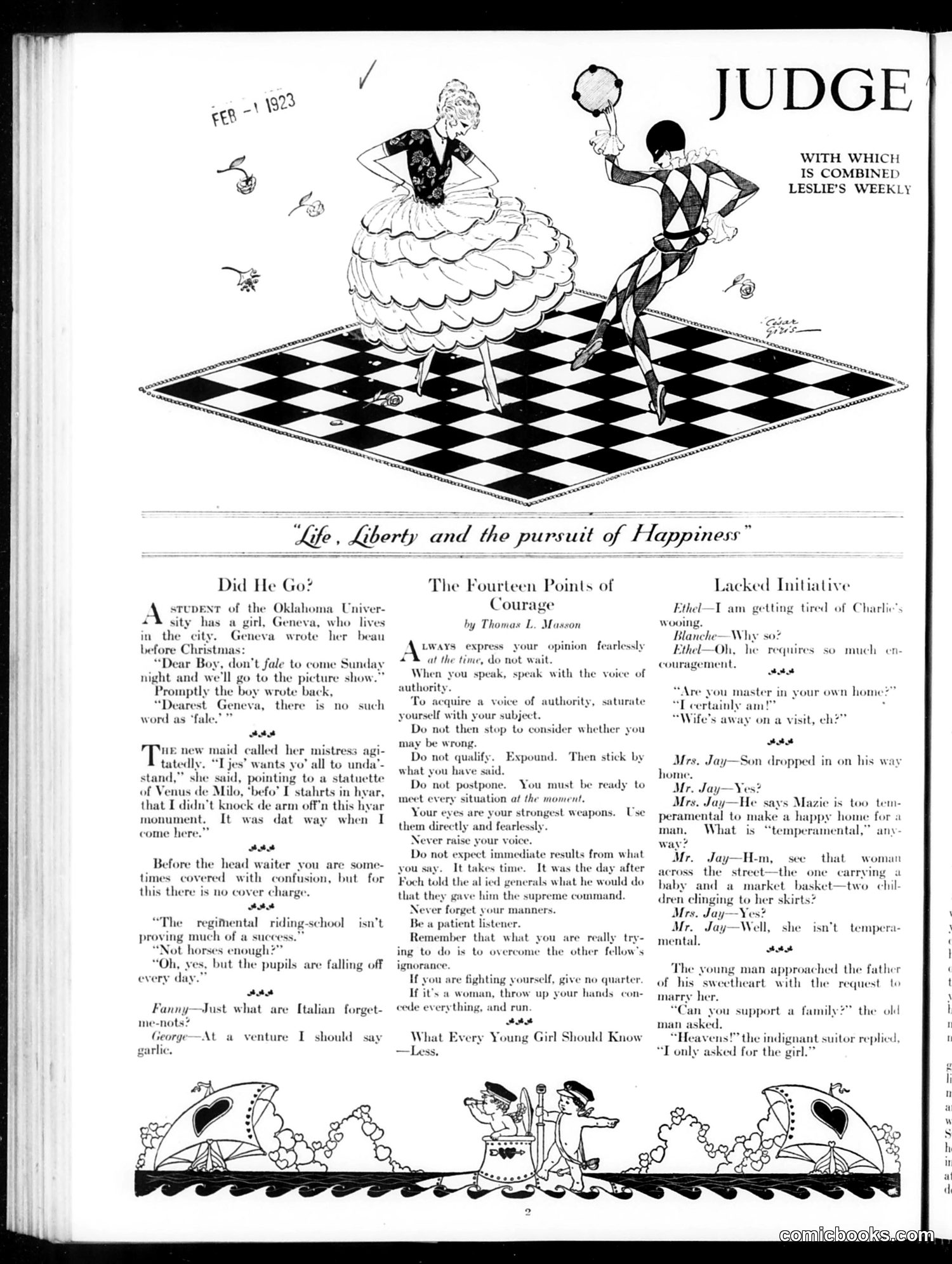
The main illustration depicts two figures on a checkered floor beneath the motto "Life, Liberty and the pursuit of Happiness." One wears an elaborate tiered ball gown; the other sports a geometric patterned outfit and holds a balloon. The cartoon likely satirizes 1920s fashion and social customs—the exaggerated silhouettes and theatrical poses mock contemporary flapper culture and changing gender roles during the Jazz Age. The text below contains conversational snippets about courtship and domesticity, including articles like "The Fourteen Points of Courage" and advice columns. These appear to mock earnest self-help literature and relationship guidance popular with young people of the era. The overall page satirizes modern social anxieties and evolving courtship customs of the 1920s.
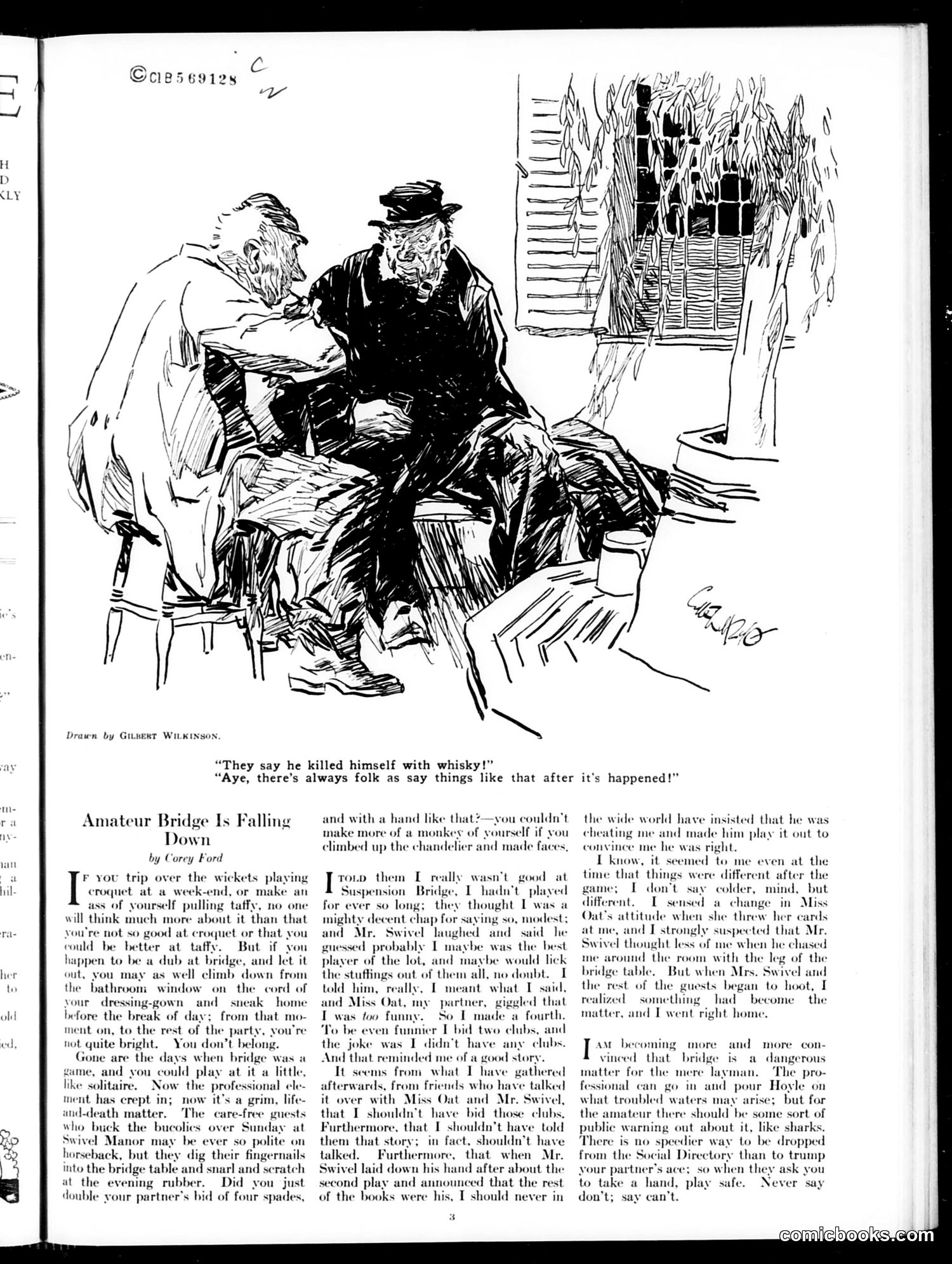
This illustration by Gilbert Wilkinson depicts a humorous scene at a bridge game (the card game, not the structure). The cartoon satirizes amateur bridge players' incompetence and social awkwardness. The illustration shows three men at a table, with dialogue about someone killing himself with whisky. The accompanying story describes disastrous bridge gameplay—poor strategy, excessive drinking, and bad sportsmanship among casual players. The narrative mocks how amateur players blame luck, make excuses, and become argumentative rather than admitting their lack of skill. The satire targets the pretensions of amateur bridge enthusiasts who took the recently-popularized card game seriously without actually understanding it, while indulging in drinking and quarreling—common critiques of leisure-class social activities in early 20th-century satirical magazines.
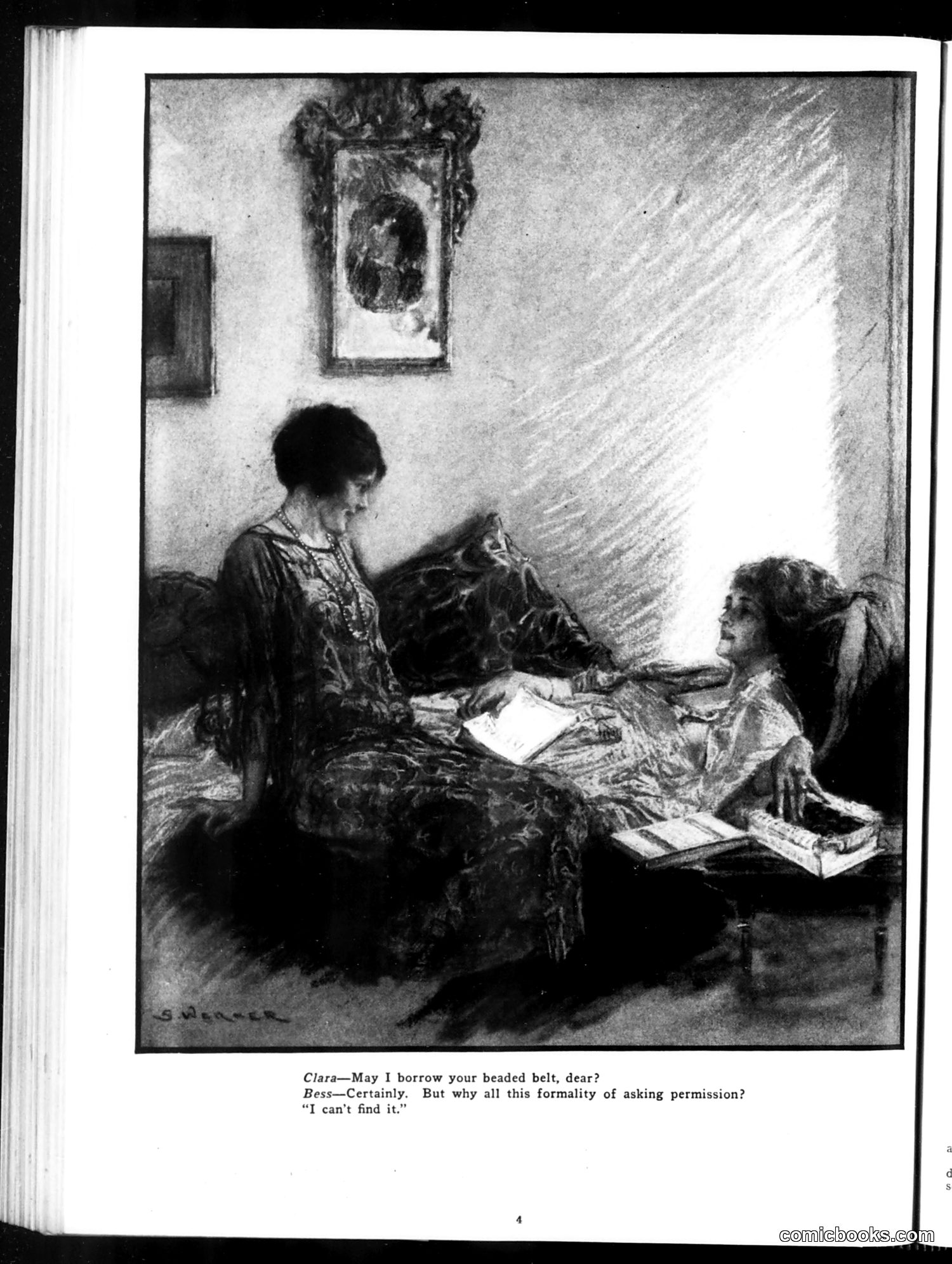
This illustration depicts a domestic scene with two women in ornate, patterned clothing seated together. The dialogue reveals social commentary about gender relations and etiquette. Clara requests to borrow Bess's beaded belt. Bess agrees but questions why Clara bothers with "all this formality of asking permission," saying she "can't find it." The satire targets upper-class conventions of politeness and propriety among women. Bess's response ironically highlights the absurdity: she grants permission for something she cannot locate, mocking the ritualistic politeness between society women while suggesting casual indifference underneath. The joke satirizes the performative nature of genteel behavior—the empty formality of asking permission when the requested item is already lost or inaccessible. This reflects Judge magazine's tendency to mock Victorian social conventions and the pretenses of polite society.
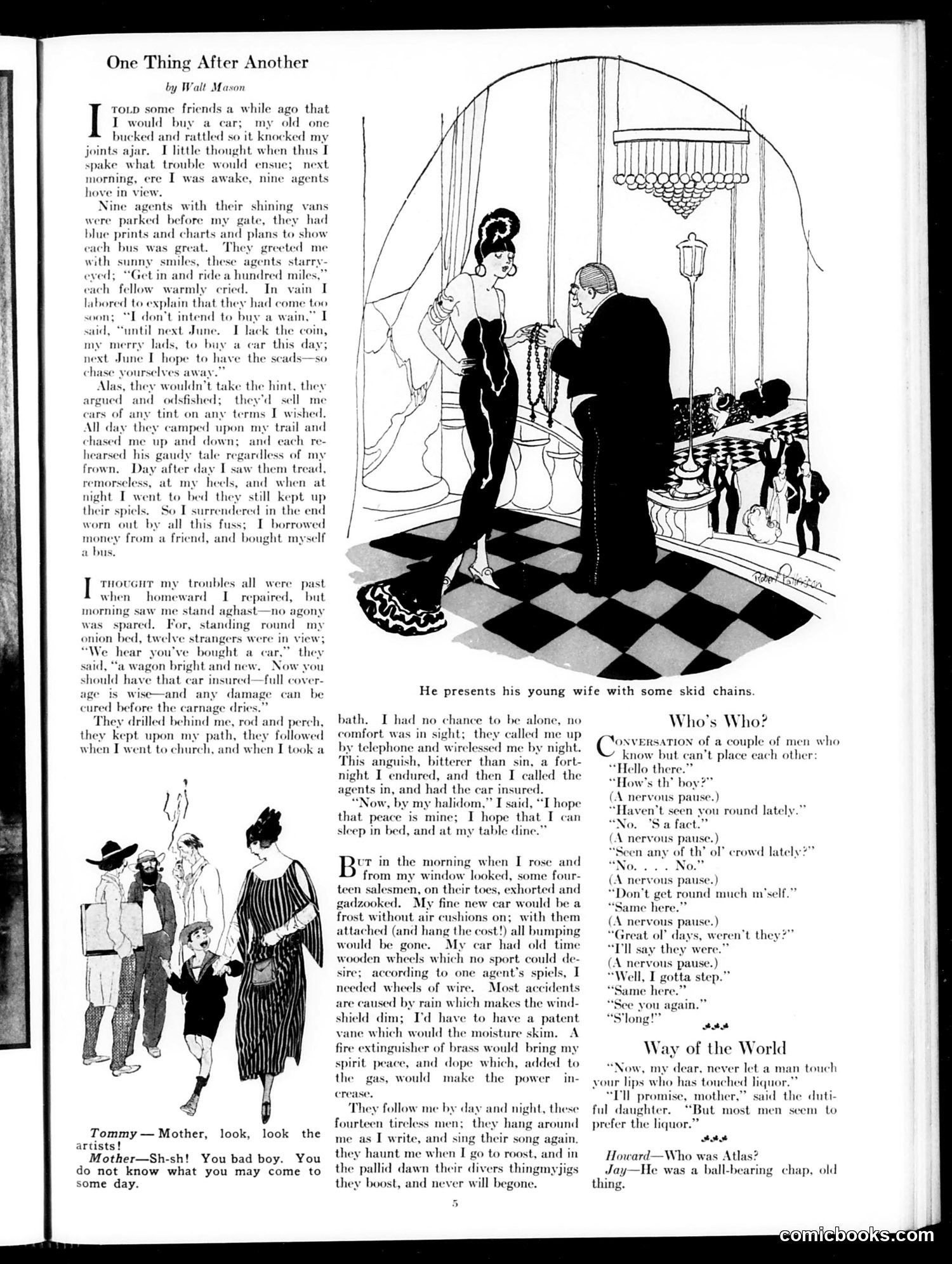
**"One Thing After Another" by Walt Mason** is a humorous narrative poem satirizing aggressive American sales tactics of the early 20th century. The narrator mentions wanting to buy a car "next June," but nine insurance and auto salesmen immediately descend on him, relentlessly pursuing him through daily life—at church, in bed, via telephone and wireless—despite his repeated refusals. He eventually surrenders and buys a car just to escape them. The satire mocks the era's intrusive, high-pressure sales culture and the proliferation of automobile-related add-on products (air cushions, wire wheels, fire extinguishers, moisture-protection vanes). The accompanying illustrations show well-dressed salesmen persistently following the bewildered protagonist. The page also includes two brief humor sections: "Who's Who?" depicts two men who cannot remember each other despite clearly knowing one another, and "Way of the World" features a sexual innuendo joke about women preferring liquor to men. The cartoons reflect concerns about commercialism and consumer manipulation in a booming consumer economy.
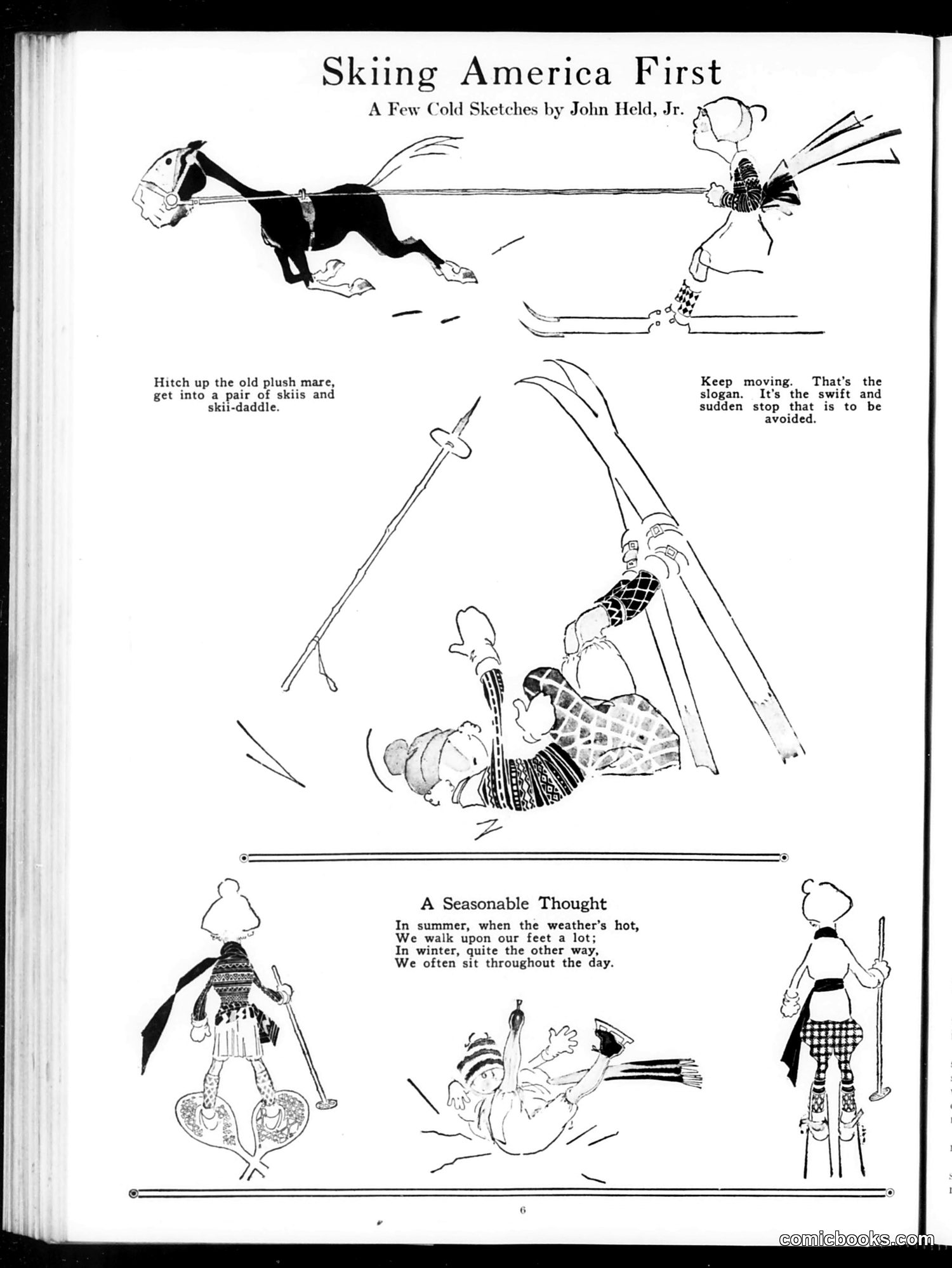
This humorous piece satirizes 1920s skiing culture in America. The top sketch depicts someone being dragged behind a runaway horse while on skis—absurdist comedy suggesting amateur skiers have no control. The caption "ski-daddle" (likely "skedaddle") and the warning about "swift and sudden stops" mock the dangers inexperienced skiers face. The lower section, "A Seasonable Thought," presents ironic observations: in summer we walk on our feet, in winter we "sit throughout the day"—likely referencing both the sedentary nature of winter and skiers repeatedly falling or remaining prone. The bottom illustrations show various people in winter clothing, some apparently falling or struggling with skis, reinforcing the visual gag about winter inactivity and skiing mishaps. Held's characteristic style emphasizes the comedic collision between ambitious "America First" industriousness and the practical reality of clumsy outdoor recreation during winter months.
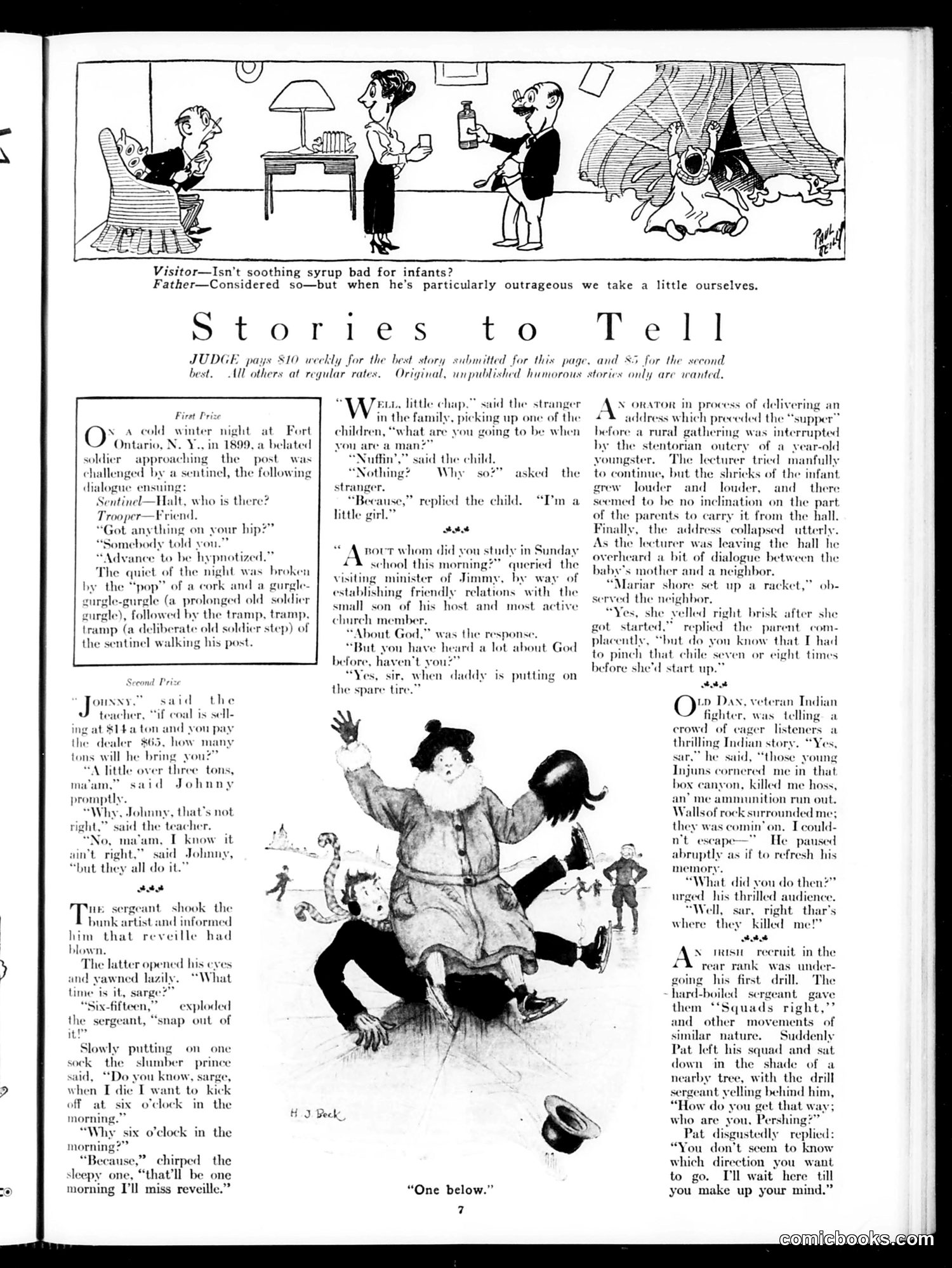
The top cartoon satirizes parental hypocrisy regarding infant sedatives. A father admits to the visitor that while soothing syrup (likely containing laudanum or similar opiates—common in this era) is considered harmful for babies, parents dose themselves with it when their children misbehave. This mocks Victorian-era parenting practices and the casual use of narcotics. The "Stories to Tell" section presents humorous anecdotes about: 1. **Military discipline**: A soldier's deadpan response about timing his death at reveille 2. **Child innocence**: A boy correctly calculating coal purchases by admitting "they all do it" (implying dishonest dealer practices) 3. **Religious education**: A child learning about God only when his father curses while changing a tire 4. **Parental neglect**: A mother pinching her baby eight times to make it cry during a lecture The humor relies on children's candid observations exposing adult hypocrisy, dishonesty, and poor parenting—common Judge magazine themes mocking middle-class social pretenses of the early 1900s.
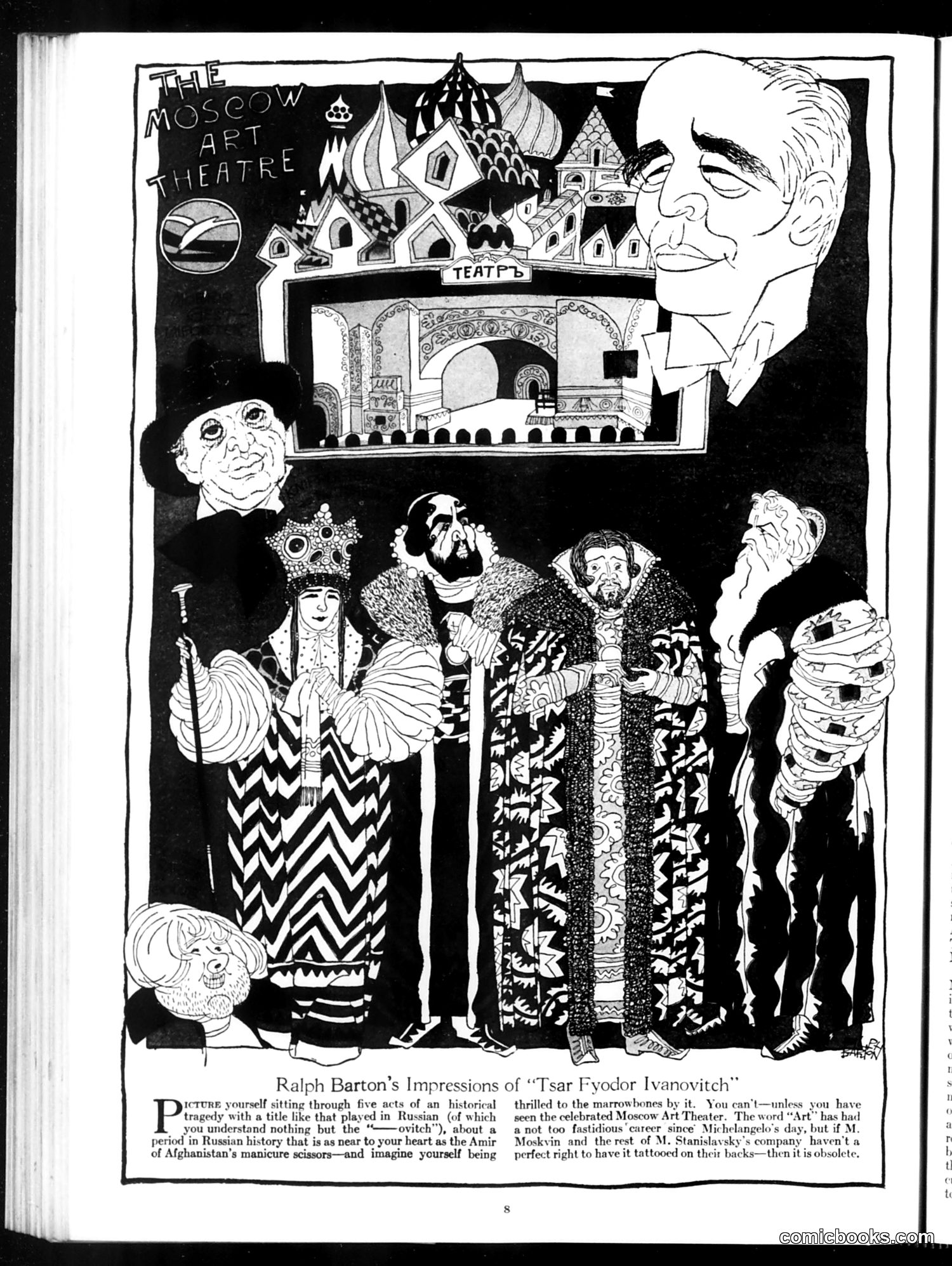
This is satirical commentary on the Moscow Art Theatre's production of a historical Russian play. Barton mocks American audiences' enthusiasm for this culturally foreign work—a five-act tragedy in Russian about an obscure Tsar, comprehensible only for the "-ovitch" suffix ending Russian names. The cartoon ridicules the pretentiousness of attending avant-garde theater you cannot understand. The elaborate costumed figures (likely actors from the production) are caricatured as affectedly exotic. Barton suggests viewers' fascination stems from snobbish cultural aspiration rather than genuine appreciation. The text sarcastically notes that even if the actors were as accomplished as Michelangelo, the play remains incomprehensibly distant from American experience—"as near to your heart as the Amir of Afghanistan's manicure scissors." It's social satire targeting 1920s highbrow theater culture and American cultural pretension.
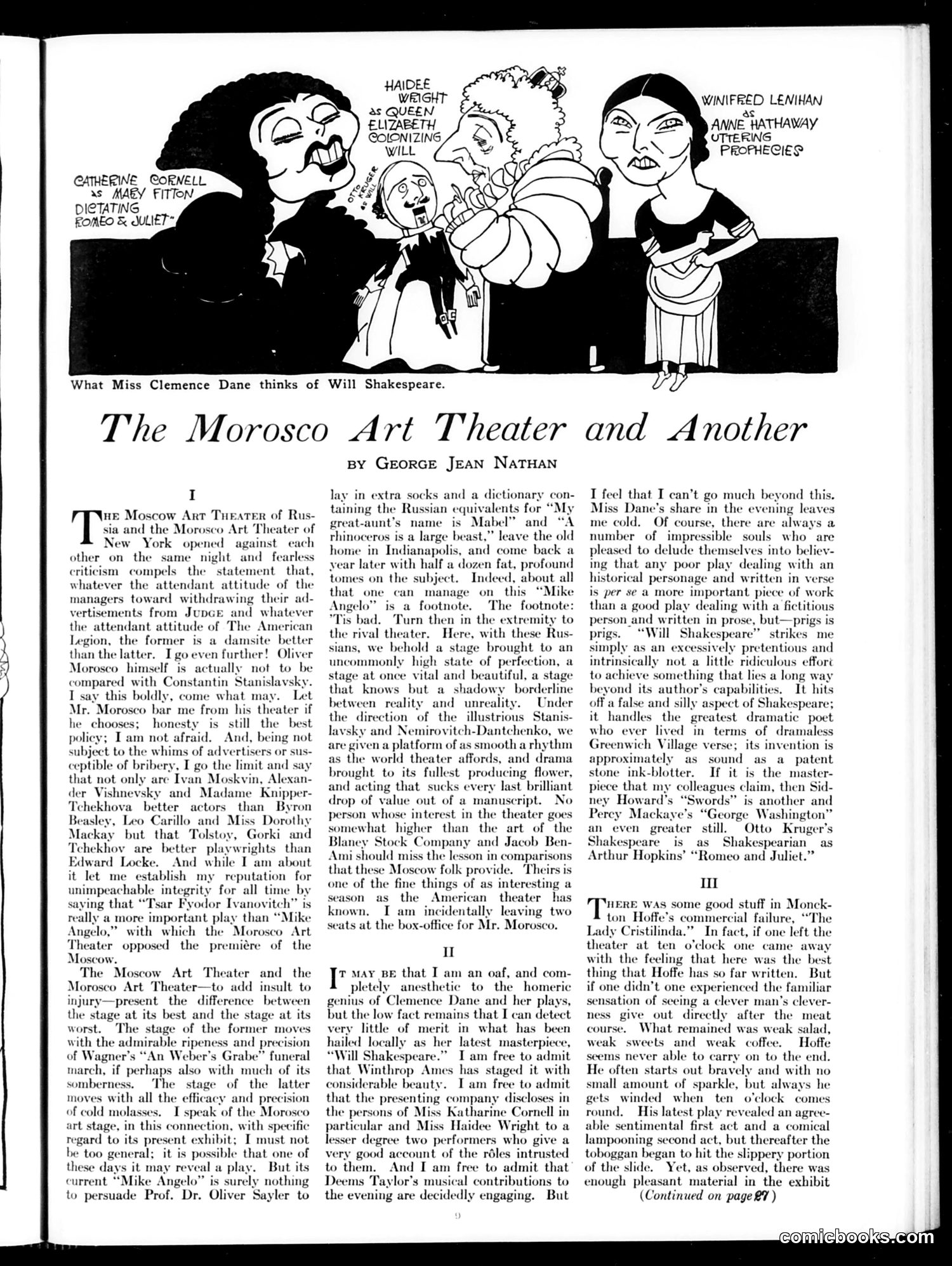
This is a theater criticism page from Judge magazine comparing two competing New York theaters that opened simultaneously: the Moscow Art Theater (a Russian company) and the Morosco Art Theater (American). **The Cartoon** caricatures prominent actresses in a play about Shakespeare: Catherine Cornell as Mary Fitton, Haidee Wright as Queen Elizabeth, and Winifred Lenihan. The caption "What Miss Clemence Dane thinks of Will Shakespeare" mocks the play's pretentiousness. **The Satire**: Critic George Jean Nathan delivers scathing reviews, provocatively declaring the Russian company vastly superior to the American production. He's deliberately inflammatory—challenging the American theater's artistic standards while praising Russian actors like Stanislavsky. Nathan also dismisses Clemence Dane's Shakespeare-themed play as artistically worthless, using biting wit ("'Tis bad"). The overall point satirizes both American theatrical mediocrity and the pretentious amateur dramatics of wealthy producers like Oliver Morosco.
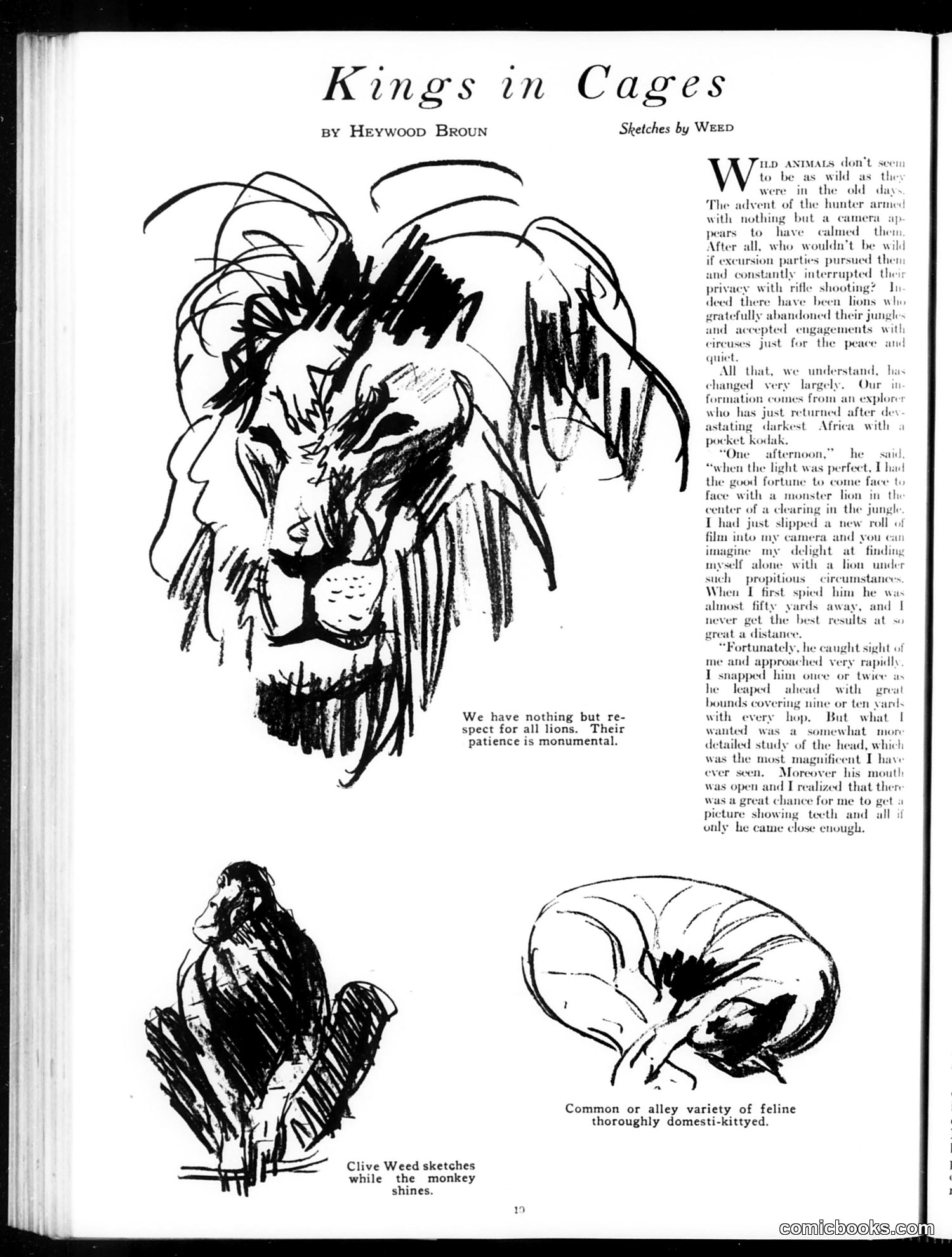
This piece satirizes the emerging trend of wildlife photography and the romanticization of "taming" wild animals through civilization and tourism. The main illustration shows a fierce lion's head. The accompanying text, attributed to an explorer returning from Africa with a "pocket kodak" (portable camera), describes pursuing a wild lion to photograph it—getting progressively closer, wanting detailed shots of its teeth and head, treating the dangerous animal as a subject to be captured rather than respected. The satire cuts two ways: it mocks both the foolhardy adventurer-photographer willing to endanger himself for the "perfect shot," and the broader cultural phenomenon where wild animals lose their wildness through human intrusion (hunting expeditions, circuses, photography). The caption "We have nothing but respect for all lions. Their patience is monumental" is ironic—the lions' "patience" means their submission to human encroachment. The secondary sketches appear to contrast wild and domestic animals, reinforcing the theme of civilization's conquest over nature.
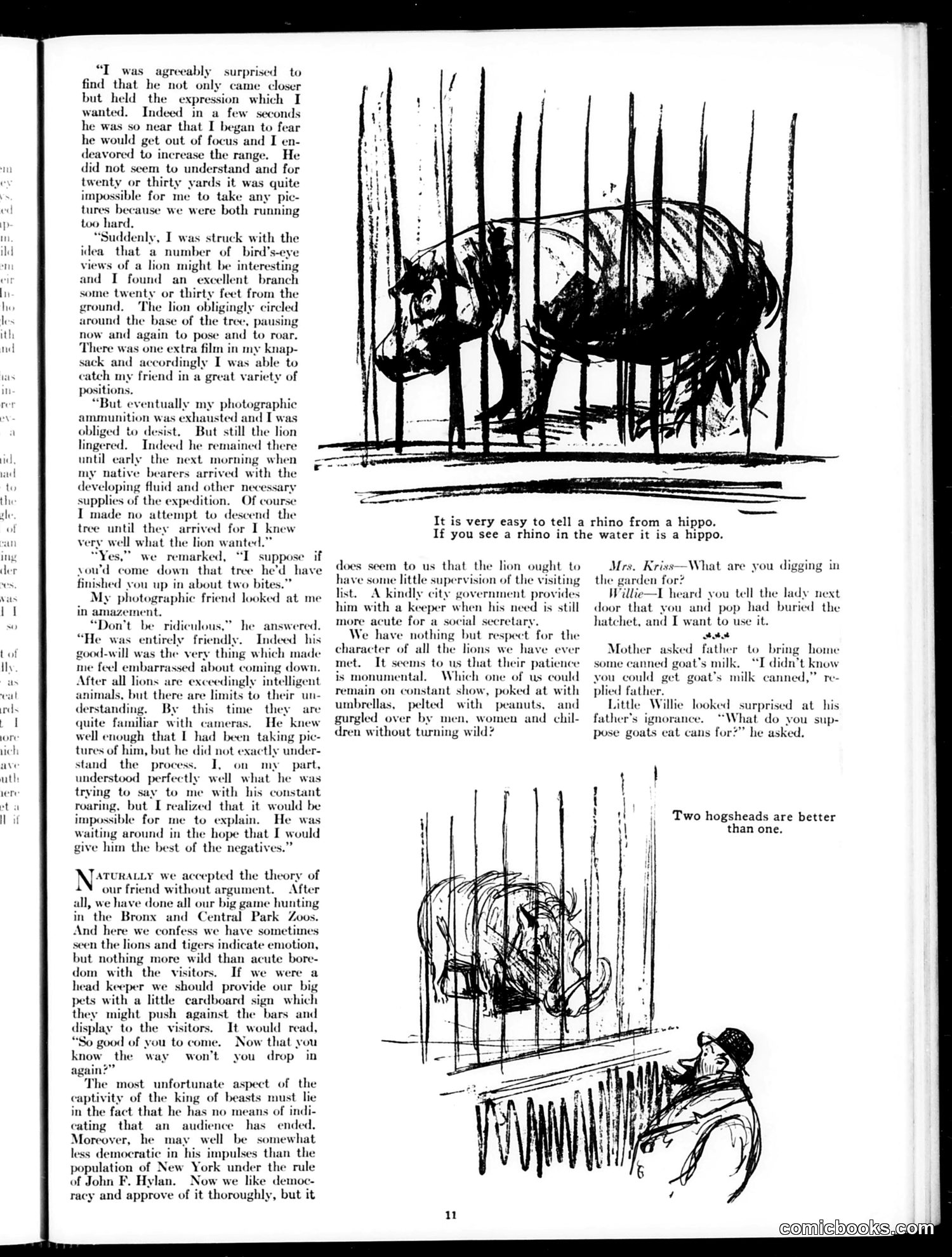
This page satirizes tourists' naive behavior at zoo exhibits, particularly the Bronx Zoo. The main narrative describes a hunter's supposed encounter with a "friendly" lion that waited all night for him to descend a tree, supposedly hoping to receive photographic negatives—an absurd claim the magazine's editors pretend to accept. The satire targets two things: First, the hunter's ridiculous anthropomorphization of the lion's intentions. Second, and more pointedly, zoo visitors' obliviousness to animal welfare. The editors argue lions deserve protection from constant harassment—umbrellas poking, peanuts pelting—and suggest they need a "social secretary" to screen visitors. There's also a dig at Mayor John F. Hylan's administration regarding "democracy," implying the city's permissiveness extends even to animal management. The accompanying cartoons of caged animals emphasize their captive misery, contrasting sharply with the hunter's sentimental nonsense about the lion's "patience" and "good-will."
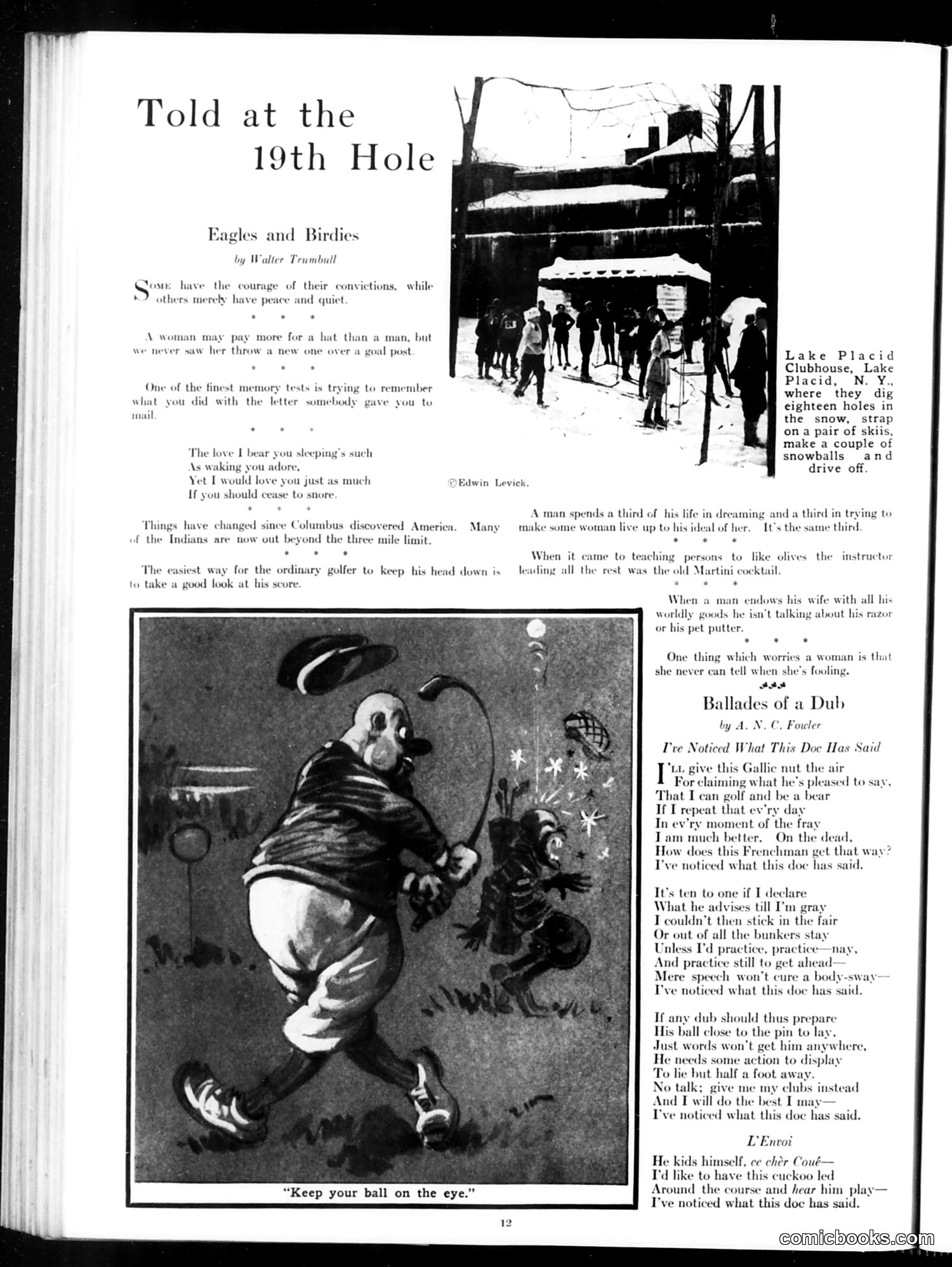
This page from Judge magazine contains golf-themed humor titled "Told at the 19th Hole" (the bar/lounge at golf clubs). The main cartoon depicts a golfer mid-swing with the caption "Keep your ball on the eye"—a visual pun playing on the instruction to "keep your eye on the ball," rendered literally as a large eyeball. The accompanying text consists of witty one-liners about golf and relationships, plus a poem called "Ballades of a Dub" mocking a golfer who listens to advice but refuses to practice, expecting words alone to improve his game. The Lake Placid reference describes winter golf on snow—a novelty sport of the era. The satire targets amateur golfers' overconfidence and their tendency to blame instruction rather than their own effort for poor performance. The humor relies on golf culture knowledge and wordplay rather than political content.
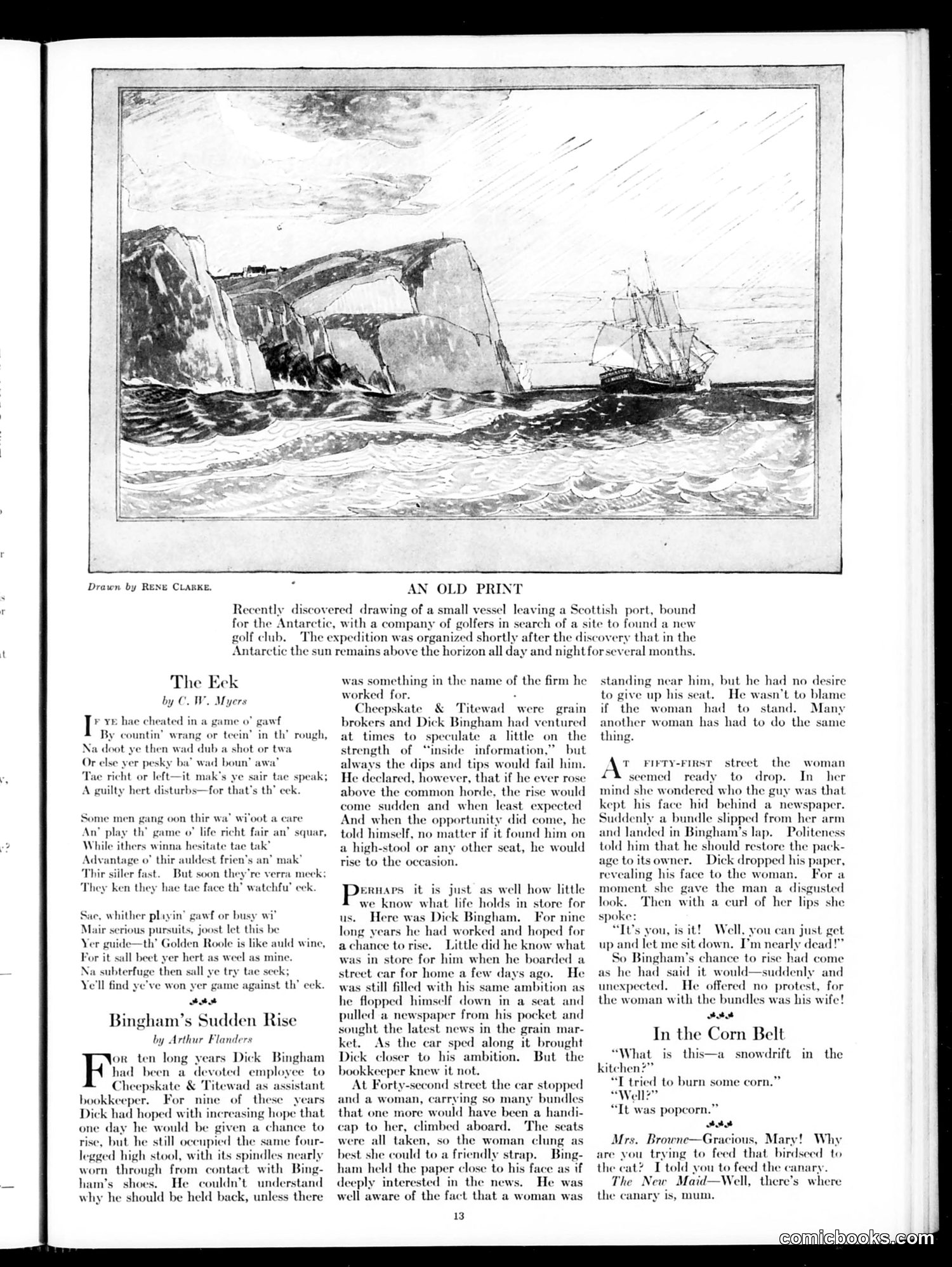
The top cartoon, drawn by René Clarke, satirizes the obsessive nature of golf enthusiasts by depicting a ship full of golfers sailing to Antarctica—solely to establish a new golf club where the sun never sets, allowing endless daylight play for months. The main story, "Bingham's Sudden Rise" by Arthur Flanders, is a morality tale about Dick Bingham, a lowly bookkeeper at a grain-brokerage firm who refuses to give up his streetcar seat to an exhausted woman standing with heavy bundles. When she drops a package on his lap, forcing him to help, he finally looks up—and she recognizes him as someone from her past, responding with disgust. The narrative suggests his moral failure (refusing basic courtesy) will prevent his professional advancement despite his ambitions. The story illustrates the era's social criticism about male selfishness and the connection between personal ethics and life success.
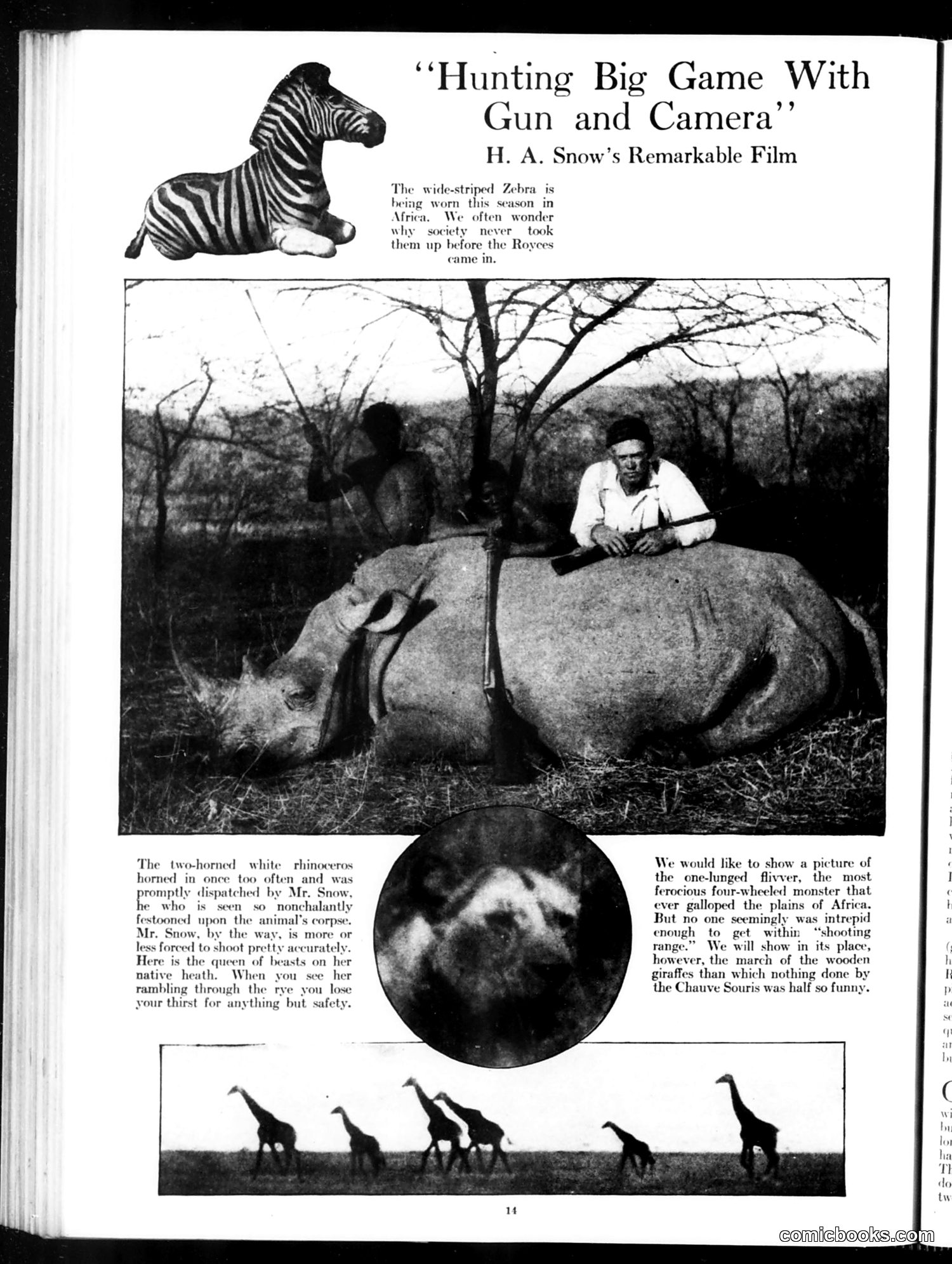
This page features H.A. Snow's wildlife film "Hunting Big Game With Gun and Camera," presenting African animals and hunting scenes. The content blends genuine wildlife documentation with light social satire. The satire targets wealthy fashion trends and leisure pursuits. References to "the Royces" (likely the Rolls-Royce automobile brand, symbolizing luxury) suggest that African animals—particularly zebras—become fashionable only after wealthy elites adopt them. The quip about "wide-striped Zebra" being "worn this season" mocks how the wealthy appropriate exotic wildlife as status symbols. Additional humor comes from the "one-lunged flivver" (flivver = cheap car, likely Model T Ford), presented as a comically unreliable vehicle for African hunting compared to luxury automobiles. The reference to "Chauve Souris" (a famous cabaret known for absurdist theater) and "wooden giraffes" suggests the film contains deliberately staged or comedic elements alongside genuine footage. Overall, the page satirizes both the exploitation of African wildlife and the conspicuous consumption of wealthy Americans.
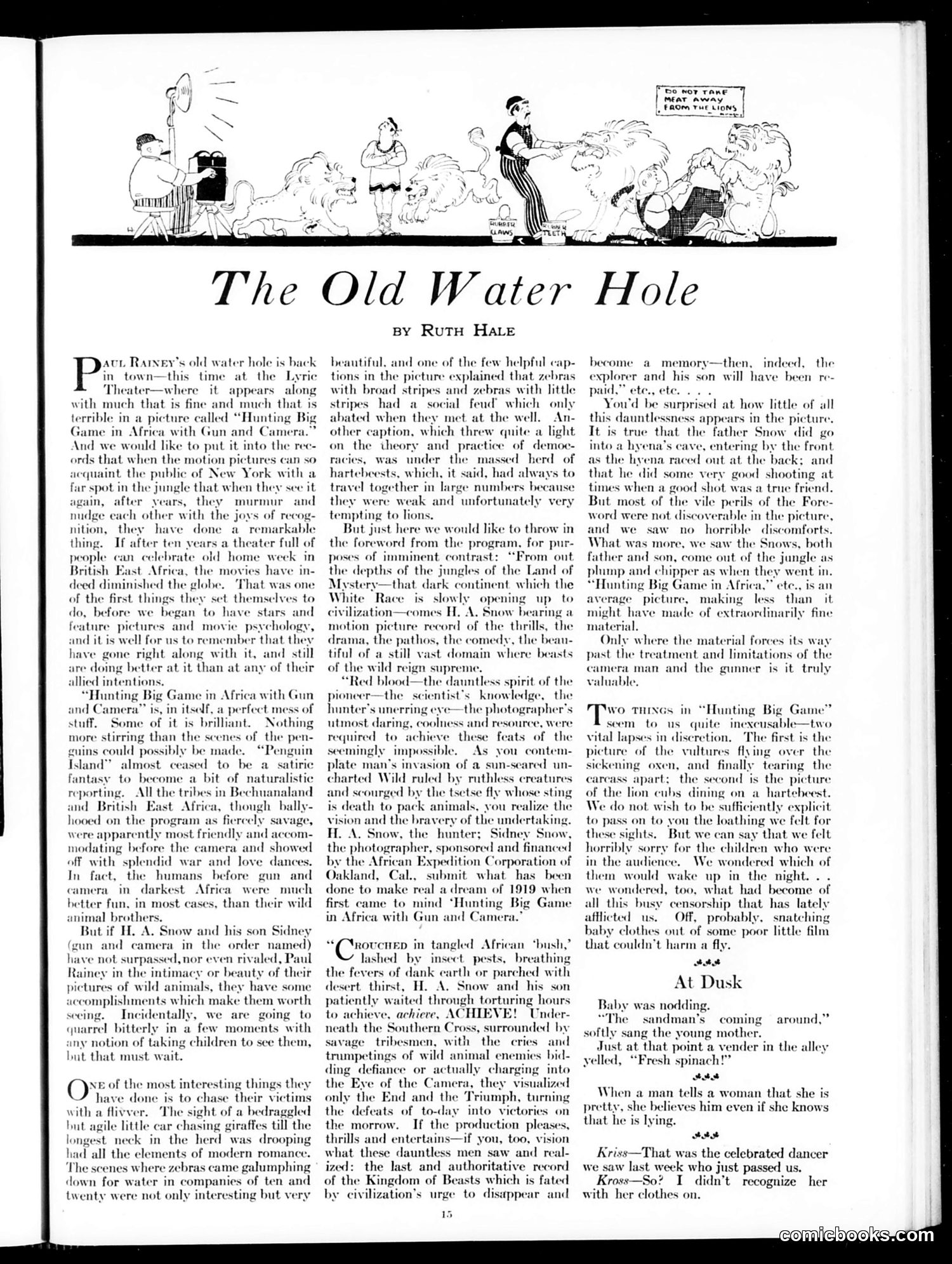
This is Ruth Hale's review of a nature documentary film, "Hunting Big Game in Africa with Gun and Camera," featuring H.A. Snow and his son Sidney. The illustrated header shows children and adults watching the film. Hale praises specific sequences (penguin colonies, zebras at a watering hole) as genuinely compelling cinema that shrinks the globe. However, she mocks the film's grandiose promotional language about "red blood" and "dauntless pioneers" conquering a "dark continent"—exposing the gap between the flowery rhetoric of colonial adventure and the actual footage of animals (and conveniently cooperative African tribes) cooperating before cameras. Her main critique concerns the film's suitability for children, which she promises to address later. The satire targets both the film industry's inflated claims about African "discovery" and the imperialist ideology underlying such productions.
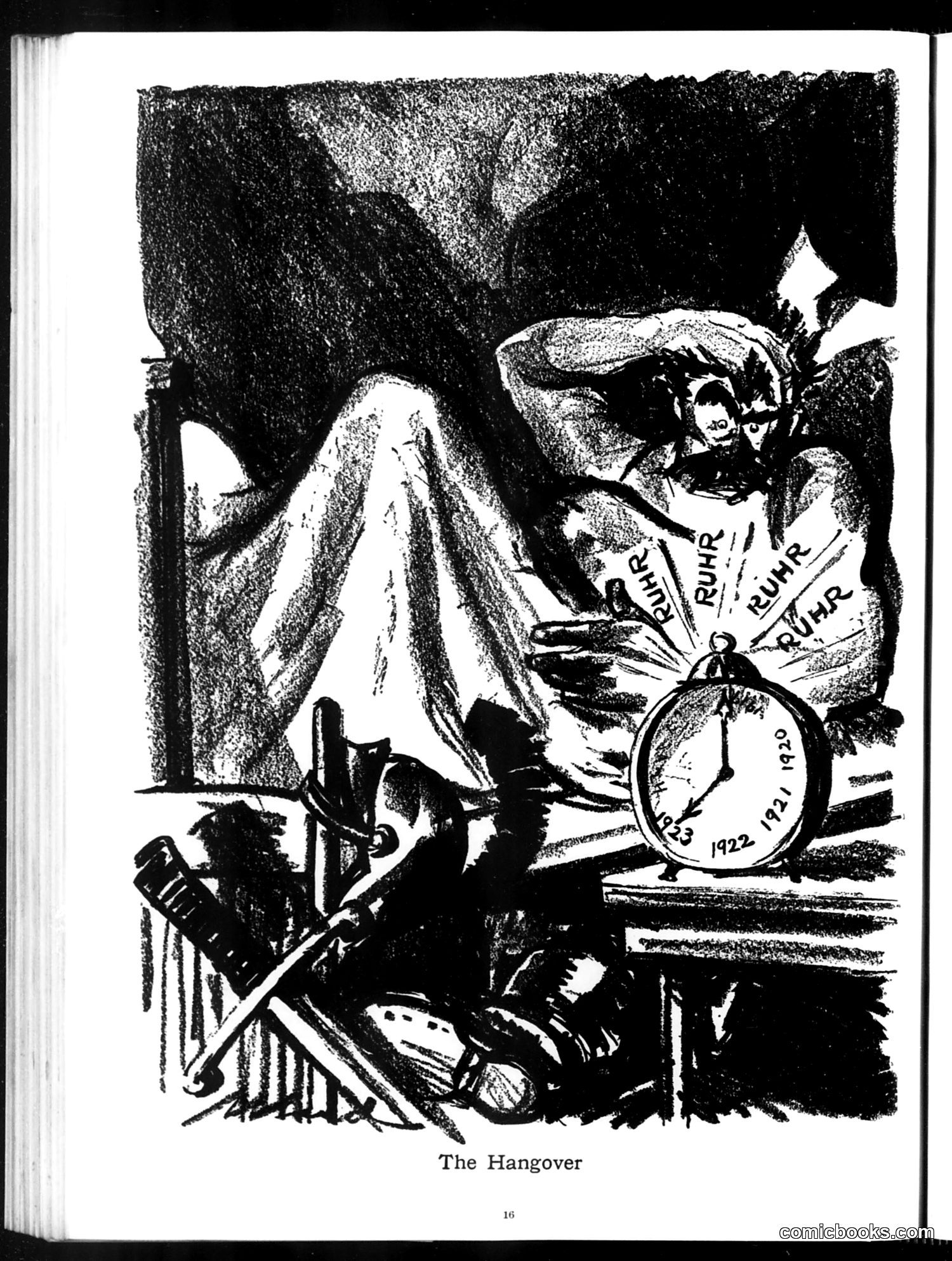
This cartoon satirizes the aftermath of Prohibition's implementation (note the clock reading "1922"). The central figure—appearing disheveled and suffering in bed—likely represents America or the American public experiencing the consequences of the 18th Amendment (Prohibition, 1920-1933). The surreal imagery of chaotic figures, bottles labeled "FUHR" (possibly "FURY"), and distressed expressions suggests the satirist's view that Prohibition created social chaos rather than the promised moral improvement. The "hangover" metaphor criticizes the policy's effects: crime, black markets, and public disorder despite the intent to eliminate alcohol consumption. Judge magazine, known for its political satire, presents this as commentary on Prohibition's unintended negative consequences during the early years of the amendment's enforcement.
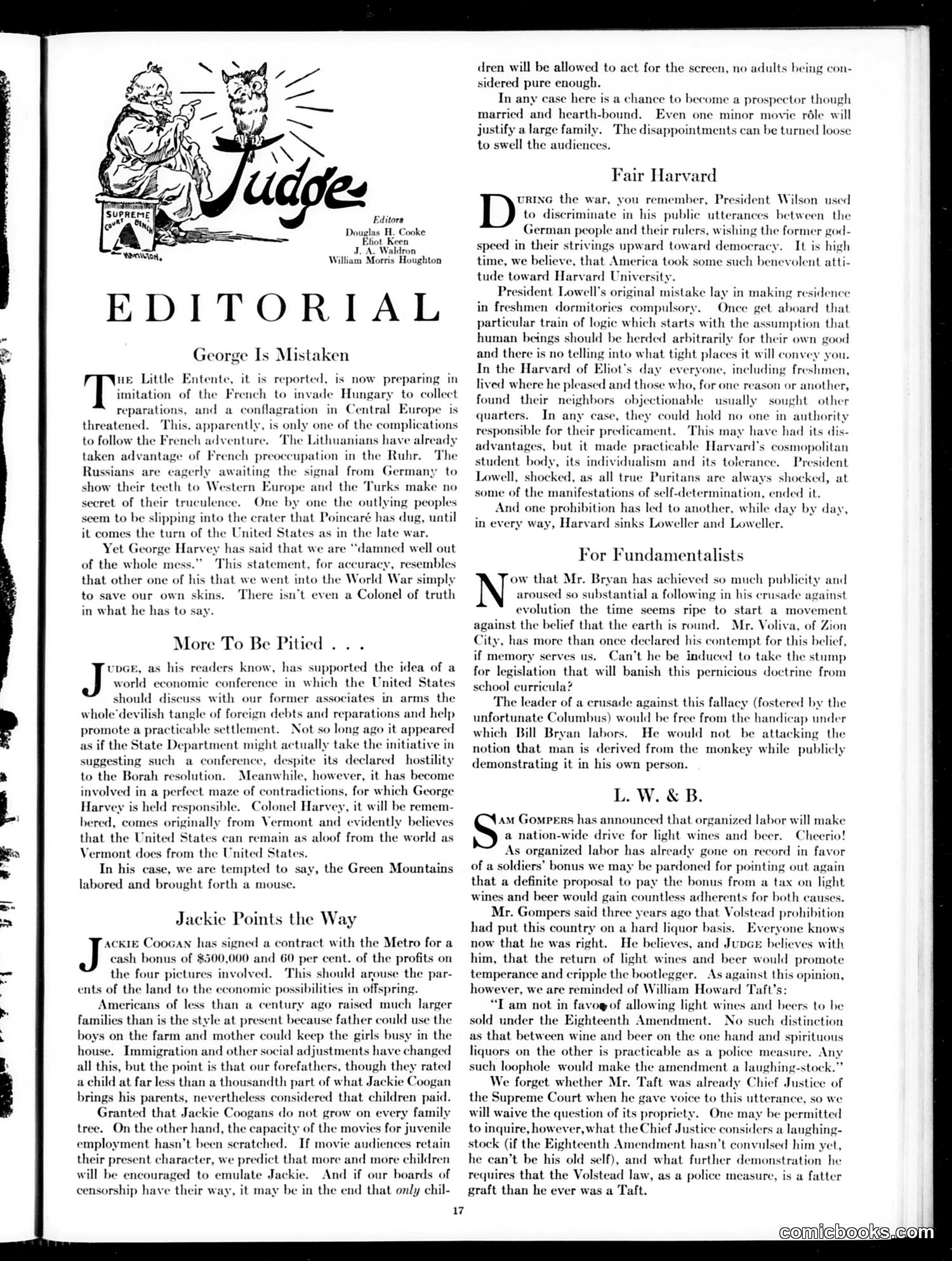
This editorial page from Judge satirizes several post-WWI political issues through four separate pieces: **"George Is Mistaken"** attacks diplomat George Harvey's isolationist stance on European affairs, particularly regarding the French occupation of the Ruhr and potential Central European conflicts. Judge argues Harvey naively believes America can remain detached from global consequences—a position the editors mock as producing only a "mouse" from the "Green Mountains." **"Jackie Points the Way"** uses child actor Jackie Coogan's lucrative film contract ($500,000 bonus) to satirize American parents' newfound interest in exploiting children as economic assets, predicting movie studios will increasingly employ minors. **"For Fundamentalists"** addresses William Jennings Bryan's anti-evolution crusade, questioning whether legislation can actually ban such "pernicious doctrine" from schools. **"L.W. & B."** discusses Sam Gompers' labor advocacy regarding bonus payments and prohibition of light wines and beer. The cartoonish masthead shows Judge as a wise authority figure judging public figures' foolishness. The overall tone is satirical progressivism—mocking isolationism, child labor normalization, and religious legislation.
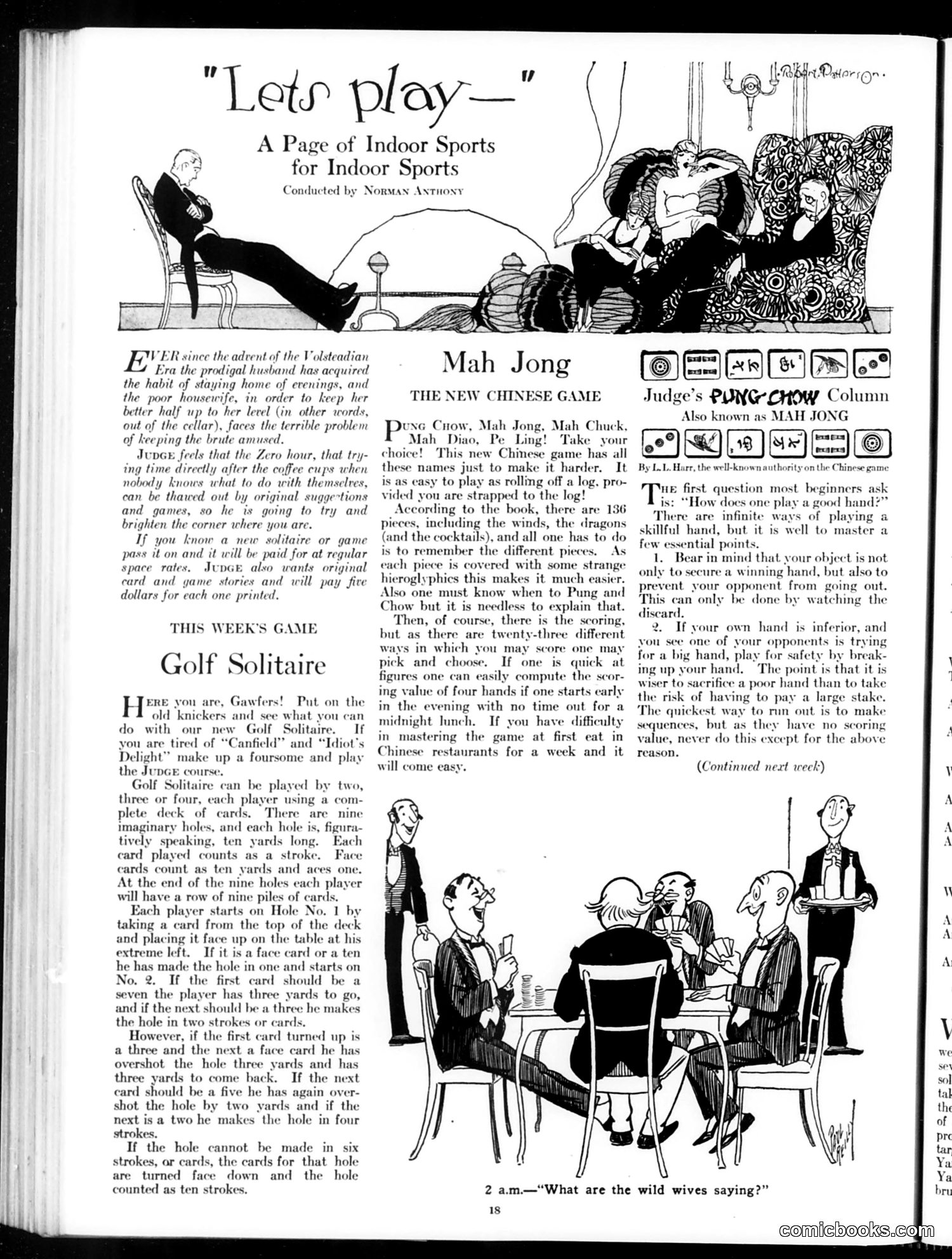
This Judge magazine page addresses the "Volstead Era" (Prohibition, 1920-1933), when husbands stayed home instead of visiting bars. The editorial frames the problem: wives must entertain their husbands at home to keep them from seeking illicit alcohol ("out of the cellar"). The page offers two indoor games as solutions: 1. **Golf Solitaire**: A card game mimicking golf, played solo or competitively. It reflects the era's obsession with golf as a leisure activity. 2. **Mah Jong**: A newly fashionable Chinese tile game gaining popularity in 1920s America. The satirical tone ("as easy to play as rolling off a log, provided you are strapped to the log") mocks its actual complexity while poking fun at the fad. The cartoon below shows people playing cards at home—visualizing the domestic entertainment solution the page promotes. The humor stems from portraying Prohibition's unintended consequence: transforming the American home into an entertainment venue, and wives as reluctant activity coordinators for bored husbands.
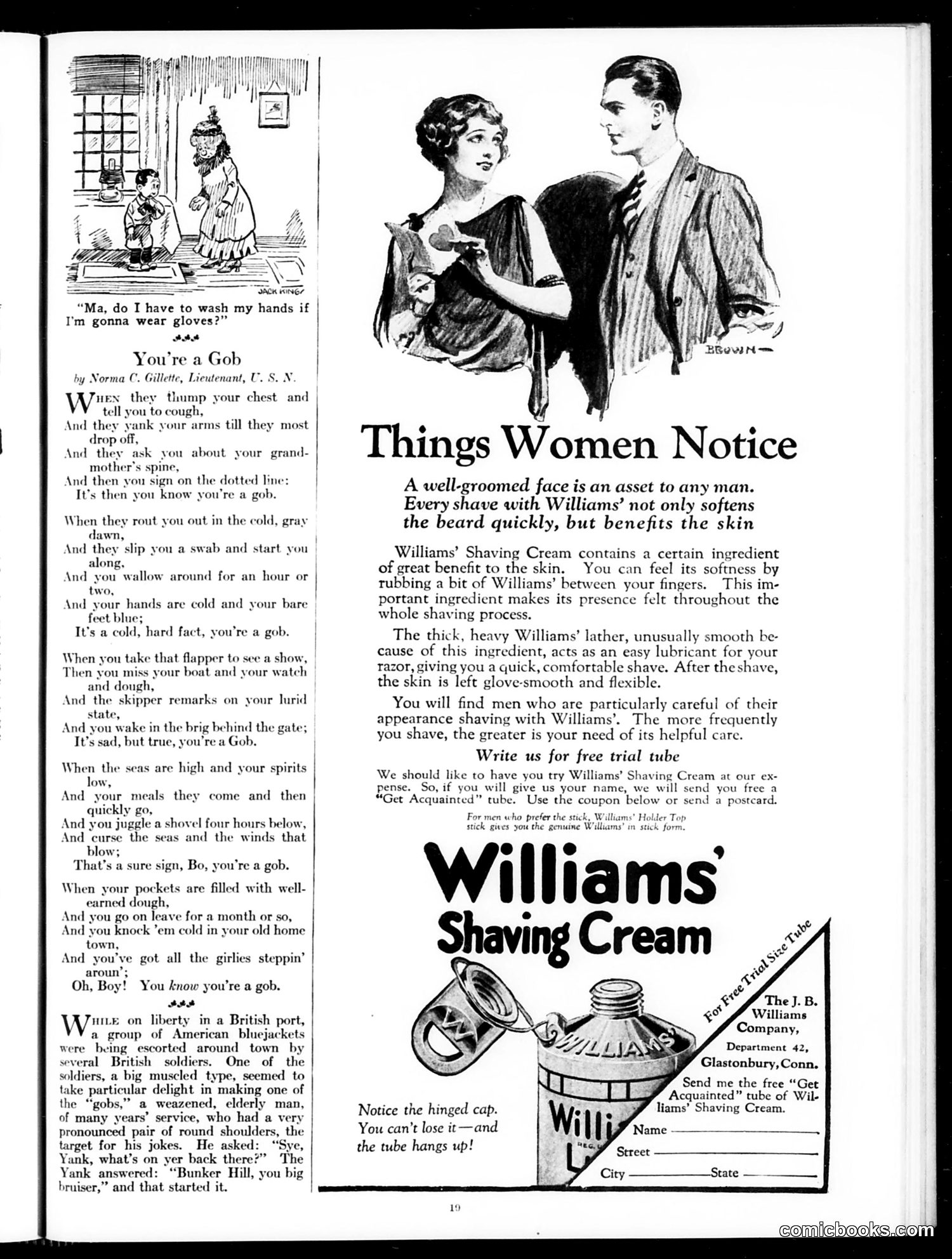
This page contains two distinct pieces typical of Judge's mix of humor and advertising: **Left side - Two humorous pieces:** 1. A small cartoon about a child asking whether hand-washing matters if wearing gloves—a simple joke about practical hygiene during an era when gloves were common outerwear. 2. "You're a Gob" (by Lieutenant Norma C. Gillette, U.S. Navy)—a poem cataloging the hardships and experiences that mark a naval sailor ("gob"). It humorously lists indignities: physical exams, cold weather, missing dates and money, seasickness, and arduous labor. The anecdote below recounts American sailors ribbing a British soldier about his posture, calling him "Bunker Hill"—a patriotic jab referencing America's Revolutionary War victory. **Right side - Williams' Shaving Cream advertisement:** An ad targeting men, emphasizing that grooming signals attractiveness to women ("Things Women Notice"). It promotes the cream's skin-softening properties and includes a mail-in coupon for a free trial tube. The page reflects 1920s concerns: military service, gendered beauty standards, and consumer product marketing.
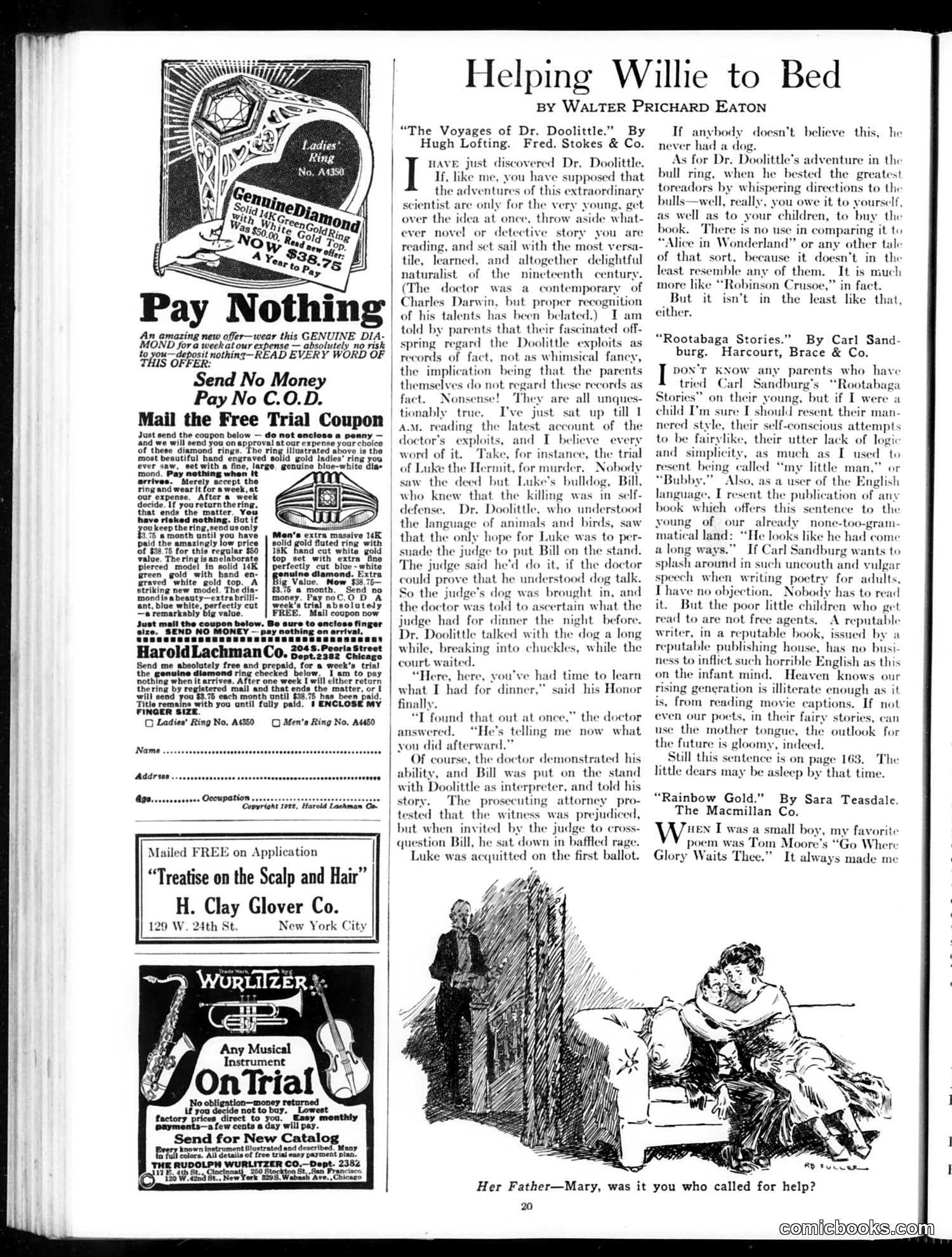
This page is primarily a **book review column** by Walter Prichard Eaton discussing "The Voyages of Dr. Doolittle" by Hugh Lofting. Eaton defends the children's book against adult skepticism, arguing it deserves serious readership. He illustrates his point with an amusing plot summary: Dr. Doolittle proves he understands animal language by having a bulldog testify in court about what the judge ate for dinner the night before—a whimsical yet convincing demonstration. The accompanying illustration shows a father putting a child to bed, likely referencing the column's title and the domestic scene of bedtime story-reading. The page also contains **period advertisements** (diamond rings, musical instruments, hair treatments) typical of early 20th-century magazines. These ads are unrelated to the editorial content.
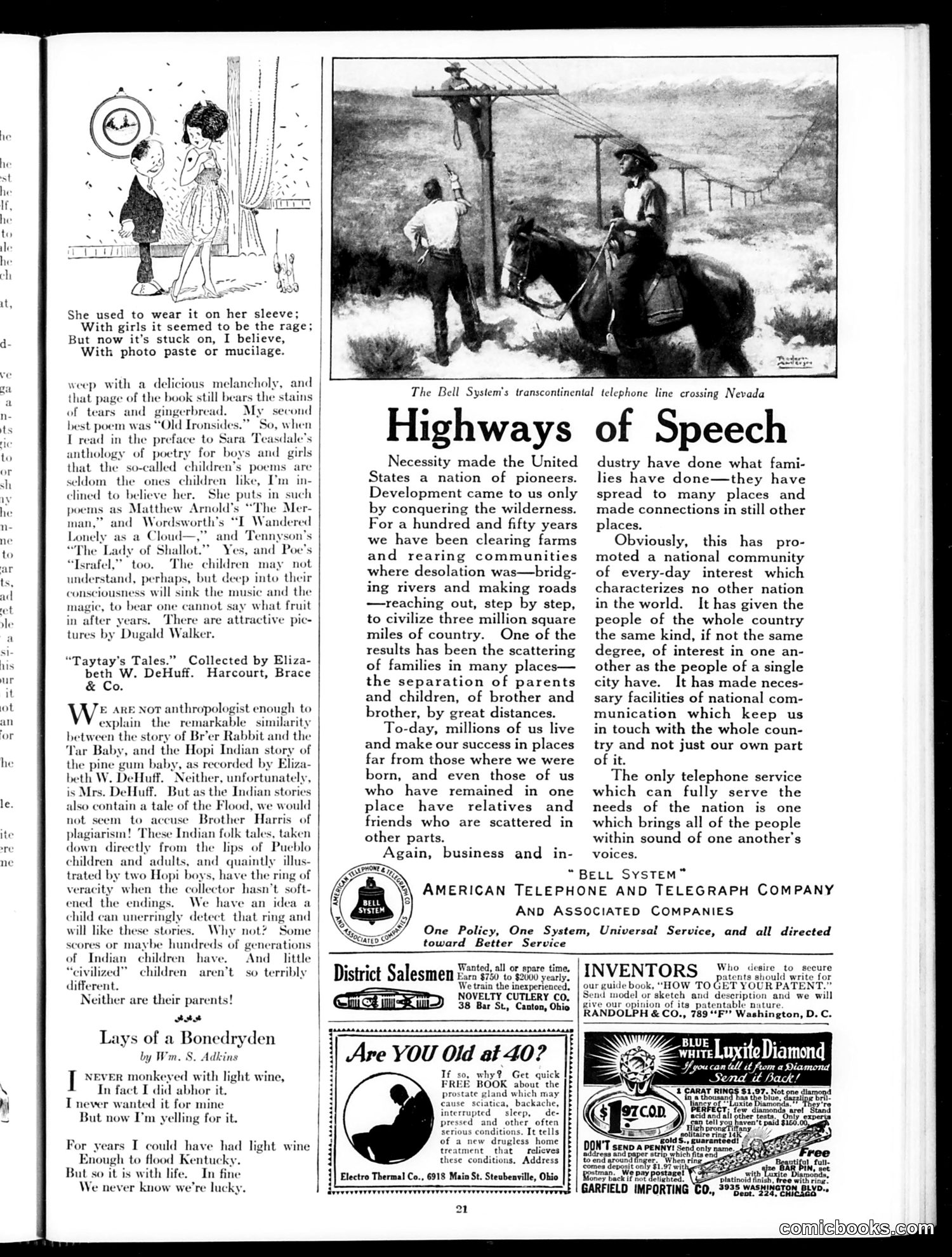
This is primarily a **literary review and advertising page** rather than a political cartoon. The main content discusses children's poetry anthologies and folk tales, with a notable critique: the reviewer notes that editors select "serious" poems (Arnold, Wordsworth, Poe) for children, assuming these have educational value, yet suspects children actually prefer simpler works. The **left cartoon** depicts a woman showing someone something stuck to her sleeve—likely a pin or brooch that was fashionable ("the rage") but has become permanently adhered with adhesive. It's a light joke about dating fashion trends. The **"Highways of Speech" piece** is a Bell System advertisement framed as social commentary, arguing that America's geographic expansion necessitated telephone infrastructure to maintain national community bonds—family connections across distances. **"Lays of a Bonedryden"** is humorous Prohibition-era verse: a man who claimed to never want alcohol now desperately desires it (referencing Prohibition's restrictions). The overall page mixes literary criticism with advertising, typical of Judge's format.
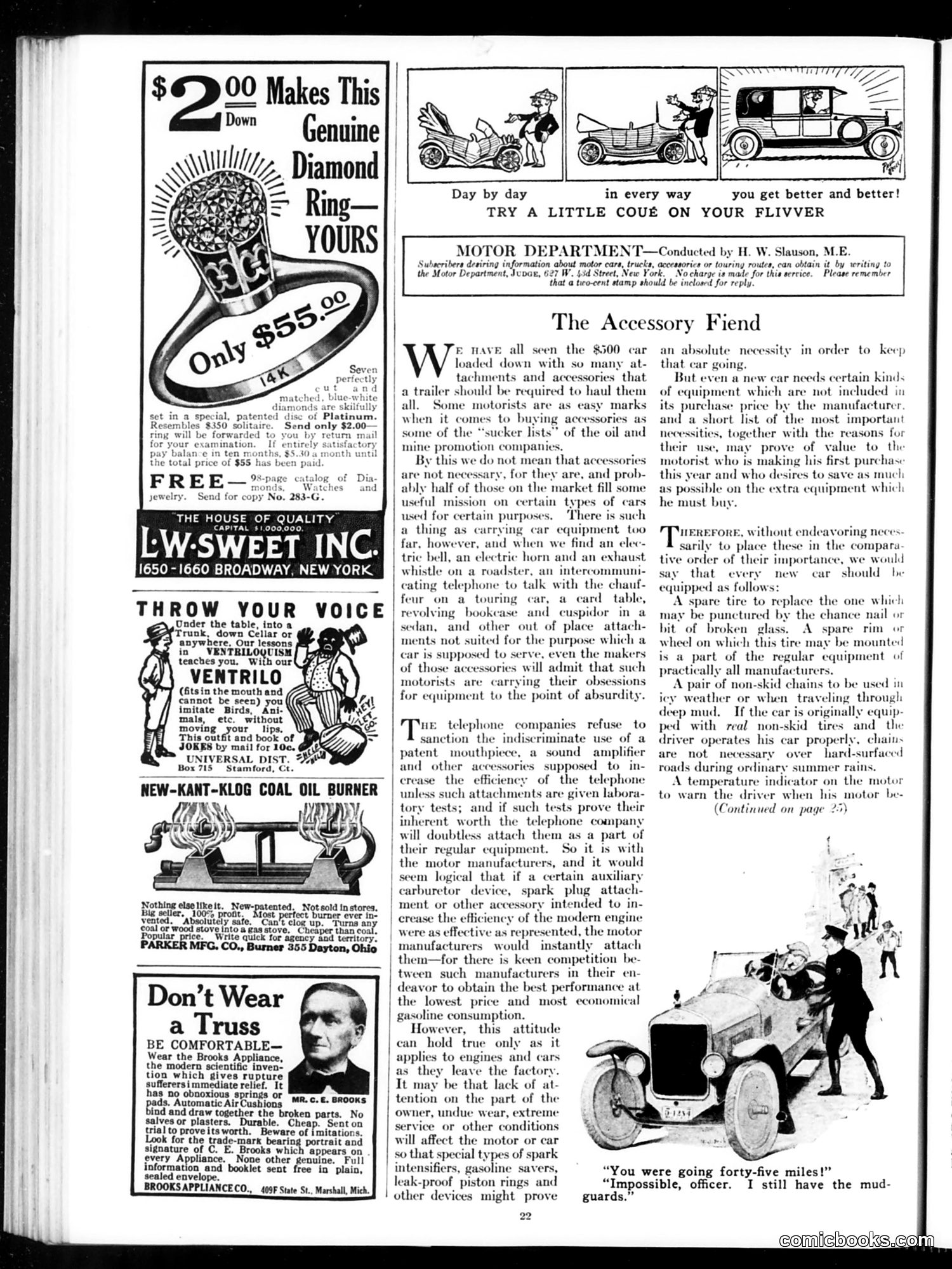
This page is primarily **advertising and automotive advice**, not political satire. The main content is "The Accessory Fiend," a motor department article by H.W. Slauson criticizing motorists who excessively equip their cars with unnecessary gadgets—electric bells, horns, intercommunicating telephones, card tables, and cuspidors. The author argues that legitimate accessories should improve efficiency, and that manufacturers would adopt truly effective devices. The satirical point targets wealthy car owners' absurd over-accessorizing. The surrounding ads promote various products: a $55 diamond ring, ventriloquism lessons, a coal oil burner, and a rupture appliance ("Don't Wear a Truss"). The cartoon bottom-right shows police stopping a speeding driver; the caption "You were going forty-five miles!" with the driver's mudguard excuse satirizes early traffic enforcement and driver excuses. This reflects 1910s-era concerns about automobile culture and conspicuous consumption among the wealthy.
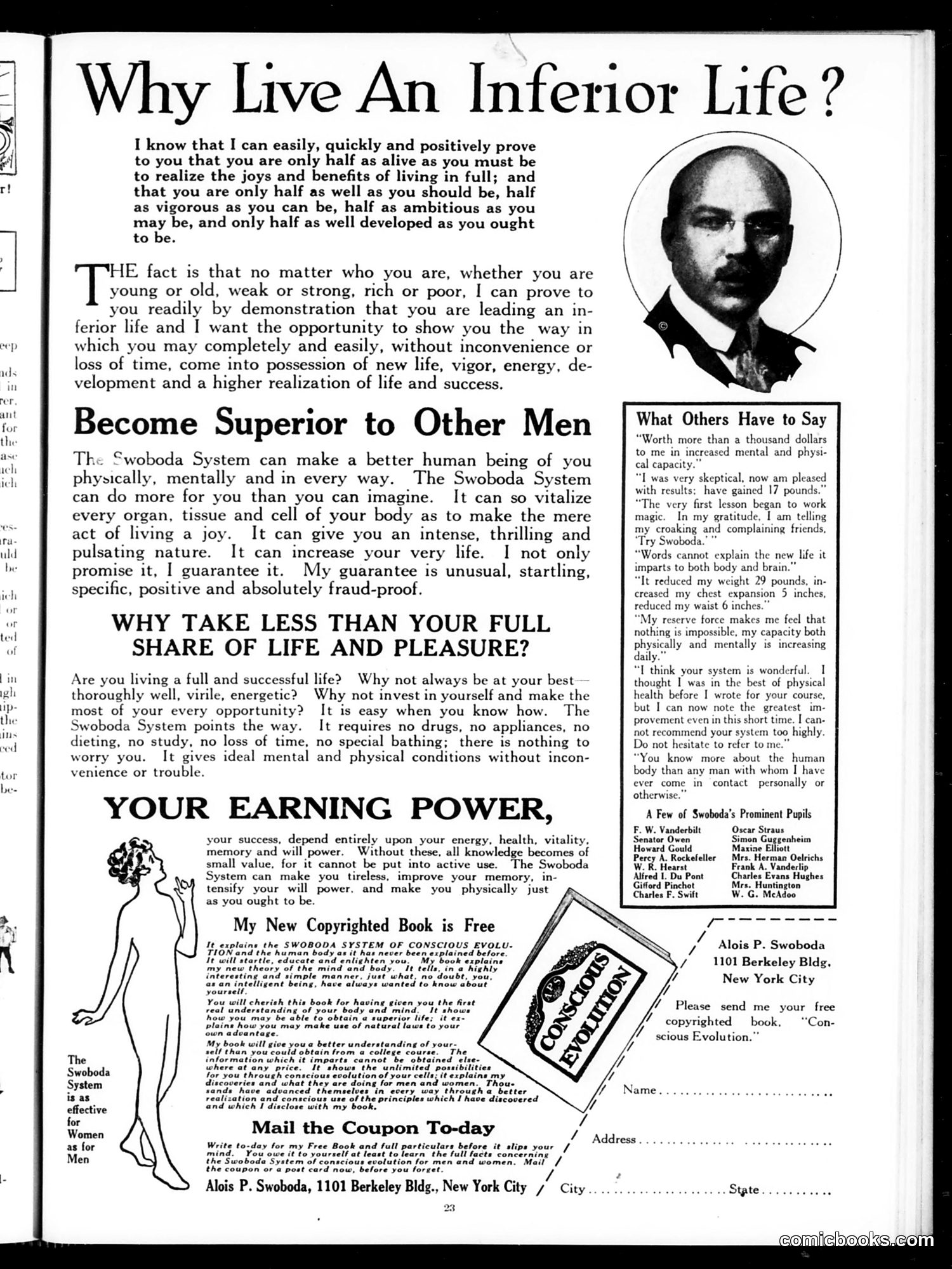
This page is primarily a **self-help advertisement** rather than satire. It promotes Alois P. Swoboda's "System of Conscious Evolution"—a mail-order self-improvement program claiming to increase vitality, health, earning power, and physical development through unspecified methods (no drugs, diet, or appliances required). The hyperbolic language ("prove you are only half as alive," "become superior to other men") and grandiose promises typify early 20th-century pseudoscientific marketing. The testimonials praising dramatic results (17-pound weight gains, chest expansion) lend false credibility. **The satirical angle:** Judge magazine likely ran this as **satire of such fraudulent self-help schemes** proliferating in that era. The extreme boasting and vague methodology—claiming to improve everything from memory to willpower through mysterious "conscious evolution"—would strike contemporary readers as absurd quackery worthy of mockery. The coupon inviting requests for the "free" book was standard bait-and-switch advertising practice.
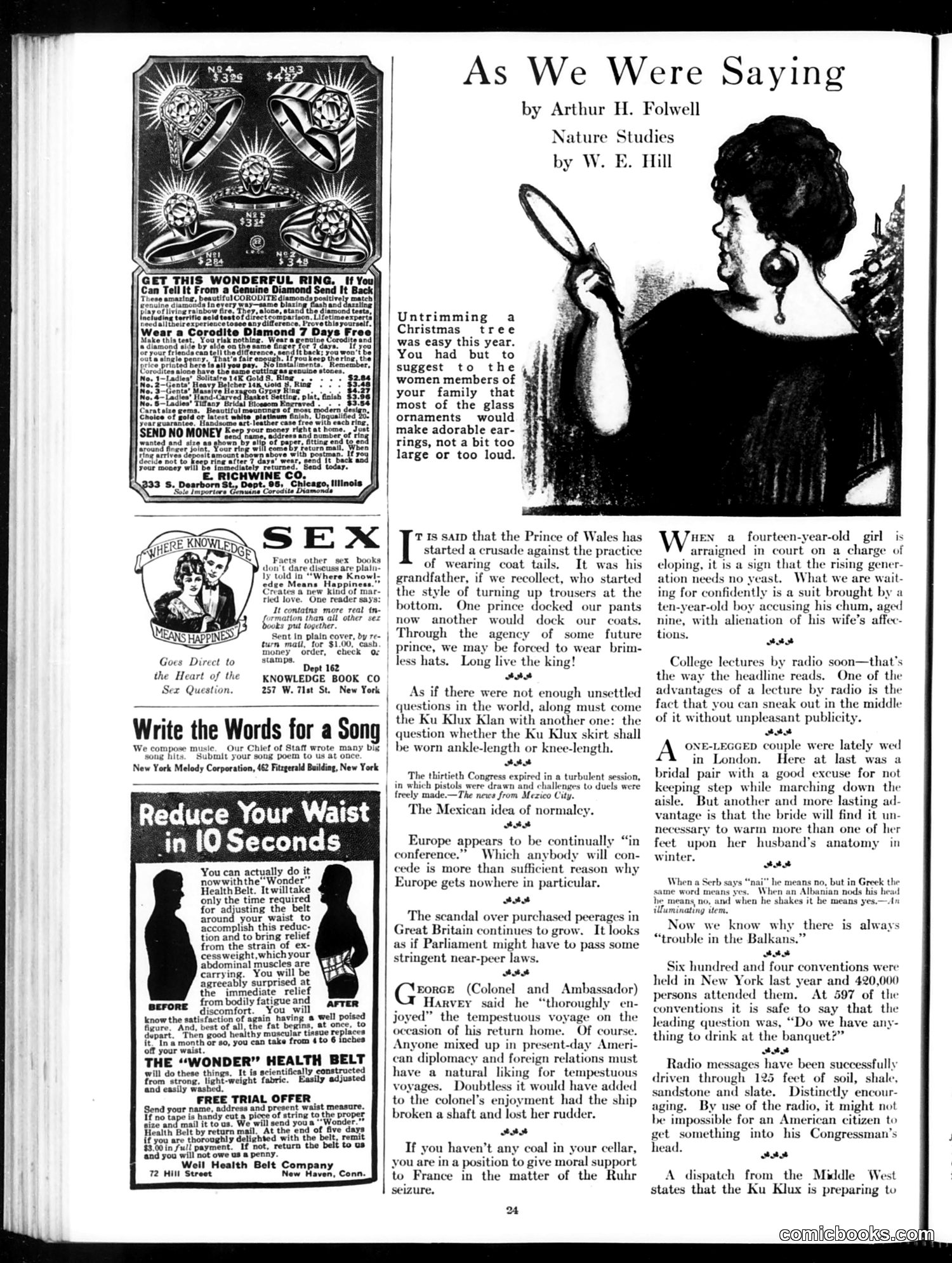
This page is primarily **light social satire and humor** rather than political cartooning. The main content is a column by Arthur H. Folwell with nature observations by W.E. Hill. The satirical items mock contemporary social concerns: - **Fashion absurdity**: Mockery of the Prince of Wales starting trends (like turning up trouser cuffs), suggesting future princes might force men to wear brimless hats—poking fun at blind fashion-following. - **The Ku Klux Klan**: A quick jab at the Klan debating whether their robes should be ankle- or knee-length, treating their internal disputes as trivial. - **European politics**: Sarcasm about Europe being perpetually "in conference" without resolving anything. - **British corruption**: Criticism of the "peerages scandal"—selling titles to the wealthy. - **Ambassador Harvey**: Dry mockery of a diplomat praising a rough voyage, implying modern diplomats accept chaos as normal. The page also contains period advertisements (mail-order books, waist-reduction belts, song-writing services), typical of 1920s magazines. No specific politicians are identified or caricatured here.
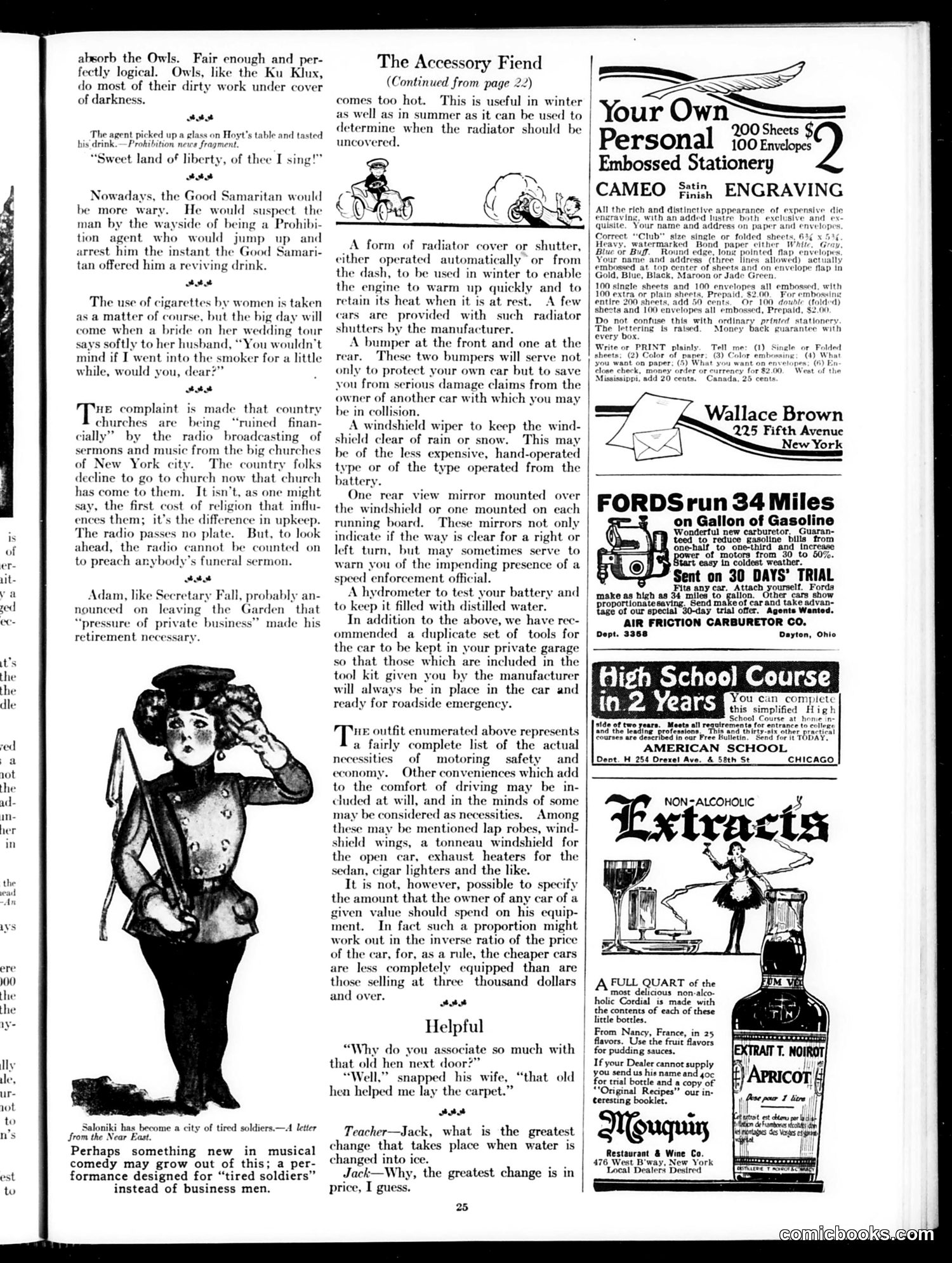
This page contains primarily **automobile safety accessories advertising and advice**, not political satire. The main article "The Accessory Fiend" discusses practical car equipment like radiator shutters, bumpers, windshield wipers, mirrors, and tools—presented as necessary safety features for motorists. The scattered brief humorous items are social commentary rather than political cartoons: - **Prohibition-era jokes** about federal agents and offering drinks - **Gender commentary** on women smoking cigarettes and wives entering train smoking cars - **Radio's impact on rural churches**, which lose attendance when city church sermons broadcast - **Secretary Fall's resignation**, humorously compared to Adam leaving Eden The **illustration** (bottom left) appears to be a decorative figure, possibly related to the Saloniki reference about "tired soldiers." The page is primarily **advertising-driven**, with promotions for embossed stationery, Ford automobiles, and various consumer products typical of 1920s magazines. The satire is mild, focused on contemporary social changes rather than political critique.
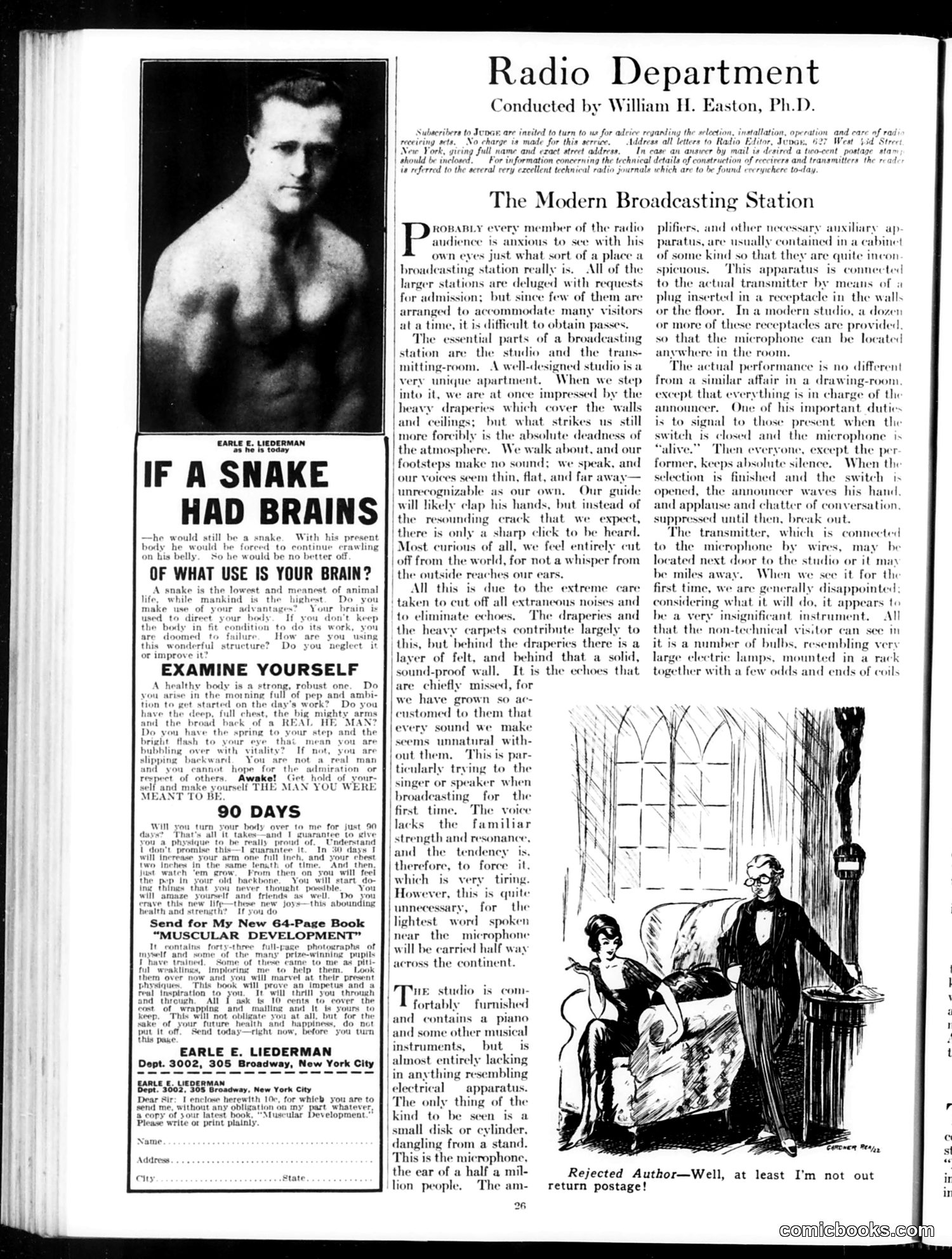
This page contains two distinct elements: **The Radio Department Article**: A technical explainer about modern broadcasting studios, conducted by William H. Easton. It describes how radio stations work—the soundproofed studio with heavy drapes, the control room, the microphone placement, and the transmitter. The accompanying cartoon illustrates a studio scene with performers and technical staff. This is straightforward educational content, not satire. **The Earle E. Liederman Advertisement**: The left side features an aggressive self-help pitch using the provocative headline "If a Snake Had Brains"—suggesting readers are currently as limited as snakes. Liederman was a real fitness promoter of this era who used shaming tactics to sell physical development courses via mail. The ad urges readers to "examine yourself" and promises transformation in "90 days," culminating in a form to request his "Muscle Development" book. The contrast between serious radio education and the hyperbolic fitness hucksterism is typical of Judge's mixed content model—legitimate articles alongside satirical commentary embedded in advertisements themselves.
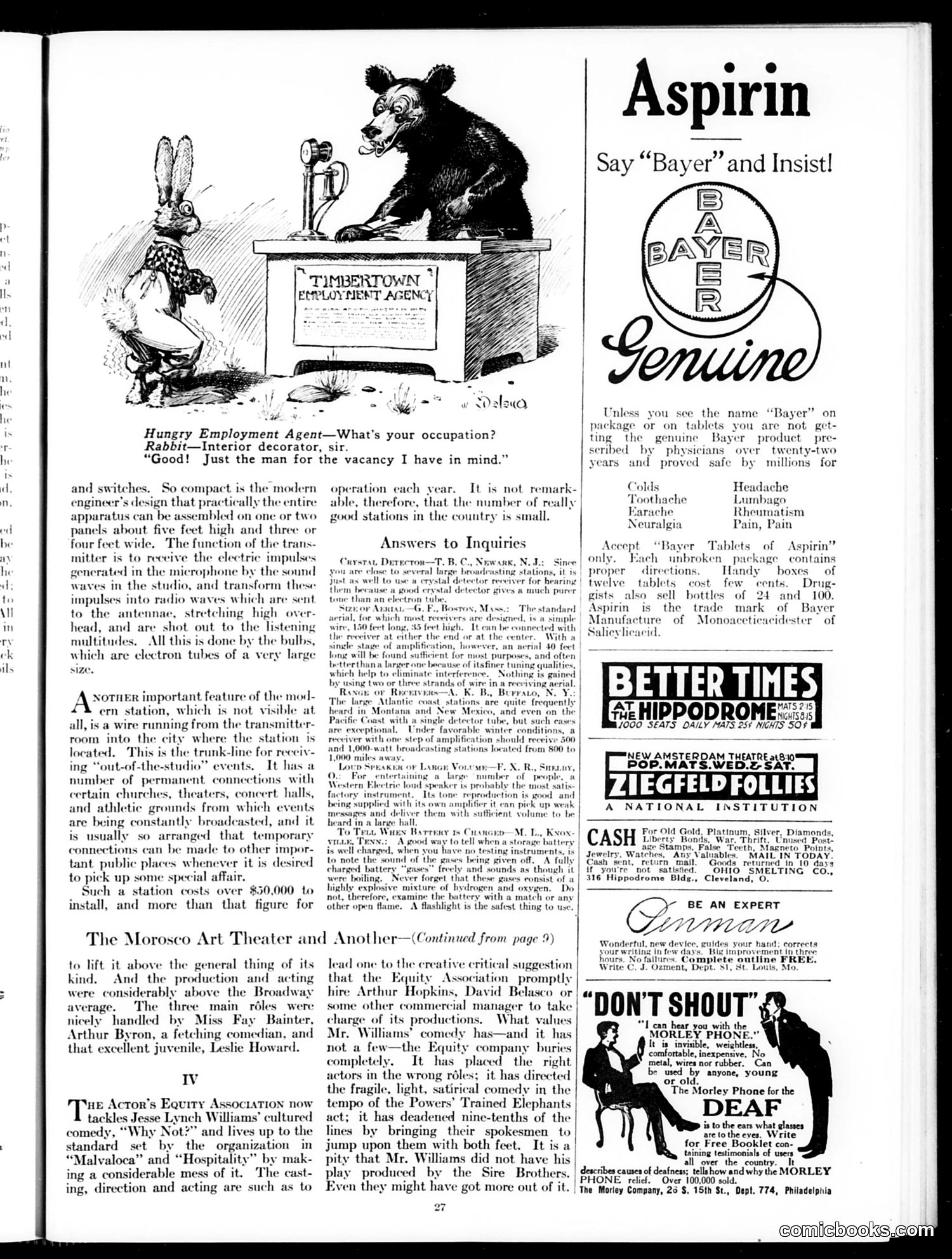
This single-panel cartoon satirizes absurd job placements through a visual pun. A **rabbit** applies to a "Timbertown" employment agency seeking work as an "interior decorator." The employment agent enthusiastically responds: "Good! Just the man for the vacancy I have in mind." The joke relies on the double meaning of "decorator" — the rabbit, as a *real rabbit*, would naturally decorate interior spaces by eating or damaging furnishings and walls. The agent treats the rabbit's species as a perfect qualification for destroying homes. This is typical **Judge magazine** humor: wordplay-based satire that exploits literal versus figurative meanings. The cartoon mocks both incompetent employment practices (hiring unsuitable candidates) and the "modern" employment agency industry of the 1920s-30s era, suggesting that such agencies make absurdly poor hiring decisions. The rabbit's earnest expression and formal attire enhance the absurdist humor.
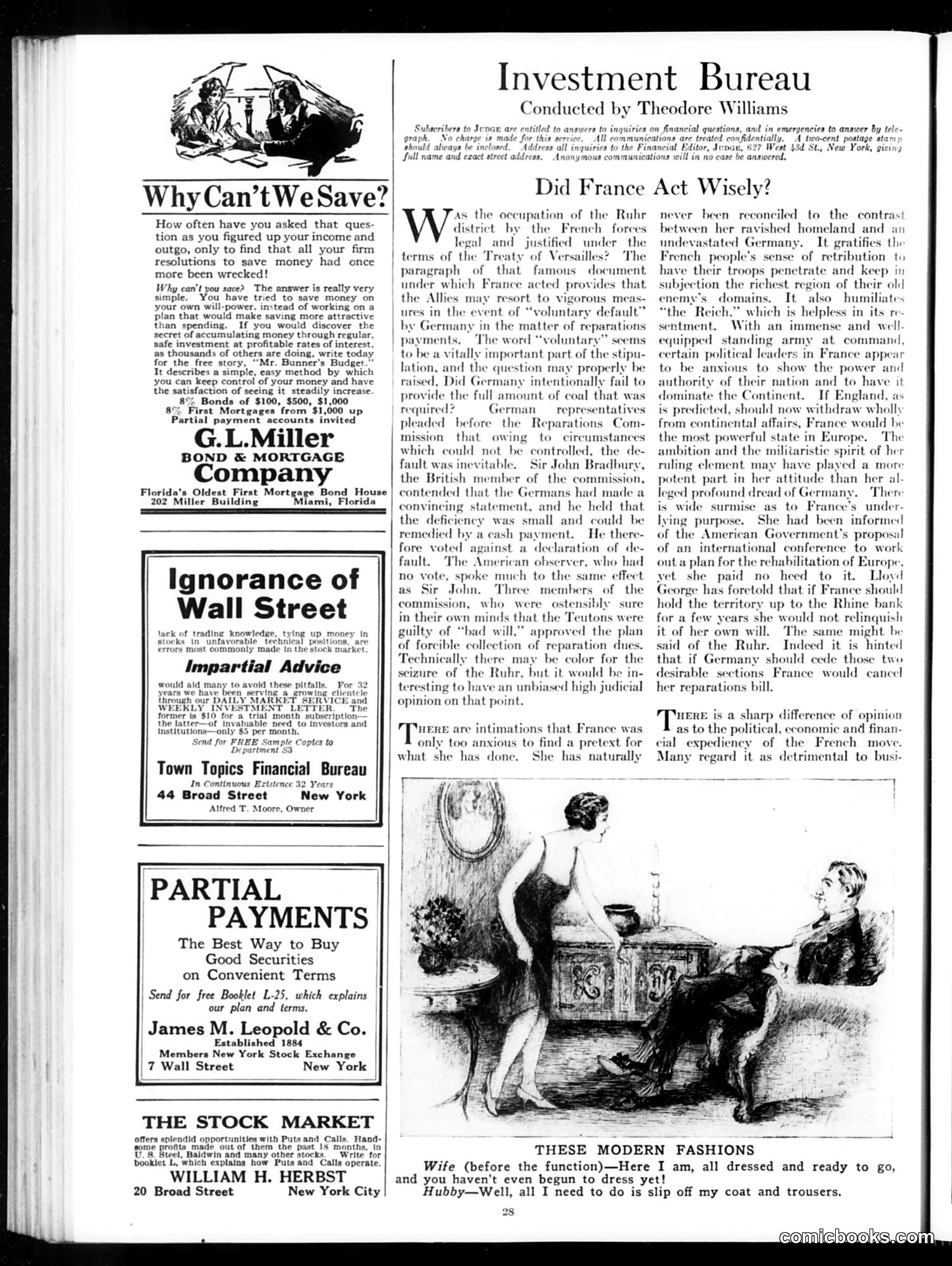
This page combines financial advertisements with a serious political commentary on France's 1923 occupation of Germany's Ruhr industrial region. **The Main Article:** "Did France Act Wisely?" debates whether France legally justified seizing the Ruhr under the Treaty of Versailles. The author presents competing interpretations: France claimed Germany deliberately defaulted on coal reparations ("voluntary default"), while British and American observers argued Germany's failure was circumstantial, not intentional. The piece suggests bias—three commission members favored France's seizure, implying political rather than legal reasoning. **The Cartoon:** Shows a fashionably dressed woman at a mirror, telling her husband she's "all dressed and ready to go" but needs him to slip off her coat and trousers. The caption "These Modern Fashions" sarcastically implies France is like a woman making unreasonable demands of her husband—suggesting France's aggressive Ruhr occupation was excessive or inappropriately demanding toward Germany. **Context:** This reflects American skepticism toward French reparations policy in the early 1920s.
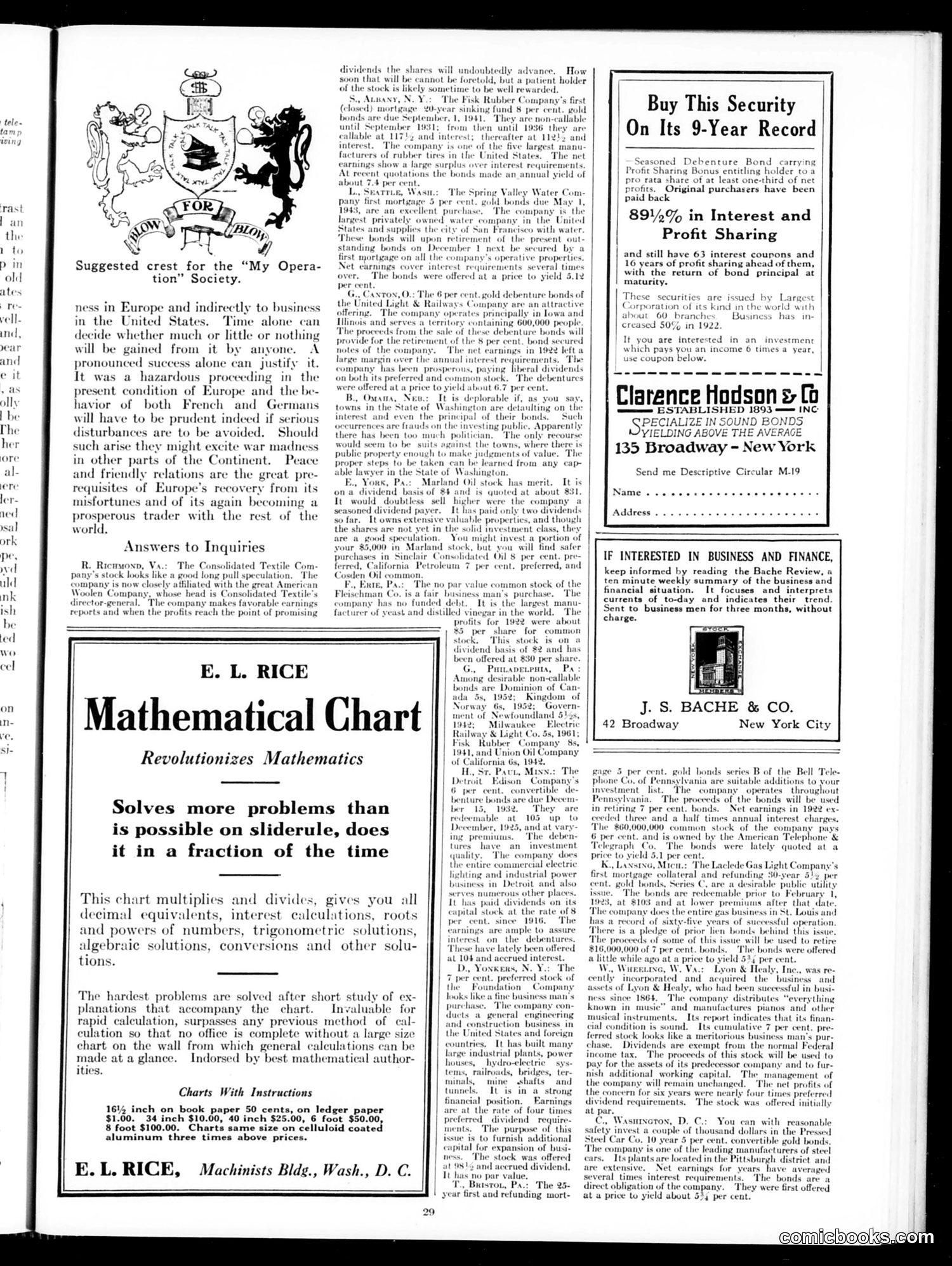
This page is primarily **financial advertising and investment advice**, not political satire. The small cartoon at the top—labeled "Suggested crest for the 'My Operation' Society"—appears to be a brief visual joke, likely mocking some contemporary social trend or organization (unclear which without more context), featuring heraldic shields with exaggerated figures. The bulk of the page consists of: 1. **Investment recommendations** for various bonds and stocks (Fisk Rubber, Spring Valley Water, Canton Light & Railways, etc.) 2. **Advertisements** for securities firms (Clarence Hodson & Co., J.S. Bache & Co., E.L. Rice Mathematical Charts) 3. **Reader Q&A about bonds and dividends** The tone reflects 1920s optimism about corporate investments and profit-sharing schemes. The page demonstrates how Judge magazine blended satire with financial content to appeal to middle-class readers interested in business news and investment opportunities.
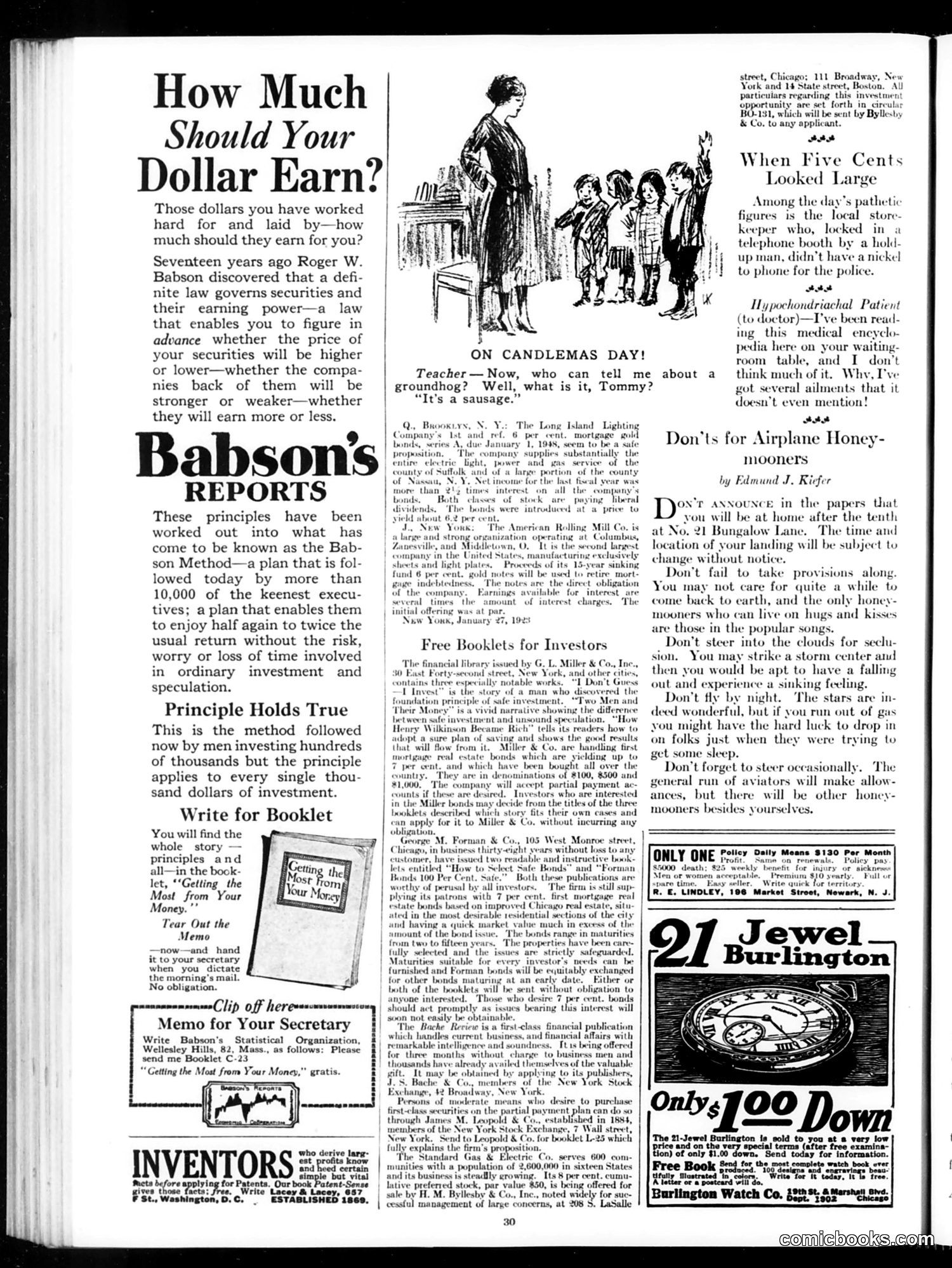
This page mixes financial advertising with light humor. The primary content is an advertisement for **Babson's Reports**, an investment advisory service founded by Roger W. Babson seventeen years prior. It promotes the "Babson Method" for predicting securities performance, claiming to help investors earn returns 1.5 to 2 times normal without excessive risk. The satirical content includes three brief jokes: 1. **"On Candlemas Day"**: A teacher asks about groundhogs; a child answers "It's a sausage"—a simple non-sequitur children's joke. 2. **"When Five Cents Looked Large"**: References a store-keeper locked in a phone booth by a robber, lacking a nickel for police—implying economic desperation during what appears to be the 1920s. 3. **"Don'ts for Airplane Honeymoon"**: Practical humor advising couples about aviation limitations and courtesies. The page reflects 1920s investment culture and early aviation novelty.
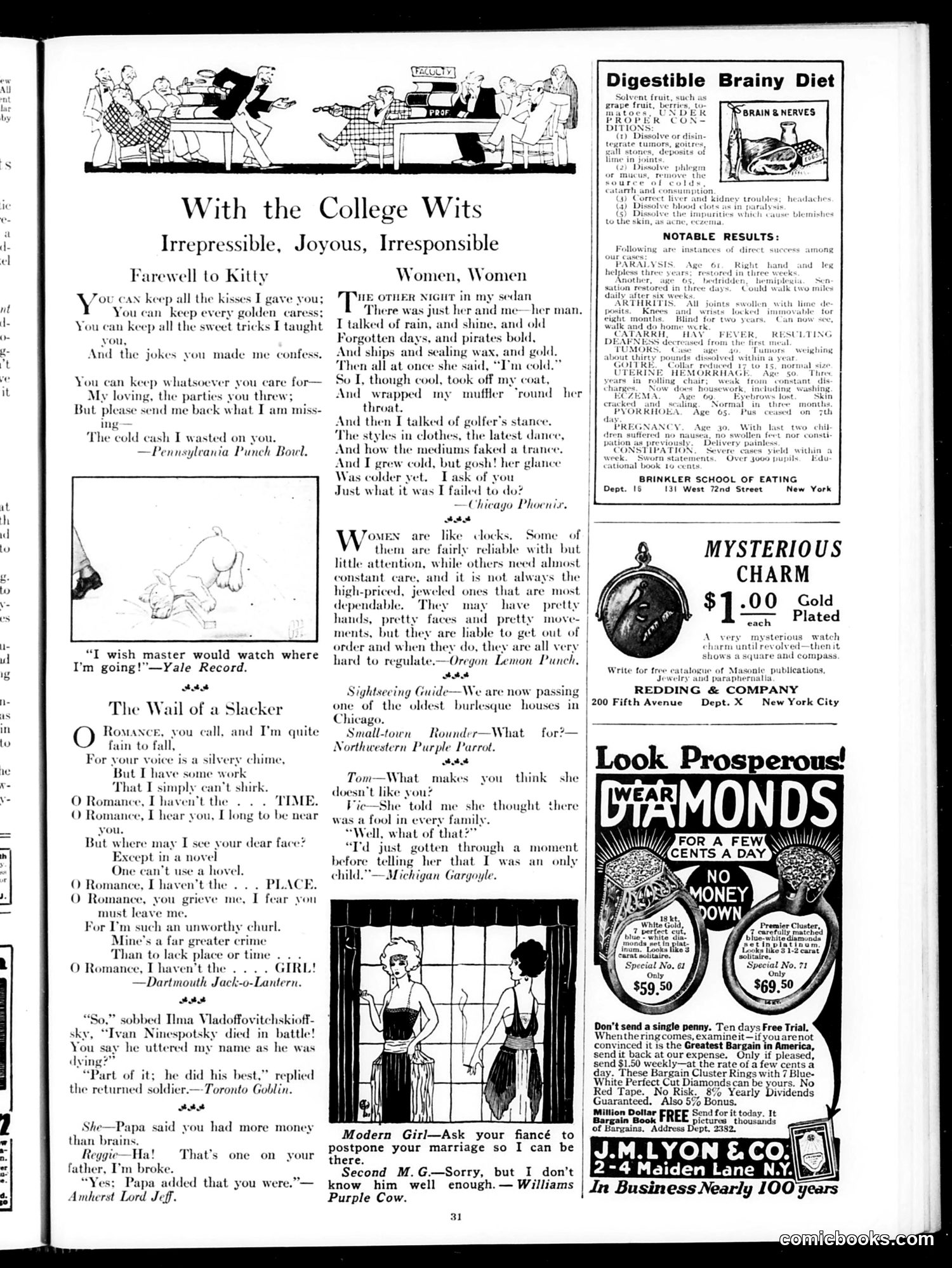
This page collects humorous college poetry and jokes satirizing young romance and courtship among college students circa the 1920s. **Main Content:** The featured poems mock romantic pretense: "Farewell to Kitty" portrays a man asking his ex to return the money he wasted on her; "The Wail of a Slacker" depicts someone too busy with work to pursue romance. These target college men's contradictory desires—wanting romance while avoiding its demands or expenses. **Social Satire:** The jokes ridicule gender relations: one piece compares women to clocks needing constant maintenance; another shows a woman's romantic coldness after a man removes his coat to comfort her. The final joke plays on a woman's dig at a man's intelligence. **Context:** This reflects post-WWI college culture where young people navigated new social freedoms while facing economic pressures. The tone is gently mocking toward both genders' romantic games rather than harshly critical. The page also includes unrelated period advertisements (health remedies, jewelry, diamond rings).
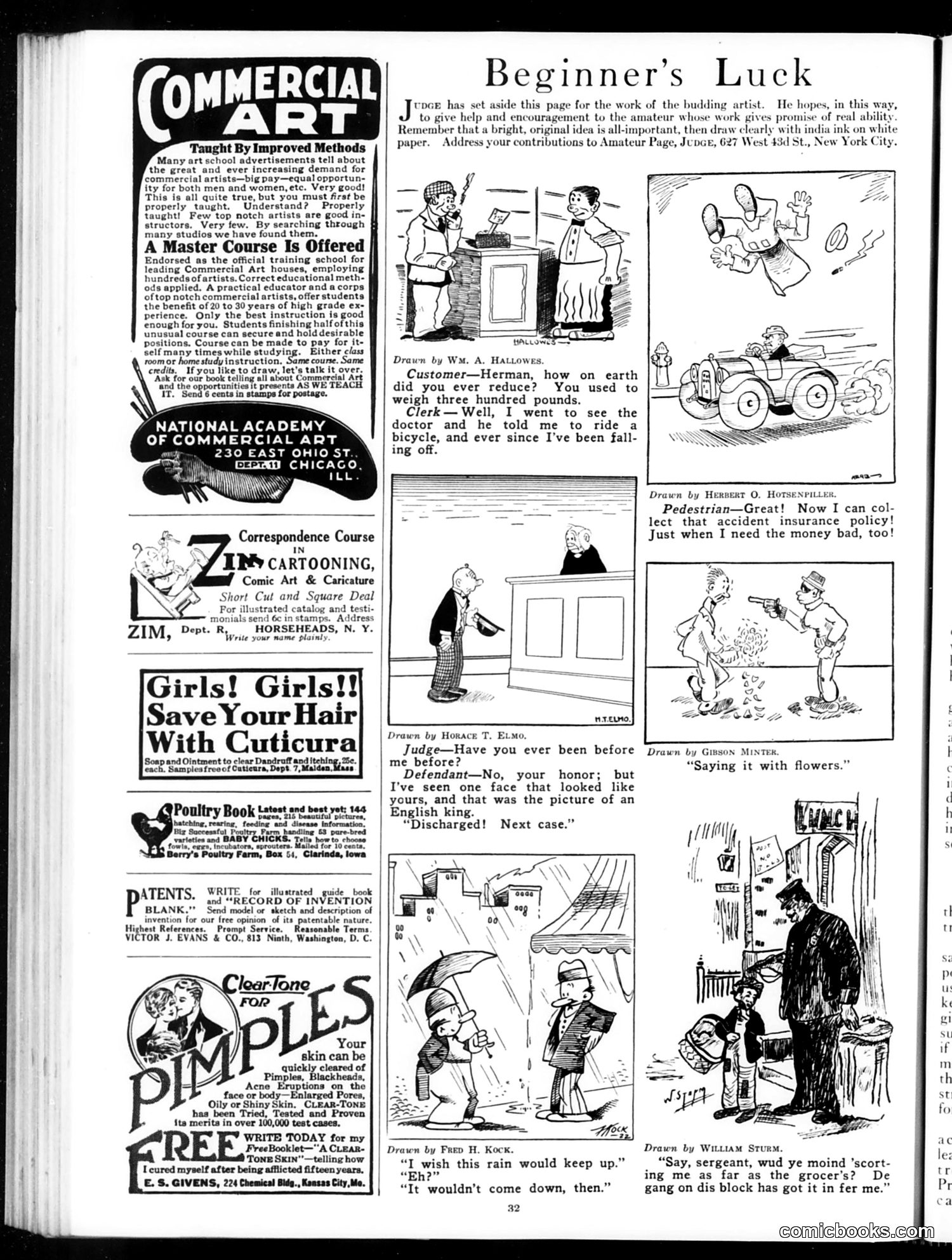
This page showcases six short humorous comics from Judge magazine's "Amateur Page," featuring jokes about everyday situations: 1. **Weight loss via bicycle**: A clerk credits his dramatic weight loss to doctor's orders to ride a bicycle, admitting he's been "falling off" — the joke being literal rather than metaphorical. 2. **Courtroom repeat offender**: A defendant claims never appearing before the judge, yet recognizes his face from a picture of an English king — suggesting the judge resembles royalty (or appears regal/stern). 3. **Insurance opportunism**: A pedestrian celebrates a minor accident, seeing it as a windfall for collecting accident insurance. 4. **Rain paradox**: Two figures joke about rain "keeping up" versus "coming down" — wordplay on the phrase's ambiguity. 5. **Flower apology**: Simple visual gag about expressing sentiment through flowers. 6. **Irish immigrant humor**: An Irish character requests police escort to the grocer's, fearing "de gang." The page emphasizes everyday American life, working-class characters, and simple wordplay humor typical of early 20th-century Judge magazine.
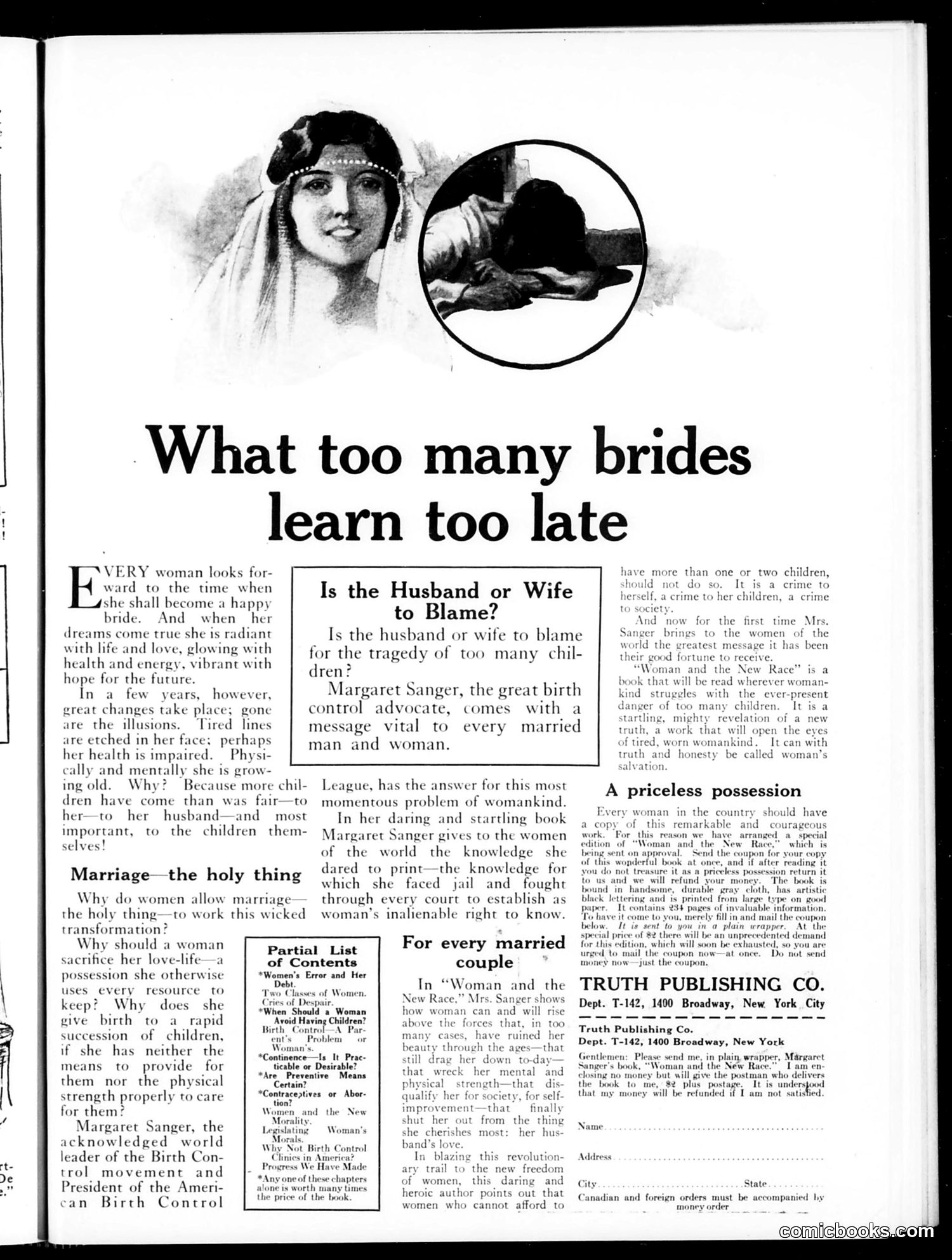
This page advertises Margaret Sanger's birth control advocacy book "Woman and the New Race" through a moral argument dressed as satire. The headline "What too many brides learn too late" presents a before-and-after scenario: a radiant newlywed becomes a worn, exhausted woman due to bearing too many children. The advertisement frames birth control as a solution to women's suffering and societal problems. It positions Sanger—the real historical birth control pioneer—as answering the crucial question: "Is the Husband or Wife to Blame?" for having excessive children. The text argues that women bearing more children than they can physically support is "a crime to her children, a crime to society." The circular inset photograph appears to show a woman in distress, visually reinforcing the "too late" regret theme. This represents early-1900s birth control advocacy, which was controversial and sometimes prosecuted. The ad uses emotional appeals about women's health and exhaustion to normalize contraception as socially responsible rather than morally transgressive.
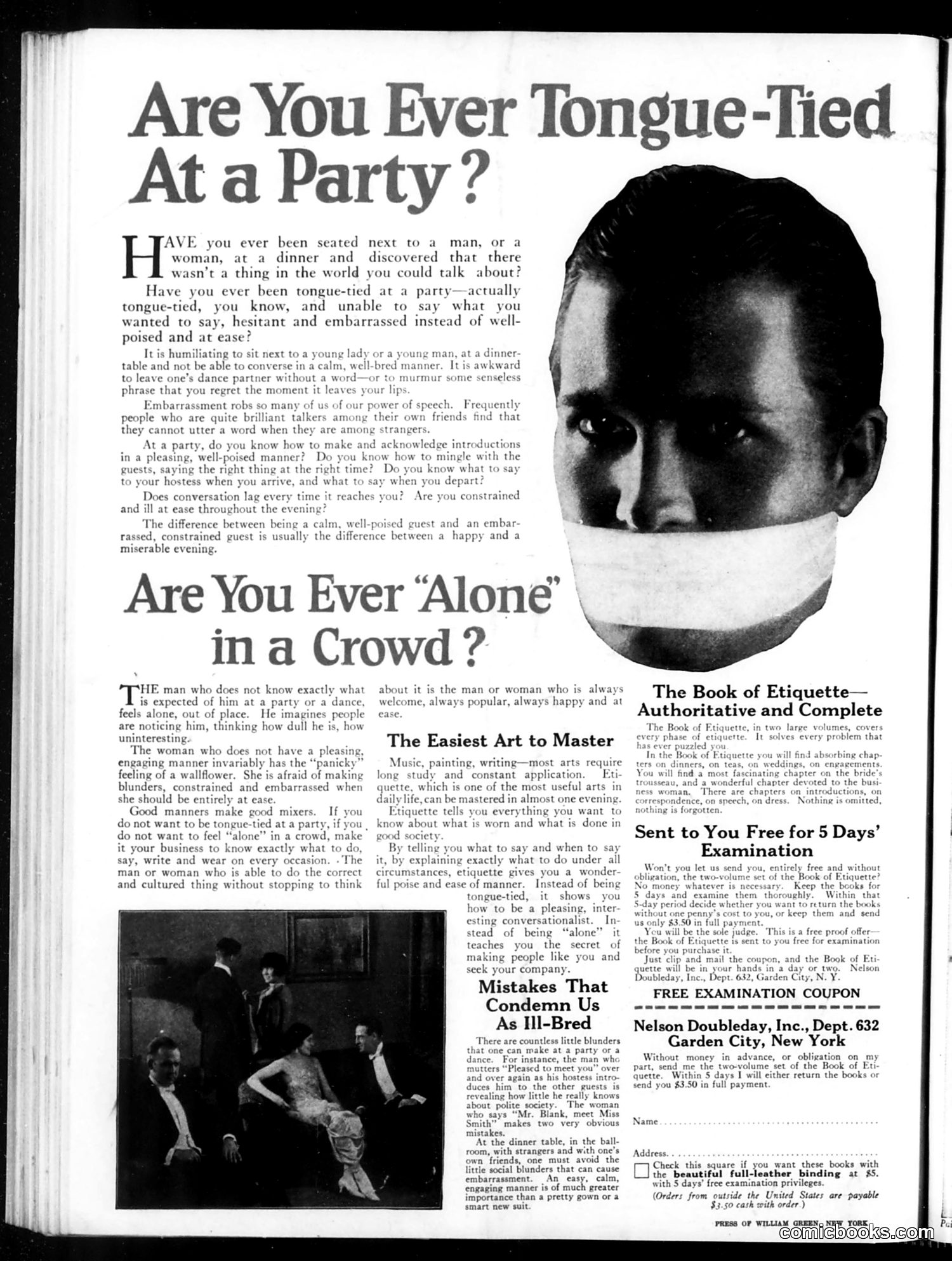
This is primarily **advertising content** for "The Book of Etiquette" by Nelson Doubleday, disguised as social commentary. The page addresses anxieties about party etiquette—being tongue-tied, feeling like an outsider in crowds, and making social mistakes. The two photographs show posed scenarios: one depicts an awkward dinner conversation, the other shows someone isolated amid socializing guests. These illustrate the social failures the text warns against. The satire is gentle: the piece mocks people who lack conversational skills and social polish, positioning etiquette knowledge as the solution to feeling inadequate at parties. This reflects 1920s-era concerns about middle-class social mobility—the idea that proper "manners" could elevate one's status. The free examination coupon (a common mail-order tactic) encourages readers to address their social insecurities by purchasing this two-volume set. Rather than mocking specific figures or events, the satire targets universal social anxiety about fitting in—a timeless concern, though the emphasis on rigid etiquette rules feels distinctly period-specific.