
Judge, 1923-02-03 · page 13 of 36
Judge — February 3, 1923 — page 13: what you’re looking at
What you’re looking at
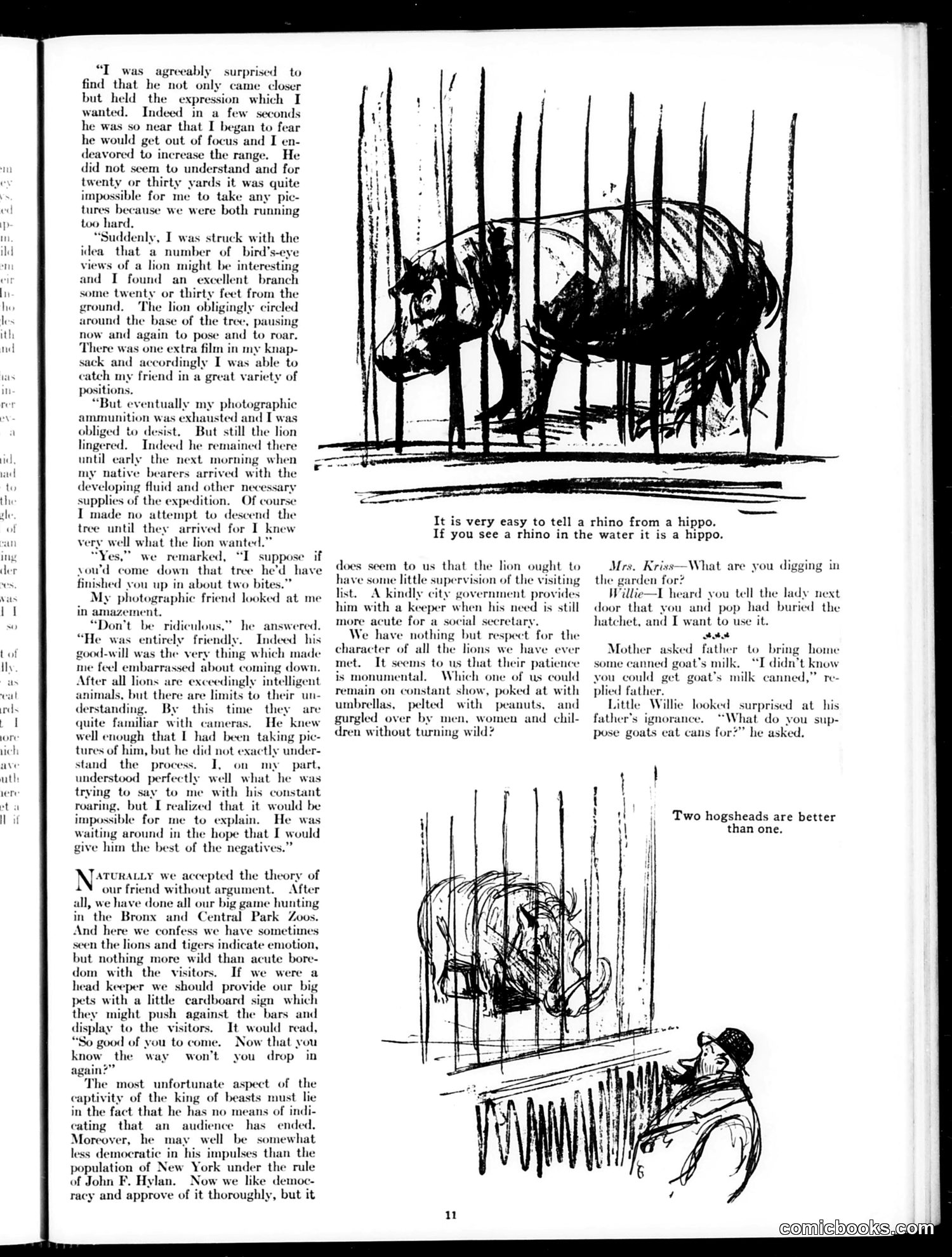
This page satirizes tourists' naive behavior at zoo exhibits, particularly the Bronx Zoo. The main narrative describes a hunter's supposed encounter with a "friendly" lion that waited all night for him to descend a tree, supposedly hoping to receive photographic negatives—an absurd claim the magazine's editors pretend to accept. The satire targets two things: First, the hunter's ridiculous anthropomorphization of the lion's intentions. Second, and more pointedly, zoo visitors' obliviousness to animal welfare. The editors argue lions deserve protection from constant harassment—umbrellas poking, peanuts pelting—and suggest they need a "social secretary" to screen visitors. There's also a dig at Mayor John F. Hylan's administration regarding "democracy," implying the city's permissiveness extends even to animal management. The accompanying cartoons of caged animals emphasize their captive misery, contrasting sharply with the hunter's sentimental nonsense about the lion's "patience" and "good-will."
📄 Transcribed text from this page (OCR, searchable)
Machine-transcribed from the original scan — historical spelling and the odd misread are preserved.
“IT was agreeably surprised to find that he not only came closer but held the expression which I wanted. Indeed in a few seconds he was so near that I began to fear he would get out of focus and I en- ‘ored to increase the range. He did not seem to understand and for twenty or thirty yards it was quite impossible for me to take any pic- tures because we were both running too hard, uddenly, I was struck with the that a number of _ bird's-eye views of a lion might be interesting and I found an excellent’ branch some twenty or thirty feet from the ground. The lion obligingly circled around the base of the tree, pausing now and again to pose There was o1 sa vrdingly I was able to catch my friend in a great variety of positions. “But eventually my photographic ammunition was exhausted and T was obliged to desist. But still the lion lingered. Indeed he remained there until early the next: morning when my native bearers arrived with the developing fluid and other necessary supplies of the expedition. Of course I made no attempt to descend the tree until they arrived for I knew very well what the lion wanted.” “Yes,” we remarked, “I suppose if you'd come down that tree he’d have finished you up in about two bites.” My photographie friend looked at me in amazement. “Don't be ridiculous,” he answered. Indeed his “He was entirely friendly. good-will was the very thing which me feel embarrassed about coming down. After all lions are exceedingly intelligent animals, but there are limits to their un- derstanding. By this time they are quite familiar with cameras. He knew well enough that I had been taking pic- tures of him, but he did not exactly under- stand the process. I, on my part, understood perfectly well what he was trying to say to me with his constant roaring, but I realized that it would be impossible for me to explain. He was waiting around in the hope that I would give him the best of the negatives.” NAterar we accepted the theory of 4 our friend without argument. After all, we have done all our big game hunting in the Bronx and Central Park Zoos. And here we confess we have sometimes seen the lions and tigers indicate emotion, but nothing more wild than acute bore- dom with the visitors. If we were a head keeper we should provide our big pets with a little cardboard sign which they might push against the bars and display to the visitors. It would read, “So good of you to come. Now that you know the way won't you drop in again?” The most unfortunate aspect of the captivity of the king of beasts must lie in the fact that he has no means of indi- cating that an audience has ended. Moreover, he may well be somewhat less democratic in his impulses than the population of New York under the rule of John F. Hylan. Now we like democ- racy and approve of it thoroughly, but it It is very easy to tell a rhino from a hippo. If you see a rhino in the water it is a hippo. does seem to us that the lion ought to have some little supervision of the visiting list. A kindly city government provides him with a keeper when his need is still more acute for a social secretary. We have nothing but respect for the character of all the lions we have ever met. It seems to us that their patience is monumental. Which one of us could remain on constant show, poked at with umbrellas, pelted with peanuts, and gurgled over by men, women and chil- dren without turning wild? Mrs. Kriss—What are you digging in the garden for? Willie—I heard you tell the lady next door that you and pop had buried the hatchet, and I want to use it. tote Mother asked father to bring home some canned goat's milk. “I didn’t know you could get goat's milk canned,” re- plied father. Little Willie looked surprised at his father’s ignorance. “What do you sup- pose goats cat cans for?” he asked. Two hogsheads are better than one,