
Judge, 1923-02-03 · page 11 of 36
Judge — February 3, 1923 — page 11: what you’re looking at
What you’re looking at
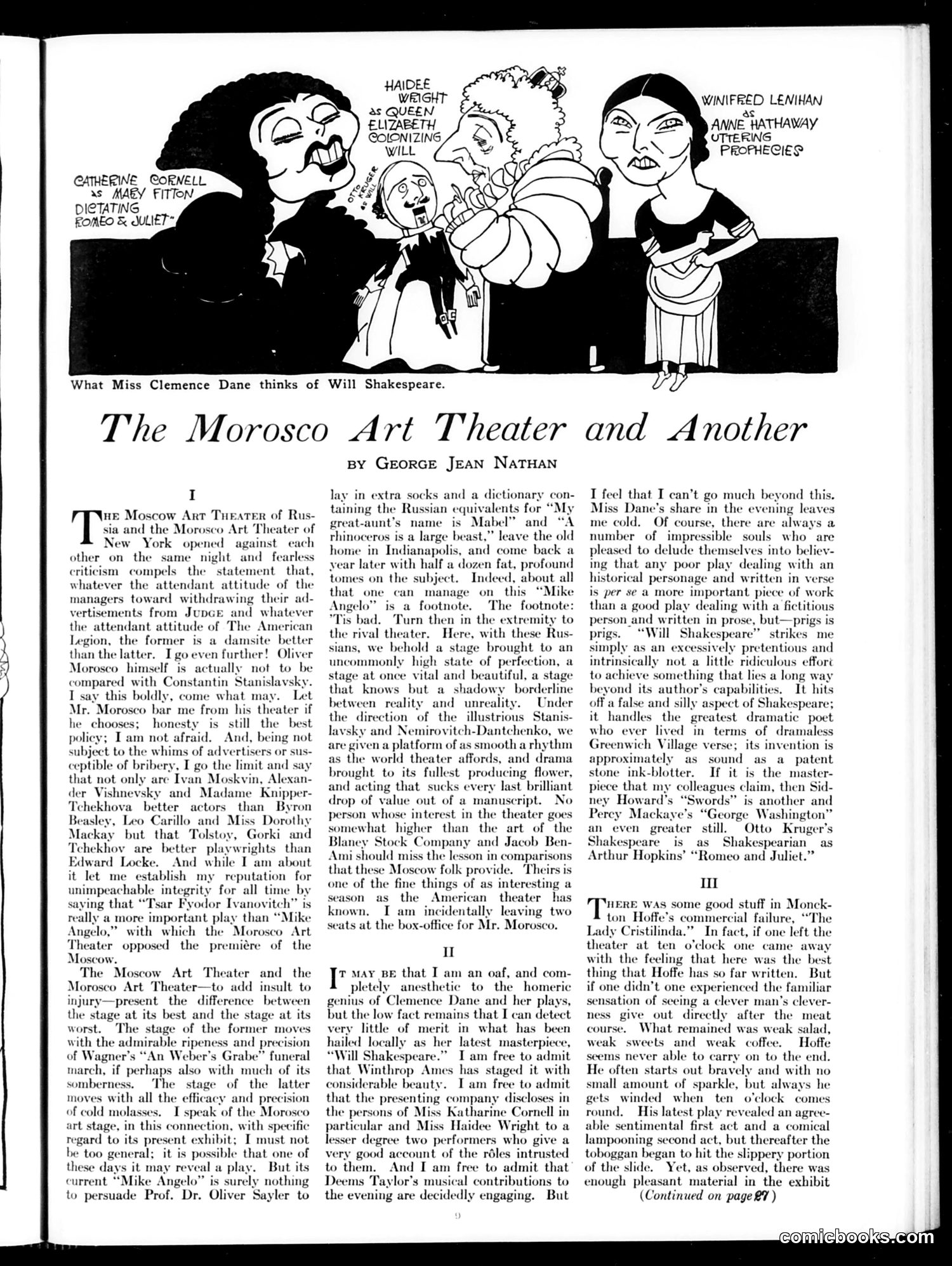
This is a theater criticism page from Judge magazine comparing two competing New York theaters that opened simultaneously: the Moscow Art Theater (a Russian company) and the Morosco Art Theater (American). **The Cartoon** caricatures prominent actresses in a play about Shakespeare: Catherine Cornell as Mary Fitton, Haidee Wright as Queen Elizabeth, and Winifred Lenihan. The caption "What Miss Clemence Dane thinks of Will Shakespeare" mocks the play's pretentiousness. **The Satire**: Critic George Jean Nathan delivers scathing reviews, provocatively declaring the Russian company vastly superior to the American production. He's deliberately inflammatory—challenging the American theater's artistic standards while praising Russian actors like Stanislavsky. Nathan also dismisses Clemence Dane's Shakespeare-themed play as artistically worthless, using biting wit ("'Tis bad"). The overall point satirizes both American theatrical mediocrity and the pretentious amateur dramatics of wealthy producers like Oliver Morosco.
📄 Transcribed text from this page (OCR, searchable)
Machine-transcribed from the original scan — historical spelling and the odd misread are preserved.
CATHERINE CORNELL as MABRY FITTON. DICTATING ROMEO & JULIET HAIDEE WRIGHT as QUEEN ELIZABETH. COIPNIZING What Miss Clemence Dane thinks of Will Shakespeare. The Morosco Art Theater and Another I HE Moscow Art TueaTer of Rus- I and the Morosco Art Theater of New York opened against each other on the same night and fearless criticism compels the statement that, whatever the attendant attitude of the ugers toward withdrawing their ad- tisements from JupGeE and whatever » attendant attitude of The American Legion, the former is a damsite better than the latter. I go even further! Oliver Morosco himself is actually not to be compared with Constantin Stanislavsky. I say this boldly, come what m Let Mr. Morosco bar me from his theater if he chooses; honesty is. still the best policy; Iam not afraid. And, being not subject to the whims of advertisers or sus- ceptible of bribery, I go the limit and say that not only are Ivan Moskvin, Alexan- der Vishne and Madame Knipper- Tchekhova better actors than Byron Beasley, Leo Carillo and Miss Dorothy Mackay but that Tolstoy, Gorki and Tchekhoy are better playwrights than Edward Locke. And while I am about it let me establish my reputation for unimpeachable integrity for all time saying that “Tsar Fyodor Ivanovitch really a more important play than “Mike Angelo,” with which the Morosco Art Theater opposed the premiére of the Moscow. The Moscow Art Theater and_ the Morosco Art Theater—to add insult to injury—present the difference between the stage at its best and the stage at its worst. The stage of the former moves with the admirable ripeness and precision of Wagner’s “An Weber's Grabe” funeral march, if perhaps also with much of its somberness. The stage of the latter moves with all the efficacy and precision of cold molasses. I speak of the Morosco art stage, in this connection, with specific regard to its present exhibit; I must not be too general; it is possible that one of these days it may reveal a play, But its current “Mike Angelo” is surcly nothing to persuade Prof. Dr. Oliver BY GEORGE JEAN NaTHAN in extra socks and a dictionary con- taining the Russia n equivalents for “My ame is Mabel” and “A rge beast,” leave the old homie in Indianapolis, and come back a year later with half a dozen fat, profound tomes on the subject. Indeed, about all that one can manage on this “Mike Angelo” is a footnote. The footnote: *Tis bad. Turn then in the extremity to the rival theater. Here, with these Rus- sians, we behold a stage brought to an uncommonly high state of perfection, a stage at once vital and beautiful, a stage that knows but a shadowy borderline between reality and unreality. Under the direction of the illustrious Stanis- avsky and Nemirovitch-Dantchenko, we re given a platform of as smooth a rhythm as the world theater affords, and drama brought to its fullest producing flower, and acting that sucks every last brilliant drop of value out of a manuscript. No person whose interest in the theater goes somewhat higher than the art of the Blaney Stock Company and Jacob Ben- Ami should miss the lesson in comparisons that these Moscow folk provide. Theirs is one of the fine things of as interesting a season as the American theater hi known. IT am incidentally leaving two seats at the box-office for Mr. Morosco. Il I" MAY BE that I am an oaf, and com- plete 1esthetic to the homeric genius of Clemence Dane and her 5 but the low fact remains that I can detect very little of merit in what has been hailed locally as her latest masterpiece, “Will Sha’ I am free to admit that Winthrop Ames has staged it with considerable beauty. [am free to admit that the presenting company discloses in the persons of Miss Katharine Cornell in articular and Miss Haidee Wright to a ssser degree two performers who give a very good account of the rdles intrusted to the sm. And I am free to admit that T; vlor' 's musical contributions to ~dly engaging. But WINIFRED LENIHAN I feel that I can’t go much beyond this. Miss Dane's share in the evening leaves me cold. Of course, there are alw L number of impressible souls who. are pleased to delude themselves into believ- ing that any poor play dealing with an historical personage and written in verse is per se a more important piece of work than a good play dealing with a fictitious person and written i but—prigs is prigs. “Will ” strikes me simply as an excessively pretentious and intrinsically not a little ridiculous effori to achieve something that lies a long way beyond its author’s eapabil It hits a false and silly aspect of Shakespeare; it handles the greatest dramatic poet who ever lived in terms of dramaless Greenwich e verse; its invention is approximately as sound as a_ patent stone ink-blotter. If it is the master- piece that my colleagues claim, then ney Howard’s “Swords” is another and srcy Mackaye’s “George Washington” er still. Otto Kruger’s Shakespeare is as Shakespe: Arthur Hopkins’ “Romeo and Juliet.” il [ures Was some good stuff in Monck- ton Hoffe’s commercial failure, “The Lady Cristilinda.” In fact, if one left the theater at ten o'clock one came i with the feeling that here was the best thing that Hoffe has so far written. But if one didn’t one experienced the familiar sensation of seeing a clever man’s clever- ness give out directly after the m course. What remained was weak salad, weak sweets and weak coffee. Hoffe seems never able to carry on to the end. He often starts out bravely and with no small amount of sparkle, but always he gets winded when ten o'clock comes round. His latest play revealed an agree- able sentimental first act and a comical lampooning second act, but thereafter the toboggan began to hit the slippery portion of the slide. Yet, as observed, there was enough pleasant erial in the exhibit (Continued on page 87)