
A complete issue · 36 pages · 1922
Judge — December 9, 1922
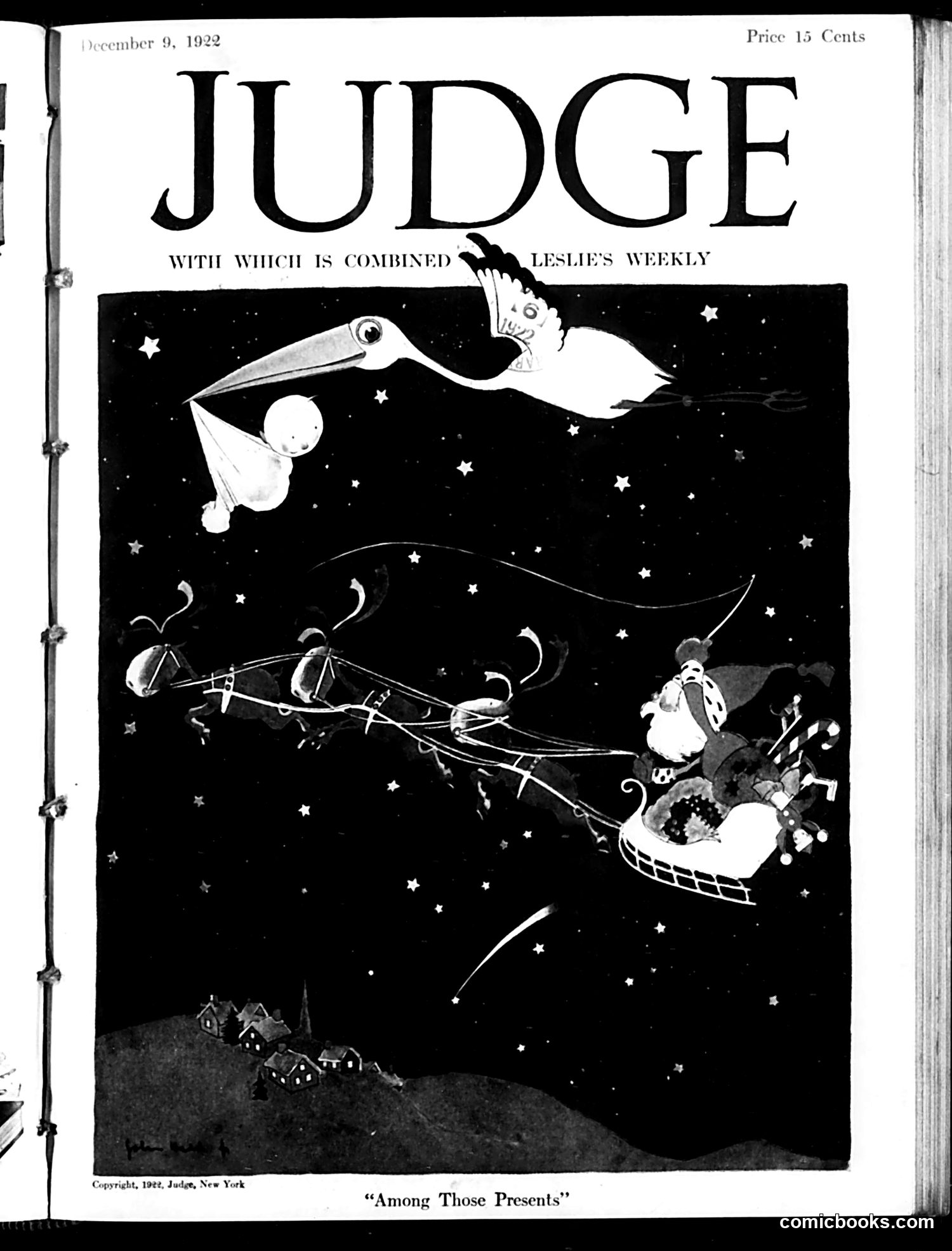
This cover illustrates the Christmas story "Among Those Presents" through whimsical, surreal imagery. A stork delivers a baby in a bundle at the top of the composition, while below, mice or small creatures pull Santa's sleigh across a starry night sky toward a snowy village with lit houses. The satire likely plays on traditional Christmas narratives and gift-giving customs. The stork—traditionally associated with baby delivery—appears here alongside Santa's gift-delivery operation, creating humorous confusion about Christmas's various "presents" (both gifts and births). The starry, dreamlike quality and anthropomorphized animals reflect the whimsical illustration style common to Judge's humor during this period, targeting an audience familiar with both folklore and Victorian-era sentimental Christmas imagery.
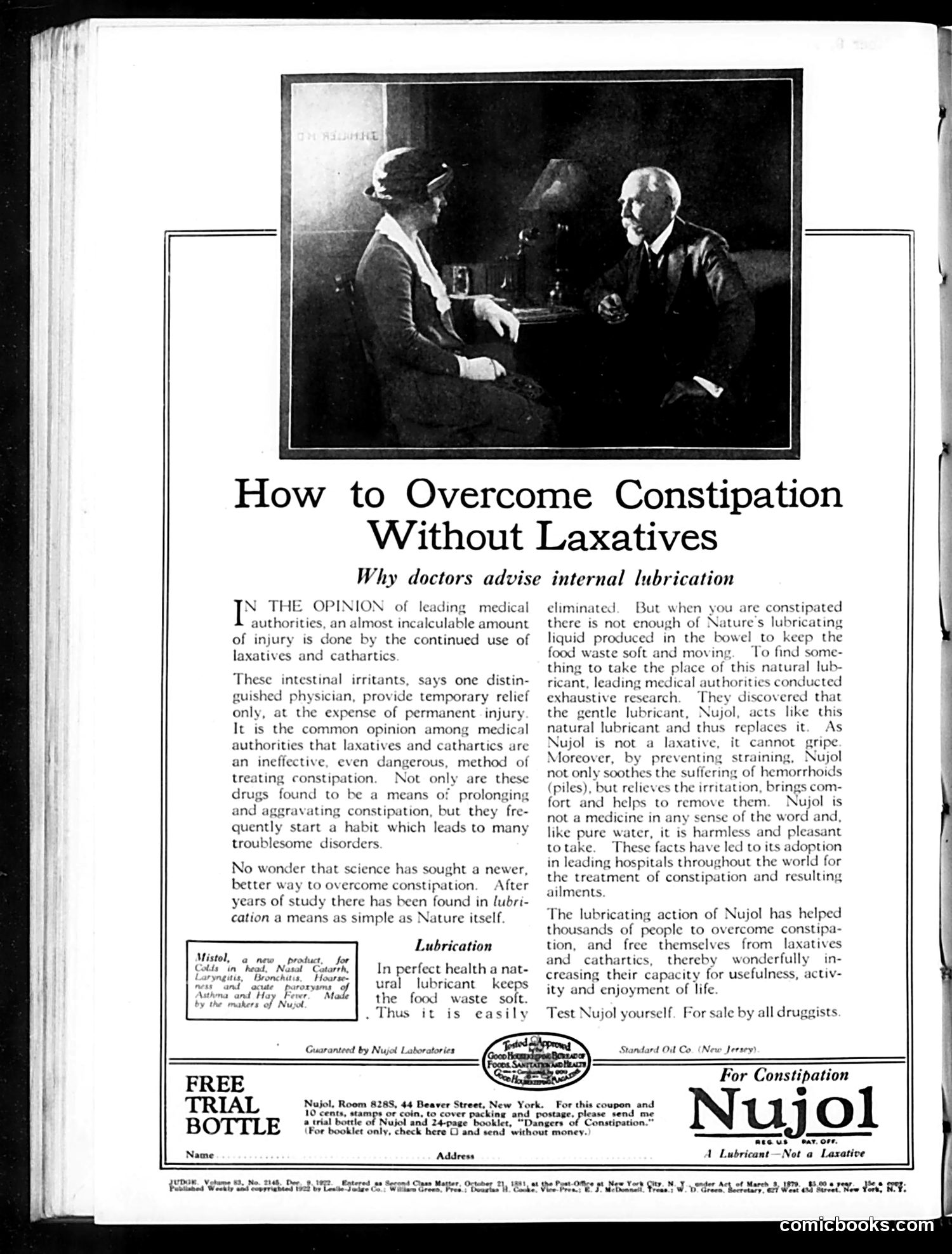
This page is **primarily advertising, not satire or political content**. It's a vintage advertisement for Nujol, a mineral oil laxative product, from what appears to be an early 20th-century Judge magazine. The image shows two men in conversation—likely a doctor and patient—illustrating the product's medical endorsement. The ad argues that Nujol provides "internal lubrication" rather than harsh laxative action, claiming medical authorities prefer this gentler approach to treat constipation. The satirical element, if any, is subtle: the ad subtly mocks the overuse of harsh laxatives by positioning Nujol as the "scientific" alternative. However, this is primarily a straightforward product advertisement leveraging medical authority and genteel language to sell a constipation remedy—typical of early 20th-century advertising conventions.
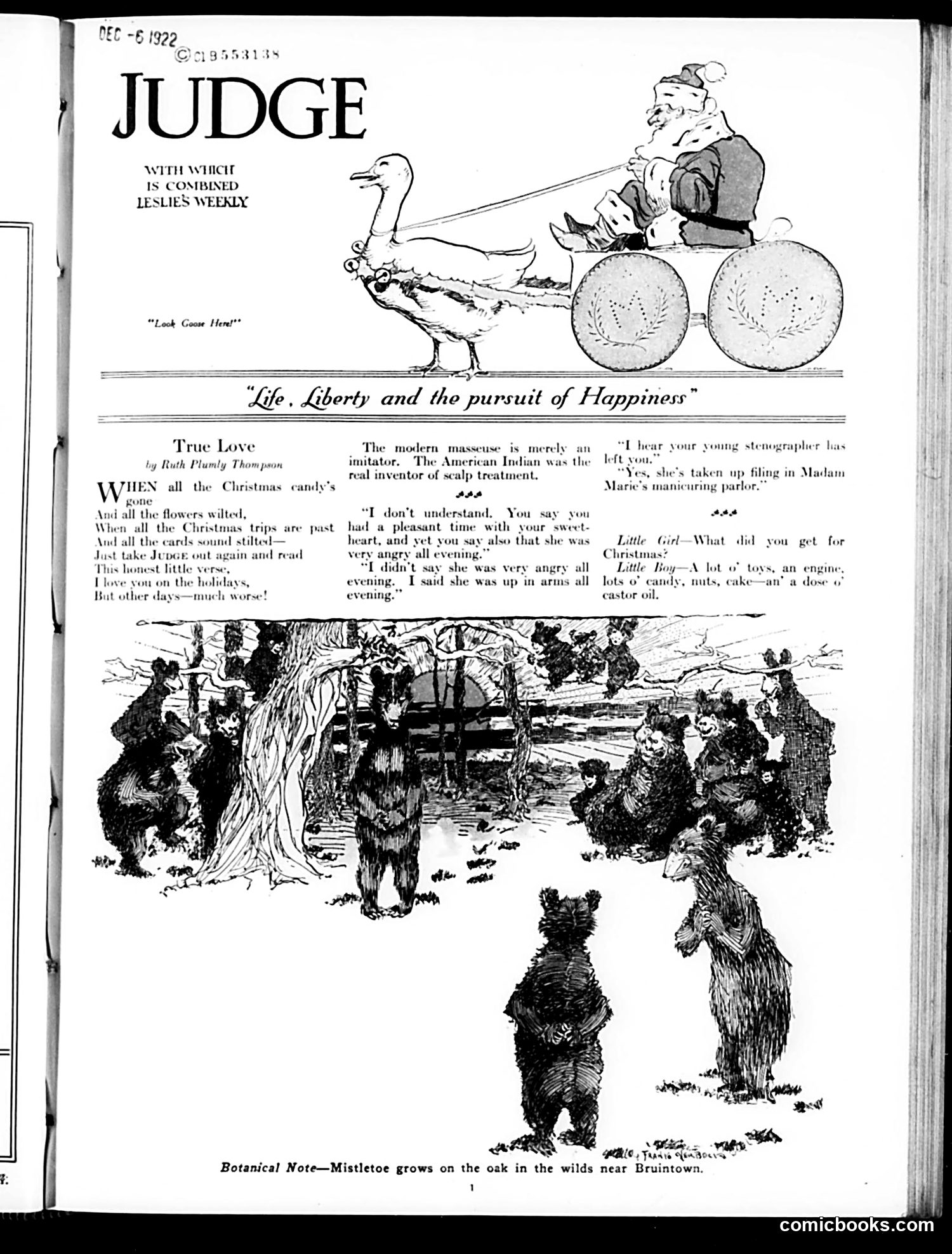
The top cartoon shows a figure riding in a cart pulled by an ostrich, captioned "Look Goose Here!" This appears to be satirizing someone's poor judgment or foolish behavior—the ostrich as a beast of burden is inherently absurd. The page's main content is a poem titled "True Love" by Ruth Hussey Thompson, a sentimental piece about Christmas fading and lost romance. Below it are humorous short exchanges, including a joke about a stenographer and a manicurist. The large illustration depicts bears gathered around a tree, seemingly celebrating Christmas in a forest setting, with a botanical note about mistletoe growing near Bruintown—a whimsical, non-political animal vignette typical of Judge's humor content.
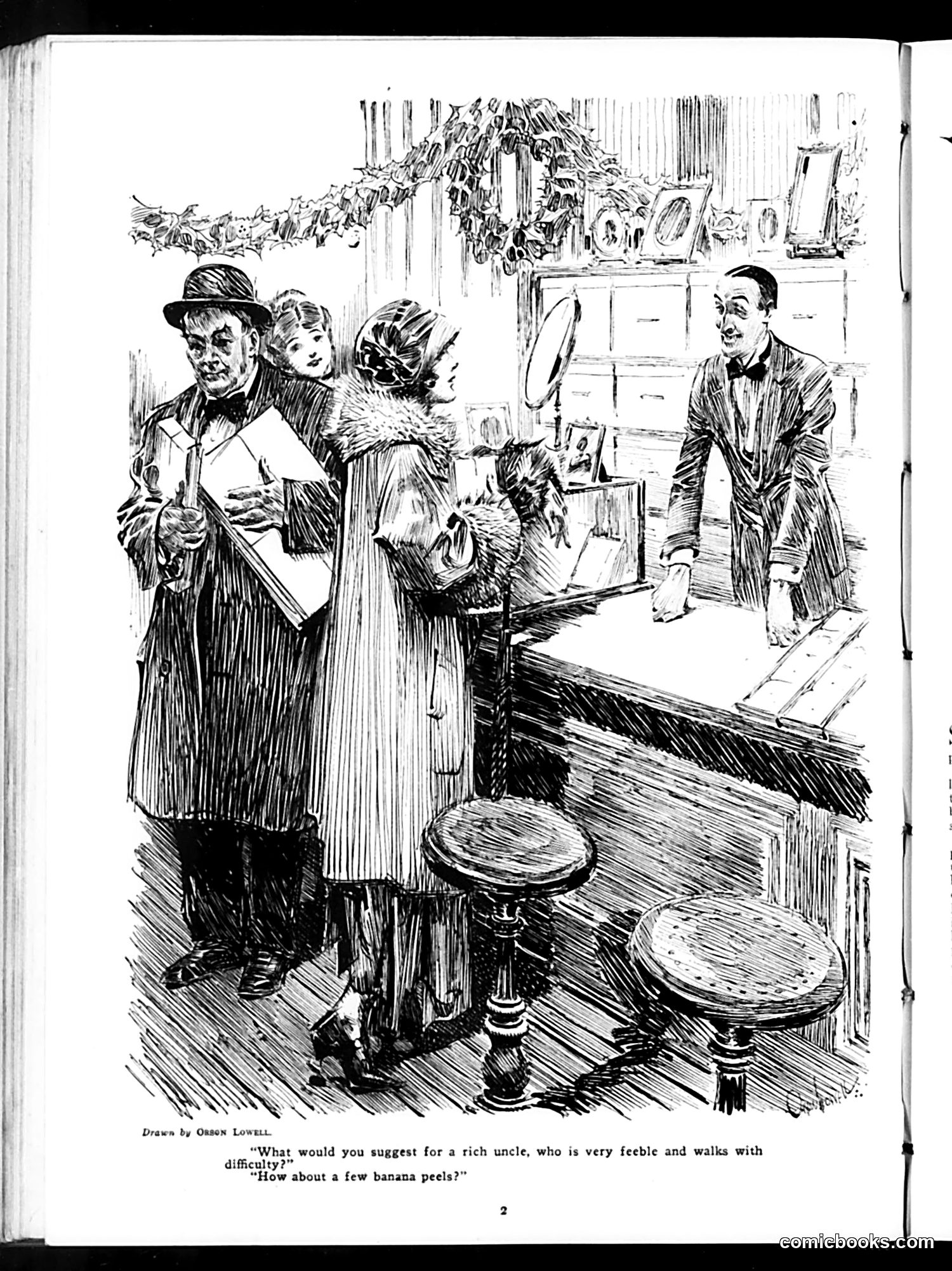
This single-panel cartoon depicts a domestic scene where visitors call on a wealthy but infirm uncle. The humor relies on a cruel suggestion: when asked what to recommend for an elderly, physically frail gentleman, someone quips "How about a few banana peels?"—implying the uncle might slip and fall, potentially hastening his death and allowing relatives to inherit. The joke satirizes mercenary family dynamics and the darker implications of visiting elderly wealthy relatives. It reflects early-20th-century attitudes about inheritance, greed, and the cynical calculations sometimes hidden behind familial concern. The cartoon is drawn by Orson Lowell and uses physical comedy (banana peel slips being a slapstick trope) to expose social hypocrisy.
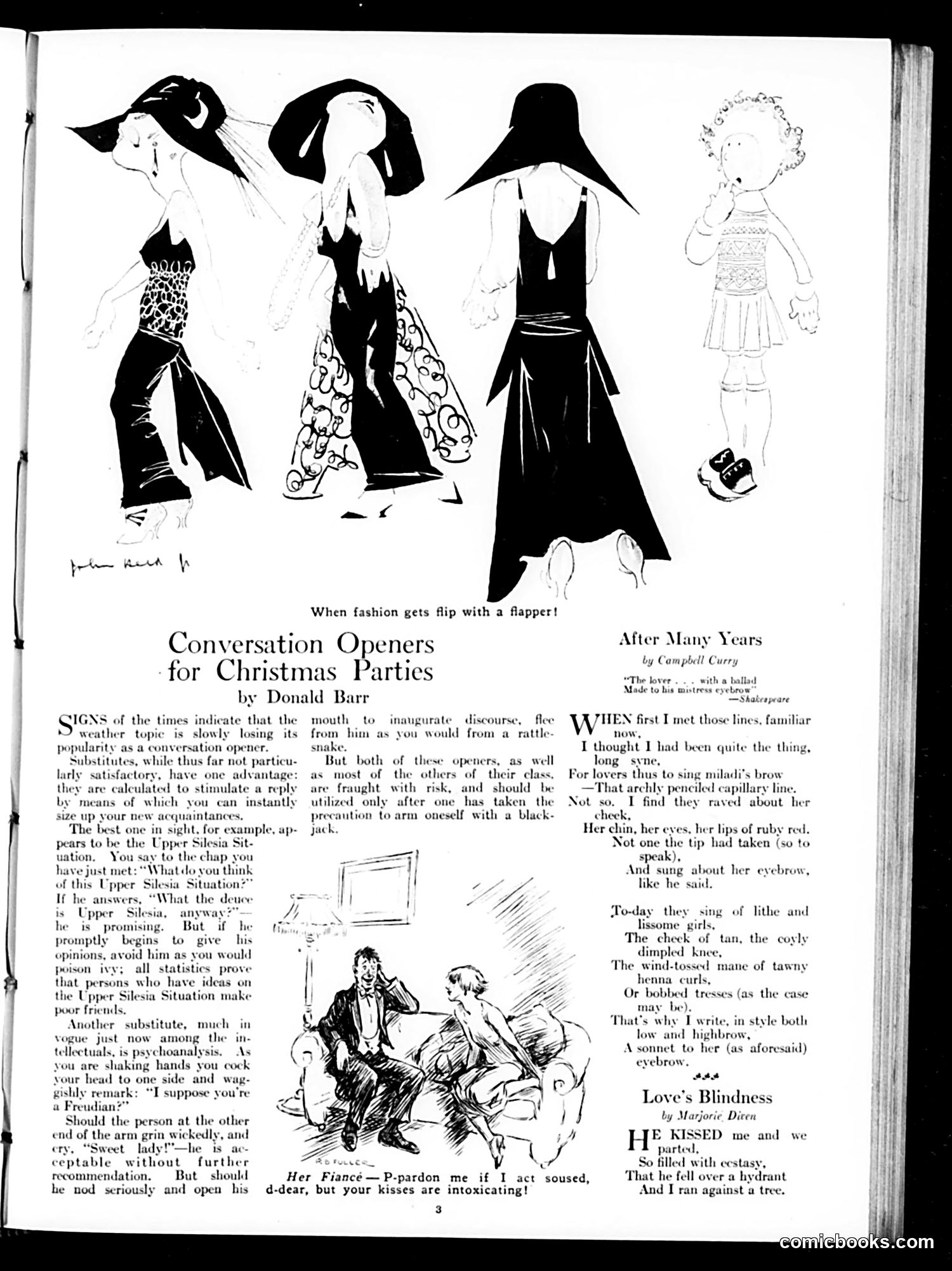
This page contains three separate pieces of satirical content from the 1920s flapper era: **"Conversation Openers for Christmas Parties"** by Donald Burr satirizes social awkwardness. It mocks the "Upper Silesia Situation" as a conversation topic—a reference to the post-WWI territorial dispute between Poland and Germany. The joke: discussing geopolitical conflicts at parties to avoid uncomfortable silences is absurd. The accompanying cartoon shows a man uncomfortably discussing this with women at a social gathering. **"After Many Years"** and **"Love's Blindness"** are romantic poetry pieces about love and memory, contrasting with the satirical lead article. **"Her Fiancé"** is a humorous caption about intoxicating kisses. The page primarily satirizes 1920s social conventions and the difficulty of making conversation at parties.
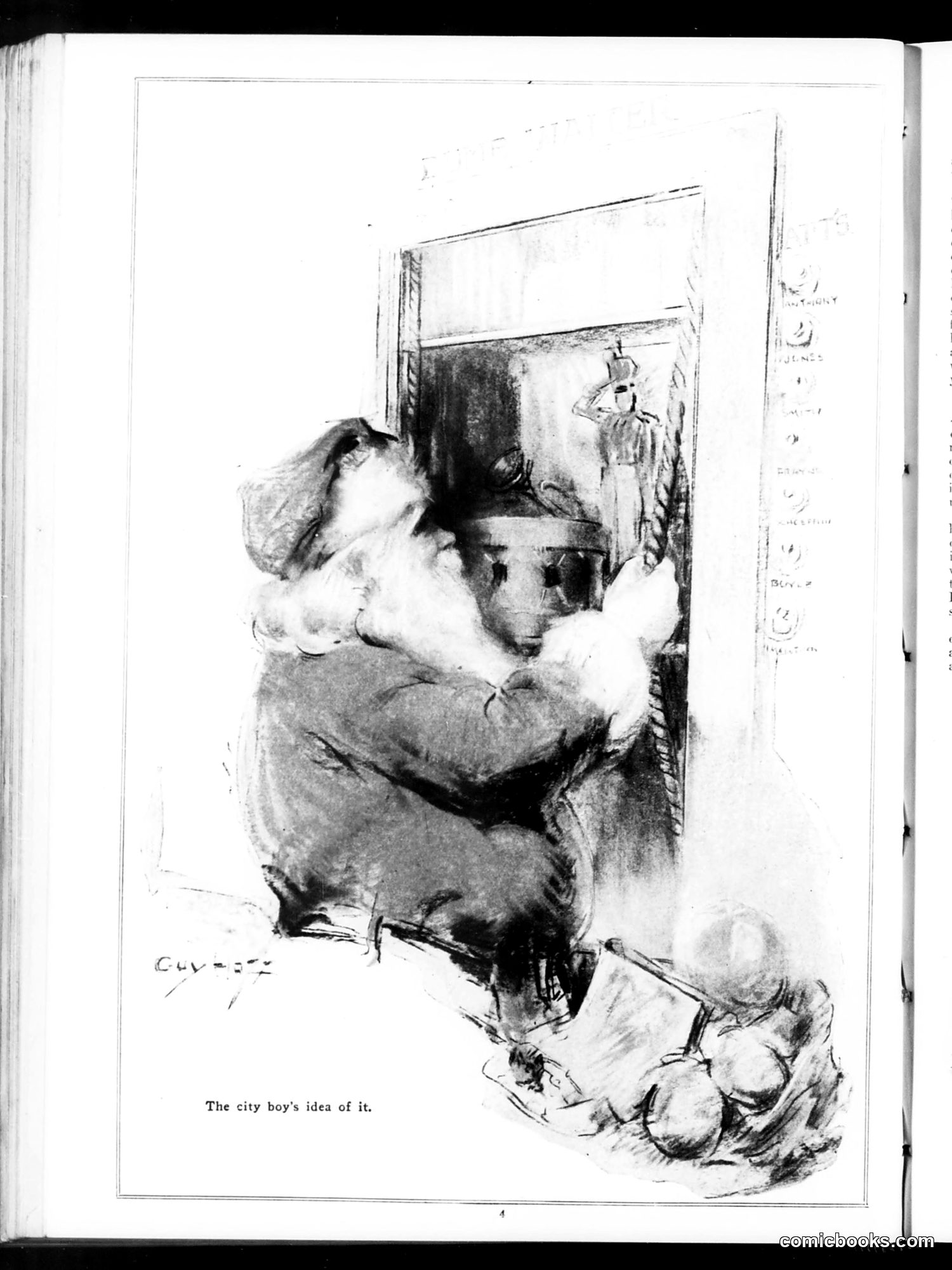
This cartoon satirizes urban children's disconnection from rural life and farming. The sketch shows a city boy attempting manual labor—likely plowing or working a field—in an awkward, inefficient manner. His body language and posture suggest he lacks practical experience with physical farm work. The caption "The city boy's idea of it" implies the joke: city-raised children, unfamiliar with agricultural labor, have romanticized or misconceived notions of what farm work actually involves. The exaggerated, struggling pose emphasizes the contrast between youthful enthusiasm and the demanding reality of rural labor. This reflects early 20th-century American anxiety about urbanization and generational separation from agricultural traditions, a common theme in Judge magazine's social commentary.
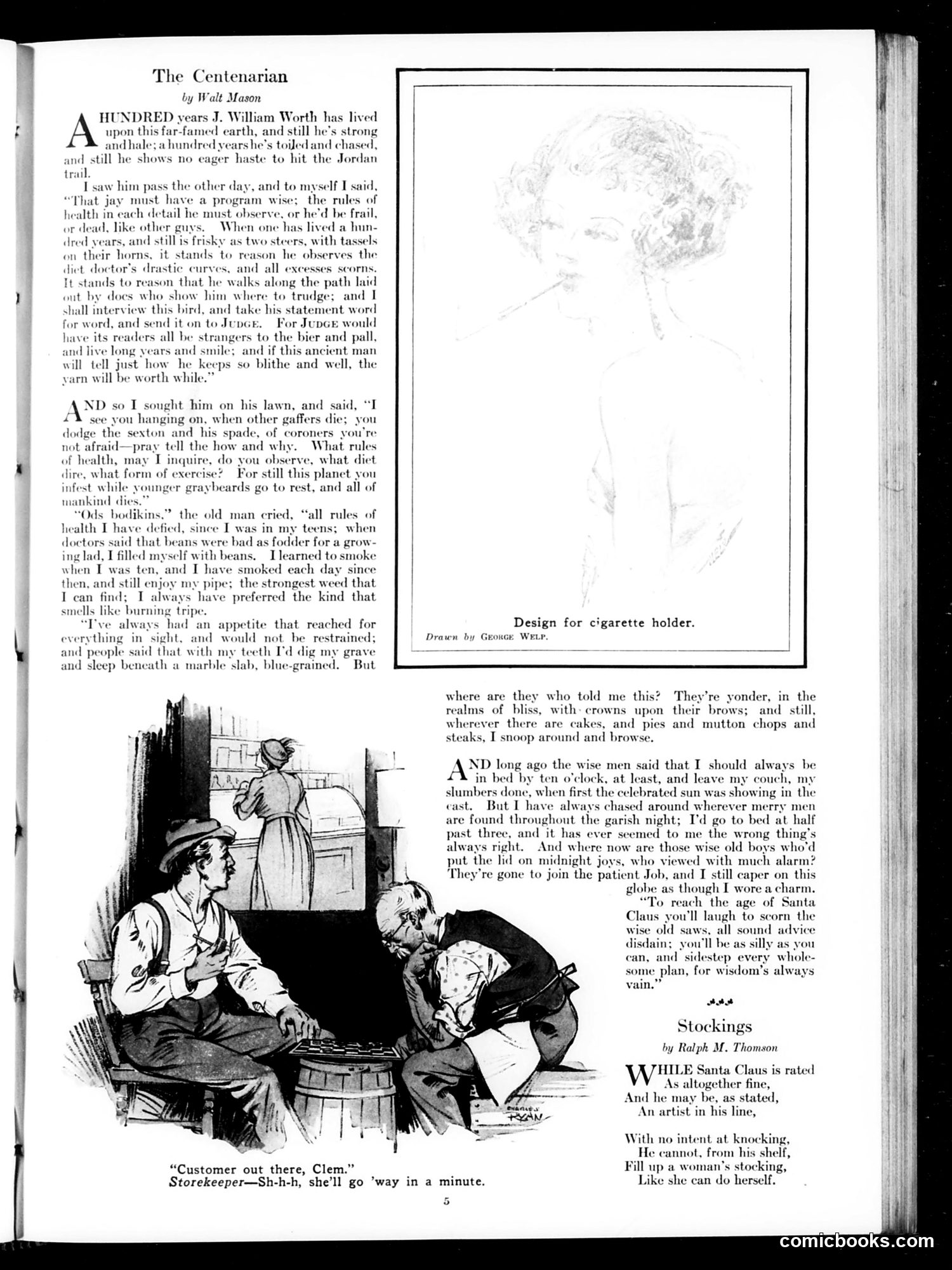
This page contains two pieces of satirical content: **"The Centenarian"** by Walt Mason is a humorous poem about J. William Worth, a 100-year-old man in apparent perfect health. The joke subverts conventional wisdom about longevity: Worth claims he achieved his robust health by *ignoring* all medical advice—he smokes, eats excessively, stays up late, and generally indulges freely. Meanwhile, the "wise men" who gave him sound health advice are now dead. The satire mocks both contemporary health fads and the arrogance of medical professionals by suggesting that living well may have nothing to do with following their rules. **"Stockings"** by Ralph M. Thomson is a brief comic poem about Santa Claus's limitations: while he's talented at many things, he cannot fill a woman's stocking with the same skill she can herself—a mild joke about gender capabilities and holiday gift-giving. The accompanying illustration shows an old man and younger person in conversation, supporting the main narrative.
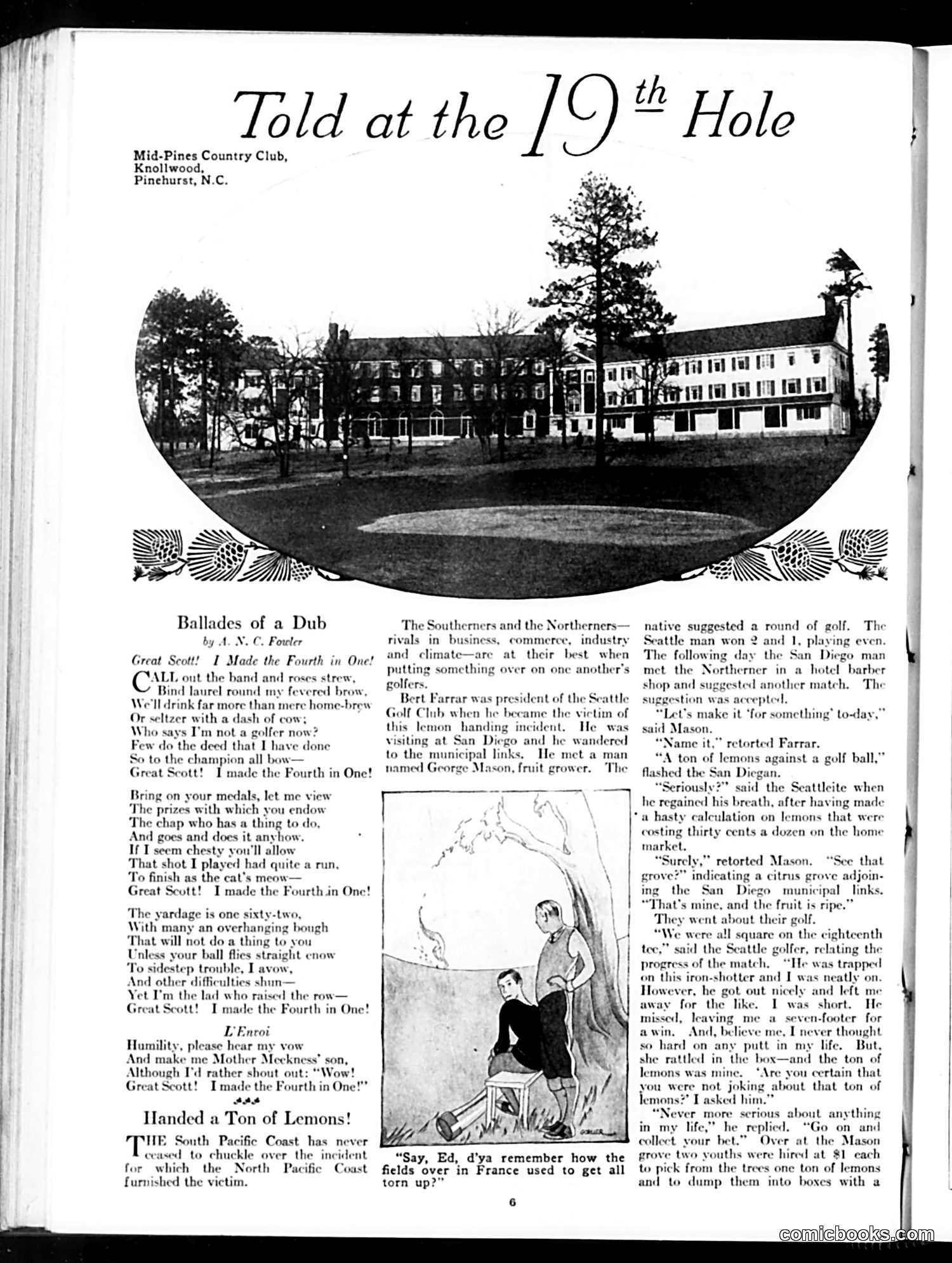
This page from *Judge* presents two interconnected golf stories from country clubs in the Pacific Northwest, told in verse and prose. The main narrative concerns **Bert Farrar**, president of the Seattle Golf Club, who visits San Diego and encounters a local fruit grower named **George Mason**. They wager on a golf match, with Mason betting **"a ton of lemons"**—a jest about San Diego's citrus industry. The humor operates on multiple levels: first, as a regional rivalry joke (Seattle's Northerner vs. San Diego's Southerner), and second, as a practical joke when Mason actually delivers the wager after losing. The satire mocks both the competitive boasting of wealthy golf club members and the comic literalism of taking humorous bets seriously. The accompanying verse mocks golf "dubs" (poor players) who boast absurdly about rare achievements like scoring four under par on a hole. The setting—an exclusive country club—positions this as humor for an upper-class audience familiar with golf culture and regional business rivalries.
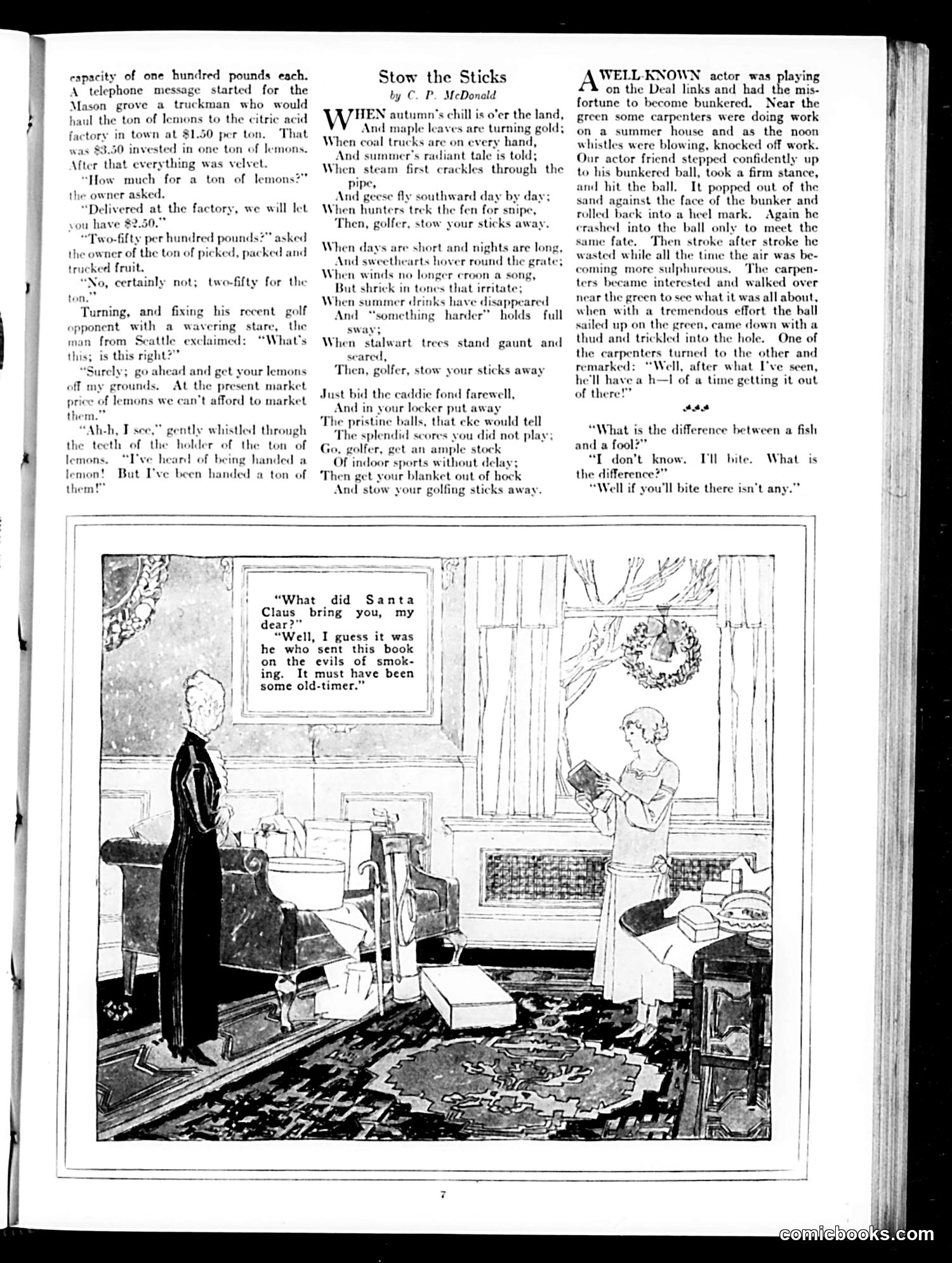
This page contains three distinct pieces of humor typical of early-20th-century American satire: 1. **"Stow the Sticks"** (poem by C.P. McDonald): A seasonal reminder for golfers to put away their clubs when autumn arrives and winter approaches. It's gentle, nostalgic verse mocking the obsessive golfer who must be forcibly separated from his sport. 2. **The Actor's Bunker Story** (cartoon + text): A well-known actor repeatedly fails to escape a sand bunker on a golf course while carpenters watch. The joke plays on his mounting frustration and the workers' crude assessment of his incompetence—comparing his difficulty escaping the bunker to the difficulty of escaping hell itself. 3. **Fish and Fool Riddle**: A simple joke riddle with a play on words: the difference between a fish and a fool is that a fish won't "bite" (take the bait of the joke). The page reflects Judge's focus on genteel humor about leisure activities, social embarrassment, and wordplay—appealing to educated, middle-class readers.
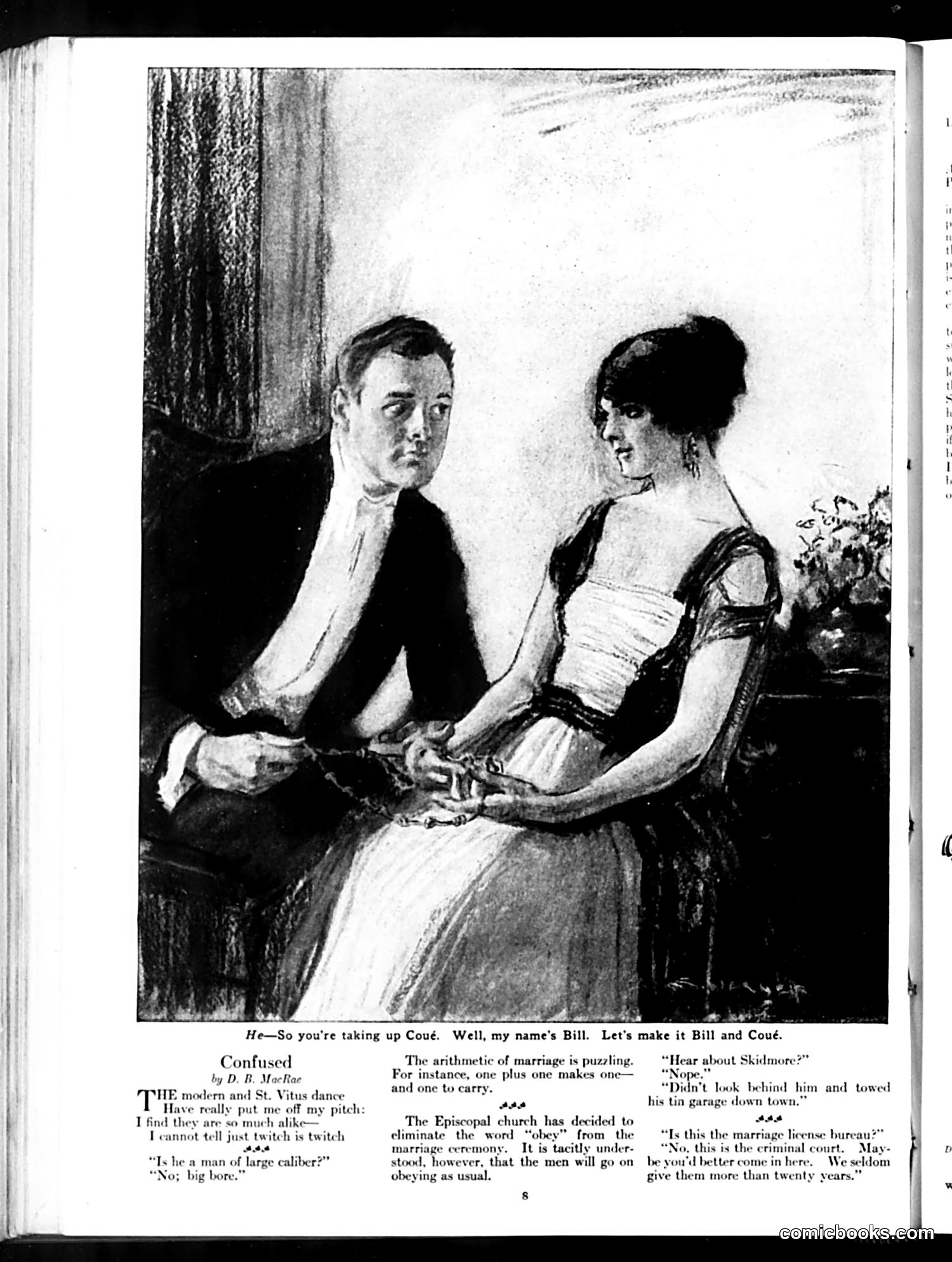
This page contains a cartoon and several brief satirical jokes commenting on early 20th-century social and religious issues. **The main cartoon** depicts a couple where the man proposes a humorous marriage arrangement: since both will take the surname "Coué" (referencing Émile Coué's popular "self-help" movement of positive thinking), they'll combine their names as "Bill and Coué"—a pun playing on the marriage arithmetic joke below it. **The jokes satirize:** - Modern dance crazes (St. Vitus dance reference) confusing people - Marriage mathematics (one plus one makes one—spousal unity) - A man described as having "large caliber" but being "big bore"—wordplay on character - The Episcopal Church's decision to remove "obey" from marriage vows, with the sardonic observation that men will continue commanding obedience anyway - A quip about garage mechanics and marriage licenses The overall tone mocks contemporary social trends, religious reform, and marital dynamics with typical Judge magazine humor—clever wordplay targeting recognizable cultural anxieties of the era.
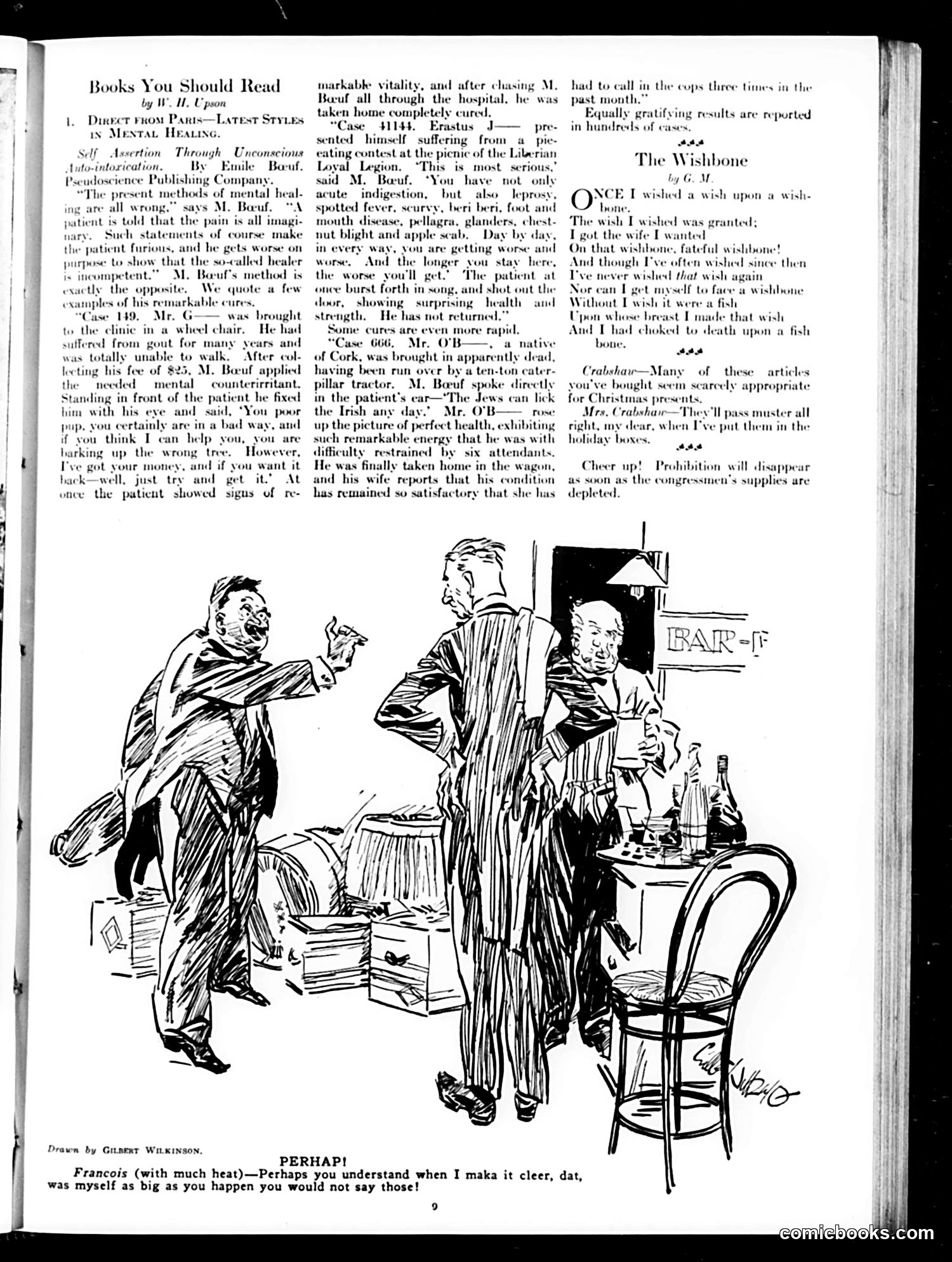
This page contains two distinct items: **Book Review (Top Left):** A satirical review of "Assertion Through Unconscious Fabrication" by fake author Emile Bovuf. The satire mocks pseudo-scientific mental healing methods popular in the early 20th century. The "doctor" uses aggressive psychological manipulation and suggestion—telling patients they're pathetic, then claiming miraculous cures when they flee in anger or embarrassment. The joke targets charlatans selling fake mental cures. **"The Wishbone" Poem (Top Right):** A darkly comic poem about the perils of wishing on wishbones, ending with the speaker choking to death on one. It's straightforward cautionary humor. **Bottom Cartoon:** Depicts a bar scene labeled "BAR-F" where a man (Francois) gestures angrily while arguing with another patron. The caption suggests Francois is saying something offensive and defensive about his size. The joke appears to reference Prohibition-era bars operating illegally ("BAR-F" likely obscures the full name).
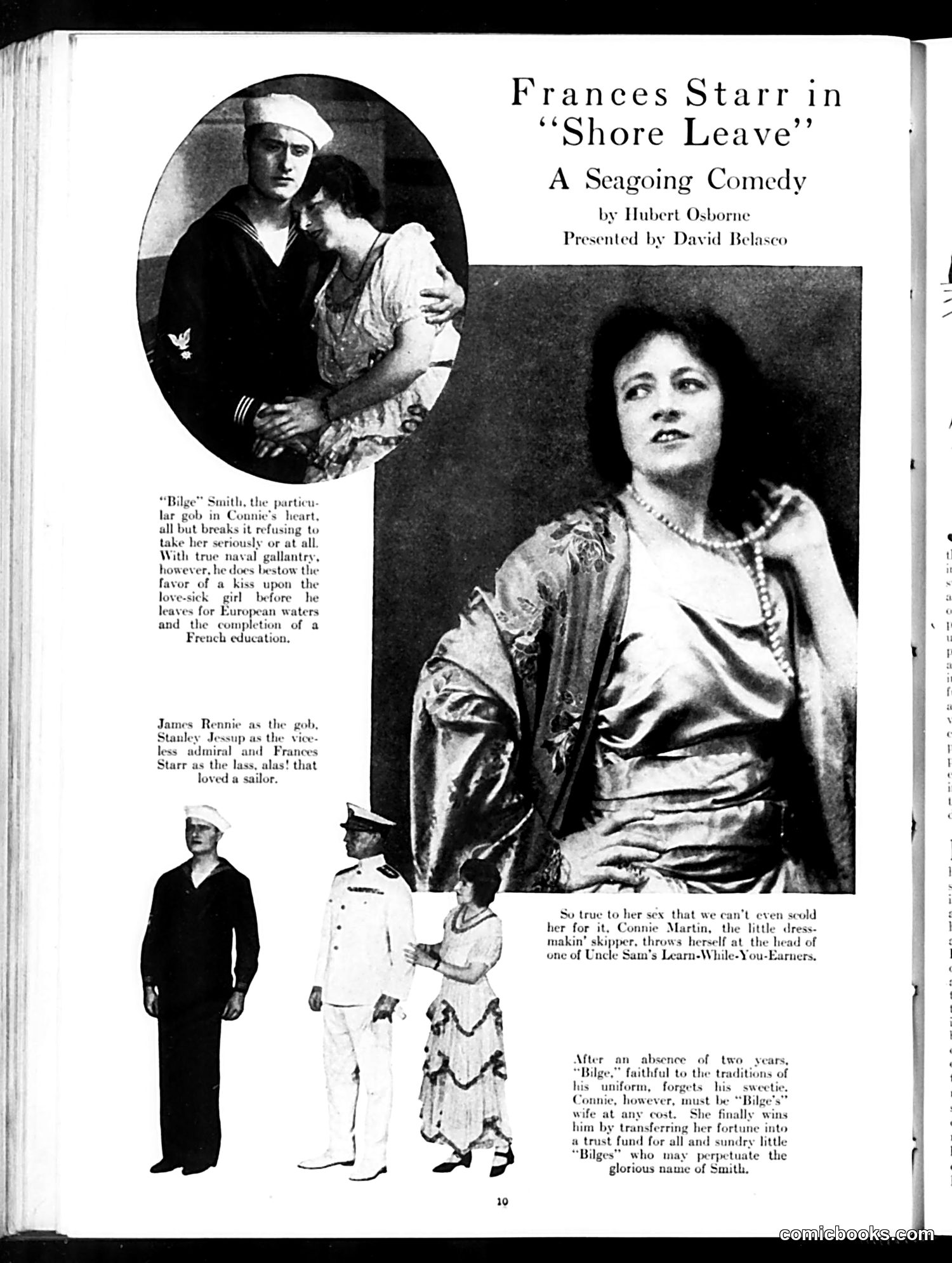
This page promotes a seagoing comedy film starring Frances Starr, written by Hubert Osborne and presented by David Belasco. The plot follows a romantic entanglement: "Bilge" Smith, a sailor, romances Connie Martin before departing for European duty. After two years' absence, he forgets her—a satirical jab at sailors' notorious infidelity ("faithful to the traditions of his uniform, forgets his sweetie"). Connie ultimately wins him over by transferring her fortune into a trust fund bearing the Smith name, ensuring future heirs perpetuate the "glorious name." The humor targets both the sailor stereotype and female romantic desperation. The phrase "Learn-While-You-Earners" likely references the Navy's training programs. For modern readers, this reflects early 20th-century gender stereotypes and romanticized military life common to Judge magazine's satirical content.
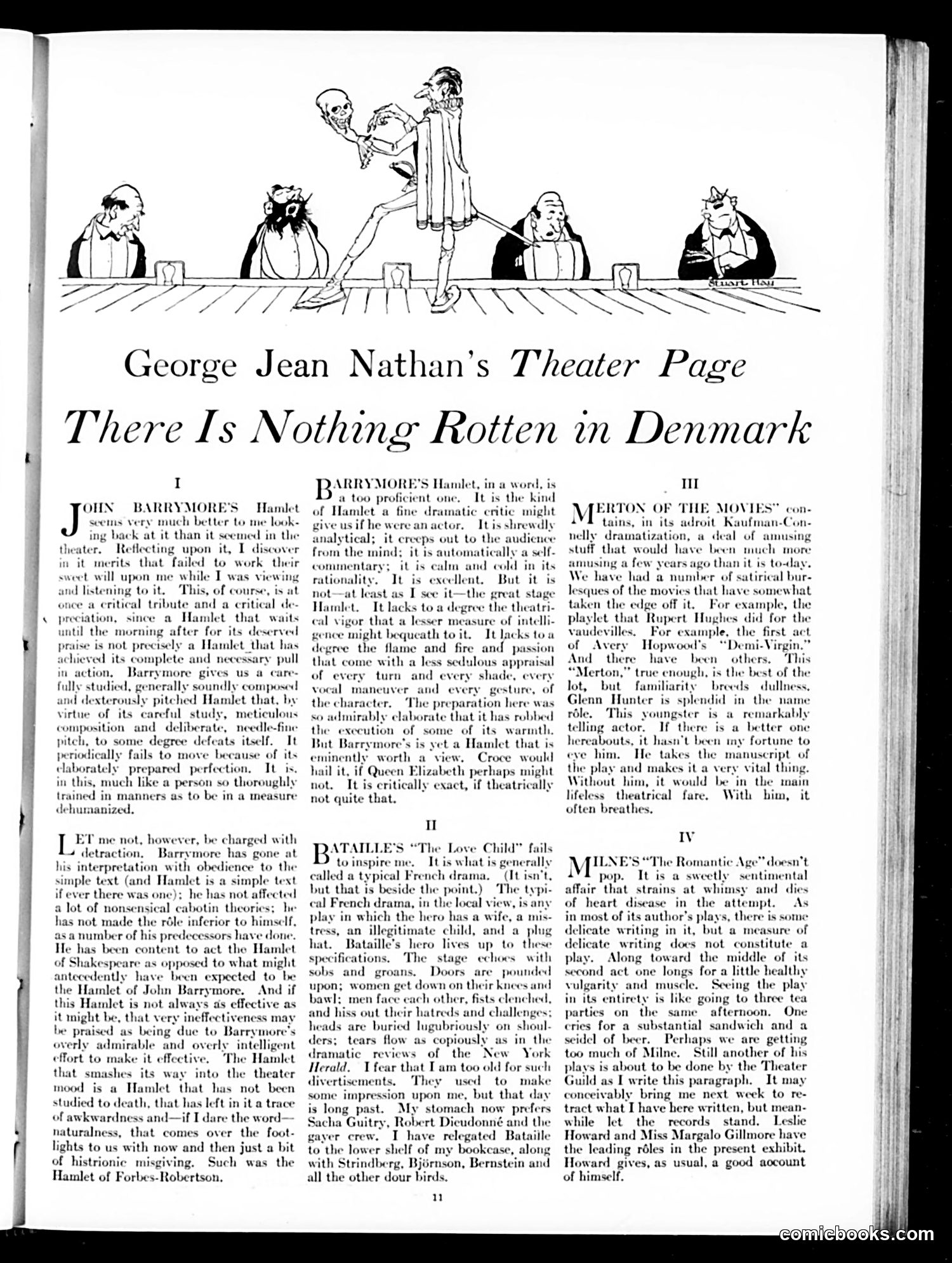
This is George Jean Nathan's theater review column. The cartoon header shows five caricatured theater figures seated at a table, likely representing different theatrical personalities or critic types of the era. Nathan critiques three productions: John Barrymore's *Hamlet*, Bataille's *The Love Child*, and Milne's *The Romantic Age*. **Main point of satire:** Nathan praises Barrymore's intellectually rigorous but emotionally cold interpretation, arguing it's *too* expertly calculated—so technically perfect it loses theatrical vitality. He contrasts this unfavorably with the natural awkwardness of earlier actors like Forbes-Robertson. For Bataille's play, Nathan mocks the stereotypical "typical French drama" formula: wife, mistress, illegitimate child, overwrought emotional scenes, and melodramatic posturing. The reviews represent sophisticated theatrical criticism rather than broad satire, targeting actors' interpretive choices and predictable dramatic conventions rather than political figures. This reflects Judge's focus on cultural commentary aimed at educated readers.
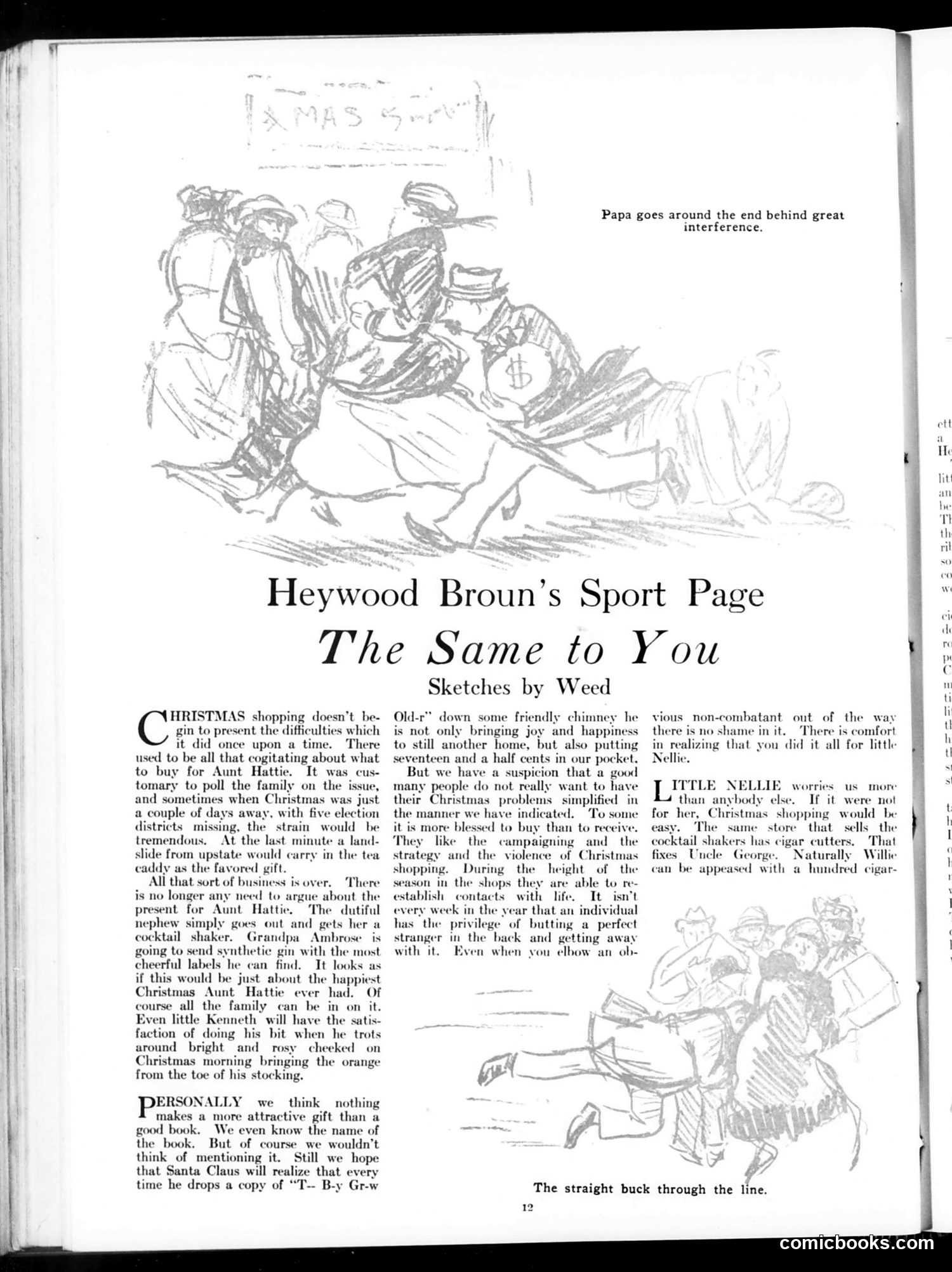
This is a sports column using football metaphors to satirize 1920s Christmas shopping culture—specifically the recent legalization concerns around alcohol during Prohibition. The two cartoons illustrate football plays: "Papa goes around the end behind great interference" and "The straight buck through the line." These represent aggressive Christmas shopping tactics. The column's satire targets: 1. **Prohibition's absurdity**: Broun mocks how everyone now gives cocktail shakers and "synthetic gin" as Christmas gifts, suggesting Prohibition failed to stop drinking—it just made it darkly humorous. 2. **Modern gift-giving**: He contrasts old-fashioned gift-deliberation (like tea caddies) with the now-universal cocktail shaker, implying alcohol consumption became normalized despite legal prohibition. 3. **Shopping violence**: The football metaphor humorously describes Christmas shopping as socially acceptable aggression—elbowing strangers, "butting" people—which wouldn't be tolerated elsewhere. The self-referential joke at the end ("T-- B-y Gr-w") appears to be Broun coyly censoring a book title while hoping readers buy it anyway, adding meta-humor about commercial promotion.
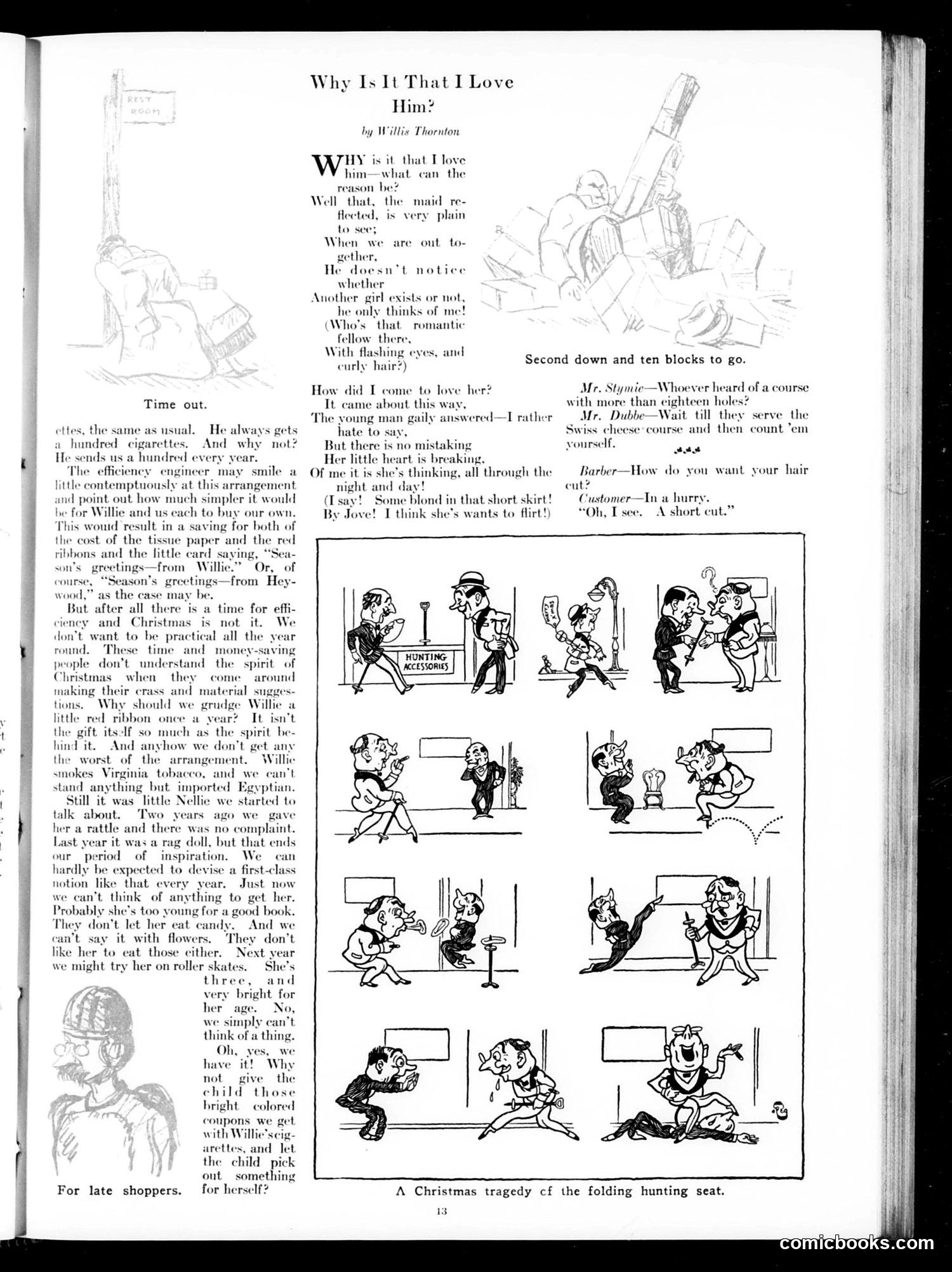
This Judge magazine page contains three distinct pieces of humor: **"Why Is It That I Love Him?"** (top left): A sentimental poem about a young woman convinced her boyfriend loves only her, while he's actually distracted by other women. The irony is that she misreads his indifference as devotion. **The comic strip** (right side): Titled "A Christmas tragedy of the folding hunting seat," it depicts slapstick humor involving a collapsible hunting chair that repeatedly malfunctions, trapping or launching people in increasingly absurd ways. This is pure physical comedy about a faulty product. **The prose article** (left column): Satirizes gift-giving inefficiency. A man annually receives 100 cigarettes from "Willie," finding the ritual wasteful yet defending it as "Christmas spirit" against practical suggestions. The joke mocks sentimentality overriding logic, ending with a suggestion to give a 3-year-old bright cigarette coupons to "pick out something for herself"—absurd and darkly humorous by modern standards. The page reflects 1920s-era attitudes about consumerism, gender relations, and consumer products.
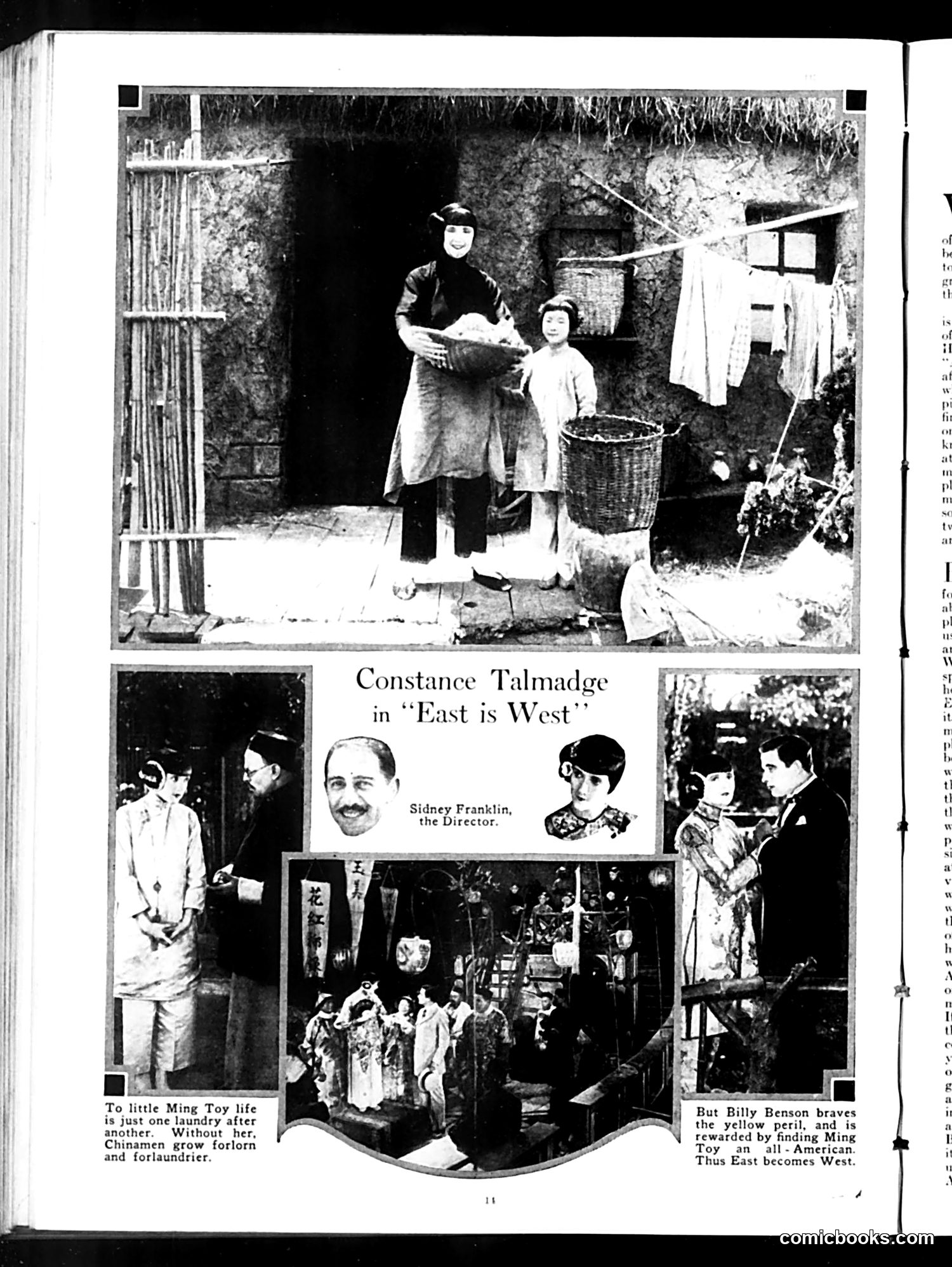
This page promotes the silent film "East is West" starring Constance Talmadge, directed by Sidney Franklin. The content reflects early 1920s racial stereotypes: it depicts Chinese characters through the "yellow peril" trope—a period fear of Asian immigration and influence. The plot summary reveals the film's assimilationist message: a Chinese woman (Ming Toy) is "rewarded" by becoming "all-American" through romance with a white character (Billy Benson), suggesting that Asian identity should be abandoned for American acceptance. The caption's pun about laundries—a stereotypical Chinese-American occupation—and the phrase "Chinamen grow forlorn" reinforce dehumanizing caricatures common in early cinema. The film essentially celebrated cultural erasure as romantic resolution.
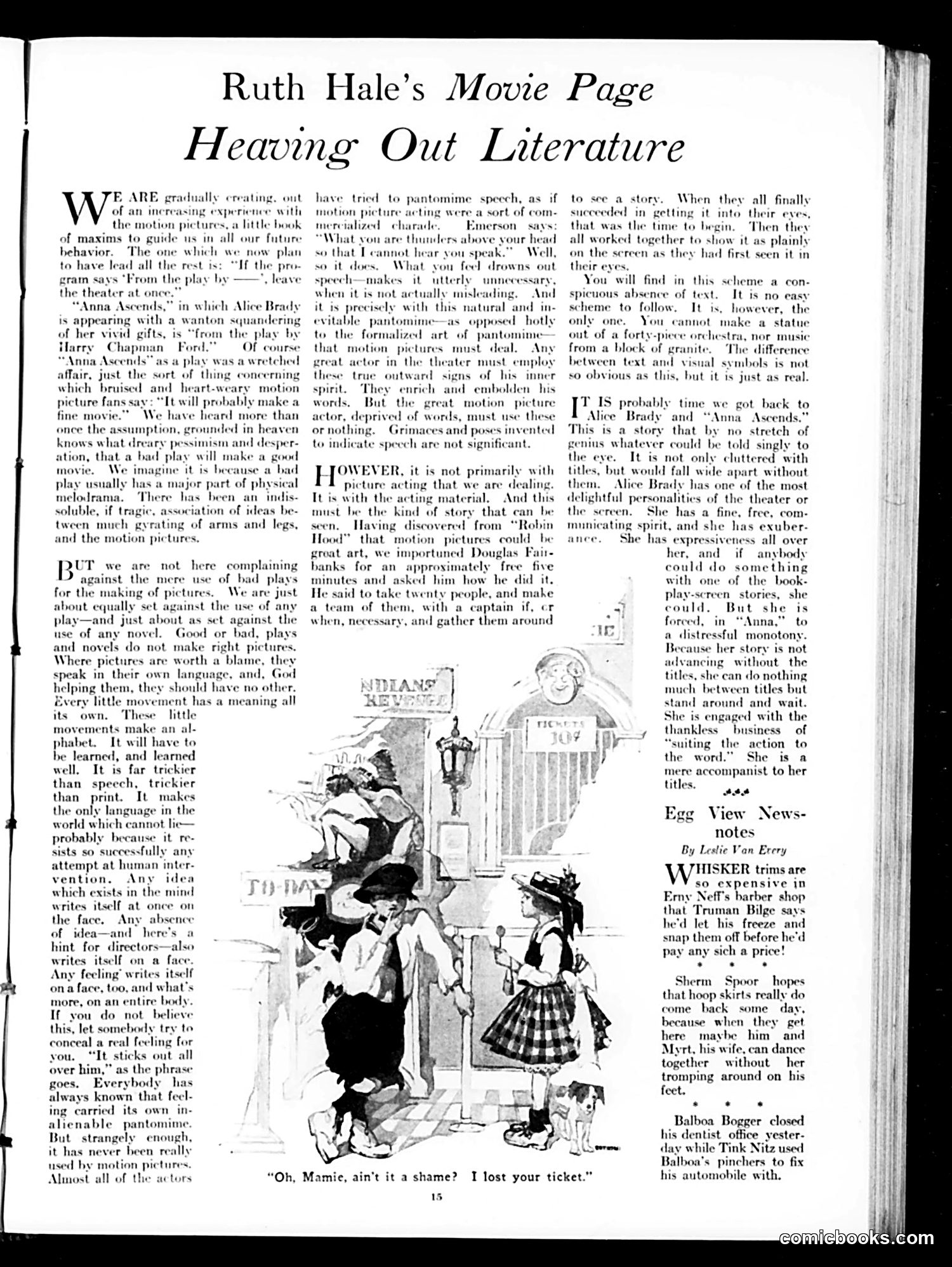
This is a film criticism essay by Ruth Hale discussing how motion pictures should use visual storytelling rather than pantomimed speech. The accompanying illustration shows a comedic scene of a woman losing her theater ticket, with the caption "Oh, Mamie, ain't it a shame? I lost your ticket." **The satire's point**: Hale argues that early cinema was mistakenly having actors pantomime dialogue (trying to "mouth" words silently), when film's true power lies in pure physical expression and action—the "universal language" that cannot lie. She critiques theatrical actors brought into film who cling to speech-based performance. **The illustration** is a practical joke about theater tickets—ironic given Hale's argument about cinema replacing theater, and showing the very physical comedy (slapstick/gesture) she champions as film's strength. **Key reference**: "Anna Ascends" (the film under review) stars actress Alice Brady, whom Hale praises for genuine expressiveness rather than artificial pantomime. The essay advocates for cinema as a distinct visual medium, not merely recorded theater—a progressive stance for early film criticism.
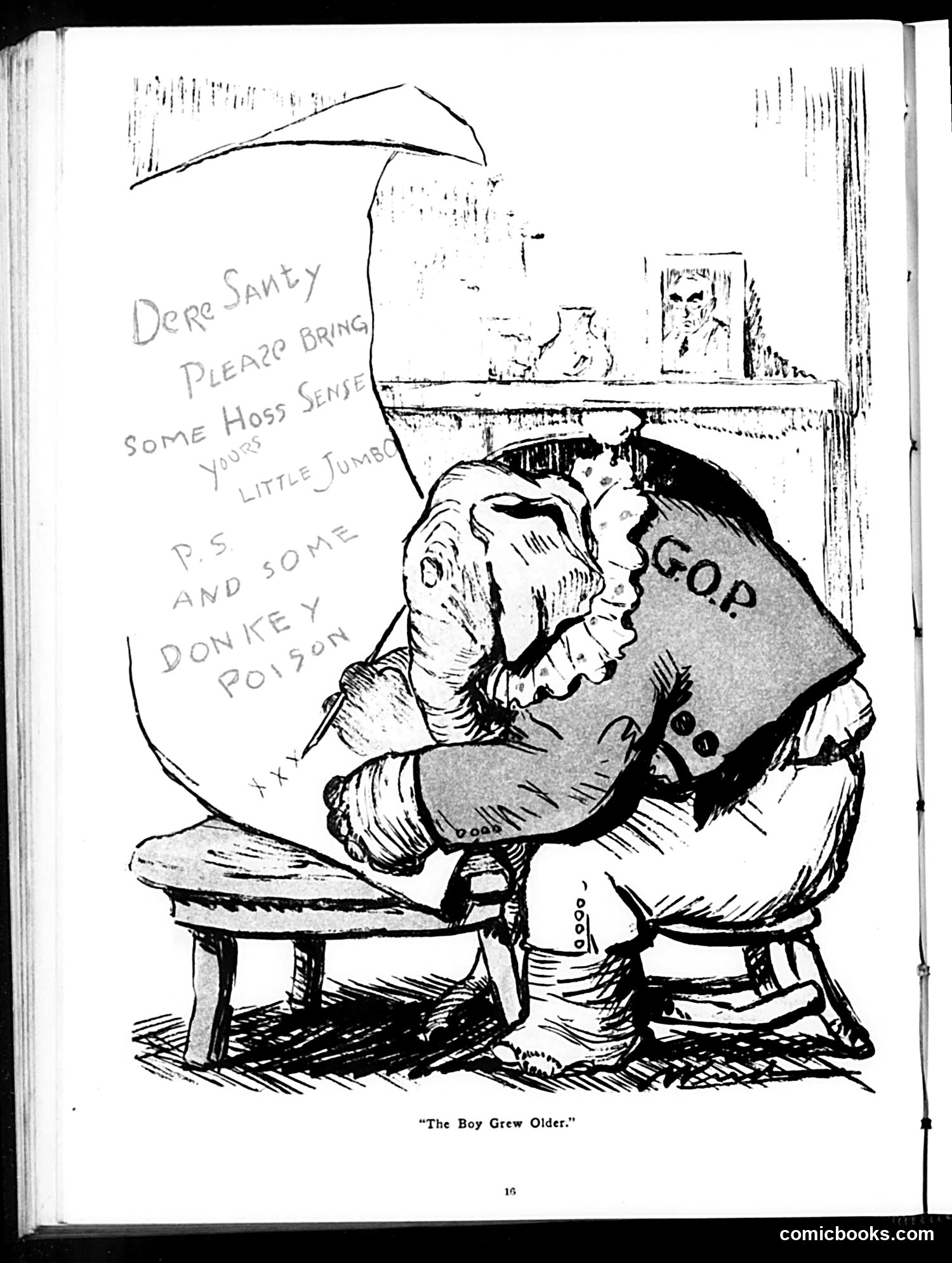
This appears to be a satirical cartoon from *Judge* magazine depicting an elephant (the Republican Party symbol) being fed poison labeled "G.O.P." by a figure in formal dress. The accompanying handwritten text reads: "Dear Sairey, Please bring some Hoss Sense. You're little Jumbo. P.S. and some donkey poison." The cartoon satirizes Republican leadership or policies as self-destructive—the GOP is literally poisoning itself. The reference to "Sairey" and "Hoss Sense" (horse sense/common sense) suggests criticism that the party lacks wisdom. The "donkey poison" reference invokes the Democratic Party symbol. The title "The Boy Grew Older" implies the party has matured into self-harm. This likely critiques early 20th-century GOP internal divisions or policies the cartoonist viewed as harmful to the party's interests.
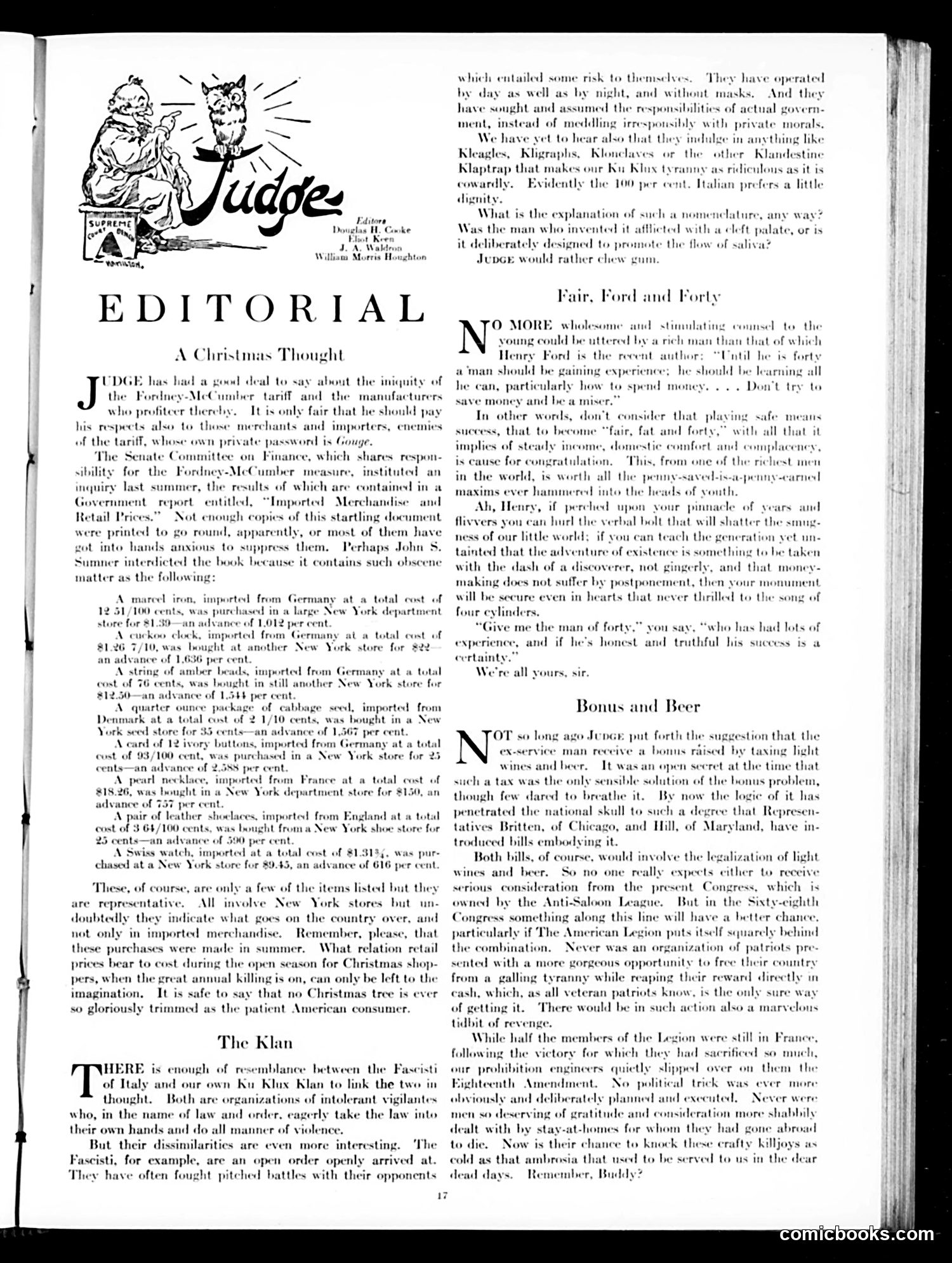
This *Judge* editorial page contains three satirical pieces attacking American institutions: **The Main Cartoon** depicts a figure labeled "Judge" scolding someone, likely related to the tariff debate discussed below. **"A Christmas Thought"** criticizes the Fordney-McCumber tariff by listing obscene markup examples: German marble irons marked up 1,012%, amber beads 1,636%, cabbage seeds 1,367%. The editorial argues these price gouges on imported goods harm American consumers during Christmas shopping—when "the great annual killing is on." **"The Klan"** compares the Ku Klux Klan unfavorably to Italian Fascists. Unlike the open, uniformed Fascists who take public responsibility for their actions, the KKK operates secretly, "without masks," uses ridiculous nomenclature ("Kligraphs," "Klonelaves"), and cowardly "meddl[es]...with private morals" rather than governing openly. The author mockingly questions whether the KKK's founder had a speech impediment. **"Fair, Ford and Forty"** summarizes Henry Ford's advice that young men should gain experience and save money until age forty—conventional wisdom presented as worthy counsel.
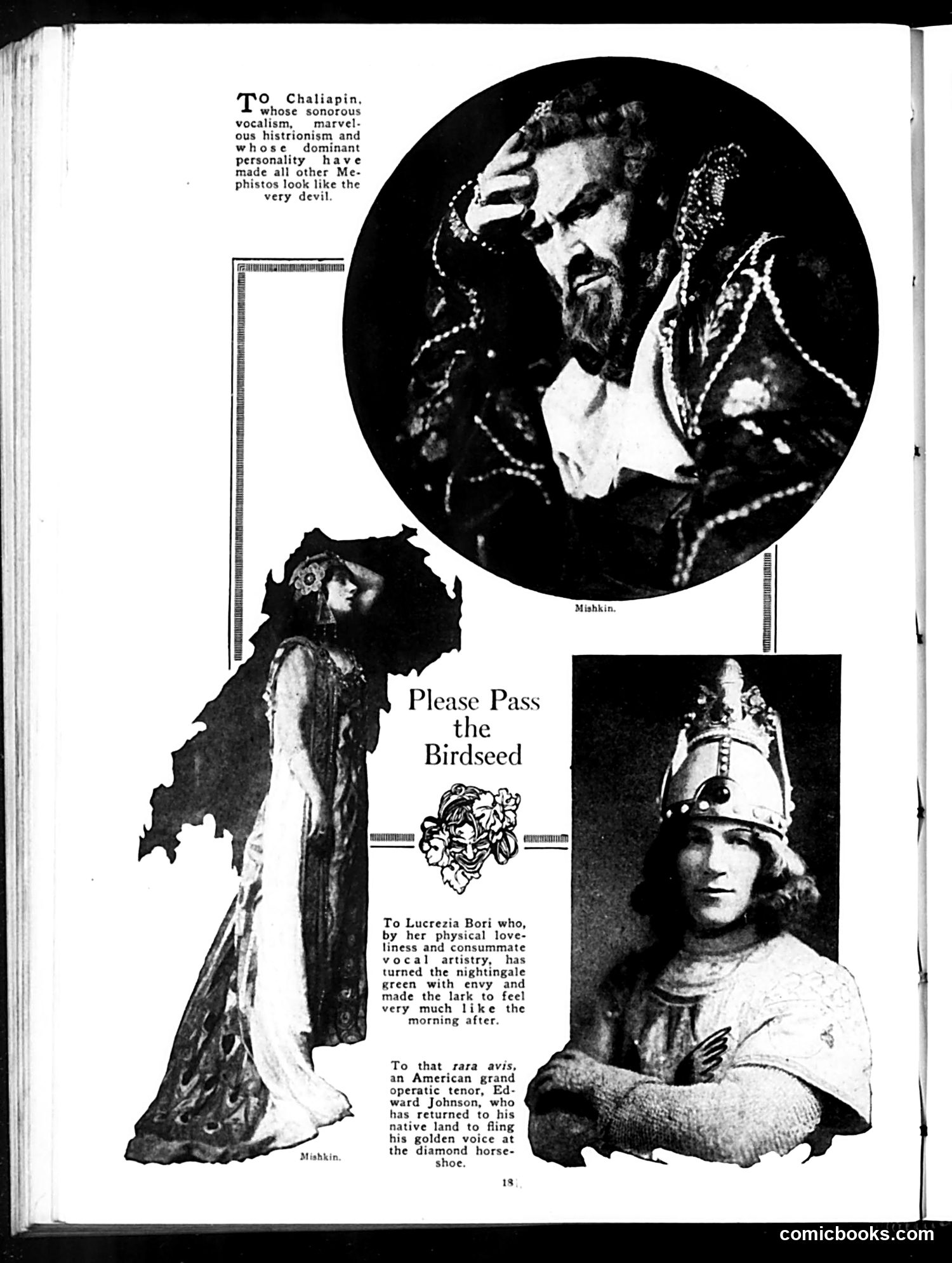
This page celebrates three opera stars through humorous comparisons to birds. **Feodor Chaliapin**, a renowned Russian bass-baritone, is praised so effusively that other Mephistos (the devil role in *Faust*) pale beside him. **Lucrezia Bori**, an Italian soprano, is so beautiful and talented she makes nightingales and larks jealous—the "morning after" suggesting they're hungover from competing with her. **Edward Johnson**, an American tenor returning home, will perform at the "diamond horseshoe" (the Metropolitan Opera's prestigious box seating section). The satire is gentle mockery of opera world pretension: comparing singers to birds and using elaborate flattery. The "birdseed" title puns on bird references, playfully suggesting these celebrated performers are as attention-seeking as caged birds. This reflects Judge magazine's tradition of satirizing elite cultural institutions while acknowledging genuine talent.
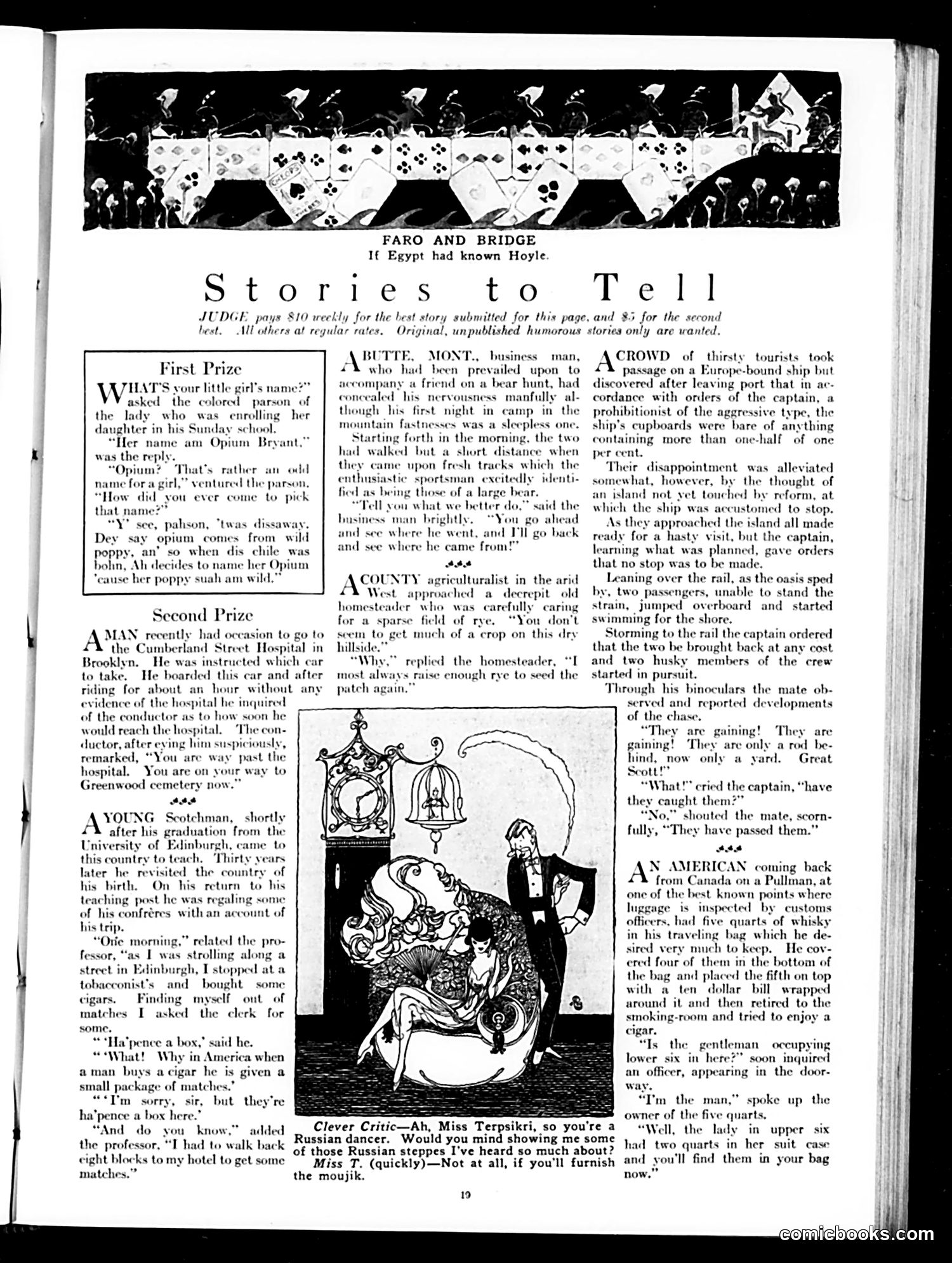
This page contains three short humorous stories typical of early 20th-century American satirical journalism. The cartoons aren't overtly political but rather rely on period stereotypes and social comedy: **First Prize story** uses racist dialect humor common to the era, depicting a Black minister and parent through caricatured speech patterns about naming a child "Opium." **Second Prize** features Scottish immigrant stereotypes—a recent University of Edinburgh graduate unaccustomed to American customs, shocked that matches cost extra at tobacconists (they're free in America). **The illustrated story** depicts a wealthy businessman's bear hunt, playing on frontier adventure tropes and sporting culture humor. The overall tone reflects Judge's satirical approach: mocking immigrant unfamiliarity with American norms, racial caricature accepted as mainstream humor, and gentle ribbing of the wealthy. The "Stories to Tell" section explicitly paid writers for original humorous content, indicating this was popular entertainment for educated, middle-class readers of the period.
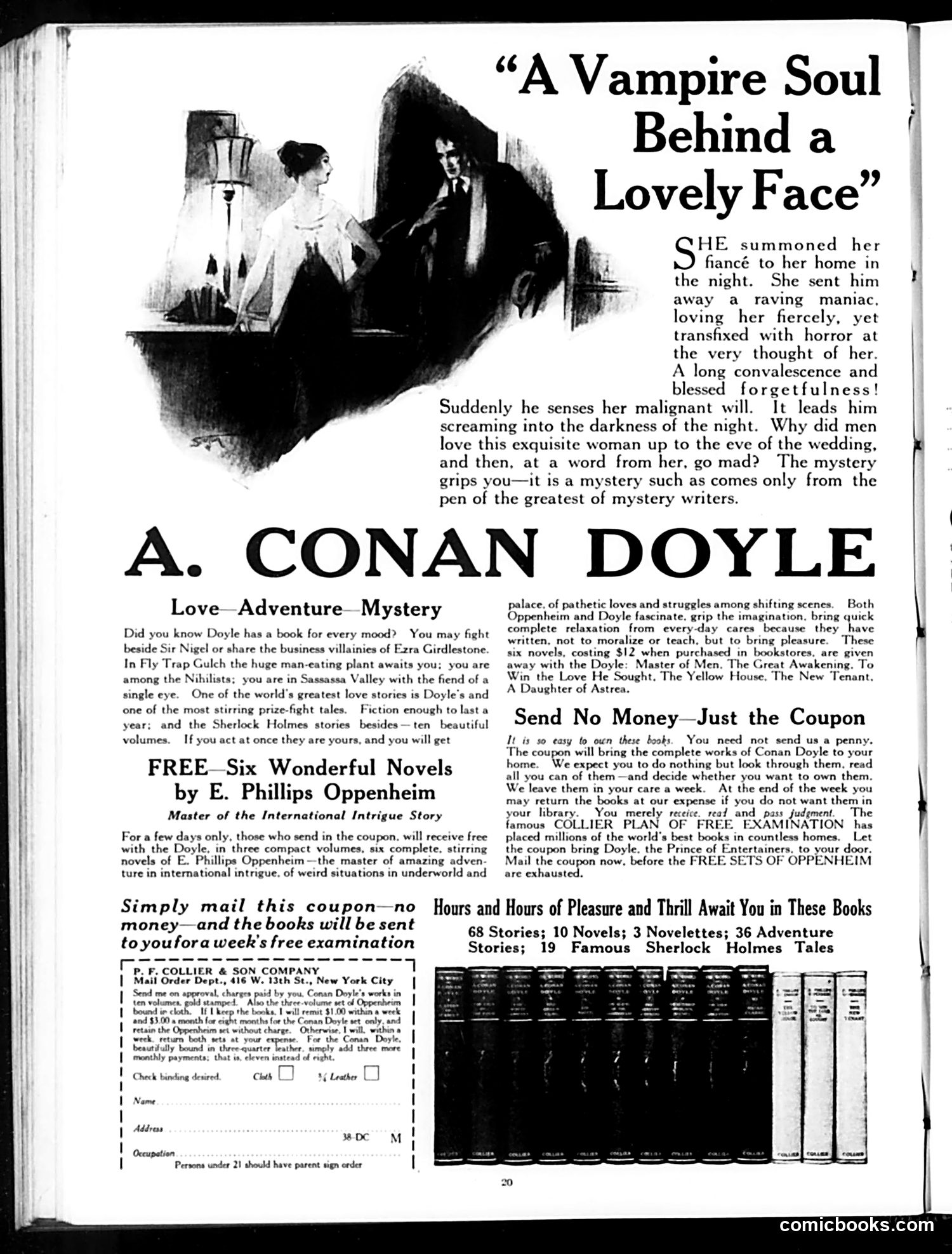
This page is primarily **advertising, not political satire**. It's a promotional insert for the Collier & Son Company offering free books by Arthur Conan Doyle and E. Phillips Oppenheim. The illustration at top depicts a dramatic domestic scene—a woman with "a vampire soul behind a lovely face" who has driven her fiancé to madness through malevolent supernatural influence. This serves as clickbait advertising, teasing Doyle's mysterious and sensational storytelling to entice readers. The ad emphasizes Doyle's versatility ("a book for every mood") across adventure, romance, and detective fiction, including the famous Sherlock Holmes stories. It promotes a free-examination scheme: readers receive books on approval for one week without payment, then decide whether to purchase through installments. This reflects early 20th-century direct-mail marketing strategies targeting middle-class readers seeking affordable access to quality literature. The page contains no political commentary or social satire—it's purely commercial content designed to appear in Judge's pages.
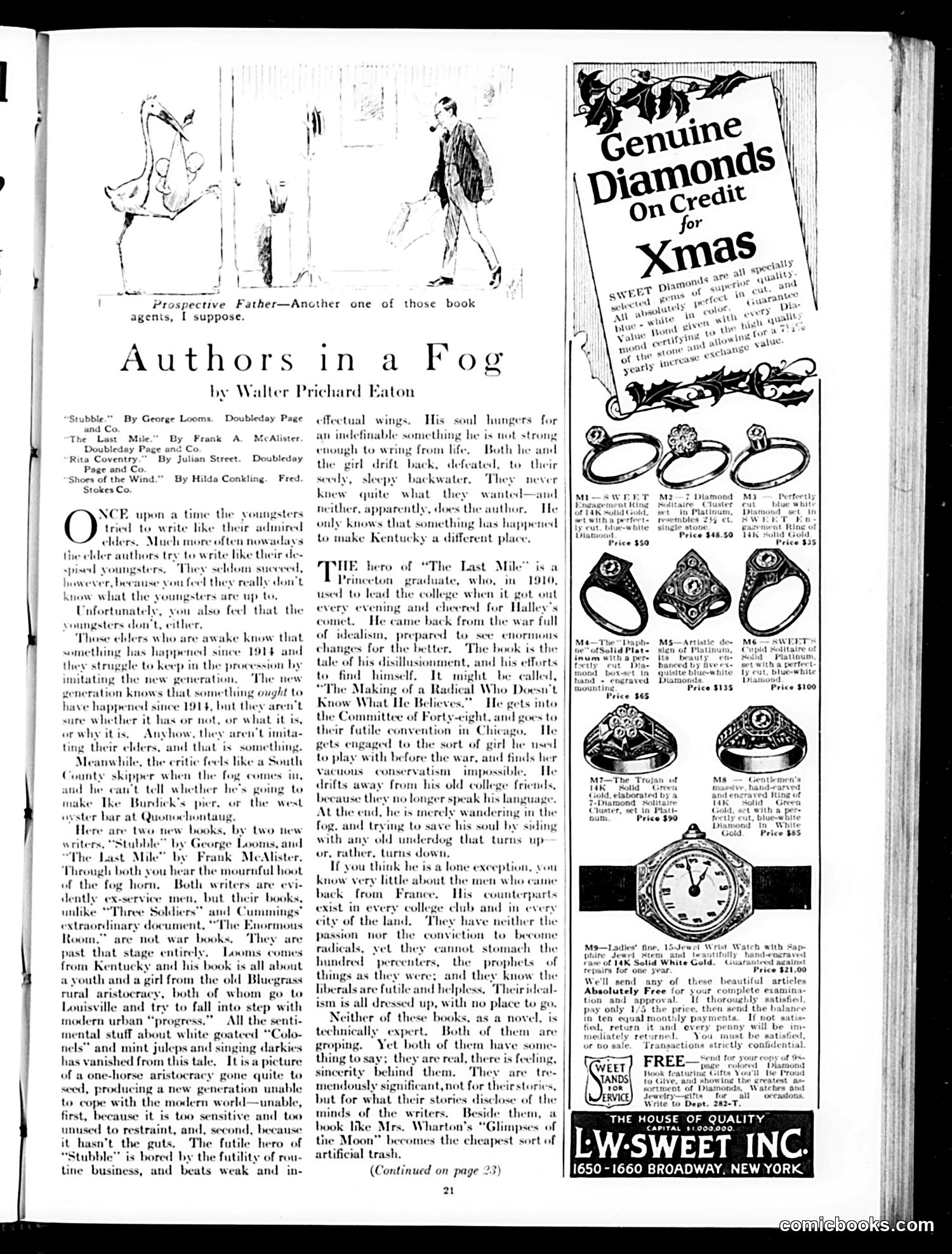
This page features Walter Prichard Eaton's literary criticism essay critiquing two contemporary novels: George Loom's "Stubble" and Frank McAlister's "The Last Mile." The opening cartoon depicts a man at the door, with the caption "Prospective Father—Another one of those book agents, I suppose," mocking the era's aggressive door-to-door book sales. Eaton's essay uses "fog" as metaphor for post-WWI confusion afflicting both young writers and their disillusioned characters. He criticizes authors attempting to capture the "new generation" without understanding it. Both novels follow young men adrift after 1914—one a Kentucky aristocrat bored by routine, the other a Princeton graduate radicalized then paralyzed by ideological uncertainty. Eaton suggests these protagonists represent authentic post-war malaise: veterans unable to embrace pre-war values or commit to radical change, instead wandering emotionally lost. The "fog" reflects genuine generational disorientation after WWI, not mere literary affectation.
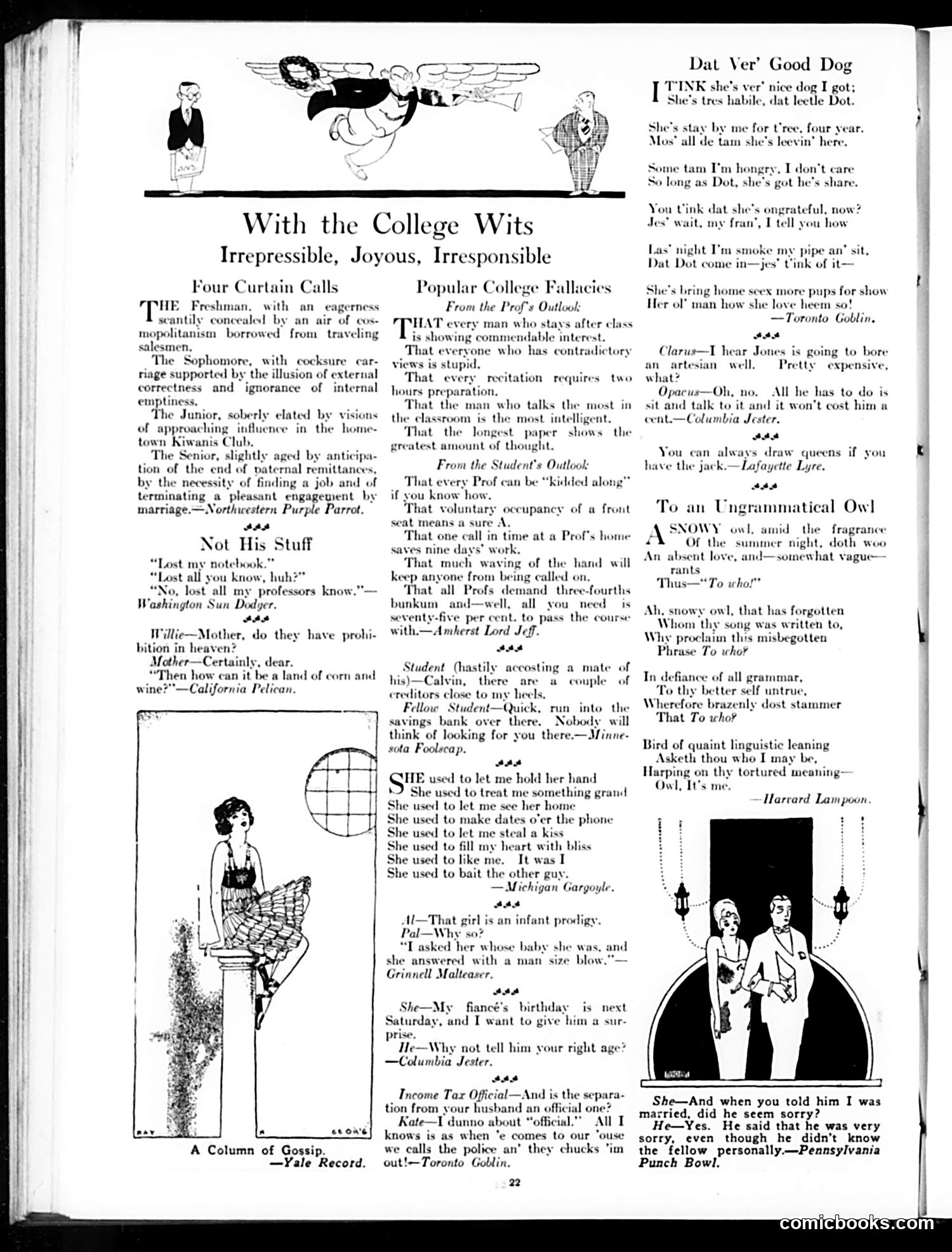
This page from **Judge** magazine (a satirical publication) contains college humor pieces targeting early-20th-century student life and academic pretense. **Main Content:** The "Four Curtain Calls" satirizes undergraduate stereotypes—freshmen act cosmopolitan, sophomores are arrogantly ignorant, juniors fantasize about status, seniors dread real life. **"Popular College Fallacies"** mocks both professors and students: profs believe talkative students are intelligent; students believe they can manipulate professors or that sitting in front guarantees good grades. **The gossip column and jokes** ridicule typical college situations: broke students, romantic fickleness, and grammar misuse. **"Dat Ver' Good Dog"** features dialect humor (a working-class immigrant voice), celebrating a faithful dog who shares the owner's food—a sentimental counterpoint suggesting loyalty transcends social class. **The illustrations** show flapper-era college life. The page overall reflects 1920s campus culture: prohibition-era references, dating customs, and academic hierarchies now mostly historical curiosities.
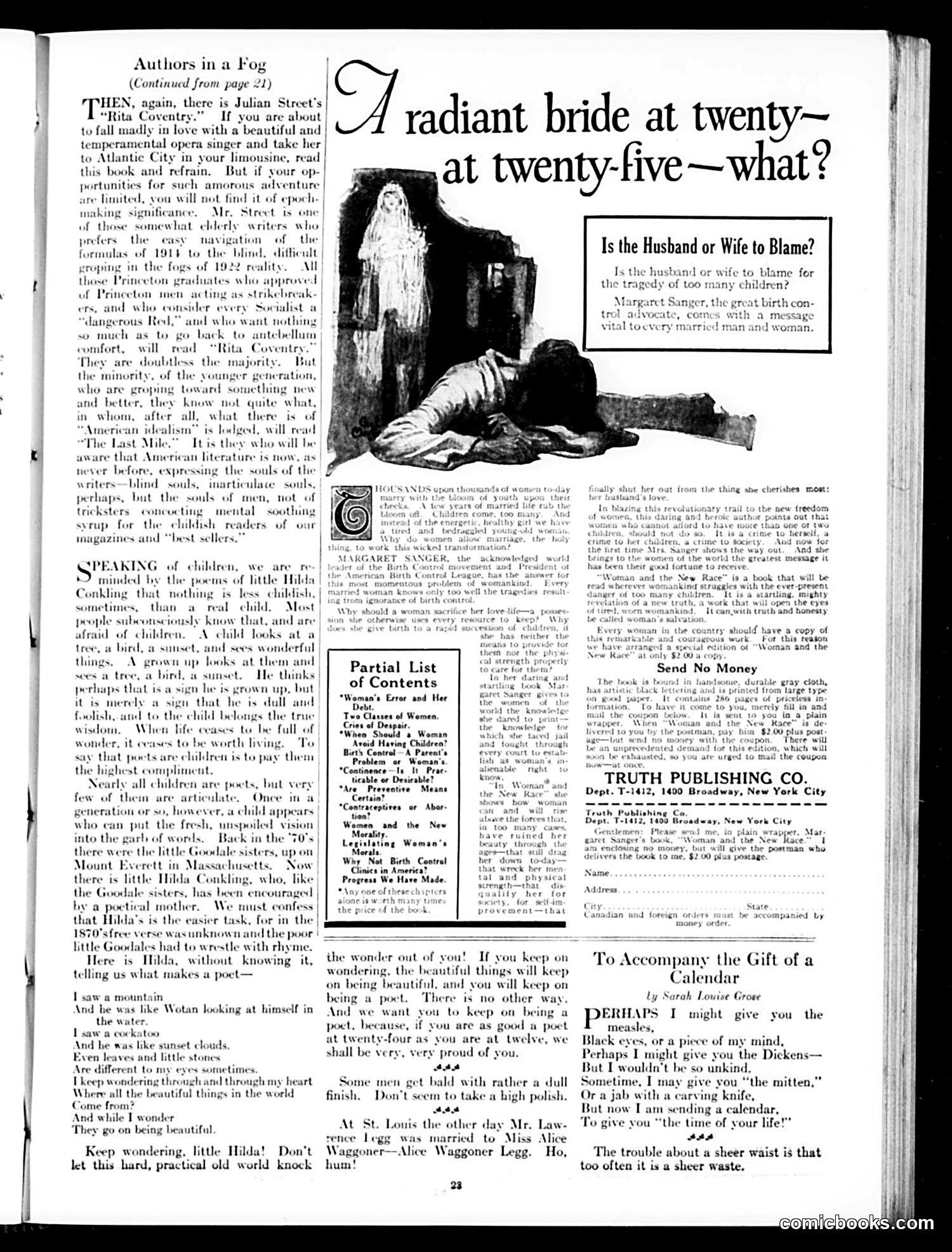
This page from Judge magazine contains literary criticism and social commentary typical of the 1920s. The main feature "Authors in a Fog" critiques contemporary writers, particularly Julian Street's novel "Rita Coventry," dismissing it as conventional entertainment for Princeton alumni and conservative readers uncomfortable with modernism. The critic contrasts this with praise for young poet Hilda Conkling, celebrating her fresh, childlike perspective as superior to formulaic adult writing. A sidebar celebrates Conkling's poetry about wonder and nature, positioning childhood imagination as the true source of artistic merit—a common 1920s Romantic ideal about art. The boxed advertisement "Is the Husband or Wife to Blame?" promotes Margaret Sanger's birth control advocacy book, framing contraception as a solution to unwanted large families. This reflects the era's emerging family-planning movement and women's rights debates. A marriage announcement joke about "Alice Waggoner Legg" provides concluding humor about women's identity after marriage. The page reflects 1920s intellectual tensions: modernism versus conservatism, childhood versus adulthood, and emerging discussions of reproductive autonomy.
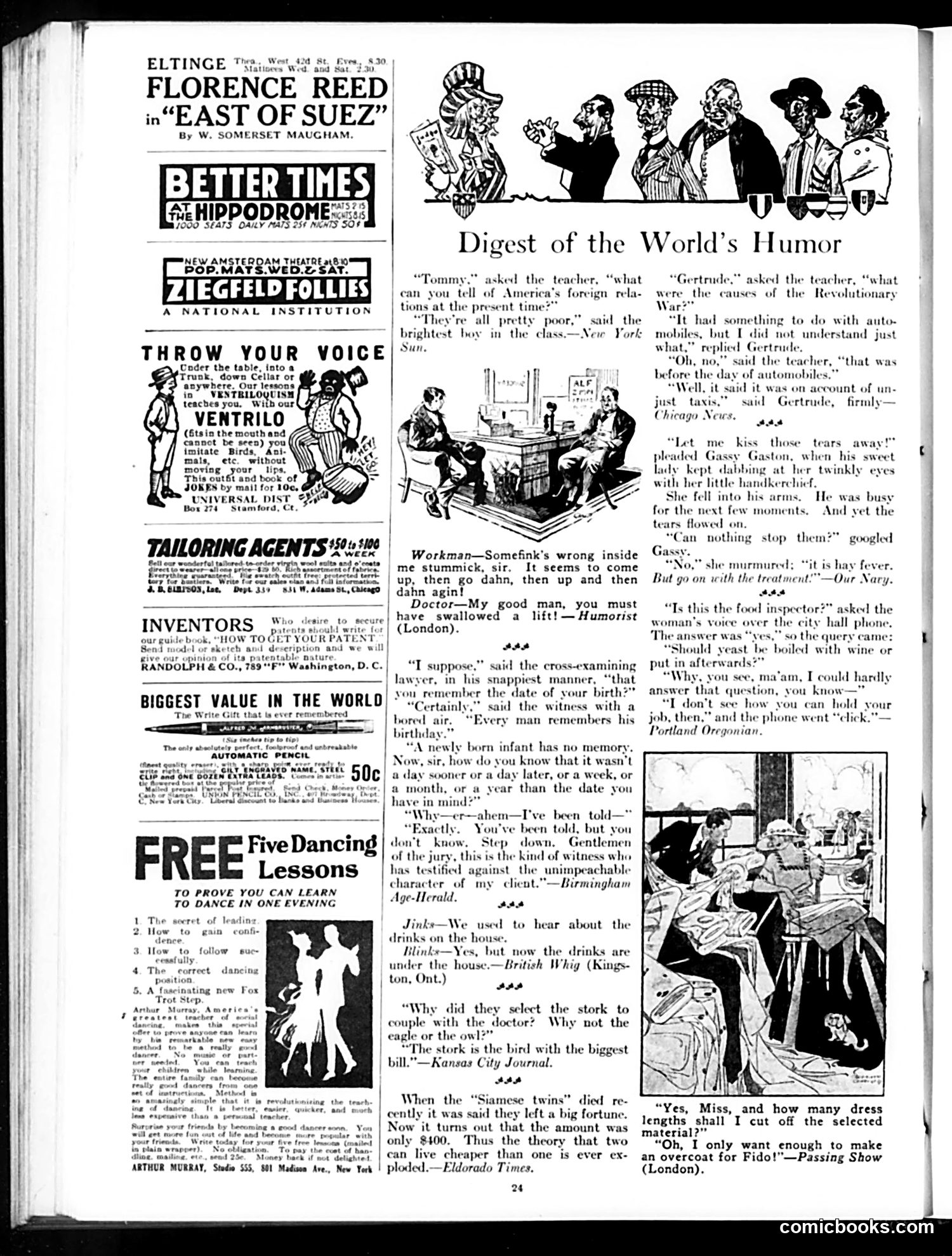
This page is primarily **advertisements and humor columns**, not political satire. The content includes: **Theater/Entertainment Ads**: Florence Reed in "East of Suez" by Somerset Maugham, and Ziegfeld Follies are promoted at the top. **Product Ads**: Ventriloquism lessons, dancing classes, and an automatic pencil fill most of the left side. **Humor Section** ("Digest of the World's Humor"): A collection of brief jokes and anecdotes sourced from various publications (New York Sun, Humorist, Birmingham Age-Herald, Kansas City Journal, etc.). These include: - A student's joke about America's foreign relations being "pretty poor" - Wordplay about taxi-related Revolutionary War causes - A doctor-patient exchange - Courtroom witness humor - Social observations about changing customs The jokes reflect **early 20th-century sensibilities**—working-class dialect humor, romantic situations, and light domestic comedy. No identifiable political figures or specific events are targeted; this appears to be a standard filler page from Judge's regular humor column.
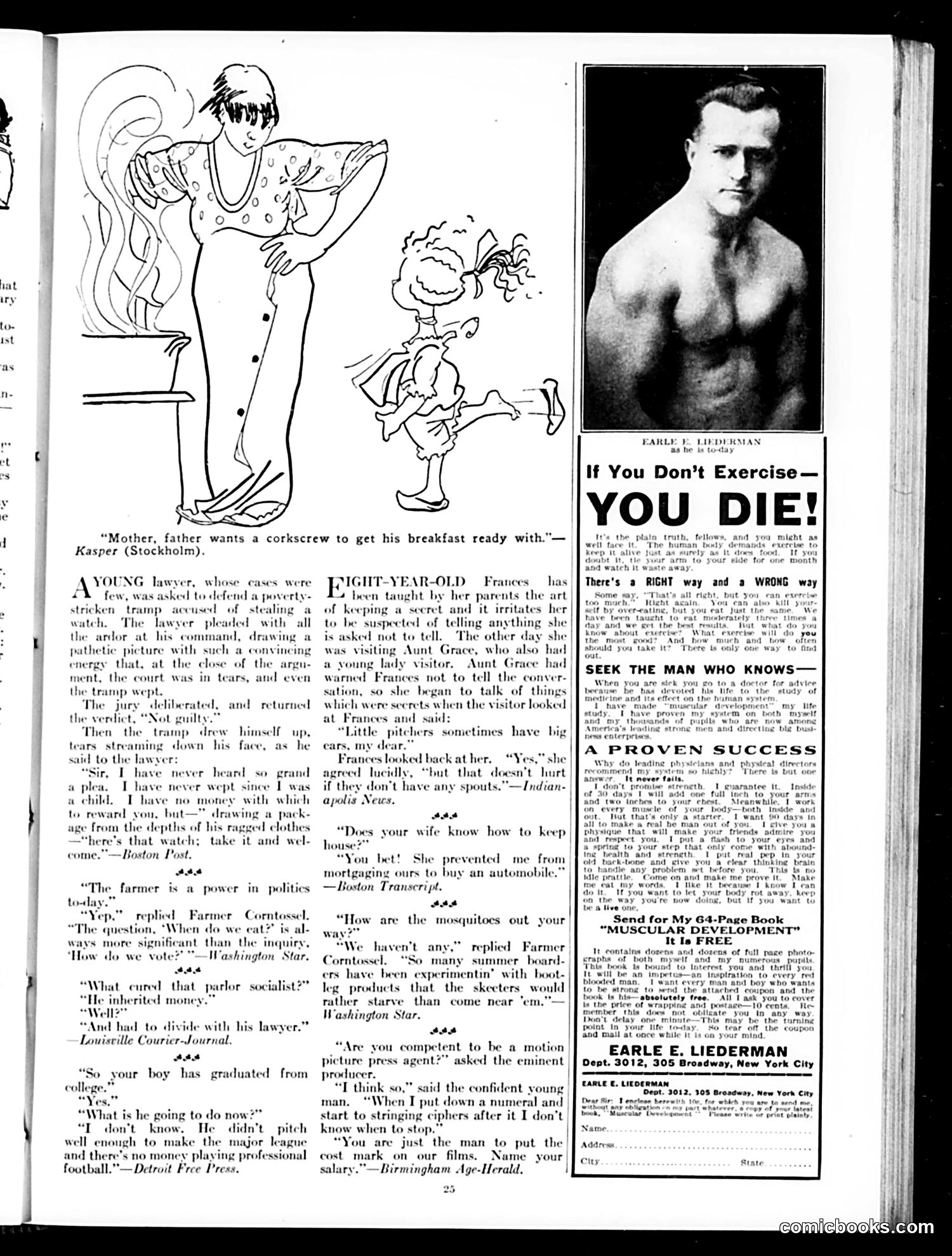
This page contains several brief jokes and one substantial advertisement. **The Cartoons/Jokes:** Most are short anecdotes about lawyers, farmers, and social pretense—typical Judge magazine humor from the early 20th century. One mocks a "parlor socialist" (someone who talks radical politics in comfortable drawing rooms but doesn't act on them). Another features "Farmer Corntossel," a stock character representing rural common sense, joking about mosquitoes avoiding areas where people drink illegal bootleg alcohol (referencing Prohibition-era concerns). **The Main Content:** The right half is a full-page advertisement from Earle E. Liederman, a famous bodybuilding promoter of that era. The headline "If You Don't Exercise—YOU DIE!" and the muscular male photograph exemplify early 1900s fitness marketing rhetoric—making exaggerated health claims to sell his "Muscular Development" course. This represents the birth of modern bodybuilding commercialism in American magazines. The left cartoon shows a child with a corkscrew, likely satirizing parental incompetence.
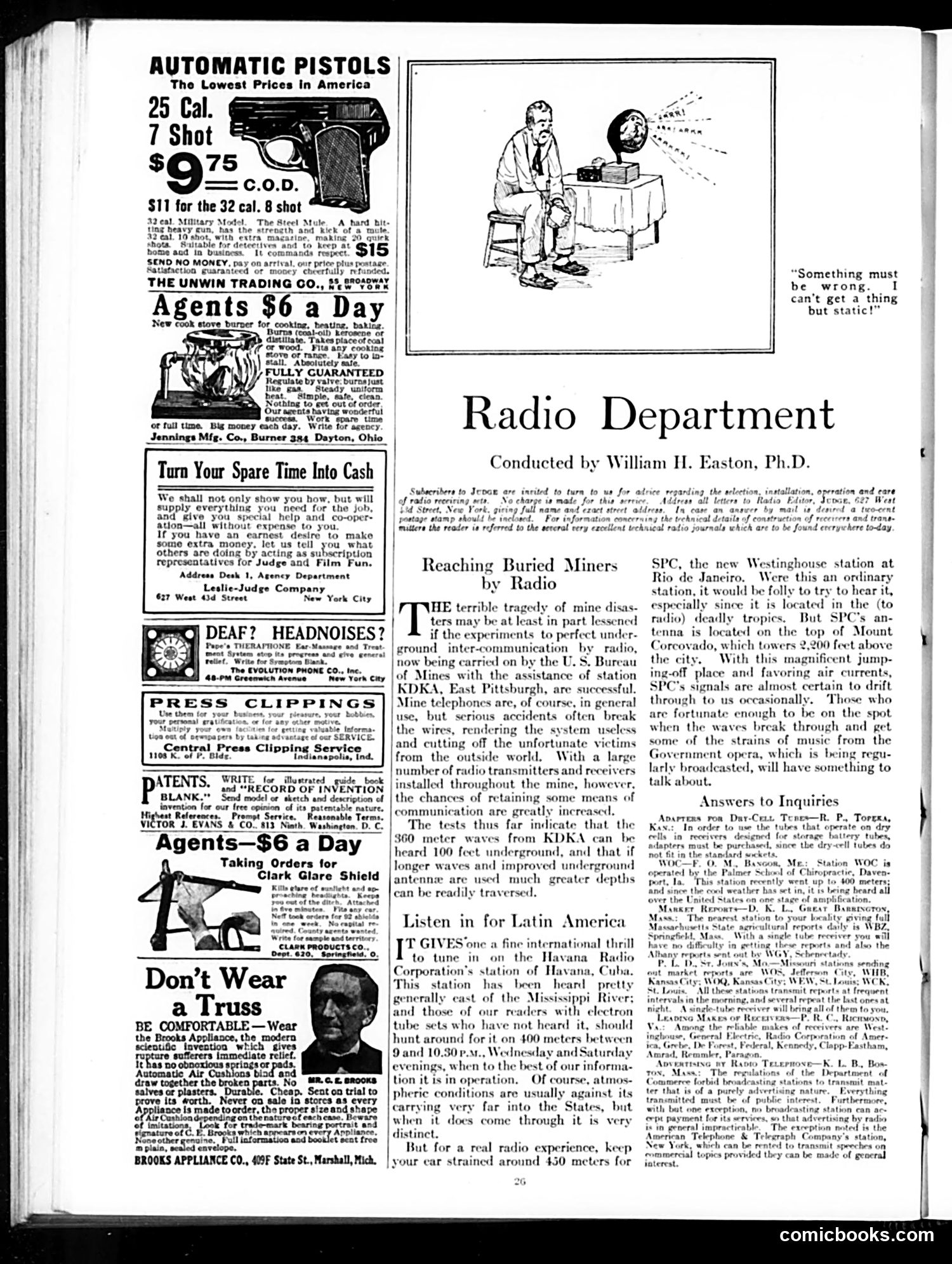
This page is primarily **advertising with a small editorial section**. The main cartoon illustrates a radio problem: a man sits frustrated at a radio receiver, stating "Something must be wrong, I can't get a thing but static!" This reflects a common 1920s radio experience—reception was highly unreliable and frequently disrupted by atmospheric interference ("static"). The "Radio Department" article discusses practical radio applications: using underground radio systems in mines to communicate with trapped workers (improving on telephone lines that break during accidents), and tuning into international broadcasts like Havana's radio station. The surrounding ads sell firearms, stoves, and employment schemes—typical direct-mail marketing of the era. The cartoon's humor comes from capturing the frustration of early radio users, where poor reception was an unavoidable reality of the technology.
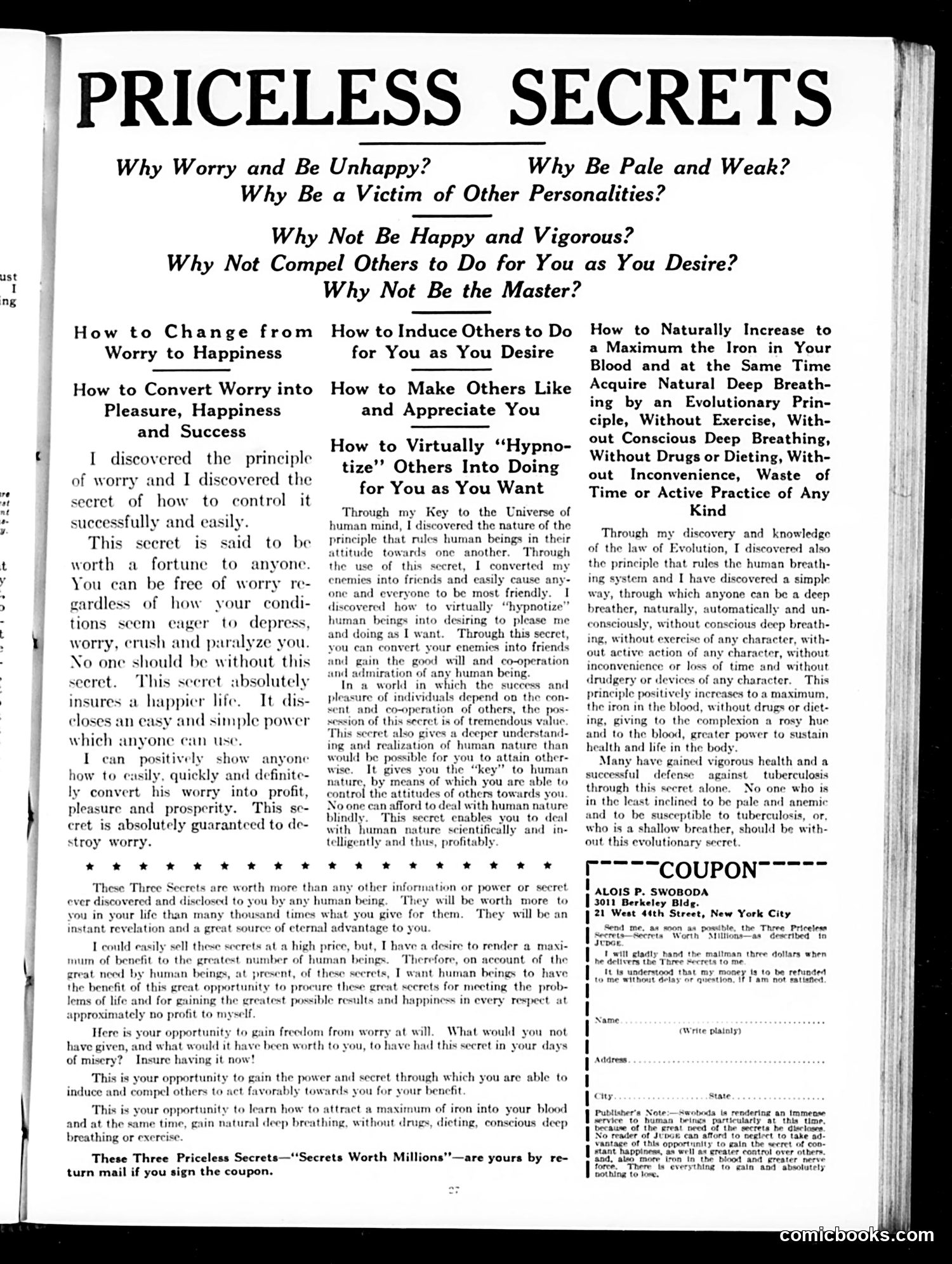
This page is primarily **advertising copy**, not satire—though it exemplifies what modern readers might find ridiculous about early 20th-century self-help marketing. The ad promotes three purported "secrets" claiming to solve fundamental human problems: eliminating worry, manipulating others' behavior through pseudo-psychological "hypnosis," and increasing iron in blood through breathing exercises. The hyperbolic language ("worth a fortune," "secrets worth millions") and grandiose promises ("compel others to do for you as you desire") reflect common mail-order self-improvement schemes of the era. The coupon at bottom solicits customer information, suggesting this is a genuine commercial pitch rather than Judge magazine satirizing such schemes. However, the over-the-top claims—that a single "principle" can simultaneously cure worry, control human nature scientifically, and improve health without drugs or exercise—would have seemed dubious even then, possibly explaining its inclusion in a satirical publication. The page represents early 20th-century pseudoscience marketing targeting anxious, aspirational readers.
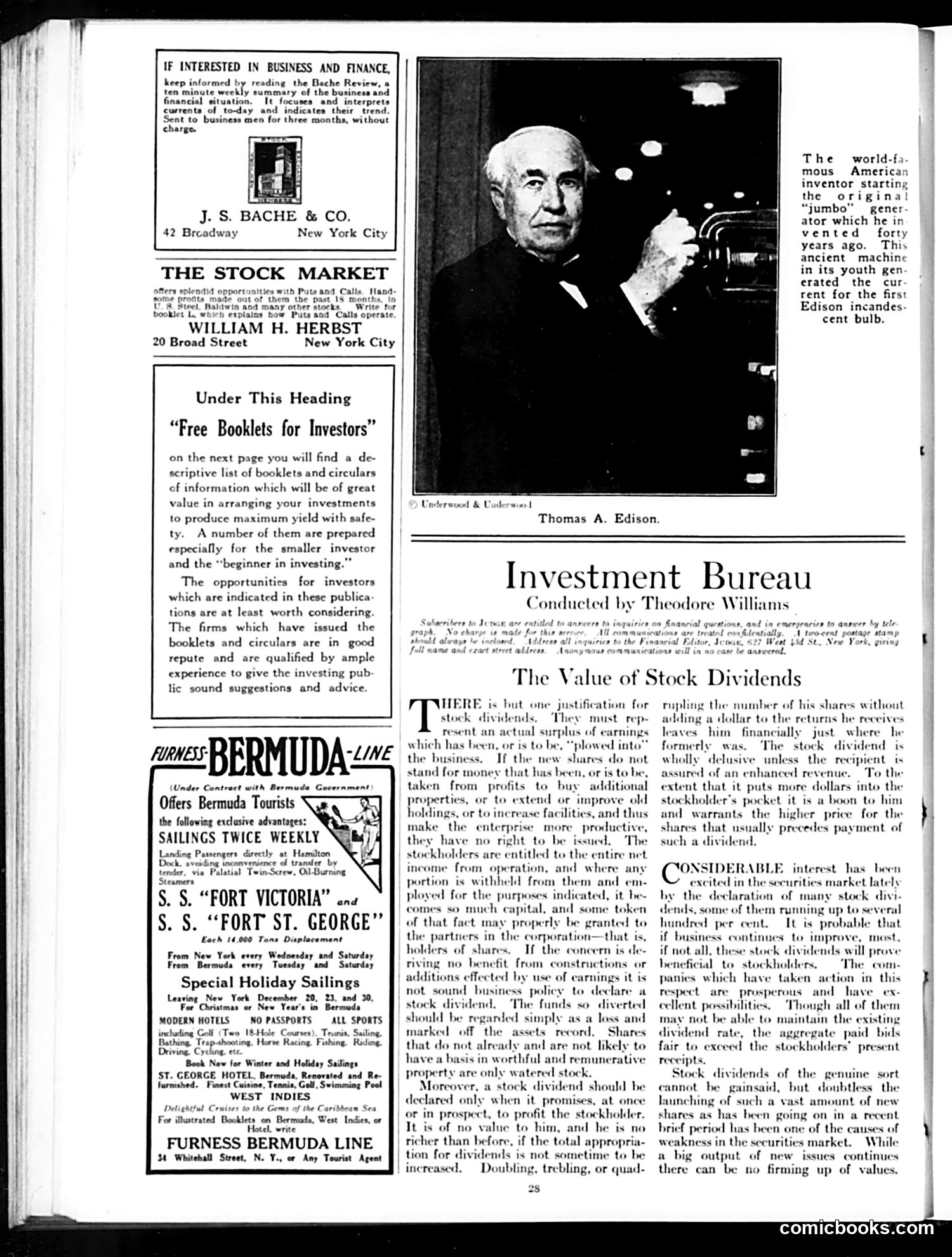
This page is primarily **advertising and editorial content** rather than political satire. It features: **Main Content:** - A photograph of **Thomas A. Edison** with commentary about his "original 'jumbo' generator" invented forty years prior, which powered the first Edison incandescent bulbs—presented as a historical achievement in American innovation. **Advertisements:** Multiple business and investment services dominate the page: - J.S. Bache & Co. (stock market information) - William H. Herbst (stock market booklets) - Furness Bermuda Line (steamship sailings) - An "Investment Bureau" article on stock dividends by Theodore Williams **Editorial Section:** "Free Booklets for Investors" promoting financial guidance materials for small investors and beginners. **Context for Modern Readers:** This reflects the 1920s investment culture—the page markets financial literacy materials to ordinary citizens during the prosperous pre-1929 crash era. The Edison image serves as aspirational American industrial achievement. There is **no apparent satire or political cartoon** on this page.
This page primarily contains **investor advice columns** rather than political cartoons. The main content addresses financial inquiries about stocks and bonds—reflecting the 1920s investment boom. The visible cartoon at the bottom shows **two figures** (appears to be capitalists or investors based on style) in what seems a commentary on speculation, though the specific caption is unclear in this OCR. The page's satire is **implicit rather than explicit**: the dense, contradictory financial advice—warning against risky investments while promoting questionable stocks—satirizes how financial columnists themselves often give unreliable guidance. References to failed companies, foreign currency speculation (notably warning against "German marks"), and mining ventures reflect post-WWI economic instability. The advertisements for upscale hotels (Waldorf-Astoria, Bellevue-Stratford) ironically juxtapose with cautionary investment language, suggesting the disconnect between wealthy leisure and financial precarity during this volatile period.
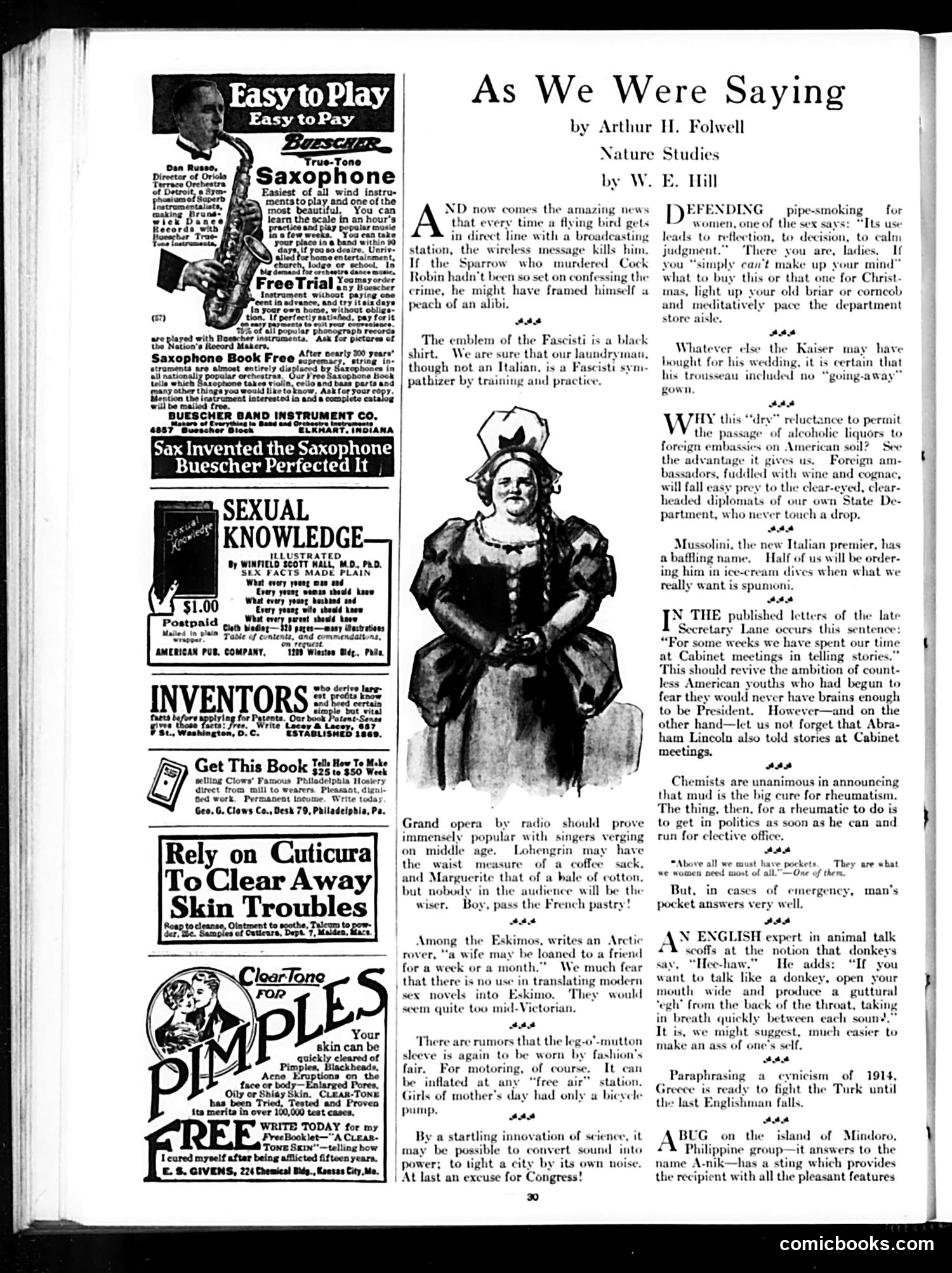
This page from Judge magazine contains brief satirical commentary pieces rather than formal political cartoons. The central image—a caricatured woman in old-fashioned dress—appears to illustrate the Fascist emblem discussion. Key satire targets include: **Fascism**: The joke equates Italian laundrymen's training with Fascism, mocking both the movement and its symbol (the black shirt). **Prohibition**: A jab at American "dry" diplomacy policy, sarcastically suggesting forbidding alcohol to foreign embassies actually benefits U.S. diplomats. **Mussolini**: A wordplay joke on Italy's new premier's name sounding like "spumoni" ice cream. **Congress**: Blamed for noise pollution; suggests converting sound to power would justify their existence. **Fashion & Gender**: Mocking women's indecision (pipe-smoking supposedly aids reflection) and outdated fashion trends. The tone is lighthearted political commentary typical of 1920s satirical magazines, targeting current events, politics, and social trends with brief witticisms rather than deeper investigation.
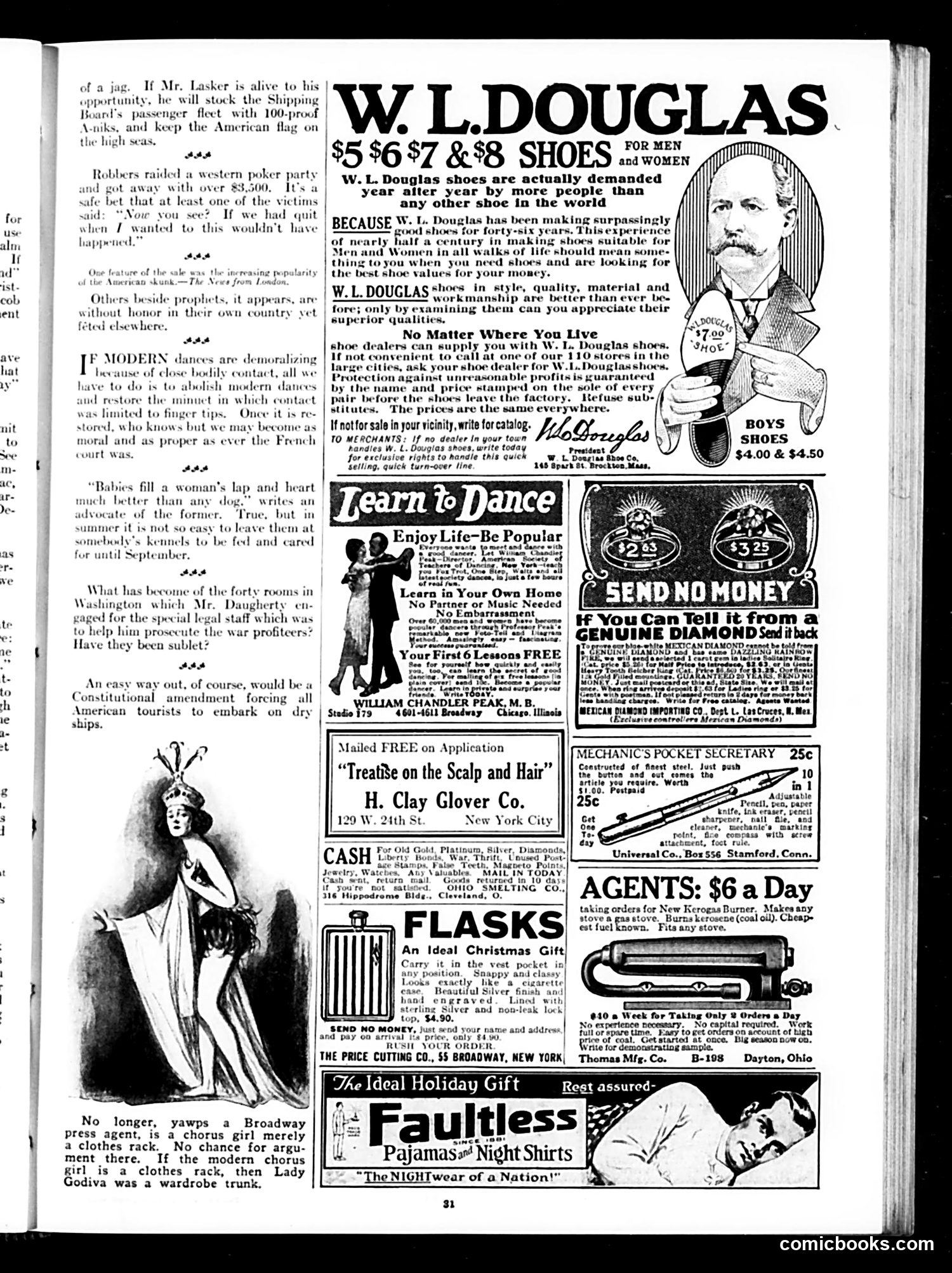
This page is primarily **advertising**, with satirical commentary in the text columns on the left. The visible political/social satire includes: 1. **"Modern dances" critique**: A tongue-in-cheek piece suggesting that close bodily contact in modern dancing is "demoralizing" and that returning to minuet-style dancing (with only finger-tip contact) would make society "proper"—mocking conservative anxieties about jazz-age social changes. 2. **Daugherty reference**: A jab at Attorney General Harry Daugherty, who had assembled a large legal staff to prosecute war profiteers after WWI but apparently achieved little, prompting the joke: where did those forty rooms of lawyers go? 3. **Lasker/shipping reference**: Unclear without fuller context, but appears to reference Albert Lasker and maritime policy debates. The bulk of the page consists of period product advertisements (W.L. Douglas shoes, dance lessons, diamond imitations, flasks, pajamas)—typical of Judge's revenue model and offering insight into 1920s consumer culture.
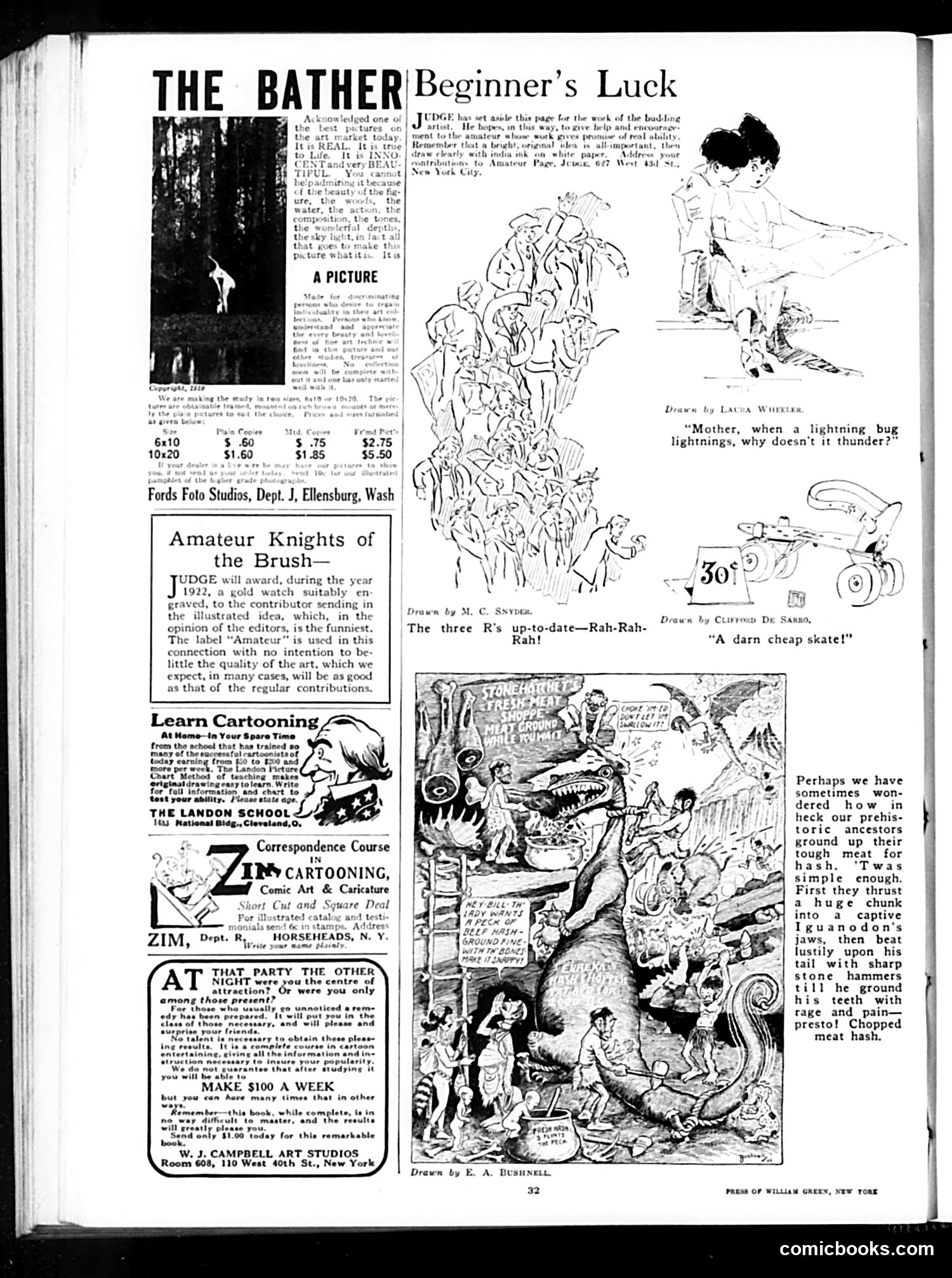
This page is primarily **advertisements and contest announcements** rather than political satire. The main content includes: **"Amateur Knights of the Brush"**: Judge's 1922 contest offering a gold watch for the funniest reader-submitted cartoon idea—positioning amateur artists as legitimate contributors. **The cartoons shown** are humorous domestic/children's content: - A child asking why lightning bugs don't thunder (plays on homophone confusion) - A "cheap skate" figure on a tricycle - "The three R's up-to-date" showing modern youth culture - A prehistoric joke about using an Iguanodon's grinding teeth to process meat **The advertising** promotes cartooning correspondence courses and art studios—reflecting robust 1920s demand for illustration skills. This page contains **no obvious political satire**. It's a typical Judge magazine issue mixing humor cartoons with art education marketing, aimed at encouraging amateur submissions and reader engagement during the prosperous 1920s.
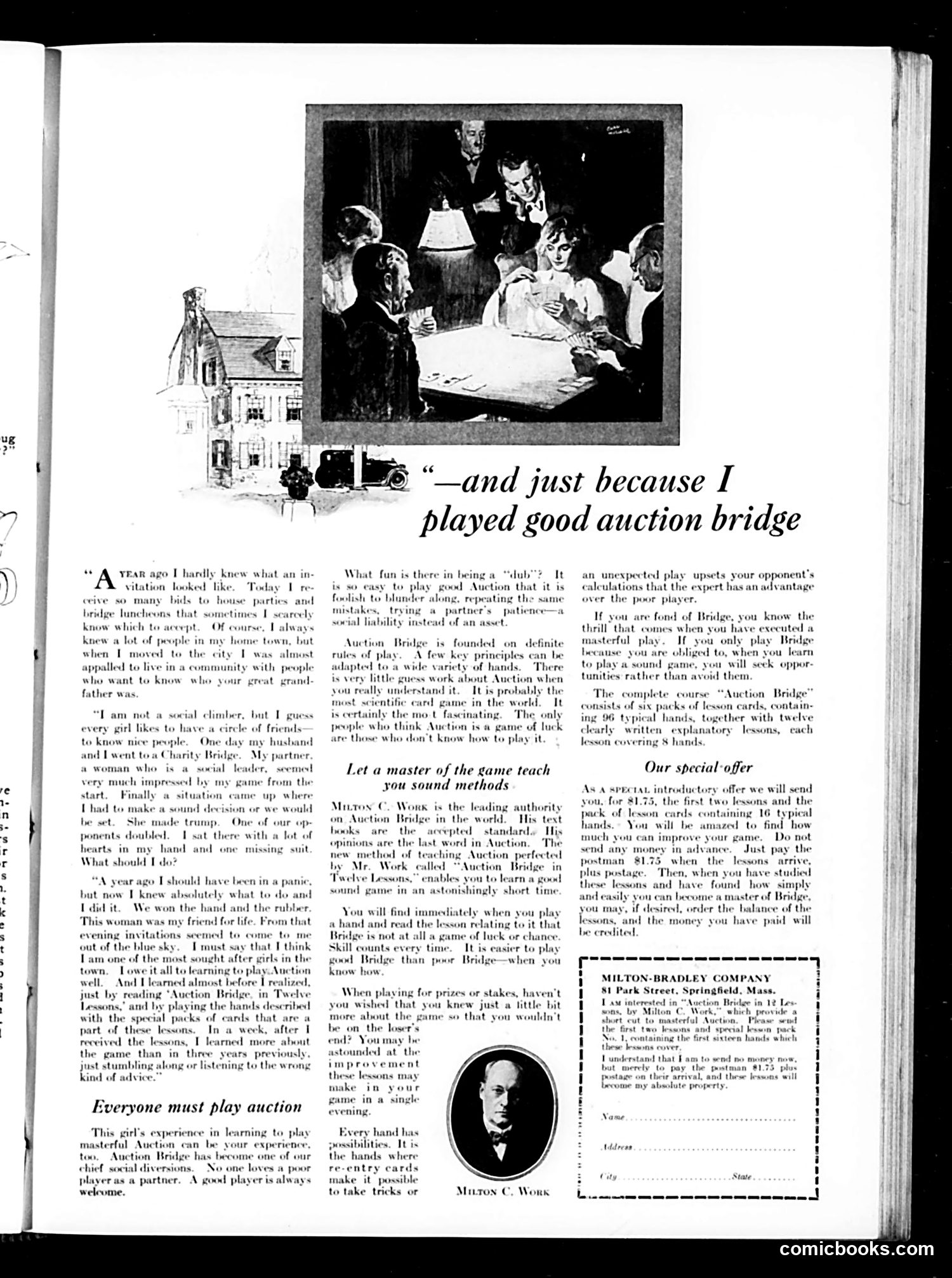
This page advertises **Auction Bridge**, a card game that was a major social activity among the American middle and upper classes in the early 20th century. The narrative testimonial describes a young woman's social transformation: initially excluded from fashionable circles despite family connections, she gained social acceptance by becoming a skilled bridge player. The implicit message is that Auction Bridge competence was essential social currency—playing poorly made one a social liability, while mastery opened doors to desirable friendships and social advancement. The satire targets the superficiality of social climbing: the woman's entire social elevation rested not on character or wealth, but on mastering a parlor game. The page advertises **Milton C. Work's** instructional card packs and "Twelve Lessons" course as the solution to social inadequacy. This reflects the Jazz Age anxiety about social mobility and the middle-class obsession with acquiring the "correct" leisure skills to climb the social ladder.
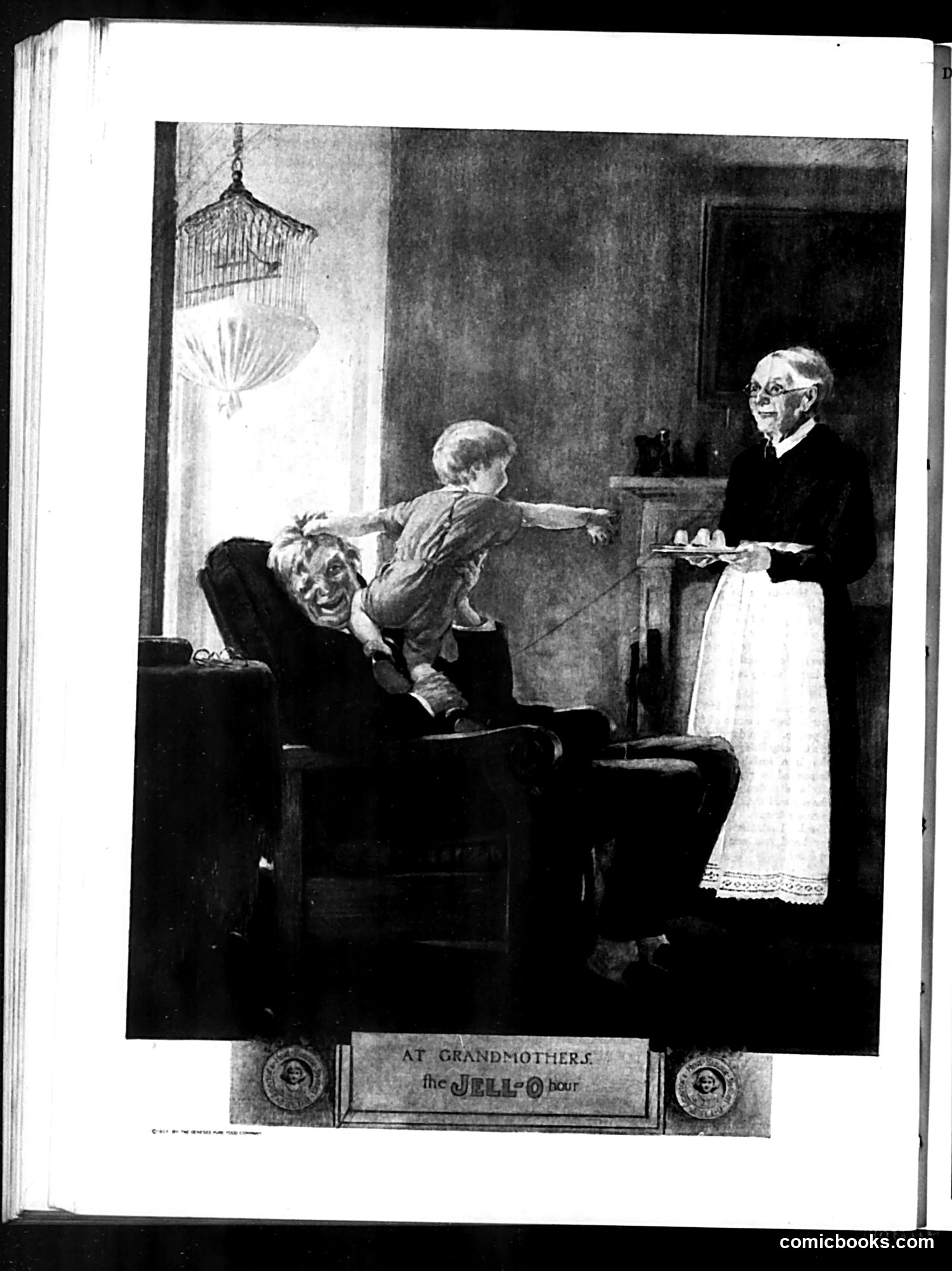
This Judge magazine illustration satirizes early 20th-century domestic life and consumer culture. The scene depicts a grandmother entertaining a young child while a formal servant (right) stands ready with refreshments—likely Jell-O, the trendy new gelatin dessert being heavily marketed during this era. The satire appears to target the ritualization of leisure time among the wealthy and the prominence of branded products in genteel households. The exaggerated, grotesque caricature of the grandmother's face suggests mockery of pretension or vanity. The "Jell-O hour" label indicates this is satirizing how modern commercial products were being integrated into supposedly traditional domestic rituals, reflecting broader Gilded Age anxieties about consumerism and social performance.