
Judge, 1922-12-09 · page 23 of 36
Judge — December 9, 1922 — page 23: what you’re looking at
What you’re looking at
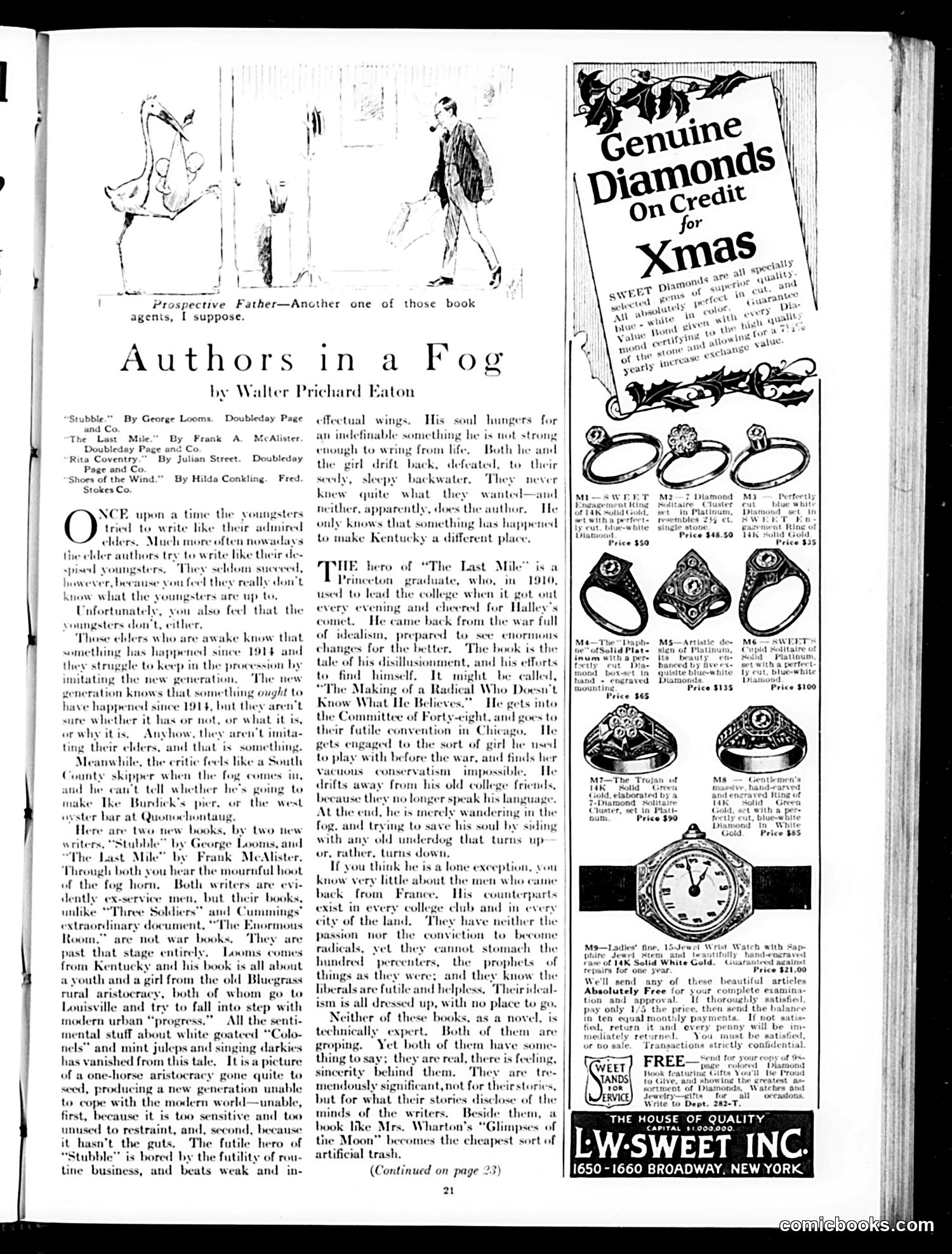
This page features Walter Prichard Eaton's literary criticism essay critiquing two contemporary novels: George Loom's "Stubble" and Frank McAlister's "The Last Mile." The opening cartoon depicts a man at the door, with the caption "Prospective Father—Another one of those book agents, I suppose," mocking the era's aggressive door-to-door book sales. Eaton's essay uses "fog" as metaphor for post-WWI confusion afflicting both young writers and their disillusioned characters. He criticizes authors attempting to capture the "new generation" without understanding it. Both novels follow young men adrift after 1914—one a Kentucky aristocrat bored by routine, the other a Princeton graduate radicalized then paralyzed by ideological uncertainty. Eaton suggests these protagonists represent authentic post-war malaise: veterans unable to embrace pre-war values or commit to radical change, instead wandering emotionally lost. The "fog" reflects genuine generational disorientation after WWI, not mere literary affectation.
📄 Transcribed text from this page (OCR, searchable)
Machine-transcribed from the original scan — historical spelling and the odd misread are preserved.
Prospective Father—Ancther one of those book agents, I suppose. Authors il Lf . , in a Fog by Walter Prichard Eaton Stubble.” By George Looms. Doubleday Page and Co The Last Mile.” By Prank A. McAlister Doubleday Page and Co Rita Coventry.” By Julian Street Page and Co. ‘Shoes of the Wind.” Stokes Co. Doubleday By Hilda Conkling. Fred. CF. upon a time the youngsters tried to write like their admired ces. Much more often nowadays thors try to write like their « crs. They seldom succee or because vou feel they really don’t w what the youngsters are up to, Unfortunately, vou also feel that the youngsters don't, either, ‘Those elders who are awake know that something has happened since 1914 and they struggle to keep in the procession by ating the new generation. ‘The new ation knows that something ought to ve happened since 1914, but they aren't whether it has or not it is, orwhy itis. Anyhow, they aren't imita- and that is something. Meanwhile, the critic like a South County skipper when the fog comes in, and he can’t tell whether he’s going make Tke Burdick’s pier, or the west oyster bar at Quonochontaug. w books, by two new iy » Looms, and by Frank MeAlister. Through both you hear the mournful hoot of the fog horn, Both writers are evi- 1. service men, but their books. unlike “Three Soldiers” and Cummings’ extraordinary document, The Enormous Room,” are not war books. 1 past that stage tirely. from Kentucky and his book is all about a youth and a girl from the old Bluegrass rural aristocracy, both of whom go to Louisville and try to fall into step with modern urban “progress.” All the senti- mental stuff about white goateed “Colo- nels” and mint juleps and singing darkies has vanished from this t Itis a picture of a one-horse aristocracy gone quite to seed, producing a new in unable to cope with the modern world—unable, first, because it is too sensitive and too unused to restraint, and, second, because it hasn’t the guts. The futile hero of “Stubble” is bored by the futility of rou- tine business, and beats weak and in- or wh: Looms comes effectual His soul lhungers for an indefinable something wings. is Hot strong enough to wring from | Both he and the girl drift: back, defeated, to their seedy, sleepy backwater. They never knew what they land neither, apparently, does the author. He only knows that something has happened to make Kentucky a different place. want quite The Last Mile” is a e Who, in 1910, the college when it got out ting and cheered for Halley's He came back from the war full ared to see enormous changes for the better. The book is the tale of his disillusionment, and his efforts to find himself. It) might called, dB hero of Princeton ss Making of a Radical Who Doesn't Know What He Believes.” He gets into the Committee of Forty es to their futile convention in Chicage 1 to the sort of girl h with before the war, and fir Vacuous conservatism impossibl drifts away from his old college friends, In At the end, he is merely wandering in the fog, and trying to save his soul by siding with any old underdog that turns up or, rather, turns down, If you think he is a lone exceptic know very little about the men wh back from France. His counterparts exist in every college club and in every city of the land, ‘Th ve neither the passion nor the conviction to become radicals, yet they cannot stomach the hundred “percenters, the prophets of things as they were; and they know the liberals are fe nd helpless. Theirideal- ism i dressed up, with no place to go. Neither of these books, as a novel, is techi expert. Both of them are groping. Yet both of them have some- thing to say; they are real, there is feeling, ind them. They are tre- icant, not for theirstories, but for wh ip stories disclose of the minds of the writers. Beside them, a book like Mrs. Wharton's “Glimpses of the Moon” becomes the cheapest sort of artificial trash. (Continued on page 23) gets et to pli a ause they no longer speak his language. xWr TN Trojan of 4G We'll send tion and approval pay only 1 ten 1 send the bal ite to Dept. 282-T- THE HOUSE OF QUALITY I CAPITAL $1,009,000. SWEET INC. 1650-1660 BR WAY, NEW YORK