
Judge, 1922-12-09 · page 13 of 36
Judge — December 9, 1922 — page 13: what you’re looking at
What you’re looking at
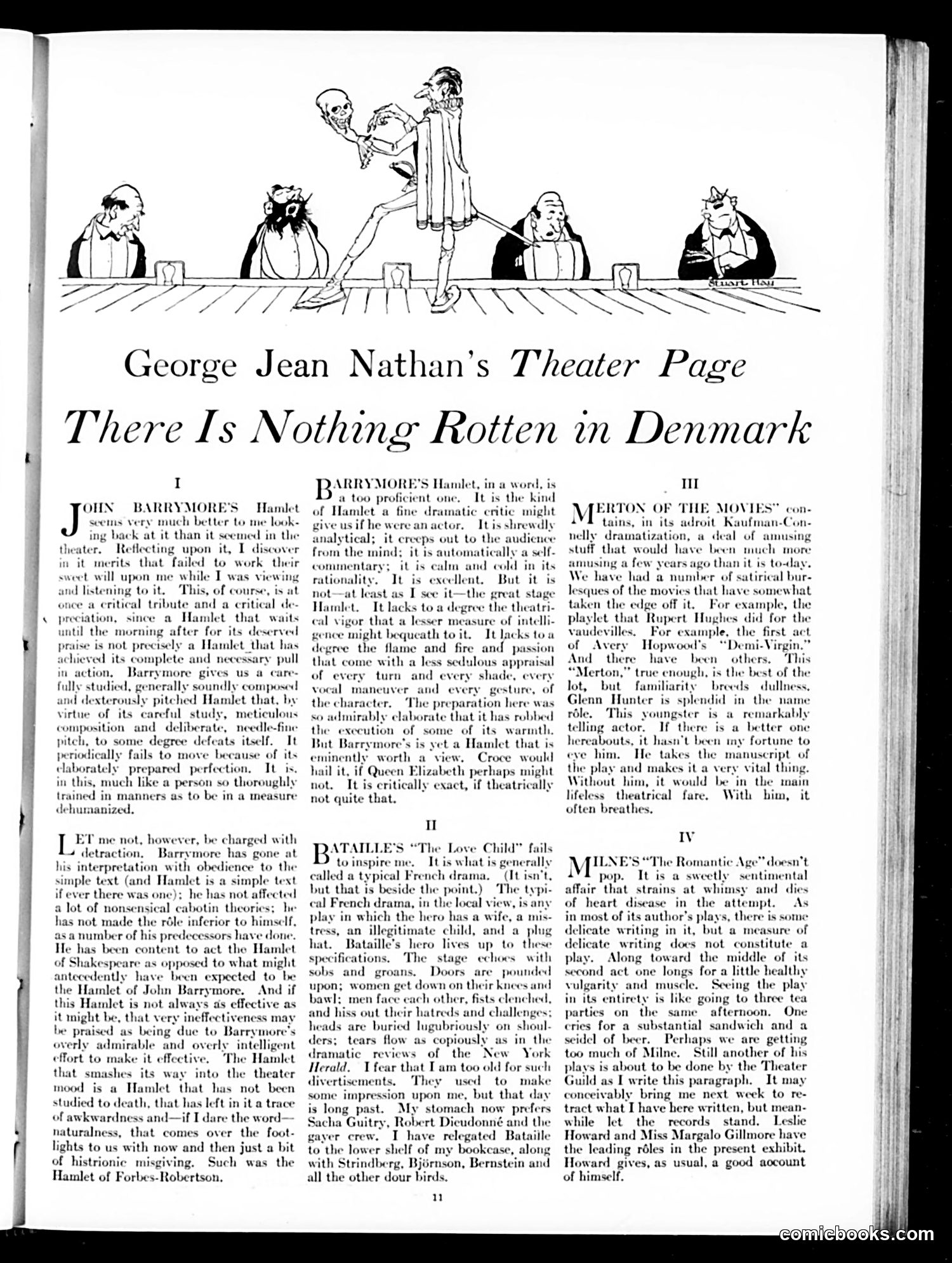
This is George Jean Nathan's theater review column. The cartoon header shows five caricatured theater figures seated at a table, likely representing different theatrical personalities or critic types of the era. Nathan critiques three productions: John Barrymore's *Hamlet*, Bataille's *The Love Child*, and Milne's *The Romantic Age*. **Main point of satire:** Nathan praises Barrymore's intellectually rigorous but emotionally cold interpretation, arguing it's *too* expertly calculated—so technically perfect it loses theatrical vitality. He contrasts this unfavorably with the natural awkwardness of earlier actors like Forbes-Robertson. For Bataille's play, Nathan mocks the stereotypical "typical French drama" formula: wife, mistress, illegitimate child, overwrought emotional scenes, and melodramatic posturing. The reviews represent sophisticated theatrical criticism rather than broad satire, targeting actors' interpretive choices and predictable dramatic conventions rather than political figures. This reflects Judge's focus on cultural commentary aimed at educated readers.
📄 Transcribed text from this page (OCR, searchable)
Machine-transcribed from the original scan — historical spelling and the odd misread are preserved.
George Jean Nathan’s Theater Page There Is Nothing Rotten in Denmark | I OHN BARRYMORE’S — Hamlet J seems very much better to me look- ing back at it than it seemed in the theater. Retleeting upon it, I dise r in it merits that failed to work their J Sweet will upon me while T was view } and listening to it. This, of course, is at we a critical tribute and a critical }< preciation, since a Hamlet that until the morning after for its deserved Bo praise is not precisely a Hamlet that has achieved its complete and necessary pull in action, Barrymore gives us a care- fully studied, generally soundly composed and dexterously pitched Hamlet that, by virtue of its careful study, meticulc composition and. deliberate, ncedle-fine pitch, to some degree defeats itself. It I} periodically fails to move because of its | elaborately prepared perfection, It is. in this, much like a person so thoroughly trained in manners as to be in a measure } dehumanized. ET me not, however, be charged with 4 detraction, Barrymore has gone at his interpretation with obedience to the simple text (and Hamlet is a simple text | if ever there was one); he has not affected a lot of nonsensica tin theories; he has not made the rdle inferior to himself, | — asanumber of his predecessors have done. He has been content to act the Hamlet of Shakespea »posed to what might | antecedently 1 ren expected to. be | the Hamlet of John Barrymore, | this Hamlet is not alw | itimight be, that v ineffee tiveness may g due to Barrymore's r id overly. intellig effort to make it effecti The Hamlet that smashes its way into the theater mood is a Hamlet that has not been studied to death, that has left in it a trace of awkwardness and—if I dare the word- naturalness, that comes over the foot- lights to us with now and then just a bit of histrionic misgiving. Such was the Hamlet of Forbes-Robertson. I ARRYMORE’S Hamlet, in a word, is a too proficient o: It is the kind of Hamlet a fine dramatic ertic might give us if he were an actor. Itis shrewdly analytical; it creeps out to the audience from the mind; it is automatically a self- commer it is calm and cold in its rationality. It is excellent. But it is not—at least as I sce it—the great stage Hamlet. It lacks to a degree the theatri- cal vigor that a lesser measure of intelli- gence might bequeath to it. It lacks toa degree the flame and fire and passion that come with a less sedulous appraisal of every turn and every shade, every vocal maneuver and every gesture, of the character. ‘The preparation here was so admirably elaborate t the execution of some of its warmth. But Barrymore's is yet a Hamlet that is eminently worth a view, Croce would hail it, if Que izabeth perhaps m not. It is critically exact, if theatrically not quite that. Il ATAILLE’S “The Love Child” fails toinspire me. Itis what is generally called a typical French drama. (It isn’t, but that is beside the point.) The typi- cal French drama, in the local view, is any play in which the hero has a wife, a mis- tress, an illegitimate child, and a plug hat. B. Ss up to these specificati » echoes with sobs and. gre pounded upon; women get down on their knees and bawl; men face each other, fists clenched, and hiss out their hatreds and challenges: heads are buried lugubriously on shoul- ders; tears flow as copiously as in t York dramatic reviews of the } I fear that Tam too old for such isements. They used to mak impression upon me, but that d: My stomach now prefers Robert Dicudonné and the some is long past. Sacha Guitry, gayer crew. I have relegated Ba to the lower shelf of my boc ; with Strindberg, Bjérnson, Bernstein and all the other dour birds. Ill \ ERTON OF THE MOVIES” con- a tains, in its vit Kaufman-Con- nelly dramati a deal of amusing stuff that would ha ween much more had a number of satirical bur- We have lesques of the movies that have somewhat taken the edge off it. For example, the playlet that Rupert Hughes did for the vaudevilles. For example, the first of Avery Hopwood's “Demi-Vir And there have been others. “Merton,” true cnough, is the best of the lot, but familiarity breeds dullness, ilenn Hunter is splendid in the name role. This youngster is a remarks telling actor. If there is a better hereabouts, it hasn't been my fortune to eve him. He takes the manuscript of the play and makes it a very vital thing. Without him, it would be in the main lifeless theatrical fare, With him, it often breathes. IV NY | hreat “The Romantic Age” doesn’t pop. It is a sweetly sentimental affair that strains at whimsy and « of heart disease in the attempt. As s author’s plays, there is some ng in it, but a measure of © writing doves not constitute a Along toward the middle of its second act one longs for a little healthy vulgarity and muscle. Seeing the play in its entirety is like going to three tea parties on same afternoon. One the cries for a substantial sandwich and a seidel of beer. Perhaps we are getting too much of Milne. Still another of his plays is about to be done by the Theater Guild as I write this paragraph. It may conceivably bring me next week to re- tract what I have here written, but mean- while let the records stand. Leslie Howard and Miss Margalo Gillmore have the leading réles in the present exhibit. Howard gives, as usual, a good account of himself.