
A complete issue · 36 pages · 1922
Judge — December 2, 1922
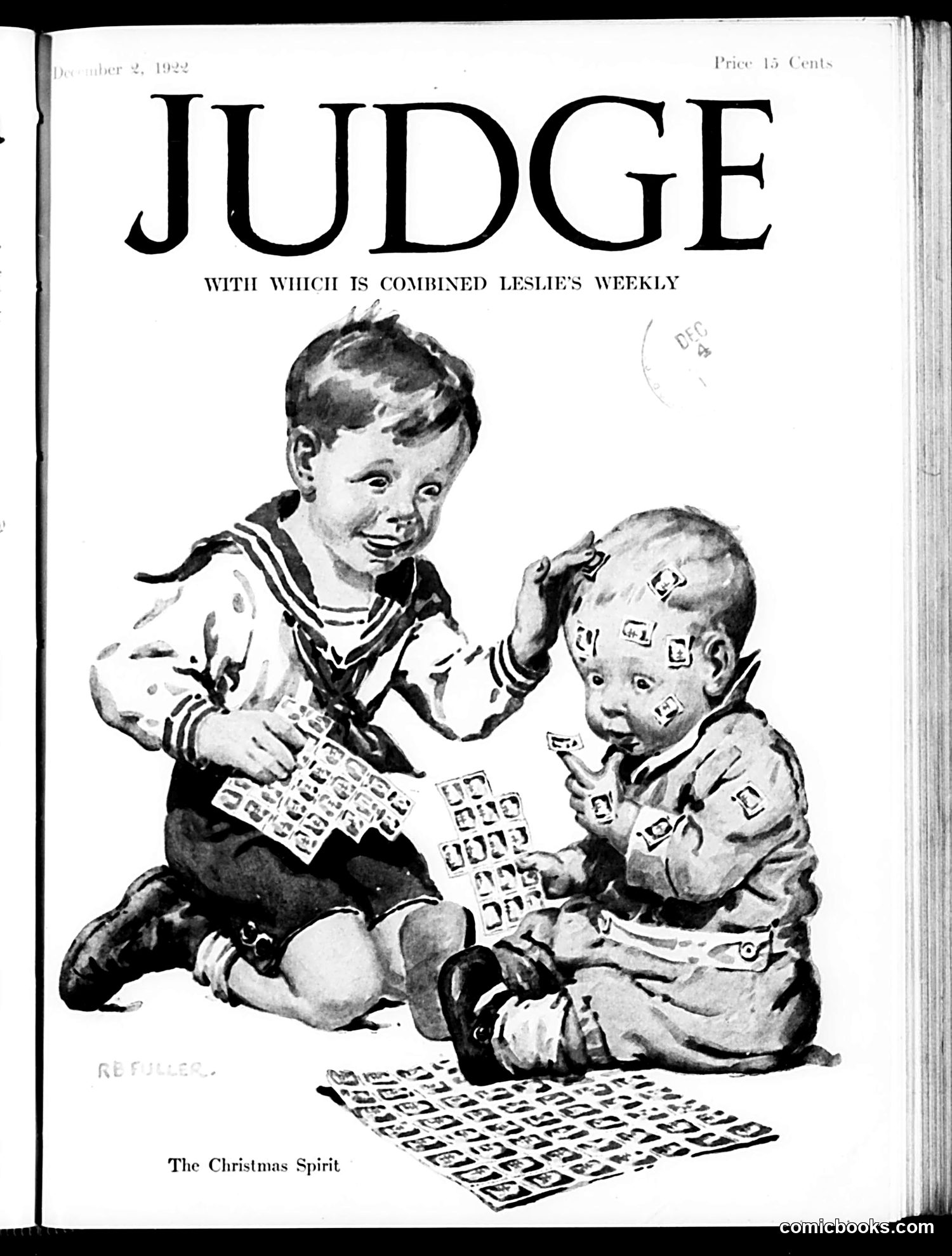
**What We See:** The cover shows two young children in sailor outfits playing with what appears to be lottery or bingo cards scattered around them. The caption reads "The Christmas Spirit." **The Satire:** This is likely satirizing the commercialization of Christmas and the gambling culture of the 1920s era. By depicting innocent children engaged in games of chance, the cartoonist criticizes how American consumer culture and potentially illegal gambling had infiltrated even holiday traditions meant for families. The "Christmas Spirit" title is ironic—suggesting that materialistic pursuits and games of chance had replaced the spiritual values traditionally associated with Christmas. The Prohibition-era 1920s saw widespread illegal gambling, making this commentary particularly pointed.
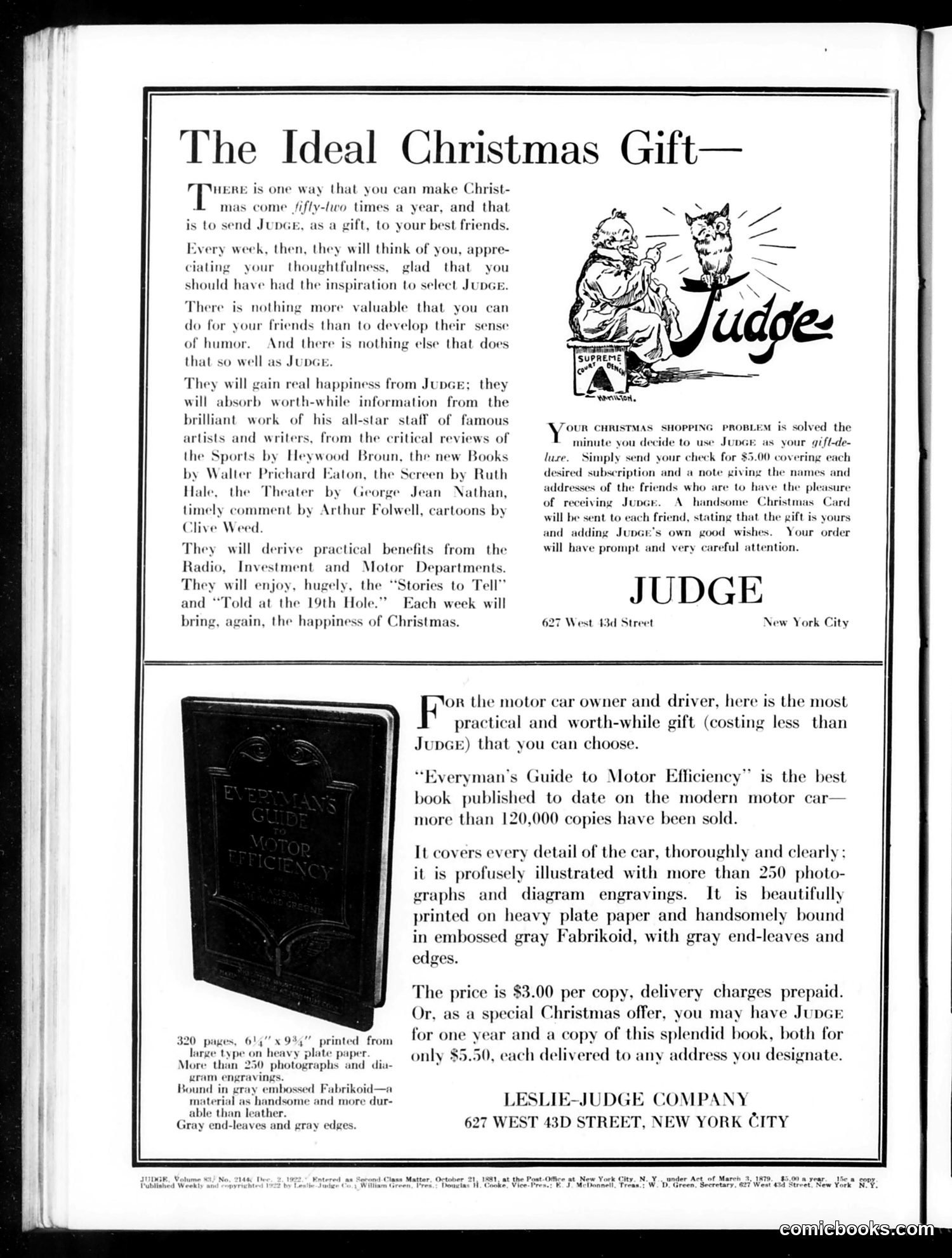
This page is primarily **advertising content** rather than political satire. It promotes two products from Judge magazine's publisher: 1. **Judge magazine itself** - marketed as an ideal Christmas gift (costing $5.00 for a year's subscription). The ad emphasizes the magazine's humor and content from celebrity contributors like Hollywood Brown and Walter Prichard Eaton. 2. **"Everyman's Guide to Motor Efficiency"** - a 320-page book about automobile maintenance, priced at $3.00. The ad highlights its 250+ photographs and diagrams, plus a special Christmas offer bundling both items for $5.50. The cartoon showing a judge figure is a visual pun on the magazine's name rather than political commentary. This represents typical early-1900s magazine advertising—using the publication's brand identity to sell related products to readers.
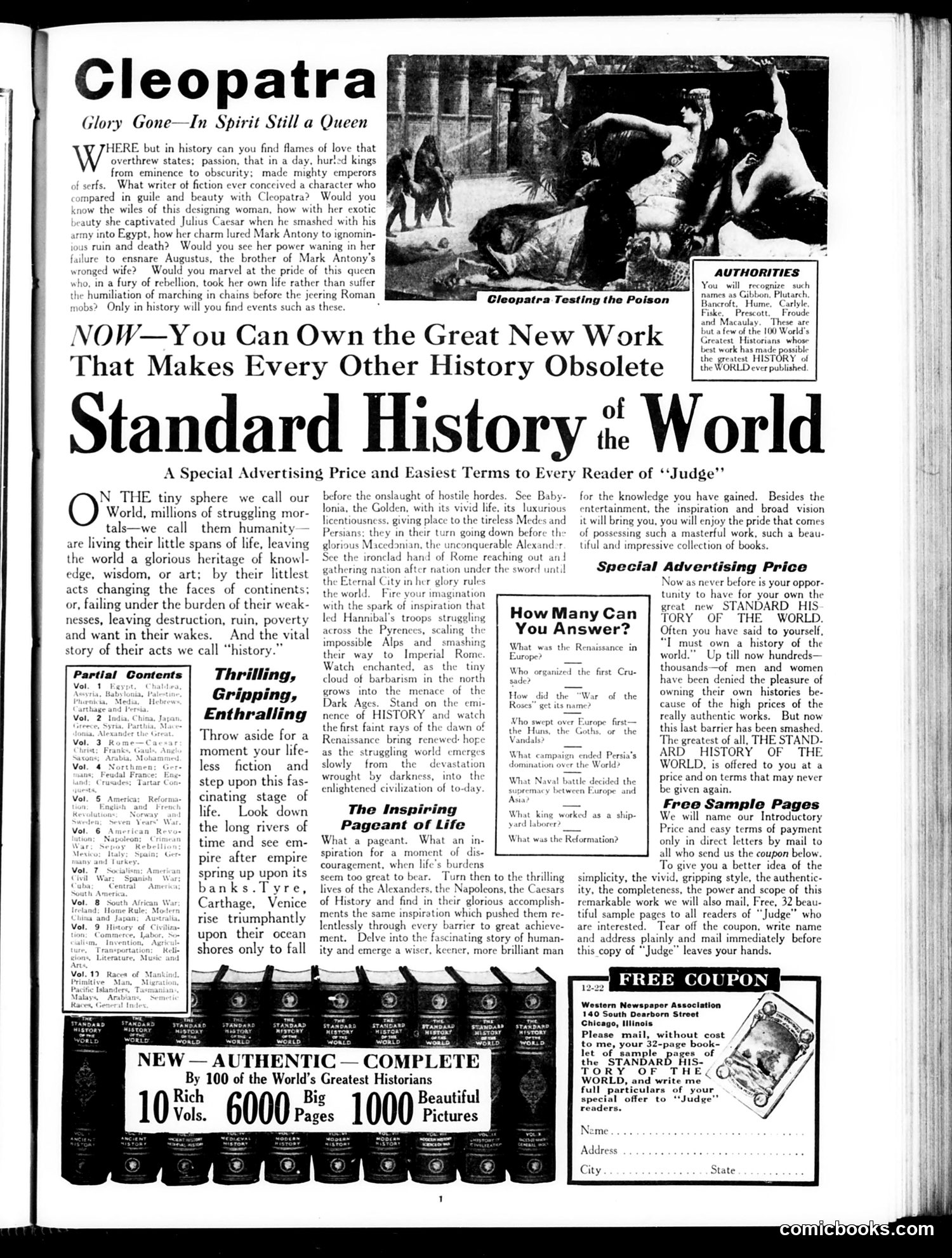
This page is primarily **advertising, not satire or political cartoon**. The dominant content is a full-page advertisement for "Standard History of the World," a 10-volume encyclopedia set marketed as the comprehensive history reference that makes "every other history obsolete." The small illustration at top shows "**Cleopatra Testing the Poison**"—a historical scene used to evoke the dramatic, consequential narratives the encyclopedia promises to deliver. The caption lists figures like Mark Antony and Augustus, emphasizing the work's coverage of world history's most compelling moments. The page uses the rhetorical device of asking readers historical questions about famous figures (Cleopatra, Hannibal, Napoleon) to demonstrate knowledge gaps their purchase would fill. This is straightforward marketing wrapped in educational appeal, not political commentary.
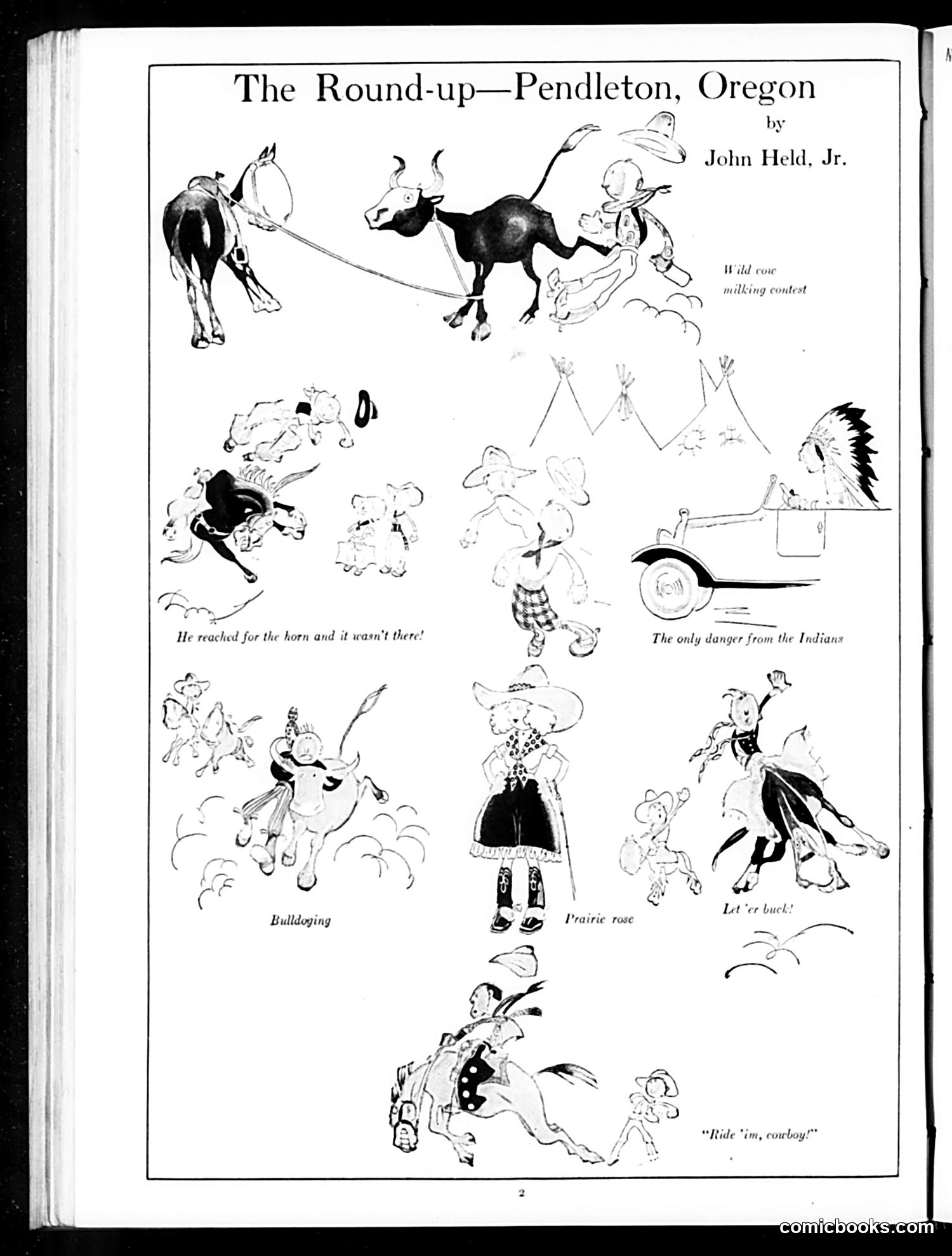
This is a humorous illustrated story about a Wild West roundup at Pendleton, Oregon. The sequential vignettes show various comedic misadventures: a wild cow milking contest, cowboys reaching for a horn that isn't there, bulldogging, a prairie rose (woman) amid the chaos, Indians as "the only danger," and concluding with a bucking bronco ride. The satire targets Eastern romanticization of the American West. The inclusion of a fashionable woman ("Prairie rose") surrounded by bumbling cowboys, combined with the casual reference to Native Americans as merely incidental danger, reflects the era's stereotypes and the gap between Wild West mythology and actual frontier life. Held's cartoon mocks both the cowhands and urban audiences' fascination with the West.
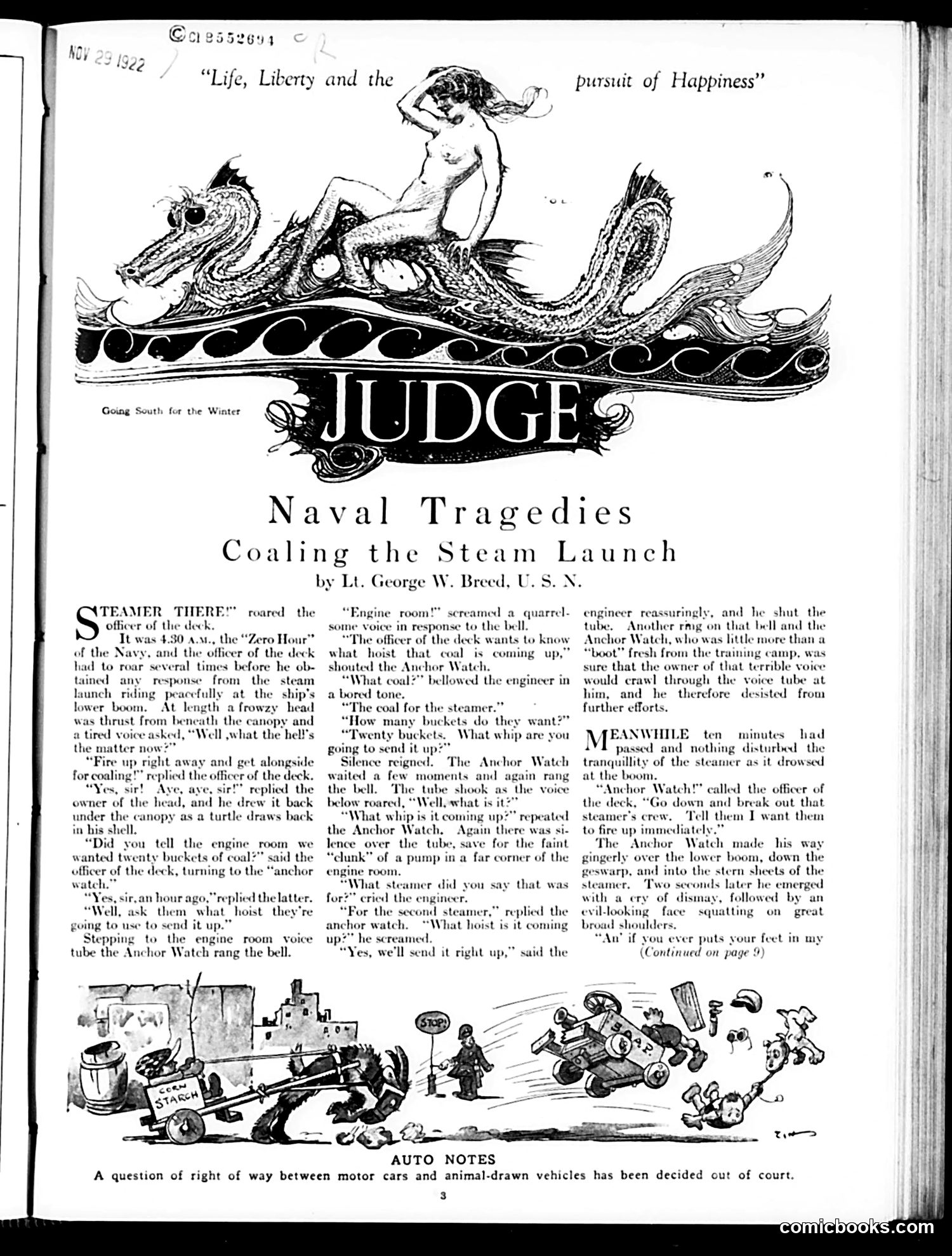
This page contains a serialized story titled "Naval Tragedies: Coaling the Steam Launch" by Lt. George W. Breed, U.S.N. The narrative depicts officers and crew aboard a naval vessel discussing the logistics of loading coal into the ship's steam engine—a routine but labor-intensive task in early 20th-century naval operations. The humor appears genteel rather than satirical: it captures the bureaucratic miscommunications and operational friction between deck officers and engine room staff as they manage the coal-loading process. The accompanying illustration shows a comedic auto accident, with the caption noting a court decision about right-of-way between motor cars and animal-drawn vehicles—reflecting contemporary anxieties about new automobile technology conflicting with traditional transportation.
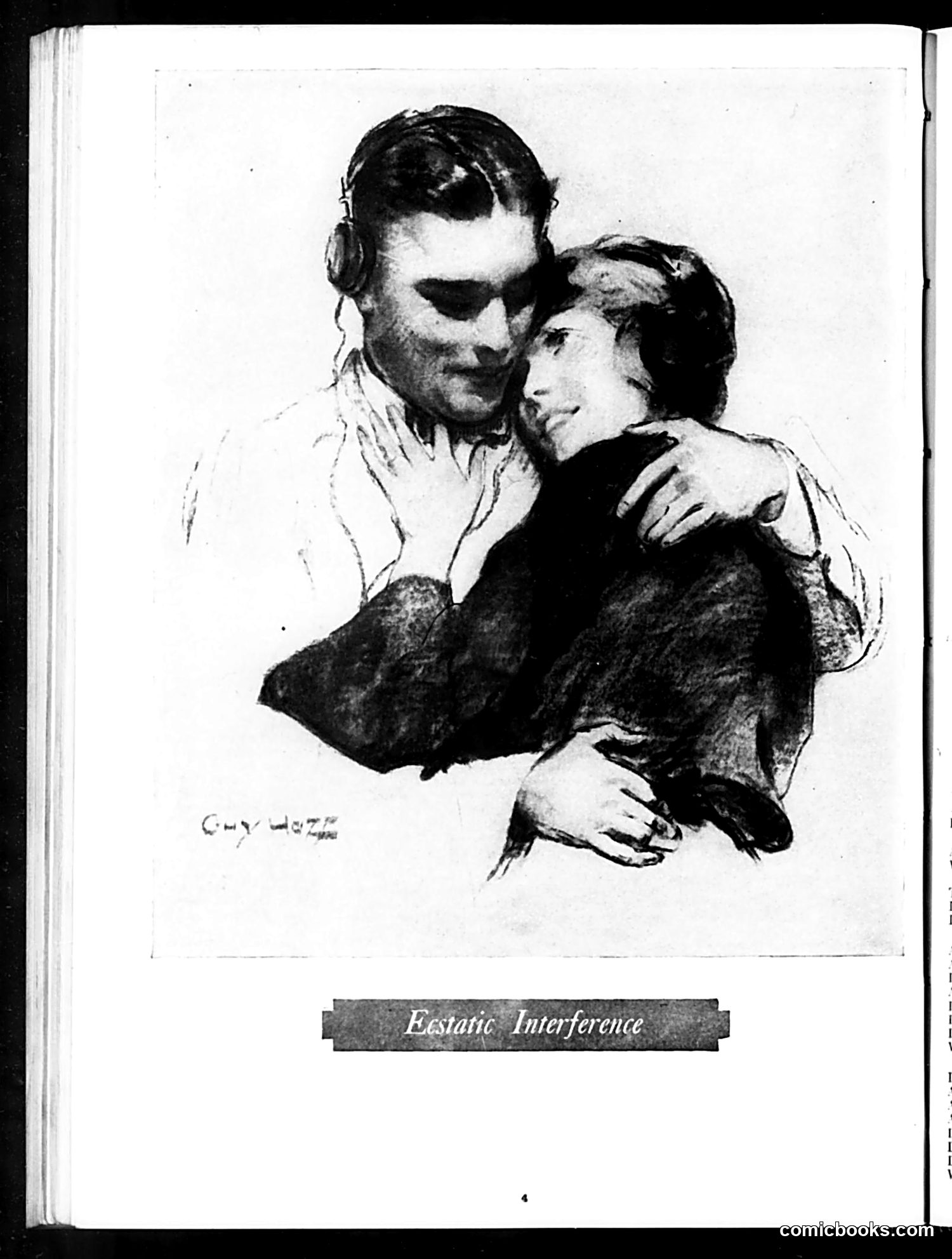
This appears to be an illustration from *Judge* magazine depicting a romantic or intimate moment between two figures. The man wears headphones and a light shirt, while the woman in darker clothing leans toward him affectionately. The title "Ecstatic Interference" likely plays on technical/radio terminology to suggest romantic "interference" or interruption. Given the headphones, this may reference early radio technology or perhaps a phonograph operator being distracted from his work by amorous attention. Without additional context from the magazine's date or surrounding articles, the specific satirical target remains unclear—whether this mocks romantic distraction from duties, critiques early technology use, or comments on gender relations of the era. The artwork style suggests early-to-mid twentieth century publication.
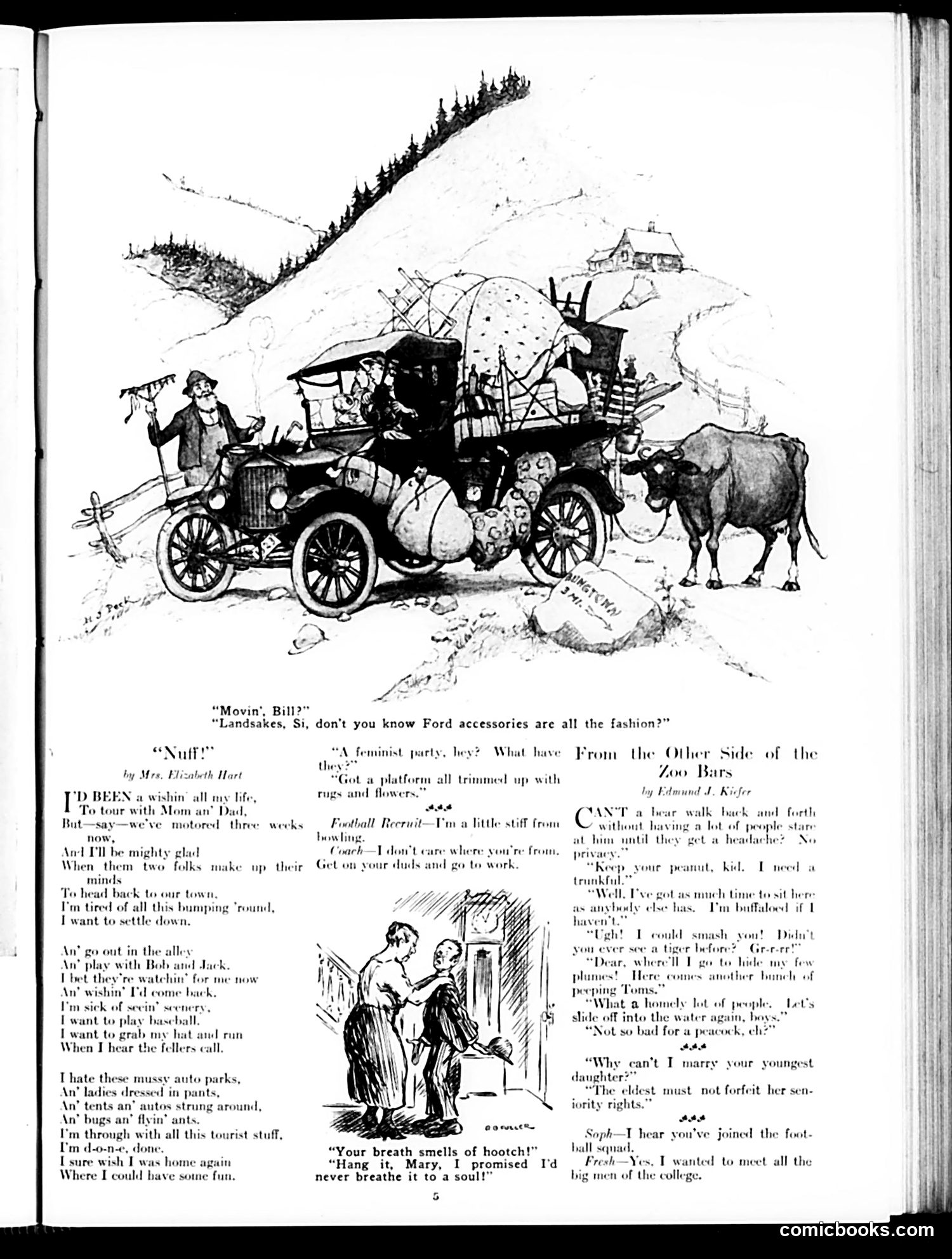
This page contains three humorous pieces satirizing early 20th-century American life, likely from the 1910s-1920s (the Ford automobile references and "flapper" mentions suggest this era). **Top cartoon**: Mocks automobile tourism culture. A overloaded touring car breaks down on a rural road, with a cow present. The joke critiques how Ford accessories had become fashionable status symbols among the newly car-owning middle class—people were obsessed with automotive accessories as fashion statements. **"Nuff!"**: A child's poem complaining about a family road trip. It satirizes the then-popular "auto tourism" craze, where families drove around camping in auto parks, treating it as recreation. The child wants to return home to normal childhood play. **Zoo Bars section**: Anthropomorphized zoo animals complain about being constantly observed by visitors. It's social commentary on the loss of privacy in modern life—humans are themselves like caged animals, unable to escape public scrutiny. Overall, the page satirizes emerging modern inconveniences: automobile culture, tourism, and loss of privacy.
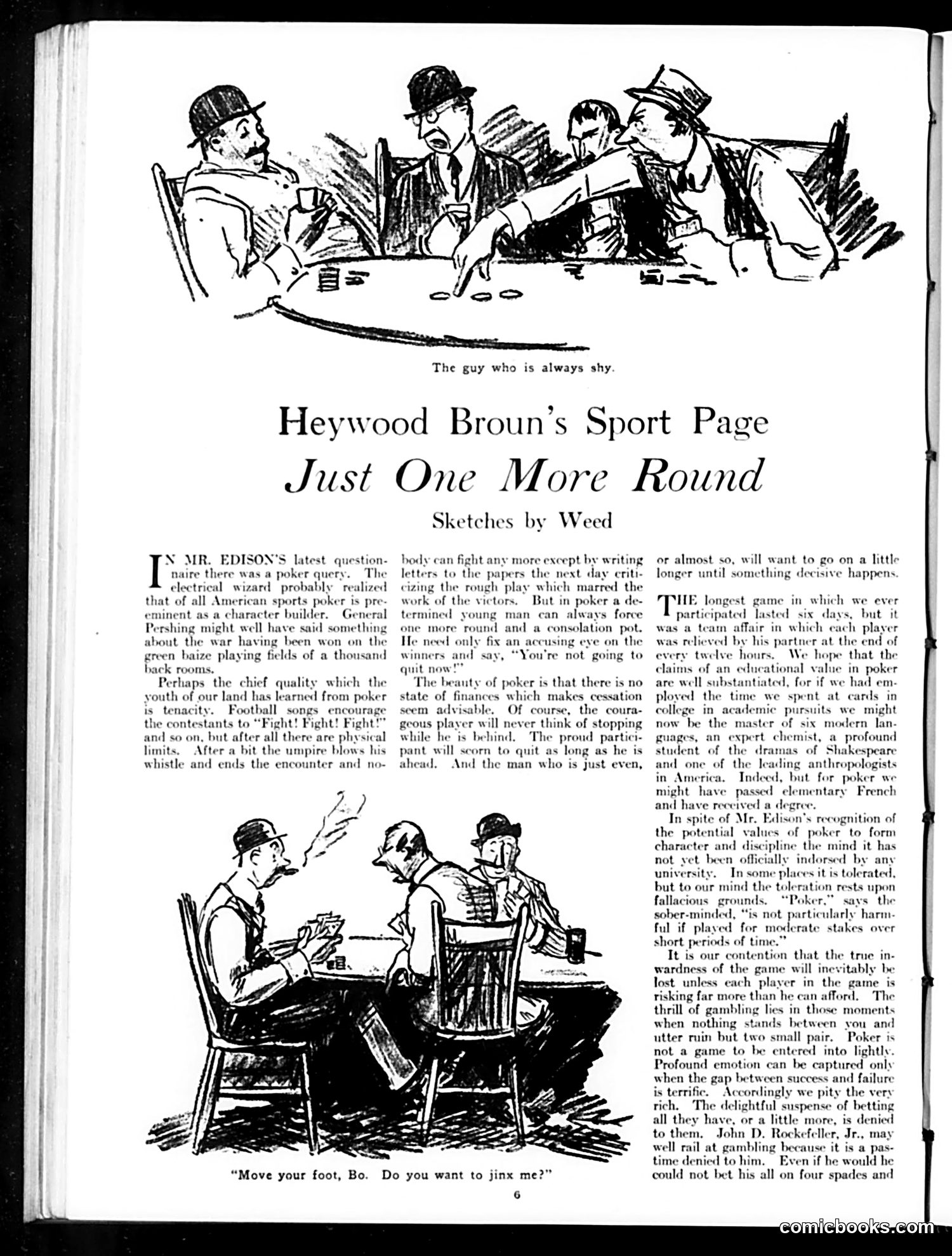
This sports column satirizes poker as a character-building activity, ironically treating the card game with mock seriousness. The sketch shows men at a poker table, with the caption "Move your foot, Bo. Do you want to jinx me?" — depicting the superstitious rituals surrounding gambling. Broun's essay argues that poker builds "tenacity" and teaches valuable life lessons, comparing it to military discipline (referencing General Pershing and WWI). However, the satire is layered: he simultaneously critiques wealthy industrialists like John D. Rockefeller Jr., who cannot truly experience gambling's "thrill" because they cannot meaningfully risk their fortunes. The piece mocks both poker's educational pretensions (it's not officially endorsed by universities) and the paradox that the game's true value lies only in genuine financial risk—making it inaccessible to the truly wealthy. The humor targets American attitudes about gambling, masculinity, and class during the Jazz Age.
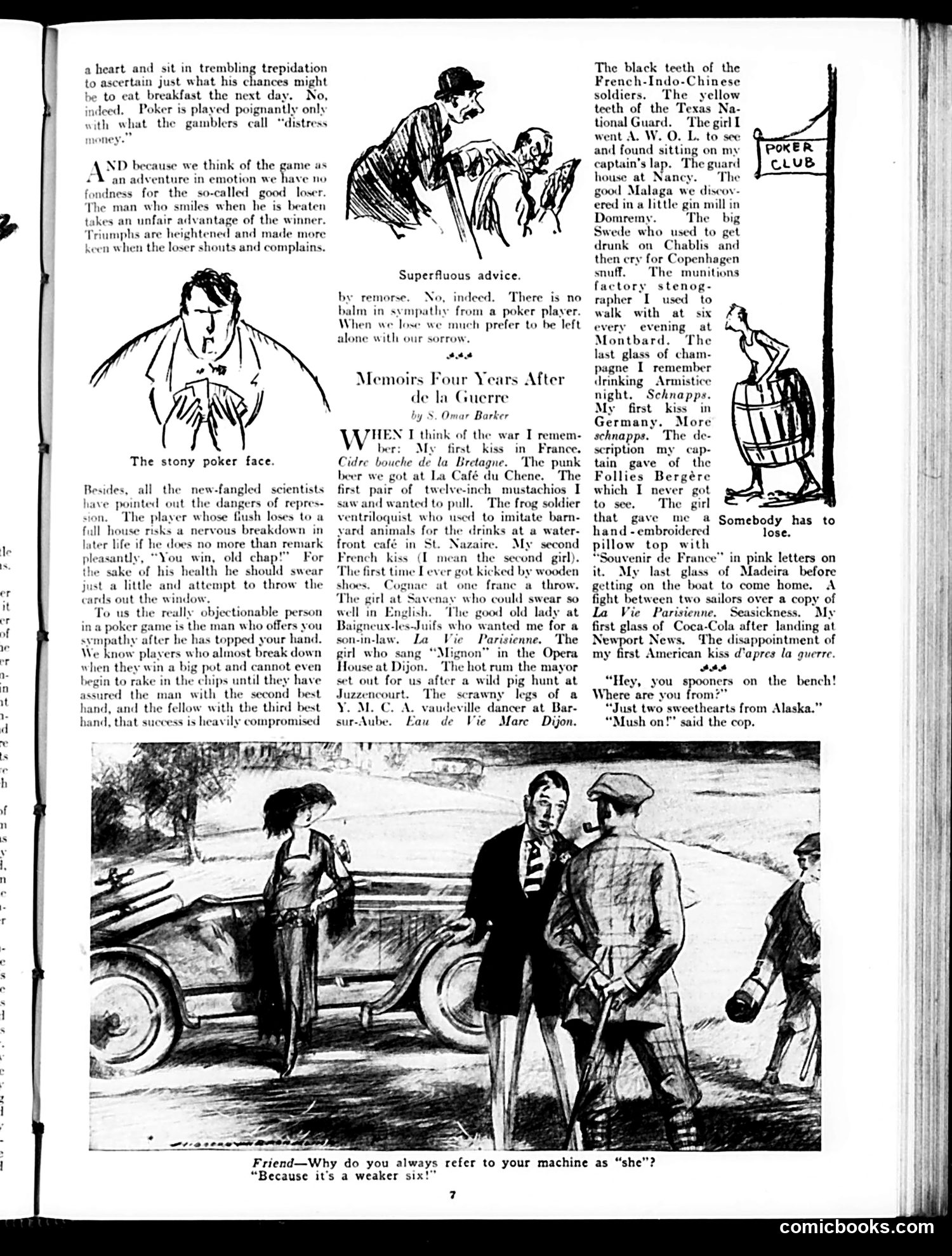
This page contains two distinct pieces: a philosophical essay on poker etiquette and a nostalgic WWI memoir. **Top Section ("The Stony Poker Face")**: Satirizes sentimental ideas about "good losers." The author argues poker should be played with emotional intensity—that graceful losing is actually unsportsmanlike, removing the winner's triumph. Modern psychologists' warnings against "repression" are mocked; the piece insists players should curse and complain, not smile politely. It's a humorous inversion of gentlemanly conduct. **Bottom Section ("Memoirs Four Years After de la Guerre")**: A sentimental recollection of WWI France, cataloging trivial memories: French beer, mustaches, girls, drinks, and minor encounters. The tone is wistful rather than martial—no battles, only social experiences and romance. **Bottom Cartoon**: A man and woman flirt near a car while another man watches. The joke: he calls his car "she" because "it's a weaker six"—a poker term meaning an inferior hand. The automobile is humorously feminized as unreliable. The page reflects post-WWI American humor: cynical about sentiment, nostalgic about Europe, and focused on masculine leisure activities (gambling, cars).
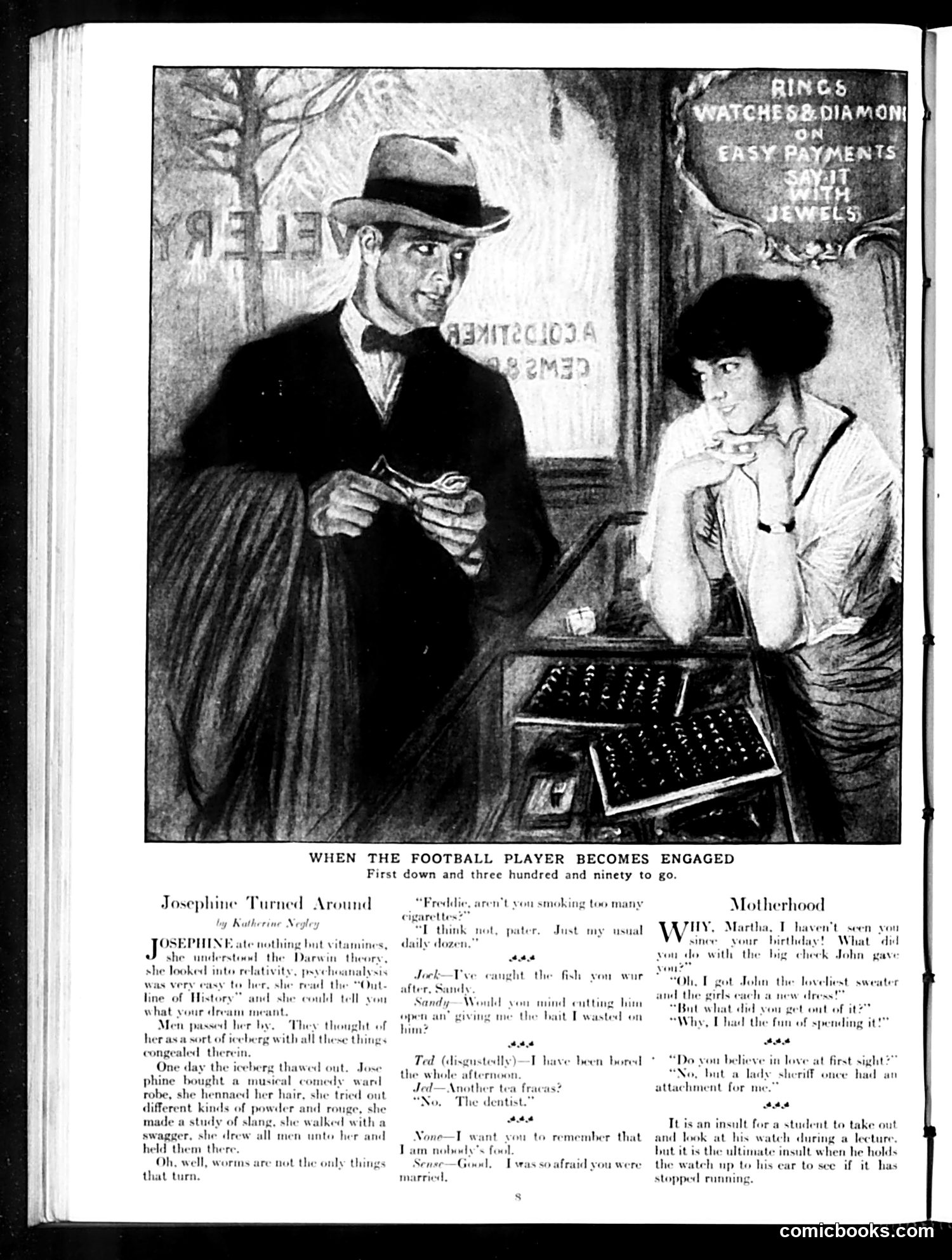
This Judge magazine page features three separate humorous short stories aimed at early 20th-century readers: **"When the Football Player Becomes Engaged"** (main illustration): A young man shopping for an engagement ring—the joke being that commitment is a long, difficult "game" (a football metaphor: "first down and three hundred and ninety to go"). **"Josephine Turned Around"**: A satire on intellectual women. Josephine was an "iceberg" obsessed with modern ideas (Darwin, psychoanalysis), but men ignored her. Once she adopted feminine interests—makeup, fashion, flirtation—she became popular. The joke mocks both the shallow woman and the men who prefer appearance to intellect. **"Motherhood" and other vignettes**: Brief comedic exchanges about cigarette smoking, fishing anecdotes, romance, and classroom etiquette—typical light humor for the era. The overall tone reflects 1920s anxieties about changing gender roles and modernity, combining gentle mockery of both intellectual pretense and romantic follies.
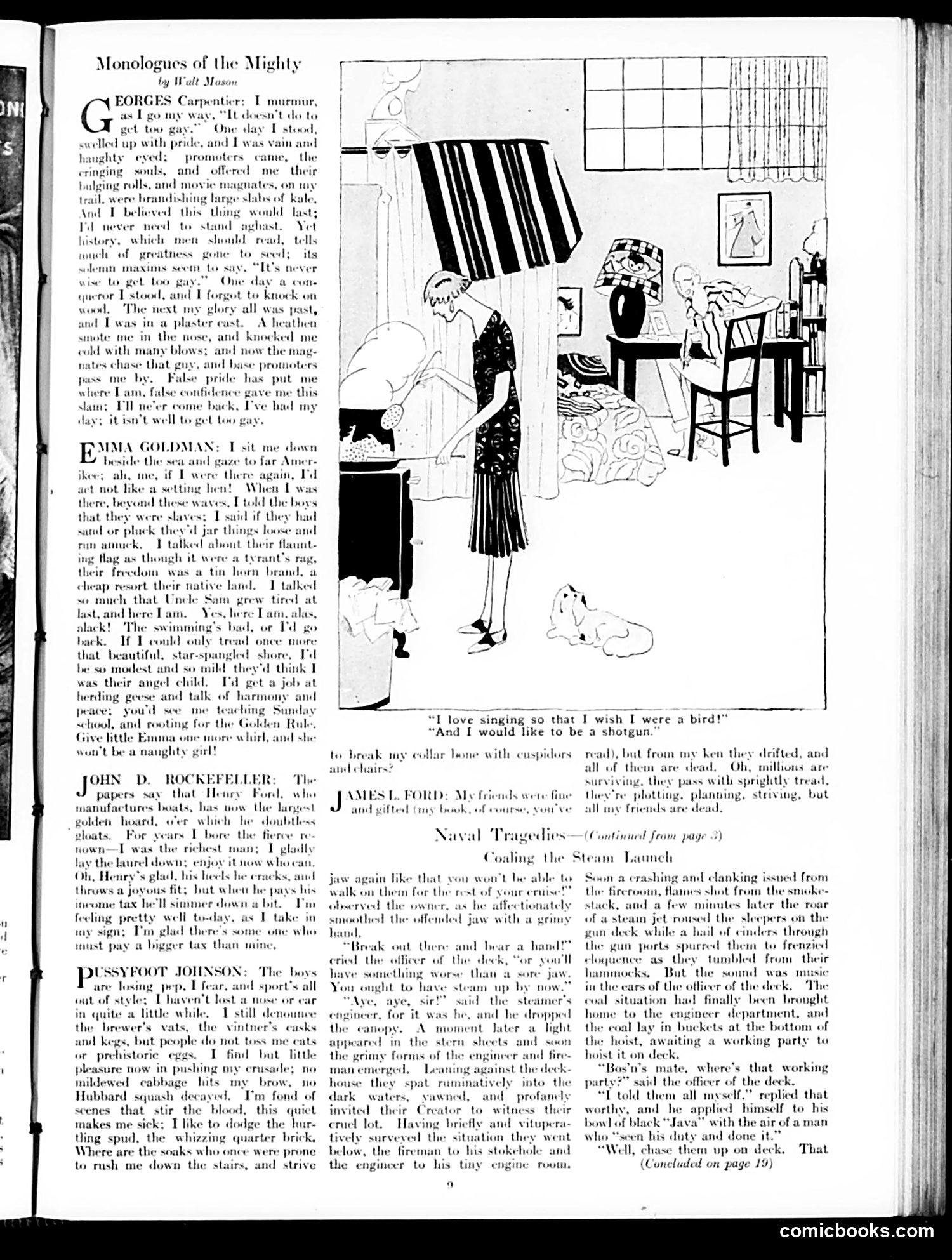
This page contains **satirical monologues** by prominent public figures of the era, mocking their pride and comeuppance. The visible speakers include: - **Georges Carpentier** (boxer): brags about his success, then gets humiliated when defeated - **Emma Goldman** (anarchist activist): boasts of her radical influence, until deported by "Uncle Sam" - **John D. Rockefeller** (oil magnate): gloats over his wealth while others pay higher taxes - **Dusyfoot Johnson** (temperance crusader): complains that prohibition has robbed him of the joy of being attacked by drunk rowdies The cartoon's satire is straightforward: **powerful or famous men are reduced to whining about losing their status or influence.** The humor depends on recognizing these figures and their public personas. A secondary illustration shows a naval scene about "coaling the steam launch." The overall message: pride comes before a fall, and even the mighty deserve mockery for their vanity.
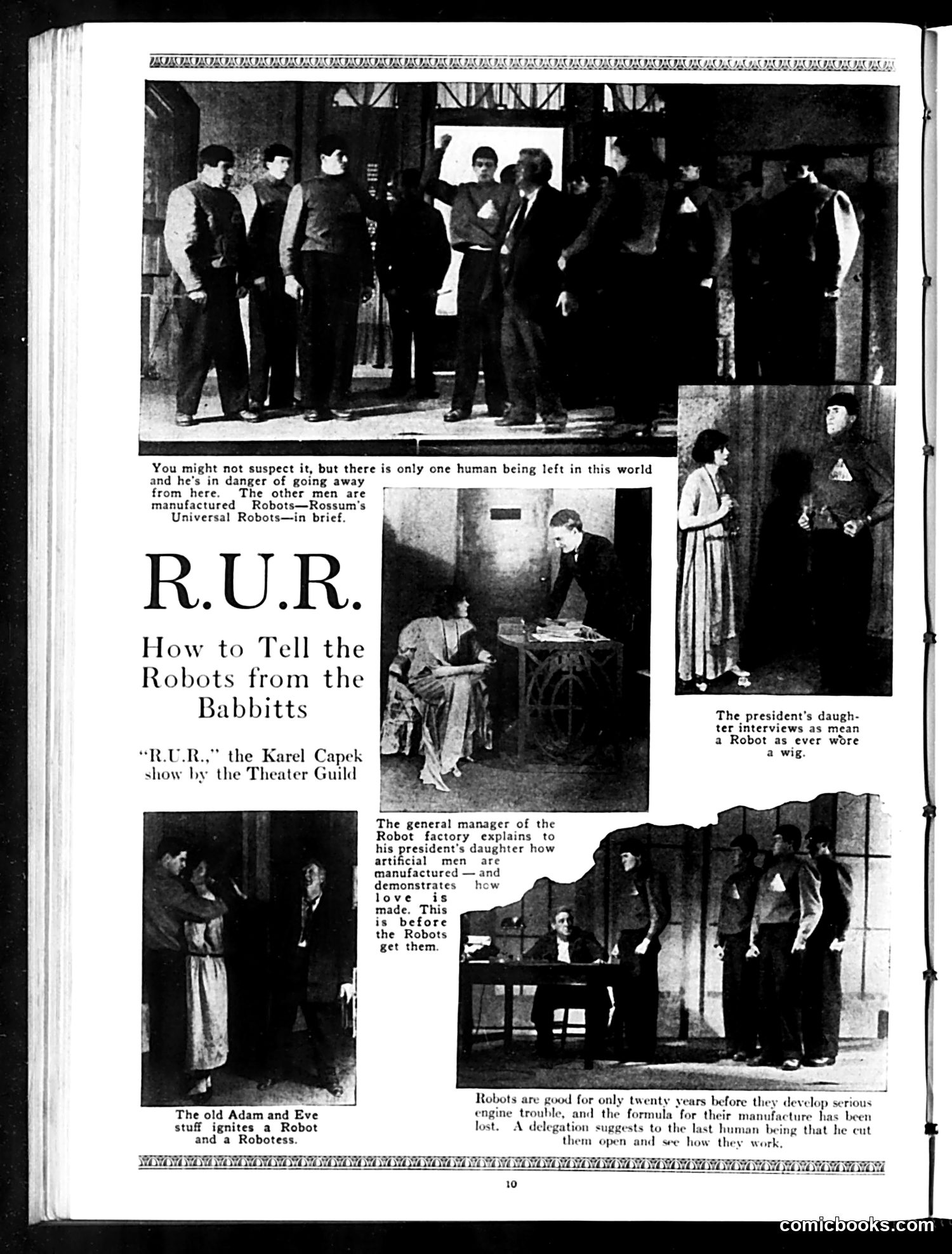
This page promotes "R.U.R." (*Rossum's Universal Robots*), a Karel Capek play produced by the Theater Guild. The satire compares robots to "Babbitts"—a reference to the shallow, conformist businessman protagonist of Sinclair Lewis's 1922 novel *Babbitt*. The joke is that in this world, only one human remains; everyone else is a manufactured robot—yet they're indistinguishable from ordinary men. The caption suggests robots and humans are equally unremarkable or emotionally vacant. The photos show theatrical scenes: robots mimicking human behavior (love, interviews, work), with the implicit satire that modern conformist society produces people as emotionally authentic as machines. The play's premise—that artificial beings become indistinguishable from real ones—reflects 1920s anxieties about industrialization, standardization, and loss of authentic human individuality in modern life.
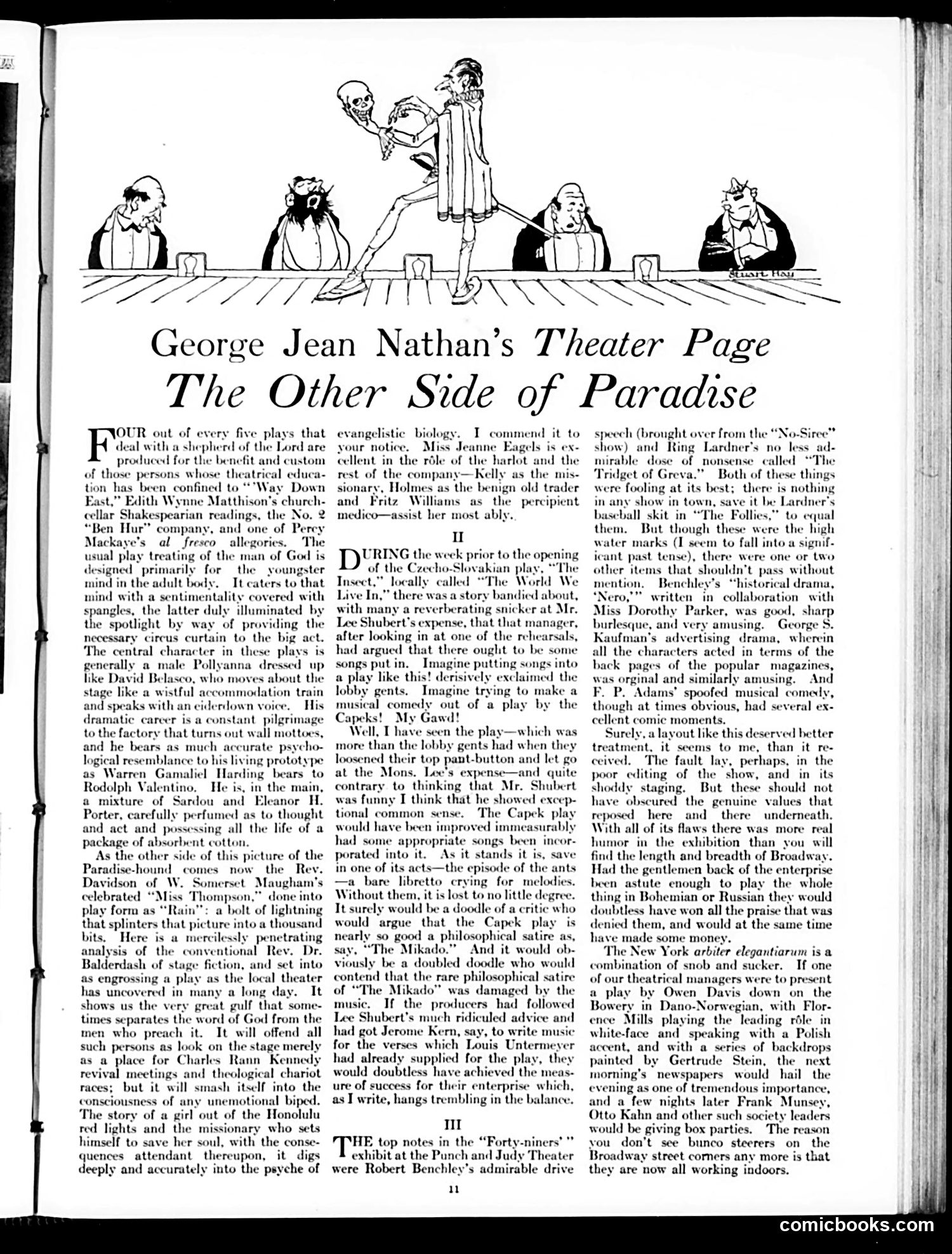
This theater criticism column by George Jean Nathan discusses two contrasting plays featuring religious figures. The header illustration shows caricatured judges or authority figures seated at a bench, satirizing theatrical gatekeepers. Nathan criticizes the typical stage "man of God"—a sentimental, unrealistic character designed for unsophisticated audiences, resembling Eleanor H. Porter's saccharine writing more than genuine human complexity. He compares this false piety to Warren G. Harding versus Rudolph Valentino: superficially similar but fundamentally different. By contrast, he praises W. Somerset Maugham's "Rain" (adapted as a stage play featuring Jeanne Eagels), which unflinchingly examines a missionary's hypocrisy when confronted with a Honolulu prostitute. Nathan argues this play succeeds precisely because it penetrates psychological reality rather than offering comfortable sentimentality—a "bolt of lightning" exposing the gap between religious preaching and actual morality.
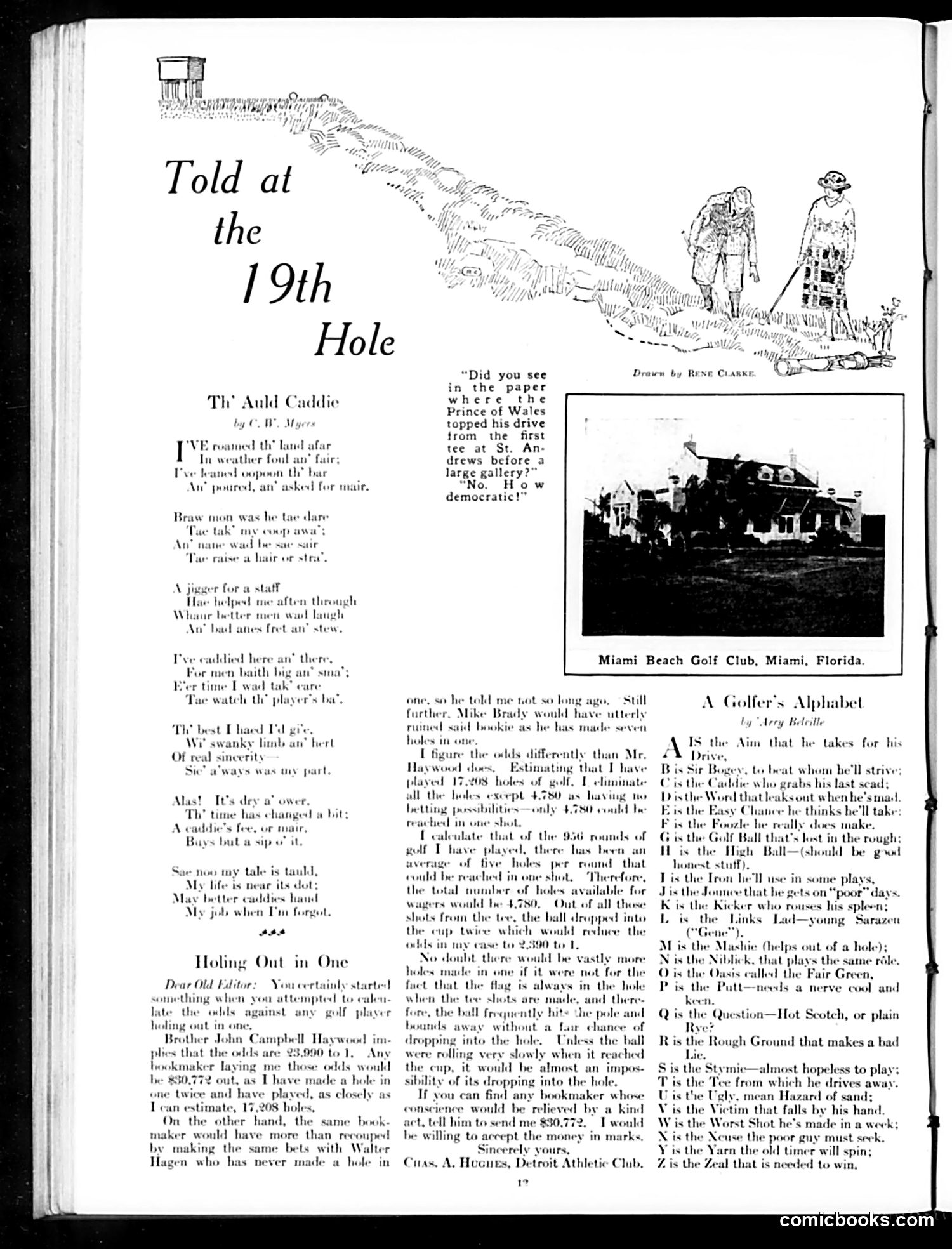
This page presents humorous golf content typical of Judge magazine's satirical style. **Main features:** 1. **"Th' Auld Caddie"** — A Scottish-dialect poem by C.H. Mears about an aging golf caddie reflecting on his long career, ending with melancholy ("It's dry a' ower"). The dialect humor was popular entertainment at the time. 2. **Prince of Wales joke** — A brief quip mocking the Prince of Wales for "topping" (poorly hitting) his drive at St. Andrews, with someone sarcastically calling it "democratic" — suggesting even royalty fail at golf. 3. **"Holing Out in One"** — A letter-to-editor debate about mathematical odds of scoring a hole-in-one, with calculations and references to famous golfers like Mike Brady and Walter Hagen. This reflects early 20th-century golf's popularity among the magazine's audience. 4. **"A Golfer's Alphabet"** — Light verse defining golf terms and club types using alphabetic wordplay (The Mashie, Niblick, Stymie, etc.), popular comedic format of the era. The photograph shows Miami Beach Golf Club, indicating golf's glamorous resort associations.
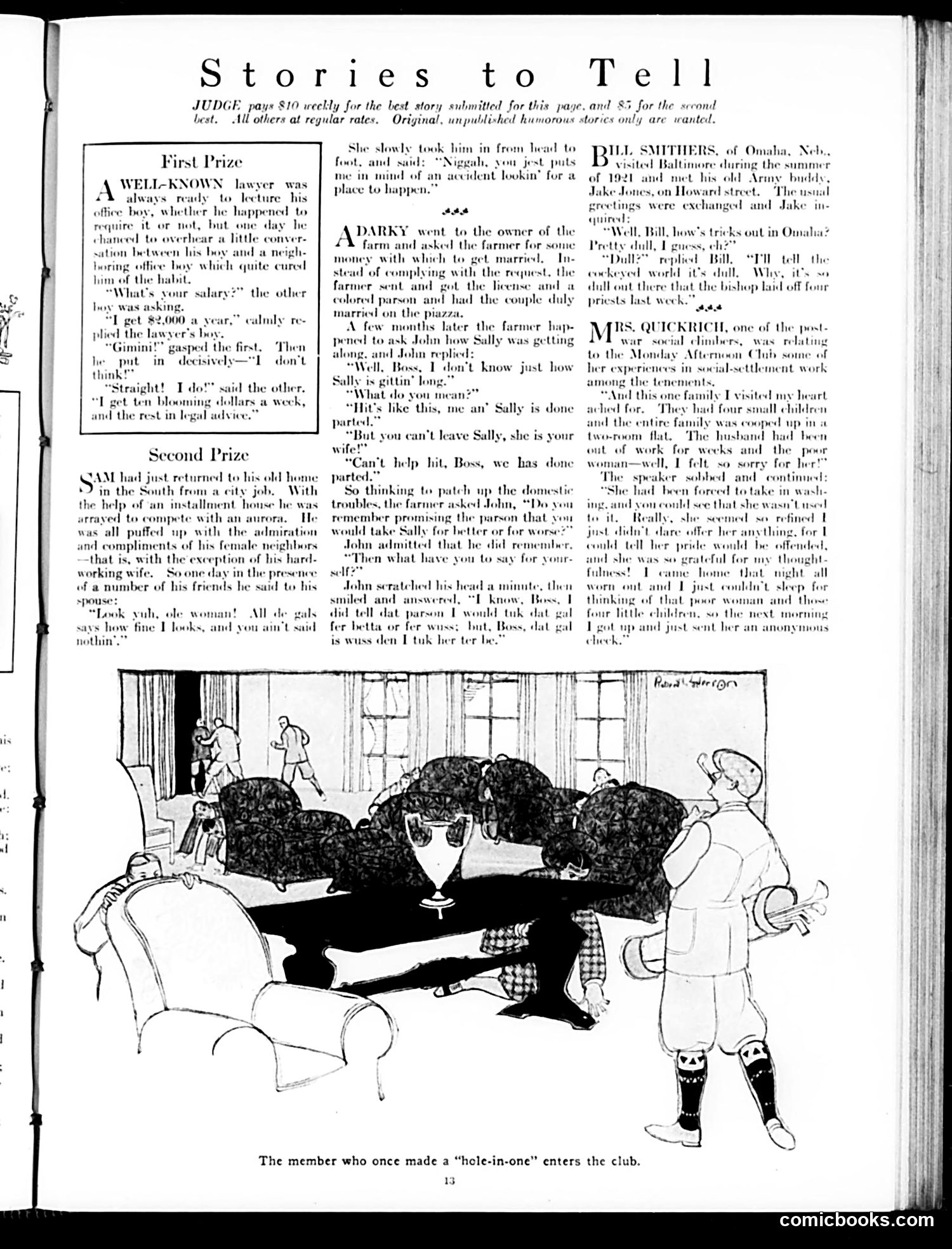
This page from Judge contains three humorous stories typical of early 20th-century American humor magazines. The **first prize story** features a racist dialect story about a "Darky" (using the period's offensive terminology) farmer who borrows money for his worker John to marry Sally. Months later, John wants to leave Sally, but the farmer refuses—the joke relies on crude stereotypes and marital discord humor common to the era. The **second prize story** depicts a returning soldier whose wife has been praised by female neighbors during his absence. She's frustrated by their compliments, leading to a domestic quarrel—playing on post-war social dynamics and masculine jealousy. The **third story** about Mrs. Quickrich concerns a wealthy woman moved by poverty she witnesses, ultimately anonymously sending money to help a struggling family—satirizing wealthy philanthropists' superficial charity. The bottom illustration shows club members socializing; the caption "The member who once made a 'hole-in-one' enters the club" is a golf reference, suggesting someone who achieved one notable success.
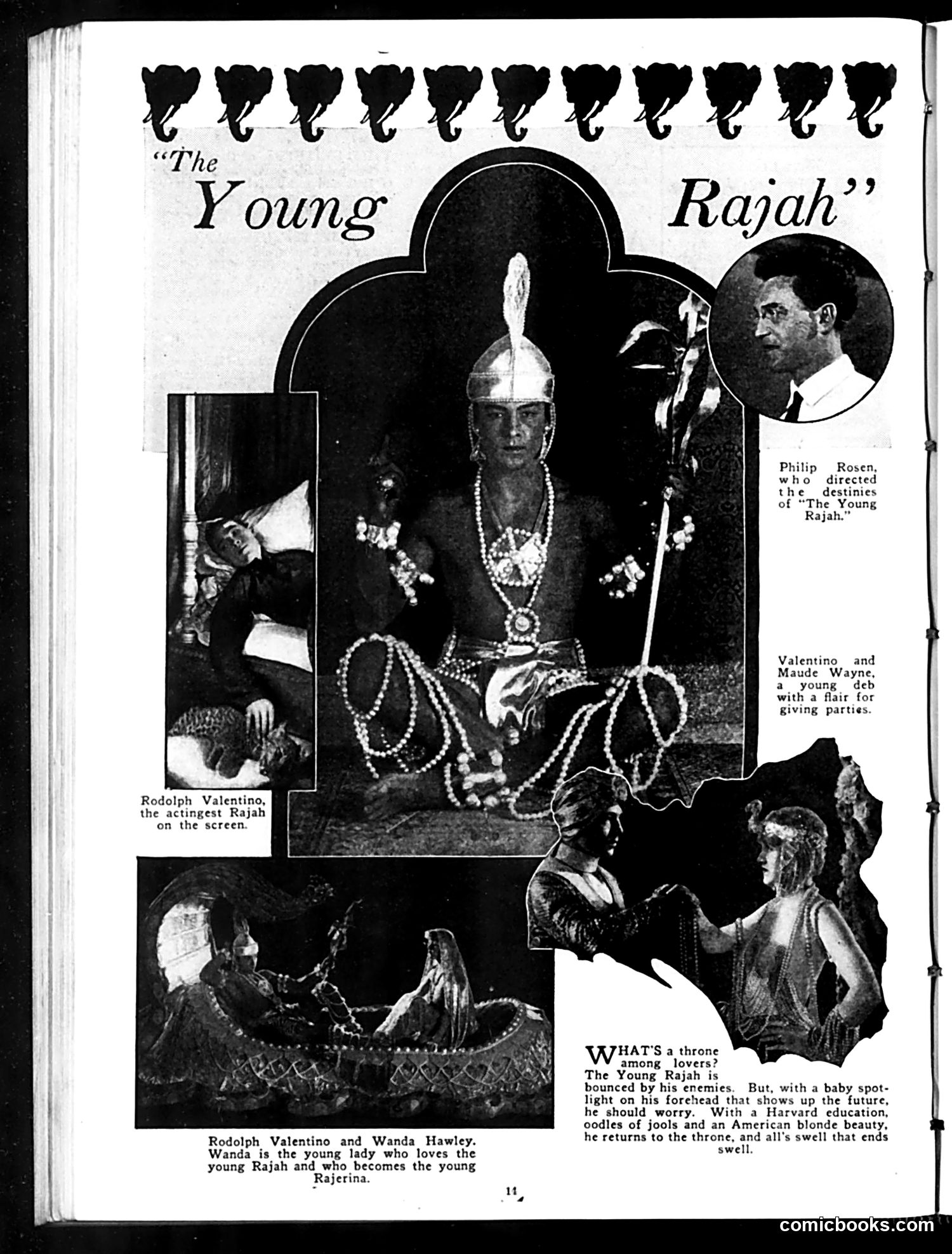
This page promotes the 1922 silent film "The Young Rajah," directed by Philip Rosen and starring Rudolph Valentino. It's not political satire but entertainment coverage with comedic tone. The page mocks the film's melodramatic plot: Valentino plays an Indian prince overthrown by enemies, but recovers his throne through a magical spotlight revealing his future. Judge's humor targets the absurdity—a "baby spotlight" on his forehead supposedly guarantees success because he has "Harvard education, oodles of jools [jewels] and an American blonde beauty." The satire ridicules both the film's implausibility and Valentino's exotic "Rajah" persona that made him a major 1920s star. The closing line "all's swell that ends swell" mocks the convenient, unrealistic happy ending. This reflects Judge's typical approach: gentle mockery of popular culture rather than hard-hitting political commentary.
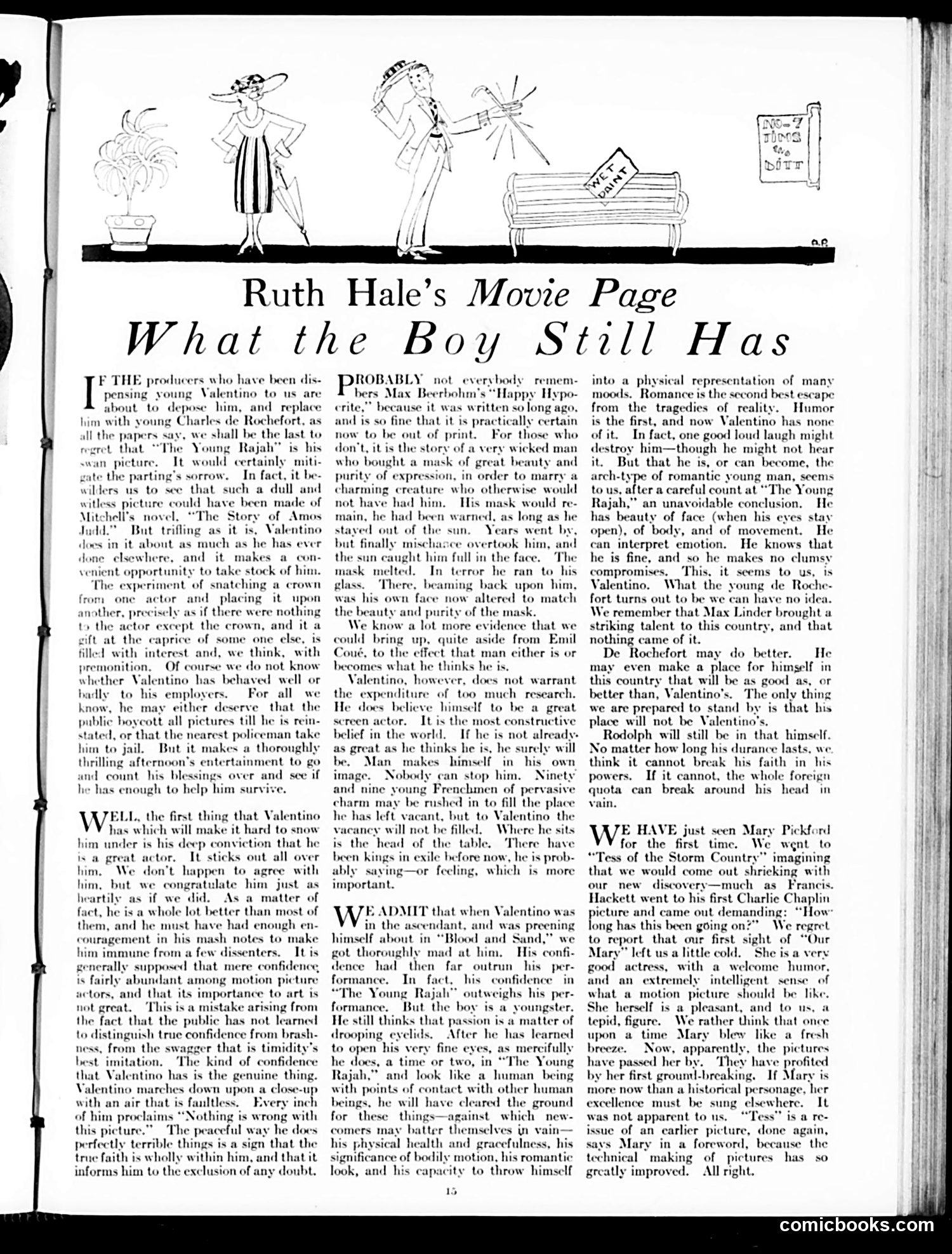
This is a film criticism column by Ruth Hale reviewing Valentine's latest picture, "The Young Rajah." The page critiques actor Rudolph Valentino's performance and screen presence. The illustrated header shows a fashionable woman viewing a film scene with a man on a bench labeled "GREAT," suggesting the page's focus on evaluating romantic leading men. Hale discusses whether Valentino deserves his reputation as a great screen actor, arguing his appeal relies heavily on physical beauty and expression rather than genuine acting ability. She compares him unfavorably to Charlie Chaplin and favorably notes Mary Pickford's discovery talent. The piece debates whether Valentino's "deep conviction" and faith in himself can overcome his limited dramatic range—a contemporary debate about whether movie stardom requires authentic talent or merely photogenic appeal.
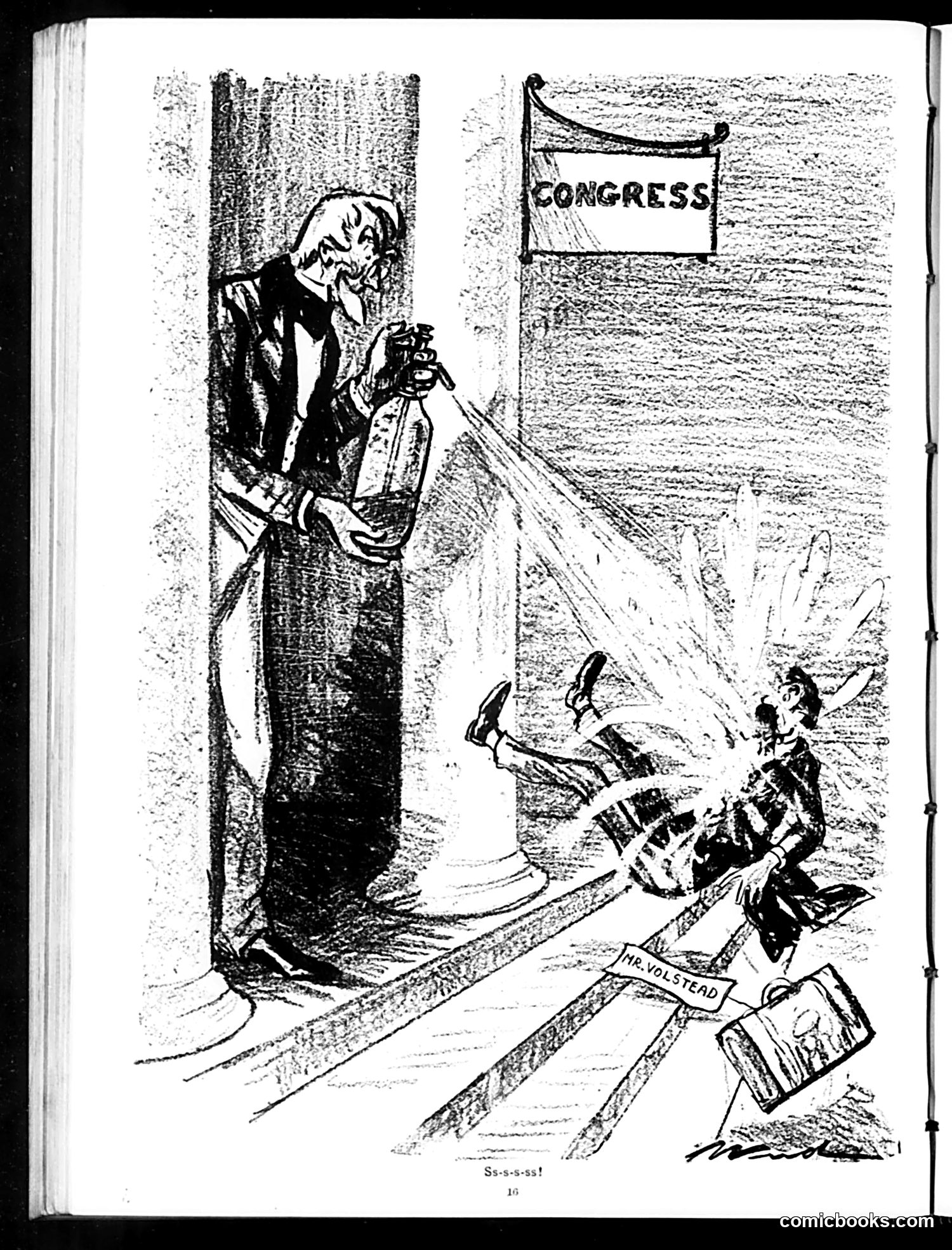
This cartoon depicts a man in formal dress hiding behind a pillar labeled "CONGRESS," appearing to warn or shush someone (indicated by "Ss-s-s-ss!"). Below, military or uniformed figures are being pulled by ropes labeled "Mr. Volstead" toward what appears to be a trap or snare. The "Volstead" reference indicates this relates to Prohibition enforcement (the Volstead Act enforced the 18th Amendment). The cartoon satirizes Congress's handling of Prohibition policy—suggesting Congressional figures are complicit in or hypocritically managing Prohibition enforcement while military/enforcement officials are being manipulated or ensnared by it. The overall message appears critical of Congressional duplicity regarding Prohibition's implementation.
The main cartoon features "Judge" (depicted as a jester) commenting on editorial hypocrisy. The *New York World* ran adjacent news items: Oregon voters approved a law (backed by the KKK) banning parochial schools, and Lakewood, Ohio banned dogs from barking at night. Judge satirizes this juxtaposition as deliberately manipulative—pairing anti-Catholic legislation with a trivial dog ordinance to make both seem equally absurd. The editor accuses the *World* of violating journalistic objectivity by suggesting readers naturally compare the two items, thereby mocking the anti-Catholic measure's severity. The "Help Yourself, Si" editorial discusses peasant resistance to Soviet Bolshevism and warns American farmers not to naively ally with labor at a coming Cleveland conference. It argues farmers will eventually realize labor's gains come from their pockets, then withdraw support—comparing them to a mule that suddenly stops and throws its rider. A minor piece, "A Suggestion," promotes heliotherapy (sun-bathing for health), noting sunlight darkens white skin while benefiting health.
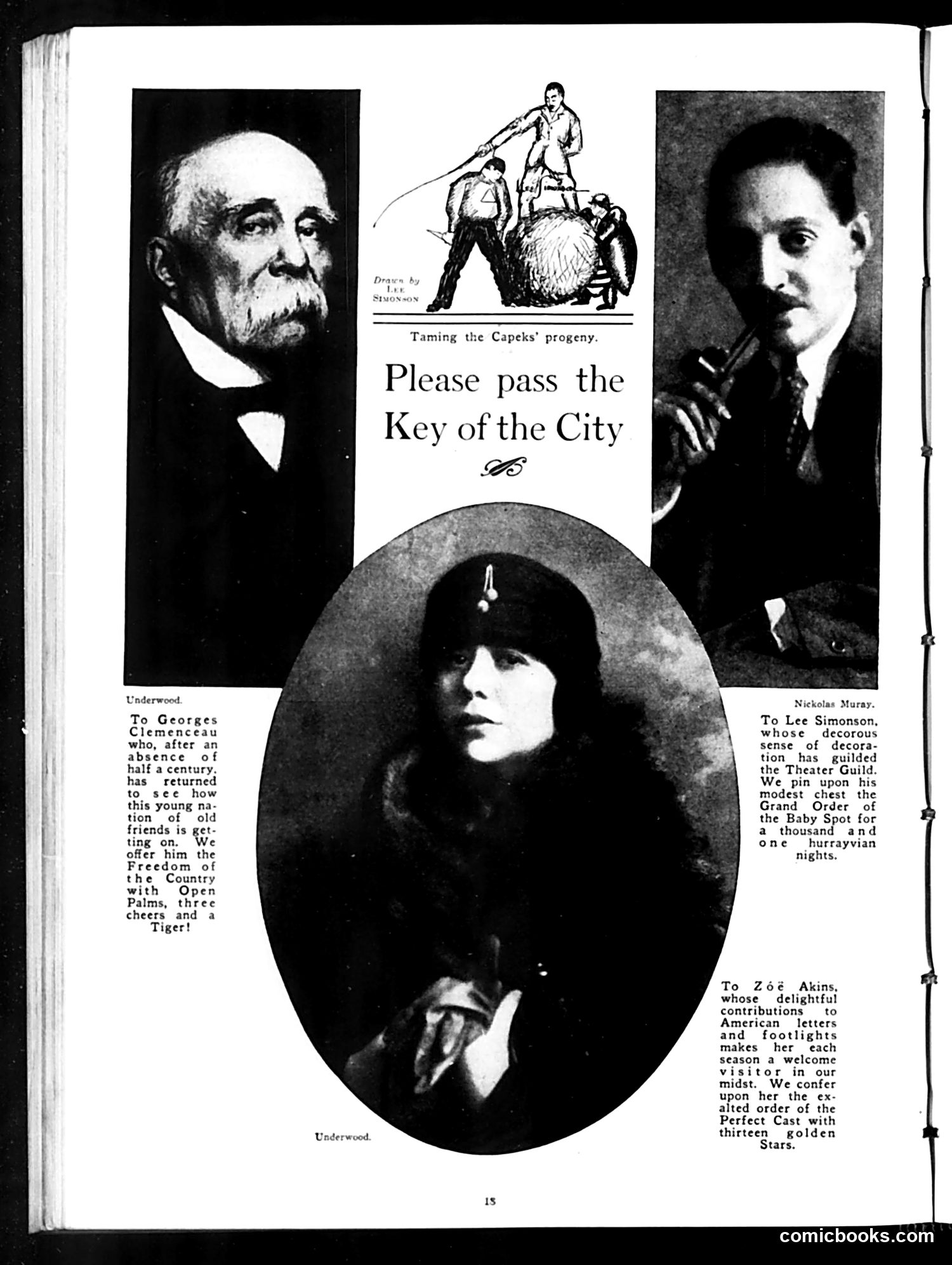
This page presents satirical tributes to notable figures of the era. The central cartoon, "Taming the Capeks' progeny," references the Čapek brothers' play *R.U.R.* (featuring robots), showing men struggling to control a giant spherical creature—satirizing anxieties about new technology or dramatic innovation. The three portrait tributes honor: - **Georges Clemenceau** (French statesman): praised for returning after 50 years absence to check on "this young nation of old friends" (America), offered "Freedom of the Country" - **Lee Simonson**: Theater Guild designer recognized for his stage decoration work - **Zoë Akins**: Playwright/screenwriter celebrated for contributions to American theater and letters These are ceremonial mock-honors typical of Judge's style—playful recognition of cultural figures through exaggerated awards and flowery language. The page celebrates artistic and diplomatic achievements in post-WWI America, presenting an insider's view of theatrical and political celebrity.
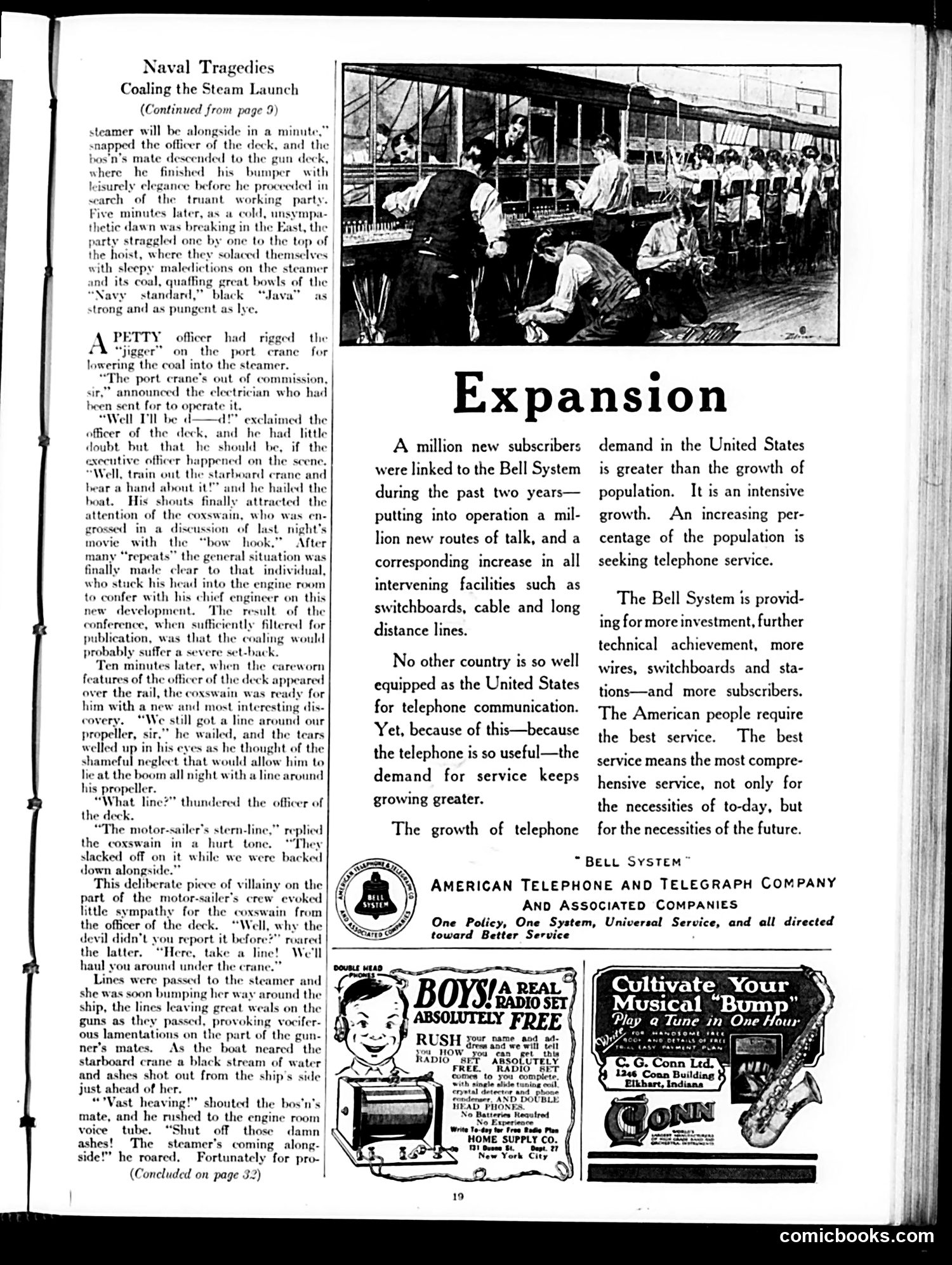
This page combines a serialized naval humor story with Bell System advertising. ## The "Naval Tragedies" Story The left column continues a comedic narrative about military incompetence during ship operations. It depicts petty officers and crew members dealing with cascading mishaps while coaling (refueling) a steam launch: broken equipment, tangled propeller lines, and miscommunications between vessels. The humor derives from the exaggerated frustration of officers dealing with absurd bureaucratic obstacles and crew incompetence—classic satirical fare poking fun at naval hierarchy and procedure. ## The "Expansion" Advertisement The right side is a full Bell System ad celebrating telephone growth: one million new subscribers in two years. It emphasizes American technological superiority and frames telephone expansion as progress meeting natural demand. This reflects 1920s optimism about corporate growth and infrastructure. The page juxtaposes military satire with corporate self-promotion—typical Judge magazine layout mixing humor with advertising revenue.
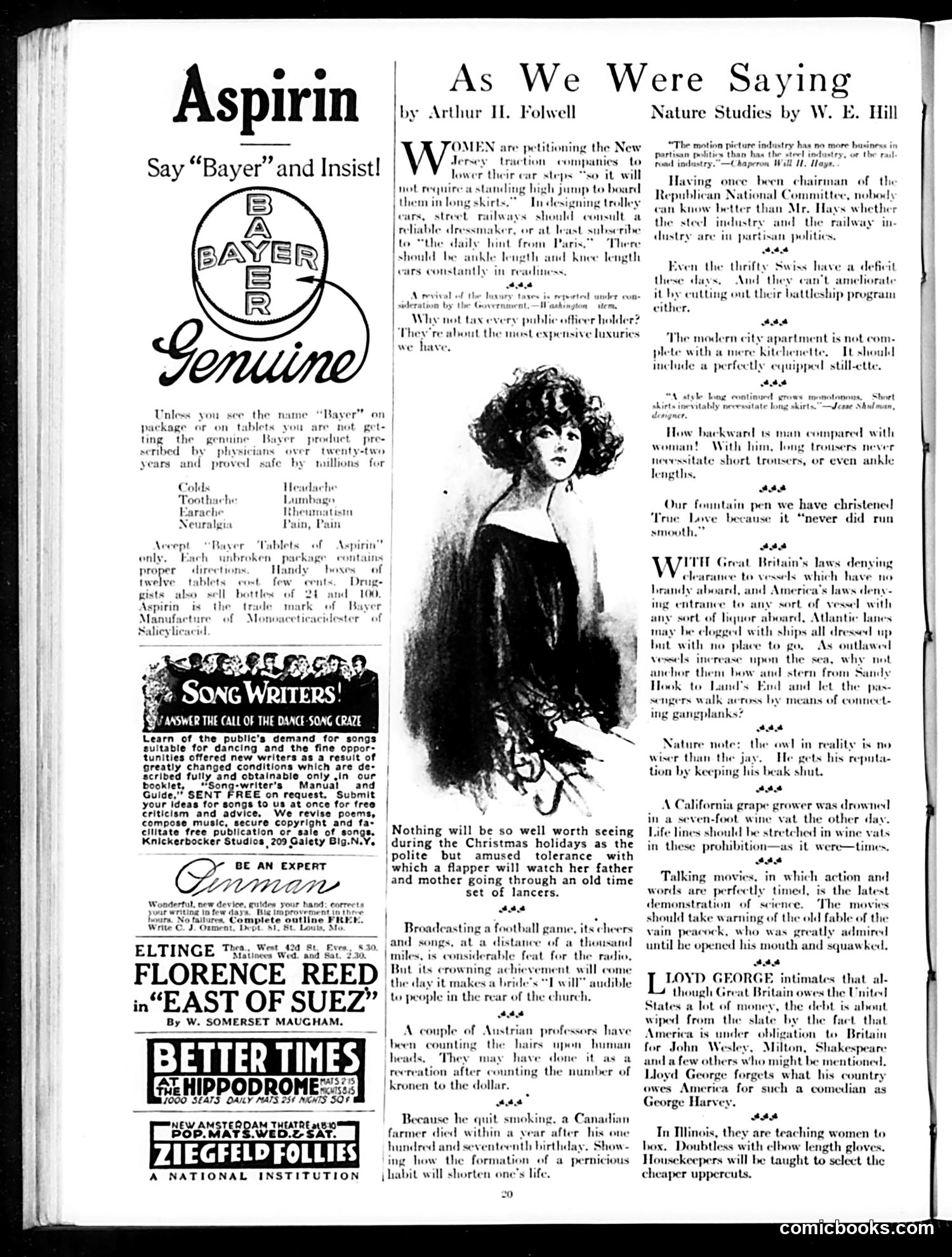
This is primarily an **advertising and editorial page** from Judge magazine, not a political cartoon. The left side features a **Bayer Aspirin advertisement** emphasizing brand authenticity—"Say 'Bayer' and Insist!"—warning readers that only genuine Bayer tablets, manufactured by Bayer, are reliable. This reflects early 20th-century concerns about patent medicines and counterfeit drugs. The right side contains **"As We Were Saying,"** a social commentary column by Arthur H. Folwell and nature notes by W.E. Hill. The brief satirical items mock contemporary absurdities: women petitioning for lower streetcar steps (addressing the fashion constraint of long skirts), the amusement of watching "flappers" do old-fashioned dances, Prohibition-era hidden alcohol ("still-ette"), and naval policy contradictions between Britain and America. The page also advertises theatrical productions and other services typical of the era. The satire is gentle, focused on fashion, technology, and social contradictions rather than hard political critique.
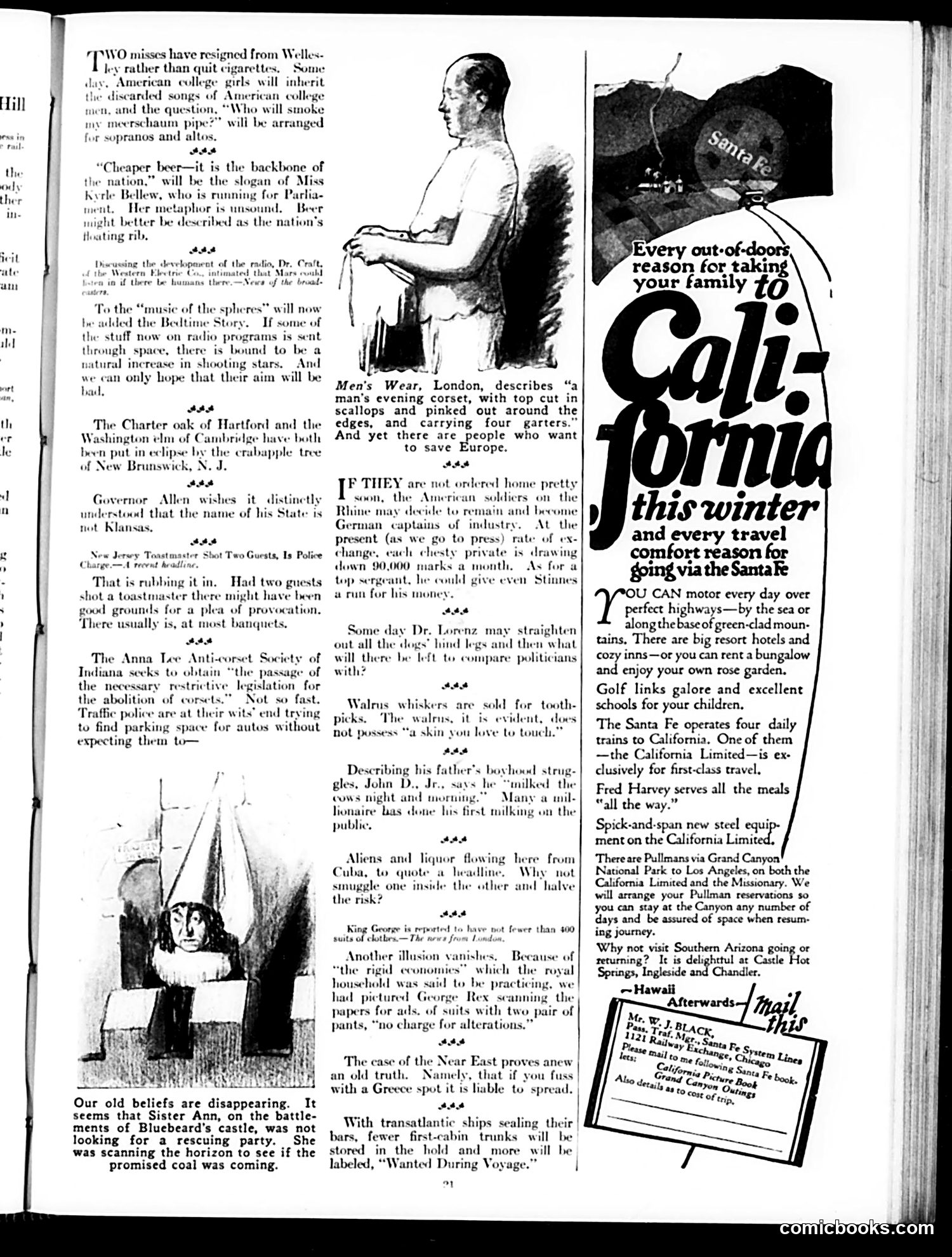
This page mixes brief satirical commentary with advertising. The cartoons and text snippets mock contemporary social trends and politics: **Key satirical points:** - College girls quitting cigarettes (reversing gender norms) - Miss Bellew's parliamentary campaign, criticized for comparing beer to national "backbone" rather than "heartbeat" - A man's evening corset from London fashion—used to ridicule European aesthetics ("people who want to save Europe") - Post-WWI German economic chaos: officers drawing 90,000 marks monthly (hyperinflation reference) - Prohibition-era smuggling jokes (aliens and liquor from Cuba; alcohol hidden in ship trunks) - Political commentary on Near East tensions: "if you fuss with a Greece spot it is liable to spread" - Sister Ann (folklore reference) scanning horizons for coal, not rescue—mocking outdated beliefs **The advertisement** promotes Santa Fe Railway's California travel, emphasizing luxury accommodations and Fred Harvey restaurants—typical 1920s tourism marketing. The page reflects post-WWI anxiety, Prohibition, gender role shifts, and European political instability.
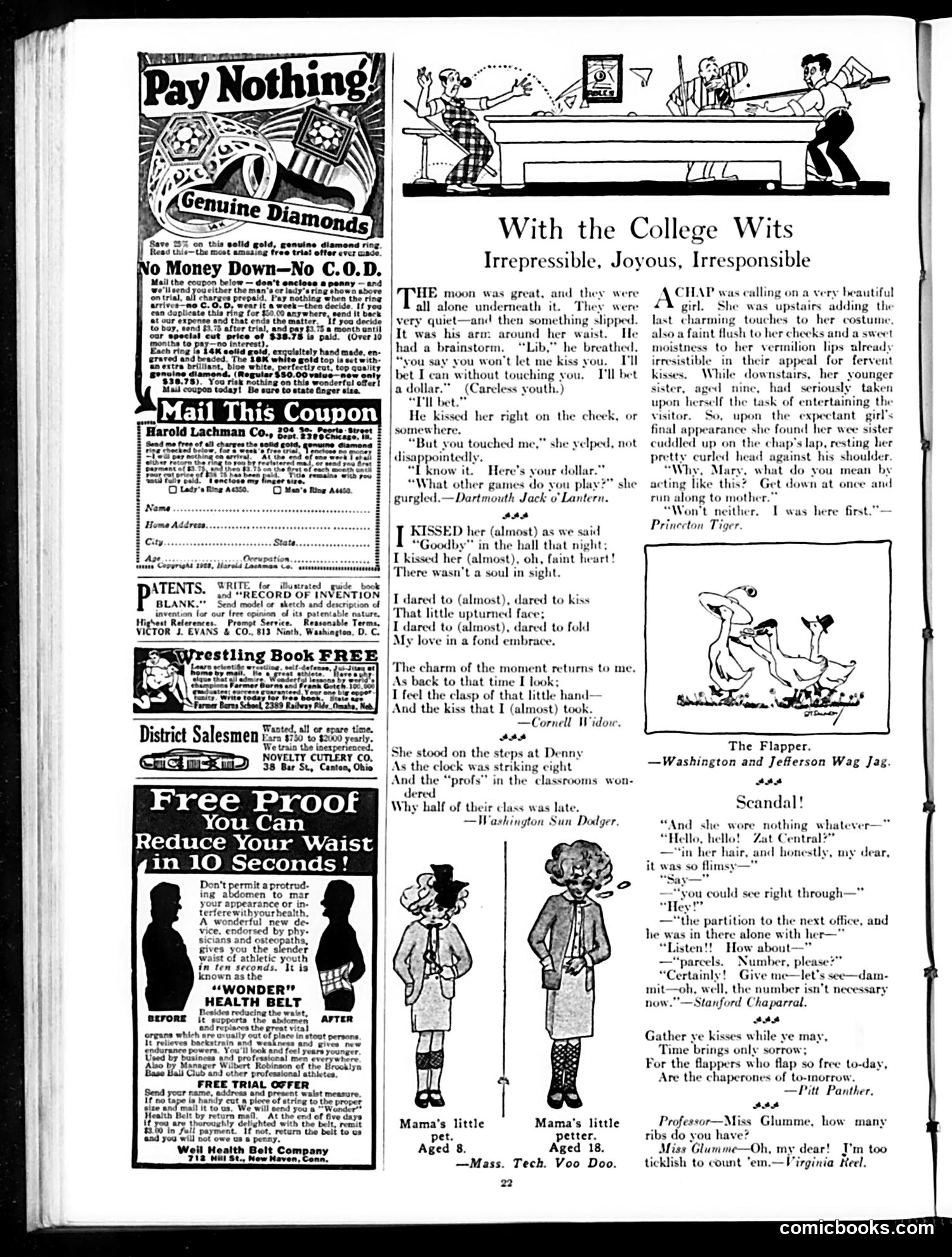
This page is primarily a collection of advertisements and college humor contributions rather than political cartoons. The advertisers (diamond rings, patent services, health belts, etc.) typical of the era appear alongside student humor from college publications. The "With the College Wits" section features romantic and mildly risqué humor common to 1920s college magazines. The verses and anecdotes play on themes of young romance—almost-kisses, innocent flirtation, and romantic encounters. The humor relies on the tension between propriety and youthful desire: young men and women navigating courtship under social constraints. The concluding anecdote about the young visitor interrupted by the younger sister provides gentle satire of adult pretensions: the visiting suitor is "shown up" as less sophisticated than he pretends. The cartoons labeled "Mama's little pet" (age 8) versus "Mama's little petter" (age 18) make a pun about how girls change with age, suggesting sexual maturation. This reflects 1920s college culture's obsession with dating, propriety, and the flapper era's loosening social conventions.
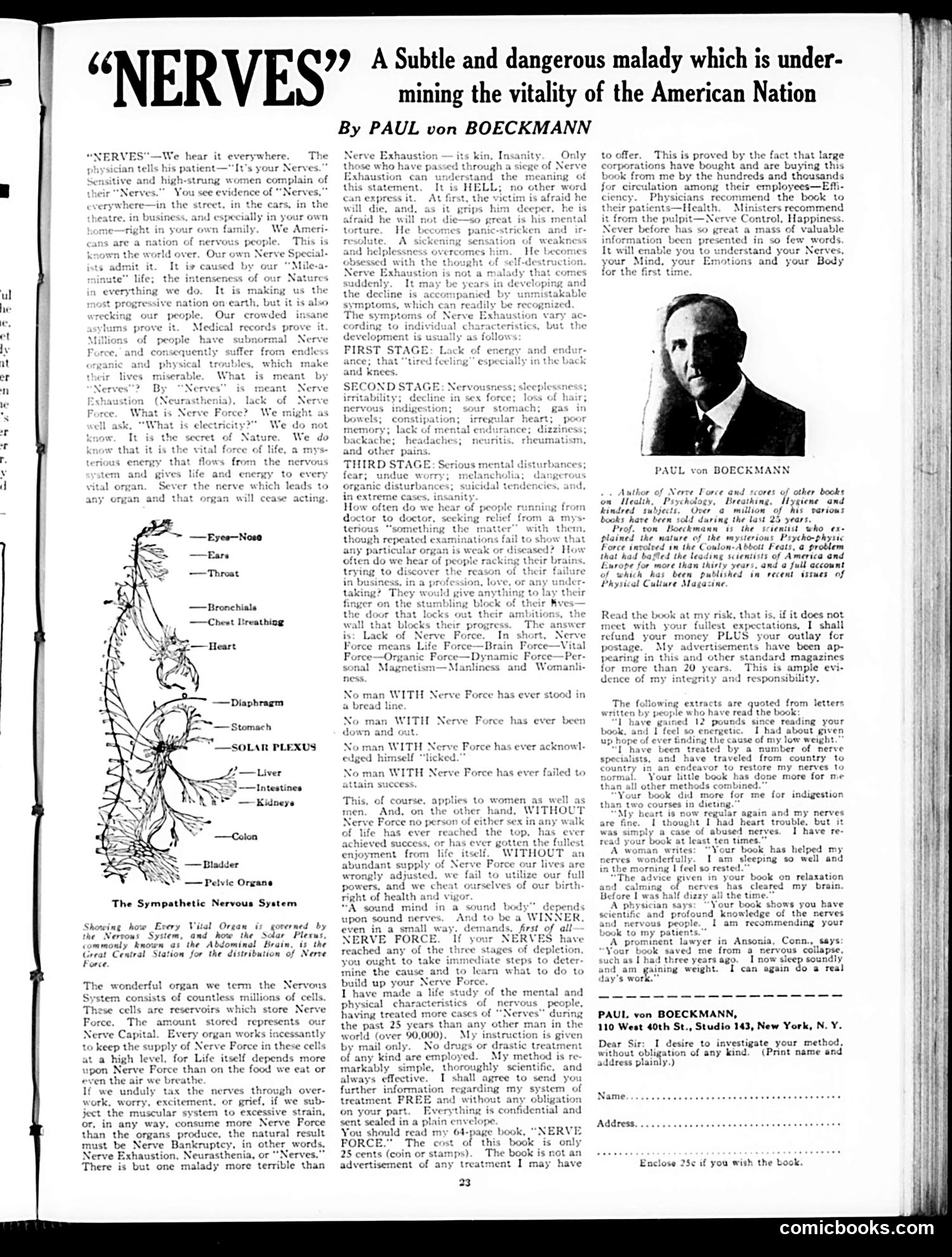
This is primarily **advertising disguised as editorial content** in Judge magazine, not satire. The piece promotes von Boeckmann's book about "Nerve Force" and alleged treatments for "Nerve Exhaustion" (neurasthenia). The diagram illustrates the sympathetic nervous system, labeling organs supposedly governed by "Nerve Force"—a pseudoscientific concept popular in early 20th-century alternative medicine. **Historical context:** Neurasthenia was a genuine diagnosis of the era, attributed to modern civilization's stress. Von Boeckmann exploits this real anxiety, claiming his method uniquely restores "Nerve Force" through relaxation techniques—promising relief from fatigue, insomnia, and mental disturbance without drugs. The testimonial letters and publisher's endorsement lend false credibility. This represents the era's proliferation of dubious health cures marketed to anxious Americans concerned about depleted vitality. Judge's inclusion reflects the magazine's willingness to run paid promotional content alongside satire.
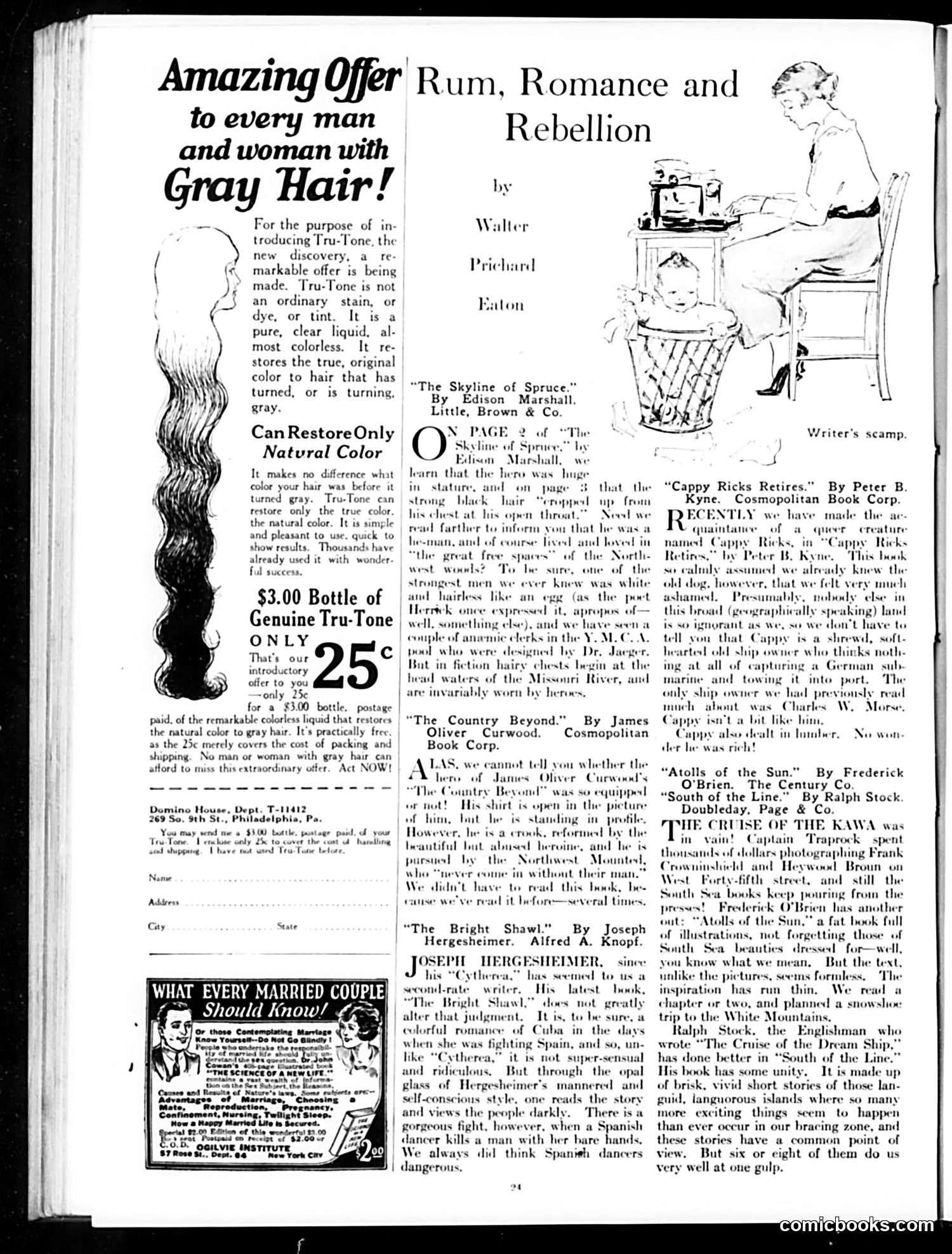
This page is primarily **advertising and book reviews**, not satirical political content. The dominant feature is a **hair-restoration product advertisement** for "Tru-Tone," marketed to people with gray hair. The ad promises to restore "natural color" to graying hair, claiming it's a "pure, clear liquid" rather than a dye. The introductory price is 25¢ (reduced from $3.00). This reflects early 20th-century consumer culture and vanity marketing. The remainder consists of **book reviews** discussing contemporary fiction: works by Edison Marshall, James Oliver Curwood, Joseph Hergesheimer, Peter B. Kyne, Frederick O'Brien, and Ralph Stock. The reviews are mildly humorous but not satirical—they poke gentle fun at recurring tropes (shirtless heroes, Spanish dancers, colorful island romances) without targeting specific political figures or events. A small **marriage advice advertisement** appears at bottom left, unrelated to the main content. This is a typical magazine page mixing commercial promotion with literary commentary.
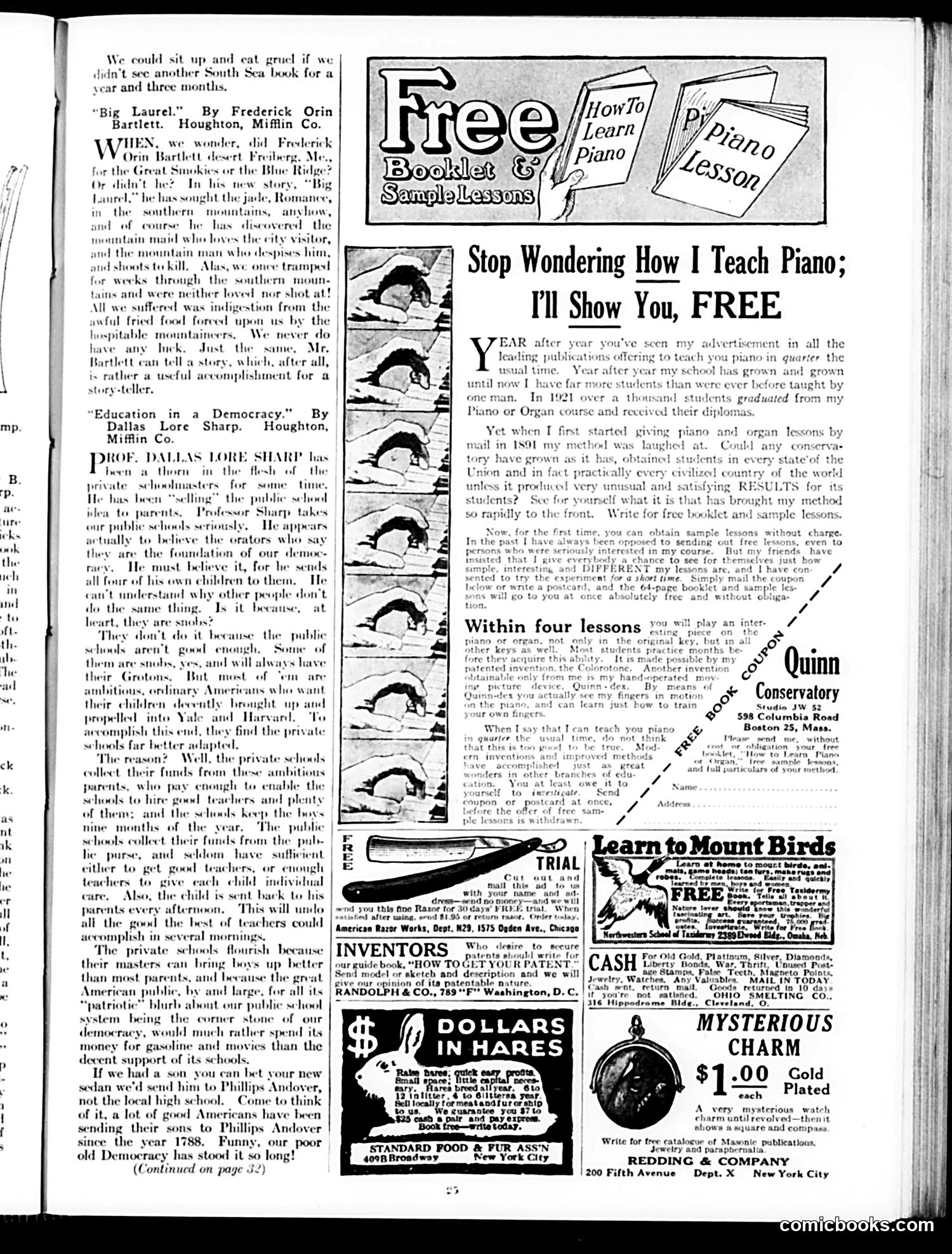
This page is primarily **advertising**, not political satire. It contains: **Book Reviews** (left column): Brief critiques of novels by Frederick Orin Bartlett and Dallas Lore Sharp. The Sharp review satirizes private school advocates—Sharp championed public education but sent his own children to private schools, which the reviewer mocks as hypocritical. The point: wealthy Americans claim public schools are "the foundation of democracy" while privately funding elite institutions like Phillips Andover. **Advertisements** (dominant): Multiple mail-order offers including piano lessons, patent guidance, bird-mounting instruction, rabbit raising, cash for precious metals, and a "mysterious charm" watch—typical early 20th-century classified ads promising quick success or self-improvement. **Social Context**: These ads reveal Depression-era or post-WWI economic anxiety—readers were clearly seeking home-based income (rabbit farming, patent invention) and self-education on budgets (free piano lessons). The abundance of such offers suggests widespread financial desperation among the readership.
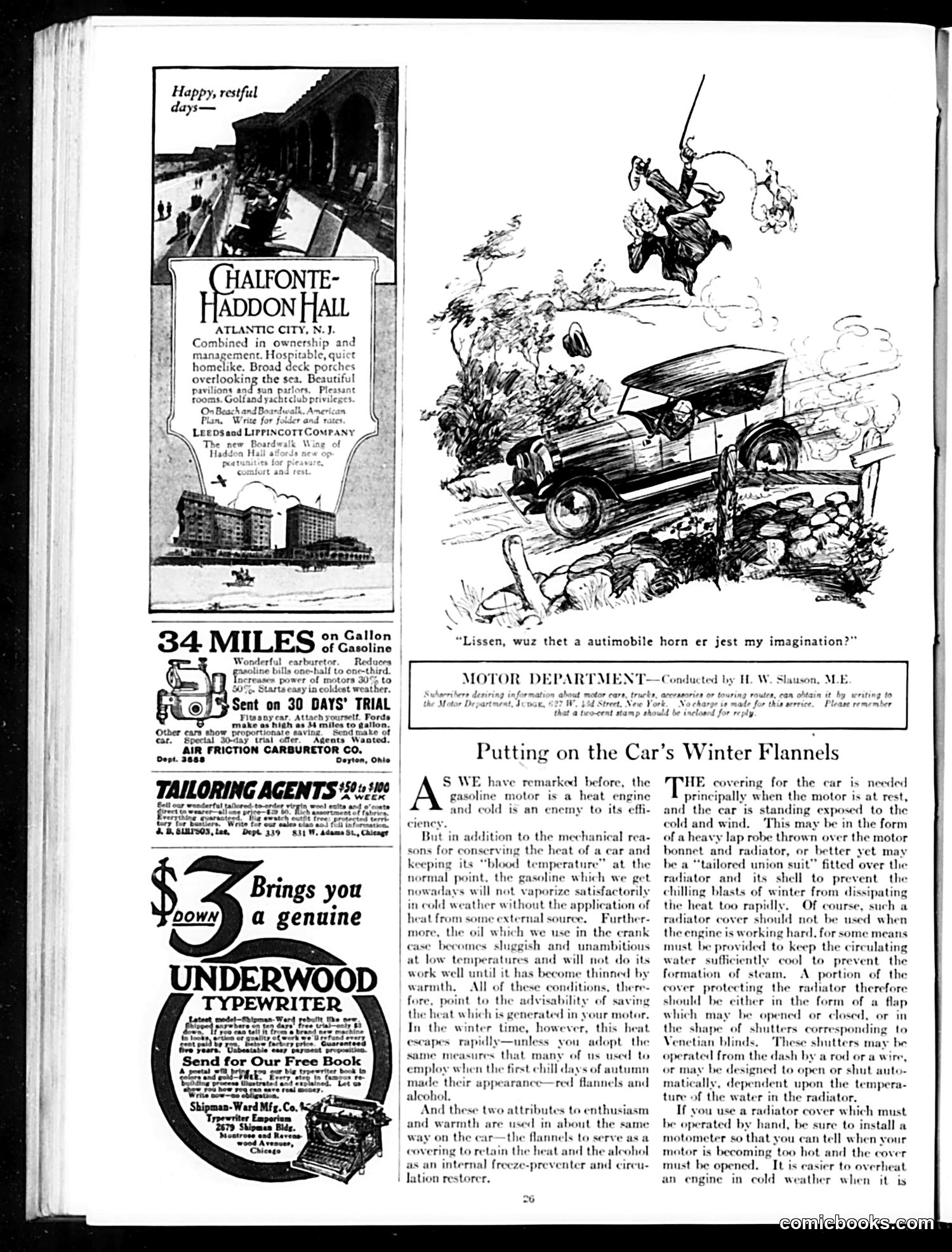
This page combines advertisements with a technical automotive article, reflecting early 1920s concerns about winterizing cars. **Main Content:** "Putting on the Car's Winter Flannels" is a humorous article explaining winter car maintenance. The title uses the metaphor of dressing a car in flannel underwear (as people wore for warmth), comparing protective covers for the radiator and engine to human winter clothing. The piece discusses practical problems: cold prevents gasoline from vaporizing properly, engine oil becomes sluggish, and heat escapes the motor. Solutions include radiator covers (like lap robes or fitted "union suits"), shutters to control cooling, and alcohol additives as antifreeze. **Cartoons:** A small illustration at top left shows a beach resort ("Happy, restful days"). The right panel depicts a humorous motoring scene with a figure on a bucking horse-like automobile, asking "Lissen, wuz that a automobile horn er jest my imagination?"—satirizing early car noise or perhaps an unfamiliar mechanical sound to a rural observer. **Advertisements** include a carburetor company, tailoring agents, and typewriter offers—typical period magazine filler targeting automobile owners and entrepreneurs.
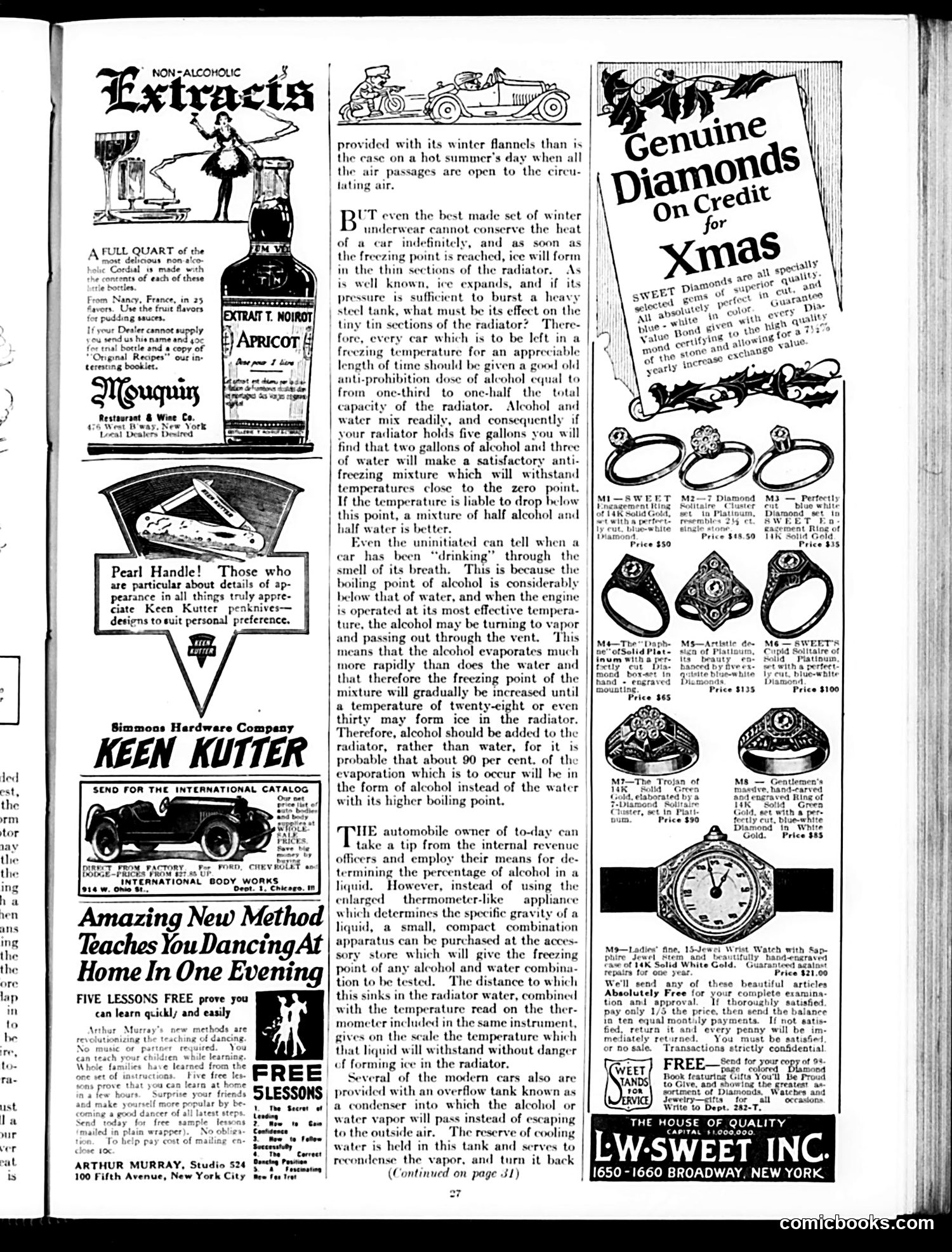
This page is primarily **advertising and instructional content** rather than political satire. The main article discusses winterizing automobiles by adding alcohol to radiators as antifreeze—a practical concern in the pre-modern heating era. The satire is subtle: the piece anthropomorphizes cars as "drinking," joking that vehicles smell of alcohol on their "breath" when antifreeze evaporates. This creates dark humor by likening cars to intoxicated people, likely a pointed reference to **Prohibition** (1920-1933), when Americans illegally consumed alcohol while officially banned. The surrounding advertisements—for Keen Kutter tools, dancing lessons, jewelry, and other goods—are standard commercial content. The "Pearl Handle" penknife ad and diamond ring promotions represent typical early 20th-century luxury marketing. **The joke**: In Prohibition-era America, suggesting cars need alcohol for survival is wryly ironic commentary on society's simultaneous ban and dependence on the substance.
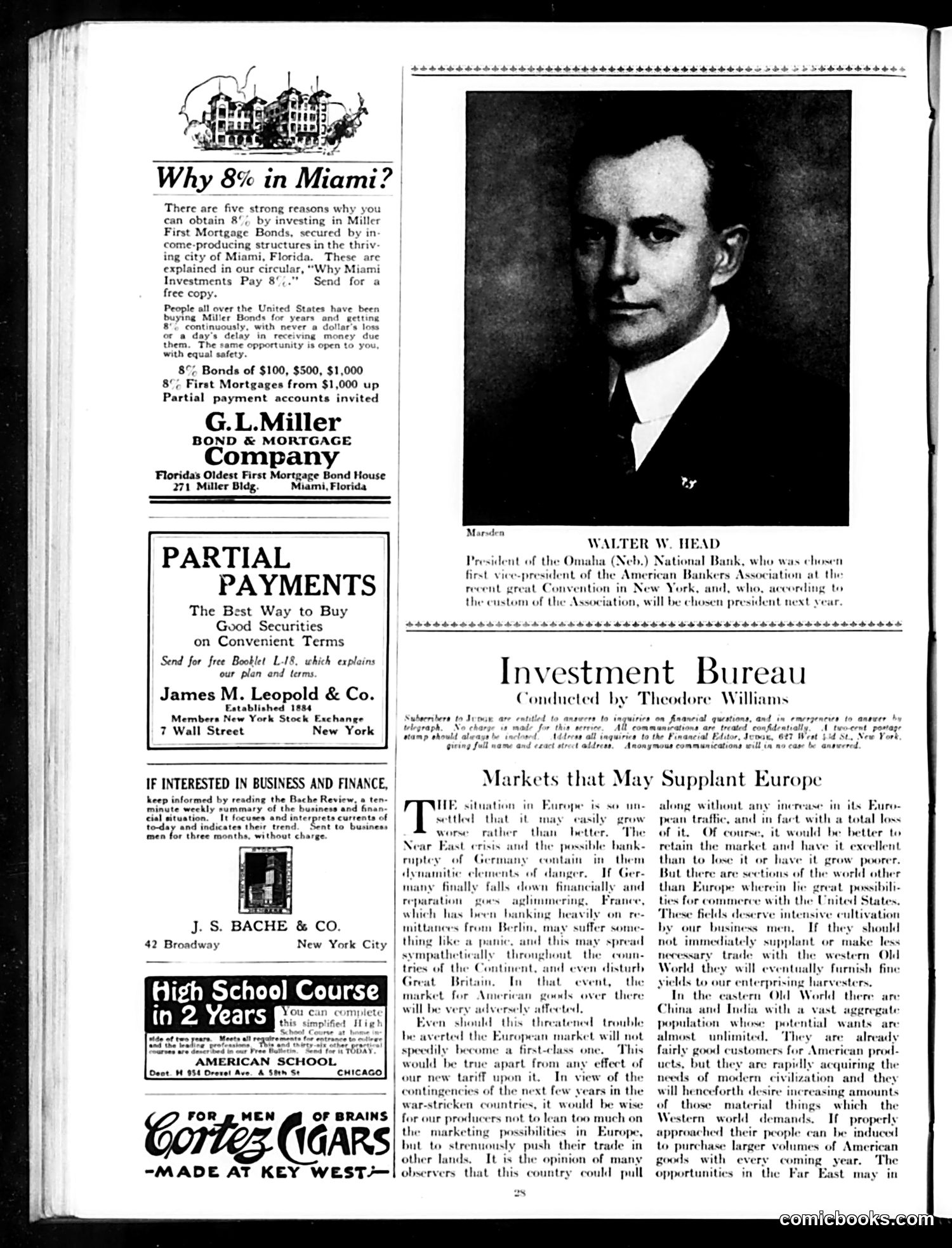
This page is primarily **advertisements and business notices** from Judge magazine, with one editorial piece. The portrait shows **Walter W. Head**, president of Omaha's National Bank, identified as newly chosen first vice-president of the American Bankers Association. The caption indicates he'll become president next year—this is straightforward reporting, not satire. The main editorial, "Markets that May Supplant Europe," discusses post-World War I economic strategy. It argues that while Europe recovers from war damage and financial instability, American businesses should actively develop trade with **China and India** rather than depend heavily on European markets. The piece reflects 1920s concerns about European economic weakness and positions Asian markets as alternative opportunities for American commerce. The surrounding ads (for Miami bonds, investment services, and cigars) represent typical Judge content of this era.
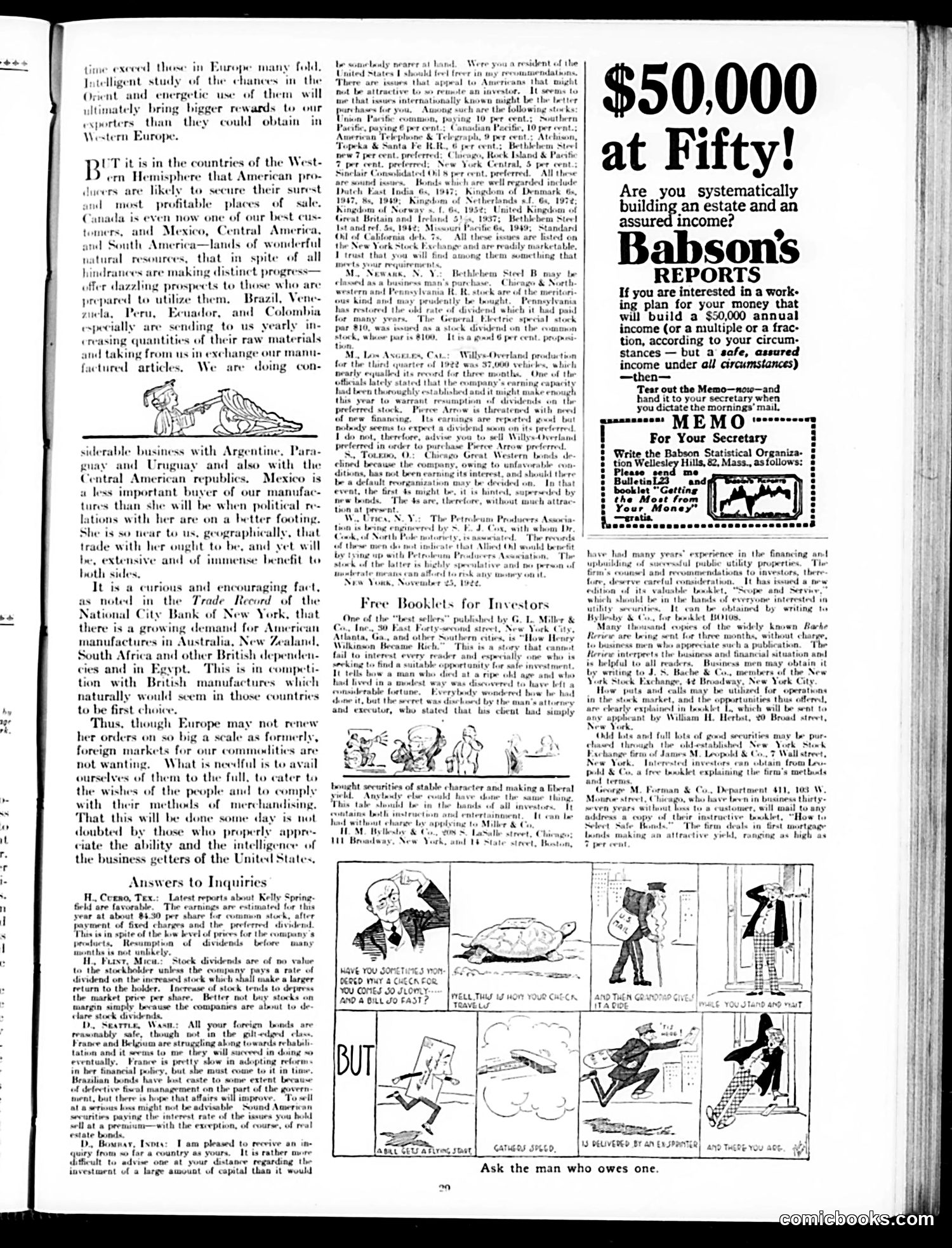
This page from *Judge* is primarily **financial/investment advertising and advice**, not political satire. The dominant content includes: **Main Advertisement:** "Babson's Reports" promoting a "$50,000 at Fifty" investment plan offering annual income through systematic estate-building. **"Answers to Inquiries" Section:** A financial advice column addressing readers' stock and bond questions—discussing dividends, Brazilian bonds, Belgian securities, and Bethlehem Steel stock valuations. **Cartoon:** A small comic strip at bottom-right depicting a domestic financial scenario ("Ask the man who owes one"), appears to satirize household debt/credit rather than political themes. **Context:** This reflects the 1920s American investment boom period, when magazines marketed securities heavily to middle-class readers. The "Babson" reference suggests the influential Babson Statistical Organization, actual investment advisors of the era. The page's financial focus reflects *Judge's* business-minded readership and advertising model rather than its traditional satirical mission.
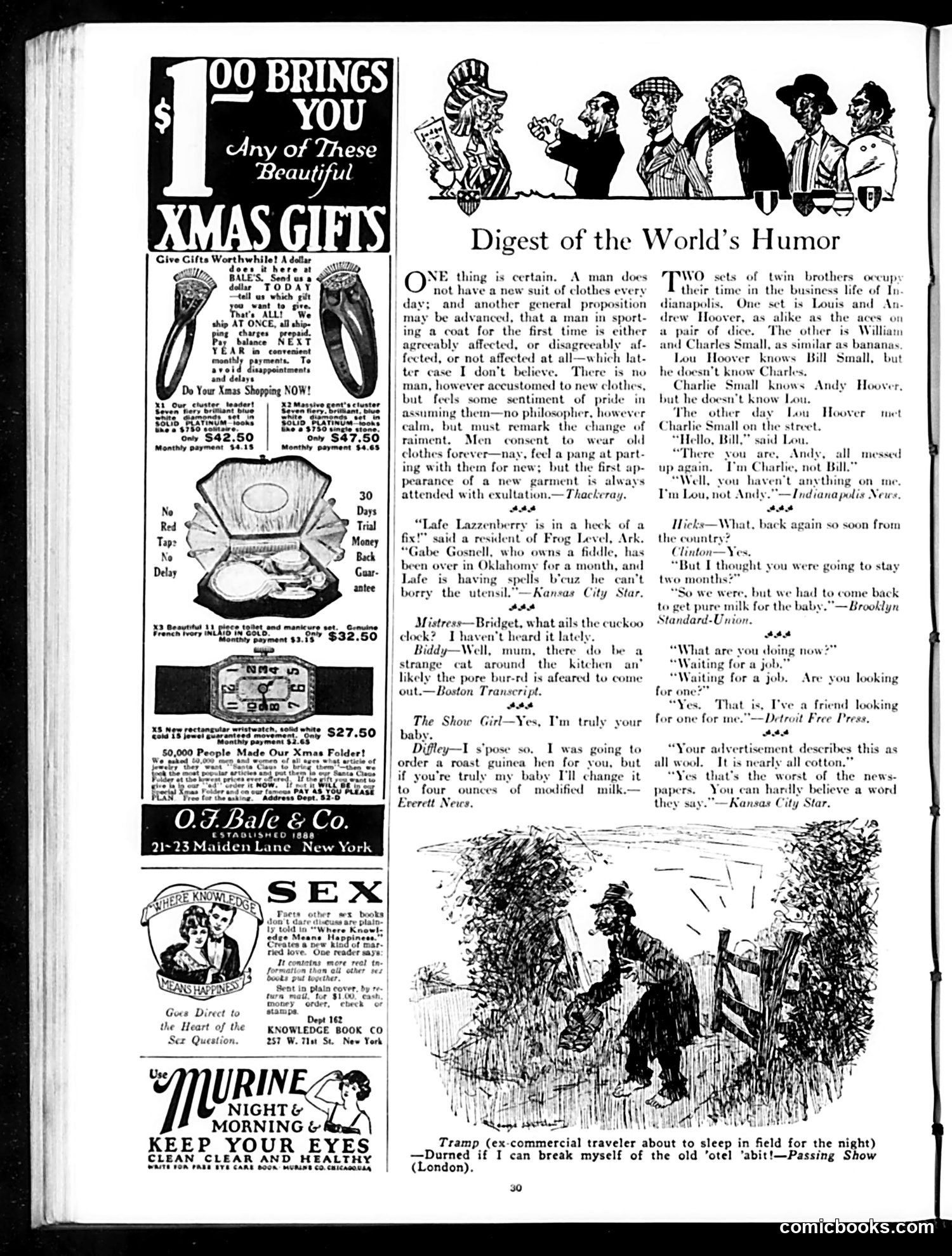
This page collects brief humor pieces—anecdotes, jokes, and comic observations—typical of Judge's "digest" format. The central cartoon shows a tramp attempting to sleep outdoors in a field but reflexively maintaining "hotel habits," suggesting he's a displaced commercial traveler reduced to rough circumstances. The surrounding text jokes emphasize class anxieties and social mishaps: men's pride in new clothes, domestic servant confusion, mistaken identities among look-alike brothers (the Hoovers and Smalls), and the absurdity of urban professionals (the "show girl," the businessman) caught in ridiculous situations. One joke mocks newspaper advertising credibility. The overall tone reflects early 20th-century humor targeting both working-class people and aspirational urban figures—poking fun at pretension, social climbing, and the gap between appearance and reality. The advertisements (jewelry, eye care, books) frame this satirical commentary on American consumer culture.
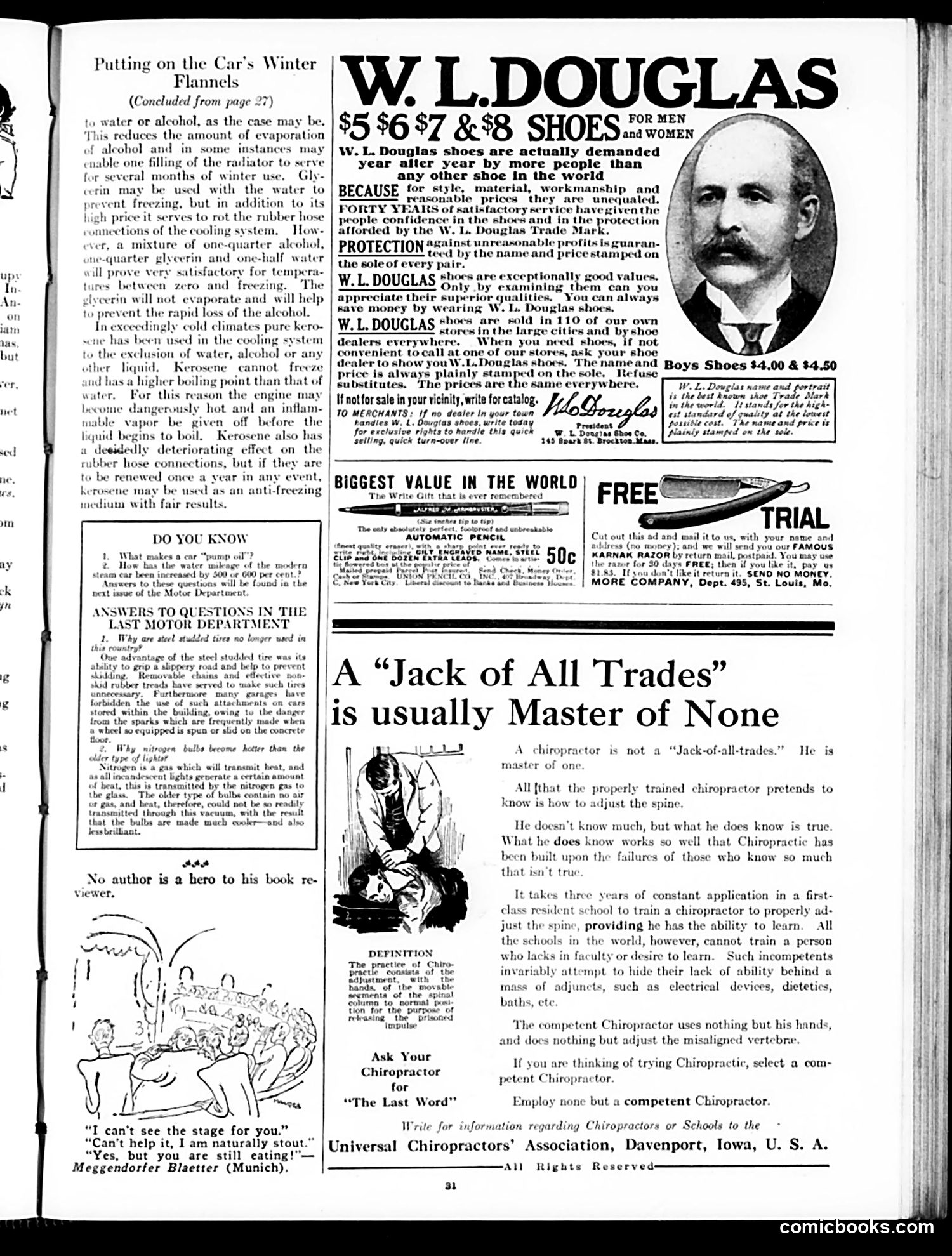
This page is primarily **advertising and technical content**, not political satire. The dominant features are: **Main Advertisement**: W.L. Douglas shoes ($5-$8 price range) occupy the right column. This is a straightforward product ad emphasizing quality, brand recognition ("40 years"), and wide availability across 110 stores nationwide. **Technical Content**: The left side concludes an article on winterizing automobile radiators, discussing coolant mixtures (alcohol, glycerin, kerosene) and their properties—practical automotive advice for early 20th-century car owners. **Filler Content**: Small items include motor department Q&A, a joke about theater seating (from a Munich publication), and an advertisement for a free razor trial. The only item with satirical potential is a brief chiropractor advertisement titled "A 'Jack of All Trades' is usually Master of None"—which argues that proper chiropractic training requires three years and uses only hand adjustment, implicitly critiquing unqualified practitioners using gadgets and dietary supplements. The page reflects Judge's mixed format: serious technical instruction alongside consumer advertising, with minimal actual satirical content.
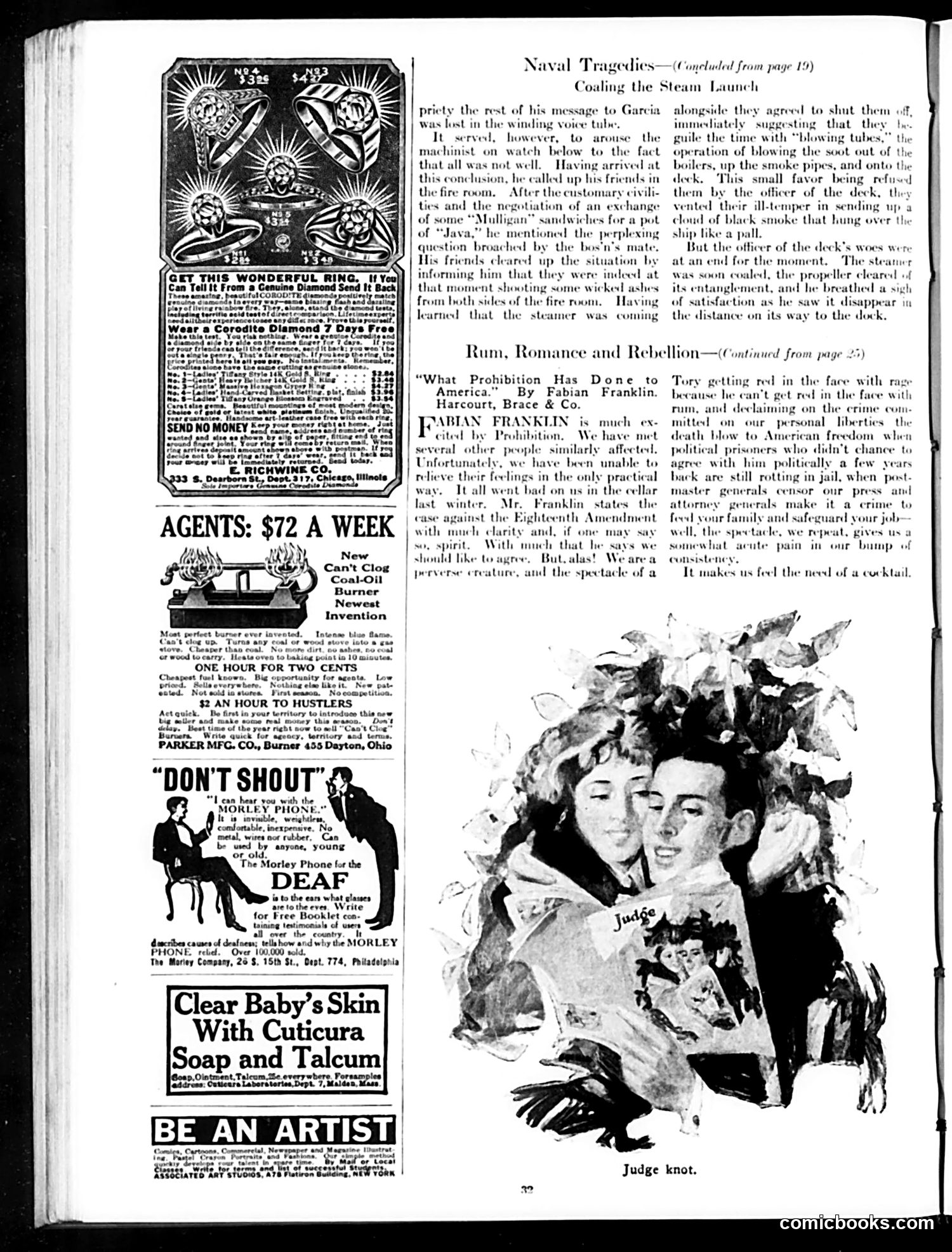
This page is primarily **advertisements** with two article continuations. The main content includes: **Left side**: Multiple product ads—a coal-oil burner, a "Morley Phone" hearing device for deaf people, Cuticura soap, and an art school advertisement. These are typical early 20th-century classified ads with exaggerated claims ("$2 AN HOUR TO HUSTLERS"). **Right side**: Two article continuations: 1. **"Naval Tragedies: Coaling the Steam Launch"**—a mundane anecdote about ship crew members shooting ashes from a furnace while loading coal, causing minor irritation to a deck officer. 2. **"Rum, Romance and Rebellion"**—a book review of Fabian Franklin's *What Prohibition Has Done to America*. The reviewer is **anti-Prohibition**, sarcastically mocking Franklin's passionate defense of the ban while criticizing the government's concurrent crackdown on political prisoners and press censorship—arguing that restricting alcohol while suppressing civil liberties is hypocritical inconsistency. The illustrated figure labeled "Judge knot" appears decorative rather than satirical. This is a mixed editorial/advertising page typical of Judge magazine's format.
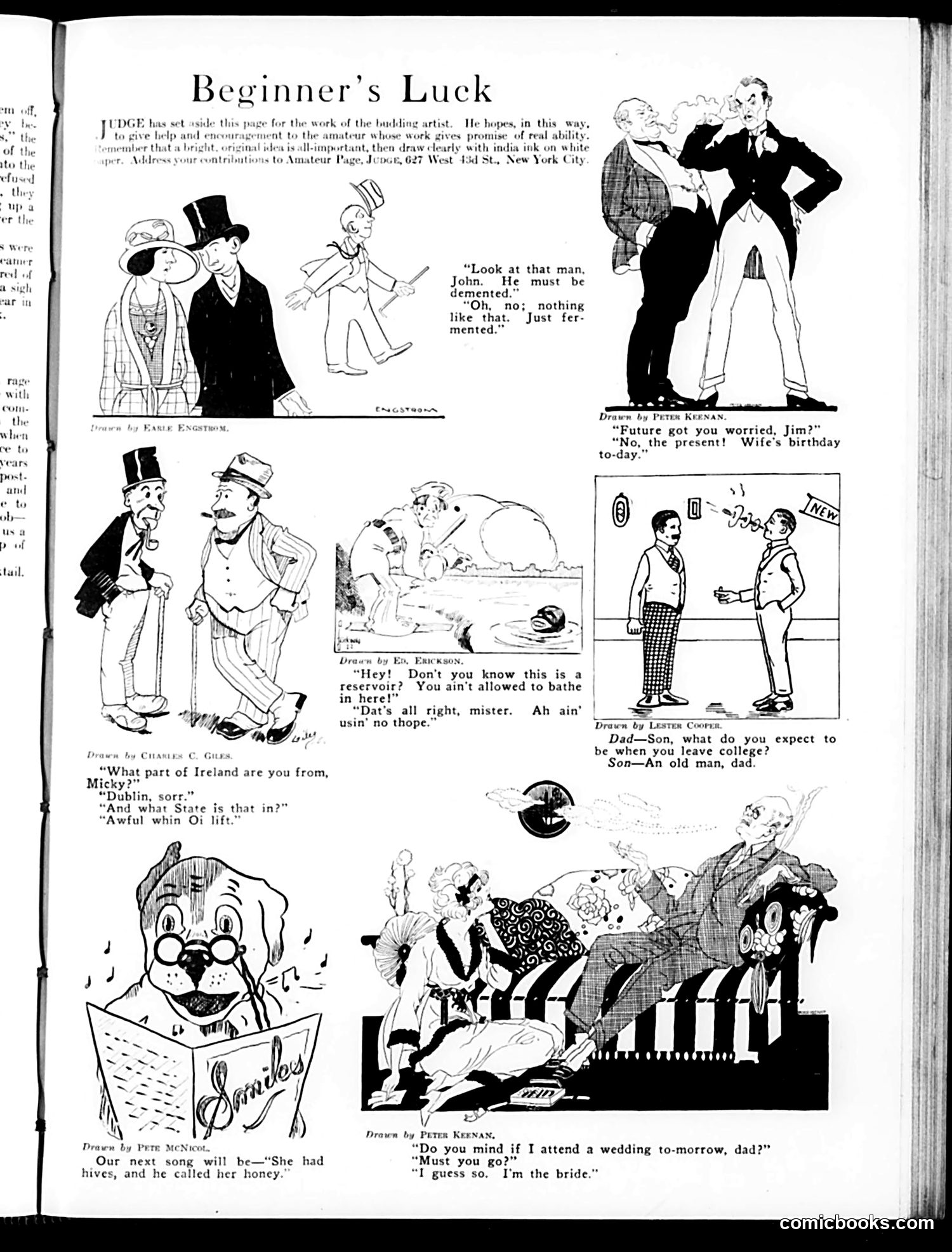
This is a collection of humorous single-panel and multi-panel comics showcasing amateur artists' work. The page demonstrates early 20th-century American humor through various joke formats: **Key content includes:** - A drunk man ("fermented" vs. "demented") — wordplay on intoxication - A husband worried about his wife's birthday gift, not the future - An immigrant attempting to bathe in a reservoir, using dialect humor ("Dat's all right, mister") - A college-bound son's pessimistic answer about his future - An Irish immigrant's malapropism confusing Dublin with a U.S. state - A bride asking her father's permission to attend her own wedding (absurdist humor) - A dog reading a music book (visual gag) The humor relies heavily on **ethnic/immigrant stereotypes** (Irish, possibly German accents), **marital comedy**, and **wordplay**. This represents typical Judge magazine content: lighthearted satire of everyday life rather than political commentary, with an emphasis on the comedic absurd.
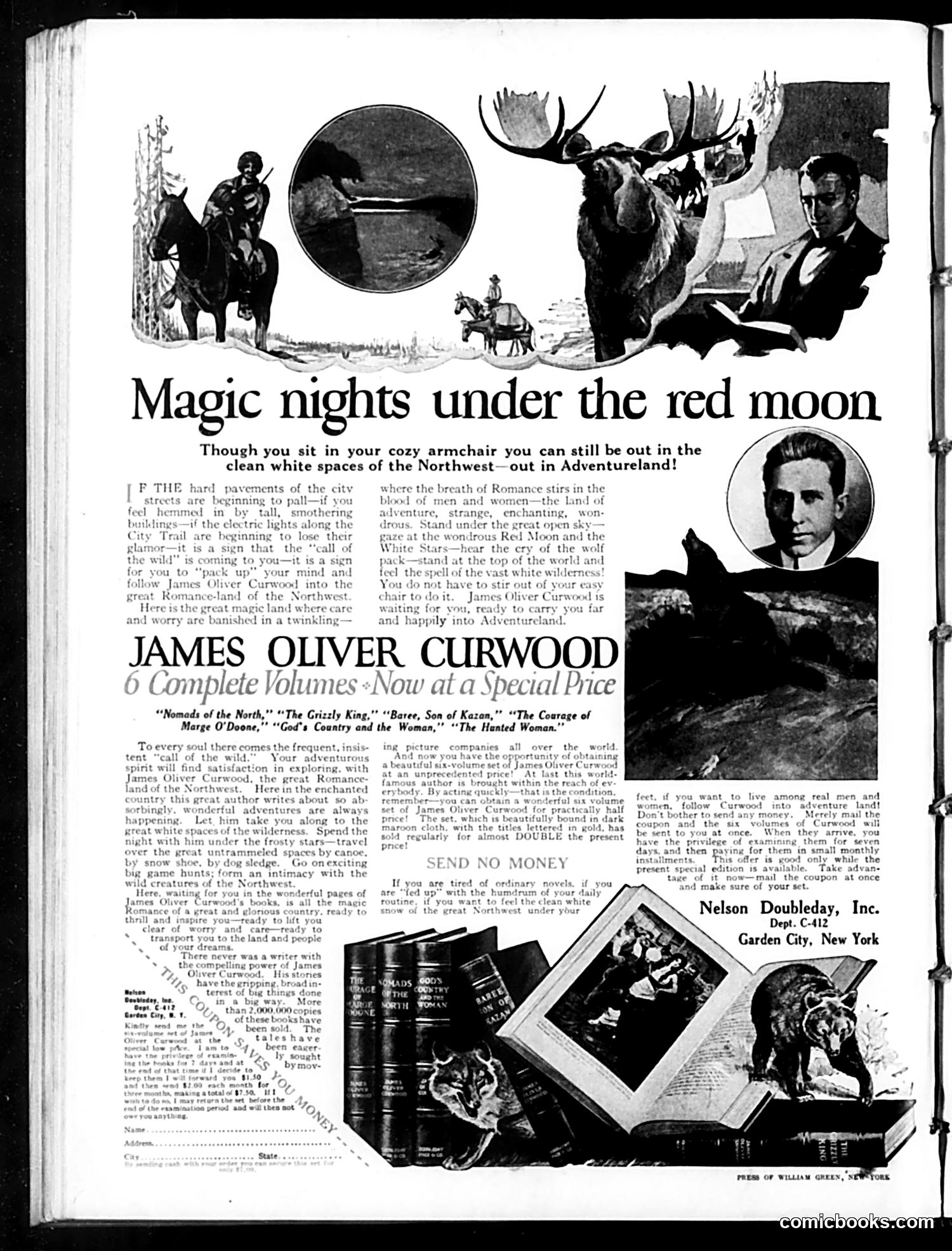
This is primarily a **book advertisement** rather than political satire. It promotes a six-volume collection of novels by James Oliver Curwood, a popular adventure writer of the early 20th century. **The content**: The ad uses romantic imagery of the Canadian Northwest—moose, wolves, mounted riders, frontier scenes—to evoke adventure and wilderness escape. The text appeals to armchair travelers, promising readers can experience "magic nights" and adventure vicariously through Curwood's stories set in "Adventureland." **Historical context**: Curwood's wilderness adventure novels were commercially successful during this era. The ad emphasizes the special price and attractive binding of the collected set, targeting middle-class readers seeking escape literature. **No clear satire**: Unlike typical Judge magazine content, this page contains straightforward commercial promotion rather than political or social commentary. It reflects period attitudes valuing wilderness adventure and romantic notions of frontier life.