
Judge, 1922-12-02 · page 8 of 36
Judge — December 2, 1922 — page 8: what you’re looking at
What you’re looking at
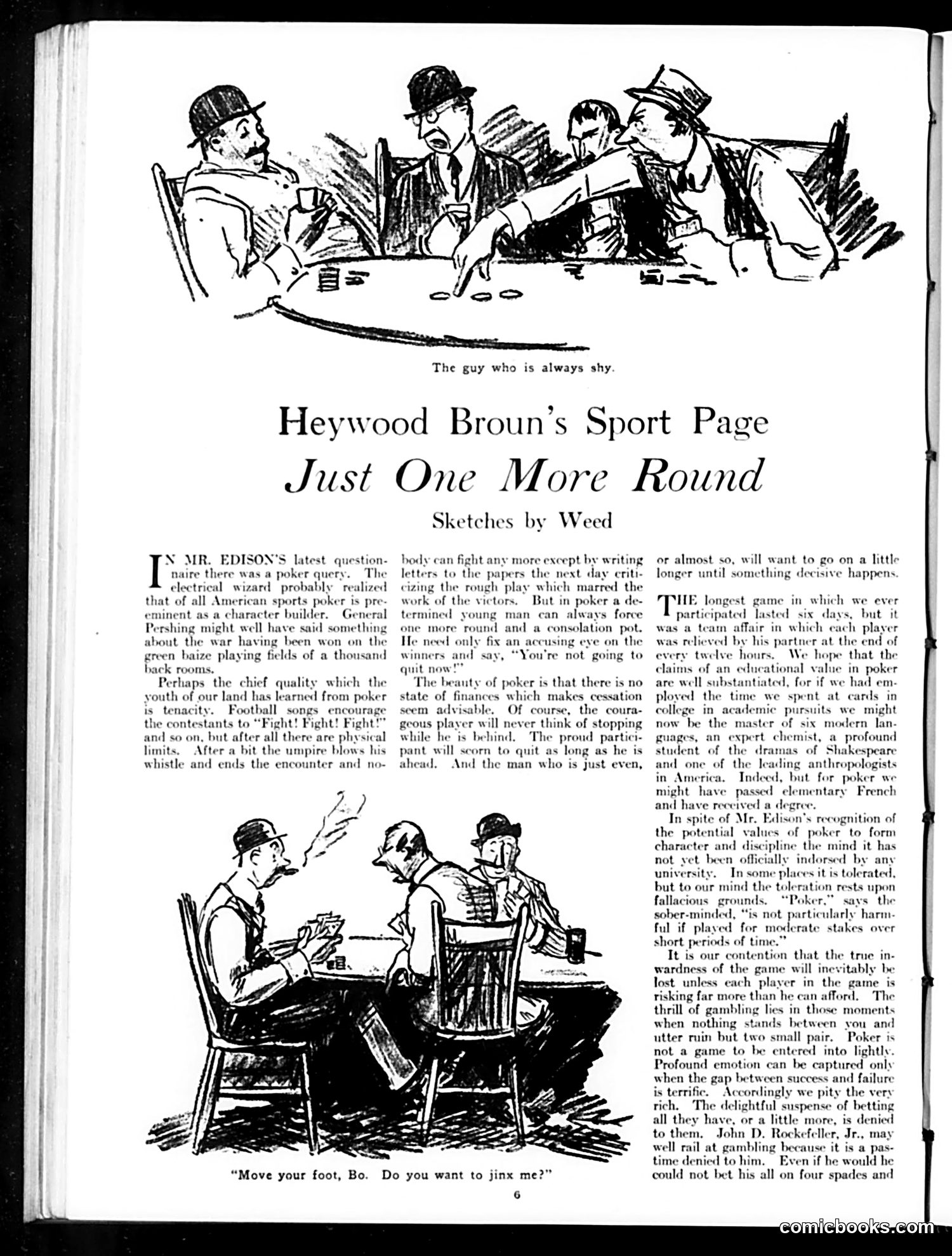
This sports column satirizes poker as a character-building activity, ironically treating the card game with mock seriousness. The sketch shows men at a poker table, with the caption "Move your foot, Bo. Do you want to jinx me?" — depicting the superstitious rituals surrounding gambling. Broun's essay argues that poker builds "tenacity" and teaches valuable life lessons, comparing it to military discipline (referencing General Pershing and WWI). However, the satire is layered: he simultaneously critiques wealthy industrialists like John D. Rockefeller Jr., who cannot truly experience gambling's "thrill" because they cannot meaningfully risk their fortunes. The piece mocks both poker's educational pretensions (it's not officially endorsed by universities) and the paradox that the game's true value lies only in genuine financial risk—making it inaccessible to the truly wealthy. The humor targets American attitudes about gambling, masculinity, and class during the Jazz Age.
📄 Transcribed text from this page (OCR, searchable)
Machine-transcribed from the original scan — historical spelling and the odd misread are preserved.
The guy who is always shy Heywood Broun’s Sport Page Just One More Round Sketches by Weed naire there was a poker query. The electrical wizard probably ‘realized that of all American sports poker is pre- eminent as a cha r builder. neral Pershing might well have said something about the war having been won on the green baize playing fields of a thousand back rooms. Perhaps the chief quality which the youth of our land has learned from poker is tenacity. Foo the contestants to and so on, but after all there are physica limits, After a bit the umpire blows h whistle and ends the encounter and no- I: MR. EDISON’S latest question- “Move your foot, Bo. body can fight any more except by writing letters to the papers the next day eriti- cizing the rough play which marred the work of the victors. But in poker a de- termined young man can always force one more and a He need « winners quit now!” The beauty of poker is that there is no state of finances which makes cessation seem advisable. Of course, the coura- geous player will never think of stopping while he is behind, The proud _partici- ant will scorn to quit as long as he is ahead, And the man who is Just even, I say, “You're not going to Do you want to jinx me?” 6 or almost so, will want to go on a little longer until something decisive happens THe longest game partici 1 lasted six days, but it n affair in which each player was relieved by his partner at the end of sry twelve hours. We hope that the Jaims of an educational value in poker are well substantiated, for if we had em- ployed the time we spent at cards in college in academic pursuits we might now be the master of six modern lan- guages, an expert chemist, a student of the drar and one in Ameri might and ha In spite of Mr. Edison's recognition of e potential values of poker to form cha: ne the mind it has not yet been offici indorsed by any university. In some places it is tolerated, but to our mind the toleration rests up fallacious grounds. ” says the sober-minded, “is not particularly harm- ful if pla for moderate stakes over short periods of time.” It is our contention that the true in- wardness of the game will inevitably be lost unless each player in the game is risking far more than he can aff The thrill of gambling lies in those moments when nothing stands between you and utter ruin but two small pair. Poker is not a game to be entered into lightly. Profound emotion can be captured only when the gap between success and failure is terrific. Accordingly we pity the very rich, The delightful suspense of betting all they ha little more, is denied to them, John D. Rockefeller, Jr., may well rail at gambling because it is a pas- time denied to } Even if he would he in which we ever was a te: ng anthropologists Indeed, but for poker we » passed elementary French th