
Judge, 1922-12-02 · page 13 of 36
Judge — December 2, 1922 — page 13: what you’re looking at
What you’re looking at
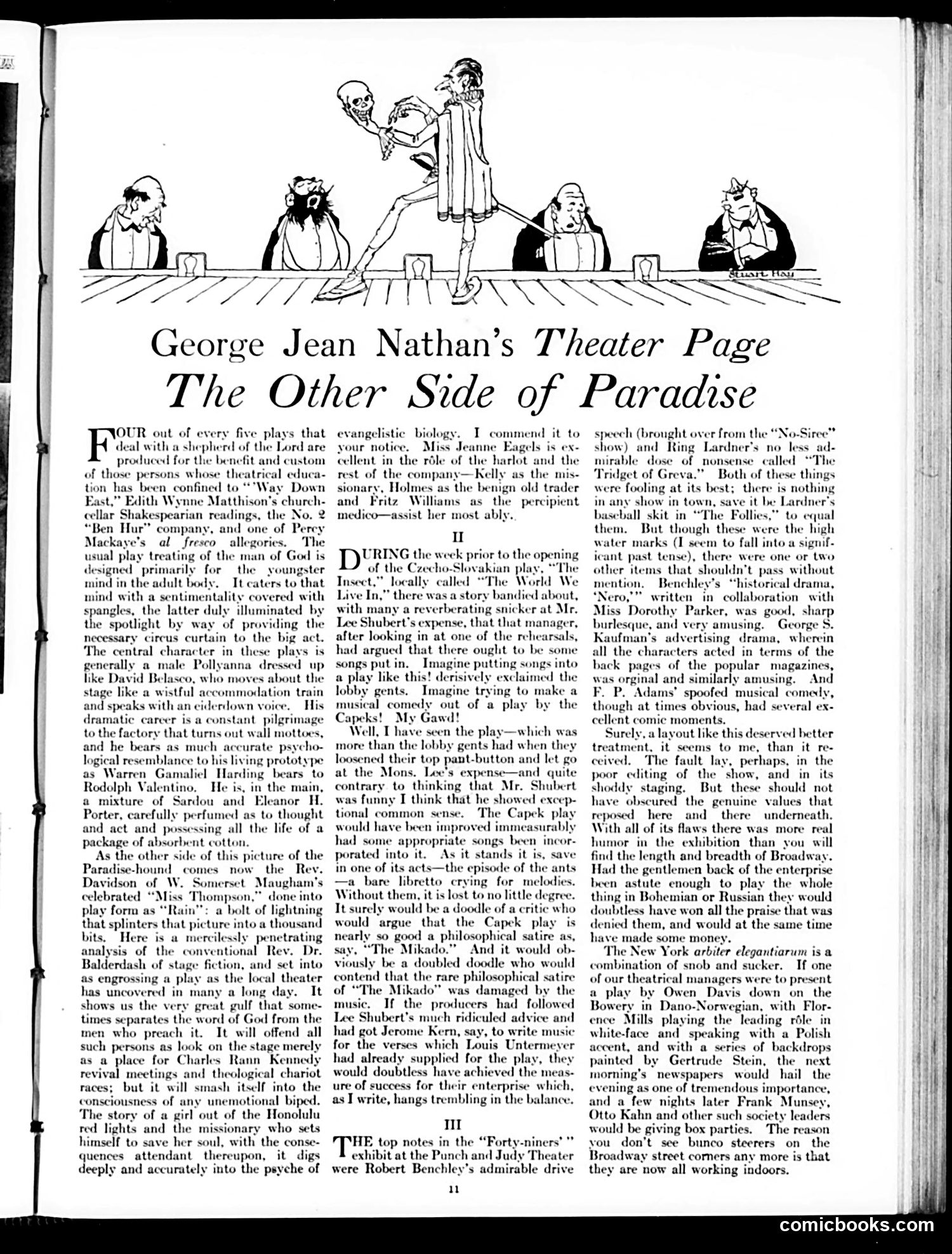
This theater criticism column by George Jean Nathan discusses two contrasting plays featuring religious figures. The header illustration shows caricatured judges or authority figures seated at a bench, satirizing theatrical gatekeepers. Nathan criticizes the typical stage "man of God"—a sentimental, unrealistic character designed for unsophisticated audiences, resembling Eleanor H. Porter's saccharine writing more than genuine human complexity. He compares this false piety to Warren G. Harding versus Rudolph Valentino: superficially similar but fundamentally different. By contrast, he praises W. Somerset Maugham's "Rain" (adapted as a stage play featuring Jeanne Eagels), which unflinchingly examines a missionary's hypocrisy when confronted with a Honolulu prostitute. Nathan argues this play succeeds precisely because it penetrates psychological reality rather than offering comfortable sentimentality—a "bolt of lightning" exposing the gap between religious preaching and actual morality.
📄 Transcribed text from this page (OCR, searchable)
Machine-transcribed from the original scan — historical spelling and the odd misread are preserved.
George Jean Nathan’s Theater Page The Other Side of Paradise OUR out of every five plays that deal with a shepherd of the Lord are produced for benefit and custom of those persons whose theat educa- tion has been confined to “’Way Down East,” Edith Wynne Matthison’s church- cellar Shakespearian readings, the No. 2 “Ben Hur” company, and one of Pere Mackaye’s al fresco allegories. usual play treating of the man of God is designed primarily for the youngster mind in the adult body, It caters to that mind with a sentimentality covered with spangles, the latter duly illuminated by the spotlight by way of providing the necessary circus curtain to the big act. ter in these plays is Pollyanna dressed up . who moves about the stage like a wistful. accommodation train and speaks with an ciderdown voice. His dramatic carcer is a constant pilgrimage to the factory that turns out wall mottoes, and he bears as much accurate psycho- logical resemblance to his living prototype as Warren Gamaliel Harding bears to Rodolph Valentino, He is, in the main, a mixture of Sardou and Eleanor H. Porter, carefully perfumed as to thought and act and possessing all the life of a package of absorbent cotton, As the other side of this picture of the Paradise-hound comes now the Rev. Davidson of W. Somerset Maugham's celebrated ‘Miss Thompson,” done into play form as “Rain”: a bolt of lightning that splinters that picture into a thousand bits. Here is a m ssly penetrating analysis of the conventional Rev. Dr. Balderdash of stage fiction, and set into as engrossing a play as the local theater has uncovered in many a long day, It shows us the very great gulf that some- times separates the word of God from the men who preach it. It will offend all such persons as look on the stage merely as a place for Charles Rann Kennedy revival meetings and theological chariot races; but it will smash itself into the consciousness of any unemotional biped. The story of a girl out of the Honolulu red lights and the missionary who sets himself to save her soul, with the conse- quences attendant thereupon, it digs deeply and accurately into the psyche of The central ch: generally a male like David Belase evangelistic biology. I commend it to your notice. Miss Jeanne Eagels is ex- cellent in the role of the harlot and the rest of the company—Kelly as the mis- si Holmes as the benign old trader and Krite Williams as the percipient medico—assist her most ably. Il URING the wee Drigt to the opening of the Czech Tnsect,” locally called * Live In,” there was a Story bandied about, with many a reverberating snicker at Mr. Lee Shubert’s expense, that that manager, after looking in at one of the rehearsals, had argued that there ought to be some songs putin. Imagine putting songs into like this! derisively exclaimed the gents. Imagine trying to make a musical comedy out of a play by the ! My Gawd! T have seen the play—which was the lobby gents had when they loosened their top pant-button and let go at the Mons. Lee's expense—and quite contrary to thinking that Mr. Shubert was funny I think that he showed excep- tional common sense. The Capek play would have been improved immeasurably had some appropriate songs been incor- porated into it. As it stands it is, save in one of its acts—the episode of the ants —a bare libretto crying for melodies. Without them, it is lost to no little degree. It surely would be a doodle of a critic who would argue that the Capek pla nearly so good a philosophical satire “The Mikado.” And it would ob- viously be a doubled doodle who would contend that the rare philosophical satire of “The Mikado” was damaged by the music, If the producers had followed Lee Shubert’s much ridiculed advice and had got Jerome Kern, say, to write music for the verses which Louis Untermeyer had already supplied for the play, they would doubtless achieved the meas- ure of success for their enterprise which, as I write, hangs trembling in the balance. Tl THE top notes in the “Forty-niners’ exhibit at the Punch and Judy Thea’ were Robert Bench} admirable drive speech (brought over from the “No-Siree”™ show) and Ring Lardner’s no less ad- mirable dose of nonsense called “The ‘Tridget of Greva.” Both of these things were fooling at its best; there is nothing in any show in town, save it be Lardner’s baseball skit in “The Follies,” to equal them. But though these were the high water marks (I seem to fall into a signif- icant t tense), there were one or two other items that shouldn't pass without mention. Benchley’s “historical drama, ‘Nero,’ written in collaboration with Miss Dorothy Parker, was good, sharp burless dd very amusing. George Kaufman's advertising drama, wherein all the characters acted in terms back pages of the popular magazi was orginal and similarly amusing. And F. P. Adams’ spoofed musical comely, though at times obvious, had several ex- cellent comic moments. Surel, yout like this deserved better treatment, it seems to me, than it re- ceived. The fault lay, perhaps, in the poor editing of the show, and in its shoddy staging. But these should not have obscured the genuine values that reposed here and there underneath. With all of its flaws there was more real humor in the exhibition than you will find the length and breadth of Broadway. Had the gentlemen back of the enterprise been astute enough to play the whole thing in Bohemian or Russian they would doubtless have won all the praise that was denied them, and would at the same time have made some money. The New York arbiter elegantiarum is a combination of snob and sucker. If one of our theatrical managers were to present a play by Owen Davis down on the Bowery in Dano-Norwegian, with Flor- ence Mills playing the leading réle in white-face and speaking with a Polish accent, and with a series of b painted by Gertrude Stein, morning's newspapers would hail the evening as one of tremendous importance, and a few nights later Frank Munsey, Otto Kahn and other such society leaders would be giving box parties. The reason you don’t see bunco steerers on the Broadway street comers any more is that they are now all working indoors. comicbooks.com