
A complete issue · 36 pages · 1922
Judge — November 25, 1922
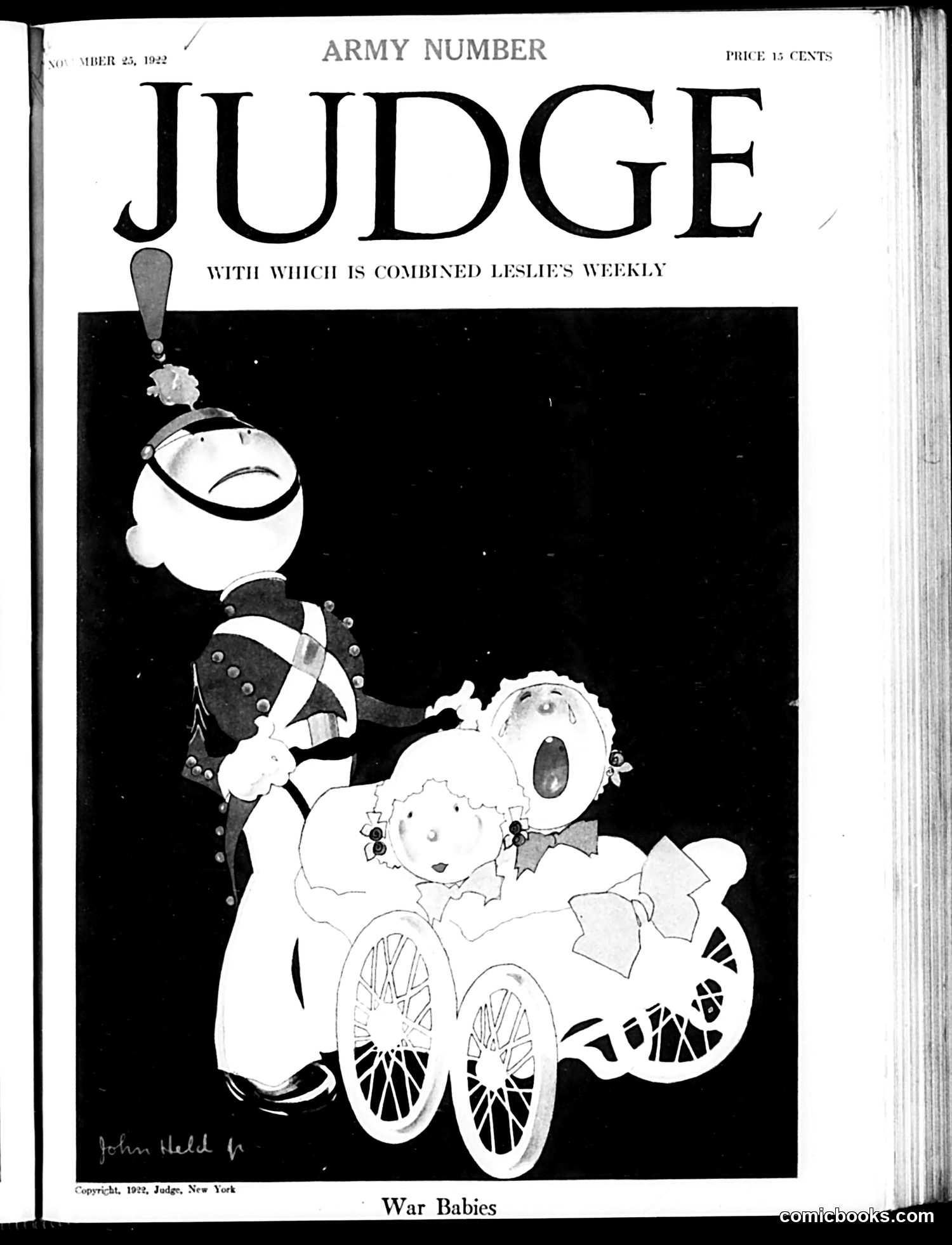
This satirical illustration depicts babies in a carriage labeled "War Babies," drawn by a soldier in military uniform. The babies appear as various anthropomorphized objects—including what seem to be weapons or military equipment styled as infants. The title references children born during or immediately after World War I (1914-1918, U.S. involvement 1917-1918). The satire likely critiques the generation born from wartime circumstances—possibly commenting on illegitimate births, hasty wartime marriages, or the societal disruption caused by the Great War. The soldier pushing this "carriage" of military-styled babies suggests the war's lasting legacy and burden on society in the post-war period.
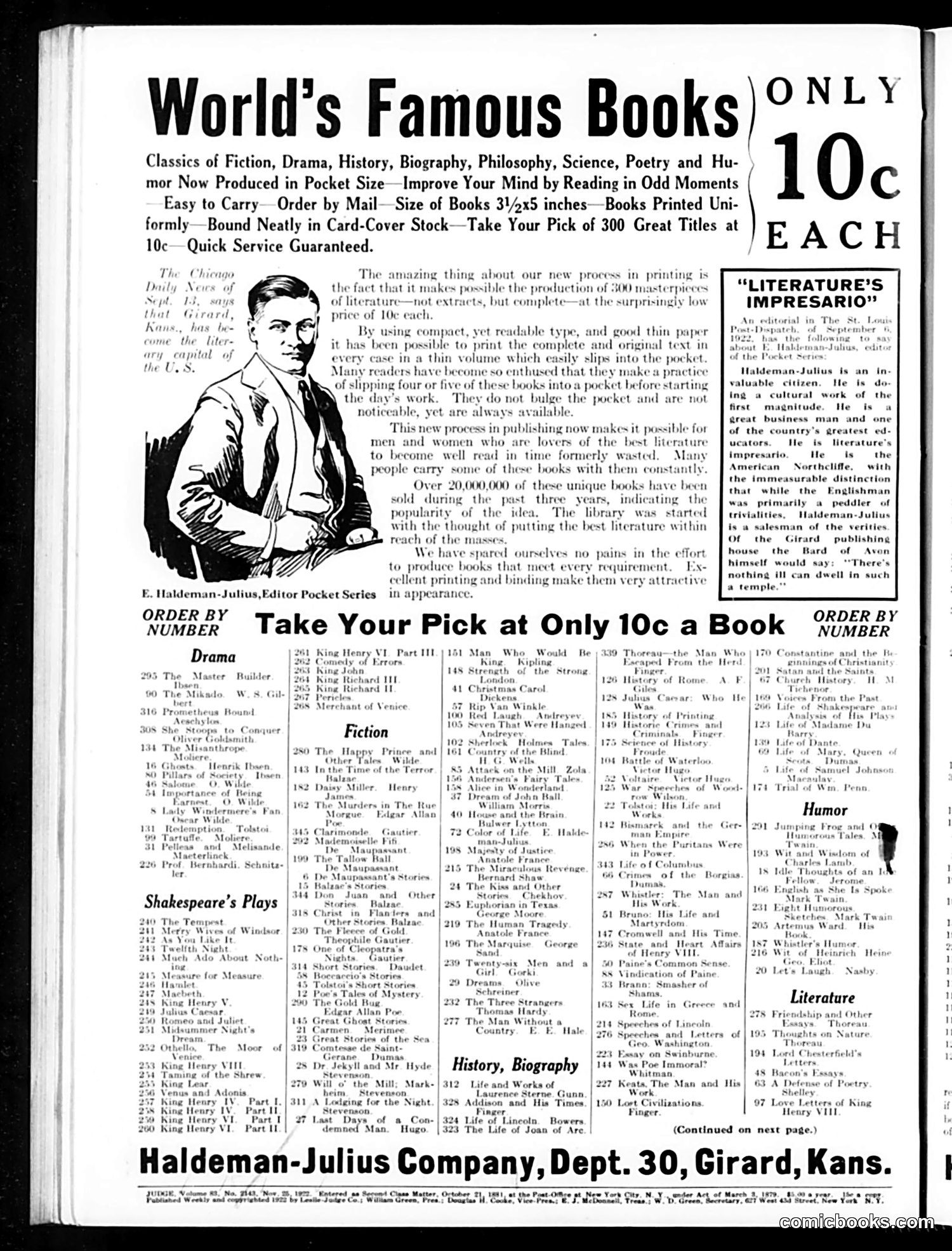
This page is **primarily an advertisement**, not a political cartoon. It's a full-page ad from Haldeman-Julius Company promoting their "World's Famous Books" series—classic literature sold for only 10 cents per pocket-sized volume. The illustration shows a well-dressed man (likely representing an educated reader or the publisher) and includes an editorial testimonial praising the series as "Literature's Impression." The ad emphasizes accessibility: over 20 million copies sold, books small enough to carry, readable in spare moments. The extensive numbered list catalogs available titles across Drama, Fiction, Shakespeare's Plays, History, Biography, Literature, and Humor—positioning cheap, portable books as democratizing culture for ordinary Americans. This reflects early 20th-century publishing innovation making literature affordable for mass audiences.
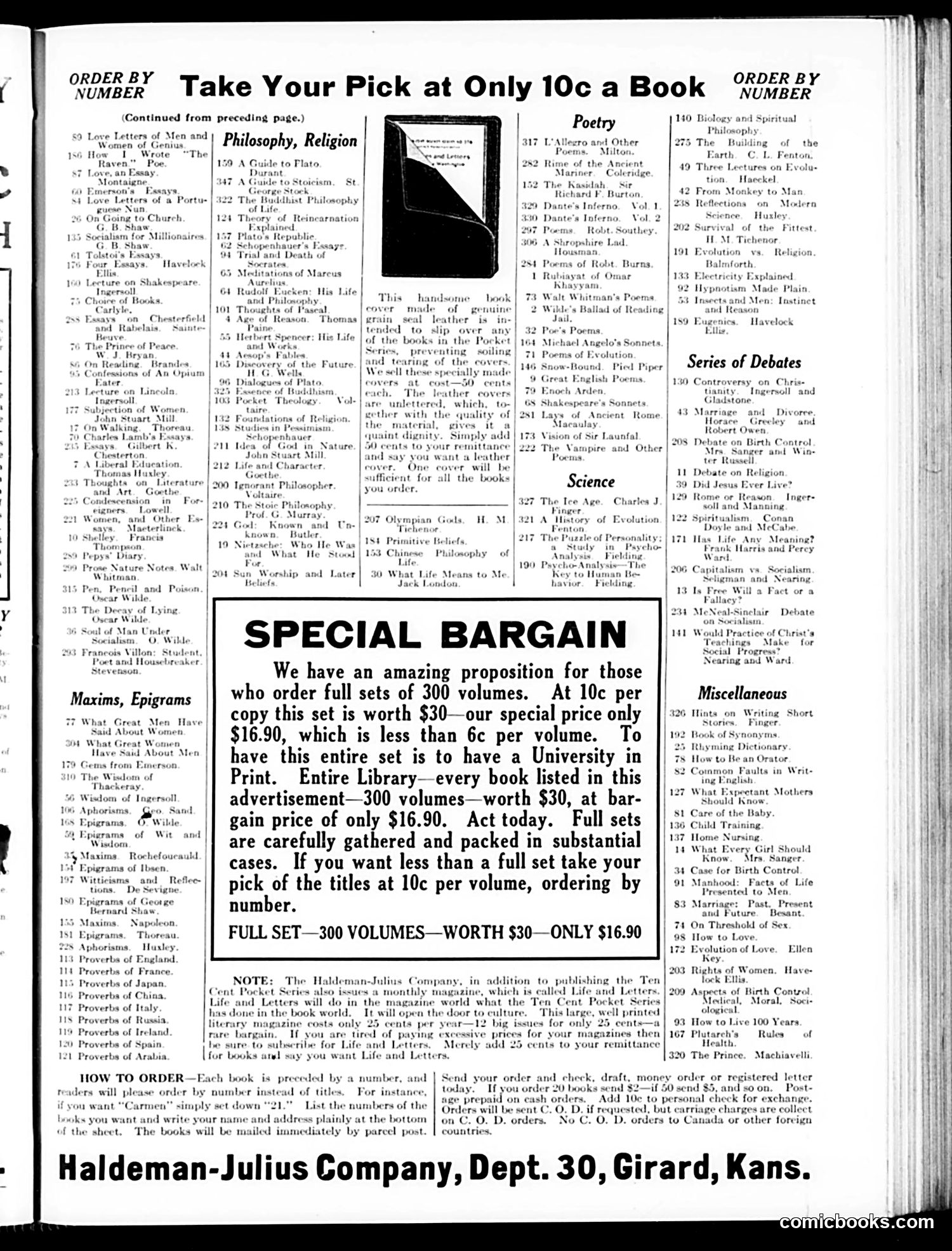
This page is **primarily advertising**, not political satire. It consists of: 1. **Book catalog listings** organized by category (Philosophy/Religion, Poetry, Science, Series of Debates, Miscellaneous) 2. **A prominent "Special Bargain" advertisement** for the Haldeman-Julius Company offering a 300-volume "University in Print" library set for $16.90 (worth $30), or individual books at 10¢ each 3. **"Maxims, Epigrams" section** listing aphorism collections 4. **An instructional "How to Order" section** at bottom There is **no political cartoon visible** on this page. The small black rectangle appears to be a book cover image for the advertised set. This is a straightforward mail-order book sales page typical of early 20th-century magazine advertising.
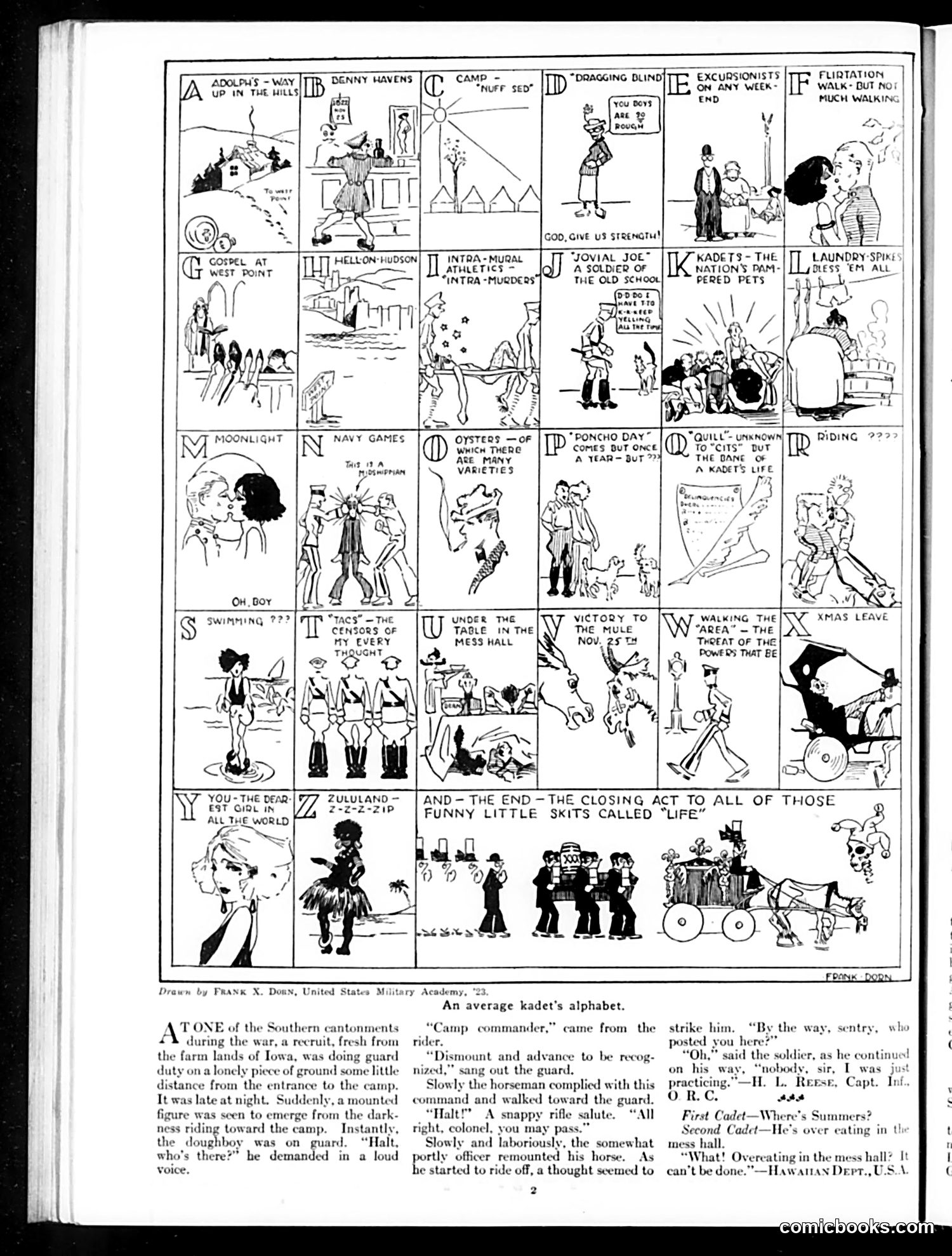
This page presents "An average kader's alphabet"—a military alphabet comic strip drawn by Frank X. Donn from the U.S. Military Academy (West Point), class of '23. Each letter (A-Z) depicts humorous scenes from cadet life: drilling, camp routines, swimming, dancing, and military ceremonies. The satire targets the absurdities of military training and discipline through visual jokes about marching, regulations, and cadet culture. The bottom story describes a recruit guarding camp who encounters a mounted officer; through comedic misunderstanding, the guard fails to recognize him properly, illustrating the confusion and rigidity of military protocol. The humor relies on readers' familiarity with cadet life and military conventions of the 1920s era.
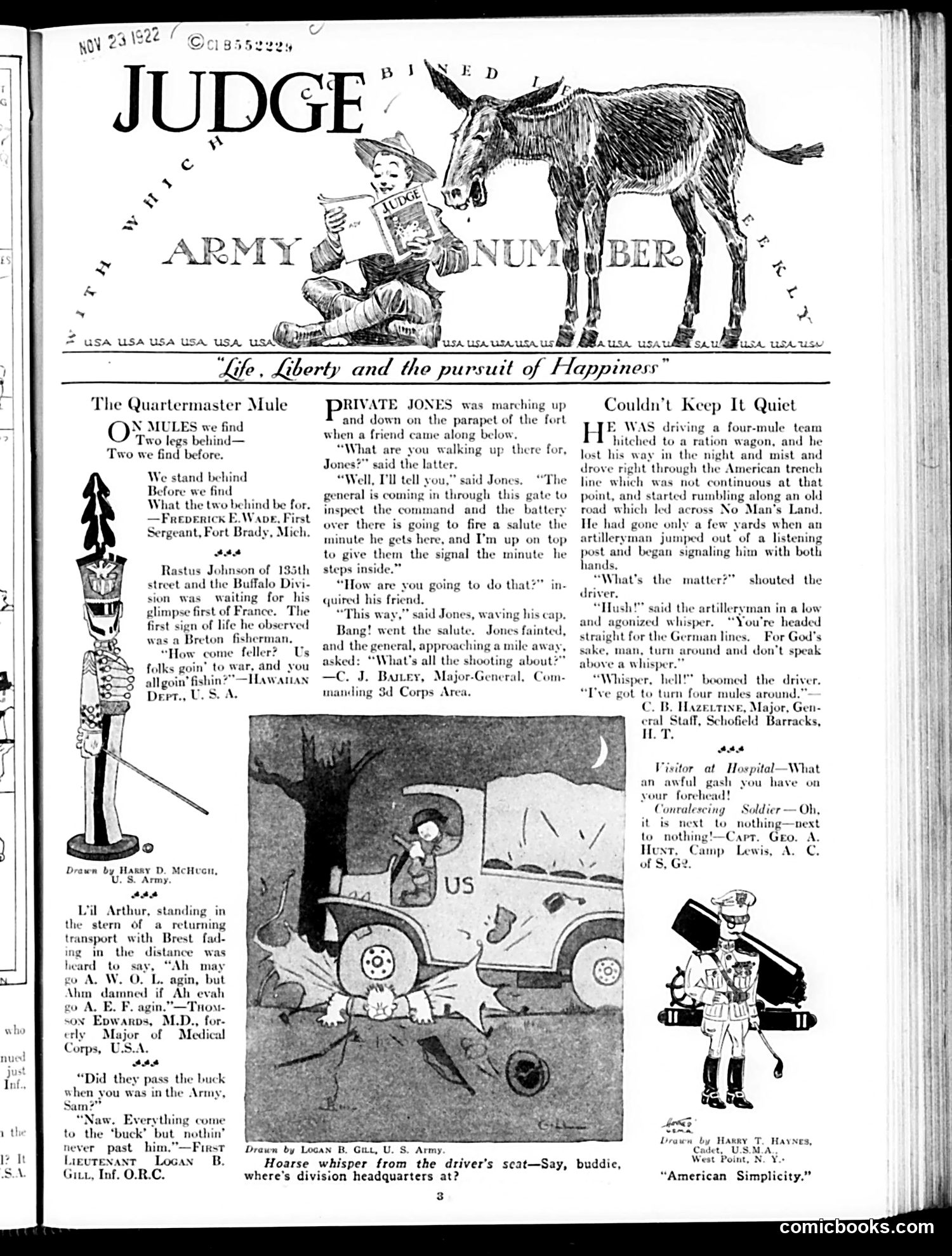
This 1922 page satirizes **Army life and military bureaucracy** through humor. The main cartoon shows a soldier driving a mule team lost at night, asking "where's division headquarters at?" — mocking the confusion and poor communication in military operations. The surrounding anecdotes mock Army inefficiency: a quartermaster unable to explain mule procurement, Private Jones receiving contradictory orders about saluting, and a driver scolded for speaking about getting lost (an officer demands silence rather than problem-solving). The cartoon's point: **the Army's rigid hierarchy and absurd rules** create chaos rather than competence. Officers prioritize obedience and appearances over practical results. The humor targets post-WWI military incompetence and the disconnect between command and field-level reality.
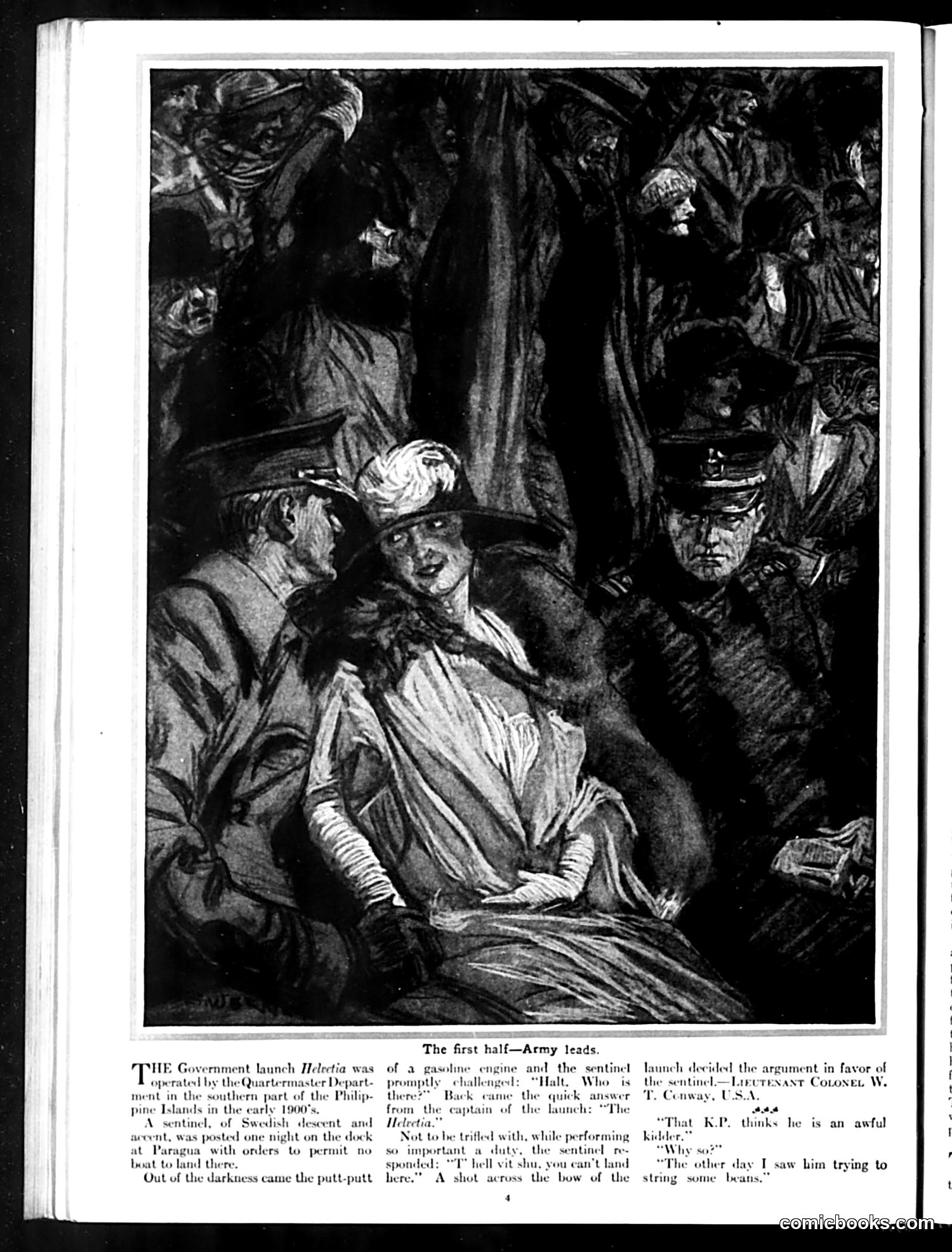
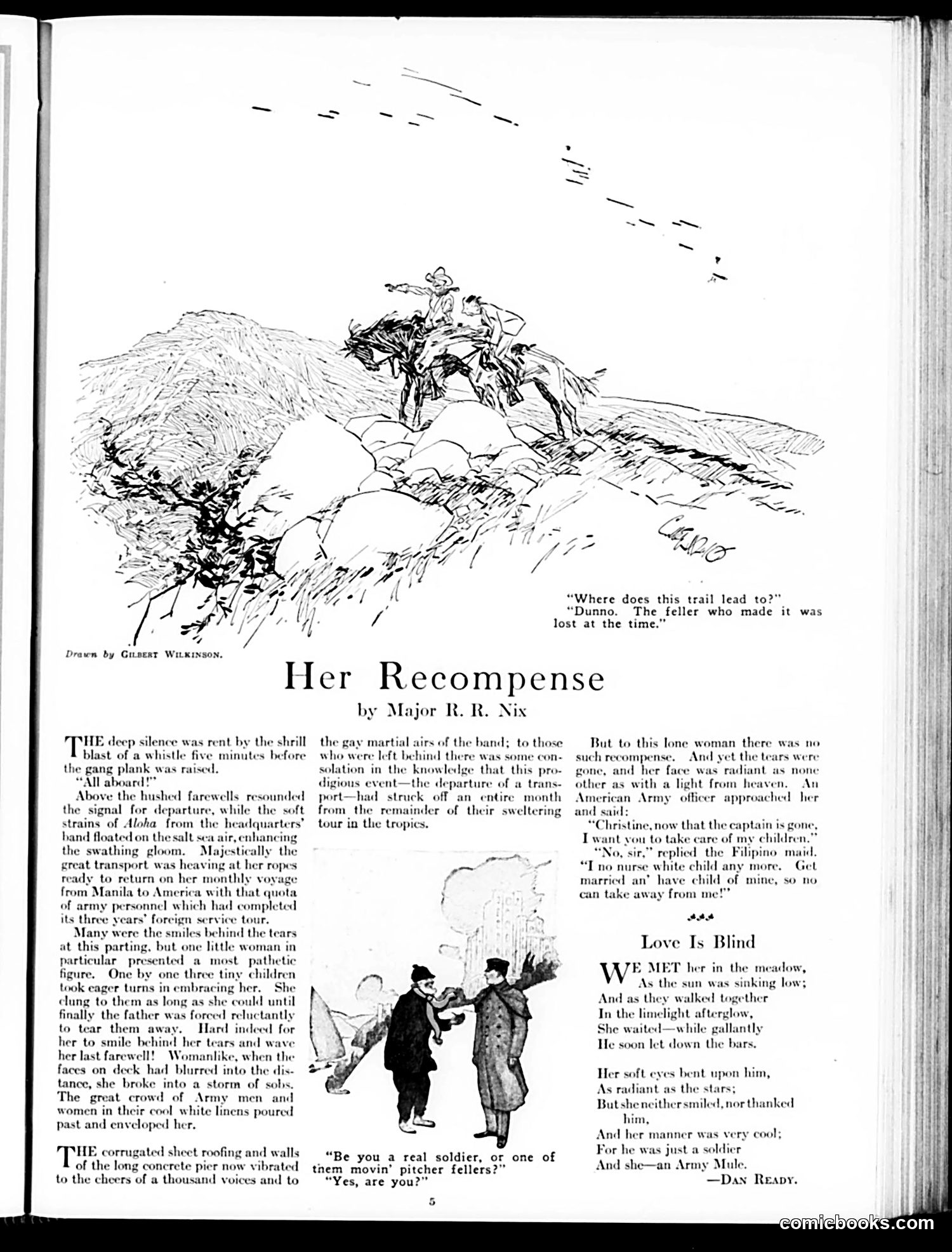
This page contains two pieces about American military life in the Philippines (likely early 20th century, given references to Manila transport ships and colonial army service). **"Her Recompense"** depicts a Filipino maid's emotional farewell as an Army transport departs. The satire lies in the anticlimactic resolution: though other soldiers celebrate their shortened tours, the maid Christine receives no compensation for her loss. The humor darkens when she declares she'll marry and have her own child so "no can take away from me"—a pointed comment on the precarity of colonial domestic workers whose charges are suddenly removed. **"Love Is Blind"** is a brief comic poem with a punchline: a soldier courts a woman in romantic moonlight, but the "beloved" is actually an Army mule. The joke relies on the absurdity of applying romantic language to an animal, mocking sentimental soldier poetry. Together, these pieces reflect Judge magazine's satirical treatment of American military experience abroad—mixing pathos with crude humor about colonial service and soldier life.
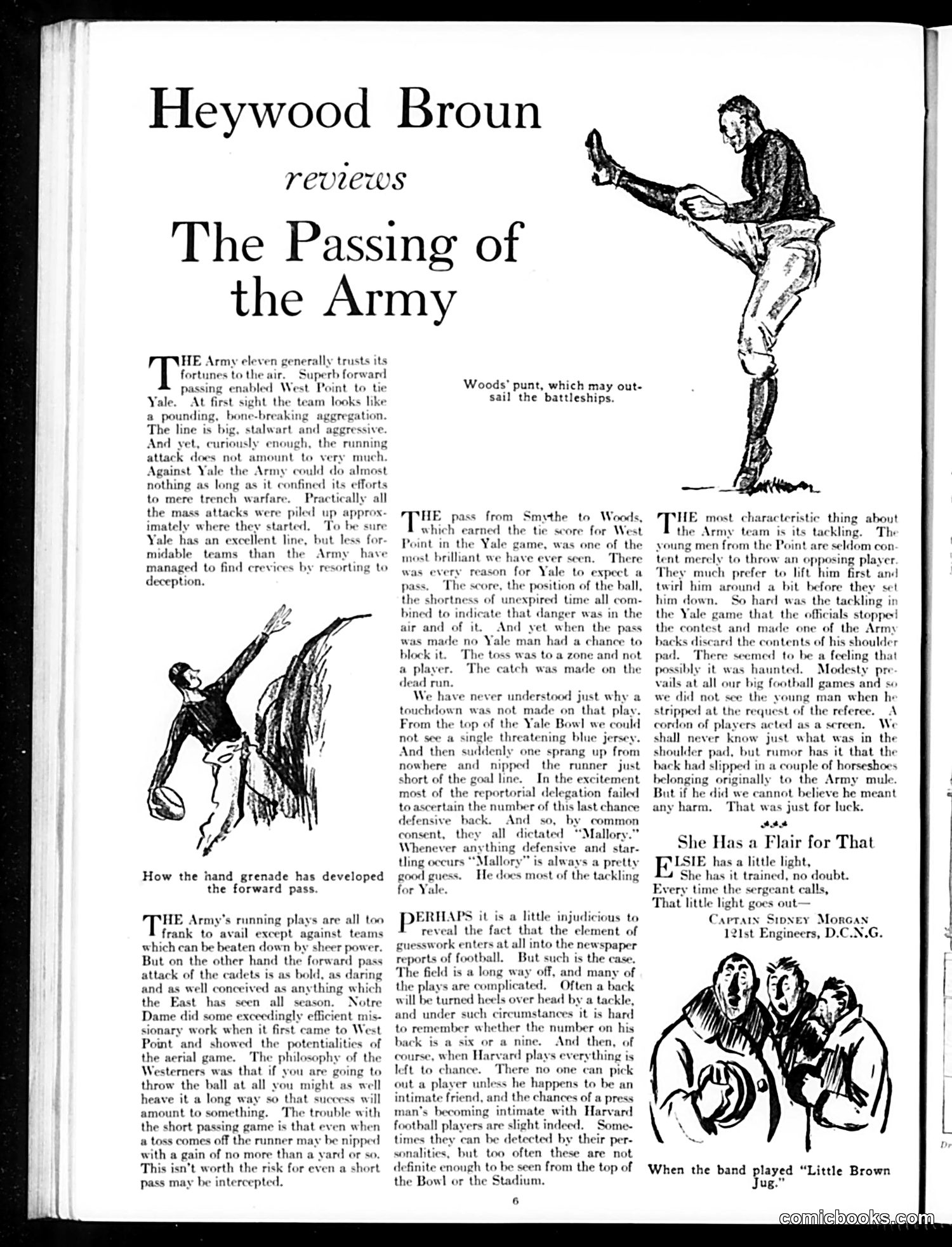
This is a sportswriting review by prominent critic Heywood Broun analyzing West Point's football team, comparing it favorably to Yale. The piece uses military metaphors throughout—hand grenades, trench warfare, defensive backs—linking football strategy to WWI combat tactics. The cartoons illustrate football plays: one shows a player executing a forward pass ("how the hand grenade has developed the forward pass"), another depicts a kicking technique. The humor lies in Broun's admission that sportswriters often guess at play details from the distant stands, inventing or misremembering player numbers and actions. He jokes that identifying players requires either intimate friendship or obvious "personalities." The piece reflects early 20th-century college football's cultural importance and contemporary journalistic frankness about reporting limitations—a refreshingly honest acknowledgment that sports coverage involved educated guessing rather than precise observation.
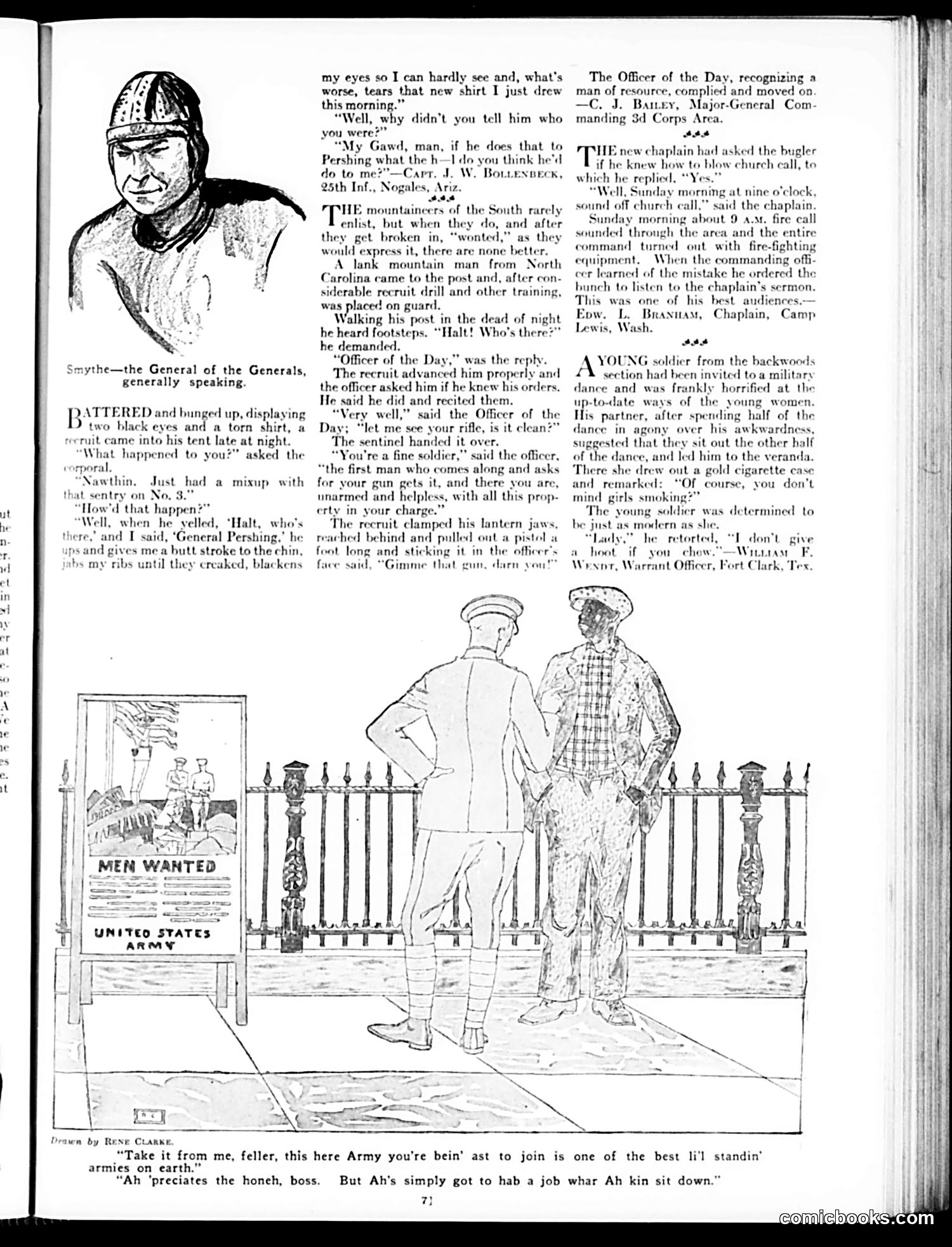
This page from *Judge* magazine contains several military-themed humorous anecdotes, likely from **World War I era** (references to General Pershing, Army recruitment, and training camps support this dating). The cartoons satirize **military discipline and culture**: 1. **"Smythe—the General of the Generals"**: A recruit beaten up by General Pershing explains why he didn't identify himself—implying even mentioning Pershing's name wouldn't help, as the General is indiscriminately brutal. 2. **The mountain recruit**: A backwoods soldier, given proper military instruction, paradoxically interprets his orders literally and violently: when tested by the Officer of the Day, he brandishes a knife and demands the officer's gun. 3. **Other brief sketches** mock recruits unfamiliar with modern social customs (a young soldier embarrassed by women smoking) and military bureaucracy (a chaplain's service accidentally disrupted by a fire drill). The humor targets the **clash between raw recruits and military formality**, and satirizes how strict discipline can produce absurd, unintended consequences.
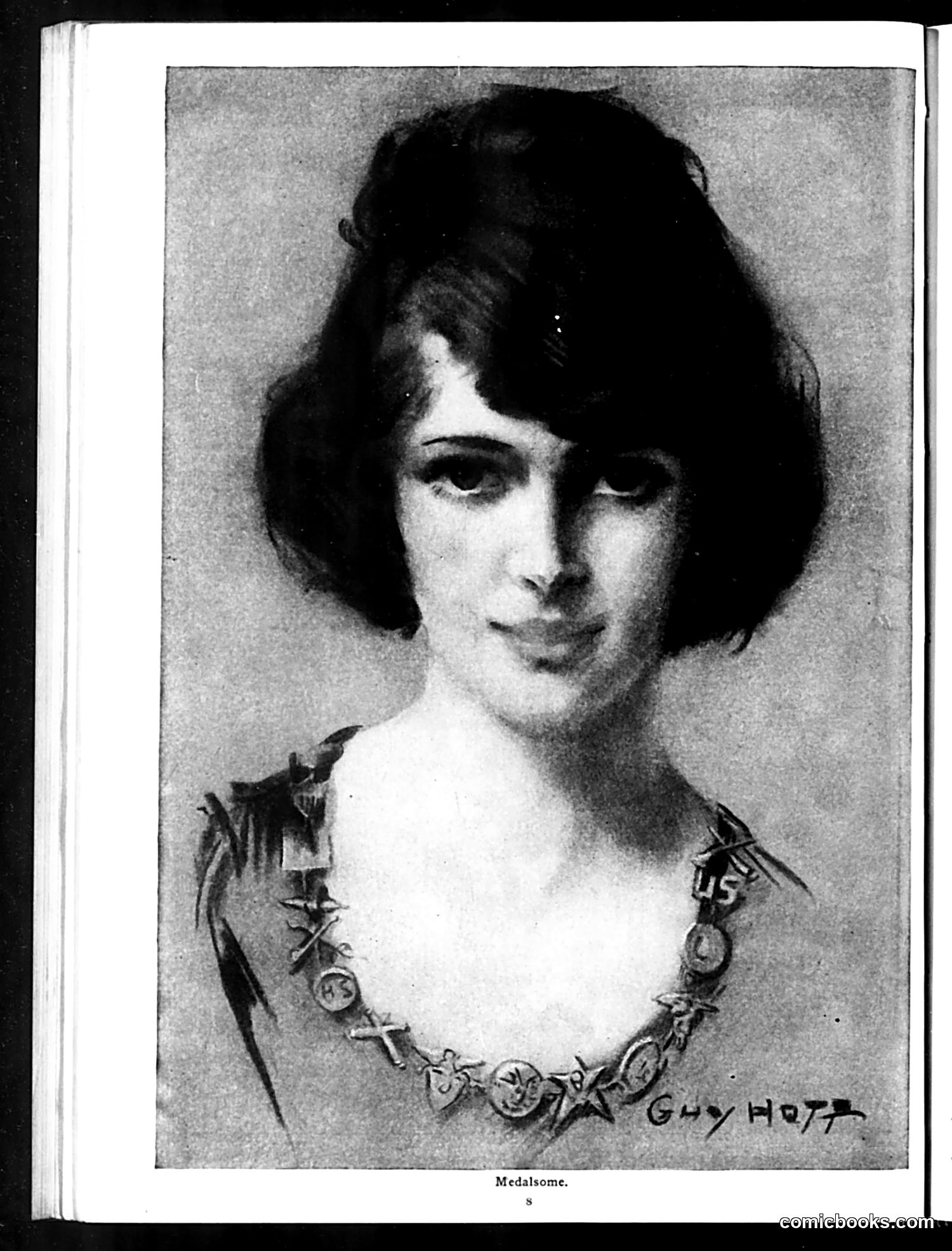
This page appears to be from *Judge* magazine and features a portrait photograph signed "Guy Hoff" of a woman wearing an elaborate decorative chain or necklace adorned with medals and cross symbols. The caption reads "Medalsome." The satire likely mocks a woman—possibly a society figure or public personality of the era—for ostentatiously displaying military medals, decorations, or honors. "Medalsome" is a pun combining "medals" with "meddlesome," suggesting she is both showy with honors and perhaps inappropriately involved in matters beyond her proper sphere. This was typical *Judge* satire targeting wealthy or socially prominent women who adopted militaristic affectations, particularly during or after wartime periods when medal-wearing held special significance.
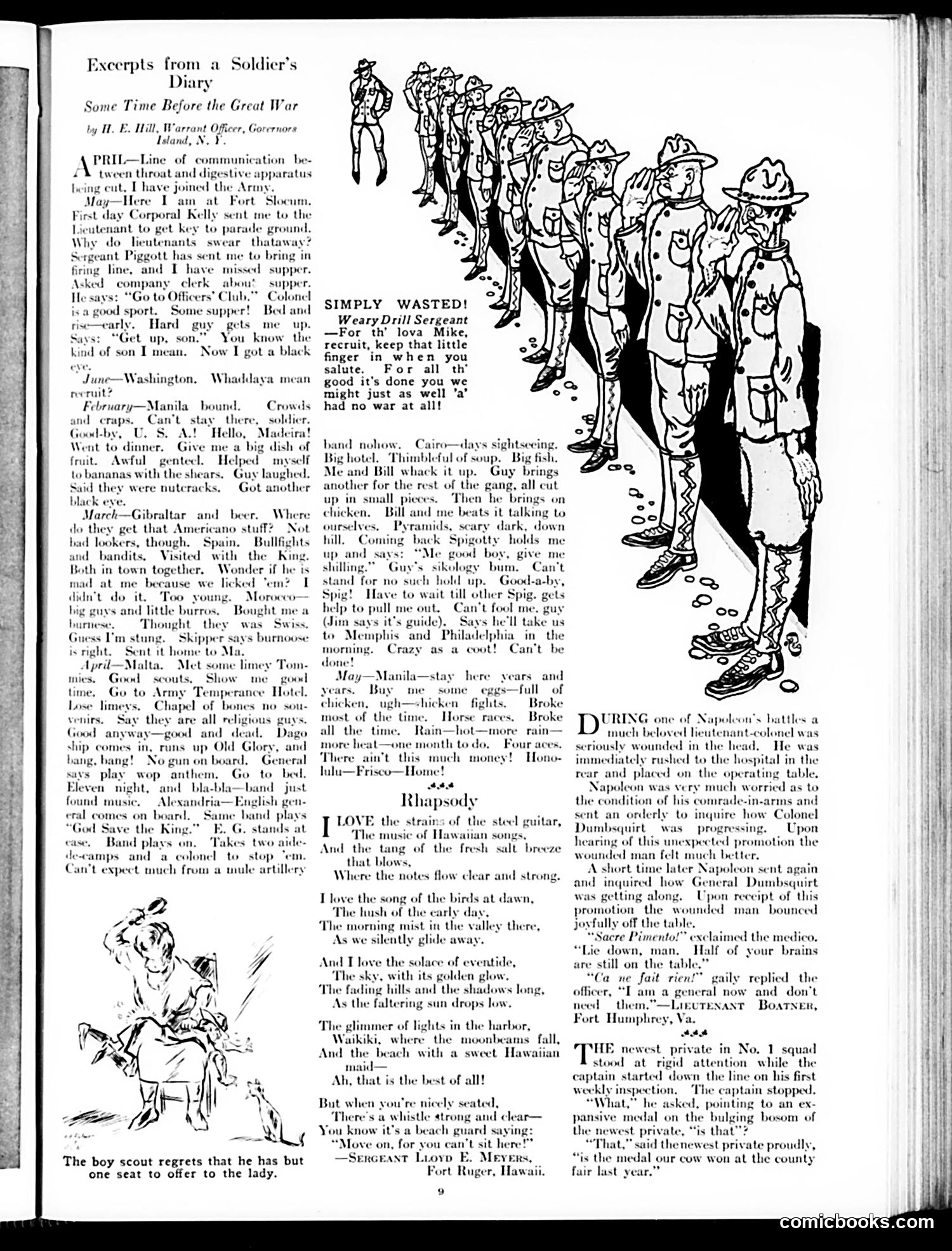
This page from *Judge* (pre-WWI era) contains military humor by H.E. Hill, a Warrant Officer stationed at Governors Island, New York. **"Excerpts from a Soldier's Diary"** satirizes army life through a recruit's naive observations. The entries mock military absurdities: officers' unexplained orders, poor food rations, tedious drill, and the general waste of peacetime military service. References to Gibraltar, Morocco, Cairo, Manila, and Honolulu suggest overseas postings. **"Simply Wasted!"** cartoon depicts a drill sergeant complaining that a recruit's perfect salute form is pointless—the war effort renders such precision meaningless. The joke: meticulous training serves no actual purpose. **"Rhapsody"** is sentimental verse celebrating Hawaii's beauty, contrasting sharply with the diary's cynical tone. **"During one of Napoleon's battles..."** features a brief anecdote about a wounded officer promoted while hospitalized. The punchline—his joy at promotion provides better recovery than medicine—satirizes military vanity and the healing power of ego. Overall, the page mocks peacetime military life as monotonous, underfed, and absurdly rigid.
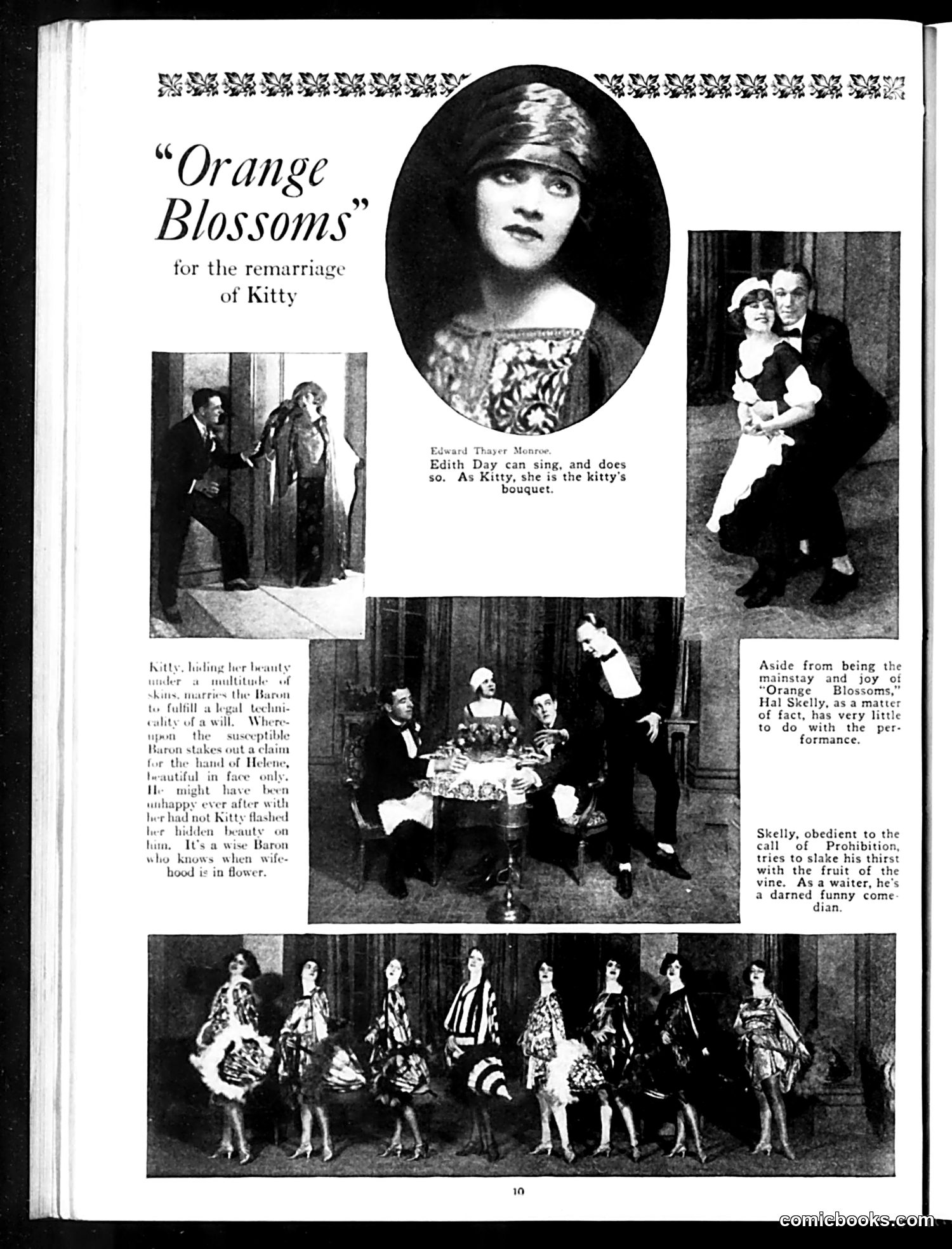
This page reviews a Broadway play titled "Orange Blossoms," likely from the 1920s. The plot involves a woman named Kitty who marries a Baron to fulfill a will's legal requirement, then later reveals her hidden beauty to win back his affection when he pursues another woman. The review praises actress Edith Day's performance as Kitty and notes that actor Hal Skelly, playing a waiter character, provides comic relief—including a joke about Prohibition (the alcohol ban then in effect) where his character tries to drink wine despite the law. The multiple photographs show scenes from the production and a chorus line. The satire here is gentle theatrical criticism rather than political commentary—it's entertainment journalism critiquing the actors' performances and the play's romantic plot mechanics.
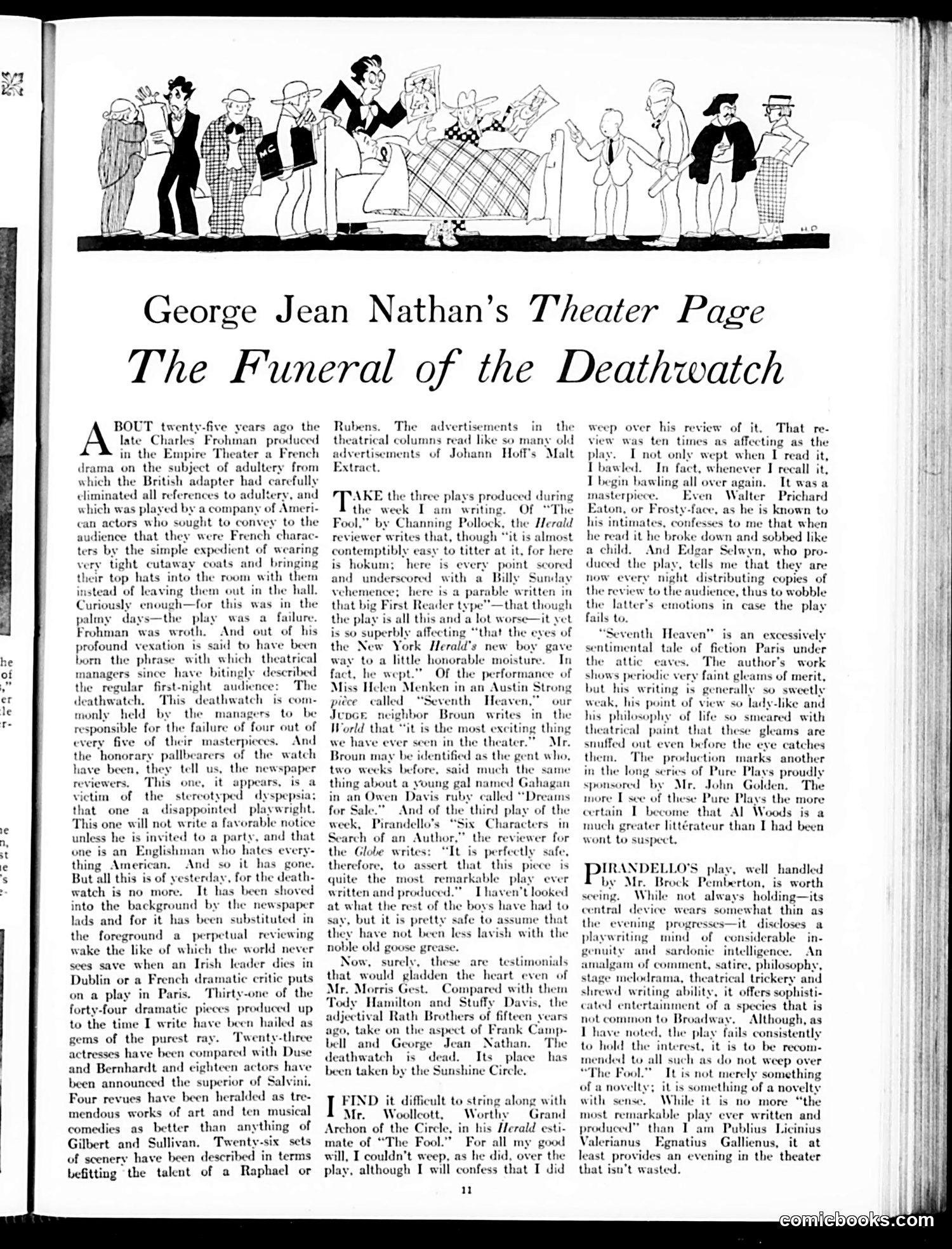
This is a theater criticism column by George Jean Nathan, not a political cartoon. The header illustration depicts various theatrical characters and scenes. Nathan argues that theater critics have abandoned their traditional role as skeptical "deathwatch"—a term coined when Charles Frohman blamed critics for killing plays decades earlier. Now, Nathan observes, critics have become absurdly effusive cheerleaders. He cites three recent plays that received wildly hyperbolic reviews: critics called mediocre works "gems," compared actresses to the legendary Duse and Bernhardt, and described ordinary scenery in terms befitting Renaissance masters like Raphael. Nathan's satire targets the degradation of theatrical criticism—critics once held managers accountable; now they provide promotional puffery indistinguishable from patent medicine advertisements. The "funeral" refers to the death of honest critical judgment.
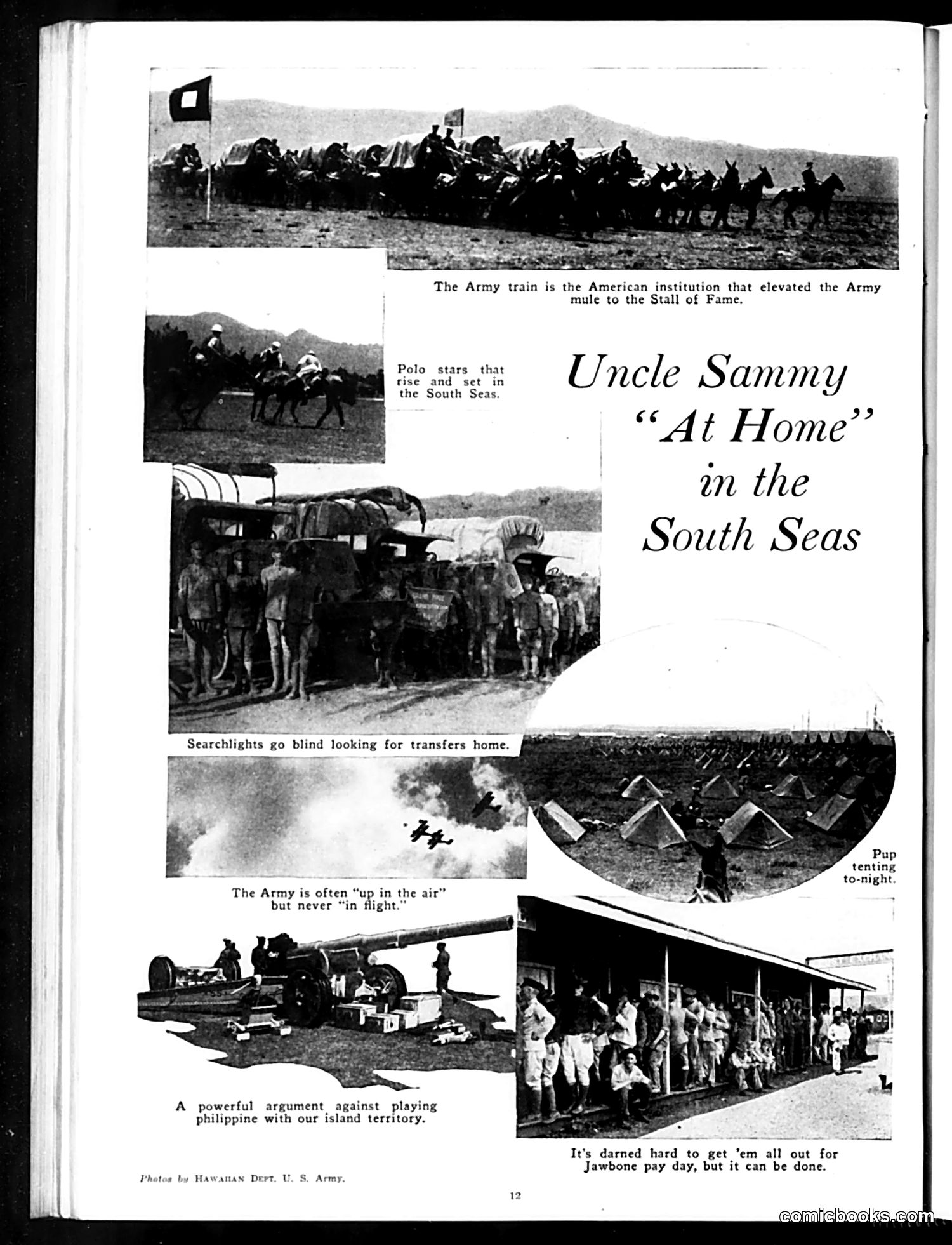
This page satirizes American military operations in the Philippines and Pacific territories during the early 20th century. "Uncle Sammy" represents the United States conducting colonial activities overseas. The captions mock various aspects of military life in these territories: mules serving in the Army train, polo played by officers, searchlights scanning for "transfers home" (soldiers trying to leave), and aircraft operations. The final caption—"A powerful argument against playing philippine with our island territory"—directly critiques U.S. imperial expansion, suggesting the difficulties and complications of maintaining these distant colonies justify reconsidering the policy. The humorous tone masks serious political debate: imperialist expansion was contested in early-1900s America. The page presents military complications as evidence that colonialism wasn't worthwhile for the nation.
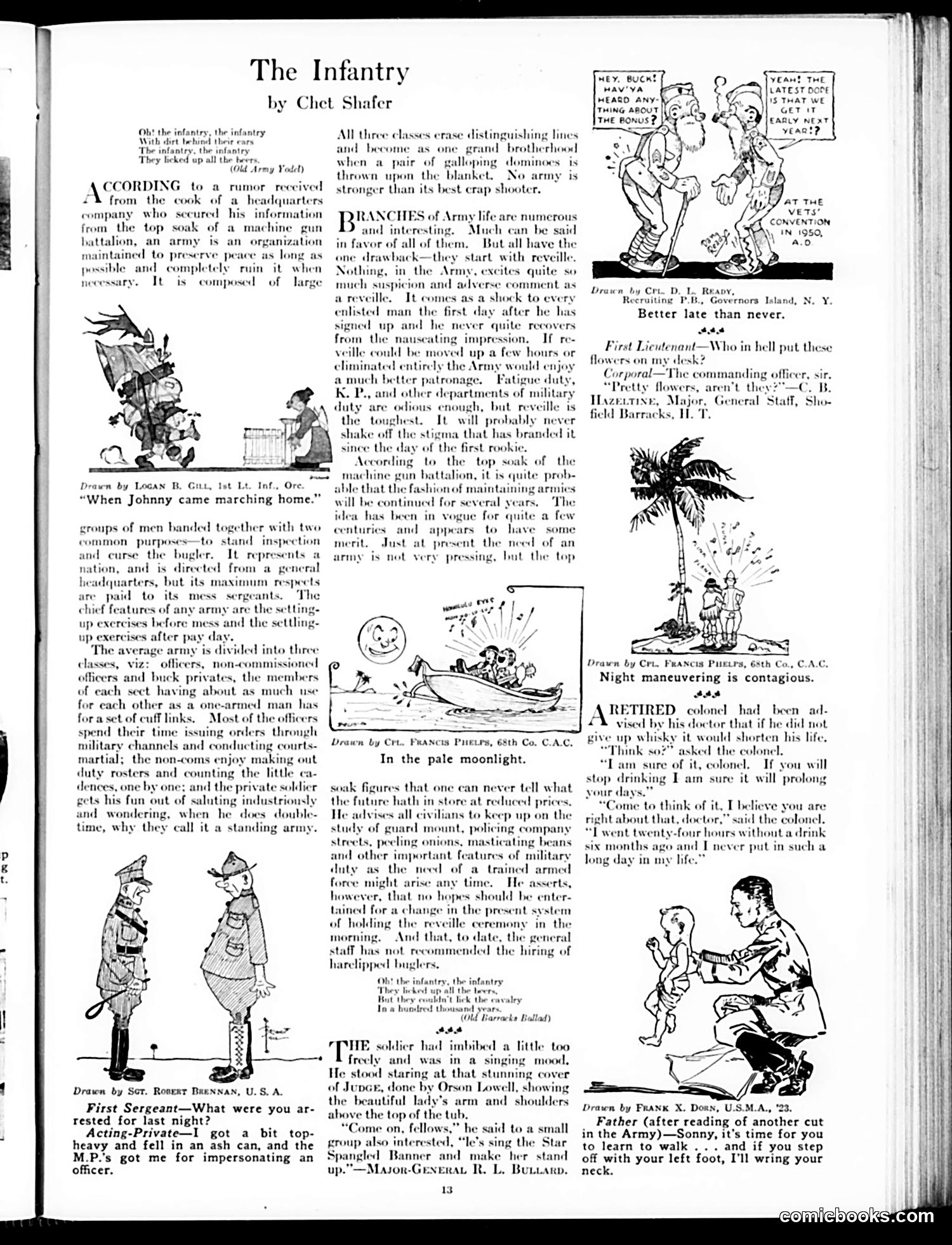
This is a satirical piece about Army life, likely from the 1920s post-WWI era. The article humorously critiques military organization and culture through soldiers' perspectives. **Main satirical points:** - The Army is described as an organization existing to "preserve peace" while simultaneously being designed to "completely ruin" soldiers when necessary - **Reveille** (dawn wake-up call) is mocked as the most hated military tradition—"a shock to every enlisted man" - The three Army classes (officers, non-coms, privates) are said to have "about as much use for each other" as a one-armed man has for cuff links - A joke about a drunk soldier impersonating an officer by falling in an ash can satirizes the class divisions **The cartoons** illustrate soldiers in various indignities: drill inspections, night maneuvers, and a intoxicated soldier admiring a pin-up magazine cover—poking fun at soldier boredom and military absurdity. The tone suggests post-war cynicism about military necessity and the tedium of peacetime soldiering.
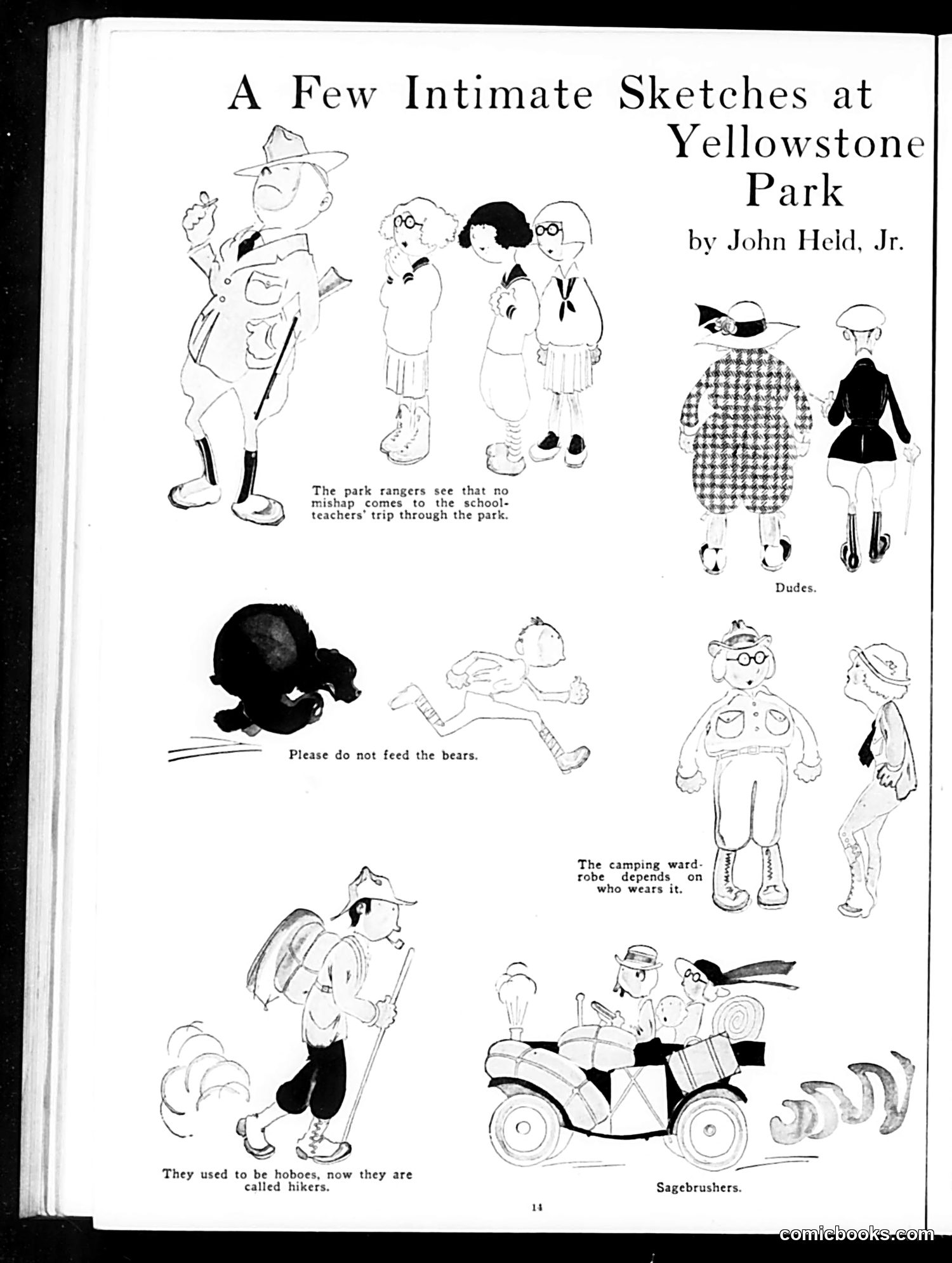
This humor page satirizes Yellowstone tourists through character types. The sketches mock: **School-teachers' trips**: Rangers must supervise these groups carefully, suggesting teachers were accident-prone tourists. **"Dudes"**: Well-dressed outsiders in fancy checkered coats, contrasted with practical park-goers. **Fashion inconsistency**: The "camping wardrobe" joke—clothing varies wildly depending on the wearer's actual experience level. **Hiking rebranding**: The final caption's wit—what used to be called "hoboism" (vagrant wandering) is now respectable "hiking," reflecting 1920s-30s tourism trends where working-class travel became romanticized leisure. The page presents Yellowstone as attracting diverse, often ill-prepared visitors, with rangers and park staff managing various tourist types. The humor relies on social class observations and the contrast between tourists' pretensions and reality.
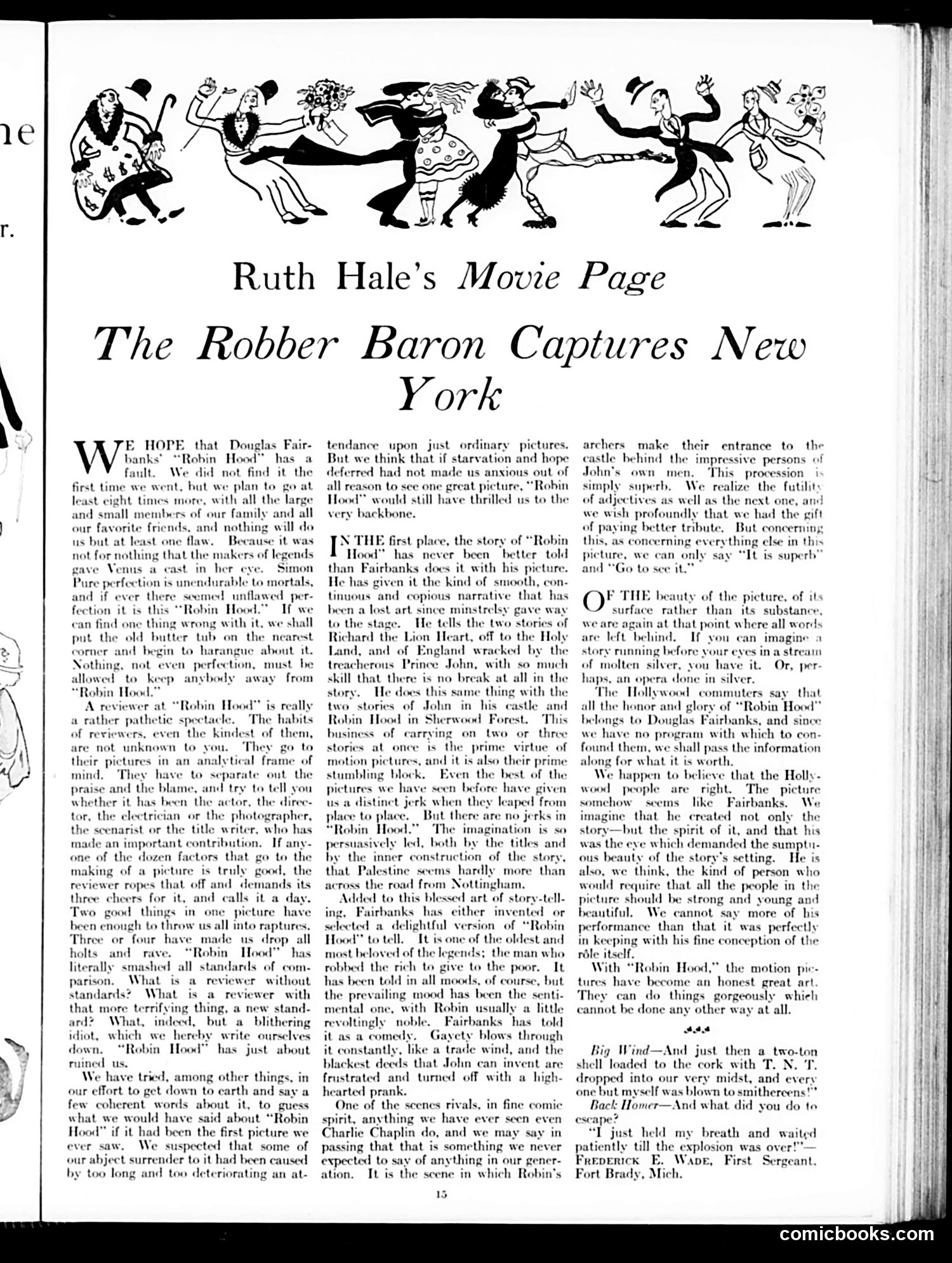
This page reviews Douglas Fairbanks's film adaptation of *Robin Hood*. The decorative header shows silhouettes of people in lively, dancing poses—representing the film's energy and appeal. The review, written by Ruth Hale, is extraordinarily enthusiastic. Hale admits she cannot find a single flaw in the picture and has seen it repeatedly. She praises Fairbanks's direction and cinematography for seamlessly interweaving multiple plotlines (Richard the Lionheart's crusade and Robin Hood's adventures) without jarring transitions—a technical achievement she considers rare in motion pictures. Notably, Hale appreciates that Fairbanks presents Robin Hood as **comedy** rather than sentimental drama, a departure from typical tellings that portray him as overly noble. The "Robber Baron" headline puns on Robin Hood as a thief who robs the rich to aid the poor—playfully contrasting this fictional hero with real American industrialists ("robber barons") of the era.
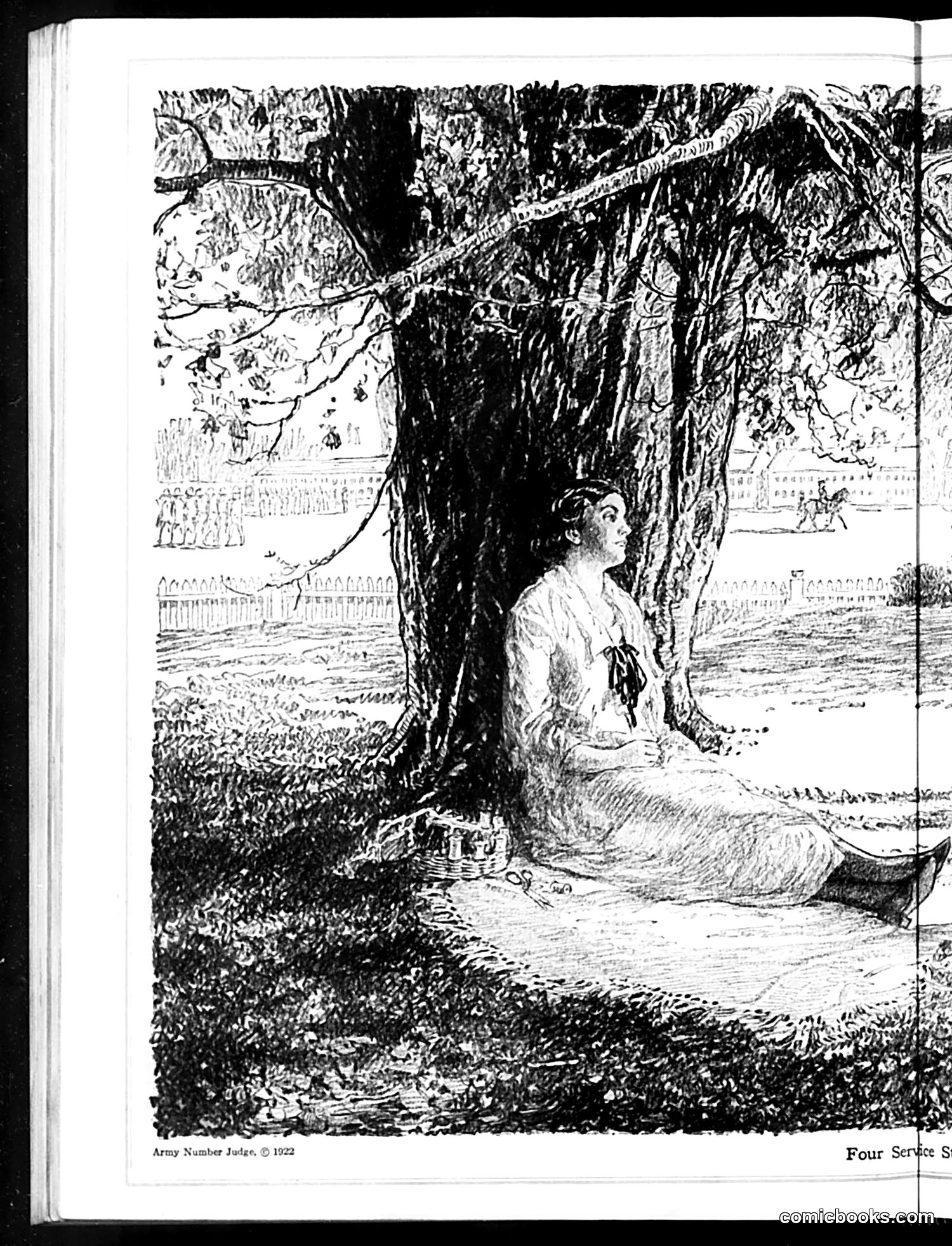
This page from *Judge* magazine (©1922) shows an illustration of a woman reclining against a large tree trunk in an idyllic pastoral setting. She wears a light dress and appears peaceful or contemplative. The caption reads "Army Number Judge" and references "Four Service" (text cut off). However, the OCR is garbled and unclear, making the specific satirical point difficult to determine with certainty. Given the 1922 date and "Army Number" reference, this likely relates to post-WWI themes. The pastoral scene contrasts with military subject matter, possibly commenting on soldiers' desire for peace and civilian life after service, or perhaps satirizing romanticized notions of the military. Without clearer text, the precise satire remains uncertain.
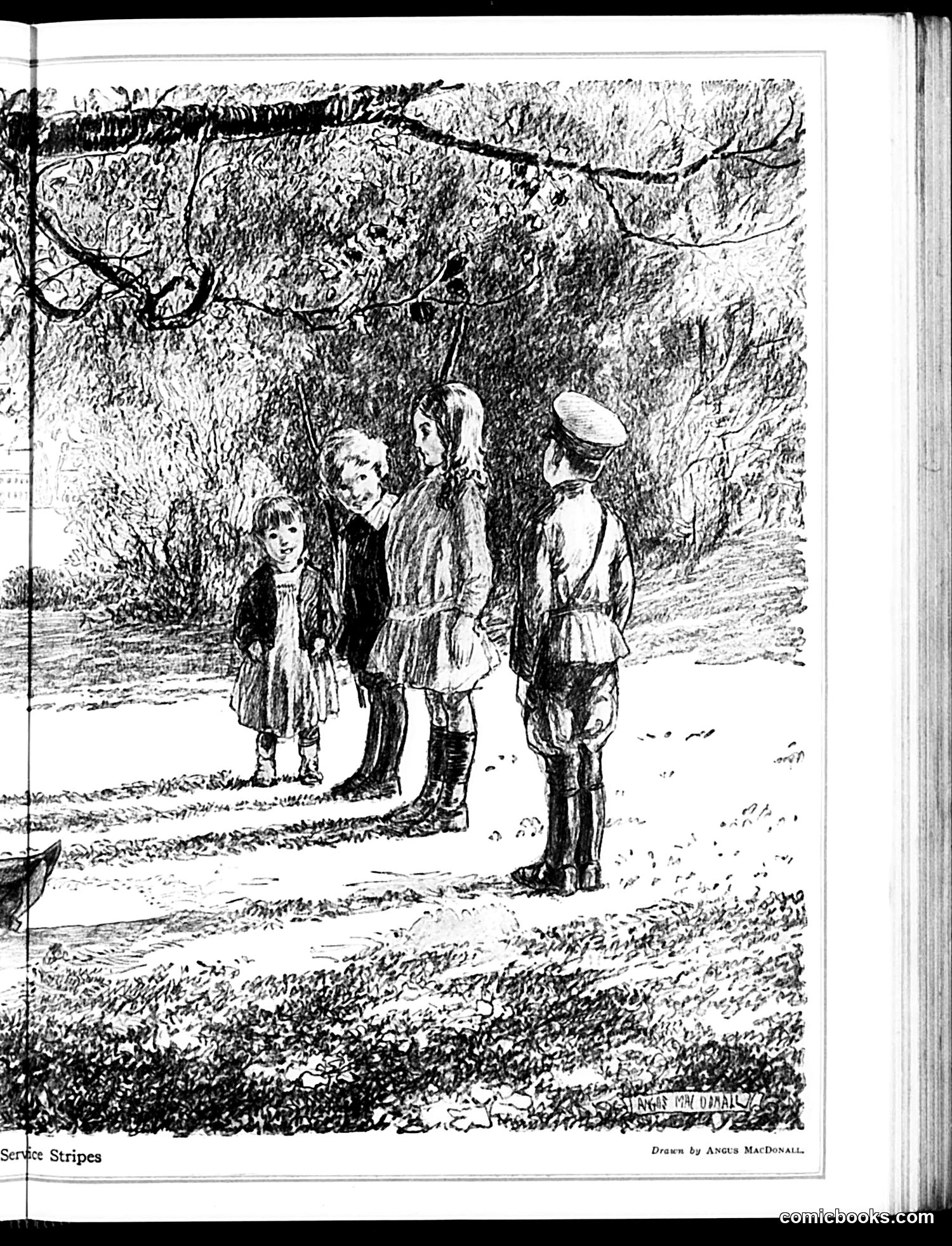
This appears to be a single illustration titled "Service Stripes," drawn by Angus MacDonall for *Judge* magazine. The image depicts four young boys or soldiers in military uniforms standing outdoors against a backdrop of dense foliage. Based on the title "Service Stripes"—which refers to insignia earned through military service—this likely satirizes child soldiers or the militarization of youth, a concern during wartime periods. The contrast between the boys' youth and their military dress suggests social commentary on early or inappropriate military recruitment or training of children. The specific historical context remains unclear without additional publication information, but the satire appears to critique involving minors in military service.
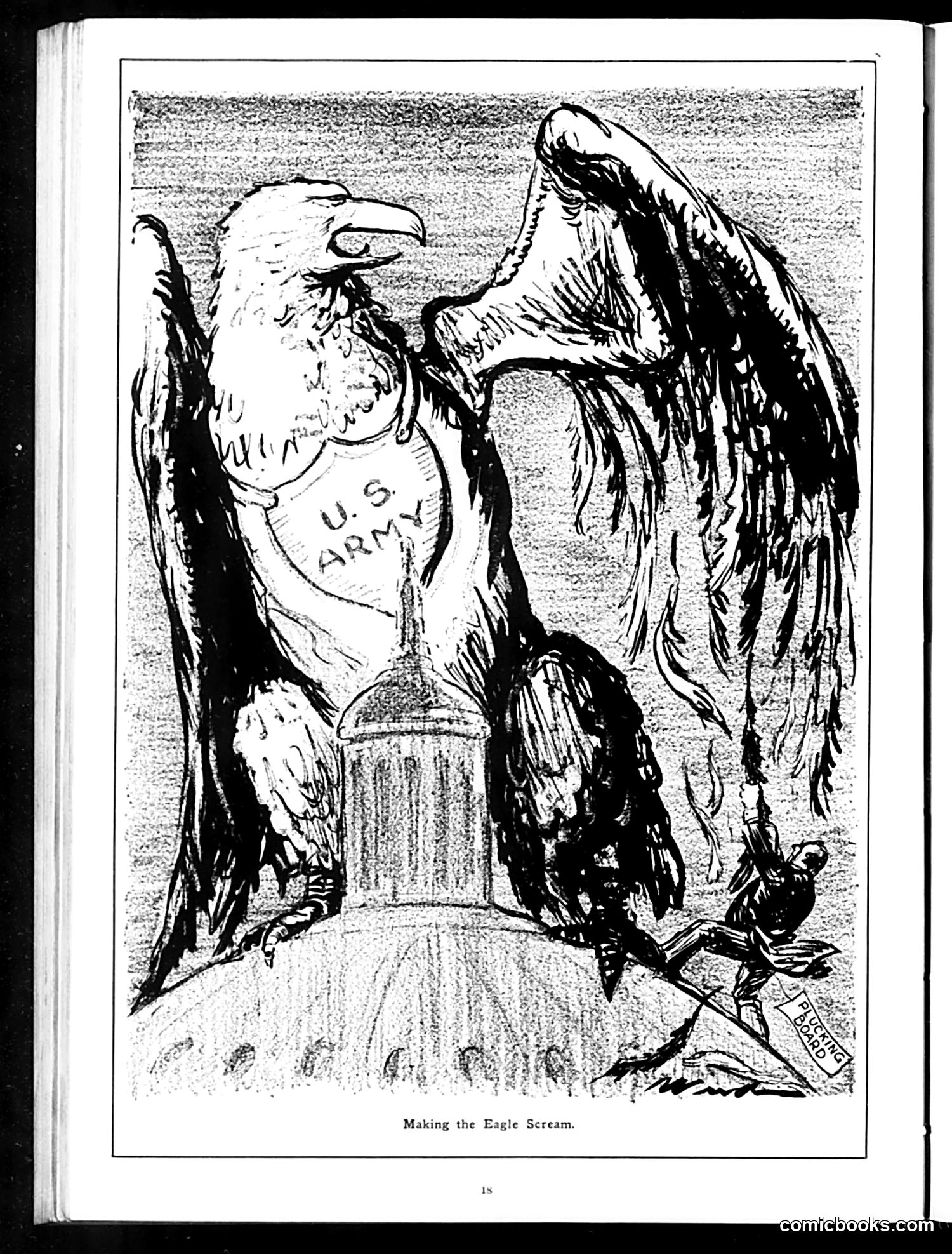
This political cartoon depicts an eagle (symbol of the United States military/imperialism) being tortured or attacked by two dark figures with wings—likely representing foreign powers or adversaries. The eagle wears "U.S. ARMY" on its body, emphasizing the American military focus. A small figure at bottom right appears to hold a document labeled "MONROE DOCTRINE," suggesting debates over American foreign policy interventions. The title "Making the Eagle Scream" suggests forcing America to cry out—implying the cartoon critiques either American military aggression abroad or foreign threats to American interests. Without a specific date visible, the exact historical context is unclear, though it likely references late 19th or early 20th-century debates over American imperialism or military interventions.
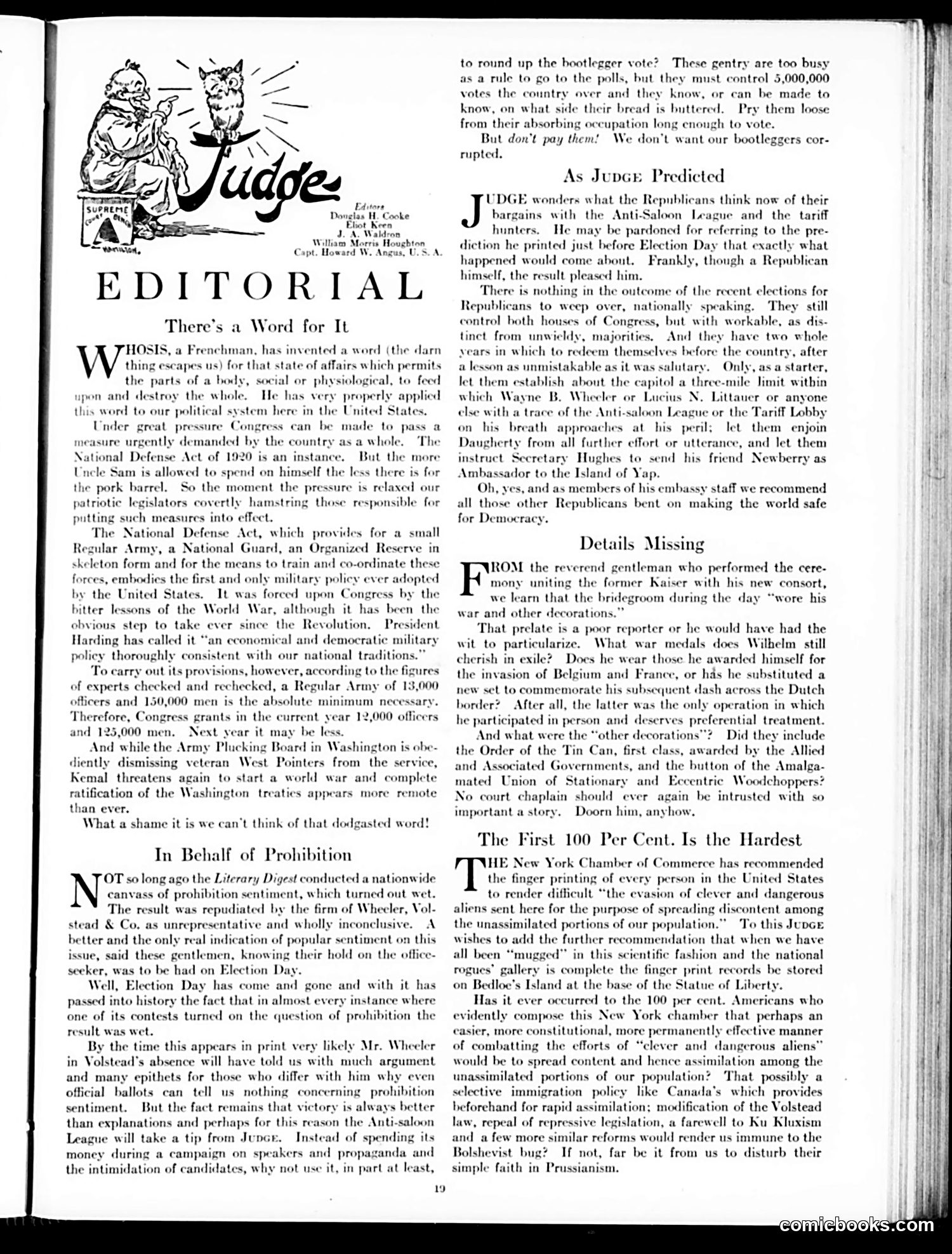
This page contains three editorial pieces satirizing early 1920s American politics: **"There's a Word for It"** critiques Congressional dysfunction, arguing that politicians only support necessary measures (like the 1920 National Defense Act) under public pressure, then quietly undermine them. The French word "whosis" apparently describes this legislative hypocrisy. **"In Behalf of Prohibition"** mocks anti-prohibition advocates Wheeler and Volstead, who dismissed a wet Literary Digest poll as unrepresentative. Judge sarcastically suggests the Anti-Saloon League should focus on getting bootleggers to vote rather than spending money on propaganda—without paying them, to avoid "corrupting" criminals. **"As Judge Predicted"** references an earlier prediction (not shown) about Republican electoral bargains with anti-saloon interests. The cartoon shows Judge (the magazine's mascot figure) confronting what appears to be a political figure, likely representing one of these criticized politicians. The overall tone is cynical about post-war American politics and enforcement of Prohibition.
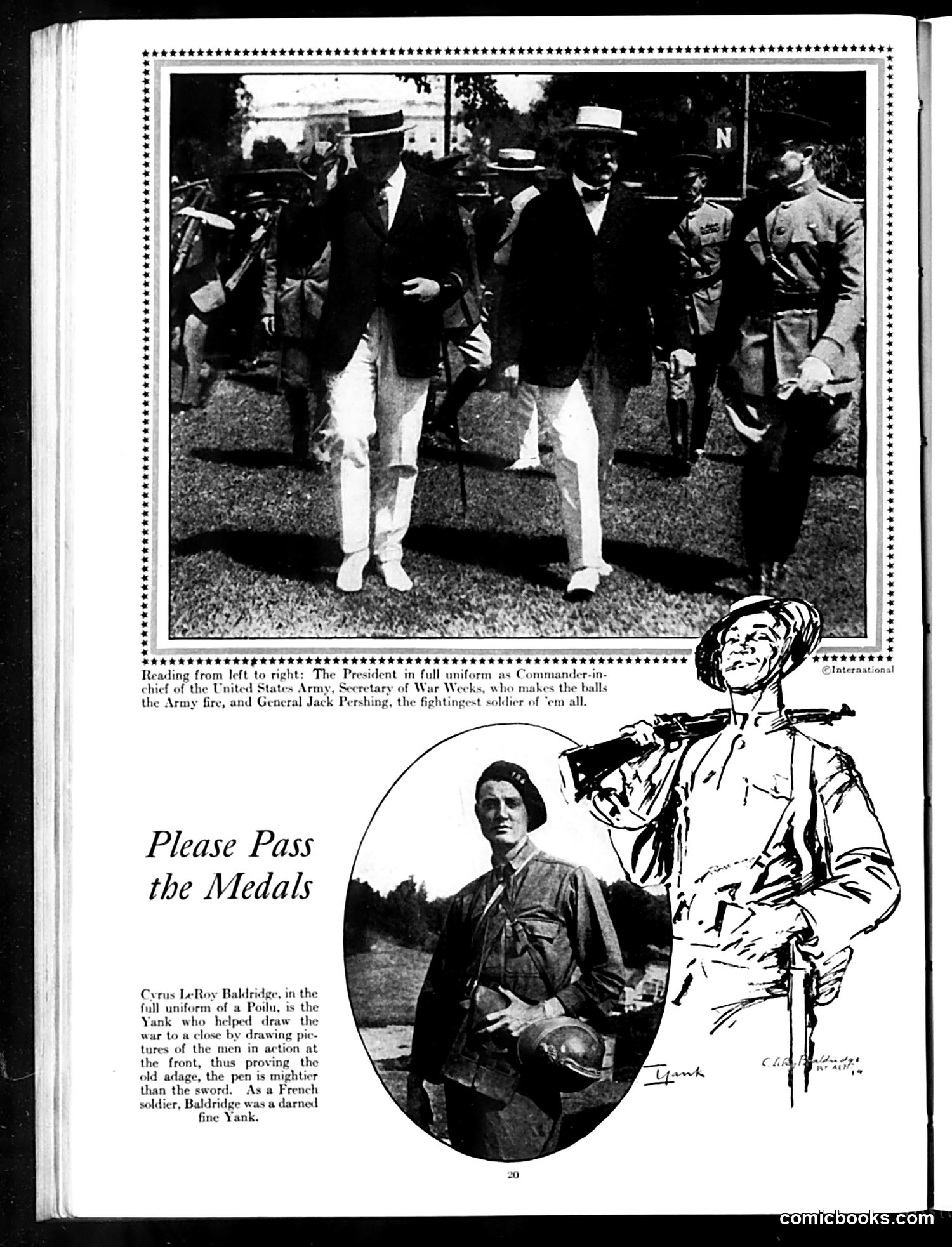
This Judge magazine page satirizes military medal-giving and patriotic posturing during or after World War I. The top photograph shows military and government officials (including what appears to be the President and Secretary of War) in formal dress. The caption ironically notes they "make the balls" for Army fire—suggesting bureaucratic distance from actual combat. The lower section, titled "Please Pass the Medals," features **Cyrus LeRoy Baldridge**, an artist-soldier who drew combat scenes from the front lines. The satire's point: Baldridge, who actually contributed to the war effort through his documentary art, deserves medals as much as desk-bound officials distributing them. The cartoon (right) depicts a soldier with rifle, reinforcing the contrast between those in actual danger and those awarding honors from safety. The phrase "the pen is mightier than the sword" undercuts typical military hierarchy, suggesting artistic documentation of war was as valuable as combat itself. The overall message critiques how medals and glory flow to administrators rather than creative contributors to the war effort.
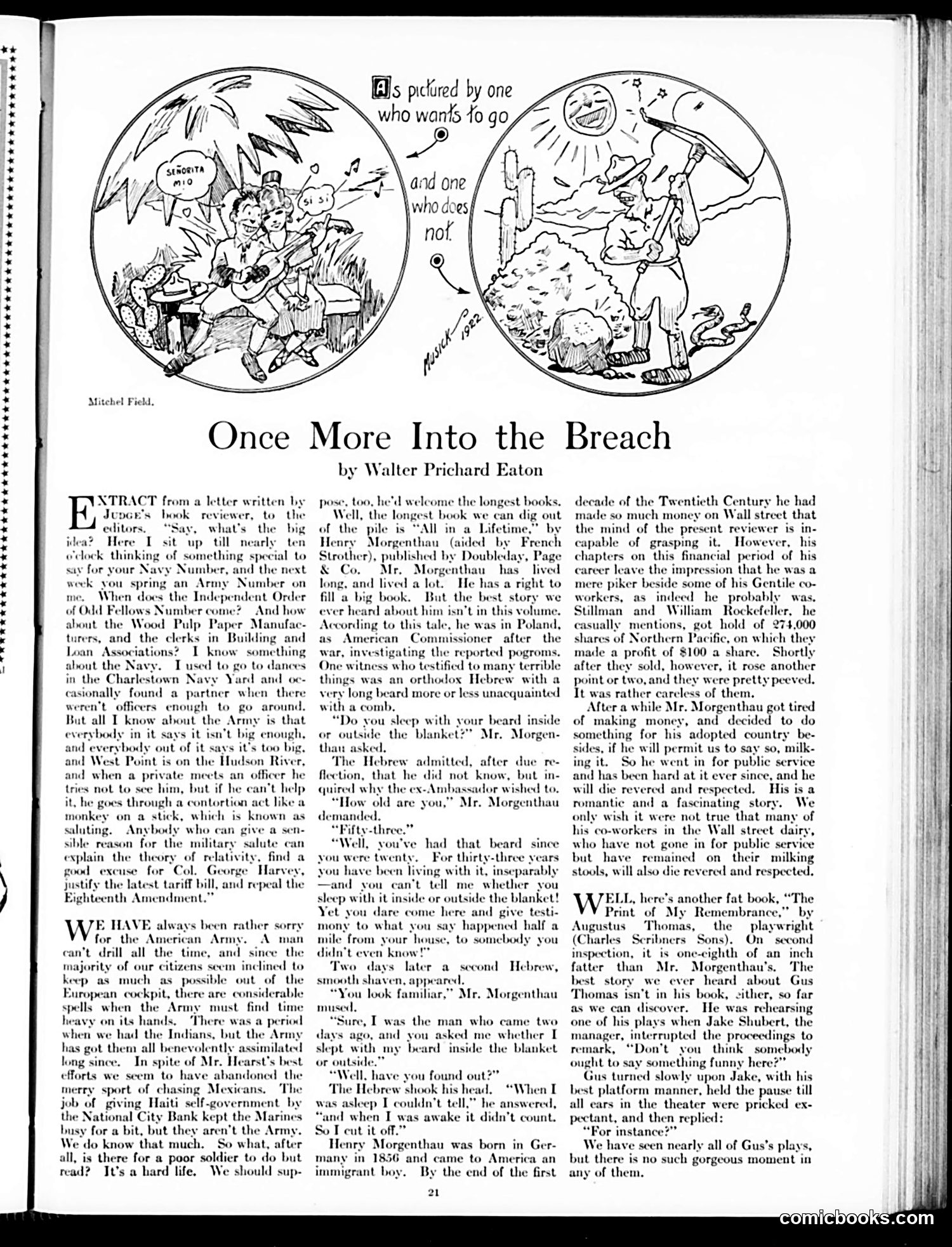
The page contains two elements: political cartoons at top and a book review below. **The Cartoons:** Two circular illustrations labeled "Mitchel Field" contrast soldiers' attitudes toward military duty. The left circle shows eager recruits wanting to "go"; the right shows reluctant ones who "do not." This reflects WWI-era tensions about American military service and enlistment. **The Review:** Critic Walter Prichard Eaton reviews Henry Morgenthau's autobiography "All in a Lifetime." Morgenthau was a prominent Jewish financier and diplomat who served as American Commissioner investigating pogroms in Poland after WWI. The review includes an anecdote mocking an Orthodox Jewish witness's beard—a casual ethnic stereotype typical of 1920s-era magazine humor. The joke relies on portraying the witness as confused and unsophisticated, contrasting with Morgenthau's American success.
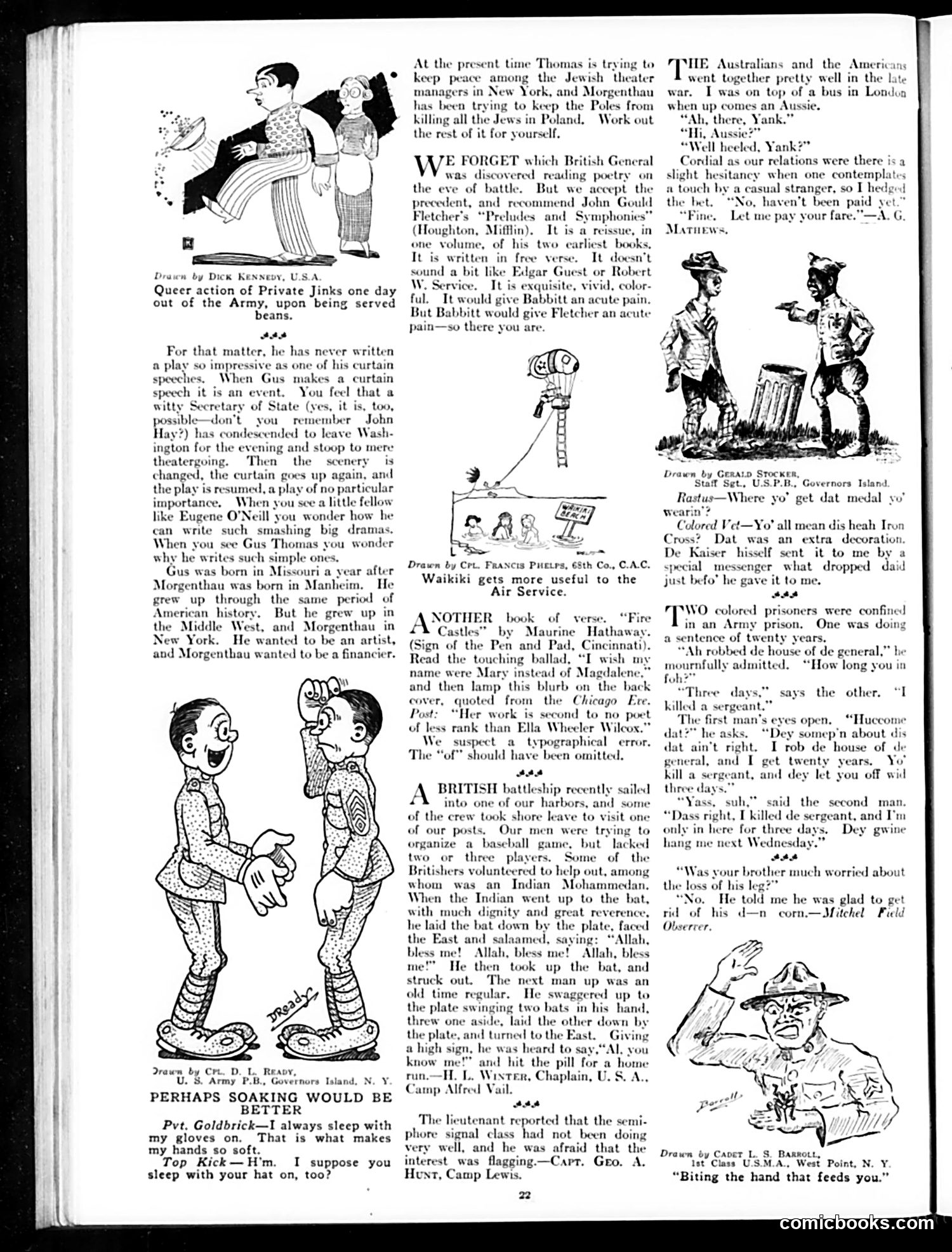
This page contains multiple satirical pieces mocking military life and cultural figures during WWI era: **Top cartoon**: Depicts "Private Jinks" reacting exaggeratedly to being served beans—satirizing soldiers' complaints about Army food. **Middle section**: Compares playwright Gus Thomas and financier Henry Morgenthau, born same year in Missouri and New York respectively. The satire notes Thomas now mediates disputes among Jewish theater managers while Morgenthau works on Jewish-Polish conflicts in Poland—suggesting Thomas's theatrical "peacemaking" is trivial by comparison. **Other pieces**: Include a review of poet John Gould Fletcher's work (contrasting it favorably to Edgar Guest's sentimentality), commentary on a British battleship visit to an American harbor where British and American soldiers play baseball, and dialogue mocking a soldier's vanity about soft hands from wearing gloves. **Bottom**: A brief anecdote about Australian and American soldiers' camaraderie during the war. The page's overall tone is irreverent toward military hierarchy, cultural pretension, and ethnic/national stereotypes typical of 1910s-20s satirical humor.
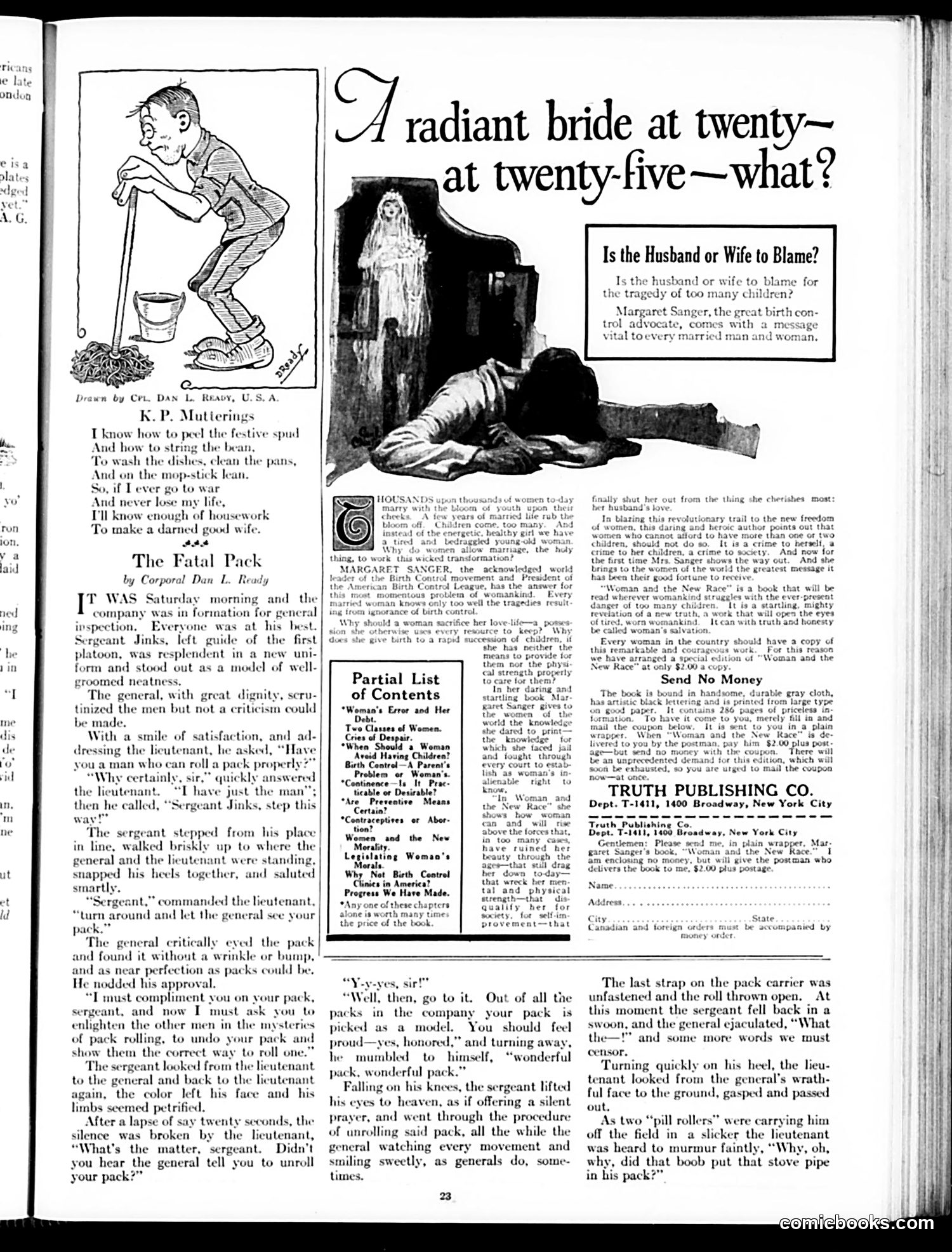
This page contains two distinct pieces from Judge magazine: **"The Fatal Pack"** (main story): A military satire about a sergeant whose perfectly-packed knapsack becomes his undoing. The general praises it as exemplary, then orders the sergeant to unroll it publicly to demonstrate technique. When opened, the pack apparently contains something scandalous—the text is censored ("what the—!"). The sergeant faints; officers rush him away on a stretcher. The joke likely satirizes military absurdity: perfectionism rewarded until exposed, or perhaps the gap between appearance and reality in military life. **"A Radiant Bride at Twenty—at Twenty-Five—What?"** (advertisement): Promotes Margaret Sanger's birth control advocacy literature, framing family planning as essential to women's health and beauty. The ad suggests that multiple pregnancies ruin women's appearance and vitality, positioning contraception as a solution. Both pieces reflect early 20th-century concerns: military bureaucracy's contradictions and the emerging birth control movement.
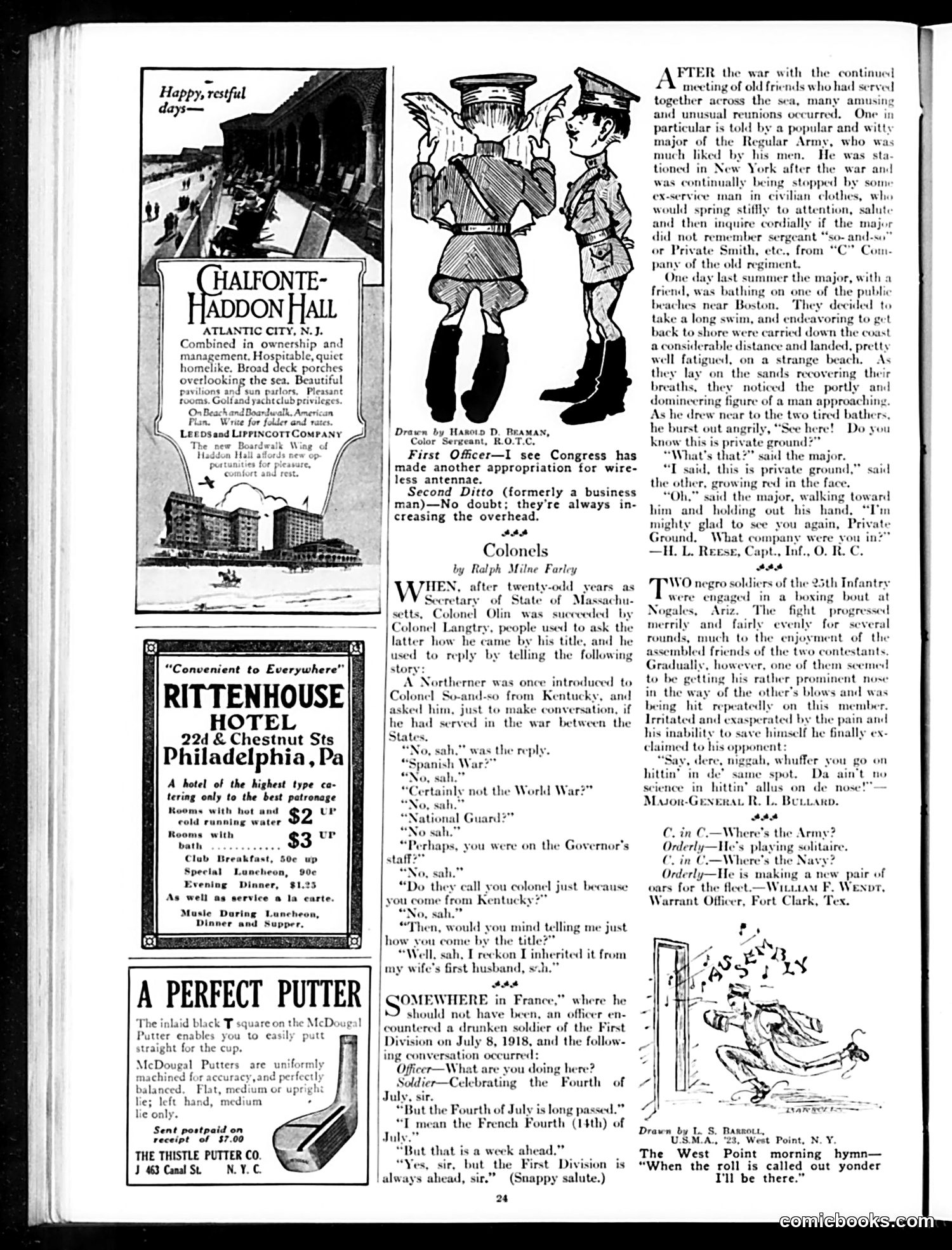
This page contains three anecdotes satirizing military life and rank, drawn from post-WWI experiences. **The "Colonels" story** mocks the proliferation of honorary Southern military titles. Colonel Langtry inherited his "colonel" rank from his wife's first husband—a joke suggesting these titles held little substance and were inherited casually rather than earned. **The "Private Ground" anecdote** features an officer confronting two exhausted swimmers on a beach. When the officer claims it's "private ground," the major (outranking him) responds by asking what company the man served in, implying that military camaraderie supersedes property rights—a gentle critique of post-war reunion nostalgia. **The boxing match cartoon** shows African American soldiers enjoying entertainment, with one boxer's prominent nose repeatedly getting struck—simple slapstick humor. The page satirizes military pretension, bureaucratic absurdity (Congress appropriating wireless antennas), and the sometimes absurd encounters between civilian and military life in the post-WWI period. The humor assumes readers would recognize these common soldier experiences.
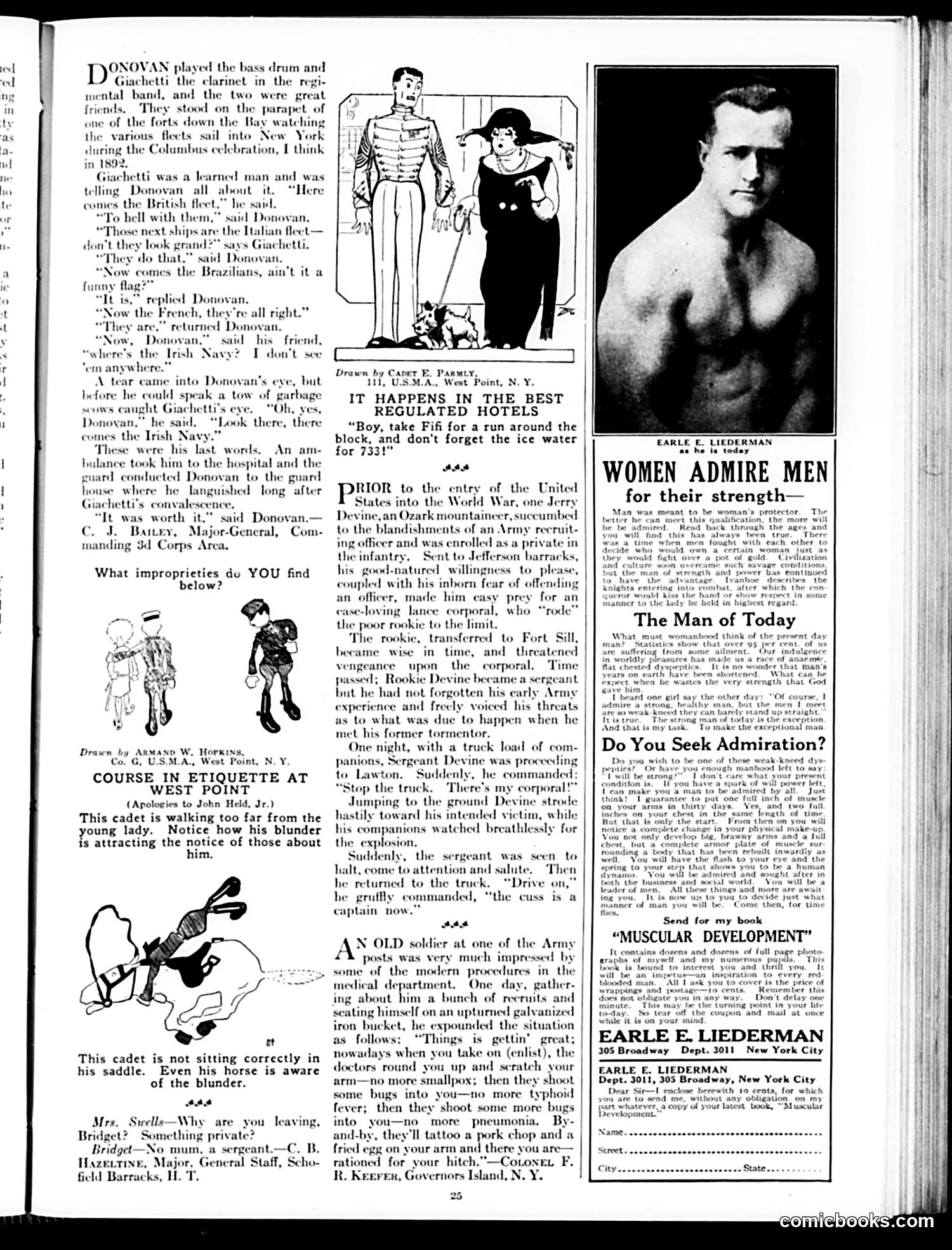
This page from *Judge* magazine contains several military-themed humorous pieces from the World War I era, likely early 1920s based on the West Point attribution and WWI references. **The cartoons satirize military etiquette and discipline:** The "Course in Etiquette at West Point" section mocks cadets' social blunders—walking too close to ladies, sitting incorrectly in saddles—suggesting military training emphasizes rigid formality over common sense. **The stories illustrate military hierarchy and unexpected reversals:** "It Happens in the Best Regulated Hotels" jokes about wealthy guests and their pets. More significantly, the "Rookie Devine" narrative depicts a private who endured abuse from a lance corporal, only to later encounter that same man promoted to captain—forcing Devine to salute his former tormentor despite harboring resentment. The irony: military rank supersedes personal grievance. The final anecdote about an old soldier explaining modern medical procedures to recruits humorously exaggerates preventative treatments (vaccines depicted as "bugs") as almost magical, reflecting contemporary amazement at medical advances. **Overall tone:** Affectionate mockery of military life, hierarchy, and modernization.
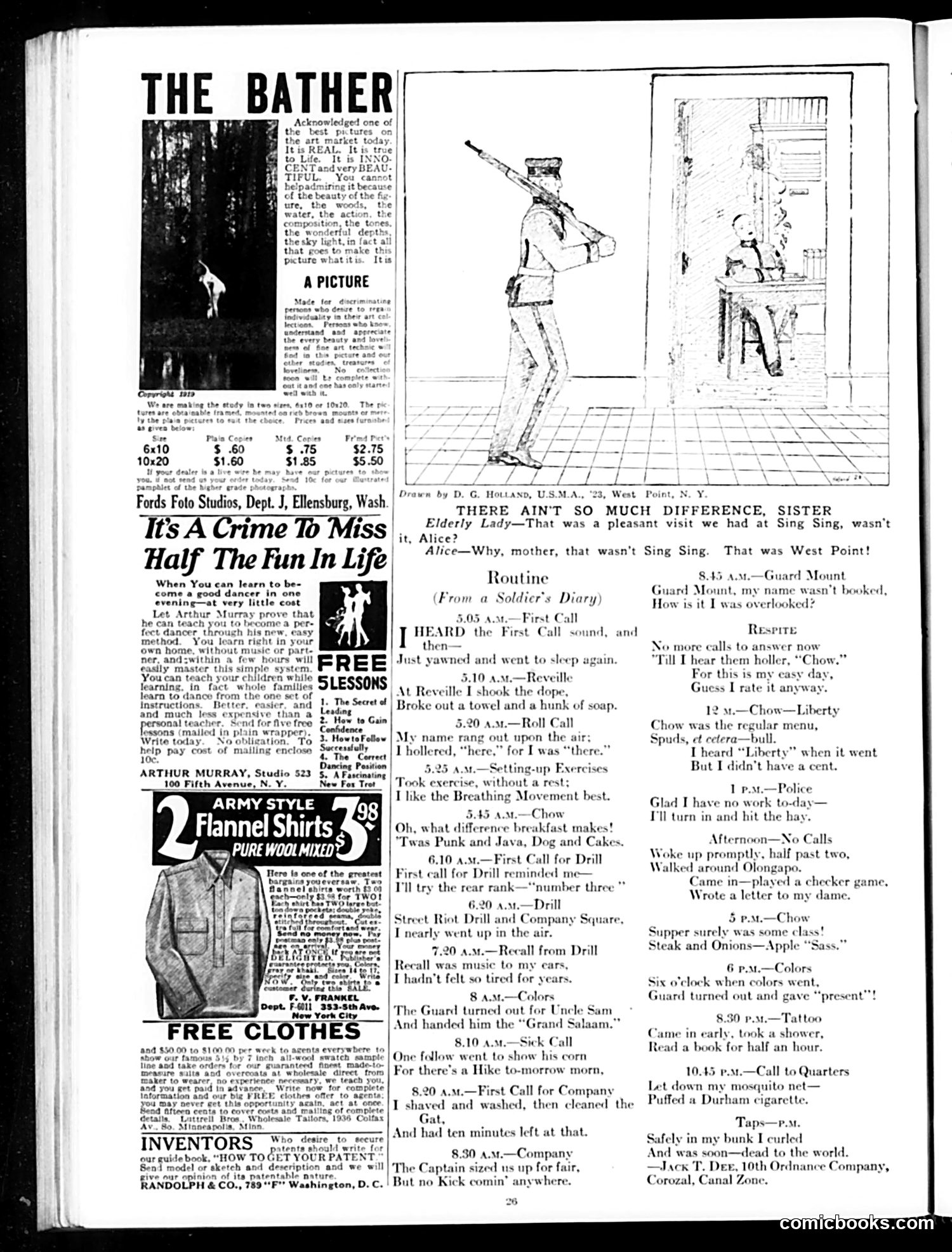
This page contains three distinct pieces of content: **"The Bather"** (top): A photograph/art submission to Judge's readers, showing what appears to be a dog or animal in water. The accompanying text praises it as a well-composed picture worthy of exhibition. **"There Ain't So Much Difference, Sister"** (main cartoon): The joke contrasts a prison visit to Sing Sing with a visit to West Point Military Academy. An elderly woman asks her daughter if their Sing Sing visit was pleasant; the daughter replies it wasn't—that was West Point. The satire suggests the rigid discipline, harsh conditions, and regimentation of military academy life are comparable to incarceration, mocking both institutions' authoritarian nature. **"Routine (From a Soldier's Diary)"** (right): A soldier's humorous account of a typical day at what appears to be a Philippines post (Corozal, Canal Zone), detailing repetitive military schedules from 5 a.m. reveille through evening taps, emphasizing tedium and monotony rather than combat or heroism. The page is otherwise filled with period advertisements for dance lessons, flannel shirts, and other products.
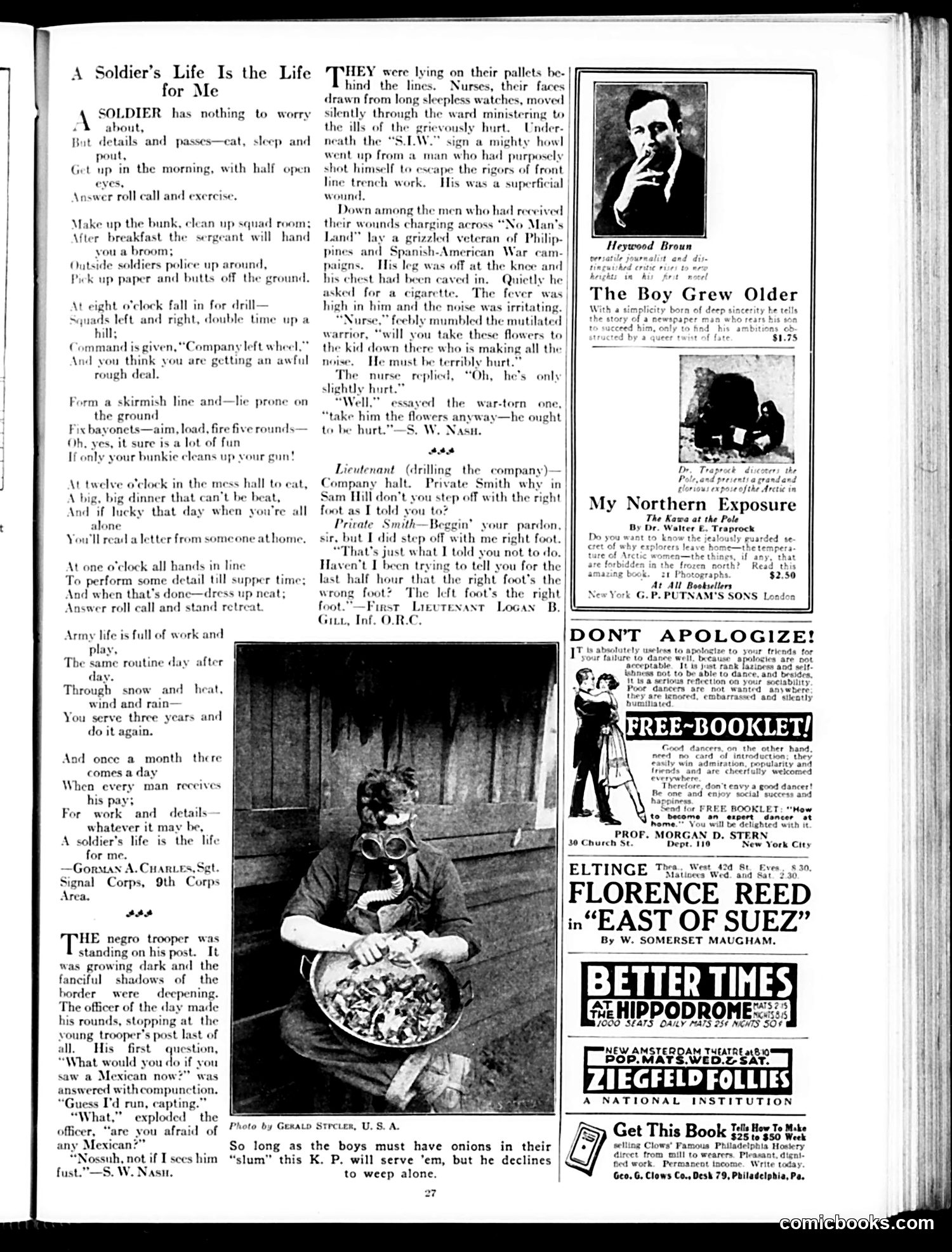
This page from *Judge* contains poetry and short military anecdotes, largely celebrating soldiers' lives with gentle humor. The main section, **"A Soldier's Life Is the Life for Me"** by Sergeant Gorman A. Charles, presents an ironic poem: it lists tedious routines (drilling, cleaning guns, marching in all weather) yet concludes positively. The satire cuts both ways—mocking either the soldiers' acceptance of drudgery or glorifying duty; the ambiguity is typical of WWI-era patriotic humor. Below are brief comic anecdotes involving soldiers and officers. One depicts a "negro trooper" admitting fear of Mexicans—reflecting period racial stereotypes. Another shows an officer confusing left/right foot commands in absurdist fashion. A third shows a soldier peeling onions without crying, claiming onions should weep instead. The page is primarily **text-driven**, with one central photograph of a soldier (credited to Gerald Stieglitz, U.S.A.) eating from a large bowl. The right side features advertisements for unrelated products: dance instruction, theater shows, and books. **Overall:** This reflects WWI-era military journalism blending patriotism, gentle ribaldry, and period racial attitudes.
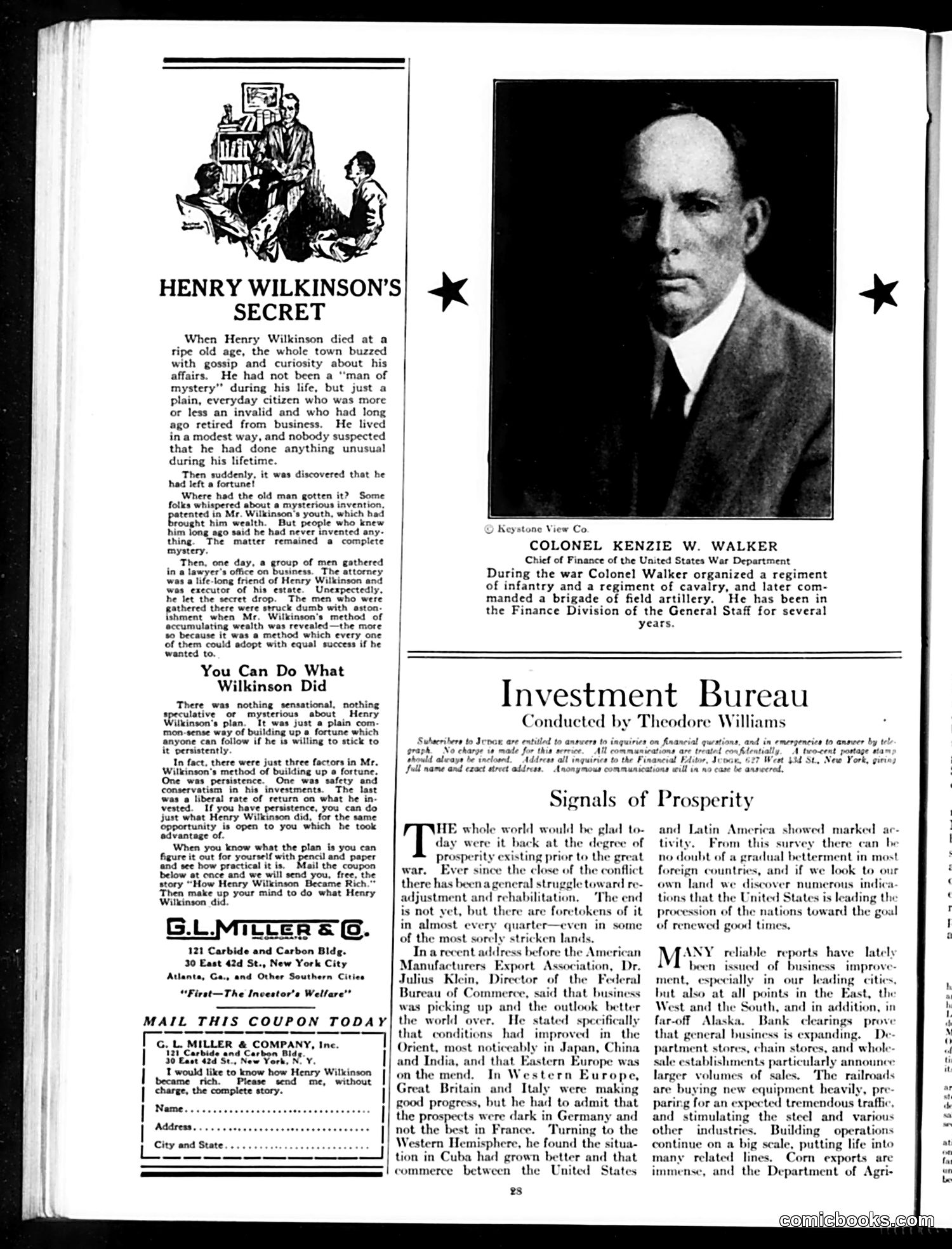
This page is primarily advertising disguised as editorial content. The "Henry Wilkinson's Secret" story is a fictional narrative promoting G.L. Miller & Company's investment services. The story presents a morality tale: an ordinary retired man accumulates wealth through three factors—persistence, safety, and steady returns—not through speculation or invention. This appears designed to appeal to post-WWI readers seeking reliable wealth-building methods after economic instability. The accompanying photograph of Colonel Kenzie W. Walker, Chief of Finance of the U.S. War Department, lends governmental credibility to the financial advice. The "Investment Bureau" section and references to post-war economic recovery reinforce themes of stability and "Signals of Prosperity." The message is clear: ordinary citizens can build fortunes through patient, conservative investing—a reassuring pitch during uncertain economic times.
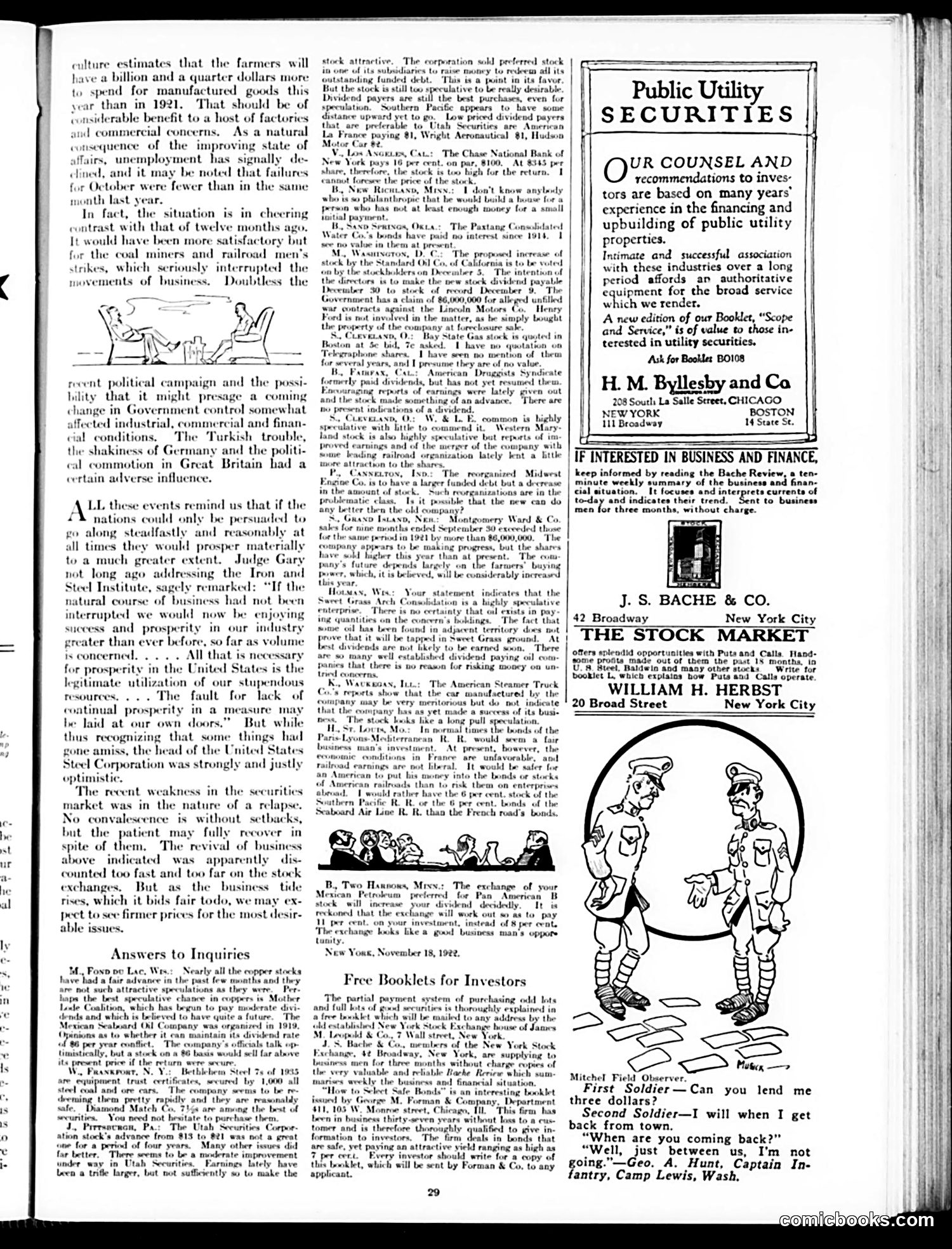
This page is primarily **financial and business advice content**, not satire. The single cartoon depicts two soldiers discussing lending money—a straightforward joke about financial caution, not political commentary. The main text discusses American post-WWI economic recovery: improved farmer income, declining business failures, and cautious optimism about industrial conditions. References to "Turkish trouble," "shakiness of Germany," and "political commotion in Great Britain" reflect contemporary international instability. Judge Gary, head of U.S. Steel, is quoted advocating for uninterrupted business as essential to prosperity—a pro-business editorial stance typical of the magazine's orientation. The bulk of the page comprises an "Answers to Inquiries" investment advice column addressing reader questions about stocks (copper, oil, coal), bonds, and securities—reflecting 1920s amateur investor interest and the magazine's service function for its educated, financially-engaged readership. The cartoon's humor relies on universal financial anxiety rather than specific historical reference.
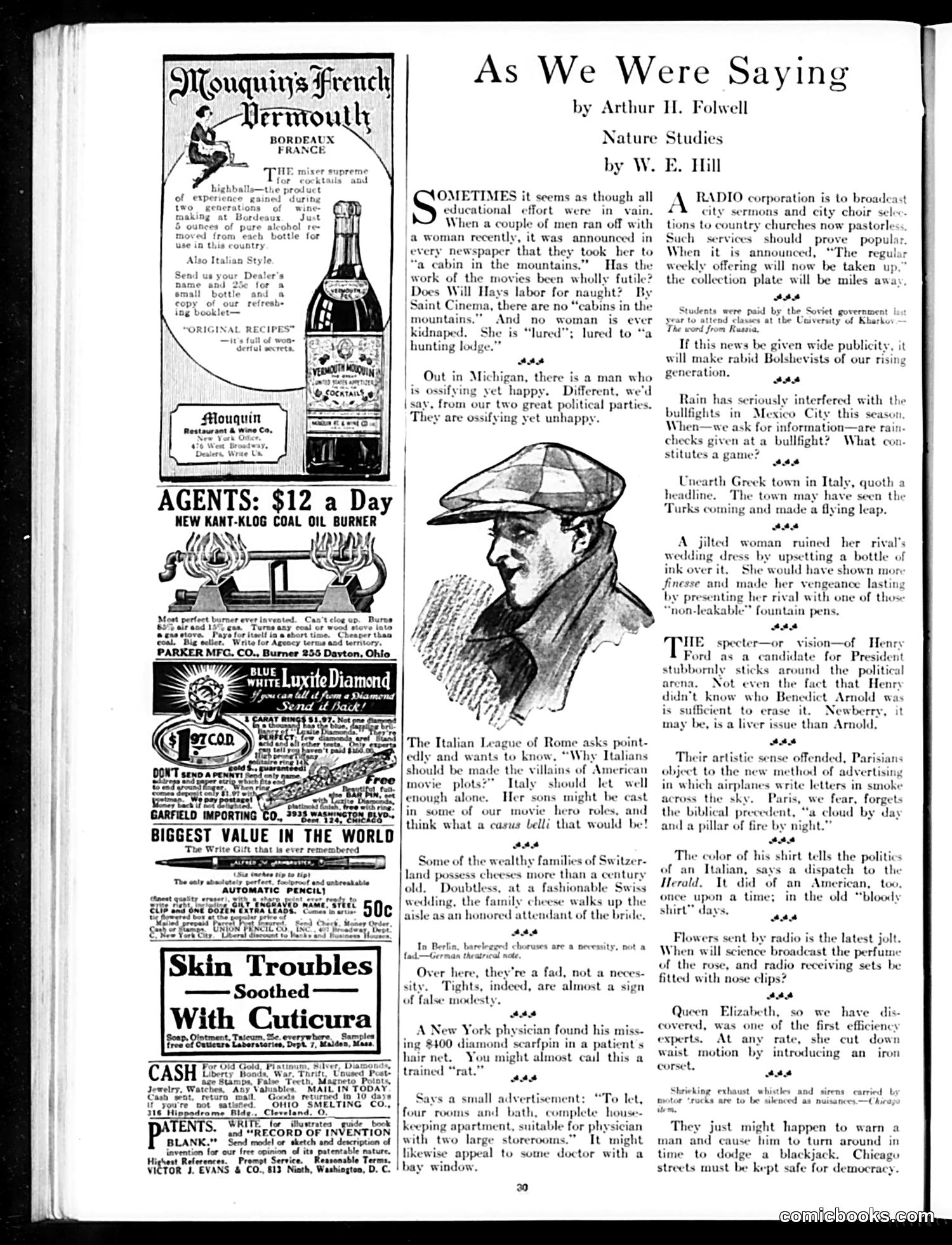
This page consists primarily of **short satirical commentary pieces** by Arthur H. Folwell with nature studies by W.E. Hill, interspersed with period advertisements. The satire targets contemporary American culture and politics: - **Movie industry censorship**: Folwell mocks Will Hays (Hollywood's moral censor) for failing to stop depicting women as "lured" to cabins—suggesting movies perpetuate seduction tropes despite censorship efforts. - **Political parties**: A Michigan man is "ossifying yet happy" while the two major parties are "ossifying yet unhappy"—implying both Republicans and Democrats are rigid and declining. - **Italian representation**: Italian-Americans resent being villains in Hollywood films. - **Soviet education**: Students paid to attend Russian university—presented as dangerously appealing to Americans. - **Radio broadcasting**: Distant church services via radio means collection plates are "miles away"—satirizing technology's financial implications. The page is primarily **advertising filler with light humor** rather than hard political cartooning.
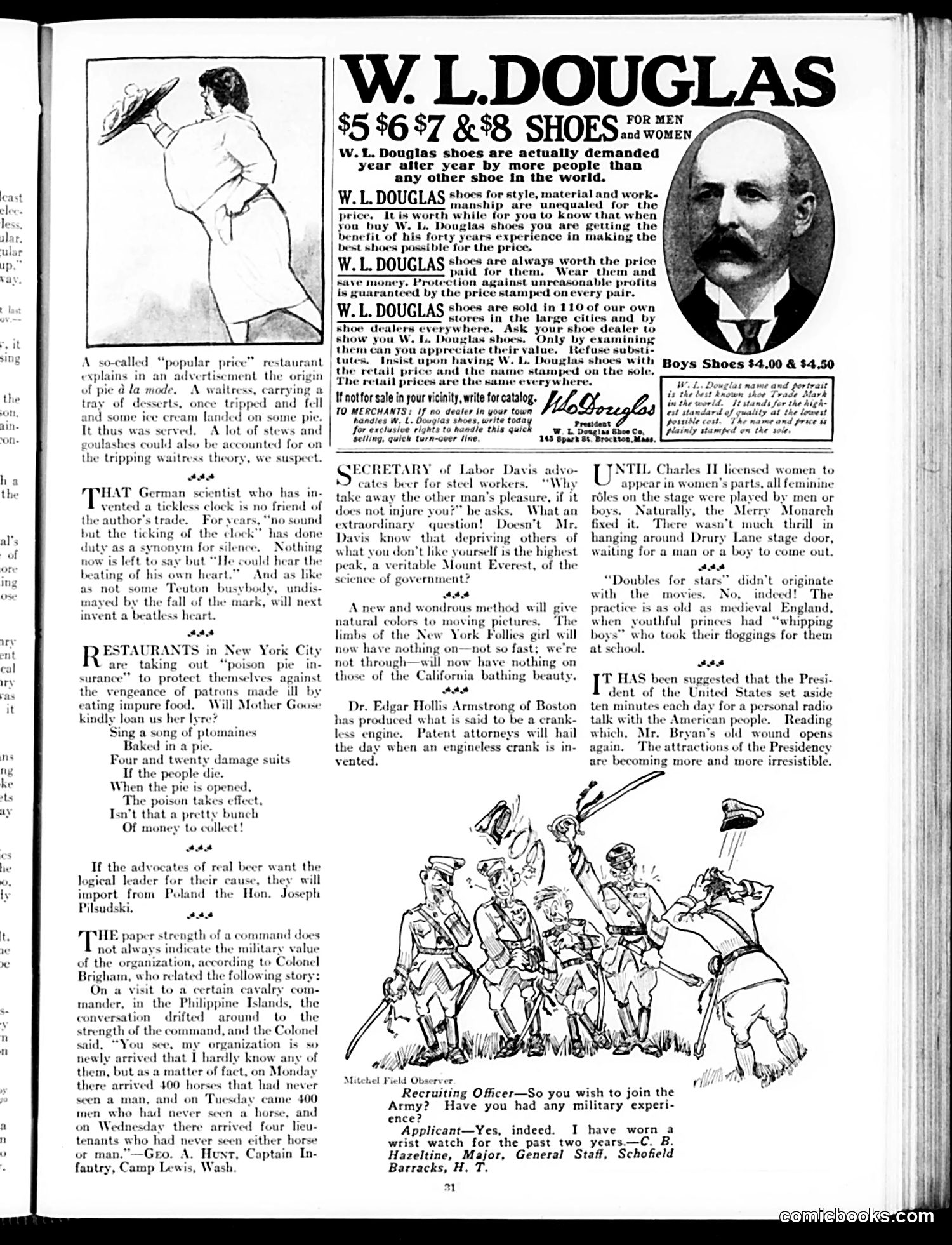
This page is primarily **advertising**, dominated by a large W.L. Douglas shoe advertisement featuring the company founder's portrait. The ad emphasizes the shoes' quality, durability, and fair pricing—a common early 20th-century marketing appeal against "unreasonable profits." The remaining content consists of brief satirical columns and jokes: - A joke about a restaurant serving contaminated pie, with waitress negligence blamed - A quip about a German "tickless clock" inventor - Commentary on Labor Secretary Davis advocating beer for steel workers - A historical note about King Charles II allowing women on stage (previously men played female roles) - A joke about movie "doubles" for stars, tracing the practice to medieval England's practice of having substitute "whipping boys" for princes - Brief mentions of New York restaurants seeking "poison pie insurance" and an inventor's "crankless engine" The cartoons include a simple line drawing of a waitress and a chaotic recruiting scene. The humor is lighthearted, topical commentary typical of Judge's satirical style—social observation rather than pointed political critique.
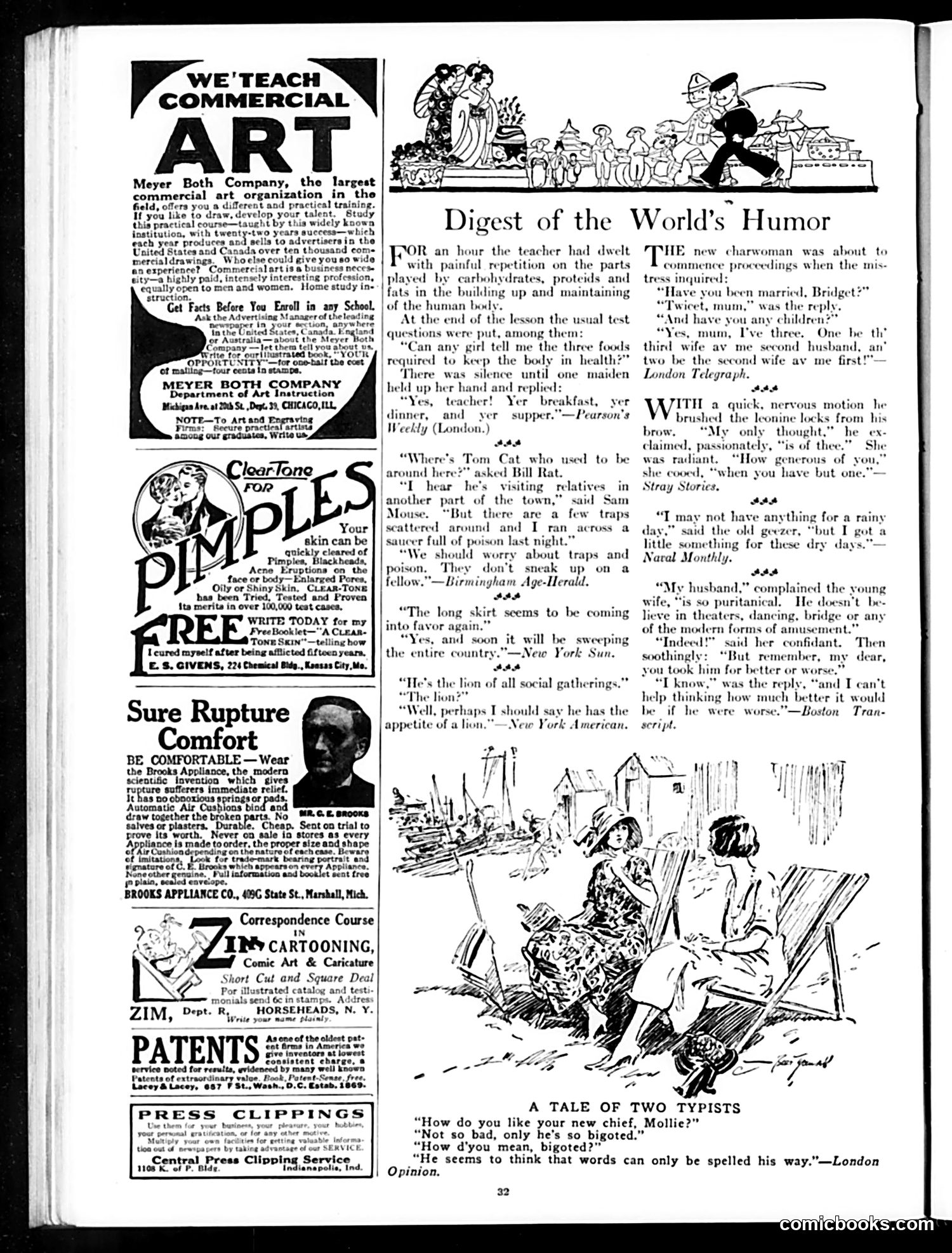
This page is primarily **advertising** interspersed with brief humor snippets. The main content consists of ads for commercial art schools, skin treatments, rupture appliances, and patent services—typical early 20th-century magazine filler. The scattered jokes under "Digest of the World's Humor" are brief, generic anecdotes with no political significance. They mock schoolchildren's literal thinking, animal characters' indifference to traps, fashion cycles, and a woman's romantic history. One joke satirizes pedantic spelling obsession. The cartoon "A Tale of Two Typists" shows office workers and appears to mock workplace gossip or cattiness, with one typist calling another's new boss "bigoted" because he insists words have correct spellings. **Bottom line:** This is essentially a commercial page offering art instruction and medical products, with light, apolitical humor. There's no meaningful political satire or social commentary—just period advertising and mild workplace humor.
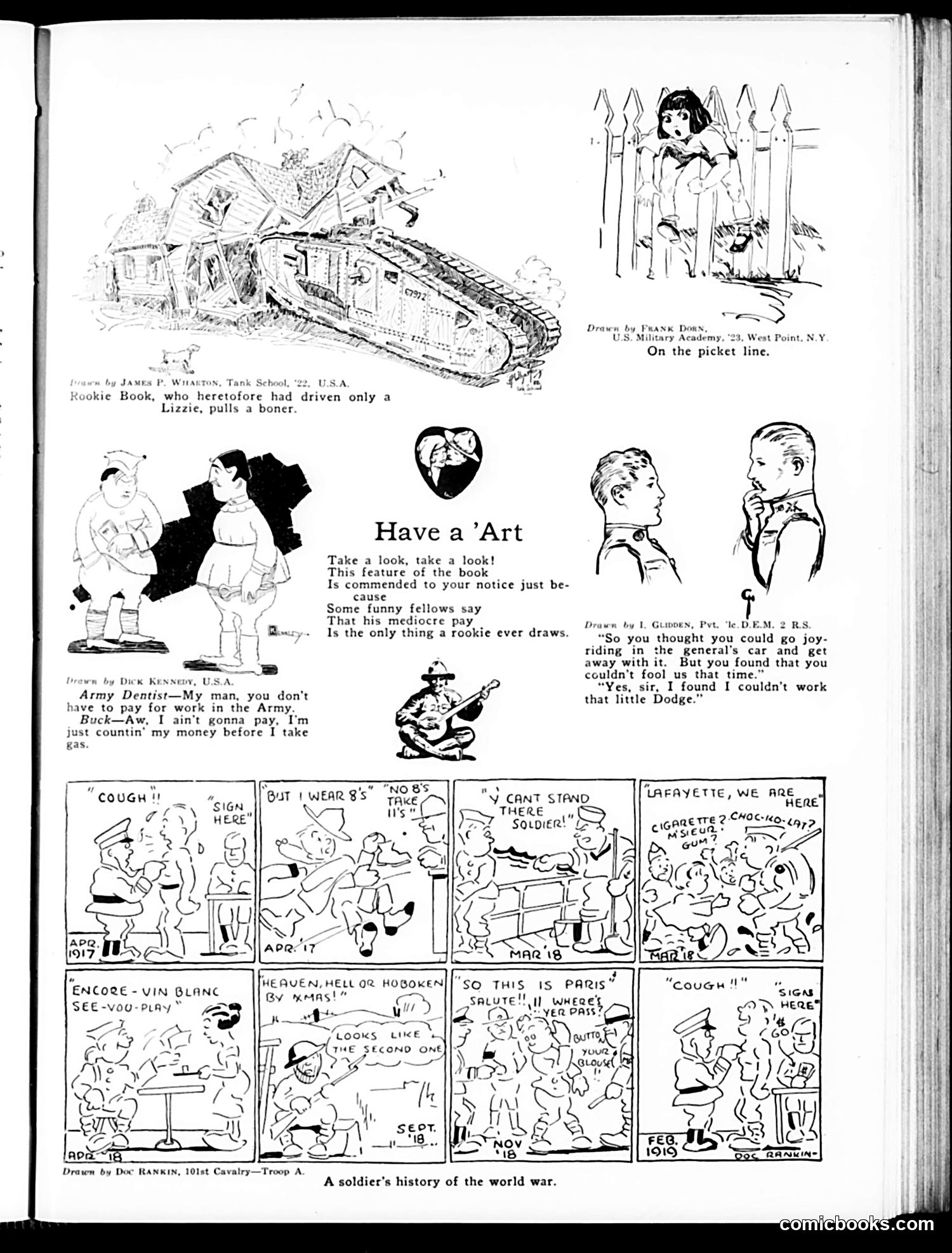
This Judge magazine page collects WWI-era military humor drawn by soldiers themselves. The content reflects American Expeditionary Forces experiences circa 1917-1919. The bottom comic strip depicts soldiers' encounters with French culture and military discipline: references to French wine ("Vin Blanc"), Paris, and the phrase "Heaven, Hell or Hoboken" (a soldier's lament about deployment destinations). The strip progresses chronologically through the war. Upper illustrations mock military life: "Rookie Book" who only knew civilian driving ("Lizzie"—Model T Ford) now handles tanks; an Army dentist joke about payment; and enlisted men's low pay ("mediocre pay"). The general's car joke references the rigid hierarchy and consequences of fraternization violations. The tone is affectionate mockery—soldiers making fun of their own experiences rather than harsh satire. These drawings validate enlisted perspectives on army life, pay disparities, and cultural shock in France, published for a civilian audience back home.
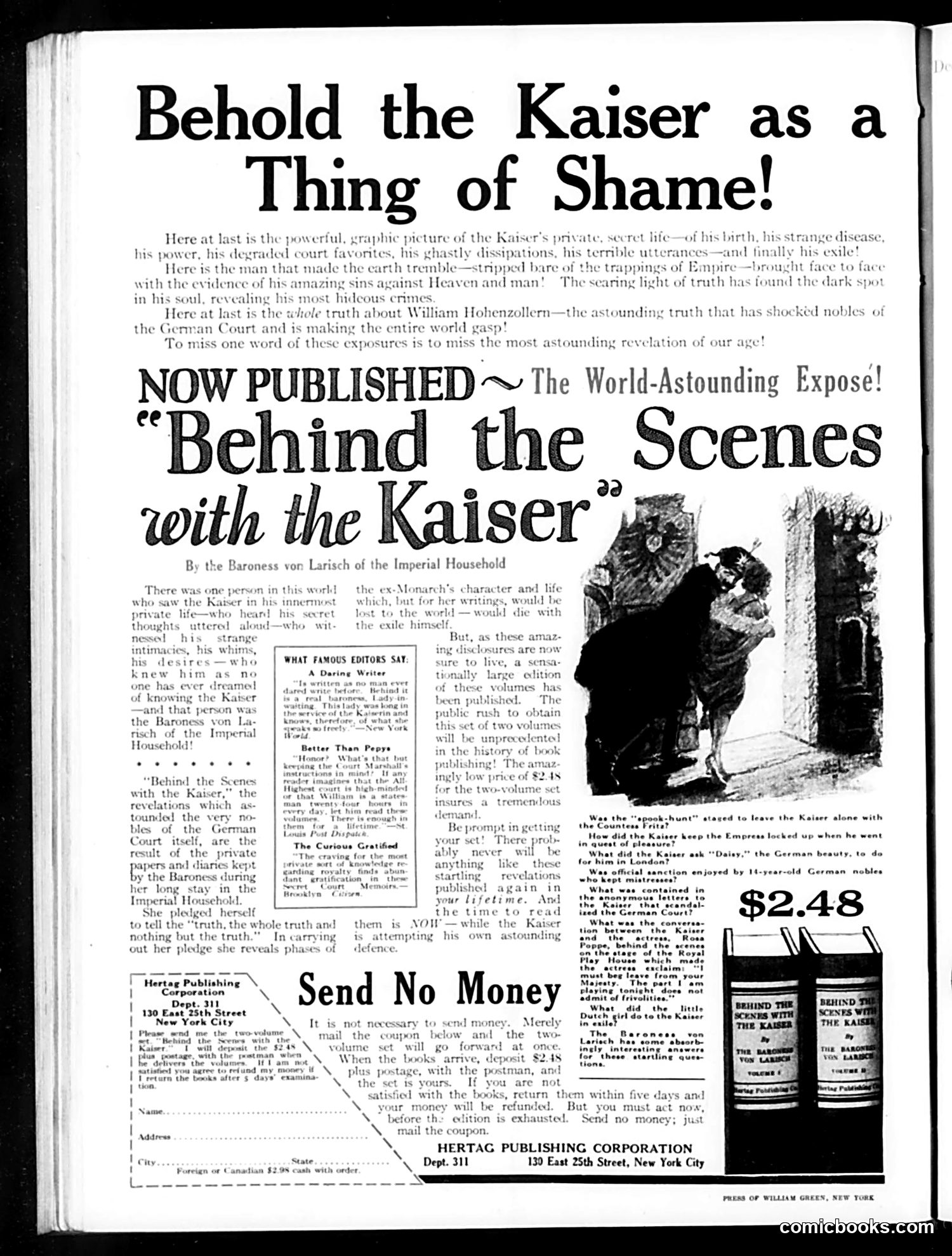
This is primarily a **book advertisement**, not a political cartoon. It promotes "Behind the Scenes with the Kaiser," purportedly by Baroness von Larisch of the Imperial Household. **Historical Context:** The ad targets anti-German sentiment during or after World War I by advertising an exposé claiming to reveal Kaiser Wilhelm II's private life, "birth, his strange disease, his power, his degraded court favorites, his ghastly dissipations." **The Satire/Appeal:** Rather than satirize the Kaiser himself, Judge satirizes the American public's appetite for sensationalized gossip about the enemy leader. The exaggerated language—"world-astonishing exposé," "most astounding revelation of our age"—mocks readers' credulity. The pitch exploits wartime propaganda and anti-German feeling to sell books cheaply ($2.48 for two volumes). **Bottom Line:** This is cynical marketing capitalizing on public animosity toward Germany, presented through a magazine known for satire. Judge appears to be satirizing American eagerness for such dubious "insider" accounts.