
Judge, 1922-11-25 · page 24 of 36
Judge — November 25, 1922 — page 24: what you’re looking at
What you’re looking at
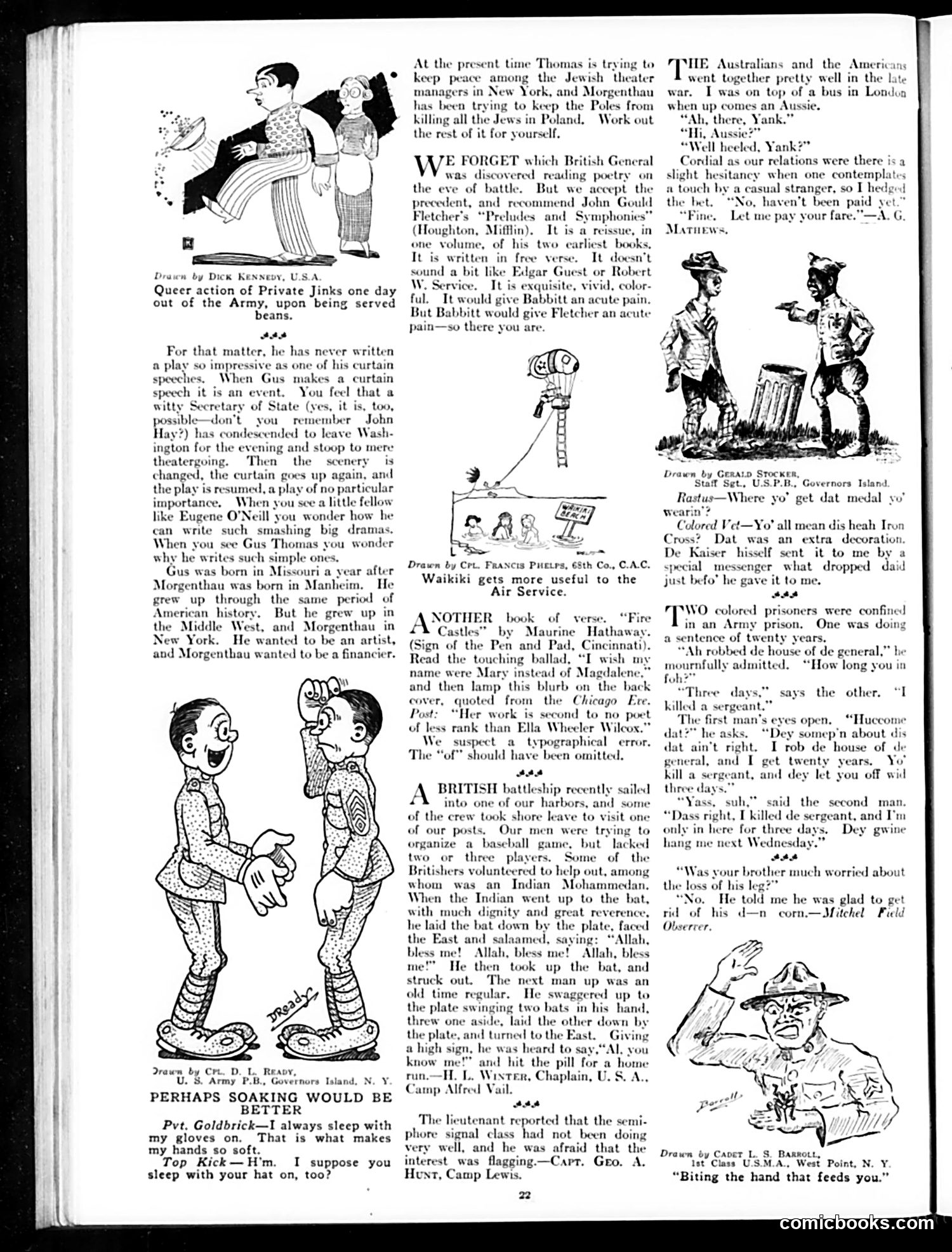
This page contains multiple satirical pieces mocking military life and cultural figures during WWI era: **Top cartoon**: Depicts "Private Jinks" reacting exaggeratedly to being served beans—satirizing soldiers' complaints about Army food. **Middle section**: Compares playwright Gus Thomas and financier Henry Morgenthau, born same year in Missouri and New York respectively. The satire notes Thomas now mediates disputes among Jewish theater managers while Morgenthau works on Jewish-Polish conflicts in Poland—suggesting Thomas's theatrical "peacemaking" is trivial by comparison. **Other pieces**: Include a review of poet John Gould Fletcher's work (contrasting it favorably to Edgar Guest's sentimentality), commentary on a British battleship visit to an American harbor where British and American soldiers play baseball, and dialogue mocking a soldier's vanity about soft hands from wearing gloves. **Bottom**: A brief anecdote about Australian and American soldiers' camaraderie during the war. The page's overall tone is irreverent toward military hierarchy, cultural pretension, and ethnic/national stereotypes typical of 1910s-20s satirical humor.
📄 Transcribed text from this page (OCR, searchable)
Machine-transcribed from the original scan — historical spelling and the odd misread are preserved.
Drawn by Dick Kennevy, U.S.A. Queer action of Private Jinks one day out of the Army, upon being served beans. ory For that matter, he has never written a play so impressive as one of his curtain speeches. When Gus makes a curtain speech it is an event. You feel that a witty Secretary of State ( it is, too, possible—don't. you. remember John ) has condeseended to leave Wash- ington for the evening and stoop to mere theatergoing. 1 n the scenery is changed, the curtain goes up again, and the play is resumed, a play of no particular importance. Wh vu see a little fellow like Eugene O'Neill you wonder how he can write such smashing big dramas. When you see Gus Thomas you wonder why he writes such simple ones. Gus was born in Missouri a year after Morgenthau was born in } grew up through the same period of American history. But he grew up in th iddle West, and Morgenthau in New York. He wanted to be an artist, and Morgenthau wanted to be a financier. Drawn by Crt, D. L. Reapy, U. 3. Army P.B., Governors Island, N.Y. PERHAPS SOAKING WOULD BE BETTER Pvt. Goldbrick—I always sleep with my gloves on. That is what makes my hands so soft. Top Kick—H'm. I suppose you sleep with your hat on, too? At the present time Thomas is trying to keep peace among the Jewish theater managers in New York, and Morgenthau has been trying to keep the Poles from killing all the Jews in Poland. Work out the rest of it for yourself, AY E FORGET which British General was discovered reading poetry on the eve of battle. But we accept the precedent do recommend John G Fletcher's “Preludes and Symphor (Houghton, Mifflin). It is a reissue one volume, of his two earliest books. It is written in free ve Tt doesn’t sound a bit like Edgar Guest or Robert W. Service. It is exquisite, vivid, color- ful. It would give Babbitt an acute pain. But Babbitt would give Fletcher an acute pain—so there you are. CAC. Waikiki gets more useful to the Air Service. ANOTHER book of verse. “Fire Casth by Maurine Hathaway. (Sign of the Pen and Pad, Cincinnati) Read the te name were y instead of Magdalene. and then lamp this blurb on the | cover, quoted from the Chicago E Post: “Her work is second to no poe of less rank than Ella Wheeler Wilcox.” We suspect a typographical error. fhe “of” should have been omitted. sae A_ BRITISH battleship recently. saile é into one of our harbors, and sc of the crew took shore leave 7 ne of our posts, Our men w trying to organize a baseball gam put lacked two or three players. ne of the Britishers volunteered to help out, among whom was an Ini Mohammedan, When the Indian went up to the | with much dignity and gre i down by the the East and salaamed, saying bless me! Allah, bless me! Allah, bless me!” He then took up the bat, and struck out. The next man up was an old time regular. He swaggered up to the plate swinging two bats in his hand, threw one aside, laid the other down by the plate, and turned to the East. Giving a high sign, he was heard to say,“Al, you know me!” and hit the pill for a home run.—H. L. Winter, Chaplain, U. Camp Alfred Vail. Caled The lieutenant reported that the semi- phore signal class had not been doing very well, and he was afraid that the interest was flagging—Carr. Geo. A. Henrt, Camp Lewis. 22 Te Australians and the Americ went together pretty well in the war. I was on top of a bus in London when up comes an Aussie. “Ah, there, Yank.” “Hi, Aussi “Well heeled, Yank?" Cordial as our relations were there is a icy when one contempla asual stranger, so I he . haven't been paid Let me pay your fare. Matuews. a touch t Colored Vet—Yo’ all mean dis heah Iron Cross? Dat was an extra decoration. De Kaiser hisself sent it to me by a special messenger what dropped just befo” he gave it to me. sae rpyo colored prisoners were confined in an Army prison. One was doing a sentence of twenty years, “Ah robbed de house of de general e arnfully admitted. ‘**How long you in says the other. “I 1's eyes open, “Huccome “Dey somep'n about dis ain't right. I rob de house of de and I get twenty years. Yo nt, and dey let you off wid he asks. gene Kill a ser; three da “ * said the second man. 1 de sergeant, and I'm only in here for three Dey gwine hang me next Wednesd: oe “Was your brother much worried about the loss of his leg? He told me he was glad to get f his d—n corn.—Mitchel Field Observer. Drawn by Cavet L. S. Barrott, Ist Class U.S.M.A., West Point, N. Y. “Biting the hand that feeds you.”