
Judge, 1922-11-25 · page 7 of 36
Judge — November 25, 1922 — page 7: what you’re looking at
What you’re looking at
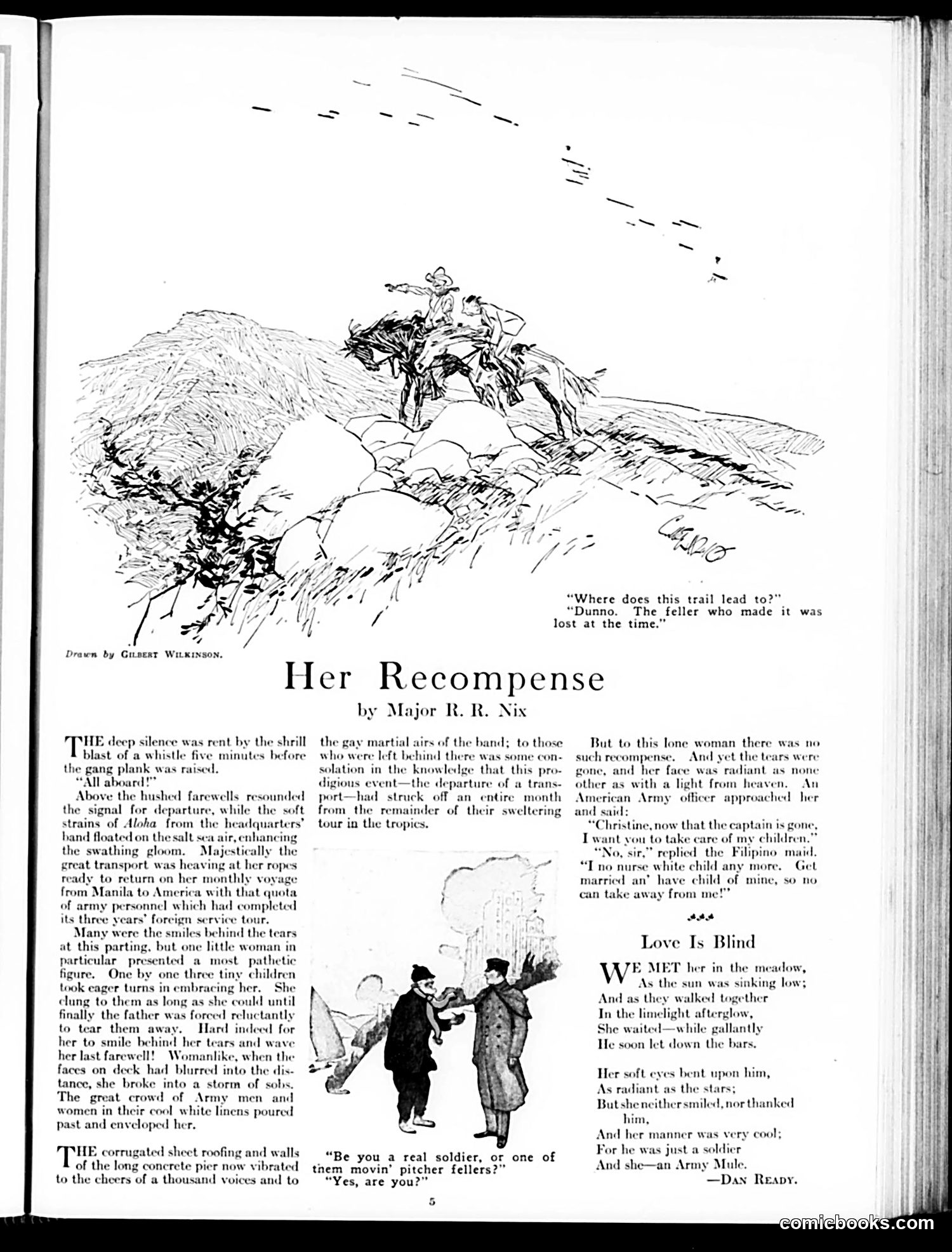
This page contains two pieces about American military life in the Philippines (likely early 20th century, given references to Manila transport ships and colonial army service). **"Her Recompense"** depicts a Filipino maid's emotional farewell as an Army transport departs. The satire lies in the anticlimactic resolution: though other soldiers celebrate their shortened tours, the maid Christine receives no compensation for her loss. The humor darkens when she declares she'll marry and have her own child so "no can take away from me"—a pointed comment on the precarity of colonial domestic workers whose charges are suddenly removed. **"Love Is Blind"** is a brief comic poem with a punchline: a soldier courts a woman in romantic moonlight, but the "beloved" is actually an Army mule. The joke relies on the absurdity of applying romantic language to an animal, mocking sentimental soldier poetry. Together, these pieces reflect Judge magazine's satirical treatment of American military experience abroad—mixing pathos with crude humor about colonial service and soldier life.
📄 Transcribed text from this page (OCR, searchable)
Machine-transcribed from the original scan — historical spelling and the odd misread are preserved.
“Where does this trail lead to?” “Dunno. The feller who made it was lost at the time.” Her Recompense by Major R. R. Nix HE deep silence was rent by the shrill blast of a whistle five minutes before the gang plar Above the hushed farewells resounded the signal for departure, while the soft strains of Aloha from the headquarters’ hand floated on the salt se enhancing the swathing gloom. tically the great transport was heaving at her ropes ye to return on her monthly voyage from Manila to America with that que of army personnel which had completed its three rs’ foreign service tour. Many were the smiles behind the tears at this parting, but one little w particular presented a most pa figure. One by one three tiny children took eager turns in embracing her. She clung to them as long as she could until finally the father was forced ntly to tear them away. Hard indeed for her to smile behind her tears and wave her last farewell! Womanlike, when the faces on deck | blurred into the dis- tance, she broke into a storm of sobs. The great crowd of Army men and women in their cool white linens poured past and enveloped her. HE corrugated sheet roofing and walls of the long concrete pier now vibrated to the cheers of a thousand voices and to 3 to those re was some con- ge that this pro- the gay martial airs of th who were left behind th solation in the know digious event—the departure of a trans- port—had struck off an entire: month from the remainder of their sweltering tour in the tropics. _“Be you a real soldier, or one of them movin’ pitcher fellers?” “Yes, are you?” But to this lone woman there was no ompense. And yet the tears were doher face was radiant as none f An American Army officer approached her and said: “Christine, now that the captain is gone, T want you to take care of my childre », sir.” replied the Filipino: maid. “Tno nurse white child any more. Get married an’ have child of mine, so no can take away from me!” such res sae Love Is Blind E MET her in the meadow, As the sun was sinking low; And as they walked together In the limelight afterglow, She waited—while gallantly He soon let down the bars. V Her soft eyes bent upon him, As radiant as the stars; Butsheneithersmiled, nor thanked him, And her m: For he was just a soldier And she—an Army Mule. —Dan Reavy. nner was very cool;