
Judge, 1922-11-25 · page 8 of 36
Judge — November 25, 1922 — page 8: what you’re looking at
What you’re looking at
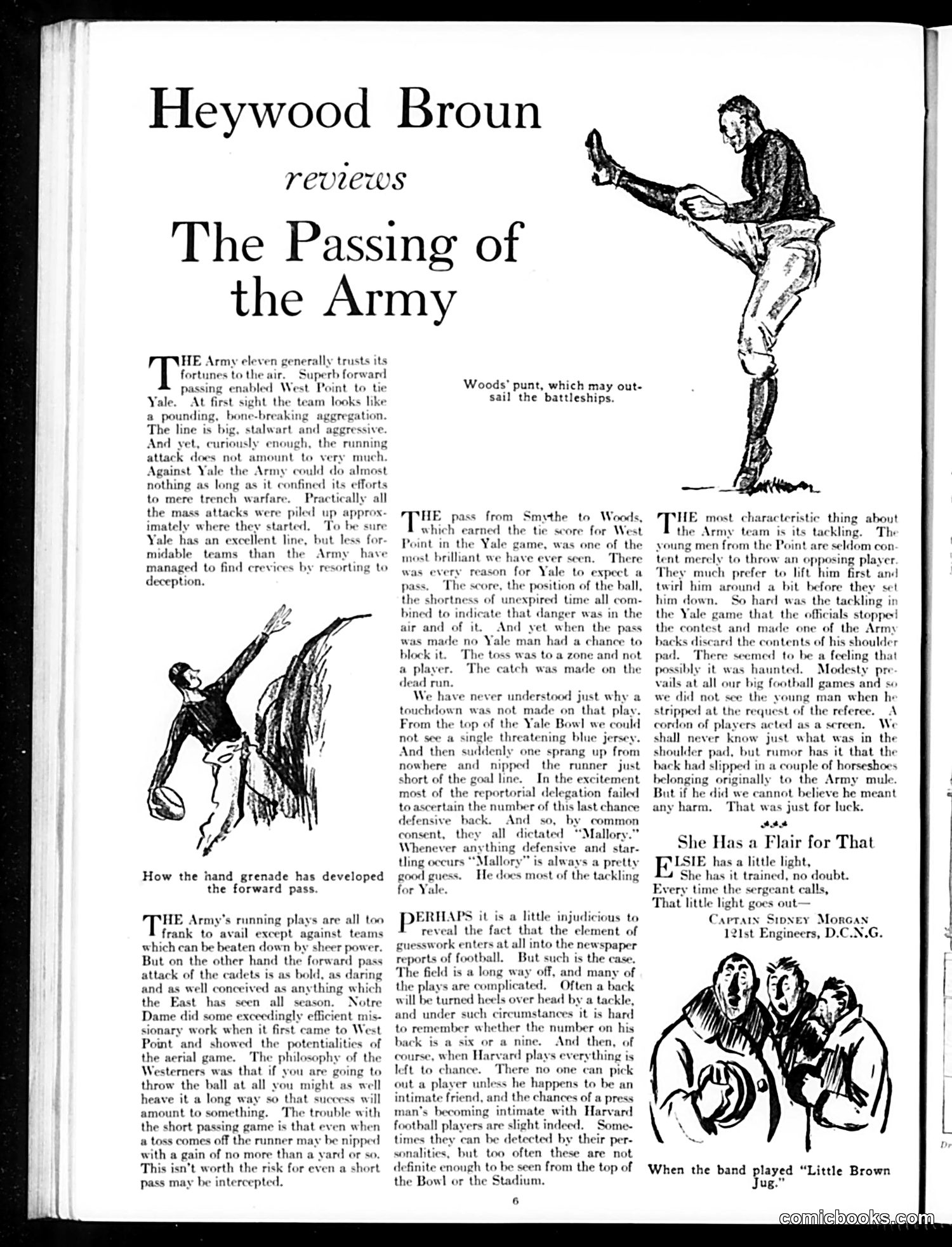
This is a sportswriting review by prominent critic Heywood Broun analyzing West Point's football team, comparing it favorably to Yale. The piece uses military metaphors throughout—hand grenades, trench warfare, defensive backs—linking football strategy to WWI combat tactics. The cartoons illustrate football plays: one shows a player executing a forward pass ("how the hand grenade has developed the forward pass"), another depicts a kicking technique. The humor lies in Broun's admission that sportswriters often guess at play details from the distant stands, inventing or misremembering player numbers and actions. He jokes that identifying players requires either intimate friendship or obvious "personalities." The piece reflects early 20th-century college football's cultural importance and contemporary journalistic frankness about reporting limitations—a refreshingly honest acknowledgment that sports coverage involved educated guessing rather than precise observation.
📄 Transcribed text from this page (OCR, searchable)
Machine-transcribed from the original scan — historical spelling and the odd misread are preserved.
Heywood Broun TeVIEWS The Passing of the Army Tie Army eleven generally trusts its fortunes to the air. Superb forward passing enabled West Point to tie At first sight the team looks like bone-breaking aggregation. The line is big, stalwart and aggressive. And yet, curiously enough, the running attack does not amount to very much, Against Yale the Army could do almost nothing as long as it confined its efforts to mere trench warf: Practically all the mass attacks were pil imately where they start Yale has an excellent li midable ms than the Army have mai 1 to find crevices by resorting to deception. Yale. a pounding, How the hand grenade has developed the forward pass. HE Army's running plays are all too frank to avail except against teams which can be beaten down by sheer power. But on the other hand the forward pass attack of the cadets is as bold, as daring and as well conceived as anything w the East has seen all season. Notre Dame did some exceedingly efficient mis- sionary work when it first came to West Point and showed the potentialities of the acrial game. The philosophy of the Westerners was that if you are going to throw the ball at all you might as well heave it a long way so that success will amount to something. The trouble with the short passing game is that even when a toss comes off the runner may be nipped with a gain of no more t a yard or so. This isn’t worth the risk for even a short pass may be intercepted. Woods’ punt, which may out- sail the battleships. THE pass from Smythe to Woods, which earned the tie score for West Point in the Yale game, was one of the most brilliant we have seen. Ther was every reason for to expect pass, The score, the position of the ball, the shortness of unexpired time all com- bined to indicate that danger was in the air and of it. And yet when the pass was made no Yale man had a chance to block it toss was to a zone and not a player. The catch was made on the 1 run. We have never understood just why a touchdown was not made on that play. From the top of the Y Bowl we could not see a single threatening blue jersey. And then suddenly one sprang up from nowhere and nipped the runner just short of the goal line. In the excitement most of the reportorial delegation failed to ascertain the number of this last chance defensive back. And so, by common consent, they all di Whenever anything d nd star- tling occurs “Mallory” Ways a pretty good guess. He does most of the tackling for Yale. PERHAPS it is a little injudicious to reveal the fact that the element of guesswork enters at all into the newspaper reports of football. But such is the case. The field is a long way off, and many of the plays are complicated. | Often will be turned heels over head by and under such circumstances it is hard to remember whether the number on his back is a six or a nine. And then, of course, when Harvard pla thing is left to chance. here no one can pick out a player unless he happens to be an intimate friend, and the chances of a press man’s becoming intimate with Harvard football players are slight indeed. Some- times they can be detected by their per- sonalities, but too often these are not definite enough to be seen from the top of the Bowl or the Stadium. 6 THE most characteristic thing about the Army team is its tackling. The young men from the Point are seldom con nt merely to throw an opposing player They much prefer to lift him first and twirl him around a bit before they set him down. So hard was the tackling in the Yale game that the officials stoppei the contest and made one of the Army hacks discard the contents of his shoulder pad. There seemed to be a feeling that possibly it was haunted. Modesty pre vails at all our big football games and so we did not see t ig man when he stripped at the est of the referee. A cordon of players acted as a screen. We shall never know just what was in the shoulder pad, but rumor has it that the hack had slipped in a couple of horseshoes belonging originally to the Army mule. But if he did we cannot believe he meant any harm. That was just for luck. “ She Has a Flair for That LSIE has a little light, She has it trained, no doubt. Every time the sergeant calls, That little light goes out— Captain Stoney Morcan 12Ist Engineers, D.C.N.G.