
Judge, 1922-11-25 · page 13 of 36
Judge — November 25, 1922 — page 13: what you’re looking at
What you’re looking at
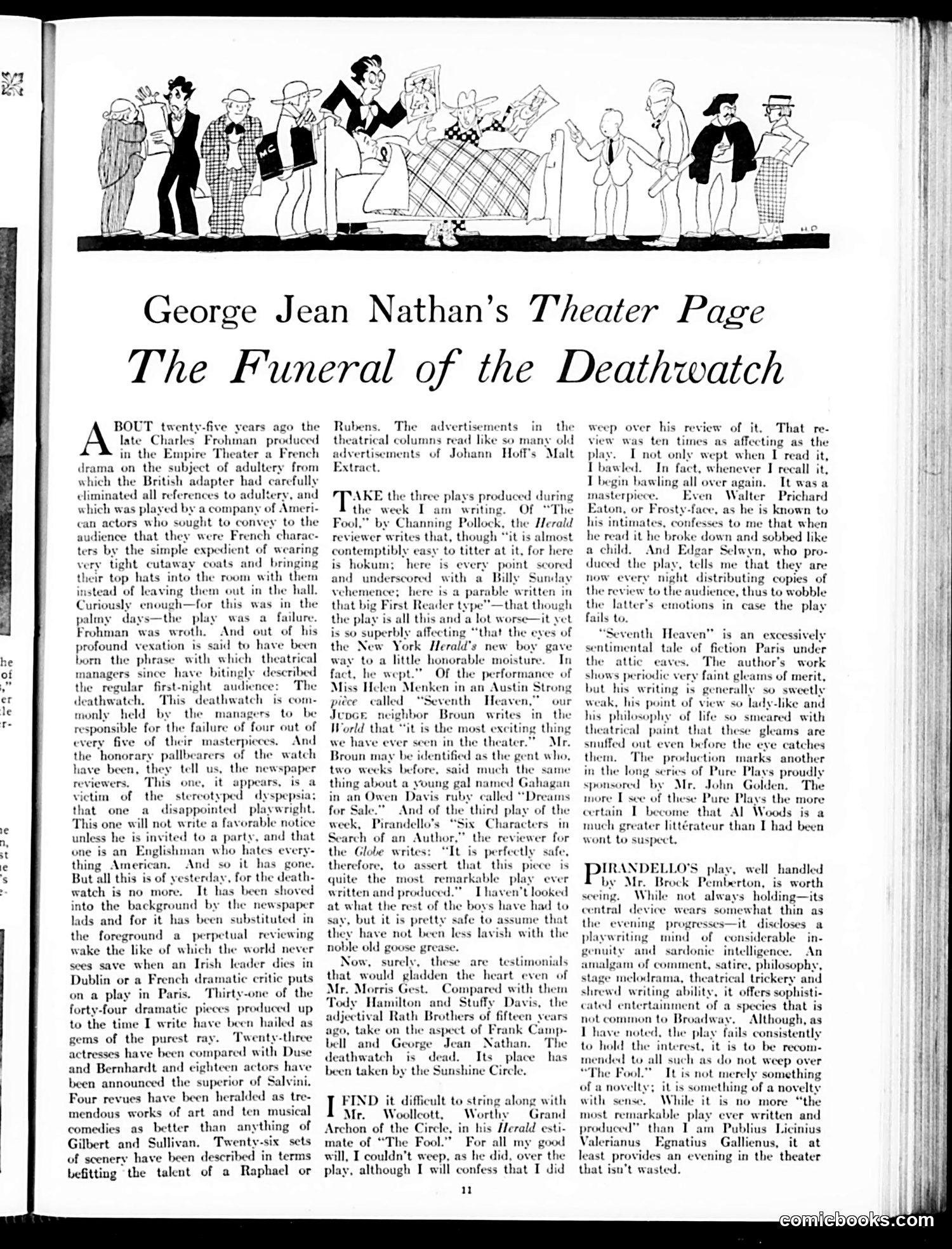
This is a theater criticism column by George Jean Nathan, not a political cartoon. The header illustration depicts various theatrical characters and scenes. Nathan argues that theater critics have abandoned their traditional role as skeptical "deathwatch"—a term coined when Charles Frohman blamed critics for killing plays decades earlier. Now, Nathan observes, critics have become absurdly effusive cheerleaders. He cites three recent plays that received wildly hyperbolic reviews: critics called mediocre works "gems," compared actresses to the legendary Duse and Bernhardt, and described ordinary scenery in terms befitting Renaissance masters like Raphael. Nathan's satire targets the degradation of theatrical criticism—critics once held managers accountable; now they provide promotional puffery indistinguishable from patent medicine advertisements. The "funeral" refers to the death of honest critical judgment.
📄 Transcribed text from this page (OCR, searchable)
Machine-transcribed from the original scan — historical spelling and the odd misread are preserved.
George Jean Nathan’s Theater Page The Funeral of the Deathwatch BOUT twenty-five years ago the A late Charles Frohinan_ produced in the Empire Theater a French drama on the subject of adultery from which the British adapter had carefully eliminated all references to adultery, and which was played by a company of Ameri- can actors who sought to convey to the audience that they were French charac. ters by the simple expedient of wearing very tight cutaway coats and bringing their top hats into the room with them instead of leaving them out in the hall. Curiously enough—for this was in the palmy days—the play was a failure. Frohman was wroth. And out of his profound vexation is said te ve been born the phrase with which theatrical managers since have bitingly described the regular first-night audience: The deathwatch. This deathwatch is com- monly held by) the managers to be responsible for the failure of four out of every five of their masterpieces. And the hono: pallbearers of the watch have been, they tell us, the newspaper ewers. This one, i i victim of the stereotyped dyspepsia; that one a disappointed playwright. This one will not write a favorable notice unles: party, and that one is an Englishman who hates every- thing American, And so it has gone. But all this is of yesterday, for the de: watch is no more. It has been shoved into the background by the newspaper lads and for it has been substituted in the foreground a perpetual reviewing wake the like of which the world never sees save when an Irish leader dies in Dublin or a French dramatic critic puts on a play in Paris. Thirty-one of the forty-four dramatic pieces produced up to the time I write have been hailed as gems of the purest rs actresses have been compared with Duse and Bernhardt and eighteen actors h: been announced the superior of Salvini. Four revues have been heralded as tre- mendous works of art and ten musical comedies as better than anything of Gilbert and Sullivan. Twenty-six sets of scenery have been described in terms befitting the talent of a Raphael or advertisements in the The columns read like so many old F tisements of Johann Extract. Hoff’s Malt AKE the three plays produced during the week I am writing. Of “The Fool,” by Channing Pollock, the Herald reviewer writes that, though “it is almost contemptibly easy to titter at it, for here is hokum; here is every point scor and underscored with a Billy Sunday vehemence; here is a parable written in that big First Reader type”—that though the play is all this and a lot worse—it yet is so superbly affecting “that the eyes of the New York Herald's new boy gave ay to a little honorable moisture. In fact, he wept.” Of the performance of Miss Helen Menken in an Austin Strong piece 1 “Seventh Heaven,” our Jvuvcr neighbor Broun writes in_ the World that “it is the most exciting thing we have ever seen in the th "Mr. Broun may be identified as the gent who, two weeks before, 1 much the same thing about a young gal named in an Owen Davis ruby called “Dreams for Sale.” And of the third play of the wee Pirandello’s * Characters in Search of an Author,” the reviewer for the Globe writes: “It is perfectly P therefore, to assert that this piece is quite the most remarkable play ever written and produced.” [haven't looked at what the rest of the boys have had to », but it is pretty safe to assume that they have not been less lavish with the noble old goose grease. Now, surely, these are testimonials that would gladden the heart even of Mr. Morris Gest. Compared with them T Hamilton and Stuffy Davis, ectival Rath Brothers of fifteen 4 ago, take on the aspect of Frank bell and George Jean Nathan. deathwatch is dead. place been taken by the Sunshine Circle. The has FIND it difficult to string along with Mr. Woollcott, Worthy Grand Archon of the Circle, in his Herald esti- mate of “The Fool.” For all my good will, I couldn’t weep, as he did, over the play, although I will confess that I did 1 weep over his review of it. That re- view was ten times as affecting as the 1 I not only wept when I read it, I bawled. In fact, whenever I recall it, I begin bawling all over again. It was a masterpiece. Even Walter Prichard Zaton, or Frosty-face, as he is known to his intimates, confesses to me that when he read it he broke down and sobbed like a child. And Edgar Selwyn, who pro- duced the play, tells me that they are now every night distributing copies of the review to the audience, thus to wobble the latter’s emotions in case the play fails to. “Seventh Heaven" is an_excessivels sentimental tale of fiction Paris unc the attic ea The author's work shows periodic very faint gleams of merit, but his writing is generally so sweetly weak, his point of view so lady-like and his philosophy of life so smei theatrical paint that these g snuffed out even before the eve catches them. The production marks another in the long series of Pure Plays proudly sponsored by Mr. John Golden. The more T see of these Pure Plays the more certain T become that Al Woods is a much greater littérateur than I had been wont to suspect. IRANDELLO'S play, well handled by Mr. Brock Pemberton, is worth seeing. While not always holding—its central device wears somewhat thin as the evening progresses—it di playwriting mind of conside nuity and sardonic intelligence. nalgam of comment, satire, philosophy stage melodrama, theatrical trickery an d writing ability, it offers sophisti- entertainment of a species that is not common to Broady Although, as T have noted, the play fails consistently to hold the interest, it is to be recom- to all such as do not weep over It is not merely something it is something of a novelty with sense. While it is no more “the most remarkable play ever written and produced” than Tam Publius Licinius Valerianus atius Gallienus, it at least provides an evening in the theater that isn’t wasted. shre cates