
Judge, 1922-11-25 · page 23 of 36
Judge — November 25, 1922 — page 23: what you’re looking at
What you’re looking at
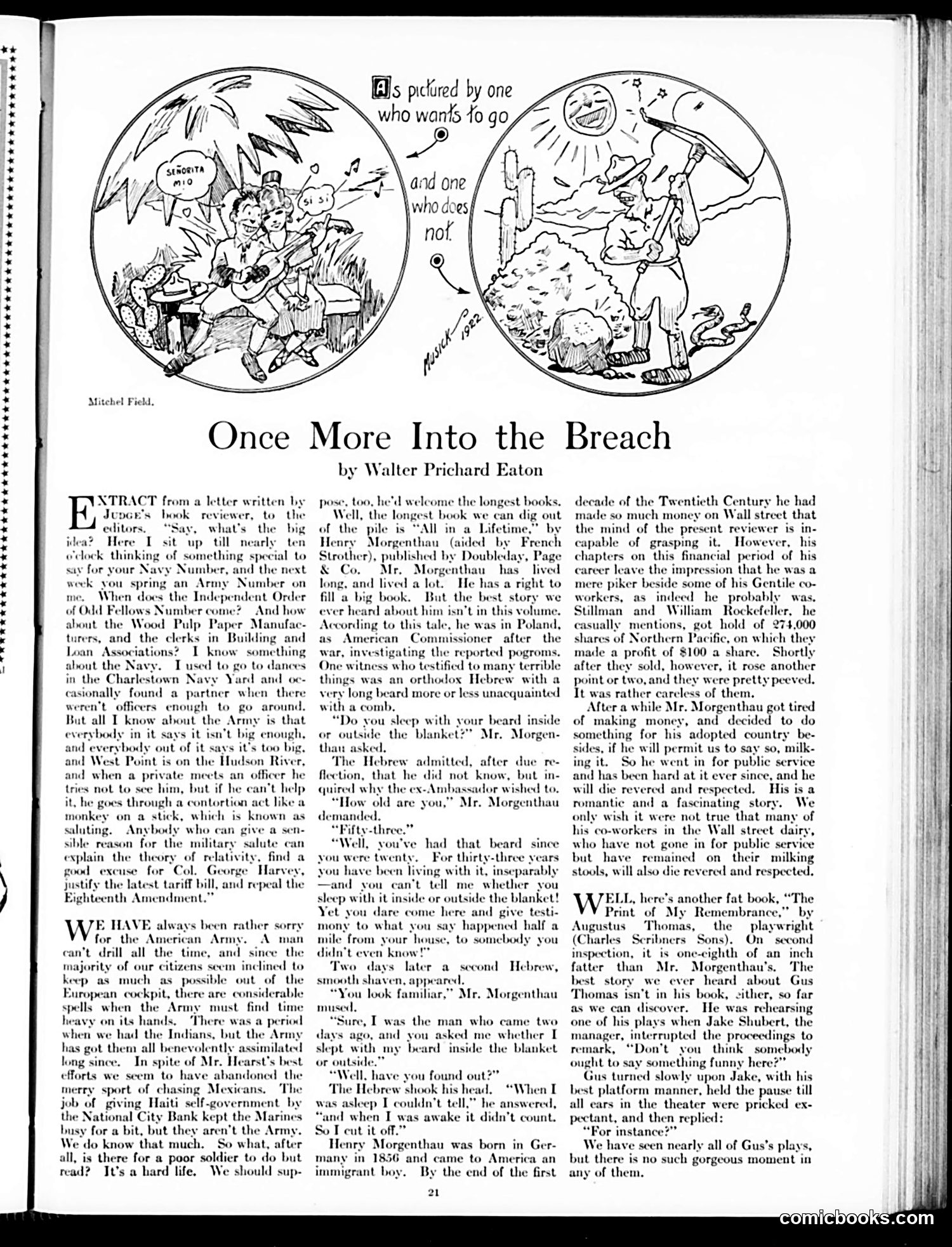
The page contains two elements: political cartoons at top and a book review below. **The Cartoons:** Two circular illustrations labeled "Mitchel Field" contrast soldiers' attitudes toward military duty. The left circle shows eager recruits wanting to "go"; the right shows reluctant ones who "do not." This reflects WWI-era tensions about American military service and enlistment. **The Review:** Critic Walter Prichard Eaton reviews Henry Morgenthau's autobiography "All in a Lifetime." Morgenthau was a prominent Jewish financier and diplomat who served as American Commissioner investigating pogroms in Poland after WWI. The review includes an anecdote mocking an Orthodox Jewish witness's beard—a casual ethnic stereotype typical of 1920s-era magazine humor. The joke relies on portraying the witness as confused and unsophisticated, contrasting with Morgenthau's American success.
📄 Transcribed text from this page (OCR, searchable)
Machine-transcribed from the original scan — historical spelling and the odd misread are preserved.
¥ * NSN NNN SNC EAAENARRRERRRRREERERR KKK KKKKEKKKEKKKKKKKKKEREAAAS Mitchel Field, Gils pictired by one who wants to go KH Once More Into the Breach ott reviewer, to the + What's the big sit up till nearly ten f something special to say for your Number, and the next week you spring an Army Number on me. When does the Inde nt Order of Odd Fellows Number come? — And how about the Wood Pulp Paper Manufac- turers, and the clerks in Building and Loan Associations? I know something about the Navy. I to dances in the Charlestown Navy dand oc- casionally found a partner when there rent officers enough to go around. But all Tk Bx ACT from a letter written by editors. i it says it isn’t big enough, verybody out of it says it’s too big, and West Point is on the Hudson Rive and when a private meets an officer he tries not to see him, but if he can’t help it, he goes through a contortion act like a m ona stick, which is known as saluting. Anybody who can give a sen- sible m for the military salute can explain the theory of re ity, find a good excuse for Col. George Harvey, justify the latest tariff bill, and repeal the Eighteenth Amendment.” been rather sorry for the American Art AUma can’t drill all the time, and since the majority of our citizens scem inclined to keep as much as possible out of the European cockpit, there are considerable spells when the Army must find time on its hands, ‘There was a period ians, but the Army ny ly assimilated long since. In spite of Mr. Hearst's best efforts we seem to bh merry sport of chasing Mexicans. The jot giving Haiti self-government. by the National City Bank kept the Marines busy for a bit, but they aren't the Army. We do know that much. So what, after all, is there for a poor soldier to do but read? It’s a hard life. We should sup- E HAVE als heavy by Walter Prichard Eaton pose, too, he'd welcome the longest books. Well, the longest book we can dig out of the pile is “All in a Lifetime.” by Henry Morgenthau (aided by French Strother), published by Doubleday, Page & Co. Mr. Morgenthau has lived long, and lived a lot. He has a right to fill'a big book. But the best story we ever heard about him isn’t in this volume. According to this tale, he was in Poland, the as American Commissioner after war, investigating the reported pog One witness who testified to many tei things was an orthodox Hebrew with a very long beard more or less unacquainted with a comb, “Do you sleep with or outside the blanke! thau asked, The Hebrew admitted, after due re- flection, that he did not know, but in- quired why the tbassador wished to. “How old are you,” Mr. Morgenthau ded. ir beard inside Mr. Morgen- or thirty-three ig with it, insey vou can’t tell: me sleep with it inside or outside the Yet you dare come here and give mony to what you say happened half a a second Hebrew, ad. Mr. Morgenthau T was the man who came two days ago, and you asked me whether I slept with my beard inside the blanket or outside.” Well, have you found out The Hebrew shook his head, “When I was asleep I couldn't tell,” he answered, “and when I was awake it didn’t count. So T cut it off.” Henry Morgenthau was born in Ger- many 1856 and came to America an immigrant boy. By the end of the first au decade of the Twentieth Century he had ade so much money on Wall street that mind of the present reviewer is in- pable of grasping it. However, his chapters on this financial period of his career leave the impression that he was a mere piker beside some of his Gentile co- workers, as indeed he probably was. Stillman and William Rockefeller, he casually mentions, got hold of 274,000 shares of Northern Pacific, on which they made a profit of $100 a share. Shortly after they sold, however, it rose another point or two, and they were pretty peeved. It was rather careless of them. After a while Mr. Morgenthau got tired of making money, and decided to do something for his adopted country be- if he will permit us to say so, ing it. So he went in for public service and has been hard at it ever since, and he will die revered and respected, E romantic and a fascinating stor y wish it were not true that many of his co-workers in the Wall street dairy, who have not gone in for public service but have remained on their milking stools, will also die revered and respected. ELL, here’s another fat book, “The Print of My Remembrance,” by Augustus Thomas, the — playwright (Charles Scribners Sons), On second inspection, it is one-cighth of an inch fatter than Mr. Morgenthau’s. ‘The best story we ever heard about Gus Thomas isn't in his book, cither, so far as we can discover. He was rehearsing one of his plays when Jake Shubert, the manager, interrupted the proceedings to remark, “Don't you think somebody ought to say something funny here?” Gus turned slowly upon Jake, with his best platform manner, held the pause till all ears in the theater were pricked ex- pectant, and then replied: “For instance?” We have seen nearly all of Gus’s plays, but there is no such gorgeous moment in any of them,