
Judge, 1922-11-25 · page 17 of 36
Judge — November 25, 1922 — page 17: what you’re looking at
What you’re looking at
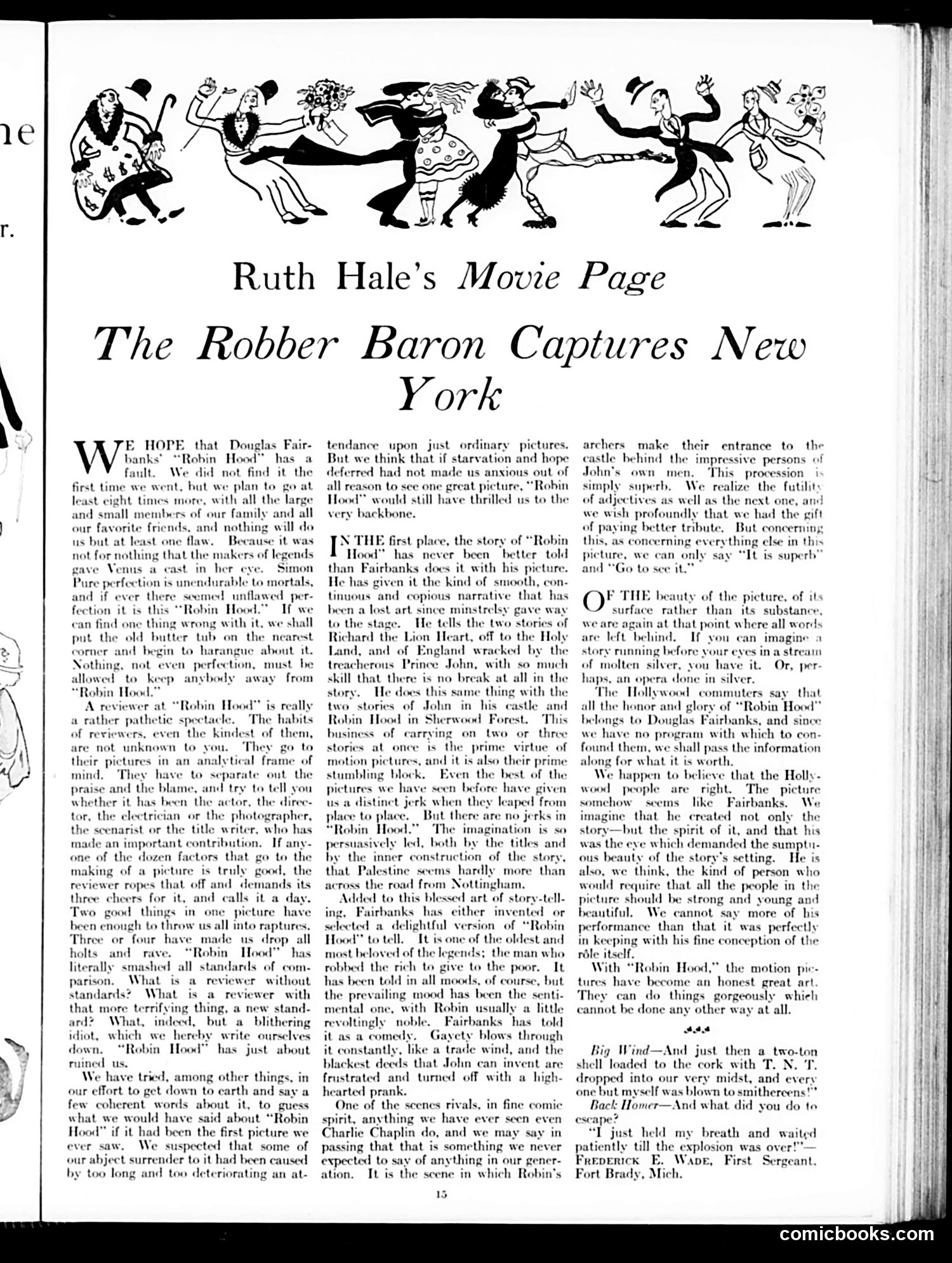
This page reviews Douglas Fairbanks's film adaptation of *Robin Hood*. The decorative header shows silhouettes of people in lively, dancing poses—representing the film's energy and appeal. The review, written by Ruth Hale, is extraordinarily enthusiastic. Hale admits she cannot find a single flaw in the picture and has seen it repeatedly. She praises Fairbanks's direction and cinematography for seamlessly interweaving multiple plotlines (Richard the Lionheart's crusade and Robin Hood's adventures) without jarring transitions—a technical achievement she considers rare in motion pictures. Notably, Hale appreciates that Fairbanks presents Robin Hood as **comedy** rather than sentimental drama, a departure from typical tellings that portray him as overly noble. The "Robber Baron" headline puns on Robin Hood as a thief who robs the rich to aid the poor—playfully contrasting this fictional hero with real American industrialists ("robber barons") of the era.
📄 Transcribed text from this page (OCR, searchable)
Machine-transcribed from the original scan — historical spelling and the odd misread are preserved.
Ruth Hale’s Movie Page The Robber Baron Captures New E HOPE that Douglas Fair- \ banks’ “Robin Hood” has a fault. We did not find it the first time we went, but we 7 least eight times more, with and small members of our family our favorite friends, and nothing will « us but at least one flaw. Because it was not for nothing that the mak of legends gave Venus ast in her ¢ Simon Pure perfection is unendurable to mortals, and if ever there seemed unflawed_per- fection it is this “Robin Hood.” If we can find one thing wrong with it, we shall put the old butter tub on the nearest comer and begin to harangue about it. Nothing, not even perfection, must be allowed to keep anybody away from “Robin Hood.” A reviewer at is really a rather pathet he habits reviewers, even the kindest of them, » not unknown to you. They go to stures in an analytical frame of mind, They have to separate out the praise and the blame, and try to tell you whether it has been the actor, the direc- tor, the electrician or the phote the scenarist or the t writer, who ha made an important contributic If any- one of the dozen factors that go to the making of a picture is truly good, the reviewer ropes that off and d i three cheers for it, and cal Two good things in one picture been enough to throw us all into raptures. Three or four have made us drop all holts | and Robin Hood" has literally sme I standards of com- parison, W wer without standards? is a reviewer with that more terrifying thing, a new stand- ard? What, indeed, but blithering idiot, which we hereby write ourselves down. “Robin Hood” has just about ruined us. We have tried, among other things, in our effort to get down to earth and s few coherent words about it, to guess what we would have said about “Robin Hox if it had been the first picture we ever saw. We suspected that some of our abject surrender to it had been caused by too long and too deteriorating an at- “Robin He spectacle, York tendance upon just ordinary pictures. But we think that if starvation and hope deferred had not made us anxious out of all reason to sce one great picture, “Robin Hood” would still have thrilled us to the very backbone. [5 THE fisst place, the story of “Robin Hood” has never been better told than Fairbanks does it with his picture. He has given it the kind of smooth, con- tinuous and copious narrative that has been a lost art since minstrelsy ga to the st He tells the two stories of Richard the Lion Heart, off to the Holy Land, and of England wracked by the treacherous Prince an, h so much skill that. there is no by all in the story. He does this same thing with the two stories of in his castle and Robin Hood in wood Forest. This business of carrying on two or three stories at once is the prime virtue of motion pictures, and it is also their prime stumbling bl Even the best of the pictures w have given a distinet jerk jahien they 1 from But there jerks in The i ation is so persuasively led, both by the titles and by the inner construction of the story, that Palestine seems hardly more than across the road from Nottingham. Added to this blessed art of story-tell- nks has either invented or leet delightful version of “Robin Hood f the ¢ most be dof the legends; the man who robbed the rich to give to the poor. It has been told in all moods, of course, but the prevailing mood has been the senti- mental one, with Robin usually a little revoltingly noble. Fairbanks has told it as a comedy. ws through it constantly, like a trade wind, and the blackest deeds that John can invent are frustra a and turned off with a high- hearted prank. One of the scenes ri spirit, anything we Charlie Chaplin do, and we may say in passing that that is something we never expected to say of anything in our gener- ation. It is the scene in which Robin's als, in fine comic © ever seen even 15 archers make their entrance to the castle behind the impressive persons of John’s own men. This procession simply superb. We realize the futility of adjectives as well as the next one, and we wish profoundly that we had the gift of paying better tribute. But concerning this, as concerning else in this pictur “It is superb” and “Go to see Or THE surf rather than its substance gain at that point where all words i “behind, If you can imagine a story ninning before your eyes ina streain of molten silver, you have it. Or, per haps, an opera done in silver. The Hollywood commuters say_ that all the honor and glory of “Robin Hood” belongs to Douglas Fairbanks, and since we have no program with which to con- found them, we shall pass the information along for what it is worth, We happen to believe that the Holly- wood people are right. The picture somehow seems like Fairbanks. We imagine that he created not only the story—but the spirit of it, and that his was the eye which demanded the sumptu- ous beauty of the story's setting. He is also, we think, the kind of person who would require that all the people in the picture should be strong and young and beautiful. We cannot say more of his performance than that it was perfectly in keeping with his fine conception of the role itself. With “Robin Hood,” the motion pic- tures have become an honest great art They can do things gorgeously whieh: cannot be done any other way at all. ily say auty of the picture, of its sae Big Wind—And just then a two-ton shell loaded to the cork with T. N. dropped into our very midst, and every one but myself was blown to smithereens!” Back: Homer—And what did you do to napa? just held my breath and waited patiently till the explosion vy f Frepertck E. Wane, First Sergeant, Fort Brady, Mich. comicbooks.com