
A complete issue · 36 pages · 1922
Judge — November 18, 1922
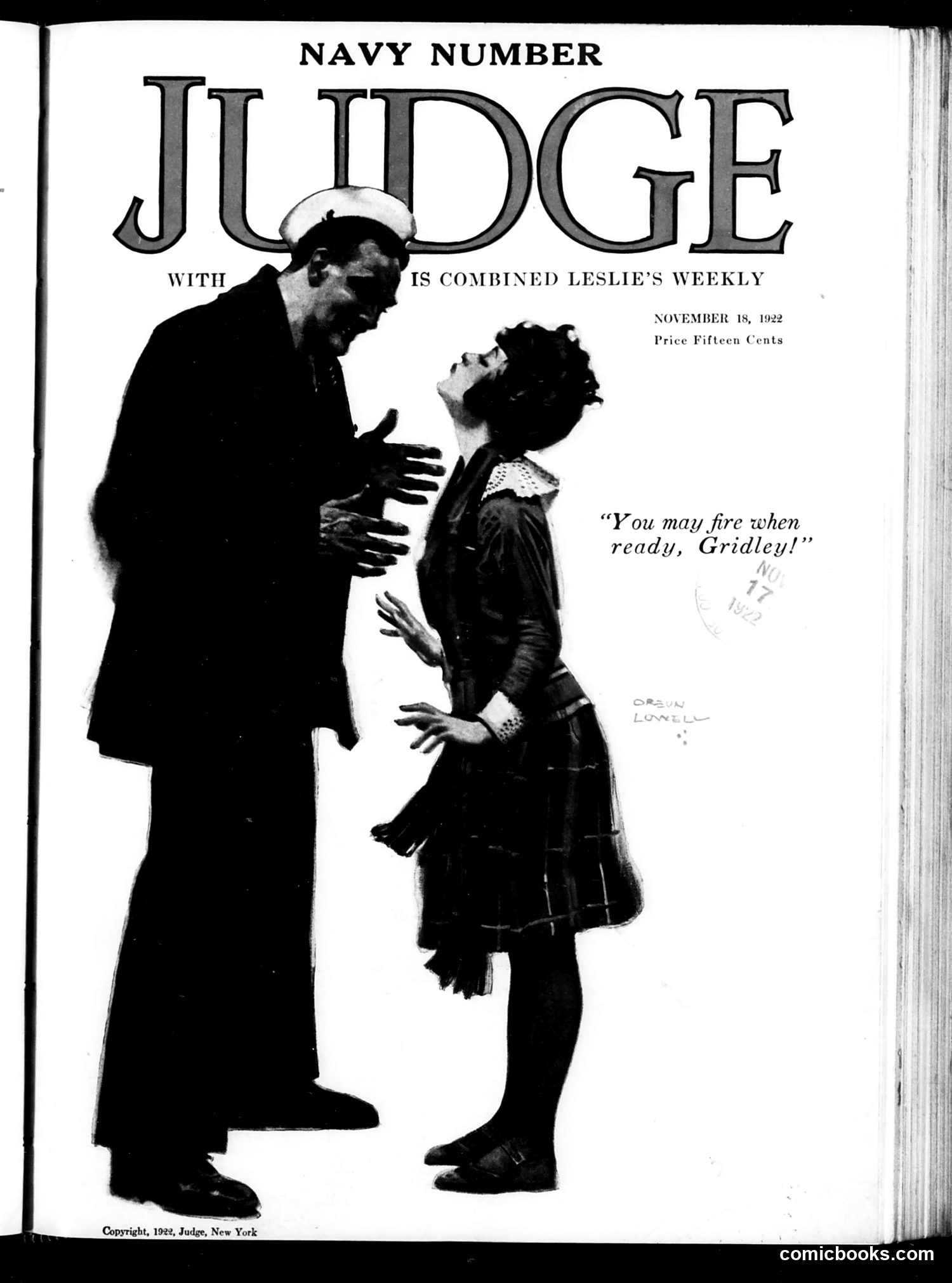
This cover depicts a naval officer in dress uniform instructing a woman, with the caption "You may fire when ready, Gridley!" The phrase references a famous naval command from the Spanish-American War (1898), when Commodore George Dewey reportedly told Captain Charles Gridley "You may fire when ready, Gridley" during the Battle of Manila Bay—a celebrated moment in American military history. The satire appears to mock either the formality of naval protocol or possibly gender dynamics of the era by placing a woman in a military scenario using this iconic historical phrase. The exact joke is somewhat unclear without additional context, but it likely comments on contemporary social changes regarding women's roles or naval affairs circa 1922.
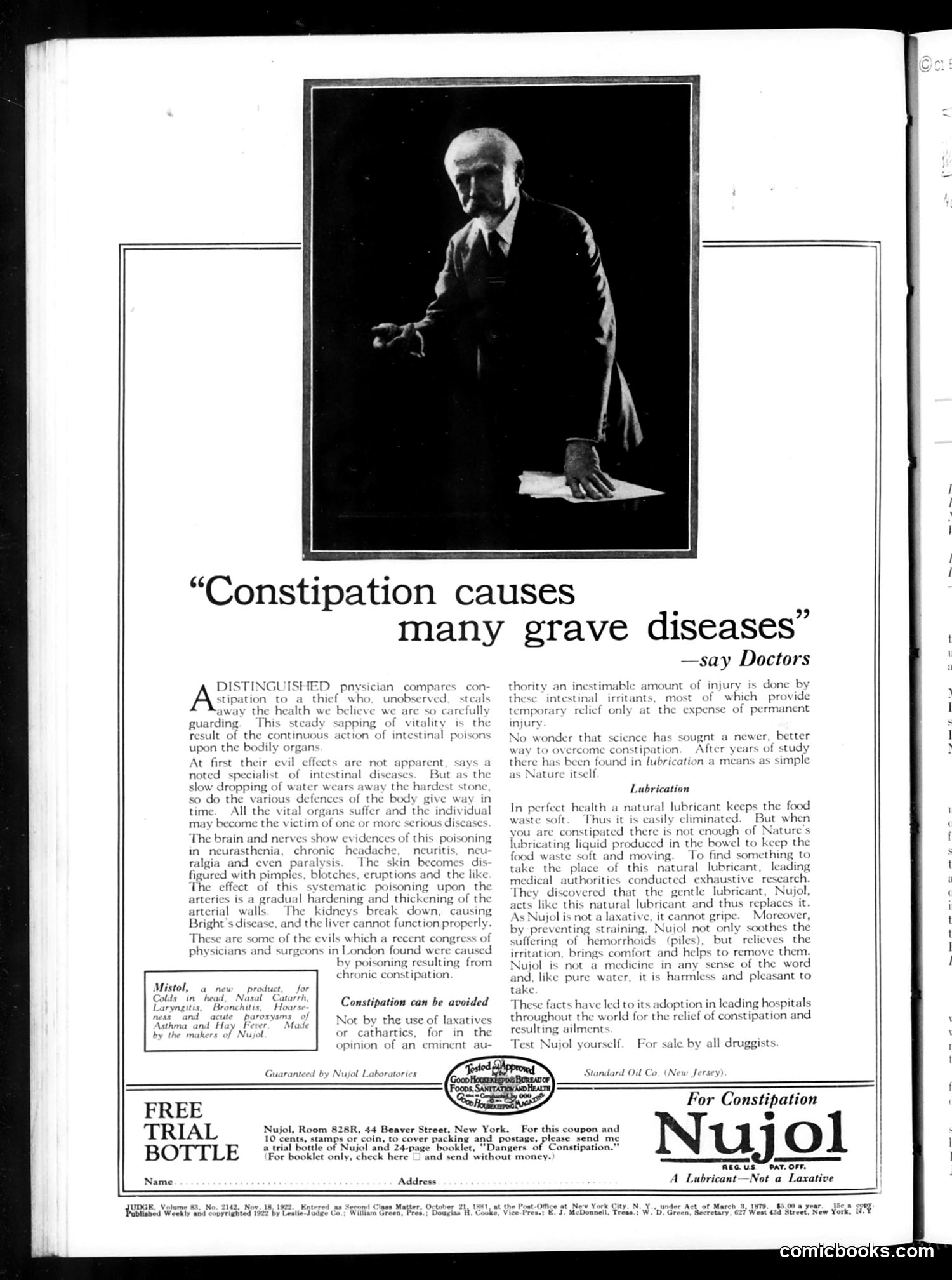
This page is primarily **advertising, not satire**. It's a full-page ad for "Nuiol," a commercial laxative product from the early 20th century. The image shows a distinguished older man (likely meant to represent a physician or medical authority) gesturing thoughtfully. The ad claims doctors say "Constipation causes many grave diseases" and positions Nuiol as a solution. The marketing strategy relies on medical authority and fear-based messaging—common in early pharmaceutical advertising before FDA regulation. The product is pitched as a "lubricant, not a laxative," emphasizing gentleness. The "FREE TRIAL BOTTLE" coupon at bottom was a standard direct-response marketing technique of the era. This reflects how patent medicines exploited digestive anxiety to drive sales, a practice that eventually prompted stricter advertising regulations.
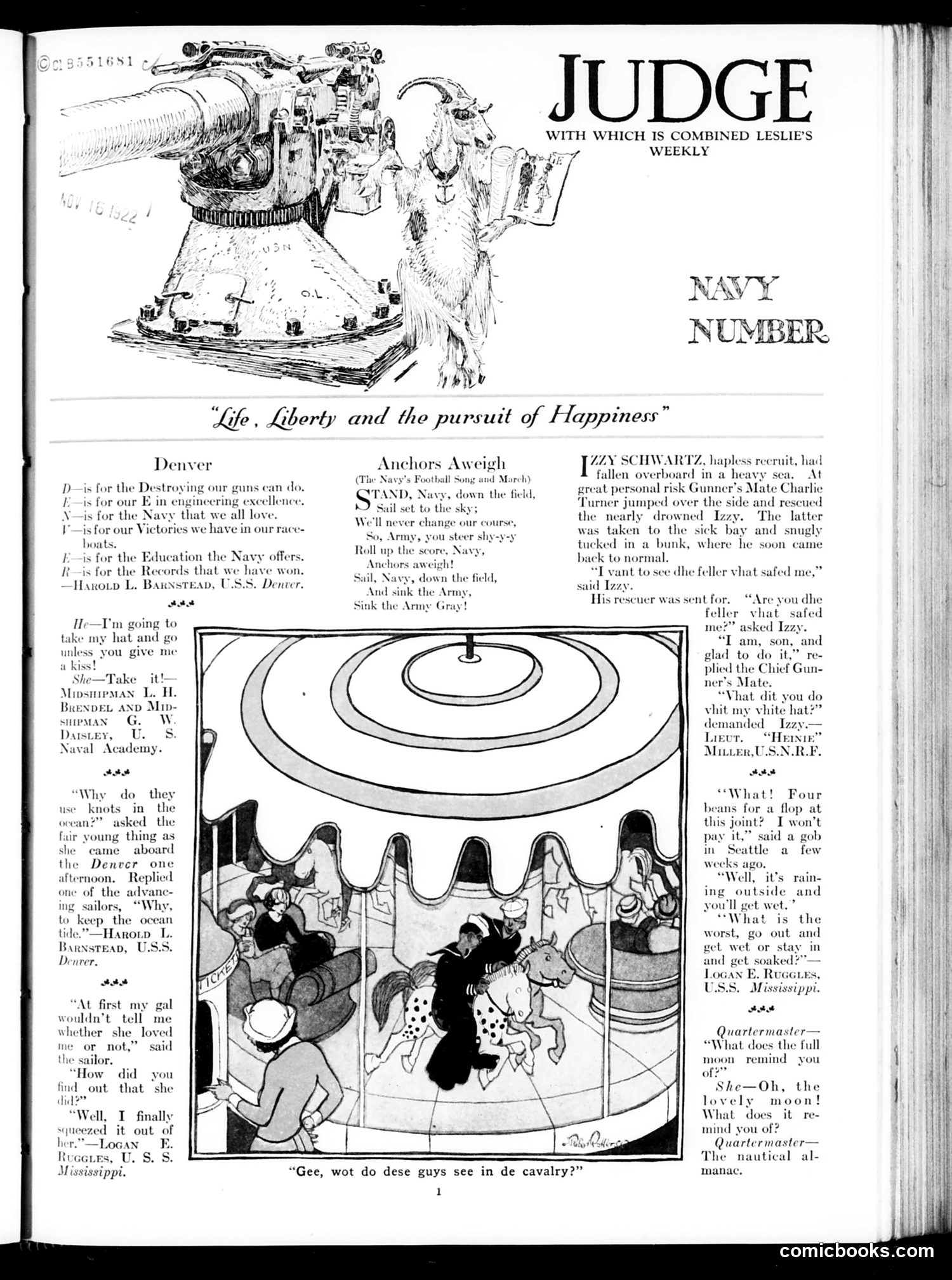
This is a **Navy-themed issue** of Judge magazine, featuring patriotic military content and sailor humor. The main cartoon depicts sailors in what appears to be a ship's interior (likely a gun turret or confined space), with the caption "Gee, wot do dese guys see in de cavalry?" The joke relies on **dialect humor** (common in early 20th-century American comedy), contrasting sailors' experience with cavalry soldiers. The surrounding text includes Naval Academy anecdotes and a patriotic acrostic poem about Navy capabilities. The page reflects **pro-military sentiment**, typical of Judge during America's naval expansion period. The cartoons and verses celebrate naval service through lighthearted, folksy humor rather than serious political commentary.
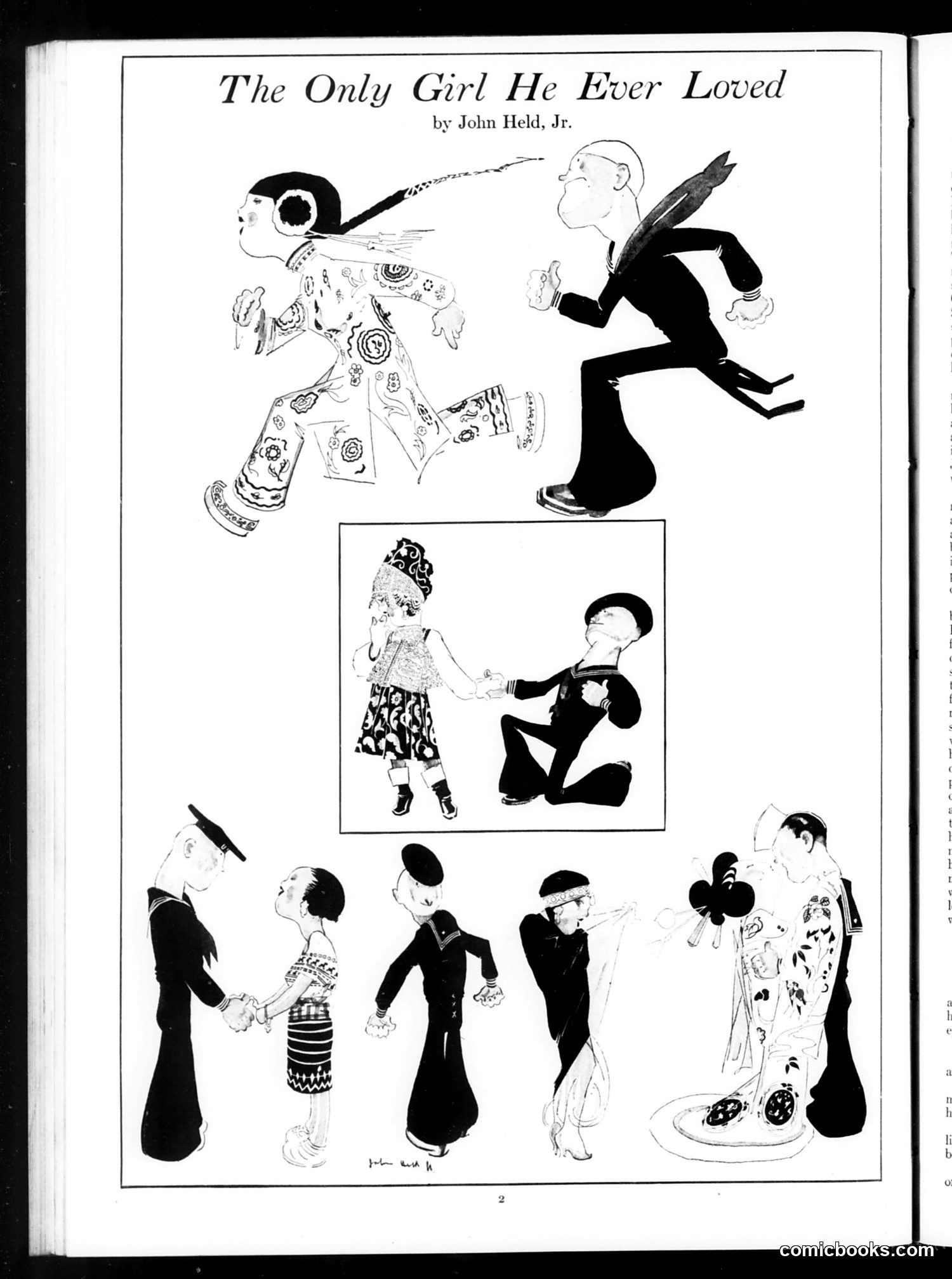
This satirical illustration depicts a man's romantic pursuits across different social contexts and life stages. The top panels show him chasing various fashionably-dressed women in what appears to be 1920s flapper-era settings—suggesting youthful infatuation and inconstancy. The bottom row presents multiple scenes of him interacting with different women in formal attire, implying a pattern of romantic interests rather than genuine devotion. The title's irony is the joke: despite claiming "the only girl he ever loved," the cartoon shows him repeatedly pursuing different women, mocking male protestations of singular devotion. Held's characteristic Art Deco style and the emphasis on fashionable clothing typical of his Jazz Age work suggests this targets contemporary dating culture and romantic dishonesty among young men.
This page contains a short story rather than a political cartoon. "The Leg-puller" appears to be a humorous narrative about John Octavius Peglar, a Canadian citizen working for the U.S. State Department who is known for pulling pranks on British admiralty officials. The story describes Peglar's reputation for practical jokes—he once famously pulled the leg of a British admiral. The narrative follows his assignment to a naval position and his interactions with a British naval officer, involving accounts ledgers and supply requisitions. The "leg-pulling" (practical joking) serves as the satirical vehicle, mocking bureaucratic absurdity and the tensions between American and British naval establishments during what appears to be a World War I-era period.
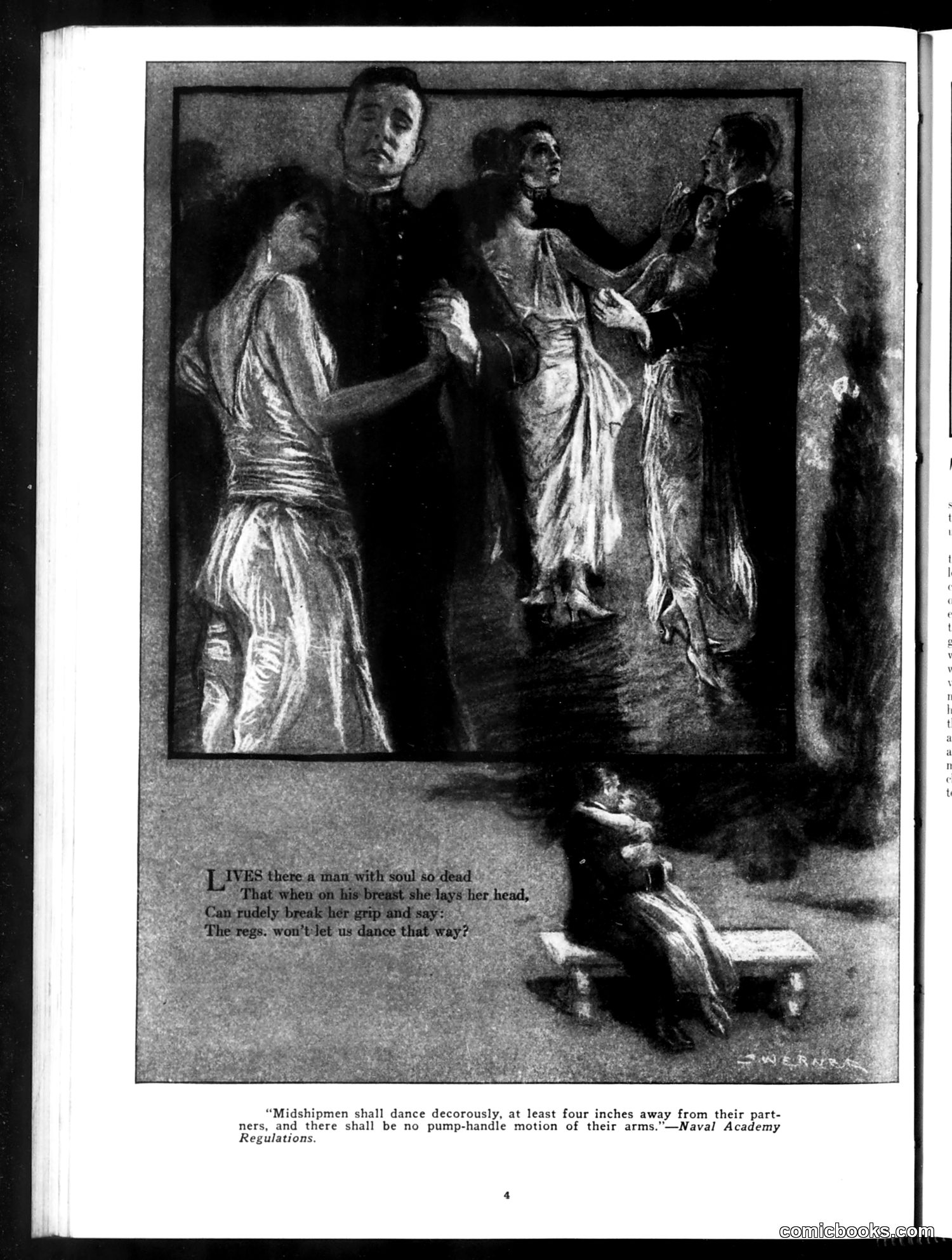
This page satirizes **Naval Academy regulations** governing midshipmen's conduct during social dancing. The illustration depicts officers monitoring midshipmen dancing with women while maintaining prescribed distance ("at least four inches away"). The quoted poem above the image—beginning "Lives there a man with soul so dead"—mocks the restrictive rules by suggesting they're emotionally deadening. The regulation quote below emphasizes the absurdity: midshipmen must dance decorously with "no pump-handle motion of their arms." The satire targets the Navy's attempt to enforce rigid propriety during social interaction. By pairing overly formal regulations with the melodramatic poem, **Judge** ridicules institutional control over young officers' personal behavior, suggesting such restrictions are both laughable and soul-crushing.
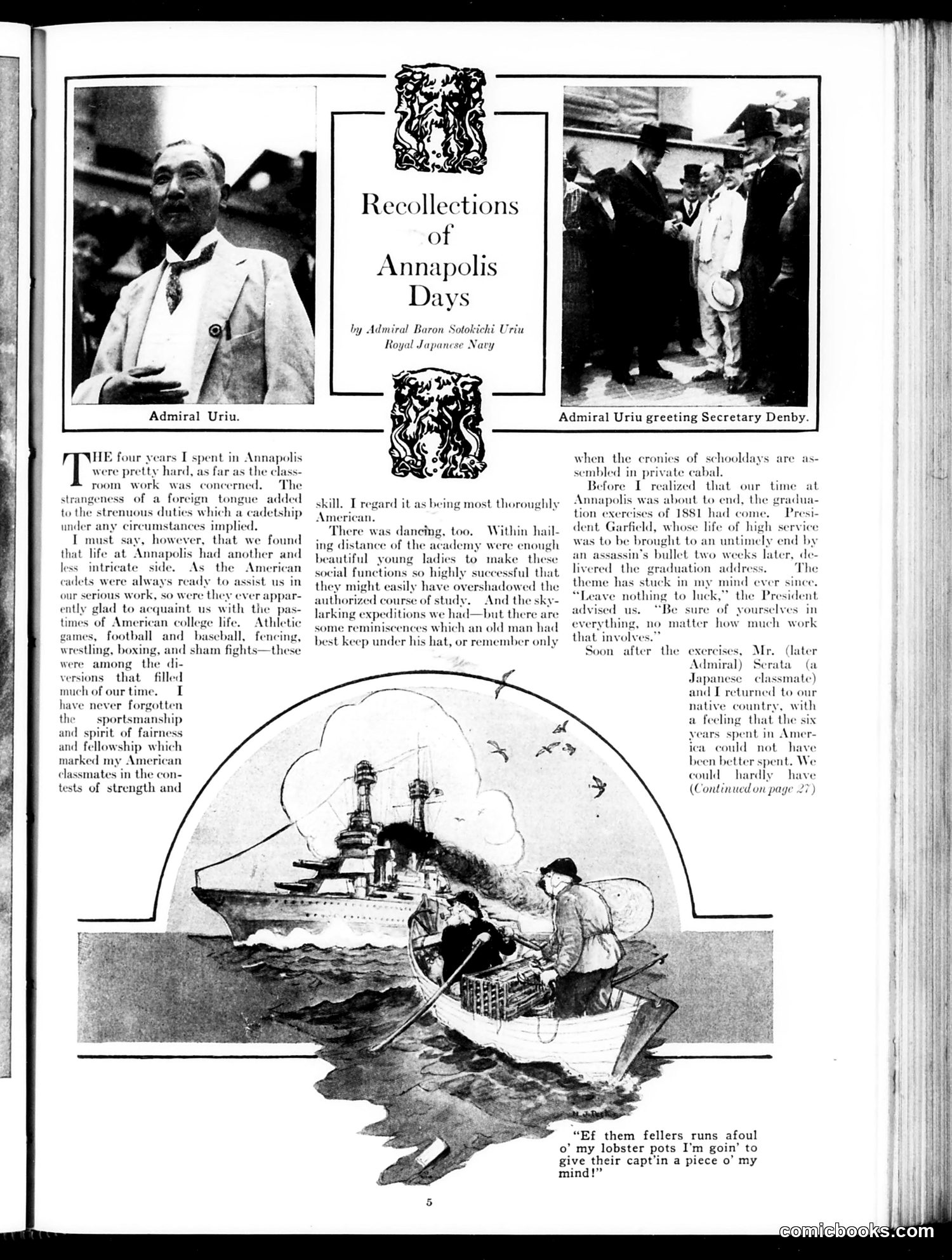
This is a nostalgic memoir by Admiral Baron Sotokichi Uriu of Japan's Royal Navy, recounting his four years as a cadet at the U.S. Naval Academy in Annapolis (circa 1881). Uriu reflects warmly on the rigorous academics, athletic competitions (boxing, wrestling, football), and social life—particularly dances with "beautiful young ladies"—that characterized his experience. The article emphasizes the sportsmanship and camaraderie among American and foreign classmates, and notes how supportive local society was toward cadets. A graduation address by President Garfield (assassinated shortly after) inspired the graduating class. The cartoon below, showing fishermen with lobster pots and a warship, appears to be an unrelated humorous sketch, possibly commentary on coastal life or international naval presence—its specific satirical point is unclear from context alone.
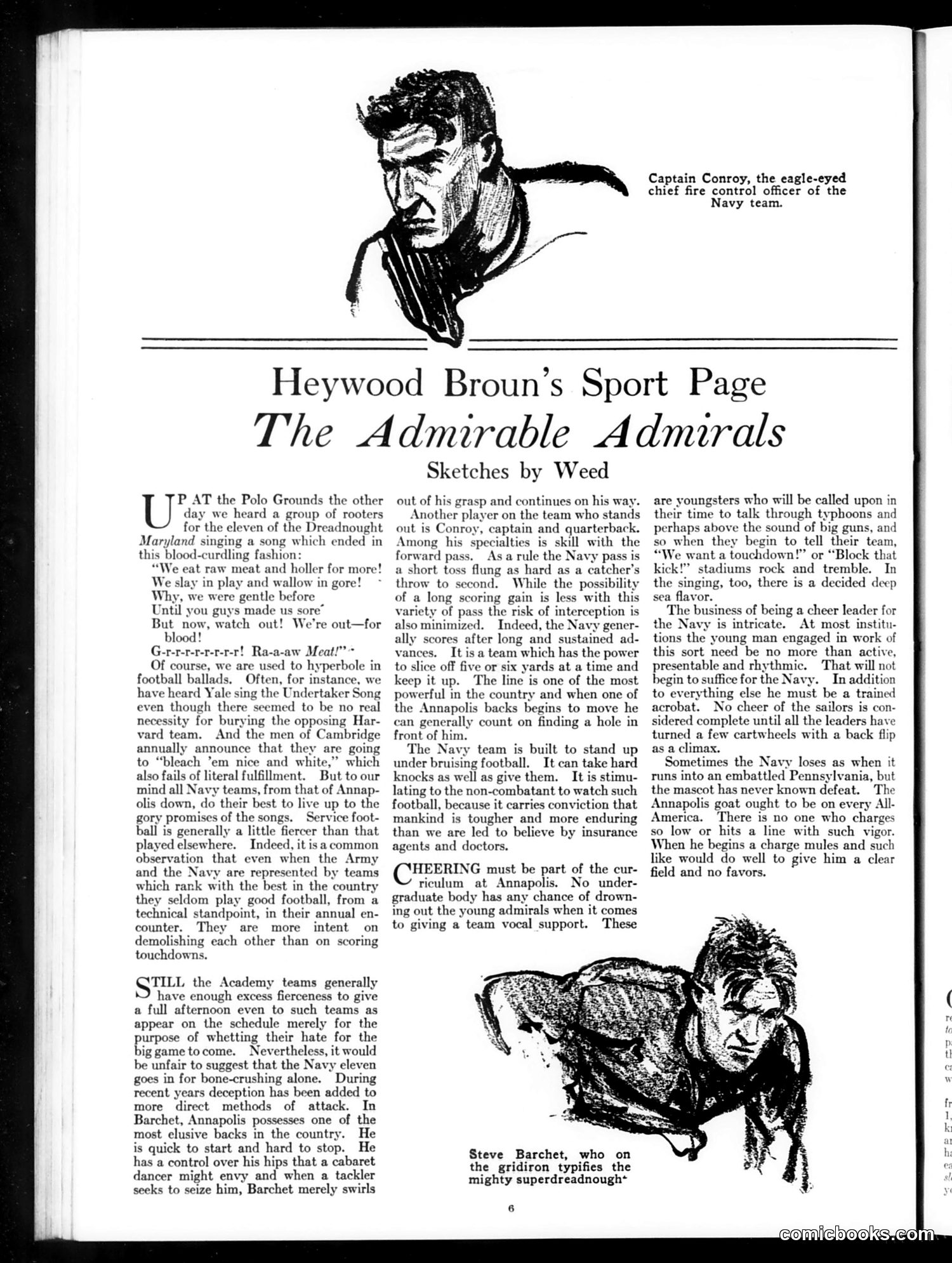
This is a sports commentary by journalist Heywood Broun analyzing the U.S. Naval Academy football team. The page features sketches of two players: Captain Conroy (quarterback) and Steve Barchet (running back). Broun contrasts the Navy team's physical, aggressive playing style with the more technical finesse of civilian college football. He notes that while service teams sing fierce songs about "eating raw meat" and "wallowing in gore," the Navy actually plays with genuine brutality and tactical deception rather than mere bluster. The piece celebrates the Navy players' toughness, discipline, and coordinated blocking while praising their vocal support as evidence of the kind of resilience they'll need as future naval officers commanding during wartime (the "typhoons" and "big guns" reference likely alludes to WWI concerns). The satire gently mocks the gap between football bravado and reality—other teams make similar threats, but Navy actually backs theirs up.
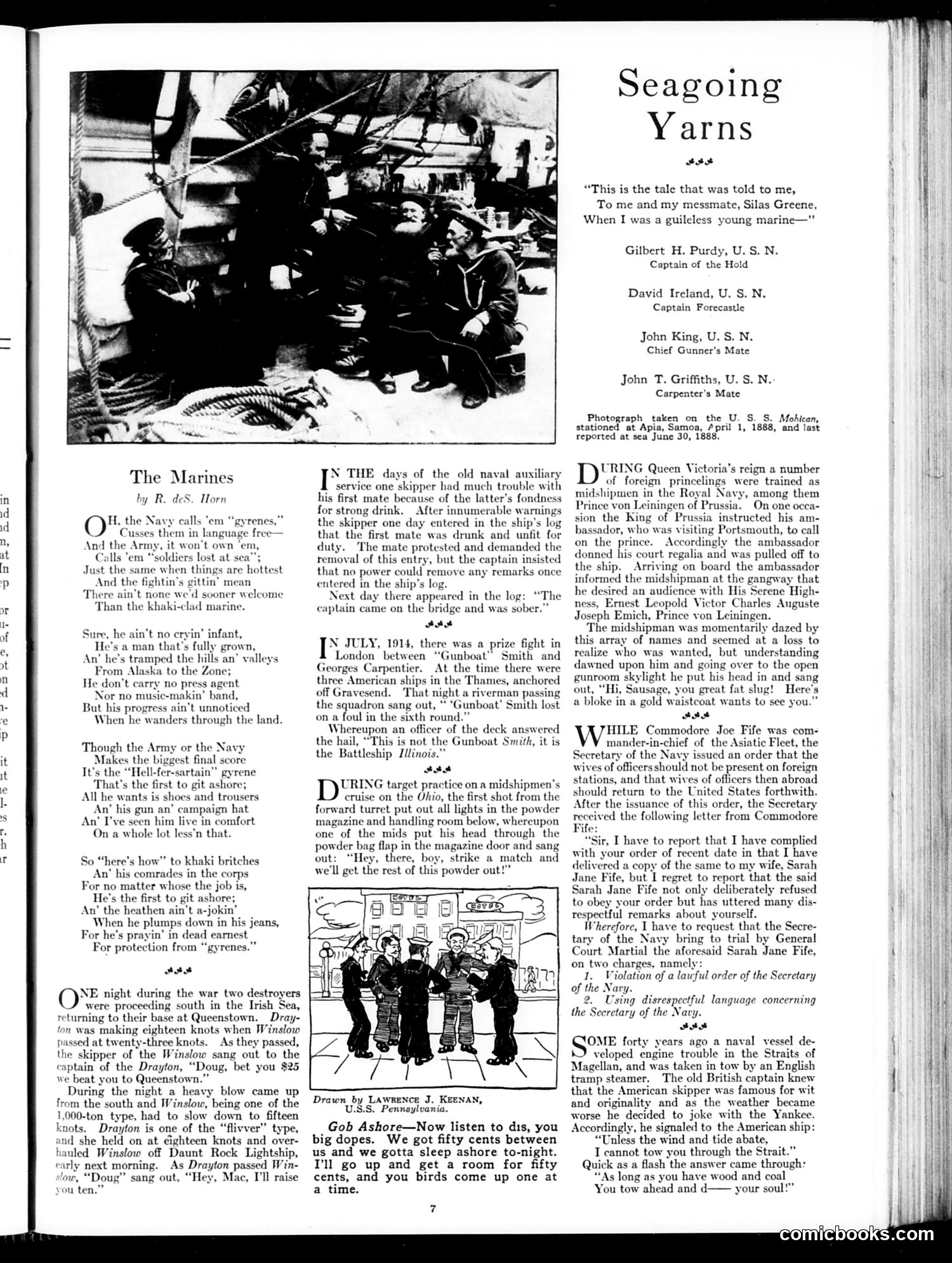
This page collects humorous military anecdotes told by naval personnel, celebrating the U.S. Marines and sailors. The content includes: **Poetry** ("The Marines" by R. deS. Horn): A tribute to Marine soldiers, contrasting their modest demeanor with their crucial combat role—they're the first ashore despite lacking publicity or fanfare. **Cartoon** (by Lawrence J. Keenan, bottom right): Sailors with minimal funds scheming to share one cheap hotel room, sending men up "one at a time"—a joke about Navy wages and their resourcefulness. **Short anecdotes**: Humorous incidents involving naval officers and crew, including ship races and a misheard report about boxer "Gunboat" Smith confused with the USS *Illinois*. The overall point: celebrating enlisted sailors' toughness, loyalty, and practical humor despite low pay and harsh conditions—wartime morale-boosting content for the magazine's readers.
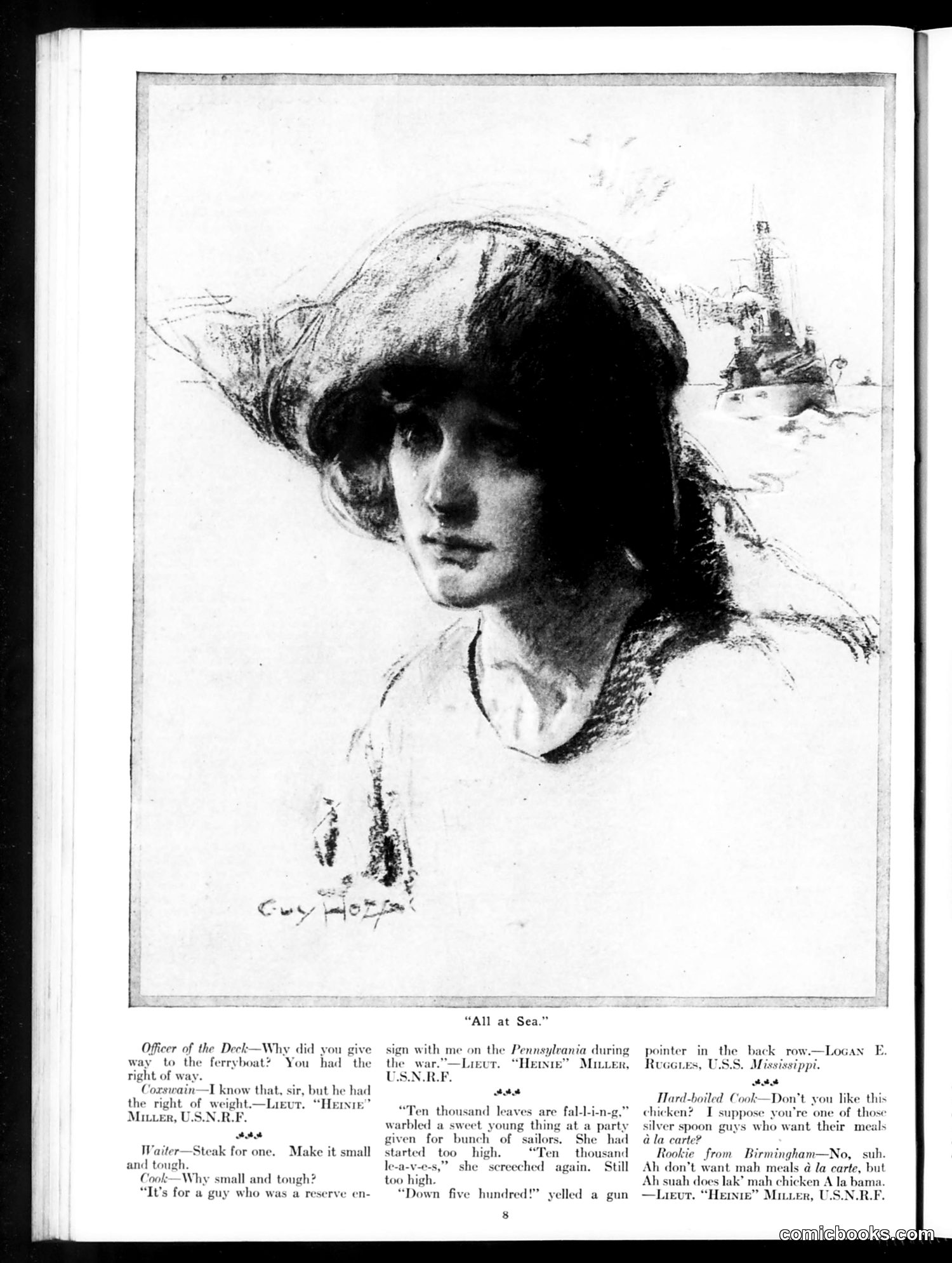
This page presents WWI-era military humor sketches, likely from 1917-1918 based on references to the USS Pennsylvania and Navy Reserve personnel. The sketches mock military life through workplace interactions: 1. **Officer/Coxswain exchange**: Jokes about naval protocol—a junior sailor yields to a larger ferry despite having right-of-way, using "right of weight" as wordplay. 2. **Cook/Waiter dialogue**: Dark humor about reserve officers' toughness; the cook assumes a reservation officer deserves tough, small portions (suggesting reserve officers were considered lesser soldiers). 3. **Singing sailors**: A woman at a naval party repeatedly fails to hit high notes while singing about "ten thousand leaves," with a gunner joking she should transpose down—lighthearted teasing. 4. **Rookie/Cook finale**: A Southern recruit prefers home-style chicken to fancy "à la carte" dining, playing on regional dialect for comic effect. The humor relies on naval hierarchy, class distinctions between regular and reserve officers, and ethnic/regional stereotypes typical of period satire.
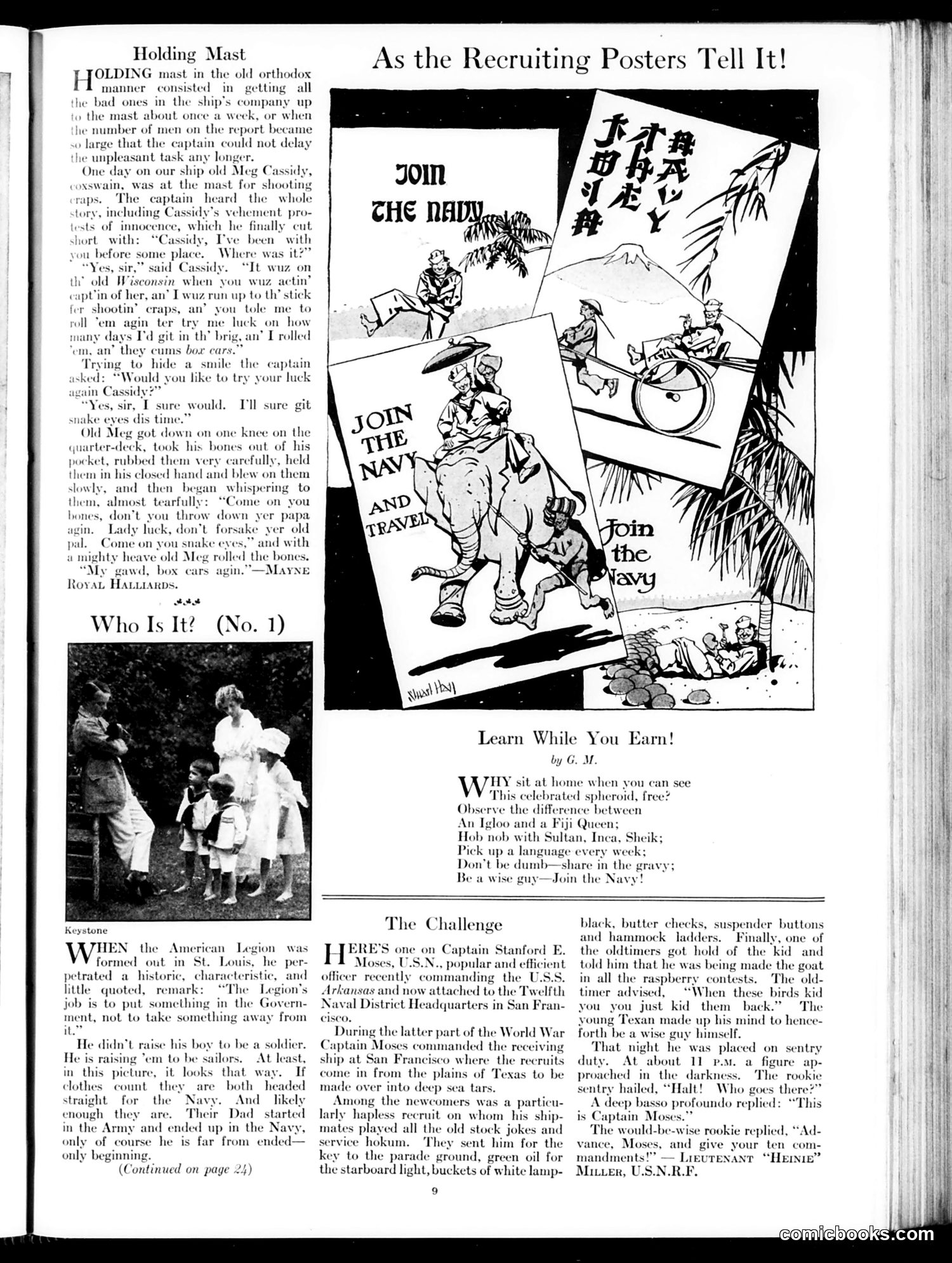
This page from *Judge* magazine contains Navy recruitment content from the World War I era, presented through humor and anecdotes. **Main Content:** The central cartoon "As the Recruiting Posters Tell It!" satirizes Navy recruitment propaganda by exaggerating promised benefits—seeing the world, learning languages, rubbing shoulders with exotic locales ("Igloo and a Fiji Queen," "Sultan, Inca, Sheik")—the kind of romantic claims made in official recruiting posters. **Supporting Stories:** "The Challenge" describes a Texas recruit who, after being pranked relentlessly by experienced sailors, adopts a cocky attitude. When confronted by a superior officer in darkness, the rookie freshly orders him to halt and identify himself—humorously testing his newfound confidence. The joke illustrates how recruitment transforms civilians into cocky "wise guys." "Who Is It?" references an American Legion founder who raised his son for the Navy rather than the Army—endorsing military service as character-building. These pieces collectively mock recruitment rhetoric while actually promoting Navy enlistment through humor and patriotic anecdotes aimed at young male readers.
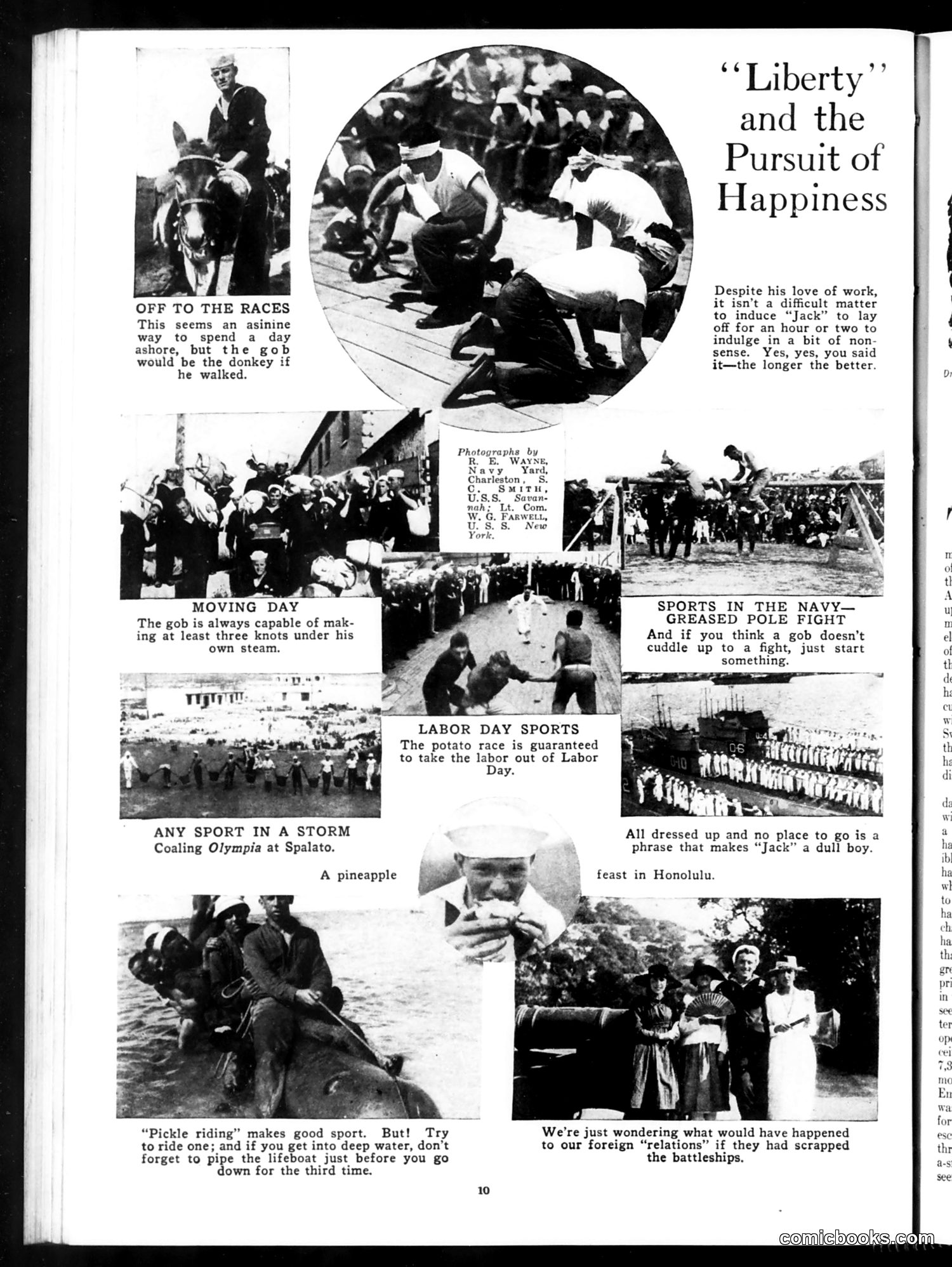
This Judge magazine page satirizes U.S. Navy leisure activities circa WWI era. "Jack" is slang for a common sailor. The piece mocks naval shore leave pastimes—horse racing, sports competitions, and recreation—as frivolous yet necessary morale-boosters for enlisted men. The satire operates on two levels: it gently ridicules sailors' simple pleasures (greased pole fights, pickle riding, potato races) while simultaneously suggesting that even "dull" sailors deserve downtime. The photographs document actual naval sports and activities. The final caption's reference to scrapping battleships appears political commentary, likely questioning military spending priorities or naval policy debates of the period. Overall, the article presents navy life as simultaneously serious work and justified leisure, using humor to humanize working-class servicemen during a militarily significant era.
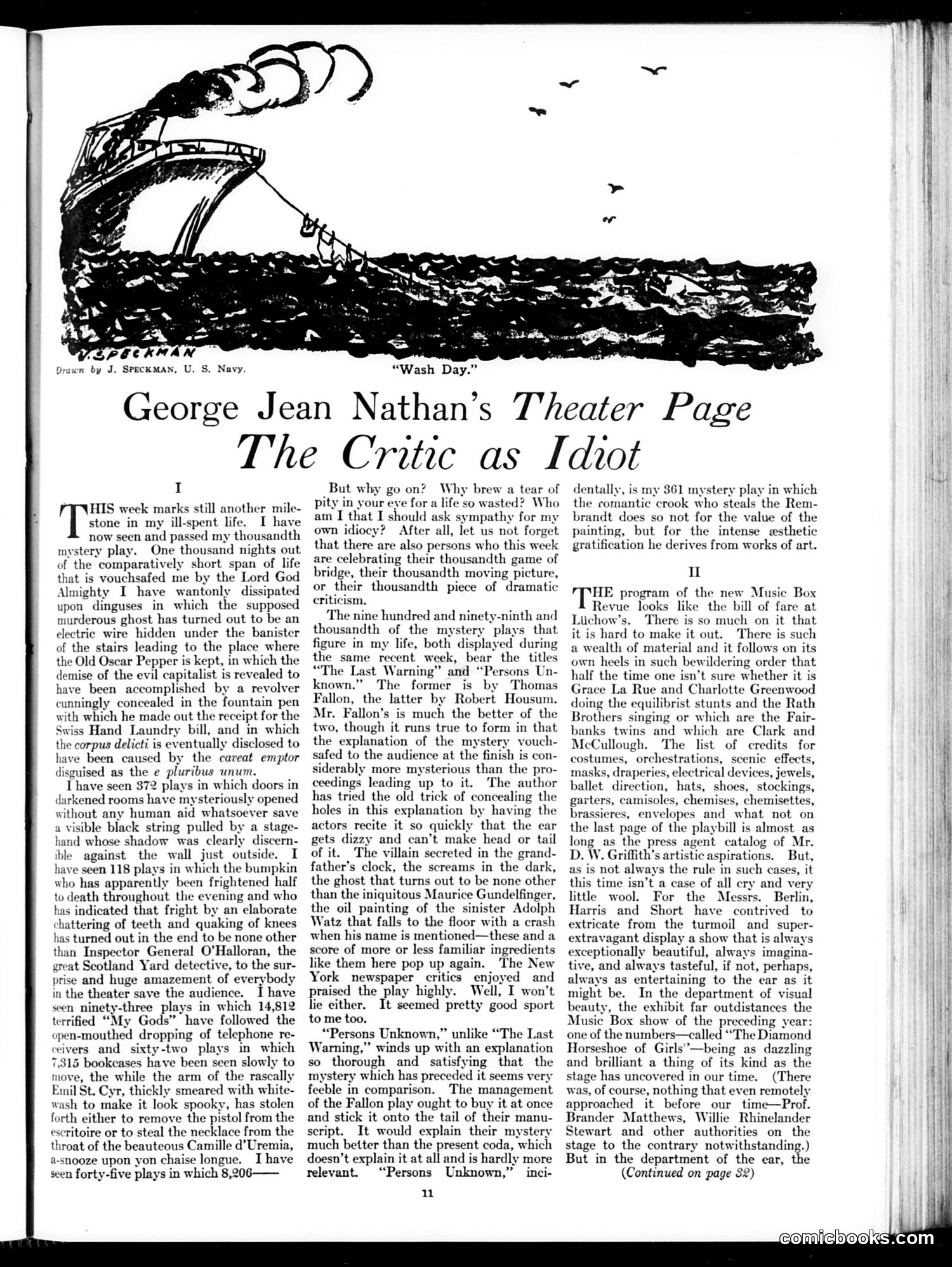
The cartoon shows a military vessel dumping what appears to be refuse or sewage into water—titled "Wash Day," likely satirizing Navy sanitation practices or waste management. The accompanying text is George Jean Nathan's theater column mocking mystery plays. Nathan sarcastically describes attending his thousandth mystery play, cataloging absurd tropes: murderers revealed as electric wires, detectives disguised as frightened bumpkins, moving bookcases, and villains hidden in grandfather clocks. He ridicules how playwrights deliberately obscure weak explanations by having actors recite solutions too quickly "so the ear gets dizzy." Nathan's point: mystery play writers and critics have become idiots, endlessly recycling predictable nonsense. His self-deprecating framing—admitting he's "wasted" 1,000 evenings on this drivel—underscores the satire: both audiences and critics deserve mockery for tolerating such formulaic theater.
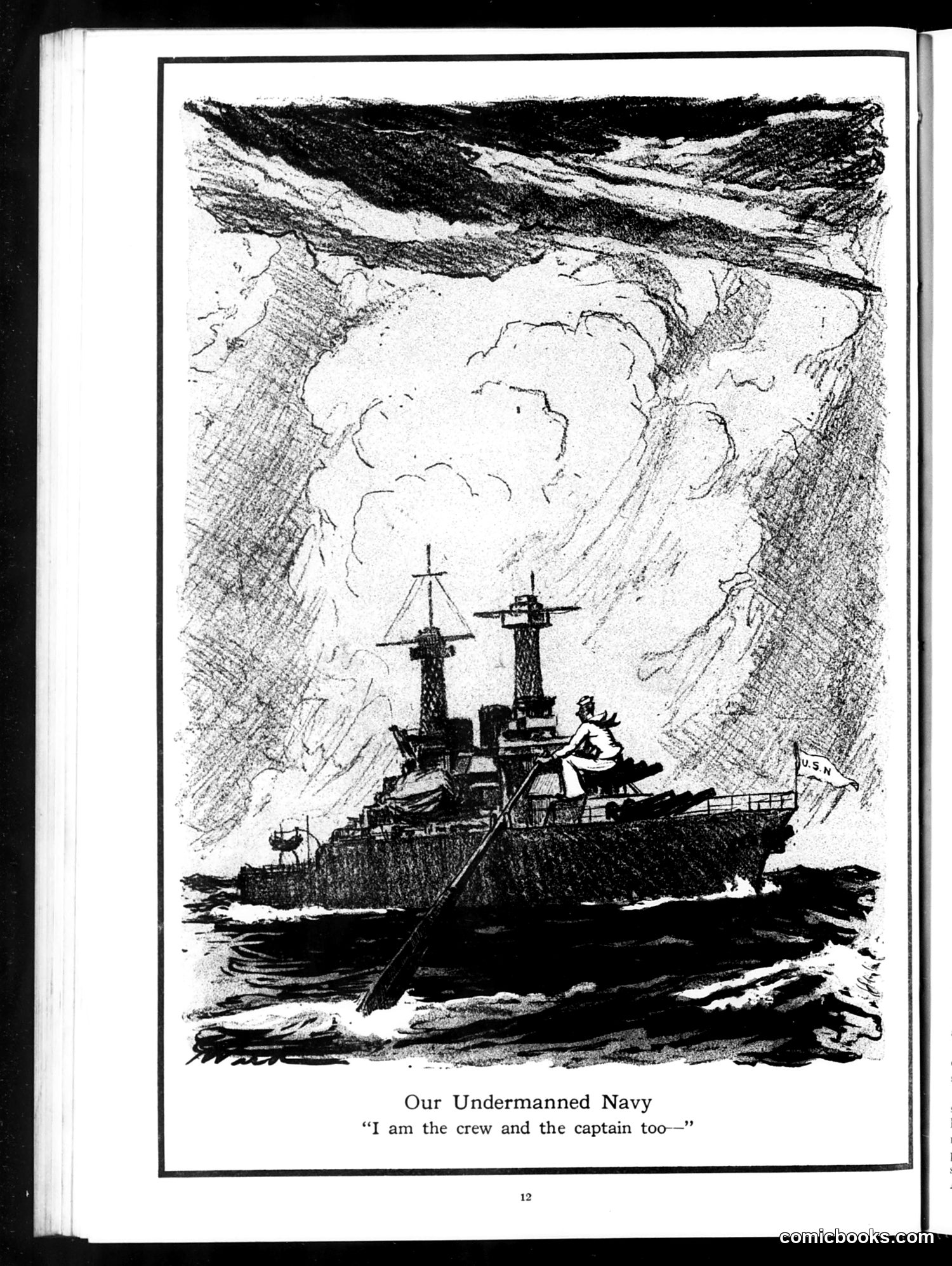
This Judge cartoon depicts a U.S. Navy battleship (marked "U.S.N.") anchored in what appears to be a narrow, rocky waterway or harbor. The illustration shows a single sailor operating the vessel alone, depicted in the act of manning multiple positions simultaneously—suggesting he must serve as both crew and captain. The title and caption ("I am the crew and the captain too") reference the nursery rhyme "Rub-a-dub-dub," adapting it to critique severe naval understaffing. The cartoon satirizes the U.S. Navy's chronic manpower shortage, likely during the pre-WWI era or early twentieth century. The cramped setting and dangerous rocks emphasize the peril of operating a warship without adequate personnel—a serious vulnerability for national defense that Judge's readers would have recognized as a legitimate policy failure.
This editorial page from Judge magazine (circa 1920s, based on naval treaty references) contains two main satirical pieces: **"Avast, Ye Lubbers!"** criticizes Congressional prioritization of naval *ships* over trained *personnel*. Judge argues that post-naval-limitation-treaty, focus should shift from building dreadnoughts to maintaining skilled officers and crews. The satire mocks Congress for underfunding Navy maneuvers while approving "pork" spending, sarcastically suggesting such penny-pinching Congressmen be "collected in some remote fjord and quietly sunk." **"Time Out!"** attacks the hypocrisy of college football's labor practices. Judge notes that while institutions celebrate football's "Spartan atmosphere," they give varsity players unexpected holidays, implying they're exhausted. The piece sarcastically proposes football players form a *union* demanding "just wages" and a 44-hour work week—treating amateur athletics as exploitative labor rather than sport. Both editorials use ironic exaggeration to expose institutional contradictions: Congress undermining military readiness, and colleges profiting from student athletes without compensation.
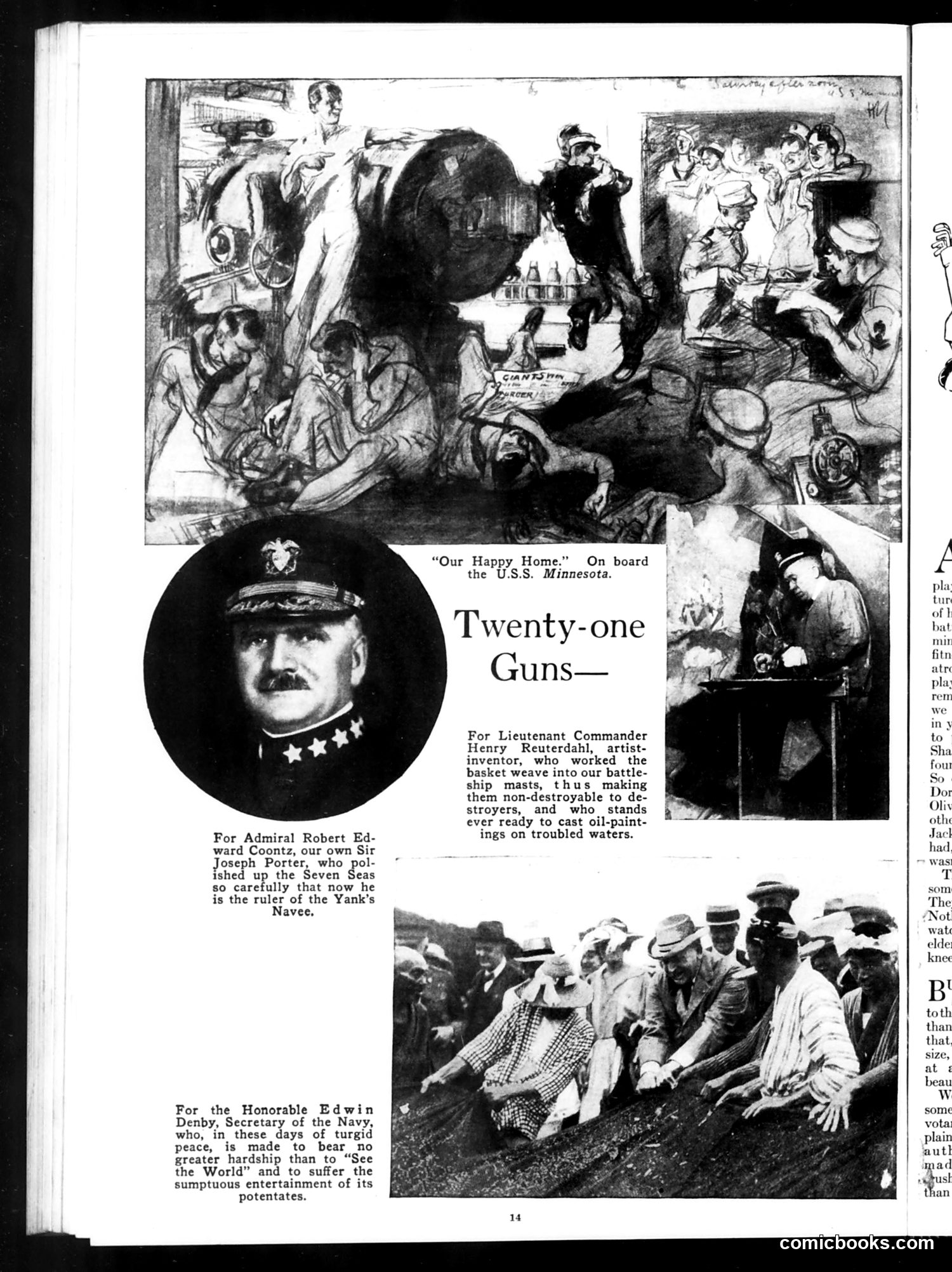
This page satirizes U.S. Navy leadership during peacetime through mock-heroic praise. The cartoons depict scenes of shipboard life aboard the USS *Minnesota*, labeled "Our Happy Home." The text offers tongue-in-cheek tributes to three figures: 1. **Admiral Robert Edward Coontz** — praised for polishing the Navy so thoroughly he now "rules the Yank's Navee" 2. **Lieutenant Commander Henry Reuterdahl** — an artist-inventor credited with weaving basket-weave into battleship masts to make them "non-destroyable," and ready to "cast oil-paintings on troubled waters" 3. **Secretary of the Navy Edwin Denby** — mocked for his supposed "hardship" of having to "see the world" and endure "sumptuous entertainment" The satire targets naval bureaucracy and leadership during peacetime, suggesting they're more concerned with appearances, luxury, and artistic flourishes than actual naval readiness. The absurd claims (indestructible masts, oil-paintings solving problems) underscore the critique.
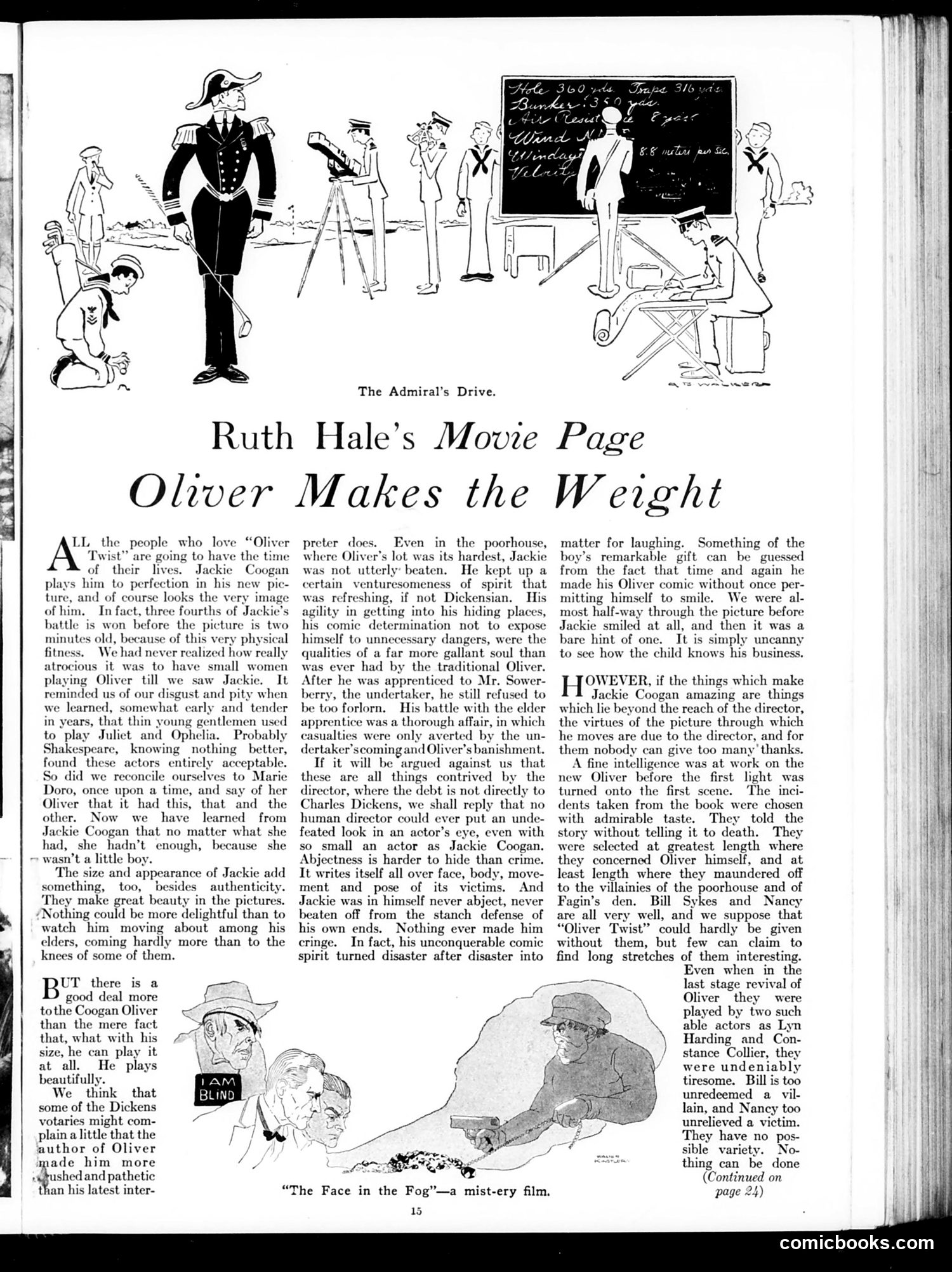
This is a film review by Ruth Hale praising child actor Jackie Coogan's performance in a new film adaptation of Dickens's *Oliver Twist*. The satire targets previous theatrical casting practices. The central joke: historically, adult actresses played young male roles like Oliver Twist and Shakespearean juveniles (Juliet, Ophelia). The reviewer argues this was absurd—Coogan's actual small stature and boyish physicality make him authentically believable, whereas adult women playing children were ridiculous. The title "Oliver Makes the Weight" is a pun: Coogan has the physical substance (weight/presence) the character requires. The cartoon at top ("The Admiral's Drive") appears unrelated to the review text. The piece praises not just Coogan's appearance but his acting: his ability to convey resilience and spirit rather than abject defeat, and his skill at creating comedy without smiling—demonstrating professional maturity despite his youth.
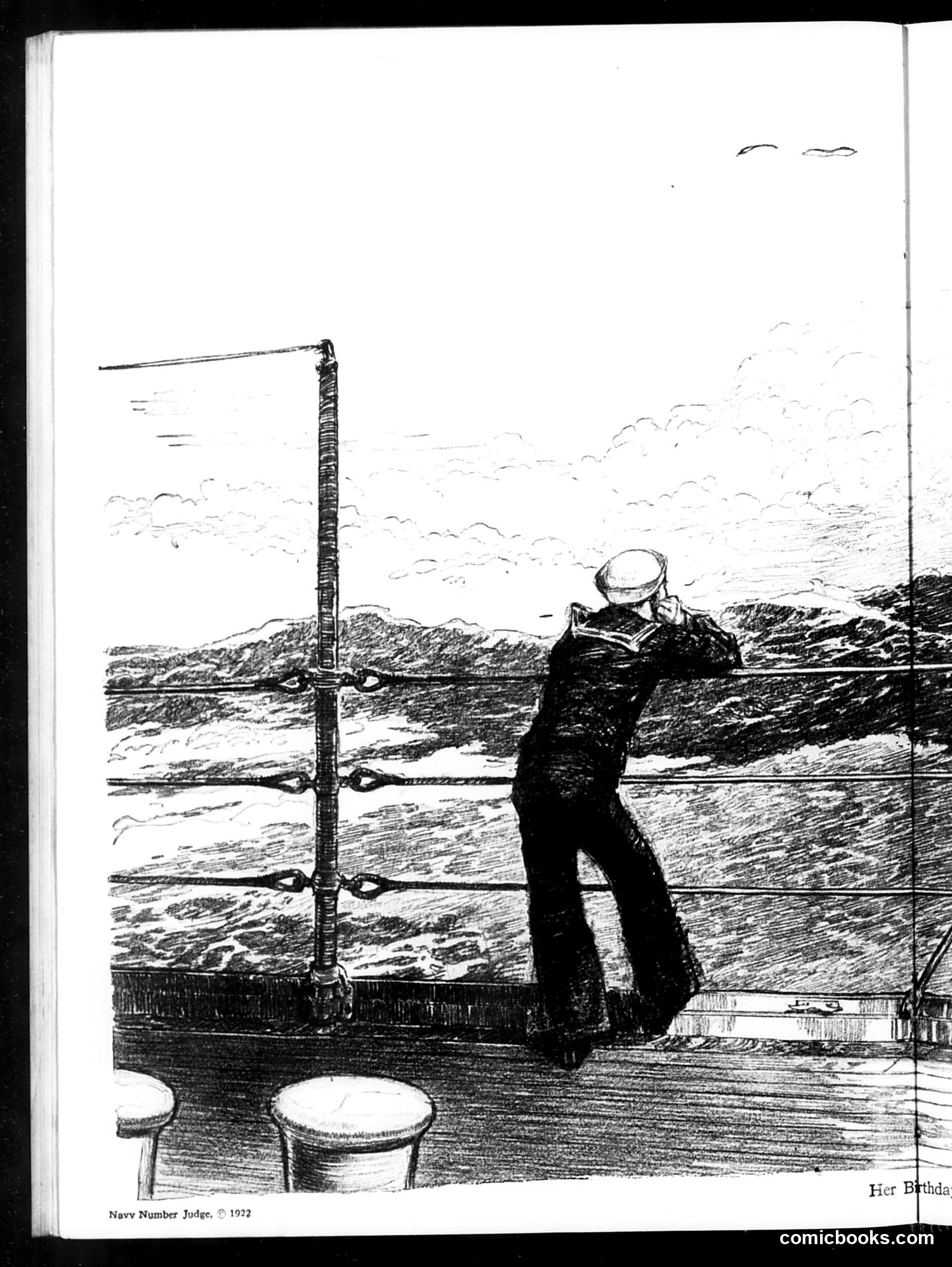
This 1922 Judge cartoon depicts a naval officer leaning against a gate overlooking a coastal landscape. The title "Navy Number Judge" and caption "Her Birthday" suggest this is from Judge's navy-themed issue. The cartoon appears to be a sentimental or possibly romantic scene—the officer's posture suggests contemplation or longing as he gazes at the seascape. The "Her Birthday" caption implies he may be thinking of someone on this special occasion, perhaps separated by his naval duties. Without additional context from the magazine's surrounding content, the specific satirical target remains unclear. It could reference naval life's romantic challenges, military service during this post-WWI period, or be a straightforward sentimental illustration rather than political satire. The artistic style is typical of Judge's 1920s engravings.
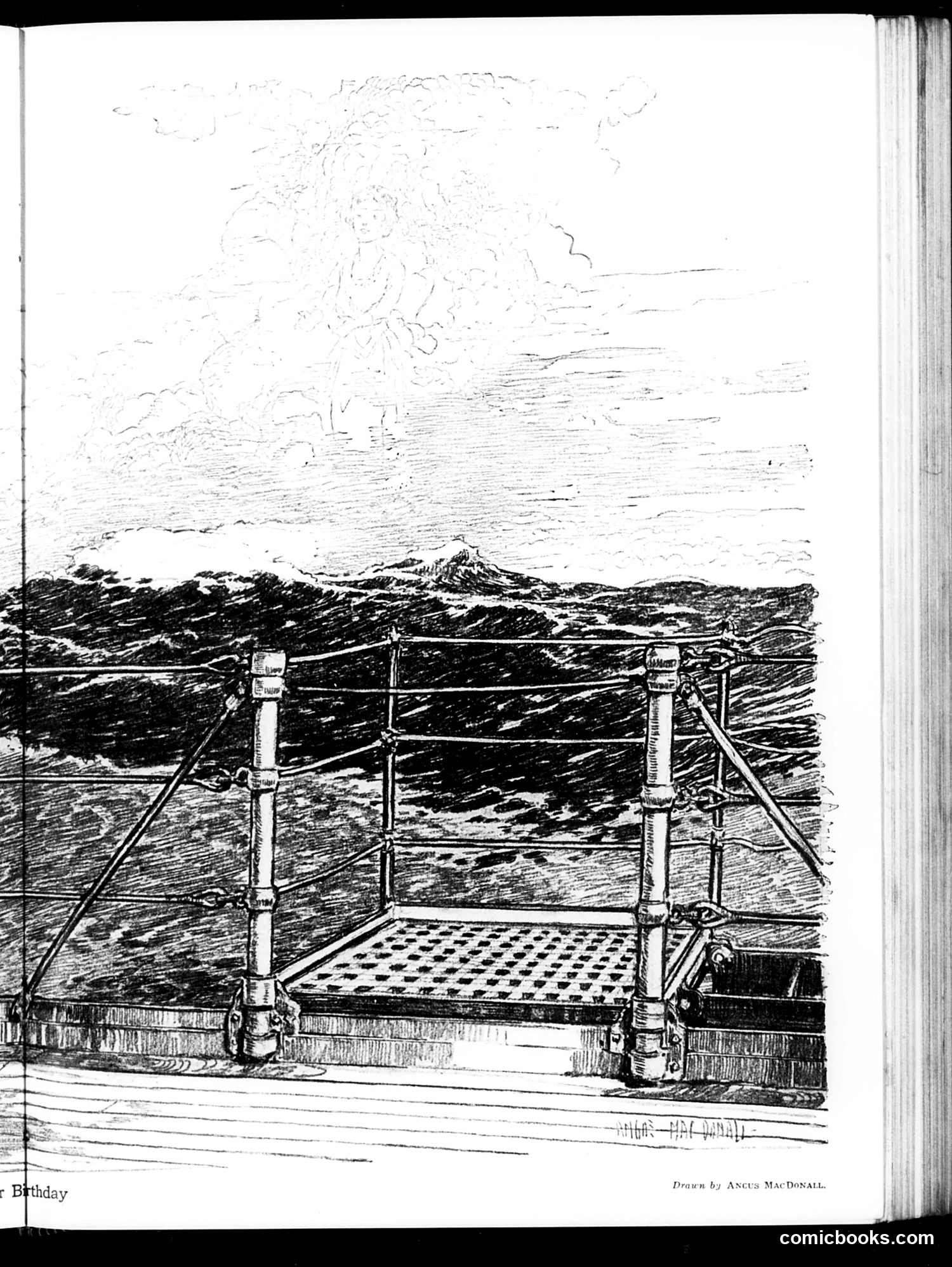
This page shows a single illustration by Angus MacDonald depicting a formal gate or fence overlooking a landscape with mountains or hills in the distance. The gate features a checkered pattern panel, cylindrical posts, and wire railings. The drawing style uses cross-hatching and line work typical of late 19th/early 20th-century engraving. However, without clear contextual text on this page—the OCR appears corrupted—I cannot identify what specific political or social satire this illustration represents. The image alone doesn't contain obvious caricatures or labeled figures that would clarify the cartoon's subject or point. Without knowing the article title, caption, or date of publication, I cannot confidently explain what contemporary issue or event this references. More context would be needed for accurate interpretation.
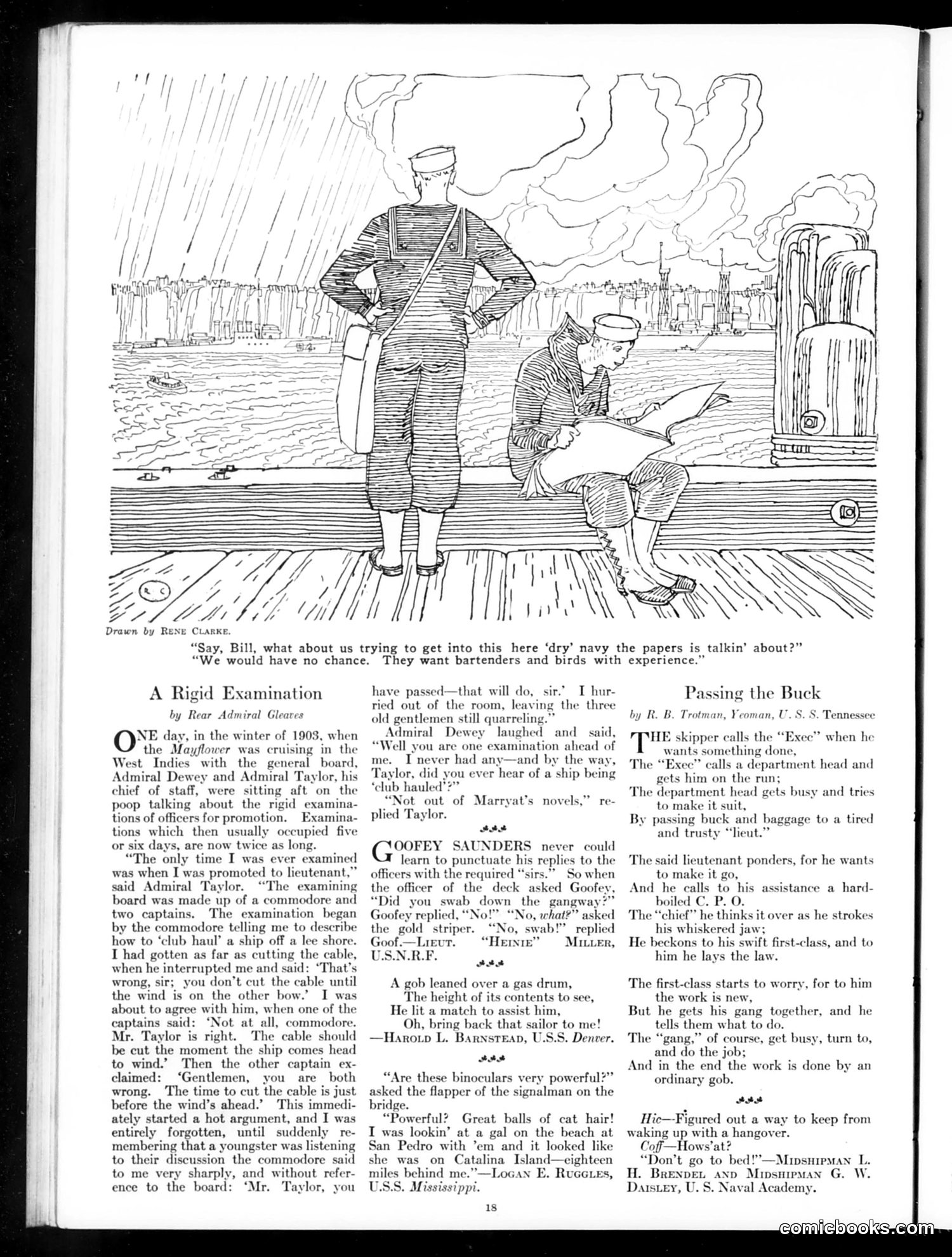
The top cartoon depicts two working-class men discussing Navy recruitment, with one saying they want "bartenders and birds with experience" for the "dry navy"—a satirical reference to the U.S. Navy's alcohol prohibition policies. The humor mocks both the Navy's strict regulations and the men's unsuitability for service. The page primarily contains three naval anecdotes by Rear Admiral Gleaves and others. "A Rigid Examination" recounts Admiral Taylor's promotion board where examiners argue among themselves about proper sailing procedure, ultimately passing him without resolving their disagreement—satirizing the absurdity of naval promotion examinations. "Passing the Buck" humorously traces how orders flow downward through naval hierarchy, with each superior passing responsibility to subordinates until an ordinary sailor ("gob") actually does the work—a timeless critique of bureaucratic inefficiency. The other brief items are naval humor pieces common to the era, mocking sailor behavior and Navy procedures.
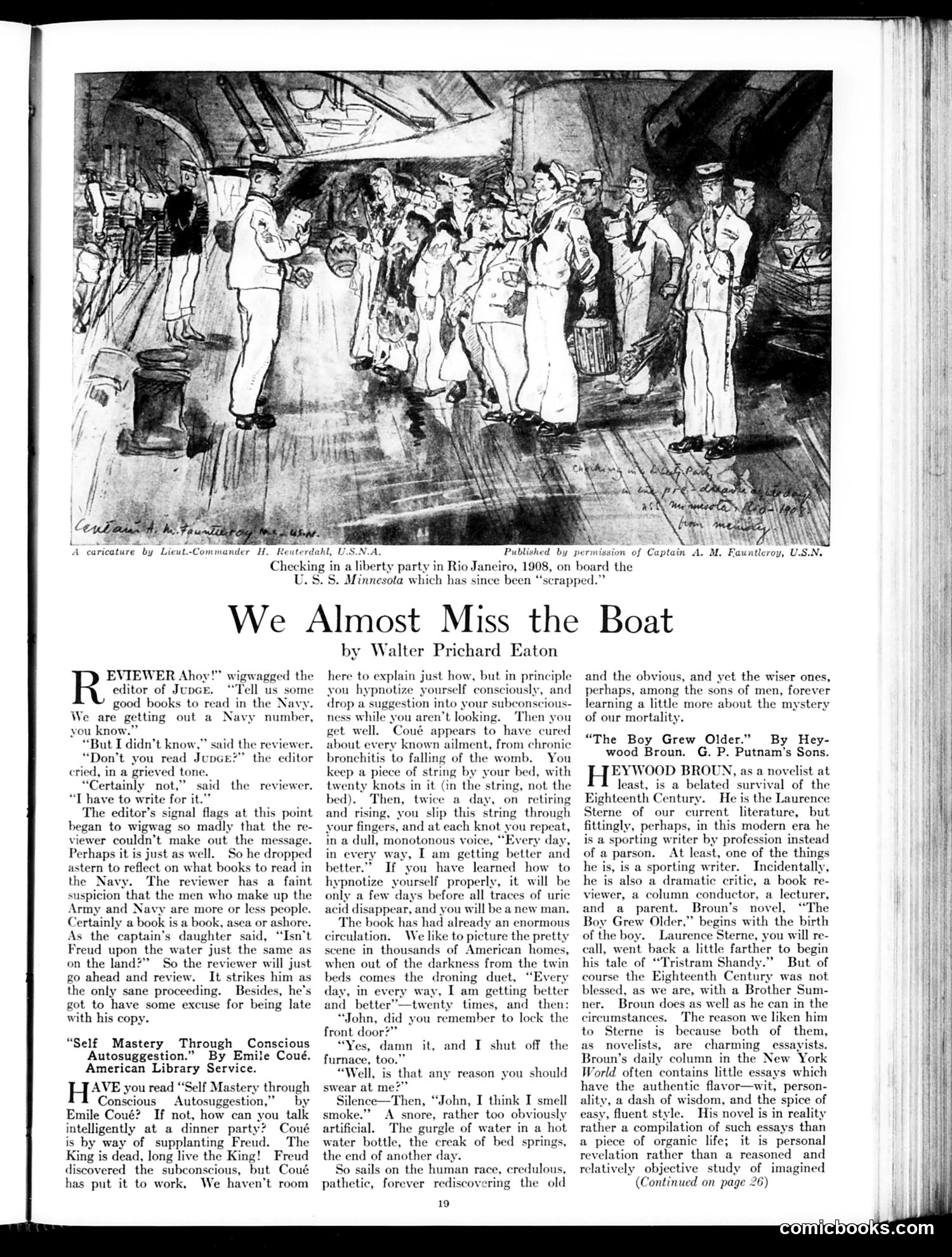
This page from *Judge* magazine contains a satirical column by Walter Prichard Eaton discussing Navy reading recommendations and book reviews. The cartoon at the top depicts "a liberty party in Rio Janeiro, 1908, on board the U.S.S. Minnesota"—officers in white uniforms socializing. The caption notes the ship "has since been scrapped," likely a gentle jab at naval obsolescence. The main content satirizes **Émile Coué's "Self-Mastery Through Conscious Autosuggestion,"** a genuine self-help fad of the 1920s-30s. Eaton mocks the method: repeating "Every day, in every way, I am getting better and better" while sliding knots on a string. He humorously depicts a couple using it before bed, only for the wife to interrupt his affirmation with "John, did you remember to lock the front door?"—undermining the technique's supposed power. The satire targets both the book's earnest followers and human nature's eternal gullibility, suggesting people repeatedly embrace obvious truths repackaged as revelation. Coué had genuinely replaced Freud in popular culture as the fashionable psychological authority.
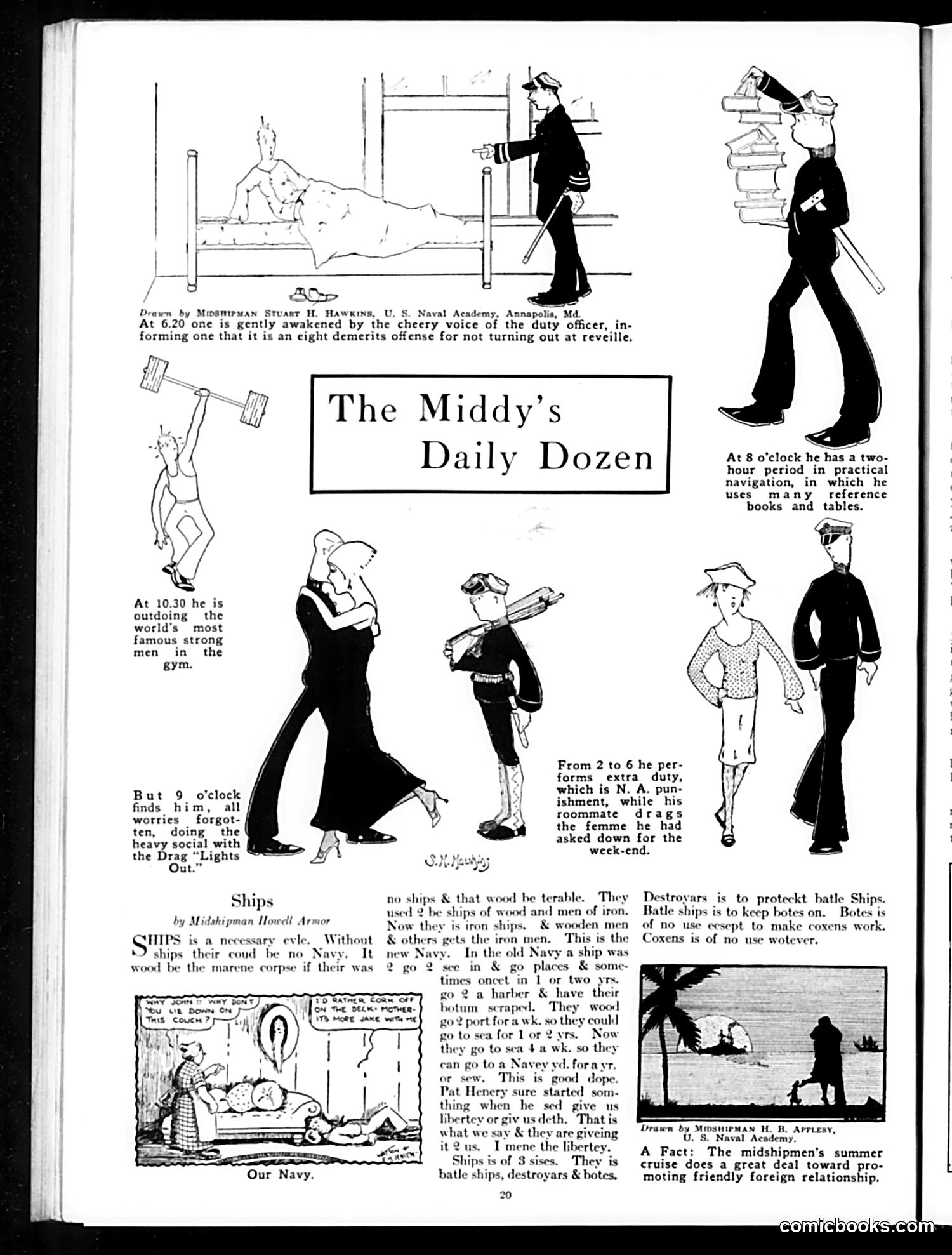
This page satirizes life at the U.S. Naval Academy through humor and cartoons drawn by actual midshipmen (naval cadets). **The main cartoon** humorously chronicles a midshipman's daily schedule: harsh 6:20 AM reveille with threat of demerits; morning navigation classes with heavy reference materials; gymnasium exercise; afternoon "extra duty" punishment while a roommate enjoys a social outing with a female guest ("the femme"). **The Ships section** uses deliberately poor grammar and misspelling—likely mimicking a midshipman's casual writing—to make crude jokes about naval vessels and naval life. References to wooden vs. iron ships, liberty (shore leave), and the contrasts between old and new Navy practices appear intended as self-deprecating humor about naval traditions and regulations. **The final note** about summer cruises promoting "friendly foreign relationship" likely contains romantic/sexual innuendo about interactions with foreign women. The overall tone is affectionate mockery of Academy life by insiders, not harsh political satire.
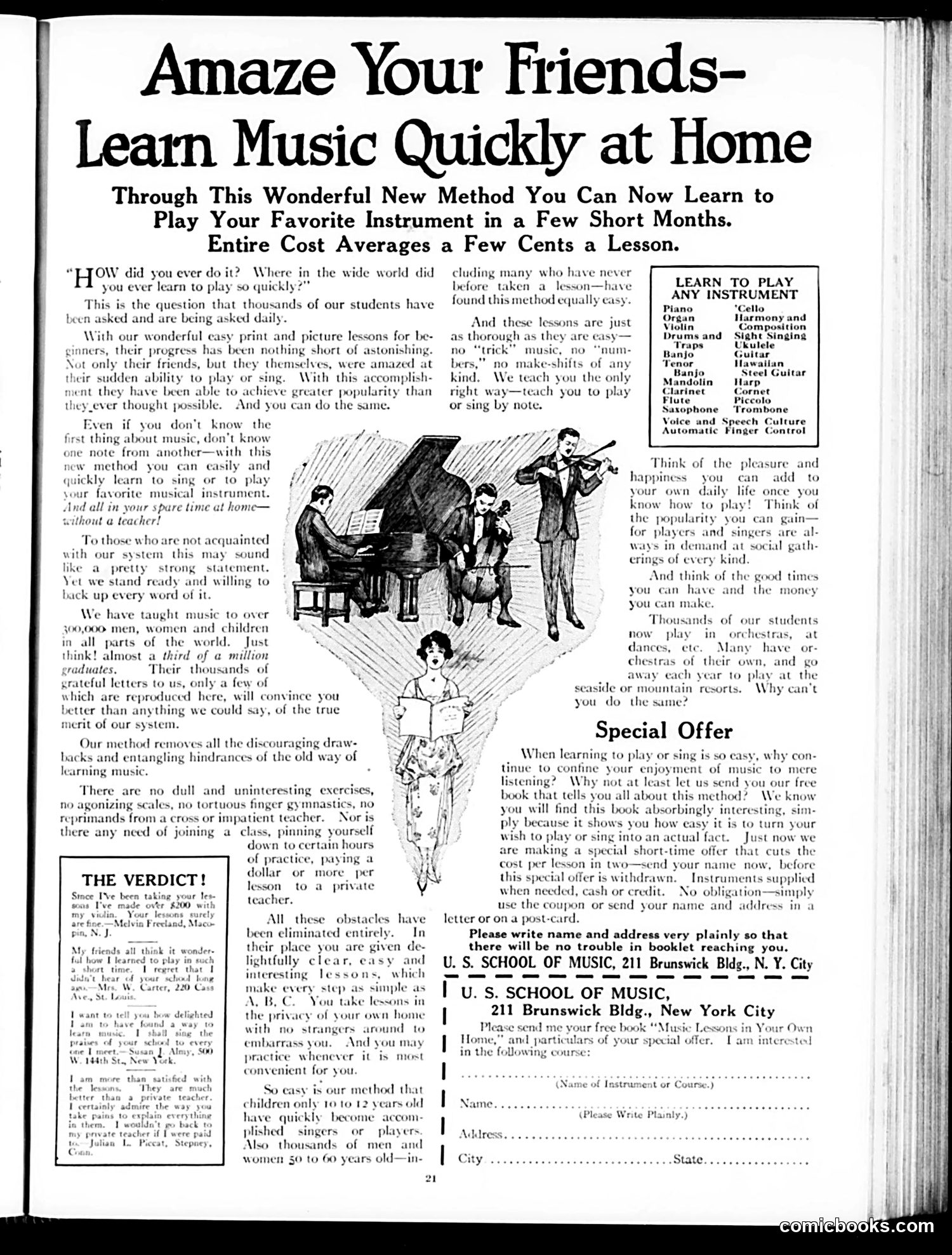
This is primarily a **music instruction advertisement**, not a political cartoon. The page promotes the "U.S. School of Music" correspondence course, claiming anyone can learn an instrument at home in months for minimal cost. The illustration shows a family group around a piano, depicting the aspirational lifestyle promised: domestic music-making bringing joy and social status. The testimonials quoted ("THE VERDICT!") feature satisfied customers claiming rapid success. **The appeal targets middle-class anxieties**: the ad promises social popularity, entertainment value, and economic opportunity (forming orchestras, earning money). It emphasizes ease over traditional rigorous training, positioning their method against "old way" obstacles like difficult exercises and intimidating teachers. **No political satire is apparent** — this is straightforward commercial rhetoric typical of early 20th-century advertising. The "amazing" testimonials and exaggerated claims about 10-year-olds and 60-year-olds mastering instruments quickly reflect period advertising conventions rather than satire. Judge magazine apparently accepted such advertisements alongside editorial content.
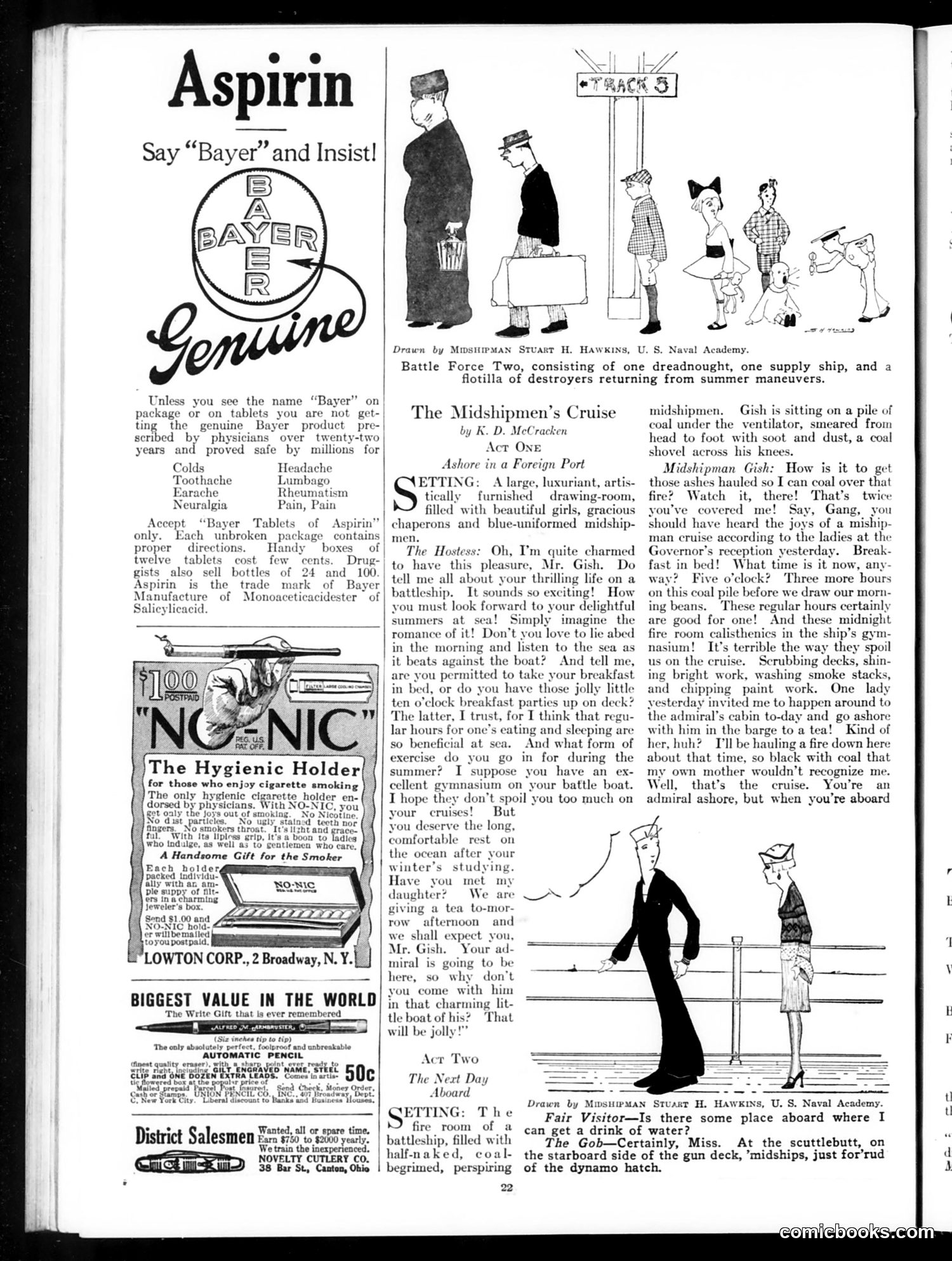
This cartoon by K.D. McCracken contrasts the romanticized view of naval service held by civilian society with the actual grueling work performed by midshipmen. **The Setup:** A well-dressed midshipman (Gish) is courted by an upper-class hostess at a drawing room, who imagines his life consists of leisurely breakfasts in bed, romantic sea breezes, and social tea parties. **The Reality:** The same midshipman is shown covered in soot, shoveling coal in the ship's engine room—performing backbreaking, filthy labor during the summer cruise. **The Satire's Point:** The cartoon mocks how civilians, particularly society women, sentimentalize military service while remaining ignorant of the actual harsh, unglamorous work. The midshipman's bitter monologue reveals the disconnect: ladies think he enjoys comfortable rest and exercise; he's actually exhausted, covered in coal dust, with no time for their social invitations. It's a commentary on class perception and the gap between how outsiders imagine military life versus its genuine demands.
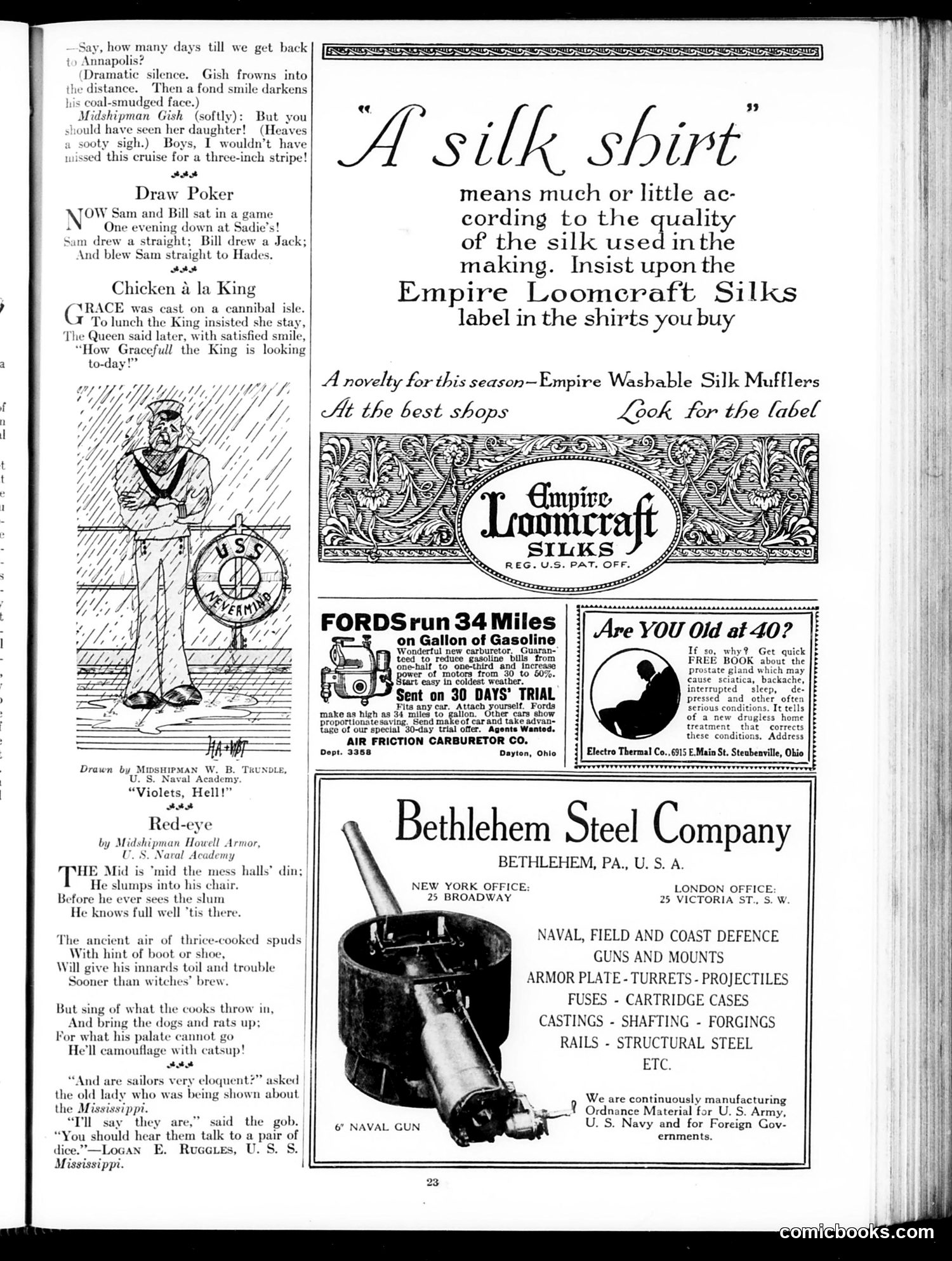
This page contains several brief humorous sketches typical of Judge magazine's satirical style, plus period advertisements. ## The Cartoons/Jokes: **"Draw Poker"** and **"Chicken à la King"** are short, punchy jokes playing on wordplay and exaggeration—Sam loses at cards and gets "blown to Hades"; a cannibal king hosts a lady for lunch with darkly humorous implications. **"Red-eye"** satirizes Naval Academy mess hall food. A "midshipman" (Naval student) describes the notoriously poor quality of ship's meals—ancient, poorly cooked potatoes that smell of boots and shoes, requiring heavy use of catsup to be palatable. This reflects genuine complaints about military food. The other sketches appear to be romantic or domestic comedy bits about Naval life. ## The Advertisements: These target military/working-class audiences: Empire Loomercraft Silks (quality menswear), Ford carburetors (fuel efficiency), and Bethlehem Steel Company (military ordnance manufacturing). The page reflects early 20th-century Judge content: light military humor, product advertising, and casual period prejudices.
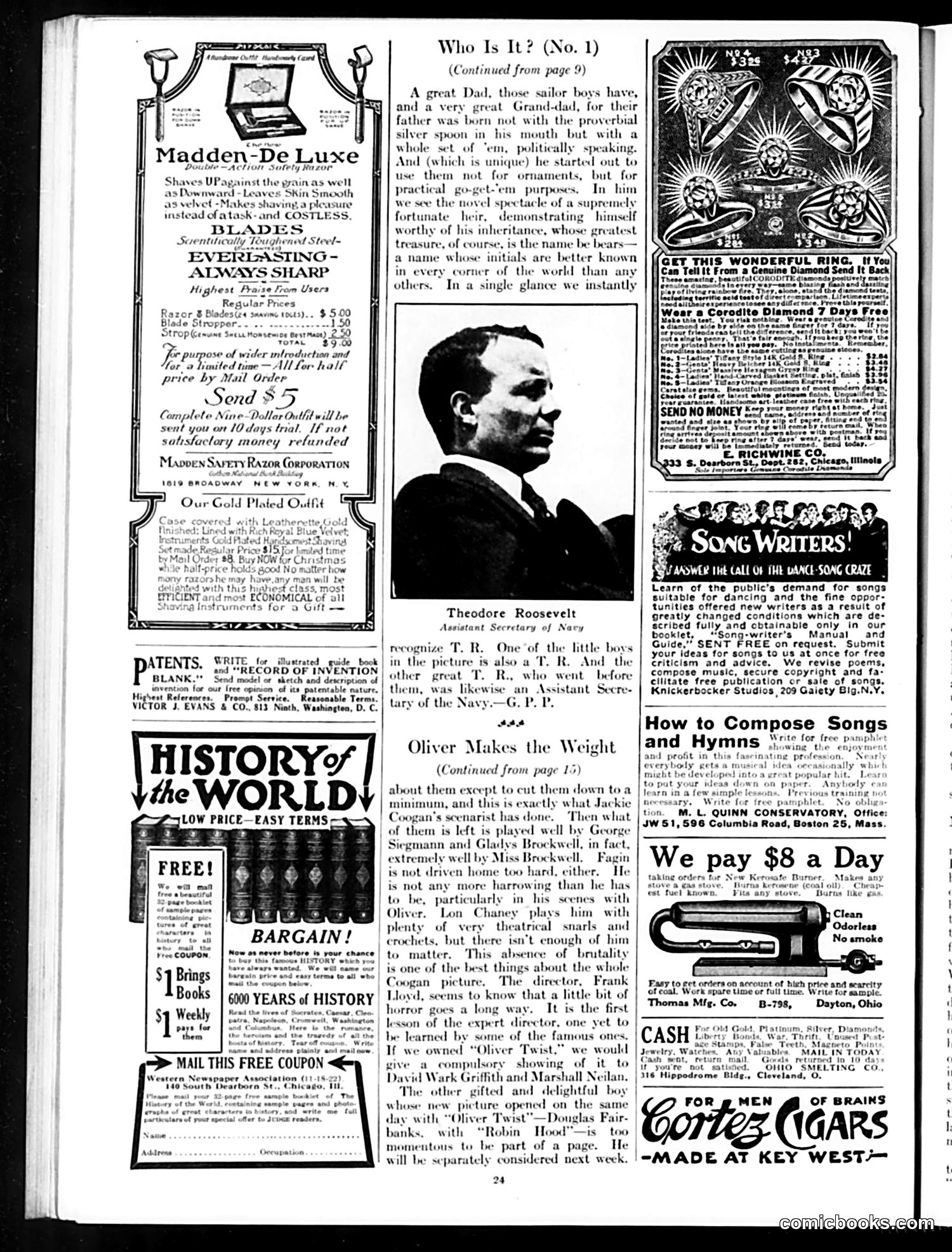
This page is primarily **advertising**, with limited cartoon content. The main illustrated article is a "Who Is It?" identity puzzle featuring **Theodore Roosevelt**, identified as Assistant Secretary of the Navy. The text humorously explains he comes from a distinguished family of T.R.s—his father was also an Assistant Secretary of the Navy—suggesting the Roosevelt name carries political power and inherited prominence, yet ironically presenting it as virtuous that Theodore actually *used* his advantages productively rather than merely as ornaments. The remaining content consists of vintage product advertisements (razors, patent services, history books) and notices about song-writing opportunities. This is typical magazine filler content, not political satire.
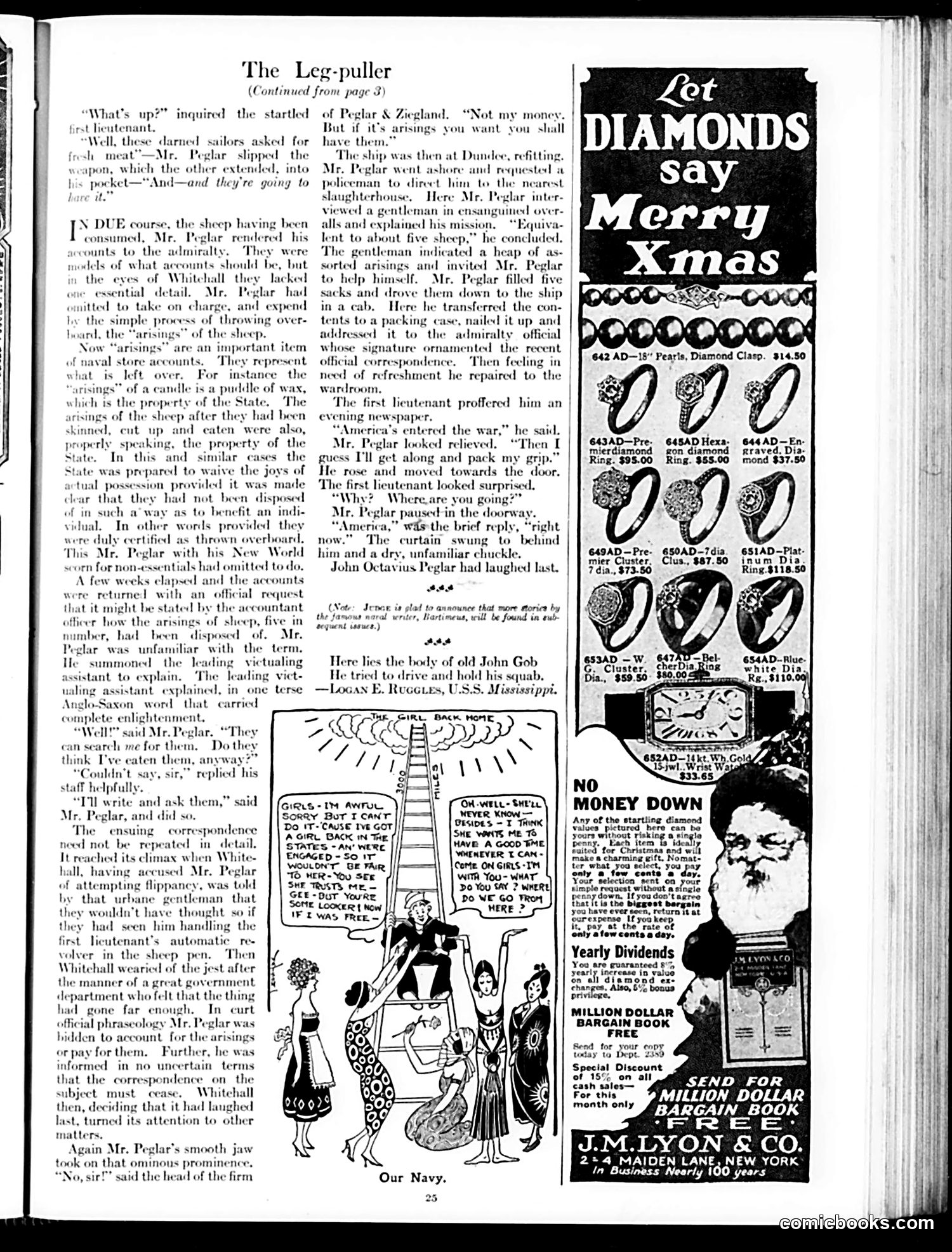
This page contains a continuation of a humorous story about Mr. Peglar, a naval officer dealing with British bureaucratic absurdity. The central joke: Peglar purchases five sheep for sailors' fresh meat, then—when asked to account for the "arisings" (waste byproducts, legally Crown property)—literally collects the sheep remains and ships them to the official who demanded accounting. The satire mocks military red tape and bureaucratic pedantry: officials create paperwork requirements so trivial and removed from practical reality that Peglar's absurd literal compliance becomes the only reasonable response. His final act—waiting until America enters WWI before leaving—suggests his gesture of defiance was worth the bureaucratic trouble. The cartoon at bottom depicts sailors' romantic complaints about leaving girlfriends. The diamonds advertisement and other ads occupy significant space, typical of Judge's commercial content.
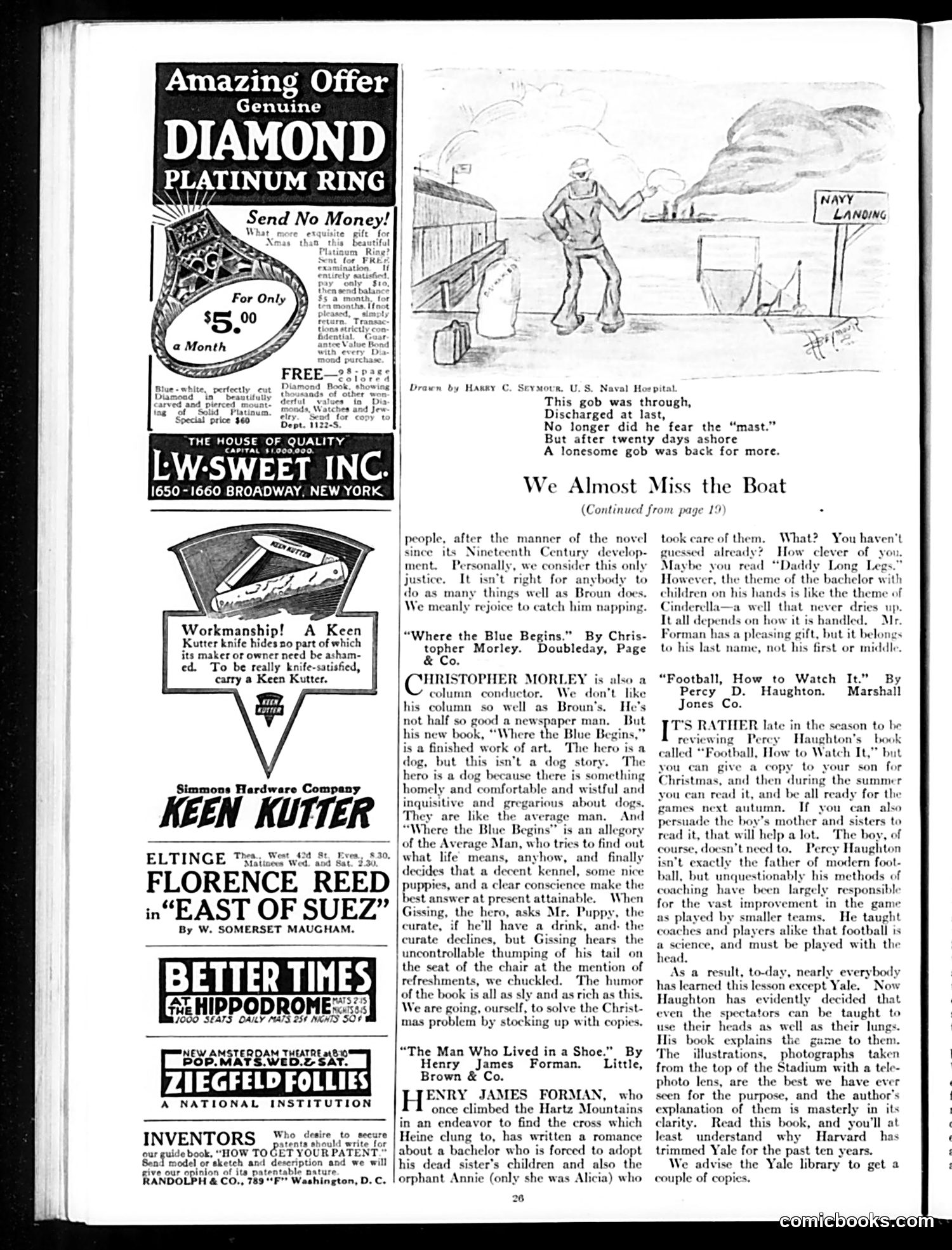
This page is primarily **advertisements and book reviews**, not political satire. The cartoon at the top, drawn by naval hospital artist Harry C. Seymour, depicts a discharged sailor ("gob" in naval slang) returning to shore duty after leaving the Navy. The simple four-line verse illustrates the common experience of sailors who, after discharge, felt unable to adjust to civilian life and re-enlisted—a relatable post-WWI scenario when this likely appeared. The rest of the page contains book reviews praising works by Christopher Morley and Henry James Forman, theatrical advertisements, and period product ads (diamond rings, Keen Kutter knives, patent services). There is **no political cartoon or satire** to analyze. The Seymour illustration is a humorous anecdote rather than commentary, relying on the period's familiar understanding of military service culture.
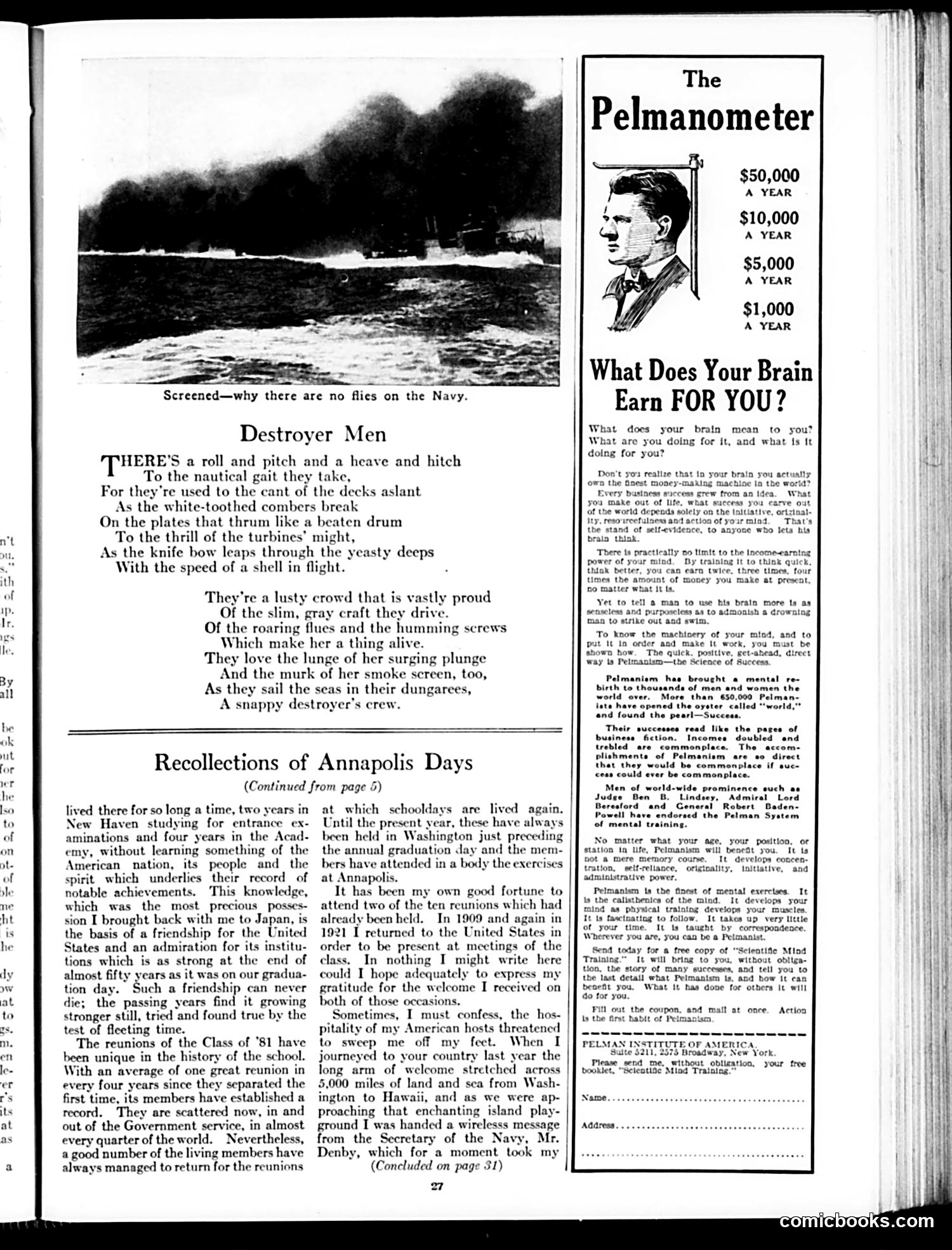
This page combines patriotic verse celebrating naval personnel with a period self-improvement advertisement. **"Destroyer Men"** is a romantic poem praising sailors aboard destroyer vessels—emphasizing their skill, toughness, and seamanship during what appears to be WWI-era naval operations. The verse celebrates the physical sensations and dangers of naval service. **"The Pelmanometer"** advertisement promotes the Pelman System, a mail-order "mind training" course promising to maximize one's mental earning potential (ranging from $1,000 to $50,000 yearly). The ad emphasizes that brain power determines financial success and that most people underutilize their mental capacity. This reflects early 20th-century optimism about self-improvement through correspondence courses. The juxtaposition is characteristic of *Judge* magazine: patriotic content celebrating American military service alongside commercial appeals to readers' ambitions and insecurities about personal advancement. Both content types sold magazines to their target middle-class audience.
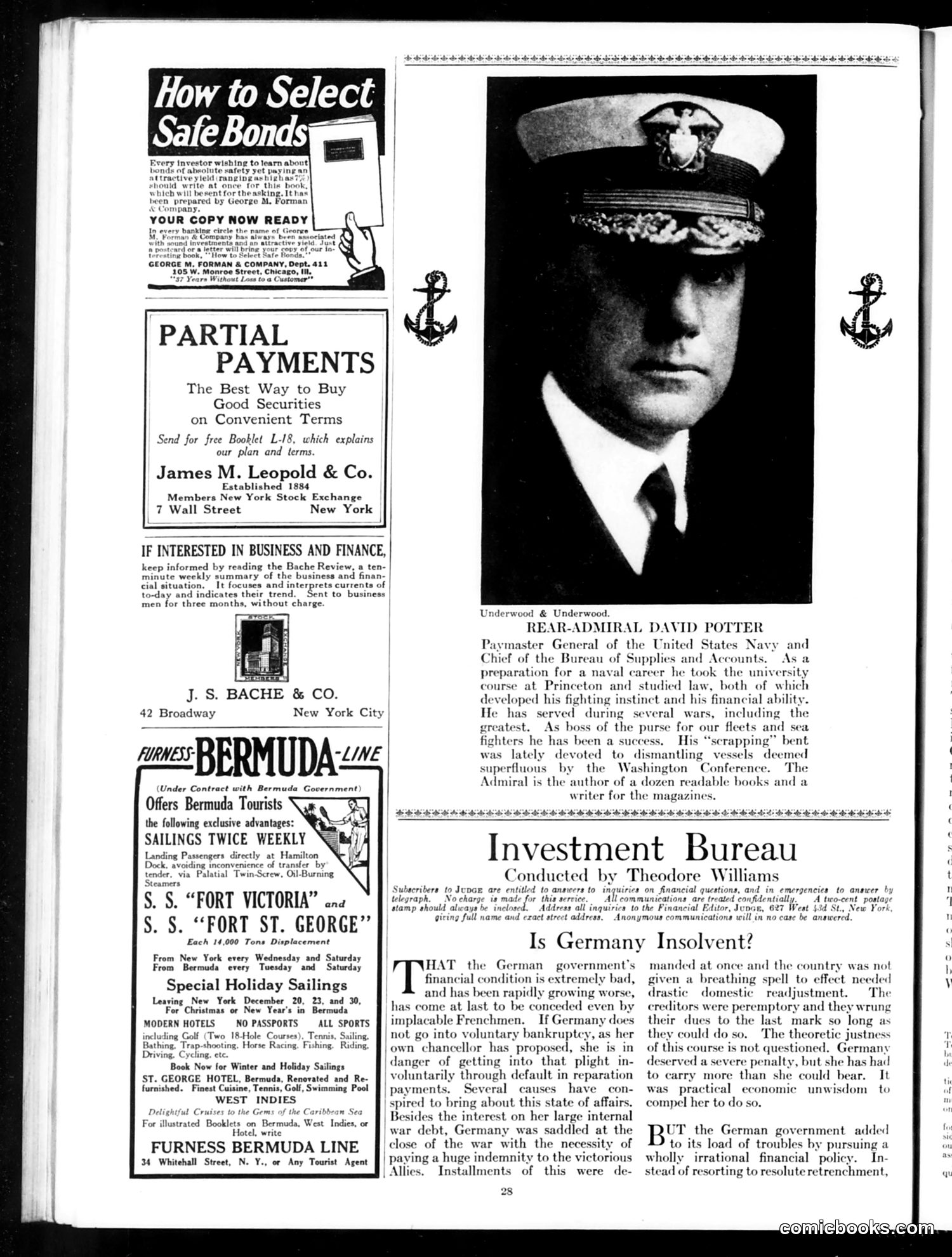
This page is primarily **financial advertising and editorial content**, not political satire. The main visual is a portrait of Rear-Admiral David Potter, Paymaster General of the U.S. Navy, accompanying a biographical note praising his financial management of naval resources and wartime service. The substantive editorial piece is an "Investment Bureau" column addressing **Germany's post-WWI financial crisis**. The text explains that Germany faces insolvency due to: internal war debt, Allied reparation payments imposed by the Treaty of Versailles, and accumulated interest. The column notes even France acknowledges Germany's dire straits, and warns Germany may be forced into involuntary bankruptcy if voluntary measures aren't taken. This reflects early 1920s anxieties about European economic instability following World War I—a prescient concern, as Germany's financial collapse would later contribute to political upheaval. The remainder consists of investment and travel advertisements typical of *Judge* magazine's commercial content.
This page is primarily **financial/investment advice** rather than political satire. The main content consists of detailed answers to investor inquiries about various stocks and bonds—discussing companies like Southwestern Bell Telephone, Fuller Motors, and Mathieson Alkali. However, the **opening essay** (top left) contains relevant commentary: it discusses **Germany's post-WWI economic collapse**, specifically the hyperinflation of the mark (reaching 5,000 marks per dollar). The author criticizes German administrators for reckless fiscal policy—printing money without backing, failing to levy adequate taxes, and creating dangerous inflation. The piece argues that Germany requires **allied financial intervention** to avoid complete economic collapse, warning that such failure could destabilize all of Europe and potentially rekindle war sentiment across the continent. The advertisements on the right (Chalfonte-Haddon Hall, Bellevue-Stratford) are unrelated to the editorial content.
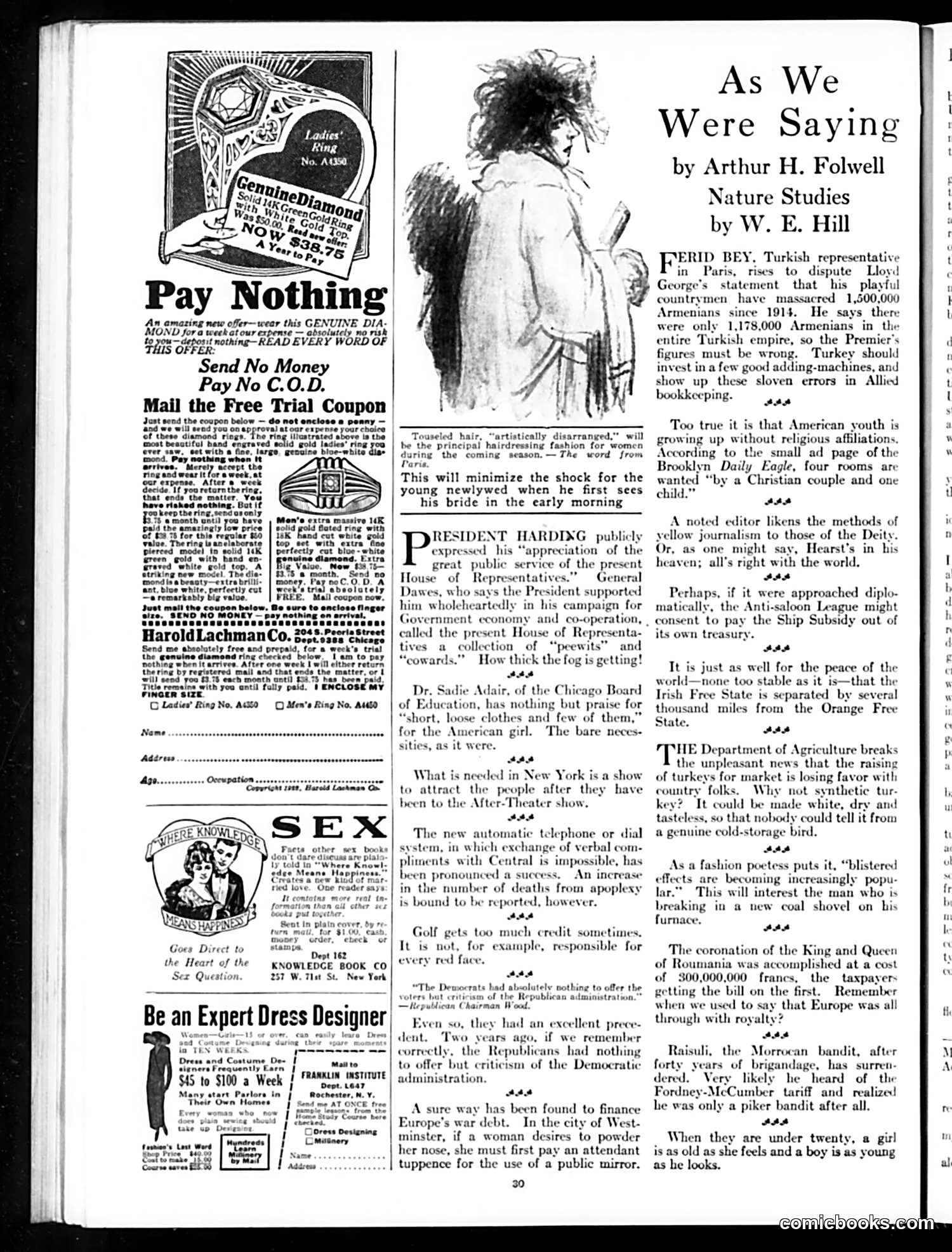
This Judge magazine page combines advertisements with satirical commentary on 1920s American politics and society. **The Diamond Ring Ad** (left): A classic mail-order scam promising "free" diamond rings requiring only small monthly payments—satirizing predatory consumer schemes targeting working-class buyers. **"As We Were Saying"** (right): Folwell's satirical column mocks contemporary issues: - **Turkish Armenian massacres**: Sardonic commentary on Ferid Bey's absurd arithmetic—disputing casualty figures to deny atrocities, suggesting Turkey buy adding machines rather than address genocide. - **Religious decline**: Humorous observation that Brooklyn apartment ads specify "Christian couple" needed, implying American youth abandoning faith. - **Democratic criticism**: Mocking Democrats for offering only criticism of the Republican Harding administration rather than constructive alternatives. - **Miscellaneous**: Jokes about telephone operators, golf's overrated reputation, and women's fashion trends. The overall tone is acerbic political and social commentary typical of Judge's satirical approach to postwar American life.
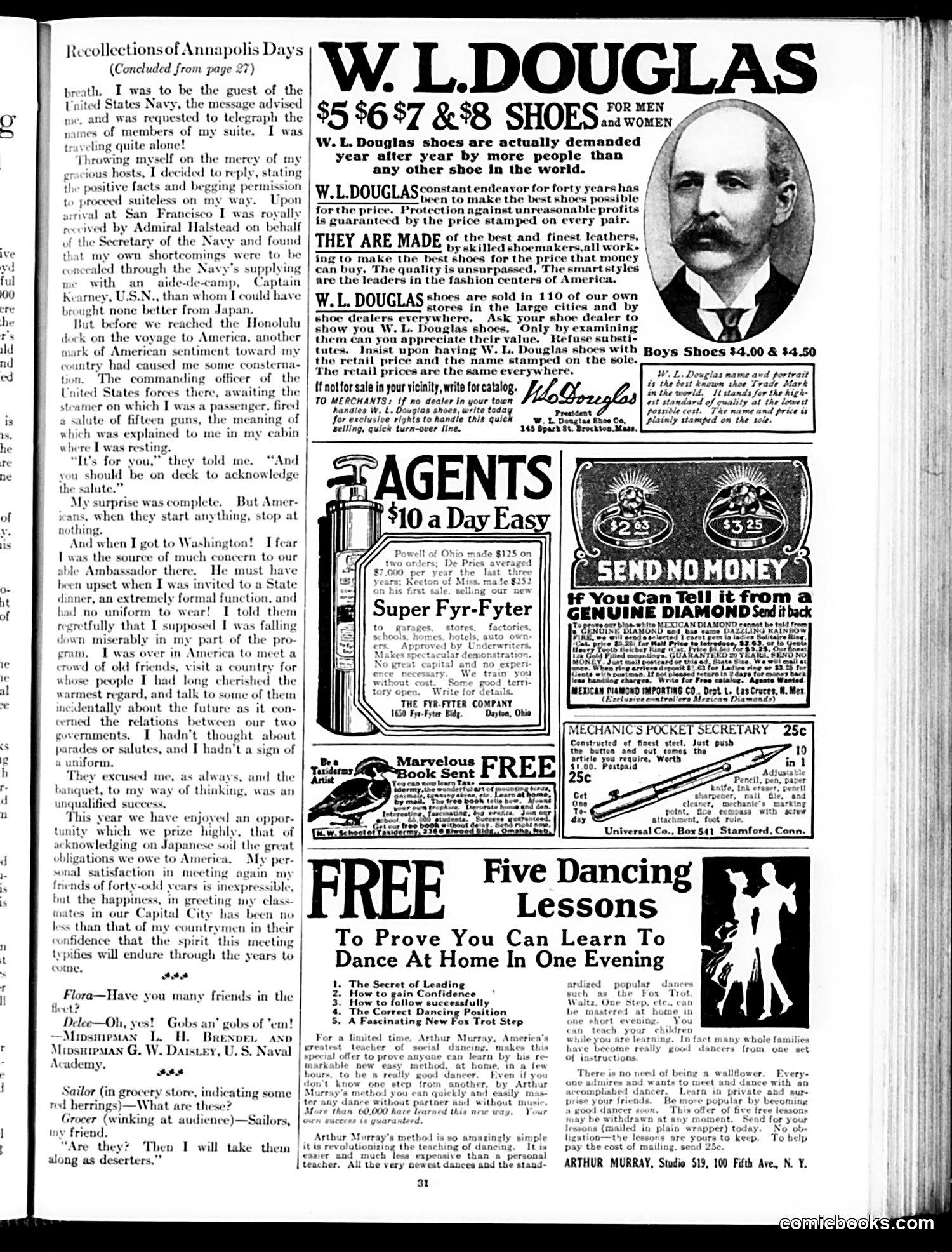
This page is primarily **advertising content** rather than political satire. The dominant feature is a W.L. Douglas shoes advertisement prominently featuring the company founder's portrait and marketing copy emphasizing quality and value ($5-$8 price range). The page includes scattered **short humorous bits** typical of Judge magazine: - A continuation of "Recollections of Annapolis Days"—an anecdote about a Japanese naval officer's visit to America, noting cultural surprises (formal dinners without uniforms, ceremonial gun salutes) - Three brief jokes at bottom: one about Navy friends ("Gobs an' gobs"), another about Midshipmen at the Naval Academy, and a grocer's pun calling red herrings "Sailors" These jokes rely on mild wordplay and naval service stereotypes rather than political commentary. The page reflects early 20th-century American humor conventions: simple puns, service-branch ribbing, and gentle social observation rather than sharp satire. The advertising dominates the editorial content significantly.
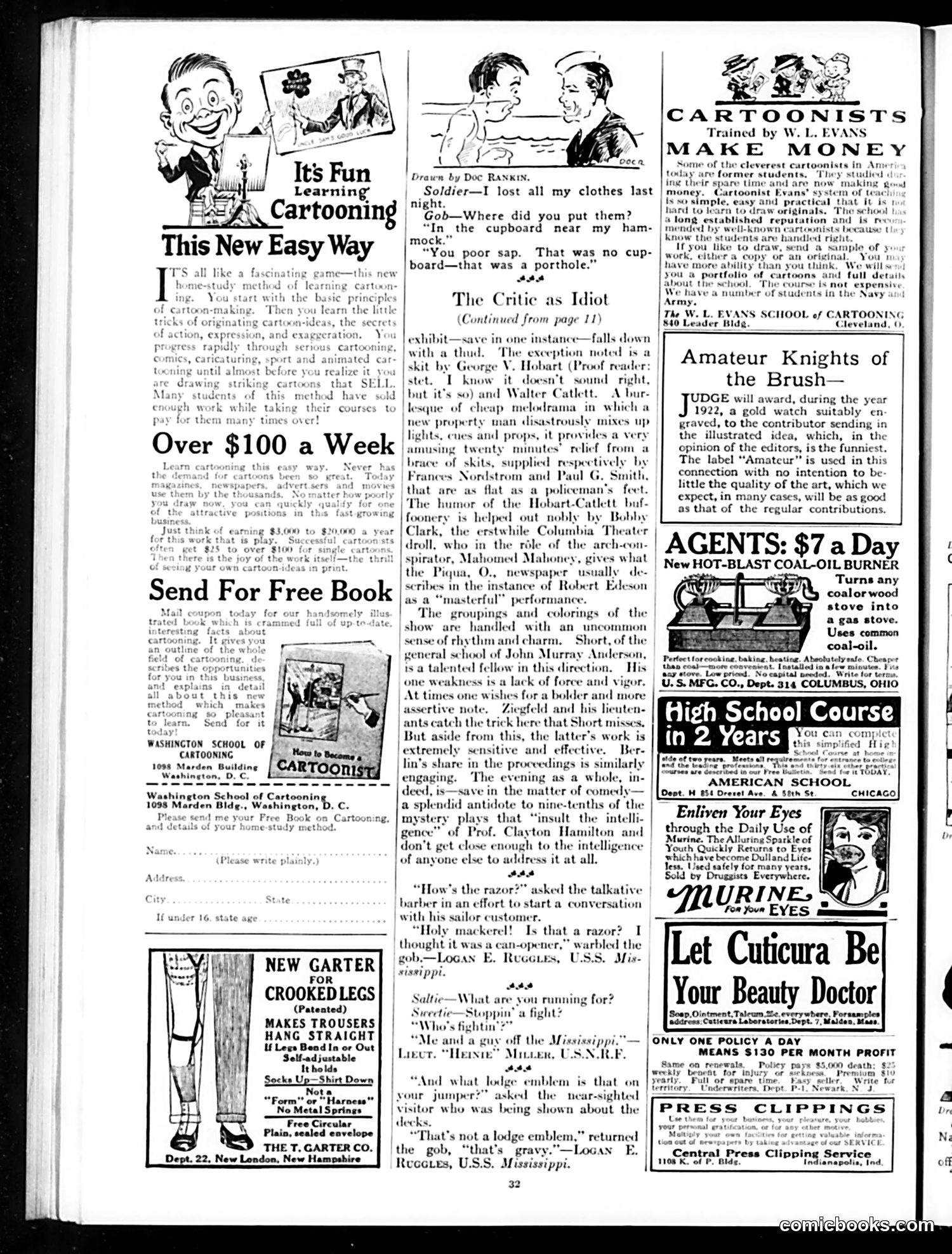
This page primarily features **advertisements** (cartooning courses, novelty garters, etc.) mixed with **satirical humor pieces** typical of Judge magazine. **The main cartoons visible:** 1. **"Soldier-Gob" exchange**: A sailor's joke about a soldier losing his clothes through a porthole instead of a cupboard—absurdist wartime humor playing on military inexperience. 2. **Theater review excerpt titled "The Critic as Idiot"**: Appears to mock pretentious theater criticism while praising performers like Bobby Clark. The satire targets overly intellectual critics who dismiss popular entertainment. 3. **Sailor jokes** throughout: Naval humor involving sailors and their misadventures, likely referencing WWI-era servicemen. The page reflects 1920s-era advertising culture and Judge's formula of mixing practical business opportunities (cartooning schools promising "$100 a week") with crude, pun-based jokes targeting servicemen and cultural pretension.
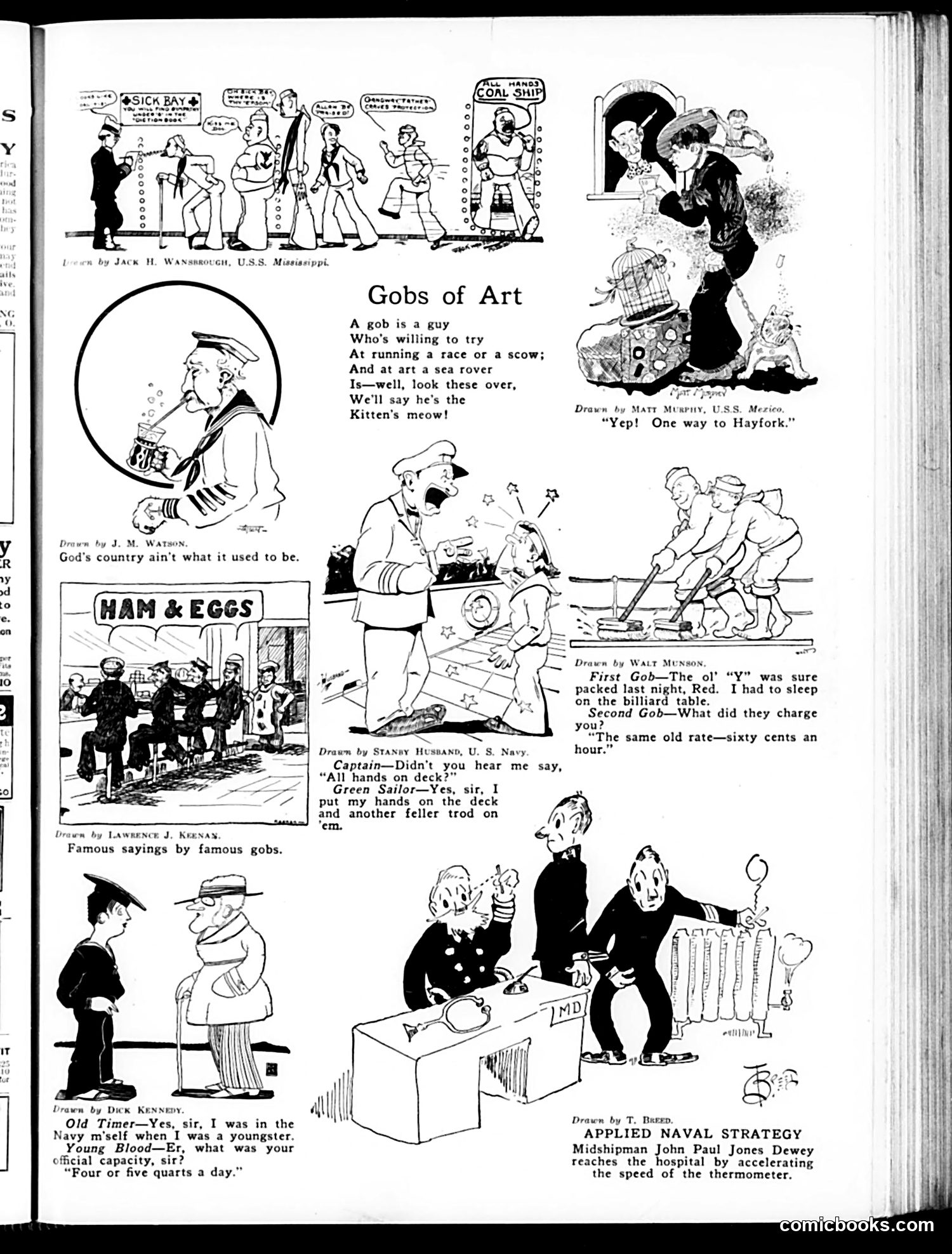
This page collects humorous cartoons about Navy sailors ("gobs"), a slang term from WWI-era. The satire works on multiple levels: **Main Theme**: Sailors attempting art or cultural pursuits, contrasting their rough seafaring reputation with refined activities. The opening poem playfully suggests sailors are surprisingly capable artists—calling them "the Kitten's meow" (1920s slang for excellence). **Individual Jokes**: - Sailors sleeping on billiard tables at the YMCA for sixty cents - A green sailor misinterpreting "all hands on deck" literally - An old salt claiming his naval "capacity" was drinking ("four or five quarts a day") - A joke about falsifying medical readings by heating thermometers **Social Context**: Post-WWI humor satirizing working-class sailors' interactions with institutions (YMCA, hospitals) and their linguistic/cultural gaps. The humor assumes readers find sailors' rough behavior and speech patterns amusing when placed in genteel or technical situations. The cartoons gently mock both sailor culture and institutional pretension.
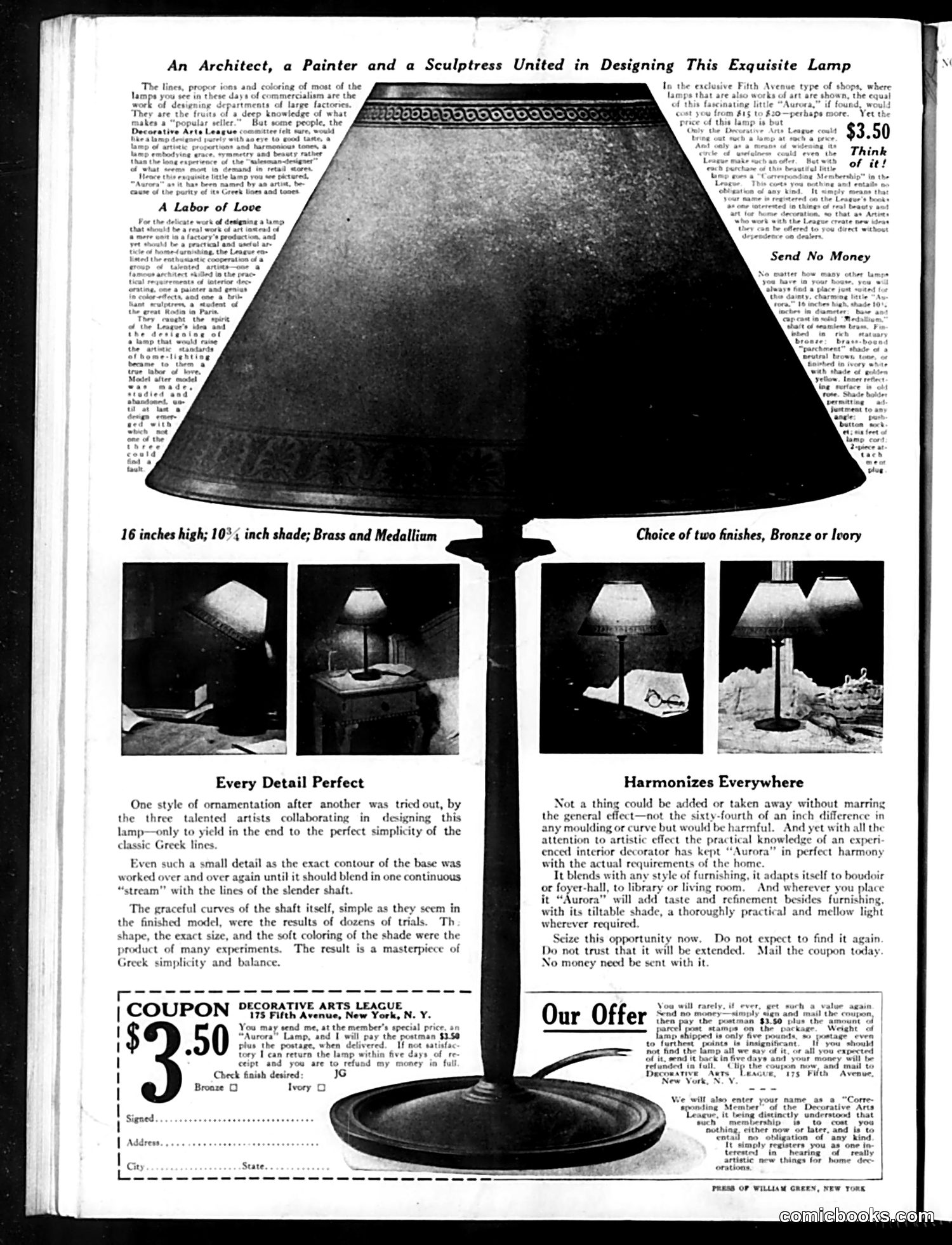
This is primarily a **product advertisement**, not a political cartoon. It promotes the "Aurora" lamp, designed collaboratively by an architect, painter, and sculptor to embody classical Greek aesthetic principles. The marketing pitch emphasizes that true artistry involves meticulous refinement—every curve, proportion, and detail was carefully considered and reconsidered. The lamp's "perfect simplicity" required extensive artistic labor, a paradox the ad exploits to justify its price. The advertisement includes a membership coupon for the Decorative Arts League (175 Fifth Avenue, NYC), offering a special price of $3.50 with a send-no-money offer. This appeals to consumers interested in high-end home decoration and artistic credibility. The surrounding images show the lamp in various domestic settings, emphasizing its versatility and visual harmony with different room styles. For modern readers: this represents early 20th-century marketing that blended artistic prestige with consumer desire—essentially selling taste and cultural refinement alongside functional lighting.