
Judge, 1922-11-18 · page 5 of 36
Judge — November 18, 1922 — page 5: what you’re looking at
What you’re looking at
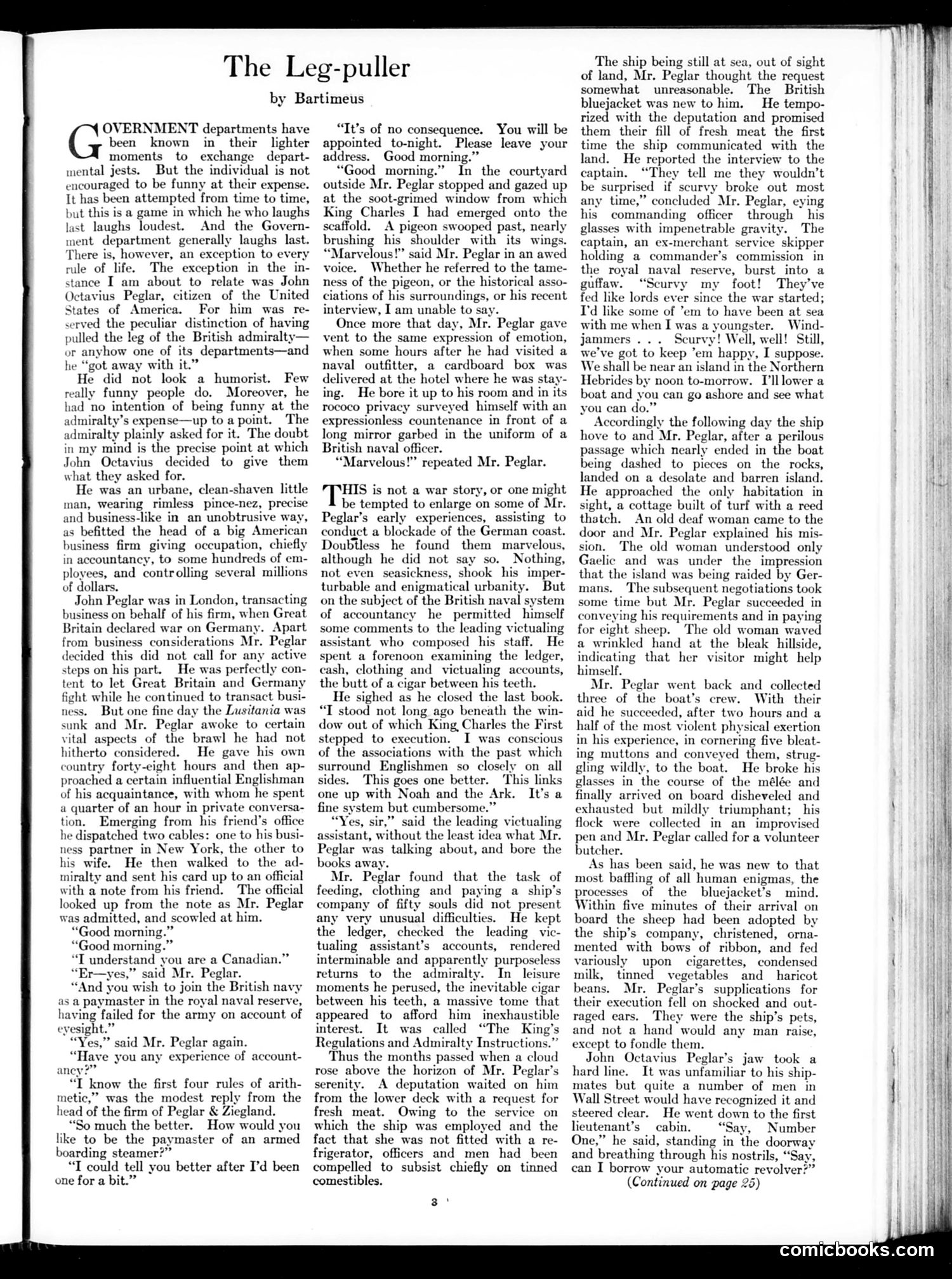
This page contains a short story rather than a political cartoon. "The Leg-puller" appears to be a humorous narrative about John Octavius Peglar, a Canadian citizen working for the U.S. State Department who is known for pulling pranks on British admiralty officials. The story describes Peglar's reputation for practical jokes—he once famously pulled the leg of a British admiral. The narrative follows his assignment to a naval position and his interactions with a British naval officer, involving accounts ledgers and supply requisitions. The "leg-pulling" (practical joking) serves as the satirical vehicle, mocking bureaucratic absurdity and the tensions between American and British naval establishments during what appears to be a World War I-era period.
📄 Transcribed text from this page (OCR, searchable)
Machine-transcribed from the original scan — historical spelling and the odd misread are preserved.
OVERNMENT departments have been known in_ their lighter moments to exchange depart- mental jests. But the individual is not encouraged to be funny at their expense. It has been attempted from time to time, but this is a game in which he who laughs last laughs loudest. And the Govern- ment department generally laughs last. There is, however, an exception to every rule of life. The exception in the in- stance I am about to relate was John Octavius Peglar, citizen of the United States of America. For him was re- served the peculiar distinction of having pulled the leg of the British admiralty— or anyhow one of its departments—and he “got away with it.” He did not look a humorist. Few really funny people do. Moreover, he had no intention of being funny at the admiralty’s expense—up to a point. The admiralty plainly asked for it. The doubt in my mind is the preci point at which John Octavius decided to give them what they asked for. He was an urbane, clean-shaven little man, wearing rimless pince-nez, precise and business-like in an unobtrusive way, as befitted the head of a big American business firm giving occupation, chiefly in accountancy, to some hundreds of em- ployees, and controlling several millions of dollars. John Peglar was in London, transacting business on behalf of his firm, when Great Britain declared war on Germany. Apart from business considerations Mr. Peglar decided this did not call for any active steps on his part. He was perfectly con- tent to let Great Britain and Germany fight while he continued to transact busi- ness. But one fine day the Lusitania was sunk and Mr. Peglar awoke to certain vital aspects of the brawl he had not hitherto considered. He gave his own country forty-eight hours and then ap- proached a certain influential Englishman of his acquaintance, with whom he spent a quarter of an hour in private conversa- tion. Emerging from his friend's office he dispatched two cables: one to his busi- ness partner in New York, the other to his wife. He then walked to the ad- miralty and sent his card up to an official with a note from his friend. The official looked up from the note as Mr. Peglar was admitted, and scowled at him. “Good morning.” “Good morning.” “T understand you are a Canadian.” Mr. Peglar. “And you wish to join the British navy as a paymaster in the royal naval reserve, having failed for the army on account of said Mr. Peglar again. “Have you any experience of account- now the first four rules of arith- metic,” was the modest reply from the head of the firm of Peglar & Ziegland. “So much the better. How would you like to be the paymaster of an armed boarding steamer?” “I could tell you better after I'd been one for a bit.” The Leg-puller by Bartimeus “It’s of no consequence. You will be appointed to-night. Please leave your address. Good morning.” “Good morning.” In the courtyard outside Mr. Peglar stopped and gazed up at the soot-grimed window from which King Charles I had emerged onto the scaffold. A pigeon swooped past, nearly brushing his shoulder with its wings. “Marvelous!” said Mr. Peglar in an awed voice. Whether he referred to the tame- ness of the pigeon, or the historical asso- ciations of his surroundings, or his recent interview, I am unable to say. Once more that day, Mr. Peglar gave vent to the same ex ion of emotion, when some hours after he had visited a naval outfitter, a cardboard box was delivered at the hotel where he was s ing. He bore it up to his room and in its rococo privacy surveyed himself with an expressionless countenance in front of a long mirror garbed in the uniform of a British naval officer. “Marvelous!” repeated Mr. Peglar. if hits is not a war story, or one might be tempted to enlarge on some of Mr. Peglar’s early experiences, assisting to conduct a blockade of the German coast. Doubtless he found them marvelous, although he did not say so. Nothing, not even seasickness, shook his imper- turbable and enigmatical urbanity. But on the subject of the British nav stem of accountancy he permitted himself some comments to the leading victualing assistant who composed his staff. He spent a forenoon examining the ledger, cash, clothing and victualing accounts, the butt of a cigar between his teeth. He sighed as he closed the last book. “T stood not long ago beneath the win- dow out of which King, Charles the First stepped to execution. I was conscious of the associations with the past which surround Englishmen so closely on all sides. This goes one better. This links one up with Noah and the Ark. It’s a ‘stem but cumbersome.” said the leading victualing Pe eglar was talking aboue and bare ‘the books away Mr. Peglar found that the task of feeding, clothing and ying a ship’s company of fifty souls did not present any very unusual difficulties. He kept the ledger, checked the leading vic- tualing assistant’s accounts, rendered interminable and apparently purposeless returns to the admiralty. In leisure moments he perused, the inevitable cigar between his teeth, a massive tome that appeared to afford him inexhaustible interest. It was called “The King’s Regulations and Admiralty Instructions.” Thus the months passed when a cloud rose above the horizon of Mr. Peglar’s serenity. A deputation waited on him from the lower deck with a request for fresh meat. Owing to the service on which the ship was employed and the fact that she was not fitted with a re- frigerator, officers and men had been compelled to subsist chiefly on tinned comestibles. The ship being still at sea, out of sight of land, Mr. Peglar thought the request i somewhat unreasonable. The British bluejacket was new to him. He tempo- rized with the deputation and promised j them their fill of fresh meat the first time the ship communicated with the land. He reported the interview to the captain. “They tell me they wouldn’t be surprised if scurvy broke out most any time,” concluded Mr. Peglar, his commanding officer through glasses with impenetrable gra captain, an ex-merchant service skipper holding a commander’s commission in the royal naval reserve, burst into a guffaw. “Scurvy my foot! They’ve fed like lords ever since the war started; I'd like some of "em to have been at sea j | with me when I was a youngster. Wind- ... Scurvy! Well, well! Still, got to keep ’em happy, I suppose. all be near an island in the Northern Hebrides by noon to-morrow. I'll lower a boat and you can go ashore and see what you can do.” Accordingly the following day the ship hove to and Mr. Peglar, after a perilous e which nearly ended in the boat being dashed to pieces on the rocks, landed on a desolate and barren island. He approached the only habitation in sight, a cottage built of turf with a reed thatch. An old deaf woman came to the door and Mr. Peglar explained his mis- sion. The old woman understood only Gaelic and was under the impression that the island was being raided by Ger- mans. The subsequent negotiations took some time but Mr. Peglar succeeded in i ng his requirements and in pa; ght sheep. The old woman y a wrinkled hand at the bleak hillside, indicating that her visitor might help a himself. i} Mr. Peglar went back and_ collected three of the boat’s crew. With their aid he succeeded, after two hours and a half of the most violent physical exertion in his experience, in cornering five bleat- ing muttons and conveyed them, strug gling wildly, to the bo: He broke his in the course of the mélée and ally arrived on board disheveled and exhausted but mildly triumphant; his flock were collected in an improvised pen and Mr, Peglar called for a volunteer butcher. As has been said, he was new to that most baffling of all human enigmas, the proce of the bluejacket’s mind. Within five minutes of their arrival on | board the sheep had been adopted by § the ship’s company, christened, orna- mented with bows of ribbon, and fed variously upon cigarettes, condensed { milk, tinned vegetables and haricot beans. Mr. Peglar’s supplications for their execution fell on shocked and out- raged ears. They were the ship’s pets, and not a hand would any man raise, except to fondle them. John Octavius Peglar’s jaw took a { hard line. It was unfamiliar to his ship- mates but quite a number of men in { Wall Street would have recognized it and steered clear. He went down to the first lieutenant’s cabin. = “Say, Number One,” he said, standing in the doorway and breathing through his nostrils, “Say, can I borrow your automatic revolver?” (Continued on page 25) | comicbooks.com i