
Judge, 1922-11-18 · page 8 of 36
Judge — November 18, 1922 — page 8: what you’re looking at
What you’re looking at
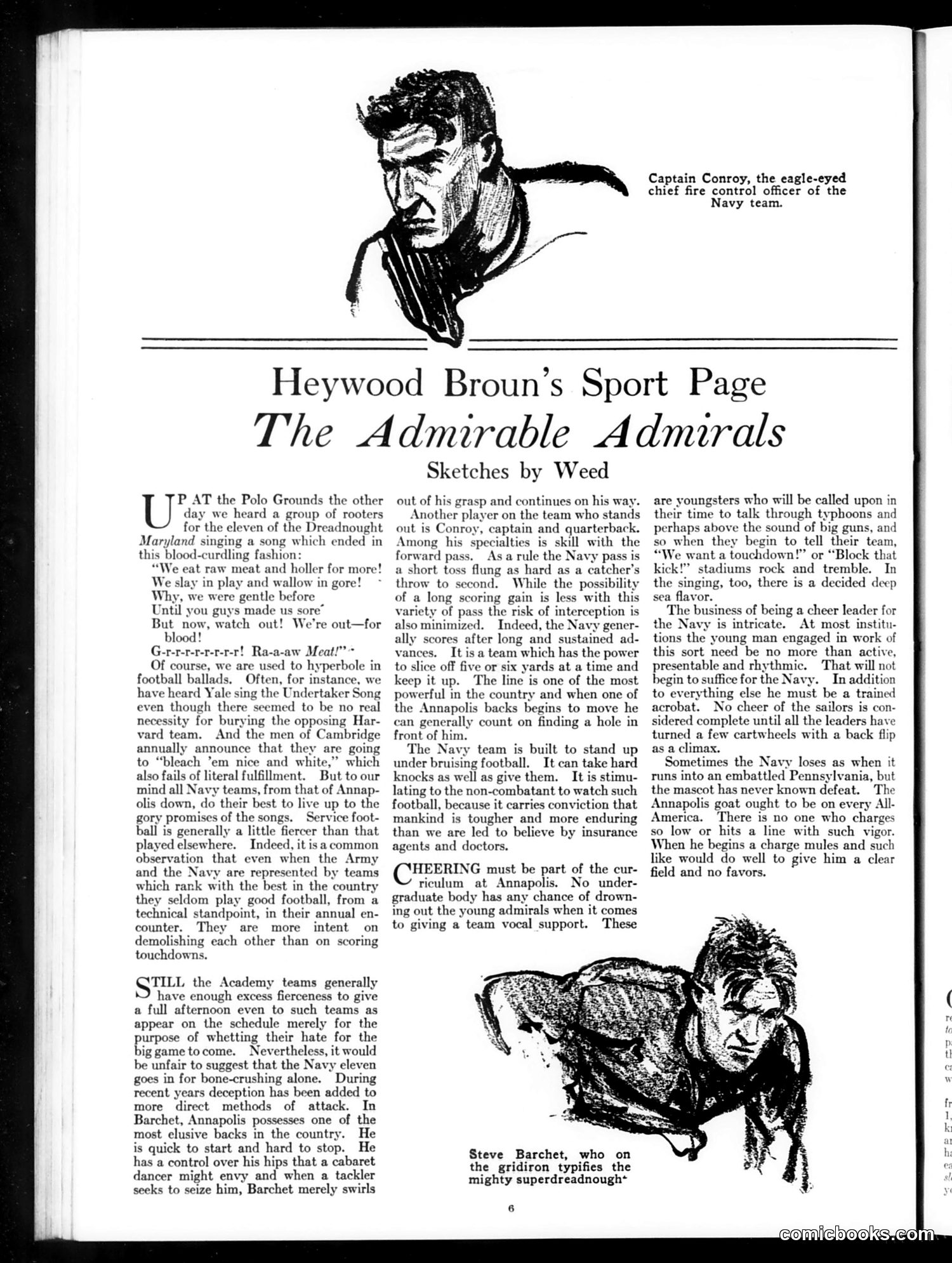
This is a sports commentary by journalist Heywood Broun analyzing the U.S. Naval Academy football team. The page features sketches of two players: Captain Conroy (quarterback) and Steve Barchet (running back). Broun contrasts the Navy team's physical, aggressive playing style with the more technical finesse of civilian college football. He notes that while service teams sing fierce songs about "eating raw meat" and "wallowing in gore," the Navy actually plays with genuine brutality and tactical deception rather than mere bluster. The piece celebrates the Navy players' toughness, discipline, and coordinated blocking while praising their vocal support as evidence of the kind of resilience they'll need as future naval officers commanding during wartime (the "typhoons" and "big guns" reference likely alludes to WWI concerns). The satire gently mocks the gap between football bravado and reality—other teams make similar threats, but Navy actually backs theirs up.
📄 Transcribed text from this page (OCR, searchable)
Machine-transcribed from the original scan — historical spelling and the odd misread are preserved.
Captain Conroy, the eagle-eyed chief fire control officer of the Navy team. Heywood Broun’s Sport Page The Admirable Admirals | P AT the Polo Grounds the other ay we heard a group of rooters for the eleven of the Dreadnought Maryland singing a song which ended in this blood-curdling fashion: “We eat raw meat and holler for more! We slay in play and wallow in gore! Why, we were gentle before Until you guys made us sore” But now, watch out! We're out—for blood! G-r-r-r-r-r-r-r-t! Ra-a-aw Meat!” Of course, we are used to hyperbole in football ballads. Often, for instance, we have heard Yale sing the Undertaker Song even though there seemed to be no real necessity for burying the opposing Har- vard team. And the men of Cambridge annually announce that they are going to “bleach ’em nice and white,” which also fails of literal fulfillment. But to our mind all Navy teams, from that of Annap- olis down, do their best to live up to the gory promises of the songs. Service foot- ball is generally a little fiercer than that played elsewhere. Indeed, it is a common observation that even when the Army and the Navy are represented by teams which rark with the best in the country they seldom play good football, from a technical standpoint, in their annual en- counter. They are more intent on demolishing each other than on scoring touchdowns. TILL the Academy teams generally have enough excess fierceness to give a full afternoon even to such teams as appear on the schedule merely for the purpose of whetting their hate for the big gametocome. Nevertheless, it would be unfair to suggest that the Navy eleven goes in for bone-crushing alone. During recent years deception has been added to more direct methods of attack. In Barchet, Annapolis possesses one of the most elusive backs in the country. He is quick to start and hard to stop. He has a control over his hips that a cabaret dancer might envy and when a tackler seeks to seize him, Barchet merely swirls Sketches by Weed out of his grasp and continues on his Another player on the team who stan out is Conroy, captain and quarterback. Among his specialties is skill with the forward pass. As a rule the Navy pass is a short toss flung as hard as a throw to second. While the possibility of a long scoring gain is less with this variety of pass the risk of interception is also minimized. Indeed, the Navy gener- ally scores after long and sustained ad- s. It isa team which has the power to slice off five or six yards at a time and keep it up. The line is one of the most powerful in the country and when one of the Annapolis backs begins to move he can generally count on finding a hole in front of him. The Navy team is built to stand up under bruising football. It can take hard knocks as well as give them. It is stimu- lating to the non-combatant to watch such football, because it carries conviction that mankind is tougher and more enduring than we are led to believe by insurance agents and doctors. (CHEERING must be part of the cur- riculum at Annapolis. No under- graduate body has any chance of drown- ing out the young admirals when it comes to giving a team vocal support. These Steve Barchet, who on the gridiron typifies the mighty superdreadnough* 6 are youngsters who will be called upon in their time to talk through typhoons and perhaps above the sound of big guns, and when they begin to tell their team, “We want a touchdown!” or “Block that kic stadiums rock and tremble. In the singing, too, there is a decided deep sea flavor. The business of being a cheer leader for the Navy is intricate. At most institu- tions the young man engaged in work of this sort need be no more than active, presentable and rhythmic. That will not begin to suffice for the Navy. In addition to everything else he must be a trained acrobat. No cheer of the sailors is con- sidered complete until all the leaders have turned a few cartwheels with a back flip as a climax. Sometimes the Navy loses as when it runs into an embattled Pennsylvania, but the mascot has never known defeat. The Annapolis goat ought to be on every All- America. There is no one who charges so low or hits a line with such vigor. When he begins a charge mules and such like would do well to give him a clear field and no favors.