
Judge, 1922-11-18 · page 21 of 36
Judge — November 18, 1922 — page 21: what you’re looking at
What you’re looking at
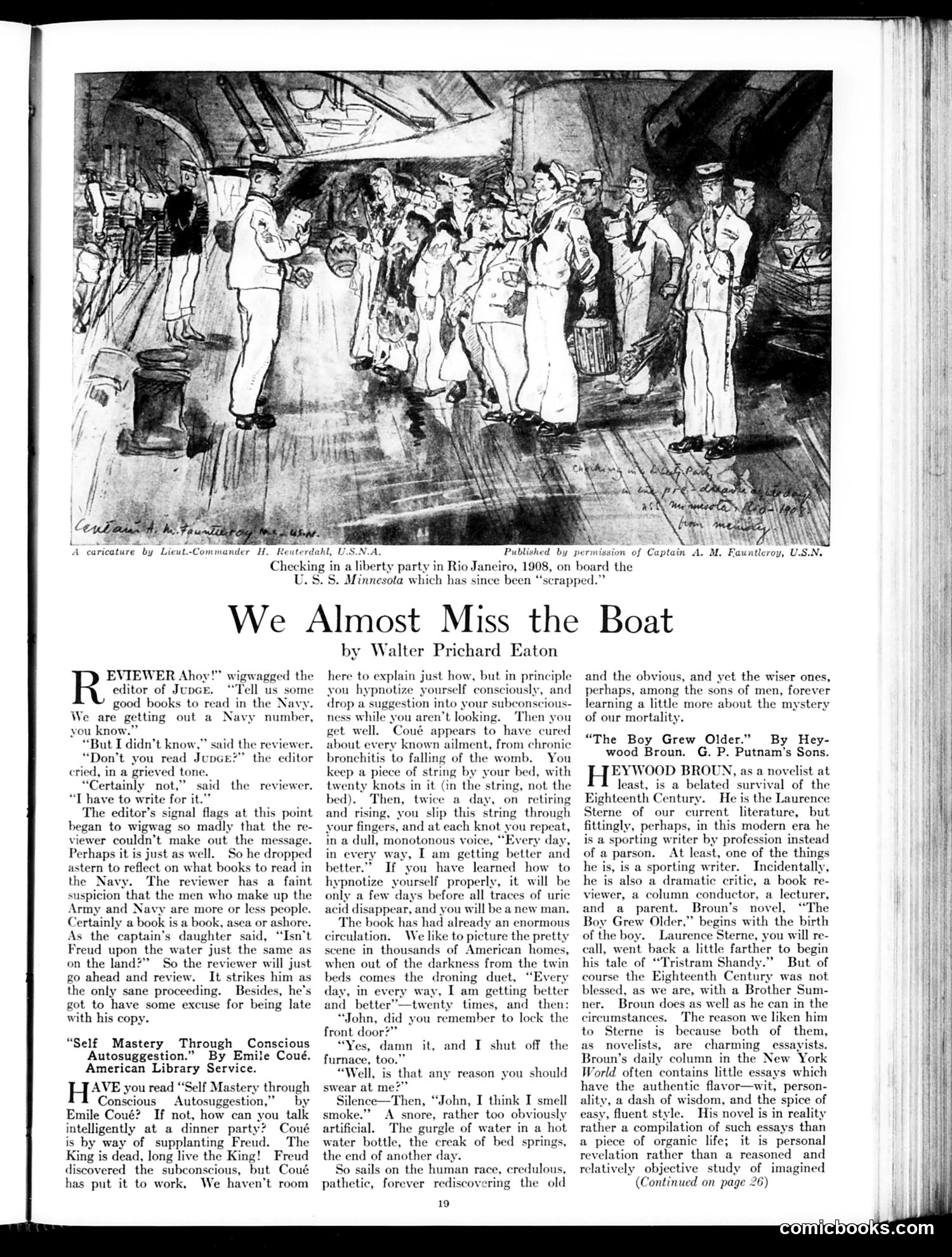
This page from *Judge* magazine contains a satirical column by Walter Prichard Eaton discussing Navy reading recommendations and book reviews. The cartoon at the top depicts "a liberty party in Rio Janeiro, 1908, on board the U.S.S. Minnesota"—officers in white uniforms socializing. The caption notes the ship "has since been scrapped," likely a gentle jab at naval obsolescence. The main content satirizes **Émile Coué's "Self-Mastery Through Conscious Autosuggestion,"** a genuine self-help fad of the 1920s-30s. Eaton mocks the method: repeating "Every day, in every way, I am getting better and better" while sliding knots on a string. He humorously depicts a couple using it before bed, only for the wife to interrupt his affirmation with "John, did you remember to lock the front door?"—undermining the technique's supposed power. The satire targets both the book's earnest followers and human nature's eternal gullibility, suggesting people repeatedly embrace obvious truths repackaged as revelation. Coué had genuinely replaced Freud in popular culture as the fashionable psychological authority.
📄 Transcribed text from this page (OCR, searchable)
Machine-transcribed from the original scan — historical spelling and the odd misread are preserved.
Published by per "Checking i ina libe rty party in Rio Janeiro, 1908, on board the U.S. S. Minnesota which has since been M. Fauntleroy, U. ion of Captain scrapped.” We Almost Miss the Boat EVIEWER Ahoy! agged the R editor of Jun ll us some good books to read in the Navy. We are getting out a Navy number, you know.” “But I didn’t know “Don’t you read JupGe?” cried, in a grieved tone. “Certainly not,” said the reviewer. “T have to write for it.” The editor’s signal flags at this point began to wigwag so madly that the re- viewer couldn’t make out the message. Perhaps it is just as well. So he dropped astern to reflect on what books to read in the Navy. The reviewer has a faint suspicion that the men who make up the Army and Navy are more or less people. Certainly a book is a book, asea or ashore. As the captain’s daughter said, *t Freud upon the water just the same as on the land?” So the reviewer will just go ahead and review. It strikes him as the only sane proceeding. Besides, he’s got to have some excuse for being late with his copy. id the reviewer. the editor “Self Mastery Through Conscious Autosuggestion.” By Emile Coué. American Library Service. AVE you read “Self Mastery through Conscious Autosuggestion,” by Emile Coué? If not, how can you talk intelligently at a dinner party? Coué is by way of supplanting Freud. The King is dead, long live the King! Freud discovered the subconscious, but Coué has put it to work, We haven't room by Walter Prichard Eaton in just how, but in principle yourself consciously, and drop a suggestion into your subcons¢ ness while you aren't looking. Then you Coué appears to have cured ery known ailment, from chronic bronchitis to falling of the womb. You keep a piece of string by your bed, with twenty knots in it (in the'string, not the bed). Then, twice a day, on retiring and rising, you slip this string through your fingers, and at each knot you repeat, in a dull, monotonous voice, “Every day, in every way, I am getting better and better.” If you have learned how to hypnotize yourself properly, it will be before all traces of uric nd you will be a new man. The book has had already an enormous circulation. We like to picture the pretty scene in thousands of American homes, when out of the darkness from the twin beds comes the droning duet, “Every day, in every way, I am getting better and_better”—twenty times, and then: “John, did you remember to lock the front door?” “Yes, damn it, and I shut off the furnace, too.” “Well, is that any reason you should swear at me?” Silence—Then, “John, I think I smell smoke.” A snore, rather too obviously artificial. The gurgle of water in a hot water bottle, the creak of bed springs, the end of another day. So sails on the human race, credulous, pathetic, forever rediscovering the old here to exp you hypnoti yus- 19 and the obvious, and yet the wiser ones, perhaps, among the sons of men, forever learning a little more about the mystery of our mortality. “The Boy Grew Older.” By Hey- wood Broun. G. P. Putnam’s Sons. EYWOOD BROUN, as a novelist at least, is a belated survival of the Eighteenth Century. He is the Laurence Sterne of our current literature, but fittingly, perhaps, in this modern era he is a sporting writer by profession instead of a parson, At least, one of the things he is, is a sporting writer. Incidentally, he is also a dramatic critic, a book re- viewer, a column conductor, a lecturer, and a parent. Broun’s novel, ‘The Boy Grew Older,” begins with the birth of the boy. Laurence Sterne, you will re- call, went back a little farther to begin his tale of “Tristram Shandy.” But of course the Eighteenth Century was not blessed, as we are, with a Brother Sum- ner. Broun does as well as he can in the circumstances. The reason we liken him to Sterne is because both of them, as novelists, are charming essayists. Broun’s daily column in the New York World often contains little essays which have the authentic flavor—wit, person- a dash of wisdom, and the spice of , fluent style. His novel is in reality rather a compilation of such essays than a piece of organic life; it is personal revelation rather than a reasoned and relatively objective study of imagined (Continued on page 26)