
Judge, 1922-11-18 · page 17 of 36
Judge — November 18, 1922 — page 17: what you’re looking at
What you’re looking at
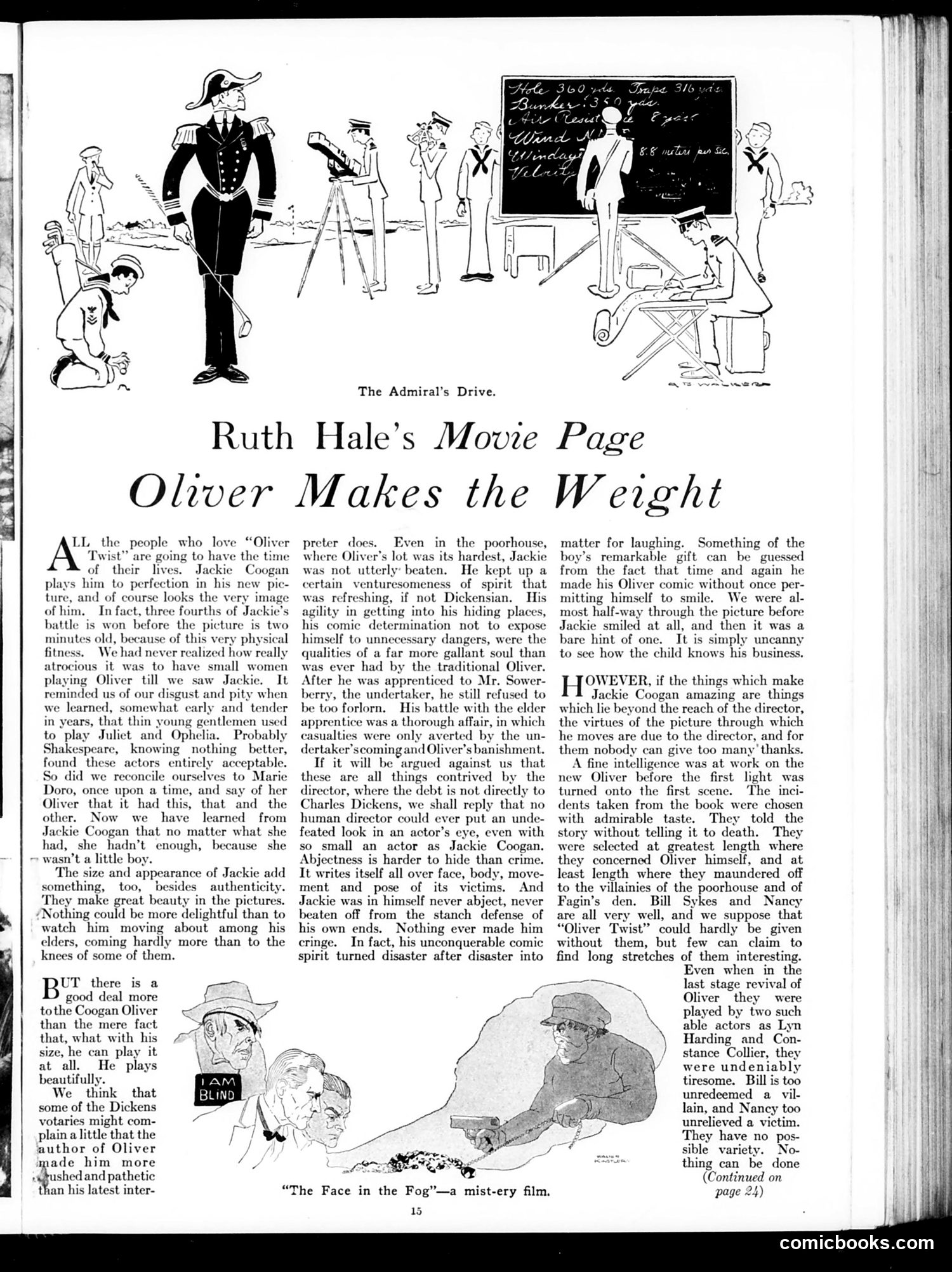
This is a film review by Ruth Hale praising child actor Jackie Coogan's performance in a new film adaptation of Dickens's *Oliver Twist*. The satire targets previous theatrical casting practices. The central joke: historically, adult actresses played young male roles like Oliver Twist and Shakespearean juveniles (Juliet, Ophelia). The reviewer argues this was absurd—Coogan's actual small stature and boyish physicality make him authentically believable, whereas adult women playing children were ridiculous. The title "Oliver Makes the Weight" is a pun: Coogan has the physical substance (weight/presence) the character requires. The cartoon at top ("The Admiral's Drive") appears unrelated to the review text. The piece praises not just Coogan's appearance but his acting: his ability to convey resilience and spirit rather than abject defeat, and his skill at creating comedy without smiling—demonstrating professional maturity despite his youth.
📄 Transcribed text from this page (OCR, searchable)
Machine-transcribed from the original scan — historical spelling and the odd misread are preserved.
The Admiral’s Drive. Ruth Hale’s Movie Page Oliver Makes the Weight LL the people who love “Oliver A Twist” are going to have the time of their lives. Jackie Coo, plays him to perfection in his new pic- ture, and of course looks the very image of him. In fact, three fourths of Jackie's battle is won before the picture is two minutes old, because of this very physical fitness. We had never realized how really atrocious it was to have small women playing Oliver till we saw J yt reminded us of our disgust and pity when we learned, somewhat carly and tender in years, that thin young gentlemen used to play Juliet and Ophelia. Probably Shakespeare, knowing nothing better, found these actors entirely acceptable. So did we reconcile ourselves to Marie Doro, once upon a time, and say of her Oliver that it had this, that d_ the other. Now we have learned from Jackie Coogan that no matter what she had, she hadn’t enough, because she wasn’t a little boy. The size and ap} ance of Jac something, too, besides authentici They make great beauty in the pictures. -Nothing could be more delightful than to watch him moving about among his elders, coming hardly more than to the knees of some of them. dd UT there is a good deal more tothe Coogan Oliver than the mere fi that, what with his size, he can play it at all. He plays beautifully. We think that some of the Dickens votaries might com- plain a little that the author of Oliver His him more y shed and pathetic than his latest inter- preter docs. Even in the poorhouse, where Oliver's lot was its hardest, Jackie was not utterly: beaten. He kept up a certain venturesomeness of irit that was refreshing, if not Dickensian. Hi: agility in getting into his hiding places, his comic determination not to expose himself to unnecessary dangers, were the qualities of a far more gallant soul than was ever had by the traditional Oliver. After he was apprenticed to Mr. Sower- berry, the undertaker, he still refused to be too forlorn. His battle with the elder apprentice was a thorough affair, in which sualties were only averted by the un- dertaker’scoming and Oliver’s banishment. If it will be ‘argued inst us that these are all things contrived by the director, where the debt is not directly to Charles Dickens, we shall reply that no human director could ever put an unde- feated look in an actor’s eye, even with so small an actor as Ja Coogan. Abjectness is harder to hide than crime. It writes itself all over face, body, move- ment and pose of its victims. And Jackie was in himself never abject, never beaten off from the stanch defense of his own ends. Nothing ever made him cringe. In fact, his unconquerable comic spirit turned disaster after disaster into LOS “The Face in the Fog”—a mist-ery film. 15 matter for laughing. Something of the boy’s remarkable gift can be guessed from the fact that time and again he made his Oliver comic without once per- mitting himself to smile. We were al- most half-way through the picture before Jackie smiled at all, and then it was a bare hint of one. It is simply uncanny) to see how the child knows his business. OWEVER, if the things which make Jackie Coogan amazing are things which lie beyond the reach of the director, the virtues of the picture through which he moves are due to the director, and for them nobody can give too many’ thanks. A fine intelligence was at work on the new Oliver before the first light w: turned onto the first scene. The inci- dents taken from the book were chosen with admirable taste. They told the story without telling it to death. They were selected at greatest length where they concerned Oliver himself, and at least length where they maundered off to the villainies of the poorhouse and of Fagin’s den. Bill Sykes and Nancy are all very well, and we suppose that “Oliver Twist” could hardly be given without them, but few can claim to find long stretches of them interesting. Even when in the last stage revival of Oliver they were played by two such able actors as Lyn Harding and Con- stance Collier, they were undeniably tiresome. Bill is too unredeemed a vil- lain, and Nancy too unrelieved a victim. They have no pos- . sible variety. No- a thing can be done (Continued on page 24 comicbooks.com