
Judge, 1922-11-18 · page 13 of 36
Judge — November 18, 1922 — page 13: what you’re looking at
What you’re looking at
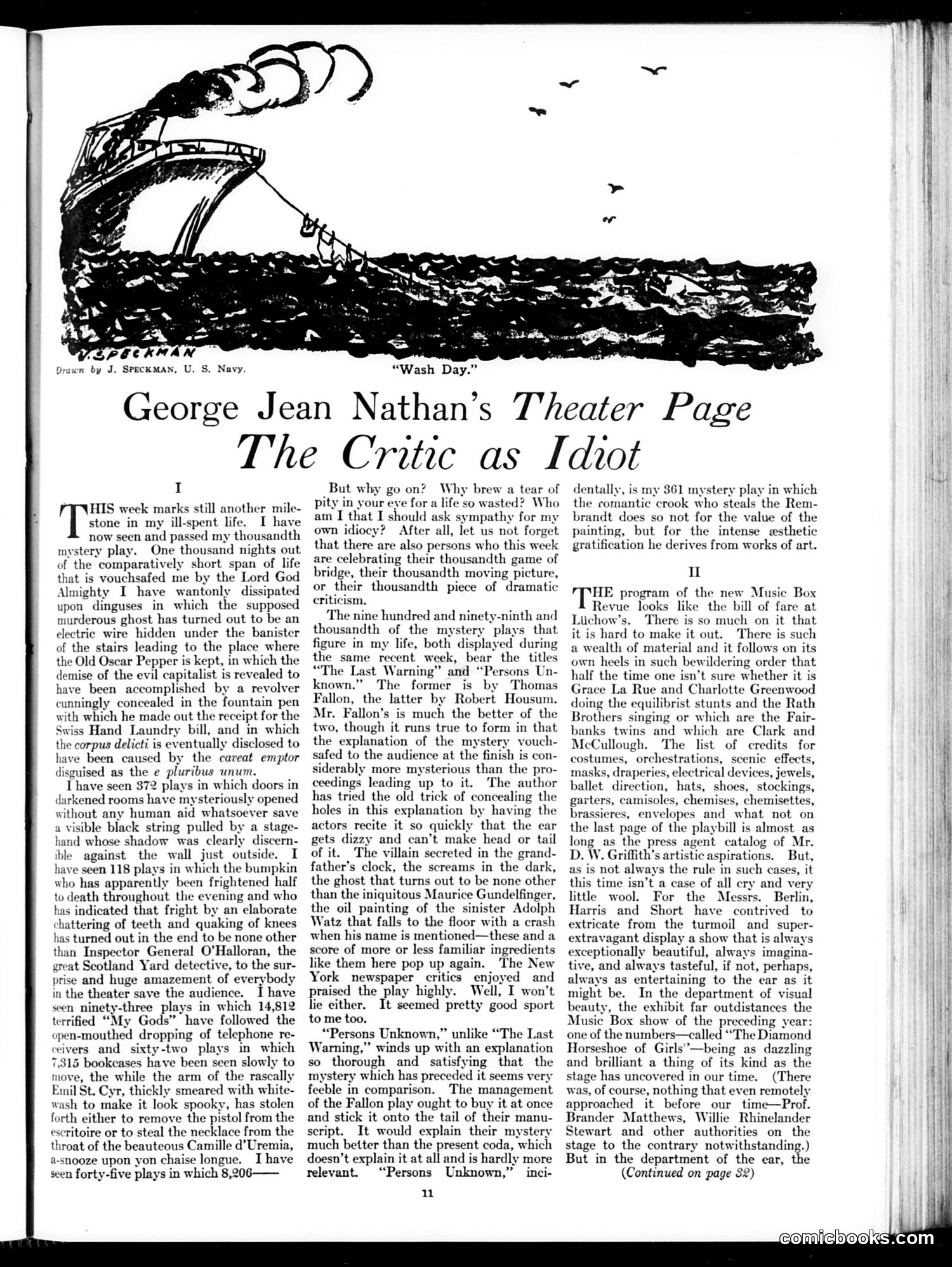
The cartoon shows a military vessel dumping what appears to be refuse or sewage into water—titled "Wash Day," likely satirizing Navy sanitation practices or waste management. The accompanying text is George Jean Nathan's theater column mocking mystery plays. Nathan sarcastically describes attending his thousandth mystery play, cataloging absurd tropes: murderers revealed as electric wires, detectives disguised as frightened bumpkins, moving bookcases, and villains hidden in grandfather clocks. He ridicules how playwrights deliberately obscure weak explanations by having actors recite solutions too quickly "so the ear gets dizzy." Nathan's point: mystery play writers and critics have become idiots, endlessly recycling predictable nonsense. His self-deprecating framing—admitting he's "wasted" 1,000 evenings on this drivel—underscores the satire: both audiences and critics deserve mockery for tolerating such formulaic theater.
📄 Transcribed text from this page (OCR, searchable)
Machine-transcribed from the original scan — historical spelling and the odd misread are preserved.
Drawn by J. SPECKMAN, U. S. Navy. “Wash Day.” George Jean Nathan’s Theater Page The Critic as Idiot I HIS week marks still another mile- | stone in my ill-spent life. I have now seen and passed my thousandth mystery play. One thousand nights out of the comparatively short span of life that is vouchsafed me by the Lord God Almighty I have wantonly dissipated upon dinguses in which the supposed murderous ghost has turned out to be an electric wire hidden under the banister of the stairs leading to the place where the Old Oscar Pepper is kept, in which the demise of the evil capitalist is revealed to have been accomplished by a revolver cunningly concealed in the fountain pen with which he made out the receipt for the Swiss Hand Laundry bill, and in which the corpus delicti is eventually disclosed to have been caused by the caveat emptor disguised as the e pluribus unum. T have seen $72 plays in which doors in darkened rooms have mysteriously opened without any human aid whatsoever save a visible black string pulled by a stage- hand whose shadow was clearly discern- ible against the wall just outside. I have seen 118 plays in which the bumpkin who has apparently been frightened half to death throughout the evening and who has indicated that fright by an elaborate chattering of teeth and quaking of knees has turned out in the end to be none other an Inspector General O'Halloran, the great Scotland Yard detective, to the sur- prise and huge amazement of everybody in the theater save the audience. I have seen ninety-three plays in which 14,812 terrified “My Gods” have followed the open-mouthed dropping of telephone re- ceivers and sixty-two plays in which 7,315 bookcases have been seen slowly to move, the while the arm of the rascally Emil St. Cyr, thickly smeared with white- wash to make it look spooky, has stolen forth either to remove the pistol from the escritoire or to steal the necklace from the throat of the beauteous Camille d’Uremia, a-snooze upon yon chaise longue. I have seen forty-five plays in which 8,206-—— But why go on? Why brew a tear of pity in your eye for a life so wasted? Who am I that I own idiocy? After all, let us not forget that there are also persons who this wi are celebrating their thousandth game of bridge, their thousandth moving picture, or their thousandth piece of dramatic criticism. The nine hundred and ninety-ninth and thousandth of the mystery plays that figure in my life, both displayed during the same recent week, bear the titles “The Last Warning” and “Persons Un- known.” The former is by Thomas Fallon, the latter by Robert Housum. Mr. Fallon’s is much the better of the two, though it runs true to form in that the explanation of the mystery vouch- safed to the audience at the finish is con- siderably more mysterious than the pro- ceedings leading up to it. The author has tried the old trick of concealing the holes in this explanation by having the actors recite it so quickly that the ear gets dizzy and can’t make head or tail of it. The villain secreted in the grand- father’s clock, the screams in the dark, the ghost that turns out to be none other than the iniquitous Maurice Gundelfinger, the oil painting of the sinister Adolph Watz that falls to the floor with a crash when his name is mentioned—these and a score of more or less familiar ingredients like them here pop up again. The New York newspaper critics enjoyed and praised the play highly. Well, I won’t lie either. It seemed pretty good sport to me too. “Persons Unknown,” unlike “The Last Warning,” winds up with an explanation so thorough and satisfying that the mystery which has preceded it seems very feeble in comparison. The management of the Fallon play ought to buy it at once and stick it onto the tail of their manu- script. It would explain their mystery much better than the present coda, which doesn’t explain it at all and is hardly more relevant. “Persons Unknown,” inci- 11 dentally, is my 361 mystery play in which the romantic crook who steals the Rem- brandt does so not for the value of the painting, but for the intense esthetic gratification he derives from works of art. Il HE program of the new Music Box Revue looks like the bill of fare at Liichow’s. There is so much on it that it is hard to make it out. There is such a wealth of material and it follows on its own heels in such bewildering order that half the time one isn’t sure whether it is Grace La Rue and Charlotte Greenwood doing the equilibrist stunts and the Rath Brothers singing or which are the Fair- banks twins and which are Clark and McCullough. The list of credits for costumes, orchestrations, scenic effects, masks, draperies, electrical devices, jewels, ballet direction, hats, shoes, stockings, garters, camisoles, chemises, chemisettes, brassieres, envelopes and what not on the last page of the playbill is almost as long as the press agent catalog of Mr. D. W. Griffith’s artistic aspirations. But, as is not always the rule in such cases, it this time isn’t a case of all cry and very little wool. For the Messrs. Berlin, Harris and Short have contrived to extricate from the turmoil and super- avagant display a show that is always exceptionally beautiful, always imagina- tive, and always tasteful, if not, perhaps, always as entertaining to the ear as it might be. In the department of visual beauty, the exhibit far outdistances the Music Box show of the preceding year: one of the numbers—called “The Diamond Horseshoe of Girls’’—being as dazzling and brilliant a thing of its kind as the stage has uncovered in our time. (There was, of course, nothing that even remotely approached it before our time—Prof. Brander Matthews, Willie Rhinelander Stewart and other authorities on_ the stage to the contrary notwithstanding.) But in the department of the ear, the (Continued on page 82)